EP0169459A2 - Azofarbstoffe - Google Patents
Azofarbstoffe Download PDFInfo
- Publication number
- EP0169459A2 EP0169459A2 EP85108704A EP85108704A EP0169459A2 EP 0169459 A2 EP0169459 A2 EP 0169459A2 EP 85108704 A EP85108704 A EP 85108704A EP 85108704 A EP85108704 A EP 85108704A EP 0169459 A2 EP0169459 A2 EP 0169459A2
- Authority
- EP
- European Patent Office
- Prior art keywords
- alkyl
- oco
- alkoxy
- nhco
- phenyl
- Prior art date
- Legal status (The legal status is an assumption and is not a legal conclusion. Google has not performed a legal analysis and makes no representation as to the accuracy of the status listed.)
- Granted
Links
- 0 CCN(CC)C1C=C(*)C(N=NC(C)=NC(CC(C=C2)C#N)C2S)=CC1 Chemical compound CCN(CC)C1C=C(*)C(N=NC(C)=NC(CC(C=C2)C#N)C2S)=CC1 0.000 description 1
Classifications
-
- C—CHEMISTRY; METALLURGY
- C09—DYES; PAINTS; POLISHES; NATURAL RESINS; ADHESIVES; COMPOSITIONS NOT OTHERWISE PROVIDED FOR; APPLICATIONS OF MATERIALS NOT OTHERWISE PROVIDED FOR
- C09B—ORGANIC DYES OR CLOSELY-RELATED COMPOUNDS FOR PRODUCING DYES, e.g. PIGMENTS; MORDANTS; LAKES
- C09B29/00—Monoazo dyes prepared by diazotising and coupling
- C09B29/0025—Monoazo dyes prepared by diazotising and coupling from diazotized amino heterocyclic compounds
- C09B29/0074—Monoazo dyes prepared by diazotising and coupling from diazotized amino heterocyclic compounds the heterocyclic ring containing nitrogen and sulfur as heteroatoms
- C09B29/0077—Monoazo dyes prepared by diazotising and coupling from diazotized amino heterocyclic compounds the heterocyclic ring containing nitrogen and sulfur as heteroatoms containing a five-membered heterocyclic ring with one nitrogen and one sulfur as heteroatoms
- C09B29/0085—Thiazoles or condensed thiazoles
- C09B29/0088—Benzothiazoles
Definitions
- disperse dye types that is to say those dyes of the formula (I) which do not contain any water-solubilizing groups, but also to water-soluble dyes which have at least one radical of the formula -S0 3 H, -OSO 3 H or SS0 3 H contain.
- Suitable coupling components are those of the phenol, naphthalene, pyridine, pyrimidine, pyrazole, thiazole, indole, carbazole, oxazole, diazine and acetoacetic anilide series.
- Examples of such compounds are those as described in DE-A 3 226 761 and DE-A 3 206 092.
- alkyl radicals mentioned above in any context were preferably understood to mean those having 1 to 8, in particular 1 to 4, carbon atoms. Methyl, ethyl and methoxy are particularly preferred.
- Suitable aryl and aryloxy radicals are, in particular, phenyl and phenoxy radicals which are formed by C 1 -C 4 alkyl, halogen, CO 2 -C 1 -C 4 alkyl, N0 2 , COCH 3 , C 1 -C 4 alkoxy or CN can be substituted.
- Suitable aralkyl radicals are phenyl-C 1 -C 3 -alkyl radicals which, like the aryl radicals, can contain a sulfo group.
- Suitable cycloalkyl radicals are cyclohexyl radicals.
- the alkenyl radicals mentioned preferably have 3 to 6 carbon atoms.
- Halogen means in particular Br and Cl.
- Suitable solvents are, in particular, boiling alcohols and especially pyridine in the temperature range mentioned.
- the new dyes are ideal for dyeing and printing textile fiber materials, with the water-insoluble types naturally being used for dyeing hydrophobic fibers such as cellulose esters, polyesters or mixtures of these materials with natural fiber materials as well as for dyeing organic solvents, mineral oil products, waxes, plastics and surface coverings .
- the new dyes give brilliant, bright yellow to violet dyeings and prints with very good fastness properties and good pull-out and leveling properties.
- the water-soluble dyes ie which contain at least one radical of the formula -S0 3 H, -OSO 3 H or SS0 3 H in the form of the free acid, are very suitable for dyeing natural and synthetic polyamide fibers, which in the latter case are clear orange in color to bluish red shades with good fastness properties.
- these dyes can also be used in the form of their salts, especially their alkali and ammonium salts.
Landscapes
- Chemical & Material Sciences (AREA)
- Organic Chemistry (AREA)
- Coloring (AREA)
- Photoreceptors In Electrophotography (AREA)
- Investigating Or Analysing Biological Materials (AREA)
- Heat Sensitive Colour Forming Recording (AREA)
- Plural Heterocyclic Compounds (AREA)
Abstract

worin
- K den Rest einer Kupplungskomponente - mit Ausnahme einer solchen der Diphenylaminreihe - bedeutet, eignen sich hervorragend zum Färben von Textilfasern. Sie zeichnen sich dabei durch gute Allgemeinechtheiten aus.
Description
- Gegenstand der Erfindung sind anwendungstechnische besonders wertvolle Azofarbstoffe der Formel

worin - K den Rest einer Kupplungskomponente - mit Ausnahme einer solchen der Diphenylaminreihe - bedeutet.
- Während die isomeren 6-Cyanobenzthiazol-Derivate in der Literatur relativ häufig beschrieben worden sind, gibt es nur eine Publikation, worin das 5-Cyano-2-amino- benzthiazol als Diazokomponente erwähnt wird (vgl. GB 1 185 174, Seite 2) und zwar zur Herstellung spezieller Azofarbstoffe mit einer Diphenylaminkupplungskomponente. Es fehlen jedoch konkrete Farbstoffbeispiele sowie Angaben über die Herstellung und Eigenschaften des 5-Cyano-2-amino-benzthiazols. Auch wurde nicht erkannt, daß Azofarbstoffe, die sich von dieser Verbindung ableiten, generell hervorragende färberische Eigenschaften aufweisen. Das gilt insbesondere für Dispersionsfarbstoff-Typen, d.h. also solchen Farbstoffen der Formel (I), die keine wasserlöslich machenden Gruppen enthalten, aber auch für wasserlösliche Farbstoffe, die mindestens einen Rest der Formel -S03H, -OSO3H oder SS03H enthalten.
- Geeignete Kupplungskomponenten sind solche der Phenol-, Naphthalin-, Pyridin-, Pyrimidin-, Pyrazol-, Thiazol-, Indol-, Carbazol-, Oxazol-, Diazin- und Acetessigsäureanilid-Reihe.
- Beispielhaft seien solche Verbindungen genannt, wie sie in DE-A 3 226 761 und DE-A 3 206 092 beschrieben sind.
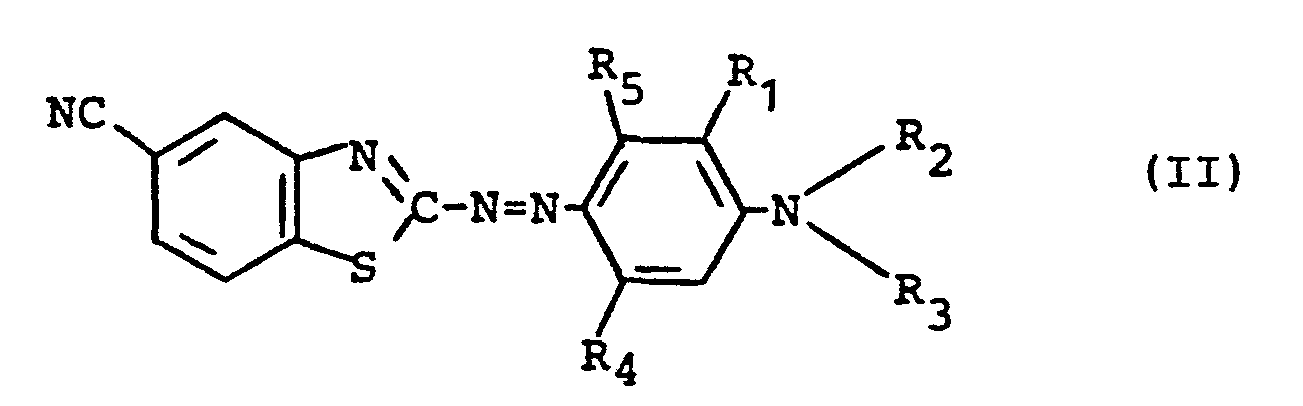
- Bevorzugt sind jedoch Kupplungskomponenten der N,N-Dialkylanilin-Reihe sowie der NH, N-Alkylanilin-Reihe.
- Farbstoffe, die sich davon ableiten, entsprechen beispielsweise folgender Formel
worin
- R1 Wasserstoff, Halogen, Alkyl, Alkoxy, Alkoxyalkyl oder Aryloxy,
- R2 Alkenyl oder gegebenenfalls durch OH, Halogen, CN, C02-Alkyl, Aryl, Cycloalkyl, Alkoxy, Aryloxy, OCO-Alkyl, OCO-Aryl, OCONH-Alkyl oder OC02-Alkyl substituiertes Alkyl
- R3 Wasserstoff oder gleiches oder verschiedenes R2,
- R4 Wasserstoff, Alkyl, Alkenyl, Cycloalkyl, Aralkyl, Alkoxy, Halogen, CF3, NHCO-Alkyl, NHCO-Aryl, NHCO2-Alkyl, NHCHO, NHSO2-Alkyl, NHCONH2, NHS02-Aryl, NHSO2-Alkenyl, NHCONH-Alkyl oder NHCON(Alkyl)2 und
- R5 Wasserstoff, Alkyl oder Alkoxy bedeuten,
- Unter den vorstehend im beliebigen Zusammenhang genannten Alkylresten wurden vorzugsweise solche mit 1 bis 8, insbesondere 1 bis 4 C-Atomen verstanden. Besonders bevorzugt sind Methyl, Ethyl und Methoxy.
- Geeignete Aryl- und Aryloxyreste sind vor allem Phenyl-und Phenoxyreste, die durch C1-C4-Alkyl, Halogen, CO2-C1-C4-Alkyl, N02, COCH3, C1-C4-Alkoxy oder CN substituiert sein können.
- Geeignete Aralkylreste sind Phenyl-C1-C3-alkylreste, die - ebenso wie die Arylreste eine Sulfogruppe enthalten können.
- Geeignete Cycloalkylreste sind Cyclohexylreste.
- Die genannten Alkenylreste haben vorzugsweise 3 bis 6 C-Atome.
- Unter "Halogen" wird insbesondere Br und Cl verstanden.
- Bevorzugte Farbstoffe sind solche der Formel II, worin
- R1 Wasserstoff, Alkyl, Alkoxy oder Cl,
- R2 Alkenyl oder gegebenenfalls durch Cl, CN, CO2-Alkyl, Aryl, Alkoxy, OCO-Alkyl, OCO2-Alkyl oder OCO-Aryl substituiertes Alkyl,
- R3 Wasserstoff oder gleiches oder verschiedenes bevorzugtes R2,
- R4 Wasserstoff, Alkyl, Alkoxy, Cl oder - insbesondere - NHCO-Alkyl, NHCO-Phenyl, NHC02-Alkyl, NHSO2-Alkyl oder NHSO2-Aryl und
- R5 Wasserstoff bedeuten,
- Besonders bevorzugte Farbstoffe entsprechen der Formel II, worin
- R1 H, C1-C2-Alkoxy, CH3 oder Cl,
- R 2 C3-C6-Alkenyl oder gegebenenfalls durch OH, Cl, CN, CO2-C1-C2-Alkyl, Phenyl, Tolyl, Chlorphenyl, C1-C4-Alkoxy, OCO-C1-C4-Alkyl, OCO-Phenyl, OCO-Tolyl oder OCO-Chlorphenyl substituiertes C1-C6-Alkyl,
- R3 H oder gegebenenfalls durch CN, CO2-C1-C2-Alkyl, Phenyl, Tolyl, Chlorphenyl, C1-C4-Alkoxy, OCO-C1-C4-Alkyl, OCO-Phenyl, OCO-Tolyl oder OCO-Chlorphenyl substituiertes C1-C6-Alkyl,
- R4 H, CH3 oder - insbesondere - NHCO-C1-C4-Alkyl, NHCO-Phenyl, NHCO-Tolyl, NHCO-Chlorphenyl, NHSO2-C1-C4-Alkyl, NHSO2-CH2Cl, NHCO2-C1-C4-Alkyl, NHSO2-Phenyl, NHSO2-Tolyl oder NHSO2-Chlorphenyl und
- R 5 H bedeuten.
- Ganz besonders bevorzugt sind Farbstoffe der Formel (II), worin
- R1 H oder Cl,
- R2 gegebenenfalls durch CN, CO2-C1-C2-Alkyl, Phenyl, Tolyl, Chlorphenyl, C1-C4-Alkoxy, OCO-C1-C4-Alkyl oder OCO-Phenyl substituiertes C1-C4-Alkyl,
- R3 H oder gegebenenfalls durch CN, C02-Alkyl, Phenyl, Tolyl, Chlorphenyl, C1-C4-Alkoxy oder OCO-C1-C4-Alkyl substituiertes C1-C4-Alkyl,
- R 4 CH3, NHCO-C1-C4-Alkyl, NH-Benzoyl oder NHSO2-C1-C4-Alkyl und
- R 5 H bedeuten.
- Darunter sind wiederum solche Farbstoffe bevorzugt, bei denen
- R2 durch CN, CO2-C1-C4-Alkyl, C1-C4-Alkoxy oder OCO-C1-C4-Alkyl substituiertes C1-C4-Alkyl,
- R3 H oder gegebenenfalls durch CN, CO2-C1-C4-Alkyl, C1-C4-Alkoxy oder OCO-C1-C4-Alkyl substituiertes Alkyl
- Die neuen Farbstoffe erhält man z.B. dadurch, daß man diazotiertes 2-Amino-5-cyano-benzthiazol auf Kupplungskomponenten der Formel

worin - X für H oder eine Abgangsgruppe, z.B. COOH, CH2OH oder S03H, steht und
- K die obengenannte Bedeutung hat,
- So ist etwa die Kupplung mit Verbindungen, welche eine Abgangsgruppe enthalten, in GB 2 036 775 beschrieben.
- Das 2-Amino-5-cyano-benzthiazol ist - abgesehen von der Erwähnung in der obengenannten Patentpublikation als geeignete Diazokomponente - bislang nicht beschrieben worden.
- Man erhält diese Verbindung nach einem erfindungsgemäßen Verfahren dadurch, daß man Verbindungen der Formel

worin - Y für SH, SCN,

- Z für NH2 oder vorzugsweise für N02,
- T für CONH2 oder vorzugsweise für CN und
- n für 2 oder vorzugsweise für 1 stehen,
- Geeignete Lösungsmittel sind insbesondere im genannten Temperaturbereich siedende Alkohole und vor allem Pyridin.
- Die neuen Farbstoffe eignen sich hervorragend zum Färben und Bedrucken von Textilfasermaterialien, wobei die wasserunlöslichen Typen naturgemäß zum Färben von hydrophoben Fasern wie Celluloseester, Polyester oder Mischungen dieser Materialien mit natürlichen Fasermaterialien sowie zum Färben von organischen Lösungsmitteln, Mineralölprodukten, Wachsen, Kunststoffen und Oberflächenbelägen eingesetzt werden.
- Auf den bevorzugten Polyesterfasern erhält man mit den neuen Farbstoffen farbstarke brillante gelbe bis violette Färbungen und Drucke mit sehr guten Echtheitseigenschaften und gutem Auszieh- und Egalisiervermögen.
- Die wasserlöslichen Farbstoffe, d.h. die in Form der freien Säure mindestens einen Rest der Formel -S03H, -OSO3H oder SS03H enthalten, eignen sich sehr gut zum Färben von natürlichen und synthetischen Polyamidfasern, die im letztgenannten Falle in klaren orangefarbenen bis blaustichig roten Nuancen mit guten Echtheiten gefärbt werden.
- Selbstverständlich können diese Farbstoffe auch in Form ihrer Salze, insbesondere ihrer Alkali- und Ammoniumsalze eingesetzt werden.
- Bevorzugt sind solche Typen, die eine Sulfogruppe enthalten, die sich insbesondere in den Resten R2/R3 der Formel II befindet.
- Besonders bevorzugte Säurefarbstoffe sind Farbstoffe der Formel II, worin
- R2 für H oder einen vorzugsweise unsubstituierten Alkylrest,
- R3 für einen durch -S03H, -OSO3H oder Sulfoaryl substituierten Alkylrest stehen,
- Ganz besonders bevorzugt sind solche sauren Farbstoffe der Formel II, worin


und die übrigen Reste die obengenannten bevorzugten Bedeutungen haben. - Beispiel 1 Herstellung des Farbstoffs der Formel

- a) 103,9 g 4-Chlor-3-nitrobenzoesäureamid werden in ein Gemisch von 300 ml Phosphoroxychlorid und 40,2 ml Pyridin eingetragen. Durch Außenkühlung hält man dabei die Temperatur auf 50°C. Man rührt weitere zwei Stunden bei 50°C, läßt abkühlen und klärt die Lösung über eine Glasfilternutsche. Das Filtrat wird langsam in 3 1 Eiswasser eingerührt. Man saugt die kristalline Fällung ab, wäscht und trocknet im Vakuum. Man erhält 86 g rohes 4-Chlor-3-nitrobenzonitril.
- b) In eine siedende Lösung von 243 g Thioharnstoff in 600 ml Pyridin trägt man langsam 146 g 4-Chlor-3-nitrobenzonitril ein und erwärmt das Gemisch noch weitere 5 Stunden zum Sieden. Nach Erkalten trägt man auf 4,0 1 Wasser aus, saugt ab, wäscht mit Wasser nach und verrührt das Rohprodukt über Nacht mit 200 ml 18 %iger Natriumhydrogensulfidlösung und 2,0 1 Wasser. Man saugt ab, wäscht mit Wasser und trocknet. Ausbeute: 115 g; Massenspektrum m + : 175 (100 %); IR: 2232 cm-1 (C≡N) ; Fp.: 256-258° Zers.
- c) 5 g 2-Amino-5-cyanbenzthiazol werden in einer Mischung von 35 ml Eisessig, 10 ml Wasser und 15 ml konzentrierter Schwefelsäure (66°Be) angerührt. Bei 0 bis 5°C tropft man in 30 Minuten 5 ml 40 %ige Nitrosylschwefelsäure zu und rührt noch weitere 2 Stunden bei 0-5°C. Man läßt die Lösung der Diazokomponente zu einer Lösung von 6,4 g 3-Diethylaminoacetanilid und 1 g Harnstoff in 100 ml Wasser und 10 ml 30 %iger Salzsäure bei 0°C zulaufen, rührt eine Stunde bei 0°C ·und verdünnt dann mit 500 ml Eiswasser. Man saugt ab, wäscht mit 200 ml Wasser nach und trocknet. Ausbeute 7,4 g. Der Farbstoff färbt Polyesterfasern in einem farbstarken, klaren Rubin mit sehr guten Echtheiten.
- Bei analoger oder ähnlicher Arbeitsweise können die in nachfolgender Tabelle aufgeführten Farbstoffe in guter Ausbeute erhalten werden:
- Farbstoffe der Formel


wobei die genannten Kohlenwasserstoffreste durch weitere in der Chemie der Azofarbstoffe übliche Substituenten substituiert sein können.
wobei die genannten Alkyl-, Alkoxy-, Alkenyl- und Arylreste beispielsweise die oben angegebenen C-Zahlen und Substitutionsmuster aufweisen.
bedeuten, und die übrigen Reste wie vorstehend definiert sind.
in an sich bekannter Weise kuppelt.
mit Thioharnstoff oder Thioharnstoffbildnern bei 60° bis 200°C gegebenenfalls in Gegenwart eines indifferenten Lösungsmittels umsetzt und - im Falle von T = CONH2 - anschließend diese Gruppe zu einer Nitrilgruppe dehydratisiert.
wobei die übrigen Reste die obengenannten speziellen oder allgemeinen Bedeutungen haben.
Claims (10)

worin
worin
wobei die genannten Kohlenwasserstoffreste durch weitere in der Chemie der Azofarbstoffe übliche Substituenten substituiert sein können.


worin

mit Thioharnstoff oder Thioharnstoffbildnern bei 60° bis 200°C gegebenenfalls in Gegenwart eines indifferenten Lösungsmittels umsetzt und - im Falle von T = CONH2 - anschließend diese Gruppe zu einer Nitrilgruppe dehydratisiert.
Applications Claiming Priority (2)
| Application Number | Priority Date | Filing Date | Title |
|---|---|---|---|
| DE3427237 | 1984-07-24 | ||
| DE19843427237 DE3427237A1 (de) | 1984-07-24 | 1984-07-24 | Azofarbstoffe |
Publications (3)
| Publication Number | Publication Date |
|---|---|
| EP0169459A2 true EP0169459A2 (de) | 1986-01-29 |
| EP0169459A3 EP0169459A3 (en) | 1988-05-04 |
| EP0169459B1 EP0169459B1 (de) | 1991-05-15 |
Family
ID=6241428
Family Applications (1)
| Application Number | Title | Priority Date | Filing Date |
|---|---|---|---|
| EP85108704A Expired - Lifetime EP0169459B1 (de) | 1984-07-24 | 1985-07-12 | Azofarbstoffe |
Country Status (3)
| Country | Link |
|---|---|
| EP (1) | EP0169459B1 (de) |
| JP (1) | JPS6137845A (de) |
| DE (2) | DE3427237A1 (de) |
Families Citing this family (1)
| Publication number | Priority date | Publication date | Assignee | Title |
|---|---|---|---|---|
| JPS61254006A (ja) * | 1985-04-30 | 1986-11-11 | 株式会社東芝 | 閉鎖配電盤 |
Family Cites Families (2)
| Publication number | Priority date | Publication date | Assignee | Title |
|---|---|---|---|---|
| FR1406200A (fr) * | 1963-08-14 | 1965-07-16 | Sandoz Sa | Colorants mono-azoïques peu solubles ou insolubles dans l'eau, leur fabrication et leurs applications |
| CH448320A (de) * | 1964-09-28 | 1967-12-15 | Sandoz Ag | Verfahren zur Herstellung von in Wasser schwerlöslichen Azofarbstoffen |
-
1984
- 1984-07-24 DE DE19843427237 patent/DE3427237A1/de not_active Withdrawn
-
1985
- 1985-07-12 EP EP85108704A patent/EP0169459B1/de not_active Expired - Lifetime
- 1985-07-12 DE DE8585108704T patent/DE3582827D1/de not_active Expired - Lifetime
- 1985-07-22 JP JP16040185A patent/JPS6137845A/ja active Pending
Also Published As
| Publication number | Publication date |
|---|---|
| JPS6137845A (ja) | 1986-02-22 |
| EP0169459A3 (en) | 1988-05-04 |
| EP0169459B1 (de) | 1991-05-15 |
| DE3427237A1 (de) | 1986-01-30 |
| DE3582827D1 (de) | 1991-06-20 |
Similar Documents
| Publication | Publication Date | Title |
|---|---|---|
| DE1644177C3 (de) | Verfahren zur Herstellung sulfonsäuregruppenfreier Monoazofarbstoffe | |
| DE2340569C2 (de) | Azofarbstoffe | |
| DE69703340T2 (de) | Heterozyklische monoazofarbstoffe | |
| DE1069313B (de) | ||
| EP0038439A1 (de) | Farbstoffmischung, Verfahren zu ihrer Herstellung, sie enthaltende Farbstoffe und Verfahren zum Färben und Bedrucken von synthetischem, hydrophobem Fasermaterial | |
| EP0335234B1 (de) | Isothiazolazofarbstoffe | |
| DE1769263C3 (de) | Von in Wasser ionogen-salzbildenden Gruppen freie Monoazofarbstoffe, Verfahren zu ihrer Herstellung und ihre Verwendung | |
| DE2736785C3 (de) | Neue Dispersionsazofarbstoffe, Verfahren zu ihrer Herstellung sowie deren Verwendung zum Färben oder Bedrucken von synthetischen Fasermaterialien | |
| EP0169459B1 (de) | Azofarbstoffe | |
| DE2531445B2 (de) | Sulfogruppenfreie wasserloesliche azofarbstoffe und deren verwendung zum faerben und/oder bedrucken von synthetischen textilfasern | |
| DE959748C (de) | Verfahren zur Herstellung neuer Monoazofarbstoffe | |
| EP0198206B1 (de) | Azofarbstoffe | |
| DE3876313T2 (de) | Dispersionsfarbstoffe. | |
| DE2404854A1 (de) | Farbstoffzubereitungen fuer den transferdruck | |
| CH638551A5 (de) | Monoazofarbstoffe und verfahren zu deren herstellung. | |
| CH343560A (de) | Verfahren zur Herstellung wasserunlöslicher Monoazofarbstoffe | |
| DE1298661B (de) | Verfahren zur Herstellung in Wasser schwer loeslicher Dispersionsfarbstoffe | |
| DE2850643A1 (de) | Hydroxypyridon-azofarbstoffe | |
| EP0267467A1 (de) | Verfahren zur Herstellung von Thiophenverbindungen | |
| DE2320361C3 (de) | Dispersions-Azofarbstoffe sowie deren Herstellung | |
| DE3220117A1 (de) | 2,6-dicyananiline | |
| DE2849995B2 (de) | Monoazofarbstoffe, Verfahren zu deren Herstellung und ihre Verwendung | |
| DE1644401C (de) | Monoazofarbstoffe und Verfahren zur Herstellung und Verwendung von Monoazofarbstoffen | |
| DE2448911A1 (de) | Azofarbstoffe | |
| DE1544600C (de) | Monoazofarbstoffe sowie Ver fahren zu ihrer Herstellung und Verwendung |
Legal Events
| Date | Code | Title | Description |
|---|---|---|---|
| PUAI | Public reference made under article 153(3) epc to a published international application that has entered the european phase |
Free format text: ORIGINAL CODE: 0009012 |
|
| 17P | Request for examination filed |
Effective date: 19850712 |
|
| AK | Designated contracting states |
Designated state(s): CH DE FR GB LI |
|
| PUAL | Search report despatched |
Free format text: ORIGINAL CODE: 0009013 |
|
| AK | Designated contracting states |
Kind code of ref document: A3 Designated state(s): CH DE FR GB LI |
|
| 17Q | First examination report despatched |
Effective date: 19890417 |
|
| GRAA | (expected) grant |
Free format text: ORIGINAL CODE: 0009210 |
|
| AK | Designated contracting states |
Kind code of ref document: B1 Designated state(s): CH DE FR GB LI |
|
| GBT | Gb: translation of ep patent filed (gb section 77(6)(a)/1977) | ||
| PGFP | Annual fee paid to national office [announced via postgrant information from national office to epo] |
Ref country code: DE Payment date: 19910619 Year of fee payment: 7 |
|
| REF | Corresponds to: |
Ref document number: 3582827 Country of ref document: DE Date of ref document: 19910620 |
|
| ET | Fr: translation filed | ||
| PGFP | Annual fee paid to national office [announced via postgrant information from national office to epo] |
Ref country code: GB Payment date: 19910701 Year of fee payment: 7 |
|
| PGFP | Annual fee paid to national office [announced via postgrant information from national office to epo] |
Ref country code: FR Payment date: 19910705 Year of fee payment: 7 |
|
| PGFP | Annual fee paid to national office [announced via postgrant information from national office to epo] |
Ref country code: CH Payment date: 19910715 Year of fee payment: 7 |
|
| PLBE | No opposition filed within time limit |
Free format text: ORIGINAL CODE: 0009261 |
|
| STAA | Information on the status of an ep patent application or granted ep patent |
Free format text: STATUS: NO OPPOSITION FILED WITHIN TIME LIMIT |
|
| 26N | No opposition filed | ||
| PG25 | Lapsed in a contracting state [announced via postgrant information from national office to epo] |
Ref country code: GB Effective date: 19920712 |
|
| PG25 | Lapsed in a contracting state [announced via postgrant information from national office to epo] |
Ref country code: LI Effective date: 19920731 Ref country code: CH Effective date: 19920731 |
|
| GBPC | Gb: european patent ceased through non-payment of renewal fee |
Effective date: 19920712 |
|
| PG25 | Lapsed in a contracting state [announced via postgrant information from national office to epo] |
Ref country code: FR Effective date: 19930331 |
|
| REG | Reference to a national code |
Ref country code: CH Ref legal event code: PL |
|
| PG25 | Lapsed in a contracting state [announced via postgrant information from national office to epo] |
Ref country code: DE Effective date: 19930401 |
|
| REG | Reference to a national code |
Ref country code: FR Ref legal event code: ST |