EP0267467A1 - Verfahren zur Herstellung von Thiophenverbindungen - Google Patents
Verfahren zur Herstellung von Thiophenverbindungen Download PDFInfo
- Publication number
- EP0267467A1 EP0267467A1 EP87115393A EP87115393A EP0267467A1 EP 0267467 A1 EP0267467 A1 EP 0267467A1 EP 87115393 A EP87115393 A EP 87115393A EP 87115393 A EP87115393 A EP 87115393A EP 0267467 A1 EP0267467 A1 EP 0267467A1
- Authority
- EP
- European Patent Office
- Prior art keywords
- alkyl
- formula
- oco
- nhso2
- aryl
- Prior art date
- Legal status (The legal status is an assumption and is not a legal conclusion. Google has not performed a legal analysis and makes no representation as to the accuracy of the status listed.)
- Granted
Links
- 238000000034 method Methods 0.000 title claims abstract description 24
- 238000002360 preparation method Methods 0.000 title claims abstract description 19
- 150000003577 thiophenes Chemical class 0.000 title 1
- 239000000987 azo dye Substances 0.000 claims abstract description 9
- 125000001424 substituent group Chemical group 0.000 claims abstract description 6
- GLQWRXYOTXRDNH-UHFFFAOYSA-N thiophen-2-amine Chemical class NC1=CC=CS1 GLQWRXYOTXRDNH-UHFFFAOYSA-N 0.000 claims abstract description 5
- 150000003556 thioamides Chemical class 0.000 claims abstract description 4
- 229910052739 hydrogen Inorganic materials 0.000 claims description 21
- 125000000217 alkyl group Chemical group 0.000 claims description 19
- 229910052801 chlorine Inorganic materials 0.000 claims description 19
- 239000000975 dye Substances 0.000 claims description 18
- 229910052794 bromium Inorganic materials 0.000 claims description 17
- 125000003545 alkoxy group Chemical group 0.000 claims description 15
- 239000001257 hydrogen Substances 0.000 claims description 14
- 125000004435 hydrogen atom Chemical group [H]* 0.000 claims description 14
- 150000001875 compounds Chemical class 0.000 claims description 13
- 238000006243 chemical reaction Methods 0.000 claims description 12
- 229910052736 halogen Inorganic materials 0.000 claims description 12
- 150000002367 halogens Chemical class 0.000 claims description 12
- -1 hydrocarbon radicals Chemical class 0.000 claims description 11
- 125000003118 aryl group Chemical group 0.000 claims description 9
- 125000004178 (C1-C4) alkyl group Chemical group 0.000 claims description 8
- 125000003342 alkenyl group Chemical group 0.000 claims description 8
- 125000000956 methoxy group Chemical group [H]C([H])([H])O* 0.000 claims description 7
- JCXJVPUVTGWSNB-UHFFFAOYSA-N nitrogen dioxide Inorganic materials O=[N]=O JCXJVPUVTGWSNB-UHFFFAOYSA-N 0.000 claims description 7
- 239000002253 acid Substances 0.000 claims description 6
- GDTBXPJZTBHREO-UHFFFAOYSA-N bromine Substances BrBr GDTBXPJZTBHREO-UHFFFAOYSA-N 0.000 claims description 6
- 125000000753 cycloalkyl group Chemical group 0.000 claims description 6
- 125000000229 (C1-C4)alkoxy group Chemical group 0.000 claims description 5
- WKBOTKDWSSQWDR-UHFFFAOYSA-N Bromine atom Chemical compound [Br] WKBOTKDWSSQWDR-UHFFFAOYSA-N 0.000 claims description 5
- 239000003795 chemical substances by application Substances 0.000 claims description 5
- 125000001997 phenyl group Chemical group [H]C1=C([H])C([H])=C(*)C([H])=C1[H] 0.000 claims description 5
- 125000003710 aryl alkyl group Chemical group 0.000 claims description 4
- 125000004104 aryloxy group Chemical group 0.000 claims description 4
- 125000000068 chlorophenyl group Chemical group 0.000 claims description 4
- 125000003944 tolyl group Chemical group 0.000 claims description 4
- 230000008878 coupling Effects 0.000 claims description 3
- 238000010168 coupling process Methods 0.000 claims description 3
- 238000005859 coupling reaction Methods 0.000 claims description 3
- 125000004169 (C1-C6) alkyl group Chemical group 0.000 claims description 2
- 239000004215 Carbon black (E152) Substances 0.000 claims description 2
- 125000004183 alkoxy alkyl group Chemical group 0.000 claims description 2
- 125000001072 heteroaryl group Chemical group 0.000 claims description 2
- 125000000623 heterocyclic group Chemical group 0.000 claims description 2
- 229930195733 hydrocarbon Natural products 0.000 claims description 2
- 125000002924 primary amino group Chemical group [H]N([H])* 0.000 claims description 2
- 150000003254 radicals Chemical class 0.000 claims description 2
- 125000002023 trifluoromethyl group Chemical group FC(F)(F)* 0.000 claims description 2
- YTPLMLYBLZKORZ-UHFFFAOYSA-N Thiophene Chemical group C=1C=CSC=1 YTPLMLYBLZKORZ-UHFFFAOYSA-N 0.000 claims 1
- 125000002490 anilino group Chemical class [H]N(*)C1=C([H])C([H])=C([H])C([H])=C1[H] 0.000 claims 1
- 125000000664 diazo group Chemical group [N-]=[N+]=[*] 0.000 abstract description 3
- 238000006798 ring closing metathesis reaction Methods 0.000 abstract description 3
- ZMXDDKWLCZADIW-UHFFFAOYSA-N N,N-Dimethylformamide Chemical compound CN(C)C=O ZMXDDKWLCZADIW-UHFFFAOYSA-N 0.000 description 33
- VEXZGXHMUGYJMC-UHFFFAOYSA-N Hydrochloric acid Chemical compound Cl VEXZGXHMUGYJMC-UHFFFAOYSA-N 0.000 description 20
- IAZDPXIOMUYVGZ-UHFFFAOYSA-N Dimethylsulphoxide Chemical compound CS(C)=O IAZDPXIOMUYVGZ-UHFFFAOYSA-N 0.000 description 15
- HEMHJVSKTPXQMS-UHFFFAOYSA-M Sodium hydroxide Chemical compound [OH-].[Na+] HEMHJVSKTPXQMS-UHFFFAOYSA-M 0.000 description 15
- YMWUJEATGCHHMB-UHFFFAOYSA-N Dichloromethane Chemical compound ClCCl YMWUJEATGCHHMB-UHFFFAOYSA-N 0.000 description 14
- 239000000203 mixture Substances 0.000 description 11
- UIIMBOGNXHQVGW-UHFFFAOYSA-M Sodium bicarbonate Chemical compound [Na+].OC([O-])=O UIIMBOGNXHQVGW-UHFFFAOYSA-M 0.000 description 8
- 238000001816 cooling Methods 0.000 description 7
- 239000005457 ice water Substances 0.000 description 7
- OKKJLVBELUTLKV-UHFFFAOYSA-N Methanol Chemical compound OC OKKJLVBELUTLKV-UHFFFAOYSA-N 0.000 description 6
- IXCSERBJSXMMFS-UHFFFAOYSA-N hydrogen chloride Substances Cl.Cl IXCSERBJSXMMFS-UHFFFAOYSA-N 0.000 description 6
- 229910000041 hydrogen chloride Inorganic materials 0.000 description 6
- XLYOFNOQVPJJNP-UHFFFAOYSA-N water Substances O XLYOFNOQVPJJNP-UHFFFAOYSA-N 0.000 description 6
- 238000005160 1H NMR spectroscopy Methods 0.000 description 5
- 239000000047 product Substances 0.000 description 5
- QTBSBXVTEAMEQO-UHFFFAOYSA-N Acetic acid Chemical compound CC(O)=O QTBSBXVTEAMEQO-UHFFFAOYSA-N 0.000 description 4
- 0 C*(C=C1)C=Cc2c1c(*N)c(*)[s]2 Chemical compound C*(C=C1)C=Cc2c1c(*N)c(*)[s]2 0.000 description 4
- 238000004043 dyeing Methods 0.000 description 4
- 125000002496 methyl group Chemical group [H]C([H])([H])* 0.000 description 4
- 235000017557 sodium bicarbonate Nutrition 0.000 description 4
- 229910000030 sodium bicarbonate Inorganic materials 0.000 description 4
- 239000002904 solvent Substances 0.000 description 4
- 239000007858 starting material Substances 0.000 description 4
- 238000003756 stirring Methods 0.000 description 4
- YUKQRDCYNOVPGJ-UHFFFAOYSA-N thioacetamide Chemical compound CC(N)=S YUKQRDCYNOVPGJ-UHFFFAOYSA-N 0.000 description 4
- DLFVBJFMPXGRIB-UHFFFAOYSA-N thioacetamide Natural products CC(N)=O DLFVBJFMPXGRIB-UHFFFAOYSA-N 0.000 description 4
- LFQSCWFLJHTTHZ-UHFFFAOYSA-N Ethanol Chemical compound CCO LFQSCWFLJHTTHZ-UHFFFAOYSA-N 0.000 description 3
- YXFVVABEGXRONW-UHFFFAOYSA-N Toluene Chemical compound CC1=CC=CC=C1 YXFVVABEGXRONW-UHFFFAOYSA-N 0.000 description 3
- 238000006193 diazotization reaction Methods 0.000 description 3
- 239000000706 filtrate Substances 0.000 description 3
- 229920000728 polyester Polymers 0.000 description 3
- 238000007363 ring formation reaction Methods 0.000 description 3
- 229920006395 saturated elastomer Polymers 0.000 description 3
- UOMVXAZVAZDQIN-UHFFFAOYSA-N 2-(2-chloro-4-nitrophenyl)-2-cyanoethanethioamide Chemical compound NC(=S)C(C#N)C1=CC=C([N+]([O-])=O)C=C1Cl UOMVXAZVAZDQIN-UHFFFAOYSA-N 0.000 description 2
- LINGKQWBFQNHGP-UHFFFAOYSA-N 2-amino-6,7-dichloro-1-benzothiophene-3-carbonitrile Chemical compound ClC1=CC=C2C(C#N)=C(N)SC2=C1Cl LINGKQWBFQNHGP-UHFFFAOYSA-N 0.000 description 2
- QMOLZZMBUADGRJ-UHFFFAOYSA-N 2-amino-6-nitro-1-benzothiophene-3-carbonitrile Chemical compound [O-][N+](=O)C1=CC=C2C(C#N)=C(N)SC2=C1 QMOLZZMBUADGRJ-UHFFFAOYSA-N 0.000 description 2
- QXYXPWCPTSZTSV-UHFFFAOYSA-N 2-amino-6-nitro-4-(trifluoromethyl)-1-benzothiophene-3-carbonitrile Chemical compound [O-][N+](=O)C1=CC(C(F)(F)F)=C2C(C#N)=C(N)SC2=C1 QXYXPWCPTSZTSV-UHFFFAOYSA-N 0.000 description 2
- VJFFEYQYSSKFBJ-UHFFFAOYSA-N 2-cyano-2-(3,4-dichlorophenyl)ethanethioamide Chemical compound NC(=S)C(C#N)C1=CC=C(Cl)C(Cl)=C1 VJFFEYQYSSKFBJ-UHFFFAOYSA-N 0.000 description 2
- GNSULHCYYFWLBN-UHFFFAOYSA-N 2-cyano-2-(4-nitrophenyl)ethanethioamide Chemical compound NC(=S)C(C#N)C1=CC=C([N+]([O-])=O)C=C1 GNSULHCYYFWLBN-UHFFFAOYSA-N 0.000 description 2
- HEDRZPFGACZZDS-UHFFFAOYSA-N Chloroform Chemical compound ClC(Cl)Cl HEDRZPFGACZZDS-UHFFFAOYSA-N 0.000 description 2
- KFZMGEQAYNKOFK-UHFFFAOYSA-N Isopropanol Chemical compound CC(C)O KFZMGEQAYNKOFK-UHFFFAOYSA-N 0.000 description 2
- PCLIMKBDDGJMGD-UHFFFAOYSA-N N-bromosuccinimide Chemical compound BrN1C(=O)CCC1=O PCLIMKBDDGJMGD-UHFFFAOYSA-N 0.000 description 2
- JUJWROOIHBZHMG-UHFFFAOYSA-N Pyridine Chemical compound C1=CC=NC=C1 JUJWROOIHBZHMG-UHFFFAOYSA-N 0.000 description 2
- WQDUMFSSJAZKTM-UHFFFAOYSA-N Sodium methoxide Chemical compound [Na+].[O-]C WQDUMFSSJAZKTM-UHFFFAOYSA-N 0.000 description 2
- 229960000583 acetic acid Drugs 0.000 description 2
- 150000007513 acids Chemical class 0.000 description 2
- 229910000287 alkaline earth metal oxide Inorganic materials 0.000 description 2
- 150000005840 aryl radicals Chemical class 0.000 description 2
- 230000015572 biosynthetic process Effects 0.000 description 2
- 125000004432 carbon atom Chemical group C* 0.000 description 2
- MVPPADPHJFYWMZ-UHFFFAOYSA-N chlorobenzene Chemical compound ClC1=CC=CC=C1 MVPPADPHJFYWMZ-UHFFFAOYSA-N 0.000 description 2
- JHIVVAPYMSGYDF-UHFFFAOYSA-N cyclohexanone Chemical compound O=C1CCCCC1 JHIVVAPYMSGYDF-UHFFFAOYSA-N 0.000 description 2
- XBDQKXXYIPTUBI-UHFFFAOYSA-N dimethylselenoniopropionate Natural products CCC(O)=O XBDQKXXYIPTUBI-UHFFFAOYSA-N 0.000 description 2
- 239000000835 fiber Substances 0.000 description 2
- 239000002657 fibrous material Substances 0.000 description 2
- 239000012362 glacial acetic acid Substances 0.000 description 2
- 229910052740 iodine Inorganic materials 0.000 description 2
- 239000003960 organic solvent Substances 0.000 description 2
- 239000000843 powder Substances 0.000 description 2
- 239000002244 precipitate Substances 0.000 description 2
- 239000000725 suspension Substances 0.000 description 2
- 238000003786 synthesis reaction Methods 0.000 description 2
- VZGDMQKNWNREIO-UHFFFAOYSA-N tetrachloromethane Chemical compound ClC(Cl)(Cl)Cl VZGDMQKNWNREIO-UHFFFAOYSA-N 0.000 description 2
- NUKLDTSTOVGVDB-UHFFFAOYSA-N 1,1-dichloroethane;1,2-dichloroethane Chemical compound CC(Cl)Cl.ClCCCl NUKLDTSTOVGVDB-UHFFFAOYSA-N 0.000 description 1
- NTBYINQTYWZXLH-UHFFFAOYSA-N 1,2-dichloro-4-nitrobenzene Chemical compound [O-][N+](=O)C1=CC=C(Cl)C(Cl)=C1 NTBYINQTYWZXLH-UHFFFAOYSA-N 0.000 description 1
- FCEHBMOGCRZNNI-UHFFFAOYSA-N 1-benzothiophene Chemical class C1=CC=C2SC=CC2=C1 FCEHBMOGCRZNNI-UHFFFAOYSA-N 0.000 description 1
- AEXXMWSRGNFOGZ-UHFFFAOYSA-N 2-(3,4-dichlorophenyl)-2-hydroxybutanedinitrile Chemical compound N#CCC(O)(C#N)C1=CC=C(Cl)C(Cl)=C1 AEXXMWSRGNFOGZ-UHFFFAOYSA-N 0.000 description 1
- QWZNCAFWRZZJMA-UHFFFAOYSA-N 2-(3,4-dichlorophenyl)acetonitrile Chemical compound ClC1=CC=C(CC#N)C=C1Cl QWZNCAFWRZZJMA-UHFFFAOYSA-N 0.000 description 1
- CVWSILBRNKCTPA-UHFFFAOYSA-N 2-amino-4-chloro-6-nitro-1-benzothiophene-3-carbonitrile Chemical compound [O-][N+](=O)C1=CC(Cl)=C2C(C#N)=C(N)SC2=C1 CVWSILBRNKCTPA-UHFFFAOYSA-N 0.000 description 1
- WTLJBPALOQRUEB-UHFFFAOYSA-N 2-amino-4-methylsulfonyl-6-nitro-1-benzothiophene-3-carbonitrile Chemical compound CS(=O)(=O)C1=CC([N+]([O-])=O)=CC2=C1C(C#N)=C(N)S2 WTLJBPALOQRUEB-UHFFFAOYSA-N 0.000 description 1
- KVYNQJMKYMQTJT-UHFFFAOYSA-N 2-cyano-2-(2-methylsulfonyl-4-nitrophenyl)ethanethioamide Chemical compound CS(=O)(=O)C1=CC([N+]([O-])=O)=CC=C1C(C#N)C(N)=S KVYNQJMKYMQTJT-UHFFFAOYSA-N 0.000 description 1
- REQWTCYBUAOEBS-UHFFFAOYSA-N 2-cyano-2-[4-nitro-2-(trifluoromethyl)phenyl]ethanethioamide Chemical compound NC(=S)C(C#N)C1=CC=C([N+]([O-])=O)C=C1C(F)(F)F REQWTCYBUAOEBS-UHFFFAOYSA-N 0.000 description 1
- BHPYMZQTCPRLNR-UHFFFAOYSA-N 2-cyanoethanethioamide Chemical compound NC(=S)CC#N BHPYMZQTCPRLNR-UHFFFAOYSA-N 0.000 description 1
- CZGCEKJOLUNIFY-UHFFFAOYSA-N 4-Chloronitrobenzene Chemical compound [O-][N+](=O)C1=CC=C(Cl)C=C1 CZGCEKJOLUNIFY-UHFFFAOYSA-N 0.000 description 1
- RXQNKKRGJJRMKD-UHFFFAOYSA-N 5-bromo-2-methylaniline Chemical compound CC1=CC=C(Br)C=C1N RXQNKKRGJJRMKD-UHFFFAOYSA-N 0.000 description 1
- ZCYVEMRRCGMTRW-UHFFFAOYSA-N 7553-56-2 Chemical compound [I] ZCYVEMRRCGMTRW-UHFFFAOYSA-N 0.000 description 1
- BVKZGUZCCUSVTD-UHFFFAOYSA-M Bicarbonate Chemical class OC([O-])=O BVKZGUZCCUSVTD-UHFFFAOYSA-M 0.000 description 1
- 238000006937 Gewald synthesis reaction Methods 0.000 description 1
- 239000003513 alkali Substances 0.000 description 1
- 239000000010 aprotic solvent Substances 0.000 description 1
- 238000005899 aromatization reaction Methods 0.000 description 1
- 239000002585 base Substances 0.000 description 1
- 125000002837 carbocyclic group Chemical group 0.000 description 1
- 150000004649 carbonic acid derivatives Chemical class 0.000 description 1
- 229920002678 cellulose Polymers 0.000 description 1
- SXMCJSLCSAKPNR-NYYWCZLTSA-N chembl1976049 Chemical compound C1=C([N+]([O-])=O)C(O)=CC=C1\C=N\N1C(=S)SCC1=O SXMCJSLCSAKPNR-NYYWCZLTSA-N 0.000 description 1
- 238000005352 clarification Methods 0.000 description 1
- 239000012043 crude product Substances 0.000 description 1
- 238000002425 crystallisation Methods 0.000 description 1
- 230000008025 crystallization Effects 0.000 description 1
- QPJDMGCKMHUXFD-UHFFFAOYSA-N cyanogen chloride Chemical compound ClC#N QPJDMGCKMHUXFD-UHFFFAOYSA-N 0.000 description 1
- 238000006114 decarboxylation reaction Methods 0.000 description 1
- 238000006471 dimerization reaction Methods 0.000 description 1
- IEJIGPNLZYLLBP-UHFFFAOYSA-N dimethyl carbonate Chemical compound COC(=O)OC IEJIGPNLZYLLBP-UHFFFAOYSA-N 0.000 description 1
- 239000006185 dispersion Substances 0.000 description 1
- 238000001035 drying Methods 0.000 description 1
- AEOCXXJPGCBFJA-UHFFFAOYSA-N ethionamide Chemical compound CCC1=CC(C(N)=S)=CC=N1 AEOCXXJPGCBFJA-UHFFFAOYSA-N 0.000 description 1
- 125000001495 ethyl group Chemical group [H]C([H])([H])C([H])([H])* 0.000 description 1
- 229910052731 fluorine Inorganic materials 0.000 description 1
- 230000002209 hydrophobic effect Effects 0.000 description 1
- 150000004679 hydroxides Chemical class 0.000 description 1
- 150000007529 inorganic bases Chemical class 0.000 description 1
- 239000011630 iodine Substances 0.000 description 1
- 239000000463 material Substances 0.000 description 1
- 239000000155 melt Substances 0.000 description 1
- 239000002480 mineral oil Substances 0.000 description 1
- 235000010446 mineral oil Nutrition 0.000 description 1
- FPUKYOSOAAPHTN-UHFFFAOYSA-N n-[3-(diethylamino)phenyl]acetamide Chemical compound CCN(CC)C1=CC=CC(NC(C)=O)=C1 FPUKYOSOAAPHTN-UHFFFAOYSA-N 0.000 description 1
- 150000007530 organic bases Chemical class 0.000 description 1
- 239000004033 plastic Substances 0.000 description 1
- 229920003023 plastic Polymers 0.000 description 1
- 238000001556 precipitation Methods 0.000 description 1
- 235000019260 propionic acid Nutrition 0.000 description 1
- UMJSCPRVCHMLSP-UHFFFAOYSA-N pyridine Natural products COC1=CC=CN=C1 UMJSCPRVCHMLSP-UHFFFAOYSA-N 0.000 description 1
- IUVKMZGDUIUOCP-BTNSXGMBSA-N quinbolone Chemical compound O([C@H]1CC[C@H]2[C@H]3[C@@H]([C@]4(C=CC(=O)C=C4CC3)C)CC[C@@]21C)C1=CCCC1 IUVKMZGDUIUOCP-BTNSXGMBSA-N 0.000 description 1
- 238000007127 saponification reaction Methods 0.000 description 1
- 238000000859 sublimation Methods 0.000 description 1
- 230000008022 sublimation Effects 0.000 description 1
- 238000006467 substitution reaction Methods 0.000 description 1
- IIACRCGMVDHOTQ-UHFFFAOYSA-N sulfamic acid Chemical compound NS(O)(=O)=O IIACRCGMVDHOTQ-UHFFFAOYSA-N 0.000 description 1
- GLBQVJGBPFPMMV-UHFFFAOYSA-N sulfilimine Chemical compound S=N GLBQVJGBPFPMMV-UHFFFAOYSA-N 0.000 description 1
- 125000000020 sulfo group Chemical group O=S(=O)([*])O[H] 0.000 description 1
- 239000004753 textile Substances 0.000 description 1
- 125000005270 trialkylamine group Chemical group 0.000 description 1
- 239000001993 wax Substances 0.000 description 1
Classifications
-
- C—CHEMISTRY; METALLURGY
- C09—DYES; PAINTS; POLISHES; NATURAL RESINS; ADHESIVES; COMPOSITIONS NOT OTHERWISE PROVIDED FOR; APPLICATIONS OF MATERIALS NOT OTHERWISE PROVIDED FOR
- C09B—ORGANIC DYES OR CLOSELY-RELATED COMPOUNDS FOR PRODUCING DYES, e.g. PIGMENTS; MORDANTS; LAKES
- C09B29/00—Monoazo dyes prepared by diazotising and coupling
- C09B29/0025—Monoazo dyes prepared by diazotising and coupling from diazotized amino heterocyclic compounds
- C09B29/0059—Monoazo dyes prepared by diazotising and coupling from diazotized amino heterocyclic compounds the heterocyclic ring containing only sulfur as heteroatom
-
- C—CHEMISTRY; METALLURGY
- C07—ORGANIC CHEMISTRY
- C07D—HETEROCYCLIC COMPOUNDS
- C07D333/00—Heterocyclic compounds containing five-membered rings having one sulfur atom as the only ring hetero atom
- C07D333/50—Heterocyclic compounds containing five-membered rings having one sulfur atom as the only ring hetero atom condensed with carbocyclic rings or ring systems
- C07D333/52—Benzo[b]thiophenes; Hydrogenated benzo[b]thiophenes
- C07D333/62—Benzo[b]thiophenes; Hydrogenated benzo[b]thiophenes with hetero atoms or with carbon atoms having three bonds to hetero atoms with at the most one bond to halogen, e.g. ester or nitrile radicals, directly attached to carbon atoms of the hetero ring
- C07D333/68—Carbon atoms having three bonds to hetero atoms with at the most one bond to halogen
-
- Y—GENERAL TAGGING OF NEW TECHNOLOGICAL DEVELOPMENTS; GENERAL TAGGING OF CROSS-SECTIONAL TECHNOLOGIES SPANNING OVER SEVERAL SECTIONS OF THE IPC; TECHNICAL SUBJECTS COVERED BY FORMER USPC CROSS-REFERENCE ART COLLECTIONS [XRACs] AND DIGESTS
- Y10—TECHNICAL SUBJECTS COVERED BY FORMER USPC
- Y10S—TECHNICAL SUBJECTS COVERED BY FORMER USPC CROSS-REFERENCE ART COLLECTIONS [XRACs] AND DIGESTS
- Y10S534/00—Organic compounds -- part of the class 532-570 series
- Y10S534/01—Mixtures of azo compounds
Definitions
- the invention relates to a process for the preparation of 2-aminothiophenes of the formula wherein R is a substituent and n is a number from 0 to 4.
- Suitable substituents R in the formulas (I) and (II) are, in particular, nonionic types, as are customary above all in dye chemistry.
- Examples include: F, Cl, Br, I, C1-C4-alkyl, NO2, CN, SO2-C1-C4-alkyl and CF3.
- Preferred process products correspond to the formula wherein X H, Cl, Br, CF3 or SO2-C1-C2-alkyl, Y H, Cl, Br or NO2 and Z / Z1 Cl, Br and in particular H.
- Free halogen J2, Br2, Cl2
- halogen-releasing compounds eg N-bromosuccinimide
- the reaction can be carried out in a wide temperature range (about -20 to 100 ° C). It is preferred to work at room temperature, i.e. at around 10 to 30 ° C.
- Suitable bases are: trialkylamines, pyridine and alkali and alkaline earth oxides, hydroxides, carbonates and preferably bicarbonates, such as e.g. NaHCO3.
- This reaction also advantageously takes place in a solvent.
- dipolar aprotic solvents such as e.g. Suitable for DMF.
- the compounds of formula (IV), preferably thioacetamide, are used in equimolar amounts and up to an excess of 100%.
- Another object of the present invention are new azo dyes of the formula where K is a remainder of the formulas or or V Cl, Br or CF3, W Cl, Br or NO2
- R1 is hydrogen, halogen, alkyl, alkoxy, alkoxyalkyl or aryloxy, R2 alkenyl or alkyl optionally substituted by OH, halogen, CN, CO2-alkyl, aryl, cycloalkyl, alkoxy, aryloxy, OCO-alkyl, OCO-aryl, OCONH-alkyl or OCO2-alkyl
- R3 is hydrogen or the same or different R2 and R4 hydrogen, alkyl, alkenyl, cycloalkyl, aralkyl, alkoxy, halogen, CF3, NHCO-alkyl, NHCO-aryl, NHCO2-alkyl, NHCHO, NHSO2-alkyl, NHCONH2, NHSO2-aryl, NHSO2-alkenyl
- Suitable aralkyl radicals are phenyl-C1-C3-alkyl radicals which - like the aryl radicals - can contain a sulfo group.
- Suitable cycloalkyl radicals are cyclohexyl radicals.
- the alk enyl radicals mentioned preferably have 3 to 6 carbon atoms.
- Halogen means in particular Br and Cl.
- Preferred dyes are those of the formula (V) in which R1 is hydrogen, alkyl, alkoxy or Cl, R2 alkenyl or alkyl optionally substituted by Cl, CN, CO2-alkyl, aryl, alkoxy, OCO-alkyl, OCO2-alkyl or OCO-aryl, R3 is hydrogen or the same or different preferred R2, R4 is hydrogen, alkyl, alkoxy, Cl or - in particular - NHCO-alkyl, NHCO-phenyl, NHCO2-alkyl, NHSO2-alkyl or NHSO2-aryl and where the alkyl, alkoxy, alkenyl and aryl radicals mentioned have, for example, the C numbers indicated above and substitution patterns.
- Particularly preferred dyes correspond to the formula (V) in which R1 H, C1-C2 alkoxy, CH3 or Cl, R2 C3-C6-alkenyl or optionally by OH, Cl, CN, CO2-C1-C2-alkyl, phenyl, tolyl, chlorophenyl, C1-C4-alkoxy, OCO-C1-C4-alkyl, OCO-phenyl, OCO-tolyl or OCO-chlorophenyl substituted C1-C6 alkyl, R3 H or optionally C1-C6 substituted by CN, CO2-C1-C2-alkyl, phenyl, tolyl, chlorophenyl, C1-C4-alkoxy, OCO-C1-C4-alkyl, OCO-phenyl, OCO-tolyl or OCO-chlorophenyl -Alkyl and R4 H, CH3 or - in particular - NHCO-C1
- the new dyes are ideal for dyeing and printing textile fiber materials, with the water-insoluble types naturally used for dyeing hydrophobic fibers such as cellulose esters, polyesters or mixtures of these materials with natural fiber materials, but also for dyeing organic solvents, mineral oil products, waxes, plastics and surface coverings will.
- the new dyes give brilliant, strong dyeings and prints with good fastness properties, in particular good fastness to light and sublimation.
- 3,4-dichlorophenyl-malodinitrile By reacting 3,4-dichlorophenyl-malodinitrile with thioacetamide analogously to Example 1, 3,4-dichlorophenylcyanthioacetamide is obtained in 63% yield.
- Mp .: 143 ° C (3,4-dichlorophenylmalonitrile can be obtained by reaction of 3,4-dichlorobenzyl cyanide with dimethyl carbonate / sodium methylate, further reaction with cyanogen chloride, saponification and decarboxylation).
Landscapes
- Chemical & Material Sciences (AREA)
- Organic Chemistry (AREA)
- Plural Heterocyclic Compounds (AREA)
- Organic Low-Molecular-Weight Compounds And Preparation Thereof (AREA)
- Heterocyclic Compounds Containing Sulfur Atoms (AREA)
Abstract
Description
- Gegenstand der Erfindung ist ein Verfahren zur Herstellung von 2-Aminothiophenen der Formel

R einen Substituenten und
n eine Zahl von 0 bis 4 bedeuten. - Es ist bereits bekannt, Verbindungen dieses Typs durch die sogenannte "Gewald-Reaktion" und anschließende Aromatisierung herzustellen (vgl. Chem. Ber. 98, 3571 (1965) und 101, 1933 (1968)).
- Das Prinzip dieser Synthese sei an Hand des folgenden Reaktionsschemas beispielhaft erläutert:

- Diese orginelle Methode weist jedoch den Nachteil auf, daß sie über viele Stufen verläuft, von denen insbesondere die erste und vorletzte nur verhältnismäßig geringe Ausbeuten liefern. Die Gesamtausbeute (bezogen auf Cyclohexanon) beträgt deshalb auch nur knapp 10 %.
- Es wurde nun gefunden, daß man 2-Aminothiophene der Formel (I) wesentlich vorteilhafter erhält, wenn man Thioamide der Formel

- Geeignete Substituenten R in den Formeln (I) bzw. (II) sind insbesondere nichtionische Typen, wie sie vor allem in der Farbstoffchemie üblich sind.
- Beispielhaft seien erwähnt: F, Cl, Br, I, C₁-C₄-Alkyl, NO₂, CN, SO₂-C₁-C₄-Alkyl und CF₃.
- Darüber hinaus können zwei benachbarte Reste R gemeinsam einen ankondensierten carbo- oder heterocyclischen Ring bilden.
- Bevorzugte Verfahrensprodukte entsprechen der Formel

X H, Cl, Br, CF₃ oder SO₂-C₁-C₂-Alkyl,
Y H, Cl, Br oder NO₂ und
Z/Z₁ Cl, Br und insbesondere H bedeuten. - Als Dehydrierungsmittel zur Durchführung der erfindungsgemäßen Cyclisierung kommen insbesondere freies Halogen (J₂, Br₂, Cl₂) und halogenabspaltende Verbindungen (z.B. N-Bromsuccinimid) in betracht.
- Bevorzugt sind Iod und vor allem Brom.
- Im allgemeinen werden äquimolare Mengen davon eingesetzt.
- Die Reaktion kann in einem breiten Temperaturbereich (etwa -20 bis 100°C) durchgeführt werden. Vorzugsweise arbeitet man bei Raumtemperatur, d.h. also bei etwa 10 bis 30°C.
- Zweckmäßigerweise wird die Umsetzung in einem geeigneten unter Reaktionsbedingungen indifferenten Lösungsmittel durchgeführt. Bevorzugt sind organische Lösungsmittel, wie z.B. Methanol, Ethanol, Isopropanol, CH₂Cl₂, C₂H₂Cl₂, CHCl₃, CCl₄, Toluol, Chlorbenzol.
- Besonders bevorzugt sind unpolare Typen.
- Im übrigen empfiehlt es sich, die Ringschlußreaktion in Gegenwart eines Säureakzeptors, wie z.B. organischen und anorganischen Basen, vorzunehmen.
- Geeignete Basen sind: Trialkylamine, Pyridin sowie Alkali- und Erdalkalioxide, -hydroxide, -carbonate und vorzugsweise -hydrogencarbonate, wie z.B. NaHCO₃.
- Bei der praktischen Durchführung des Verfahrens geht man beispielsweise so vor, daß man in eine Lösung bzw. Dispersion des Thioamids und des Natriumhydrogencarbonats in Methylenchlorid bei Raumtemperatur eine Lösung von Brom in Methylenchlorid zutropft und solange nachrührt, bis die Reaktion beendet ist.
- Es ist durchaus als überraschend anzusehen, daß dieser Ringschluß so glatt verläuft, da aufgrund ähnlicher bekannter Reaktionen (vgl. J. Org. Chem. 31, 2654 (1966)) erwartet werden konnte, daß zumindest zum Teil Dimerisierung des Ausgangsmaterials zu Verbindungen der folgenden Formel eintritt:

- Die Thioamide der Formel (II) sind bislang nicht in der Literatur beschrieben worden. Es wurde nun im Rahmen eines weiteren Gegenstandes dieser Erfindung gefunden, daß man diese neuen Verbindungen leicht dadurch erhält, daß man Verbindungen der Formel

T--NH₂ (IV)
worin
T NH₂, Aryl oder Alkyl, vorzugsweise Methyl, bedeutet,
in Gegenwart einer Säure umsetzt. - Auch diese Umsetzung erfolgt vorteilhafterweise in einem Lösungsmittel. In diesem Falle sind jedoch besonders dipolare aprotische Lösungsmittel, wie z.B. DMF geeignet.
- Geeignete Säuren sind vor allem Halogenwasserstoffsäuren, wie z.B. Chlorwasserstoff.
- Die Verbindungen der Formel (IV), vorzugsweise Thioacetamid, werden in äquimolaren Mengen sowie bis zu einem Überschuß von 100 % eingesetzt.
- Es ist überraschend, daß bei der Umsetzung von (III) mit (IV) - entgegen anderer Befunde an ähnlichen Systemen (vgl. J.A.C.S 82, 2656 (1960)) - auch bei einem Überschuß von (IV) nur das Monothioamid entsteht.
- Durch diesen nicht vorhersehbar problemlosen Reaktionsverlauf ergeben sich in Abhängigkeit von der Art des eingesetzten Ausgangsmaterials Gesamtausbeuten an dem Verfahrensprodukt der Formel (I) über alle Stufen hinweg (d.h. 1. Herstellung von (III), 2. Umsetzung von (III) mit (IV), 3. Cyclisierung von (II)) von 40 bis 60 %.
- Das bedeutet eine wesentliche Ausbeuteverbesserung gegenüber dem bekannten "Gewald-Verfahren", das - wie oben gezeigt - nur Ausbeuten von weniger als 10 % liefert - und auch das nur am unsubstituierten Typ mit R n = H.
- Die Herstellung der als Ausgangsmaterial benötigten Verbindungen der Formel (III) erfolgt nach an sich bekannten Methoden (vgl. DE-A 2 854 197 = GB-A 2 037 286; J.A.C.S. 72, 1853 (1950), und 74, 3443 (1952) sowie H. Hindermayr, Dissertation, Ludwig-Maximilian-Universität, München 1967) und wird in den nachfolgenden Beispielen näher erläutert.
- Die Verfahrensprodukte der Formel (I) sind Diazokomponenten, die sich nach üblichen Methoden in teilweise bekannte Azofarbstoffe überführen lassen (vgl. DE-A 2 333 447 = GB-A 1 434 654).
- Ein weiterer Gegenstand der vorliegenden Erfindung sind neue Azofarbstoffe der Formel


W Cl, Br oder NO₂
R₁ Wasserstoff, Halogen, Alkyl, Alkoxy, Alkoxyalkyl oder Aryloxy,
R₂ Alkenyl oder gegebenenfalls durch OH, Halogen, CN, CO₂-Alkyl, Aryl, Cycloalkyl, Alkoxy, Aryloxy, OCO-Alkyl, OCO-Aryl, OCONH-Alkyl oder OCO₂-Alkyl substituiertes Alkyl,
R₃ Wasserstoff oder gleiches oder verschiedenes R₂ und
R₄ Wasserstoff, Alkyl, Alkenyl, Cycloalkyl, Aralkyl, Alkoxy, Halogen, CF₃, NHCO-Alkyl, NHCO-Aryl, NHCO₂-Alkyl, NHCHO, NHSO₂-Alkyl, NHCONH₂, NHSO₂-Aryl, NHSO₂-Alkenyl, NHCONH-Alkyl oder NHCON(Alkyl)₂
R₅ Wasserstoff, Alkyl, Aralkyl, Cycloalkyl, Hetaryl oder insbesondere Aryl und
R₆ CN oder CO₂-Alkyl
bedeuten
wobei die genannten Kohlenwasserstoffreste durch weitere in der Chemie der Azofarbstoffe übliche Substituenten substituiert sein können. - Unter den vorstehend im beliebigen Zusammenhang genannten Alkylresten werden vorzugsweise solche mit 1 bis 8, insbesondere 1 bis 4 C-Atomen verstanden. Besonders bevorzugt sind Methyl, Ethyl und Methoxy.
- Geeignete Aryl- und Aryloxyreste sind vor allem Phenyl-und Phenoxyreste, die durch C₁-C₄-Alkyl, Halogen, CO₂-C₁-C₄-Alkyl, NO₂, COCH₃, C₁-C₄-Alkoxy oder CN substituiert sein können.
- Geeignete Aralkylreste sind Phenyl-C₁-C₃-Alkylreste, die - ebenso wie die Arylreste - eine Sulfogruppe enthalten können.
- Geeignete Cycloalkylreste sind Cyclohexylreste.
- Die genannten Alk enylreste haben vorzugsweise 3 bis 6 C-Atome.
- Unter "Halogen" wird insbesondere Br und Cl verstanden.
- Bevorzugte Farbstoffe sind solche der Formel (V), worin
R₁ Wasserstoff, Alkyl, Alkoxy oder Cl,
R₂ Alkenyl oder gegebenenfalls durch Cl, CN, CO₂-Alkyl, Aryl, Alkoxy, OCO-Alkyl, OCO₂-Alkyl oder OCO-Aryl substituiertes Alkyl,
R₃ Wasserstoff oder gleiches oder verschiedenes bevorzugtes R₂,
R₄ Wasserstoff, Alkyl, Alkoxy, Cl oder - insbesondere - NHCO-Alkyl, NHCO-Phenyl, NHCO₂-Alkyl, NHSO₂-Alkyl oder NHSO₂-Aryl bedeuten und
wobei die genannten Alkyl-, Alkoxy-, Alkenyl- und Arylreste beispielsweise die oben angegebenen C-Zahlen und Substitutionsmuster aufweisen. - Besonders bevorzugte Farbstoffe entsprechen der Formel (V), worin
R₁ H, C₁-C₂-Alkoxy, CH₃ oder Cl,
R₂ C₃-C₆-Alkenyl oder gegebenenfalls durch OH, Cl, CN, CO₂-C₁-C₂-Alkyl, Phenyl, Tolyl, Chlorphenyl, C₁-C₄-Alkoxy, OCO-C₁-C₄-Alkyl, OCO-Phenyl, OCO-Tolyl oder OCO-Chlorphenyl substituiertes C₁-C₆-Alkyl,
R₃ H oder gegebenenfalls durch CN, CO₂-C₁-C₂-Alkyl, Phenyl, Tolyl, Chlorphenyl, C₁-C₄-Alkoxy, OCO-C₁-C₄-Alkyl, OCO-Phenyl, OCO-Tolyl oder OCO-Chlorphenyl substituiertes C₁-C₆-Alkyl und
R₄ H, CH₃ oder - insbesondere - NHCO-C₁-C₄-Alkyl, NHCO-Phenyl, NHCO-Tolyl, NHCO-Chlorphenyl, NHSO₂-C₁-C₄-Alkyl, NHSO₂-CH₂Cl, NHCO₂-C₁-C₄-Alkyl, NHSO₂-Phenyl, NHSO₂-Tolyl oder NHSO₂-Chlorphenyl bedeuten. - Auch die folgenden, nach dem erfindungsgemäßen Verfahren zur Herstellung von Benzothiophenen erhältlichen Farbstoffe sind neu:
- a) Farbstoffe der Formel

B₁ H, Cl oder OCH₃,
B₂ C₂-C₄-Alkyl, C₂H₄OCH₃, C₂H₄OC₂H₅, C₂H₄OCOCH₃ oder C₂H₄OCOC₂H₅,
B₃ gleiches oder verschiedenes B₂,
B₄ NHCOB₅ und
B₅ H oder C₁-C₄-Alkyl bedeuten. - b) Farbstoffe der Formel (VI)
worin
B₁ H oder OCH₃,
B₂ C₂-C₄-Alkyl,
B₃ B₂ oder C₂H₄CN,
B₄ NHCOB₅ und
B₅ C₁-C₄-Alkyl bedeuten. - Bevorzugt stehen B₁ für H und B₅ für C₂-C₄-Alkyl, Man erhält die neuen Farbstoffe durch Diazotierung und Kupplung in üblicher Weise.
- Die neuen Farbstoffe eignen sich hervorragend zum Färben und Bedrucken von Textilfasermaterialien, wobei die wasserunlöslichen Typen naturgemäß zum Färben von hydrophoben Fasern wie Celluloseester, Polyester oder Mischungen dieser Materialien mit natürlichen Fasermaterialien aber auch zum Färben von organischen Lösungsmitteln, Mineralölprodukten, Wachsen, Kunststoffen und Oberflächenbelägen eingesetzt werden.
- Auf den bevorzugten Polyesterfasern erhält man mit den neuen Farbstoffen farbstarke brillante Färbungen und Drucke mit guten Echtheitseigenschaften, insbesondere guten Licht- und Sublimierechtheiten.
-

- Zu einer Suspension von 5,53 g (25 mmol) p-Nitrophenylcyanthioacetamid und 4,2 g (50 mmol) Natriumhydrogencarbonat in 40 ml 1,2-Dichlorethan tropft man eine Lösung von 1,3 ml (25 mmol) Brom in 10 ml Dichlorethan zu. Durch Kühlung mit Eiswasser hält man die Temperatur bei 20°C. Man läßt 30 Minuten nachrühren, saugt ab und wäscht mit Wasser nach. Nach Trocknen im Vakuum bei 50°C verbleiben 4,9 g eines braunen Pulvers = 89 % d.Th.
m e⁺: 219; Fp.: 266°C
IR: 3390 cm⁻¹ (NH₂); 2217 cm⁻¹ (C≡N) 1328 cm⁻¹ (NO₂) - ¹H-NMR (DMSO): δ = 7 ,35 ppm (d, I = 7,5 Hz, 1H); 8,06 ppm (dd, I = 7,5 Hz, I = 2,5 Hz, 1H); 8,46 ppm (s, 2H, mit D₂O austauschbar); 8,65 ppm (d, I = 2,5 Hz, 1H)
- Eine Lösung von 187 g p-Nitrophenylmalodinitril und 75 g Thioacetamid in 1 l Dimethylformamid wird bei Raumtemperatur mit Chlorwasserstoff gesättigt und unter weiterem schwachem Einleiten von Chlorwasserstoff auf 100°C erwärmt. Man rührt 90 Minuten bei 100°C. Nach Abkühlen trägt man die Lösung auf 4 l Eiswasser aus und hält dabei durch Zugabe von konzentrierter Natronlauge den pH-Wert bei 10 bis 11. Man klärt von einem geringen Rückstand und säuert das Filtrat durch Zugabe von konzentrierter Salzsäure unter Kühlung bis pH = 2 an. Zur besseren Kristallisation läßt man über Nacht bei Raumtemperatur nachrühren, saugt ab und trocknet.
Ausbeute: 143 g (65 % der Theorie);
m e⁺: 221 (11 %) C₉H₇N₃O₂S;
Fp.: 75°C - Zu einer Lösung von 120 g NaOH pulverisiert in 1,5 l Dimethylformamid fügt man 198 g Malodinitril und tropft anschließend bei Raumtemperatur eine Lösung von 236 g 4-Nitrochlorbenzol in 150 ml DMF zu. Man rührt zwei Tage bei Raumtemperatur, zieht das Lösungsmittel im Vakuum weitgehend ab und löst den Rückstand in 5 l Eiswasser. Man stellt unter Kühlung mit Salzsäure auf pH = 2, saugt den gebildeten Niederschlag ab und trocknet im Vakuum bei 50°C.
Ausbeute: 240 g oranges Pulver (Rohausbeute: 85 % der Theorie). -

- Zu einer Suspension von 46 g 2-Chlor-4-nitrophenylcyanthioacetamid (0,18 Mol) und 30 g Natriumhydrogencarbonat (0,36 Mol) in 650 ml Methylenchlorid tropfte man bei Raumtemperatur eine Lösung von 9,2 ml (0,18 Mol) Brom in 72 ml Methylenchlorid zu. Man rührte zwei Stunden bei Raumtemperatur, saugte ab und wusch den gelben Rückstand mehrmals mit Wasser.
Ausbeute: 43 g = 94 % der Theorie
m e⁺: 253 (100 %); 255 (33,8 %) (C₉H₄ClN₃O₂S);
Fp.: 279°C - Eine Lösung von 66,5 g (0,3 Mol) 2-Chlor-4-nitrophenylmalodinitril und 22,5 g (0,3 Mol) Cyanthioacetamid in 300 ml Dimethylformamid wird bei Raumtemperatur mit Chlorwasserstoff gesättigt und unter weiterem Einleiten von Chlorwasserstoff auf 100°C erwärmt. Nach zwei Stunden bei 100°C läßt man abkühlen und trägt auf 1,5 l Eiswasser aus, wobei durch Zugabe von konzentrierter Natronlauge pH = 10,5 gehalten wird. Man klärt von einem unlöslichen Rückstand und säuert das Filtrar unter Eiskühlung langsam mit konzentrierter Salzsäure bis pH = 2 an. Die zunächst ölige Fällung kristallisiert über Nacht durch.
Ausbeute: 55 g = 72 % der Theorie;
m e⁺: 255 (C₉H₆ClN₃O₂S);
Fp.: 148°C - ¹H-NMR (DMSO) δ = 5,9 ppm (s, 1H mit D₂O austauschbar); 7,85 ppm (d, 1H); 8,28 ppm (m, 2H); 9,75 ppm (s, 1H, mit D₂O austauschbar); 10,23 ppm (s, 1H, mit D₂O austauschbar)
- Zu einer Lösung von 40 g pulverisiertem Natriumhydroxid und 66 g (1 Mol) Malodinitril in 1 l Dimethylformamid tropfte man bei 0°C in einer Stunde eine Lösung von 96 g (0,5 Mol) 1,2-Dichlor-4-nitrobenzol in 100 ml Dimethylformamid. Man läßt zwei Tage bei Raumtemperatur nachrühren, zieht das Lösungsmittel im Vakuum ab und trägt den Rückstand auf 4 l Eiswasser aus. Unter Kühlung stellt man die Lösung langsam auf pH = 1,5 durch Zutropfen von konzentrierter Salzsäure. Man saugt ab und wäscht mit 1n Salzsäure nach. Man trocknet im Vakuum bei 50°C.
Ausbeute: 105 g (95 % der Theorie)
m e⁺: 221 (54 %), 223 (18 %); - ¹H-NMR (DMSO): δ = 6,95 ppm (d, I = 9 Hz, 1H); 7,83 ppm (m, 2H); 12,5 ppm (s breit, 1H); Fp.: 105°C
-

- Man verfährt analog Beispiel 2a.
Ausbeute: 60 % der Theorie;
m e⁺: 287 (199 %) C₁₀H₄F₃N₃O₂S;
Fp.: 257°C - Eine Lösung von 230 g 2-Trifluormethyl-4-nitrophenyl-malodinitril in 900 ml Dimethylformamid wird bei Raumtemperatur mit Chlorwasserstoff gesättigt. Nach Zugabe von 74,4 g Thioacetamid wird 2 Stunden auf 100°C erwärmt. Man läßt auf Raumtemperatur abkühlen und gießt auf 6 l Eiswasser, wobei durch Zugabe von Natronlauge pH 10 bis 11 gehalten wird. Nach Klärfiltration wird das Filtrat unter Kühlung langsam mit konzentrierter Salzsäure auf pH = 2 gestellt. Der semikristalline Niederschlag wird abgetrennt und über Nacht mit 2 l Wasser und 1 l Methanol verrührt. Man saugt ab und wäscht mit 1n Salzsäure.
Ausbeute: 191 g (65 % der Theorie)
Fp.: 73°C - Man verfährt analog Beispiel 1c und erzielt eine Ausbeute von 93 % der Theorie; Fp.: 103°C
-

- Die Synthese erfolgt analog Beispiel 1 aus 2-Methylsulfonyl-4-nitrophenyl-cyanthioacetamid. Das Rohprodukt wird aus Dimethylformamid umkristallisiert.
m e⁺: 297 (100 %) C₁₀H₇N₃O₄S₂;
IR: 2200 cm⁻¹ (C≡N); - ¹H-NMR (DMSO) δ = 3,30 ppm (s, 4H, -NH₂, H₂O); 3,45 ppm (s, 3H); 8,60 ppm (d, I = 2 Hz, 1H); 8,85 ppm (s, breit, 1H); 9,05 ppm (d, I = 2 Hz, 1H).
-

- Durch Umsetzung von 3,4-Dichlorphenyl-malodinitril mit Thioacetamid analog Beispiel 1 wird 3,4-Dichlorphenylcyanthioacetamid in 63 %iger Ausbeute erhalten. Fp.: 143°C (3,4-Dichlorphenylmalonitril läßt sich durch Reaktion von 3,4-Dichlorbenzylcyanid mit Dimethylcarbonat/Natriummethylat, weitere Umsetzung mit Chlorcyan, Verseifung und Decarboxylierung erhalten).
- Der Ringschluß von 3,4-Dichlorphenyl-cyan-thioacetamid zum 2-Amino-3-cyan-6.7-dichlor-benzo-[b]-thiophen erfolgt analog Beispiel 6 mit 69 %iger Ausbeute. Das Produkt läßt sich aus Dimethylformamid umkristallisieren.
m e⁺: 242 (100 %), 243 (12 %), 244 (76 %), 245 (7 %), 246 (7 %), 246 (14 %) (C₉H₄Cl₂N₂S);
Fp.: 262°C; - ¹H-NMR (DMSO) δ = 7,2 ppm (d, I = 7,5 Hz, 1H); 7,48 ppm (d, I = 7,5 Hz, 1H); 8,18 ppm (s, 2H, mit D₂O austauschbar).
-

- Zu einer Lösung von 8,3 g 2-Amino-3-cyan-4-trifluormethyl-6-nitrobenzo-[b]-thiophen in 20 ml Propionsäure und 40 ml Eisessig läßt man bei 0°C in 15 Minuten 5 ml 42 %ige Nitrosylschwefelsäure zutropfen. Man läßt 30 Minuten nachrühren und läßt dann die Lösung der Diazotierung in 5 Minuten zu einer eiskalten (0°C) Lösung von 3-Diethylamino-acetanilid in 20 ml 10 %iger wäßriger Amidosulfonsäurelösung und 100 ml Eisessig zulaufen. Man verdünnt mit Eiswasser auf ein Volumen von 900 ml, läßt 2 Stunden bei 0°C nachrühren, saugt ab, wäscht mit Wasser säurefrei und trocknet. Ausbeute: 10,6 g (72 % d.Th.). Nach Umlösen aus Dimethylformamid schmilzt der Farbstoff bei 261°C. λ max = 611 nm (DMF). Der Farbstoff färbt Polyester nach der HT-Methode in einem klaren Blau mit sehr guten Echtheiten.
- Nach ana logen oder ähnlichen Verfahren können die folgenden Farbstoffe erhalten werden:


- Verfährt man wie in Beispiel 6 angegeben, setzt jedoch 2-Amino-3-cyan-6-nitrobenzo-[b]-thiophen als Diazokomponente ein und vereinigt diese nach deren Diazotierung mit entsprechenden Kupplungskomponenten, so erhält man die in nachstehender Tabelle aufgeführten Farbstoffe:


Claims (13)

R einen Substituenten und
n eine Zahl von 0 bis 4 bedeuten,
dadurch gekennzeichnet, daß man Thioamide der Formel

mit Dehydrierungsmitteln ringschließend umsetzt.

X H, Cl, Br, CF₃ oder SO₂-C₁-C₂-Alkyl,
Y H, Cl, Br oder NO₂ und
Z/Z₁ Cl, Br und insbesondere H bedeuten.


mit Verbindungen der Formel
T-

worin T NH₂, Aryl oder Alkyl bedeutet,
in Gegenwart einer Säure umsetzt.

V Cl, Br oder CF₃,
W Cl, Br oder NO₂
R₁ Wasserstoff, Halogen, Alkyl, Alkoxy, Alkoxyalkyl oder Aryloxy,
R₂ Alkenyl oder gegebenenfalls durch OH, Halogen, CN, CO₂-Alkyl, Aryl, Cycloalkyl, Alkoxy, Aryloxy, OCO-Alkyl, OCO-Aryl, OCONH-Alkyl oder OCO₂-Alkyl substituiertes Alkyl,
R₃ Wasserstoff oder gleiches oder verschiedenes R₂ und
R₄ Wasserstoff, Alkyl, Alkenyl, Cycloalkyl, Aralkyl, Alkoxy, Halogen, CF₃, NHCO-Alkyl, NHCO-Aryl, NHCO₂-Alkyl, NHCHO, NHSO₂-Alkyl, NHCONH₂, NHSO₂-Aryl, NHSO₂-Alkenyl, NHCONH-Alkyl oder NHCON(Alkyl)₂ bedeuten
wobei die genannten Kohlenwasserstoffreste durch weitere in der Chemie der Azofarbstoffe übliche Substituenten substituiert sein können.
R₁ Wasserstoff, Alkyl, Alkoxy oder Cl,
R₂ Alkenyl oder gegebenenfalls durch Cl, CN, CO₂-Alkyl, Aryl, Alkoxy, OCO-Alkyl, OCO₂-Alkyl oder OCO-Aryl substituiertes Alkyl,
R₃ Wasserstoff oder gleiches oder verschiedenes bevorzugtes R₂ und
R₄ Wasserstoff, Alkyl, Alkoxy, Cl oder - insbesondere - NHCO-Alkyl, NHCO-Phenyl, NHCO₂-Alkyl, NHSO₂-Alkyl oder NHSO₂-Aryl bedeuten.
R₁ H, C₁-C₂-Alkoxy, CH₃ oder Cl,
R₂ C₃-C₆-Alkenyl oder gegebenenfalls durch OH, Cl, CN. CO ₂-C₁-C₂-Alkyl, Phenyl, Tolyl, Chlorphenyl, C₁-C₄-Alkoxy, OCO-C₁-C₄-Alkyl, OCO-Phenyl, OCO-Tolyl oder OCO-Chlorphenyl substituiertes C₁-C₆-Alkyl,
R₃ H oder gegebenenfalls durch CN, CO₂-C₁-C₂-Alkyl, Phenyl, Tolyl, Chlorphenyl, C₁-C₄-Alkoxy, OCO-C₁-C₄-Alkyl, OCO-Phenyl, OCO-Tolyl oder OCO-Chlorphenyl substituiertes C₁-C₆-Alkyl und
R₄ H, CH₃ oder - insbesondere - NHCO-C₁-C₄-Alkyl, NHCO-Phenyl, NHCO-Tolyl, NHCO-Chlorphenyl, NHSO₂-C₁-C₄-Alkyl, NHSO₂-CH₂Cl, NHCO₂-C₁-C₄-Alkyl, NHSO₂-Phenyl, NHSO₂-Tolyl oder NHSO₂-Chlorphenyl bedeuten.


B₁ H, Cl oder OCH₃,
B₂ C₂-C₄-Alkyl, C₂H₄OCH₃, C₂H₄OC₂H₅, C₂H₄OCOCH₃ oder C₂H₄OCOC₂H₅,
B₃ gleiches oder verschiedenes B₂,
B₄ NHCOB₅
B₅ H oder C₁-C₄-Alkyl bedeuten.

B₁ H oder OCH₃,
B₂ C₂-C₄-Alkyl,
B₃ B₂ oder C₂H₄CN und
B₅ C₁-C₄-Alkyl bedeuten.

K eine Kupplungskomponente der heterocyclischen Reihe, vorzugsweise einen Thiazolrest der Formel
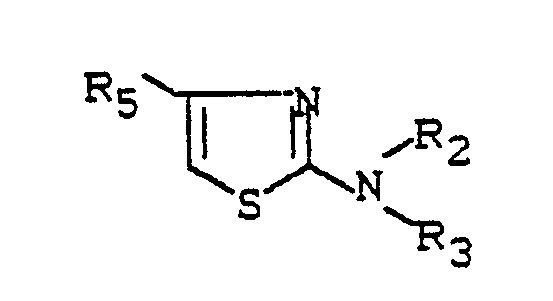

R₆ CN oder CO₂-Alkyl
bedeuten und
die übrigen Reste die in Anspruch 10 genannten Bedeutungen haben.
Applications Claiming Priority (2)
| Application Number | Priority Date | Filing Date | Title |
|---|---|---|---|
| DE19863637223 DE3637223A1 (de) | 1986-11-03 | 1986-11-03 | Verfahren zur herstellung von thiophenverbindungen |
| DE3637223 | 1986-11-03 |
Publications (2)
| Publication Number | Publication Date |
|---|---|
| EP0267467A1 true EP0267467A1 (de) | 1988-05-18 |
| EP0267467B1 EP0267467B1 (de) | 1989-10-18 |
Family
ID=6312955
Family Applications (1)
| Application Number | Title | Priority Date | Filing Date |
|---|---|---|---|
| EP87115393A Expired EP0267467B1 (de) | 1986-11-03 | 1987-10-21 | Verfahren zur Herstellung von Thiophenverbindungen |
Country Status (4)
| Country | Link |
|---|---|
| US (1) | US4888432A (de) |
| EP (1) | EP0267467B1 (de) |
| JP (1) | JPH0813810B2 (de) |
| DE (2) | DE3637223A1 (de) |
Families Citing this family (4)
| Publication number | Priority date | Publication date | Assignee | Title |
|---|---|---|---|---|
| WO1998023690A1 (en) | 1996-11-27 | 1998-06-04 | Eastman Chemical Company | Method for preparing light-absorbing polymeric compositions |
| US6362216B1 (en) | 1998-10-27 | 2002-03-26 | Array Biopharma Inc. | Compounds which inhibit tryptase activity |
| DE10017947A1 (de) * | 2000-04-11 | 2001-10-25 | Merck Patent Gmbh | Verfahren zur Herstellung benzo-annelierter Heterocyclen |
| US9200741B2 (en) | 2012-10-25 | 2015-12-01 | Nordson Corporation | Adhesive dispensing system and method using smart melt heater control |
Citations (2)
| Publication number | Priority date | Publication date | Assignee | Title |
|---|---|---|---|---|
| DE2333447A1 (de) * | 1972-07-04 | 1974-01-24 | Sandoz Ag | In wasser schwer loesliche azoverbindungen, ihre herstellung und verwendung |
| EP0166566A2 (de) * | 1984-06-25 | 1986-01-02 | Milliken Research Corporation | Harzfarbstoffe und Harzfärbung |
Family Cites Families (8)
| Publication number | Priority date | Publication date | Assignee | Title |
|---|---|---|---|---|
| US3491083A (en) * | 1966-01-14 | 1970-01-20 | Acna | Azo dyestuffs for polyamide fibers containing a thiophenedioxide group |
| US3776924A (en) * | 1970-05-20 | 1973-12-04 | Exxon Research Engineering Co | N-(2-(4,5,6,7-tetrahydrobenzothienyl))-ureas |
| US4092329A (en) * | 1972-12-01 | 1978-05-30 | Sandoz Ltd. | Process for the synthesis of certain 2-amino-5-cyanothiophenes |
| CH584257A5 (de) * | 1973-09-06 | 1977-01-31 | Sandoz Ag | |
| US4013681A (en) * | 1975-06-23 | 1977-03-22 | Hawaiian Sugar Planters' Association | Derivatives of thiophene |
| FR2375228A1 (fr) * | 1976-12-23 | 1978-07-21 | Parcor | Nouveaux benzothiophenes, leurs procedes de preparation et leur application notamment comme hypolipemiants et hypocholesterolemiants |
| US4507407A (en) * | 1984-06-25 | 1985-03-26 | Milliken Research Corporation | Process for in situ coloration of thermosetting resins |
| DE3427200A1 (de) * | 1984-07-24 | 1986-01-30 | Basf Ag, 6700 Ludwigshafen | Methinfarbstoffe |
-
1986
- 1986-11-03 DE DE19863637223 patent/DE3637223A1/de not_active Withdrawn
-
1987
- 1987-10-15 US US07/109,022 patent/US4888432A/en not_active Expired - Lifetime
- 1987-10-21 EP EP87115393A patent/EP0267467B1/de not_active Expired
- 1987-10-21 DE DE8787115393T patent/DE3760808D1/de not_active Expired
- 1987-10-29 JP JP62271963A patent/JPH0813810B2/ja not_active Expired - Lifetime
Patent Citations (2)
| Publication number | Priority date | Publication date | Assignee | Title |
|---|---|---|---|---|
| DE2333447A1 (de) * | 1972-07-04 | 1974-01-24 | Sandoz Ag | In wasser schwer loesliche azoverbindungen, ihre herstellung und verwendung |
| EP0166566A2 (de) * | 1984-06-25 | 1986-01-02 | Milliken Research Corporation | Harzfarbstoffe und Harzfärbung |
Non-Patent Citations (1)
| Title |
|---|
| CHEMISCHE BERICHTE, Band 101, Nr. 6, 1968, Seiten 1933-1939, Verlag Chemie GmbH, Weinheim, DE; K. GEWALD et al.: "2-Amino-thionaphthene" * |
Also Published As
| Publication number | Publication date |
|---|---|
| JPS63126874A (ja) | 1988-05-30 |
| JPH0813810B2 (ja) | 1996-02-14 |
| DE3637223A1 (de) | 1988-05-05 |
| US4888432A (en) | 1989-12-19 |
| DE3760808D1 (en) | 1989-11-23 |
| EP0267467B1 (de) | 1989-10-18 |
Similar Documents
| Publication | Publication Date | Title |
|---|---|---|
| DE2340569C2 (de) | Azofarbstoffe | |
| DE3529831C2 (de) | Thiophen-Azofarbstoffe | |
| DE1768892B2 (de) | Disazopigmente und deren Verwendung | |
| CH636116A5 (de) | Heterocyclische dispersionsfarbstoffe. | |
| DE3033159A1 (de) | Dimethinverbindungen der cumarinreihe, verfahren zu deren herstellung sowie deren verwendung als leuchtfarbstoffe | |
| EP0193885B1 (de) | Thiophenderivate | |
| DE2346316A1 (de) | Verfahren zur herstellung von furylbenzimidazolen. | |
| EP0267467A1 (de) | Verfahren zur Herstellung von Thiophenverbindungen | |
| CH639119A5 (de) | Azopigmente. | |
| DE2510373A1 (de) | Neue azofarbstoffe und verfahren zu deren herstellung | |
| DE2238378B2 (de) | Perinonfarbstoffe und Verfahren zu ihrer Herstellung | |
| EP0247970B1 (de) | Benzanthronlactone, Verfahren zu ihrer Herstellung und ihre Verwendung | |
| EP0281920A2 (de) | Farbstoffe mit N-(2-Aminoethyl)-piperazingruppen und ihre Verwendung | |
| DE2531445B2 (de) | Sulfogruppenfreie wasserloesliche azofarbstoffe und deren verwendung zum faerben und/oder bedrucken von synthetischen textilfasern | |
| DE2307169A1 (de) | Azofarbstoffe | |
| DE2254017A1 (de) | Wasserunloesliche azofarbstoffe und verfahren zu ihrer herstellung | |
| DE2307341A1 (de) | Wasserunloesliche monoazomethinfarbstoffe, verfahren zu ihrer herstellung und ihre verwendung | |
| CH618962A5 (de) | ||
| EP0169459B1 (de) | Azofarbstoffe | |
| EP0095638A1 (de) | 2,6-Dicyananiline | |
| DE2832456A1 (de) | Neue monoazopigmente und verfahren zu deren herstellung | |
| EP0624628A1 (de) | Kationische Diazacyaninfarbstoffe | |
| EP0000737B1 (de) | Monoazopigmente der Acetoacetylaminobenzimidazolonreihe, Verfahren zu deren Herstellung, und deren Verwendung zum Pigmentieren von hochmolekularem organischem Material | |
| EP0022076B1 (de) | Iminoisoindolinonfarbstoffe, Verfahren zu deren Herstellung und deren Verwendung | |
| DE2448911A1 (de) | Azofarbstoffe |
Legal Events
| Date | Code | Title | Description |
|---|---|---|---|
| PUAI | Public reference made under article 153(3) epc to a published international application that has entered the european phase |
Free format text: ORIGINAL CODE: 0009012 |
|
| 17P | Request for examination filed |
Effective date: 19871021 |
|
| AK | Designated contracting states |
Kind code of ref document: A1 Designated state(s): CH DE FR GB LI |
|
| 17Q | First examination report despatched |
Effective date: 19890112 |
|
| GRAA | (expected) grant |
Free format text: ORIGINAL CODE: 0009210 |
|
| AK | Designated contracting states |
Kind code of ref document: B1 Designated state(s): CH DE FR GB LI |
|
| ET | Fr: translation filed | ||
| REF | Corresponds to: |
Ref document number: 3760808 Country of ref document: DE Date of ref document: 19891123 |
|
| GBT | Gb: translation of ep patent filed (gb section 77(6)(a)/1977) | ||
| PLBE | No opposition filed within time limit |
Free format text: ORIGINAL CODE: 0009261 |
|
| STAA | Information on the status of an ep patent application or granted ep patent |
Free format text: STATUS: NO OPPOSITION FILED WITHIN TIME LIMIT |
|
| 26N | No opposition filed | ||
| PGFP | Annual fee paid to national office [announced via postgrant information from national office to epo] |
Ref country code: FR Payment date: 19981019 Year of fee payment: 12 |
|
| PGFP | Annual fee paid to national office [announced via postgrant information from national office to epo] |
Ref country code: GB Payment date: 19981023 Year of fee payment: 12 |
|
| PG25 | Lapsed in a contracting state [announced via postgrant information from national office to epo] |
Ref country code: GB Free format text: LAPSE BECAUSE OF NON-PAYMENT OF DUE FEES Effective date: 19991021 |
|
| GBPC | Gb: european patent ceased through non-payment of renewal fee |
Effective date: 19991021 |
|
| PG25 | Lapsed in a contracting state [announced via postgrant information from national office to epo] |
Ref country code: FR Free format text: LAPSE BECAUSE OF NON-PAYMENT OF DUE FEES Effective date: 20000630 |
|
| REG | Reference to a national code |
Ref country code: FR Ref legal event code: ST |
|
| PGFP | Annual fee paid to national office [announced via postgrant information from national office to epo] |
Ref country code: DE Payment date: 20010706 Year of fee payment: 15 Ref country code: CH Payment date: 20010706 Year of fee payment: 15 |
|
| PG25 | Lapsed in a contracting state [announced via postgrant information from national office to epo] |
Ref country code: LI Free format text: LAPSE BECAUSE OF NON-PAYMENT OF DUE FEES Effective date: 20021031 Ref country code: CH Free format text: LAPSE BECAUSE OF NON-PAYMENT OF DUE FEES Effective date: 20021031 |
|
| PG25 | Lapsed in a contracting state [announced via postgrant information from national office to epo] |
Ref country code: DE Free format text: LAPSE BECAUSE OF NON-PAYMENT OF DUE FEES Effective date: 20030501 |
|
| REG | Reference to a national code |
Ref country code: CH Ref legal event code: PL |