EP0170380A1 - Traitement de compositions verrières - Google Patents
Traitement de compositions verrières Download PDFInfo
- Publication number
- EP0170380A1 EP0170380A1 EP85304280A EP85304280A EP0170380A1 EP 0170380 A1 EP0170380 A1 EP 0170380A1 EP 85304280 A EP85304280 A EP 85304280A EP 85304280 A EP85304280 A EP 85304280A EP 0170380 A1 EP0170380 A1 EP 0170380A1
- Authority
- EP
- European Patent Office
- Prior art keywords
- glass
- oxygen
- composition
- glasses
- absorption
- Prior art date
- Legal status (The legal status is an assumption and is not a legal conclusion. Google has not performed a legal analysis and makes no representation as to the accuracy of the status listed.)
- Granted
Links
Images


Classifications
-
- C—CHEMISTRY; METALLURGY
- C03—GLASS; MINERAL OR SLAG WOOL
- C03C—CHEMICAL COMPOSITION OF GLASSES, GLAZES OR VITREOUS ENAMELS; SURFACE TREATMENT OF GLASS; SURFACE TREATMENT OF FIBRES OR FILAMENTS MADE FROM GLASS, MINERALS OR SLAGS; JOINING GLASS TO GLASS OR OTHER MATERIALS
- C03C3/00—Glass compositions
- C03C3/32—Non-oxide glass compositions, e.g. binary or ternary halides, sulfides or nitrides of germanium, selenium or tellurium
- C03C3/325—Fluoride glasses
-
- C—CHEMISTRY; METALLURGY
- C03—GLASS; MINERAL OR SLAG WOOL
- C03B—MANUFACTURE, SHAPING, OR SUPPLEMENTARY PROCESSES
- C03B5/00—Melting in furnaces; Furnaces so far as specially adapted for glass manufacture
- C03B5/06—Melting in furnaces; Furnaces so far as specially adapted for glass manufacture in pot furnaces
- C03B5/08—Glass-melting pots
-
- C—CHEMISTRY; METALLURGY
- C03—GLASS; MINERAL OR SLAG WOOL
- C03B—MANUFACTURE, SHAPING, OR SUPPLEMENTARY PROCESSES
- C03B5/00—Melting in furnaces; Furnaces so far as specially adapted for glass manufacture
- C03B5/16—Special features of the melting process; Auxiliary means specially adapted for glass-melting furnaces
- C03B5/225—Refining
-
- C—CHEMISTRY; METALLURGY
- C03—GLASS; MINERAL OR SLAG WOOL
- C03C—CHEMICAL COMPOSITION OF GLASSES, GLAZES OR VITREOUS ENAMELS; SURFACE TREATMENT OF GLASS; SURFACE TREATMENT OF FIBRES OR FILAMENTS MADE FROM GLASS, MINERALS OR SLAGS; JOINING GLASS TO GLASS OR OTHER MATERIALS
- C03C13/00—Fibre or filament compositions
- C03C13/04—Fibre optics, e.g. core and clad fibre compositions
- C03C13/041—Non-oxide glass compositions
- C03C13/042—Fluoride glass compositions
-
- C—CHEMISTRY; METALLURGY
- C03—GLASS; MINERAL OR SLAG WOOL
- C03B—MANUFACTURE, SHAPING, OR SUPPLEMENTARY PROCESSES
- C03B2201/00—Type of glass produced
- C03B2201/80—Non-oxide glasses or glass-type compositions
- C03B2201/82—Fluoride glasses, e.g. ZBLAN glass
-
- Y—GENERAL TAGGING OF NEW TECHNOLOGICAL DEVELOPMENTS; GENERAL TAGGING OF CROSS-SECTIONAL TECHNOLOGIES SPANNING OVER SEVERAL SECTIONS OF THE IPC; TECHNICAL SUBJECTS COVERED BY FORMER USPC CROSS-REFERENCE ART COLLECTIONS [XRACs] AND DIGESTS
- Y10—TECHNICAL SUBJECTS COVERED BY FORMER USPC
- Y10S—TECHNICAL SUBJECTS COVERED BY FORMER USPC CROSS-REFERENCE ART COLLECTIONS [XRACs] AND DIGESTS
- Y10S501/00—Compositions: ceramic
- Y10S501/90—Optical glass, e.g. silent on refractive index and/or ABBE number
- Y10S501/904—Infrared transmitting or absorbing
-
- Y—GENERAL TAGGING OF NEW TECHNOLOGICAL DEVELOPMENTS; GENERAL TAGGING OF CROSS-SECTIONAL TECHNOLOGIES SPANNING OVER SEVERAL SECTIONS OF THE IPC; TECHNICAL SUBJECTS COVERED BY FORMER USPC CROSS-REFERENCE ART COLLECTIONS [XRACs] AND DIGESTS
- Y10—TECHNICAL SUBJECTS COVERED BY FORMER USPC
- Y10S—TECHNICAL SUBJECTS COVERED BY FORMER USPC CROSS-REFERENCE ART COLLECTIONS [XRACs] AND DIGESTS
- Y10S65/00—Glass manufacturing
- Y10S65/15—Nonoxygen containing chalogenides
- Y10S65/16—Optical filament or fiber treatment with fluorine or incorporating fluorine in final product
Definitions
- This invention relates to the treatment of glass compositions.
- it relates to the treatment of compositions which are suitable for use in the production of optical fibres, in order that the fibres should have low loss.
- the distance over which a signal can be successfully transmitted through an optical fibre is limited by two distinct types of loss which occur in glasses generally: losses arising from absorption, e.g. in electronic transitions or vibrational transitions; and losses due to Rayleigh scattering (a phenomenon resulting from inhomogeneities).
- the latter type of loss is a theoretically inevitable one, although it becomes far less significant at longer wavelengths. If a glass can be formulated so that the absorption is very low at long wavelengths, very low loss (absorption plus Rayleigh scattering) can be achieved in communications at such wavelengths.
- the absorption spectrum is such that they have minimum loss in the range of 0.8-1.2 ⁇ m. Such fibres are less suitable for long than for short distance communication, e.g. between computers.
- An absorption peak at about 950 nm may be attributed to OH vibrational absorption, and various solutions have been proposed to reduce loss at or around this wavelength, by the passage of gases through the glass melt, such gases being CO/C0 2 (GB-A-1507712), dry oxygen (GB-A-2033373), chlorides such as SiC1 4 (JP-A-56-149332) and fluorine-containing gases, e.g. C 3 F 8 and F 2 , as drying agents (EP-A-0103441).
- Loss may also be attributable to impurities in the glass constituents and therefore in the glass.
- One class of impurities is the transition metal elements, but the need to reduce the loss caused by such compounds is dependent on the relationship between the wavelength at which they absorb and the transmission wavelength; if these wavelengths are sufficiently different, the impurities can be tolerated.
- GB-A-1507712 discloses that the effect of Fe and Cu impurities in oxide glasses may be reduced, not by removing the compounds as such but by changing the oxidation states of the metals, to Fe(III) and Cu(I), respectively.
- As 2 O 3 and other redox buffering agents are proposed for use with the reducing gas CO.
- Preferred multi-component fluoride glass compositions are ZrF 4 -based.
- components of such compositions are, in addition to zrF 4 (or HfF 4), BaF 2 , LaF 3 , GdF 3 , AlF 3 and NaF or LiF.
- Particular compositions, and a general background to the formulation of non-silica-based infra-red fibres, are given by Miyashita et al., IEEE Journal of Quantum Electronics, QE-18, No. 10 (October 1982).
- Suitable compositions can be determined from phase diagrams of the type given for a ZrF 4 -BaF 2 -GdF 3 composition in Figure 3 of the article by Miyashita et al.
- a process for treating a halide glass composition comprises contacting a melt of the composition with dry oxygen.
- oxygen is convenient and practical, and avoids problems associated with handling other oxidising agents such as F 2' Cl 2 and perfluorocarbons.
- the process can be conducted in simple apparatus of the type illustrated schematically in Figure 1 of the accompanying drawings, which is described in more detail below.
- the present invention is based on the realisation that the raw materials which are used to prepare a halide glass contain carbon and transition metal impurities which can have a deleterious effect on the absorption spectrum of the glass, and on the attenuation of optical fibre prepared from the glass. It has now been appreciated that, at the likely operational wavelength for fluoride glass fibres, Fe(II) contributes to loss, although Fe(III) does not. This is similar to the problems encountered in oxide glasses, as discussed above, but a difference lies in the fact that losses due to Cu(II) absorption can be substantially ignored at higher wavelengths than are used for transmission in oxide glass fibres. It has also been discovered that fluoride glasses can contain transition metal impurities in different oxidation states, stably within the matrix; this had not been predicted, and was unexpected.
- the present invention is based also on the surprising discovery that the use of oxygen does not necessarily cause the production of oxides or other compounds in the glass, which might absorb at or near suitable operating wavelengths. This can now be explained, with hindsight, by the relatively high thermodynamic stability of fluorides with respect to oxides. It has also been found that reactive atmosphere processing is unnecessary for the removal of OH from fluoride glasses.
- the glass may be any halide, e.g. mixed halide, glass composition.
- a fluoride glass composition is preferred.
- Oxygen will usually be used, in the invention, in admixture with an inert gas diluent.
- Air can be used, if well dried, e.g. by using molecular sieves or other filters.
- an inert gas such as N 2 may be used, the gas mixture usually containing at least 1 and generally at least 5, preferably 5 to 50, e.g. 10, % v/v 0 2 .
- 0 2 can be generated in situ.
- a source of N 2 0 may be used; 0 2 and inert gases only are then in contact with the glass melt, under the reaction conditions.
- a suitable liquid which releases 0 2 on heating can be volatilised and the vapour caused to pass over the glass melt.
- the oxygen should not be used in the presence of components which can themselves be, or react to introduce, undesirable components in the composition.
- Moisture must be absent, in order to avoid the formation of oxides.
- the glass may be melted in a crucible which should be inert.
- Oxygen can simply be flushed over the melt, in a sealed chamber, to give satisfactory results.
- Fig. 1 shows a suitable sealed chamber.
- a crucible 1 having a lid 2 and containing a glass melt 3.
- the crucible 1 is housed within a liner 4 having a lid 5 through which gas can enter via an inlet 6 and exit via an outlet 7.
- the crucible 1 and the liner 4 are positioned inside a furnace 8.
- the crucible may be of Pt/Au, the liner and its lid of silica.
- the schedule of oxygen/melt contact will in fact usually comprise a period during which an inert gas/oxygen gas mixture is contacted with the melt, followed by an inert gas phase which allows cooling.
- the period of oxidation may be from 30 min to 5 hours.
- the temperature during oxidation may be from 600 to 1200 C.
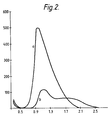
- the desired effect of the process of the invention can be monitored by observation of the absorption characteristics of the bulk glass and, in particular, by monitoring the disappearance of Fe(II) absorbence in the 2-3 ⁇ m wavelength range, or the appearance of absorbence owing to Fe(III).
- the reaction should go substantially to completion, i.e. so that there is substantially no Fe(II) absorbence, a characteristic which can be determined by relative experimentation at least.
- compositions treated by the invention can be formulated into bulk glasses or preforms for subsequent drawing into optical fibres, e.g. for monomode transmission. It is preferred that both core and cladding glasses of an optical fibre are treated by the process of the invention. Fast quenching may be necessary. Chemical vapour deposition may be used.
- Glass compositions treated by the invention can also be used for optical components in general, e.g. windows and test apparatus, and wherever there is a need for long wavelength transmission.
- Fluoride (and other halide) glass fibres can be produced by the methods described by Miyashita et al., supra. These methods can be used or suitably modified for the production of fibres having a core and a cladding, e.g. from a double-crucible or by casting; see also Mitachi et al., Electron Lett. 1.8 (Feb. 1982) 170-171.
- the core diameter may be 5 to 200 ⁇ m, and the cladding's outer diameter is usually at least 25 ⁇ m more, e.g. 100 to 300 ⁇ m.
- Optical fibres of the invention may have low loss, e.g. less than 100 dB/km (at 2.8 ⁇ m).
- Two glass compositions (about 20 g and 30 g, respectively) were prepared from ZrF 4 , BaF 2 , LaF 3 , A1F 3 , NaF, PbF 2 (in the first case) and NH 4 HF 2 .
- the amounts of these components in the first (core glass) composition were 11.71, 4.65, 1.41, 0.37, 1.03, 0.83 and 0.5 g, respectively; in the second (cladding glass) composition, these amounts were 18.66, 7.39, 1.68, 0.53, 1.76, 0 and 0.5 g, respectively.
- compositions were heated to 400 C in separate, inert crucibles with lids, under a nitrogen gas flow at a rate of 3 1/min. After 45 minutes, the temperature of the oven was raised to 900 C. After 60 minutes, oxygen was also introduced, at a rate of 0.2 1/min, and the combined nitrogen/oxygen flow was maintained for 2 hours. The oxygen flow was then turned off and the temperature was reduced to 670 C. After a further hour, the melts were cast to form a preform, by centrifugally casting the cladding glass into a tube and then casting the core glass into that tube, followed by cooling and annealing.
- the preform was drawn into fibre having an external diameter of 180 ⁇ m.
- the loss characteristics of the fibre were observed.
- An attenuation maximum corresponding to about 1 ppm Cu(II) was observed at about 1 ⁇ m, and an attenuation minimum, apparently substantially free of loss owing to Fe(II), at 2.6-2.7 ⁇ m.
- Example 1 The procedure of Example 1 was followed, except that a temperature of 850, rather than 900, C was used and the 0 2 flow rate was increased to 0.3 1/min. The product was again satisfactory, with little or no loss attributable to Fe(II).
- a series of tests was conducted to illustrate the utility of the invention.
- a glass composition was made up from anhydrous fluoride powders which had been stored under dry nitrogen.
- the composition was 51.5% ZrF 4 , 19.5% BaF 2 , 5.3% LaF 3 , 3.2% A1F 3 , 18.0% NaF and 2.5% PbF 2 (percentages by weight).
- the powders were weighed and mixed into plastic containers in batches of 30 g.
- 0.1 wt % metal fluoride was added to each batch, using the materials shown in the Table, below.
- 0.5 g NH 4 HF 2 was also added, to convert any residual oxides into fluorides.
- Oxidising conditions were provided by introducing 0.3 1/min of 0 2 into the N 2 gas flow, 1 hr into the run, and maintaining this until the end.
- the P 0 2 in this case was 0.091 atmospheres.
- Reducing conditions were obtained by melting in a Pt/Au crucible under dry nitrogen supplied from a large reservoir of liquid nitrogen (-196 C). Since the melting temperature was kept constant and the N 2 supply was from a continuous source with a quoted oxygen content of less than 10 ppm, the oxygen fugacity is believed to have been fairly constant between runs.
- the liner was removed from the furnace so that the melt could be quenched whilst still under an atmosphere of dry nitrogen. After a quench time of 5 min, the glass had reached Tg, and the crucible and glass sample were transferred to an annealing oven at 240 C. The sample was cooled overnight to room temperature, before being removed from the crucible and cut and polished in preparation for optical measurements, to thicknesses in the range of 6 to 24 mm.
- Absorption spectra were measured over a wavelength range of 0.2 to 2.85 ⁇ m. In general, the colours observed in the absorption spectra were similar to those seen in low alkali oxide glasses where the transition metals take up octahedral symmetry, apart from Fe and Cu where the weaker ligand field associated with fluoride has removed the normal colouration and shifted the absorption into the infra-red.
- dopant concentrations were independently measured on each sample using electron microprobe techniques.
- the work was done with a Cambridge Instruments S180 scanning electron microscope fitted with a Microspec wavelength dispersive X-ray spectrometer. Small circular blocks, about 6 mm in diameter, were cut from each glass sample and mounted in a large block. The top surface was then polished flat, coated with gold and mounted for electron microprobe work.
- Bulk glasses were made up from anhydrous fluorides and doped with Fe and Cu.
- the host glass was a Zr-Ba-La-Al-Na-Pb fluoride composition which was used as the core glass in IR fibres.
- Oxidised and reduced glasses were made up by melting under a stream of N 2 , either alone (reducing) or together with O 2 .
- Infra-red fibres were fabricated from both oxidised and reduced glasses in order to determine the effects on the transmission losses.
- the core glass was of the same composition as that described in Example 4, and the cladding glass was similar but with a lower refractive index. Reducing conditions were again obtained from a flow of dry N 2 ; 0 2 was introduced to give oxidising conditions.
- the glasses were converted into preforms using rotational casting as described by Tran et al, Electron. Let. 18 (1982) 657-658, and were drawn into fibre using conventional techniques.
- the fibres were 170 ⁇ m in diameter with a core of 90 ⁇ m and loss measurements were made on 60 m of fibre cut from a 300 m length.
- Fig. 3 shows absorption curves a and b, for fibres made respectively under reducing and oxidising conditions, as a function of the extinction coefficient (abscissa) in dB/km with respect to wavelength (ordinate) in ⁇ m.
- the fibres have similar characteristics, with a minimum loss occurring close to 2.7 ⁇ m, an OH absorption at 2.87 ⁇ m and an IR edge rising above 3.3 ⁇ m.
- the reduced fibre clearly exhibits an Fe 2+ absorption corresponding to about 600 ppb of Fe (assuming all Fe exists as Fe 2+ ).
- the oxidised fibre has little Fe 2+ absorption, but now exhibits a peak centred at 0.97 ⁇ m corresponding to about 100 ppb of Cu2+. By removing the Fe 2+ absorption and reducing scattering losses, the total loss in this fibre has been reduced to 21 dB/km at 2.7 ⁇ m.
- Fe is found to be the dominant impurity (Fe ⁇ 600 ppb, Cu ⁇ 100 ppb, all others ⁇ 80 ppb) and, for this reason, it is likely that oxidised glasses will give lower absorption losses.
- the absorption loss of fibre (b) has been estimated to be of the order of 2 dB/km at 2.5 ⁇ m and this figure has been corroborated by measurements at shorter wavelengths using calorimetric absorption; see White et al, Opto-Electron. 5 (1973) 323-324.
Landscapes
- Chemical & Material Sciences (AREA)
- Engineering & Computer Science (AREA)
- Materials Engineering (AREA)
- Organic Chemistry (AREA)
- Life Sciences & Earth Sciences (AREA)
- Chemical Kinetics & Catalysis (AREA)
- General Chemical & Material Sciences (AREA)
- Geochemistry & Mineralogy (AREA)
- Physics & Mathematics (AREA)
- Optics & Photonics (AREA)
- Glass Compositions (AREA)
- Manufacture, Treatment Of Glass Fibers (AREA)
- Optical Fibers, Optical Fiber Cores, And Optical Fiber Bundles (AREA)
- Glass Melting And Manufacturing (AREA)
Priority Applications (1)
| Application Number | Priority Date | Filing Date | Title |
|---|---|---|---|
| AT85304280T ATE52750T1 (de) | 1984-08-03 | 1985-06-14 | Behandlung von glaszusammensetzungen. |
Applications Claiming Priority (2)
| Application Number | Priority Date | Filing Date | Title |
|---|---|---|---|
| GB8419829 | 1984-08-03 | ||
| GB848419829A GB8419829D0 (en) | 1984-08-03 | 1984-08-03 | Treating glass compositions |
Publications (2)
| Publication Number | Publication Date |
|---|---|
| EP0170380A1 true EP0170380A1 (fr) | 1986-02-05 |
| EP0170380B1 EP0170380B1 (fr) | 1990-05-16 |
Family
ID=10564892
Family Applications (1)
| Application Number | Title | Priority Date | Filing Date |
|---|---|---|---|
| EP85304280A Expired - Lifetime EP0170380B1 (fr) | 1984-08-03 | 1985-06-14 | Traitement de compositions verrières |
Country Status (7)
| Country | Link |
|---|---|
| US (2) | US4741752A (fr) |
| EP (1) | EP0170380B1 (fr) |
| JP (1) | JPS61101423A (fr) |
| AT (1) | ATE52750T1 (fr) |
| CA (1) | CA1267537A (fr) |
| DE (1) | DE3577689D1 (fr) |
| GB (1) | GB8419829D0 (fr) |
Cited By (4)
| Publication number | Priority date | Publication date | Assignee | Title |
|---|---|---|---|---|
| WO1986007587A1 (fr) * | 1985-06-21 | 1986-12-31 | Hughes Aircraft Company | Traitement en atmosphere reactive de verres a base de fluorure de metaux lourds |
| JPH03505008A (ja) * | 1988-05-09 | 1991-10-31 | ブリテイッシュ・テレコミュニケーションズ・パブリック・リミテッド・カンパニー | フッ化物ガラス光ファイバ結合器および製造方法 |
| JPH03505262A (ja) * | 1988-05-09 | 1991-11-14 | ブリテイッシュ・テレコミュニケーションズ・パブリック・リミテッド・カンパニー | フッ化物ガラス光結合素子、結合器および方法 |
| WO1992000923A1 (fr) * | 1990-07-09 | 1992-01-23 | British Telecommunications Public Limited Company | Procede de preparation d'objets en verre d'halogenure |
Families Citing this family (12)
| Publication number | Priority date | Publication date | Assignee | Title |
|---|---|---|---|---|
| GB8419829D0 (en) * | 1984-08-03 | 1984-09-05 | British Telecomm | Treating glass compositions |
| US5256178A (en) * | 1987-01-23 | 1993-10-26 | Siemens Aktiengesellschaft | Method for producing an optical fiber of halide glass, particularly an infrared permeable fiber of heavy metal fluoride glass |
| US5201920A (en) * | 1987-01-23 | 1993-04-13 | Siemens Aktiengesellschaft | Method for producing an optical fiber of halide glass, particularly an infrared permeable fiber of fluoride glass |
| US4895813A (en) * | 1987-09-30 | 1990-01-23 | American Telephone And Telegraph Company, At&T Bell Laboratories | Method for fabricating devices including multicomponent metal halide glasses and the resulting devices |
| US5055120A (en) * | 1987-12-15 | 1991-10-08 | Infrared Fiber Systems, Inc. | Fluoride glass fibers with reduced defects |
| US5215563A (en) * | 1990-05-04 | 1993-06-01 | Alfred University | Process for preparing a durable glass composition |
| US5796903A (en) * | 1992-07-06 | 1998-08-18 | Infrared Fiber Systems, Inc. | Heavy metal-oxide glass optical fibers for use in laser medical surgery and process of making |
| JPH0710548A (ja) * | 1993-06-18 | 1995-01-13 | Sumitomo Electric Ind Ltd | フッ化物ガラスの製造方法 |
| US6345519B1 (en) * | 1996-10-25 | 2002-02-12 | Corning Incorporated | Method of reducing break sources in drawn fibers by active oxidation of contaminants in a reducing atmosphere |
| TWI276611B (en) * | 2000-08-17 | 2007-03-21 | Hoya Corp | Process for producing glass and glass-melting apparatus thereof |
| US6485562B1 (en) | 2001-08-16 | 2002-11-26 | Ceramoptec Industries, Inc. | Production of material with improved infrared transmission |
| JP5215743B2 (ja) * | 2008-06-12 | 2013-06-19 | Hoya株式会社 | 光学ガラスの製造方法、精密プレス成形用プリフォームの製造方法および光学素子の製造方法 |
Citations (2)
| Publication number | Priority date | Publication date | Assignee | Title |
|---|---|---|---|---|
| US4189208A (en) * | 1978-03-10 | 1980-02-19 | Bell Telephone Laboratories, Incorporated | Zinc chloride optical fibers for transmission in the infrared |
| FR2521546A1 (fr) * | 1982-02-18 | 1983-08-19 | Centre Nat Rech Scient | Nouveaux verres halogenes, leur preparation et leur application |
Family Cites Families (14)
| Publication number | Priority date | Publication date | Assignee | Title |
|---|---|---|---|---|
| GB1507712A (en) * | 1975-07-14 | 1978-04-19 | Post Office | Preparation of alkali-metal-boro-silicate glasses |
| DE2726170C2 (de) * | 1976-06-15 | 1987-01-22 | Agence Nationale de Valorisation de la Recherche (ANVAR), Neuilly-sur-Seine, Hauts-de-Seine | Fluoridglas auf der Basis eines ternären Systems aus Zirkoniumfluorid, Bariumfluorid und einem Seltenerdfluorid sowie ggfs. einem weiteren Metallfluorid als zusätzlichen Bestandteil und ein Verfahren zu seiner Herstellung |
| JPS5852932B2 (ja) * | 1976-06-30 | 1983-11-26 | 株式会社東芝 | 光通信用光学ガラスの製造方法 |
| DE2842586A1 (de) * | 1978-09-29 | 1980-04-17 | Siemens Ag | Verfahren zur herstellung von lichtleitfasern niedriger daempfung und hoher numerischer apertur |
| JPS5562822A (en) * | 1978-11-02 | 1980-05-12 | Nippon Telegr & Teleph Corp <Ntt> | Production of multicomponent glass body for light transmission |
| JPS5842138B2 (ja) * | 1979-10-04 | 1983-09-17 | 株式会社 小原光学硝子製造所 | 弗化物ガラスの製造方法 |
| DD153969A3 (de) * | 1980-04-14 | 1982-02-17 | Herbert Buerger | Optische fluoridglaeser |
| JPS56149332A (en) * | 1980-04-17 | 1981-11-19 | Nippon Sheet Glass Co Ltd | Manufacture of glass with low water content |
| GB2075001B (en) * | 1980-04-24 | 1983-08-17 | Standard Telephones Cables Ltd | Glasses based on hafnium fluoride |
| US4388413A (en) * | 1981-10-21 | 1983-06-14 | Doremus Robert H | Silver halide glasses |
| FR2563826B1 (fr) * | 1984-05-07 | 1991-08-30 | Verre Fluore Sa | Procedes de fabrication de fibres et de composants optiques en verres fluores et appareils destines a les mettre en oeuvre |
| GB8419829D0 (en) * | 1984-08-03 | 1984-09-05 | British Telecomm | Treating glass compositions |
| US4659352A (en) * | 1985-06-21 | 1987-04-21 | Hughes Aircraft Company | Reactive atmosphere processing of heavy-metal fluoride glasses |
| FR2771805B1 (fr) * | 1997-12-02 | 2000-02-18 | Lacroix Soc E | Generateur pyroacoustique pour la protection de sous-marins et de batiments de surface |
-
1984
- 1984-08-03 GB GB848419829A patent/GB8419829D0/en active Pending
-
1985
- 1985-06-14 AT AT85304280T patent/ATE52750T1/de not_active IP Right Cessation
- 1985-06-14 DE DE8585304280T patent/DE3577689D1/de not_active Expired - Lifetime
- 1985-06-14 EP EP85304280A patent/EP0170380B1/fr not_active Expired - Lifetime
- 1985-06-21 JP JP60135827A patent/JPS61101423A/ja active Pending
- 1985-07-18 US US06/756,304 patent/US4741752A/en not_active Expired - Lifetime
- 1985-07-24 CA CA000487356A patent/CA1267537A/fr not_active Expired - Lifetime
-
1988
- 1988-04-05 US US07/155,055 patent/US4848997A/en not_active Expired - Lifetime
Patent Citations (2)
| Publication number | Priority date | Publication date | Assignee | Title |
|---|---|---|---|---|
| US4189208A (en) * | 1978-03-10 | 1980-02-19 | Bell Telephone Laboratories, Incorporated | Zinc chloride optical fibers for transmission in the infrared |
| FR2521546A1 (fr) * | 1982-02-18 | 1983-08-19 | Centre Nat Rech Scient | Nouveaux verres halogenes, leur preparation et leur application |
Non-Patent Citations (2)
| Title |
|---|
| JOURNAL OF NON-CRYSTALLINE SOLIDS, vol. 69, no. 2/3, January 1985, pages 303-315, Elsevier Science Publishers B.V., Amsterdam, NL; T. KOMATSU et al.: "Infrared transmission and glass formation in AgI-AgF-AIF3" * |
| VERRES REFRACTAIRES, vol. 34, no. 3, May-June 1980, pages 333-342; A. LECOQ et al.: "Etude phénomémologique du rôle stabilisateur de l'aluminium dans les verres au tétrafluorure de zirconium" * |
Cited By (7)
| Publication number | Priority date | Publication date | Assignee | Title |
|---|---|---|---|---|
| WO1986007587A1 (fr) * | 1985-06-21 | 1986-12-31 | Hughes Aircraft Company | Traitement en atmosphere reactive de verres a base de fluorure de metaux lourds |
| JPH03505008A (ja) * | 1988-05-09 | 1991-10-31 | ブリテイッシュ・テレコミュニケーションズ・パブリック・リミテッド・カンパニー | フッ化物ガラス光ファイバ結合器および製造方法 |
| JPH03505262A (ja) * | 1988-05-09 | 1991-11-14 | ブリテイッシュ・テレコミュニケーションズ・パブリック・リミテッド・カンパニー | フッ化物ガラス光結合素子、結合器および方法 |
| US5139550A (en) * | 1988-05-09 | 1992-08-18 | British Telecommunications Public Limited Company | Method of making fluoride glass optical coupler |
| WO1992000923A1 (fr) * | 1990-07-09 | 1992-01-23 | British Telecommunications Public Limited Company | Procede de preparation d'objets en verre d'halogenure |
| US5334232A (en) * | 1990-07-09 | 1994-08-02 | British Telecommunications Public Limited Company | Method for the preparation of halide glass articles |
| US5401289A (en) * | 1990-07-09 | 1995-03-28 | British Telecommunications Public Limited Company | Method of making halide fibers including casting under a reduced pressure |
Also Published As
| Publication number | Publication date |
|---|---|
| GB8419829D0 (en) | 1984-09-05 |
| JPS61101423A (ja) | 1986-05-20 |
| US4741752A (en) | 1988-05-03 |
| ATE52750T1 (de) | 1990-06-15 |
| EP0170380B1 (fr) | 1990-05-16 |
| DE3577689D1 (de) | 1990-06-21 |
| US4848997A (en) | 1989-07-18 |
| CA1267537A (fr) | 1990-04-10 |
Similar Documents
| Publication | Publication Date | Title |
|---|---|---|
| US4741752A (en) | Treating glass compositions | |
| Poulain | Halide glasses | |
| US4341873A (en) | Fluorozirconate, glass and the process for making the same | |
| US5655046A (en) | Glass composition, optical fiber made of same, and method for preparing glasses | |
| Lezal et al. | GeO2-PbO glassy system for infrared fibers for delivery of Er: YAG laser energy | |
| US4946490A (en) | Method for preparing fluoride glasses | |
| Mitachi et al. | Reduction of impurities in fluoride glass fibers | |
| Marchese et al. | 1G4 lifetimes, optical and thermal characteristics of Pr-doped GeS2-chalcohalide glasses | |
| EP0227792B1 (fr) | Traitement en atmosphere reactive de verres a base de fluorure de metaux lourds | |
| US5015281A (en) | Method for preparing fluoride glasses | |
| EP0629587A1 (fr) | Procédé et dispositif pour la fabrication de verre fluoré | |
| US4322500A (en) | Potassium fluoroborate silicate glasses | |
| Maze et al. | Reduction of OH-absorption in fluoride glasses | |
| EP0502569B1 (fr) | Procédé pour la réalisation d'une composition de verre à base de fluorure-métal lourd | |
| Saad | High purity fluoride glass synthesis: a review | |
| Mimura et al. | Optical fiber loss mechanisms | |
| Aasland et al. | Oxidation states of transition metals in ZBLAN | |
| EP0336280A2 (fr) | Méthode de préparation de verres fluorés | |
| Khalilev et al. | The influence of oxide doping on some optical properties of fluoroaluminate glasses | |
| Ohishi et al. | Influence of humidity during the fibre preparation process on transmission loss for ZrF4-based optical fibres | |
| GB2148276A (en) | Glass compositions | |
| Poignant | Role of impurities in halide glasses | |
| Drexhage | Optical properties of fluoride glasses | |
| Qui et al. | Influence of various divalent metal fluorides on the properties of glasses in the ZrF4-AlF3 system | |
| Le Sergent | Chalcogenide glass optical fibers-an overview |
Legal Events
| Date | Code | Title | Description |
|---|---|---|---|
| PUAI | Public reference made under article 153(3) epc to a published international application that has entered the european phase |
Free format text: ORIGINAL CODE: 0009012 |
|
| AK | Designated contracting states |
Designated state(s): AT BE CH DE FR GB IT LI LU NL SE |
|
| 17P | Request for examination filed |
Effective date: 19860521 |
|
| 17Q | First examination report despatched |
Effective date: 19870313 |
|
| RAP3 | Party data changed (applicant data changed or rights of an application transferred) |
Owner name: BRITISH TELECOMMUNICATIONS PUBLIC LIMITED COMPANY |
|
| GRAA | (expected) grant |
Free format text: ORIGINAL CODE: 0009210 |
|
| AK | Designated contracting states |
Kind code of ref document: B1 Designated state(s): AT BE CH DE FR GB IT LI LU NL SE |
|
| REF | Corresponds to: |
Ref document number: 52750 Country of ref document: AT Date of ref document: 19900615 Kind code of ref document: T |
|
| ITF | It: translation for a ep patent filed | ||
| REF | Corresponds to: |
Ref document number: 3577689 Country of ref document: DE Date of ref document: 19900621 |
|
| ET | Fr: translation filed | ||
| PLBE | No opposition filed within time limit |
Free format text: ORIGINAL CODE: 0009261 |
|
| STAA | Information on the status of an ep patent application or granted ep patent |
Free format text: STATUS: NO OPPOSITION FILED WITHIN TIME LIMIT |
|
| 26N | No opposition filed | ||
| ITTA | It: last paid annual fee | ||
| EPTA | Lu: last paid annual fee | ||
| EAL | Se: european patent in force in sweden |
Ref document number: 85304280.2 |
|
| PGFP | Annual fee paid to national office [announced via postgrant information from national office to epo] |
Ref country code: SE Payment date: 19980518 Year of fee payment: 14 |
|
| PGFP | Annual fee paid to national office [announced via postgrant information from national office to epo] |
Ref country code: NL Payment date: 19980527 Year of fee payment: 14 |
|
| PGFP | Annual fee paid to national office [announced via postgrant information from national office to epo] |
Ref country code: BE Payment date: 19980604 Year of fee payment: 14 |
|
| PGFP | Annual fee paid to national office [announced via postgrant information from national office to epo] |
Ref country code: LU Payment date: 19981021 Year of fee payment: 14 |
|
| PG25 | Lapsed in a contracting state [announced via postgrant information from national office to epo] |
Ref country code: LU Free format text: LAPSE BECAUSE OF NON-PAYMENT OF DUE FEES Effective date: 19990614 |
|
| PG25 | Lapsed in a contracting state [announced via postgrant information from national office to epo] |
Ref country code: SE Free format text: THE PATENT HAS BEEN ANNULLED BY A DECISION OF A NATIONAL AUTHORITY Effective date: 19990629 |
|
| PG25 | Lapsed in a contracting state [announced via postgrant information from national office to epo] |
Ref country code: BE Free format text: LAPSE BECAUSE OF NON-PAYMENT OF DUE FEES Effective date: 19990630 |
|
| BERE | Be: lapsed |
Owner name: BRITISH TELECOMMUNICATIONS P.L.C. Effective date: 19990630 |
|
| PG25 | Lapsed in a contracting state [announced via postgrant information from national office to epo] |
Ref country code: NL Free format text: LAPSE BECAUSE OF NON-PAYMENT OF DUE FEES Effective date: 20000101 |
|
| EUG | Se: european patent has lapsed |
Ref document number: 85304280.2 |
|
| NLV4 | Nl: lapsed or anulled due to non-payment of the annual fee |
Effective date: 20000101 |
|
| REG | Reference to a national code |
Ref country code: GB Ref legal event code: 732E |
|
| REG | Reference to a national code |
Ref country code: GB Ref legal event code: IF02 |
|
| PGFP | Annual fee paid to national office [announced via postgrant information from national office to epo] |
Ref country code: AT Payment date: 20020510 Year of fee payment: 18 |
|
| PGFP | Annual fee paid to national office [announced via postgrant information from national office to epo] |
Ref country code: GB Payment date: 20020520 Year of fee payment: 18 |
|
| PGFP | Annual fee paid to national office [announced via postgrant information from national office to epo] |
Ref country code: CH Payment date: 20020521 Year of fee payment: 18 |
|
| PGFP | Annual fee paid to national office [announced via postgrant information from national office to epo] |
Ref country code: DE Payment date: 20020523 Year of fee payment: 18 |
|
| PG25 | Lapsed in a contracting state [announced via postgrant information from national office to epo] |
Ref country code: GB Free format text: LAPSE BECAUSE OF NON-PAYMENT OF DUE FEES Effective date: 20030614 Ref country code: AT Free format text: LAPSE BECAUSE OF NON-PAYMENT OF DUE FEES Effective date: 20030614 |
|
| PG25 | Lapsed in a contracting state [announced via postgrant information from national office to epo] |
Ref country code: LI Free format text: LAPSE BECAUSE OF NON-PAYMENT OF DUE FEES Effective date: 20030630 Ref country code: CH Free format text: LAPSE BECAUSE OF NON-PAYMENT OF DUE FEES Effective date: 20030630 |
|
| PG25 | Lapsed in a contracting state [announced via postgrant information from national office to epo] |
Ref country code: DE Free format text: LAPSE BECAUSE OF NON-PAYMENT OF DUE FEES Effective date: 20040101 |
|
| GBPC | Gb: european patent ceased through non-payment of renewal fee |
Effective date: 20030614 |
|
| REG | Reference to a national code |
Ref country code: CH Ref legal event code: PL |
|
| PGFP | Annual fee paid to national office [announced via postgrant information from national office to epo] |
Ref country code: FR Payment date: 20040513 Year of fee payment: 20 |