EP0174207B1 - Herstellung von Poly(arylenetherketonen) - Google Patents
Herstellung von Poly(arylenetherketonen) Download PDFInfo
- Publication number
- EP0174207B1 EP0174207B1 EP85306349A EP85306349A EP0174207B1 EP 0174207 B1 EP0174207 B1 EP 0174207B1 EP 85306349 A EP85306349 A EP 85306349A EP 85306349 A EP85306349 A EP 85306349A EP 0174207 B1 EP0174207 B1 EP 0174207B1
- Authority
- EP
- European Patent Office
- Prior art keywords
- diluent
- lewis acid
- polymer
- poly
- complex
- Prior art date
- Legal status (The legal status is an assumption and is not a legal conclusion. Google has not performed a legal analysis and makes no representation as to the accuracy of the status listed.)
- Expired - Lifetime
Links
- -1 poly(arylene ether ketones Chemical class 0.000 title claims abstract description 61
- RTZKZFJDLAIYFH-UHFFFAOYSA-N ether Substances CCOCC RTZKZFJDLAIYFH-UHFFFAOYSA-N 0.000 title claims abstract description 52
- 238000002360 preparation method Methods 0.000 title abstract description 9
- 239000002841 Lewis acid Substances 0.000 claims abstract description 80
- 150000007517 lewis acids Chemical class 0.000 claims abstract description 79
- 239000003085 diluting agent Substances 0.000 claims abstract description 69
- 239000002270 dispersing agent Substances 0.000 claims abstract description 66
- 238000006116 polymerization reaction Methods 0.000 claims abstract description 54
- 239000000203 mixture Substances 0.000 claims abstract description 33
- 239000002879 Lewis base Substances 0.000 claims abstract description 20
- 150000007527 lewis bases Chemical class 0.000 claims abstract description 20
- 239000003054 catalyst Substances 0.000 claims abstract description 18
- 150000002894 organic compounds Chemical class 0.000 claims abstract 2
- 239000000178 monomer Substances 0.000 claims description 73
- RFFLAFLAYFXFSW-UHFFFAOYSA-N 1,2-dichlorobenzene Chemical compound ClC1=CC=CC=C1Cl RFFLAFLAYFXFSW-UHFFFAOYSA-N 0.000 claims description 51
- 125000003118 aryl group Chemical group 0.000 claims description 43
- 239000011541 reaction mixture Substances 0.000 claims description 41
- 238000000034 method Methods 0.000 claims description 37
- 239000012429 reaction media Substances 0.000 claims description 28
- 238000006243 chemical reaction Methods 0.000 claims description 24
- 239000002904 solvent Substances 0.000 claims description 20
- PPBRXRYQALVLMV-UHFFFAOYSA-N Styrene Chemical compound C=CC1=CC=CC=C1 PPBRXRYQALVLMV-UHFFFAOYSA-N 0.000 claims description 16
- YMWUJEATGCHHMB-UHFFFAOYSA-N Dichloromethane Chemical compound ClCCl YMWUJEATGCHHMB-UHFFFAOYSA-N 0.000 claims description 12
- VLKZOEOYAKHREP-UHFFFAOYSA-N n-Hexane Chemical compound CCCCCC VLKZOEOYAKHREP-UHFFFAOYSA-N 0.000 claims description 12
- KGIGUEBEKRSTEW-UHFFFAOYSA-N 2-vinylpyridine Chemical compound C=CC1=CC=CC=N1 KGIGUEBEKRSTEW-UHFFFAOYSA-N 0.000 claims description 10
- 229920001400 block copolymer Polymers 0.000 claims description 10
- PBKONEOXTCPAFI-UHFFFAOYSA-N 1,2,4-trichlorobenzene Chemical compound ClC1=CC=C(Cl)C(Cl)=C1 PBKONEOXTCPAFI-UHFFFAOYSA-N 0.000 claims description 9
- YGYAWVDWMABLBF-UHFFFAOYSA-N Phosgene Chemical compound ClC(Cl)=O YGYAWVDWMABLBF-UHFFFAOYSA-N 0.000 claims description 9
- 125000000843 phenylene group Chemical group C1(=C(C=CC=C1)*)* 0.000 claims description 9
- 229910052736 halogen Inorganic materials 0.000 claims description 8
- 125000001246 bromo group Chemical group Br* 0.000 claims description 7
- 229920001577 copolymer Polymers 0.000 claims description 7
- 150000002367 halogens Chemical class 0.000 claims description 7
- QPFMBZIOSGYJDE-UHFFFAOYSA-N 1,1,2,2-tetrachloroethane Chemical compound ClC(Cl)C(Cl)Cl QPFMBZIOSGYJDE-UHFFFAOYSA-N 0.000 claims description 6
- IMNFDUFMRHMDMM-UHFFFAOYSA-N N-Heptane Chemical compound CCCCCCC IMNFDUFMRHMDMM-UHFFFAOYSA-N 0.000 claims description 6
- 230000000379 polymerizing effect Effects 0.000 claims description 6
- GYCMBHHDWRMZGG-UHFFFAOYSA-N Methylacrylonitrile Chemical compound CC(=C)C#N GYCMBHHDWRMZGG-UHFFFAOYSA-N 0.000 claims description 5
- 150000001491 aromatic compounds Chemical class 0.000 claims description 5
- QGJOPFRUJISHPQ-NJFSPNSNSA-N carbon disulfide-14c Chemical compound S=[14C]=S QGJOPFRUJISHPQ-NJFSPNSNSA-N 0.000 claims description 5
- 238000007336 electrophilic substitution reaction Methods 0.000 claims description 5
- KFDVPJUYSDEJTH-UHFFFAOYSA-N 4-ethenylpyridine Chemical compound C=CC1=CC=NC=C1 KFDVPJUYSDEJTH-UHFFFAOYSA-N 0.000 claims description 4
- NLHHRLWOUZZQLW-UHFFFAOYSA-N Acrylonitrile Chemical compound C=CC#N NLHHRLWOUZZQLW-UHFFFAOYSA-N 0.000 claims description 4
- KAKZBPTYRLMSJV-UHFFFAOYSA-N Butadiene Chemical compound C=CC=C KAKZBPTYRLMSJV-UHFFFAOYSA-N 0.000 claims description 4
- RRHGJUQNOFWUDK-UHFFFAOYSA-N Isoprene Chemical compound CC(=C)C=C RRHGJUQNOFWUDK-UHFFFAOYSA-N 0.000 claims description 4
- 150000001408 amides Chemical class 0.000 claims description 4
- WSLDOOZREJYCGB-UHFFFAOYSA-N 1,2-Dichloroethane Chemical compound ClCCCl WSLDOOZREJYCGB-UHFFFAOYSA-N 0.000 claims description 3
- VGGSQFUCUMXWEO-UHFFFAOYSA-N Ethene Chemical compound C=C VGGSQFUCUMXWEO-UHFFFAOYSA-N 0.000 claims description 3
- 239000005977 Ethylene Substances 0.000 claims description 3
- 150000008378 aryl ethers Chemical group 0.000 claims description 3
- 125000000962 organic group Chemical group 0.000 claims description 3
- 239000003208 petroleum Substances 0.000 claims description 3
- GOYDNIKZWGIXJT-UHFFFAOYSA-N 1,2-difluorobenzene Chemical compound FC1=CC=CC=C1F GOYDNIKZWGIXJT-UHFFFAOYSA-N 0.000 claims description 2
- SMZOUWXMTYCWNB-UHFFFAOYSA-N 2-(2-methoxy-5-methylphenyl)ethanamine Chemical compound COC1=CC=C(C)C=C1CCN SMZOUWXMTYCWNB-UHFFFAOYSA-N 0.000 claims description 2
- NIXOWILDQLNWCW-UHFFFAOYSA-N 2-Propenoic acid Natural products OC(=O)C=C NIXOWILDQLNWCW-UHFFFAOYSA-N 0.000 claims description 2
- NIXOWILDQLNWCW-UHFFFAOYSA-M Acrylate Chemical compound [O-]C(=O)C=C NIXOWILDQLNWCW-UHFFFAOYSA-M 0.000 claims description 2
- VQTUBCCKSQIDNK-UHFFFAOYSA-N Isobutene Chemical group CC(C)=C VQTUBCCKSQIDNK-UHFFFAOYSA-N 0.000 claims description 2
- 229920002367 Polyisobutene Polymers 0.000 claims description 2
- 125000005907 alkyl ester group Chemical group 0.000 claims description 2
- 229920005549 butyl rubber Polymers 0.000 claims description 2
- 229920013728 elastomeric terpolymer Polymers 0.000 claims description 2
- HCDGVLDPFQMKDK-UHFFFAOYSA-N hexafluoropropylene Chemical group FC(F)=C(F)C(F)(F)F HCDGVLDPFQMKDK-UHFFFAOYSA-N 0.000 claims description 2
- 229920000768 polyamine Polymers 0.000 claims description 2
- BFKJFAAPBSQJPD-UHFFFAOYSA-N tetrafluoroethene Chemical group FC(F)=C(F)F BFKJFAAPBSQJPD-UHFFFAOYSA-N 0.000 claims description 2
- HIXDQWDOVZUNNA-UHFFFAOYSA-N 2-(3,4-dimethoxyphenyl)-5-hydroxy-7-methoxychromen-4-one Chemical compound C=1C(OC)=CC(O)=C(C(C=2)=O)C=1OC=2C1=CC=C(OC)C(OC)=C1 HIXDQWDOVZUNNA-UHFFFAOYSA-N 0.000 claims 1
- 125000000113 cyclohexyl group Chemical group [H]C1([H])C([H])([H])C([H])([H])C([H])(*)C([H])([H])C1([H])[H] 0.000 claims 1
- 229920000642 polymer Polymers 0.000 abstract description 107
- 238000005727 Friedel-Crafts reaction Methods 0.000 abstract description 12
- 239000011968 lewis acid catalyst Substances 0.000 abstract description 7
- 125000004432 carbon atom Chemical group C* 0.000 abstract description 6
- OKKJLVBELUTLKV-UHFFFAOYSA-N Methanol Chemical compound OC OKKJLVBELUTLKV-UHFFFAOYSA-N 0.000 description 99
- VSCWAEJMTAWNJL-UHFFFAOYSA-K aluminium trichloride Chemical compound Cl[Al](Cl)Cl VSCWAEJMTAWNJL-UHFFFAOYSA-K 0.000 description 85
- 239000000725 suspension Substances 0.000 description 58
- IJGRMHOSHXDMSA-UHFFFAOYSA-N Atomic nitrogen Chemical compound N#N IJGRMHOSHXDMSA-UHFFFAOYSA-N 0.000 description 44
- 239000000243 solution Substances 0.000 description 35
- XLYOFNOQVPJJNP-UHFFFAOYSA-N water Substances O XLYOFNOQVPJJNP-UHFFFAOYSA-N 0.000 description 33
- CSCPPACGZOOCGX-UHFFFAOYSA-N Acetone Chemical compound CC(C)=O CSCPPACGZOOCGX-UHFFFAOYSA-N 0.000 description 28
- 229910052757 nitrogen Inorganic materials 0.000 description 22
- 239000010410 layer Substances 0.000 description 20
- XDTMQSROBMDMFD-UHFFFAOYSA-N Cyclohexane Chemical compound C1CCCCC1 XDTMQSROBMDMFD-UHFFFAOYSA-N 0.000 description 19
- 239000000843 powder Substances 0.000 description 18
- AOOZVQGGMFGGEE-UHFFFAOYSA-N 4-phenoxybenzoyl chloride Chemical compound C1=CC(C(=O)Cl)=CC=C1OC1=CC=CC=C1 AOOZVQGGMFGGEE-UHFFFAOYSA-N 0.000 description 17
- 239000002245 particle Substances 0.000 description 16
- 238000003756 stirring Methods 0.000 description 16
- QGJOPFRUJISHPQ-UHFFFAOYSA-N Carbon disulfide Chemical compound S=C=S QGJOPFRUJISHPQ-UHFFFAOYSA-N 0.000 description 15
- 229920002633 Kraton (polymer) Polymers 0.000 description 15
- 230000008569 process Effects 0.000 description 12
- VEXZGXHMUGYJMC-UHFFFAOYSA-N Hydrochloric acid Chemical compound Cl VEXZGXHMUGYJMC-UHFFFAOYSA-N 0.000 description 11
- 230000015572 biosynthetic process Effects 0.000 description 11
- 238000000926 separation method Methods 0.000 description 11
- 239000003795 chemical substances by application Substances 0.000 description 10
- 238000002386 leaching Methods 0.000 description 10
- 125000004104 aryloxy group Chemical group 0.000 description 9
- 125000002915 carbonyl group Chemical group [*:2]C([*:1])=O 0.000 description 9
- 238000001914 filtration Methods 0.000 description 9
- 239000002253 acid Substances 0.000 description 8
- 239000007788 liquid Substances 0.000 description 8
- 239000011877 solvent mixture Substances 0.000 description 8
- 239000002585 base Substances 0.000 description 7
- 239000006185 dispersion Substances 0.000 description 7
- 239000012530 fluid Substances 0.000 description 7
- 238000003825 pressing Methods 0.000 description 7
- KTZVZZJJVJQZHV-UHFFFAOYSA-N 1-chloro-4-ethenylbenzene Chemical compound ClC1=CC=C(C=C)C=C1 KTZVZZJJVJQZHV-UHFFFAOYSA-N 0.000 description 6
- VVQNEPGJFQJSBK-UHFFFAOYSA-N Methyl methacrylate Chemical compound COC(=O)C(C)=C VVQNEPGJFQJSBK-UHFFFAOYSA-N 0.000 description 6
- FXHOOIRPVKKKFG-UHFFFAOYSA-N N,N-Dimethylacetamide Chemical compound CN(C)C(C)=O FXHOOIRPVKKKFG-UHFFFAOYSA-N 0.000 description 6
- WTEOIRVLGSZEPR-UHFFFAOYSA-N boron trifluoride Chemical compound FB(F)F WTEOIRVLGSZEPR-UHFFFAOYSA-N 0.000 description 6
- 239000012065 filter cake Substances 0.000 description 6
- 125000004435 hydrogen atom Chemical group [H]* 0.000 description 6
- 239000007791 liquid phase Substances 0.000 description 6
- 239000000047 product Substances 0.000 description 6
- 238000005406 washing Methods 0.000 description 6
- KVNRLNFWIYMESJ-UHFFFAOYSA-N butyronitrile Chemical compound CCCC#N KVNRLNFWIYMESJ-UHFFFAOYSA-N 0.000 description 5
- 229940113088 dimethylacetamide Drugs 0.000 description 5
- 239000000839 emulsion Substances 0.000 description 5
- QHZOMAXECYYXGP-UHFFFAOYSA-N ethene;prop-2-enoic acid Chemical class C=C.OC(=O)C=C QHZOMAXECYYXGP-UHFFFAOYSA-N 0.000 description 5
- 150000004820 halides Chemical class 0.000 description 5
- LXEJRKJRKIFVNY-UHFFFAOYSA-N terephthaloyl chloride Chemical compound ClC(=O)C1=CC=C(C(Cl)=O)C=C1 LXEJRKJRKIFVNY-UHFFFAOYSA-N 0.000 description 5
- UVGPELGZPWDPFP-UHFFFAOYSA-N 1,4-diphenoxybenzene Chemical compound C=1C=C(OC=2C=CC=CC=2)C=CC=1OC1=CC=CC=C1 UVGPELGZPWDPFP-UHFFFAOYSA-N 0.000 description 4
- 229910021578 Iron(III) chloride Inorganic materials 0.000 description 4
- QAOWNCQODCNURD-UHFFFAOYSA-N Sulfuric acid Chemical compound OS(O)(=O)=O QAOWNCQODCNURD-UHFFFAOYSA-N 0.000 description 4
- WYURNTSHIVDZCO-UHFFFAOYSA-N Tetrahydrofuran Chemical compound C1CCOC1 WYURNTSHIVDZCO-UHFFFAOYSA-N 0.000 description 4
- 229910052799 carbon Inorganic materials 0.000 description 4
- 150000002148 esters Chemical class 0.000 description 4
- 238000010438 heat treatment Methods 0.000 description 4
- RBTARNINKXHZNM-UHFFFAOYSA-K iron trichloride Chemical compound Cl[Fe](Cl)Cl RBTARNINKXHZNM-UHFFFAOYSA-K 0.000 description 4
- 125000001424 substituent group Chemical group 0.000 description 4
- BJQFWAQRPATHTR-UHFFFAOYSA-N 1,2-dichloro-4-ethenylbenzene Chemical compound ClC1=CC=C(C=C)C=C1Cl BJQFWAQRPATHTR-UHFFFAOYSA-N 0.000 description 3
- 229910015900 BF3 Inorganic materials 0.000 description 3
- QMMFVYPAHWMCMS-UHFFFAOYSA-N Dimethyl sulfide Chemical compound CSC QMMFVYPAHWMCMS-UHFFFAOYSA-N 0.000 description 3
- ZMXDDKWLCZADIW-UHFFFAOYSA-N N,N-Dimethylformamide Chemical compound CN(C)C=O ZMXDDKWLCZADIW-UHFFFAOYSA-N 0.000 description 3
- CYTYCFOTNPOANT-UHFFFAOYSA-N Perchloroethylene Chemical group ClC(Cl)=C(Cl)Cl CYTYCFOTNPOANT-UHFFFAOYSA-N 0.000 description 3
- KWYUFKZDYYNOTN-UHFFFAOYSA-M Potassium hydroxide Chemical compound [OH-].[K+] KWYUFKZDYYNOTN-UHFFFAOYSA-M 0.000 description 3
- 239000007795 chemical reaction product Substances 0.000 description 3
- 150000001875 compounds Chemical class 0.000 description 3
- 238000001816 cooling Methods 0.000 description 3
- 238000004090 dissolution Methods 0.000 description 3
- 238000001035 drying Methods 0.000 description 3
- PSCMQHVBLHHWTO-UHFFFAOYSA-K indium(iii) chloride Chemical compound Cl[In](Cl)Cl PSCMQHVBLHHWTO-UHFFFAOYSA-K 0.000 description 3
- 238000005191 phase separation Methods 0.000 description 3
- 229920000098 polyolefin Polymers 0.000 description 3
- 230000002028 premature Effects 0.000 description 3
- 239000000376 reactant Substances 0.000 description 3
- 150000003839 salts Chemical class 0.000 description 3
- 238000007086 side reaction Methods 0.000 description 3
- 239000007787 solid Substances 0.000 description 3
- 239000012453 solvate Substances 0.000 description 3
- 239000012798 spherical particle Substances 0.000 description 3
- 229950011008 tetrachloroethylene Drugs 0.000 description 3
- YJCVRMIJBXTMNR-UHFFFAOYSA-N 1,3-dichloro-2-ethenylbenzene Chemical group ClC1=CC=CC(Cl)=C1C=C YJCVRMIJBXTMNR-UHFFFAOYSA-N 0.000 description 2
- QGZKDVFQNNGYKY-UHFFFAOYSA-O Ammonium Chemical compound [NH4+] QGZKDVFQNNGYKY-UHFFFAOYSA-O 0.000 description 2
- 238000012935 Averaging Methods 0.000 description 2
- OKTJSMMVPCPJKN-UHFFFAOYSA-N Carbon Chemical compound [C] OKTJSMMVPCPJKN-UHFFFAOYSA-N 0.000 description 2
- LCGLNKUTAGEVQW-UHFFFAOYSA-N Dimethyl ether Chemical compound COC LCGLNKUTAGEVQW-UHFFFAOYSA-N 0.000 description 2
- LFQSCWFLJHTTHZ-UHFFFAOYSA-N Ethanol Chemical compound CCO LFQSCWFLJHTTHZ-UHFFFAOYSA-N 0.000 description 2
- JIGUQPWFLRLWPJ-UHFFFAOYSA-N Ethyl acrylate Chemical group CCOC(=O)C=C JIGUQPWFLRLWPJ-UHFFFAOYSA-N 0.000 description 2
- 239000004716 Ethylene/acrylic acid copolymer Substances 0.000 description 2
- KRHYYFGTRYWZRS-UHFFFAOYSA-N Fluorane Chemical compound F KRHYYFGTRYWZRS-UHFFFAOYSA-N 0.000 description 2
- DGAQECJNVWCQMB-PUAWFVPOSA-M Ilexoside XXIX Chemical compound C[C@@H]1CC[C@@]2(CC[C@@]3(C(=CC[C@H]4[C@]3(CC[C@@H]5[C@@]4(CC[C@@H](C5(C)C)OS(=O)(=O)[O-])C)C)[C@@H]2[C@]1(C)O)C)C(=O)O[C@H]6[C@@H]([C@H]([C@@H]([C@H](O6)CO)O)O)O.[Na+] DGAQECJNVWCQMB-PUAWFVPOSA-M 0.000 description 2
- HPEUJPJOZXNMSJ-UHFFFAOYSA-N Methyl stearate Chemical compound CCCCCCCCCCCCCCCCCC(=O)OC HPEUJPJOZXNMSJ-UHFFFAOYSA-N 0.000 description 2
- LRHPLDYGYMQRHN-UHFFFAOYSA-N N-Butanol Chemical compound CCCCO LRHPLDYGYMQRHN-UHFFFAOYSA-N 0.000 description 2
- MZRVEZGGRBJDDB-UHFFFAOYSA-N N-Butyllithium Chemical compound [Li]CCCC MZRVEZGGRBJDDB-UHFFFAOYSA-N 0.000 description 2
- JUJWROOIHBZHMG-UHFFFAOYSA-N Pyridine Chemical compound C1=CC=NC=C1 JUJWROOIHBZHMG-UHFFFAOYSA-N 0.000 description 2
- 150000007513 acids Chemical class 0.000 description 2
- 125000000217 alkyl group Chemical group 0.000 description 2
- 150000003863 ammonium salts Chemical class 0.000 description 2
- QVGXLLKOCUKJST-UHFFFAOYSA-N atomic oxygen Chemical compound [O] QVGXLLKOCUKJST-UHFFFAOYSA-N 0.000 description 2
- RWCCWEUUXYIKHB-UHFFFAOYSA-N benzophenone Chemical compound C=1C=CC=CC=1C(=O)C1=CC=CC=C1 RWCCWEUUXYIKHB-UHFFFAOYSA-N 0.000 description 2
- 239000012965 benzophenone Substances 0.000 description 2
- PASDCCFISLVPSO-UHFFFAOYSA-N benzoyl chloride Chemical compound ClC(=O)C1=CC=CC=C1 PASDCCFISLVPSO-UHFFFAOYSA-N 0.000 description 2
- MTAZNLWOLGHBHU-UHFFFAOYSA-N butadiene-styrene rubber Chemical class C=CC=C.C=CC1=CC=CC=C1 MTAZNLWOLGHBHU-UHFFFAOYSA-N 0.000 description 2
- 150000001732 carboxylic acid derivatives Chemical class 0.000 description 2
- 230000003247 decreasing effect Effects 0.000 description 2
- 238000010790 dilution Methods 0.000 description 2
- 239000012895 dilution Substances 0.000 description 2
- PSLWZOIUBRXAQW-UHFFFAOYSA-M dimethyl(dioctadecyl)azanium;bromide Chemical compound [Br-].CCCCCCCCCCCCCCCCCC[N+](C)(C)CCCCCCCCCCCCCCCCCC PSLWZOIUBRXAQW-UHFFFAOYSA-M 0.000 description 2
- ZUOUZKKEUPVFJK-UHFFFAOYSA-N diphenyl Chemical compound C1=CC=CC=C1C1=CC=CC=C1 ZUOUZKKEUPVFJK-UHFFFAOYSA-N 0.000 description 2
- 238000002474 experimental method Methods 0.000 description 2
- PCHJSUWPFVWCPO-UHFFFAOYSA-N gold Chemical compound [Au] PCHJSUWPFVWCPO-UHFFFAOYSA-N 0.000 description 2
- 239000010931 gold Substances 0.000 description 2
- 229910052737 gold Inorganic materials 0.000 description 2
- IPCSVZSSVZVIGE-UHFFFAOYSA-N hexadecanoic acid Chemical class CCCCCCCCCCCCCCCC(O)=O IPCSVZSSVZVIGE-UHFFFAOYSA-N 0.000 description 2
- 229920006158 high molecular weight polymer Polymers 0.000 description 2
- 229910000040 hydrogen fluoride Inorganic materials 0.000 description 2
- 238000002955 isolation Methods 0.000 description 2
- 150000002576 ketones Chemical class 0.000 description 2
- 125000005647 linker group Chemical group 0.000 description 2
- 238000004519 manufacturing process Methods 0.000 description 2
- 150000002825 nitriles Chemical class 0.000 description 2
- LQNUZADURLCDLV-UHFFFAOYSA-N nitrobenzene Chemical compound [O-][N+](=O)C1=CC=CC=C1 LQNUZADURLCDLV-UHFFFAOYSA-N 0.000 description 2
- 230000000269 nucleophilic effect Effects 0.000 description 2
- LYRFLYHAGKPMFH-UHFFFAOYSA-N octadecanamide Chemical compound CCCCCCCCCCCCCCCCCC(N)=O LYRFLYHAGKPMFH-UHFFFAOYSA-N 0.000 description 2
- 229910052760 oxygen Inorganic materials 0.000 description 2
- 239000001301 oxygen Substances 0.000 description 2
- 239000010702 perfluoropolyether Substances 0.000 description 2
- 239000012071 phase Substances 0.000 description 2
- 125000001997 phenyl group Chemical group [H]C1=C([H])C([H])=C(*)C([H])=C1[H] 0.000 description 2
- 239000002243 precursor Substances 0.000 description 2
- 238000010992 reflux Methods 0.000 description 2
- 239000011347 resin Substances 0.000 description 2
- 229920005989 resin Polymers 0.000 description 2
- 238000002791 soaking Methods 0.000 description 2
- 229910052708 sodium Inorganic materials 0.000 description 2
- 239000011734 sodium Substances 0.000 description 2
- 150000003440 styrenes Chemical class 0.000 description 2
- 239000000126 substance Substances 0.000 description 2
- 238000006467 substitution reaction Methods 0.000 description 2
- 150000003457 sulfones Chemical class 0.000 description 2
- 238000003786 synthesis reaction Methods 0.000 description 2
- YLQBMQCUIZJEEH-UHFFFAOYSA-N tetrahydrofuran Natural products C=1C=COC=1 YLQBMQCUIZJEEH-UHFFFAOYSA-N 0.000 description 2
- GETQZCLCWQTVFV-UHFFFAOYSA-N trimethylamine Chemical compound CN(C)C GETQZCLCWQTVFV-UHFFFAOYSA-N 0.000 description 2
- JIAARYAFYJHUJI-UHFFFAOYSA-L zinc dichloride Chemical compound [Cl-].[Cl-].[Zn+2] JIAARYAFYJHUJI-UHFFFAOYSA-L 0.000 description 2
- ITVUPWDTDWMACZ-UHFFFAOYSA-N (4-phenoxyphenyl)-phenylmethanone Chemical compound C=1C=C(OC=2C=CC=CC=2)C=CC=1C(=O)C1=CC=CC=C1 ITVUPWDTDWMACZ-UHFFFAOYSA-N 0.000 description 1
- 0 *CC(CC1)CCC1Oc(cc1)ccc1S(c(cc1)ccc1Oc1ccccc1)(=O)=O Chemical compound *CC(CC1)CCC1Oc(cc1)ccc1S(c(cc1)ccc1Oc1ccccc1)(=O)=O 0.000 description 1
- WTWRNRBSHQDWMY-UHFFFAOYSA-N 1-phenylnonadecan-1-one Chemical compound CCCCCCCCCCCCCCCCCCC(=O)C1=CC=CC=C1 WTWRNRBSHQDWMY-UHFFFAOYSA-N 0.000 description 1
- 238000005160 1H NMR spectroscopy Methods 0.000 description 1
- PCLXYPMMZJNFEE-UHFFFAOYSA-N 2,2-dimethyloctadecanamide Chemical compound CCCCCCCCCCCCCCCCC(C)(C)C(N)=O PCLXYPMMZJNFEE-UHFFFAOYSA-N 0.000 description 1
- PZRWFKGUFWPFID-UHFFFAOYSA-N 3,9-dioctadecoxy-2,4,8,10-tetraoxa-3,9-diphosphaspiro[5.5]undecane Chemical compound C1OP(OCCCCCCCCCCCCCCCCCC)OCC21COP(OCCCCCCCCCCCCCCCCCC)OC2 PZRWFKGUFWPFID-UHFFFAOYSA-N 0.000 description 1
- 125000004179 3-chlorophenyl group Chemical group [H]C1=C([H])C(*)=C([H])C(Cl)=C1[H] 0.000 description 1
- CSDQQAQKBAQLLE-UHFFFAOYSA-N 4-(4-chlorophenyl)-4,5,6,7-tetrahydrothieno[3,2-c]pyridine Chemical compound C1=CC(Cl)=CC=C1C1C(C=CS2)=C2CCN1 CSDQQAQKBAQLLE-UHFFFAOYSA-N 0.000 description 1
- FPWNLURCHDRMHC-UHFFFAOYSA-N 4-chlorobiphenyl Chemical group C1=CC(Cl)=CC=C1C1=CC=CC=C1 FPWNLURCHDRMHC-UHFFFAOYSA-N 0.000 description 1
- 125000004801 4-cyanophenyl group Chemical group [H]C1=C([H])C(C#N)=C([H])C([H])=C1* 0.000 description 1
- 125000000590 4-methylphenyl group Chemical group [H]C1=C([H])C(=C([H])C([H])=C1*)C([H])([H])[H] 0.000 description 1
- 229910021630 Antimony pentafluoride Inorganic materials 0.000 description 1
- MILSYCKGLDDVLM-UHFFFAOYSA-N CC(C)(c1ccccc1)c1ccccc1 Chemical compound CC(C)(c1ccccc1)c1ccccc1 MILSYCKGLDDVLM-UHFFFAOYSA-N 0.000 description 1
- LZZYPRNAOMGNLH-UHFFFAOYSA-M Cetrimonium bromide Chemical compound [Br-].CCCCCCCCCCCCCCCC[N+](C)(C)C LZZYPRNAOMGNLH-UHFFFAOYSA-M 0.000 description 1
- WHXSMMKQMYFTQS-UHFFFAOYSA-N Lithium Chemical compound [Li] WHXSMMKQMYFTQS-UHFFFAOYSA-N 0.000 description 1
- CSNNHWWHGAXBCP-UHFFFAOYSA-L Magnesium sulfate Chemical compound [Mg+2].[O-][S+2]([O-])([O-])[O-] CSNNHWWHGAXBCP-UHFFFAOYSA-L 0.000 description 1
- OFOBLEOULBTSOW-UHFFFAOYSA-N Malonic acid Chemical compound OC(=O)CC(O)=O OFOBLEOULBTSOW-UHFFFAOYSA-N 0.000 description 1
- OKIZCWYLBDKLSU-UHFFFAOYSA-M N,N,N-Trimethylmethanaminium chloride Chemical compound [Cl-].C[N+](C)(C)C OKIZCWYLBDKLSU-UHFFFAOYSA-M 0.000 description 1
- 238000005481 NMR spectroscopy Methods 0.000 description 1
- GWFGDXZQZYMSMJ-UHFFFAOYSA-N Octadecansaeure-heptadecylester Natural products CCCCCCCCCCCCCCCCCOC(=O)CCCCCCCCCCCCCCCCC GWFGDXZQZYMSMJ-UHFFFAOYSA-N 0.000 description 1
- OIZXRZCQJDXPFO-UHFFFAOYSA-N Octadecyl acetate Chemical compound CCCCCCCCCCCCCCCCCCOC(C)=O OIZXRZCQJDXPFO-UHFFFAOYSA-N 0.000 description 1
- 229910019142 PO4 Inorganic materials 0.000 description 1
- 235000021314 Palmitic acid Nutrition 0.000 description 1
- ABLZXFCXXLZCGV-UHFFFAOYSA-N Phosphorous acid Chemical class OP(O)=O ABLZXFCXXLZCGV-UHFFFAOYSA-N 0.000 description 1
- 235000021355 Stearic acid Nutrition 0.000 description 1
- UCKMPCXJQFINFW-UHFFFAOYSA-N Sulphide Chemical compound [S-2] UCKMPCXJQFINFW-UHFFFAOYSA-N 0.000 description 1
- 229910021627 Tin(IV) chloride Inorganic materials 0.000 description 1
- 239000005703 Trimethylamine hydrochloride Substances 0.000 description 1
- JKFWKYCRXYOPRC-UHFFFAOYSA-N [4-(4-phenoxyphenoxy)phenyl]-phenylmethanone Chemical compound C=1C=C(OC=2C=CC(OC=3C=CC=CC=3)=CC=2)C=CC=1C(=O)C1=CC=CC=C1 JKFWKYCRXYOPRC-UHFFFAOYSA-N 0.000 description 1
- 230000010933 acylation Effects 0.000 description 1
- 238000005917 acylation reaction Methods 0.000 description 1
- 150000001298 alcohols Chemical class 0.000 description 1
- 150000001299 aldehydes Chemical class 0.000 description 1
- 150000007933 aliphatic carboxylic acids Chemical class 0.000 description 1
- 150000007824 aliphatic compounds Chemical class 0.000 description 1
- 239000003513 alkali Substances 0.000 description 1
- 229910052783 alkali metal Inorganic materials 0.000 description 1
- 150000001340 alkali metals Chemical class 0.000 description 1
- 125000002877 alkyl aryl group Chemical group 0.000 description 1
- 230000029936 alkylation Effects 0.000 description 1
- 238000005804 alkylation reaction Methods 0.000 description 1
- 125000002947 alkylene group Chemical group 0.000 description 1
- 125000000304 alkynyl group Chemical group 0.000 description 1
- PQLAYKMGZDUDLQ-UHFFFAOYSA-K aluminium bromide Chemical compound Br[Al](Br)Br PQLAYKMGZDUDLQ-UHFFFAOYSA-K 0.000 description 1
- 150000001412 amines Chemical class 0.000 description 1
- 150000001450 anions Chemical class 0.000 description 1
- VBVBHWZYQGJZLR-UHFFFAOYSA-I antimony pentafluoride Chemical compound F[Sb](F)(F)(F)F VBVBHWZYQGJZLR-UHFFFAOYSA-I 0.000 description 1
- VMPVEPPRYRXYNP-UHFFFAOYSA-I antimony(5+);pentachloride Chemical compound Cl[Sb](Cl)(Cl)(Cl)Cl VMPVEPPRYRXYNP-UHFFFAOYSA-I 0.000 description 1
- 125000003710 aryl alkyl group Chemical group 0.000 description 1
- 125000005129 aryl carbonyl group Chemical group 0.000 description 1
- 125000000751 azo group Chemical group [*]N=N[*] 0.000 description 1
- CSKNSYBAZOQPLR-UHFFFAOYSA-N benzenesulfonyl chloride Chemical compound ClS(=O)(=O)C1=CC=CC=C1 CSKNSYBAZOQPLR-UHFFFAOYSA-N 0.000 description 1
- 238000006480 benzoylation reaction Methods 0.000 description 1
- 235000010290 biphenyl Nutrition 0.000 description 1
- 239000004305 biphenyl Substances 0.000 description 1
- BSILAEQTGTZMIW-UHFFFAOYSA-N bis(4-phenoxyphenyl)methanone Chemical compound C=1C=C(OC=2C=CC=CC=2)C=CC=1C(=O)C(C=C1)=CC=C1OC1=CC=CC=C1 BSILAEQTGTZMIW-UHFFFAOYSA-N 0.000 description 1
- 150000001721 carbon Chemical group 0.000 description 1
- CREMABGTGYGIQB-UHFFFAOYSA-N carbon carbon Chemical compound C.C CREMABGTGYGIQB-UHFFFAOYSA-N 0.000 description 1
- 239000011203 carbon fibre reinforced carbon Substances 0.000 description 1
- 150000001735 carboxylic acids Chemical class 0.000 description 1
- 230000003197 catalytic effect Effects 0.000 description 1
- YMKDRGPMQRFJGP-UHFFFAOYSA-M cetylpyridinium chloride Chemical compound [Cl-].CCCCCCCCCCCCCCCC[N+]1=CC=CC=C1 YMKDRGPMQRFJGP-UHFFFAOYSA-M 0.000 description 1
- 229960001927 cetylpyridinium chloride Drugs 0.000 description 1
- WOWHHFRSBJGXCM-UHFFFAOYSA-M cetyltrimethylammonium chloride Chemical compound [Cl-].CCCCCCCCCCCCCCCC[N+](C)(C)C WOWHHFRSBJGXCM-UHFFFAOYSA-M 0.000 description 1
- 125000001309 chloro group Chemical group Cl* 0.000 description 1
- 238000010668 complexation reaction Methods 0.000 description 1
- 238000007796 conventional method Methods 0.000 description 1
- 238000004132 cross linking Methods 0.000 description 1
- 125000004093 cyano group Chemical group *C#N 0.000 description 1
- 230000009849 deactivation Effects 0.000 description 1
- 150000001990 dicarboxylic acid derivatives Chemical class 0.000 description 1
- USIUVYZYUHIAEV-UHFFFAOYSA-N diphenyl ether Chemical compound C=1C=CC=CC=1OC1=CC=CC=C1 USIUVYZYUHIAEV-UHFFFAOYSA-N 0.000 description 1
- 238000012674 dispersion polymerization Methods 0.000 description 1
- JRTVEUGOGWTHTR-UHFFFAOYSA-N dodecyl octadecanoate Chemical compound CCCCCCCCCCCCCCCCCC(=O)OCCCCCCCCCCCC JRTVEUGOGWTHTR-UHFFFAOYSA-N 0.000 description 1
- 238000007350 electrophilic reaction Methods 0.000 description 1
- CAMHHLOGFDZBBG-UHFFFAOYSA-N epoxidized methyl oleate Natural products CCCCCCCCC1OC1CCCCCCCC(=O)OC CAMHHLOGFDZBBG-UHFFFAOYSA-N 0.000 description 1
- 150000002170 ethers Chemical class 0.000 description 1
- 238000001704 evaporation Methods 0.000 description 1
- 239000000284 extract Substances 0.000 description 1
- 238000000605 extraction Methods 0.000 description 1
- 239000010419 fine particle Substances 0.000 description 1
- 230000009969 flowable effect Effects 0.000 description 1
- 125000001153 fluoro group Chemical group F* 0.000 description 1
- 238000010528 free radical solution polymerization reaction Methods 0.000 description 1
- UPWPDUACHOATKO-UHFFFAOYSA-K gallium trichloride Chemical compound Cl[Ga](Cl)Cl UPWPDUACHOATKO-UHFFFAOYSA-K 0.000 description 1
- 239000007863 gel particle Substances 0.000 description 1
- 238000001879 gelation Methods 0.000 description 1
- 230000008570 general process Effects 0.000 description 1
- 239000008187 granular material Substances 0.000 description 1
- 125000005843 halogen group Chemical group 0.000 description 1
- URXQDXAVUYKSCK-UHFFFAOYSA-N hexadecyl(dimethyl)azanium;chloride Chemical compound [Cl-].CCCCCCCCCCCCCCCC[NH+](C)C URXQDXAVUYKSCK-UHFFFAOYSA-N 0.000 description 1
- 238000004128 high performance liquid chromatography Methods 0.000 description 1
- GARHHHWGJIXLDK-UHFFFAOYSA-N icosan-2-one Chemical compound CCCCCCCCCCCCCCCCCCC(C)=O GARHHHWGJIXLDK-UHFFFAOYSA-N 0.000 description 1
- 239000003999 initiator Substances 0.000 description 1
- 229910001502 inorganic halide Inorganic materials 0.000 description 1
- 230000010354 integration Effects 0.000 description 1
- 125000000468 ketone group Chemical group 0.000 description 1
- 229910052744 lithium Inorganic materials 0.000 description 1
- 238000005259 measurement Methods 0.000 description 1
- 238000010128 melt processing Methods 0.000 description 1
- 229910052751 metal Inorganic materials 0.000 description 1
- 239000002184 metal Chemical class 0.000 description 1
- 238000005065 mining Methods 0.000 description 1
- GICWIDZXWJGTCI-UHFFFAOYSA-I molybdenum pentachloride Chemical compound Cl[Mo](Cl)(Cl)(Cl)Cl GICWIDZXWJGTCI-UHFFFAOYSA-I 0.000 description 1
- WQEPLUUGTLDZJY-UHFFFAOYSA-N n-Pentadecanoic acid Chemical class CCCCCCCCCCCCCCC(O)=O WQEPLUUGTLDZJY-UHFFFAOYSA-N 0.000 description 1
- HNUFCQUTJXHEPI-UHFFFAOYSA-N n-methyloctadecanamide Chemical compound CCCCCCCCCCCCCCCCCC(=O)NC HNUFCQUTJXHEPI-UHFFFAOYSA-N 0.000 description 1
- 150000002828 nitro derivatives Chemical class 0.000 description 1
- 125000000449 nitro group Chemical group [O-][N+](*)=O 0.000 description 1
- LYGJENNIWJXYER-UHFFFAOYSA-N nitromethane Chemical compound C[N+]([O-])=O LYGJENNIWJXYER-UHFFFAOYSA-N 0.000 description 1
- QIQXTHQIDYTFRH-UHFFFAOYSA-N octadecanoic acid Chemical class CCCCCCCCCCCCCCCCCC(O)=O QIQXTHQIDYTFRH-UHFFFAOYSA-N 0.000 description 1
- OQCDKBAXFALNLD-UHFFFAOYSA-N octadecanoic acid Natural products CCCCCCCC(C)CCCCCCCCC(O)=O OQCDKBAXFALNLD-UHFFFAOYSA-N 0.000 description 1
- NKBWPOSQERPBFI-UHFFFAOYSA-N octadecyl octadecanoate Chemical compound CCCCCCCCCCCCCCCCCCOC(=O)CCCCCCCCCCCCCCCCC NKBWPOSQERPBFI-UHFFFAOYSA-N 0.000 description 1
- 239000012044 organic layer Substances 0.000 description 1
- MPQXHAGKBWFSNV-UHFFFAOYSA-N oxidophosphanium Chemical class [PH3]=O MPQXHAGKBWFSNV-UHFFFAOYSA-N 0.000 description 1
- 125000003854 p-chlorophenyl group Chemical group [H]C1=C([H])C(*)=C([H])C([H])=C1Cl 0.000 description 1
- PNJWIWWMYCMZRO-UHFFFAOYSA-N pent‐4‐en‐2‐one Natural products CC(=O)CC=C PNJWIWWMYCMZRO-UHFFFAOYSA-N 0.000 description 1
- 235000021317 phosphate Nutrition 0.000 description 1
- 150000003003 phosphines Chemical class 0.000 description 1
- AQSJGOWTSHOLKH-UHFFFAOYSA-N phosphite(3-) Chemical class [O-]P([O-])[O-] AQSJGOWTSHOLKH-UHFFFAOYSA-N 0.000 description 1
- 150000003009 phosphonic acids Chemical class 0.000 description 1
- XRBCRPZXSCBRTK-UHFFFAOYSA-N phosphonous acid Chemical class OPO XRBCRPZXSCBRTK-UHFFFAOYSA-N 0.000 description 1
- 150000008039 phosphoramides Chemical class 0.000 description 1
- 150000003013 phosphoric acid derivatives Chemical class 0.000 description 1
- 229920000090 poly(aryl ether) Polymers 0.000 description 1
- 229920006216 polyvinyl aromatic Polymers 0.000 description 1
- 159000000001 potassium salts Chemical class 0.000 description 1
- 239000002244 precipitate Substances 0.000 description 1
- 238000001556 precipitation Methods 0.000 description 1
- 238000000425 proton nuclear magnetic resonance spectrum Methods 0.000 description 1
- 238000000746 purification Methods 0.000 description 1
- UMJSCPRVCHMLSP-UHFFFAOYSA-N pyridine Natural products COC1=CC=CN=C1 UMJSCPRVCHMLSP-UHFFFAOYSA-N 0.000 description 1
- 150000003242 quaternary ammonium salts Chemical class 0.000 description 1
- 229920005604 random copolymer Polymers 0.000 description 1
- 238000011110 re-filtration Methods 0.000 description 1
- 230000035484 reaction time Effects 0.000 description 1
- 238000011084 recovery Methods 0.000 description 1
- 229920006395 saturated elastomer Polymers 0.000 description 1
- 239000002002 slurry Substances 0.000 description 1
- 238000005507 spraying Methods 0.000 description 1
- 229940037312 stearamide Drugs 0.000 description 1
- 239000008117 stearic acid Substances 0.000 description 1
- RHSBIGNQEIPSCT-UHFFFAOYSA-N stearonitrile Chemical compound CCCCCCCCCCCCCCCCCC#N RHSBIGNQEIPSCT-UHFFFAOYSA-N 0.000 description 1
- 239000012258 stirred mixture Substances 0.000 description 1
- 229920003048 styrene butadiene rubber Polymers 0.000 description 1
- 125000003011 styrenyl group Chemical group [H]\C(*)=C(/[H])C1=C([H])C([H])=C([H])C([H])=C1[H] 0.000 description 1
- HXJUTPCZVOIRIF-UHFFFAOYSA-N sulfolane Chemical compound O=S1(=O)CCCC1 HXJUTPCZVOIRIF-UHFFFAOYSA-N 0.000 description 1
- 229940124530 sulfonamide Drugs 0.000 description 1
- 150000003456 sulfonamides Chemical class 0.000 description 1
- 150000003460 sulfonic acids Chemical class 0.000 description 1
- 150000003462 sulfoxides Chemical class 0.000 description 1
- 239000006228 supernatant Substances 0.000 description 1
- 238000010557 suspension polymerization reaction Methods 0.000 description 1
- 150000003568 thioethers Chemical class 0.000 description 1
- HPGGPRDJHPYFRM-UHFFFAOYSA-J tin(iv) chloride Chemical compound Cl[Sn](Cl)(Cl)Cl HPGGPRDJHPYFRM-UHFFFAOYSA-J 0.000 description 1
- XJDNKRIXUMDJCW-UHFFFAOYSA-J titanium tetrachloride Chemical compound Cl[Ti](Cl)(Cl)Cl XJDNKRIXUMDJCW-UHFFFAOYSA-J 0.000 description 1
- FAQYAMRNWDIXMY-UHFFFAOYSA-N trichloroborane Chemical compound ClB(Cl)Cl FAQYAMRNWDIXMY-UHFFFAOYSA-N 0.000 description 1
- SZYJELPVAFJOGJ-UHFFFAOYSA-N trimethylamine hydrochloride Chemical compound Cl.CN(C)C SZYJELPVAFJOGJ-UHFFFAOYSA-N 0.000 description 1
- 229920002554 vinyl polymer Polymers 0.000 description 1
- 239000003039 volatile agent Substances 0.000 description 1
- 238000010792 warming Methods 0.000 description 1
- 238000010626 work up procedure Methods 0.000 description 1
- 239000011592 zinc chloride Substances 0.000 description 1
- 235000005074 zinc chloride Nutrition 0.000 description 1
Classifications
-
- C—CHEMISTRY; METALLURGY
- C08—ORGANIC MACROMOLECULAR COMPOUNDS; THEIR PREPARATION OR CHEMICAL WORKING-UP; COMPOSITIONS BASED THEREON
- C08G—MACROMOLECULAR COMPOUNDS OBTAINED OTHERWISE THAN BY REACTIONS ONLY INVOLVING UNSATURATED CARBON-TO-CARBON BONDS
- C08G61/00—Macromolecular compounds obtained by reactions forming a carbon-to-carbon link in the main chain of the macromolecule
- C08G61/12—Macromolecular compounds containing atoms other than carbon in the main chain of the macromolecule
- C08G61/127—Macromolecular compounds containing atoms other than carbon in the main chain of the macromolecule derived from carbon dioxide, carbonyl halide, carboxylic acids or their derivatives
-
- C—CHEMISTRY; METALLURGY
- C08—ORGANIC MACROMOLECULAR COMPOUNDS; THEIR PREPARATION OR CHEMICAL WORKING-UP; COMPOSITIONS BASED THEREON
- C08L—COMPOSITIONS OF MACROMOLECULAR COMPOUNDS
- C08L65/00—Compositions of macromolecular compounds obtained by reactions forming a carbon-to-carbon link in the main chain; Compositions of derivatives of such polymers
Definitions
- This invention is directed to an improved electrophilic synthesis for preparing poly(arylenes), in particular all para-linked poly(arylene ether ketones).
- the polymerization step involves the formation of an aryl ketone group from a carboxylic acid or acid derivative group and an aromatic compound containing an aromatic carbon bearing an activated hydrogen atom, i.e., a hydrogen atom displaceable under the electrophilic reaction conditions.
- the monomer system employed in the polymerization can be, for example, (a) a single aromatic compound containing both an acid or acid derivative group as well as an activated hydrogen atom on an aromatic carbon for example, p-phenoxybenzoyl chloride; or (b) a twocomponent system of a dicarboxylic acid or acid derivative and an aromatic compound containing two activated hydrogen atoms, for example, terephthaloyl chloride and 1,4-diphenoxybenzene.
- US-A-3,791,890 provide a method of producing the polymers in granular form by special treatment of the reaction mixture before gellation can occur and US-A-3,767,620 provide the method of treating the polymer to reduce undesired end groups which result from side reactions during polymerization and which cause thermal instability of the polymer.
- a poly(arylene ether ketone) is prepared by Friedel-Crafts polymerization under conditions such that the polymer and/or its complex with the catalyst is suspended in the reaction medium.
- An effective amount of a dispersant may be included in the reaction medium.
- the polymer or its complex with the catalyst is in finely divided particulate form and is readily isolated from the reaction mixture and purified.
- Another aspect of this invention comprises a method of producing a poly(arylene ether ketone) which comprises polymerizing a monomer system comprising:
- the process of this reaction can be carried out in the absence of a dispersant using a diluent having a dielectric constant less that 2.6.
- the monomer system is added to a particulate suspension of a catalytically effective amount of a Lewis acid in said relatively non-polar diluent.
- another aspect of this invention comprises a method of producing a poly(arylene ether ketone) which comprises polymerizing a monomer system comprising:
- a poly(arylene ether ketone) is produced from an appropriate monomer system.
- the polymers produced by the process of the invention have repeat units of the general formula; wherein each Ar is independently selected from substituted and unsubstituted phenylene and substituted and unsubstituted polynuclear aromatic moieties.
- polynuclear aromatic moieties is used to mean aromatic moieties containing at least two aromatic rings. The rings can be fused, joined by a direct bond or by a linking group. Linking groups which can join aromatic rings in the aromatic moieties include, for example, ether oxygen, carbonyl, sulfone, sulfide, amide imide, azo, alkylene, perfluoroalkylene and the like.
- the phenylene and polynuclear aromatic moieties can contain substitutents on the aromatic rings.
- substituents include, for example, phenyl, halogen, nitro, cyano, alkyl, 2-aralkenyl, alkynyl and the like. It is to be understood, that monomers containing such substituents can be used in preparing the polymers, provided that the presence of such substituents in the monomer does not interfere with the polymerization reaction to any significant extent.
- These polymers are prepared in accordance with this invention by polymerizing an appropriate monomer system.
- monomer systems comprise:
- Aromatic diacid dihalide employed is preferably a dichloride or dibromide.
- Illustrative diacid dihalides which can be used include, for example: wherein a is 0-4.
- Illustrated polynuclear aromatic comonomers which can be used with such diacid halides are:
- monomers can be employed.
- one or more diacid dihalides can be used with one or more polynuclear aromatic comonomers as long as the correct stoichiometry is maintained.
- one or more acid halides can be included.
- monomers which do not contain an ether linkage can be employed as long as one or more comonomer used contains at least one ether oxygen linkage.
- Such comonomers include, for example: which can be used as the sole comonomer with an ether containing diacid dihalide or with phosgene or any diacid dihalide when used in addition to a polynuclear aromatic comonomer as defined above.
- the monomer system is polymerized under conditions such that the poly(arylene ether ketone) and/or its Lewis acid complex is suspended in the diluent during the reaction.
- the reaction medium comprises a Lewis acid in an amount effective to act as a catalyst for the polymerization, a non-protic diluent in which the poly(arylene ether ketone) or its complex with the Lewis acid is substantially insoluble and, optionally, a dispersant in accordance with the claims.
- Lewis acid is used herein to refer to a substance which can accept an unshared electron pair from another molecule.
- Lewis acids which can be used in the practice of this invention include, for example, aluminum trichloride, aluminum tribromide, antimony pentachloride, antimony pentafluoride, indium trichloride, gallium trichloride, boron trichloride, boron trifluoride, zinc chloride, ferric chloride, stannic chloride, titanium tetrachloride, and molybdenum pentachloride.
- substantially anhydrous aluminum trichloride as the Lewis acid is preferred.
- Lewis acid used depends on the particular Lewis acid and the particular monomer system.
- Lewis acids such as ferric chloride and indium chloride do not complex with carbonyl groups and can be used in traditional catalytic amounts, e.g., 0.03 to 0.5 equivalent per equivalent of acid halide.
- Lewis acids such as aluminum trichloride complex with carbonyl groups and should be used in an amount at least equivalent to the carbonyl groups in the monomer system. The amount of Lewis acid in excess of this amount required to act as a catalyst for the polymerization varies depending on the monomer system.
- the Friedel-Crafts polymerization reaction is preferably carried out in the presence of an effective amount of a dispersant (or dispersing agent).
- the dispersant acts to control the phase separation or formation of the polymer or polymer/Lewis acid complex to achieve the desired suspension of finely divided particulate polymer or polymer/Lewis acid complex suspended in the diluent.
- Such suspension can be readily separated and worked up to achieve the desired melt-processable, high molecular weight, substantially linear poly(arylene ether ketone).
- the process of the invention is applicable to two types of suspension polymerization.
- the initial reaction mixture consists of two separate phases and the polymerization is heterogeneous throughout.
- the reaction mixture is initially homogeneous but as polymerization proceeds, polymer or polymer/Lewis acid complex separates out and the reaction proceeds thereafter in a heterogeneous manner.
- the dispersant contains at least one segment substantially compatible with said poly(arylene ether ketone) or its complex with the Lewis acid and substantially incompatible with the diluent and at least one segment substantially incompatible with said poly(arylene ether ketone) or its complex with the Lewis acid and substantially compatible with the diluent.
- a given segment is referred to as being substantially compatible with the diluent, the polymer, or the polymer/Lewis acid complex, if that segment is more solvated by the diluent, polymer or polymer/Lewis acid complex respectively under the reaction conditions, than by a theta solvent. Conversely, if a segment is referred to as substantially incompatible with the diluent polymer or polymer/Lewis acid catalyst, it is not more solvated by the diluent, polymer or polymer/Lewis acid complex under the reaction conditions than by a theta solvent.
- the dispersants used in the practice of the invention are amphipathic, that is the molecules comprise segments of markedly different or even opposing solubility tendencies.
- Dispersants which are particularly useful in the instant invention include Lewis bases.
- Such Lewis bases are amphipathic or are potentially amphipathic, that is, the complex of such a Lewis base with the Lewis acid present in the reaction medium exhibits amphipathic character.
- the term "Lewis base” is used herein to refer to a substance capable of donating an unshared electron pair to a Lewis acid, that is, it forms a complex with the Lewis acid used in the reaction medium. It has been found that Lewis bases which form a complex with the Lewis acid are preferred.
- Typical dispersants which can be employed include, for example, amphipathic or potentially amphipathic amides, amines and their salts, esters, ethers, ketones, nitriles, nitro compounds, phosphates, phosphites, phosphonates, phosphonites, phosphines, phosphine oxides, phosphoramides, sulfides, sulfones, sulfonamides, sulfoxides, quaternary ammonium salts, salts of organic carboxylic, sulfonic and phosphonic acids, ester, acids and the like.
- each R is independently selected from alkyl, arylalkyl, alkylaryl, aryl groups and substituted derivatives thereof. Such substituted derivatives can contain additional X groups as defined above.
- Each R preferably contains from 1 to about 30 carbon atoms, with the proviso that the total number of carbon atoms present in the molecule is at least about 8.
- the dispersant contains from about 8 to about 120 carbon atoms.
- Preferred dispersants include aliphatic carboxylic acids, aldehydes, ketones and alcohols and their derivatives such as, for example, alkali, ammonium or substituted ammonium, metal salts, esters and amides.
- Specific preferred dispersants include lithium, sodium or potassium salts of stearic acid, palmitic acid and the acids themselves, methyl stearate, stearyl acetate, lauryl stearate, stearyl stearate, stearamide, dimethyl stearamide, mono methyl stearamide, cetyl dimethyl ammonium chloride, cetyl trimethyl ammonium chloride, cetyl pyridinium chloride, stearyl methyl ketone, stearyl phenyl ketone, stearonitrile, distearylpentaerythritoldiphosphite, distearylpentaerythritoldiphosphate, and the like.
- the dispersant used in the polymerization process is a polymer having segments A that are substantially compatible with the poly(arylene ether ketone) and/or its complex with Lewis acid, and preferably containing one or more X groups as hereinabove described, pendant from or incorporated into the molecular chain, the remainder (B segments) of said chain being substantially compatible with the diluent.
- the segments substantially compatible with the poly(arylene ether ketone) and/or its complex with Lewis acid, i.e., segments A have a weight of at least about 150 Daltons, preferably at least about 300 Daltons, more preferably at least about 500 Daltons, especially at least about 1000 Daltons and most preferably about 2000 Daltons.
- the remaining portions of the chain (B segments) each have a weight of at least about 150 Daltons, preferably at least about 300 Daltons, more preferably at least about 500 Daltons, especially at least about 1000 Daltons and most preferably about 2000 Daltons.
- the upper limit to the molecular weight of such polymeric dispersants, or course, is set by considerations of solubility and ease of dissolution in the diluent.
- polymeric dispersants may have number average molecular weights of about 1 X 10⁵ and even about 2.5 X 10⁵ Daltons.
- the preferred range of number average molecular weights of such polymeric dispersants is from at least about 1500 Daltons, especially at least about 3000 Daltons, most preferably about 5000 Daltons to about 5 X 10⁵, especially about 2.5 X 10⁵ most preferably about 1 X 10⁵ Daltons.
- the B segments or blocks in polymeric dispersants of the invention are selected from linear or branched chain polyolefin, perfluorinated polyolefin, perfluoropolyether or poly(vinyl aromatic) moieties or poly(aryl ether) moieties containing at least two fluoro, chloro or bromo substituents per aromatic ring.
- Linear or branched polyolefin segments or blocks may contain small amounts of carbon-carbon unsaturation but are more preferably substantially saturated. More preferably each main chain carbon is attached to two carbon atoms and two hydrogen atoms, or to four carbon atoms or, if at a chain end, to one carbon atom and three hydrogen atoms.
- Perfluoropolyolefin segments or blocks may be linear but preferably are branched.
- Preferred perfluoropolyether segments or blocks include those containing the repeat units:
- Preferred polyvinylaromatic segments or blocks comprise repeat units derived from ring substituted mono- or polyfluoro-, -chloro-, -bromo-, perfluoroalkyl- or perfluoroalkoxy-styrenes or -alphamethylstyrenes.
- the preferred A segments or blocks in polymeric dispersants comprise repeat units derived from acylated styrene, vinylpyridine, acrylonitrile, methacrylonitrile, methylmethacrylate and ethylacrylate residues.
- Polymeric dispersants containing an X group pendant can be a random copolymer, one of the comonomers of which contains a pendant X group or it can be formed by acylation of a precursor polymer, prior to or subsequent to its introduction into the Friedel-Crafts polymerization reaction mixture.
- Suitable polymeric dispersant and precursor polymers include block copolymers of styrene and butadiene (hydrogenated) or isoprene (hydrogenated); of 4-chloro (or bromo) styrene, 3,4-dichloro (or bromo) styrene or 2,6-dichloro (or bromo) styrene with 2vinylpyridine, 4-vinylpyridine, methacrylonitrile, acrylonitrile, C1 to C8 alkyl methacrylate or acrylate such as methylmethacrylate or ethylacrylate; or of isobutylene and polyamine; or copolymers of ethylene and acrylic acid or an alkyl ester, amide or alkyl amide thereof; ethylene propylene-diene elastomeric terpolymers; substantially non-crystalline copolymers of tetrafluoroethylene and perfluoropropylene; butyl rubber; poly
- the dispersant when polymeric is a block copolymer [AB] b A c or [BA] b B c wherein b is 1 to 20, c is 0 or 1 and segments A and B are as defined hereinabove.
- a combination of dispersants may be used if desired.
- a combination of a polymeric dispersant as described above and a Lewis base dispersant as described hereinabove can be used.
- a Lewis base which may be a Lewis base which does not act as a dispersant, can be used in accordance with our U.S. Patent 4709007.
- the use of a Lewis base as described therein tends to solvate the growing polymer in the suspended form and reduces side reactions which can lead to branching and/or cross-linking.
- the amount of dispersant present should be effective for its purpose, that is, generally from 0.01 to 10% by weight, based on the weight of the monomer system.
- the dispersant is present in an amount of about 0.1 to about 5% by weight, based on the weight of the monomer system. Amounts greater than 10% can be employed, if desired, however, no additional advantage is usually achieved by adding larger amounts.
- the dispersant is a Lewis base, i.e. contains at least one "X" group as defined above, a proportionate increase in the amount of the Lewis acid may be desired, especially if a relatively large amount of the dispersant is used.
- an additional amount of Lewis acid generally about one equivalent per equivalent of X (the Lewis base group) may be used.
- one equivalent is considered to be AlCl3.
- the diluent may be polar or non-polar and may comprise mixtures of components including mixtures of polar and non-polar components. Since, as discussed below, a non-polar diluent can be used to suspend the polymer even in the absence of a dispersant, use of a non-polar component permits use of a polar component which might otherwise dissolve the polymer and/or its complex with Lewis acid. This polar component may in some instances solvate the growing polymer in the suspended particles thereby facilitating polymerization.
- Suitable diluents include, for example, methylene chloride, carbon disulfide, o-dichlorobenzene, 1,2,4-trichlorobenzene, o-difluorobenzene, fluorinated and perfluorinated aliphatic compounds, 1,2-dichloroethane, tetrachloroethylene, 1,1,2,2-tetrachloroethane, cyclohexane, petroleum ether, heptane, hexane and mixtures thereof.
- the diluent is used in an amount of at least about 15%, preferably at least about 30%, and up to about 93%, preferably up to about 80%, and more preferably up to about 70% by weight, based on the weight of the total reaction mixture.
- the Lewis acid may be added to monomer, or the polynuclear aromatic comonomer may be added to diacid dihalide monomer/Lewis acid complex, or vice versa.
- dispersant may be present initially in any component prior to contacting monomer and Lewis acid or may be added at any stage prior to decomplexation and/or separation of the polymer from the reaction mixture.
- a suspension of the polymer in a diluent can be obtained without the use of a dispersant.
- a non-protic, relatively non-polar diluent By “relatively non-polar” is meant that the diluent has a dielectric constant less than 2.6.
- the monomer/Lewis acid complex, polymer and/or the polymer/Lewis acid complex are substantially insoluble in the non-polar diluent.
- Substantially insoluble connotes that monomer/Lewis acid complex, polymer and/or its complex with the Lewis acid has a solubility of about 5 percent or less, more preferably about 3 percent or less, most preferably about 1 percent or less in the non-polar diluent.
- Non-polar diluents generally comprise one or more non-polar components such as cyclohexane, petroleum ether, heptane, hexane or the like.
- the diluent may further comprise a relatively polar component in addition to the non-polar component.
- relatively polar is meant that that component has a dielectric constant greater than 2.6.
- the presence of the polar component may solvate the growing polymer and/or its complex with Lewis acid within the suspended particles thereby facilitating polymerization.
- the diluent mixture should contain at least about 50%, preferably at least about 70%, by weight based on the weight of the total diluent mixture, of a nonpolar component or components.
- Polar components which can be used in the diluent mixture include, for example, methylene chloride, carbon disulfide, o-dichlorobenzene, 1,2,4-trichlorobenzene, odifluorobenzene, 1,2-dichloroethane, tetrachloroethylene, 1,1,2,2-tetrachloroethane and mixtures thereof.
- the diluent mixture is used in an amount of at least about 70%, preferably at least about 80%, and up to about 95%, preferably about 90% by weight, based on the weight of the total reaction mixture.
- the comonomer is generally added to a suspension of a catalytically effective amount of Lewis acid in a diluent containing the diacid dihalide, thus preventing the possibility of premature polymerization.
- the process of this invention is used to prepare poly(arylene ether ketones) of high molecular weight used to prepare in the form of a suspension.
- high molecular weight is meant polymer having an inherent viscosity greater than about 0.6.
- the polymer prepared by the process of this invention has an inherent viscosity in the range of about 0.6 to about 2.0.
- inherent viscosity refers to the mean inherent viscosity determined accoding to the method of Sorenson et al, "Preparative Methods of Polymer Chemistry,” 2nd edition, Interscience (1968), at page 44 [0.1g polymer dissolved in 100 ml of concentated sulfuric acid at 25°C].
- the molecular weight of the polymer, the degree of branching and amount of gelation can be controlled by the use of, for example, capping agents as described in US-A-4,247,682.
- the molecular weight of the polymer can also be controlled by a polymerization reaction utilizing a two-monomer system as described above, by employing a slight excess of one of the monomers.
- Capping agents when employed, are added to the polymerization reaction medium to cap the polymer on at least one end of the polymer chain. This terminates continued growth of that chain and controls the resulting molecular weight of the polymer, as shown by the inherent viscosity of the polymer. Judicious use of the capping agents results in a polymer within a selected narrow molecular weight range, decreased gel formation during polymerization, and decreased branching of the polymer chains and increases melt stability. Both nucleophilic and electrophilic capping agents are used to cap the polymer at each end of the chain.
- Preferred nucleophilic capping agents are 4-chlorobiphenyl, 4-phenoxybenzophenone, 4-(4-phenoxyphenoxy)benzophenone, biphenyl, 4-benzenesulonylphenyl phenyl ether, and the like.
- Typical electrophilic capping agents are compounds of the formula: wherein Ar" is phenyl, 3-chlorophenyl, 4-chlorophenyl, 4-cyanophenyl, 4-methylphenyl or an aromatic group substituted with an electron withdrawing substituent and E is halogen or other leaving group.
- Preferred electrophilic capping agents include benzoyl chloride, benzenesulfonyl chloride and the like.
- Decomplexation can be accomplished by treating the polymerization reaction mixture with a decomplexing base after completion of polymerization.
- the base can be added to the reaction medium or the reaction medium can be added to the base.
- the decomplexing base must be at least as basic towards the Lewis acid as the basic groups on the polymer chain. Such decomplexation should be effected before isolation of the polymer from the reaction mixture.
- the amount of decomplexing base used should be in excess of the total amount of bound (complexed) and unbound Lewis acid present in the reaction mixture and is preferably twice the total amount of Lewis acid.
- Typical decomplexing bases which can be used include water, dilute aqueous hydrochloric acid, methanol, ethanol, acetone, N,Ndimethylformamide, N,N-dimethylacetamide, pyridine, dimethyl ether, diethyl ether, tetrahydrofuran, trimethylamine, trimethylamine hydrochloride, dimethyl sulfide, tetramethylenesulfone, benzophenone, tetramethylammonium chloride, butanol and the like.
- the decomplexed polymer can then be removed by conventional techniques such as adding a non-solvent for the polymer which is a solvent for, or miscible with, the rest of the reaction mixture including the base-catalyst complex, spraying the reaction medium into a non-solvent for the polymer, separating the polymer by filtration, or evaporating the volatiles from the reaction medium and then washing with an appropriate solvent to remove any remaining base/catalyst complex from the polymer.
- a non-solvent for the polymer which is a solvent for, or miscible with, the rest of the reaction mixture including the base-catalyst complex
- spraying the reaction medium into a non-solvent for the polymer separating the polymer by filtration, or evaporating the volatiles from the reaction medium and then washing with an appropriate solvent to remove any remaining base/catalyst complex from the polymer.
- the polymer-AlCl3 complex precipitated from solution as a suspension of fine particles which would settle out if the stirring was stopped, but would redisperse readily when stirring recommenced.
- the reaction was allowed to proceed at 25°C for 24 h.
- the stirrer was stopped and the suspension was allowed to settle out, the ODCB supernatant was discarded and the particulate polymer-Lewis acid complex was transferred to a 1 quart Waring blender containing about 300 ml of 1.2 N aqueous hydrochloric acid solution (HCl).
- Cyclohexane washes were used to rinse the clouded separated aqueous layers.
- the cyclohexane extracts were combined with the o-dichlorobenzene layer, dried over anhydrous magnesium sulfate and the solvents removed under vacuum in a rotary evaporator. Further drying of the residue in a vacuum oven at 120°C/1 mm, gave 4.38 g of pale yellow rubbery product, hereinafter referred to as benzoylated Kraton G 1650, showing a ketone carbonyl IR band at 6.02 microns and para substitution of the styrene residues by NMR.
- reaction temperature was then gradually increased, while stirring vigorously, to +10°C over a period of 7 minutes, resulting in the formation of a fine suspension.
- the reaction temperature reached 24°C in another 30 minutes and stirring was continued for 24 hours at 24°C to give a very fluid red suspension consisting of very fine spherical particles and particle clusters as seen under the microscope.
- Examples 7 to 9 are examples of the production of a particulate polymer and polymer complex without the use of an added dispersant.
- the yellow particulate suspension obtained was cooled in an ice bath and decomplexed by slow addition of water (while stirring) followed by methanol, then filtered to give a light colored particulate product. This was washed with methanol and then leached with methanol for 16 hours, followed by a 2 hour reflux in water and drying (2 hours at 120°C/1 mm) to yield a colorless polymer of inherent viscosity 0.82, showing an absence of carbonium ions in CF3CO2H-CH2C12 and giving to a light colored flexible slab on pressing for 2 minutes at 400°C.
- Aluminum chloride (0.85 g, 0.0064 mole) was slowly added to a solution of 1.42 g (0.0061 mole) p-phenoxybenzoyl chloride in 5 ml carbon disulfide cooled in an ice bath. The mixture was stirred for a few minutes, resulting in dissolution of most of the aluminum chloride and formation of two liquid layers. The reaction mixture was maintained at about 0-5°C to slow down excessive polymerization.
- the polar bottom layer (of monomer and possibly, oligomer complexes) was slowly added (dropwise, in portions) to a stirred suspension, under nitrogen, of 0.85 g (0.0064 mole) aluminum chloride (fine powder) in 25 ml cyclohexane at 70-78°C, resulting in evolution of carbon disulfide and HCl and formation of an easily stirable slurry of light yellow precipitate of polymer-aluminum chloride complex. Heating and stirring was continued for 2 hours (80-82°C), followed by decomplexation with water at 0-5°C, dilution with methanol, filtration, leaching of the filtercake with excess methanol at room temperature for 16 hours, yielding colorless polymer.
Landscapes
- Chemical & Material Sciences (AREA)
- Health & Medical Sciences (AREA)
- Chemical Kinetics & Catalysis (AREA)
- Medicinal Chemistry (AREA)
- Polymers & Plastics (AREA)
- Organic Chemistry (AREA)
- Polyethers (AREA)
- Organic Low-Molecular-Weight Compounds And Preparation Thereof (AREA)
- Polyoxymethylene Polymers And Polymers With Carbon-To-Carbon Bonds (AREA)
Claims (12)
- Verfahren zur Herstellung eines Poly(arylenetherketons) mit der sich wiederholenden Einheit

- Verfahren zur Herstellung eines Poly(arylenetherketons), umfassend die Polymerisation eines Monomersystems, das umfaßt:(I)i) Phosgen oder ein aromatisches Disäure-Dihalogenid zusammen mitii) einem mehrkernigen aromatischen Comonomer der Formel
H-(Ar-O)n-Ar[-(CO-Ar)o-(O-Ar)p]q-H
mit n = 1, 2 oder 3, o = 1 oder 2, p = 1, 2 oder 3 und q = 0, 1, 2 oder 3
oderII. ein aromatisches Halogenid der Formel
H-(Ar-O)x-Ar[-CO-Ar(O-Ar)y]z-COZ
mit Z = Halogen, x = 1, 2 oder 3, y = 0, 1, 2 oder 3 und z = 0, 1, 2 oder 3; und wobei jedes Ar unabhängig ausgewählt ist aus substituiertem oder unsubstituiertem Phenylen sowie substituierten und unsubstituierten mehrkernigen aromatischen Gruppen, die für eine elektrophile Substitution aktiviert sind;
in einem Reaktionsmedium, das umfaßt:A) eine Lewis-Säure in einer als Katalysator für die Polymerisation wirksamen Menge;
dadurch gekennzeichnet, daß das Reaktionsmedium aufweistB) ein nicht-protisches Verdünnungsmittel in einer Menge von 20-93 Gew.-%, bezogen auf das Gewicht des gesamten Reaktionsgemischs; wobei das Verdünnungsmittel im wesentlichen ein Nichtlösungsmittel für das Poly(arylenetherketon) und/oder seinen Komplex mit der Lewis-Säure ist; undC) ein Dispergiermittel, das amphipathisch oder eine mit der Lewis-Säure einen amphipathischen Komplex bildende Lewis-Base ist, in einer Menge von 0,01-10 Gew.-%, bezogen auf das Gewicht des Monomersystems. - Verfahren nach Anspruch 2, wobei das Dispergiermittel in einer Menge von 0,1-5 Gew.-%, bezogen auf das Gewicht des Monomersystems, vorliegt.
- Verfahren nach Anspruch 1 oder 2, wobei das Dispergiermittel polymer ist.
- Verfahren nach Anspruch 4, wobei das Dispergiermittel ein Copolymer von Ethylen und Acrylsäure oder ein Alkylester, ein Amid oder ein Alkylamid davon; elastomere Ethylen-Propylen-Dien-Terpolymere; im wesentlichen nichtkristalline Copolymere von Tetrafluorethylen und Perfluorpropylen; Butylkautschuk; oder Polyisobutylen ist.
- Verfahren nach Anspruch 4, wobei das Dispergiermittel ein Blockcopolymer von Styrol und Butadien (hydriert) oder Isopren (hydriert); 4-Chlor- (oder -Brom)styrol, 3,4-Dichlor- (oder Brom)styrol oder 2,6-Dichlor- (oder -Brom)styrol mit 2-Vinylpyridin, 4-Vinylpyridin, Methacrylnitril, Acrylnitril, C₁-C₈ -Alkylmethacrylat oder -Acrylat; oder von Isobutylen und einem Polyamin ist.
- Verfahren nach Anspruch 1 oder 2, wobei das Dispergiermittel eine organische Verbindung der Formel
RmXn
ist, wobei jedes R eine organische Gruppe ist, von denen wenigstens eine unter den Reaktionsbedingungen stärker solvatisierend als ein Theta-Lösungsmittel ist, X eine Gruppe ist, die ein freies Elektronenpaar an ein anderes Molekül abgeben kann, m = 1-4 und n 1-4. - Verfahren zur Herstellung eines Poly(arylenetherketons), das umfaßt:(I)i) Phosgen oder ein aromatisches Disäure-Dihalogenid zusammen mitii) einem mehrkernigen aromatischen Comonomer der Formel
H-(Ar-O)n-Ar[-(CO-Ar)o-(O-Ar)p]q-H
mit n = 1, 2 oder 3, o = 1 oder 2, p = 1, 2 oder 3 und q = 0, 1, 2 oder 3
oderII. ein aromatisches Halogenid der Formel
H-(Ar-O)x-Ar[-CO-Ar-(O-Ar)y]z-COZ
mit Z = Halogen, x = 1, 2 oder 3, y = 0, 1, 2 oder 3 und z = 0, 1, 2 oder 3; und wobei jedes Ar unabhängig ausgewählt ist aus substituiertem oder unsubstituiertem Phenylen sowie substituierten und unsubstituierten mehrkernigen aromatischen Gruppen, die für eine elektrophile Substitution aktiviert sind;
in einem Reaktionsmedium, das umfaßt:A) eine Lewis-Säure in einer als Katalysator für die Polymerisation wirksamen Menge;
dadurch gekennzeichnet, daß das Reaktionsmedium aufweistB) ein Verdünnungsmittel mit einer Dielektrizitätskonstanten von weniger als 2,6; und daß die Polymerisation unter solchen Bedingungen durchgeführt wird, daß das erzeugte Poly(arylenketon) oder sein Komplex mit der Lewis-Säure in dem Verdünnungsmittel suspendiert ist. - Verfahren nach einem der vorhergehenden Ansprüche, wobei das Monomersystem ein aromatisches Säurehalogenid der Formel

- Verfahren nach einem der Ansprüche 1-9, wobei das Monomersystem ein aromatisches Disäure-Dihalogenid der Formel
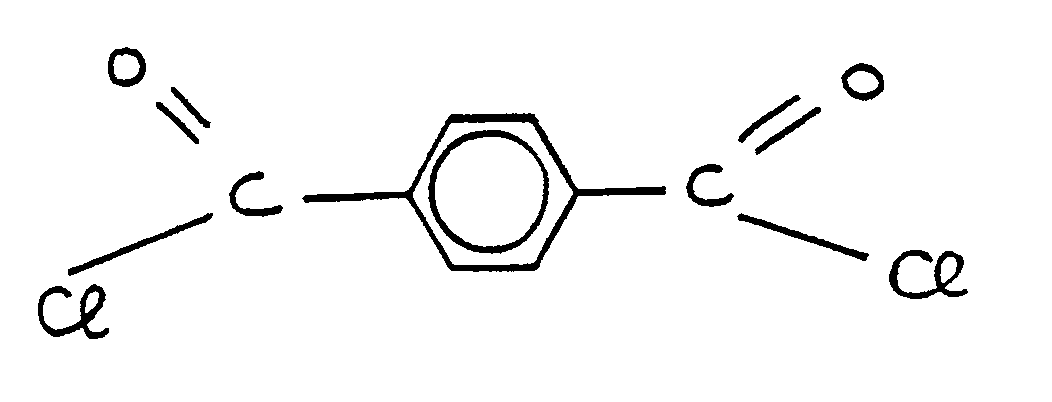

- Verfahren nach Anspruch 8, 9 oder 10, wobei das Verdünnungsmittel Cyclohexan, Petrolether, Heptan, Hexan oder Gemische davon ist.
- Verfahren nach Anspruch 11, wobei das Verdünnungsmitttel ferner Methylenchlorid, Kohlendisulfid, o-Dichlorbenzol, 1,2,4-Trichlorbenzol, o-Difluorbenzol, 1,2-Dichlorethan, 1,1,2,2-Tetrachlorethan oder Gemische davon umfaßt.
Priority Applications (1)
| Application Number | Priority Date | Filing Date | Title |
|---|---|---|---|
| AT85306349T ATE69613T1 (de) | 1984-09-06 | 1985-09-06 | Herstellung von poly(arylenetherketonen). |
Applications Claiming Priority (2)
| Application Number | Priority Date | Filing Date | Title |
|---|---|---|---|
| US64811984A | 1984-09-06 | 1984-09-06 | |
| US648119 | 1984-09-06 |
Publications (3)
| Publication Number | Publication Date |
|---|---|
| EP0174207A2 EP0174207A2 (de) | 1986-03-12 |
| EP0174207A3 EP0174207A3 (en) | 1988-04-13 |
| EP0174207B1 true EP0174207B1 (de) | 1991-11-21 |
Family
ID=24599513
Family Applications (1)
| Application Number | Title | Priority Date | Filing Date |
|---|---|---|---|
| EP85306349A Expired - Lifetime EP0174207B1 (de) | 1984-09-06 | 1985-09-06 | Herstellung von Poly(arylenetherketonen) |
Country Status (6)
| Country | Link |
|---|---|
| EP (1) | EP0174207B1 (de) |
| JP (1) | JPH0730178B2 (de) |
| AT (1) | ATE69613T1 (de) |
| CA (1) | CA1266749A (de) |
| DE (1) | DE3584706D1 (de) |
| ES (2) | ES8704521A1 (de) |
Families Citing this family (7)
| Publication number | Priority date | Publication date | Assignee | Title |
|---|---|---|---|---|
| US4841013A (en) * | 1986-09-18 | 1989-06-20 | Raychem Limited | Preparation of poly(arylene ether ketones) |
| GB8623511D0 (en) * | 1986-09-30 | 1986-11-05 | Raychem Ltd | Arylene cligomers |
| GB8726884D0 (en) * | 1987-11-17 | 1987-12-23 | Raychem Ltd | Poly(arylene ether ketones) |
| CN100582133C (zh) | 2008-01-11 | 2010-01-20 | 吉林金正高分子材料研发有限公司 | 一种聚醚醚酮的制备方法 |
| GB0911905D0 (en) | 2009-07-09 | 2009-08-19 | Ketonex Ltd | Method |
| GB201409128D0 (en) | 2014-05-22 | 2014-07-09 | Ketonex Ltd | Method |
| GB201415972D0 (en) | 2014-09-10 | 2014-10-22 | Ketonex Ltd | Process |
Family Cites Families (10)
| Publication number | Priority date | Publication date | Assignee | Title |
|---|---|---|---|---|
| US3065205A (en) * | 1959-10-27 | 1962-11-20 | Du Pont | Aromatic polyketones and preparation thereof |
| US3516966A (en) * | 1968-02-05 | 1970-06-23 | Du Pont | Polyketone copolymers |
| US3666612A (en) * | 1970-06-10 | 1972-05-30 | Du Pont | Heat-sealable copolyketone film structure |
| JPS59159826A (ja) * | 1983-03-01 | 1984-09-10 | Mitsubishi Chem Ind Ltd | 芳香族ポリケトンの製造法 |
| JPS59159825A (ja) * | 1983-03-01 | 1984-09-10 | Mitsubishi Chem Ind Ltd | 芳香族ポリケトンの製造方法 |
| GB8408082D0 (en) * | 1983-03-31 | 1984-05-10 | Raychem Corp | Preparing poly-(arylene ketones) |
| DE3472262D1 (en) * | 1983-09-29 | 1988-07-28 | Mitsubishi Chem Ind | Process for producing aromatic polyether ketones and polythioether ketones |
| JPS6072923A (ja) * | 1983-09-29 | 1985-04-25 | Mitsubishi Chem Ind Ltd | 芳香族ポリエ−テルケトンの製造方法 |
| JPS60101119A (ja) * | 1983-11-08 | 1985-06-05 | Mitsubishi Chem Ind Ltd | 芳香族ポリエ−テルケトンの製造方法 |
| JPS6079040A (ja) * | 1983-10-07 | 1985-05-04 | Mitsubishi Chem Ind Ltd | 芳香族ポリエ−テルケトンの製造法 |
-
1985
- 1985-09-05 ES ES546722A patent/ES8704521A1/es not_active Expired
- 1985-09-05 CA CA000490084A patent/CA1266749A/en not_active Expired - Fee Related
- 1985-09-06 EP EP85306349A patent/EP0174207B1/de not_active Expired - Lifetime
- 1985-09-06 AT AT85306349T patent/ATE69613T1/de not_active IP Right Cessation
- 1985-09-06 JP JP60198416A patent/JPH0730178B2/ja not_active Expired - Lifetime
- 1985-09-06 DE DE8585306349T patent/DE3584706D1/de not_active Expired - Fee Related
-
1986
- 1986-11-28 ES ES557228A patent/ES8708143A1/es not_active Expired
Also Published As
| Publication number | Publication date |
|---|---|
| CA1266749A (en) | 1990-03-13 |
| JPS6183226A (ja) | 1986-04-26 |
| JPH0730178B2 (ja) | 1995-04-05 |
| DE3584706D1 (de) | 1992-01-02 |
| ES557228A0 (es) | 1987-10-01 |
| ES8704521A1 (es) | 1987-04-16 |
| EP0174207A3 (en) | 1988-04-13 |
| ES546722A0 (es) | 1987-04-16 |
| ES8708143A1 (es) | 1987-10-01 |
| EP0174207A2 (de) | 1986-03-12 |
| ATE69613T1 (de) | 1991-12-15 |
Similar Documents
| Publication | Publication Date | Title |
|---|---|---|
| US4698393A (en) | Preparation of poly(arylene ether ketones) | |
| EP0124276B1 (de) | Herstellung von aromatischen Polymeren | |
| US4841013A (en) | Preparation of poly(arylene ether ketones) | |
| US4709007A (en) | Preparation of aromatic polymers | |
| CA1311077C (en) | Preparation of poly(arylene ether ketones) | |
| US5734005A (en) | Aromatic polymers | |
| EP0174207B1 (de) | Herstellung von Poly(arylenetherketonen) | |
| EP0314384B1 (de) | Herstellung von Polyarylenätherketonen | |
| US5145938A (en) | Preparation of poly(arylene ether ketones) | |
| CA1271771A (en) | Preparation of aromatic polymers | |
| JPH0676491B2 (ja) | エーテル―ケトン―イミド芳香族ポリマー | |
| EP0178183B1 (de) | Herstellung von aromatischen Keton-Sulfon-Copolymeren | |
| EP0173408B1 (de) | Herstellung von Poly(arylenketonen) | |
| US4912195A (en) | Preparation of aromatic polymers using a specified quantity of Lewis acid | |
| KR930004616B1 (ko) | 폴리(아릴렌 에테르 케톤)의 제조방법 | |
| EP0298770B1 (de) | Polyarylenetherketone mit Biphenyl-4,4'-dicarbonylgruppen | |
| US3359239A (en) | Polymerization of bis-(alpha-haloalkyl) aromatic compounds in the pressence of a coupling agent; reaction conducted in organic solvent/hydroxylic solvent medium | |
| CA1262795A (en) | Aryl ether ketone polymers | |
| JPS63132936A (ja) | ポリ(アリーレンエーテルケトン)の製造法 | |
| JPH08127617A (ja) | 臭素化ポリスチレンの製造法 |
Legal Events
| Date | Code | Title | Description |
|---|---|---|---|
| PUAI | Public reference made under article 153(3) epc to a published international application that has entered the european phase |
Free format text: ORIGINAL CODE: 0009012 |
|
| 17P | Request for examination filed |
Effective date: 19850910 |
|
| AK | Designated contracting states |
Kind code of ref document: A2 Designated state(s): AT BE CH DE FR GB IT LI NL SE |
|
| PUAL | Search report despatched |
Free format text: ORIGINAL CODE: 0009013 |
|
| AK | Designated contracting states |
Kind code of ref document: A3 Designated state(s): AT BE CH DE FR GB IT LI NL SE |
|
| RAP1 | Party data changed (applicant data changed or rights of an application transferred) |
Owner name: RAYCHEM CORPORATION (A DELAWARE CORPORATION) |
|
| 17Q | First examination report despatched |
Effective date: 19891020 |
|
| GRAA | (expected) grant |
Free format text: ORIGINAL CODE: 0009210 |
|
| AK | Designated contracting states |
Kind code of ref document: B1 Designated state(s): AT BE CH DE FR GB IT LI NL SE |
|
| PG25 | Lapsed in a contracting state [announced via postgrant information from national office to epo] |
Ref country code: SE Effective date: 19911121 Ref country code: NL Effective date: 19911121 Ref country code: BE Effective date: 19911121 Ref country code: AT Effective date: 19911121 |
|
| REF | Corresponds to: |
Ref document number: 69613 Country of ref document: AT Date of ref document: 19911215 Kind code of ref document: T |
|
| REF | Corresponds to: |
Ref document number: 3584706 Country of ref document: DE Date of ref document: 19920102 |
|
| ET | Fr: translation filed | ||
| ITF | It: translation for a ep patent filed | ||
| NLV1 | Nl: lapsed or annulled due to failure to fulfill the requirements of art. 29p and 29m of the patents act | ||
| PLBE | No opposition filed within time limit |
Free format text: ORIGINAL CODE: 0009261 |
|
| STAA | Information on the status of an ep patent application or granted ep patent |
Free format text: STATUS: NO OPPOSITION FILED WITHIN TIME LIMIT |
|
| 26N | No opposition filed | ||
| PGFP | Annual fee paid to national office [announced via postgrant information from national office to epo] |
Ref country code: GB Payment date: 19960828 Year of fee payment: 12 |
|
| PGFP | Annual fee paid to national office [announced via postgrant information from national office to epo] |
Ref country code: FR Payment date: 19960910 Year of fee payment: 12 |
|
| PGFP | Annual fee paid to national office [announced via postgrant information from national office to epo] |
Ref country code: DE Payment date: 19960913 Year of fee payment: 12 |
|
| PGFP | Annual fee paid to national office [announced via postgrant information from national office to epo] |
Ref country code: CH Payment date: 19960919 Year of fee payment: 12 |
|
| PG25 | Lapsed in a contracting state [announced via postgrant information from national office to epo] |
Ref country code: GB Free format text: LAPSE BECAUSE OF NON-PAYMENT OF DUE FEES Effective date: 19970906 |
|
| PG25 | Lapsed in a contracting state [announced via postgrant information from national office to epo] |
Ref country code: LI Free format text: LAPSE BECAUSE OF NON-PAYMENT OF DUE FEES Effective date: 19970930 Ref country code: FR Free format text: THE PATENT HAS BEEN ANNULLED BY A DECISION OF A NATIONAL AUTHORITY Effective date: 19970930 Ref country code: CH Free format text: LAPSE BECAUSE OF NON-PAYMENT OF DUE FEES Effective date: 19970930 |
|
| GBPC | Gb: european patent ceased through non-payment of renewal fee |
Effective date: 19970906 |
|
| REG | Reference to a national code |
Ref country code: CH Ref legal event code: PL |
|
| PG25 | Lapsed in a contracting state [announced via postgrant information from national office to epo] |
Ref country code: DE Free format text: LAPSE BECAUSE OF NON-PAYMENT OF DUE FEES Effective date: 19980603 |
|
| REG | Reference to a national code |
Ref country code: FR Ref legal event code: ST |