EP0174454A2 - Anordnung zur Minimierung des Kühlflüssigkeitsverbrauches, insbesondere bei Flüssigkeitsring-Vakuumpumpen oder dergleichen - Google Patents
Anordnung zur Minimierung des Kühlflüssigkeitsverbrauches, insbesondere bei Flüssigkeitsring-Vakuumpumpen oder dergleichen Download PDFInfo
- Publication number
- EP0174454A2 EP0174454A2 EP85108389A EP85108389A EP0174454A2 EP 0174454 A2 EP0174454 A2 EP 0174454A2 EP 85108389 A EP85108389 A EP 85108389A EP 85108389 A EP85108389 A EP 85108389A EP 0174454 A2 EP0174454 A2 EP 0174454A2
- Authority
- EP
- European Patent Office
- Prior art keywords
- liquid
- separator
- line
- gas
- arrangement according
- Prior art date
- Legal status (The legal status is an assumption and is not a legal conclusion. Google has not performed a legal analysis and makes no representation as to the accuracy of the status listed.)
- Granted
Links
Images


Classifications
-
- B—PERFORMING OPERATIONS; TRANSPORTING
- B04—CENTRIFUGAL APPARATUS OR MACHINES FOR CARRYING-OUT PHYSICAL OR CHEMICAL PROCESSES
- B04C—APPARATUS USING FREE VORTEX FLOW, e.g. CYCLONES
- B04C7/00—Apparatus not provided for in group B04C1/00, B04C3/00, or B04C5/00; Multiple arrangements not provided for in one of the groups B04C1/00, B04C3/00, or B04C5/00; Combinations of apparatus covered by two or more of the groups B04C1/00, B04C3/00, or B04C5/00
-
- B—PERFORMING OPERATIONS; TRANSPORTING
- B01—PHYSICAL OR CHEMICAL PROCESSES OR APPARATUS IN GENERAL
- B01D—SEPARATION
- B01D19/00—Degasification of liquids
- B01D19/0042—Degasification of liquids modifying the liquid flow
- B01D19/0052—Degasification of liquids modifying the liquid flow in rotating vessels, vessels containing movable parts or in which centrifugal movement is caused
- B01D19/0057—Degasification of liquids modifying the liquid flow in rotating vessels, vessels containing movable parts or in which centrifugal movement is caused the centrifugal movement being caused by a vortex, e.g. using a cyclone, or by a tangential inlet
-
- F—MECHANICAL ENGINEERING; LIGHTING; HEATING; WEAPONS; BLASTING
- F04—POSITIVE - DISPLACEMENT MACHINES FOR LIQUIDS; PUMPS FOR LIQUIDS OR ELASTIC FLUIDS
- F04C—ROTARY-PISTON, OR OSCILLATING-PISTON, POSITIVE-DISPLACEMENT MACHINES FOR LIQUIDS; ROTARY-PISTON, OR OSCILLATING-PISTON, POSITIVE-DISPLACEMENT PUMPS
- F04C19/00—Rotary-piston pumps with fluid ring or the like, specially adapted for elastic fluids
- F04C19/004—Details concerning the operating liquid, e.g. nature, separation, cooling, cleaning, control of the supply
-
- F—MECHANICAL ENGINEERING; LIGHTING; HEATING; WEAPONS; BLASTING
- F04—POSITIVE - DISPLACEMENT MACHINES FOR LIQUIDS; PUMPS FOR LIQUIDS OR ELASTIC FLUIDS
- F04C—ROTARY-PISTON, OR OSCILLATING-PISTON, POSITIVE-DISPLACEMENT MACHINES FOR LIQUIDS; ROTARY-PISTON, OR OSCILLATING-PISTON, POSITIVE-DISPLACEMENT PUMPS
- F04C23/00—Combinations of two or more pumps, each being of rotary-piston or oscillating-piston type, specially adapted for elastic fluids; Pumping installations specially adapted for elastic fluids; Multi-stage pumps specially adapted for elastic fluids
Definitions
- the invention relates to an arrangement for minimizing the consumption of cooling liquid and, if appropriate, for preventing cavitation, in particular in the case of liquid ring vacuum pumps or the like.
- the pumping speed of a liquid ring vacuum pump depends not only on the medium to be pumped, but also to a considerable extent on the operating liquid, and in the case of the predominantly used water as operating liquid on its temperature.
- the pumping speed of a water ring vacuum pump can be greatly influenced by adjusting the temperature of the process water, particularly in the region of higher negative pressures, with a lower operating liquid temperature providing higher outputs. This results in the need to cool the circulating operating fluid, which usually happens with water as the operating fluid in that part of the heated fluid is always removed from the operating fluid circuit and replaced by cooler fresh fluid from the supply network, i.e. the operation of a water ring vacuum pump always requires a more or less high consumption of fresh water, which often has a considerable impact on the operating costs of such a pump.
- the object of the present invention is therefore to achieve a reduction in the water operating costs, in particular for water ring vacuum pumps. Such Lowering the operating costs naturally also applies to operating fluids other than water, since these had to be cooled down again and again with great effort in an internal cooling circuit.
- a separating container designed as a single-stage or multi-stage gas / liquid separator with a temperature sensor in the container or in the circulation line of the exhaust gas line is designed in the exhaust line of the liquid ring vacuum pump or to arrange the vacuum pump for the operating fluid temperature of the fluid ring vacuum pump, which is connected via a control device to a control valve in the cooling fluid line,
- the temperature sensor can be designed as a thermostat and the control valve as a solenoid valve or can also be replaced by a manually operated valve.
- the temperature sensor should be advantageous via a control unit which has one or more inputs and outputs. and also has temporal and logical links for a programmable logic controller to be connected to the control valve in the coolant line.
- the gas / liquid separator is designed as a two-stage centrifugal separator, in which the first stage is a cyclone separator and the second stage is a potential vortex separator.
- the cyclone separator should consist of a housing with a cylindrical jacket, to which a tangential feed line for the gas-liquid mixture and a discharge line for the discharged liquid are attached.
- the housing should have a closed cover part and a bottom part, on which a discharge for the operating liquid is arranged and through which a line for the discharge of the gas from the separator is passed, the inlet opening of which is above the discharge for the discharged liquid.
- the potential vortex separator should be designed as a cylindrical housing inserted into the housing of the cyclone separator, the lower opening of which is in the liquid separation space below the discharge line for the derived liquid and the upper opening of which is connected to the interior of the housing by baffles through which the flow from the interior of the cyclone separator is guided substantially tangentially into the interior of the cylindrical housing.
- the temperature transducer can be an immersion temperature arranged at the bottom of the gas / liquid separator and projecting into the liquid area of the separator sensor or thermostat.
- the discharge for the operating liquid should be lower than the supply of the cooling liquid, so that a backflow of the cooling liquid is excluded (system separation).
- the coolant line can lead into the suction chamber or the suction pipe of the vacuum pump. It can end in the gas-liquid separator or in the exhaust pipe.
- a line with adjustable gas throughput e.g. be led into the operating fluid line with a throttle. Throttling in the operating fluid line creates a negative pressure, through which a variable amount of gas is fed from the separator to the vacuum pump through a bypass.
- the liquid ring vacuum pump is designated by 10, which is connected to the space to be evacuated by the vacuum line.
- the pump 10 conveys a gas-operating liquid mixture through the line 22 into the gas / liquid separator 11, from which a part of the separated liquid is discharged through the line 20 and a part is returned through the operating liquid line 19 into the vacuum pump.
- the gas separated from the liquid is discharged through the exhaust pipe 21.
- a temperature sensor 12 which, in the example shown in FIG. 1, is connected via the control device 13 to a control valve 14 with presetting in the fresh or cooling water line 15, the valve being controlled in this way that by adding coolant, the temperature of the operating fluid is regulated to a constant set value or is optimally set for the respective operating point of the pump, which means that a minimum of cooling fluid is supplied at the optimal temperature of the operating fluid during pressure control operation of the vacuum system.
- a quantity of liquid corresponding to this quantity of fresh liquid supplied is discharged through the line 20 and is a measure of the actual liquid consumption.
- the regulating and control functions are carried out by a microcomputer in the control cabinet 13.
- FIG. 2 a simple arrangement for preventing cavitation in the vacuum pump is indicated in FIG. 2.
- a ventilation line 23 with adjustable. Throughput from the gas space of the separator 11 into the operating fluid line 19. From here, the air or the gas then reaches the pump.
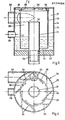
- the gas / liquid separator is now shown enlarged in FIGS. 3 to 5 in various views. It consists essentially of a cyclone housing, generally designated 24, into which a cylindrical inner housing 33 is inserted, in which, with the help of Leit sheet 36 a potential vortex is generated.
- the result is a two-stage centrifugal separator, the first stage of which works on the principle of the cyclone separator and the second stage of which works as a potential vortex separator.
- the cyclone separator has a cylindrical jacket 25 with a cover 26 and a bottom 27. On the jacket 25 there is a tangential feed 28 for the gas-liquid mixture coming from the vacuum pump, as well as a nozzle 29 through which the heated operating liquid to be discharged corresponding to the quantity of fresh liquid supplied is discharged. If water is the operating liquid, it can be discharged from there directly into the sewage system or, for other liquids, into a cooling and treatment plant for reuse.
- the potential vortex separator is formed by the cylindrical inner housing 33.
- the gas-liquid mixture largely freed of liquid in the cyclone separator is discharged from the annular space 37 of the cyclone separator via that at the upper part of the separator below the cover 26 attached guide plates 36 through the upper opening 35 of the inner housing 33 into the interior 38 of this housing, a potential vortex being formed in this space by the guide plates 36, which leads to further separation of the gas from the liquid.
- the liquid runs down the inner wall and unites, since the cylindrical inner housing has a lower opening 34, with the liquid from the cyclone separator which is already there.
- the temperature sensor designed as an immersion temperature sensor 40, is expediently attached to the base 27 of the gas-liquid separator.
- a particularly compact design can be achieved if the coolant line 15 and the control valve designed as a solenoid valve with presetting 14 are attached directly to the separator.
- FIG. 6 Such an arrangement is indicated in a schematic representation in FIG. 6.
- This illustration also shows the possible arrangement of the ventilation line 23 and the operating liquid line 19 with control elements on or in the gas / liquid separator 11.
Landscapes
- Engineering & Computer Science (AREA)
- Mechanical Engineering (AREA)
- General Engineering & Computer Science (AREA)
- Chemical & Material Sciences (AREA)
- Chemical Kinetics & Catalysis (AREA)
- Applications Or Details Of Rotary Compressors (AREA)
- Jet Pumps And Other Pumps (AREA)
- Cyclones (AREA)
- Cleaning By Liquid Or Steam (AREA)
- Structures Of Non-Positive Displacement Pumps (AREA)
- Compressors, Vaccum Pumps And Other Relevant Systems (AREA)
- Motor Or Generator Cooling System (AREA)
Abstract
Description
- Die Erfindung betrifft eine Anordnung zur Minimierung des Kühlflüssigkeitsverbrauches, sowie gegebenenfalls zur Verhinderung von Kavitation, insbesondere bei Flüssigkeitsring-Vakuumpumpen oder dergl.
- Das Saugvermögen einer Flüssigkeitsring-Vakuumpumpe hängt außer vom Fördermedium in erheblichem Maße von der Betriebsflüssigkeit ab und zwar bei dem überwiegend verwendeten Wasser als Betriebsflüssigkeit von dessen Temperatur. Das Saugvermögen einer Wasserring-Vakuumpumpe kann durch die Verstellung der Temperatur des Betriebswassers insbesondere im Bereich höherer Unterdrücke stark beeinflußt werden, wobei eine geringere Betriebsflüssigkeitstemperatur höhere Leistungen erbringt. Damit ergibt sich das Erfordernis einer Kühlung der umlaufenden Betriebsflüssigkeit, was bei Wasser als Betriebsflüssigkeit in der Regel dadurch geschieht, daß aus dem Betriebsflüssigkeitskreislauf immer ein Teil der erwärmten Flüssigkeit abgeführt und durch kühlere Frischflüssigkeit aus dem Leitungsnetz ersetzt wird, d.h. der Betrieb einer Wasserring-Vakuumpumpe macht immer einen mehr oder weniger großen Frischwasserverbrauch erforderlich, der die Betriebskosten einer solchen Pumpe oft nicht unerheblich belastet.
- Durch die vorliegende Erfindung soll deshalb die Aufgabe gelöst werden, eine Senkung der Wasserbetriebskosten insbes. für Wasserring-Vakuumpumpen zu erreichen. Eine solche Senkung der Betriebskosten gilt natürlich auch für andere Betriebsflüssigkeiten als Wasser, da diese ja auch in einem internen Kühlkreislauf mit hohem Aufwand immer wieder heruntergekühlt werden mußten.
- Zur Lösung der gestellten Aufgabe wird erfindungegemäß bei einer Anordnung der eingangs genannten Art vorgeschlagen, in der Abgasleitung der Flüssigkeitsring-Vakuumpumpe einen als ein- oder mehrstufigen Gas-/Flüssigkeits-Separator ausgebildeten Abscheidebehälter mit einem Temperatur-Meßwertaufnehmer im Behälter oder in der Umlaufleitung der Abgasleitung oder der Vakuumpumpe für die Betriebsflüssigkeitemperatur der Flüssigkeitsring-Vakuumpumpe anzuordnen, der über eine Steuereinrichtung mit einem Stellventil in der Kühlfiüssigkeitsleitung verbunden ist,
- In einfachster Ausgestaltung der Erfindung können dabei der Temperatur-Meßwertaufnehmer als Thermostatregler und das Stellventil als Magnetventil ausgebildet oder auch durch ein manuell betätigtes Ventil ersetzt sein.
- Vorteilhaft soll aber der Temperatur-Meßwertaufnehmer über ein Steuergerät, welches einen oder mehrere Ein- und Ausginge. sowie zeitliche und logische Verknüpfungen für eine speicherprogrammierbare Steuerung aufweist, mit dem Stellventil in der Kühlflüssigkeitsleitung verbunden sein.
- Bei einer bevorzugten Ausführungsform der Erfindung soll der Gas-/Flüssigkeits-Separator als zweistufiger Fliehkraftabscheider ausgebildet sein, bei dem die erste Stufe ein Zyklonabscheider und die zweite Stufe ein Potentialwirbelabscheider ist. Dabei soll der Zyklonabscheider aus einem Gehäuse mit einem zylindrischen Mantel bestehen, an dem eine tangentiale Zuleitung für das Gas-Flüssigkeits-gemisch und eine Ableitung für die abgeführte Flüssigkeit angebracht sind. Das Gehäuse soll einen geschlossenen Deckelteil und einen Bodenteil aufweisen, an dem eine Abführung für die Betriebsflüssigkeit angeordnet ist und durch den eine Leitung für die Ableitung des Gases aus dem Abscheider hindurchgeführt ist, deren Eintrittsöffnung oberhalb der Ableitung für die abgeführte Flüssigkeit liegt. Der Potentialwirbelabscheider soll als in das Gehäuse des Zyklonabscheiders eingesetztes zylindrisches Gehäuse ausgebildet sein, dessen untere öffnung im Abscheideraum für die Flüssigkeit unterhalb der Ableitung für die abgeleitete Flüssigkeit liegt und dessen obere öffnung mit dem Innenraum des Gehäuses durch Leitbleche in Verbindung steht, durch die die Strömung vom Innenraum des Zyklonabscheiders im wesentlichen tangential in den Innenraum des zylindrischen Gehäuses geleitet wird.
- Der Temperatur-Meßwertaufnehmer kann als am Boden des Gas-/Flüssigkeits-Abscheiders angeordneter, in den Flüssigkeitsbereich des Abscheiders ragender Tauchtemperaturfühler bzw. Thermostat ausgebildet sein.
- Die Abführung für die Betriebsflüssigkeit soll niedriger liegen als die Zuführung der KühlflUssigkeit, so daß ein Rückfließen der Kühlflüssigkeit ausgeschlossen wird (Systemtrennung). Die KUhlflüssigkeitsleitung kann in den Saugraum bzw. das Saugrohr der Vakuumpumpe führen. Sie kann im Gas-Flüssigkeitsabscheider oder in der Abgasleitung mUnden.
- In weiterer Ausgestaltung der Erfindung kann zur Vermeidung von Kavitation in der FlUssigkeitsring-Vakuumpumpe vom Gasraum des Gas-/Flüssigkeits-Abscheiders eine Leitung mit einstellbarem Gasdurchsatz, also z.B. mit einer Drossel in die Betriebsflüssigkeitsleitung geführt sein. Dabei entsteht durch Androsseln in der Betriebsflüssigkeitsleitung ein Unterdruck, durch den eine variable Gasmenge aus dem Separator der Vakuumpumpe durch einen Bypass zugeführt wird.
- An Hand der beiliegenden Zeichnungen soll die Erfindung nachfolgend noch näher erläutert werden. Auf den Zeichnungen zeigen in schematischer Darstellung
- Fig. 1 den Gesamtaufbau einer erfindungsgemäßen Anordnung,
- Fig. 2 eine Anordnung zur Einleitung von Gas in die Betriebsflüssigkeitsleitung,
- Fig. 3 einen Vertikalschnitt durch ein Auführungsbeispiel eines zweistufigen Fliehkraftabscheiders,
- Fig. 4 eine Anischt von oben auf diesen Abscheider bei abgenommenem Deckelteil,
- Fig. 5 die Anordnung des Temperatur-Meßwertaufnehmers am Abscheider in Seitenansicht und
- Fig. 6 die Anordnung der Kühl flüssigkeitsleitung und des Stellventils am Abscheider in schematischer Darstellung.
- In den Figuren sind gleiche Teile mit gleichen Bezugszeichen versehen.
- Bei dem Gesamtaufbau einer Anordnung gemäß der Erfindung nach Fig. 1 ist die Flüssigkeitsring-Vakuumpumpe mit 10 bezeichnet, die durch die Vakuumleitung mit dem zu evakuierenden Raum verbunden ist. Die Pumpe 10 fördert ein Gas-Betriebsflüssigkeits-Gemisch durch die Leitung 22 in den Gas-/Flüssigkeitsabscheider 11, von dem ein Teil der abgeschiedenen Flüssigkeit durch die Leitung 20 abgeleitet und ein Teil durch die Betriebsflüssigkeitleitung 19 in die Vakuumpumpe zurückgeführt wird. Das von der Flüssigkeit getrennte Gas wird durch die Abgasleitung 21 abgeführt.
- Am Gas-/Flüssigkeits-Abscheider 11 ist ein Temperatur-Meßwertaufnehmer 12 angebracht, der im in Fig. 1 dargestellten Beispiel über das Steuergerät 13 mit einem Stellventil 14 mit Voreinstellung in der Frisch- oder Kühlwasserleitung 15 verbunden ist, wobei das Ventil so gesteuert wird, daß durch Zugabe von Kühlflüssigkeit die Temperatur der Betriebsflüssigkeit auf einen konstanten eingestellten Wert geregelt oder optimal für den jeweiligen Betriebspunkt der Pumpe eingestellt wird, was bedeutet, daß bei der optimalen Temperatur der Betriebsflüssigkeit beim Druckregelbetrieb des Vakuumsystems ein Minimum an Kühlflüssigkeit zugeführt wird.
- Am Abscheider 11 wird durch die Leitung 20 eine dieser zugeführten Frischflüssigkeitsmenge entsprechende Flüssigkeitsmenge abgeführt und ist ein Maß für den eigentlichen Flüssigkeitsverbrauch. Die Regel- und Steuerungsfunktionen übernimmt ein Micro-Computer im Schaltschrank 13.
- In Fig. 2 ist die Kombination Meßwertaufnehmer 12, Schaltschrank 13, Stellventil 14 durch die technisch aber auch leistungsmißig einfachere und preisgünstigere Kombination Thermostatregler 17 und Stellventil 14 ersetzt, die für einfachere B-etriebsfälle oft ausreichend ist und jederzeit auf die in Fig. 1 dargestellte Kombination erweiterbar ist.
- Außerdem ist in Fig. 2 noch eine einfache Anordnung zur Verhinderung von Kavitation in der Vakuumpumpe angedeutet. Dazu führt eine Belüftungsleitung 23 mit einstellb. Durchsatz vom Gasraum des Abssheiders 11 in die Betriebsflüssigkeitsleitung 19. Von hier gelangt die Luft bzw. das Gas dann in die Pumpe.
- Der Gas-/Flüssigkeitsabscheider ist nun in den Fig. 3 bis 5 in verschiedenen Ansichten vergrößert dargestellt. Er besteht im wesentlichen aus einem allgemein mit 24 bezeichneten Zyklongehäuse, in das ein zylindrisches Innengehäuse 33 eingesetzt ist, in dem mit Hilft von Leitblechen 36 ein Potentionalwirbel erzeugt wird. Es entsteht so ein zweistufiger Fliehkraftabscheider, dessen erste Stufe nach dem Prinzip des Zyklonabscheiders und dessen zweite Stufe als Potentialwirbelabscheider arbeitet.
- Der Zyklonabscheider weist einen zylindrischen Mantel 25 mit einem Deckel 26 und einem Boden 27 auf. AM Mantel 25 ist eine tangentiale Zuführung 28 für das aus der Vakuumpumpe kommende Gas-Flüssigkeits-Gemisch angebracht, sowie ein Stutzen 29, durch den die der zugeführten Frischflüssigkeitsmenge entsprechende Menge abzuleitender erwärmter Betriebsflüssigkeit abgeführt wird. Dabei kann bei Wasser als Betriebsflüssigkeit die Abführung von dort eventuell gleich in die Kanalisation erfolgen oder bei anderen Flüssigkeiten in eine Kühl- und Aufbereitungsanlage zur Wiederverwendung.
- Am Boden 27 ist einmal ein Ablauf 30 für das zur Pumpe zurückzuführende Betriebswasser angebracht und zum anderen eine leitung 31 zur Abführung des Gases deren Zulauföffnung 32 sich deshalb im Gasraum des Abscheiders befindet.
- Der Potentialwirbelabscheider wird durch das zylindrische Innengehäuse 33 gebildet. Dabei wird das im Zyklon- abscheider weitgehend von Flüssigkeit befreite Gas-Flüssigkeits-Gemisch aus dem Ringraum 37 des Zyklon- abscheiders über die am oberen Teil des Abscheiders unterhalb des Deckels 26 angebrachten Leitbleche 36 durch die obere Öffnung 35 des Innengehäuses 33 in den Innenraum 38 dieses Gehäuses eingeführt, wobei sich durch die Leitbleche 36 in diesem Raum ein Potentialwirbel ausbildet, der zur weiteren Separierung des Gases von der Flüssigkeit führt. Die Flüssigkeit läuft dabei an der Innenwand herab und vereinigt sich, da das zylindrische Innengehäuse eine untere Öffnung 34 aufweist, mit der dort schon befindlichen Flüssgkeit aus dem Zyklonabscheider.
- Wie Fig. 5 erkennen läßt, wird der als Tauchtemperaturfühler 40 ausgebildete Temperatur-Meßwertaufnehmer zweckmäßig am Boden 27 des Gas-Flüssigkeitsabscheider befestigt. Eine besonders kompa-kte Ausführung läßt sich erreichen, wenn die Kühlflüssigkeitsleitung 15 und das als Magnetventil mit Voreinstellung 14 ausgeführte Stellventil direkt am Abscheider angebracht sind.
- In Fig. 6 ist eine derartige Anordnung in schematischer Darstellung angedeutet. In dieser Darstellung sind auch die mögliche Anordnung der Belüftungsleitung 23 und der Betriebsflüssigkeitsleitung 19 mit Regelorganen am bzw, im Gas-/ Flüssigkeitsabscheider 11 wiedergegeben.
Claims (13)
Priority Applications (1)
| Application Number | Priority Date | Filing Date | Title |
|---|---|---|---|
| AT85108389T ATE70340T1 (de) | 1984-07-12 | 1985-07-05 | Anordnung zur minimierung des kuehlfluessigkeitsverbrauches, insbesondere bei fluessigkeitsring-vakuumpumpen oder dergleichen. |
Applications Claiming Priority (2)
| Application Number | Priority Date | Filing Date | Title |
|---|---|---|---|
| DE3425616 | 1984-07-12 | ||
| DE19843425616 DE3425616A1 (de) | 1984-07-12 | 1984-07-12 | Anordnung zur minimierung des kuehlfluessigkeitsverbrauches insbes. bei fluessigkeitsring-vakuumpumpen o.dgl. |
Publications (3)
| Publication Number | Publication Date |
|---|---|
| EP0174454A2 true EP0174454A2 (de) | 1986-03-19 |
| EP0174454A3 EP0174454A3 (en) | 1986-11-20 |
| EP0174454B1 EP0174454B1 (de) | 1991-12-11 |
Family
ID=6240416
Family Applications (1)
| Application Number | Title | Priority Date | Filing Date |
|---|---|---|---|
| EP85108389A Expired - Lifetime EP0174454B1 (de) | 1984-07-12 | 1985-07-05 | Anordnung zur Minimierung des Kühlflüssigkeitsverbrauches, insbesondere bei Flüssigkeitsring-Vakuumpumpen oder dergleichen |
Country Status (8)
| Country | Link |
|---|---|
| US (1) | US4692101A (de) |
| EP (1) | EP0174454B1 (de) |
| JP (1) | JPS6140477A (de) |
| AT (1) | ATE70340T1 (de) |
| CA (1) | CA1268748A (de) |
| DE (2) | DE3425616A1 (de) |
| DK (1) | DK164134C (de) |
| NO (1) | NO166199C (de) |
Cited By (2)
| Publication number | Priority date | Publication date | Assignee | Title |
|---|---|---|---|---|
| EP0638723A1 (de) * | 1993-08-11 | 1995-02-15 | Siemens Aktiengesellschaft | Mechanischer Verdichter |
| DE19715480A1 (de) * | 1997-04-14 | 1998-10-15 | Saskia Solar Und Energietechni | Vakuumpumpsystem mit einer Flüssigringpumpe |
Families Citing this family (14)
| Publication number | Priority date | Publication date | Assignee | Title |
|---|---|---|---|---|
| US4756672A (en) * | 1986-01-27 | 1988-07-12 | Siemens Aktiengesellschaft | Liquid-ring pump with maintenance of liquid level |
| US4699570A (en) * | 1986-03-07 | 1987-10-13 | Itt Industries, Inc | Vacuum pump system |
| DE3829263A1 (de) * | 1988-08-29 | 1990-03-15 | Schmitz Uwe | Vorrichtung zum verteilen eines stroemenden fluessigkeits-gas-gemisches in mehrere teilstroeme |
| US4919826A (en) * | 1988-12-20 | 1990-04-24 | Air Techniques, Incorporated | Process and apparatus for separating solids and liquids from an effluent stream |
| US5584911A (en) * | 1995-06-15 | 1996-12-17 | Jordan Holding Company | Vapor recovery system with cyclonic separator |
| EP0943805B1 (de) * | 1998-03-19 | 2004-12-15 | NSB Gas Processing AG | Verfahren und Sensor zur Detektion von Kavitationen, sowie Vorrichtung enthaltend einen solchen Sensor |
| DE19932632A1 (de) * | 1999-07-13 | 2001-02-01 | Siemens Ag | Zweistufige Flüssigkeitsringmaschine |
| US6558131B1 (en) * | 2001-06-29 | 2003-05-06 | nash-elmo industries, l.l.c. | Liquid ring pumps with automatic control of seal liquid injection |
| FI110537B (fi) * | 2001-06-29 | 2003-02-14 | Evac Int Oy | Alipaineviemärijärjestelmä |
| US7465391B2 (en) * | 2005-09-09 | 2008-12-16 | Cds Technologies, Inc. | Apparatus for separating solids from flowing liquids |
| CN104066989B (zh) * | 2011-12-14 | 2017-03-01 | 斯特林工业咨询有限公司 | 用于排空腔室并净化从所述腔室抽取的气体的装置和方法 |
| WO2018039685A1 (en) * | 2016-08-24 | 2018-03-01 | Fourie Gido Johan | A water saving device |
| CN112344215A (zh) * | 2020-09-18 | 2021-02-09 | 南通新金丰皮革机械有限公司 | 一种皮革用真空系统液体供料装置 |
| CN112879292A (zh) * | 2021-03-18 | 2021-06-01 | 广东肯富来泵业股份有限公司 | 液环泵工作液温度控制系统及其控制方法 |
Family Cites Families (28)
| Publication number | Priority date | Publication date | Assignee | Title |
|---|---|---|---|---|
| CA611354A (en) * | 1960-12-27 | R. Quertier John | Cooling system for air compressors | |
| US1681574A (en) * | 1923-03-01 | 1928-08-21 | Westinghouse Air Brake Co | Rotary compressor |
| US2057257A (en) * | 1933-10-23 | 1936-10-13 | Guy O Marchant | Method of and means for separating fluids |
| DE689345C (de) * | 1935-11-17 | 1940-03-18 | Siemens Schuckertwerke Akt Ges | Verfahren zum Herstellen eines Vakuums in einem gl |
| US2195375A (en) * | 1935-12-30 | 1940-03-26 | Nash Engineering Co | Pump |
| US2178994A (en) * | 1937-08-27 | 1939-11-07 | Clyde Paper Company Ltd | Centrifugal pump unit |
| US2230405A (en) * | 1938-04-20 | 1941-02-04 | Irving C Jennings | Pumping system |
| CH284884A (de) * | 1950-09-15 | 1952-08-15 | Burckhardt Ag Maschf | Flüssigkeitsringpumpe. |
| US2971691A (en) * | 1955-08-16 | 1961-02-14 | Heraeus Gmbh W C | Pumping system |
| US3032258A (en) * | 1958-09-04 | 1962-05-01 | Nash Engineering Co | Vacuum pumps |
| US3088595A (en) * | 1959-10-07 | 1963-05-07 | British Oxygen Co Ltd | Filter unit |
| FR1295617A (fr) | 1961-05-09 | 1962-06-08 | Perfectionnements aux appareils d'épuration des fluides chargés de particules solides | |
| FR1553943A (de) * | 1967-12-05 | 1969-01-17 | ||
| DE2217022C3 (de) * | 1972-04-08 | 1975-03-27 | Sihi Gmbh & Co Kg, 2210 Itzehoe | Flüssigkeitsring-Vakuumpumpe mit Umlaufbehälter |
| US3877904A (en) | 1974-06-18 | 1975-04-15 | Combustion Eng | Gas-liquid separator |
| US3900300A (en) * | 1974-10-19 | 1975-08-19 | Universal Oil Prod Co | Vapor-liquid separation apparatus |
| DE2460268B2 (de) * | 1974-12-19 | 1977-02-03 | Siemens AG, 1000 Berlin und 8000 München | Fluessigkeitsabscheider |
| CA1038835A (en) * | 1974-12-27 | 1978-09-19 | General Signal Corporation | Low vacuum pumping system |
| US4050851A (en) * | 1975-11-10 | 1977-09-27 | The Nash Engineering Company | Liquid ring pumps and compressors using a ferrofluidic ring liquid |
| US4087208A (en) * | 1976-06-08 | 1978-05-02 | Mitsubishi Jukogyo Kabushiki Kaisha | Method for compressing mixed gas consisting of combustible gas and air |
| US4083658A (en) * | 1976-09-08 | 1978-04-11 | Siemens Aktiengesellschaft | Liquid ring compressor including a calibrated gas input opening |
| FR2374539A1 (fr) * | 1976-12-15 | 1978-07-13 | Air Ind | Procede de compression de vapeur d'eau, et circuits thermiques pour sa mise en oeuvre |
| US4151725A (en) * | 1977-05-09 | 1979-05-01 | Borg-Warner Corporation | Control system for regulating large capacity rotating machinery |
| DE3149802A1 (de) * | 1981-12-16 | 1983-07-21 | Bieger Apparate- Und Maschinenbau Kg, 6234 Hattersheim | Luftabscheide- und foerdergeraet |
| DE3207507C2 (de) * | 1982-03-02 | 1984-12-20 | Siemens AG, 1000 Berlin und 8000 München | Flüssigkeitsringverdichter |
| DE3213155A1 (de) * | 1982-04-08 | 1983-10-13 | VIA Gesellschaft für Verfahrenstechnik mbH, 4000 Düsseldorf | Verfahren zur ueberwachung einer drucklufterzeugungsanlage und einrichtung zur ausfuehrung des verfahrens |
| SU1041751A1 (ru) | 1982-04-23 | 1983-09-15 | Предприятие П/Я В-8857 | Вакуумна установка |
| DE3420144A1 (de) * | 1984-05-30 | 1985-12-05 | Loewe Pumpenfabrik GmbH, 2120 Lüneburg | Regelungs- und steuerungssystem, insbes. fuer wassering-vakuumpumpen |
-
1984
- 1984-07-12 DE DE19843425616 patent/DE3425616A1/de active Granted
-
1985
- 1985-07-05 CA CA000486384A patent/CA1268748A/en not_active Expired - Lifetime
- 1985-07-05 DE DE8585108389T patent/DE3584863D1/de not_active Expired - Fee Related
- 1985-07-05 EP EP85108389A patent/EP0174454B1/de not_active Expired - Lifetime
- 1985-07-05 AT AT85108389T patent/ATE70340T1/de not_active IP Right Cessation
- 1985-07-11 NO NO852787A patent/NO166199C/no unknown
- 1985-07-11 US US06/754,419 patent/US4692101A/en not_active Expired - Fee Related
- 1985-07-11 DK DK317685A patent/DK164134C/da not_active IP Right Cessation
- 1985-07-12 JP JP15257785A patent/JPS6140477A/ja active Granted
Cited By (3)
| Publication number | Priority date | Publication date | Assignee | Title |
|---|---|---|---|---|
| EP0638723A1 (de) * | 1993-08-11 | 1995-02-15 | Siemens Aktiengesellschaft | Mechanischer Verdichter |
| DE19715480A1 (de) * | 1997-04-14 | 1998-10-15 | Saskia Solar Und Energietechni | Vakuumpumpsystem mit einer Flüssigringpumpe |
| DE19715480C2 (de) * | 1997-04-14 | 1999-01-14 | Saskia Solar Und Energietechni | Vakuumpumpsystem mit einer Flüssigringpumpe |
Also Published As
| Publication number | Publication date |
|---|---|
| DK317685D0 (da) | 1985-07-11 |
| ATE70340T1 (de) | 1991-12-15 |
| DK164134B (da) | 1992-05-11 |
| JPS6140477A (ja) | 1986-02-26 |
| JPS649473B2 (de) | 1989-02-17 |
| EP0174454A3 (en) | 1986-11-20 |
| NO852787L (no) | 1986-01-13 |
| US4692101A (en) | 1987-09-08 |
| NO166199C (no) | 1991-06-12 |
| DE3584863D1 (de) | 1992-01-23 |
| DK317685A (da) | 1986-01-13 |
| NO166199B (no) | 1991-03-04 |
| EP0174454B1 (de) | 1991-12-11 |
| DE3425616A1 (de) | 1986-01-23 |
| CA1268748A (en) | 1990-05-08 |
| DK164134C (da) | 1992-10-12 |
| DE3425616C2 (de) | 1988-12-15 |
Similar Documents
| Publication | Publication Date | Title |
|---|---|---|
| EP0174454B1 (de) | Anordnung zur Minimierung des Kühlflüssigkeitsverbrauches, insbesondere bei Flüssigkeitsring-Vakuumpumpen oder dergleichen | |
| EP0635296B1 (de) | Flüssigkeitsfilter | |
| EP2709840B1 (de) | Schneckenpresse | |
| WO1992022506A1 (de) | Verfahren und vorrichtung zur klärung von abwasser | |
| DE10323068A1 (de) | Flüssigkeitstank | |
| DE3639958A1 (de) | Mehrstufige anordnung zur gegenstromwaschung, sowie zugehoerige verfahrensmassnahmen | |
| EP1261809A1 (de) | Kühlvorrichtung | |
| DE1403453A1 (de) | Verbesserungen an Kompressor-Aggregaten | |
| CH668162A5 (de) | Verfahren zur sterilisierung von fluessigkeiten und anlage zur durchfuehrung des verfahrens. | |
| EP2022760B1 (de) | Filterkartusche für eine Wasserfiltervorrichtung | |
| DE1542266A1 (de) | Vorrichtung zum Abscheiden von in einem stroemenden gasfoermigen Medium mitgefuehrten fluessigen und festen Partikeln | |
| DE2400325A1 (de) | Mit oeleinspritzung arbeitender kreiselkompressor | |
| DE2530399A1 (de) | Gasreinigungseinrichtung | |
| DE68917207T2 (de) | Verdampfer mit einer Vorrichtung zur Kontrolle der Strömung von Festteilchen. | |
| DE102005023258A1 (de) | Drehtrommel zur aeroben Erwärmung rieselfähiger Feststoffe | |
| AT521034B1 (de) | Formgebungsmaschine mit einem Hydrauliksystem | |
| DE60203272T2 (de) | Schraubenverdichtereinheit mit eingebauter ölkühlung | |
| EP0356537B1 (de) | Fallstromverdampfer-Anordnung | |
| DE3448123C2 (en) | Precipitator, in particular for liquid-ring vacuum pumps or the like | |
| DE10243122A1 (de) | Selbstreinigende Filteranordnung | |
| DE3101954C2 (de) | ||
| DE60118178T2 (de) | Verfahren und vorrichtung zur führung gereinigten faserbreis zu einem geregelten auslauf | |
| DE3439218A1 (de) | Luefter | |
| DE2219729B2 (de) | Transportable Kläranlage für Abwasser | |
| DE3326326C2 (de) |
Legal Events
| Date | Code | Title | Description |
|---|---|---|---|
| PUAI | Public reference made under article 153(3) epc to a published international application that has entered the european phase |
Free format text: ORIGINAL CODE: 0009012 |
|
| AK | Designated contracting states |
Kind code of ref document: A2 Designated state(s): AT CH DE FR GB IT LI SE |
|
| PUAL | Search report despatched |
Free format text: ORIGINAL CODE: 0009013 |
|
| AK | Designated contracting states |
Kind code of ref document: A3 Designated state(s): AT CH DE FR GB IT LI SE |
|
| 17P | Request for examination filed |
Effective date: 19870209 |
|
| 17Q | First examination report despatched |
Effective date: 19880610 |
|
| RAP1 | Party data changed (applicant data changed or rights of an application transferred) |
Owner name: LOEWE PUMPENFABRIK GMBH |
|
| GRAA | (expected) grant |
Free format text: ORIGINAL CODE: 0009210 |
|
| AK | Designated contracting states |
Kind code of ref document: B1 Designated state(s): AT CH DE FR GB IT LI SE |
|
| PG25 | Lapsed in a contracting state [announced via postgrant information from national office to epo] |
Ref country code: SE Effective date: 19911211 Ref country code: IT Free format text: LAPSE BECAUSE OF FAILURE TO SUBMIT A TRANSLATION OF THE DESCRIPTION OR TO PAY THE FEE WITHIN THE PRESCRIBED TIME-LIMIT;WARNING: LAPSES OF ITALIAN PATENTS WITH EFFECTIVE DATE BEFORE 2007 MAY HAVE OCCURRED AT ANY TIME BEFORE 2007. THE CORRECT EFFECTIVE DATE MAY BE DIFFERENT FROM THE ONE RECORDED. Effective date: 19911211 Ref country code: FR Effective date: 19911211 |
|
| REF | Corresponds to: |
Ref document number: 70340 Country of ref document: AT Date of ref document: 19911215 Kind code of ref document: T |
|
| REF | Corresponds to: |
Ref document number: 3584863 Country of ref document: DE Date of ref document: 19920123 |
|
| GBT | Gb: translation of ep patent filed (gb section 77(6)(a)/1977) | ||
| EN | Fr: translation not filed | ||
| PLBE | No opposition filed within time limit |
Free format text: ORIGINAL CODE: 0009261 |
|
| STAA | Information on the status of an ep patent application or granted ep patent |
Free format text: STATUS: NO OPPOSITION FILED WITHIN TIME LIMIT |
|
| 26N | No opposition filed | ||
| PGFP | Annual fee paid to national office [announced via postgrant information from national office to epo] |
Ref country code: AT Payment date: 19930617 Year of fee payment: 9 |
|
| PGFP | Annual fee paid to national office [announced via postgrant information from national office to epo] |
Ref country code: CH Payment date: 19930705 Year of fee payment: 9 |
|
| PGFP | Annual fee paid to national office [announced via postgrant information from national office to epo] |
Ref country code: GB Payment date: 19930720 Year of fee payment: 9 |
|
| PGFP | Annual fee paid to national office [announced via postgrant information from national office to epo] |
Ref country code: DE Payment date: 19930804 Year of fee payment: 10 |
|
| PG25 | Lapsed in a contracting state [announced via postgrant information from national office to epo] |
Ref country code: GB Effective date: 19940705 Ref country code: AT Effective date: 19940705 |
|
| PG25 | Lapsed in a contracting state [announced via postgrant information from national office to epo] |
Ref country code: LI Effective date: 19940731 Ref country code: CH Effective date: 19940731 |
|
| GBPC | Gb: european patent ceased through non-payment of renewal fee |
Effective date: 19940705 |
|
| REG | Reference to a national code |
Ref country code: CH Ref legal event code: PL |
|
| PG25 | Lapsed in a contracting state [announced via postgrant information from national office to epo] |
Ref country code: DE Effective date: 19960402 |