EP0175357A2 - Übersetzungssystem - Google Patents
Übersetzungssystem Download PDFInfo
- Publication number
- EP0175357A2 EP0175357A2 EP85111799A EP85111799A EP0175357A2 EP 0175357 A2 EP0175357 A2 EP 0175357A2 EP 85111799 A EP85111799 A EP 85111799A EP 85111799 A EP85111799 A EP 85111799A EP 0175357 A2 EP0175357 A2 EP 0175357A2
- Authority
- EP
- European Patent Office
- Prior art keywords
- translation
- word
- designated
- sentence
- machine according
- Prior art date
- Legal status (The legal status is an assumption and is not a legal conclusion. Google has not performed a legal analysis and makes no representation as to the accuracy of the status listed.)
- Granted
Links
Images
















Classifications
-
- G—PHYSICS
- G06—COMPUTING OR CALCULATING; COUNTING
- G06F—ELECTRIC DIGITAL DATA PROCESSING
- G06F40/00—Handling natural language data
- G06F40/20—Natural language analysis
- G06F40/268—Morphological analysis
-
- G—PHYSICS
- G06—COMPUTING OR CALCULATING; COUNTING
- G06F—ELECTRIC DIGITAL DATA PROCESSING
- G06F40/00—Handling natural language data
- G06F40/20—Natural language analysis
- G06F40/205—Parsing
- G06F40/211—Syntactic parsing, e.g. based on context-free grammar [CFG] or unification grammars
-
- G—PHYSICS
- G06—COMPUTING OR CALCULATING; COUNTING
- G06F—ELECTRIC DIGITAL DATA PROCESSING
- G06F40/00—Handling natural language data
- G06F40/30—Semantic analysis
-
- G—PHYSICS
- G06—COMPUTING OR CALCULATING; COUNTING
- G06F—ELECTRIC DIGITAL DATA PROCESSING
- G06F40/00—Handling natural language data
- G06F40/40—Processing or translation of natural language
- G06F40/55—Rule-based translation
Definitions
- the present invention is related to a dialogical translation system for completing a translation in cooperation with a translating machine.
- Japanese translations obtained are represented in Japanese. However, if these are represented with Japanese letters or with Roman letters in place of Japanese letters, it is impossible for Westerners to understand them. Therefore, Japanese word or sentence is represented in English as a re-translation thereof hereinafter as far as we can.
- One object of the present invention is to provide a translation system in which a correct translation can be obtained faster by selecting it among plural possible translations.
- Another object of the present invention is to provide a translation system in which corresponding relationship between the source language and the target language can be clearly recognized.
- One other object of the present invention is to provide a translation system in which the funciton of dictionary is utilized fully in order to obtain a correct translation faster.
- a further object of the present invention is to provide a translation system in which target language is generated in a style designated.
- a one more object of the present invention is to provide a translation system in which editorial operations such as deletion, movement are easily done.
- a translation machine comprising
- the source language to be displayed corresponding to the target lenguage may be a word contained in the original or the sentence.
- a word included in the designated sentence can be designated further in the latter case and said word designated and the equivalent can be displayed in a special display format such as highlight.
- user's dictionary is further provided for registering data about each of words having been not contained in the translation dictionary.
- means for designating one of styles upon translating the original can be further provided and the translation can be generated after transforming it into the style designated.
- the translation machine can provide a buffer means furtehr for storing character data designated to be edited temporarily and, when designated, the data are transferred from a buffer in which they have been stored into said buffer means for an editional proceeding.
- Fig. 1 shows a block diagram of a translation machine according to the present invention.
- the translation machine is comprised of a central processing unit 1 for processing translation process and other necessary processes, a main memory 2 for storing programs which are developed in order to execute necessary processes, a CRT display 3 for displaying possible translations etc., a key board 4 for entering data necessary for translation processing and a translation module 5 for storing data necessary for translation processing.
- Fig. 2 shows an example of the translation module 5.
- the module 5 provides five buffers A, B, C, D and E, a table means 6 including a dictionary for translation, grammatical rules and transformational rules for the so called tree structure.
- a table means 6 including a dictionary for translation, grammatical rules and transformational rules for the so called tree structure.
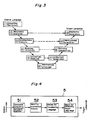
- Fig. 3 there provided many levels in the machine translation as is well known to those skilled in the art.
- analysis thereof is proceeded in the order of consulting the dictionary (level #1), morphemic analysis (level #2) and constructional analysis (level #3).
- the machine translation method is classified into two according to the level to which the analysis is proceeded. One of them is so called "Pivot Method" in which the analysis is proceeded to the level #6 wherein the source language is transformed or translated into so called intermediate language constructed by general ideas being independent on either of existing languages and target language is generated according to the intermediate language obtained.
- Transfer Method in which the analysis is proceeded to either one level of morphemic analysis (#2), constructional analysis (#3), meaning analysis (#4) and contextual analysis (#5) to obtain the internal structure of the source language and the target language is generated by transferring each structure obtained in each analysis level into structure of the level corresponding thereto represented in target language.
- the analysis is proceeded at least to the level (#3) of constructional analysis.
- the translation module 5 is functionally divided into :means 51 for consulting dictionary and for analyzing morpheme, means 52 for analyzing construction, means 53 for transferring source language to target language and means 54 for generating the corresponding target language.
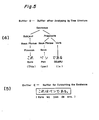
- Fig. 5 shows the content of each buffer, shown in Fig. 2, during the process of translating English sentence "This is a pen.” into Japanese.
- the original sentence is read into Buffer A as is shown in Fig. 5(1).
- the means 51 of the module 5 consult the dictionary about each word of the original to obtain grammatical data and meaning thereabout. These data obtained are entered into Buffer B as is shown partially in Fig. 5(2).
- Fig. 5(2) data regarding to the part of speech are merely shown. Although the word “this” has multiple parts.of speech, the part of speech of "this" in this sentence is identified to a specified one as the result of the analysis by the constructional-analysis means 52 and the tree structure thereof is entered into Buffer C as shewn in Fig. 5(3). In this process, analysis as shown in Table 2 is made based upon the grammatical rules (phrase structure rules) stored in Table means 6.
- the rule ( ⁇ ) means generally that, for instance, "Sentence is comprised of the subject and the predicate.”
- the language transferring means 53 execute analysis using transfer rules of tree structure similarly to the constructional analysis and the result obtained is stored into Buffer D.
- the target language generating means 54 supplements one or more suitable post-positional words functioning as an auxiliary to a main word and one or more auxiliary verbs so as to form a Japanese sentence and the result obtained is stored into Buffer E (Result Buffer) as shown in Fig. 5(5). This result is an output of the translation module 5.
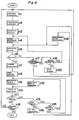
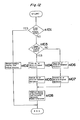
- Fig. 6 shows a flow chart of a main routine program according to the present invention.
- the flag provided for indicating the selection of next possibility is reset at step n1. This flag is used to indicate an error when any answer is not obtained in the constructional analysis.
- source language is entered at step n2, consulting the translating dictionary and the morphemic analysis are executed at step n3.
- n4 a combination of "first" part of speech of each word. is initially set.
- step n5 the series of parts of speech is analyzed with respect to the construction thereof. Then, it is decided, at step n6, whether the constructional analysis made at step n5 is successful or not.
- step n7 When decided successful, the process is proceeded to step n7 wherein language transfer is made and then to step n8 for generating target language and, at step n9, a translation is generated with use of each of first equivalent of first part of speech.
- step n10 the translation obtained is displayed on the CRT display 3.
- next possible translation is to be generated or not at step n11 and, at next step n12, it is decided whether the next sentence is to be translated or not. If there is no need to translate, the translation process is completed.
- next possible translation is required at step n11, it is decided whether a cursor is positioned on a word in the sentence to be translated.
- the process is proceeded to next step n14 and it is decided whether or not the word designated by the cursor has another meaning or equivalent.
- step n15 the next translation is generated with use thereof at step n15. If the word has not next or another meaning, the process is returned to step n9.
- step n16 If the cursor is not on the word but at the end of sentence, the process is proceeded to step n16 and the flag for the next possible translation is set thereat. When the flag is set, the process is returned to step n5 to execute next constructional analysis.
- the constructional analyzing means 52 has such a function that, if the series of parts of speech is not changed in the next constructional analysis, another modification relation is found out. If another modification is obtained, steps n7 to n11 are executed successively as mentioned above.
- step n17 If it failed to obtain another modification, the process is proceeded to step n17 and it is decided whether all of combinations with respect to the part of speech have been considered or not.
- step n18 If it is decided that there exists one or more combination, one new combination is designated at step n18 and the constructional analysis is done about new combination at step n5. When there is no further combination of the part of speech, the process is proceeded from step n17 to step n19 and it is decided whether or not the flag for next translation is set.
- step n4 When the flag is set, the process is returned to step n4. Only when the flag is not set, namely when answer is not obtained in the constructional analysis at step n5, an error message is displayed at step n20 and the process is returned to step n1.
- Fig. 7 shows examples of the method how to designate next possible translation in the case of English as source language.
- an arrow 2 in Fig. 7(1) if the cursor is positioned at one of words, for example at the word "flies”, next equivalent of the word designated by the cursor is employed. If the cursor is positioned before the heading of the sentence as indicated by an arrow 1, a next construction is employed. In this example, it is necessary to provide a set of cursor move keys and a key for designating next possible translation.
- Fig. 7(3) there provided one or more special cursor move keys for designating every word, as indicated by the cursor ka, together with the ordinary set of cursor move key.
- the cursor is moved to the position of next word. According to the example, the cursor is moved rapidly when compared with the first or second example.
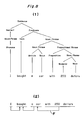
- Fig. 8 shows the method for displaying modification relation.
- Figs. 8(1) and (3) show respectively the result of the constructional analysis being stored in Buffer C as is indicated in Fig. 5(3).
- a possible modification relation with respect to the tree structure obtained by the constructional analysis is indicated as shown in Fig. 8(2) or (4).
- rules are predetermined in such a manner defined as follows. For example, when a tree structure such as ["noun phrase” +"noun phrase (a car)" and “prepositional phrase (with 200 dollars)"] is obtained, the noun phrase “a car” and the prepositional phrase "with 200 dollars” are underlined separately and an arrow is so drawn as to point from the prepositional phrase to the noun phrase as indicated by the arrow F.
- next possible answer can be designated in either of two ways, namely as a next equivalent of a word or as a next possible construction, a number of key touch necessary for obtaining a correct translation is considerably decreased.
- the display method as mentioned above may be advantageous in learning language.
- a user can select a correct translation among a plurality of possible translations in a short time.
- each Japanese equivalent word is obtained corresponding to each English word as shown in Table 5.
- Japanese translation is displayed together with the English original as is shown in Fig. 11. If the result displayed is correct, the process is proceeded to the translation of next sentence or is finished. If the result is incorrect, it is corrected according to the following manner.
- Fig. 12 shows a flow chart of a program developed for the correction operation. As is shown in Fig. 11, the English original is displayed in an area 41a provide left hand side of the display area 41 and the Japanese translation is displayed in a-right hand side area 41b.
- the cursor C is positioned, in this example, at the position of "i” of "is” in the original display area 41a.
- the cursor C can be positioned in the blank area as indicated by “S” or in the word display area as indicated by "L”.
- step n101 it is decided whether or not the cursor C is positioned in the blank area S.
- the process is proceeded to step n102 and, at step n102, the word having been displayed in an emphasis manner such as a highlighting is returned to normal display.
- step n10 4 the process is proceeded to step n10 4 and, at step n104, the order of the word indicated by the cursor is counted.
- step n105 the order of the equivalent corresponding to the original word is searched.
- step n106 the process is proceeded to step n106 and, at step n106, the order of the translation is calculated.
- step n107 the order of the equivalent word indicated by the cursor C is searched.
- step n108 both of the word searched at step n105 or n107 and the word indicated by the cursor are displayed in an emphatic manner such as a highlighting as indicated by a reference R in Fig. 11. For instance, in the case that the cursor C is positioned at "i" or "s" of the word "is” of the original text, the order of the original word is two and the order of the equivalent word corresponding thereto is six, and therefore, the word "is” and the Japanese word "desu" are highlighted.
- the correspondence between the original word and the equivalent can be explicitly recognized and, therefore, efficiency in the translation operation is increased.
- Fig. 13 shows a flow chart of a program for executing translation.
- step n201 the level of analysis for executing the assignment of equivalent is set.
- step n202 an original text to be translated is in entered.
- step n203 the morphemic analysis is made with respect to the text entered.
- step n204 it is decided whether the assignment of equivalent is to be displayed or not. If it is to be done, the process is proceeded to step n205.
- step n205 there displayed the assignment of equivalent together with the part of speech of each word.
- the assignment of equivalent means that each equivalent to each word of the input sentence F1 to be translated is assigned to corresponding original word in a word for word manner as indicated by an arrow F2.
- the abbreviation of each part of speech is displayed.
- each word of source language usually has a plurality of equivalents in this morphemic analysis.
- the correct equivalent is chosen among the plural equivalents.
- step n207 If the assignment of equivalent is decided not to be done, the process is proceeded to step n207.
- step n207 the constructional analysis, the transformation and the generation mentioned above are made to obtain a translation.
- step n208 the result of translation obtained at step n207 is displayed on the CRT display.
- step n209 it is decided whether the translation displayed is correct or not. If decided correct, the translation is printed out by the printer 7 at step n210 and, then, the process is proceeded to step n211.
- step n212 it is decided whether the assignment of equivalent is to be displayed or not.
- step n207 In the case that the operator considers that it is possible to obtain a correct translation if the constructional analysis etc. are executed again at step n207 or in the case that it is decided not to be done at step n212, the process is returned to step n207.
- step n212 is provided to decide whether the process is to be returned to step n207, it is also possible to return to step n202 or step n203 if it is considered desirable in view of contents of the incorrect translation.
- step n212 When the assignment of equivalent is decided to be displayed at step n212, the process is proceeded to step n213 and, at step n213, the assignment of equivalent is displayed. At next step n214, it is decided whether or not correction about the incorrect translation is possible at step n207.
- step n203 If it is decided impossible, the process is returned to step n203 and the morphemic analysis is executed again. However, there may be a case in that the correction is impossible even when the morphemic analysis is made. In such a case, the process is returned to step n202 not to step 203 and a next sentence is entered at step n202.
- step n214 If it is considered to be possible at step n214, the process is proceeded to step n215.
- step n215 the process including selection of equivalents is executed and, then, the process is returned to step n207.
- step n211 it is decided whether there is a next sentence to be translated or not. If there is a next sentence, the process is returned to step n202 in order to enter it. If there is not any next sentence to be translated, the process is completed.
- the assignment of equivalent is displayed explicitly and, therefore, it becomes possible to decide whether or not the correct translation is obtained and/or to find out what is to be corrected in the incorrect translation.
- Fig. 16 shows a flow chart of a program for pointing out.
- step n301 an original text, namely source language is entered.
- the translation dictionary is consulted with and, at step n303, the morphemic analysis is executed and, at step n304, the constructional analysis is made. Further, at step n305, the language transfer is executed and a translation is generated at step n306.
- the steps n301 to n306 are subroutines.
- step n307 it is decided whether the translation generated is to be printed out.
- step n308 it is decided whether the translation is to be printed side by side with the original.
- step n309 the original text stored in the Buffer A and the translation stored in the Buffer E are transferred to the Buffer F provided for print.
- step n310 data stored in the Buffer F is printed by the printer 7.
- step n311 The print format is so set as to print out the translation side by side with the original as is shown in Fig. 17.
- step n307 If the print is not selected at step n307, the process is proceeded to step n311.
- step n308 If the side by side print format is not selected at step n308, the process is proceeded to step n112. At step n312, only the translation stored in the Buffer E is printed out by the printer 7.
- step n311 it is decided whether there is a next sentence to be translated. If there is a further sentence to be translated, the process is returned to step n301 to execute the translation thereof.
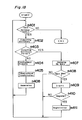
- Fig. 18 shows a flow chart of a program developed for the dictionary function.
- step n401 it is decided whether an original text has been entered into the Buffer A. If there is no text to be translated, the process is completed.
- step n402 If there is a text to be translated, the process is proceed to step n402 and the translation dictionary is consulted with thereat. At step n403, it is decided whether the dictionary is failed to consult with. If failed, the process is proceed to step n407.
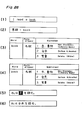
- a message indicating there is a word not given in the dictionary is displayed as shown in Fig. 20(1). Then, it is decided whether the word is to be entered or not at step n4o8.
- step n408 When "YES" is entered at step n408, the process is proceeded to step n409, data about the word is entered thereat. This data entry is proceeded according to a program developed therefor.
- steps n501 and n502 correspond to steps n407 and n408 respectively.
- the cursor is automatically displayed at the position which the word is to be entered as shown in Fig. 20(2). Namely, the user can enter the word directly without operations for moving the cursor.
- the word is entered with the keyboard and then, the return key is pushed to proceed to step n405.
- the word entered is stored in the buffer.
- the cursor is moved to the head position of a plurality of parts of speech to be selected. As shown in Fig. 20(3), a mark " ⁇ " is displayed at the position of the cursor to indicate the part of speech explicitly.
- step n507 the cursor is moved to the position of the correct part of speech. If the part of speech indicated at the initial position of the cursor is correct, only the return key is pushed. Next, the process is proceeded to step n508 and the part of speech indicated by the cursor is stored into the buffer. At next step n509, the cursor is moved to the heading position of the item of equivalent as shown in Fig. 20(4). The user enters one or more equivalents with the keyboard and then pushes the return key at step n510. The equivalents entered are stored into the buffer at step n511. At that time, all the data related are displayed on the CRT display as shown in Fig. 20(5).
- a message readable as "Is entry data to be registered in the user's dictionary?" is displayed as shown in Fig. 20(6).
- step n513 corresponds to the step n410 of Fig. 18. If the answer is "NO”, the entry proceedings are completed and the translation proceeding is continued.
- step n514 corresponding to step n411 of Fig. 18.
- step n514 the original word, the equivalent thereto, the part of speech are written into the user's dictionary and, then, the process is completed to return to step n401 of Fig. 18.
- the translation process is favorably proceeded by entering data such as an original word, one or more equivalent and the part of speech.
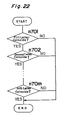
- the input word is stored into the buffer at step n601. Then, the number m of characters of the input word is counted at step n602. A dictionary pointer is set at the head of the dictionary at step n603. A word searching routine is started at step n605. The word searching routine is shown in Fig. 22.
- step n701 of Fig. 22 it is decided whether the first character of the word designated by the dictionary pointer corresponds to that of the word stored in the buffer. If they correspond to each other, the comparison between second characters is made at step n702.
- step n604 the dictionary pointer is increased by "+1" and the process is proceeded to step n605 in order to compare with respect to the next word of the dictionary.
- step n602 If the second characters correspond to each other at step n602, the process is proceeded to step n603 at which the third characters are compared with each other.
- step n604 the dictionary pointer is increased by "+ 1 ".
- step n607 the process is proceeded to step n607 and the dictionary pointer is increased by "+ 1" .
- step n608 the process is proceed to the routine of Fig. 22.
- a dictionary as shown in Fig. 22.
- Fig. 24(1) when the word "ba" is entered into the area A1 with the keyboard and the return key is pushed, two words having 2 characters "ba” are displayed in the area B1. If only "b” is entered into the area A2, as is shown in Fig. 24(2), five words having "b” as a heading character are displayed in the area B2 as the result of the word search. The operator can designated or identify easily the objective word among words displayed.
- a sentence of the source language "I read a book” as shown in Fig. 26(1) is entered at step n801.
- a function key for example a dictionary display key provided on the keyboard in order to proceed the process to step n802.
- the dictionary pointer is set so as to position at the head of the dictionary provided.
- next step n806 it is inquired to the CRT display whether the equivalent is to be replaced with respect to the original sentence. So called “multi-window” format is employed as the display format of the inquiry, with respect to the contents of the dictionary displayed. If it is not necessary to replace the equivalent with another one, "NO" is entered and then the return key is pushed to complete the translation process.
- step n807 the equivalent “hon” corresponding to the word "BOOK” corresponding to the word “book” in the translation displayed in highlighted, as shown in Fig. 26.(5) At this time, the cursor is positioned at the head in the item for equivalents, namely at the position of the equivalent "hon".
- step n809 the cursor is moved to a position of the word desired and the return key is pushed. Then the equivalent having been highlighted is deleted at step n810 and, in place of that, the equivalent indicated by the cursor is inserted as is shown in Fig. 26(4)
- contents of a word in the dictionary are displayed and the replacement of the equivalent is easily done by moving the cursor.
- the type A is defined as a combination of at least two of one or more Chinese characters and/or one or more Katakanas and/or one or more Arabic numerals.
- Type B is defined as Hiragana STR namely one or more Hiraganas.
- Type C is defined as one or more marks or symbols.
- Fig. 28 shows a flow chart of a program for executing deletion of one or specified type.
- step n901 the start and end addresses of characters, designated by the cursor are stored into a "start pointer SP" and a “end pointer EP” respectively.
- step n902 it is decided whether or not the character indicated by the cursor is belonged to Type C. If it belongs to Type C, the process is proceeded to step n909 which will be mentioned later. If it is not Type C, the process is proceeded to step n903 at which it is decided whether the characters indicated by the cursor belong to Type B.
- the process is proceeded to n906 and, if it does not belong to Type B, the process is proceeded to step n904. AT step n906 or n904, the end pointer EP is renewed.
- step n905 it is decided whether the characters indicated by the cursor belongs to Type A. If it is Type A, the process is returned to step n904 at which the end point EP is renewed.
- the end pointer EP is renewed at step n906.
- step n908 the process is proceeded to step n908 at which the end pointer EP is decreased by "1".
- the last end of the characters indicated by the cursor is appointed as the end pointer EP in the case that the characters belong to Type A
- the last end of the same is appointed as the end pointer EP in the case that the same belong to Type B
- the single character belongs to Type C it is appointed as both of the start pointer and the end pointer.
- one or more characters to be deleted are designated.
- One or more characters designated above are stored into a "temporary buffer TEMPBF" at step n909. Then, one or more characters are deleted from the text stored in the text buffer TEXTBF at step n910.
- Fig. 29 shows a flow chart for moving one or more characters being classified either of three Types A, B and C.
- a buffer area is reserved in the temporary buffer TEMPBF from the address thereof corresponding to the position of the cursor so as to have a length same to that of the character row to be moved.
- the contents of the temporary buffer TEMPBF are copied into the text buffer TEXTBF. Then, the specified character row is moved to a desired position.
- FIG. 30 An example of deletion and/or movement process is shown in Fig. 30.
- the text shown in Fig. 30(1) is readable as follows.
- deletion and/or movement of a character row can be done only by indication with the cursor. Therefore, operability in editorial jobs is greatly improved.
- Fig. 31 shows a flow chart therefor. Assume that a text being comprised of a plurality of sentences has been stored in the text buffer TEXTBF.
- the address data corresponding to the position of a character designated by the cursor is stored respectively into the start pointer SP and the end pointer EP provided in the memory.
- step n1002 it is decided whether the end pointer EP indicates an ending mark or symbol each of which shows the end of a sentence. If it does not indicated an ending mark, the process is proceeded to step n1003 at which the end pointer EP is renewed. The end of a sentence is thus searched according to the character code given by repeating the renewal process of the end pointer EP.
- step n1004 When the end of a sentence is found out by the end pointer, the process is proceeded to step n1004 at which the character row comprising a sentence to be deleted which is defined between the start pointer SP and the end pointer EP is stored into the temporary buffer TEMPBF temporarily.
- the objective sentence is deleted in the text buffer TEXTBF.
- Fig. 32 shows a flow chart for processing movement of a sentence.
- step n1001 to n1004 have been executed before the start of step n1006, namely a sentence or character row to be moved has been stored in the temporary buffer TEMPBF.
- step n1006 the number of characters included in the sentence or the character row is counted to know the length thereof.
- a buffer area is reserved in the temporary buffer TEMPBF from the address corresponding to the position of the cursor so as to have the same length to that of the sentence or the character row to be deleted.
- step n1008 the content of the temporary buffer TEMPBF is copied into the text buffer TEXTBF. Thus, the sentence designated can be moved.
- Figs. 33 and 34 show respectively Japanese texts to be edited.
- Fig. 35 shows a flow chart of the main routine to be executed by CPU.
- a style for Japanese translation is designated at step n1101. If the first style is to be selected, the flag provided therefor is not set. This flag is set when the second style is to be selected. Namely, the translation machine usually translate the original into Japanese in the first style when any special indication is not entered.
- step n1102 it is decided whether or not there is the original text to be translated.
- the original text is a sentence "This is a pen.” as shown in Fig. 36(1).
- step n1103 the process is proceeded to step n1103 at which the morphemic analysis is done.
- the part of speech and the equivalent with respect to each word are found out as shown in Fig. 36(2).
- step n1104 the constructional analysis is executed to determine labels as indicated in Fig. 36(1).
- step n1105 the translation is generated with use of the first style designated at step n1101.
- steps from n1103 to n1105 defined as a separated subroutine.
- the process is returned to step n1101.
- the step n1101 for designating the style is provided in the loop thereof and, therefore, it is possible to designated the style with respect to every sentence.
- step n1101 is provided so as to be executed out of the loop of the flow chart of Fig. 35. It is also possible by defining the program so as for the flag state to be maintained during the translation process when it is designated once. In this case, the process is returned from step n1105 to step n1102.
- Fig. 37 shows a flow chart of the subroutine of step n1105.
- the pointer P is set at the head of a generation Table shown in Fig. 36(3) at step n1106. At step n1107, it is decided whether or not the label indicated by the pointer exists in the original as shown in Fig. 36(1).
- step n1108 the pointer P is increased by one and, then, the process is returned to step 1107. If there is the label indicated by the pointer in the original, the process is proceeded from n1107 to n1109. '
- step n1109 it is decided whether or not the label indicated is the predicate and the style designated is the second style. If the label is the predicate and the style is designated as the second style, the process is proceeded to step n1110 at which the predicate is transformed from the first style to the second style and the process is proceeded to n1112.
- step n1109 If it is decided at step n1109, that the label indicated by the pointer is not the predicate or the style is designated to the first style, the process is proceeded to step n1111.
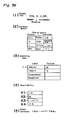
- step n1111 Japanese equivalents are stored into areas K1 to K4 of the Result Buffer as shown in Fig. 36(4).
- step n1112 it is decided whether or not the label indicated by the pointer is the predicated. If it is so, the process is proceeded to step n1113.
- step n1113 the conjugation process is executed.
- the predicated is conjugated according to the tense, the negative etc.
- step n1113 the process is proceeded to step n1114.
- auxiliary word corresponding to the label indicated by the pointer is stored into corresponding buffer area of the Result Buffer as shown in Fig. 36(b).
- step n1115 it is decided whether or not the generation of the sentence has been completed.
- step n1108 the process is proceeded to step n1108 to increase the pointer by one. After the increment of the pointer, the process is returned to step n1107.
- the process according to the generation subroutine is finished.
- the head of the generation Table is input into the pointer. As shown in Fig. 36(3), the head of the generation Table is the subject (shugo).
- step n1107 it is decided whether or not the label indicated by the pointer P is included in the original of Fig. 36(1). In this case, the subject is included in the original and, therefore, the process is proceeded to step n1109. Since the label is the subject at step n1109, the process is proceeded to step n1111.
- step n1111 the subject "this” is consulted with the translation dictionary and the equivalent “kore” corresponding thereto is read out and is stored into the area K1 of the Result Buffer. It is decided whether the label is the predicate at step n1112. But, in this case, the label is the subject and, therefore, the process is proceeded to step n1114 at which the auxiliary word "wa" contained in the generation Table is stored into the area K2 of the Result Buffer.
- step n1115 it is decided that the generation is not completed and the pointer P is increased by one at step n1108, to indicate the object being the next label. Since the original does not include the object, the process is proceeded from step n1107 to step n1108 to increase the pointer by one. Therefore, the pointer indicates the complement. Since the complement is included in the original, the process is proceeded from step n1107 to step n1109. The label is the complement at step n1109, the process is proceeded to step n1111 at which the equivalent "hitotsu no pen" corresponding to "a pen" is stored into the area K3 of the Result Buffer.
- step n1112 It is decided at step n1112 that the label is not the predicate and the process is proceeded to step n1114.
- step n1114 nothing is stored into the Result Buffer, since there is no auxiliary words corresponding to the complement in the generation Table.
- step 1115 it is decided that the generation is not completed and, at step n1108, the pointer P is increased by one to indicate the predicate. Since the predicate indicated by the pointer P is included in the original, the process is proceeded from step n1107 to step n1109.
- step n1110 When the style is designated to the second style, the process is proceeded to step n1110 since the predicate indicated by the pointer is included in the original.
- the equivalent "desu" in the second style is chosen among equivalents listed in the translation dictionary and is stored into the area K4 of the Result Buffer.
- the label is the predicate at step n1112, the process is proceeded to step n1113 to execute the conjugation process.
- step n1114 it is decided that there is no auxiliary words. Therefore, the process is proceeded to step n1115.
- step n1115 it is decided that the generation has been completed and, therefore, the process is finished.
- Fig. 38 shows a flow chart of a program for transforming the style from the first to the second.
- step n1116 it is decided whether or not the part of speech of the predicate is a verb. If it is so, the process is proceeded to step n1117. At step n1117, the verb is so conjugated as to meet with the second style and "masu" is added to the end of the verb conjugated. At step n1118, the equivalent obtained is stored into the Result Buffer.
- step n1119 it is decided whether or not the part of speech is the adjective. If it is so, the process is proceeded to step n1120.
- step n1120 the word "desu" in the second style is added next to the equivalent and, then, the equivalent obtained at step n1120 is stored into the Result Buffer.
- step n1121 At which it is decided whether or not the part of speech is the adjective verb. If it is so, the process is proceeded to step n1122. At step n1122, the word "desu" in the second style is added to the trunk of the predicated and the equivalent obtained is stored into the Result Buffer.
- step n1123 it is decided whether or not the equivalent is ending in the form of "-dearu”. If it is decided that the equivalent is ending in the form of "- dearu”, the process is proceeded to step n1124 to transform "-dearu" into "-desu”. After the transformation, the equivalent obtained is stored into the Result Buffer.
- step n1123 When it is decided, at step n1123, that the equivalent is not ending in the form of "-dearu”, the process is ended since it is supposed to be wrongly proceeded.
Landscapes
- Engineering & Computer Science (AREA)
- Theoretical Computer Science (AREA)
- Health & Medical Sciences (AREA)
- Artificial Intelligence (AREA)
- Audiology, Speech & Language Pathology (AREA)
- Computational Linguistics (AREA)
- General Health & Medical Sciences (AREA)
- Physics & Mathematics (AREA)
- General Engineering & Computer Science (AREA)
- General Physics & Mathematics (AREA)
- Machine Translation (AREA)
Applications Claiming Priority (20)
| Application Number | Priority Date | Filing Date | Title |
|---|---|---|---|
| JP59195591A JPS6174068A (ja) | 1984-09-18 | 1984-09-18 | 翻訳装置 |
| JP195592/84 | 1984-09-18 | ||
| JP59195592A JPS6174064A (ja) | 1984-09-18 | 1984-09-18 | 文書編集方式 |
| JP195591/84 | 1984-09-18 | ||
| JP59199290A JPS6177956A (ja) | 1984-09-22 | 1984-09-22 | 文書編集方式 |
| JP199292/84 | 1984-09-22 | ||
| JP199290/84 | 1984-09-22 | ||
| JP59199292A JPS6177970A (ja) | 1984-09-22 | 1984-09-22 | 翻訳の表示方式 |
| JP201113/84 | 1984-09-26 | ||
| JP201115/84 | 1984-09-26 | ||
| JP201114/84 | 1984-09-26 | ||
| JP59201115A JPS6180361A (ja) | 1984-09-26 | 1984-09-26 | 翻訳表示方式 |
| JP59201114A JPS6180360A (ja) | 1984-09-26 | 1984-09-26 | 翻訳方式 |
| JP59201113A JPS6180359A (ja) | 1984-09-26 | 1984-09-26 | 翻訳装置 |
| JP212161/84 | 1984-10-09 | ||
| JP59212161A JPS6190272A (ja) | 1984-10-09 | 1984-10-09 | 辞書機能を用いた翻訳方式 |
| JP59212159A JPS6190270A (ja) | 1984-10-09 | 1984-10-09 | 辞書機能を用いた翻訳方式 |
| JP212159/84 | 1984-10-09 | ||
| JP59212160A JPS6190271A (ja) | 1984-10-09 | 1984-10-09 | 入力語の探索表示方式 |
| JP212160/84 | 1984-10-09 |
Publications (3)
| Publication Number | Publication Date |
|---|---|
| EP0175357A2 true EP0175357A2 (de) | 1986-03-26 |
| EP0175357A3 EP0175357A3 (en) | 1986-09-10 |
| EP0175357B1 EP0175357B1 (de) | 1992-04-29 |
Family
ID=27580390
Family Applications (1)
| Application Number | Title | Priority Date | Filing Date |
|---|---|---|---|
| EP85111799A Expired - Lifetime EP0175357B1 (de) | 1984-09-18 | 1985-09-18 | Übersetzungssystem |
Country Status (2)
| Country | Link |
|---|---|
| EP (1) | EP0175357B1 (de) |
| DE (1) | DE3585937D1 (de) |
Cited By (14)
| Publication number | Priority date | Publication date | Assignee | Title |
|---|---|---|---|---|
| GB2175718A (en) * | 1985-05-14 | 1986-12-03 | Sharp Kk | A translating apparatus |
| GB2177525A (en) * | 1985-05-14 | 1987-01-21 | Sharp Kk | Bilingual translation system with self intelligence |
| GB2193358A (en) * | 1986-06-30 | 1988-02-03 | Sharp Kk | Translation machine |
| GB2193362A (en) * | 1986-05-20 | 1988-02-03 | Sharp Kk | Machine translation |
| GB2194084A (en) * | 1986-06-27 | 1988-02-24 | Sharp Kk | Translation system |
| FR2604814A1 (fr) * | 1986-10-03 | 1988-04-08 | Ricoh Kk | Analyseur de langage |
| US4787038A (en) * | 1985-03-25 | 1988-11-22 | Kabushiki Kaisha Toshiba | Machine translation system |
| US4814987A (en) * | 1985-05-20 | 1989-03-21 | Sharp Kabushiki Kaisha | Translation system |
| EP0318975A1 (de) * | 1987-12-03 | 1989-06-07 | Siemens Aktiengesellschaft | Verfahren und Anordnung zum Bearbeiten von verschiedensprachigen Texten |
| GB2193355B (en) * | 1986-05-20 | 1990-07-11 | Sharp Kk | Machine translation system |
| EP0189665B1 (de) * | 1984-12-25 | 1993-03-03 | Kabushiki Kaisha Toshiba | System zur maschinellen Übersetzung |
| US5225981A (en) * | 1986-10-03 | 1993-07-06 | Ricoh Company, Ltd. | Language analyzer for morphemically and syntactically analyzing natural languages by using block analysis and composite morphemes |
| EP0514305A3 (en) * | 1991-04-18 | 1993-10-27 | Ibm | Method and apparatus for facilitating contextual language translation within an interactive software application |
| GB2513537A (en) * | 2012-12-20 | 2014-11-05 | Ibm | Natural language processing |
Family Cites Families (3)
| Publication number | Priority date | Publication date | Assignee | Title |
|---|---|---|---|---|
| FR2101495A5 (de) * | 1971-06-18 | 1972-03-31 | Baillie Andre | |
| JPS5748159A (en) * | 1980-09-03 | 1982-03-19 | Sharp Corp | Electronic interpreter |
| JPS58101365A (ja) * | 1981-12-14 | 1983-06-16 | Hitachi Ltd | 機械翻訳システム |
-
1985
- 1985-09-18 DE DE8585111799T patent/DE3585937D1/de not_active Expired - Lifetime
- 1985-09-18 EP EP85111799A patent/EP0175357B1/de not_active Expired - Lifetime
Cited By (18)
| Publication number | Priority date | Publication date | Assignee | Title |
|---|---|---|---|---|
| EP0189665B1 (de) * | 1984-12-25 | 1993-03-03 | Kabushiki Kaisha Toshiba | System zur maschinellen Übersetzung |
| US4787038A (en) * | 1985-03-25 | 1988-11-22 | Kabushiki Kaisha Toshiba | Machine translation system |
| GB2175718B (en) * | 1985-05-14 | 1989-10-25 | Sharp Kk | A translating apparatus |
| GB2177525A (en) * | 1985-05-14 | 1987-01-21 | Sharp Kk | Bilingual translation system with self intelligence |
| GB2175718A (en) * | 1985-05-14 | 1986-12-03 | Sharp Kk | A translating apparatus |
| GB2177525B (en) * | 1985-05-14 | 1989-08-16 | Sharp Kk | Translation system |
| US4814987A (en) * | 1985-05-20 | 1989-03-21 | Sharp Kabushiki Kaisha | Translation system |
| GB2193362A (en) * | 1986-05-20 | 1988-02-03 | Sharp Kk | Machine translation |
| GB2193355B (en) * | 1986-05-20 | 1990-07-11 | Sharp Kk | Machine translation system |
| GB2193362B (en) * | 1986-05-20 | 1990-06-06 | Sharp Kk | Machine translation system |
| GB2194084A (en) * | 1986-06-27 | 1988-02-24 | Sharp Kk | Translation system |
| GB2193358A (en) * | 1986-06-30 | 1988-02-03 | Sharp Kk | Translation machine |
| FR2604814A1 (fr) * | 1986-10-03 | 1988-04-08 | Ricoh Kk | Analyseur de langage |
| US5225981A (en) * | 1986-10-03 | 1993-07-06 | Ricoh Company, Ltd. | Language analyzer for morphemically and syntactically analyzing natural languages by using block analysis and composite morphemes |
| EP0318975A1 (de) * | 1987-12-03 | 1989-06-07 | Siemens Aktiengesellschaft | Verfahren und Anordnung zum Bearbeiten von verschiedensprachigen Texten |
| EP0514305A3 (en) * | 1991-04-18 | 1993-10-27 | Ibm | Method and apparatus for facilitating contextual language translation within an interactive software application |
| GB2513537A (en) * | 2012-12-20 | 2014-11-05 | Ibm | Natural language processing |
| US10503830B2 (en) | 2012-12-20 | 2019-12-10 | International Business Machines Corporation | Natural language processing with adaptable rules based on user inputs |
Also Published As
| Publication number | Publication date |
|---|---|
| DE3585937D1 (de) | 1992-06-04 |
| EP0175357B1 (de) | 1992-04-29 |
| EP0175357A3 (en) | 1986-09-10 |
Similar Documents
| Publication | Publication Date | Title |
|---|---|---|
| US5220503A (en) | Translation system | |
| US5010486A (en) | System and method for language translation including replacement of a selected word for future translation | |
| EP0180888B1 (de) | Verfahren und Gerät zur Natursprachenverarbeitung | |
| US4814987A (en) | Translation system | |
| EP0175357B1 (de) | Übersetzungssystem | |
| EP0370774A2 (de) | Maschinenübersetzungssystem | |
| EP0244871A2 (de) | System zur maschinellen Übersetzung | |
| JPH0351020B2 (de) | ||
| JPH02299068A (ja) | 入力文字列からワードを分離する方法 | |
| US5396419A (en) | Pre-edit support method and apparatus | |
| US5299124A (en) | Translation machine capable of analyzing syntactic of sentence | |
| JPH08292955A (ja) | 言語処理方法及びそれを適用するデータ処理装置 | |
| US4860206A (en) | Translation system allowing user designation of postpositional words | |
| Rateb et al. | A critical survey on Arabic named entity recognition and diacritization systems | |
| JPH05151261A (ja) | 時制推敲支援システム | |
| JP3814000B2 (ja) | 文字列変換装置および文字列変換方法 | |
| JPH0410665B2 (de) | ||
| JP2902343B2 (ja) | 言語解析システムおよび方法 | |
| Ahmed et al. | Bangla grammar and spelling check using machine learning | |
| JP2880600B2 (ja) | 単語列翻訳装置 | |
| JPH0612453A (ja) | 未知語抽出登録装置 | |
| JPS63136264A (ja) | 機械翻訳装置 | |
| Lukjanow | Statement of proposed method for mechanical translation | |
| JPH0773174A (ja) | 日本語処理システム | |
| Mulligan et al. | A Prototype Syntax Checker for German Learners of English |
Legal Events
| Date | Code | Title | Description |
|---|---|---|---|
| PUAI | Public reference made under article 153(3) epc to a published international application that has entered the european phase |
Free format text: ORIGINAL CODE: 0009012 |
|
| AK | Designated contracting states |
Kind code of ref document: A2 Designated state(s): DE GB |
|
| PUAL | Search report despatched |
Free format text: ORIGINAL CODE: 0009013 |
|
| AK | Designated contracting states |
Kind code of ref document: A3 Designated state(s): DE GB |
|
| 17P | Request for examination filed |
Effective date: 19861224 |
|
| 17Q | First examination report despatched |
Effective date: 19890414 |
|
| GRAA | (expected) grant |
Free format text: ORIGINAL CODE: 0009210 |
|
| AK | Designated contracting states |
Kind code of ref document: B1 Designated state(s): DE GB |
|
| REF | Corresponds to: |
Ref document number: 3585937 Country of ref document: DE Date of ref document: 19920604 |
|
| PLBI | Opposition filed |
Free format text: ORIGINAL CODE: 0009260 |
|
| 26 | Opposition filed |
Opponent name: XEROX CORPORATION Effective date: 19930129 |
|
| APAC | Appeal dossier modified |
Free format text: ORIGINAL CODE: EPIDOS NOAPO |
|
| APAC | Appeal dossier modified |
Free format text: ORIGINAL CODE: EPIDOS NOAPO |
|
| PLBQ | Unpublished change to opponent data |
Free format text: ORIGINAL CODE: EPIDOS OPPO |
|
| PLAB | Opposition data, opponent's data or that of the opponent's representative modified |
Free format text: ORIGINAL CODE: 0009299OPPO |
|
| R26 | Opposition filed (corrected) |
Opponent name: XEROX CORPORATION Effective date: 19930129 |
|
| PGFP | Annual fee paid to national office [announced via postgrant information from national office to epo] |
Ref country code: GB Payment date: 19981015 Year of fee payment: 14 |
|
| PGFP | Annual fee paid to national office [announced via postgrant information from national office to epo] |
Ref country code: DE Payment date: 19981029 Year of fee payment: 14 |
|
| APAC | Appeal dossier modified |
Free format text: ORIGINAL CODE: EPIDOS NOAPO |
|
| RDAH | Patent revoked |
Free format text: ORIGINAL CODE: EPIDOS REVO |
|
| RDAG | Patent revoked |
Free format text: ORIGINAL CODE: 0009271 |
|
| STAA | Information on the status of an ep patent application or granted ep patent |
Free format text: STATUS: PATENT REVOKED |
|
| 27W | Patent revoked |
Effective date: 19981027 |
|
| GBPR | Gb: patent revoked under art. 102 of the ep convention designating the uk as contracting state |
Free format text: 981027 |
|
| APAH | Appeal reference modified |
Free format text: ORIGINAL CODE: EPIDOSCREFNO |