EP0176348B1 - Développement tannant dans la formation d'images photographiques à partir de faibles quantités d'argent - Google Patents
Développement tannant dans la formation d'images photographiques à partir de faibles quantités d'argent Download PDFInfo
- Publication number
- EP0176348B1 EP0176348B1 EP85306785A EP85306785A EP0176348B1 EP 0176348 B1 EP0176348 B1 EP 0176348B1 EP 85306785 A EP85306785 A EP 85306785A EP 85306785 A EP85306785 A EP 85306785A EP 0176348 B1 EP0176348 B1 EP 0176348B1
- Authority
- EP
- European Patent Office
- Prior art keywords
- coupler
- developing agent
- polymeric
- groups
- silver halide
- Prior art date
- Legal status (The legal status is an assumption and is not a legal conclusion. Google has not performed a legal analysis and makes no representation as to the accuracy of the status listed.)
- Expired
Links
- 229910052709 silver Inorganic materials 0.000 title claims description 49
- 239000004332 silver Substances 0.000 title claims description 49
- 238000011161 development Methods 0.000 title claims description 22
- BQCADISMDOOEFD-UHFFFAOYSA-N Silver Chemical compound [Ag] BQCADISMDOOEFD-UHFFFAOYSA-N 0.000 title 1
- -1 silver halide Chemical class 0.000 claims description 69
- 239000003795 chemical substances by application Substances 0.000 claims description 53
- 238000000034 method Methods 0.000 claims description 42
- QIGBRXMKCJKVMJ-UHFFFAOYSA-N Hydroquinone Chemical compound OC1=CC=C(O)C=C1 QIGBRXMKCJKVMJ-UHFFFAOYSA-N 0.000 claims description 25
- 239000000758 substrate Substances 0.000 claims description 24
- YCIMNLLNPGFGHC-UHFFFAOYSA-N catechol Chemical compound OC1=CC=CC=C1O YCIMNLLNPGFGHC-UHFFFAOYSA-N 0.000 claims description 16
- 238000005859 coupling reaction Methods 0.000 claims description 14
- 230000008878 coupling Effects 0.000 claims description 12
- 238000010168 coupling process Methods 0.000 claims description 12
- WQGWDDDVZFFDIG-UHFFFAOYSA-N pyrogallol Chemical compound OC1=CC=CC(O)=C1O WQGWDDDVZFFDIG-UHFFFAOYSA-N 0.000 claims description 12
- 239000003125 aqueous solvent Substances 0.000 claims description 8
- 229940079877 pyrogallol Drugs 0.000 claims description 6
- 238000005406 washing Methods 0.000 claims description 6
- 239000002253 acid Substances 0.000 claims description 5
- 239000002245 particle Substances 0.000 claims description 5
- AVXURJPOCDRRFD-UHFFFAOYSA-N Hydroxylamine Chemical compound ON AVXURJPOCDRRFD-UHFFFAOYSA-N 0.000 claims description 4
- ZFIQGRISGKSVAG-UHFFFAOYSA-N 4-methylaminophenol Chemical compound CNC1=CC=C(O)C=C1 ZFIQGRISGKSVAG-UHFFFAOYSA-N 0.000 claims description 3
- 125000002843 carboxylic acid group Chemical group 0.000 claims description 3
- 125000000687 hydroquinonyl group Chemical group C1(O)=C(C=C(O)C=C1)* 0.000 claims description 3
- 230000005855 radiation Effects 0.000 claims description 3
- 150000005208 1,4-dihydroxybenzenes Chemical class 0.000 claims description 2
- 239000012736 aqueous medium Substances 0.000 claims description 2
- ABLZXFCXXLZCGV-UHFFFAOYSA-N phosphonic acid group Chemical group P(O)(O)=O ABLZXFCXXLZCGV-UHFFFAOYSA-N 0.000 claims description 2
- 125000000542 sulfonic acid group Chemical group 0.000 claims description 2
- 239000010410 layer Substances 0.000 description 39
- 239000000243 solution Substances 0.000 description 39
- 229920000642 polymer Polymers 0.000 description 31
- QTBSBXVTEAMEQO-UHFFFAOYSA-N Acetic acid Chemical compound CC(O)=O QTBSBXVTEAMEQO-UHFFFAOYSA-N 0.000 description 18
- 238000000576 coating method Methods 0.000 description 18
- 239000011248 coating agent Substances 0.000 description 17
- 238000002360 preparation method Methods 0.000 description 17
- 108010010803 Gelatin Proteins 0.000 description 16
- 239000008273 gelatin Substances 0.000 description 16
- 229920000159 gelatin Polymers 0.000 description 16
- 235000019322 gelatine Nutrition 0.000 description 16
- 235000011852 gelatine desserts Nutrition 0.000 description 16
- XLYOFNOQVPJJNP-UHFFFAOYSA-N water Substances O XLYOFNOQVPJJNP-UHFFFAOYSA-N 0.000 description 16
- 239000000975 dye Substances 0.000 description 13
- 239000000839 emulsion Substances 0.000 description 13
- 239000008199 coating composition Substances 0.000 description 11
- 229920006267 polyester film Polymers 0.000 description 10
- 230000002378 acidificating effect Effects 0.000 description 9
- JEXVQSWXXUJEMA-UHFFFAOYSA-N pyrazol-3-one Chemical compound O=C1C=CN=N1 JEXVQSWXXUJEMA-UHFFFAOYSA-N 0.000 description 9
- LFQSCWFLJHTTHZ-UHFFFAOYSA-N Ethanol Chemical compound CCO LFQSCWFLJHTTHZ-UHFFFAOYSA-N 0.000 description 8
- 229920001577 copolymer Polymers 0.000 description 8
- 239000000049 pigment Substances 0.000 description 8
- 239000012190 activator Substances 0.000 description 7
- 238000006243 chemical reaction Methods 0.000 description 7
- 239000000178 monomer Substances 0.000 description 7
- OZAIFHULBGXAKX-UHFFFAOYSA-N 2-(2-cyanopropan-2-yldiazenyl)-2-methylpropanenitrile Chemical compound N#CC(C)(C)N=NC(C)(C)C#N OZAIFHULBGXAKX-UHFFFAOYSA-N 0.000 description 6
- VHUUQVKOLVNVRT-UHFFFAOYSA-N Ammonium hydroxide Chemical compound [NH4+].[OH-] VHUUQVKOLVNVRT-UHFFFAOYSA-N 0.000 description 6
- PEDCQBHIVMGVHV-UHFFFAOYSA-N Glycerine Chemical compound OCC(O)CO PEDCQBHIVMGVHV-UHFFFAOYSA-N 0.000 description 6
- OKKJLVBELUTLKV-UHFFFAOYSA-N Methanol Chemical compound OC OKKJLVBELUTLKV-UHFFFAOYSA-N 0.000 description 6
- DKGAVHZHDRPRBM-UHFFFAOYSA-N Tert-Butanol Chemical compound CC(C)(C)O DKGAVHZHDRPRBM-UHFFFAOYSA-N 0.000 description 6
- 235000011114 ammonium hydroxide Nutrition 0.000 description 6
- 239000006185 dispersion Substances 0.000 description 6
- 150000004820 halides Chemical class 0.000 description 6
- 239000000203 mixture Substances 0.000 description 6
- 230000003287 optical effect Effects 0.000 description 6
- 239000002904 solvent Substances 0.000 description 6
- JIGUQPWFLRLWPJ-UHFFFAOYSA-N Ethyl acrylate Chemical compound CCOC(=O)C=C JIGUQPWFLRLWPJ-UHFFFAOYSA-N 0.000 description 5
- CERQOIWHTDAKMF-UHFFFAOYSA-N Methacrylic acid Chemical compound CC(=C)C(O)=O CERQOIWHTDAKMF-UHFFFAOYSA-N 0.000 description 5
- 239000000908 ammonium hydroxide Substances 0.000 description 5
- 239000007864 aqueous solution Substances 0.000 description 5
- 239000003960 organic solvent Substances 0.000 description 5
- PNJWIWWMYCMZRO-UHFFFAOYSA-N pent‐4‐en‐2‐one Natural products CC(=O)CC=C PNJWIWWMYCMZRO-UHFFFAOYSA-N 0.000 description 5
- 238000010992 reflux Methods 0.000 description 5
- WZCQRUWWHSTZEM-UHFFFAOYSA-N 1,3-phenylenediamine Chemical group NC1=CC=CC(N)=C1 WZCQRUWWHSTZEM-UHFFFAOYSA-N 0.000 description 4
- WOBHKFSMXKNTIM-UHFFFAOYSA-N Hydroxyethyl methacrylate Chemical compound CC(=C)C(=O)OCCO WOBHKFSMXKNTIM-UHFFFAOYSA-N 0.000 description 4
- VVQNEPGJFQJSBK-UHFFFAOYSA-N Methyl methacrylate Chemical compound COC(=O)C(C)=C VVQNEPGJFQJSBK-UHFFFAOYSA-N 0.000 description 4
- 150000001241 acetals Chemical class 0.000 description 4
- 239000002585 base Substances 0.000 description 4
- 239000011230 binding agent Substances 0.000 description 4
- 239000003086 colorant Substances 0.000 description 4
- 238000004090 dissolution Methods 0.000 description 4
- XYIBRDXRRQCHLP-UHFFFAOYSA-N ethyl acetoacetate Chemical compound CCOC(=O)CC(C)=O XYIBRDXRRQCHLP-UHFFFAOYSA-N 0.000 description 4
- 238000005227 gel permeation chromatography Methods 0.000 description 4
- 238000004519 manufacturing process Methods 0.000 description 4
- 239000000463 material Substances 0.000 description 4
- 150000003839 salts Chemical group 0.000 description 4
- GEHJYWRUCIMESM-UHFFFAOYSA-L sodium sulfite Chemical compound [Na+].[Na+].[O-]S([O-])=O GEHJYWRUCIMESM-UHFFFAOYSA-L 0.000 description 4
- ZNQVEEAIQZEUHB-UHFFFAOYSA-N 2-ethoxyethanol Chemical compound CCOCCO ZNQVEEAIQZEUHB-UHFFFAOYSA-N 0.000 description 3
- 229940093475 2-ethoxyethanol Drugs 0.000 description 3
- KFZMGEQAYNKOFK-UHFFFAOYSA-N Isopropanol Chemical compound CC(C)O KFZMGEQAYNKOFK-UHFFFAOYSA-N 0.000 description 3
- HEMHJVSKTPXQMS-UHFFFAOYSA-M Sodium hydroxide Chemical compound [OH-].[Na+] HEMHJVSKTPXQMS-UHFFFAOYSA-M 0.000 description 3
- PPBRXRYQALVLMV-UHFFFAOYSA-N Styrene Chemical compound C=CC1=CC=CC=C1 PPBRXRYQALVLMV-UHFFFAOYSA-N 0.000 description 3
- 229920005601 base polymer Polymers 0.000 description 3
- 125000003178 carboxy group Chemical group [H]OC(*)=O 0.000 description 3
- 239000003153 chemical reaction reagent Substances 0.000 description 3
- 230000000694 effects Effects 0.000 description 3
- 238000003384 imaging method Methods 0.000 description 3
- 230000006698 induction Effects 0.000 description 3
- 125000001570 methylene group Chemical group [H]C([H])([*:1])[*:2] 0.000 description 3
- 238000002156 mixing Methods 0.000 description 3
- 229920003229 poly(methyl methacrylate) Polymers 0.000 description 3
- 239000004926 polymethyl methacrylate Substances 0.000 description 3
- 239000007787 solid Substances 0.000 description 3
- 230000008961 swelling Effects 0.000 description 3
- 229920002554 vinyl polymer Polymers 0.000 description 3
- QGKMIGUHVLGJBR-UHFFFAOYSA-M (4z)-1-(3-methylbutyl)-4-[[1-(3-methylbutyl)quinolin-1-ium-4-yl]methylidene]quinoline;iodide Chemical compound [I-].C12=CC=CC=C2N(CCC(C)C)C=CC1=CC1=CC=[N+](CCC(C)C)C2=CC=CC=C12 QGKMIGUHVLGJBR-UHFFFAOYSA-M 0.000 description 2
- VOZKAJLKRJDJLL-UHFFFAOYSA-N 2,4-diaminotoluene Chemical compound CC1=CC=C(N)C=C1N VOZKAJLKRJDJLL-UHFFFAOYSA-N 0.000 description 2
- SGWZVZZVXOJRAQ-UHFFFAOYSA-N 2,6-Dimethyl-1,4-benzenediol Chemical compound CC1=CC(O)=CC(C)=C1O SGWZVZZVXOJRAQ-UHFFFAOYSA-N 0.000 description 2
- OAYXUHPQHDHDDZ-UHFFFAOYSA-N 2-(2-butoxyethoxy)ethanol Chemical compound CCCCOCCOCCO OAYXUHPQHDHDDZ-UHFFFAOYSA-N 0.000 description 2
- SMZOUWXMTYCWNB-UHFFFAOYSA-N 2-(2-methoxy-5-methylphenyl)ethanamine Chemical compound COC1=CC=C(C)C=C1CCN SMZOUWXMTYCWNB-UHFFFAOYSA-N 0.000 description 2
- XNWFRZJHXBZDAG-UHFFFAOYSA-N 2-METHOXYETHANOL Chemical compound COCCO XNWFRZJHXBZDAG-UHFFFAOYSA-N 0.000 description 2
- NIXOWILDQLNWCW-UHFFFAOYSA-N 2-Propenoic acid Natural products OC(=O)C=C NIXOWILDQLNWCW-UHFFFAOYSA-N 0.000 description 2
- POAOYUHQDCAZBD-UHFFFAOYSA-N 2-butoxyethanol Chemical compound CCCCOCCO POAOYUHQDCAZBD-UHFFFAOYSA-N 0.000 description 2
- CSCPPACGZOOCGX-UHFFFAOYSA-N Acetone Chemical compound CC(C)=O CSCPPACGZOOCGX-UHFFFAOYSA-N 0.000 description 2
- WTDHULULXKLSOZ-UHFFFAOYSA-N Hydroxylamine hydrochloride Chemical compound Cl.ON WTDHULULXKLSOZ-UHFFFAOYSA-N 0.000 description 2
- LRHPLDYGYMQRHN-UHFFFAOYSA-N N-Butanol Chemical compound CCCCO LRHPLDYGYMQRHN-UHFFFAOYSA-N 0.000 description 2
- 239000004372 Polyvinyl alcohol Substances 0.000 description 2
- 206010070834 Sensitisation Diseases 0.000 description 2
- CDBYLPFSWZWCQE-UHFFFAOYSA-L Sodium Carbonate Chemical compound [Na+].[Na+].[O-]C([O-])=O CDBYLPFSWZWCQE-UHFFFAOYSA-L 0.000 description 2
- BZHJMEDXRYGGRV-UHFFFAOYSA-N Vinyl chloride Chemical compound ClC=C BZHJMEDXRYGGRV-UHFFFAOYSA-N 0.000 description 2
- DHKHKXVYLBGOIT-UHFFFAOYSA-N acetaldehyde Diethyl Acetal Natural products CCOC(C)OCC DHKHKXVYLBGOIT-UHFFFAOYSA-N 0.000 description 2
- WDJHALXBUFZDSR-UHFFFAOYSA-M acetoacetate Chemical compound CC(=O)CC([O-])=O WDJHALXBUFZDSR-UHFFFAOYSA-M 0.000 description 2
- 150000007513 acids Chemical class 0.000 description 2
- 239000000654 additive Substances 0.000 description 2
- 238000007605 air drying Methods 0.000 description 2
- 229910052782 aluminium Inorganic materials 0.000 description 2
- XAGFODPZIPBFFR-UHFFFAOYSA-N aluminium Chemical compound [Al] XAGFODPZIPBFFR-UHFFFAOYSA-N 0.000 description 2
- 150000001412 amines Chemical class 0.000 description 2
- 229940051880 analgesics and antipyretics pyrazolones Drugs 0.000 description 2
- 239000003637 basic solution Substances 0.000 description 2
- GGNQRNBDZQJCCN-UHFFFAOYSA-N benzene-1,2,4-triol Chemical compound OC1=CC=C(O)C(O)=C1 GGNQRNBDZQJCCN-UHFFFAOYSA-N 0.000 description 2
- 230000015572 biosynthetic process Effects 0.000 description 2
- 229920002678 cellulose Polymers 0.000 description 2
- 229920002301 cellulose acetate Polymers 0.000 description 2
- 238000007334 copolymerization reaction Methods 0.000 description 2
- 239000000835 fiber Substances 0.000 description 2
- 150000002443 hydroxylamines Chemical class 0.000 description 2
- 238000007654 immersion Methods 0.000 description 2
- BDAGIHXWWSANSR-UHFFFAOYSA-N methanoic acid Natural products OC=O BDAGIHXWWSANSR-UHFFFAOYSA-N 0.000 description 2
- 230000007935 neutral effect Effects 0.000 description 2
- 229920000139 polyethylene terephthalate Polymers 0.000 description 2
- 239000005020 polyethylene terephthalate Substances 0.000 description 2
- 229920002451 polyvinyl alcohol Polymers 0.000 description 2
- IOLCXVTUBQKXJR-UHFFFAOYSA-M potassium bromide Chemical compound [K+].[Br-] IOLCXVTUBQKXJR-UHFFFAOYSA-M 0.000 description 2
- BWHMMNNQKKPAPP-UHFFFAOYSA-L potassium carbonate Chemical compound [K+].[K+].[O-]C([O-])=O BWHMMNNQKKPAPP-UHFFFAOYSA-L 0.000 description 2
- 125000002924 primary amino group Chemical group [H]N([H])* 0.000 description 2
- 230000008313 sensitization Effects 0.000 description 2
- 230000001235 sensitizing effect Effects 0.000 description 2
- 235000010265 sodium sulphite Nutrition 0.000 description 2
- 239000007921 spray Substances 0.000 description 2
- 238000009498 subcoating Methods 0.000 description 2
- 229920003002 synthetic resin Polymers 0.000 description 2
- 239000000057 synthetic resin Substances 0.000 description 2
- CNHDIAIOKMXOLK-UHFFFAOYSA-N toluquinol Chemical compound CC1=CC(O)=CC=C1O CNHDIAIOKMXOLK-UHFFFAOYSA-N 0.000 description 2
- BFVPXROCOCTNOP-UHFFFAOYSA-M 1-ethyl-4-[(1-ethylquinolin-1-ium-4-yl)methylidene]quinoline;iodide Chemical compound [I-].C12=CC=CC=C2N(CC)C=C\C1=C\C1=CC=[N+](CC)C2=CC=CC=C12 BFVPXROCOCTNOP-UHFFFAOYSA-M 0.000 description 1
- AUFZRCJENRSRLY-UHFFFAOYSA-N 2,3,5-trimethylhydroquinone Chemical compound CC1=CC(O)=C(C)C(C)=C1O AUFZRCJENRSRLY-UHFFFAOYSA-N 0.000 description 1
- DBCKMJVEAUXWJJ-UHFFFAOYSA-N 2,3-dichlorobenzene-1,4-diol Chemical compound OC1=CC=C(O)C(Cl)=C1Cl DBCKMJVEAUXWJJ-UHFFFAOYSA-N 0.000 description 1
- VNXUPEPDMYVBQY-UHFFFAOYSA-N 2-(4-aminophenyl)-5-methyl-4h-pyrazol-3-one Chemical compound O=C1CC(C)=NN1C1=CC=C(N)C=C1 VNXUPEPDMYVBQY-UHFFFAOYSA-N 0.000 description 1
- CDAWCLOXVUBKRW-UHFFFAOYSA-N 2-aminophenol Chemical class NC1=CC=CC=C1O CDAWCLOXVUBKRW-UHFFFAOYSA-N 0.000 description 1
- JKFYKCYQEWQPTM-UHFFFAOYSA-N 2-azaniumyl-2-(4-fluorophenyl)acetate Chemical compound OC(=O)C(N)C1=CC=C(F)C=C1 JKFYKCYQEWQPTM-UHFFFAOYSA-N 0.000 description 1
- REFDOIWRJDGBHY-UHFFFAOYSA-N 2-bromobenzene-1,4-diol Chemical compound OC1=CC=C(O)C(Br)=C1 REFDOIWRJDGBHY-UHFFFAOYSA-N 0.000 description 1
- GKQZDIPRXDPUTL-UHFFFAOYSA-N 2-chloro-3-methylbenzene-1,4-diol Chemical compound CC1=C(O)C=CC(O)=C1Cl GKQZDIPRXDPUTL-UHFFFAOYSA-N 0.000 description 1
- XUDBVJCTLZTSDC-UHFFFAOYSA-N 2-ethenylbenzoic acid Chemical compound OC(=O)C1=CC=CC=C1C=C XUDBVJCTLZTSDC-UHFFFAOYSA-N 0.000 description 1
- TZSJAVRADXYUJU-UHFFFAOYSA-N 2-methyl-n-(3-oxo-2-phenyl-1h-pyrazol-5-yl)prop-2-enamide Chemical compound N1C(NC(=O)C(=C)C)=CC(=O)N1C1=CC=CC=C1 TZSJAVRADXYUJU-UHFFFAOYSA-N 0.000 description 1
- VPWNQTHUCYMVMZ-UHFFFAOYSA-N 4,4'-sulfonyldiphenol Chemical class C1=CC(O)=CC=C1S(=O)(=O)C1=CC=C(O)C=C1 VPWNQTHUCYMVMZ-UHFFFAOYSA-N 0.000 description 1
- OSWFIVFLDKOXQC-UHFFFAOYSA-N 4-(3-methoxyphenyl)aniline Chemical compound COC1=CC=CC(C=2C=CC(N)=CC=2)=C1 OSWFIVFLDKOXQC-UHFFFAOYSA-N 0.000 description 1
- MAGFQRLKWCCTQJ-UHFFFAOYSA-N 4-ethenylbenzenesulfonic acid Chemical compound OS(=O)(=O)C1=CC=C(C=C)C=C1 MAGFQRLKWCCTQJ-UHFFFAOYSA-N 0.000 description 1
- ZVNPWFOVUDMGRP-UHFFFAOYSA-N 4-methylaminophenol sulfate Chemical compound OS(O)(=O)=O.CNC1=CC=C(O)C=C1.CNC1=CC=C(O)C=C1 ZVNPWFOVUDMGRP-UHFFFAOYSA-N 0.000 description 1
- XPAZGLFMMUODDK-UHFFFAOYSA-N 6-nitro-1h-benzimidazole Chemical class [O-][N+](=O)C1=CC=C2N=CNC2=C1 XPAZGLFMMUODDK-UHFFFAOYSA-N 0.000 description 1
- NLHHRLWOUZZQLW-UHFFFAOYSA-N Acrylonitrile Chemical compound C=CC#N NLHHRLWOUZZQLW-UHFFFAOYSA-N 0.000 description 1
- 229930185605 Bisphenol Natural products 0.000 description 1
- LSNNMFCWUKXFEE-UHFFFAOYSA-M Bisulfite Chemical compound OS([O-])=O LSNNMFCWUKXFEE-UHFFFAOYSA-M 0.000 description 1
- OYPRJOBELJOOCE-UHFFFAOYSA-N Calcium Chemical compound [Ca] OYPRJOBELJOOCE-UHFFFAOYSA-N 0.000 description 1
- DQEFEBPAPFSJLV-UHFFFAOYSA-N Cellulose propionate Chemical compound CCC(=O)OCC1OC(OC(=O)CC)C(OC(=O)CC)C(OC(=O)CC)C1OC1C(OC(=O)CC)C(OC(=O)CC)C(OC(=O)CC)C(COC(=O)CC)O1 DQEFEBPAPFSJLV-UHFFFAOYSA-N 0.000 description 1
- RYGMFSIKBFXOCR-UHFFFAOYSA-N Copper Chemical compound [Cu] RYGMFSIKBFXOCR-UHFFFAOYSA-N 0.000 description 1
- 229920000742 Cotton Polymers 0.000 description 1
- IMROMDMJAWUWLK-UHFFFAOYSA-N Ethenol Chemical compound OC=C IMROMDMJAWUWLK-UHFFFAOYSA-N 0.000 description 1
- 229920000219 Ethylene vinyl alcohol Polymers 0.000 description 1
- 206010073306 Exposure to radiation Diseases 0.000 description 1
- VQTUBCCKSQIDNK-UHFFFAOYSA-N Isobutene Chemical group CC(C)=C VQTUBCCKSQIDNK-UHFFFAOYSA-N 0.000 description 1
- FYYHWMGAXLPEAU-UHFFFAOYSA-N Magnesium Chemical compound [Mg] FYYHWMGAXLPEAU-UHFFFAOYSA-N 0.000 description 1
- 239000004677 Nylon Substances 0.000 description 1
- 229920002302 Nylon 6,6 Polymers 0.000 description 1
- 229910019142 PO4 Inorganic materials 0.000 description 1
- ALQSHHUCVQOPAS-UHFFFAOYSA-N Pentane-1,5-diol Chemical compound OCCCCCO ALQSHHUCVQOPAS-UHFFFAOYSA-N 0.000 description 1
- 239000004952 Polyamide Substances 0.000 description 1
- 229920001328 Polyvinylidene chloride Polymers 0.000 description 1
- 229920000297 Rayon Polymers 0.000 description 1
- BUGBHKTXTAQXES-UHFFFAOYSA-N Selenium Chemical compound [Se] BUGBHKTXTAQXES-UHFFFAOYSA-N 0.000 description 1
- 229910021607 Silver chloride Inorganic materials 0.000 description 1
- 229910021612 Silver iodide Inorganic materials 0.000 description 1
- PMZURENOXWZQFD-UHFFFAOYSA-L Sodium Sulfate Chemical compound [Na+].[Na+].[O-]S([O-])(=O)=O PMZURENOXWZQFD-UHFFFAOYSA-L 0.000 description 1
- NINIDFKCEFEMDL-UHFFFAOYSA-N Sulfur Chemical compound [S] NINIDFKCEFEMDL-UHFFFAOYSA-N 0.000 description 1
- XTXRWKRVRITETP-UHFFFAOYSA-N Vinyl acetate Chemical compound CC(=O)OC=C XTXRWKRVRITETP-UHFFFAOYSA-N 0.000 description 1
- SJOOOZPMQAWAOP-UHFFFAOYSA-N [Ag].BrCl Chemical compound [Ag].BrCl SJOOOZPMQAWAOP-UHFFFAOYSA-N 0.000 description 1
- XCFIVNQHHFZRNR-UHFFFAOYSA-N [Ag].Cl[IH]Br Chemical compound [Ag].Cl[IH]Br XCFIVNQHHFZRNR-UHFFFAOYSA-N 0.000 description 1
- 238000010521 absorption reaction Methods 0.000 description 1
- WDJHALXBUFZDSR-UHFFFAOYSA-N acetoacetic acid Chemical group CC(=O)CC(O)=O WDJHALXBUFZDSR-UHFFFAOYSA-N 0.000 description 1
- 238000010306 acid treatment Methods 0.000 description 1
- 229920006243 acrylic copolymer Polymers 0.000 description 1
- 125000002015 acyclic group Chemical group 0.000 description 1
- WNLRTRBMVRJNCN-UHFFFAOYSA-L adipate(2-) Chemical compound [O-]C(=O)CCCCC([O-])=O WNLRTRBMVRJNCN-UHFFFAOYSA-L 0.000 description 1
- 150000001298 alcohols Chemical class 0.000 description 1
- 229910000288 alkali metal carbonate Inorganic materials 0.000 description 1
- 150000008041 alkali metal carbonates Chemical class 0.000 description 1
- 229910001508 alkali metal halide Inorganic materials 0.000 description 1
- 150000008045 alkali metal halides Chemical class 0.000 description 1
- 239000012670 alkaline solution Substances 0.000 description 1
- 230000009435 amidation Effects 0.000 description 1
- 238000007112 amidation reaction Methods 0.000 description 1
- QGZKDVFQNNGYKY-UHFFFAOYSA-N ammonia Natural products N QGZKDVFQNNGYKY-UHFFFAOYSA-N 0.000 description 1
- 150000008064 anhydrides Chemical group 0.000 description 1
- 239000003963 antioxidant agent Substances 0.000 description 1
- 239000002216 antistatic agent Substances 0.000 description 1
- 150000003934 aromatic aldehydes Chemical class 0.000 description 1
- 230000002238 attenuated effect Effects 0.000 description 1
- 230000001588 bifunctional effect Effects 0.000 description 1
- 239000007844 bleaching agent Substances 0.000 description 1
- 230000001680 brushing effect Effects 0.000 description 1
- 239000011575 calcium Substances 0.000 description 1
- 229910052791 calcium Inorganic materials 0.000 description 1
- 239000000298 carbocyanine Substances 0.000 description 1
- 239000006229 carbon black Substances 0.000 description 1
- 150000001732 carboxylic acid derivatives Chemical class 0.000 description 1
- 239000001913 cellulose Substances 0.000 description 1
- 229920006218 cellulose propionate Polymers 0.000 description 1
- 238000001311 chemical methods and process Methods 0.000 description 1
- 150000008280 chlorinated hydrocarbons Chemical class 0.000 description 1
- AJPXTSMULZANCB-UHFFFAOYSA-N chlorohydroquinone Chemical compound OC1=CC=C(O)C(Cl)=C1 AJPXTSMULZANCB-UHFFFAOYSA-N 0.000 description 1
- 239000002131 composite material Substances 0.000 description 1
- 150000001875 compounds Chemical class 0.000 description 1
- 238000009833 condensation Methods 0.000 description 1
- 230000005494 condensation Effects 0.000 description 1
- 229910052802 copper Inorganic materials 0.000 description 1
- 239000010949 copper Substances 0.000 description 1
- 239000012153 distilled water Substances 0.000 description 1
- 238000009826 distribution Methods 0.000 description 1
- 238000001035 drying Methods 0.000 description 1
- 125000004185 ester group Chemical group 0.000 description 1
- 230000032050 esterification Effects 0.000 description 1
- 238000005886 esterification reaction Methods 0.000 description 1
- 150000002148 esters Chemical group 0.000 description 1
- 238000006266 etherification reaction Methods 0.000 description 1
- SUPCQIBBMFXVTL-UHFFFAOYSA-N ethyl 2-methylprop-2-enoate Chemical compound CCOC(=O)C(C)=C SUPCQIBBMFXVTL-UHFFFAOYSA-N 0.000 description 1
- 238000002474 experimental method Methods 0.000 description 1
- 239000004744 fabric Substances 0.000 description 1
- 239000011094 fiberboard Substances 0.000 description 1
- 239000000945 filler Substances 0.000 description 1
- 239000011888 foil Substances 0.000 description 1
- 235000019253 formic acid Nutrition 0.000 description 1
- 230000006870 function Effects 0.000 description 1
- 239000011521 glass Substances 0.000 description 1
- 239000011491 glass wool Substances 0.000 description 1
- PCHJSUWPFVWCPO-UHFFFAOYSA-N gold Chemical compound [Au] PCHJSUWPFVWCPO-UHFFFAOYSA-N 0.000 description 1
- 229910052737 gold Inorganic materials 0.000 description 1
- 239000010931 gold Substances 0.000 description 1
- 229910052736 halogen Inorganic materials 0.000 description 1
- 150000002367 halogens Chemical class 0.000 description 1
- 238000010438 heat treatment Methods 0.000 description 1
- 125000004435 hydrogen atom Chemical group [H]* 0.000 description 1
- XMBWDFGMSWQBCA-UHFFFAOYSA-N hydrogen iodide Chemical compound I XMBWDFGMSWQBCA-UHFFFAOYSA-N 0.000 description 1
- 230000007062 hydrolysis Effects 0.000 description 1
- 238000006460 hydrolysis reaction Methods 0.000 description 1
- NWVVVBRKAWDGAB-UHFFFAOYSA-N hydroquinone methyl ether Natural products COC1=CC=C(O)C=C1 NWVVVBRKAWDGAB-UHFFFAOYSA-N 0.000 description 1
- 150000004679 hydroxides Chemical class 0.000 description 1
- 238000005213 imbibition Methods 0.000 description 1
- 238000010348 incorporation Methods 0.000 description 1
- 239000003999 initiator Substances 0.000 description 1
- 150000002576 ketones Chemical class 0.000 description 1
- 230000031700 light absorption Effects 0.000 description 1
- 239000011777 magnesium Substances 0.000 description 1
- 229910052749 magnesium Inorganic materials 0.000 description 1
- 230000000873 masking effect Effects 0.000 description 1
- 229910052751 metal Inorganic materials 0.000 description 1
- 239000002184 metal Substances 0.000 description 1
- 229910021645 metal ion Inorganic materials 0.000 description 1
- FQPSGWSUVKBHSU-UHFFFAOYSA-N methacrylamide Chemical compound CC(=C)C(N)=O FQPSGWSUVKBHSU-UHFFFAOYSA-N 0.000 description 1
- 125000001434 methanylylidene group Chemical group [H]C#[*] 0.000 description 1
- ICWPRFNZEBFLPT-UHFFFAOYSA-N n-(2-hydroxyphenyl)-2-methylprop-2-enamide Chemical compound CC(=C)C(=O)NC1=CC=CC=C1O ICWPRFNZEBFLPT-UHFFFAOYSA-N 0.000 description 1
- VAVZHSBOROHMQD-UHFFFAOYSA-N n-(3-hydroxyphenyl)-2-methylprop-2-enamide Chemical compound CC(=C)C(=O)NC1=CC=CC(O)=C1 VAVZHSBOROHMQD-UHFFFAOYSA-N 0.000 description 1
- LOZMAUHOAQHYDM-UHFFFAOYSA-N n-(4-aminophenyl)-2-methylprop-2-enamide Chemical compound CC(=C)C(=O)NC1=CC=C(N)C=C1 LOZMAUHOAQHYDM-UHFFFAOYSA-N 0.000 description 1
- XZSZONUJSGDIFI-UHFFFAOYSA-N n-(4-hydroxyphenyl)-2-methylprop-2-enamide Chemical compound CC(=C)C(=O)NC1=CC=C(O)C=C1 XZSZONUJSGDIFI-UHFFFAOYSA-N 0.000 description 1
- NYJIXHQKWMNVNP-UHFFFAOYSA-N n-(5-hydroxynaphthalen-1-yl)-2-methylprop-2-enamide Chemical compound C1=CC=C2C(NC(=O)C(=C)C)=CC=CC2=C1O NYJIXHQKWMNVNP-UHFFFAOYSA-N 0.000 description 1
- XLJVAIJMRQTNQC-UHFFFAOYSA-N n-[4-(cyanomethyl)phenyl]-2-methylprop-2-enamide Chemical compound CC(=C)C(=O)NC1=CC=C(CC#N)C=C1 XLJVAIJMRQTNQC-UHFFFAOYSA-N 0.000 description 1
- PTPQVJBFQYDEBE-UHFFFAOYSA-N n-[4-hydroxy-3-(2-methylprop-2-enoylamino)phenyl]-2-methylprop-2-enamide Chemical compound CC(=C)C(=O)NC1=CC=C(O)C(NC(=O)C(C)=C)=C1 PTPQVJBFQYDEBE-UHFFFAOYSA-N 0.000 description 1
- 150000004780 naphthols Chemical class 0.000 description 1
- 229920001778 nylon Polymers 0.000 description 1
- 239000007800 oxidant agent Substances 0.000 description 1
- 230000003647 oxidation Effects 0.000 description 1
- 238000007254 oxidation reaction Methods 0.000 description 1
- 239000006174 pH buffer Substances 0.000 description 1
- 239000003973 paint Substances 0.000 description 1
- 239000000123 paper Substances 0.000 description 1
- CMCWWLVWPDLCRM-UHFFFAOYSA-N phenidone Chemical compound N1C(=O)CCN1C1=CC=CC=C1 CMCWWLVWPDLCRM-UHFFFAOYSA-N 0.000 description 1
- ISWSIDIOOBJBQZ-UHFFFAOYSA-N phenol group Chemical group C1(=CC=CC=C1)O ISWSIDIOOBJBQZ-UHFFFAOYSA-N 0.000 description 1
- 150000002989 phenols Chemical class 0.000 description 1
- WVDDGKGOMKODPV-ZQBYOMGUSA-N phenyl(114C)methanol Chemical compound O[14CH2]C1=CC=CC=C1 WVDDGKGOMKODPV-ZQBYOMGUSA-N 0.000 description 1
- 235000021317 phosphate Nutrition 0.000 description 1
- 150000003013 phosphoric acid derivatives Chemical class 0.000 description 1
- 208000017983 photosensitivity disease Diseases 0.000 description 1
- 231100000434 photosensitization Toxicity 0.000 description 1
- QWYZFXLSWMXLDM-UHFFFAOYSA-M pinacyanol iodide Chemical compound [I-].C1=CC2=CC=CC=C2N(CC)C1=CC=CC1=CC=C(C=CC=C2)C2=[N+]1CC QWYZFXLSWMXLDM-UHFFFAOYSA-M 0.000 description 1
- 239000004014 plasticizer Substances 0.000 description 1
- 229920002647 polyamide Polymers 0.000 description 1
- 229920000728 polyester Polymers 0.000 description 1
- 229920006149 polyester-amide block copolymer Polymers 0.000 description 1
- 239000013047 polymeric layer Substances 0.000 description 1
- 239000005033 polyvinylidene chloride Substances 0.000 description 1
- 239000011736 potassium bicarbonate Substances 0.000 description 1
- 229910000028 potassium bicarbonate Inorganic materials 0.000 description 1
- 235000015497 potassium bicarbonate Nutrition 0.000 description 1
- 229910000027 potassium carbonate Inorganic materials 0.000 description 1
- 235000011181 potassium carbonates Nutrition 0.000 description 1
- TYJJADVDDVDEDZ-UHFFFAOYSA-M potassium hydrogencarbonate Chemical compound [K+].OC([O-])=O TYJJADVDDVDEDZ-UHFFFAOYSA-M 0.000 description 1
- 239000002243 precursor Substances 0.000 description 1
- 230000002028 premature Effects 0.000 description 1
- 238000012545 processing Methods 0.000 description 1
- PNXMTCDJUBJHQJ-UHFFFAOYSA-N propyl prop-2-enoate Chemical compound CCCOC(=O)C=C PNXMTCDJUBJHQJ-UHFFFAOYSA-N 0.000 description 1
- 230000001681 protective effect Effects 0.000 description 1
- 239000001397 quillaja saponaria molina bark Substances 0.000 description 1
- 239000012744 reinforcing agent Substances 0.000 description 1
- 229910052703 rhodium Inorganic materials 0.000 description 1
- 239000010948 rhodium Substances 0.000 description 1
- MHOVAHRLVXNVSD-UHFFFAOYSA-N rhodium atom Chemical compound [Rh] MHOVAHRLVXNVSD-UHFFFAOYSA-N 0.000 description 1
- YGSDEFSMJLZEOE-UHFFFAOYSA-N salicylic acid Chemical compound OC(=O)C1=CC=CC=C1O YGSDEFSMJLZEOE-UHFFFAOYSA-N 0.000 description 1
- 229930182490 saponin Natural products 0.000 description 1
- 150000007949 saponins Chemical class 0.000 description 1
- 229910052711 selenium Inorganic materials 0.000 description 1
- 239000011669 selenium Substances 0.000 description 1
- 150000004760 silicates Chemical class 0.000 description 1
- ADZWSOLPGZMUMY-UHFFFAOYSA-M silver bromide Chemical compound [Ag]Br ADZWSOLPGZMUMY-UHFFFAOYSA-M 0.000 description 1
- ZUNKMNLKJXRCDM-UHFFFAOYSA-N silver bromoiodide Chemical compound [Ag].IBr ZUNKMNLKJXRCDM-UHFFFAOYSA-N 0.000 description 1
- 229940045105 silver iodide Drugs 0.000 description 1
- HKZLPVFGJNLROG-UHFFFAOYSA-M silver monochloride Chemical compound [Cl-].[Ag+] HKZLPVFGJNLROG-UHFFFAOYSA-M 0.000 description 1
- 229910000029 sodium carbonate Inorganic materials 0.000 description 1
- 235000017550 sodium carbonate Nutrition 0.000 description 1
- 235000011121 sodium hydroxide Nutrition 0.000 description 1
- 229910052938 sodium sulfate Inorganic materials 0.000 description 1
- 235000011152 sodium sulphate Nutrition 0.000 description 1
- KICVIQZBYBXLQD-UHFFFAOYSA-M sodium;2,5-dihydroxybenzenesulfonate Chemical compound [Na+].OC1=CC=C(O)C(S([O-])(=O)=O)=C1 KICVIQZBYBXLQD-UHFFFAOYSA-M 0.000 description 1
- 230000003595 spectral effect Effects 0.000 description 1
- 229910001220 stainless steel Inorganic materials 0.000 description 1
- 239000010935 stainless steel Substances 0.000 description 1
- 238000003860 storage Methods 0.000 description 1
- 239000000126 substance Substances 0.000 description 1
- 125000001424 substituent group Chemical group 0.000 description 1
- 238000006467 substitution reaction Methods 0.000 description 1
- 238000006277 sulfonation reaction Methods 0.000 description 1
- 229910052717 sulfur Inorganic materials 0.000 description 1
- 239000011593 sulfur Substances 0.000 description 1
- 150000003467 sulfuric acid derivatives Chemical class 0.000 description 1
- 239000004094 surface-active agent Substances 0.000 description 1
- 229920001059 synthetic polymer Polymers 0.000 description 1
- 238000012546 transfer Methods 0.000 description 1
- 125000000391 vinyl group Chemical group [H]C([*])=C([H])[H] 0.000 description 1
- 229920001959 vinylidene polymer Polymers 0.000 description 1
- ZTWTYVWXUKTLCP-UHFFFAOYSA-N vinylphosphonic acid Chemical compound OP(O)(=O)C=C ZTWTYVWXUKTLCP-UHFFFAOYSA-N 0.000 description 1
- NLVXSWCKKBEXTG-UHFFFAOYSA-N vinylsulfonic acid Chemical compound OS(=O)(=O)C=C NLVXSWCKKBEXTG-UHFFFAOYSA-N 0.000 description 1
- 239000003039 volatile agent Substances 0.000 description 1
- 239000000080 wetting agent Substances 0.000 description 1
- 239000002023 wood Substances 0.000 description 1
Classifications
-
- G—PHYSICS
- G03—PHOTOGRAPHY; CINEMATOGRAPHY; ANALOGOUS TECHNIQUES USING WAVES OTHER THAN OPTICAL WAVES; ELECTROGRAPHY; HOLOGRAPHY
- G03C—PHOTOSENSITIVE MATERIALS FOR PHOTOGRAPHIC PURPOSES; PHOTOGRAPHIC PROCESSES, e.g. CINE, X-RAY, COLOUR, STEREO-PHOTOGRAPHIC PROCESSES; AUXILIARY PROCESSES IN PHOTOGRAPHY
- G03C7/00—Multicolour photographic processes or agents therefor; Regeneration of such processing agents; Photosensitive materials for multicolour processes
- G03C7/30—Colour processes using colour-coupling substances; Materials therefor; Preparing or processing such materials
- G03C7/32—Colour coupling substances
- G03C7/327—Macromolecular coupling substances
-
- G—PHYSICS
- G03—PHOTOGRAPHY; CINEMATOGRAPHY; ANALOGOUS TECHNIQUES USING WAVES OTHER THAN OPTICAL WAVES; ELECTROGRAPHY; HOLOGRAPHY
- G03C—PHOTOSENSITIVE MATERIALS FOR PHOTOGRAPHIC PURPOSES; PHOTOGRAPHIC PROCESSES, e.g. CINE, X-RAY, COLOUR, STEREO-PHOTOGRAPHIC PROCESSES; AUXILIARY PROCESSES IN PHOTOGRAPHY
- G03C7/00—Multicolour photographic processes or agents therefor; Regeneration of such processing agents; Photosensitive materials for multicolour processes
- G03C7/30—Colour processes using colour-coupling substances; Materials therefor; Preparing or processing such materials
- G03C7/32—Colour coupling substances
- G03C7/327—Macromolecular coupling substances
- G03C7/3275—Polymers obtained by reactions involving only carbon-to-carbon unsaturated bonds, e.g. vinyl polymers
Definitions
- This invention concerns an improvement in the methods for forming photoimages that are disclosed in U.S. 4,335,197 and U.S. 4,211,561.
- the improvement comprises insolubilizing the polymeric coupler with a hydroquinone or N-substituted aminophenol-type developing agent to produce washout images that are substantially colorless.
- the invention also relates to a photosensitive element/developer system.
- U.S. Patent 4,335,197 discloses a method for producing a photopolymer image on a substrate which comprises exposing to actinic radiation a photosensitive layer containing dispersed silver halide in operative association with a multifunctional polymeric coupler, developing the latent image with a monofunctional developing agent, and removing the undeveloped, soluble portion by washing with aqueous solvent.
- U.S. Patent 4,211,561 discloses a method for producing a photopolymer image employing a multifunctional developing agent in place of the monofunctional developer of U.S. Patent 4,335,197.
- U.S. Patent 2,310,943 describes the use of a polyvinyl acetal carrying phenolic color-former groups, dispersed in a gelatin/silver halide photographic emulsion.
- U.S. Patents 2,397,864 and 2,397,865 disclose acetals and related hydrophilic polymeric color-formers as the sole film-forming carrier for silver halide in a color film.
- U.S. Patent 3,904,418 discloses the use of a polymerized monomer containing at least one active methylene group as a component of a binding agent, useful in a photographic element adapted for silver- dye bleach processes.
- U.S. Patent 4,137,080 discloses a process for preparing color pictures by means of light-sensitive, photographic, silver halide reproducing materials in which development occurs with a polyfunctional developing agent in the presence of a polyfunctional coupler.
- a photoimaging system comprising the components (a) a photosensitive element for photoimaging applications and (b) a developing agent;
- components (a) and (b) cooperate to provide photoimages whose low inherent color will not complicate color generation and balancing using toners, pigments or dyes.
- the improved (tanning) method of this invention produces washout images that are substantially colorless, a property which is particularly useful in color-proofing applications requiring a variety of techniques such as prepigmentation and custom toning.
- the coupler comprise 30 to 80 meq per 100 g of polymeric coupler of coupler groups, and 20 to 165 meq per 100 g of polymeric coupler of carboxylic acid groups.
- Preferred couplers contain pyrazolone coupling groups and are between 5,000 and 70,000 in molecular weight.
- Preferred developing agents are hydroquinone, N-methyl-p-aminophenol, catechol, and pyragallol.
- the photosensitive elements described herein comprise coatings applied to a wide variety of substrates.
- substrate is meant any natural or synthetic support, preferably one which is capable of existing in a flexible or rigid film of sheet form.
- the substrate can be glass, a metal sheet or foil such as copper, aluminum, or stainless steel; fiberboard; or a composite of two or more of these materials.
- substrates include wood, cloth, and cellulose esters such as cellulose acetate, cellulose propionate, cellulose buturate, and the like.
- films or plates composed of various film-forming synthetic resins or high polymers, such as the addition polymers, in particular the vinylidene polymers such as vinyl chloride polymers, vinylidene chloride copolymers with vinyl chloride, vinyl acetate, styrene, isobutylene, and acrylonitrile; vinyl chloride copolymers with the latter polymerizable monomers; linear condensation polymers including polyesters such as polyethylene terephthalate; polyamides such as polyhexylmethylene sebacamide; polyester amides such as polyhexamethylene adipamide/adipate, and the like.
- Preferred substrates include oriented polyethylene terephthalate film, polyvinylidene chloride copolymer-coated oriented polyester film, and gelatin-coated oriented polyester film.
- Fillers or reinforcing agents can be present in the synthetic resin or polymer bases, including synthetic, modified or natural fibers such as cellulosic fibers like cotton, cellulose acetate, viscose rayon and paper. Also useful are glass wool, nylon and the like. These reinforced bases can be used in laminated form.
- the photosensitive elements of this invention with an oriented polyester film substrate are particularly useful in color-proofing systems and for the preparation of lithographic films.
- the photosensitive element will consist of one or more layers on the substrate.
- the elements can also contain a top-coat or protective stratum.
- Such top-coats should be transparent to light and permeable to the basic developer solution, preferably soluble in an aqueous alkaline solution.
- the layer or layers are usually applied in a carrier solvent.
- the solution or dispersion can be sprayed, brushed, applied by a roller or an immersion coater, flowed over the surface, picked up by immersion, spin-coated, or applied to the substrate by other means. The solvent is then allowed to evaporate.
- solvents are employed which are volatile at ordinary pressures.
- suitable solvents include water, aqueous ammonia, aqueous solutions containing strongly basic organic amines, and mixtures of water with water-miscible organic solvents such as methanol, ethanol, butanol, 2-methoxyethanol, 2-ethoxyethanol, 2-butyoxyethanol, and the like.
- the polymeric coupler layer can be applied to the substrate using an organic solvent such as chlorinated hydrocarbons, ketones, or alcohols, and the silver halide emulsion is subsequently applied from an aqueous solution.
- Silver halide can also be applied from an alcohol dispersion by processes wherein silver halide emulsions in water are diluted with water miscible solvents like acetone to precipitate the emulsion binder, i.e., gelatin, around the AgX grains and hence break the emulsion.
- the gelatin coated AgX grains are then filtered and redispersed in alcohol with the assistance of, for example, salicyclic acid.
- the thickness of the photosensitive element after drying is usually about 0.02 to 0.3 mil (0.5 to 7.5 pm). This corresponds to a coating weight of about 5 to 80 mg/dm 2 .
- a coating weight of about 10 to 50 mg/dm 2 .
- Such a coating weight represents a level of silver halide of about 4 to 22 mg/dm2 .
- the light-sensitive halide used in the system and method of this invention to produce photoimages includes silver chloride, silver bromide, silver iodide, silver chlorobromide, silver iodobromide, and silver chloroiodobromide, either singly or in mixtures.
- Preparation of the halide can be carried out in the conventional manner in gelatin, or the halide can be formed directly in a solution of the polymeric coupler.
- the halide can be formed in gelatin, the gelatin removed, and the halide redispersed in a solution of the polymeric coupler. At least about two equivalents of silver halide per equivalent of coupler groups are employed. In imaging systems in which all of the silver halide present is not developable, more than about two equivalents of silver halide per equivalent of coupler groups may be needed, even up to about fifteen equivalents.
- the grain size distribution and sensitization of the silver halide can be controlled to make silver halides suitable for all classes of photographic materials including general continuous tone, x-ray, lithographic, microphotographic, direct positive, and the like.
- the silver halide dispersions will be sensitized chemically with compounds of sulfur, gold, rhodium, selenium, and the like.
- sensitizing dyes such as cyanine, 1,1'-diethyl-4,4'-cyanine iodide, 1,1'-diethyl-2,2'-carbocyanine iodide, 1',3-diethylthia-4'-carbocyanine iodide and other methine and polymethine cyanine dyes, kryptocyanines, merocyanines, pseudocyanines, and others.
- the polymeric coupler is present as a continuous phase in operative association with silver halide particles which are dispersed in the polymeric coupler phase itself or in a layer of binder adjacent to the polymeric coupler phase.
- a binder layer is preferably a gelatin layer overlying the polymeric coupler phase. Minor amounts of gelatin can be present in the polymeric coupler phase so long as the coupler provides the continuous phase.
- Polymeric ocupler molecular weight vary between about 2,000 to 100,000 as determined by gel permeation chromatography. Specific molecular weights needed for various utilities can be determined by balancing the ease of the washing out the soluble areas against the need for good mechanical properties. For example, low molecular weight acetoacetate polymeric couplers are more easily removed in the soluble areas after development, but the films tend to be somewhat weak. Alternatively, high molecular weight acetocetate polymeric couplers give films of good mechanical properties, but the soluble areas are difficult to remove by washout. When a low molecular weight polymeric coupler is employed, it should contain a relatively low concentration of acidic groups so that imaged areas are sufficiently insoluble in aqueous solvents. Alternatively, when a high molecular weight polymeric coupler is used, a relatively high concentration of acidic groups may be required to provide adequate solubility of unimagined areas in aqueous solvents. Carboxyl groups are the preferred acidic groups.
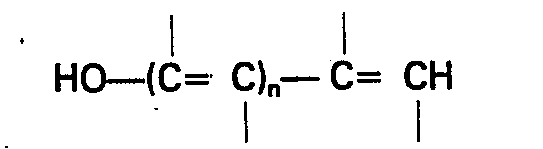
- the coupler groups can be any coupler groups which are capable of coupling with an oxidized hydroquinone-type or N-substituted aminophenol-type developing agent.
- Useful coupler groups include those having the structure where n is 0 or 1. This structure is found in couplers which contain a reactive acyclic or intracyclic methylene group and in aromatic hydroxy compounds. These groups occur in phenols (including naphthols), amines, aminophenols, bis-phenols, acylacetrylides, cyanoacetarylides, beta-ketoesters, pyrazolones, N-homophthalylamines, coumaranones, indoxyls, thioindoxyls, and the like.
- the reaction groups can also be termed reactive methylene, reactive ethenol and reactive 4-hydroxy-1,3-butadienyl groups.
- the hydrogen atoms in the coupling position can be replaced by groups which are readily eliminated in the coupling reaction, including halogen such as CI and Br, sulfonic acid, carboxylic acid, and the like. Pyrazolones are preferred coupler groups.
- the coupler groups can be attached to any suitable base polymer so as to obtain the polymeric couplers useful in the invention.
- Preferred base polymers include copolymers of acrylic acid, methacrylic acid, methacrylamide, ethyl acrylate and 2-hydroxyethyl methacrylate with other conventional vinyl monomers.
- Preparation of polymers which contain coupler groups is usually accomplished by copolymerization of a ethylenically unsaturated monomer which contains a coupler group such as 1-phenyl-3-methacrylamido-5-pyrazolone, or the acetoacetic ester of ⁇ -hydroxyethyl methacrylate, with such other monomers as methyl methacrylate, ethyl methacrylate, ethyl acrylate, propyl acrylate, methacrylic acid, acrylic acid, vinylphosphonic acid, vinylsulfonic acid, vinylbenzoic acid, p-vinylbenzenesulfonic acid, methyacrylamide, 2-hydroxyethyl methacrylate, and the like, to provide polymers which contain pyrazolone groups or acetoacetate groups attached to the polymer chain.
- a coupler group such as 1-phenyl-3-methacrylamido-5-pyrazolone
- the pyrazolone coupler group can be attached to a polymer chain by reaction of 1-p-aminophenyl-3-methyl-5-pyrazolone with anhydride groups in a polymer chain, e.g., with a styrene/maleic anhydride copolymer.
- anhydride groups in a polymer chain, e.g., with a styrene/maleic anhydride copolymer.
- Other useful ethylenically unsaturated monomers which contain color-forming coupler groups are disclosed in British Patent No.
- 875,248 and include m-methacrylamidophenol, 5-methacrylamido-1-naphthol, p-methacrylamidophenol, o-methacrylamidophenol, p-methacrylamidoaniline, p-methacrylamidophenylacetonitrile, I.phenyl-3-methacrylamido-5-pyrazolone, 2,4-dimethacrylamidophenol, and m-methacrlamido-a-benzoylacetanilide.
- Coupler groups can be attached as lateral substituents on the main chain of a base polymer using such conventional chemical processes as esterification, amidation, etherification, acetal formation, and the like.
- preparation of polymers which contain ketomethylene coupler groups can be carried out by polymer substitution reactions. For example, reaction of ethyl acetoacetate with a carboxyl-containing polyvinyl alcohol in an ester exchange reaction gives a polymer which contains a plurality of ketomethylene groups. Similar reaction of carboxyl-containing polyvinyl alcohol with amino and hydroxy-substituted aromatic aldehydes gives polyvinyl acetals with attached coupler groups.
- Acidic groups into the polymeric coupler is typically accomplished by copolymerization with an acidic group-containing monomer. Acidic groups can also be obtained by selective hydrolysis of ester groups attached to the polymer chain. The necessary acidic groups can also be introduced into a preformed polymer chain by sulfonation of preformed styrene copolymers.
- the polymeric coupler phase can contain dyes and pigments to provide the required optical density of the final image. Pigments such as carbon black are preferred when a very high optical density is required.
- the layer can also contain a colorless, transparent mordant for dyes. When a mordant is present, the insolublized layer, after removal of soluble areas, can be treated with a dye solution to increase optical density as the dye is adsorbed by the mordant. Such a system avoids the loss of imaging speed which could be experienced if the dye or pigment is present in the photosensitive layer during exposure to radiation.
- the dye or pigment that provides the density can be incorporated in the polymeric coupler phase which can, in turn, be overcoated with a photosensitive silver halide layer.
- the silver halide is most conveniently carried in an unhardened gelatin layer. With such an arrangement, essentially all of the light used for the exposure is available to the silver halide and none is lost by absorption by colorant.
- the oxidized developing agent diffuses into the colored polymeric coupler phase to effect insolublization.
- Such element can be employed in the process of the instant invention using the tanning developing agents, i.e., a hydroquinone or N-substituted aminophenol-type developing agent, to give a neutral black image.
- the photosensitive element can also contain various conventional photographic additives such as coating aids like saponin, alkylarylsulfonic acids or sulfoalkylsuccinic acids; plasticizers such as glycerol or 1,5-pentanediol; antistatic agents; agents to prevent the formation of spots, antihalation colorants; and the like.
- coating aids like saponin, alkylarylsulfonic acids or sulfoalkylsuccinic acids
- plasticizers such as glycerol or 1,5-pentanediol
- antistatic agents agents to prevent the formation of spots, antihalation colorants; and the like.
- the developing agent can be substituted or unsubstituted hydroquinone and N-substituted aminophenol types which are useful in conventional black and white photography. Suitable developing agents do not contain a primary amino group. In all cases, however, at least two active coupling sites must be present in the developer. For example, although trimethylhydroquinone is an effective silver halide developing agent, it does not produce a tanned image.
- the developing agent contains a group capable of selectively reducing a silver halide latent image and (in its oxidized state) capable of reacting with the coupler groups of the polymeric coupler.
- the polymeric couplers are tanned (insolublized) after exposure by treatment with the developing agent in basic solution.
- the acidic groups of the polymeric coupler in both imaged and unimaged areas, are concurrently converted to ionic salt groups by reaction with base in the developer solution. Since the coupler groups are attached to the polymer chains, insolublization of the polymer chains in aqueous solvents, in the imaged areas, takes place as a result of the coupling reaction.
- Preferred developing agents include the hydroquinone-type, especially hydroquinone, methylhydroquinone, 2,6-dimethylhydroquinone, chlorohydroquinone, 2-methyl-3-chlorohydroquinone, dichlorohydroquinone, bromohydroquinone, hydroxyhydroquinone, sodium hydroquinone monosulfonate, pyrogallol, and catechol. Hydroquinone is particularly preferred.
- Preferred N-substituted aminophenol developers include N-methyl-p-aminophenol.
- Imagewise exposure of the photosensitive layer is conveniently carried out by exposing the layer by any of the usual procedures used with silver halide photographic materials, including camera, cathode ray tube, light emitting diode, projection contact or laser processes.
- Laser imaging is best done with compositions using silver halide spectrally sensitized to the laser output wavelength. Spectral sensitization can improve silver halide light absorption at desired wavelengths.
- the original copy used for camera exposure will consist of black and white areas only; or, if used for contact or projection printing, it will consist of opaque and clear areas (process transparency). Exposures are normally made directly onto the photosensitive element. However, when high concentrations of colorant are present in the silver halide-containing layer, exposure may be made through a transparent substrate to provide proper anchorage of the image to the substrate. When the photosensitive element contains a pigmented polymeric coupler layer and a separate superior silver halide emulsion layer, exposure can be made directly onto the silver halide layer. If an appropriate concentration of light-absorbing dye or pigment is present throughout the thickness of the photosensitive element so that the light is attenuated as it passes through the element, exposures to continuous tone copy can be made through the transparent support. Alternatively, the exposed and developed layer can be transferred to another support before removing the undeveloped, soluble areas. Theimage obtained is of varying thickness and continuous tone.
- the developer is usually employed as a solution comprising developing agent in water or watersoluble organic solvents.
- the developing agent can also be incorporated in the photosensitive element itself as a subcoating, topcoating, or it can be mixed with the polymeric coupler to provide an integral structure containing the developing agent.
- a protected developer or developer precursor such as a masked developer, so that premature oxidation and reaction of the developer is prevented.
- Acid salts of some of the developing agents are also suitable.
- the developer solution can comprise an activator solution (for the developing agent) such as aqueous base.
- the developer solutions can contain conventional additives.
- alkaline agents such as sodium hydroxide, ammonium hydroxide, potassium carbonate, potassium bicarbonate, and sodium carbonate are useful as development accelerators.
- Sodium sulfite at levels below about 0.5% can be employed to improve storage stability.
- Conventional developer superadditives such as 1-phenyl-3-pyrazolidone can also be added. The superadditive can be added directly to the developer solution or it can be incorporated within the photosensitive element.
- Hydroxylamine and substituted hydroxylamines can also function as development accelerators in many instances. In a preferred composition, hydroxylamine is employed as a development accelerator and the ratio of developing agent to hydroxylamine is 10:1 to 1:2.5, most preferably about 1:1.
- the superadditive can be added to the activator solution.
- Sodium sulfate can be used as a swelling suppressant: hydroxylamine salts and sodium sulfite are used as antioxidants; antifoggants include 6-nitrobenzimidazole salts and alkali metal halides such as potassium bromide; solubilizing agents include benzyl alcohol, 2-ethoxyethanol, 2-methoxyethanol, 2-butoxyethanol and 2-(2-butoxyethoxy)ethanol. Water softeners, wetting agents, pH buffers and the like can also be present.
- the pH of the developer solutions is preferably 9 to 12.5, most preferably 9.4 to 11.5.
- the pH and salt content of the developer solutions are adjusted so that swelling but not dissolution of the photosensitive layer occurs during the developing step.
- a water-insoluble polymeric coupler is used, the pH of the developer solution is increased and the salt concentration is adjusted so that swelling but not dissolution of the polymeric layer occurs.
- the quantity of developing agent employed is not critical. When developer solutions are employed, the developing agent usually amounts to 1 to 50 g/I of solution, preferably 5 to 25 g/I.
- the ratio of developing agent to polyfunctional coupler is not critical, but sufficient developing agent should be present to effect satisfactory coupling and insolublization. Preferably, at least 1.0 mole of developing agent for each equivalent of coupler group is employed.
- the undeveloped, soluble areas of the polymeric coupler layer are removed by washing with water, an aqueous solution of solids such as alkali metal carbonate, hydroxides, silicates, phosphates, sulfates, and halides, or a semiaqueous solution of water and a water-miscible organic solvent.
- Suitable organic solvents include methanol, ethanol, 2-propanol, 2-ethoxyethanol, 2-butoxyethanol, 2-(butoxyethoxy)ethanol, and glycerol.
- Spray washout and brushing are preferred for removal of the undeveloped areas. When a separate silver halide emulsion layer is employed, this entire layer can be removed during the washing step.
- one or more conventional finishing steps can be included. Such steps include fixing after development or before or during washout, treatment with an oxidizing agent, acid treatment, hardening with polyvalent metal ions such as calcium, magnesium or borate ions, treatment with surface active agent, and the like.
- the element is dried in a conventional manner.
- the process of this invention provides a water-insoluble polymeric relief image with good resolution over a wide range of exposure speeds including camera speeds.
- the process is operable with silver halide coating weights as low as about 2 mg/dm 2 .
- the process is applicable for a wide variety of uses, but it is particularly useful for the preparation of lithographic films and proofing films where an image of low inherent color is desirable so as not to complicate color production and balancing using, for example, toners or pigments or dyes.
- the photoimaging system and the method according to the invention can thus be used to provide photoimages which are substantially colorless.
- the process of the invention can be employed for the preparation of both negative and positive images.
- the areas insolublized correspond to the areas exposed to light, whereas for a positive image, the areas insolublized correspond to the unexpected areas.
- the type of image obtained depends on the character of the silver halide used.
- a normal negative-working silver halide yields a negative polymer image
- a positive-working silver halide such as one prepared by well-known solarization or chemical fogging techniques, yields a positive polymer image.
- An acrylic copolymer containing pyrazolone coupler groups was prepared by heating at reflux for 8 hours a t-butyl alcohol solution of a mixture of 10 parts of methacrylic acid, 35 parts of methyl methacrylate, 43 parts of ethyl acrylate and 12 parts of 1-phenyl-3-methylacrylamido-5-pyrazolin-2-one in the presence of azobisisobutyronitrile initiator.
- the solution was poured into water to precipitate the copolymer and the precipitated copolymer was steamed to remove volatiles.
- the number of average molecular weight measured by gel permeation chromatography was found to be approximately 70,000 using poly(methylmethacrylate) standards.
- a polymer solution was prepared by dissolving 10 g of the polymer in a mixture of 70 mL of distilled water and 1.25 mL of concentrated ammonium hydroxide.
- a coating formulation was prepared under photographic safelights by mixing 41 g of the polymer solution of Part A with 50 g of a silver halide dispersion in water (10% solids) consisting of orthosensitized, negative-working AgBr 0.985 I 0.015 grains with an average equivalent edge length of 0.28 pm (0.02 ⁇ m 3 volume).
- the coating formulation was coated onto a 25 ⁇ m oriented polyester film using a doctor knife.
- the coating was dried under a stream of warm air to give a photosensitive element with a coating weight of about 30 mg/dm 2 .
- the coated films were contact-exposed (vacuum frame) for 5 sec through a V2 step wedge process transparency using an incandescent lamp (10 ft-candies (108 Im/m 2 ) at 30.5 cm) placed 1.4 m from the film surface.
- the films were immersed in Developer A solution for 2 min at 26°. After development, the films were spray-washed with an air/water spray from a paint sprayer gun at about 275 kPa to remove unexposed areas, and then stopped in 2% aqueous acetic acid for 1 min. The films were air-dried. The developed image, having a D max of 0.72 was laminated (about 50% transfer) to an anodized aluminum surface at 122°.
- Example 1 The photosensitive element of Example 1 was exposed through a process transparency which contained 2%, 5%, 50%, 95% and 98% 150 line halftone dots for periods from 2 to 15 s using an incandescent lamp as described in Example 1. After exposure, the films were developed in Developer B solution for times of either 1 min or 2 min at 26°. The developed films were washed, fixed, and dried as described. The results are summarized in the Table.
- This Example demonstrates the addition of hydroxylamine hydrochloride to the developer solution. Although an initial induction period of about 90 seconds is observed, once started the rate of development is rapid. The developed film has greatly improved washout properties. The induction period can be reduced by the addition of PMHMP to the developer solution at a concentration of 0.05 g/I to 1.1 g/l, preferably 0.1 g/I.
- Example 2 the photosensitive element of Example 1 was exposed, developed and processed as described in Example 1 except that Developer A was replaced with Developer C. An induction time of about 30 s was observed. At an exposure time of 2 s with a 30 to 60 s development time, excellent images were obtained. The developed image (60 s development time) had a D max of 2.
- Acrylate copolymer containing an acetoacetic ester coupler was prepared in the following manner. A solution of 17.5 parts of methyl methacrylate, 21.5 parts of ethyl acrylate, 5.0 parts of methacrylic acid, and 5.4 parts of the acetoacetic ester of 2-hydroxyethyl methacrylate in 333 ml of t-butyl alcohol was heated at reflux. Azobisisobutyronitrile was added in four 0.01 part portions at one hour invervals, ending finally with one hour at reflux. The viscous polymer solution was added in small portions to ice in a blender, mixed vigorously, and filtered. After air-drying there was obtained 23.2 g of white, free-flowing polymer. The number average molecular weight was found to be 94,3000 by gel permeation chromatography using poly(methyl methacrylate) standards. The inherent viscosity measured in 90% formic acid/water was 0.548 dl/g.
- a coating formulation of the polymeric coupler of Part A was prepared as described for the coupler of Example 1 by dissolution of the polymer in aqueous ammonium hydroxide with subsequent mixing of this polymer solution with the silver halide dispersion.
- the coating formulation was coated onto a 102 ⁇ m oriented polyester film having a subcoating of gelatin which had been hardened, and which contained an antihalation backing layer.
- the dried film contained a coating weight of about 20 mg/dm 2.
- a coating formulation of the polymeric coupler of Part A was prepared as described for the coupler of Example 1 by dissolution of the polymer in aqueous ammonium hydroxide with subsequent mixing of this polymer solution with the silver halide dispersion.
- the coating formulation was coated onto a 102 ⁇ m gelatin-subbed oriented polyester film substrate which contained an antihalation backing layer.
- the dried film contained a coating weight of about 50 mg/dm 2 .
- the dried films were exposed through a 2 to 98% halftone dot process transparency, developed in Developer E, washed out, and stopped for 32 s in 2% aqueous acetic acid using the general procedure described for the films of Example. With an exposure time of 0.5 s and 5 s development, a good image with 2 to 98%, 150 line/in halftone dots, was obtained. The wet strength during processing was excellent as was the dry scratch resistance. In a second experiment it was found that PMHMP is not required in the developer solution to obtain a good image.
- This Example demonstrates incorporation of the developer within the photosensitive element.
- To 10 g of the silver halide-containing coating formulation prepared as described in Part B of Example 1 was added 60 mg of hydroquinone, and the resulting coating formulation was immediately coated onto a 102 Ilm gelatin-subbed oriented polyester film substrate which contained an antihalation backing layer.
- the dried element was exposed through a 2 to 98% halftone dot process transparency for 1 s, treated for 30 s with Activator (solution) A, washed, and stopped for 30 s in 2% aqueous acetic acid using the general procedure described for the films of Example 1.
- the resulting image was easily washed out, had good wet strength, and excellent dry scratch resistance. Resolution was very good; 2 to 98% 150 line/in halftone dots were present.
- This Example demonstrates the preparation and use of a two-layer photosensitive element.
- a solution of 5.0 g of the pyrazolone polymeric coupler of Example 6 in 35 ml of water and 0.75 ml of concentrated ammonium hydroxide was prepared. To a portion of this polymer solution was added sufficient 7.5% aqueous solution of N-methyl-p-aminophenol sulfate to give about 0.8% based on total solids.
- This developer-incorporated polymer solution was coated onto a 102 ⁇ m gelatin-subbed oriented polyester film substrate which contained an antihalation backing layer. Onto the dried film was overcoated a standard silver halide/gelatin emulsion layer to give a silver halide coating weight of 17 mg/dm 2.
- the dried element was exposed through a 2 to 98% halftone dot process transparency for 3 s, treated for 30 s with Activator (solution) B, washed, and stopped for 1 min in 2% aqueous acetic acid using the general procedure described for the films of Example 1.
- a virtually colorless image was obtained; density of about 0.03 compared with a density of about 0.01 for the film substrate.
- the dried film contained a coating weight of about 50 mg/dm 2 .
- the dried element was exposed for 10 s, treated for 1 min in Developer F, washed, and stopped for 1 min in 2% aqueous acetic acid using the general procedure described for the films of Example 1.
- the resulting image had good dry scratch resistance.
- Developer F was the same as Developer C except that the hydroquinone was replaced with 10 g of pyrogallol.
- the dried element was exposed through a 2 to 98% halftone dot process transparency for 1 sec, treated for 10 s with Activator (solution) A, washed, and stopped for 1 min in 2% aqueous acetic acid using the general procedure described for the films of Example 1.
- the resulting image had excellent wet strength and resolution and acceptable dry scratch resistance; 1 to 99% 150 line/in halftone dots were present.
Landscapes
- Physics & Mathematics (AREA)
- Spectroscopy & Molecular Physics (AREA)
- General Physics & Mathematics (AREA)
- Chemical & Material Sciences (AREA)
- Chemical Kinetics & Catalysis (AREA)
- Photosensitive Polymer And Photoresist Processing (AREA)
- Silver Salt Photography Or Processing Solution Therefor (AREA)
Claims (10)

Applications Claiming Priority (2)
| Application Number | Priority Date | Filing Date | Title |
|---|---|---|---|
| US06/653,593 US4576894A (en) | 1984-09-24 | 1984-09-24 | Tanning development in low silver photoimaging using polymeric couplers |
| US653593 | 1984-09-24 |
Publications (3)
| Publication Number | Publication Date |
|---|---|
| EP0176348A2 EP0176348A2 (fr) | 1986-04-02 |
| EP0176348A3 EP0176348A3 (en) | 1988-11-17 |
| EP0176348B1 true EP0176348B1 (fr) | 1991-01-23 |
Family
ID=24621520
Family Applications (1)
| Application Number | Title | Priority Date | Filing Date |
|---|---|---|---|
| EP85306785A Expired EP0176348B1 (fr) | 1984-09-24 | 1985-09-24 | Développement tannant dans la formation d'images photographiques à partir de faibles quantités d'argent |
Country Status (5)
| Country | Link |
|---|---|
| US (1) | US4576894A (fr) |
| EP (1) | EP0176348B1 (fr) |
| JP (1) | JPH0690458B2 (fr) |
| CA (1) | CA1251084A (fr) |
| DE (1) | DE3581462D1 (fr) |
Families Citing this family (2)
| Publication number | Priority date | Publication date | Assignee | Title |
|---|---|---|---|---|
| JPS62250435A (ja) * | 1986-04-23 | 1987-10-31 | Konika Corp | ハロゲン化銀カラ−写真感光材料 |
| DE3736645A1 (de) * | 1987-10-29 | 1989-05-11 | Du Pont Deutschland | System zur herstellung punktgeaetzter lithographischer filme |
Family Cites Families (10)
| Publication number | Priority date | Publication date | Assignee | Title |
|---|---|---|---|---|
| US2310943A (en) * | 1938-10-05 | 1943-02-16 | Du Pont | Polyvinyl acetals |
| US2397865A (en) * | 1944-03-31 | 1946-04-02 | Du Pont | Processes of color photography and elements therefor |
| US2397864A (en) * | 1944-03-31 | 1946-04-02 | Du Pont | Color yielding photographic elements |
| US3440049A (en) * | 1966-06-03 | 1969-04-22 | Du Pont | Polyhydroxy-spiro-bis-indane photographic tanning agent |
| US3904418A (en) * | 1974-08-15 | 1975-09-09 | Eastman Kodak Co | Hardenable vehicles for silver halide emulsions |
| JPS6011342B2 (ja) * | 1975-11-07 | 1985-03-25 | 小西六写真工業株式会社 | ハロゲン化銀写真感光材料の画像形成方法 |
| US4137080A (en) * | 1975-11-07 | 1979-01-30 | Konishiroku Photo Industry Co., Ltd. | Process for dye image production on a light-sensitive silver halide photographic material |
| US4211561A (en) * | 1978-12-08 | 1980-07-08 | E. I. Du Pont De Nemours And Company | Method of producing cross-linked polymeric images |
| US4335197A (en) * | 1980-11-25 | 1982-06-15 | E. I. Du Pont De Nemours And Company | Photoimaging process |
| US4520093A (en) * | 1984-01-30 | 1985-05-28 | E. I. Du Pont De Nemours And Company | Photosensitive composition and method for forming a neutral black image |
-
1984
- 1984-09-24 US US06/653,593 patent/US4576894A/en not_active Expired - Lifetime
-
1985
- 1985-09-19 CA CA000491135A patent/CA1251084A/fr not_active Expired
- 1985-09-20 JP JP60206712A patent/JPH0690458B2/ja not_active Expired - Lifetime
- 1985-09-24 EP EP85306785A patent/EP0176348B1/fr not_active Expired
- 1985-09-24 DE DE8585306785T patent/DE3581462D1/de not_active Expired - Lifetime
Also Published As
| Publication number | Publication date |
|---|---|
| EP0176348A2 (fr) | 1986-04-02 |
| DE3581462D1 (de) | 1991-02-28 |
| CA1251084A (fr) | 1989-03-14 |
| JPS6180257A (ja) | 1986-04-23 |
| EP0176348A3 (en) | 1988-11-17 |
| US4576894A (en) | 1986-03-18 |
| JPH0690458B2 (ja) | 1994-11-14 |
Similar Documents
| Publication | Publication Date | Title |
|---|---|---|
| JPS58121031A (ja) | 画像形成方法 | |
| US4560637A (en) | Silver halide sensor type polymerizable light-sensitive material | |
| JPH0343613B2 (fr) | ||
| US3647460A (en) | Method of producing photographic images by rapid processing | |
| EP0052942B1 (fr) | Procédé pour la formation d'images photographiques | |
| US2854338A (en) | Negative working diazo sulfonate foils | |
| US3043695A (en) | Photographic films | |
| US4520093A (en) | Photosensitive composition and method for forming a neutral black image | |
| US4211561A (en) | Method of producing cross-linked polymeric images | |
| EP0176348B1 (fr) | Développement tannant dans la formation d'images photographiques à partir de faibles quantités d'argent | |
| US4254210A (en) | Combined silver halide tonable photopolymer element to increase density | |
| US2397864A (en) | Color yielding photographic elements | |
| US4460679A (en) | Low coating weight silver halide element | |
| JPS61183655A (ja) | 線画またはハーフトーン多色コロイドパターンの形成方法 | |
| JPS5964838A (ja) | 硬化現像用ゼラチンハロゲン化銀写真要素 | |
| US3637389A (en) | Method of producing photographic images by rapid processing | |
| JPS58192032A (ja) | 重合画像形成方法 | |
| JPH02306237A (ja) | 画像形成法 | |
| JPS59113434A (ja) | ハロゲン化銀写真感光材料 | |
| US3895946A (en) | Process for producing a lithographic printing plate | |
| JP2811100B2 (ja) | 発汗性の改良されたハロゲン化銀写真感光材料 | |
| US4992355A (en) | System for the production of dot-etched lithographic films | |
| JPH0147777B2 (fr) | ||
| JPS5828744A (ja) | ハロゲン化銀感光材料 | |
| JPH0147776B2 (fr) |
Legal Events
| Date | Code | Title | Description |
|---|---|---|---|
| PUAI | Public reference made under article 153(3) epc to a published international application that has entered the european phase |
Free format text: ORIGINAL CODE: 0009012 |
|
| AK | Designated contracting states |
Kind code of ref document: A2 Designated state(s): BE DE FR GB IT |
|
| PUAL | Search report despatched |
Free format text: ORIGINAL CODE: 0009013 |
|
| AK | Designated contracting states |
Kind code of ref document: A3 Designated state(s): BE DE FR GB IT |
|
| 17P | Request for examination filed |
Effective date: 19890505 |
|
| 17Q | First examination report despatched |
Effective date: 19890724 |
|
| GRAA | (expected) grant |
Free format text: ORIGINAL CODE: 0009210 |
|
| AK | Designated contracting states |
Kind code of ref document: B1 Designated state(s): BE DE FR GB IT |
|
| ITF | It: translation for a ep patent filed | ||
| ET | Fr: translation filed | ||
| REF | Corresponds to: |
Ref document number: 3581462 Country of ref document: DE Date of ref document: 19910228 |
|
| PLBE | No opposition filed within time limit |
Free format text: ORIGINAL CODE: 0009261 |
|
| STAA | Information on the status of an ep patent application or granted ep patent |
Free format text: STATUS: NO OPPOSITION FILED WITHIN TIME LIMIT |
|
| 26N | No opposition filed | ||
| REG | Reference to a national code |
Ref country code: GB Ref legal event code: 732E |
|
| REG | Reference to a national code |
Ref country code: FR Ref legal event code: TP |
|
| PGFP | Annual fee paid to national office [announced via postgrant information from national office to epo] |
Ref country code: BE Payment date: 19990903 Year of fee payment: 15 |
|
| PGFP | Annual fee paid to national office [announced via postgrant information from national office to epo] |
Ref country code: GB Payment date: 19990906 Year of fee payment: 15 |
|
| PGFP | Annual fee paid to national office [announced via postgrant information from national office to epo] |
Ref country code: FR Payment date: 19990907 Year of fee payment: 15 |
|
| REG | Reference to a national code |
Ref country code: GB Ref legal event code: 746 Effective date: 19990910 |
|
| REG | Reference to a national code |
Ref country code: FR Ref legal event code: D6 |
|
| PG25 | Lapsed in a contracting state [announced via postgrant information from national office to epo] |
Ref country code: GB Free format text: LAPSE BECAUSE OF NON-PAYMENT OF DUE FEES Effective date: 20000924 |
|
| PG25 | Lapsed in a contracting state [announced via postgrant information from national office to epo] |
Ref country code: BE Free format text: LAPSE BECAUSE OF NON-PAYMENT OF DUE FEES Effective date: 20000930 |
|
| BERE | Be: lapsed |
Owner name: AGFA-GEVAERT N.V. Effective date: 20000930 |
|
| GBPC | Gb: european patent ceased through non-payment of renewal fee |
Effective date: 20000924 |
|
| PG25 | Lapsed in a contracting state [announced via postgrant information from national office to epo] |
Ref country code: FR Free format text: LAPSE BECAUSE OF NON-PAYMENT OF DUE FEES Effective date: 20010531 |
|
| REG | Reference to a national code |
Ref country code: FR Ref legal event code: ST |
|
| PGFP | Annual fee paid to national office [announced via postgrant information from national office to epo] |
Ref country code: DE Payment date: 20010829 Year of fee payment: 17 |
|
| PG25 | Lapsed in a contracting state [announced via postgrant information from national office to epo] |
Ref country code: DE Free format text: LAPSE BECAUSE OF NON-PAYMENT OF DUE FEES Effective date: 20030401 |