EP0176836A2 - Phlegmatisierter roter Phosphor - Google Patents
Phlegmatisierter roter Phosphor Download PDFInfo
- Publication number
- EP0176836A2 EP0176836A2 EP85111592A EP85111592A EP0176836A2 EP 0176836 A2 EP0176836 A2 EP 0176836A2 EP 85111592 A EP85111592 A EP 85111592A EP 85111592 A EP85111592 A EP 85111592A EP 0176836 A2 EP0176836 A2 EP 0176836A2
- Authority
- EP
- European Patent Office
- Prior art keywords
- red phosphorus
- organic compound
- mass
- desensitized
- desensitizing agent
- Prior art date
- Legal status (The legal status is an assumption and is not a legal conclusion. Google has not performed a legal analysis and makes no representation as to the accuracy of the status listed.)
- Granted
Links
- OAICVXFJPJFONN-UHFFFAOYSA-N Phosphorus Chemical compound [P] OAICVXFJPJFONN-UHFFFAOYSA-N 0.000 title claims abstract description 64
- 150000002894 organic compounds Chemical class 0.000 claims abstract description 24
- 239000003975 dentin desensitizing agent Substances 0.000 claims abstract description 23
- 239000000839 emulsion Substances 0.000 claims abstract description 12
- 239000002245 particle Substances 0.000 claims abstract description 9
- 239000007900 aqueous suspension Substances 0.000 claims abstract description 7
- 239000000203 mixture Substances 0.000 claims abstract description 7
- 238000001914 filtration Methods 0.000 claims abstract description 6
- 239000007788 liquid Substances 0.000 claims abstract description 5
- 238000000034 method Methods 0.000 claims description 20
- BJQHLKABXJIVAM-UHFFFAOYSA-N bis(2-ethylhexyl) phthalate Chemical compound CCCCC(CC)COC(=O)C1=CC=CC=C1C(=O)OCC(CC)CCCC BJQHLKABXJIVAM-UHFFFAOYSA-N 0.000 claims description 16
- 239000004803 Di-2ethylhexylphthalate Substances 0.000 claims description 7
- 238000002360 preparation method Methods 0.000 claims description 4
- 239000000428 dust Substances 0.000 description 8
- CSCPPACGZOOCGX-UHFFFAOYSA-N Acetone Chemical compound CC(C)=O CSCPPACGZOOCGX-UHFFFAOYSA-N 0.000 description 6
- 230000015572 biosynthetic process Effects 0.000 description 5
- 239000000725 suspension Substances 0.000 description 4
- 239000000706 filtrate Substances 0.000 description 3
- 238000002156 mixing Methods 0.000 description 3
- RNFJDJUURJAICM-UHFFFAOYSA-N 2,2,4,4,6,6-hexaphenoxy-1,3,5-triaza-2$l^{5},4$l^{5},6$l^{5}-triphosphacyclohexa-1,3,5-triene Chemical compound N=1P(OC=2C=CC=CC=2)(OC=2C=CC=CC=2)=NP(OC=2C=CC=CC=2)(OC=2C=CC=CC=2)=NP=1(OC=1C=CC=CC=1)OC1=CC=CC=C1 RNFJDJUURJAICM-UHFFFAOYSA-N 0.000 description 2
- IJGRMHOSHXDMSA-UHFFFAOYSA-N Atomic nitrogen Chemical compound N#N IJGRMHOSHXDMSA-UHFFFAOYSA-N 0.000 description 2
- VEXZGXHMUGYJMC-UHFFFAOYSA-N Hydrochloric acid Chemical compound Cl VEXZGXHMUGYJMC-UHFFFAOYSA-N 0.000 description 2
- NBIIXXVUZAFLBC-UHFFFAOYSA-N Phosphoric acid Chemical compound OP(O)(O)=O NBIIXXVUZAFLBC-UHFFFAOYSA-N 0.000 description 2
- 238000009835 boiling Methods 0.000 description 2
- 239000003795 chemical substances by application Substances 0.000 description 2
- 238000000586 desensitisation Methods 0.000 description 2
- RLRMXWDXPLINPJ-UHFFFAOYSA-N dioctan-2-yl benzene-1,2-dicarboxylate Chemical compound CCCCCCC(C)OC(=O)C1=CC=CC=C1C(=O)OC(C)CCCCCC RLRMXWDXPLINPJ-UHFFFAOYSA-N 0.000 description 2
- 238000004821 distillation Methods 0.000 description 2
- 238000001035 drying Methods 0.000 description 2
- 238000004880 explosion Methods 0.000 description 2
- 239000003063 flame retardant Substances 0.000 description 2
- 239000011521 glass Substances 0.000 description 2
- 238000005259 measurement Methods 0.000 description 2
- 239000012188 paraffin wax Substances 0.000 description 2
- 229910052698 phosphorus Inorganic materials 0.000 description 2
- 239000011574 phosphorus Substances 0.000 description 2
- 239000004033 plastic Substances 0.000 description 2
- 229920003023 plastic Polymers 0.000 description 2
- 239000000047 product Substances 0.000 description 2
- 239000000523 sample Substances 0.000 description 2
- 239000002904 solvent Substances 0.000 description 2
- XLYOFNOQVPJJNP-UHFFFAOYSA-N water Substances O XLYOFNOQVPJJNP-UHFFFAOYSA-N 0.000 description 2
- 239000001993 wax Substances 0.000 description 2
- XEEYBQQBJWHFJM-UHFFFAOYSA-N Iron Chemical compound [Fe] XEEYBQQBJWHFJM-UHFFFAOYSA-N 0.000 description 1
- 239000004952 Polyamide Substances 0.000 description 1
- 229910000147 aluminium phosphate Inorganic materials 0.000 description 1
- 239000008346 aqueous phase Substances 0.000 description 1
- 230000007547 defect Effects 0.000 description 1
- 230000000694 effects Effects 0.000 description 1
- 239000003995 emulsifying agent Substances 0.000 description 1
- 239000008187 granular material Substances 0.000 description 1
- 239000012442 inert solvent Substances 0.000 description 1
- 238000004519 manufacturing process Methods 0.000 description 1
- 238000002844 melting Methods 0.000 description 1
- 230000008018 melting Effects 0.000 description 1
- 229910052757 nitrogen Inorganic materials 0.000 description 1
- 229920000847 nonoxynol Polymers 0.000 description 1
- 150000003961 organosilicon compounds Chemical class 0.000 description 1
- 229920002647 polyamide Polymers 0.000 description 1
- 229920002635 polyurethane Polymers 0.000 description 1
- 239000004814 polyurethane Substances 0.000 description 1
- 239000000843 powder Substances 0.000 description 1
- 238000003756 stirring Methods 0.000 description 1
Classifications
-
- C—CHEMISTRY; METALLURGY
- C01—INORGANIC CHEMISTRY
- C01B—NON-METALLIC ELEMENTS; COMPOUNDS THEREOF; METALLOIDS OR COMPOUNDS THEREOF NOT COVERED BY SUBCLASS C01C
- C01B25/00—Phosphorus; Compounds thereof
- C01B25/003—Phosphorus
- C01B25/006—Stabilisation
Definitions
- the present invention relates to desensitized, powdered red phosphorus, which is prepared by treating red phosphorus with a desensitizing agent from an organic compound which is liquid at room temperature and normal pressure, inert to red phosphorus and has a low vapor pressure, and a process for the preparation of this desensitized, good free-flowing red phosphorus.
- red phosphorus is required in pyrotechnics and for the production of matchstick surfaces and is also used as a flame retardant for plastics such as. B. polyamides or polyurethanes.
- plastics such as. B. polyamides or polyurethanes.
- the processing of the powdered red phosphorus is difficult because of its easy flammability.
- the dust formation previously unavoidable when processing the red phosphorus hides large amounts. Danger in itself, since electrostatic discharge sparks can trigger dust explosions with a high rate of reproduction. The risk is greater the finer the red phosphorus is ground. Finely powdered red phosphorus is required, for example, for the flame-retardant finishing of plastics. It was therefore the task of eliminating the aforementioned risk by desensitizing the red phosphorus.
- German patent specification 11 85 591 it is known according to German patent specification 11 85 591 to protect powdered red phosphorus against the action of air and moisture by intimately mixing it with paraffin and / or wax present in finely divided form, then the mixture heated only slightly above the melting point of the paraffin and / or wax and then cooled again.
- the German patent specification 22 49 638 describes the desensitization of red phosphorus with the aid of organic or organosilicon compounds which are liquid at room temperature and atmospheric pressure and are inert and have a low vapor pressure.
- the preferred concentration range is 4 - 10 mass% of desensitizing agent. This high proportion of desensitizing agent clearly limits the usability of the red phosphorus.
- the previously known method of applying the desensitizing agent by intimately mixing the components has considerable technical disadvantages.
- the red phosphorus can also be mixed with a solution of the desensitizing agent in an inert solvent, the boiling point of which is at most about 60 ° C .; then the solvent is evaporated. Process defects can be seen in the fact that the handling of the powdered red phosphorus involves the risk of dust explosions and the use of a solution of the desensitizing agent makes it necessary to completely remove the solvent.
- the disadvantages indicated are surprisingly overcome in the inventive agent and the inventive procedure.
- the invention now relates to desensitized, powdered red phosphorus, which is prepared by treating red phosphorus with a desensitizing agent from an organic compound which is liquid at room temperature and normal pressure, inert to red phosphorus and has a low vapor pressure, in such a way that it consists of. over 98 to 99.95 mass% red phosphorus of a particle size up to about 2 mm and 0.05 to less than 2% by mass of a water-emulsifiable organic compound.
- the proportion of the organic compound as a desensitizing agent can be in particular 0.05 to 1.8% by mass, preferably 0.3 to 1.5% by mass.
- the red phosphorus is preferably used with a particle size of 0.0001 mm to 0.5 mm.
- the organic compound as a desensitizing agent consists, for example, of di-2-ethylhexyl phthalate.
- the present invention also consists of an advantageous process for the preparation of phlegmatized, powdery red phosphorus, wherein according to the invention an aqueous emulsion of the organic compound serving as the phlegmatizing agent is introduced into an aqueous suspension of the red phosphorus with a particle size of up to about 2 mm. that fall to over 98 to 99.95 parts by weight of red phosphorus under 2 to 0.05 parts by weight of the organic compound, whereupon the mixture after adjusting the pH from 5 to 9 for 0.5 to 3 hours at a Stirred temperature of 20 to 90 ° C and finally the desensitized red phosphorus after filtration at elevated temperature.
- the phlegmatization according to the invention in the aqueous phase surprisingly leads to the desired effects being achieved with very low levels of phlegmatizer.
- the product obtained according to the procedure described is free-flowing and not dusty. Since the dust formation of the red phosphorus modified in this way is considerably reduced, the latter can be used without difficulty in the fields of application mentioned at the beginning.
- di-2-ethylhexyl phthalate e.g. ® Genomoll 100 from HOECHST Aktiengesellschaft, Frankfurt / Main
- a suitable emulsifier e.g. ® Arkopal N 090 from HOECHST Aktiengesellschaft, Frankfurt / Main
- the analytically determined DOP content was 0.38% by mass.
- the analytically determined DOP content was 0.81% by mass.
- the analytically determined DOP content was 1.45% by mass.
- the analytically determined DOP content was 9.86% by mass.
- sample material prepared according to Examples 1-4
- sample material 50 g are weighed into a 500 ml volumetric flask, made up to the mark with acetone and stirred on a magnetic stirrer for 10-15 minutes. It is then filtered through a pleated filter (32 cm 0); the filtrate is collected in a dry glass jar.
- the usually cloudy filtrate is then mixed with 10 - 20 drops of a solution of 10 g concentrated hydrochloric acid in 100 ml acetone and, after thorough mixing, filtered through a double pleated filter (32 cm ⁇ ) into a dry 250 ml volumetric flask.
- the clear, slightly yellowish filtrate is poured into a weighed 500 ml distillation flask with 2-3 boiling stones ben. After the majority of the acetone has been distilled off, the distillation flask is heated to constant weight in an electrically heated drying cabinet at 120 ° C. After the flask has cooled, the amount of DOP is determined gravimetrically.
- the pourability was determined using the test device specified in DIN 53 916 according to PFRENGLE. (DIN 53 916 (August 1974 edition): Determination of the pourability of powders and granules.)
Landscapes
- Chemical & Material Sciences (AREA)
- Organic Chemistry (AREA)
- Inorganic Chemistry (AREA)
- Fireproofing Substances (AREA)
- Cosmetics (AREA)
- Pigments, Carbon Blacks, Or Wood Stains (AREA)
- Removal Of Specific Substances (AREA)
Abstract
Description
- Die vorliegende Erfindung betrifft phlegmatisierten, pulverförmigen roten Phosphor, welcher durch Behandlung von rotem Phosphor mit einem Phlegmatisierungsmittel aus einer bei Raumtemperatur und Normaldruck flüssigen, gegen roten Phosphor reaktionsträgen und einen geringen Dampfdruck aufweisenden organischen Verbindung hergestellt wird, sowie ein Verfahren zur Herstellung dieses phlegmatisierten, gut rieselfähigen roten Phosphors.
- Roter Phosphor wird bekanntlich in der Pyrotechnik sowie zur Herstellung von Zündholzreibflächen benötigt und findet darüber hinaus Anwendung als Flammschutzmittel für Kunststoffe wie z. B. Polyamide oder Polyurethane. In jedem der vorgenannten Anwendungsgebiete ist die Verarbeitung des pulverförmigen roten Phosphors auf Grund seiner leichten Entzündbarkeit erschwert. Insbesondere die bei der Verarbeitung des roten Phosphors bisher unvermeidliche Staubbildung birgt große. Gefahren in-sich, da bereits elektrostatische Entladungsfunken Staubexplosionen mit hoher Fortpflanzungsgeschwindigkeit auslösen können. Diese Gefahr ist umso größer, je feiner der rote Phosphor gemahlen ist. Feinpulverisierter roter Phosphor wird aber beispielsweise bei der flammwidrigen Ausrüstung von Kunststoffen benötigt. Es bestand somit die Aufgabe, vorgenannte Gefahr durch Phlegmatisieren des roten Phosphors zu beseitigen.
- Es ist gemäß der deutschen Patentschrift 11 85 591 bekannt, pulverförmigen roten Phosphor gegen die Einwirkung von Luft und Feuchtigkeit dadurch zu schützen, daß man ihn mit in feinverteilter Form vorliegendem Paraffin und/oder Wachs innig vermischt, anschließend die Mischung nur wenig über den Schmelzpunkt des Paraffins und/oder Wachses erhitzt und dann wieder abkühlt.
- Schließlich wird in der deutschen Auslegeschrift 22 49 638 die Phlegmatisierung des roten Phosphors mit Hilfe von bei Raumtemperatur und Atmosphärendruck flüssigen, reaktionsträgen und einen geringen Dampfdruck aufweisenden organischen oder silicoorganischen Verbindungen beschrieben. Der bevorzugte Konzentrationsbereich liegt bei 4 - 10 Masse-% an Phlegmatisierungsmittel. Dieser hohe Anteil an Phlegmatisierungsmittel schränkt die Verwendbarkeit des roten Phosphors deutlich ein. Darüber hinaus ist das vorbekannte Verfahren der Aufbringung des Phlegmatisierungsmittels durch inniges Vermischen der Komponenten mit erheblichen technischen Nachteilen behaftet. Nach der bevorzugten Ausführungsy form kann der rote Phosphor auch mit einer Lösung des Phlegmatisierungsmittels in einem inerten Lösungsmittel, dessen Siedepunkt höchstens etwa 60°C beträgt, gemischt werden; anschließend wird das Lösungsmittel verdampft. Verfahrensmängel sind hierbei darin zu erblicken, daß einmal die Handhabung des pulverförmigen roten Phosphors die Gefahr von Staubexplosionen in sich birgt und zum anderen die Verwendung einer Lösung des Phlegmatisierungsmittels die völlige Entfernung des Lösungmittels notwendig macht.
- Die aufgezeigten Nachteile werden bei dem erfindungsgemäßen Mittel und der erfindungsgemäßen Verfahrensweise in überraschender Weise überwunden. Gegenstand der Erfindung ist nunmehr phlegmatisierter, pulverförmiger roter Phosphor, welcher durch Behandlung von rotem Phosphor mit einem Phlegmatisierungsmittel aus einer bei Raumtemperatur und Normaldruck flüssigen, gegen roten Phosphor reaktionsträgen und einen geringen Dampfdruck aufweisenden organischen Verbindung hergestellt wird, derart, daß er aus. über 98 bis 99,95 Masse-% rotem Phosphor einer Teilchengröße bis zu etwa 2 mm und 0,05 bis unter 2 Masse-% einer wasseremulgierbaren organischen Verbindung besteht.
- Der Anteil der organischen Verbindung als Phlegmatisierungsmittel kann insbesondere 0,05 bis 1,8 Masse-%, vorzugsweise 0,3 bis 1,5 Masse-%, betragen. Der rote Phosphor wird vorzugsweise mit einer Teilchengröße von 0,0001 mm bis 0,5 mm eingesetzt. Schließlich besteht die organische Verbindung als Phlegmatisierungsmittel beispielsweise aus Di-2-ethylhexylphthalat.
- Die vorliegende Erfindung besteht aber auch aus einem vorteilhaften Verfahren zur Herstellung von phlegmatisiertem, pulverförmigem rotem Phosphor, wobei man erfindungsgemäß in eine wässerige Suspension des roten Phosphors mit einer Teilchengröße bis zu etwa 2 mm eine wässerige Emulsion der als Phlegmatisierungsmittel dienenden organischen Verbindung einträgt, derart, daß auf über 98 bis 99,95 Masse-Teile roter Phosphor unter 2 bis 0,05 Masse-Teile der organischen Verbindung fallen, worauf man das Gemisch nach Einstellen eines pH-Wertes von 5 bis 9 während 0,5 bis 3 Stunden bei einer Temperatur von 20 bis 90°C rührt und schließlich den phlegmatisierten roten Phosphor nach der Filtration bei erhöhter Temperatur trocknet.
- Das Verfahren ist wahlweise durch die folgenden Maßnahmen gekennzeichnet:
- a) Die wässerige Suspension enthält bis zu 75 Masse-% roten Phosphor; _
- b) die wässerige Emulsion enthält bis zu 25 Masse-% der als Phlegmatisierungsmittel dienenden organischen Verbindung;
- c) der rote Phosphor besitzt eine Teilchengröße von 0,0001 mm bis 0,5 mm;
- d) in dem wässerigen Suspensions-/Emulsions-Gemisch fallen auf 98,2 - 99,95 Masseteile roter Phosphor 1,8 - 0,05 Masseteile der organischen Verbindung
- e) nach Einstellen eines pH-Wertes von 6 - 8 und Zugabe des Phlegmatisierungsmittels wird während 1 Stunde bei einer Temperatur von 60°C gerührt;
- f) die organische Verbindung des Phlegmatisierungsmittles besteht aus Di-2-ethyl-hexylphthalat und
- g) nach der abschließenden Filtration wird noch bei Temperaturen von 80 bis 120°C getrocknet.
- Die erfindungsgemäße Phlegmatisierung in wäßriger Phase führt in überraschender Weise dazu, daß die angestrebten Effekte bei sehr geringen Gehalten an Phlegmatisierungsmittel erreicht werden.
- Das nach der beschriebenen Verfahrensweise anfallende Produkt ist gut rieselfähig und nicht staubend. Da die Staubbildung des so modifizierten roten Phosphors erheblich verringert ist, kann letzterer ohne Schwierigkeiten in den eingangs erwähnten Anwendungsbereichen eingesetzt werden.
- Die nachfolgenden Beispiele und Tabellen dienen zur näheren Erläuterung der Erfindung.
- 500 ml einer alkalischen Phosphorsuspension mit einem Gehalt von 250 g rotem Phosphor wurden durch Zugabe von 5 %iger Phosphorsäure auf einen pH-Wert von 8 eingestellt und auf 60°C erwärmt.
- Bei der Bereitung der Phlegmatisierungsmittel-Emulsion wurde in folgender Weise verfahren:
- In 100 g Di-2-ethylhexylphthalat (z. B. ® Genomoll 100 der Firma HOECHST Aktiengesellschaft, Frankfurt/Main) wurden 0,75 g eines geeigneten Emulgators (z. B. ® Arkopal N 090 der Firma HOECHST Aktiengesellschaft, Frankfurt/Main) eingerührt. Dann wurden unter intensivem Rühren 300 ml Wasser zugegeben.
- Von der so bereiteten DOP (Di-2-ethylhexylphthalat)-Emulsion wurden 4 ml in die oben beschriebene Phosphorsuspension eingerührt. Die Suspension wurde dann noch während 1 Stunde bei 60°C gerührt und anschließend filtriert. Der Filterrückstand wurde mit Wasser gewaschen und anschließend bei 100°C im Stickstoffstrom getrocknet.
- Der analytisch ermittelte DOP-Gehalt lag bei 0,38 Masse-%.
- Die Werte für die anwendungsbezogenen Ausprüfungen des auf diese Weise phlegmatisierten roten Phosphors sind in den Tabellen 1 und 2 dargestellt.
- Es wurde analog Beispiel 1 verfahren, wobei jedoch 8 ml DOP-Emulsion eingesetzt wurden.
- Der analytisch ermittelte DOP-Gehalt lag bei 0,81 Masse-%.
- Die Werte für die anwendungsbezogenen Ausprüfungen des auf diese Weise phlegmatisierten roten Phosphors sind in den Tabellen 1 und 2 dargestellt.
- Es wurde analog Beispiel 1 verfahren, wobei jedoch 15 ml DOP-Emulsion eingesetzt wurden.
- Der analytisch ermittelte DOP-Gehalt lag bei 1,45 Masse-%.
- Die Werte für die anwendungsbezogenen Ausprüfungen des auf diese Weise phlegmatisierten roten Phosphors sind in den Tabellen 1 und 2 dargestellt.
- Es wurde analog DE-OS 22 49 638, Beispiel IC, unter Verwendung von 450 g rotem Phosphor und 50 g ®Genomoll 100 gearbeitet.
- Der analytisch ermittelte DOP-Gehalt lag bei 9,86 Masse-%.
- Die Werte für die anwendungsbezogenen Ausprüfungen des auf diese Weise phlegmatisierten roten Phosphors sind in den Tabellen 1 und 2 dargestellt.
- Bestimmung des Di-2-ethylhexylphthalat-(DOP)-Gehaltes:
- 50 g Probematerial (hergestellt gemäß Beispielen 1 - 4) werden in einen 500 ml-Meßkolben eingewogen, mit Aceton bis zur Marke aufgefüllt und auf einem Magnetrührer 10 - 15 Minuten gerührt. Anschließend wird über ein Faltenfilter (32 cm 0) filtriert; das Filtrat wird in einem trockenen Glasgefäß aufgefangen. Das meist trübe Filtrat wird dann mit 10 - 20 Tropfen einer Lösung von 10 g konzentrierter Salzsäure in 100 ml Aceton versetzt und nach gründlichem Mischen über doppelte Faltenfilter (32 cm Ø) in einen trockenen 250 ml-Meßkolben filtriert. Das klare, leicht gelblich gefärbte Filtrat wird in einen gewogenen 500 ml-Destillationskolben mit 2 - 3 Siedesteinen gegeben. Nach dem Abdestillieren der Hauptmenge des Acetons wird der Destillationskolben in einem elektrisch beheizten Trockenschrank bei 120°C bis zur Gewichtskonstanz erhitzt. Nach dem Erkalten des Kolbens wird die DOP-Menge gravimetrisch ermittelt.
- Die Bestimmung der Rieselfähigkeit erfolgte mit dem in der DIN 53 916 angegebenen Testgerät nach PFRENGLE. (DIN 53 916 (Ausgabe August 1974): Bestimmung der Rieselfähigkeit von Pulvern und Granulaten.)
- Ein Relativvergleich der Staubbildung wurde mit Hilfe des Konimeters, Typ H-S, der Fa. Sartorius, Göttingen durchgeführt. Dieses Gerät ist von K. Guthmann, Stahl und Eisen 79, 1129 ff. (1959).beschrieben worden.
- Zur Vorbereitung der Messung wurde 1 g Probematerial in eine trockene 250 ml Glasflasche mit Schraubdeckel eingewogen und 2 Minuten intensiv geschüttelt. Nach Entfernung des Schraubdeckels erfolgte die Messung des Phosphorstaubes in den in der Tabelle 2 angegebenen Zeitintervallen.

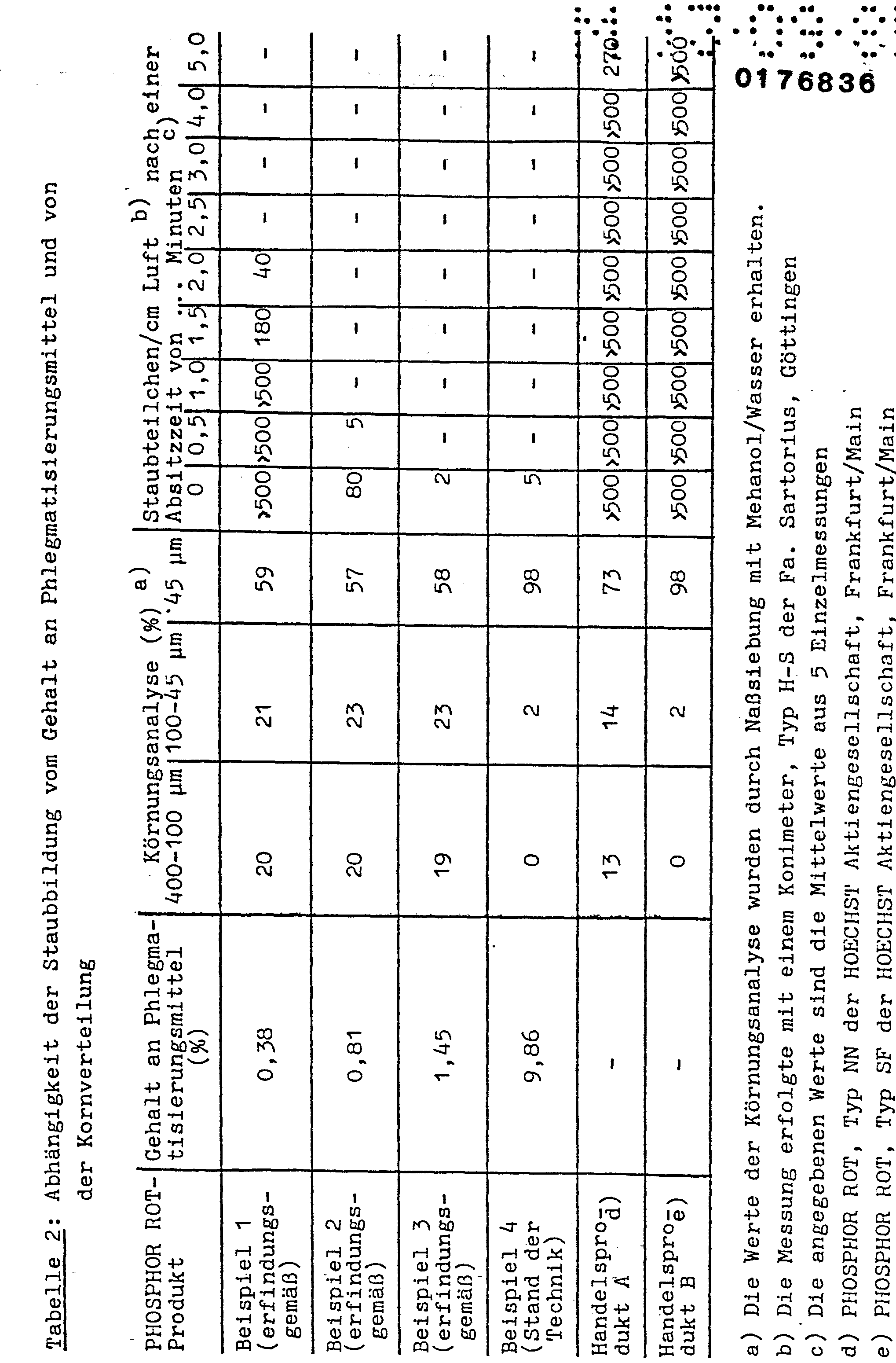
- Die in der Tabelle 1 angegebenen Werte für die Rieselfähigkeit zeigen deutlich, daß das Rieselverhalten des nicht phlegmatisierten roten Phosphors (Handelsprodukt A und B) beim erfindungsgemäßen Verfahren zur Phlegmatisierung praktisch unverändert erhalten bleibt.
- Gleichzeitig wird, wie die Tabelle 2 zeigt, die Staubbildung durch das erfindungsgemäße Verfahren auf ein Niveau gesenkt, das beim Stand der Technik nur mit einem wesentlich höheren Gehalt an Phlegmatisierungsmittel erreicht werden kann.
Claims (12)
Applications Claiming Priority (2)
| Application Number | Priority Date | Filing Date | Title |
|---|---|---|---|
| DE3436161 | 1984-10-03 | ||
| DE19843436161 DE3436161A1 (de) | 1984-10-03 | 1984-10-03 | Phlegmatisierter roter phosphor |
Publications (3)
| Publication Number | Publication Date |
|---|---|
| EP0176836A2 true EP0176836A2 (de) | 1986-04-09 |
| EP0176836A3 EP0176836A3 (en) | 1988-11-23 |
| EP0176836B1 EP0176836B1 (de) | 1991-02-06 |
Family
ID=6246923
Family Applications (1)
| Application Number | Title | Priority Date | Filing Date |
|---|---|---|---|
| EP85111592A Expired - Lifetime EP0176836B1 (de) | 1984-10-03 | 1985-09-13 | Phlegmatisierter roter Phosphor |
Country Status (8)
| Country | Link |
|---|---|
| EP (1) | EP0176836B1 (de) |
| JP (1) | JPH0791046B2 (de) |
| CN (1) | CN85106725A (de) |
| CA (1) | CA1284016C (de) |
| DD (1) | DD239660A5 (de) |
| DE (2) | DE3436161A1 (de) |
| IN (1) | IN165880B (de) |
| SU (1) | SU1482519A3 (de) |
Cited By (27)
| Publication number | Priority date | Publication date | Assignee | Title |
|---|---|---|---|---|
| EP0384203A1 (de) * | 1989-02-18 | 1990-08-29 | Hoechst Aktiengesellschaft | Phlegmatisierter roter Phosphor |
| EP0490110A3 (en) * | 1990-12-14 | 1993-02-03 | Hoechst Aktiengesellschaft | Stabilised red phosphorus and method for its preparation |
| EP0490109A3 (en) * | 1990-12-14 | 1993-02-03 | Hoechst Aktiengesellschaft | Stabilised red phosphorus and method for its preparation |
| US6084012A (en) * | 1996-11-22 | 2000-07-04 | Basf Aktiengesellschaft | Flame resistant thermoplastic moulding materials |
| EP1211220A1 (de) * | 2000-11-28 | 2002-06-05 | Clariant GmbH | Stabilisierter roter Phosphor und ein Verfahren zu seiner Herstellung |
| DE10196240B4 (de) * | 2000-05-25 | 2006-09-07 | Nippon Chemical Industrial Co., Ltd. | Flammschutzmittel für Epoxyharze auf Basis von rotem Phosphor und Verfahren zur Herstellung derselben |
| EP2415827A1 (de) | 2010-08-04 | 2012-02-08 | Basf Se | Flammgeschützte Polyamide mit Schichtsilikaten |
| WO2012146624A1 (de) | 2011-04-28 | 2012-11-01 | Basf Se | Flammgeschütze formmassen |
| WO2013037647A1 (de) | 2011-09-15 | 2013-03-21 | Basf Se | Silber-zinkoxid-mischungen als stabilisator für flammgeschützte polyamide enthaltend roten phosphor |
| WO2013083508A1 (de) | 2011-12-07 | 2013-06-13 | Basf Se | Flammgeschützte polyamide mit flüssigkristallinen polyestern |
| WO2013124128A1 (de) | 2012-02-20 | 2013-08-29 | Basf Se | Cuo/zno-mischungen als stabilisatoren für flammgeschützte polyamide |
| EP2641939A1 (de) | 2012-03-21 | 2013-09-25 | Basf Se | Hellgefärbte flammgeschützte Polyamide |
| WO2013189676A1 (de) | 2012-06-18 | 2013-12-27 | Basf Se | Flammgeschützte polyamide mit polyacrylnitrilhomopolymerisaten |
| WO2013189779A1 (de) | 2012-06-18 | 2013-12-27 | Basf Se | Flammgeschützte polyester mit polyacrylnitrilhomopolymerisaten |
| US8629206B2 (en) | 2011-01-20 | 2014-01-14 | Basf Se | Flame-retardant thermoplastic molding composition |
| US8653168B2 (en) | 2011-05-10 | 2014-02-18 | Basf Se | Flame-retardant thermoplastic molding composition |
| WO2014044471A1 (de) | 2012-09-19 | 2014-03-27 | Basf Se | Flammgeschützte polyamide mit heller farbe |
| US8883904B2 (en) | 2011-09-15 | 2014-11-11 | Basf Se | Mixtures of silver and zinc oxide as stabilizer for flame-retardant polyamides |
| DE102014215370A1 (de) | 2013-09-05 | 2015-03-05 | Basf Se | Langfaserverstärkte flammgeschützte Polyamide |
| WO2016087324A1 (de) | 2014-12-01 | 2016-06-09 | Basf Se | Flammgeschützte polyamide mit sulfonsäuresalzen |
| US9828503B2 (en) | 2013-04-15 | 2017-11-28 | Basf Se | Glow wire resistant polyamides |
| WO2018024450A1 (de) | 2016-08-02 | 2018-02-08 | Basf Se | Transparente tpu blends mit pyrrolidon enthaltenden polyamiden |
| WO2018234429A1 (de) | 2017-06-22 | 2018-12-27 | Basf Se | Polyamide mit phosphor und al-phosphonaten |
| WO2024104965A1 (en) | 2022-11-17 | 2024-05-23 | Basf Se | Mixed metal-oxide compositions as stabilizer for flame retardant polyamides |
| WO2025186378A1 (en) | 2024-03-08 | 2025-09-12 | Basf Se | Impact modifier mixtures in flame retardant polyamides compositions |
| WO2025201399A1 (en) | 2024-03-27 | 2025-10-02 | Basf Se | Sustainable AABB Polyamide for flame-retardant applications |
| WO2025252781A1 (en) | 2024-06-05 | 2025-12-11 | Basf Se | Flame retardant polyamides for improved lsr compression set |
Families Citing this family (1)
| Publication number | Priority date | Publication date | Assignee | Title |
|---|---|---|---|---|
| RU2378190C1 (ru) * | 2008-04-21 | 2010-01-10 | Артем Валерианович Баринов | Состав флегматизированного красного фосфора и способ его изготовления |
Family Cites Families (1)
| Publication number | Priority date | Publication date | Assignee | Title |
|---|---|---|---|---|
| DE2249638B2 (de) * | 1972-10-11 | 1981-01-15 | Hoechst Ag, 6000 Frankfurt | Phlegmatisierter roter Phosphor |
-
1984
- 1984-10-03 DE DE19843436161 patent/DE3436161A1/de not_active Withdrawn
-
1985
- 1985-09-02 IN IN684/MAS/85A patent/IN165880B/en unknown
- 1985-09-05 CA CA000490085A patent/CA1284016C/en not_active Expired - Lifetime
- 1985-09-06 CN CN85106725A patent/CN85106725A/zh active Pending
- 1985-09-13 DE DE8585111592T patent/DE3581685D1/de not_active Expired - Lifetime
- 1985-09-13 EP EP85111592A patent/EP0176836B1/de not_active Expired - Lifetime
- 1985-10-01 DD DD85281255A patent/DD239660A5/de not_active IP Right Cessation
- 1985-10-02 JP JP60218180A patent/JPH0791046B2/ja not_active Expired - Lifetime
- 1985-10-02 SU SU853959884A patent/SU1482519A3/ru active
Cited By (29)
| Publication number | Priority date | Publication date | Assignee | Title |
|---|---|---|---|---|
| EP0384203A1 (de) * | 1989-02-18 | 1990-08-29 | Hoechst Aktiengesellschaft | Phlegmatisierter roter Phosphor |
| EP0490110A3 (en) * | 1990-12-14 | 1993-02-03 | Hoechst Aktiengesellschaft | Stabilised red phosphorus and method for its preparation |
| EP0490109A3 (en) * | 1990-12-14 | 1993-02-03 | Hoechst Aktiengesellschaft | Stabilised red phosphorus and method for its preparation |
| US6084012A (en) * | 1996-11-22 | 2000-07-04 | Basf Aktiengesellschaft | Flame resistant thermoplastic moulding materials |
| DE10196240B4 (de) * | 2000-05-25 | 2006-09-07 | Nippon Chemical Industrial Co., Ltd. | Flammschutzmittel für Epoxyharze auf Basis von rotem Phosphor und Verfahren zur Herstellung derselben |
| EP1211220A1 (de) * | 2000-11-28 | 2002-06-05 | Clariant GmbH | Stabilisierter roter Phosphor und ein Verfahren zu seiner Herstellung |
| US6645625B2 (en) | 2000-11-28 | 2003-11-11 | Clariant Gmbh | Stabilized red phosphorus material and a process for its preparation |
| EP2415827A1 (de) | 2010-08-04 | 2012-02-08 | Basf Se | Flammgeschützte Polyamide mit Schichtsilikaten |
| US8629206B2 (en) | 2011-01-20 | 2014-01-14 | Basf Se | Flame-retardant thermoplastic molding composition |
| WO2012146624A1 (de) | 2011-04-28 | 2012-11-01 | Basf Se | Flammgeschütze formmassen |
| US8653168B2 (en) | 2011-05-10 | 2014-02-18 | Basf Se | Flame-retardant thermoplastic molding composition |
| WO2013037647A1 (de) | 2011-09-15 | 2013-03-21 | Basf Se | Silber-zinkoxid-mischungen als stabilisator für flammgeschützte polyamide enthaltend roten phosphor |
| US8883904B2 (en) | 2011-09-15 | 2014-11-11 | Basf Se | Mixtures of silver and zinc oxide as stabilizer for flame-retardant polyamides |
| WO2013083508A1 (de) | 2011-12-07 | 2013-06-13 | Basf Se | Flammgeschützte polyamide mit flüssigkristallinen polyestern |
| WO2013124128A1 (de) | 2012-02-20 | 2013-08-29 | Basf Se | Cuo/zno-mischungen als stabilisatoren für flammgeschützte polyamide |
| EP2641939A1 (de) | 2012-03-21 | 2013-09-25 | Basf Se | Hellgefärbte flammgeschützte Polyamide |
| WO2013139827A1 (de) | 2012-03-21 | 2013-09-26 | Basf Se | Hellgefärbte flammgeschützte polyamide |
| WO2013189676A1 (de) | 2012-06-18 | 2013-12-27 | Basf Se | Flammgeschützte polyamide mit polyacrylnitrilhomopolymerisaten |
| WO2013189779A1 (de) | 2012-06-18 | 2013-12-27 | Basf Se | Flammgeschützte polyester mit polyacrylnitrilhomopolymerisaten |
| WO2014044471A1 (de) | 2012-09-19 | 2014-03-27 | Basf Se | Flammgeschützte polyamide mit heller farbe |
| US9828503B2 (en) | 2013-04-15 | 2017-11-28 | Basf Se | Glow wire resistant polyamides |
| DE102014215370A1 (de) | 2013-09-05 | 2015-03-05 | Basf Se | Langfaserverstärkte flammgeschützte Polyamide |
| WO2016087324A1 (de) | 2014-12-01 | 2016-06-09 | Basf Se | Flammgeschützte polyamide mit sulfonsäuresalzen |
| WO2018024450A1 (de) | 2016-08-02 | 2018-02-08 | Basf Se | Transparente tpu blends mit pyrrolidon enthaltenden polyamiden |
| WO2018234429A1 (de) | 2017-06-22 | 2018-12-27 | Basf Se | Polyamide mit phosphor und al-phosphonaten |
| WO2024104965A1 (en) | 2022-11-17 | 2024-05-23 | Basf Se | Mixed metal-oxide compositions as stabilizer for flame retardant polyamides |
| WO2025186378A1 (en) | 2024-03-08 | 2025-09-12 | Basf Se | Impact modifier mixtures in flame retardant polyamides compositions |
| WO2025201399A1 (en) | 2024-03-27 | 2025-10-02 | Basf Se | Sustainable AABB Polyamide for flame-retardant applications |
| WO2025252781A1 (en) | 2024-06-05 | 2025-12-11 | Basf Se | Flame retardant polyamides for improved lsr compression set |
Also Published As
| Publication number | Publication date |
|---|---|
| DD239660A5 (de) | 1986-10-01 |
| EP0176836A3 (en) | 1988-11-23 |
| CN85106725A (zh) | 1986-03-10 |
| JPS6186406A (ja) | 1986-05-01 |
| SU1482519A3 (ru) | 1989-05-23 |
| EP0176836B1 (de) | 1991-02-06 |
| CA1284016C (en) | 1991-05-14 |
| IN165880B (de) | 1990-02-03 |
| JPH0791046B2 (ja) | 1995-10-04 |
| DE3436161A1 (de) | 1986-04-10 |
| DE3581685D1 (de) | 1991-03-14 |
Similar Documents
| Publication | Publication Date | Title |
|---|---|---|
| EP0176836B1 (de) | Phlegmatisierter roter Phosphor | |
| EP0004305B1 (de) | Stabilisierter roter Phosphor | |
| EP0283759A1 (de) | Stabilisierter roter Phosphor sowie Verfahren zu seiner Herstellung | |
| DE2708468B2 (de) | Verfahren zur Herstellung von N, N'-Alkylen-bis-tetrabromophthalimiden | |
| DE4041827A1 (de) | Faellungskieselsaeurepaste | |
| DE10058922A1 (de) | Stabilisierter roter Phosphor und ein Verfahren zu seiner Herstellung | |
| EP0384203B1 (de) | Phlegmatisierter roter Phosphor | |
| EP0088265A1 (de) | Kettenförmige, im wesentlichen wasserunlösliche Ammoniumpolyphosphate und Verfahren zu ihrer Herstellung | |
| EP0702000A1 (de) | Verfahren zur Einstellung eines bestimmten Gehaltes an Eisen in Diphenylmethandiisocyanat oder in Polyisocyanat-Gemischen der Diphenylmethandiisocyanat-Reihe | |
| EP0176834B1 (de) | Stabilisierter und phlegmatisierter rieselfähiger roter Phosphor | |
| EP0070432B1 (de) | Verfahren zur Herstellung von gereinigtem Tetraacetylethylendiamin (TAED) | |
| EP0490109B1 (de) | Stabilisierter roter Phosphor sowie Verfahren zu seiner Herstellung | |
| DE3900965C1 (de) | ||
| EP0490110B1 (de) | Stabilisierter roter Phosphor sowie Verfahren zu seiner Herstellung | |
| DE102004063221A1 (de) | Verfahren zur Reinigung organischer Isocyanate | |
| DE3101783C2 (de) | Verfahren zur Herstellung von grobkörnigem 1,3,5-Triaminotrinitrobenzol | |
| EP0326865A2 (de) | Verfahren zur Entstaubung von Nitrocellulose enthaltenden Pigmentzubereitungen | |
| DD213219A5 (de) | Verfahren zur herstellung von kristallinem natrium-cefoperazon | |
| DE2125286C3 (de) | ||
| DE60114572T2 (de) | Ein verfahren zur herstellung von salzen des l-carnitins und alkanoyl l-carnitins mit galaktarsäure | |
| DE927624C (de) | Verfahren zur Trennung oder Anreicherung von Niob und Tantal | |
| AT311523B (de) | Verfahren zur Herstellung nichtbackender Gemische aus Natriumtripolyphosphat-Hexahydrat und Natriumnitrilotriacetat-Mono- bwz. Dihydrat | |
| DD288593A5 (de) | Reinigungsverfahren organischer isocyanate von chlor enthaltenden verbindungen | |
| DE1139854B (de) | Verfahren zur Herstellung von granulierten Phosphatduengemitteln | |
| DD269625A1 (de) | Verfahren zur herstellung eines mangnanethylenglykolphosphat-gemisches |
Legal Events
| Date | Code | Title | Description |
|---|---|---|---|
| PUAI | Public reference made under article 153(3) epc to a published international application that has entered the european phase |
Free format text: ORIGINAL CODE: 0009012 |
|
| AK | Designated contracting states |
Kind code of ref document: A2 Designated state(s): DE GB IT SE |
|
| PUAL | Search report despatched |
Free format text: ORIGINAL CODE: 0009013 |
|
| AK | Designated contracting states |
Kind code of ref document: A3 Designated state(s): DE GB IT SE |
|
| 17P | Request for examination filed |
Effective date: 19881207 |
|
| 17Q | First examination report despatched |
Effective date: 19900618 |
|
| GRAA | (expected) grant |
Free format text: ORIGINAL CODE: 0009210 |
|
| AK | Designated contracting states |
Kind code of ref document: B1 Designated state(s): DE GB IT SE |
|
| REF | Corresponds to: |
Ref document number: 3581685 Country of ref document: DE Date of ref document: 19910314 |
|
| ITF | It: translation for a ep patent filed | ||
| GBT | Gb: translation of ep patent filed (gb section 77(6)(a)/1977) | ||
| PLBE | No opposition filed within time limit |
Free format text: ORIGINAL CODE: 0009261 |
|
| STAA | Information on the status of an ep patent application or granted ep patent |
Free format text: STATUS: NO OPPOSITION FILED WITHIN TIME LIMIT |
|
| 26N | No opposition filed | ||
| PGFP | Annual fee paid to national office [announced via postgrant information from national office to epo] |
Ref country code: SE Payment date: 19920817 Year of fee payment: 8 Ref country code: GB Payment date: 19920817 Year of fee payment: 8 |
|
| PG25 | Lapsed in a contracting state [announced via postgrant information from national office to epo] |
Ref country code: GB Effective date: 19930913 |
|
| PG25 | Lapsed in a contracting state [announced via postgrant information from national office to epo] |
Ref country code: SE Effective date: 19930914 |
|
| GBPC | Gb: european patent ceased through non-payment of renewal fee |
Effective date: 19930913 |
|
| EUG | Se: european patent has lapsed |
Ref document number: 85111592.3 Effective date: 19940410 |
|
| PGFP | Annual fee paid to national office [announced via postgrant information from national office to epo] |
Ref country code: DE Payment date: 20010816 Year of fee payment: 17 |
|
| PG25 | Lapsed in a contracting state [announced via postgrant information from national office to epo] |
Ref country code: DE Free format text: LAPSE BECAUSE OF NON-PAYMENT OF DUE FEES Effective date: 20030401 |