EP0179700A1 - Compositions adhésives à base d'élastomères thermoplastiques et de polyétheramides et leurs utilisations - Google Patents
Compositions adhésives à base d'élastomères thermoplastiques et de polyétheramides et leurs utilisations Download PDFInfo
- Publication number
- EP0179700A1 EP0179700A1 EP85401916A EP85401916A EP0179700A1 EP 0179700 A1 EP0179700 A1 EP 0179700A1 EP 85401916 A EP85401916 A EP 85401916A EP 85401916 A EP85401916 A EP 85401916A EP 0179700 A1 EP0179700 A1 EP 0179700A1
- Authority
- EP
- European Patent Office
- Prior art keywords
- sequences
- composition according
- polyetheramide
- polyamide
- parts
- Prior art date
- Legal status (The legal status is an assumption and is not a legal conclusion. Google has not performed a legal analysis and makes no representation as to the accuracy of the status listed.)
- Granted
Links
- 239000000203 mixture Substances 0.000 title claims abstract description 33
- 229920002614 Polyether block amide Polymers 0.000 title claims abstract description 20
- 230000001070 adhesive effect Effects 0.000 title claims abstract description 14
- 239000000853 adhesive Substances 0.000 title claims abstract description 12
- 229920002725 thermoplastic elastomer Polymers 0.000 title 1
- 239000004952 Polyamide Substances 0.000 claims abstract description 16
- 229920002647 polyamide Polymers 0.000 claims abstract description 16
- 239000011347 resin Substances 0.000 claims abstract description 10
- 229920005989 resin Polymers 0.000 claims abstract description 10
- 239000004793 Polystyrene Substances 0.000 claims abstract description 9
- 229920002223 polystyrene Polymers 0.000 claims abstract description 9
- 229920001577 copolymer Polymers 0.000 claims abstract description 5
- 238000006068 polycondensation reaction Methods 0.000 claims abstract description 5
- 229920001169 thermoplastic Polymers 0.000 claims abstract 2
- 239000004416 thermosoftening plastic Substances 0.000 claims abstract 2
- 229920006146 polyetheresteramide block copolymer Polymers 0.000 claims description 13
- LYCAIKOWRPUZTN-UHFFFAOYSA-N Ethylene glycol Chemical compound OCCO LYCAIKOWRPUZTN-UHFFFAOYSA-N 0.000 claims description 8
- -1 poly (ethylene-butylene) Polymers 0.000 claims description 8
- 239000004820 Pressure-sensitive adhesive Substances 0.000 claims description 7
- 229920001400 block copolymer Polymers 0.000 claims description 7
- 229920000299 Nylon 12 Polymers 0.000 claims description 5
- 239000005062 Polybutadiene Substances 0.000 claims description 5
- 125000001931 aliphatic group Chemical group 0.000 claims description 5
- 229920002857 polybutadiene Polymers 0.000 claims description 5
- WGCNASOHLSPBMP-UHFFFAOYSA-N hydroxyacetaldehyde Natural products OCC=O WGCNASOHLSPBMP-UHFFFAOYSA-N 0.000 claims description 4
- 125000004427 diamine group Chemical group 0.000 claims description 3
- 150000004985 diamines Chemical class 0.000 claims description 3
- 229920001195 polyisoprene Polymers 0.000 claims description 3
- 229920000571 Nylon 11 Polymers 0.000 claims description 2
- 239000004721 Polyphenylene oxide Substances 0.000 abstract description 2
- 229920000570 polyether Polymers 0.000 abstract description 2
- 229920001971 elastomer Polymers 0.000 description 10
- 239000000806 elastomer Substances 0.000 description 9
- 229920004939 Cariflex™ Polymers 0.000 description 5
- WNLRTRBMVRJNCN-UHFFFAOYSA-N adipic acid Chemical compound OC(=O)CCCCC(O)=O WNLRTRBMVRJNCN-UHFFFAOYSA-N 0.000 description 5
- 239000000126 substance Substances 0.000 description 5
- 239000004831 Hot glue Substances 0.000 description 4
- 238000005259 measurement Methods 0.000 description 4
- 239000004014 plasticizer Substances 0.000 description 4
- JHWNWJKBPDFINM-UHFFFAOYSA-N Laurolactam Chemical compound O=C1CCCCCCCCCCCN1 JHWNWJKBPDFINM-UHFFFAOYSA-N 0.000 description 3
- BGYHLZZASRKEJE-UHFFFAOYSA-N [3-[3-(3,5-ditert-butyl-4-hydroxyphenyl)propanoyloxy]-2,2-bis[3-(3,5-ditert-butyl-4-hydroxyphenyl)propanoyloxymethyl]propyl] 3-(3,5-ditert-butyl-4-hydroxyphenyl)propanoate Chemical compound CC(C)(C)C1=C(O)C(C(C)(C)C)=CC(CCC(=O)OCC(COC(=O)CCC=2C=C(C(O)=C(C=2)C(C)(C)C)C(C)(C)C)(COC(=O)CCC=2C=C(C(O)=C(C=2)C(C)(C)C)C(C)(C)C)COC(=O)CCC=2C=C(C(O)=C(C=2)C(C)(C)C)C(C)(C)C)=C1 BGYHLZZASRKEJE-UHFFFAOYSA-N 0.000 description 3
- 239000002390 adhesive tape Substances 0.000 description 3
- YFXPPSKYMBTNAV-UHFFFAOYSA-N bensultap Chemical compound C=1C=CC=CC=1S(=O)(=O)SCC(N(C)C)CSS(=O)(=O)C1=CC=CC=C1 YFXPPSKYMBTNAV-UHFFFAOYSA-N 0.000 description 3
- 239000004615 ingredient Substances 0.000 description 3
- RLSSMJSEOOYNOY-UHFFFAOYSA-N m-cresol Chemical compound CC1=CC=CC(O)=C1 RLSSMJSEOOYNOY-UHFFFAOYSA-N 0.000 description 3
- 238000002844 melting Methods 0.000 description 3
- 230000008018 melting Effects 0.000 description 3
- 238000000034 method Methods 0.000 description 3
- 229920000642 polymer Polymers 0.000 description 3
- VSKJLJHPAFKHBX-UHFFFAOYSA-N 2-methylbuta-1,3-diene;styrene Chemical compound CC(=C)C=C.C=CC1=CC=CC=C1.C=CC1=CC=CC=C1 VSKJLJHPAFKHBX-UHFFFAOYSA-N 0.000 description 2
- AQWSFUIGRSMCST-UHFFFAOYSA-N 3-pyridin-3-ylsulfonyl-5-(trifluoromethyl)chromen-2-one Chemical compound N1=CC(=CC=C1)S(=O)(=O)C=1C(OC2=CC=CC(=C2C=1)C(F)(F)F)=O AQWSFUIGRSMCST-UHFFFAOYSA-N 0.000 description 2
- 241000897276 Termes Species 0.000 description 2
- 235000011037 adipic acid Nutrition 0.000 description 2
- 239000001361 adipic acid Substances 0.000 description 2
- 239000003963 antioxidant agent Substances 0.000 description 2
- 230000003078 antioxidant effect Effects 0.000 description 2
- 239000000470 constituent Substances 0.000 description 2
- JBKVHLHDHHXQEQ-UHFFFAOYSA-N epsilon-caprolactam Chemical compound O=C1CCCCCN1 JBKVHLHDHHXQEQ-UHFFFAOYSA-N 0.000 description 2
- 150000002148 esters Chemical class 0.000 description 2
- 239000012943 hotmelt Substances 0.000 description 2
- 238000004519 manufacturing process Methods 0.000 description 2
- 239000000155 melt Substances 0.000 description 2
- GUOSQNAUYHMCRU-UHFFFAOYSA-N 11-Aminoundecanoic acid Chemical compound NCCCCCCCCCCC(O)=O GUOSQNAUYHMCRU-UHFFFAOYSA-N 0.000 description 1
- HBKBEZURJSNABK-MWJPAGEPSA-N 2,3-dihydroxypropyl (1r,4ar,4br,10ar)-1,4a-dimethyl-7-propan-2-yl-2,3,4,4b,5,6,10,10a-octahydrophenanthrene-1-carboxylate Chemical compound C([C@@H]12)CC(C(C)C)=CC1=CC[C@@H]1[C@]2(C)CCC[C@@]1(C)C(=O)OCC(O)CO HBKBEZURJSNABK-MWJPAGEPSA-N 0.000 description 1
- RSWGJHLUYNHPMX-UHFFFAOYSA-N Abietic-Saeure Natural products C12CCC(C(C)C)=CC2=CCC2C1(C)CCCC2(C)C(O)=O RSWGJHLUYNHPMX-UHFFFAOYSA-N 0.000 description 1
- 229920002633 Kraton (polymer) Polymers 0.000 description 1
- OFOBLEOULBTSOW-UHFFFAOYSA-N Malonic acid Chemical compound OC(=O)CC(O)=O OFOBLEOULBTSOW-UHFFFAOYSA-N 0.000 description 1
- 229920002292 Nylon 6 Polymers 0.000 description 1
- KHPCPRHQVVSZAH-HUOMCSJISA-N Rosin Natural products O(C/C=C/c1ccccc1)[C@H]1[C@H](O)[C@@H](O)[C@@H](O)[C@@H](CO)O1 KHPCPRHQVVSZAH-HUOMCSJISA-N 0.000 description 1
- 241001080024 Telles Species 0.000 description 1
- 241001639412 Verres Species 0.000 description 1
- 125000003118 aryl group Chemical group 0.000 description 1
- FACXGONDLDSNOE-UHFFFAOYSA-N buta-1,3-diene;styrene Chemical compound C=CC=C.C=CC1=CC=CC=C1.C=CC1=CC=CC=C1 FACXGONDLDSNOE-UHFFFAOYSA-N 0.000 description 1
- 238000007278 cyanoethylation reaction Methods 0.000 description 1
- 230000008034 disappearance Effects 0.000 description 1
- 239000000975 dye Substances 0.000 description 1
- 239000000945 filler Substances 0.000 description 1
- 239000011521 glass Substances 0.000 description 1
- 150000002314 glycerols Chemical class 0.000 description 1
- 239000012760 heat stabilizer Substances 0.000 description 1
- 238000005984 hydrogenation reaction Methods 0.000 description 1
- 239000004611 light stabiliser Substances 0.000 description 1
- 239000000178 monomer Substances 0.000 description 1
- 239000003208 petroleum Substances 0.000 description 1
- 239000004033 plastic Substances 0.000 description 1
- 229920003023 plastic Polymers 0.000 description 1
- 229920000728 polyester Polymers 0.000 description 1
- 229920006267 polyester film Polymers 0.000 description 1
- 239000005060 rubber Substances 0.000 description 1
- 229920000468 styrene butadiene styrene block copolymer Polymers 0.000 description 1
- KHPCPRHQVVSZAH-UHFFFAOYSA-N trans-cinnamyl beta-D-glucopyranoside Natural products OC1C(O)C(O)C(CO)OC1OCC=CC1=CC=CC=C1 KHPCPRHQVVSZAH-UHFFFAOYSA-N 0.000 description 1
Classifications
-
- C—CHEMISTRY; METALLURGY
- C09—DYES; PAINTS; POLISHES; NATURAL RESINS; ADHESIVES; COMPOSITIONS NOT OTHERWISE PROVIDED FOR; APPLICATIONS OF MATERIALS NOT OTHERWISE PROVIDED FOR
- C09J—ADHESIVES; NON-MECHANICAL ASPECTS OF ADHESIVE PROCESSES IN GENERAL; ADHESIVE PROCESSES NOT PROVIDED FOR ELSEWHERE; USE OF MATERIALS AS ADHESIVES
- C09J153/00—Adhesives based on block copolymers containing at least one sequence of a polymer obtained by reactions only involving carbon-to-carbon unsaturated bonds; Adhesives based on derivatives of such polymers
-
- C—CHEMISTRY; METALLURGY
- C09—DYES; PAINTS; POLISHES; NATURAL RESINS; ADHESIVES; COMPOSITIONS NOT OTHERWISE PROVIDED FOR; APPLICATIONS OF MATERIALS NOT OTHERWISE PROVIDED FOR
- C09J—ADHESIVES; NON-MECHANICAL ASPECTS OF ADHESIVE PROCESSES IN GENERAL; ADHESIVE PROCESSES NOT PROVIDED FOR ELSEWHERE; USE OF MATERIALS AS ADHESIVES
- C09J153/00—Adhesives based on block copolymers containing at least one sequence of a polymer obtained by reactions only involving carbon-to-carbon unsaturated bonds; Adhesives based on derivatives of such polymers
- C09J153/02—Vinyl aromatic monomers and conjugated dienes
-
- C—CHEMISTRY; METALLURGY
- C08—ORGANIC MACROMOLECULAR COMPOUNDS; THEIR PREPARATION OR CHEMICAL WORKING-UP; COMPOSITIONS BASED THEREON
- C08L—COMPOSITIONS OF MACROMOLECULAR COMPOUNDS
- C08L2666/00—Composition of polymers characterized by a further compound in the blend, being organic macromolecular compounds, natural resins, waxes or and bituminous materials, non-macromolecular organic substances, inorganic substances or characterized by their function in the composition
- C08L2666/02—Organic macromolecular compounds, natural resins, waxes or and bituminous materials
- C08L2666/14—Macromolecular compounds according to C08L59/00 - C08L87/00; Derivatives thereof
Definitions
- the present invention relates to new adhesive compositions based on block elastomers and polyetheramides as well as their use, more particularly as pressure-sensitive adhesives.
- block polymers can be formulated with tackifying resins and plasticizers to obtain pressure-sensitive adhesives, as described in US Pat. Nos. 3,239,478 (Harlan), 4,097,434 (Coker), and in articles by JB BORTHWICK (1976 TAPPI international Hot Melt Pressure Sensitive Adhesives Short Course, Amsterdam, 3-5 Nov. 1976) and by R. DELME (Technology of Plastics and Rubber Interface, Brussels, September 1976).
- the bonding temperature obtained with such hot-melt compositions can be increased by adding a certain amount of crystalline polymers of high molecular weight and high melting point.
- this addition causes an excessively large increase in the viscosity in the molten state and a disappearance of the permanent tackiness.
- the present invention results from the observation that the adhesive properties of hot melt adhesive compositions are pressure-based on block elastomers can be considerably improved by the addition of polyetheramide; it is observed, in fact, that, thanks to this addition, the high temperature resistance of the bonding carried out is greatly increased without there being any loss of permanent stickiness; moreover, there is only a very small increase in melt viscosity.
- compositions thus obtained can be used with greater satisfaction in the manufacture of adhesive tapes for the most diverse applications.
- polyetheramide we mean both statistical polyetheramides (that is to say formed by the random sequence of the various monomer components) as well as sequenced polyetheramides, that is to say formed from blocks having a certain chain length of their various constituents.
- novel compositions which are the subject of the present invention consist of at least one block copolymer of polystyrene and polydiene, tackifying resins and at least one polyetheramide, this polyetheramide being in proportions such that there are from 0.1 to 50 parts and preferably from 3 to 20 parts by weight per 100 parts of copolymer.
- compositions can of course include plasticizers, heat or light stabilizers, fillers, dyes, etc.
- the block copolymer is a linear tri-block of the ABA type, the terminal blocks of which are polystyrene and the central block is either a polybutadiene, a polyisoprene or a poly (ethylene-butylene) ).
- Such products are sold by the company SHELL CHEMICALS under the name of CARIFLEX TR or KRATON.
- block copolymers can be mixed together, for example, a tri-block styrene-butadiene-styrene with a tri-block styrene-isoprene-styrene ...
- the polyetheramide associated with the sequenced elastomer is a polyetheresteramide block of molecular weight greater than 10,000, formed from the product of the co-polycondensation of a polyamide or alpha-omega dicarboxylic copolyamide having a molecular weight of 300 to 15,000 and preferably 600 to 5,000, used in an amount of 95 to 15% by weight, and a polyetherdiol having a molecular weight of 100 to 6,000 and, preferably 200 to 3,000, used in an amount of 5 to 85% by weight, said product having a melting point of between 80 and 210 ° C and preferably 120 to 180 ° C and a melt viscosity of 500 to 5,000 Pa.sec at 210 ° C for a shear speed of 10 s -1 .
- said polyetheresteramide comprises 80 to 20% of said polyamide or copolyamide and 20 to 80% of said polyetherdiol, the polyamide being a polyamide 6 (PA6) resulting from the polycondensation of caprolactam or a polyamide 11 (PA11) based 11-aminoundecanoic acid or a PA 12 based on lauryllactam and the polyetherdiol being polyoxytetramethylene glycol (PTMG).
- PA6 polyamide 6
- PA11 polyamide 11
- PA 12 polyoxytetramethylene glycol
- Polyetheramides or polyetheresteramides can also be mixed together and thus, by varying their composition and, consequently, their properties (among others, their melting point), adjusting an adhesive formula allowing it to meet certain technical requirements.
- any tackifying resin can be used in the composition according to the invention, knowing that the tackifying resin, according to its composition and its chemical structure, will preferentially associate with the polystyrene phase or the elastomeric phase, as described in the documentation. technical from SHELL CHEMICALS.
- the plasticizers depending on whether it is an aromatic or aliphatic oil, will preferentially associate with one or the other of the phases of the sequenced elastomer, thus modifying its mechanical and adhesive properties.
- the present invention also relates to hot-melt adhesives obtained from said compositions and, of course, their uses.
- the sample is placed in an oven and a load of 500 g is suspended from the ribbon.
- compositions are prepared by mixing, at a temperature of the order of 150 to 200 ° C., the various ingredients of which they are made up, this mixing being carried out in a mixer the time necessary to obtain a homogeneous product.
- Table II collates the results of measurements carried out on various compositions prepared as in Examples 1 to 4.
- Table III below relates to compositions identical to those of Examples 1 to 4 with the difference that the polyetheresteramide PEEA-A has been replaced by another polyetheresteramide, which we will call PEEA-B, obtained by copolycondensation, according to the procedure described.
- PEEA-B polyetheresteramide obtained by copolycondensation, according to the procedure described.
- French Patent No. 74.18913 67 parts by weight of a prepolymer of PA 12 dicarboxylic acid (obtained from lauryllactam and adipic acid) of molecular weight 2,000 with 33 parts by weight of PTMG of molecular weight 1,000, this polyetheresteramide having an inherent viscosity of 1.60 dl.g 1.
- the permanent adhesive power makes it possible to use them industrially as pressure-sensitive adhesives.
- the permanent adhesive power makes it possible to use them industrially as pressure-sensitive adhesives.
Landscapes
- Chemical & Material Sciences (AREA)
- Chemical Kinetics & Catalysis (AREA)
- Organic Chemistry (AREA)
- Adhesives Or Adhesive Processes (AREA)
- Polyamides (AREA)
- Compositions Of Macromolecular Compounds (AREA)
Abstract
Description
- La présente invention a pour objet des compositions adhésives nouvelles à base d'élastomères séquencés et de polyétheramides ainsi que leur utilisation, plus particulièrement en tant qu'adhésifs sensibles à la pression.
- Les adhésifs thermofusibles sensibles à la pression et les rubans auto-adhésifs sont bien connus. Jusqu'à présent des compositions adhésives thermofusibles ont été préparées en en mélangeant les deux constituants essentiels : élastomère et résines tackifiantes. Les élastomères les plus utilisés sont :
- - des copolymères séquencés du type A-B-A, ayant des séquences terminales polystyrèniques et une séquence centrale consituée soit de polybutadiène, soit de polyisoprène, soit de poly(éthylène-butylène)
- - ou des copolymères séquencés en étoiles à n branches dont les séquences sont à base de polystyrène et de polybutadiène.
- Ces polymères séquencés peuvent être formulés avec des résines tackifiantes et des plastifiants pour obtenir des adhésifs sensibles à la pression, ainsi qu'il est décrit dans les brevets US n° 3,239,478 (Harlan), 4,097,434 (Coker), et dans les articles de J.B BORTHWICK (1976 TAPPI international Hot Melt Pressure Sensitive Adhesives Short Course, Amsterdam, 3-5 Nov. 1976) et de R. DELME (Technology of Plastics and Rubber Interface, Bruxelles, septembre 1976).
- Ces compositions adhésives ont de bonnes propriétés de collage, de pouvoir collant permanent et de résistance au pelage, mais leurs résistances au fluage et au cisaillement baissent rapidement avec la température.
- Il est cependant connu que l'on peut augmenter la tenue à la température des collages réalisés avec de telles compositions thermofusibles par addition d'une certaine quantité de polymères cristallins de masse moléculaire et de point de fusion élevés. Mais, cette addition provoque une augmentation trop importante de la viscosité à l'état fondu et une disparition du pouvoir collant permanent.
- La présente invention résulte de la constatation que les propriétés adhésives des compositions d'adhésifs thermofusibles sensibles à la pression à base d'élastomères séquencés peuvent être considérablement améliorées par l'addition de polyétheramide ; on observe, en effet, que, grâce à cette addition, la résistance à haute température des collages effectués est fortement augmentée sans qu'il y ait perte du pouvoir collant permanent ; de plus, il n'y a qu'une très faible augmentation de la viscosité à l'état fondu.
- C'est ainsi que les compositions ainsi obtenues peuvent être utilisées avec davantage de satisfaction dans la confection de rubans adhésifs pour les applications les plus diverses.
- Par polyétheramide, nous entendons aussi bien les polyétheramides statistiques (c'est-à-dire formés par l'enchaînement aléatoire des divers constituants monomères) que les polyétheramides séquencés, c'est-à-dire formés de blocs présentant une certaine longueur de chaîne de leurs divers constituants.
- Les polyétheramides séquencés résultent de la copolycondensation de séquences polyamides à extrémités réactives avec des séquences polyéthers à extrémités réactives, telles que, entre autres :
- 1°/ Séquences polyamides à bouts de chaînes diamines avec des séquences polyoxyalkylènes à bouts de chaînes dicarboxyliques.
- 2°/ Séquences polyamides à bouts de chaînes dicarboxyliques avec des séquences polyoxyalkylènes à bouts de chaîne diamines obtenues par cyanoéthylation et hydrogénation de polyétherdiols.
- 3°/ Séquences polyamides à bouts de chaînes dicarboxyliques avec des séquences polyoxyalkylènes alpha-oméga-dihydroxylées aliphatiques ou polyétherdiols, les polyétheramides obtenus étant, dans ce cas particulier, des polyétheresteramides.
- La composition et la fabrication de tels polyétheresteramides ont été décrites dans les brevets français n° 7418913 et 7726678 au nom de la demanderesse et dont le contenu s'ajoute à la présente description.
- Les compositions nouvelles qui font l'objet de la présente invention sont constituées d'au moins un copolymère séquencé de polystyrène et de polydiène, de résines tackifiantes et d'au moins un polyétheramide, ce polyétheramide étant en proportions telles qu'il y en ait de 0,1 à 50 parties et, de préférence, de 3 à 20 parties en poids pour 100 parties de copolymère.
- En plus de ces constituants essentiels, ces compositions peuvent bien entendu comprendre des plastifiants, stabilisants à la chaleur ou à la lumière, charges, colorants...
- Selon un mode de réalisation de l'invention, le copolymère séquencé est un tri-séquencé linéaire du type A-B-A, dont les séquences terminales sont du polystyrène et la séquence centrale est soit un polybutadiène, soit un polyisoprène, soit un poly(éthylène- butylène). De tels produits sont vendus par la société SHELL CHEMICALS sous le nom de CARIFLEX TR ou de KRATON.
- Selon un autre mode de réalisation, on peut mélanger entre eux des copolymères séquencés, par exemple, un tri-séquencé styrène- butadiène-styrène avec un tri-séquencé styrène-isoprène-styrène...
- Selon un mode de réalisation de l'invention, le polyétheramide associé à l'élastomère séquencé est un polyétheresteramide séquence de poids moléculaire supérieur à 10.000, formé du produit de la copolycondensation d'un polyamide ou copolyamide alpha-oméga dicarboxylique présentant un poids moléculaire de 300 à 15.000 et, de préférence, 600 à 5.000, employé à raison de 95 à 15 % en poids, et d'un polyétherdiol présentant un poids moléculaire de 100 à 6.000 et, de préférence 200 à 3.000, employé à raison de 5 à 85 % en poids, ledit produit présentant un point de fusion compris entre 80 et 210°C et, de préférence, 120 à 180°C et une viscosité à l'état fondu de 500 à 5.000 Pa.sec à 210°C pour une vitesse de cisaillement de 10 s-1.
- Selon un autre mode de réalisation, ledit polyétheresteramide comprend 80 à 20 Σ dudit polyamide ou copolyamide et 20 à 80 % dudit polyétherdiol, le polyamide étant un polyamide 6 (PA6) résultant de la polycondensation du caprolactame ou un polyamide 11 (PA11) à base d'acide 11-aminoundécanoique ou un PA 12 à base de lauryllactame et le polyétherdiol étant le polyoxytétraméthylène glycol (PTMG).
- On peut également mélanger entre eux les polyétheramides ou polyétheresteramides et ainsi, en jouant sur leur composition et, par suite, leurs propriétés (entre autres, leur point de fusion) ajuster une formule d'adhésif lui permettant de répondre à certains impératifs techniques.
- Toute résine tackifiante peut être utilisée dans la composition selon l'inventior., sachant que la résine tackifiante, selon sa composition et sa structure chimique, s'associera préférentiellement avec la phase polystyrène ou la phase élastomérique, tel que cela est décrit dans la documentation technique de la société SHELL CHEMICALS. De même les plastifiants, selon qu'il s'agira d'une huile aromatique ou aliphatique, s'associeront préférentiellement avec l'une ou l'autre des phases de l'élastomère séquencé, modifiant ainsi ses propriétés mécaniques et adhésives.
- La présente invention a également pour objet les adhésifs thermofusibles obtenus à partir des dites compositions et, bien entendu, leurs utilisations.
- D'autres buts et avantages de la présente invention apparaîtront à la lecture de ce qui suit et des exemples donnés à titre illustratif et nullement limitatif.
- Dans la présente description et dans les revendications auxquelles elles donnent lieu :
- - les propositions sont exprimées en parties en poids
- - la viscosité à l'état fondu est déterminée à l'aide d'un RHEOMAT 30, viscosimètre rotatif fabriqué par la société suisse CONTRAVES
- - le point de ramollissement est déterminé par la méthode bille et anneau telle que définie par la norme américaine ASTM E-28
- - la résistance au fluage en cisaillement est mesurée en s'inspirant des normes AFERA 4012 P2 et PSTC-7 ; la composition adhésive ayant été appliquée sur un support (par exemple un film de polyester), le ruban adhésif ainsi obtenu est appliqué sur du verre, sur une surface de 25x25 mm, à l'aide d'un rouleau PSTC de 2 kg.
- L'échantillon est placé dans une étuve et une charge de 500 g est suspendue au ruban.
- La mesure peut être effectuée de deux façons :
- - la température de l'étuve est augmentée de 5°C/min et on enregistre la température à laquelle le ruban tombe (décrite ci-après sous le terme "température de résistance au fluage")
- - la température est maintenue constante (40-50-60-70°C) et on enregistre le temps au bout duquel le ruban tombe (décrit ci-après sous le terme "résistance au fluage en isotherme")
- - la résistance au pelage à 180° est déterminée selon les normes AFERA 4001 P 11 et PSTC-1.
- Nous rassemblons dans le tableau I suivant les résultats des mesures effectuées sur diverses compositions à teneur variable en polyétheramide.
- Ces compositions sont préparées par mélange, à une température de l'ordre de 150 à 200°C, des divers ingrédients dont elles sont constituées, ce mélange étant effectué dans un malaxeur le temps nécessaire à l'obtention d'un produit homogène.
- Ces ingrédients sont :
- - un élastomère séquencé -le CARIFLEX TR 1107, élastomère tri-séquencé, styrène-isoprène-styrène, de la société SHELL CHEMICALS-
- - une résine tackifiante -le FORAL 85, ester de colophane à la glycérine fortement hydrogéné, de la société HERCULES-
- - un anti-oxydant -l'IRGANOX 1010, pentaérythrityl-tétrakis (3-(3,5 di-ter-butyl-4-hydroxyphényl)-propionate), de la société CIBA-GEIGY-
- - un polyétheramide qui, dans le cas présent, est un polyétheresteramide que, pour des raisons de commodité, nous appellerons PEEA-A, obtenu par copolycondensation, suivant le mode opératoire décrit dans le brevet n° 7418913, de 30 parties en poids d'un prépolymère de PA 12 dicarboxylique (obtenu a partir de lauryllactame et d'acide adipique) de masse moléculaire 850 avec 70 parties en poids de polyoxytétraméthylène glycol (PTMG) de masse moléculaire 2.000, ce polyétheresteramide ayant une viscosité inhérente de 1,80 dl.g (mesure effectuée à 25°C sur une solution à 0,5 parties en poids de ce polymère dans 100 de m-crésol).

- Dans le cas de ces 4 compositions adhésives le pouvoir collant permanent rend possible leur utilisation industrielle en tant qu'- adhésifs sensibles à la pression.
- Le tableau II rassemble les résultats de mesures effectuées sur diverses compositions préparées comme dans les exemples 1 à 4.
- Les ingrédients en sont :
- - un élastomère séquencé : le CARIFLEX TR 1107, déjà décrit
- - une résine tackifiante : l'ESCOREZ 1310, résine de pétrole aliphatique d'ESSO CHIMIE
- - un plastifiant : le SHELLFLEX 451, huile aliphatique de SHELL CHEMICALS
- - un anti-oxydant : l'IRGANOX 1010, déjà décrit
- - un polyétheresteramide : le PEEA-A, déjà décrit.
- Le tableau III suivant est relatif à des compositions identiques à celles des exemples 1 à 4 à la différence que le polyétheresteramide PEEA-A a été remplacé par un autre polyétheresteramide, que nous appellerons PEEA-B, obtenu par copolycondensation, suivant le mode opératoire décrit dans le brevet français n° 74.18913, de 67 parties en poids d'un prépolymère de PA 12 dicarboxylique (obtenu à partir de lauryllactame et d'acide adipique) de masse moléculaire 2.000 avec 33 parties en poids de PTMG de masse moléculaire 1.000, ce polyétheresteramide ayant une viscosité inhérente de 1,60 dl.g 1.
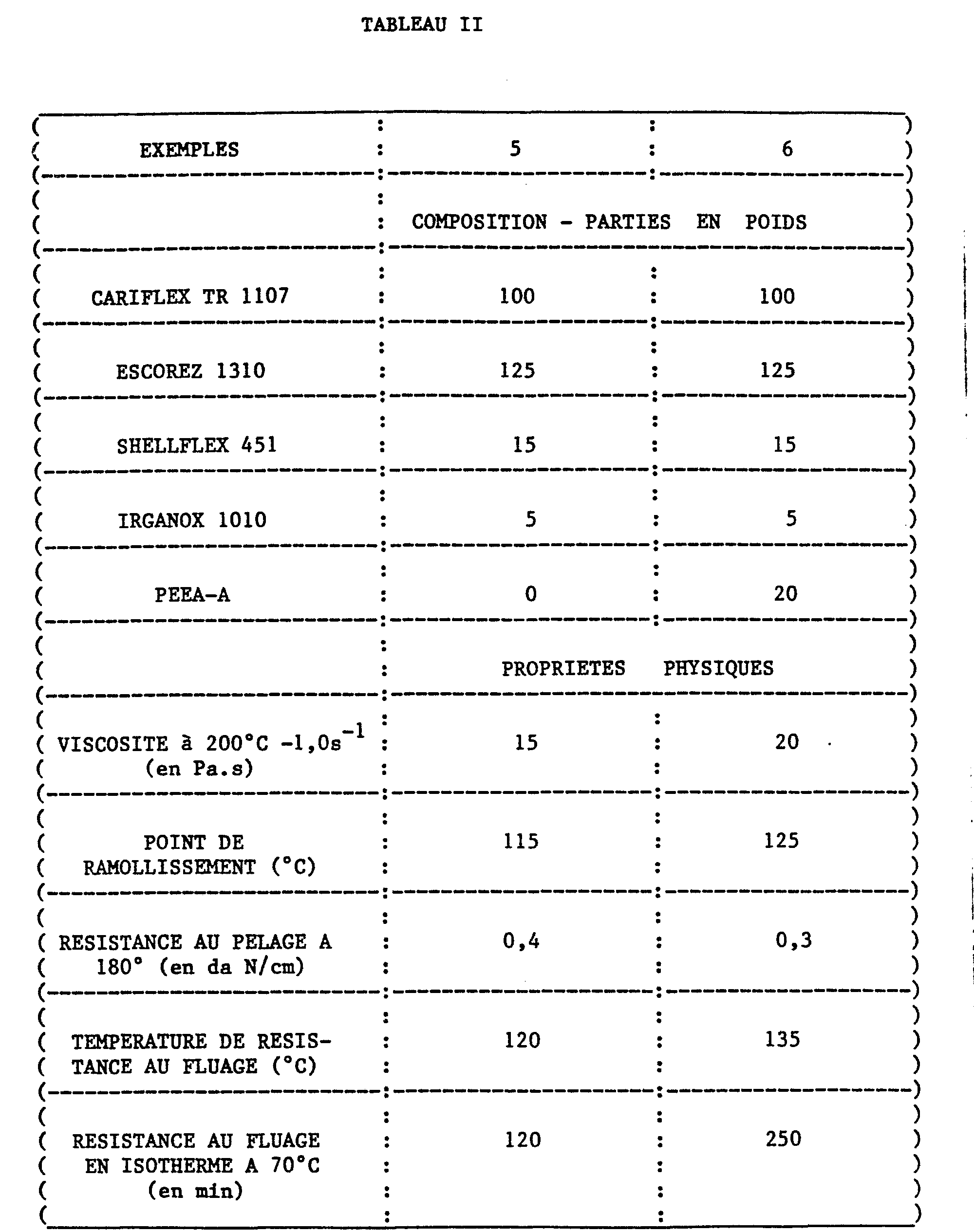
- Dans le cas de ces deux compositions adhésives, le pouvoir collant permanent rend possible leur utilisation industrielle en tant qu'adhésifs sensibles à la pression.

- Dans le cas de ces deux compositions adhésives, le pouvoir collant permanent rend possible leur utilisation industrielle en tant qu'adhésifs sensibles à la pression.
Claims (9)
Applications Claiming Priority (2)
| Application Number | Priority Date | Filing Date | Title |
|---|---|---|---|
| FR8415845 | 1984-10-16 | ||
| FR8415845A FR2571733B1 (fr) | 1984-10-16 | 1984-10-16 | Compositions adhesives a base d'elastomeres thermoplastiques et de polyetheramides et leurs utilisations |
Publications (2)
| Publication Number | Publication Date |
|---|---|
| EP0179700A1 true EP0179700A1 (fr) | 1986-04-30 |
| EP0179700B1 EP0179700B1 (fr) | 1989-01-04 |
Family
ID=9308699
Family Applications (1)
| Application Number | Title | Priority Date | Filing Date |
|---|---|---|---|
| EP85401916A Expired EP0179700B1 (fr) | 1984-10-16 | 1985-10-01 | Compositions adhésives à base d'élastomères thermoplastiques et de polyétheramides et leurs utilisations |
Country Status (6)
| Country | Link |
|---|---|
| EP (1) | EP0179700B1 (fr) |
| JP (1) | JPS61108676A (fr) |
| DE (1) | DE3567223D1 (fr) |
| DK (1) | DK160884C (fr) |
| FI (1) | FI80902C (fr) |
| FR (1) | FR2571733B1 (fr) |
Cited By (4)
| Publication number | Priority date | Publication date | Assignee | Title |
|---|---|---|---|---|
| EP0316435A4 (en) * | 1987-06-03 | 1991-08-21 | Avery International Corporation | Curable film forming compositions |
| US5439975A (en) * | 1985-12-16 | 1995-08-08 | Atochem | Thermoplastic polyetheramide/styrene copolymer composition |
| CN102906211A (zh) * | 2010-07-23 | 2013-01-30 | 大自达电线股份有限公司 | 粘合剂组合物及粘合膜 |
| EP3109273A1 (fr) | 2015-06-26 | 2016-12-28 | Arkema France | Peba pour adherence directe sur tpe |
Families Citing this family (3)
| Publication number | Priority date | Publication date | Assignee | Title |
|---|---|---|---|---|
| JP2006131810A (ja) * | 2004-11-08 | 2006-05-25 | Techno Polymer Co Ltd | 粘着剤及び粘着フィルム |
| JP5675975B2 (ja) * | 2011-05-31 | 2015-02-25 | タツタ電線株式会社 | 接着剤組成物及び接着フィルム |
| JP2015074706A (ja) * | 2013-10-08 | 2015-04-20 | 日立化成株式会社 | 粘着性樹脂組成物及び粘着材 |
Citations (2)
| Publication number | Priority date | Publication date | Assignee | Title |
|---|---|---|---|---|
| EP0088932A1 (fr) * | 1982-03-16 | 1983-09-21 | National Starch and Chemical Corporation | Adhésifs thermofusibles résistant à la chaleur |
| EP0119491A1 (fr) * | 1983-02-18 | 1984-09-26 | Gebrüder Kömmerling Kunststoffwerke GmbH | Masse adhésive et son application |
-
1984
- 1984-10-16 FR FR8415845A patent/FR2571733B1/fr not_active Expired
-
1985
- 1985-10-01 DE DE8585401916T patent/DE3567223D1/de not_active Expired
- 1985-10-01 EP EP85401916A patent/EP0179700B1/fr not_active Expired
- 1985-10-15 DK DK470585A patent/DK160884C/da active
- 1985-10-15 FI FI854010A patent/FI80902C/fi not_active IP Right Cessation
- 1985-10-15 JP JP60227961A patent/JPS61108676A/ja active Granted
Patent Citations (2)
| Publication number | Priority date | Publication date | Assignee | Title |
|---|---|---|---|---|
| EP0088932A1 (fr) * | 1982-03-16 | 1983-09-21 | National Starch and Chemical Corporation | Adhésifs thermofusibles résistant à la chaleur |
| EP0119491A1 (fr) * | 1983-02-18 | 1984-09-26 | Gebrüder Kömmerling Kunststoffwerke GmbH | Masse adhésive et son application |
Cited By (8)
| Publication number | Priority date | Publication date | Assignee | Title |
|---|---|---|---|---|
| US5439975A (en) * | 1985-12-16 | 1995-08-08 | Atochem | Thermoplastic polyetheramide/styrene copolymer composition |
| US5496876A (en) * | 1985-12-16 | 1996-03-05 | Atochem | Thermoplastic polyetheramide/styrene copolymer compositions |
| EP0316435A4 (en) * | 1987-06-03 | 1991-08-21 | Avery International Corporation | Curable film forming compositions |
| CN102906211A (zh) * | 2010-07-23 | 2013-01-30 | 大自达电线股份有限公司 | 粘合剂组合物及粘合膜 |
| CN102906211B (zh) * | 2010-07-23 | 2014-11-05 | 大自达电线股份有限公司 | 导电性粘合剂组合物及导电性粘合膜 |
| EP3109273A1 (fr) | 2015-06-26 | 2016-12-28 | Arkema France | Peba pour adherence directe sur tpe |
| US10246618B2 (en) | 2015-06-26 | 2019-04-02 | Arkema France | PEBA for direct adhesion to TPE |
| EP4163320A1 (fr) | 2015-06-26 | 2023-04-12 | Arkema France | Peba pour adherence directe sur tpe |
Also Published As
| Publication number | Publication date |
|---|---|
| DK470585D0 (da) | 1985-10-15 |
| FI854010L (fi) | 1986-04-17 |
| DK470585A (da) | 1986-04-17 |
| FR2571733B1 (fr) | 1987-02-06 |
| FI80902C (fi) | 1990-08-10 |
| DK160884B (da) | 1991-04-29 |
| DK160884C (da) | 1991-10-21 |
| DE3567223D1 (en) | 1989-02-09 |
| EP0179700B1 (fr) | 1989-01-04 |
| FR2571733A1 (fr) | 1986-04-18 |
| FI80902B (fi) | 1990-04-30 |
| JPH0380827B2 (fr) | 1991-12-26 |
| FI854010A0 (fi) | 1985-10-15 |
| JPS61108676A (ja) | 1986-05-27 |
Similar Documents
| Publication | Publication Date | Title |
|---|---|---|
| CA1267449A (fr) | Copolyetheramides techniques souples a basse temperature | |
| CA1070445A (fr) | Procede de preparation de copolyesteramides comme produits a mouler | |
| US5548027A (en) | Hotmelt adhesive | |
| CA1283232C (fr) | Alliages a base de polyamide, polyetheramide et elastomere thermoplastique | |
| FR2497518A1 (fr) | Compositions adhesives thermofusibles a base de copolyetheramides sequences | |
| CA1147883A (fr) | Copolyesteramides souples a basse temperature | |
| EP1227132A1 (fr) | Composition transparente à base de polyamide | |
| CH635356A5 (fr) | Procede d'obtention de copolyamides souples. | |
| EP0179700B1 (fr) | Compositions adhésives à base d'élastomères thermoplastiques et de polyétheramides et leurs utilisations | |
| DK165753B (da) | Polyamidsmelteklaebemiddel | |
| FR2601376A1 (fr) | Procede de preparation de copolyamides a base d'hexamethylenediamine, d'acide adipique, eventuellement d'au moins un autre diacide carboxylique a chaine courte et acide dimere | |
| CA1253995A (fr) | Procede de preparation de copolyamides a base d'hexamethylenediamine, d'acide adipique, eventuellement d'au moins un autre diacide carboxylique a chaine courte et d'acide dimere | |
| CA1225768A (fr) | Copolyetheramides techniques souples a basse temperature | |
| SE407942B (sv) | Varmsmeltande limkomposition besteende av en sur etensampolymer, en polyamid och ett klibbmedel | |
| EP0600767B1 (fr) | Compositions adhésives thermofusibles réticulables à l'humidité | |
| FR2635329A1 (fr) | Copolyamides amorphes et leurs utilisations | |
| EP0230815B1 (fr) | Compositions thermoplastiques à base de polyétheramides et de copolymeres styrène-diène et leur procédé de fabrication | |
| EP3134476B1 (fr) | Composition de copolyamide a main souple | |
| FR2479841A2 (fr) | Composition utile comme adhesif sensible a la pression et adhesif la contenant | |
| FR2575167A1 (fr) | Melanges de polyamide, de polyurethane thermoplastique ainsi que de polyolefines activees | |
| EP0905211A1 (fr) | Adhésif sensible à la pression et applicable à chaud | |
| FR2574415A1 (fr) | Copolyetheramides techniques souples a basse temperature | |
| EP4551065A1 (fr) | Chaussures de sport a recycabilite amelioree | |
| FR2523143A1 (fr) | Compositions nouvelles a base de copolymeres d'ethylene et d'ester vinylique et leur application en tant qu'adhesifs | |
| CN1325430A (zh) | 热熔粘合剂组合物 |
Legal Events
| Date | Code | Title | Description |
|---|---|---|---|
| PUAI | Public reference made under article 153(3) epc to a published international application that has entered the european phase |
Free format text: ORIGINAL CODE: 0009012 |
|
| 17P | Request for examination filed |
Effective date: 19851004 |
|
| AK | Designated contracting states |
Kind code of ref document: A1 Designated state(s): BE DE GB IT NL SE |
|
| RAP1 | Party data changed (applicant data changed or rights of an application transferred) |
Owner name: ATOCHEM |
|
| 17Q | First examination report despatched |
Effective date: 19870803 |
|
| GRAA | (expected) grant |
Free format text: ORIGINAL CODE: 0009210 |
|
| AK | Designated contracting states |
Kind code of ref document: B1 Designated state(s): BE DE GB IT NL SE |
|
| ITF | It: translation for a ep patent filed | ||
| REF | Corresponds to: |
Ref document number: 3567223 Country of ref document: DE Date of ref document: 19890209 |
|
| GBT | Gb: translation of ep patent filed (gb section 77(6)(a)/1977) | ||
| PLBE | No opposition filed within time limit |
Free format text: ORIGINAL CODE: 0009261 |
|
| STAA | Information on the status of an ep patent application or granted ep patent |
Free format text: STATUS: NO OPPOSITION FILED WITHIN TIME LIMIT |
|
| 26N | No opposition filed | ||
| ITTA | It: last paid annual fee | ||
| PGFP | Annual fee paid to national office [announced via postgrant information from national office to epo] |
Ref country code: SE Payment date: 19941017 Year of fee payment: 10 |
|
| EAL | Se: european patent in force in sweden |
Ref document number: 85401916.3 |
|
| PG25 | Lapsed in a contracting state [announced via postgrant information from national office to epo] |
Ref country code: SE Effective date: 19951002 |
|
| EUG | Se: european patent has lapsed |
Ref document number: 85401916.3 |
|
| PGFP | Annual fee paid to national office [announced via postgrant information from national office to epo] |
Ref country code: NL Payment date: 20011031 Year of fee payment: 17 |
|
| PGFP | Annual fee paid to national office [announced via postgrant information from national office to epo] |
Ref country code: BE Payment date: 20011119 Year of fee payment: 17 |
|
| REG | Reference to a national code |
Ref country code: GB Ref legal event code: IF02 |
|
| PG25 | Lapsed in a contracting state [announced via postgrant information from national office to epo] |
Ref country code: BE Free format text: LAPSE BECAUSE OF NON-PAYMENT OF DUE FEES Effective date: 20021031 |
|
| BERE | Be: lapsed |
Owner name: *ATOCHEM Effective date: 20021031 |
|
| PG25 | Lapsed in a contracting state [announced via postgrant information from national office to epo] |
Ref country code: NL Free format text: LAPSE BECAUSE OF NON-PAYMENT OF DUE FEES Effective date: 20030501 |
|
| NLV4 | Nl: lapsed or anulled due to non-payment of the annual fee |
Effective date: 20030501 |
|
| PGFP | Annual fee paid to national office [announced via postgrant information from national office to epo] |
Ref country code: GB Payment date: 20031001 Year of fee payment: 19 |
|
| PGFP | Annual fee paid to national office [announced via postgrant information from national office to epo] |
Ref country code: DE Payment date: 20031009 Year of fee payment: 19 |
|
| PG25 | Lapsed in a contracting state [announced via postgrant information from national office to epo] |
Ref country code: GB Free format text: LAPSE BECAUSE OF NON-PAYMENT OF DUE FEES Effective date: 20041001 |
|
| PG25 | Lapsed in a contracting state [announced via postgrant information from national office to epo] |
Ref country code: DE Free format text: LAPSE BECAUSE OF NON-PAYMENT OF DUE FEES Effective date: 20050503 |
|
| GBPC | Gb: european patent ceased through non-payment of renewal fee |
Effective date: 20041001 |