EP0180152A2 - Procédé et dispositif de lecture de codes à barres - Google Patents
Procédé et dispositif de lecture de codes à barres Download PDFInfo
- Publication number
- EP0180152A2 EP0180152A2 EP85113541A EP85113541A EP0180152A2 EP 0180152 A2 EP0180152 A2 EP 0180152A2 EP 85113541 A EP85113541 A EP 85113541A EP 85113541 A EP85113541 A EP 85113541A EP 0180152 A2 EP0180152 A2 EP 0180152A2
- Authority
- EP
- European Patent Office
- Prior art keywords
- bar
- bar code
- space
- comparison reference
- values
- Prior art date
- Legal status (The legal status is an assumption and is not a legal conclusion. Google has not performed a legal analysis and makes no representation as to the accuracy of the status listed.)
- Withdrawn
Links
Images





Classifications
-
- G—PHYSICS
- G06—COMPUTING OR CALCULATING; COUNTING
- G06K—GRAPHICAL DATA READING; PRESENTATION OF DATA; RECORD CARRIERS; HANDLING RECORD CARRIERS
- G06K7/00—Methods or arrangements for sensing record carriers, e.g. for reading patterns
- G06K7/10—Methods or arrangements for sensing record carriers, e.g. for reading patterns by electromagnetic radiation, e.g. optical sensing; by corpuscular radiation
- G06K7/14—Methods or arrangements for sensing record carriers, e.g. for reading patterns by electromagnetic radiation, e.g. optical sensing; by corpuscular radiation using light without selection of wavelength, e.g. sensing reflected white light
- G06K7/1404—Methods for optical code recognition
- G06K7/146—Methods for optical code recognition the method including quality enhancement steps
- G06K7/1486—Setting the threshold-width for bar codes to be decoded
-
- G—PHYSICS
- G06—COMPUTING OR CALCULATING; COUNTING
- G06K—GRAPHICAL DATA READING; PRESENTATION OF DATA; RECORD CARRIERS; HANDLING RECORD CARRIERS
- G06K7/00—Methods or arrangements for sensing record carriers, e.g. for reading patterns
- G06K7/01—Details
- G06K7/016—Synchronisation of sensing process
- G06K7/0166—Synchronisation of sensing process by means of clock-signals derived from the code marks, e.g. self-clocking code
-
- G—PHYSICS
- G06—COMPUTING OR CALCULATING; COUNTING
- G06K—GRAPHICAL DATA READING; PRESENTATION OF DATA; RECORD CARRIERS; HANDLING RECORD CARRIERS
- G06K7/00—Methods or arrangements for sensing record carriers, e.g. for reading patterns
- G06K7/10—Methods or arrangements for sensing record carriers, e.g. for reading patterns by electromagnetic radiation, e.g. optical sensing; by corpuscular radiation
- G06K7/14—Methods or arrangements for sensing record carriers, e.g. for reading patterns by electromagnetic radiation, e.g. optical sensing; by corpuscular radiation using light without selection of wavelength, e.g. sensing reflected white light
Definitions
- the present invention relates to a method of reading bar codes and an apparatus therefor, and particularly to a method of reading bar codes and an apparatus therefor wherein the speed at which an optical reader scans the bar code does not require to be limited, while still assuring the accuracy with which they are read.
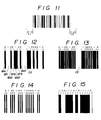
- Figs. 12 to 15 show some typical bar codes in current use.
- Fig. 12 shows a bar code which is composed of thin and thick printed bars and thin and thick spaces. Thick bars and spaces represent binary "1” whereas thin bars and spaces represent binary "0".
- Fig. 13 shows a bar code which is composed of thin and thick printed bars and thin spaces. Thick bars represent binary "1”, and thin bars represent binary "0”; spaces, however, have no significance as data.
- Fig. 14 shows a bar code which is composed of thin and thick spaces and thin printed bars. Thick spaces represent binary "1", and thin spaces represent binary "0", while the bars have no significance as data.
- F ig.
- FIG. 15 shows a bar code which is employed for the J.A.N., UPC and WPC.
- a numerical character is composed of seven modules of equal width. These seven modules form two bars and two spaces, and each bar module represents binary "1" whereas each space module represents binary "0".
- a first reading method comprises the steps of scanning the code pattern with an optical reader to obtain numerical counts representing bar and space widths, and comparing the obtained counts with a fixed reference value to determine the binary digits represented thereby.
- a second reading method appropriate for reading such a bar code as shown in Fig. 12 comprises the steps of: scanning the bar code with an optical reader to count bar and space widths sequentially, comparing the count of the bar width which the optical reader reads first with the count of the space width adjacent to the first bar to determine the binary digit represented by the first bar; or, likewise, comparing the count of the space width which the optical reader reads first, with the count of the bar width adjacent to the first space to determine the binary digit represented by the space, and so on.
- the first reading method uses a fixed reference value, and the count corresponding to the bar and space widths varies with the speed at which the optical reader scans the combinations of bars and spaces.
- the speed at which the optical reader scans the bar codes must be controlled within certain limits, otherwise there will be considerable reading error. Such reading errors have been particularly high with manual sweeping.
- bars are selected and compared with each other in terms of their widths, and likewise spaces are selected and compared with each other in terms of their widths.
- the counts of two subsequent bar widths are compared with each other to determine which one is larger in value, and then the larger one (or thicker bar) is deemed to represent binary "1” whereas the smaller one (or thinner bar) is deemed to represent binary "0".
- two subsequent space widths are compared with each other to determine which one is larger in value, and then the larger one (or wider space) is deemed to represent binary "1” whereas the smaller one (or thinner space) is deemed to represent binary "0".
- the width of a bar (or space) selected as a standard is defined as a first value; the value of a bar (or space) width to be determined is multiplied by a constant K which is larger than one, and the multiplied count is defined as a second value; the object count is divided by K and is defined as a third value; and then a determination as to which binary number the object bar (or space) represents, zero or one, is made as follows:
- the third reading method which is a combination of the two reading methods submitted for patent, is free of the disadvantage of having to control the sweeping speed of the optical reader, and of erroneous reading which would be otherwise caused by blurring in the printing.
- the second value > the first value > the first value appears instead of the correct second value > the third value > the first value.
- the third reading method cannot be applied to a bar code as shown in Fig. 15, as is the case with the second reading method.
- a reading method which is exclusively applied to a bar code of Fig. 15 comprises the steps of: obtaining a value corresponding to the width of a single module by scanning a start bar (not shown) with an optical reader, and making a decision as to which element (bar or space) each subsequent module belongs to, on the basis of the module value count every time an optical reader scans the module, thereby determining whether the binary number is "1" or "0".
- This reading method requires that an optical reader scans the code at a constant speed, and therefore erroneous readings are often caused when the optical reader is moved by hand.
- One object of the present invention is to provide a method of reading bar codes without the necessity of keeping the optical reader scanning at a constant speed, while still assuring correct readings irrespective of slight increases or decreases in bar and space widths.
- Another object of the present invention is to provide an apparatus for reading bar codes without the necessity of keeping an optical reader scanning at a constant speed, while still assuring correct reading irrespective of slight increases or decreases in bar and space widths.
- a comparison reference value is calculated from a zone value representing the width of each zone constituted by a bar or space and a given constant; each zone value is compared with the comparison reference value; and finally the width of each zone is determined from a decision as to which value is larger, the zone value or the comparison reference value.
- a bar code reading apparatus comprises a central processing unit 2, a program storage 3, a data storage 4, a digital input and output circuit 5 and a display control 6 all linked together by a bus 1.
- the central processing unit (hereinafter abbreviated to "CPU") 2 is designed to control the operation of the whole apparatus according to a program stored in the program storage 3, which is composed of a read-only memory.
- the data storage 4 is composed of a random access memory, including a zone width memory M1, a reference memory M2, a read-out data memory M3, a temporary memory M4 and a miscellaneous memory M5.
- an optical reader 7 which is designed to be moved across bar codes by hand is connected to the digital input and output circuit 5.
- This circuit 5 is designed to detect which zone the optical reader is moving across, a bar zone or space zone, and supply to the bus 1 a binary signal representing which zone the optical reader is crossing.
- the display control 6 is designed to translate bar code data retrieved from the read-out data memory M3 to a corresponding display data, and supply them to a cathode-ray tube or any other such display means 8.
- the bar codes of Figs. 12 to 15 differ in their binary expression modes, as already described, and accordingly different recognition modes are employed.
- the bar code of Fig. 12 contains as many numerical characters as required, thus presenting the same appearance as the one in Fig. 11.
- the bar code is composed of combinations of thin and thick bars and thin and thick spaces. Again, assume that the width ratio between thin bar, thick bar, thin space and thick space is 1 : 3 : 2 : 4.
- Fig. 2 represents flowchart showing the sequence of steps for measuring and counting the width of each of the bar and space zones in the bar code and storing the resultant counts.
- each unit appearing in Fig. 1 is set at its initial condition.
- a decision is then made as to whether or not the optical reader 7 has finished traversing the blank space corresponding to the start margin L1. In the affirmative case a decision is made as to whether or not the optical reader 7 is crossing the printed bars at Step 2-4. If the scan of the start margin L1 has been finished, it means the optical reader 7 has started scanning the printed bars, and one is added to the bar count B registered at a predetermined address in the storage M5. While the optical reader is running across the first bar BA1, Steps 2-4 and 2-5 are repeated, thus counting the width of the first bar BA1. When the scan of the first bar BA1 has finished, the bar count B is shifted from the memory M5 to the zone width memory M1.
- Steps 2-7 to 2-9 are repeated, thereby providing a count representing the width of the first space SP1.
- the space count S is shifted from the memory M5 to the zone width memory M1, and then the set-up reverts to Step 2-4.
- Step 2-5 the bar count is increased by one at each of the two Steps 2-4 and 2-5 and that the space count is increased by one at each of the three Steps 2-7, 2-8 and 2-9.
- a dummy step is preferably added to Step 2-5.
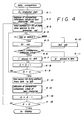
- the values representing the bar and space widths in the bar code are stored in the zone width memory M1, and the digit A of the characters contained in the whole bar code is determined at Step 3-1 in Fig. 3 (determination of a comparison reference value).
- the character digit A represents how many characters constitute the bar code, and the digit when determined is stored at a predetermined address of the memory M5.
- the counts of the four bars together contained in the first character are totaled, and the total value is divided by a given constant K1 stored in the program memory 3.
- the comparison reference value N1 pertaining to the bars contained in the first character is obtained and stored in the reference memory M2.
- the counts of the three spaces together contained in the first character are totaled, and the total value is divided by a given constant K2 stored in the program memory 3.
- the comparison reference value N2 pertaining to the spaces contained in the first character is obtained, and is stored in the reference memory M2.
- the value of the constant K1 is selected so that the bar-comparison reference value N1 may be an intermediate between the count of the thin bar and the count of the thick bar.
- the value of the constant K2 is selected so that the space-comparison reference value N2 may be an intermediate between the count of the thin space and the count of the thick space.
- the reference values N1 and N2 pertaining to the bars and spaces contained in the first character are determined, and then the character digit A of the character is decreased by one. A decision is made as to whether or not the digit A is zero.
- Steps 3-3 to 3-10 are repeated, thereby determining the comparison reference values pertaining to the bars and spaces contained in each of the subsequent characters.
- the comparison reference value thus determined are then stored in the reference memory M2.
- the determination of the comparison reference values is deemed to have been finished and comparison of read-out data with the comparison reference values follows.
- the binary digit "1" or "0" is stored in the temporary memory M4.
- the first bar BA1 is thin, and therefore the bar count is smaller than the bar-comparison reference N1.
- a binary "0" is stored.
- Step 4-4 a decision is made as to whether D is equal to zero at Step 4-9. If D is not zero, the set-up reverts to Step 4-4.
- the count of the first space SP1 is stored at the second position of the zone width memory M1.
- the address in the memory M5 of the space-comparison reference N2 for the first character is referred to, and then the space-comparison reference N2 is shifted from the reference memory M2 to a register 2a in the CPU 2.
- the second data stored in the zone width memory M1 that is, the count representing the width of the first space SP1 is compared with the space-comparison reference value N2 registered in the register 2a to determine which is larger, the first space count or the space-comparison reference value N2.
- the first space S P 1 is determined as representing binary "1", otherwise it is determined as representing binary "0". Then, binary "1" or "0" is stored in the temporary memory M4. In the example given in Fig. 12, the first space SP1 is thick, and the count thereof is larger than the space-comparison reference value N2. Thus, a binary "1" is stored, and D is decreased by one. The situation then advances to Step 4-9. The operation as described so far is repeated until all the data pertaining to the bars, spaces and inter-character space are compared with the respective references.
- the first seven-bit content of the first character data stored in the temporary memory M4 that is, the data of the bars and spaces except for the inter-character space CS, is stored in the data memory M3.
- the address of the comparison reference value of the first character is cleared from the memory M5, and the address of the comparison reference of the subsequent character is input. Then, the character digit A is decreased by one at Step 4-14.
- Step 4-15 a decision is made as to whether digit A is zero. If the decision is negative, Steps 4-3 to 4-5 are repeated, thereby performing comparisons of bar and space data of each subsequent character for determining which binary digit they represent. The data obtained as a result of these comparisons are stored in the data memory M3 in a predetermined order. When comparisons of bar and space data of every character in the bar code and storage of resultant data have been finished, the digit A reduces to zero, and the display operation as shown in Fig. 5 follows.
- the bar- and space-comparison reference values N1 and N2 in the first embodiment are calculated by summing up the bar counts of each character and dividing the sum of the bar counts by the constant K; and by summing up the space counts of each character and dividing the sum by the constant K2, respectively.
- These bar- and space-comparison reference values can be calculated according to a different principle, which is described below in a second embodiment.
- the second embodiment differs from the first embodiment only in the calculation of the bar- and space-comparison reference values. Calculation of bar and space widths, comparison of data and operation of display are similar to the corresponding ones described above with reference to Figs. 2, 4 and 5 in the first embodiment. Therefore, the description of these is omitted.
- Calculation of the bar- and space-comparison reference values is conducted according to the steps shown in Fig. 6.
- the character digit A is obtained on the basis of the data of bar and space counts stored in the zone width memory M1, and the character digit A thus obtained is put in a predetermined address of the memory M5.
- the largest count MAX and the smallest count MIN of the bar counts in the first character are selected.
- the largest and smallest counts MAX and MIN thus selected are added together, and the total is divided by two.
- the comparison reference value N1 pertaining to the bars contained in the first character is obtained, and is stored in the reference memory M2.
- the largest and smallest counts MAX and MIN of the space counts in the first character are selected.
- the largest and smallest counts MAX and MIN thus selected are added together, and the total is divided by two.
- the comparison reference value N2 pertaining to the spaces in the first character is obtained, and is stored in the reference memory M2.
- Step 6-10 a decision is made as to whether the character digit is zero.
- Steps 6-3 to 6-10 are repeated, thereby calculating the bar-and space-comparison reference values N1 and N2 pertaining to the second, third and subsequent characters.
- the character digit reduces to zero. Then, the set-up proceeds to the read-out data comparison, which has already been described with reference to Fig. 4.
- the bar- and space-comparison reference values N1 and N2 are determined by summing up the largest- and smallest-bar and space counts and by dividing these sums by two.
- a different calculation is possible. For example:
- the bar- and space-comparison reference values N1 and N2 can be calculated by adding the largest count and a count at a predetermined order among the second to fourth counts and by dividing the sum by two.
- the bar- and space-comparison reference values N1 and N2 are calculated for each character.
- one bar-comparison reference value N1 and one space-comparison reference value N2 can be used for the whole bar code. This calculation will be described below in a third embodiment.
- Step 7-4 the count of the first bar and the, count of the second bar are added together, and the total is put in a predetermined address of the memory M5.
- Step 7-5 one is subtracted from the number of addition times C1, and then at Step 7-6 a decision is made as to whether the number of addition times is zero. In the case of a negative decision the count of the next bar width is added to the summed value at Step 7-4.
- Step 7-7 the total of the above additions is divided by the product of the constant K1 and the character digit A, thereby providing the bar-comparison reference value N1 of the whole bar code.
- this this is stored in the reference memory N2.
- Step 7-9 the character digit A is multiplied by the number of the spaces contained in a single character, that is, three, and one is subtracted from the resultant value, thereby providing the number C2 of addition times of the space width counts in the whole bar code, which is put in a predetermined address of the memory M5.
- Step 7-10 the count of the first space and the count of the second space are added together, and the resultant value is put in a predetermined address of the memory M5, and at the same time one is subtracted from the number of addition times C2.
- Step 7-2 a decision is made as to whether C2 is equal to zero. If this is negative the set-up reverts to Step 7-10 where the result of additions stored in the memory M5 and the count of the next space are added together. In this way Steps 7-10 to 7-12 are repeated until the counts of all the spaces in the bar code are added together, and the result of the addition is put in a predetermined address of the memory M5.
- the character digit A is put in the storage M 5.
- a decision is then made as to whether the first count stored in the zone width memory M1 relates to a bar or a space. If a bar, the bar-comparison reference value N1 is shifted from the reference memory M2 to a preselected register 2a in CPU 2, and at Step 8-5 the bar count is compared with the bar-comparison reference value N1 to decide which is larger. if the count is found to be larger than the reference value, the bar whose count has just been compared with the bar- reference value is taken as representing binary "1".
- Step 8-8 a decision is made as to whether D is equal to zero. In the decision is negative, the set-up reverts to Step 8-3 where a decision is made as to whether the next count stored in the zone width memory M1 relates to bar or space. If space, at Step 8-9 the space-comparison reference value N2 is shifted from the reference memory M2 to a predetermined register 2a of the CPU 2, and at Step 8-5 the space count is compared with the space-comparison reference value N2 to decide which is larger. If the count is larger than the space-comparison reference value N2, the space pertaining to the count is taken as representing binary "1". If the count is smaller than the reference value, the space is taken as representing binary "0". The result is stored in the temporary memory M4.
- Step 8-11 the first seven-bit portion of the read-out data stored in the temporary memory M4, that is, the part of the read-out data excluding the inter-character space CS, is stored in the read-out data storage M3.
- Step 8-12 one is subtracted from the character digit A, and at Step 8-13 a decision is made as to whether the character digit A is equal to zero. If the decision is negative, Steps 8-2 to 8-13 are repeated, thereby performing the bar- and space-comparisons with regard to the second, third and subsequent characters one after the other.
- the character digit A is at zero, and the display process as described above with reference to Fig. 5 follows.
- the bar code reading methods according to the first, second and third embodiments as described are applied to bar codes using thin and thick bars and thin and thick spaces, thick ones representing binary "1" and thin ones binary “0” (see Fig. 12).
- This bar code reading method may, however, be equally well applied to a bar code using thin and thick bars and thin spaces (see Fig. 13) or thin and thick spaces and thin bars (see Fig. 14).
- Steps 3-6 to 3-8 may be omitted from the calculation of reference values given in Fig. 3; Steps 6-6 to 6-8 may be omitted from the calculation of reference values given in Fig. 6; and Steps 7-9 to 7-14 may be omitted from the calculation of reference values given in Fig. 7. Also, Steps 4-4, 4-10 and 4-12 may be omitted from the data comparison given in Fig. 4.
- Step 4-3 D may be set at 7, and at Steps 4-7 and 4-11 binary "1" or "0" may be stored directly in the read-out data memory M3.
- Step 8-9 and 8-11 may be omitted, and at Step 8-2 D may be set at 7.
- Steps 8-6 and 8-10 binary "1” or binary "0" may be stored directly in the read-out data memory M3.
- a first reference value may be set at a value intermediate between the count of the thin element and the count of the intermediate-thick element
- a second reference value may be set at a value intermediate between the count of the intermediate-thick element and the count of the thick element.
- the width of each element can be determined by making decisions as to which is larger, the count of an object element or the first comparison reference, and as to which is larger, the count of an object element or the second comparison reference.
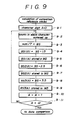
- bars and spaces may have different widths ranging from one to four modules.
- Step 9-2 the bar and space counts of the first character are summed up, and the total is divided by seven, thereby providing an average count BS for one module.
- the average count BS for one module is multiplied by 1.5, thereby providing a first comparison reference value BS1(A) intermediate between the count for one module and the count for two modules.
- the first comparison reference value BS1(A) is stored in the reference memory M5.
- an average count BS for one module is multiplied by 2.5, thereby providing a second comparison reference value BS2(A) intermediate between the count for two modules and the count for three modules, and the second comparison reference is stored in the reference memory M2.
- the average count BS for one module is multiplied by 3.5, thereby providing a third comparison reference value BS3(A) intermediate between the count for three modules and the count for four modules, and the third comparison reference value is stored in the reference memory M2.
- Step 9-11 a decision is made as to whether the character digit A is equal to 12.
- the character digit A is fixed at 12, and this value is stored in the memory M5 of the read-out data memory 4 or the program storage 3.
- the set-up reverts to Step 9-2, where the first, second and third comparison reference values BS1(A), BS2(A) and BS3(A) for subsequent characters are calculated, and stored in the reference storage M2. In this way the calculation of the reference values for all the characters is conducted.
- the character digit a is equal to 12. Data comparison follows.
- a decision is made as to which is larger, the count or the third comparison reference value BS3(A).
- Step 10-10 a decision is made as to which element of bar and space the count represents. If it is found to represent a bar, the binary "1"s of the number corresponding to the value of the binary number E are stored in the read-out data memory M3. Otherwise, if it is found to represent a space, the binary "0"s of the number corresponding to the value of the binary number E are stored in the read-out data memory M3. One is then subtracted from the total F of the bars and spaces of the whole character, and at Step 10-14 a decision is made as to whether the total F is zero. In a negative case, Steps 10-3 to 10-14 are repeated, thereby carrying out comparisons of the counts of the bars and spaces of the whole character.
- Step 10-16 a decision is made as to whether this character digit is 12 or not. In a negative case Steps 10-2 to 10-16 are repeated, thereby carrying out comparisons of subsequent bars and spaces in each character until all the comparisons with respect to the whole bar code have been completed, and the character digit A equals 12.
- bars and spaces in such a bar code as shown in Fig. 15 must be well defined in the printing process. It is prescribed that the definitions of printed bars and spaces be within a certain tolerance. Therefore, in reading a bar code as shown in Fig. 15, the same comparison reference value may be applied both to bar and space comparisons.
- the use of one common comparison reference value is possible in reading a bar code as shown in Fig. 12, provided that the definitions of printed bars and spaces are within the tolerance limits. If printed bars are blurred beyond these limits, such a common comparison reference value cannot be used.
- the bar code reading method according to the present invention is described above as being applied to the different bar codes appearing in Figs. 12 to 15.
- the bar code reading apparatus according to the present invention can be designed to handle a selected type bar code exclusively or a variety of bar codes.
- the apparatus In designing an all- round bar code reading apparatus it is necessary that the apparatus be capable of determining what type of bar code is to be read, and capable of carrying out the necessary calculation of comparison reference values and comparison of read-out data in a certain way appropriate for that bar code type. For example, an operator may select a switch among those which bear the words describing the types of bar codes to identify the bar code for reading by the apparatus.
- the bar code may be partly modified so as to permit the apparatus to automatically identify the bar code. Such modifications may be made in the form of a starting code or ending code, although this is not shown in Fig. 11.
- a comparison reference value is calculated from a value corresponding to the width of each bar and space scanned by an optical reader and from a given content; the value corresponding to the width of each element is compared with the calculated comparison reference value to determine which is larger, the zone width or the comparison reference value; and each zone width is determined as representing a bar or a space according to the result of the comparison.
- the relationship between the comparison reference value and the value corresponding to the width of each bar or space is independent of the speed at which an optical reader scans the bar code. Therefore, accurate reading is assured irrespective both of the scanning speed of the optical reader and variation in zone widths produced by blurring in the printing.
Landscapes
- Engineering & Computer Science (AREA)
- Physics & Mathematics (AREA)
- Artificial Intelligence (AREA)
- Computer Vision & Pattern Recognition (AREA)
- General Physics & Mathematics (AREA)
- Theoretical Computer Science (AREA)
- General Health & Medical Sciences (AREA)
- Health & Medical Sciences (AREA)
- Electromagnetism (AREA)
- Toxicology (AREA)
- Quality & Reliability (AREA)
- Character Discrimination (AREA)
- Printers Characterized By Their Purpose (AREA)
- Record Information Processing For Printing (AREA)
- Character Input (AREA)
Applications Claiming Priority (2)
| Application Number | Priority Date | Filing Date | Title |
|---|---|---|---|
| JP59221970A JPS61101880A (ja) | 1984-10-24 | 1984-10-24 | バ−コ−ド読取方法および装置 |
| JP221970/84 | 1984-10-24 |
Publications (2)
| Publication Number | Publication Date |
|---|---|
| EP0180152A2 true EP0180152A2 (fr) | 1986-05-07 |
| EP0180152A3 EP0180152A3 (fr) | 1988-12-14 |
Family
ID=16775017
Family Applications (1)
| Application Number | Title | Priority Date | Filing Date |
|---|---|---|---|
| EP85113541A Withdrawn EP0180152A3 (fr) | 1984-10-24 | 1985-10-24 | Procédé et dispositif de lecture de codes à barres |
Country Status (4)
| Country | Link |
|---|---|
| US (1) | US4757206A (fr) |
| EP (1) | EP0180152A3 (fr) |
| JP (1) | JPS61101880A (fr) |
| DE (1) | DE180152T1 (fr) |
Cited By (4)
| Publication number | Priority date | Publication date | Assignee | Title |
|---|---|---|---|---|
| FR2615983A1 (fr) * | 1987-05-27 | 1988-12-02 | Sogedex | Procede et dispositif de lecture de cartes d'identification portant des informations codees par un code a barres, notamment pour des systemes de controle d'acces et de gestion de site |
| DE3816800A1 (de) * | 1988-05-17 | 1989-11-30 | Zinser Textilmaschinen Gmbh | Verfahren und vorrichtung zum zuordnen von garn- und/oder maschinenbezogenen daten zu spulenhuelsen von spinnereimaschinen |
| EP0478345A3 (en) * | 1990-09-28 | 1993-02-03 | Xerox Corporation | Process for decoding bar codes |
| EP0667592A1 (fr) * | 1994-01-28 | 1995-08-16 | Canon Inc. | Méthode de codage d'information dans la forme de codes à barres, méthode et appareil pour les lire |
Families Citing this family (20)
| Publication number | Priority date | Publication date | Assignee | Title |
|---|---|---|---|---|
| JPH01156886A (ja) * | 1987-12-15 | 1989-06-20 | Matsushita Electric Ind Co Ltd | バーコード読取装置 |
| JPH07101437B2 (ja) * | 1988-06-21 | 1995-11-01 | アルプス電気株式会社 | 符号読取装置 |
| JPH0375894A (ja) * | 1989-08-17 | 1991-03-29 | Fuji Electric Co Ltd | 磁気マーカーの識別方法 |
| JP2558336Y2 (ja) * | 1991-04-30 | 1997-12-24 | 三菱自動車工業株式会社 | 車高調整装置 |
| JPH04361390A (ja) * | 1991-06-07 | 1992-12-14 | Ricoh Res Inst Of Gen Electron | バーコードデコーダ用弁別器 |
| US5401949A (en) * | 1991-06-12 | 1995-03-28 | American Neurologix, Inc. | Fuzzy logic barcode reader |
| JP2740418B2 (ja) * | 1992-07-14 | 1998-04-15 | 富士通株式会社 | バーコード読取復調方法 |
| US5550362A (en) * | 1992-11-20 | 1996-08-27 | Intermec Corporation | Method and apparatus for calibrating a bar code scanner |
| US5352878A (en) * | 1993-01-29 | 1994-10-04 | United Parcel Service Of America, Inc. | Method and apparatus for decoding bar code symbols using independent bar and space analysis |
| JPH075564A (ja) * | 1993-06-18 | 1995-01-10 | Fuji Photo Film Co Ltd | フイルムカートリッジ用バーコード読取り装置 |
| US7387253B1 (en) * | 1996-09-03 | 2008-06-17 | Hand Held Products, Inc. | Optical reader system comprising local host processor and optical reader |
| US5537431A (en) * | 1994-06-15 | 1996-07-16 | International Business Machines Corporation | Method and apparatus for bar code reading and decoding |
| US5929420A (en) * | 1995-10-02 | 1999-07-27 | Symbol Technologies, Inc. | Method for reading distorted bar codes |
| US5708261A (en) * | 1995-10-02 | 1998-01-13 | Pitney Bowes Inc. | Bar code decoding with speed compensation |
| US5767498A (en) * | 1996-09-17 | 1998-06-16 | Ncr Corporation | Bar code error scanner |
| US6164542A (en) * | 1998-11-03 | 2000-12-26 | Intermec Ip Corp. | Method and apparatus for decoding unresolved symbol profiles produced from a reduced data set |
| FR2861874B1 (fr) * | 2003-10-29 | 2006-02-24 | Eastman Kodak Co | Procede d'enregistrement et de lecture de donnees numeriques sur un support photographique |
| US7848578B2 (en) * | 2004-09-13 | 2010-12-07 | Nokia Corporation | Methods, devices and computer program products for capture and display of visually encoded data and an image |
| KR100667778B1 (ko) * | 2004-11-20 | 2007-01-11 | 삼성전자주식회사 | 바코드 판독 방법 및 장치 |
| US20190018995A1 (en) * | 2017-07-12 | 2019-01-17 | Symbol Technologies, Llc | System and method for decoding dynamic barcode quantities |
Family Cites Families (11)
| Publication number | Priority date | Publication date | Assignee | Title |
|---|---|---|---|---|
| US3811033A (en) * | 1971-06-29 | 1974-05-14 | Monarch Marking Systems Inc | Coded record interpreting system |
| US4146046A (en) * | 1973-11-16 | 1979-03-27 | Monarch Marking Systems, Inc. | Coded record and methods of and apparatus for encoding and decoding records |
| US3854036A (en) * | 1974-02-27 | 1974-12-10 | Singer Co | Tag reader to digital processor interface circuit |
| US3969613A (en) * | 1975-02-03 | 1976-07-13 | International Business Machines Corporation | Two frequency coded data interpreting method and apparatus |
| JPS586982B2 (ja) * | 1976-08-18 | 1983-02-07 | 株式会社デンソー | バ−コ−ド読取方法および装置 |
| JPS5588171A (en) * | 1978-12-27 | 1980-07-03 | Toshiba Corp | Bar-code reader |
| US4379224A (en) * | 1981-05-26 | 1983-04-05 | Honeywell Inc. | Apparatus for interpreting Code 39 bar code data |
| US4528443A (en) * | 1982-04-21 | 1985-07-09 | Burr-Brown Corporation | Bar code reading system and method |
| JPS58223876A (ja) * | 1982-06-23 | 1983-12-26 | Casio Comput Co Ltd | バ−コ−ド認識装置 |
| JPS593590A (ja) * | 1982-06-30 | 1984-01-10 | Casio Comput Co Ltd | バ−コ−ド認識装置 |
| US4578570A (en) * | 1984-08-14 | 1986-03-25 | Ncr Canada Ltd.-Ncr Canada Ltee | Bar code processing apparatus |
-
1984
- 1984-10-24 JP JP59221970A patent/JPS61101880A/ja active Pending
-
1985
- 1985-10-17 US US06/788,729 patent/US4757206A/en not_active Expired - Lifetime
- 1985-10-24 EP EP85113541A patent/EP0180152A3/fr not_active Withdrawn
- 1985-10-24 DE DE198585113541T patent/DE180152T1/de active Pending
Cited By (4)
| Publication number | Priority date | Publication date | Assignee | Title |
|---|---|---|---|---|
| FR2615983A1 (fr) * | 1987-05-27 | 1988-12-02 | Sogedex | Procede et dispositif de lecture de cartes d'identification portant des informations codees par un code a barres, notamment pour des systemes de controle d'acces et de gestion de site |
| DE3816800A1 (de) * | 1988-05-17 | 1989-11-30 | Zinser Textilmaschinen Gmbh | Verfahren und vorrichtung zum zuordnen von garn- und/oder maschinenbezogenen daten zu spulenhuelsen von spinnereimaschinen |
| EP0478345A3 (en) * | 1990-09-28 | 1993-02-03 | Xerox Corporation | Process for decoding bar codes |
| EP0667592A1 (fr) * | 1994-01-28 | 1995-08-16 | Canon Inc. | Méthode de codage d'information dans la forme de codes à barres, méthode et appareil pour les lire |
Also Published As
| Publication number | Publication date |
|---|---|
| JPS61101880A (ja) | 1986-05-20 |
| EP0180152A3 (fr) | 1988-12-14 |
| US4757206A (en) | 1988-07-12 |
| DE180152T1 (de) | 1986-09-25 |
Similar Documents
| Publication | Publication Date | Title |
|---|---|---|
| US4757206A (en) | Bar code reading method and apparatus | |
| EP0204341B1 (fr) | Méthode et appareil de lecture de code à barres | |
| US5414252A (en) | High speed scan bar code reader which can read more than one type of bar code | |
| JP2616921B2 (ja) | ラベル識別装置 | |
| US4879456A (en) | Method of decoding a binary scan signal | |
| US4405952A (en) | Apparatus for detecting faulty sectors and for allocating replacement sectors in a magnetic disc memory | |
| US4354101A (en) | Method and apparatus for reading and decoding a high density linear bar code | |
| US4421978A (en) | Decoding method for multicharacter labels | |
| US4481665A (en) | Character segmentation method | |
| US3854036A (en) | Tag reader to digital processor interface circuit | |
| US4329574A (en) | Bar code candidate select circuit | |
| US5965863A (en) | Optical reader system comprising local host processor and optical reader | |
| US4058708A (en) | Bar code reader and decoder | |
| JPS6227434B2 (fr) | ||
| US4206442A (en) | Letter segmenting apparatus for OCR comprising multi-level segmentor operable when binary segmenting fails | |
| US5451761A (en) | Bar code demodulating method | |
| JP2753260B2 (ja) | マージ方法 | |
| US5302814A (en) | Bar code reading apparatus | |
| EP0818019B1 (fr) | Procede et dispositif de decodage de codes a barres | |
| KR100334047B1 (ko) | 바코드 판독 장치 및 방법 | |
| US6554190B1 (en) | Bar code reader and its misreading detecting method | |
| JPS6155148B2 (fr) | ||
| JPH0244484A (ja) | バーコード・リーダー | |
| JPH06119480A (ja) | バーコード読取装置 | |
| JPH07121665A (ja) | 文字認識辞書の構成方法及び検索方法 |
Legal Events
| Date | Code | Title | Description |
|---|---|---|---|
| PUAI | Public reference made under article 153(3) epc to a published international application that has entered the european phase |
Free format text: ORIGINAL CODE: 0009012 |
|
| AK | Designated contracting states |
Kind code of ref document: A2 Designated state(s): DE FR GB |
|
| EL | Fr: translation of claims filed | ||
| DET | De: translation of patent claims | ||
| PUAL | Search report despatched |
Free format text: ORIGINAL CODE: 0009013 |
|
| RHK1 | Main classification (correction) |
Ipc: G06K 7/016 |
|
| AK | Designated contracting states |
Kind code of ref document: A3 Designated state(s): DE FR GB |
|
| 17P | Request for examination filed |
Effective date: 19890612 |
|
| 17Q | First examination report despatched |
Effective date: 19900525 |
|
| STAA | Information on the status of an ep patent application or granted ep patent |
Free format text: STATUS: THE APPLICATION IS DEEMED TO BE WITHDRAWN |
|
| 18D | Application deemed to be withdrawn |
Effective date: 19901004 |
|
| RIN1 | Information on inventor provided before grant (corrected) |
Inventor name: OHTA, MASATAKA |