EP0180771A1 - Méthode pour l'amélioration de la rigidité diélectrique de matériaux isolants - Google Patents
Méthode pour l'amélioration de la rigidité diélectrique de matériaux isolants Download PDFInfo
- Publication number
- EP0180771A1 EP0180771A1 EP85112532A EP85112532A EP0180771A1 EP 0180771 A1 EP0180771 A1 EP 0180771A1 EP 85112532 A EP85112532 A EP 85112532A EP 85112532 A EP85112532 A EP 85112532A EP 0180771 A1 EP0180771 A1 EP 0180771A1
- Authority
- EP
- European Patent Office
- Prior art keywords
- ethylene
- polymer
- aromatic
- electrically insulating
- polymerization
- Prior art date
- Legal status (The legal status is an assumption and is not a legal conclusion. Google has not performed a legal analysis and makes no representation as to the accuracy of the status listed.)
- Granted
Links
Images
Classifications
-
- C—CHEMISTRY; METALLURGY
- C08—ORGANIC MACROMOLECULAR COMPOUNDS; THEIR PREPARATION OR CHEMICAL WORKING-UP; COMPOSITIONS BASED THEREON
- C08F—MACROMOLECULAR COMPOUNDS OBTAINED BY REACTIONS ONLY INVOLVING CARBON-TO-CARBON UNSATURATED BONDS
- C08F210/00—Copolymers of unsaturated aliphatic hydrocarbons having only one carbon-to-carbon double bond
- C08F210/02—Ethene
-
- H—ELECTRICITY
- H01—ELECTRIC ELEMENTS
- H01B—CABLES; CONDUCTORS; INSULATORS; SELECTION OF MATERIALS FOR THEIR CONDUCTIVE, INSULATING OR DIELECTRIC PROPERTIES
- H01B3/00—Insulators or insulating bodies characterised by the insulating materials; Selection of materials for their insulating or dielectric properties
- H01B3/18—Insulators or insulating bodies characterised by the insulating materials; Selection of materials for their insulating or dielectric properties mainly consisting of organic substances
- H01B3/30—Insulators or insulating bodies characterised by the insulating materials; Selection of materials for their insulating or dielectric properties mainly consisting of organic substances plastics; resins; waxes
- H01B3/44—Insulators or insulating bodies characterised by the insulating materials; Selection of materials for their insulating or dielectric properties mainly consisting of organic substances plastics; resins; waxes vinyl resins; acrylic resins
- H01B3/441—Insulators or insulating bodies characterised by the insulating materials; Selection of materials for their insulating or dielectric properties mainly consisting of organic substances plastics; resins; waxes vinyl resins; acrylic resins from alkenes
Definitions
- the present invention relates to a method for sufficiently improving destructive strength to impulse voltage of electrically insulating materials.
- low-density polyethylenes prepared by a high-pressure radical polymerization are inexpensive and have a low dielectric loss and a good workability.
- these polyethylenes can be improved in their heat resistance when crosslinked, and in these polyethylenes, the tree phenomenon resulting from the contamination with foreign matters such as catalyst residues does not occur as often as in the case of a polyethylene prepared by ion polymerization.
- the low-density polyethylenes are utilized -extensively as materials for electric wires and power cables.
- a problem which is now present in such an insulating material for power cables is that a wall thickness of the material must be increased in proportion to the increase of voltage, when a higher transmission voltage is required in accordance with the augmentation of transmission capacity which can be supposed.
- a wall thickness of the material must be increased in proportion to the increase of voltage, when a higher transmission voltage is required in accordance with the augmentation of transmission capacity which can be supposed.
- insulating breakdown will occur unless the insulating layer is thickened to an extreme degree in order to withstand the higher voltage.
- Another suggested method comprises adding a block copolymer of styrene and a conjugated diene to a polyethylene (Japanese Patent Provisional Publication No. 41884/1977), but this method leads to the deterioration of heat resistance and extrusion workability.
- An object of the present invention is to provide a method for increasing the breakdown strength to impulse voltage of electrically insulating materials.
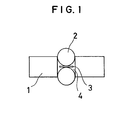
- Fig. 1 is a schematic side view illutrating a electrode for an impulse destructive test in the present invention.
- the present invention relates to a method for improving the impulse breakdown strength of an electrically insulating material comprising an ethylene copolymer which is prepared by subjecting, to a high-pressure radical polymerization, ethylene or a mixture of ethylene and another monomer in the presence of at least one monomer selected from the group group consisting of one- to three-ring aromatic compounds (except styrene and substituted styrene having a single ring) each having a carbon-carbon double bond in the molecule at a polymerization pressure of 500 to 4,000 kg/cm 2 and at a polymerization temperature of 50 to 400°C, wherein the ethylene copolymer contains 0.005 to 1 mol% of the unit derived from the aromatic compound as a component of the polymer.
- aromatic hydrocarbon compounds having one ethylenic carbon-carbon double bond in one molecule can be preferably used, but in particular, aromatic hydrocarbon compounds are more preferable.
- aromatic hydrocarbon compounds each having one carbon-carbon double bond in one molecule and one benzene ring include compounds represented by the following general formulae (I) and (II):
- Concrete compounds which can be represented by the above-mentioned formula (I) include allylbenzene, 4rphenyl-1-butene, allyltoluene, 4-tolylbutene-1, allyl-sec- butylbenzene, chloroallylbenzene and the like.
- R 1 is a hydrogen atom or a methyl group
- R 2 is a hydrogen atom, a chlorine atom or a straight-chain or a branched alkyl group having 1 to 4 carbon atoms.
- typical compounds include indenes such as indene and its derivatives, a,s-substitued styrene such as ⁇ -methylstyrene, alkenylbenzene and its derivatives, arylcycloalkene such as phenylcyclohexene and its derivatives, and the like.
- Derivatives of the compounds represented by the above-mentioned formulae (I) and (II) as well as ⁇ -substituted compounds of the excluded styrenes include compounds substituted by a halogen such as chlorine, and oxygen- containing derivatives having a methoxy group, a carboxyl group, a carbonyl group, an ether bond, an ester bond, a phenolic hydroxyl group and an alcoholic hydroxyl group, and derivatives having a sulfur atom and/or a nitrogen atom.
- a halogen such as chlorine
- oxygen-containing derivatives having a methoxy group a carboxyl group, a carbonyl group, an ether bond, an ester bond, a phenolic hydroxyl group and an alcoholic hydroxyl group
- Their concrete examples include methoxy-B-methylstyrene, chlorophenylcyclohexene, phenyl vinyl ether and the like.
- the two-ring aromatic compounds having one carbon-carbon double bond in one molecule include condensed or non-condensed olefins each having two aromatic rings.
- olefins include cyclic olefin derivatives such as cyclopentene and cyclohexene and straight chain olefin derivatives, and they can be represented by the following general formulae (III) to (VI):
- the alkenylene group or the cycloalkenylene group represented by R 1 in the general formula (III) is a divalent substituent group obtained by removing two hydrogen atoms from ethylene, propylene, butene, isobutene, pentene, methylpentene, hexene, cyclopentene, cyclohexene or an alkylcyclohexene.
- the alkyl groups R 2 and R 3 are methyl, ethyl, propyl, isopropyl, n-butyl, isobutyl, sec-butyl, tert-butyl and amyl groups.
- Concrete compounds represented-by the general formula (III) include 1,1-diphenylethylene, 1,1-ditolylethylene, 1,1-dicumylethylene, 1,1-di(butylphenyl)ethylene, 1,1-di(chlorophenyl)ethylene, I-phenyl-l-tolylethylene, 1,1-ditolylethylene, 1-phenyl-1-xylylethylene, 1-tolyl-1-xylylethylene, stilbene, 4-methylstilbene, 1,2-diphenylpropene, 1,3-diphenylpropene, 1,4-diphenylbutene-1, 1,4-diphenylbutene-2, 1.,1-diphenylpropene-l, 2,3-diphenylpropene, 1,2-diphenylbutene-2, 1,3-diphenylbutene-1, 2,4-diphenyl-4-methylpentene-1., 2,4-diphenylbutene-1, 2,4-diphenylpen
- They can be prepared by a dimerization or a co- dimerization in the presence of an acid catalyst of a styrene such as styrene, a-methylstyrene or vinyltoluene.
- a styrene such as styrene, a-methylstyrene or vinyltoluene.
- Stilbene and 1,2-diphenylpropene may be prepared by reacting benzaldehyde with benzylmagnesium bromide and then carrying out dehydration. Further, 1,1-diphenylethylene may be obtained by reacting diphenyl ketone with a Grignard reagent such as methylmagnesium iodide, followed by dehydration.
- a Grignard reagent such as methylmagnesium iodide
- R 4 in the compounds represented by the general formula (IV) is an alkenyl group or a cycloalkenyl group such as vinyl propenyl, isopropenyl, allyl, butenyl, cyclopentenyl or cyclohexenyl
- R 5 therein is a divalent substituent group obtained by removing two hydrogen atoms from a saturated alicyclic hydrocarbon such as a chain saturated aliphatic hydrocarbon, cyclopentane, cyclohexane or cycloheptane.
- R 2 and R 3 therein which are alkyl groups are identical with R 2 and R 3 in the general formual (III).
- Examples of the compounds represented by the general formual (IV) include 1-phenyl-1-styxylethane, 1-tolyl-l-styrylethane, I-phenyl-l-styrylpropane, 1-xylyl-1- styrylethane, 1-sec-butylphenyl-1-styrylethane, 1-chloropheynl-l-styrylethane, 1-phenyl-1-(4-vinylphenyl)ethane, 1-(4-methylphenyl-l-(4-vinylphenyl)ethane, I-phenyl-l-(4-isopropenylphenyl)ethane, phenyl-(4-vinylphenyl)methane and phenyl-(cyclohexenylphenyl)methane.
- phenyl-(vinylpheny)ethane may be prepared by reacting diphenylethane with acetyl chloride in the presence of a Friedel-Crafts catalyst to form phenyl-(acetylphenyl)ethane, reducing the latter with sodium boron hydride or the like, and dehydrating it.
- Phenyl-(isopropenylphenyl)ethane can be prepared by reacting phenyl-(formylphenyl)ethane with a Grignard reagent such as methylmagnesium iodide, and carrying out dehydration.
- R 4 which is the alkenyl group or the cycloalkenyl group in the general formula (V) is identical with R 4 in the formula (IV), and R 2 and R 3 which are the alkyl groups also are the same as R 2 and R 3 in the formula (IV).
- Examples of the compounds represented by the general formula (V) include allylbiphenyl, vinylbiphenyl, 2-isopropenylbiphenyl, 4-isopropenylbiphenyl, 2-isopropenyl-4'-isopropylbiphenyl., cyclohexenylbiphenyl and cyclopentenylbiphenyl.
- isopropenylbiphenyl can be prepared by dehydrogenating isopropylbiphenyl.
- R 4 which is the alkenyl group or the cycloalkenyl group in the general formula (VI) also is identical with R 4 in the formula (IV), and R 2 and R 3 which are the alkyl groups also are the same as R 2 and R 3 in the formula (IV).
- the compounds represented by the formula (VI) include a-vinylnaphthalene, isopropenylnaphthalene, allylnaphthalene and l-cyclopent-2-enylnaphthalene.
- vinylnaphthalene can be prepared by reacting formylnaphthalene with a Grignard reagent such as methylmagnesium iodide and then dehydrating the resultant product.
- Examples of further two-ring aromatic olefins include phenylbenzyl methacrylate, phenylbenzyl acrylate, arylindenes, aralkylindenes and acenaphthylenes.
- Examples of the three-ring aromatic olefins include compounds represented by the following general formulae (VII) to (XI):
- Examples of the compounds represented by the general formula (VII) include I-vinylanthracene, 2-vinylanthracene, 9-vinylanthracene, 2-isopropenylanthracene and 9-propenyl-10-propylanthracene.
- Concrete examples represented by the general formula (VIII) include 2-vinylphenanthrene, 3-isopropenyl- phenanthrene, 3-vinylphenanthrene and 9-vinylphenanthrene.
- R 1 is an aliphatic hydrocarbon residue which has 1 to 4 carbon atoms and which may have an ethylenic double bond
- R 2 to R 4 each are a hydrogen atom or an aliphatic hydrocarbon residue which has 1 to 4 carbon atoms and which may have an ethylenic double bond
- k is 0 or 1
- l m and n each are an integer of 0 to 3, but the total number of the ethylenic double bond which R 2 , R 3 and R 4 have is 1.
- Examples of the compounds represented by the general formula (IX) include 1-phenyl-2-(1-naphthyl)ethylene, l-phenyl-2-(2-naphthyl)ethylene, 1-phenyl-1-(1-naphthyl)ethylene, 1-phenyl-1-(2-naphthyl)ethylene, 1-phenyl-1-(1-naphthyl)propene, 1-phenyl-1-(2-naphthyl)propene, 1-phenyl-2-(2-naphthyl)propene and l-(l-naphthyl)-2-o-tolylethylene.
- R 1 and R 2 each are an aliphatic hydrocarbon residue which has 1 to 4 carbon atoms and which may have an ethylenic double bond
- R 3 to R 5 each are a hydrogen atom or an aliphatic hydrocarbon residue which has 1 to 4 carbon atoms and which may have an ethylenic double bond
- j and k each are 0 or 1
- l, m and n each are an integer of 0 to 3, but the total number of the ethylenic double bond which R 1 , R 2 , R 3 , R 4 and R 5 have is 1.
- Examples of the compounds represented by the general formula (X) include 2-phenylstilbene, 4-phenylstilbene, 1-phenyl-1-biphenylethylene, 4-benzylstilbene, 1-biphenyl-4-yl-1-p-tolylethylene, 1-biphenyl-4-yl-2-phenylpropene, 1-phenyl-2-(4-benzylphenyl)propene, I-phenyl-l-(benzylphenyl)ethylene, 1-tolyl-1-(benzylphenyl)ethylene and 1-phenyl-1-(phenylethylphenyl)ethylene.
- R 1 is an aliphatic hydrocarbon residue which has 1 to 4 carbon atoms and which may have an ethylenic double bond
- R 2 to R 4 each are a hydrogen atom or an aliphatic hydrocarbon residue which has 1 to 4 carbon atoms and which may have an ethylenic double bond
- l, m and n each are an integer of 0 to 3, but the total number of the ethylenic double bond which R 1 , R 2 , R 3 and R 4 have is 1.
- Examples of the compounds represented by the general formula (XI) include 1,1,2-triphenylethylene, 1,1,2-triphenylpropene, 1,1,3-triphenylbutene, 1,1-diphenyl-2-o-tolylethylene, l,l-diphenyl-2-p-tolylethylene and 3,3,3-triphenylpropene-1.
- aromatic olefins can be prepared by various chemical synthetic methods, for example, by utilizing a Grignard reaction to form an alcohol and then dehydrating it.
- 1-phenyl-l-naphthylethylene may be prepared by reacting acetophenone with a Grignard reagent derived from bromonaphthalene to form I-phenyl-l-naphthylethanol and then dehydrating the latter.
- vinylanthracene may be obtained by reacting acetaldehyde with a Grignard reagent derived from bromoanthracene to form hydroxyethylanthracene and then dehydrating the latter.
- the above-mentioned aromatic olefin may be manufactured by dehydrogenating a saturated aromatic hydrocarbon, i.e., an aromatic hydrocarbon having no ethylenic double bond.
- a method in which the dehydrogenation is employed comprises dehydrogenating a saturated aromatic hydrocarbon having 3 or more condensed or non-condensed aromatic rings in the presence of a suitable catalyst for the dehydrogenation.
- a diolefin may be manufactured from a monoolefin.
- the catalysts for the dehydrogenation are not limited particularly, and optional catalysts can be employed.
- the usable catalysts include metallic oxides of Cr, Fe, Cu, K, Mg, Ca and the'.like; mixtures of two or more of these oxides; noble metals such as Pt and Pd; and catalysts in which these metallic oxides and noble metals are supported on carriers comprising alumina and the like.
- Temperatures for the dehydrogenation reaction are within the range of 350 to 650°C, preferably 400 to 600°C.
- LHSV is within the range of 0.2 to 10, preferably 0.5 to 3.0.
- water vapor and gases of nitrogen and hydrogen can be allowed to be present in its system for the purposes of lowering a partial pressure and preventing carbon from depositing.
- a suitable diluent may be used.
- raw materials themselves can usually behave as diluents conveniently, if a rate of the dehydrogenation to be achieved is not so high.
- vinylanthracene, phenylnaphthylethylene and phenylstibene can be prepared from ethylanthracene, phenylnaphthylethane and phenylbiphenylethane, respectively.
- the three-ring aromatic olefins include diarylindenes, diaralkyl indenes and terphenyls.
- Examples of the derivatives of the above-mentioned two- to three-ring aromatic olefins include derivatives' substituted by halogens such as chlorine and bromine; oxygen- containing derivatives having methoxy, carboxyl, carbonyl, phenolic hydroxyl, alcoholic hydroxyl groups as well as ether and ester bonds; and derivatives having sulfur and nitrogen atoms.
- aromatic olefins represented by the general formulae (IV) to (XI) and their derivatives there can also be used aromatic compounds in which two- and three-ring aromatic units such as biphenyl, naphthalene, diarylalkanes, triarylalkanes, triaryldialkanes, anthracene, phenanthrene, arylnaphthalenes, alalkylnaphthalenes and terphenyl, and their derivatives are combined with groups each having one double bond such as unsaturated carboxylic acids, for example, acrylic acid, methacrylic acid, maleic acid and fumaric acid as well as vinylesters.
- unsaturated carboxylic acids for example, acrylic acid, methacrylic acid, maleic acid and fumaric acid as well as vinylesters.
- each of the above-mentioned various aromatic compounds is mixed with ethylene or another monomer containing ethylene as a main component and when the resultant mixture is subjected to a high-pressure radical polymerization to form a polymer, units of the aromatic compound will be contained, as a component, in the chain of the formed polymer.
- each aforesaid aromatic compound has such a structural feature.
- a polyethylene which has heretofore been used widely as an insulating material for power cables and the like will become poor in destructive strength to impulse voltage (impulse breakdown strength), when its crystallinity is lowered, and it will also become bad in workability, when its crystallinity is contrary increased.
- the ethylene polymer of the present invention preferably has a crystallinity of 30% or more in accordance with X-ray diffraction, and the decrease of the crystallinity compared with that of an ethylene homopolymer having no aromatic ring prepared under substantially the same conditions as above is restricted to at most 25 %.
- An upper limit of the crystallinity is naturally fixed at a level of the crystallinity or less of the ethylene homopolymer obtained under substantially the same conditions as in the ethylene polymer.
- the crystallinity of the ethylene polymer is less than 30%, its impulse destructive strength will be rather lower and its volume resistivity will also be lower, as compared with the ethylene homopolymer.
- the unit derived from the above-mentioned aromatic compound which is to be contained in the ethylene polymer of the present invention as the polymeric component its content is within the range of 0.005 to 1.0 mol%, preferably 0.01 to 0.7 mol%. When the content of the unit is less than 0.005 mol%, the improvement effect will scarcely be perceived.
- the density of the ethyl-ene polymer of the present invention preferably is within the range of 0.890 to 0.950 g/cm 3 . Further, its melt index (hereinafter referred to as MI) preferably is within the range of 0.05 to 50 g/10 minutes, more preferably 0.1 to 20 g/10 minutes.
- the ethylene polymer of the present invention can contain an unsaturated monomer other than ethylene, and examples of such monomers include propylene, butene-1, pentene-1, hexene-1, 4-methylpentene-l, octene-1, decene-1, vinyl acetate, ethyl acrylate, methacrylic acid and its esters as well as their mixtures.
- the content of the above-mentioned unsaturated monomer in the ethylene polymer preferably is within the ragne of 0 to 3 mol%, more preferably 1 mol% or less.
- the ethylene polymer of the present invention may be mixed with an ethylene polymer not containing another aromatic unit.
- the composition with which another ethylene polymer is blended also is one of the preferable embodiments of the present invention, and so long as the content of the aromatic unit in the composition is in the range indicated above, the impulse destructive strength of the composition can be improved.
- Examples of the other ethylene polymers which can be mixed with the ethylene polymer of the present invention include ethylene homopolymers; copolymers of ethylene and a-olefins each having 3 to 12 carbon atoms such as propylene, butene-1, pentene-1, hexene-1, 4-methylpentene-1, octene-1 and decene-1; copolymers of ethylene and polar group- containing monomers such as vinyl acetate, acrylic acid, ethyl acrylate, methacrylic acid, ethyl methacrylate, maleic acid and maleic anhydride; polymers prepared by modifying the ethylene homopolymers or copolymers of ethylene and a-olefins with unsaturated carboxylic acids such as acrylic acid, maleic acid and their derivatives; and their mixtures.
- ethylene homopolymers copolymers of ethylene and a-olefins each having 3 to 12 carbon atoms such as propylene,
- the ethylene polymer of the present invention may be manufactured by a radical polymerization under a high pressure.
- the radical polymerization under a high pressure just referred to means a method which comprises contacting and polymerizing ethylene, an aromatic compound, and if desired, another monomer simultaneously or stepwise at a polymerization pressure of 500 to 4,000 kg/cm 2 , preferably 1,000 to 3,500 kg/cm 2 at a reaction temperature of 50 to 400°C, preferably 100 to 350°C in the presence of a free radical catalyst, a chain transfer agent, and if desired, assistants in an autoclave type or a tube type reactor.
- the aromatic compound When the aromatic compound is solid, it may be dissolved in a suitable solvent and then fed to the reactor.
- Examples of the above-mentioned free radical catalysts include usual initiators such as peroxides, hydroperoxides, azo-compounds, amine oxide compounds and oxygen.
- examples of the chain transfer agents include hydrogen; propylene; butene-1; saturated aliphatic hydrocarbons having 1 to 20 or more carbon atoms and hydrocarbons substituted by a halogen, for example, methane, ethane, propane, butane, isobutane, n-hexane, n-heptane, cycloparaffins, chloroform and carbon tetrachloride; saturated aliphatic alcohols having 1 to 20 or more carbon atoms, for example, methanol, ethanol, propanol and isopropanol; saturated aliphatic carbonyl compounds having 1 to 20 or more carbon atoms, for example, acetone and methyl ethyl ketone; and aromatic compounds other than mentioned above, for example, toluene, diethylbenzene and xylene.
- a halogen for example, methane, ethane, propane, butane, isobutane, n-hexan
- the ethylene polymer or the ethylene polymer composition containing another ethylene polymer, which can be manufactured as just described, can exhibit excellent insulating properties, when used as an electrical insulating material, and in particular, it has a good destructive strength to impulse voltage in a high-temperature zone.
- the polymer of the present invention is very useful as insulating materials for extra-high voltage power cables.
- the polymer of the present invention can be prepared in accordance with a relatively simple process which is a high-pressure radical polymerization, and this process does not require intricate graft and blending steps, which fact also is very convenient.
- addable compounds include olefin polymers (inclusive of copolymers) except for the above-mentioned other ethylene polymers; thermoplastic resins such as polyacrylonitriles, polyamides, polycarbonates, ABS resins, polystyrenes, polyphenylene oxides, polyvinyl alcohol resins, vinyl chloride resins, vinylidene chloride resins and polyester resins; petroleum resins; cumarone-indene resins; synthetic rubbers such as ethylene-propylene copolymer rubbers (EPR, EPDM and the like), SBR, NBR, butadiene rubber, IIR, chloroprene rubber, isoprene rubber, styrene-butadienestyrene block copolymers; and natural rubbers. These compunds may be used alone or in a combination thereof.
- thermoplastic resins such as polyacrylonitriles, polyamides, polycarbonates, ABS resins, polystyrenes, polyphenylene oxides, poly
- additives may be added thereto so long as the effects of the present case are not damaged remarkably
- ruch additives include organic and inorganic fillers, antioxidants, lubricants, various organic and inorganic pigments, an ultraviolet stabilizer, a dispersant, a copper deactivator, a neutralization agent, a blowing agent, a plasticizer, a foam inhibitor, a flame retarder, a crosslinking agent, a flow improving agent, an improver for weld strength and a nucleating agent.
- the ethylene polymer or the composition containing it, which is concerned with.the present invention may be used in an uncrosslinking state, or if desired, it may be employed after crosslinked. Such a crosslinking treatment may be carried out in a usual crosslinking manner.
- Polymerization was afterward carried out at a polymerization temperature of 170°C at a polymerization pressure of 1,600 kg/cm 2 for 60 minutes in order to prepare each ethylene polymer containing a unit derived from an aromatic compound set forth in Table 1.
- the refined and dried polymer was molded into a sheet having a thickness of 500 pm by means of hot pressing, and the unit derived from the aromatic compound in each polymer thus produced was determined quantitatively by an infrared spectrophotometry on the basis of a compensation method of using a control sheet which was composed of an ethylene polymer not containing any aromatic compound and which had the same thickness.
- Example 1 The procedure of Example 1 was repeated to produce an ethylene homopolymer, and for the latter, impulse breakdown strength was measured in the same manner as in Example 1. The results are set forth in Table 1.
- Example 1 The procedure of Example 1 was repeated to prepare ethylene copolymers shown in Table 1, and impulse breakdown strength was measured. The results are set forth in Table 1.
- Example 1 The procedure of Example 1 was repeated to prepare ethylene-allylbenzene copolymer and ethylene-benzyl methacrylate copolymer in which each content of allylbenzene and benzyl methacrylate was 4 moll. With 5.5 parts by weight of the ethylene copolymer were mixed 94.5 parts by weight of the low-density polyethylene used in Comparative Example 1 with the aid of a plastograph in order to prepare an ethylene copolymer composition containing 0.2 mol% of allylbenzene and benzyl methacrylate. Table 1 sets forth the results of measured impulse breakdown strength of the thus prepared ethylene copolymer composition.
- the ethylene copolymer composition was provided with the improvement effect, when the contents of allylbenzene and benzyl methacrylate were within the certain range of the present invention.
- the impulse destructive strength test was carried out in the following manner: As an electrode system, there was used a so-called Mckeown electrode (Fig. 1) which was a kind of stationary electrode.
- a base plate 1 of the electrode system was made of polymethyl methacrylate and was provided at its central portion with a hole having a diameter of 1/2 inch.
- Used electrodes 2, 2 were stainless steel balls each having a diameter of 1/2 inch.
- An about 8 mm x 10 mm sample 3 was interposed between the electrodes 2, 2. Spaces between the sample 3 and the electrodes 2, 2 were packed with a deaerated epoxy resin 4, and the latter was then cured.
- the thus constructed Mckeown electrode was dipped in a vessel filled with silicone oil and was then placed in a thermostat, and measurement was carried out.
- a waveform used for the destruction was 1 x 40 ⁇ S negative impulse waveform. The waveform was observed by means of an oscilloscope, and data were collected on the basis of the destruction at its wave front and average values of 20 points or more were taken.
- the refined and dried polymer was molded into a sheet having a thickness of 500 ⁇ m by virtue of a heating compression operation, and the unit derived from the aromatic compound in each polymer thus produced was determined quantitatively by an infrared spectrophotometry on the basis of a compensation method of using a control sheet which was composed of an ethylene polymer not containing any aromatic compound and which has the same thickness.
- Example 17 The procedure of Example 17 was repeated to produce ethylene polymers shown in Table 2, and for the latter, impulse destructive strength was measured. The results are set forth in Table 2.
- Example 1 The procedure of Example 1 was repeated with the exception that the polymerization temperature of 170°C was replaced with 230°C, the polymerization pressure of 1,600 kg/cm 2 with 1,000 kg/cm 2 , and the modifier of n-hexane with propylene, in order to prepare an ethylene copolymer having a low crystallinity. Afterward, an impulse destructive test was carried out in the same manner as in Example 1, and the results of the test are set forth in Table 3.
Landscapes
- Chemical & Material Sciences (AREA)
- Health & Medical Sciences (AREA)
- Chemical Kinetics & Catalysis (AREA)
- Medicinal Chemistry (AREA)
- Polymers & Plastics (AREA)
- Organic Chemistry (AREA)
- Physics & Mathematics (AREA)
- Spectroscopy & Molecular Physics (AREA)
- Addition Polymer Or Copolymer, Post-Treatments, Or Chemical Modifications (AREA)
Applications Claiming Priority (6)
| Application Number | Priority Date | Filing Date | Title |
|---|---|---|---|
| JP207595/84 | 1984-10-03 | ||
| JP59207595A JPS6185416A (ja) | 1984-10-03 | 1984-10-03 | 新規エチレン共重合体及びその製造方法 |
| JP21792484A JPS6196604A (ja) | 1984-10-17 | 1984-10-17 | 電気絶縁材 |
| JP217924/84 | 1984-10-17 | ||
| JP23395084A JPS61110907A (ja) | 1984-11-06 | 1984-11-06 | 電気材料 |
| JP233950/84 | 1984-11-06 |
Publications (2)
| Publication Number | Publication Date |
|---|---|
| EP0180771A1 true EP0180771A1 (fr) | 1986-05-14 |
| EP0180771B1 EP0180771B1 (fr) | 1989-08-02 |
Family
ID=27328777
Family Applications (1)
| Application Number | Title | Priority Date | Filing Date |
|---|---|---|---|
| EP85112532A Expired EP0180771B1 (fr) | 1984-10-03 | 1985-10-03 | Méthode pour l'amélioration de la rigidité diélectrique de matériaux isolants |
Country Status (3)
| Country | Link |
|---|---|
| US (2) | US4994539A (fr) |
| EP (1) | EP0180771B1 (fr) |
| DE (1) | DE3571993D1 (fr) |
Cited By (2)
| Publication number | Priority date | Publication date | Assignee | Title |
|---|---|---|---|---|
| WO1993020117A1 (fr) * | 1992-04-07 | 1993-10-14 | Exxon Chemical Patents Inc. | Copolymeres d'olefines et d'olefines aromatiques et d'olefines et de composes aromatiques polymeres |
| EP0952181A1 (fr) * | 1998-04-21 | 1999-10-27 | Elf Atochem Italia S.r.l. | Compositions péroxidiques |
Families Citing this family (14)
| Publication number | Priority date | Publication date | Assignee | Title |
|---|---|---|---|---|
| US4994539A (en) * | 1984-10-03 | 1991-02-19 | Nippon Petrochemicals Co., Ltd. | Method for improving impulse destructive stength of electrical insulating materials |
| US4833224A (en) * | 1985-10-11 | 1989-05-23 | Idemitsu Kosan Company Limited | Ethylene copolymers and process for production |
| JP3175297B2 (ja) * | 1991-06-24 | 2001-06-11 | 日本油脂株式会社 | エチレン系ポリマーの架橋用組成物、架橋方法及び電力ケーブル |
| US6906146B2 (en) * | 1993-07-13 | 2005-06-14 | Phillips Petroleum Company | Compositions having ethylenic backbone and benzylic, allylic, or ether-containing side-chains, oxygen scavenging compositions containing same, and process for making these compositions by esterification or transesterification of a polymer melt |
| EP1923200A1 (fr) * | 2006-11-20 | 2008-05-21 | Borealis Technology Oy | article |
| EP1941998B2 (fr) * | 2006-12-21 | 2016-03-16 | Borealis Technology Oy | Film |
| DE602006013673D1 (en) * | 2006-12-21 | 2010-05-27 | Borealis Tech Oy | Film |
| DE602007011259D1 (de) * | 2007-08-10 | 2011-01-27 | Borealis Tech Oy | Artikel der eine Polypropylenzusammensetzung beinhaltet |
| EP2067799A1 (fr) * | 2007-12-05 | 2009-06-10 | Borealis Technology OY | Polymère |
| ES2527655T5 (es) * | 2008-07-10 | 2022-10-13 | Borealis Ag | Proceso para producir un polímero y un polímero para aplicaciones de cables e hilos |
| BRPI0915738B1 (pt) | 2008-07-10 | 2019-09-24 | Borealis Ag | Composição de polímero reticulável, artigo compreendendo uma composição de polímero, processo para produzir um cabo e cabo reticulável |
| WO2010003649A1 (fr) * | 2008-07-10 | 2010-01-14 | Borealis Ag | Procédé de préparation d'un câble |
| PL2354184T3 (pl) | 2010-01-29 | 2013-01-31 | Borealis Ag | Tłoczywo polietylenowe o ulepszonym stosunku odporność na pękanie /sztywność i ulepszone udarności |
| EP2354183B1 (fr) | 2010-01-29 | 2012-08-22 | Borealis AG | Composition de moulage |
Citations (2)
| Publication number | Priority date | Publication date | Assignee | Title |
|---|---|---|---|---|
| GB1077349A (en) * | 1965-05-01 | 1967-07-26 | Polymer Corp | Copolymerization of alpha olefins |
| US3954907A (en) * | 1974-11-27 | 1976-05-04 | Union Carbide Corporation | Composition with selected vinyl compounds and process for avoiding scorching of ethylene polymer composition |
Family Cites Families (15)
| Publication number | Priority date | Publication date | Assignee | Title |
|---|---|---|---|---|
| DE1073204B (de) * | 1958-01-16 | 1960-01-14 | Farbwerke Hoechst Aktiengesellschaft vormals Meister Lucius &. Brunmg Frankfurt/M | Verfahren von zur Herstellung von Formkorpern wie Fasern und Folien, geeigneten makromolekularen Stoffen aus Olefinen mit Hilfe von sogenannten Ziegler-Katalysatoren |
| BE600675A (fr) * | 1960-02-29 | |||
| NL130335C (fr) * | 1960-08-22 | |||
| NL285020A (fr) * | 1961-11-02 | |||
| US3647771A (en) * | 1964-01-30 | 1972-03-07 | Sumitomo Chemical Co | Alternating copolymers of alpha-olefins and vinyl compounds and a process for manufacturing the same |
| GB1123722A (en) * | 1965-03-31 | 1968-08-14 | Sumitomo Chemical Co | Method for producing copolymers of vinyl and olefinic compounds and compolymers thereby produced |
| US4121032A (en) * | 1965-06-30 | 1978-10-17 | Sumitomo Chemical Company, Limited | Process for preparing alternating copolymer of conjugated vinyl compound and olefinic unsaturated compound with oxygen and boron compound |
| GB1123723A (en) * | 1965-06-30 | 1968-08-14 | Sumitomo Chemical Co | Process for preparing a copolymer of a conjugated vinyl compound and an olefinic unsaturated compound |
| GB1265173A (fr) * | 1967-12-21 | 1972-03-01 | ||
| US3887610A (en) * | 1971-12-09 | 1975-06-03 | Exxon Research Engineering Co | Emulsion polymerization of ethylene with chain transfer agents to form copolymers |
| US3919182A (en) * | 1972-11-01 | 1975-11-11 | Gaylord Research Inst Inc | Method for preparing alternating copolymers using a Friedel-Crafts catalyst and a free radical initiator in an aqueous medium |
| NL7305415A (fr) * | 1973-04-18 | 1974-10-22 | ||
| US4211730A (en) * | 1975-06-21 | 1980-07-08 | Dynamit Nobel Aktiengesellschaft | Acrylate-based polymers and copolymers and their use as flameproofing agents |
| US4349651A (en) * | 1980-08-01 | 1982-09-14 | Westinghouse Electric Corp. | Resinous copolymer insulating compositions |
| US4994539A (en) * | 1984-10-03 | 1991-02-19 | Nippon Petrochemicals Co., Ltd. | Method for improving impulse destructive stength of electrical insulating materials |
-
1985
- 1985-10-01 US US06/782,402 patent/US4994539A/en not_active Expired - Lifetime
- 1985-10-03 EP EP85112532A patent/EP0180771B1/fr not_active Expired
- 1985-10-03 DE DE8585112532T patent/DE3571993D1/de not_active Expired
- 1985-11-04 US US06/794,622 patent/US4717759A/en not_active Expired - Lifetime
Patent Citations (2)
| Publication number | Priority date | Publication date | Assignee | Title |
|---|---|---|---|---|
| GB1077349A (en) * | 1965-05-01 | 1967-07-26 | Polymer Corp | Copolymerization of alpha olefins |
| US3954907A (en) * | 1974-11-27 | 1976-05-04 | Union Carbide Corporation | Composition with selected vinyl compounds and process for avoiding scorching of ethylene polymer composition |
Non-Patent Citations (1)
| Title |
|---|
| CHEMICAL ABSTRACTS, vol. 68, 1968, page 4891, abstract no. 50321e, Columbus, Ohio, US; & JP-B-42 014 449 (J. FURAKAWA et al.) 14.08.1967 * |
Cited By (3)
| Publication number | Priority date | Publication date | Assignee | Title |
|---|---|---|---|---|
| WO1993020117A1 (fr) * | 1992-04-07 | 1993-10-14 | Exxon Chemical Patents Inc. | Copolymeres d'olefines et d'olefines aromatiques et d'olefines et de composes aromatiques polymeres |
| EP0952181A1 (fr) * | 1998-04-21 | 1999-10-27 | Elf Atochem Italia S.r.l. | Compositions péroxidiques |
| US6207776B1 (en) | 1998-04-21 | 2001-03-27 | Elf Atochem Italia S.R.L. | Peroxidic compositions |
Also Published As
| Publication number | Publication date |
|---|---|
| EP0180771B1 (fr) | 1989-08-02 |
| DE3571993D1 (en) | 1989-09-07 |
| US4994539A (en) | 1991-02-19 |
| US4717759A (en) | 1988-01-05 |
Similar Documents
| Publication | Publication Date | Title |
|---|---|---|
| US4994539A (en) | Method for improving impulse destructive stength of electrical insulating materials | |
| CA1194285A (fr) | Huile dielectrique, et appareils qui la renferment | |
| JP3685996B2 (ja) | 電気絶縁用樹脂材料、電気絶縁材およびこれを用いた電線・ケーブル | |
| GB810023A (en) | Method of polymerization of olefins and the linear high molecular weight polymers produced thereby | |
| US5304619A (en) | Ethylene polymers or copolymers having improved insulating properties, compositions, and power cables made therefrom | |
| CN113563528A (zh) | 一种芳香烯烃接枝改性聚丙烯作为绝缘材料的应用和绝缘材料 | |
| JPWO2000015713A1 (ja) | 電気絶縁用樹脂材料、電気絶縁材およびこれを用いた電線・ケーブル | |
| US4871819A (en) | Ethylene copolymer and process for the production thereof | |
| EP0197303B1 (fr) | Matériaux électriquement isolants | |
| EP0180797B1 (fr) | Procédé pour la rigidité diélectrique de matériaux isolants | |
| US4736007A (en) | Novel ethylene copolymers | |
| JPH0552606B2 (fr) | ||
| EP0180982B1 (fr) | Copolymères d'éthylène | |
| JPS61206108A (ja) | 電気絶縁材料 | |
| JPH0552608B2 (fr) | ||
| JPS61110907A (ja) | 電気材料 | |
| JPS6345705A (ja) | 電気絶縁材料 | |
| EP0150908B1 (fr) | Utilisation des Compositions réticulables d'imprégnation pour l'imprégnation des dispositifs electriques | |
| JPH0552607B2 (fr) | ||
| JPS61206112A (ja) | 電気絶縁材料 | |
| JPH0552605B2 (fr) | ||
| WO2024110328A1 (fr) | Isolation de câble d'alimentation en courant continu | |
| JPS5989345A (ja) | 電気絶縁組成物 | |
| JPH0641492B2 (ja) | 新規なエチレン共重合体 | |
| JPS6196604A (ja) | 電気絶縁材 |
Legal Events
| Date | Code | Title | Description |
|---|---|---|---|
| PUAI | Public reference made under article 153(3) epc to a published international application that has entered the european phase |
Free format text: ORIGINAL CODE: 0009012 |
|
| AK | Designated contracting states |
Kind code of ref document: A1 Designated state(s): DE FR GB |
|
| 17P | Request for examination filed |
Effective date: 19860930 |
|
| 17Q | First examination report despatched |
Effective date: 19880126 |
|
| GRAA | (expected) grant |
Free format text: ORIGINAL CODE: 0009210 |
|
| AK | Designated contracting states |
Kind code of ref document: B1 Designated state(s): DE FR GB |
|
| REF | Corresponds to: |
Ref document number: 3571993 Country of ref document: DE Date of ref document: 19890907 |
|
| ET | Fr: translation filed | ||
| PLBE | No opposition filed within time limit |
Free format text: ORIGINAL CODE: 0009261 |
|
| STAA | Information on the status of an ep patent application or granted ep patent |
Free format text: STATUS: NO OPPOSITION FILED WITHIN TIME LIMIT |
|
| 26N | No opposition filed | ||
| PGFP | Annual fee paid to national office [announced via postgrant information from national office to epo] |
Ref country code: FR Payment date: 19990927 Year of fee payment: 15 |
|
| PGFP | Annual fee paid to national office [announced via postgrant information from national office to epo] |
Ref country code: GB Payment date: 19990929 Year of fee payment: 15 |
|
| PGFP | Annual fee paid to national office [announced via postgrant information from national office to epo] |
Ref country code: DE Payment date: 19991214 Year of fee payment: 15 |
|
| PG25 | Lapsed in a contracting state [announced via postgrant information from national office to epo] |
Ref country code: GB Free format text: LAPSE BECAUSE OF NON-PAYMENT OF DUE FEES Effective date: 20001003 |
|
| GBPC | Gb: european patent ceased through non-payment of renewal fee |
Effective date: 20001003 |
|
| PG25 | Lapsed in a contracting state [announced via postgrant information from national office to epo] |
Ref country code: FR Free format text: LAPSE BECAUSE OF NON-PAYMENT OF DUE FEES Effective date: 20010629 |
|
| PG25 | Lapsed in a contracting state [announced via postgrant information from national office to epo] |
Ref country code: DE Free format text: LAPSE BECAUSE OF NON-PAYMENT OF DUE FEES Effective date: 20010703 |
|
| REG | Reference to a national code |
Ref country code: FR Ref legal event code: ST |