EP0181192A1 - Verfahren zur Verminderung der Radioaktivität in einer Kernanlage - Google Patents
Verfahren zur Verminderung der Radioaktivität in einer Kernanlage Download PDFInfo
- Publication number
- EP0181192A1 EP0181192A1 EP85308019A EP85308019A EP0181192A1 EP 0181192 A1 EP0181192 A1 EP 0181192A1 EP 85308019 A EP85308019 A EP 85308019A EP 85308019 A EP85308019 A EP 85308019A EP 0181192 A1 EP0181192 A1 EP 0181192A1
- Authority
- EP
- European Patent Office
- Prior art keywords
- oxidation treatment
- step oxidation
- structural members
- pure water
- high temperature
- Prior art date
- Legal status (The legal status is an assumption and is not a legal conclusion. Google has not performed a legal analysis and makes no representation as to the accuracy of the status listed.)
- Granted
Links
Images

Classifications
-
- G—PHYSICS
- G21—NUCLEAR PHYSICS; NUCLEAR ENGINEERING
- G21C—NUCLEAR REACTORS
- G21C17/00—Monitoring; Testing ; Maintaining
- G21C17/02—Devices or arrangements for monitoring coolant or moderator
- G21C17/022—Devices or arrangements for monitoring coolant or moderator for monitoring liquid coolants or moderators
- G21C17/0225—Chemical surface treatment, e.g. corrosion
-
- C—CHEMISTRY; METALLURGY
- C23—COATING METALLIC MATERIAL; COATING MATERIAL WITH METALLIC MATERIAL; CHEMICAL SURFACE TREATMENT; DIFFUSION TREATMENT OF METALLIC MATERIAL; COATING BY VACUUM EVAPORATION, BY SPUTTERING, BY ION IMPLANTATION OR BY CHEMICAL VAPOUR DEPOSITION, IN GENERAL; INHIBITING CORROSION OF METALLIC MATERIAL OR INCRUSTATION IN GENERAL
- C23C—COATING METALLIC MATERIAL; COATING MATERIAL WITH METALLIC MATERIAL; SURFACE TREATMENT OF METALLIC MATERIAL BY DIFFUSION INTO THE SURFACE, BY CHEMICAL CONVERSION OR SUBSTITUTION; COATING BY VACUUM EVAPORATION, BY SPUTTERING, BY ION IMPLANTATION OR BY CHEMICAL VAPOUR DEPOSITION, IN GENERAL
- C23C8/00—Solid state diffusion of only non-metal elements into metallic material surfaces; Chemical surface treatment of metallic material by reaction of the surface with a reactive gas, leaving reaction products of surface material in the coating, e.g. conversion coatings, passivation of metals
- C23C8/06—Solid state diffusion of only non-metal elements into metallic material surfaces; Chemical surface treatment of metallic material by reaction of the surface with a reactive gas, leaving reaction products of surface material in the coating, e.g. conversion coatings, passivation of metals using gases
- C23C8/08—Solid state diffusion of only non-metal elements into metallic material surfaces; Chemical surface treatment of metallic material by reaction of the surface with a reactive gas, leaving reaction products of surface material in the coating, e.g. conversion coatings, passivation of metals using gases only one element being applied
- C23C8/10—Oxidising
- C23C8/16—Oxidising using oxygen-containing compounds, e.g. water, carbon dioxide
- C23C8/18—Oxidising of ferrous surfaces
-
- G—PHYSICS
- G21—NUCLEAR PHYSICS; NUCLEAR ENGINEERING
- G21F—PROTECTION AGAINST X-RADIATION, GAMMA RADIATION, CORPUSCULAR RADIATION OR PARTICLE BOMBARDMENT; TREATING RADIOACTIVELY CONTAMINATED MATERIAL; DECONTAMINATION ARRANGEMENTS THEREFOR
- G21F9/00—Treating radioactively contaminated material; Decontamination arrangements therefor
- G21F9/001—Decontamination of contaminated objects, apparatus, clothes, food; Preventing contamination thereof
- G21F9/002—Decontamination of the surface of objects with chemical or electrochemical processes
- G21F9/004—Decontamination of the surface of objects with chemical or electrochemical processes of metallic surfaces
-
- Y—GENERAL TAGGING OF NEW TECHNOLOGICAL DEVELOPMENTS; GENERAL TAGGING OF CROSS-SECTIONAL TECHNOLOGIES SPANNING OVER SEVERAL SECTIONS OF THE IPC; TECHNICAL SUBJECTS COVERED BY FORMER USPC CROSS-REFERENCE ART COLLECTIONS [XRACs] AND DIGESTS
- Y02—TECHNOLOGIES OR APPLICATIONS FOR MITIGATION OR ADAPTATION AGAINST CLIMATE CHANGE
- Y02E—REDUCTION OF GREENHOUSE GAS [GHG] EMISSIONS, RELATED TO ENERGY GENERATION, TRANSMISSION OR DISTRIBUTION
- Y02E30/00—Energy generation of nuclear origin
- Y02E30/30—Nuclear fission reactors
-
- Y—GENERAL TAGGING OF NEW TECHNOLOGICAL DEVELOPMENTS; GENERAL TAGGING OF CROSS-SECTIONAL TECHNOLOGIES SPANNING OVER SEVERAL SECTIONS OF THE IPC; TECHNICAL SUBJECTS COVERED BY FORMER USPC CROSS-REFERENCE ART COLLECTIONS [XRACs] AND DIGESTS
- Y10—TECHNICAL SUBJECTS COVERED BY FORMER USPC
- Y10S—TECHNICAL SUBJECTS COVERED BY FORMER USPC CROSS-REFERENCE ART COLLECTIONS [XRACs] AND DIGESTS
- Y10S376/00—Induced nuclear reactions: processes, systems, and elements
- Y10S376/90—Particular material or material shapes for fission reactors
Definitions
- the present invention relates to a novel method of reducing radioactivity, particularly to a method of suppressing adherence of radioactive substances to structural materials used in contact with a liquid containing the radioactive substances dissolved therein, for example, primary cooling water piping in a nuclear, power plant and a method of suppressing release of metallic ions or metallic oxides released from the structural materials and activated in a reactor core.
- Piping, pumps, valves etc. used in the primary cooling water system of nuclear power stations are made of stainless steel, Stellite which is a Co based alloy, etc. (hereinafter briefly referred to as “structural members”). These metals are subject to corrosion or damage in the course of long-term service.
- constituent metallic elements are dissolved in reactor cooling water (hereinafter briefly referred to as “cooling water”) to be entrained into the reactor.
- cooling water reactor cooling water
- the metallic elements are irradiated with neutrons.
- radioactive nuclides such as 60 Co, 58 Co, 51 Cr, and 54 Mn are formed.
- radioactive nuclides are dissolved into primary cooling water again to suspend in the form of ions or insoluble solid components (hereinafter referred to as "crud"). Part of them is removed in a demineralizer, etc. for purification of reactor water, but the rest adheres to the surfaces of structural members in the course of circulation through the primary cooling water system. Therefore, the dose rate on the surfaces of the structural members increases, thus presenting a problem of radiation exposure of workers during the course of maintenance and inspection.
- The.methods (1) and (2) encounter a difficulty in removing radioactive substances strongly adhering to the surfaces of the structural members, and are unable to decontaminate systematically over a wide area.
- the method (3) comprises dissolving an oxide film on the steel surface by a chemical reaction using a chemical such as an acid solution to remove radioactive substances present in the film. In this method, even if the dose rate is temporarily decreased, rapid recontamination occurs when the structural members are exposed to a liquid containing the radioactive substances dissolved therein at a high concentration again.
- a method of suppressing adherence of radioactive substances by preliminarily providing an oxide film on the surfaces of structural members is disclosed in, for example, Japanese Patent Laid-Open Nos. 121197/1980 and 37498/1984.
- the adherence behavior of the radioactive substances markedly varies depending on the properties of the oxide film preliminarily provided.
- the behavior of radioactive ions varies depending on the charged state of the oxide film.
- the rate of growth of oxide films newly formed on the surfaces of structural members after immersion in a liquid containing radioactive substances dissolved therein varies depending on the properties of the existent film. Thus a satisfactory film is not always formed.
- An object of the present invention is to provide a method of reducing radioactivity in a nuclear plant having a contact with pure, high-temperature and high-pressure water containing radioactive substances.
- a method of reducing radioactivity by preliminarily forming oxide films on the surfaces of metallic structural members to be in contact with high-temperature and high-pressure reactor water containing radioactive substances before the metallic structural members are exposed to said reactor water characterized in that, after a first-step oxidation treatment of heating said metallic structural members in a high-temperature environment, the metallic structural members thus treated are further subjected to a second-step oxidation treatment of heating them in an environment having a higher oxidizing capacity than that of the environment in said first-step oxidation treatment to form denser oxide films than those obtained in the first step oxidation treatment.
- the method of suppressing adherence of radioactive substances to structural members to be in contact with reactor cooling water containing radioactive substances according to the present invention comprises formation of oxide films having a relatively high porosity but a sufficient film thickness in the first-step treatment and subsequent formation of thin but dense films in the second-step treatment.
- the formation of a thick and porous film in the first-step treatment may be attained by an oxidation treatment with heated water or steam having a low oxidizing capacity, while the formation of a thin but dense film in the second-step treatment may be attained by an oxidation treatment with heated water or steam having a higher oxidizing capacity than that.in the first-step treatment.
- the present invention is based on an idea that adherence of radioactive substances may be suppressed by reducing the rate of corrosion of structural members in view of the fact that the radioactive substances contained in high-temperature and high-pressure water are confined into the structural members in the course of formation of oxide films caused by corrosion of the structural members with high-temperature and high-pressure water.
- the film grows thick by the first-step treatment alone in heated water having a low oxidizing capacity but is insufficient in the corrosion-suppressing effect in an environment of reactor cooling water. Therefore, the film is not sufficient in the effect of suppressing adherence of radioactive substances.
- the second-step treatment alone in heated water having a high oxidizing capacity provides a very thin but dense film, which is, however, subject to scratches and denaturation.
- film breakage easily occurs because of the thinness of the film. Therefore the corrosion-suppressing effect and hence the effect of suppressing adherence of radioactive substances cannot be sufficiently exhibited.
- the reason why a thick film is formed when the heated water or steam as low oxidizing capacity may be that an iron oxide forming the oxide film is a little easily dissolved in an environment of reactor cooling water so that the film may become porous enough to promote the growth of the oxide film due to the progress of oxidation through the micropores.
- the reason why only a thin film is formed in heated water having a high oxidizing capacity may be that the iron oxide forming the film is scarcely dissolved with the high oxidizing capacity so that the film may become dense enough to suppress the subsequent growth of the film.
- the dense film has a high corrosion-suppressing effect but is so liable to be broken that no sufficient effect can be obtained in an environment of reactor cooling water. Accordingly, formation of a thick and dense film provides the effects of greatly suppressing the corrosion in an environment of reactor cooling water and, hence, greatly suppressing the adherence of radioactive substances.
- the oxidizing capacity of heated water used in the first-step treatment of the two-step process must be, in principle, lower than that of reactor cooling water, while that in the second-step treatment must be higher than that of reactor cooling water.
- oxidation treatments can be effected by heated water, steam, and a heated non-oxidizing gas having a high purity.
- Ar, N 2 , He, etc. can be used as such gas.
- cooling water for a boiling water reactor usually contains 200 ppb of dissolved oxygen.
- the oxidizing capacity of cooling water depends on the dissolved oxygen concentration of the cooling water.
- the cooling water is preferably pure water of 200°C or higher having a dissolved oxygen concentration of less than 200 ppb, particularly preferably 40 to 100 ppb, in the first-step treatment, and a dissolved oxygen concentration of more than 200 ppb, more preferably 300 ppb to 8 ppm, particularly preferably 300 to 1,000 ppb, in the second-step treatment.
- the treatment time in each step is preferably 100 to 500 hours, more preferably 100 to 200 hours.
- Control of the dissolved oxygen concentration can be achieved by deaeration, introduction of oxygen, or the like.
- the thickness of a film is the first-step treatment may be used 0.5 to 3 ⁇ m, while that of a film in the second-step treatment may be about 0.05 to 0.5 ⁇ m.
- the amount of an oxide film in the first-step treatment is preferably 100 to 200 ⁇ g/cm 2 with a porosity of 60 to 70%, while that of an oxide film in the second-step treatment is preferably 10 to 100 ug/cm2 with a porosity of 20 to 40%.
- a reducing substance such as hydrazine, hydrogen,or an organic chemical such as a salt of an organic acid may be useful besides lowering of the dissolved oxygen concentration.
- the amount of the reducing substance that may be added is preferably 1,000 ppm or less.
- an oxidizing substance such as hydrogen peroxide, a permanganate, or a chromate may be useful.
- the amount of the oxidizing substance that may be added is preferably 1,000 ppm or less.
- a denser film can be formed with a weak alkalinity, too.
- a pH of 8 to 10 is preferred.
- These treatments may not necessarily be effected with complete separation of the first-step treatment and the second step treatment.
- 'oxidation may be effected under conditions continuously variable from a low oxidizing capacity to a high oxidizing capacity.
- steps of different oxidation conditions may be employed.
- Radioactive substances dissolved in reactor water are confined into an oxide film formed on the surface of stainless steel due to corrosion of the stainless steel during the course of formation of the oxide film.
- the oxide film grows toward the inner side (side of the body metal) in the interface between the oxide film and the body metal in water of a high temperature.
- the radioactive substances diffuse and move through the film toward the inner side to be confined into the oxide film in the same interface.
- the flux (J O ) of the radioactive substances can be expressed by formula (1):
- the thickness (d) of the oxide film can be expressed by the following formula:
- the rate (J 1 ) of confinement of radioactive substances into the film can be expressed by formula (4) using a rate (dm dt) of growth of the oxide film: wherein k 2 : proportional constant.
- the rate (J) can be expressed by formula (6):
- the formula (6) demonstrates that the rate (J) of accumulation of radioactive substances is proportional to the diffusion constant (D) and the radioactive substance concentration (C 1 ) of reactor water, and inversely proportional to the amount of the film, namely the thickness of the film. Accordingly, formation of a dense and thick oxide film having a low diffusion constant is one measure useful for suppressing the rate of accumulation of radioactive substances. Another measure is reduction in the concentration of the radioactive substance in reactor water, namely S up- pression of release of ions and oxides of metals, such as, cobalt or nickel to be activated in a reactor core, and iron capable of promoting activation of these metals, into reactor water due to corrosion of structural members. The corrosion of these structural members can be suppressed by forming a dense and thick oxide film.
- a dense and thick oxide film has only to be preliminarily formed on structural members to be in contact with reactor water before nuclear heating begins in a nuclear plant.
- the rate of adherence of radioactive substances shows an interrelation with the rate of growth of the film according to the study of the present inventors.
- suppression of film growth is presumed to lead to reduction in adherence of them.
- the reason why the rate of adherence of radioactive substances shows an interrelation with the rate of film growth may be that the radioactive substances are confined in growth points of the film. Accordingly, as the film growth is suppressed, the frequency of confinement of the radioactive substances is decreased.
- An increase in the amount (m) of the film on the stainless steel in an environment of cooling water is expressed by formula (7) including the logarithm of time (t): wherein a and b are constants.
- the rate of film growth is initially high, but gets lower as the film grows further. Therefore, preliminary formation of an adequate non-radioactive oxide film particularly exerts effects of suppressing confinement of radioactive substances and dissolution of metal ions. In other words, renewed film formation after immersion in a liquid containing radioactive substances dissolved therein can be suppressed and, hence, adherence of radioactive substances frequently observed during film formation can be suppressed.
- a pressure vessel of a reactor In a boiling water nuclear plant, a pressure vessel of a reactor, piping in a recycling system, piping in a primary coolant purification system, etc. are in contact with reactor water containing radioactive substances.
- a pressure vessel of a reactor In a pressurized water nuclear plant, a pressure vessel of a reactor, structural materials in the reactor, a steam generator, etc. are in contact with reactor water as described above. Therefore, when all or part of structural members made of stainless steel, Inconel, carbon steel and Satellite and to be in contact with a liquid containing radioactive substances is subjected to the oxidation treatment of this invention, adherence of radioactive substances can be suppressed, leading to minimization of radiation exposure of workers.
- the method of this invention is basically aiming at suppression of corrosion of structural members.
- the above-mentioned systems Prior to start of the operation of a nuclear plant, the above-mentioned systems, namely the water supply and steam condensation systems, are subjected to the first-step treatment under weakly oxidizing conditions and the second-step treatment under strongly oxidizing conditions to form oxide films highly protective against corrosion on the surfaces of the structural members.
- the first-step treatment under weakly oxidizing conditions
- the second-step treatment under strongly oxidizing conditions to form oxide films highly protective against corrosion on the surfaces of the structural members.
- release of metallic ions or metallic oxides into primary cooling water can be reduced.
- the amount of radioactive substances adhering to the recycling system and the reactor water purification system can be decreased.
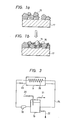
- Figs. la and lb are crosssectional views demonstrating the process of formation of an oxide film in the two-step treatments according to the present invention.
- Fig. 2 is a system diagram of a boiling water nuclear power plant in one embodiment of the present invention.
- Fig. 3 is a system diagram of a temporary circulation line of a supply water heater.
- JIS SUS 304 stainless steel having a chemical composition (wt. %) as shown in Table 1 was subjected to various oxidation treatments with pure water of 250°C (in a liquid state), and then immersed in heated water of 288°C having a cobalt ion concentration of 10 ppb 'and a dissolved oxygen concentration of 200 ppb for 500 hours. The rate of corrosion and the amounts of Co adherence were examined with each film formed. The results are shown in Table 2.
- the second-step treatments can suppress the rate of corrosion to as low a value as about 230 ⁇ g/m 2 ⁇ month or less and the amount of Co adherence to 10 ⁇ g/cm 2 ⁇ month or less.
- Figs. la and lb are model diagrams of growth of an oxide film according to the two-step treatments of xhe present invention. It is believed that a primary oxide film 15 as shown in Fig. la is formed on the surface of a structural member 17 made of metals according to the first-step oxidation treatment, and that a secondary oxide film 16 as shown in Fig. lb is formed in the porous portions of the primary oxide film. As shown in Fig. lb, the primary oxide film is densified by formation of the secondary oxide film to form a thick and dense film as a whole. Films having a porosity of about 60% were obtained with dissolved oxygen concentrations of 100 and 200 ppb as shown in Table 2, and a film having a porosity of about 26% was formed with a dissolved oxygen concentration of 500 ppb.
- a boiling water nuclear power plant was subjected to the two-step oxidation treatments of this invention by controlling the dissolved oxygen concentration of pure water of primary reactor cooling water when starting the operation and completing decontamination with use of heat generated by the operation of pumps in various systems of the plant as a heat source and without use of nuclear heating.
- Fig. 2 is a systematic view of a boiling water nuclear power plant.
- the oxidation treatments of this invention can be carried out while circulating cooling reactor water through a route of a reactor 1 - a recycling system 2 - a reactor water purification system 5.
- the system is filled with pure water.
- a main steam separation valve 25 is closed, and a recycle pump 3 is run. This elevates the water temperature in the system at a rate of 3°C/h.
- heated water having a dissolved oxygen concentration of 40 to 100 ppb and a temperature of 260 to 280°C is circulated for 100 to 500 hours.
- Reduction in the dissolved oxygen concentration to 40 to 100 ppb can be achieved by opening the main steam separation valve 25 to blow steam into a main steam system 11 or by passing a nitrogen gas to a gas phase in the upper portion of the reactor 1.
- the temperature control can be achieved by controlling the amount of heated water passing through the reactor purification system 4.
- the dissolved oxygen concentration is raised for conducting the second-step treatment. Heated water having a dissolved oxygen concentration of 400 to 1,000 ppb and the same temperature of 260 to 280°C as in the first-step treatment is circulated for 100 to 500 hours. Increase in the dissolved oxygen concentration to 400 to 1,000 ppb is attained by introducing oxygen from a sampling line 12" of the recycling system.
- a nuclear power plant where adherence of radioactive substances is reduced can be realised by practicing the two-step oxidation treatments as described above.
- a recycle pump 3 is run to introduce hydrazine from a sampling line 12" of a recycling system in the first-step treatment.
- the hydrazine concentration is thus adjusted to 100 to 1,000 ppb.
- Heated water having the thus adjusted concentration and a temperature of 200 to 280°C is circulated for 100 to 500 hours.
- hydrogen peroxide is introduced into heated water to provide a hydrogen peroxide concentration of 100 to 1,000 ppb.
- Heated water having the above-mentioned concentration and a temperature of 200 to 280°C is circulated for 100 to 500 hours.
- the two-step oxidation treatments thus practiced can realise a nuclear power plant where adherence of radioactive substances to the structural materials is suppressed.
- a temporary circulation line is attached to a supply water heater 9 before the installed heater 9 is connected with the plant.
- the two-step treatments of this invention are carried out by circulating heated water having a dissolved oxygen concentration adjusted while using an in-plant or a temporary boiler as the heat source.
- this procedure is to suppress release of metallic ions or metallic oxides from the supply water heater 9
- supply water is in contact with only the inner surface of a heater tube 26 of the supply water heater 9 as shown in Fig. 2. Accordingly, an oxidation treatment has only to be applied on the inner surface of the heater tube 26.
- a temporary circulation line 24 is attached to the inlet and outlet of the heater tube 26 in carrying out the oxidation treatment as shown in Fig. 3.
- the circulation line 24 is provided with a circulation pump 18, a blowing line 20 for heating steam from a boiler, a blow-off line 21 for steam, and an oxygen supply line 22. Heating steam is blown into the target system filled with pure water which is circulated. Heated water having a dissolved oxygen concentration of 40 to 100 ppb and a temperature of 200 to 250°C is circulated for 100 to 500 hours in the first-step treatment. Adjustment of the dissolved oxygen concentration is effected by opening the valve of the'blow-off line 21 to blow off part of steam when the temperature of heated water exceeds 100°C.
- heated water having a dissolved oxygen concentration of 400.to 1,000 ppb and a temperature of 200 to 250°C is circulated for 100 to 500 hours in the second-step treatment. Adjustment of the dissolved oxygen concentration in this treatment is effected by introducing a small amount of oxygen from the oxygen supply line 22.
- the two-step oxidation treatments according to the present invention are effected by passing steam having an oxygen concentration adjusted therein and originated from steam coming out of the in-plant boiler through the same supply water heater as in Example 4. Since it is difficult to decrease the content of oxygen in the steam coming out of the in-plant boiler, the steam is passed as such through the heater tube 26 of the supply water heater 9 in the first-step treatment. The steam of a temperature of about 200°C is passed for 100 to 500 hours. Subsequently, in the second-step treatment, steam having an oxygen concentration of 100 to 1,000 ppm adjusted by introducing an oxygen gas thereinto is passed for 500 to 1,000'hours.
- the oxidation treatments according to the present invention were conducted by using a steel pipe having the same specifications as those of SUS 304 stainless steel used in Example 1 outside the system of a nuclear power plant.
- a first-step oxidation treatment was carried out in pure water having a dissolved oxygen concentration of 100 ppb and a temperature of 250°C for 100 hours. Subsequently, an oxidation treatment was carried out in pure water having a dissolved oxygen concentration of 400 ppb and a temperature of 250°C for 100 hours.
- the corrosion test and the measurement of amount of Co adherence were made in the same manner as in Example 1.
- the rate of corrosion of the treated pipe was 200 ug/cm2 ⁇ month.
- the rate of Co adherence was 9 ⁇ g/cm 2 ⁇ month.
- the oxidation treatments on only the inner surface of the steel pipe can be effected in an apparatus provided with a circulation line and a heating means as shown in Fig. 3 in the same manner as described above.
- the treatments are so effected as to keep the temperature of the steel pipe to be subjected to the oxidation treatments.
- the steel pipe thus treated is detached, and can be connected with a predetermined portion of a nuclear power plant by welding as described above to be placed in service.
Landscapes
- Chemical & Material Sciences (AREA)
- Engineering & Computer Science (AREA)
- Chemical Kinetics & Catalysis (AREA)
- Physics & Mathematics (AREA)
- Materials Engineering (AREA)
- Mechanical Engineering (AREA)
- Metallurgy (AREA)
- Organic Chemistry (AREA)
- General Engineering & Computer Science (AREA)
- High Energy & Nuclear Physics (AREA)
- Life Sciences & Earth Sciences (AREA)
- Food Science & Technology (AREA)
- General Chemical & Material Sciences (AREA)
- Electrochemistry (AREA)
- Plasma & Fusion (AREA)
- Preventing Corrosion Or Incrustation Of Metals (AREA)
- Monitoring And Testing Of Nuclear Reactors (AREA)
- Chemical Treatment Of Metals (AREA)
Applications Claiming Priority (2)
| Application Number | Priority Date | Filing Date | Title |
|---|---|---|---|
| JP59233507A JPH0658437B2 (ja) | 1984-11-06 | 1984-11-06 | 原子力プラントの放射能低減方法 |
| JP233507/84 | 1984-11-06 |
Publications (2)
| Publication Number | Publication Date |
|---|---|
| EP0181192A1 true EP0181192A1 (de) | 1986-05-14 |
| EP0181192B1 EP0181192B1 (de) | 1990-05-23 |
Family
ID=16956110
Family Applications (1)
| Application Number | Title | Priority Date | Filing Date |
|---|---|---|---|
| EP85308019A Expired - Lifetime EP0181192B1 (de) | 1984-11-06 | 1985-11-05 | Verfahren zur Verminderung der Radioaktivität in einer Kernanlage |
Country Status (5)
| Country | Link |
|---|---|
| US (1) | US4820473A (de) |
| EP (1) | EP0181192B1 (de) |
| JP (1) | JPH0658437B2 (de) |
| CN (1) | CN85108112B (de) |
| DE (1) | DE3577884D1 (de) |
Cited By (2)
| Publication number | Priority date | Publication date | Assignee | Title |
|---|---|---|---|---|
| US4929287A (en) * | 1988-06-13 | 1990-05-29 | Abb Stal Ab | Method for surface treatment of metal alloys |
| EP0708295A1 (de) * | 1994-10-21 | 1996-04-24 | Energy Support Corporation | Vorrichtung zur Herstellung von Schutzfilmen in Kesselspeisewasserleitungen |
Families Citing this family (22)
| Publication number | Priority date | Publication date | Assignee | Title |
|---|---|---|---|---|
| JPH068914B2 (ja) * | 1986-10-20 | 1994-02-02 | 株式会社日立製作所 | 沸騰水型原子力プラントの放射性物質の付着抑制方法 |
| GB8729980D0 (en) * | 1987-12-23 | 1988-02-03 | Atomic Energy Authority Uk | Inhibition of nuclear-reactor coolant circuit contamination |
| DE58906153D1 (de) * | 1988-08-24 | 1993-12-16 | Siemens Ag | Verfahren zur chemischen Dekontamination der Oberfläche eines metallischen Bauteils einer Kernreaktoranlage. |
| US5608766A (en) * | 1993-10-29 | 1997-03-04 | General Electric Company | Co-deposition of palladium during oxide film growth in high-temperature water to mitigate stress corrosion cracking |
| JP3742451B2 (ja) * | 1996-01-17 | 2006-02-01 | 昌之 都田 | 洗浄方法 |
| CH691479A5 (de) * | 1996-12-06 | 2001-07-31 | Siemens Ag | Oberflächenbehandlung von Stahl. |
| JP4042362B2 (ja) * | 2000-08-11 | 2008-02-06 | 住友金属工業株式会社 | Ni基合金製品とその製造方法 |
| US6488783B1 (en) | 2001-03-30 | 2002-12-03 | Babcock & Wilcox Canada, Ltd. | High temperature gaseous oxidation for passivation of austenitic alloys |
| US6810100B2 (en) * | 2001-11-22 | 2004-10-26 | Organo Corporation | Method for treating power plant heater drain water |
| US6891912B1 (en) * | 2002-06-26 | 2005-05-10 | Pinnacle West Capital Corporation | Fuel assemblies in a reactor core and method of designing and arranging same |
| JP3945780B2 (ja) * | 2004-07-22 | 2007-07-18 | 株式会社日立製作所 | 原子力プラント構成部材の放射性核種の付着抑制方法および成膜装置 |
| US8116423B2 (en) | 2007-12-26 | 2012-02-14 | Thorium Power, Inc. | Nuclear reactor (alternatives), fuel assembly of seed-blanket subassemblies for nuclear reactor (alternatives), and fuel element for fuel assembly |
| CN101911211B (zh) | 2007-12-26 | 2014-02-12 | 钍能源股份有限公司 | 核反应堆(可选的)、用于核反应堆(可选的)的点火区-再生区子组件的燃料组件和用于燃料组件的燃料元件 |
| EP3032541B1 (de) | 2008-12-25 | 2019-02-20 | Thorium Power, Inc. | Brennelement und verfahren zur herstellung eines brennelements für ein kernreaktorbrennstabbündel |
| US10170207B2 (en) | 2013-05-10 | 2019-01-01 | Thorium Power, Inc. | Fuel assembly |
| WO2011143172A1 (en) | 2010-05-11 | 2011-11-17 | Thorium Power, Inc. | Fuel assembly with metal fuel alloy kernel and method of manufacturing thereof |
| US10192644B2 (en) | 2010-05-11 | 2019-01-29 | Lightbridge Corporation | Fuel assembly |
| JP5562215B2 (ja) * | 2010-11-18 | 2014-07-30 | 日立Geニュークリア・エナジー株式会社 | 化学除染方法 |
| CN105716919A (zh) * | 2016-02-22 | 2016-06-29 | 苏州热工研究院有限公司 | 一种含放射性核素的不锈钢预生氧化膜试样的制备方法 |
| CN108060387A (zh) * | 2018-01-17 | 2018-05-22 | 上海核工程研究设计院有限公司 | 一种表面改性的核电站控制棒驱动机构钩爪 |
| JP7104616B2 (ja) * | 2018-12-19 | 2022-07-21 | 日立Geニュークリア・エナジー株式会社 | 原子力プラントの炭素鋼部材への放射性核種の付着抑制方法 |
| CN119980132A (zh) * | 2025-02-21 | 2025-05-13 | 哈尔滨工业大学 | 基于变压氧化工艺在钢表面制备耐蚀氧化层的方法 |
Citations (3)
| Publication number | Priority date | Publication date | Assignee | Title |
|---|---|---|---|---|
| FR1541221A (fr) * | 1966-09-30 | 1968-10-04 | Siemens Ag | Procédé de préoxydation d'éléments de construction en alliage de zirconium, pour coeurs de réacteurs |
| US3479232A (en) * | 1966-09-20 | 1969-11-18 | Exxon Research Engineering Co | Passivation of metals |
| FR2299418A1 (fr) * | 1975-01-30 | 1976-08-27 | Uranit Gmbh | Procede pour la formation d'une couche protectrice par voie |
Family Cites Families (15)
| Publication number | Priority date | Publication date | Assignee | Title |
|---|---|---|---|---|
| US774069A (en) * | 1903-11-07 | 1904-11-01 | Harry Homer Goodsell | Method of treating sheet iron or steel. |
| US2543710A (en) * | 1948-01-15 | 1951-02-27 | Westinghouse Electric Corp | Process for producing insulating iron oxide coatings |
| GB1047333A (de) * | 1963-06-10 | |||
| SU277126A1 (ru) * | 1964-06-06 | 1977-04-05 | Всесоюзный Ордена Трудового Красного Знамени Теплотехнический Научно-Исследовательский Институт Им.Ф.Э.Дзержинского | Способ обработки воды дерного реактора |
| DE1521998A1 (de) * | 1966-09-30 | 1969-08-21 | Siemens Ag | Verfahren zur Voroxidation von Kernreaktorbauteilen aus Zirkonlegierungen |
| US3663725A (en) * | 1970-04-23 | 1972-05-16 | Gen Electric | Corrosion inhibition |
| US4042455A (en) * | 1975-05-08 | 1977-08-16 | Westinghouse Electric Corporation | Process for dissolving radioactive corrosion products from internal surfaces of a nuclear reactor |
| JPS55121197A (en) * | 1979-03-13 | 1980-09-18 | Hitachi Ltd | Method for protecting deposition of radioactive ion |
| US4483720A (en) * | 1981-11-27 | 1984-11-20 | S R I International | Process for applying thermal barrier coatings to metals |
| JPS5937498A (ja) * | 1982-08-25 | 1984-02-29 | 株式会社日立製作所 | 放射性物質の付着抑制機能を備えた原子力プラント |
| EP0107297A3 (de) * | 1982-09-08 | 1985-06-19 | United Kingdom Atomic Energy Authority | Korrosionsschutzverfahren |
| JPS59216095A (ja) * | 1983-05-24 | 1984-12-06 | 株式会社東芝 | 原子力発電プラントの系統水循環系 |
| JPS6098390A (ja) * | 1983-11-04 | 1985-06-01 | 株式会社東芝 | 原子力発電プラント |
| JPS60247198A (ja) * | 1984-05-22 | 1985-12-06 | 株式会社東芝 | 放射能付着防止方法 |
| JPS63169091A (ja) * | 1987-01-06 | 1988-07-13 | Fujikura Ltd | 分布反射型半導体レ−ザ |
-
1984
- 1984-11-06 JP JP59233507A patent/JPH0658437B2/ja not_active Expired - Lifetime
-
1985
- 1985-11-05 EP EP85308019A patent/EP0181192B1/de not_active Expired - Lifetime
- 1985-11-05 CN CN85108112A patent/CN85108112B/zh not_active Expired
- 1985-11-05 DE DE8585308019T patent/DE3577884D1/de not_active Expired - Lifetime
- 1985-11-06 US US06/795,466 patent/US4820473A/en not_active Expired - Fee Related
Patent Citations (3)
| Publication number | Priority date | Publication date | Assignee | Title |
|---|---|---|---|---|
| US3479232A (en) * | 1966-09-20 | 1969-11-18 | Exxon Research Engineering Co | Passivation of metals |
| FR1541221A (fr) * | 1966-09-30 | 1968-10-04 | Siemens Ag | Procédé de préoxydation d'éléments de construction en alliage de zirconium, pour coeurs de réacteurs |
| FR2299418A1 (fr) * | 1975-01-30 | 1976-08-27 | Uranit Gmbh | Procede pour la formation d'une couche protectrice par voie |
Non-Patent Citations (1)
| Title |
|---|
| PATENTS ABSTRACTS OF JAPAN, vol. 7, no. 11 (C-145) [1156], 18th January 1983; & JP - A - 57 169 091 (HITACHI SEISAKUSHO K.K.) 18-10-1982 * |
Cited By (3)
| Publication number | Priority date | Publication date | Assignee | Title |
|---|---|---|---|---|
| US4929287A (en) * | 1988-06-13 | 1990-05-29 | Abb Stal Ab | Method for surface treatment of metal alloys |
| EP0708295A1 (de) * | 1994-10-21 | 1996-04-24 | Energy Support Corporation | Vorrichtung zur Herstellung von Schutzfilmen in Kesselspeisewasserleitungen |
| US5797357A (en) * | 1994-10-21 | 1998-08-25 | Energy Support Corporation | Apparatus for forming protective films in water feed pipes of boiler |
Also Published As
| Publication number | Publication date |
|---|---|
| JPS61111500A (ja) | 1986-05-29 |
| CN85108112A (zh) | 1986-06-10 |
| US4820473A (en) | 1989-04-11 |
| EP0181192B1 (de) | 1990-05-23 |
| DE3577884D1 (de) | 1990-06-28 |
| JPH0658437B2 (ja) | 1994-08-03 |
| CN85108112B (zh) | 1987-11-04 |
Similar Documents
| Publication | Publication Date | Title |
|---|---|---|
| EP0181192B1 (de) | Verfahren zur Verminderung der Radioaktivität in einer Kernanlage | |
| US4722823A (en) | Nuclear power plant providing a function of suppressing the deposition of radioactive substance | |
| US4636266A (en) | Reactor pipe treatment | |
| US9390822B2 (en) | Oxidation decontamination reagent for removal of the dense radioactive oxide layer on the metal surface and oxidation decontamination method using the same | |
| JP2016161466A (ja) | 原子力プラントの構造部材への放射性核種付着抑制方法 | |
| EP0859671B1 (de) | Verfahren zur dekontaminierung von komponenten eines kernkraftwerkes | |
| JP5377147B2 (ja) | 炭素鋼部材へのニッケルフェライト皮膜形成方法 | |
| WO1997017146A9 (en) | Method for decontamination of nuclear plant components | |
| JP3620128B2 (ja) | 原子力プラント用炭素鋼部材の表面処理方法 | |
| JPS6295498A (ja) | 原子力発電プラントの製造法 | |
| JPH0480357B2 (de) | ||
| JP6322493B2 (ja) | 原子力プラントの炭素鋼部材への放射性核種付着抑制方法 | |
| JP4982465B2 (ja) | 放射能除染方法および放射能除染装置 | |
| JPH068913B2 (ja) | 原子力プラントの放射能低減方法 | |
| JP4945487B2 (ja) | 炭素鋼部材へのフェライト皮膜形成方法及びその皮膜形成装置 | |
| JPH0553400B2 (de) | ||
| JP2020160030A (ja) | 原子力プラント構成部材の線量抑制方法 | |
| WO2001027932A1 (en) | Method for nuclear power plant decontamination | |
| JPS63149598A (ja) | 原子力プラントの化学除染後の酸化処理方法 | |
| JPH0424434B2 (de) | ||
| JPH0430560B2 (de) | ||
| JPH03153858A (ja) | 高温水中耐溶出性ステンレス鋼 | |
| JPS61290396A (ja) | 前酸化処理システム | |
| Yaita et al. | Chemical decontamination using ozone oxidation process | |
| JP2007198871A (ja) | 原子力発電プラント用交換部材及び原子力発電プラント用部材の取扱方法 |
Legal Events
| Date | Code | Title | Description |
|---|---|---|---|
| PUAI | Public reference made under article 153(3) epc to a published international application that has entered the european phase |
Free format text: ORIGINAL CODE: 0009012 |
|
| 17P | Request for examination filed |
Effective date: 19851220 |
|
| AK | Designated contracting states |
Kind code of ref document: A1 Designated state(s): DE SE |
|
| 17Q | First examination report despatched |
Effective date: 19880118 |
|
| GRAA | (expected) grant |
Free format text: ORIGINAL CODE: 0009210 |
|
| AK | Designated contracting states |
Kind code of ref document: B1 Designated state(s): DE SE |
|
| REF | Corresponds to: |
Ref document number: 3577884 Country of ref document: DE Date of ref document: 19900628 |
|
| PLBE | No opposition filed within time limit |
Free format text: ORIGINAL CODE: 0009261 |
|
| STAA | Information on the status of an ep patent application or granted ep patent |
Free format text: STATUS: NO OPPOSITION FILED WITHIN TIME LIMIT |
|
| 26N | No opposition filed | ||
| EAL | Se: european patent in force in sweden |
Ref document number: 85308019.0 |
|
| PGFP | Annual fee paid to national office [announced via postgrant information from national office to epo] |
Ref country code: SE Payment date: 19960925 Year of fee payment: 12 |
|
| PGFP | Annual fee paid to national office [announced via postgrant information from national office to epo] |
Ref country code: DE Payment date: 19961231 Year of fee payment: 12 |
|
| PG25 | Lapsed in a contracting state [announced via postgrant information from national office to epo] |
Ref country code: SE Free format text: LAPSE BECAUSE OF NON-PAYMENT OF DUE FEES Effective date: 19971106 |
|
| PG25 | Lapsed in a contracting state [announced via postgrant information from national office to epo] |
Ref country code: DE Free format text: LAPSE BECAUSE OF NON-PAYMENT OF DUE FEES Effective date: 19980801 |
|
| EUG | Se: european patent has lapsed |
Ref document number: 85308019.0 |