EP0182237B1 - Verfahren und Mittel zur räumlichen Eigenschaftsveränderung eines digitalen Bildes - Google Patents
Verfahren und Mittel zur räumlichen Eigenschaftsveränderung eines digitalen Bildes Download PDFInfo
- Publication number
- EP0182237B1 EP0182237B1 EP85114304A EP85114304A EP0182237B1 EP 0182237 B1 EP0182237 B1 EP 0182237B1 EP 85114304 A EP85114304 A EP 85114304A EP 85114304 A EP85114304 A EP 85114304A EP 0182237 B1 EP0182237 B1 EP 0182237B1
- Authority
- EP
- European Patent Office
- Prior art keywords
- values
- pixels
- pixel
- matrix
- interim
- Prior art date
- Legal status (The legal status is an assumption and is not a legal conclusion. Google has not performed a legal analysis and makes no representation as to the accuracy of the status listed.)
- Expired
Links
Images

Classifications
-
- G—PHYSICS
- G06—COMPUTING OR CALCULATING; COUNTING
- G06T—IMAGE DATA PROCESSING OR GENERATION, IN GENERAL
- G06T3/00—Geometric image transformations in the plane of the image
- G06T3/40—Scaling of whole images or parts thereof, e.g. expanding or contracting
- G06T3/4007—Scaling of whole images or parts thereof, e.g. expanding or contracting based on interpolation, e.g. bilinear interpolation
-
- H—ELECTRICITY
- H04—ELECTRIC COMMUNICATION TECHNIQUE
- H04N—PICTORIAL COMMUNICATION, e.g. TELEVISION
- H04N1/00—Scanning, transmission or reproduction of documents or the like, e.g. facsimile transmission; Details thereof
- H04N1/387—Composing, repositioning or otherwise geometrically modifying originals
- H04N1/393—Enlarging or reducing
- H04N1/3935—Enlarging or reducing with modification of image resolution, i.e. determining the values of picture elements at new relative positions
-
- Y—GENERAL TAGGING OF NEW TECHNOLOGICAL DEVELOPMENTS; GENERAL TAGGING OF CROSS-SECTIONAL TECHNOLOGIES SPANNING OVER SEVERAL SECTIONS OF THE IPC; TECHNICAL SUBJECTS COVERED BY FORMER USPC CROSS-REFERENCE ART COLLECTIONS [XRACs] AND DIGESTS
- Y10—TECHNICAL SUBJECTS COVERED BY FORMER USPC
- Y10S—TECHNICAL SUBJECTS COVERED BY FORMER USPC CROSS-REFERENCE ART COLLECTIONS [XRACs] AND DIGESTS
- Y10S347/00—Incremental printing of symbolic information
- Y10S347/90—Data processing for electrostatic recording
Definitions
- This invention relates generally an improved method and apparatus for computing values for pixels according to the first part of claims 1 and 6, respectively.
- Such method and apparatus, respectively is known from EP-A-0 105 707.
- the display of a digital image is controlled by a memory which stores values for picture elements or pixels.
- a memory which stores values for picture elements or pixels.
- an electron beam is scanned across the phosphor-coated surface of the display screen, and the current of the electron beam is controlled in accordance with the stored values to thus control the light intensity of each pixel element as the electron beam impinges on the phosphor material.
- the digital image can be transferred to photographic film by scanning a laser beam across the film and modulating the intensity of the laser beam in accordance with the stored pixel values.
- EP-A-0 105 707 shows an apparatus calculating new pixels from old ones by interpolation using table look-up with offsets X and Y.
- values for pixels at locations different than the original pixel lacations must be arrived at.
- the simplest technique for doing this is to use, for each output pixel, the value of the nearest input pixel. Minification is then performed by selectively deleting pixels while to magnify some or all of the pixel values are replicated. The resulting image quality is often not satisfactory. Values for the new pixel locations can be arrived at using linear interpolation in both directions. However, images magnified using this method are blurry and structured noise is sometimes visible.
- the interpolation of new pixel values is a higher order polynomial interpolation.
- the values of sixteen adjacent pixels in the old matrix are used.
- the higher the order of the polynomial used the more fidelity and sharpness the new image will have.
- more computations are required in determining the new pixel values.
- an object of the present invention is an efficient method and apparatus for implementing polynomial interpolation of pixel values in a new matrix using pixel values of an old matrix.
- a feature of the invention as claimed is the implementation of polynomial interpolation by a weighted combination of the input pixels.
- Another feature is the use of a table of coefficients for polynomial interpolation of pixel values in a new matrix which are based on one dimensional (e.g., x or y) incremental spacing from pixels in an old matrix.
- the pixels in the new pixel matrix are mapped in the old pixel matrix to obtain x and y offsets from old pixels.
- the offset for each new pixel in one dimension (e.g., x dimension) is determined and values for interim pixels are interpolated or obtained using values of a plurality of old pixels adjacent to each new pixel in the one dimension.
- the final pixel values are then obtained by polynomial interpolation in the other dimension (e.g., y dimension) using the calculated values of interim pixels.
- the weighting coefficients for the one dimensional interpolations are precalculated for given incremental values.
- the time consuming tasks of calculating polynomial coefficients and evaluating polynomials are not required during the calculation of new pixel values.
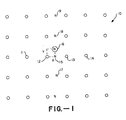
- Figure 1 illustrates a portion of a matrix 10 of pixels of known value such as the pixels 11, 12, 13 and 14 in one horizontal row of the matrix. Assume that a new matrix of pixels is mapped on the old matrix 10 and the new pixel 16 is in the new matrix. As illustrated, the pixel 16 is offset from pixel 12 by a horizontal distance, ⁇ x, and a vertical distance, ⁇ y.
- the value of a new pixel 16 is arrived at by treating the region of the image in the neighborhood of pixel 16 as some function f (x,y) the details of which depend on the values of neighboring pixels.
- the value assigned to pixel 16 is then the value of the function f (x,y) at the position of pixel 16. This process is repeated for all the output pixels to arrive at the interpolated image.
- the function f (x,y) is a polynomial function of x and y.
- the process of calculating the output pixel value then involves calculating the polynomial coefficients using input pixels neighboring the output pixel and then evaluating the polynomial.
- the number of input pixels used is equal to the number of polynomial coefficients of f (x,y) that must be determined.
- f(x,y) a0+a1x+a2x2+a3y+a4y2+a5xy+a6x2y+a7xy2+a8x2y2 (1)
- Equation 1 For the model of Equation 1 this is done by solving a system of nine equations (one for each input pixel) with nine unknowns (the coefficients). The coefficients are then used to calculate the output pixel value:
- the two dimensional interpolation process can be broken down into one-dimensional interpolations.
- the first step would interpolate in the x direction and arrive at interim pixel values for pixels (x ⁇ , y e ) where y e takes on the values of y for rows neighboring the desired output pixel.
- an interpolation in y is used, using the interim pixel values as inputs, to compute the output pixel value for the desired pixel at (x ⁇ , ⁇ ).
- x will take on values ⁇ x o x l , ..., X n ⁇ while y will take on values ⁇ y o , y l ..., y n ⁇ .
- v (x k , y e ) be the value for the pixel at (x k , y e ).
- the classical way to do this is to generate a set of coefficients ⁇ a ij ⁇ such that is true for all the (n+1)2 pixels in the square region surrounding (x ⁇ , ⁇ ), and then using these to calculate the desired output
- Equation 4 Equation 4
- Equation 5 Equation 5 for the interim pixel becomes:
- Equations 10 and 11 define one dimensional nth order polynomial interpolation in the y direction along the column defined by the interim pixels and which also contains the output pixel (x ⁇ , ⁇ ). Again, since both equations 5 and 11 are nth order polynomials and since they agree at (n+1) points (the interim pixels) they must give the same value at (x ⁇ , ⁇ ). Thus, the two dimensional interpolation can be implemented using simpler one dimensional interpolation steps. Further, it will be clear to those skilled in the art that for the often used steps of image magnification, minification, and translation, many of the interim pixel values needed to calculate one output pixel can be stored and used to calculate other output pixels.
- the interpolated output value can be calculated as a linear combination of the input pixel values, where the combination coefficients depend on the relative position of the output point with respect to the input points.
- A is a row vector containing the polynomial coefficients
- X is a square matrix containing the x values raised to the appropriate powers
- V is a row vector containing the pixel values.
- the combination coefficients depend only on the normalized distance of the output pixel from the pixel to its left.
- x k is the pixel location just to the left of x ⁇ and ⁇ p is the spacing between pixels.
- n 3
- Equation 20B defines a o .
- Equation 18 and 28 the combination coefficients for the four points surrounding the output location can be calculated using Equations 18 and 28 and then used with Equation 27 to calculate the output valve.
- Equation 18 the pixel spacing p is usually normalized to unity so no division is necessary
- the four combination coefficients for the table entry with a value of x closest to the calculated value are found, and these coefficients are used along with the values for the four pixels surrounding x ⁇ in Equation 27 to calculate the output value.
- a value for the interim pixel 15 is first calculated using ⁇ x and the values of the four adjacent old pixels 11, 12, 13, and 14 (for a third order polynomial). Similarly, values for interim pixels 17, 18 and 19 are calculated. A final pixel value is obtained for pixel 16 from the polynomial interpolation along the y-axis using the values of the pixels 17-19 and the offset ⁇ y.
- the new pixel 16 from Figure 1 is located in the matrix map 20 using the matrix 10 of Figure 1.
- the x-offset ( ⁇ x) is located at 22, and the y-offset ( ⁇ y) is located at 24.
- the interim pixel values are then determined at 26 using the x-offset, ⁇ x, coefficients from the table of coefficients 28, and the values of the four adjacent pixels.
- the final pixel value of pixel 15 is obtained at 30 using the interim pixel values from 26, the y-offset, ⁇ y. and coefficients from the table 28.
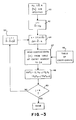
- Figure 3 is a flow diagram for performing one dimensional interpolation using the present invention.
- the location x o of the first output pixel within the input array, the increment ⁇ x ⁇ between output points, the number N of outputs desired and the input pixel values ⁇ V k ⁇ are provided as inputs at 40.
- Initialization occurs at 42 wherein the output pixel counter j is set to 1 and the output pixel location x ⁇ is set to x o .
- the index k of the pixel to the left of x ⁇ is calculated at 44.
- lFIX(x ⁇ ) refers to the largest integer less than or equal to x ⁇ .
- the distance ⁇ x of the output pixel from its left neighbor is also calculated at 44.
- Coefficients from the table of coefficients 46 are retrieved at 47 and applied in the polynomial equation using the values of the four adjacent input pixels as shown in 48 to obtain the new pixel value OUT j .
- j is compared to N. If j is equal to N then the task is completed. If it is not, the output pixel index j and location x ⁇ are incremented at 52.
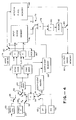
- Figure 4 is a schematic diagram of one embodiment of apparatus in accordance with the invention which operates as described above.
- interim pixel values are derived for each column of the new matrix along the pixel rows of the old matrix based on interpolation of old pixel values.
- the final values of pixels in each column are derived based on interpolation of the interim values.
- the apparatus operates column by column in calculating the interim pixel values and the final pixel values.
- switches 91, 92, 95, 89, 79 and 83 are set to their I positions.
- Switch 90 is set to the INT position to load the input address register 60 with the contents of the next column register and then is moved to the I position.
- the y register 73 is cleared.
- the input address register now contains the x coordinate of the first output column which is added to Dx at 64 and stored in the next column register in preparation for the next output column.
- the input address register is comprised of an integer part and a fractional part since it may lie between two columns of the old matrix.
- the fractional portion of the X input is applied through register 66 to address the coefficient memory 68. Assuming an interpolation of four values, four coefficients will be read from memory as the coefficient neighborhood address 69 is clocked through values 0, 1, 2, 3, as will be described below.
- the integer portion of the X input is applied through register 70 and combined in sequence at 72 with the address neighborhood (e.g. -1, 0, 1, 2) from 74 and the sum is used alone in the y register 73 to address the input image memory 76 for obtaining the four input pixel values for interpolation.
- the address neighborhood e.g. -1, 0, 1, 2
- the address neighborhood 74 and coefficient neighborhood 69 are clocked and synchronized to present four pairs of coefficients and pixel values to multiplier 78.
- the four products are added at 80 and accumulated at 82.
- the resulting interim pixel value is stored at 84 using the y register 73 as an address.
- the accumulator 82 is cleared, the y address 73 is incremented and the next interim pixel is calculated.
- Switches 91, 92, 95, 89, 79, and 83 are set to their 0 positions.
- Switch 90 is set to the INT position and the contents of the FIRST y register 94 is loaded into the input address register 60.
- Switch 90 is then set to the 0 position.
- the input image memory 76 and the y register 73 are not used in this step.
- the accumulator 82 is cleared in order to calculate the first output pixel value.
- the value of register 60 is separated into integer and fractional parts.
- the fractional part is used to select coefficients from table 68 and the integer part is added to the address neighborhood and the sum is used to address the interim pixel memory.
- the accumulator 82 is then cleared, the input address 60 is incremented by DY by adder 64 and the next output pixel is calculated. The process continues until all output pixels for this column are calculated.
- Switches 91, 92, 95, 89, 79, and 83 are set to their I positions.
- Switch 90 is used to load register 60 with the x coordinate of this column, the y register 73 is cleared and the x coordinate of the next column is calculated at 64 and stored at 93.
- the device of Fig. 4 as described is best suited for image magnification, minification or stretching in one of the cartesian directions. It can be modified by one skilled in the art to allow a more general alteration of spatial characteristics.
- the device of Fig. 2 can be used for any of the tasks described above.
Landscapes
- Engineering & Computer Science (AREA)
- Multimedia (AREA)
- Signal Processing (AREA)
- Physics & Mathematics (AREA)
- General Physics & Mathematics (AREA)
- Theoretical Computer Science (AREA)
- Image Processing (AREA)
Claims (7)
- Verfahren zum Berechnen von Werten für Pixel (16) in einer neuen Matrix auf der Basis von Pixelwerten, die in einem Bildspeicher (76) als eine alte Matrix von einem Bild gespeichert sind, wenn die räumlichen Charakteristiken des Bildes geändert werden, wobei jede Matrix als Pixel definiert ist, die in Reihen und Spalten gemäß orthogonalen ersten und zweiten Achsen angeordnet sind, enthaltend die Schritte:
Abbilden von Pixeln (16) der neuen Matrix in der alten Matrix (10),
Ermitteln entlang vorbestimmter Richtungen der ersten und zweiten Achsen von Versetzungen bzw. Offsets (x, y) von jedem Pixel (16) der neuen Matrix von einem benachbarten Pixel (12) in der alten Matrix,
Ermitteln von Pixelwerten der neuen Matrix durch Interpolieren von den Pixeln der alten Matrix unter Verwendung eines Tabellenspeichers (68), der auf die Versetzungen bzw. Offsets (x, y) anspricht,
gekennzeichnet durch:
Erstellen von Werten für Zwischenpixel (15, 17-19) durch Polynom-Interpolation entlang der ersten Achse unter Verwendung von Nachbarpixelwerten (11- 14) in Reihen der alten Matrix und Speichern in einem Zwischenspeicher (84), wobei die Zwischenpixel (15, 17-19) den Pixeln der neuen Matrix entsprechen, so daß sie die gleiche Versetzung bzw. Offset (x) haben, die entlang der ersten Achse ermittelt ist, und so daß sie auf den Reihen der alten Matrix angeordnet sind, wobei die Nachbarpixelwerte aus dem Bildspeicher (76) an der Nachbarstelle der Zwischenpixel ausgelesen werden, der Tabellenspeicher (68) Koeffizienten zur Gewichtung der Nachbarwerte der Pixel (11-14) in der alten Matrix als Antwort auf die Versetzung bzw. den Offset (x) des Zwischenpixels liefert, und
Erstellen eines Endwertes von jedem Pixel in der neuen Matrix durch Polynom-Interpolation entlang der zweiten Achse unter Verwendung der Zwischenwerte, die aus dem Zwischenpixelspeicher (84) ausgelesen sind, und unter Verwendung der Tabelle zur Lieferung der Koeffizienten zum Gewichten der Zwischenwerte in Abhängigkeit von der Versetzung bzw. dem Offset (y) entlang der zweiten Achse von jedem Pixel der neuen Matrix. - Verfahren nach Anspruch 1,
dadurch gekennzeichnet, daß die Polynom-Interpolation der n-ten Ordnung ist und Werte von n+1 Pixeln der alten Matrix durch die Koeffizienten gewichtet werden beim Erhalten von Zwischenwerten und n+1 Zwischenwerte gewichtet werden beim Erhalten jedes Endwertes. - Verfahren nach Anspruch 1 oder 2,
dadurch gekennzeichnet, daß die Gleichung für die Polynom-Interpolation alle Terme bis zur n-ten Ordnung auf jeder Koordinate enthält. - Verfahren nach einem der Ansprüche 1 bis 3,
dadurch gekennzeichnet, daß die Polynom-Interpolation der n-ten Ordnung ist und (n+1) Eingangswerte verwendet werden, um jeden Ausgangswert zu berechnen. - Verfahren nach einem der Ansprüche 1 bis 3,
dadurch gekennzeichnet, daß die Interpolation durchgeführt durch:

wobei
zi der Gewichtungskoeffizient für den i-ten Nachbareingangswerte ist,
vi der i-te Nachbareingangswert ist und wobei die Werte zi von der relativen Lage des Ausgangspunktes in bezug auf die Eingangspunkte abhängen. - Einrichtung zum Berechnen von Werten für Pixel (16) in einer neuen Matrix auf der Basis von Pixelwerten, die in einem Bildspeicher (76) als eine alte Matrix von einem Bild gespeichert sind, wenn die räumlichen Charakteristiken des Bildes geändert werden, wobei jede Matrix als Pixel definiert ist, die in Reihen und Spalten gemäß orthogonalen ersten und zweiten Achsen angeordnet sind, wobei die Einrichtung enthält:
Mittel (60, 61, 62, 64, 93, 94, 70) zum Abbilden von Pixeln (16) der neuen Matrix in der alten Matrix (10),
Mittel (66) zum Ermitteln entlang vorbestimmter Richtungen der ersten und zweiten Achsen von Versetzungen bzw. Offsets (x, y) von jedem Pixel (16) der neuen Matrix von einem benachbarten Pixel (12) in der alten Matrix,
Mittel (68, 69, 72-84) zum Ermitteln von Pixelwerten der neuen Matrix durch Interpolieren von den Pixeln der alten Matrix unter Verwendung eines Tabellenspeichers (68), der auf die Versetzungen bzw. Offsets (x, y) anspricht,
gekennzeichnet durch:
Mittel (68, 69, 72-82) zum Erstellen von Werten für Zwischenpixel (15, 17-19) durch Polynom-Interpolation entlang der ersten Achse unter Verwendung von Nachbarpixelwerten (11-14) in Reihen der alten Matrix und Speichern in einem Zwischenspeicher (84), wobei die Zwischenpixel (15, 17-19) den Pixeln der neuen Matrix entsprechen, so daß sie die gleiche Versetzung bzw. Offset (x) haben, die entlang der ersten Achse ermittelt ist, und so daß sie auf den Reihen der alten Matrix angeordnet sind, wobei die Nachbarpixelwerte aus dem Bildspeicher (76) an der Nachbarstelle der Zwischenpixel ausgelesen werden, wobei die Mittel einen Tabellenspeicher (68) aufweisen, der Koeffizienten zur Gewichtung der Nachbarwerte der Pixel (11-14) in der alten Matrix als Antwort auf die Versetzung bzw. den Offset (x) des Zwischenpixels liefert, und Mittel (94, 60, 66, 68, 70, 72, 78-84) zum Erstellen eines Endwertes von jedem Pixel in der neuen Matrix durch Polynom-Interpolation entlang der zweiten Achse unter Verwendung der Zwischenwerte, die aus dem Zwischenpixelspeicher (84) ausgelesen sind, und unter Verwendung der Tabelle zur Lieferung der Koeffizienten zum Gewichten der Zwischenwerte in Abhängigkeit von der Versetzung bzw. dem Offset (y) entlang der zweiten Achse von jedem Pixel der neuen Matrix. - Einrichtung nach Anspruch 6,
dadurch gekennzeichnet, daß die Polynom-Interpolation der n-ten Ordnung ist und Werte von n+1 Pixeln der alten Matrix durch die Koeffizienten gewichtet werden beim Erhalten von Zwischenwerten und n+1 Zwischenwerte gewichtet werden beim Erhalten jedes Endwertes.
Applications Claiming Priority (2)
| Application Number | Priority Date | Filing Date | Title |
|---|---|---|---|
| US06/672,609 US4653013A (en) | 1984-11-19 | 1984-11-19 | Altering spatial characteristics of a digital image |
| US672609 | 1996-06-28 |
Publications (3)
| Publication Number | Publication Date |
|---|---|
| EP0182237A2 EP0182237A2 (de) | 1986-05-28 |
| EP0182237A3 EP0182237A3 (en) | 1989-03-29 |
| EP0182237B1 true EP0182237B1 (de) | 1992-07-15 |
Family
ID=24699282
Family Applications (1)
| Application Number | Title | Priority Date | Filing Date |
|---|---|---|---|
| EP85114304A Expired EP0182237B1 (de) | 1984-11-19 | 1985-11-09 | Verfahren und Mittel zur räumlichen Eigenschaftsveränderung eines digitalen Bildes |
Country Status (5)
| Country | Link |
|---|---|
| US (1) | US4653013A (de) |
| EP (1) | EP0182237B1 (de) |
| JP (1) | JPS61143879A (de) |
| DE (1) | DE3586345T2 (de) |
| IL (1) | IL76947A0 (de) |
Families Citing this family (27)
| Publication number | Priority date | Publication date | Assignee | Title |
|---|---|---|---|---|
| JP2526857B2 (ja) * | 1984-12-27 | 1996-08-21 | ソニー株式会社 | 画像信号変換方法 |
| JPH0681275B2 (ja) * | 1985-04-03 | 1994-10-12 | ソニー株式会社 | 画像変換装置 |
| US4833625A (en) * | 1986-07-09 | 1989-05-23 | University Of Arizona | Image viewing station for picture archiving and communications systems (PACS) |
| US4907152A (en) * | 1986-09-25 | 1990-03-06 | The Boeing Company | Method of improving CT resolution |
| JPS63136277A (ja) * | 1986-11-28 | 1988-06-08 | Yokogawa Medical Syst Ltd | 画像補間装置 |
| US4829587A (en) * | 1987-03-02 | 1989-05-09 | Digital Equipment Corporation | Fast bitonal to gray scale image scaling |
| IL87966A (en) * | 1987-11-25 | 1992-07-15 | Gen Electric | Image magnification to reduce rendering times of three-dimensional images |
| US4885688A (en) * | 1987-11-25 | 1989-12-05 | General Electric Company | Minimization of directed points generated in three-dimensional dividing cubes method |
| US4868748A (en) * | 1987-11-25 | 1989-09-19 | General Electric Company | Rapid processing of three-dimensional graphical objects from tomographic data |
| CA2013056C (en) * | 1989-06-16 | 1994-08-02 | Bradley James Beitel | Anti-alias font generation |
| US5054100A (en) * | 1989-11-16 | 1991-10-01 | Eastman Kodak Company | Pixel interpolator with edge sharpening |
| US5504849A (en) * | 1990-05-15 | 1996-04-02 | Televerket | Method of moving a pixel a subpixel distance |
| JPH05504433A (ja) * | 1990-12-31 | 1993-07-08 | イー・アイ・デュポン・ドゥ・ヌムール・アンド・カンパニー | 画像のサイズを変換する方法、フィルタを設計する方法および出力画像空間のピクセルをサイズ変換された入力画像空間に写像する方法 |
| US5506693A (en) * | 1992-09-30 | 1996-04-09 | Harris Corporation | Addressing mechanism for interfacing spatially defined imagery data with sequential memory |
| JPH08502844A (ja) * | 1992-11-02 | 1996-03-26 | ザ スリーディーオー カンパニー | スプライトレンダリングプロセッサを制御する方法 |
| US5838389A (en) * | 1992-11-02 | 1998-11-17 | The 3Do Company | Apparatus and method for updating a CLUT during horizontal blanking |
| US5572235A (en) * | 1992-11-02 | 1996-11-05 | The 3Do Company | Method and apparatus for processing image data |
| US5481275A (en) * | 1992-11-02 | 1996-01-02 | The 3Do Company | Resolution enhancement for video display using multi-line interpolation |
| US5596693A (en) * | 1992-11-02 | 1997-01-21 | The 3Do Company | Method for controlling a spryte rendering processor |
| US5764238A (en) * | 1993-09-10 | 1998-06-09 | Ati Technologies Inc. | Method and apparatus for scaling and blending an image to be displayed |
| US5666150A (en) * | 1993-12-29 | 1997-09-09 | Eastman Kodak Company | Non-uniformity correction for LED printhead in electrophotographic gray scale printing |
| JP3264619B2 (ja) * | 1996-06-05 | 2002-03-11 | キヤノン株式会社 | 画像処理装置および方法 |
| US5930407A (en) * | 1996-10-31 | 1999-07-27 | Hewlett-Packard Co. | System and method for efficiently generating cubic coefficients in a computer graphics system |
| US7030917B2 (en) * | 1998-10-23 | 2006-04-18 | Hewlett-Packard Development Company, L.P. | Image demosaicing and enhancement system |
| US7064792B2 (en) | 2000-03-29 | 2006-06-20 | Mti Film, Llc | Format conversion |
| EP2026624B1 (de) * | 2000-04-07 | 2013-11-27 | Core Wireless Licensing S.à.r.l. | Übertragung von PDUs durch einen transparenten Induktor |
| US9881214B1 (en) * | 2016-07-13 | 2018-01-30 | The Climate Corporation | Generating pixel maps from non-image data and difference metrics for pixel maps |
Family Cites Families (5)
| Publication number | Priority date | Publication date | Assignee | Title |
|---|---|---|---|---|
| JPS5640978A (en) * | 1979-09-10 | 1981-04-17 | Ricoh Co Ltd | Processing method for picture deformation |
| US4528693A (en) * | 1982-09-30 | 1985-07-09 | International Business Machines Corporation | Apparatus and method for scaling facsimile image data |
| JPS59100972A (ja) * | 1982-12-01 | 1984-06-11 | Nec Corp | カラ−画像処理装置 |
| JPS59182758A (ja) * | 1983-04-01 | 1984-10-17 | Fuji Xerox Co Ltd | サ−マルヘツドの駆動回路 |
| JPS60225282A (ja) * | 1984-04-23 | 1985-11-09 | Hitachi Ltd | 画像の縮小方式 |
-
1984
- 1984-11-19 US US06/672,609 patent/US4653013A/en not_active Expired - Lifetime
-
1985
- 1985-11-05 IL IL76947A patent/IL76947A0/xx not_active IP Right Cessation
- 1985-11-09 EP EP85114304A patent/EP0182237B1/de not_active Expired
- 1985-11-09 DE DE8585114304T patent/DE3586345T2/de not_active Revoked
- 1985-11-15 JP JP60255141A patent/JPS61143879A/ja active Pending
Also Published As
| Publication number | Publication date |
|---|---|
| US4653013A (en) | 1987-03-24 |
| EP0182237A3 (en) | 1989-03-29 |
| DE3586345T2 (de) | 1993-03-04 |
| JPS61143879A (ja) | 1986-07-01 |
| EP0182237A2 (de) | 1986-05-28 |
| DE3586345D1 (de) | 1992-08-20 |
| IL76947A0 (en) | 1986-04-29 |
Similar Documents
| Publication | Publication Date | Title |
|---|---|---|
| US4653013A (en) | Altering spatial characteristics of a digital image | |
| US5335295A (en) | System and method for scaling a digital image | |
| EP0280316B1 (de) | Videobildänderungsverfahren und Gerät | |
| US4720871A (en) | Digital image convolution processor method and apparatus | |
| JP3276886B2 (ja) | 拡大宛先画像のピクセル値の生成方法 | |
| EP0336776B1 (de) | Bildvergrösserung | |
| WO1997017801A1 (en) | Method and apparatus for video source data interpolation | |
| US4611348A (en) | Apparatus for altering the spatial characteristics of a digital image by polynomial interpretation using sets of arithmetic processors | |
| US6947176B1 (en) | Method for correcting lightness of image | |
| JP3865165B2 (ja) | 画像データの拡大/縮小方法 | |
| CN113962856B (zh) | 图像的处理方法、装置、存储介质和电子设备 | |
| US5930407A (en) | System and method for efficiently generating cubic coefficients in a computer graphics system | |
| US6236766B1 (en) | Method and apparatus for zooming digital images | |
| US6539128B1 (en) | Method and apparatus for interpolation | |
| US20030215156A1 (en) | Method and computing device for determining the pixel value of a pixel in an image | |
| US6697539B1 (en) | Image scaling by exact 2D implicit polynomials | |
| US5926580A (en) | Convolution algorithm for efficient hardware implementation | |
| JPH0756673B2 (ja) | 分割空間フイルタによる画像処理方法 | |
| US5506693A (en) | Addressing mechanism for interfacing spatially defined imagery data with sequential memory | |
| US6208766B1 (en) | Process for influencing the quality images furnished by an electronic imaging system | |
| EP1003129B1 (de) | Verfahren und Gerät zur Grö enänderung eines Videobildes | |
| JP3962029B2 (ja) | 画像データの縮小装置及び方法 | |
| JP4069300B2 (ja) | 画像データの拡大装置 | |
| JP2691582B2 (ja) | 画素密度変換装置及びその方法 | |
| Trainer et al. | Image resampling in remote sensing and image visualization applications |
Legal Events
| Date | Code | Title | Description |
|---|---|---|---|
| PUAI | Public reference made under article 153(3) epc to a published international application that has entered the european phase |
Free format text: ORIGINAL CODE: 0009012 |
|
| AK | Designated contracting states |
Kind code of ref document: A2 Designated state(s): DE FR GB NL |
|
| PUAL | Search report despatched |
Free format text: ORIGINAL CODE: 0009013 |
|
| AK | Designated contracting states |
Kind code of ref document: A3 Designated state(s): DE FR GB NL |
|
| 17P | Request for examination filed |
Effective date: 19890906 |
|
| 17Q | First examination report despatched |
Effective date: 19901218 |
|
| GRAA | (expected) grant |
Free format text: ORIGINAL CODE: 0009210 |
|
| AK | Designated contracting states |
Kind code of ref document: B1 Designated state(s): DE FR GB NL |
|
| ET | Fr: translation filed | ||
| REF | Corresponds to: |
Ref document number: 3586345 Country of ref document: DE Date of ref document: 19920820 |
|
| REG | Reference to a national code |
Ref country code: GB Ref legal event code: 746 |
|
| REG | Reference to a national code |
Ref country code: FR Ref legal event code: DL |
|
| PLBI | Opposition filed |
Free format text: ORIGINAL CODE: 0009260 |
|
| 26 | Opposition filed |
Opponent name: OCE-NEDERLAND B.V. Effective date: 19930408 |
|
| NLR1 | Nl: opposition has been filed with the epo |
Opponent name: OCE-NEDERLAND B.V. |
|
| PGFP | Annual fee paid to national office [announced via postgrant information from national office to epo] |
Ref country code: FR Payment date: 19931011 Year of fee payment: 9 |
|
| PGFP | Annual fee paid to national office [announced via postgrant information from national office to epo] |
Ref country code: DE Payment date: 19931022 Year of fee payment: 9 |
|
| PGFP | Annual fee paid to national office [announced via postgrant information from national office to epo] |
Ref country code: GB Payment date: 19931027 Year of fee payment: 9 |
|
| PGFP | Annual fee paid to national office [announced via postgrant information from national office to epo] |
Ref country code: NL Payment date: 19931130 Year of fee payment: 9 |
|
| RDAG | Patent revoked |
Free format text: ORIGINAL CODE: 0009271 |
|
| STAA | Information on the status of an ep patent application or granted ep patent |
Free format text: STATUS: PATENT REVOKED |
|
| 27W | Patent revoked |
Effective date: 19941007 |
|
| GBPR | Gb: patent revoked under art. 102 of the ep convention designating the uk as contracting state |
Free format text: 941007 |
|
| NLR2 | Nl: decision of opposition |