EP0182523B1 - Composition hygiéniques orales et polymères actifs incorporés - Google Patents
Composition hygiéniques orales et polymères actifs incorporés Download PDFInfo
- Publication number
- EP0182523B1 EP0182523B1 EP85307813A EP85307813A EP0182523B1 EP 0182523 B1 EP0182523 B1 EP 0182523B1 EP 85307813 A EP85307813 A EP 85307813A EP 85307813 A EP85307813 A EP 85307813A EP 0182523 B1 EP0182523 B1 EP 0182523B1
- Authority
- EP
- European Patent Office
- Prior art keywords
- composition according
- groups
- chr1chr20
- same
- repeating units
- Prior art date
- Legal status (The legal status is an assumption and is not a legal conclusion. Google has not performed a legal analysis and makes no representation as to the accuracy of the status listed.)
- Expired - Lifetime
Links
- 229920000642 polymer Polymers 0.000 title claims abstract description 78
- 239000000203 mixture Substances 0.000 title claims abstract description 51
- 125000003178 carboxy group Chemical group [H]OC(*)=O 0.000 claims abstract description 18
- 125000001183 hydrocarbyl group Chemical group 0.000 claims abstract description 10
- 125000004432 carbon atom Chemical group C* 0.000 claims description 24
- LFQSCWFLJHTTHZ-UHFFFAOYSA-N Ethanol Chemical compound CCO LFQSCWFLJHTTHZ-UHFFFAOYSA-N 0.000 claims description 21
- 125000004429 atom Chemical group 0.000 claims description 19
- 239000002253 acid Substances 0.000 claims description 16
- 125000002496 methyl group Chemical group [H]C([H])([H])* 0.000 claims description 15
- -1 rinse Substances 0.000 claims description 12
- CERQOIWHTDAKMF-UHFFFAOYSA-N Methacrylic acid Chemical compound CC(=C)C(O)=O CERQOIWHTDAKMF-UHFFFAOYSA-N 0.000 claims description 10
- 229910052799 carbon Inorganic materials 0.000 claims description 10
- 150000001412 amines Chemical class 0.000 claims description 9
- 239000001257 hydrogen Substances 0.000 claims description 9
- 229910052739 hydrogen Inorganic materials 0.000 claims description 9
- UFHFLCQGNIYNRP-UHFFFAOYSA-N Hydrogen Chemical compound [H][H] UFHFLCQGNIYNRP-UHFFFAOYSA-N 0.000 claims description 7
- 150000002148 esters Chemical class 0.000 claims description 7
- SMZOUWXMTYCWNB-UHFFFAOYSA-N 2-(2-methoxy-5-methylphenyl)ethanamine Chemical compound COC1=CC=C(C)C=C1CCN SMZOUWXMTYCWNB-UHFFFAOYSA-N 0.000 claims description 6
- VZCYOOQTPOCHFL-UHFFFAOYSA-N trans-butenedioic acid Natural products OC(=O)C=CC(O)=O VZCYOOQTPOCHFL-UHFFFAOYSA-N 0.000 claims description 6
- NIXOWILDQLNWCW-UHFFFAOYSA-N 2-Propenoic acid Natural products OC(=O)C=C NIXOWILDQLNWCW-UHFFFAOYSA-N 0.000 claims description 5
- 150000001408 amides Chemical class 0.000 claims description 5
- OFOBLEOULBTSOW-UHFFFAOYSA-N Propanedioic acid Natural products OC(=O)CC(O)=O OFOBLEOULBTSOW-UHFFFAOYSA-N 0.000 claims description 4
- 230000032050 esterification Effects 0.000 claims description 4
- 238000005886 esterification reaction Methods 0.000 claims description 4
- 238000009472 formulation Methods 0.000 claims description 4
- 125000005842 heteroatom Chemical group 0.000 claims description 4
- VZCYOOQTPOCHFL-UPHRSURJSA-N maleic acid Chemical compound OC(=O)\C=C/C(O)=O VZCYOOQTPOCHFL-UPHRSURJSA-N 0.000 claims description 4
- 239000011976 maleic acid Substances 0.000 claims description 4
- FQOWJGGXNSRNJS-YFKPBYRVSA-N (2s)-2-(2-methylprop-2-enoylamino)propanoic acid Chemical compound OC(=O)[C@H](C)NC(=O)C(C)=C FQOWJGGXNSRNJS-YFKPBYRVSA-N 0.000 claims description 3
- 230000002411 adverse Effects 0.000 claims description 3
- 125000000217 alkyl group Chemical group 0.000 claims description 3
- 238000000576 coating method Methods 0.000 claims description 3
- 241000628997 Flos Species 0.000 claims description 2
- 125000002252 acyl group Chemical group 0.000 claims description 2
- 239000008376 breath freshener Substances 0.000 claims description 2
- 235000015218 chewing gum Nutrition 0.000 claims description 2
- 239000000551 dentifrice Substances 0.000 claims description 2
- 239000006260 foam Substances 0.000 claims description 2
- 150000002431 hydrogen Chemical class 0.000 claims description 2
- 150000002440 hydroxy compounds Chemical class 0.000 claims description 2
- 239000013010 irrigating solution Substances 0.000 claims description 2
- 239000007937 lozenge Substances 0.000 claims description 2
- 239000002324 mouth wash Substances 0.000 claims description 2
- 239000007921 spray Substances 0.000 claims description 2
- 239000000606 toothpaste Substances 0.000 claims description 2
- VZCYOOQTPOCHFL-OWOJBTEDSA-N Fumaric acid Chemical compound OC(=O)\C=C\C(O)=O VZCYOOQTPOCHFL-OWOJBTEDSA-N 0.000 claims 4
- 150000001735 carboxylic acids Chemical class 0.000 claims 3
- OKTJSMMVPCPJKN-UHFFFAOYSA-N Carbon Chemical compound [C] OKTJSMMVPCPJKN-UHFFFAOYSA-N 0.000 claims 2
- 150000001721 carbon Chemical group 0.000 claims 2
- 239000011248 coating agent Substances 0.000 claims 2
- 239000001530 fumaric acid Substances 0.000 claims 2
- 150000008065 acid anhydrides Chemical class 0.000 claims 1
- 238000010640 amide synthesis reaction Methods 0.000 claims 1
- 229940112822 chewing gum Drugs 0.000 claims 1
- 229940051866 mouthwash Drugs 0.000 claims 1
- 229940034610 toothpaste Drugs 0.000 claims 1
- 238000002360 preparation method Methods 0.000 abstract description 12
- 238000000034 method Methods 0.000 abstract description 9
- 230000008021 deposition Effects 0.000 abstract description 8
- 241000894006 Bacteria Species 0.000 abstract description 7
- 230000001464 adherent effect Effects 0.000 abstract description 6
- 230000001013 cariogenic effect Effects 0.000 abstract description 4
- 239000000470 constituent Substances 0.000 abstract 1
- 229920000233 poly(alkylene oxides) Polymers 0.000 abstract 1
- YXFVVABEGXRONW-UHFFFAOYSA-N Toluene Chemical compound CC1=CC=CC=C1 YXFVVABEGXRONW-UHFFFAOYSA-N 0.000 description 9
- 230000009467 reduction Effects 0.000 description 9
- XLYOFNOQVPJJNP-UHFFFAOYSA-N water Substances O XLYOFNOQVPJJNP-UHFFFAOYSA-N 0.000 description 9
- 239000000047 product Substances 0.000 description 7
- OISVCGZHLKNMSJ-UHFFFAOYSA-N 2,6-dimethylpyridine Chemical compound CC1=CC=CC(C)=N1 OISVCGZHLKNMSJ-UHFFFAOYSA-N 0.000 description 6
- 150000001732 carboxylic acid derivatives Chemical class 0.000 description 6
- 238000006243 chemical reaction Methods 0.000 description 6
- 125000002924 primary amino group Chemical group [H]N([H])* 0.000 description 6
- 239000000243 solution Substances 0.000 description 6
- 239000002904 solvent Substances 0.000 description 6
- 238000011282 treatment Methods 0.000 description 6
- 239000002202 Polyethylene glycol Substances 0.000 description 5
- 229920001577 copolymer Polymers 0.000 description 5
- 239000000178 monomer Substances 0.000 description 5
- 229920001223 polyethylene glycol Polymers 0.000 description 5
- 208000002064 Dental Plaque Diseases 0.000 description 4
- 241000194019 Streptococcus mutans Species 0.000 description 4
- 150000008064 anhydrides Chemical class 0.000 description 4
- 230000000052 comparative effect Effects 0.000 description 4
- 238000002474 experimental method Methods 0.000 description 4
- 239000003981 vehicle Substances 0.000 description 4
- PEDCQBHIVMGVHV-UHFFFAOYSA-N Glycerine Chemical compound OCC(O)CO PEDCQBHIVMGVHV-UHFFFAOYSA-N 0.000 description 3
- VVQNEPGJFQJSBK-UHFFFAOYSA-N Methyl methacrylate Chemical compound COC(=O)C(C)=C VVQNEPGJFQJSBK-UHFFFAOYSA-N 0.000 description 3
- ZMXDDKWLCZADIW-UHFFFAOYSA-N N,N-Dimethylformamide Chemical compound CN(C)C=O ZMXDDKWLCZADIW-UHFFFAOYSA-N 0.000 description 3
- 229920003171 Poly (ethylene oxide) Polymers 0.000 description 3
- 150000007513 acids Chemical class 0.000 description 3
- 230000001580 bacterial effect Effects 0.000 description 3
- KRKNYBCHXYNGOX-UHFFFAOYSA-N citric acid Chemical compound OC(=O)CC(O)(C(O)=O)CC(O)=O KRKNYBCHXYNGOX-UHFFFAOYSA-N 0.000 description 3
- 229910052588 hydroxylapatite Inorganic materials 0.000 description 3
- VHRYZQNGTZXDNX-UHFFFAOYSA-N methacryloyl chloride Chemical compound CC(=C)C(Cl)=O VHRYZQNGTZXDNX-UHFFFAOYSA-N 0.000 description 3
- XYJRXVWERLGGKC-UHFFFAOYSA-D pentacalcium;hydroxide;triphosphate Chemical compound [OH-].[Ca+2].[Ca+2].[Ca+2].[Ca+2].[Ca+2].[O-]P([O-])([O-])=O.[O-]P([O-])([O-])=O.[O-]P([O-])([O-])=O XYJRXVWERLGGKC-UHFFFAOYSA-D 0.000 description 3
- 229920001451 polypropylene glycol Polymers 0.000 description 3
- 239000002244 precipitate Substances 0.000 description 3
- 239000011541 reaction mixture Substances 0.000 description 3
- 210000003296 saliva Anatomy 0.000 description 3
- 238000003756 stirring Methods 0.000 description 3
- 239000000725 suspension Substances 0.000 description 3
- 238000012360 testing method Methods 0.000 description 3
- NGNBDVOYPDDBFK-UHFFFAOYSA-N 2-[2,4-di(pentan-2-yl)phenoxy]acetyl chloride Chemical compound CCCC(C)C1=CC=C(OCC(Cl)=O)C(C(C)CCC)=C1 NGNBDVOYPDDBFK-UHFFFAOYSA-N 0.000 description 2
- IJGRMHOSHXDMSA-UHFFFAOYSA-N Atomic nitrogen Chemical compound N#N IJGRMHOSHXDMSA-UHFFFAOYSA-N 0.000 description 2
- 229920002134 Carboxymethyl cellulose Polymers 0.000 description 2
- RTZKZFJDLAIYFH-UHFFFAOYSA-N Diethyl ether Chemical compound CCOCC RTZKZFJDLAIYFH-UHFFFAOYSA-N 0.000 description 2
- RVGRUAULSDPKGF-UHFFFAOYSA-N Poloxamer Chemical compound C1CO1.CC1CO1 RVGRUAULSDPKGF-UHFFFAOYSA-N 0.000 description 2
- FAPWRFPIFSIZLT-UHFFFAOYSA-M Sodium chloride Chemical compound [Na+].[Cl-] FAPWRFPIFSIZLT-UHFFFAOYSA-M 0.000 description 2
- 241000194017 Streptococcus Species 0.000 description 2
- WYURNTSHIVDZCO-UHFFFAOYSA-N Tetrahydrofuran Chemical compound C1CCOC1 WYURNTSHIVDZCO-UHFFFAOYSA-N 0.000 description 2
- 230000001476 alcoholic effect Effects 0.000 description 2
- 150000001335 aliphatic alkanes Chemical class 0.000 description 2
- 125000005529 alkyleneoxy group Chemical group 0.000 description 2
- 238000004458 analytical method Methods 0.000 description 2
- 125000003118 aryl group Chemical group 0.000 description 2
- 230000010065 bacterial adhesion Effects 0.000 description 2
- 230000001680 brushing effect Effects 0.000 description 2
- 125000006297 carbonyl amino group Chemical group [H]N([*:2])C([*:1])=O 0.000 description 2
- 235000010948 carboxy methyl cellulose Nutrition 0.000 description 2
- AZSFNUJOCKMOGB-UHFFFAOYSA-N cyclotriphosphoric acid Chemical compound OP1(=O)OP(O)(=O)OP(O)(=O)O1 AZSFNUJOCKMOGB-UHFFFAOYSA-N 0.000 description 2
- 238000011161 development Methods 0.000 description 2
- 125000002887 hydroxy group Chemical group [H]O* 0.000 description 2
- 239000003999 initiator Substances 0.000 description 2
- 230000000977 initiatory effect Effects 0.000 description 2
- FPYJFEHAWHCUMM-UHFFFAOYSA-N maleic anhydride Chemical compound O=C1OC(=O)C=C1 FPYJFEHAWHCUMM-UHFFFAOYSA-N 0.000 description 2
- CXKWCBBOMKCUKX-UHFFFAOYSA-M methylene blue Chemical compound [Cl-].C1=CC(N(C)C)=CC2=[S+]C3=CC(N(C)C)=CC=C3N=C21 CXKWCBBOMKCUKX-UHFFFAOYSA-M 0.000 description 2
- 229960000907 methylthioninium chloride Drugs 0.000 description 2
- 239000003973 paint Substances 0.000 description 2
- 150000003839 salts Chemical class 0.000 description 2
- 239000000126 substance Substances 0.000 description 2
- 229920002818 (Hydroxyethyl)methacrylate Polymers 0.000 description 1
- SIHSSUWJKIEVGQ-UHFFFAOYSA-N 14-methyl-1-(14-methylpentadecoxy)pentadecane Chemical compound CC(C)CCCCCCCCCCCCCOCCCCCCCCCCCCCC(C)C SIHSSUWJKIEVGQ-UHFFFAOYSA-N 0.000 description 1
- CHHHXKFHOYLYRE-UHFFFAOYSA-M 2,4-Hexadienoic acid, potassium salt (1:1), (2E,4E)- Chemical compound [K+].CC=CC=CC([O-])=O CHHHXKFHOYLYRE-UHFFFAOYSA-M 0.000 description 1
- JAHNSTQSQJOJLO-UHFFFAOYSA-N 2-(3-fluorophenyl)-1h-imidazole Chemical compound FC1=CC=CC(C=2NC=CN=2)=C1 JAHNSTQSQJOJLO-UHFFFAOYSA-N 0.000 description 1
- BQZJOQXSCSZQPS-UHFFFAOYSA-N 2-methoxy-1,2-diphenylethanone Chemical compound C=1C=CC=CC=1C(OC)C(=O)C1=CC=CC=C1 BQZJOQXSCSZQPS-UHFFFAOYSA-N 0.000 description 1
- XWKFPIODWVPXLX-UHFFFAOYSA-N 2-methyl-5-methylpyridine Natural products CC1=CC=C(C)N=C1 XWKFPIODWVPXLX-UHFFFAOYSA-N 0.000 description 1
- GNSFRPWPOGYVLO-UHFFFAOYSA-N 3-hydroxypropyl 2-methylprop-2-enoate Chemical compound CC(=C)C(=O)OCCCO GNSFRPWPOGYVLO-UHFFFAOYSA-N 0.000 description 1
- QGZKDVFQNNGYKY-UHFFFAOYSA-O Ammonium Chemical compound [NH4+] QGZKDVFQNNGYKY-UHFFFAOYSA-O 0.000 description 1
- UXVMQQNJUSDDNG-UHFFFAOYSA-L Calcium chloride Chemical compound [Cl-].[Cl-].[Ca+2] UXVMQQNJUSDDNG-UHFFFAOYSA-L 0.000 description 1
- ZAMOUSCENKQFHK-UHFFFAOYSA-N Chlorine atom Chemical compound [Cl] ZAMOUSCENKQFHK-UHFFFAOYSA-N 0.000 description 1
- FBPFZTCFMRRESA-FSIIMWSLSA-N D-Glucitol Natural products OC[C@H](O)[C@H](O)[C@@H](O)[C@H](O)CO FBPFZTCFMRRESA-FSIIMWSLSA-N 0.000 description 1
- FBPFZTCFMRRESA-JGWLITMVSA-N D-glucitol Chemical compound OC[C@H](O)[C@@H](O)[C@H](O)[C@H](O)CO FBPFZTCFMRRESA-JGWLITMVSA-N 0.000 description 1
- 208000006558 Dental Calculus Diseases 0.000 description 1
- 239000000253 Denture Cleanser Substances 0.000 description 1
- KRHYYFGTRYWZRS-UHFFFAOYSA-M Fluoride anion Chemical compound [F-] KRHYYFGTRYWZRS-UHFFFAOYSA-M 0.000 description 1
- WHUUTDBJXJRKMK-UHFFFAOYSA-N Glutamic acid Natural products OC(=O)C(N)CCC(O)=O WHUUTDBJXJRKMK-UHFFFAOYSA-N 0.000 description 1
- WOBHKFSMXKNTIM-UHFFFAOYSA-N Hydroxyethyl methacrylate Chemical compound CC(=C)C(=O)OCCO WOBHKFSMXKNTIM-UHFFFAOYSA-N 0.000 description 1
- QNAYBMKLOCPYGJ-REOHCLBHSA-N L-alanine Chemical compound C[C@H](N)C(O)=O QNAYBMKLOCPYGJ-REOHCLBHSA-N 0.000 description 1
- WHUUTDBJXJRKMK-VKHMYHEASA-N L-glutamic acid Chemical compound OC(=O)[C@@H](N)CCC(O)=O WHUUTDBJXJRKMK-VKHMYHEASA-N 0.000 description 1
- OUYCCCASQSFEME-QMMMGPOBSA-N L-tyrosine Chemical compound OC(=O)[C@@H](N)CC1=CC=C(O)C=C1 OUYCCCASQSFEME-QMMMGPOBSA-N 0.000 description 1
- 229920003091 Methocel™ Polymers 0.000 description 1
- 102000001621 Mucoproteins Human genes 0.000 description 1
- 108010093825 Mucoproteins Proteins 0.000 description 1
- 229920002415 Pluronic P-123 Polymers 0.000 description 1
- 229920002057 Pluronic® P 103 Polymers 0.000 description 1
- 229920002059 Pluronic® P 104 Polymers 0.000 description 1
- 229920002065 Pluronic® P 105 Polymers 0.000 description 1
- 239000004698 Polyethylene Substances 0.000 description 1
- 239000004793 Polystyrene Substances 0.000 description 1
- VYPSYNLAJGMNEJ-UHFFFAOYSA-N Silicium dioxide Chemical class O=[Si]=O VYPSYNLAJGMNEJ-UHFFFAOYSA-N 0.000 description 1
- DBMJMQXJHONAFJ-UHFFFAOYSA-M Sodium laurylsulphate Chemical compound [Na+].CCCCCCCCCCCCOS([O-])(=O)=O DBMJMQXJHONAFJ-UHFFFAOYSA-M 0.000 description 1
- 229920002125 Sokalan® Polymers 0.000 description 1
- 241000194023 Streptococcus sanguinis Species 0.000 description 1
- 206010044029 Tooth deposit Diseases 0.000 description 1
- XTXRWKRVRITETP-UHFFFAOYSA-N Vinyl acetate Chemical compound CC(=O)OC=C XTXRWKRVRITETP-UHFFFAOYSA-N 0.000 description 1
- 238000002479 acid--base titration Methods 0.000 description 1
- 230000002378 acidificating effect Effects 0.000 description 1
- 235000004279 alanine Nutrition 0.000 description 1
- 229910052783 alkali metal Inorganic materials 0.000 description 1
- 150000001340 alkali metals Chemical class 0.000 description 1
- 229910052784 alkaline earth metal Inorganic materials 0.000 description 1
- 150000001342 alkaline earth metals Chemical class 0.000 description 1
- 125000003545 alkoxy group Chemical group 0.000 description 1
- HZVVJJIYJKGMFL-UHFFFAOYSA-N almasilate Chemical class O.[Mg+2].[Al+3].[Al+3].O[Si](O)=O.O[Si](O)=O HZVVJJIYJKGMFL-UHFFFAOYSA-N 0.000 description 1
- 125000003368 amide group Chemical group 0.000 description 1
- 230000015572 biosynthetic process Effects 0.000 description 1
- 229920001400 block copolymer Polymers 0.000 description 1
- 229940082649 blood substitutes and perfusion irrigating solutions Drugs 0.000 description 1
- 210000004556 brain Anatomy 0.000 description 1
- 125000000484 butyl group Chemical group [H]C([*])([H])C([H])([H])C([H])([H])C([H])([H])[H] 0.000 description 1
- 239000001110 calcium chloride Substances 0.000 description 1
- 235000011148 calcium chloride Nutrition 0.000 description 1
- 229910001628 calcium chloride Inorganic materials 0.000 description 1
- 239000001768 carboxy methyl cellulose Substances 0.000 description 1
- 239000008112 carboxymethyl-cellulose Substances 0.000 description 1
- 150000001768 cations Chemical class 0.000 description 1
- 239000001913 cellulose Substances 0.000 description 1
- 229920002678 cellulose Polymers 0.000 description 1
- 229960001927 cetylpyridinium chloride Drugs 0.000 description 1
- YMKDRGPMQRFJGP-UHFFFAOYSA-M cetylpyridinium chloride Chemical compound [Cl-].CCCCCCCCCCCCCCCC[N+]1=CC=CC=C1 YMKDRGPMQRFJGP-UHFFFAOYSA-M 0.000 description 1
- 239000003795 chemical substances by application Substances 0.000 description 1
- 239000000460 chlorine Substances 0.000 description 1
- 229910052801 chlorine Inorganic materials 0.000 description 1
- 229960004106 citric acid Drugs 0.000 description 1
- 239000003086 colorant Substances 0.000 description 1
- 239000002537 cosmetic Substances 0.000 description 1
- 208000002925 dental caries Diseases 0.000 description 1
- 239000003937 drug carrier Substances 0.000 description 1
- 230000000694 effects Effects 0.000 description 1
- 235000010228 ethyl p-hydroxybenzoate Nutrition 0.000 description 1
- 238000011156 evaluation Methods 0.000 description 1
- 239000000706 filtrate Substances 0.000 description 1
- 239000000796 flavoring agent Substances 0.000 description 1
- 235000019634 flavors Nutrition 0.000 description 1
- 235000003599 food sweetener Nutrition 0.000 description 1
- 238000005227 gel permeation chromatography Methods 0.000 description 1
- 239000011521 glass Substances 0.000 description 1
- 235000013922 glutamic acid Nutrition 0.000 description 1
- 239000004220 glutamic acid Substances 0.000 description 1
- 239000001963 growth medium Substances 0.000 description 1
- 239000008266 hair spray Substances 0.000 description 1
- 229910052736 halogen Inorganic materials 0.000 description 1
- 150000002367 halogens Chemical class 0.000 description 1
- 239000003906 humectant Substances 0.000 description 1
- 238000010348 incorporation Methods 0.000 description 1
- 238000001802 infusion Methods 0.000 description 1
- 238000004519 manufacturing process Methods 0.000 description 1
- 239000000463 material Substances 0.000 description 1
- 239000002609 medium Substances 0.000 description 1
- 235000010270 methyl p-hydroxybenzoate Nutrition 0.000 description 1
- LVHBHZANLOWSRM-UHFFFAOYSA-N methylenebutanedioic acid Natural products OC(=O)CC(=C)C(O)=O LVHBHZANLOWSRM-UHFFFAOYSA-N 0.000 description 1
- 244000005700 microbiome Species 0.000 description 1
- 125000004108 n-butyl group Chemical group [H]C([H])([H])C([H])([H])C([H])([H])C([H])([H])* 0.000 description 1
- 229910052757 nitrogen Inorganic materials 0.000 description 1
- 238000000033 nuclear magnetic resonance titration Methods 0.000 description 1
- 230000000737 periodic effect Effects 0.000 description 1
- 208000028169 periodontal disease Diseases 0.000 description 1
- 230000002572 peristaltic effect Effects 0.000 description 1
- 239000008194 pharmaceutical composition Substances 0.000 description 1
- 230000007505 plaque formation Effects 0.000 description 1
- 229920001983 poloxamer Polymers 0.000 description 1
- 229920001308 poly(aminoacid) Polymers 0.000 description 1
- 229920001281 polyalkylene Polymers 0.000 description 1
- 229920000728 polyester Polymers 0.000 description 1
- 229920000573 polyethylene Polymers 0.000 description 1
- 229920002223 polystyrene Polymers 0.000 description 1
- 229920000036 polyvinylpyrrolidone Polymers 0.000 description 1
- 239000001267 polyvinylpyrrolidone Substances 0.000 description 1
- 235000013855 polyvinylpyrrolidone Nutrition 0.000 description 1
- 235000010241 potassium sorbate Nutrition 0.000 description 1
- 239000004302 potassium sorbate Substances 0.000 description 1
- 229940069338 potassium sorbate Drugs 0.000 description 1
- 239000002243 precursor Substances 0.000 description 1
- 239000003755 preservative agent Substances 0.000 description 1
- 230000002265 prevention Effects 0.000 description 1
- 230000009257 reactivity Effects 0.000 description 1
- CVHZOJJKTDOEJC-UHFFFAOYSA-N saccharin Chemical compound C1=CC=C2C(=O)NS(=O)(=O)C2=C1 CVHZOJJKTDOEJC-UHFFFAOYSA-N 0.000 description 1
- 230000009291 secondary effect Effects 0.000 description 1
- 235000012239 silicon dioxide Nutrition 0.000 description 1
- 239000011734 sodium Substances 0.000 description 1
- 229910052708 sodium Inorganic materials 0.000 description 1
- WXMKPNITSTVMEF-UHFFFAOYSA-M sodium benzoate Chemical compound [Na+].[O-]C(=O)C1=CC=CC=C1 WXMKPNITSTVMEF-UHFFFAOYSA-M 0.000 description 1
- 235000010234 sodium benzoate Nutrition 0.000 description 1
- 239000004299 sodium benzoate Substances 0.000 description 1
- 229960003885 sodium benzoate Drugs 0.000 description 1
- 239000011780 sodium chloride Substances 0.000 description 1
- 229940079862 sodium lauryl sarcosinate Drugs 0.000 description 1
- 235000019333 sodium laurylsulphate Nutrition 0.000 description 1
- GNBVPFITFYNRCN-UHFFFAOYSA-M sodium thioglycolate Chemical compound [Na+].[O-]C(=O)CS GNBVPFITFYNRCN-UHFFFAOYSA-M 0.000 description 1
- RPACBEVZENYWOL-XFULWGLBSA-M sodium;(2r)-2-[6-(4-chlorophenoxy)hexyl]oxirane-2-carboxylate Chemical compound [Na+].C=1C=C(Cl)C=CC=1OCCCCCC[C@]1(C(=O)[O-])CO1 RPACBEVZENYWOL-XFULWGLBSA-M 0.000 description 1
- ADWNFGORSPBALY-UHFFFAOYSA-M sodium;2-[dodecyl(methyl)amino]acetate Chemical compound [Na+].CCCCCCCCCCCCN(C)CC([O-])=O ADWNFGORSPBALY-UHFFFAOYSA-M 0.000 description 1
- 239000000600 sorbitol Substances 0.000 description 1
- 239000003381 stabilizer Substances 0.000 description 1
- 239000000758 substrate Substances 0.000 description 1
- BDHFUVZGWQCTTF-UHFFFAOYSA-M sulfonate Chemical compound [O-]S(=O)=O BDHFUVZGWQCTTF-UHFFFAOYSA-M 0.000 description 1
- 239000004094 surface-active agent Substances 0.000 description 1
- 239000003765 sweetening agent Substances 0.000 description 1
- YLQBMQCUIZJEEH-UHFFFAOYSA-N tetrahydrofuran Natural products C=1C=COC=1 YLQBMQCUIZJEEH-UHFFFAOYSA-N 0.000 description 1
- 239000004753 textile Substances 0.000 description 1
- 239000002562 thickening agent Substances 0.000 description 1
- 238000004448 titration Methods 0.000 description 1
- OUYCCCASQSFEME-UHFFFAOYSA-N tyrosine Natural products OC(=O)C(N)CC1=CC=C(O)C=C1 OUYCCCASQSFEME-UHFFFAOYSA-N 0.000 description 1
- 229920002554 vinyl polymer Polymers 0.000 description 1
Classifications
-
- C—CHEMISTRY; METALLURGY
- C08—ORGANIC MACROMOLECULAR COMPOUNDS; THEIR PREPARATION OR CHEMICAL WORKING-UP; COMPOSITIONS BASED THEREON
- C08F—MACROMOLECULAR COMPOUNDS OBTAINED BY REACTIONS ONLY INVOLVING CARBON-TO-CARBON UNSATURATED BONDS
- C08F220/00—Copolymers of compounds having one or more unsaturated aliphatic radicals, each having only one carbon-to-carbon double bond, and only one being terminated by only one carboxyl radical or a salt, anhydride ester, amide, imide or nitrile thereof
- C08F220/02—Monocarboxylic acids having less than ten carbon atoms; Derivatives thereof
- C08F220/52—Amides or imides
- C08F220/54—Amides, e.g. N,N-dimethylacrylamide or N-isopropylacrylamide
- C08F220/58—Amides, e.g. N,N-dimethylacrylamide or N-isopropylacrylamide containing oxygen in addition to the carbonamido oxygen, e.g. N-methylolacrylamide, N-(meth)acryloylmorpholine
-
- A—HUMAN NECESSITIES
- A61—MEDICAL OR VETERINARY SCIENCE; HYGIENE
- A61K—PREPARATIONS FOR MEDICAL, DENTAL OR TOILETRY PURPOSES
- A61K8/00—Cosmetics or similar toiletry preparations
- A61K8/18—Cosmetics or similar toiletry preparations characterised by the composition
- A61K8/72—Cosmetics or similar toiletry preparations characterised by the composition containing organic macromolecular compounds
- A61K8/81—Cosmetics or similar toiletry preparations characterised by the composition containing organic macromolecular compounds obtained by reactions involving only carbon-to-carbon unsaturated bonds
- A61K8/8141—Compositions of homopolymers or copolymers of compounds having one or more unsaturated aliphatic radicals, each having only one carbon-to-carbon double bond, and at least one being terminated by only one carboxyl radical, or of salts, anhydrides, esters, amides, imides or nitriles thereof; Compositions of derivatives of such polymers
- A61K8/8152—Homopolymers or copolymers of esters, e.g. (meth)acrylic acid esters; Compositions of derivatives of such polymers
-
- A—HUMAN NECESSITIES
- A61—MEDICAL OR VETERINARY SCIENCE; HYGIENE
- A61Q—SPECIFIC USE OF COSMETICS OR SIMILAR TOILETRY PREPARATIONS
- A61Q11/00—Preparations for care of the teeth, of the oral cavity or of dentures; Dentifrices, e.g. toothpastes; Mouth rinses
-
- C—CHEMISTRY; METALLURGY
- C08—ORGANIC MACROMOLECULAR COMPOUNDS; THEIR PREPARATION OR CHEMICAL WORKING-UP; COMPOSITIONS BASED THEREON
- C08F—MACROMOLECULAR COMPOUNDS OBTAINED BY REACTIONS ONLY INVOLVING CARBON-TO-CARBON UNSATURATED BONDS
- C08F8/00—Chemical modification by after-treatment
- C08F8/14—Esterification
-
- C—CHEMISTRY; METALLURGY
- C08—ORGANIC MACROMOLECULAR COMPOUNDS; THEIR PREPARATION OR CHEMICAL WORKING-UP; COMPOSITIONS BASED THEREON
- C08F—MACROMOLECULAR COMPOUNDS OBTAINED BY REACTIONS ONLY INVOLVING CARBON-TO-CARBON UNSATURATED BONDS
- C08F8/00—Chemical modification by after-treatment
- C08F8/30—Introducing nitrogen atoms or nitrogen-containing groups
- C08F8/32—Introducing nitrogen atoms or nitrogen-containing groups by reaction with amines
-
- C—CHEMISTRY; METALLURGY
- C08—ORGANIC MACROMOLECULAR COMPOUNDS; THEIR PREPARATION OR CHEMICAL WORKING-UP; COMPOSITIONS BASED THEREON
- C08F—MACROMOLECULAR COMPOUNDS OBTAINED BY REACTIONS ONLY INVOLVING CARBON-TO-CARBON UNSATURATED BONDS
- C08F220/00—Copolymers of compounds having one or more unsaturated aliphatic radicals, each having only one carbon-to-carbon double bond, and only one being terminated by only one carboxyl radical or a salt, anhydride ester, amide, imide or nitrile thereof
- C08F220/02—Monocarboxylic acids having less than ten carbon atoms; Derivatives thereof
- C08F220/10—Esters
- C08F220/26—Esters containing oxygen in addition to the carboxy oxygen
- C08F220/28—Esters containing oxygen in addition to the carboxy oxygen containing no aromatic rings in the alcohol moiety
- C08F220/285—Esters containing oxygen in addition to the carboxy oxygen containing no aromatic rings in the alcohol moiety and containing a polyether chain in the alcohol moiety
- C08F220/286—Esters containing oxygen in addition to the carboxy oxygen containing no aromatic rings in the alcohol moiety and containing a polyether chain in the alcohol moiety and containing polyethylene oxide in the alcohol moiety, e.g. methoxy polyethylene glycol (meth)acrylate
Definitions
- This invention relates to oral hygiene compositions and to polymers active therein to prevent or inhibit attachment of bacteria to teeth.
- dental plaque results when cariogenic and other types of bacteria aggregate in colonies on the surface of teeth and form a deposit thereon which adheres tenaciously to the surface. It is believed that the formation of plaque on the surface of a tooth is one of the first steps in the development of dental caries and periodontal disease.
- dental calculus which is a hard calcified deposit that accumulates on or near tooth surfaces
- compositions falling within the scope of the claims of US 3542917 are not very effective in preventing the adherent deposition of cariogenic bacteria, or the plaque resulting therefrom, on tooth surfaces.
- compositions (as hereinafter defined) containing certain polymers (also as hereinafter defined) are highly effective for preventing or significantly reducing the adherent deposition of cariogenic and other micro-organisms commonly found in an oral environment, and also dental plaque resulting therefrom, on tooth surfaces or simulated tooth surfaces (made of hydroxyapatite as are malian tooth surfaces) when the surfaces are treated therewith.
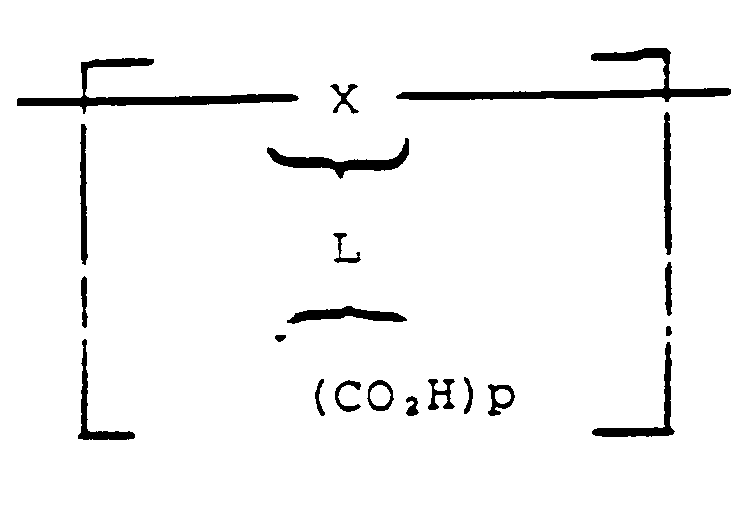
- an oral hygiene composition in the form of a pharmaceutically acceptable oral hygiene formulation comprising an effective amount of at least one polymer and a pharmaceutically acceptable vehicle for said polymer which polymer comprises one or more repeating units of general structure A and one or more repeating units of general structure B wherein X, which in the repeating units of structure A may be the same or different, and Y, which in the repeating units of structure B may be the same or different, are optionally substituted hydrocarbyl residues providing a backbone for the polymer; R1,which in the same repeating unit of structure B (when n or q is 2 or more) or in different repeating units of structure B may be the same or different, is hydrogen or methyl; R2, which in the same repeating unit of structure B (when n or q is 2 or more) or in different repeating units of structure B may be the same or different, is hydrogen or methyl; except that R1 and R2 in a single unit (CHR1CHR20) cannot both be methyl; R3, which in
- each carboxyl group is joined to the hydrocarbyl residue X by means of an intermediary or intermediaries (i.e. by a linking entity or entities), this or these being denoted by L, which is selected from one or more direct links (i.e. one or more direct bonds) and one or more groups of atoms each group providing a chain of one or more atoms for linking a carboxyl group(s) with X.
- L which is selected from one or more direct links (i.e. one or more direct bonds) and one or more groups of atoms each group providing a chain of one or more atoms for linking a carboxyl group(s) with X.
- each carboxyl group may be joined by L to the same or, in cases where L represents more than one intermediary, to the same or different carbon atoms in X, although more than 2 carboxyl groups cannot of course be directly linked to the same carbon atom of X (and also assuming that in such cases X has at least 2 carbon atoms, whereas it should be appreciated that it is within the scope of the invention for X to have only 1 carbon atom).
- L can represent up to 4 separate intermediaries in structure A (in cases where p is 4). L may be the same or different in the repeat units of structure A.
- L represents one or more groups of atoms each group providing a linking chain of atoms
- the chain will normally comprise one or more carbon atoms (which could e.g. include carbon atoms in an aryl ring) and/or hetero atoms (particularly N and/or 0).
- Examples of possible linkages provided by L are: where (apart from the direct link) the top link is to X and the bottom link(s) is to carboxyl. It is preferred in the present invention, however, that L is one or more direct links, so that each carboxyl group is joined directly to a carbon atom of X in the polymer backbone.
- p is 1 or 2 (so that L can then represent one, or at most, two intermediaries).
- each (CHR1CHR20) n group is joined to the hydrocarbyl residue Y by means of an intermediary or intermediaries (i.e. by a linking entity or entities), this or these being denoted by M, which is selected from one or more direct links (i.e. one or more direct bonds) and one or more groups of atoms each group providing a chain of one or more atoms for linking a (CHR1CHR20) n group(s) with Y.
- M which is selected from one or more direct links (i.e. one or more direct bonds) and one or more groups of atoms each group providing a chain of one or more atoms for linking a (CHR1CHR20) n group(s) with Y.
- each (CHR1CHR20) n group may be joined by M to the same or, in cases where M represents more than one intermediary, to the same or different carbon atoms in Y, although more than two (CHR1CHR20) n groups cannot of course be directly linked to the same carbon atom of Y (and also assuming that in such cases Y has at least 2 carbon atoms, whereas it should be appreciated that it is within the scope of the invention for Y to have only 1 carbon atom).
- M can represent up to 4 separate intermediaries in structure B (in cases where q is 4). M may be the same or different in the repeat units of structure B.
- M may represent one or more direct links
- M is one or more groups of atoms each group providing a linking chain of atoms; such a chain will normally comprise one or more carbon atoms (which could e.g. include carbon atoms in an aryl ring) and/or hetero atoms (particularly N and/or 0).
- Particularly preferred examples of linkages provided by M are: where the top link is to Y and the bottom link is to (CHR1CHR20) n .
- q is 1 or 2 (so that M can then represent one, or at most two intermediaries).
- the structure A represents the repeat unit derived from the polymerisation (usually free-radical initiated) of a polymerisable olefinically unsaturated carboxylic acid.
- examples of such acids are acrylic acid, methacrylic acid, maleic (or fumaric) acid, itaconic acid and the acids of formulae respectively giving rise to the following structures for A:
- Particularly preferred acids at our present stage of development are methacrylic, acrylic and maleic acid.
- the repeat units A will all be of the same specific structure, although the scope of the invention is intended to embrace polymers having repeat units A of more than one specific structure (e.g. 2 or 3 different specific structures).
- the structure B represents the repeat unit derived from the polymerisation (usually free-radical initiated) of a polymerisable olefinically unsaturated ester or amide formed from the reaction of an unsaturated carboxylic acid (or an esterifiable or amidifiable derivative thereof such as an acid chloride or anhydride) and a hydroxy compound of formula HO( ⁇ CHR1CHR20) n R3 (to form the ester) or an amine of formula H2N( ⁇ CHR1CHR20) n R3 (to form the amide).
- a polymerisable olefinically unsaturated ester or amide formed from the reaction of an unsaturated carboxylic acid (or an esterifiable or amidifiable derivative thereof such as an acid chloride or anhydride) and a hydroxy compound of formula HO( ⁇ CHR1CHR20) n R3 (to form the ester) or an amine of formula H2N( ⁇ CHR1CHR20) n R3
- the acid used is acrylic or methacrylic acid, particularly the latter, giving rise, respectively, to the following structures for B:
- the repeat units B will all be of the same specific structure, although the scope of the invention is intended to embrace polymers having repeat units B of more than one specific structure (e.g. 2 or 3 different specific structures).
- the repeating units of structure B may alternatively be formed by the partial esterification or amidification of an already-polymerised olefinically unsaturated carboxylic acid (or an esterifiable or amidifiable derivative thereof such as an acid chloride or anhydride) using, preferably, an alcohol of formula HO( ⁇ CHR1CHR20) n R3 or an amine of formula H2N( ⁇ CHR1CHR20) n R3.
- the remaining (unesterified or unamidified) carboxyl groups with their associated sections of the polymer backbone will of course provide units of structure A (it may of course be necessary to hydrolyse residual acid-derivative groups back to carboxyl when an acid derivative is used).
- an olefinically unsaturated cyclic anhydride may be used to produce both the acid and ester/amide groups of the resulting polymer.
- maleic anhydride may be polymerised to form a polymer of repeat unit and the resulting repeating units A and B after esterification with HO( ⁇ CHR1CHR20) n R3 or amidification with H2N( ⁇ CHR1CHR20) n R3 will be It is thus apparent that there are two preferred processes for preparing polymers according to the invention.
- the first process (a) comprises polymerising (usually by free-radical initiation) an olefinically unsaturated carboxylic acid (or an esterifiable or amidifiable derivative thereof) and partially esterifying or amidifying the resulting polyacid (or derivative thereof) with at least one alcohol of formula HO(CHR1CHR20) n R3 or at least one amine of formula H2N(CHR1CHR20) n R3.
- the second (and generally more preferred) process (b) comprises copolymerising (usually by free-radical initiation) at least one polymerisable ester or amide, formed from the reaction of a first olefinically unsaturated carboxylic acid (or an esterifiable or amidifiable derivative thereof) and an alcohol of formula HO( ⁇ CHR1CHR20) n R3 or an amine of formula H2N( ⁇ CHR1CHR2O) n R3, with at least one second olefinically unsaturated carboxylic acid.
- substantially all the R1 and R2 groups are hydrogen so that (CHR1CHR20) n is (CH2CH20) n .
- Such groups may be derived from the alcohol HO( ⁇ CH2CH20) n R3 or the corresponding amine H2N( ⁇ CH2CH20) n R3.
- all the R1 or R2 groups in one or more of the (CHR1CHR20) n chains may be methyl or one or more (but not all) of the R1 or R2 groups in one or more of the (CHR1CHR20) n chains may be methyl.
- R1 and R2 cannot, however, both be methyl in the same unit (CHR1CHR20) as specified hereinbefore.
- a chain could for example be derived from an amine such as H2N( ⁇ CH(CH3)CH20)2(CH2CH20)4C4H9 (where CHR1CHR2O is CH(CH3)CH20 and CH2CH20, n is 6, and C4H9 is normal butyl), or other analogous amines (varying CHR1CHR20 and n). It could also be derived from an alcohol, such as HOCH(CH3)CH20H.
- R3 is a lower alkyl group containing up to 5 carbon atoms, e.g. n-butyl or (more preferably) me thyl. It may, nevertheless, be hydrogen.
- n is a number of from 1 to 60 as defined herein. Often, however, n is preferably from 1 to 20. It should be appreciated that most polymers according to the invention (particularly those made with precursors providing the alkyleneoxy grouping that have been obtained commercially) may have a small spread of alkyleneoxy chain length so that n may represent an average value in such cases.
- the ratio of -C02H groups to -CHR1CHR20- groups is within the range of from 1:20 to 20:1. Preferably the ratio is from 1:5 to 5:1.
- the polymers of the invention have weight average molecular weights within the range of from 5000 to 500,000, although we do not exclude the possibility that suitable polymers having molecular weights outside this range may be used in the present invention.
- the groups X and Y may be unsubstituted hydrocarbyl radicals or may be substituted with groups such as hydroxy, alkoxy and halogen (chlorine) provided the desired properties of the polymers are not adversely affected.
- the groups X and Y are unsubstituted, i.e. have only groups linked L and M attached to them.
- the polymers of the invention may also contain up to 50% w/w (i.e. 0 to 50% w/w), sometimes up to 10% w/w (i,e. 0 to 10% w/w), of repeating units other than those of structures A and B, which form the backbone thereof, and these may provide one or more in-chain or pendant hetero atoms (per unit). Such other repeating units must not of course adversely affect the properties of the resulting oral hygiene compositions. More usually however, the polymers of the invention have substantially all their repeating units with structures A and B.
- the oral hygiene compositions of the invention generally have said at least one polymer present therein at a concentration of about 0.05 to 30 weight % of the composition, the preferred concentration range being from about 0.1 to 5 weight % (and more preferably 0.2 to 2 weight %).
- oral hygiene compositions of the invention will usually have only one polymer according to the invention (as defined hereinbefore) therein, it is quite feasible to use two or more such polymers in the compositions.
- Suitable conventional pharmaceutically acceptable vehicles that can be employed in the oral hygiene compositions of the present invention include water, ethanol (wherein water, or a water/ethanol mixture will often be a major component of the vehicle); such humectants as polypropylene glycol, glycerol and sorbitol; such geling agents as cellulose derivatives, for example, Methocel(RTM), carboxymethylcellulose (CMC 7MF) and Klucel(RTM) HF, polyoxypropylene/polyoxyethylene block copolymers, for example, Pluronic(RTM) F-127, Pluronic F-108, Pluronic P-103, Pluronic P-104, Pluronic P-105, and Pluronic P-123, colloidial magnesium aluminosilicate complexes such as Veegum(RTM), and mucoprotein thickening agents such as Carbopol(RTM) 934; gel stabilisers such as the silicon dioxides, for example, Cab-0-Sil(RTM) M5,
- the oral hygiene compositions of the invention may be in the form of any conventional pharmaceutically acceptable oral hygiene formulation that contains (and is compatible with) an effective amount of a polymer as defined herein.
- Such formulations include, for example, mouthwashes, rinses, irrigating solutions, abrasive and nonabrasive gel dentifrices, denture cleansers, coated dental floss, coated or impregnated toothbrush bristle (natural or synthetic), and interdental stimulator coatings, chewing gums, lozenges, breath fresheners, foams and sprays.
- the present invention is now illustrated by the following examples.
- the prefix C for a number denotes a comparative example.
- Examples 1 to 17 illustrate polymers (and their preparation) according to the present invention of which polymers oral hygiene compositions according to the invention may be comprised. It was found that comonomers providing units A and B reacted so as to give polymers in which the mole ratio of A to B units therein was close to the mole ratio used for the starting monomers (indicating approximately equal reactivities), so that the latter ratio could be used for calculating the former, which was also checked in most cases using ordinary analytical techniques (chemical analysis, NMR, and acid-base titrations).
- Methacryloyl chloride (0.11 moles) was added slowly with stirring to a slight molar excess of a 30% solution of 2,6-lutidine in toluene. Fuming occurred and a white precipitate formed.
- the mixture was cooled in an ice-bath and methoxy-ended polyethylene glycol (0.10 moles) was added dropwise over 3 hours with stirring under nitrogen. A copious white precipitate formed and stirring was continued for a further 2 hours.
- the reaction mixture was allowed to warm to room temperature.
- the precipitate was filtered off and washed with small volumes of toluene.
- the combined filtrates were evaporated to dryness (over 90% yield) on a rotary evaporator at 45°C.
- the structure of the product was confirmed, by IR, NMR and vinyl bond titration, as substantially ⁇ -methoxy- ⁇ -methacryloyloxy-polyethylene glycol.
- compositions of these polymers are also given in Table 1.
- the polymer of Example 15 was prepared by the alternative technique of partially esterifying or amidifying an already-polymerised carboxy acid or derivative thereof.
- a maleic anhydride/methyl vinyl ether copolymer (1/1 molar) of medium molecular weight (Aldrich) was reacted at an elevated temperature with the calculated amount of C4H9(OCH2CH2)4(0CH2CH(CH3))2NH2 (available commercially), under anhydrous conditions to provide a partially amidified product (each anhydride group reacting with the amine forming adjacent carboxyl and amido groups).
- This product was then heated with water (excess) to hydrolyse the residual unreacted anhydride groups to form adjacent carboxyl groups.
- the composition of this polymer is also given in Table 1.
- the polymers of C18 to C21 were prepared for comparative purposes, using substantially the same technique as used for Examples 1 to 6, etc, except that:
- the weight average molecular weights of most of the polymers were determined (using gel permeation chromatography with polystyrene or polyethylene oxide standards, and dimethyl formamide or tetrahydrofuran as solvent) and were mostly within the range 5000 and 500,000.
- Example 8 of US 3542917 was also prepared for comparative purposes, being denoted by Example C22.
- Example C23 denotes an analogous product to that of Example 8 of US 3542917 but using polyethylene glycol in place of polypropylene glycol.
- Polished hydroxyapatite discs (25 mm diameter) were used as a model tooth surface.
- S.mutans NCTC 10449 was used as the standard organism.
- the discs were used clean or were pellicle-coated by incubating in freshly collected whole saliva (from a single donor) for 1 hour at 37°C, followed by brushing with water 5 times.
- the aforementioned discs were held in a 1% w/v aqueous (or alcoholic) solution of the polymers in a petri-dish for 5 minutes at ambient temperature and were then washed by shaking 5 times in a container of flowing water ("treated discs").
- S.mutans NCTC 10449 were grown at 37°C in a Brain/Heart Infusion growth medium. A portion (20 mls) of the culture at a concentration of 109 cells/ml was centrifuged at 4,000 rpm for 10 minutes and the cells were resuspended in modified Ringer's salts solution (0.54 grams per litre NaCl; 0.02 grams per litre KCl; 0.03 grams per litre CaCl2; and 0.75 grams per litre sodium mercaptoacetate), recentrifuged, resuspended and diluted 10x in Ringer's salts solution.
- modified Ringer's salts solution (0.54 grams per litre NaCl; 0.02 grams per litre KCl; 0.03 grams per litre CaCl2; and 0.75 grams per litre sodium mercaptoacetate
- Example 5 The polymer of Example 5 was tested for its effectiveness in preventing the adherent deposition of a range of oral bacteria other than S.mutans NCTC 10449, the evaluation procedure being otherwise the same as in Examples 34 to 40, C41 to C46 (clean discs only). The results are given in Table 3. TABLE 3 Example No. Bacteria % Reduction compared with untreated control discs 49 S.sanguis 11085 96 50 S.salivarious 11389 99 51 Streptococcus Group H1 99 52 Streptococcus Group H2 99 53 Saliva Isolate A 98 54 Saliva Isolate B 99
- a number of polymers according to the invention identified as being extremely promising by the petri-dish experiments described in the preceding examples, were subjected to a more severe challenge using flowing conditions in order to more closely simulate the environment inside a mammalian (human) mouth.
- a "Drip-Machine" was developed for this purpose, and consisted of a glass reservoir containing approximately 400 ml of a stirred solution of S.mutans (prepared as for the petri-dish experiments).
Landscapes
- Chemical & Material Sciences (AREA)
- Health & Medical Sciences (AREA)
- Organic Chemistry (AREA)
- Life Sciences & Earth Sciences (AREA)
- Polymers & Plastics (AREA)
- Medicinal Chemistry (AREA)
- Chemical Kinetics & Catalysis (AREA)
- General Health & Medical Sciences (AREA)
- General Chemical & Material Sciences (AREA)
- Veterinary Medicine (AREA)
- Public Health (AREA)
- Animal Behavior & Ethology (AREA)
- Oral & Maxillofacial Surgery (AREA)
- Birds (AREA)
- Epidemiology (AREA)
- Addition Polymer Or Copolymer, Post-Treatments, Or Chemical Modifications (AREA)
- Cosmetics (AREA)
- Compositions Of Macromolecular Compounds (AREA)
Claims (20)
- Composition pour l'hygiène orale sous la forme d'une formulation pour l'hygiène orale acceptable du point de vue pharmaceutique comprenant une quantité efficace d'au moins un polymère et un véhicule acceptable du point de vue pharmaceutique pour ce polymère, lequel polymère comprend une ou plusieurs unités répétées de structure générale A

les X, qui dans les unités répétées de structure A peuvent être identiques ou différents, et les Y, qui dans les unités répétées de structure B peuvent être identiques ou différents, sont des résidus hydrocarbyles éventuellement substitués fournissant un squelette pour le polymère;
les R¹, qui dans la même unité répétée de structure B (lorsque n ou q est 2 ou plus) ou dans des unités répétées différentes de structure B peuvent être identiques ou différents, sont un atome d'hydrogène ou un groupe méthyle;
les R², qui dans la même unité répétée de structure B (lorsque n ou q est 2 ou plus) ou dans des unités répétées différentes de structure B peuvent être identiques ou différents, sont un atome d'hydrogène ou un groupe méthyle;
sauf que R¹ et R² dans une unité unique (CHR¹CHR²O) ne peuvent pas être tous deux un groupe méthyle;
les R³, qui dans la même unité répétée de structure B (lorsque q est 2 ou plus) ou dans des unités répétées différentes de structure B peuvent être identiques ou différents, sont un atome d'hydrogène ou un groupe alkyle inférieur contenant jusqu'à 5 atomes de carbone, ou un groupe acyle dérivé d'un acide alcanoïque ayant jusqu'à 5 atomes de carbone;
n est un nombre de 1 à 60;
p est un nombre de 1 à 4 et
q est un nombre de 1 à 4;
et où chaque groupe (CO₂H) est réuni via un ou des intermédiaires L au résidu hydrocarbyle X, et dans des cas où p est 2 à 4, peut être réuni par L aux mêmes atomes de carbone ou à des atomes de carbone différents de X;
et où L représente un ou plusieurs intermédiaires,
et où L peut être identique ou différent dans les unités répétées de structure A et est choisi parmi une ou plusieurs liaisons directes et un ou plusieurs groupes d'atomes, chaque groupe fournissant une chaîne d'un ou de plusieurs atomes pour relier un groupe (CO₂H) à X, sauf que plus de deux groupes (CO₂H) ne peuvent pas être directement reliés au même atome de carbone dans X;
et où chaque groupe (CHR¹CHR²O) est réuni via un ou des intermédiaires M au résidu hydrocarbyle Y, et dans des cas où q est 2 à 4, peut être réuni par M aux mêmes atomes de carbone ou à des atomes de carbone différents de Y;
et où M représente un ou plusieurs intermédiaires,
et où M peut être identique ou différent dans les unités répétées de structure B et est choisi parmi une ou plusieurs liaisons directes et un ou plusieurs groupes d'atomes, chaque groupe fournissant une chaîne d'un ou de plusieurs atomes pour relier un groupe (CHR¹CHR²O) à Y, sauf que plus de deux groupes (CHR¹CHR²O) ne peuvent pas être directement reliés au même atome de carbone dans Y;
et où le rapport du nombre des groupes -CO₂H au nombre de groupes -CHR¹CHR²O- est dans la gamme allant de 1:20 à 20:1. - Composition suivant la revendication 1, dans laquelle ce polymère est présent en une concentration de 0,05 à 30% en poids de la composition.
- Composition suivant l'une quelconque des revendications précédentes, sous la forme d'une eau dentifrice, d'une eau de rinçage, d'une solution d'irrigation, d'un dentifrice sous forme de gel abrasif ou non abrasif, d'un agent nettoyant pour dentier, d'un fil dentaire enduit, d'un revêtement ou d'un agent d'imprégnation de pâte dentifrice pour soies, d'un revêtement de stimulation interdentaire, d'une gomme à mâcher, d'une pastille, d'un produit rafraîchissant l'haleine, d'une mousse ou d'une pulvérisation.
- Composition suivant la revendication 1, dans laquelle ce polymère comprend une ou plusieurs autres unités répétées, en plus des unités répétées de structure générale A et de structure générale B, où Y dans la structure générale B est un résidu hydrocarbyle non substitué et/ou M dans la structure générale B est un groupe -COO- ou -CONH-.
- Composition suivant la revendication 1, dans laquelle L est choisi parmi une ou plusieurs liaisons directes ou un ou plusieurs groupes d'atomes fournissant chacun une chaîne d'un ou de plusieurs atomes de carbone et/ou hétéroatomes.
- Composition suivant l'une quelconque des revendications 1 à 5, dans laquelle M est choisi parmi un ou plusieurs groupes d'atomes fournissant une chaîne d'un ou de plusieurs atomes de carbone et/ou hétéroatomes.
- Composition suivant la revendication 6, dans laquelle M est choisi parmi un ou plusieurs groupes -COO- ou -CONH-.
- Composition suivant l'une quelconque des revendications 1 à 7, dans laquelle p dans la structure A est 1 ou 2.
- Composition suivant l'une quelconque des revendications 1 à 8, dans laquelle q dans la structure B est 1 ou 2.
- Composition suivant l'une quelconque des revendications 1 à 9, dans laquelle la structure A est l'unité répétée dérivée de la polymérisation d'un acide carboxylique oléfiniquement insaturé polymérisable.
- Composition suivant la revendication 10, dans laquelle cet acide est l'acide acrylique, l'acide méthacrylique, l'acide maléique ou l'acide fumarique, la N-méthacryloyl alanine ou la N-acryloyl hydroxy glycine, si bien que les structures A correspondantes sont respectivement :


et
- Composition suivant la revendication 1, dans laquelle la structure B est l'unité répétée dérivée de la polymérisation d'un ester ou d'un amide oléfiniquement insaturé polymérisable formé à partir d'un acide carboxylique oléfiniquement insaturé (ou d'un dérivé de celui-ci estérifiable ou amidifiable) et d'un composé hydroxy de formule HO-(CHR¹CHR²O)nR³ (pour former l'ester) ou d'une amine de formule H₂N-(CHR¹CHR²O)nR³ (pour former l'amide).
- Composition suivant la revendication 12, dans laquelle l'acide utilisé pour la formation de l'ester ou de l'amide est l'acide méthacrylique et les structures B correspondantes sont respectivement :

- Composition suivant la revendication 1, dans laquelle les deux structures A et B sont les unités répétées résultant de l'estérification ou de l'amidification partielle d'un acide carboxylique oléfiniquement insaturé déjà polymérisé (ou d'un dérivé de celui-ci estérifiable ou amidifiable) avec utilisation d'un alcool de formule HO-(CHR¹CHR²O)nR³ ou d'une amine de formule H₂N-(CHR¹CHR²O)nR³.
- Composition suivant la revendication 14, dans laquelle cet acide ou ce dérivé d'acide déjà polymérisé est l'anhydride d'acide polymérisé d'acide maléique, ayant l'unité répétée suivante :


- Composition suivant la revendication 1, dans laquelle pratiquement tous les groupes R¹ et R² sont des atomes d'hydrogène, si bien que le groupe (CHR¹CHR²O)n est H₂N-(CH₂CH₂O)n.
- Composition suivant la revendication 1, dans laquelle un ou plusieurs ou la totalité des groupes R¹ ou un ou plusieurs ou la totalité des groupes R² dans un oue plusieurs des chaînes (CHR¹CHR²O)n sont des groupes méthyles.
- Composition suivant la revendication 1, dans laquelle ce polymère comprend une des paires suivantes de structures pour A et B:
 où le rapport des groupes -CO₂H aux groupes -CHR¹CH₂O- (dans lesquels R¹ est un atome d'hydrogène ou un groupe méthyle comme indiqué plus haut) est compris entre 1:20 et 20:1.
- Composition suivant la revendication 1, dans laquelle ce polymère a un poids moléculaire moyen en poids compris dans la gamme de 5000 à 500.000.
- Composition suivant la revendication 1, dans laquelle le squelette de ce polymère est dérivé de ces unités répétées A et de ces unités répétées B et de 0 à 50% en p/p d'au moins une autre structure d'unité répétée qui ne nuit pas aux propriétés de la composition pour l'hygiène orale.
Applications Claiming Priority (2)
| Application Number | Priority Date | Filing Date | Title |
|---|---|---|---|
| GB848428523A GB8428523D0 (en) | 1984-11-12 | 1984-11-12 | Oral hygiene composition |
| GB8428523 | 1984-11-12 |
Related Child Applications (1)
| Application Number | Title | Priority Date | Filing Date |
|---|---|---|---|
| EP92202704.0 Division-Into | 1985-10-29 |
Publications (3)
| Publication Number | Publication Date |
|---|---|
| EP0182523A2 EP0182523A2 (fr) | 1986-05-28 |
| EP0182523A3 EP0182523A3 (en) | 1990-09-05 |
| EP0182523B1 true EP0182523B1 (fr) | 1995-01-11 |
Family
ID=10569588
Family Applications (2)
| Application Number | Title | Priority Date | Filing Date |
|---|---|---|---|
| EP19920202704 Withdrawn EP0522668A3 (en) | 1984-11-12 | 1985-10-29 | Polymers active in oral hygiene compositions |
| EP85307813A Expired - Lifetime EP0182523B1 (fr) | 1984-11-12 | 1985-10-29 | Composition hygiéniques orales et polymères actifs incorporés |
Family Applications Before (1)
| Application Number | Title | Priority Date | Filing Date |
|---|---|---|---|
| EP19920202704 Withdrawn EP0522668A3 (en) | 1984-11-12 | 1985-10-29 | Polymers active in oral hygiene compositions |
Country Status (10)
| Country | Link |
|---|---|
| US (1) | US4963347A (fr) |
| EP (2) | EP0522668A3 (fr) |
| JP (1) | JPS61118313A (fr) |
| AT (1) | ATE116842T1 (fr) |
| AU (1) | AU581695B2 (fr) |
| CA (1) | CA1262298A (fr) |
| DE (2) | DE3587974D1 (fr) |
| GB (1) | GB8428523D0 (fr) |
| NZ (1) | NZ214041A (fr) |
| ZA (1) | ZA858388B (fr) |
Families Citing this family (31)
| Publication number | Priority date | Publication date | Assignee | Title |
|---|---|---|---|---|
| US4670512A (en) * | 1986-03-14 | 1987-06-02 | The Dow Chemical Company | Acrylic coating compositions and method therefor |
| GB8801025D0 (en) * | 1988-01-18 | 1988-02-17 | Ici Plc | Oral hygiene composition |
| US5438076A (en) * | 1988-05-03 | 1995-08-01 | Perio Products, Ltd. | Liquid polymer composition, and method of use |
| US5160737A (en) * | 1988-05-03 | 1992-11-03 | Perio Products Ltd. | Liquid polymer composition, and method of use |
| US4892725A (en) * | 1988-05-09 | 1990-01-09 | The B. F. Goodrich Company | Tartar inhibition on teeth |
| US5633083A (en) * | 1989-03-14 | 1997-05-27 | Sunstar Kabushiki | Toothbrush |
| JP2608131B2 (ja) * | 1989-03-14 | 1997-05-07 | サンスター株式会社 | 歯ブラシ |
| US5211939A (en) * | 1991-09-13 | 1993-05-18 | Gillette Canada | Method for desensitizing teeth |
| US5250288A (en) * | 1991-09-13 | 1993-10-05 | Gillette Canada, Inc. | Method for desensitizing teeth |
| IT1259068B (it) * | 1992-03-16 | 1996-03-11 | Composto per la corretta rilevazione di impronte dentali | |
| WO1994022417A1 (fr) * | 1993-04-02 | 1994-10-13 | Smithkline Beecham Plc | Composition de pretraitement pour l'hygiene buccale |
| GB9307004D0 (en) * | 1993-04-02 | 1993-05-26 | Smithkline Beecham Plc | Method of treatment |
| US5660817A (en) * | 1994-11-09 | 1997-08-26 | Gillette Canada, Inc. | Desensitizing teeth with degradable particles |
| US5607663A (en) * | 1994-12-01 | 1997-03-04 | Minnesota Mining And Manufacturing Company | Hydrocarbyl containing coatings, compositions and methods of use |
| US7056935B2 (en) | 1995-06-07 | 2006-06-06 | Gpi Nil Holdings, Inc. | Rotamase enzyme activity inhibitors |
| JP2004307421A (ja) * | 2003-04-09 | 2004-11-04 | Um Dental Co Ltd | 歯科用接着剤および歯科用充填剤 |
| JP2004331558A (ja) * | 2003-05-07 | 2004-11-25 | Um Dental Co Ltd | 歯科用セメント組成物 |
| WO2004100663A1 (fr) * | 2003-05-15 | 2004-11-25 | Arch Uk Biocides Limited | Composition antimicrobienne contenant un biguanide polymerique et un copolymere et utilisation associee |
| DE602004031331D1 (de) * | 2003-05-15 | 2011-03-24 | Arch Uk Biocides Ltd | Antimikrobielle zusammensetzung enthaltend eine polymerische biguanide und ein copolymer und deren verwendung |
| JP4870564B2 (ja) * | 2003-05-15 | 2012-02-08 | アーチ ユーケイ バイオサイドズ リミテッド | 重合体ビグアニド及び共重合体を含有する抗菌組成物及びその使用 |
| WO2004100664A1 (fr) | 2003-05-15 | 2004-11-25 | Arch Uk Biocides Limited | Composition contenant un copolymere acide et un agent antimicrobien, et son utilisation |
| US7226968B2 (en) | 2003-05-20 | 2007-06-05 | Arch Uk Biocides Limited | Composition and use |
| US8603453B2 (en) | 2003-05-20 | 2013-12-10 | Arch Uk Biocides Limited | Antimicrobial polymeric biguanide and acidic co-polymer composition and method of use |
| US7217759B2 (en) | 2003-05-20 | 2007-05-15 | Arch Uk Biocides Limited | Composition and use |
| BRPI0714868A2 (pt) | 2006-09-01 | 2013-05-28 | Smithkline Beecham Corp | composiÇço para tratamento de dentadura |
| US8956161B2 (en) | 2008-11-04 | 2015-02-17 | Duane C Keller | Article and method for controlling oral-originated systemic disease |
| US8905760B2 (en) * | 2008-11-04 | 2014-12-09 | Duane C. Keller | Methods and systems for progressively treating and controlling oral periopathogens causing systemic inflammations |
| CA2778703C (fr) * | 2009-12-02 | 2018-04-24 | Huntsman Petrochemical Llc | Preparation et utilisation de compositions polymeres dispersantes |
| US8591229B2 (en) | 2010-12-16 | 2013-11-26 | Duane C. Keller | Devices and methods for creating a positive pressure environment for treatment of oral biofilms associated with periodontal disease |
| FR2974090B1 (fr) | 2011-04-15 | 2013-05-31 | Chryso | Copolymeres a groupements gem-bisphosphones |
| JP7540468B2 (ja) * | 2021-09-02 | 2024-08-27 | artience株式会社 | タンパク質用又は細胞用の添加剤 |
Family Cites Families (14)
| Publication number | Priority date | Publication date | Assignee | Title |
|---|---|---|---|---|
| US3635916A (en) * | 1969-12-29 | 1972-01-18 | Geigy Chem Corp | Copolymers of halfesters of maleic anhydride and 2-alkoxypropene |
| US3956244A (en) * | 1973-10-26 | 1976-05-11 | N L Industries, Inc. | Crosslinked vinyl acetate-maleic anhydride heteropolymers and derivatives prepared from them |
| US4079042A (en) * | 1974-12-19 | 1978-03-14 | Ciba-Geigy Corporation | Copolymers containing carboxy and ester groups, process for their manufacture and their use |
| US4110429A (en) * | 1976-12-30 | 1978-08-29 | Colgate-Palmolive Company | Antibacterial oral composition |
| JPS567707A (en) * | 1979-06-25 | 1981-01-27 | Colgate Palmolive Co | Mouth composition containing tooth tartar preventive |
| US4429087A (en) * | 1980-08-04 | 1984-01-31 | Phillips Petroleum Company | Polymerization catalyst and process |
| US4407788A (en) * | 1981-09-08 | 1983-10-04 | Colgate-Palmolive Company | Dentifrice |
| US4429097A (en) * | 1982-09-16 | 1984-01-31 | Rohm And Haas Company | Alkyl poly(oxyalkylene) esters of acrylate oligomers and copolymers thereof for thickening purposes |
| US4421902A (en) * | 1982-09-30 | 1983-12-20 | Rohm And Haas Company | Alkyl, poly(oxyethylene) poly(carbonyloxyethylene) acrylate emulsion copolymers for thickening purposes |
| JPS5988416A (ja) * | 1982-11-15 | 1984-05-22 | ジヨンソン・エンド・ジヨンソン・プロダクツ・インコ−ポレ−テツド | 口腔衛生組成物 |
| US4663385A (en) * | 1982-11-17 | 1987-05-05 | Rohm And Haas | Process for thickening with copolymers of alkyl poly (oxyalkylene) itaconic di-esters |
| GB8313232D0 (en) * | 1983-05-13 | 1983-06-22 | Causton B E | Prevention of undesired adsorption on surfaces |
| US4701319A (en) * | 1984-09-14 | 1987-10-20 | The Procter & Gamble Company | Toothpaste compositions |
| US4661341A (en) * | 1984-10-30 | 1987-04-28 | The Procter & Gamble Company | Oral compositions |
-
1984
- 1984-11-12 GB GB848428523A patent/GB8428523D0/en active Pending
-
1985
- 1985-10-29 DE DE3587974A patent/DE3587974D1/de not_active Expired - Fee Related
- 1985-10-29 AT AT85307813T patent/ATE116842T1/de not_active IP Right Cessation
- 1985-10-29 DE DE3587974T patent/DE3587974T4/de not_active Expired - Lifetime
- 1985-10-29 EP EP19920202704 patent/EP0522668A3/en not_active Withdrawn
- 1985-10-29 EP EP85307813A patent/EP0182523B1/fr not_active Expired - Lifetime
- 1985-10-31 ZA ZA858388A patent/ZA858388B/xx unknown
- 1985-11-01 NZ NZ214041A patent/NZ214041A/xx unknown
- 1985-11-06 AU AU49391/85A patent/AU581695B2/en not_active Ceased
- 1985-11-12 JP JP60253616A patent/JPS61118313A/ja active Pending
- 1985-11-12 CA CA000495089A patent/CA1262298A/fr not_active Expired
-
1988
- 1988-01-17 US US07/282,556 patent/US4963347A/en not_active Expired - Fee Related
Also Published As
| Publication number | Publication date |
|---|---|
| NZ214041A (en) | 1988-08-30 |
| CA1262298A (fr) | 1989-10-10 |
| DE3587974D1 (de) | 1995-02-23 |
| AU4939185A (en) | 1986-05-22 |
| ZA858388B (en) | 1986-06-25 |
| GB8428523D0 (en) | 1984-12-19 |
| US4963347A (en) | 1990-10-16 |
| DE3587974T4 (de) | 1995-12-07 |
| EP0182523A3 (en) | 1990-09-05 |
| JPS61118313A (ja) | 1986-06-05 |
| EP0522668A3 (en) | 1993-09-15 |
| ATE116842T1 (de) | 1995-01-15 |
| DE3587974T2 (de) | 1995-05-18 |
| EP0182523A2 (fr) | 1986-05-28 |
| AU581695B2 (en) | 1989-03-02 |
| EP0522668A2 (fr) | 1993-01-13 |
Similar Documents
| Publication | Publication Date | Title |
|---|---|---|
| EP0182523B1 (fr) | Composition hygiéniques orales et polymères actifs incorporés | |
| US5662887A (en) | Fluorocarbon containing coatings, compositions and methods of use | |
| US4362713A (en) | Salts of maleic acid copolymers as dental plaque barrier agents | |
| CA2204626C (fr) | Revetements a base "hydroxyle", compositions et procedes d'utilisation correspondants | |
| US4540507A (en) | Cleaning product for the hair and skin, based on acylisethionates, cationic polymers and salts of fatty acid/polypeptide condensates | |
| US5414060A (en) | Oral hygiene compositions and polymers active therein | |
| US4314991A (en) | Sulfonated polyamino acids as dental plaque barriers | |
| AU617144B2 (en) | Oral hygiene composition | |
| US4375461A (en) | Sulfonated vinyl aromatic homopolymers and copolymers as dental plaque barriers | |
| US4362712A (en) | Carboxylated naphthalene formaldehyde condensation polymers as dental plaque barriers | |
| US4364927A (en) | Sulfonated naphthalene formaldehyde condensation polymers as dental plaque barriers | |
| US4403089A (en) | Carboxylated naphthalene formaldehyde condensation polymers as dental plaque barriers | |
| EP0105984A1 (fr) | Polymères de condensation du formaldéhyde aromatiques en tant qu'agents protecteurs contre la plaque dentaire | |
| US4364924A (en) | Alkali metal salts of poly(vinylbenzoic acid) as dental plaque barrier agents | |
| US20240091121A1 (en) | Phosphonates and n-halamines compositions for tartar removal | |
| CN113939267B (zh) | 口腔护理组合物 | |
| GB1561362A (en) | Aminoalcohols and oral compositions thereof | |
| US3762863A (en) | Wool or hair treated with methacrylic anhydride or itaconic anhydridecopolymerized with maleic anhydride and after treated with mercaptoethylamine and propylene diamine or butyl amine | |
| EP0105983A1 (fr) | Sels de métaux alcalins de l'acide polyvinylbenzoique en tant qu'agent de barrière contre la plaque dentaire | |
| JP2002146011A (ja) | シラン化合物 | |
| EP0792141B1 (fr) | Traitement buccal | |
| CA1190150A (fr) | Sels de metaux alcalins et de poly(acide vinylbenzoique) empechant la formation de plaque dentaire | |
| JPH0495017A (ja) | 新規ポリマー及びそれを含有する毛髪化粧料 | |
| NZ202196A (en) | Oral hygiene compositions containing alkali metal salts of a homopolymer of vinylbenzoic acid | |
| NO823422L (no) | Alkalimetallsalter av poly(vinylbenzoesyre) som middel mot plaque paa tenner. |
Legal Events
| Date | Code | Title | Description |
|---|---|---|---|
| PUAI | Public reference made under article 153(3) epc to a published international application that has entered the european phase |
Free format text: ORIGINAL CODE: 0009012 |
|
| AK | Designated contracting states |
Kind code of ref document: A2 Designated state(s): AT BE CH DE FR GB IT LI LU NL SE |
|
| PUAL | Search report despatched |
Free format text: ORIGINAL CODE: 0009013 |
|
| AK | Designated contracting states |
Kind code of ref document: A3 Designated state(s): AT BE CH DE FR GB IT LI LU NL SE |
|
| 17P | Request for examination filed |
Effective date: 19910206 |
|
| 17Q | First examination report despatched |
Effective date: 19910620 |
|
| RAP1 | Party data changed (applicant data changed or rights of an application transferred) |
Owner name: SMITHKLINE BEECHAM PLC |
|
| GRAA | (expected) grant |
Free format text: ORIGINAL CODE: 0009210 |
|
| AK | Designated contracting states |
Kind code of ref document: B1 Designated state(s): AT BE CH DE FR GB IT LI LU NL SE |
|
| REF | Corresponds to: |
Ref document number: 116842 Country of ref document: AT Date of ref document: 19950115 Kind code of ref document: T |
|
| XX | Miscellaneous (additional remarks) |
Free format text: TEILANMELDUNG 92202704.0 EINGEREICHT AM 29/10/85. |
|
| EAL | Se: european patent in force in sweden |
Ref document number: 85307813.7 |
|
| REF | Corresponds to: |
Ref document number: 3587974 Country of ref document: DE Date of ref document: 19950223 |
|
| ET | Fr: translation filed | ||
| ITF | It: translation for a ep patent filed | ||
| PGFP | Annual fee paid to national office [announced via postgrant information from national office to epo] |
Ref country code: GB Payment date: 19950918 Year of fee payment: 11 Ref country code: AT Payment date: 19950918 Year of fee payment: 11 |
|
| PGFP | Annual fee paid to national office [announced via postgrant information from national office to epo] |
Ref country code: SE Payment date: 19950919 Year of fee payment: 11 |
|
| PGFP | Annual fee paid to national office [announced via postgrant information from national office to epo] |
Ref country code: LU Payment date: 19951001 Year of fee payment: 11 |
|
| PGFP | Annual fee paid to national office [announced via postgrant information from national office to epo] |
Ref country code: NL Payment date: 19951004 Year of fee payment: 11 |
|
| PGFP | Annual fee paid to national office [announced via postgrant information from national office to epo] |
Ref country code: FR Payment date: 19951020 Year of fee payment: 11 |
|
| PGFP | Annual fee paid to national office [announced via postgrant information from national office to epo] |
Ref country code: DE Payment date: 19951027 Year of fee payment: 11 |
|
| PGFP | Annual fee paid to national office [announced via postgrant information from national office to epo] |
Ref country code: BE Payment date: 19951110 Year of fee payment: 11 |
|
| PLBE | No opposition filed within time limit |
Free format text: ORIGINAL CODE: 0009261 |
|
| STAA | Information on the status of an ep patent application or granted ep patent |
Free format text: STATUS: NO OPPOSITION FILED WITHIN TIME LIMIT |
|
| PGFP | Annual fee paid to national office [announced via postgrant information from national office to epo] |
Ref country code: CH Payment date: 19951229 Year of fee payment: 11 |
|
| 26N | No opposition filed | ||
| PG25 | Lapsed in a contracting state [announced via postgrant information from national office to epo] |
Ref country code: LU Free format text: LAPSE BECAUSE OF NON-PAYMENT OF DUE FEES Effective date: 19961029 Ref country code: GB Effective date: 19961029 Ref country code: AT Effective date: 19961029 |
|
| PG25 | Lapsed in a contracting state [announced via postgrant information from national office to epo] |
Ref country code: SE Effective date: 19961030 |
|
| PG25 | Lapsed in a contracting state [announced via postgrant information from national office to epo] |
Ref country code: LI Effective date: 19961031 Ref country code: CH Effective date: 19961031 Ref country code: BE Effective date: 19961031 |
|
| BERE | Be: lapsed |
Owner name: SMITHKLINE BEECHAM P.L.C. Effective date: 19961031 |
|
| PG25 | Lapsed in a contracting state [announced via postgrant information from national office to epo] |
Ref country code: NL Effective date: 19970501 |
|
| REG | Reference to a national code |
Ref country code: CH Ref legal event code: PL |
|
| GBPC | Gb: european patent ceased through non-payment of renewal fee |
Effective date: 19961029 |
|
| PG25 | Lapsed in a contracting state [announced via postgrant information from national office to epo] |
Ref country code: FR Effective date: 19970630 |
|
| NLV4 | Nl: lapsed or anulled due to non-payment of the annual fee |
Effective date: 19970501 |
|
| PG25 | Lapsed in a contracting state [announced via postgrant information from national office to epo] |
Ref country code: DE Effective date: 19970701 |
|
| EUG | Se: european patent has lapsed |
Ref document number: 85307813.7 |
|
| REG | Reference to a national code |
Ref country code: FR Ref legal event code: ST |