EP0182670A2 - Optisches Aufzeichnungsmedium - Google Patents
Optisches Aufzeichnungsmedium Download PDFInfo
- Publication number
- EP0182670A2 EP0182670A2 EP85308493A EP85308493A EP0182670A2 EP 0182670 A2 EP0182670 A2 EP 0182670A2 EP 85308493 A EP85308493 A EP 85308493A EP 85308493 A EP85308493 A EP 85308493A EP 0182670 A2 EP0182670 A2 EP 0182670A2
- Authority
- EP
- European Patent Office
- Prior art keywords
- recording medium
- optical recording
- layer
- manganese phthalocyanine
- phthalocyanine
- Prior art date
- Legal status (The legal status is an assumption and is not a legal conclusion. Google has not performed a legal analysis and makes no representation as to the accuracy of the status listed.)
- Granted
Links
Images

Classifications
-
- G—PHYSICS
- G11—INFORMATION STORAGE
- G11B—INFORMATION STORAGE BASED ON RELATIVE MOVEMENT BETWEEN RECORD CARRIER AND TRANSDUCER
- G11B7/00—Recording or reproducing by optical means, e.g. recording using a thermal beam of optical radiation by modifying optical properties or the physical structure, reproducing using an optical beam at lower power by sensing optical properties; Record carriers therefor
- G11B7/24—Record carriers characterised by shape, structure or physical properties, or by the selection of the material
- G11B7/241—Record carriers characterised by shape, structure or physical properties, or by the selection of the material characterised by the selection of the material
- G11B7/242—Record carriers characterised by shape, structure or physical properties, or by the selection of the material characterised by the selection of the material of recording layers
- G11B7/244—Record carriers characterised by shape, structure or physical properties, or by the selection of the material characterised by the selection of the material of recording layers comprising organic materials only
- G11B7/246—Record carriers characterised by shape, structure or physical properties, or by the selection of the material characterised by the selection of the material of recording layers comprising organic materials only containing dyes
- G11B7/248—Record carriers characterised by shape, structure or physical properties, or by the selection of the material characterised by the selection of the material of recording layers comprising organic materials only containing dyes porphines; azaporphines, e.g. phthalocyanines
Definitions
- This invention relates to an optical recording medium in which optical information is recorded and reproduced by means of high energy optical beams such as a semiconductor laser beam.
- Direct-read-after-write (hereinafter referred to simply as DRAW) systems have been developed and are now in use, in which high energy beams such as laser beams, are used to record and reproduce optical information. Intensive studies have now been made to develop disc mediums for use in the DRAW systems.
- the disc medium can be classified into two groups.
- One group makes use of inorganic metals as a recording layer, whereas the other group uses organic pigments or dyes.
- the former medium has the great advantage that because information is recorded in a high contrast, the signal-to-noise ratio becomes high when the medium is reproduced.
- the metal layer is apt to undergo oxidation with the attendant disadvantage that the medium is not durable.
- the metals used are, in most cases, harmful to the human body, thus presenting the problem of public nuisance.
- the latter medium undesirably requires an additional reflective film since organic dyes are not generally so high in reflectivity. This disadvantageously makes the manufacture process complicated and invites a high manufacture cost.
- the optical recording medium of the invention is suitable for recording and reproducing optical information by application of a high energy beam.
- the medium is of the type in which an optical information signal is encoded as physical variations or pits.
- the medium comprises a substrate which is tranparent to a high energy beam and has tracking guides for servo control on one side thereof, and a layer of manganese phthalocyanine formed on the one side of the transparent substrate.
- a protective layer may be provided over and arranged parallel at a distance from phthalocyanine layer to establish a gap between the phthalocyanine layer and the protective layer.
- a double-sided recording medium can be readily fabricated using two medium units of the type described above.
- a pair of the above medium units are assembled such that the manganese phthalocyanine films are facing each other at a distance to allow a gap therebetween which is equal to or larger than the thickness of the manganese phthalocyanine layer.
- the resultant medium can be recorded on opposite sides, i.e. recording on double sides becomes possible.
- the present invention is characterized by using, as an optical recording layer, manganese phthalocyanine.
- Manganese phthalocyanine has the following formula
- manganese phthalocyanine has a fairly high reflectance when used as an optical recording layer. This means that any additional reflective film is not necessary as will be used in prior optical recording mediums using organic dyes. This is very advantageous in that the manufacture process becomes simple and the medium can be manufactured at lost cost. To a surprise, it has also been found that the signal-to-noise ratio becomes much better than the ratio attained by the case where a reflective film is provided as in prior art mediums.
- Manganese phthalocyanine of the above formula has a high reflectance and an appropriate absorbance in a wavelength range of from 700 to 900 nm, which is a wavelength usually generated from semiconductor lasers ordinarily used for these purposes. Especially, in the case of an optical recording medium of the DRAW type, it is desirable that the absorbance of the recording medium in the wavelength of a semiconductor laser beam be rather high. This is because the output power for the laser at the time of recording can be decreased, so that a substrate do not undergo an undesirable thermal history. In this sense, manganese phthalocyanine is very useful.
- the signal-to-noise ratio of the recording medium of the invention is very high.
- an optical recording medium comprising an aluminum reflective layer provided between a substrate and a manganese phthalocyanine film has a signal-to-noise ratio of 30dB, whereas an optical recording medium of the invention which is free of the aluminum reflective film, has a signal-to-noise ratio as high as 48 dB.
- the manganese phthalocyanine of the foregoing formula is a phthalocyanine complex in which Mn is present as a central metal.
- Mn is present as a central metal.
- metalo-phthalocyanines are known but are completely different in nature from manganese phthalocyanine when applied as an optical recording layer.
- metalo-phthalocyanines containing, as the central metal, Cu, Co, Ni, Fe, Zn, Sn and the like are known.
- good results cannot be obtained as will be seen from comparative examples appearing hereinafter.
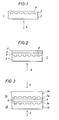
- an optical recording medium 1 which comprises a substrate 2 and a manganese phthalocyanine layer 3 formed on the substrate 2.
- the substrate 2 has, on one side thereof, tracking guides or grooves 4 which serve for servo control as is well known in the art. These tracking guides 4 are formed by molding of the substrate 2 and have usually a depth of 0.1 micron and pitches of 1.6 microns.
- the substrate 2 is generally in the form of a disk but may have any other forms, if desired.
- the substrate 2 should be made of materials which are transparent to high energy beams such as semiconductor laser beams and include, for example, glasses and synthetic resins such as methacrylic resin, polycarbonate resins and the like.
- the manganese phthalocyanine layer 2 is readily formed by vacuum deposition under conditions of a vacuum of about 10 -2 to 10 -3 Pa and a temperature of about 300 to 500°C.
- the layer 2 is formed to have a thickness of about 50(2K -1) to 90(2k - 1) nm , preferably 60(2k - 1) to 80(2k - 1) nm in which k is a positive integer and preferably, k is 1.
- the recording medium using manganese phthalocyanine is advantageous in that the recording speed is high and it is free of any problem of toxicity as in the case of lead phthalocyanine. It will be noted that in Fig. 1, a high energy beam is applied from the side indicated by arrow A.
- the recording medium 1 as shown in Fig. 1 may have a protective layer 5 formed through a gap 6 at the side of the manganese phthalocyanine layer 2 as particularly shown in Fig. 2.
- the protective layer 5 is usually made of a transparent material such as vinyl chloride resins, methacrylate resins, polycarbonate resins and the like.
- the gap 6 is arranged to be equal to or larger than the thickness of the manganese phthalocyanine layer 2.
- the protective layer 5 and the manganese phthalocyanine layer-bearing substrate 1 are fixedly secured, for example, at the peripheral margin thereof.
- the optical recording medium is a single-sided medium.
- a double-sided recording medium may be readily fabricated, in which a pair of medium units of the type described above, i.e. each unit has the same construction as shown in Fig. 1, are assembled so that the manganese phthalocyanine layers of the respective units are facing each other at a distance equal to or larger than the thickness of the manganese phthalocyanine layer.
- Fig. 3 in which there is shown a unit 1a which comprises a substrate 2a and a manganese phthalocyanine layer 3a formed on the substrate 2a.
- another unit 1b has a substrate 2b and a manganese phthalocyanine layer 3b.
- the two units are assembled in such a way that the layers 3a, 3b are in face- to-face relation through a gap 7.
- the gap 7 is determined to be equal to or larger than the thickness of the layer 3a or 3b.
- the paired units are bonded at inner and/or outer marginal portions thereof by a suitable means.
- the units la and 1b are recorded and reproduced by means of high energy beams indicated by arrows a and b, respectively.
- the high energy beams used in the practice of the invention may be any laser beams having a wavelength ranging from 700 to 900 nm.
- semiconductor lasers such as semiconductive GaAs-AIGaAs lasers are generally used.
- the present invention is more particularly described by way of example.
- a polycarbonate resin disk having a diameter of 12 cm was placed in a vacuum evaporator having a boat for evaporation of a sample target.
- Fifty milligrams of manganese phthalocyanine of the afore-indicated formula (product of Dainichi Seika K.K.) was placed on the boat.
- the vacuum evaporator was kept at a vacuum of 10 -3 Pa and the boat was heated to 500°C, so that manganese phthalocyanine was evaporated on one surface of the disk, thereby obtaining an optical disk as shown in Fig. 1.
- the thickness of the phthalocyanine layer was measured by an optical interference measuring instrument with the result that it was 80 nm.
- the manganese phthalocyanine layer of the optical disc was subjected to measurement of an absorbance characteristic. The results are shown by solid line in Fig. 4.
- the curve has an absorption peak at 760 nm at which the absorbance is about 0.9. At 780 nm, the absorbance is about 0.8. From this, it will be seen that the manganese phthalocyanine layer has an alpha-type crystal form.
- the regular reflectance determined by an integrator, was found to be about 40% at 780 nm.
- an information signal was recorded on and reproduced from the optical disk using a semiconductor laser beam having a wavelength of 780 nm.
- the signal-to-noise ratio at a frequency of 1 MHz was 48 dB.
- the recording was conducted under conditions of a frequency of the optical disk of 900 r.p.m., a laser beam pulse frequency of 1 MHZ at a linear velocity of 4.8 m/second, and an average output power of 3.5 mU. After the recording, the disk was reproduced at a laser output power of 0.5 mU.
- Example 2 The general procedure of Example was repeated except that the polycarbonate resin disk was first provided with a 50 nm thick aluminum reflective film and then placed in the vacuum evaporator, thereby obtaining a reflective film-bearing optical disk.
- This optical disk was subjected to recording by the use of a semiconductor laser capable of outputting a beam with a wavelength of 780 nm, at an average output power of 4 mU. Thereafter, the disk was reproduced at a laser output power of 0.5 mU. As a result, it was found that the signal-to-noise ratio at the reproduction operation was as low as 30 dB.
- the signal-to-noise ratio of the reflective film-bearing medium at lMHz is lower by 18 dB than the medium of the invention.
- the optical disk of the invention is much superior to the optical disk of this comparative example.
- Example 2 The general procedure of Example was repeated except that phthalocyanine was formed, instead of manganese phthalocyanine, in a thickness of 90 nm, thereby obtaining a reflective film-free optical disk.
- the absorbance characteristic of the phthalocyanine film was measured with the results as shown by broken line in Fig. 4. More particularly, the regular reflectance at 780 nm is 23%.
- a semiconductor laser was used for recording on the disk at a wavelength of 780 nm and an output power of 8 mU, followed by reproduction at a laser output power of 1 mW. As a result, it was found that the signal-to-noise ratio was 25 dB.
- Example 2 The general procedure of Example was repeated except that iron phthalocyanine was formed, instead of manganese phthalocyanine, in a thickness of 70 nm, thereby obtaining a reflective film-free optical disk.
- the absorbance and regular reflectance of the optical disk at 780 nm were measured and found to be 0.2% and 22%, respectively.
- the disk was subjected to recording by the use of a semiconductor laser capable of emitting a beam with a wavelength of 780 nm, at an output power of 8 mU and then reproduced at an output power of 1 mW. As a result, it was found that the signal-to-noise ratio was as low as 20 dB. Comparative Example 4
- Example 2 The general procedure of Example was repeated except that zinc phthalocyanine was used instead of manganese phthalocyanine, thereby obtaining an optical disk.
- the absorbance and regular reflectance of the zinc phthalocyanine layer at 780 nm were, respectively, 0.2 and 16%.
- the signal-to-noise ratio was found to be as low as 15 dB when determined in the same manner as in Comparative
- Example 2 The general procedure of Example was repeated except that neodymium phthalocyanine was used instead of manganese phthalocyanine, thereby obtaining an optical disk.
- the absorbance and regular reflectance of the disk were, respectively, 0.2 and 26%.
- the signal-to-noise ratio was found to be as low as 25 dB when determined in the same manner as in Comparative Example 3.
- Example 2 The general procedure of Example was repeated except that cobalt phthalocyanine was used instead of manganese phthalocyanine, thereby obtaining an optical disk.
- the absorbance and regular reflectance of the disk were, respectively, 0.2 and 25%.
- the signal-to-noise ratio was found to be as low as 25 dB when determined in the same manner as in Comparative Example 3.
- Example 2 The general procedure of Example was repeated except that copper phthalocyanine was used instead of manganese phthalocyanine, thereby obtaining an optical disk.
- the absorbance and regular reflectance of the disk were, respectively, 0.2 and 21%.
- the signal-to-noise ratio was found to be as low as 25 dB when determined in the same manner as in Comparative Example 3.
Landscapes
- Thermal Transfer Or Thermal Recording In General (AREA)
- Optical Record Carriers And Manufacture Thereof (AREA)
Applications Claiming Priority (2)
| Application Number | Priority Date | Filing Date | Title |
|---|---|---|---|
| JP59246345A JPS61125882A (ja) | 1984-11-22 | 1984-11-22 | 光記録媒体 |
| JP246345/84 | 1984-11-22 |
Publications (3)
| Publication Number | Publication Date |
|---|---|
| EP0182670A2 true EP0182670A2 (de) | 1986-05-28 |
| EP0182670A3 EP0182670A3 (en) | 1987-06-03 |
| EP0182670B1 EP0182670B1 (de) | 1990-10-24 |
Family
ID=17147177
Family Applications (1)
| Application Number | Title | Priority Date | Filing Date |
|---|---|---|---|
| EP19850308493 Expired EP0182670B1 (de) | 1984-11-22 | 1985-11-21 | Optisches Aufzeichnungsmedium |
Country Status (3)
| Country | Link |
|---|---|
| EP (1) | EP0182670B1 (de) |
| JP (1) | JPS61125882A (de) |
| DE (1) | DE3580246D1 (de) |
Cited By (2)
| Publication number | Priority date | Publication date | Assignee | Title |
|---|---|---|---|---|
| EP0943954A3 (de) * | 1998-03-19 | 2001-06-06 | Nec Corporation | Optische Sicherung |
| NL1018424C2 (nl) * | 2001-06-29 | 2003-01-07 | Otb Group Bv | Werkwijze voor het vervaardigen van ten minste één informatiedrager, alsmede een informatiedrager. |
Family Cites Families (3)
| Publication number | Priority date | Publication date | Assignee | Title |
|---|---|---|---|---|
| GB2066489B (en) * | 1979-11-29 | 1983-10-19 | Rca Corp | Ablative optical recording medium |
| JPS5856892A (ja) * | 1981-10-01 | 1983-04-04 | Ricoh Co Ltd | 光学的情報記録媒体 |
| US4492750A (en) * | 1983-10-13 | 1985-01-08 | Xerox Corporation | Ablative infrared sensitive devices containing soluble naphthalocyanine dyes |
-
1984
- 1984-11-22 JP JP59246345A patent/JPS61125882A/ja active Pending
-
1985
- 1985-11-21 DE DE8585308493T patent/DE3580246D1/de not_active Expired - Fee Related
- 1985-11-21 EP EP19850308493 patent/EP0182670B1/de not_active Expired
Cited By (2)
| Publication number | Priority date | Publication date | Assignee | Title |
|---|---|---|---|---|
| EP0943954A3 (de) * | 1998-03-19 | 2001-06-06 | Nec Corporation | Optische Sicherung |
| NL1018424C2 (nl) * | 2001-06-29 | 2003-01-07 | Otb Group Bv | Werkwijze voor het vervaardigen van ten minste één informatiedrager, alsmede een informatiedrager. |
Also Published As
| Publication number | Publication date |
|---|---|
| EP0182670A3 (en) | 1987-06-03 |
| EP0182670B1 (de) | 1990-10-24 |
| JPS61125882A (ja) | 1986-06-13 |
| DE3580246D1 (de) | 1990-11-29 |
Similar Documents
| Publication | Publication Date | Title |
|---|---|---|
| EP0353391B1 (de) | Optisches Informationsaufzeichnungsmedium | |
| JPS58224793A (ja) | 光学記録媒体 | |
| JPS6052940A (ja) | 光学記録媒体 | |
| HK1000262B (en) | Optical information recording medium | |
| JPS6063744A (ja) | 光学的情報記録媒体 | |
| JPH0415115B2 (de) | ||
| AU2002219540B2 (en) | Optical recording medium | |
| EP0084729A1 (de) | Aufzeichnungsmedien | |
| EP0097929B1 (de) | Optisches Informationsaufzeichnungsmedium für Halbleiterlaser | |
| EP0227981A2 (de) | Herstellungsverfahren für ein optisches Aufzeichnungsmedium | |
| EP0376231A2 (de) | Optischer Aufzeichnungsträger | |
| US5391413A (en) | Optical recording medium | |
| EP0182670B1 (de) | Optisches Aufzeichnungsmedium | |
| US6129968A (en) | Phase change recording medium and method for recording therein and reproduction therefrom | |
| US5445853A (en) | Optical data storage media | |
| US4829509A (en) | Optical recording medium, its preparation and its use as a read only memory information carrier | |
| JP3287860B2 (ja) | 光学的情報記録方法と記録媒体 | |
| JP2923036B2 (ja) | 情報記録媒体 | |
| KR950003183B1 (ko) | 광자기 기록매체 | |
| JPS6141597A (ja) | 光学的情報記録媒体 | |
| JPS62125552A (ja) | 光記録媒体 | |
| JPS60151850A (ja) | 光記録媒体 | |
| JPH10334507A (ja) | 光情報記録媒体 | |
| JPS59131493A (ja) | 光学記録媒体の製造方法 | |
| JPH01184736A (ja) | 光情報記録方法と情報記録媒体 |
Legal Events
| Date | Code | Title | Description |
|---|---|---|---|
| PUAI | Public reference made under article 153(3) epc to a published international application that has entered the european phase |
Free format text: ORIGINAL CODE: 0009012 |
|
| AK | Designated contracting states |
Kind code of ref document: A2 Designated state(s): DE FR GB |
|
| PUAL | Search report despatched |
Free format text: ORIGINAL CODE: 0009013 |
|
| AK | Designated contracting states |
Kind code of ref document: A3 Designated state(s): DE FR GB |
|
| 17P | Request for examination filed |
Effective date: 19871116 |
|
| 17Q | First examination report despatched |
Effective date: 19890417 |
|
| GRAA | (expected) grant |
Free format text: ORIGINAL CODE: 0009210 |
|
| AK | Designated contracting states |
Kind code of ref document: B1 Designated state(s): DE FR GB |
|
| ET | Fr: translation filed | ||
| REF | Corresponds to: |
Ref document number: 3580246 Country of ref document: DE Date of ref document: 19901129 |
|
| PLBE | No opposition filed within time limit |
Free format text: ORIGINAL CODE: 0009261 |
|
| STAA | Information on the status of an ep patent application or granted ep patent |
Free format text: STATUS: NO OPPOSITION FILED WITHIN TIME LIMIT |
|
| 26N | No opposition filed | ||
| PGFP | Annual fee paid to national office [announced via postgrant information from national office to epo] |
Ref country code: FR Payment date: 19921109 Year of fee payment: 8 |
|
| PGFP | Annual fee paid to national office [announced via postgrant information from national office to epo] |
Ref country code: GB Payment date: 19921110 Year of fee payment: 8 |
|
| PGFP | Annual fee paid to national office [announced via postgrant information from national office to epo] |
Ref country code: DE Payment date: 19921212 Year of fee payment: 8 |
|
| PG25 | Lapsed in a contracting state [announced via postgrant information from national office to epo] |
Ref country code: GB Effective date: 19931121 |
|
| GBPC | Gb: european patent ceased through non-payment of renewal fee |
Effective date: 19931121 |
|
| PG25 | Lapsed in a contracting state [announced via postgrant information from national office to epo] |
Ref country code: FR Effective date: 19940729 |
|
| PG25 | Lapsed in a contracting state [announced via postgrant information from national office to epo] |
Ref country code: DE Effective date: 19940802 |
|
| REG | Reference to a national code |
Ref country code: FR Ref legal event code: ST |