EP0183523B1 - Automobile antenna system - Google Patents
Automobile antenna system Download PDFInfo
- Publication number
- EP0183523B1 EP0183523B1 EP85308574A EP85308574A EP0183523B1 EP 0183523 B1 EP0183523 B1 EP 0183523B1 EP 85308574 A EP85308574 A EP 85308574A EP 85308574 A EP85308574 A EP 85308574A EP 0183523 B1 EP0183523 B1 EP 0183523B1
- Authority
- EP
- European Patent Office
- Prior art keywords
- loop antenna
- antenna
- automobile
- antenna system
- vehicle body
- Prior art date
- Legal status (The legal status is an assumption and is not a legal conclusion. Google has not performed a legal analysis and makes no representation as to the accuracy of the status listed.)
- Expired - Lifetime
Links
Images





Classifications
-
- H—ELECTRICITY
- H01—ELECTRIC ELEMENTS
- H01Q—ANTENNAS, i.e. RADIO AERIALS
- H01Q1/00—Details of, or arrangements associated with, antennas
- H01Q1/27—Adaptation for use in or on movable bodies
- H01Q1/32—Adaptation for use in or on road or rail vehicles
- H01Q1/325—Adaptation for use in or on road or rail vehicles characterised by the location of the antenna on the vehicle
- H01Q1/3283—Adaptation for use in or on road or rail vehicles characterised by the location of the antenna on the vehicle side-mounted antennas, e.g. bumper-mounted, door-mounted
Definitions
- the present invention relates to an automobile antenna system and, more particularly, to an improved automobile antenna system for effectively detecting broadcast radio waves received by the vehicle body and then transferring detected signals to various receivers located in the vehicle.
- Antenna systems are indispensable to modern automobiles which must positively receive various broadcast waves such as those for radio, television and telephone at the receivers located within the vehicle. Such antenna systems are also very important for citizen band transceivers.
- One of the conventional antenna systems is known as a pole-type antenna which projects outwardly from the vehicle body of an automobile. Although such a pole antenna is superior in performance in its own way, it always remains a nuisance from the viewpoint of vehicle body design.
- the pole antenna is disadvantageous in that it is subject to damage, tampering or theft and also in that the antenna acts to generate noises during high-speed driving. For these reasons, there has heretofore been a strong desire to eliminate the need for such pole antennas.
- the conventional antenna systems have not been successful in efficiently detecting currents induced on the vehicle body by broadcast waves.
- an automobile antenna system comprising a pick-up mounted by a bracket adjacent a sheet metal member forming a portion of the automobile body to detect radio frequency surface currents, at a frequency above 50 MHz, induced in said sheet metal member by broadcast radio frequency signals and concentrated on a marginal edge portion of the sheet metal member; said pick-up comprising casing means, an elongate loop antenna and a signal processing circuit; said casing means having an elongate opening and at least part of the casing means being formed of metal to serve as a shield against external electromagnetic fields; said elongate loop antenna being received within said casing means with one longer side of the loop antenna extending along said opening; said signal processing circuit being received within said metal shield and connected to said loop antenna to process signals picked up by said antenna; and a filling material filling the space within said casing means around said loop antenna to fix and hold the loop antenna in position.
- EP-A-181782; EP-A-180462; EP-A-181120; EP-A-181765; EP-A-182497; and EP-A-183521 are not prior publications but may be documents of the type mentioned in Article 54(3) of the European Patent Convention.
- EP-A-181782 discloses and claims an automobile antenna system comprising a pick-up mounted adjacent a sheet metal member forming a portion of the automobile body to detect radio frequency surface currents, at a frequency above 50 MHz, induced in said sheet metal member by broadcast radio frequency signals and concentrated on a marginal edge portion of the sheet metal member; said pick-up comprising a casing having an elongate opening and an elongate loop antenna received within said casing with one longer side of the loop antenna extending along said opening; and said marginal edge portion of said sheet metal member also extending along said opening; said opening being in the form of a slit having depth to provide an inner portion and an outer portion, said inner portion serving to locate said one longer side of the loop antenna in position, and said outer portion serving as guide groove means to receive said marginal edge portion to locate said pick-up relative to said sheet metal member and so also to locate said longer side of the loop antenna in a predetermined position closely adjacent and parallel to said marginal edge portion.
- Figures 1 to 9 illustrate a process of examining the distribution characteristics of high-frequency currents to determine a location at which an antenna system can operate most efficiently on the vehicle body of an automobile.
- Figure 1 shows that when external electromagnetic waves W, such as broadcast waves, pass through the vehicle body B of conductive metal, surface currents I are induced at various vehicle locations at levels corresponding to the intensities of electromagnetic waves passing therethrough.
- the present invention aims at only electromagnetic waves which belong to relatively high frequency bands in excess of 50 MHz, such as FM broadcast waves, television waves and others.
- the distribution of the surface currents induced on the vehicle body by electromagnetic waves within the above-described particular wave bands is measured so as to seek a location on the vehicle body which is higher in surface current density and lower in noise and at which a pick-up used in the present invention is to be located.
- the distribution of surface currents is determined by a simulation using a computer and also by measuring actual intensities of surface currents at various locations on a vehicle.
- the measurement is carried out by the use of a probe which can operate in accordance with the same principle as that of a high-frequency pick-up actually located on the vehicle body at the desired location, as will be described later.
- a probe is moved on the vehicle body throughout the entire surface thereof to measure the level of surface currents at various locations on the vehicle body.
- FIG. 2 shows an example of such a probe P which is constructed in accordance with substantially the same principle as that of the high-frequency pick-up described hereinafter.
- the probe P is composed of a casing of electrically conductive material 10 for preventing any external electromagnetic wave from transmitting to the interior thereof and a loop coil 12 rigidly located within the casing 10.
- the casing 10 includes an opening 1Oa formed therein through which a portion of the loop coil 12 is externally exposed.
- the exposed portion of the loop coil 12 is positioned in close proximity to the surface of the vehicle body B to detect magnetic flux induced by surface currents on the vehicle body B.
- Another portion of the loop coil 12 is connected to the casing 10 through a short-circuiting line 14.
- the loop coil 12 further includes an output end 16 connected with a core 20 in an coaxial cable 18. Still another portion of the loop coil 12 includes a capacitor 22 for causing the frequency in the loop coil 12 to resonate relative to the desired frequency to be measured to increase the efficiency of the pick-up.
- the distribution and direction of surface currents can accurately be determined at each of the vehicle locations.
- the output of the probe P is amplified by a high-frequency voltage amplifier 24 and the resulting output voltage is measured by a high-frequency voltmeter 26.
- This coil output voltage is read at the indicated value of the high-frequency voltmeter 26 and also is recorded by an XY recorder 28 to provide the distribution of surface currents at various vehicle locations.
- the input of the XY recorder 28 receives signals indicative of various vehicle locations from a potentiometer 30 to recognize the value of high-frequency surface currents at the corresponding vehicle location.
- Figure 3 illustrates an angle ⁇ of deflection between the high-frequency surface currents I and the loop coil 12 of the pick-up.
- magnetic flux ⁇ intersects the loop coil 12 to generate a detection voltage V in the loop coil 12.
- the angle ⁇ of deflection is equal to zero, that is, the surface currents I are parallel to the loop coil 12 of the pick-up, the maximum voltage can be obtained.
- the direction of the surface currents I when the probe P is rotated to obtain the maximum voltage can also be determined.
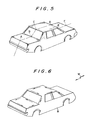
- Figures 5 and 6 respectively show the magnitude and direction of high-frequency surface currents induced at various different locations on the vehicle body at the frequency of 80 MHz, the values of which are obtained from the measurements of the probe P and the simulation effected by the computer.
- the distribution of surface currents has higher densities at the marginal edge of the vehicle body and lower densities at the central portions of the flat vehicle panels.
- Figure 7 shows a distribution of surface currents along a trunk lid between two points A and B on the longitudinal axis. As can be seen from this drawing, the surface currents attain very high levels at these points A and B and decrease toward the central portion of the trunk lid from the opposite points thereof.
- Figure 8 shows the distribution of surface currents along the roof panel of the vehicle body
- Figure 9 shows the distribution of surface currents along the engine hood of the vehicle body.
- the pick-up should be disposed at or near the marginal edge of each of the vehicle panel areas in order to catch broadcast waves with high sensitivity.
- the high-frequency pick-up can similarly be located on one of pillars and fenders as well as on the trunk lid, the engine hood and the roof panel.
- loop antenna of the high-frequency pick-up is arranged longitudinally adjacent to and along the marginal edge of each vehicle panel area, this loop antenna is preferably positioned within a range determined depending upon the carrier frequency of broadcast waves in order to obtain sensitivity very suitable for practical use.
- the distribution of currents shown in Figures 7 to 9 relates to the currents induced on the vehicle body by FM broadcast waves having the frequency of 80 MHz.
- the value of surface currents decreases in accordance with the distance between the position of the surface currents and the marginal portions of the vehicle. Considering that good sensitivity can actually be obtained in the range of decreased currents below 6 dB, it is understood that such sensitivity may be realized if the pick-up is located within a distance of 4.5 cm from each marginal edge of the vehicle.
- a satisfactory antenna system can be provided if a high-frequency pick-up is arranged within a distance of 4.5 cm away from a marginal vehicle portion for the carrier frequency of 80 MHz.
- the high-frequency pick-up is located adjacent to the marginal edge of each panel area of the metallic vehicle body and is preferably disposed within said range from that marginal edge.
- a high-frequency pick-up may be disposed at a vehicle location spaced away from a desired marginal edge of the vehicle body within a distance of 3.6 cm. It will be apparent that as the value of the carrier frequency f is increased, the distance between the high-frequency pick-up and the corresponding marginal edge of the vehicle body will be decreased.
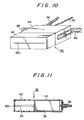
- Figure 10 shows the external appearance of a high-frequency pick-up suitable for an automobile antenna system
- Figure 11 is a schematic vertical sectional view thereof. The pick-up shown in Figs 10 and 11 is outside the scope of the present invention.
- a high-frequency pick-up 32 includes therewithin a loop antenna 34 for detecting high-frequency surface currents therewithin and a circuitry 36 which is connected to the loop antenna in order to match and amplify detected signals.
- the high frequency pick-up 32 constituting an electromagnetic coupling type pick-up in this way is disposed in proximity to a marginal edge of the vehicle body.
- the high-frequency detection signal which is processed by the circuitry 36 is fed outward by a coaxial cable 38, and is processed by a circuit similar to that used for measurement of the distribution of the surface currents.
- a power source and a signal for controlling the circuit is supplied to the circuitry 36 from a cable 40.
- the high-frequency pick-up 32 is composed of a first casing 42 and a second casing 44, which protect the loop antenna 34, and the circuitry 36, and is provided with brackets 46, 48 for fastening the high-frequency pick-up 32 to the vehicle body.
- the first casing 42 and the second casing 44 are secured to each other, and they are disposed such that the first casing 42 protects the loop antenna 34 and the second casing 44 protects the circuitry 36.
- the first casing 42 is formed of a synthetic resin, and an opening 42a is formed on the side facing the marginal edge portion of the vehicle body so that a longer side of the loop antenna 34 is exposed. Therefore, the magnetic flux induced by the high-frequency current flowing at the marginal edge portion of the vehicle body is positively caught by the loop antenna 34.
- the first casing 42 is made of a synthetic resin, the loop surface is not magnetically shielded and thus the magnetic flux produced at the marginal edge portion of the vehicle body can be detected over a wide range.
- the second casing 44 is made of a metal and is connected to the shield layer of the coaxial cable 38, thereby functioning as a shield and removing the influence of any noise on the circuitry 32.
- the brackets 46, 48 are made of a synthetic resin, and locate and firmly fix the high-frequency pick-up 32 to the marginal edge portion of the vehicle body.
- the high-frequency pick-up 32 When the high-frequency pick-up 32 is mounted, it assumes an electrically insulated state, so that the output is increased by about 5 dB in comparison with a case where metal brackets are used. This is because they prevent the currents in the opposite direction of the high-frequency surface currents flowing at the marginal edge portion of the vehicle body from flowing into the metal casing 44 and decreasing the degree of magnetic flux which passes the loop surface.
- the loop antenna 34 is in the form of a single wound coil which is covered with an insulation such that the coil can be arranged in an electrically insulated relationship with and in close contact with the marginal edge portion of the vehicle body.
- the magnetic flux induced by the surface currents can intersect the loop antenna 42 with increased intensity.
- the side of the loop antenna 34 which is exposed from the casing 42 is disposed within a distance of 4.5 cm from the marginal edge portion of the vehicle body, whereby the FM broadcast waves of the frequency of 80 MHz can be positively detected from the surface currents flowing at the marginal edge portion of the vehicle body. Since the surface currents on the vehicle body flow along its marginal portions, as is clear from Figure 6, the loop antenna 34 in this embodiment is disposed longitudinally along the marginal edge portion of the vehicle body.
- the surface currents flowing along the marginal edge of the vehicle body are electromagnetically detected with high sensitivity by the high-frequency pick-up, and reception in a high-frequency range is ensured without any external exposure of the antenna system.
- the use of synthetic resin for various components reduces the weight of the antenna as a whole. Thus this embodiment is very useful as an automobile antenna system.
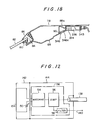
- Fig 12 shows a variable capacitor 50 connected in series to a loop antenna 134 in a first casing 142.
- the frequency of the loop antenna 134 can be caused to resonate relative to a desired frequency to be measured in order to increase the efficiency of the pick-up by adjusting the variable capacitor 50 through an adjust hole formed in the first synthetic resin case 142.
- the signal from the loop antenna 134 is connected to a matching circuit 54, the latter matching the impedance of the signal in relation to an amplifying circuit 56 which is to be employed in a later step.
- the amplifying circuit 56 is connected to a battery power source through a filter 58 by a cable 140 and the output of the amplifying circuit 56 is connected with a receiver by a coaxial cable 138.
- Figure 13 shows an embodiment similar to that shown in Figure 11.
- the loop antenna in this embodiment is fixed and held by a filling material in the first case.
- Elements similar to those shown in Figure 11 are indicated by the correspondent reference numerals prefixed by the numeral 2.
- This embodiment is characterized in that a loop antenna 234 is fixed and held by a filling material 60 in a first casing 242.
- a dielectric material having a low dielectric constant such as polyester, epoxy resin, silicone resin is formed by pouring, molding, or the like, in the gap between the casing 242 and the loop antenna 234 and integrally fixes and holds the loop antenna 234.
- the filling material 60 preferably has a dielectric constant of 2 to 4 in the frequency bands ranging from 70 to 1,000 MHz, and a small dielectric loss tangent.
- ribs 64 are provided around a printed circuit base board 62 which electrically connects the loop antenna 234 and a circuitry 236, so that inclination or deformation of the printed circuit base board 62 is prevented.
- the loop antenna 234 is firmly secured and held, and the loop antenna 234 does not resonate at all, furthermore the output does not attenuate even when a pick-up 232 is vibrated by vibration of the vehicle body.
- This embodiment also prevents any probability of insufficient contact between the printed circuit base board 62 and the loop antenna 234.
- the loop antenna 234 is enveloped by the filling material 60, no condensation is produced on the loop antenna 234 even in winter.
- Figure 14 shows still another embodiment, in which the loop antenna 234 is provided in such a manner as to be inclined in relation to the printed circuit base board 62.
- Such arrangement allows the loop antenna 234 to have a large loop surface and, hence, the output is advantageously increased.
- the loop antenna 234 and a circuitry 236 is housed in a metal casing 43.
- Figure 15 shows a high-frequency pick-up in accordance with the invention mounted on the rear marginal edge portion of the roof panel.
- a roof panel 66 is illustrated in the exposed state, and the metallic roof panel 66 is connected to a rearwindow glass 70 with a rearwindow frame 68 as its marginal edge.
- the high-frequency pick-up 32 is disposed within a distance of 4.5 cm inward of the rearwindow frame 70.
- an opening 68a is provided at a part of the rearwindow frame 68 in order to dispose the loop antenna of the high-frequency pick-up 32 such as to face the marginal edge portion of the rearwindow frame 68, and the casing 43 of the high-frequency pick-up 32 is inserted into the opening 68a.
- L-shaped brackets 72 and 74 are connected to both side surfaces of the casing 43 by bolts or the like. These brackets 54 and 56 are screwed to the rearwindow frame 68.
- the loop antenna is in the form of a compound wound coil which is covered with an insulation such that the coil can be arranged in an electrically insulated relationship with and in close contact with the rear window frame 68.
- the magnetic flux induced by the surface currents can intersect the loop antenna with increased intensity.
- the loop antenna is disposed within a distance of 4.5 cm from the edge portion of the rearwindow frame 68, whereby the FM broadcast waves of the frequency of 80 MHz can be positively detected from the surface currents flowing at the marginal edge portion of the rearwindow frame 68. Since the surface currents on the vehicle flow along its marginal portions, as is clear from Figure 6, the loop antenna is disposed longitudinally along the marginal edge portion of the rearwindow frame 68.
- the surface currents flowing along the marginal edge of the vehicle, especially along the marginal edge portion of the roof panel are electromagnetically detected with high sensitivity by the high-frequency pick-up, and reception in a high-frequency range is ensured without any external exposure of the antenna system.
- Fig. 16 shows a state in which the loop antenna 334 is located in proximity to a metallic vehicle panel a.
- the angle of degrees between the loop surface of the loop antenna 334 and the prolongation of the center line of the metallic vehicle panel a was varied successively in this state, to examine how it affects the efficiency of detecting the surface currents flowing on the metallic panel a.
- the surface currents are detected with high efficiency if the loop antenna 334 of the automobile antenna system is arranged such that the loop surface thereof makes an angle of 45 to 90 degrees or -45 to -90 degrees with respect to the prolongation of the center line of the metallic panel a.
- Brackets having slots for adjusting the retaining position of screws may be secured to the shield casing through these slots, thereby enabling the positional relationship between the automobile antenna system and the metallic vehicle panel to be adjusted as desired, and, hence, the antenna system to be attached such as to efficiently detect the surface currents induced by broadcast waves and flowing through the metallic vehicle panel.
- this dispenses with the need for an externally exposed pole antenna as employed in the prior art, or the like and provides a small-sized automobile antenna of high performance.
- Figure 18 shows an automobile antenna system according to the invention in the state of being attached to the vehicle roof.
- a rearwindow glass 82 is connected to the rear marginal edge of a roof panel 78 through a water sealing dam 80 and, the external marginal edge of the rearwindow glass 82 is, as is known, enveloped with a molding 86 with one end thereof secured to a stopper 84 which is provided on a roof panel 78.
- the marginal edge portion of a roof strip 88 on the side of the rearwindow glass is opposed to the inside of the roof panel 78, and is bonded with the roof panel 78 by spot welding or the like. Therefore, the surface currents induced on the roof panel 78 by broadcasting waves flow not only on the roof panel but also on the roof strip 88 after being transmitted directly or diffracted.
- the automobile antenna system shown in Figure 18 is mounted in such a manner that the surface currents induced on the roof strip 88 by broadcast waves are detected with high efficiency.
- the automobile antenna system is supported by a bracket 346 which is attached to the side surface of a shield casing 343, and that portion of the bracket which is attached to the vehicle body is fastened to the marginal edge portion 88a of the roof strip 88 by a screw 90.
Landscapes
- Engineering & Computer Science (AREA)
- Remote Sensing (AREA)
- Details Of Aerials (AREA)
Priority Applications (1)
| Application Number | Priority Date | Filing Date | Title |
|---|---|---|---|
| AT85308574T ATE84172T1 (de) | 1984-11-26 | 1985-11-26 | Fahrzeugantennensystem. |
Applications Claiming Priority (6)
| Application Number | Priority Date | Filing Date | Title |
|---|---|---|---|
| JP250345/84 | 1984-11-26 | ||
| JP250344/84 | 1984-11-26 | ||
| JP25034484A JPS61127204A (ja) | 1984-11-26 | 1984-11-26 | 自動車用アンテナ装置 |
| JP25034584A JPS61127205A (ja) | 1984-11-26 | 1984-11-26 | 自動車用アンテナ装置 |
| JP258806/84 | 1984-12-06 | ||
| JP25880684A JPS61136303A (ja) | 1984-12-06 | 1984-12-06 | 自動車用アンテナ装置 |
Publications (3)
| Publication Number | Publication Date |
|---|---|
| EP0183523A2 EP0183523A2 (en) | 1986-06-04 |
| EP0183523A3 EP0183523A3 (en) | 1988-04-20 |
| EP0183523B1 true EP0183523B1 (en) | 1992-12-30 |
Family
ID=27333928
Family Applications (1)
| Application Number | Title | Priority Date | Filing Date |
|---|---|---|---|
| EP85308574A Expired - Lifetime EP0183523B1 (en) | 1984-11-26 | 1985-11-26 | Automobile antenna system |
Country Status (5)
| Country | Link |
|---|---|
| US (1) | US4819001A (da) |
| EP (1) | EP0183523B1 (da) |
| CA (1) | CA1245352A (da) |
| DE (1) | DE3586942T2 (da) |
| DK (1) | DK543585A (da) |
Families Citing this family (37)
| Publication number | Priority date | Publication date | Assignee | Title |
|---|---|---|---|---|
| JPS6193701A (ja) * | 1984-10-13 | 1986-05-12 | Toyota Motor Corp | 自動車用アンテナ装置 |
| CA1245757A (en) * | 1984-10-29 | 1988-11-29 | Junzo Ohe | Automobile antenna system |
| US4717922A (en) * | 1984-11-06 | 1988-01-05 | Toyota Jidosha Kabushiki Kaisha | Automobile antenna system |
| CA1249052A (en) * | 1984-11-08 | 1989-01-17 | Junzo Ohe | Automobile antenna system |
| DK525485A (da) * | 1984-11-15 | 1986-05-16 | Toyota Motor Co Ltd | Autoantenneanlaeg |
| CA1245351A (en) * | 1984-11-15 | 1988-11-22 | Junzo Ohe | Automobile antenna system |
| CA1248220A (en) * | 1984-12-12 | 1989-01-03 | Junzo Ohe | Automobile antenna system |
| EP0209235B1 (en) * | 1985-06-10 | 1991-01-02 | Toyota Jidosha Kabushiki Kaisha | Automobile tv antenna system |
| DE3685272D1 (de) * | 1985-06-28 | 1992-06-17 | Toyota Motor Co Ltd | Fahrzeugantennensystem. |
| JPS6231201A (ja) * | 1985-08-01 | 1987-02-10 | Dx Antenna Co Ltd | マイクロストリツプ・アンテナ装置 |
| JPH0626283B2 (ja) * | 1985-08-09 | 1994-04-06 | トヨタ自動車株式会社 | 自動車用アンテナ装置 |
| JPH0642605B2 (ja) * | 1985-08-09 | 1994-06-01 | トヨタ自動車株式会社 | 自動車用アンテナ装置 |
| GB2207557A (en) * | 1987-06-01 | 1989-02-01 | Leader Radio Co Ltd | Antenna |
| FR2661531B1 (fr) * | 1990-04-25 | 1994-09-30 | Sagem | Dispositif anti-fraude pour lecteur d'objets portatifs pourvus chacun d'un circuit electronique de memorisation. |
| US5623297A (en) * | 1993-07-07 | 1997-04-22 | Intermec Corporation | Method and apparatus for controlling a thermal printhead |
| US5686903A (en) * | 1995-05-19 | 1997-11-11 | Prince Corporation | Trainable RF transceiver |
| US5699054A (en) * | 1995-05-19 | 1997-12-16 | Prince Corporation | Trainable transceiver including a dynamically tunable antenna |
| CA2222691A1 (en) * | 1995-06-06 | 1996-12-12 | Flash Comm, Inc. | Determining propagating and clear frequency in wireless data communications network |
| US5734963A (en) * | 1995-06-06 | 1998-03-31 | Flash Comm, Inc. | Remote initiated messaging apparatus and method in a two way wireless data communications network |
| US5765112A (en) * | 1995-06-06 | 1998-06-09 | Flash Comm. Inc. | Low cost wide area network for data communication using outbound message specifying inbound message time and frequency |
| US5589844A (en) * | 1995-06-06 | 1996-12-31 | Flash Comm, Inc. | Automatic antenna tuner for low-cost mobile radio |
| EP1006667B1 (en) * | 1998-05-25 | 2007-07-25 | Mitsubishi Denki Kabushiki Kaisha | Receiver |
| US6576847B2 (en) * | 1999-05-25 | 2003-06-10 | Intel Corporation | Clamp to secure carrier to device for electromagnetic coupler |
| ES2183692B2 (es) * | 2000-09-29 | 2004-11-16 | Televes, S.A. | Antena. |
| ES2182657B1 (es) * | 2000-09-29 | 2004-06-01 | Televes, S.A. | Antena. |
| ES2182658B1 (es) * | 2000-09-29 | 2004-06-01 | Televes, S.A. | Antena. |
| ES2184577B1 (es) * | 2000-09-29 | 2004-08-16 | Televes, S.A. | Antena. |
| US7088198B2 (en) * | 2002-06-05 | 2006-08-08 | Intel Corporation | Controlling coupling strength in electromagnetic bus coupling |
| US6887095B2 (en) * | 2002-12-30 | 2005-05-03 | Intel Corporation | Electromagnetic coupler registration and mating |
| WO2006035623A1 (ja) * | 2004-09-28 | 2006-04-06 | Aisin Seiki Kabushiki Kaisha | アンテナ装置及びドアハンドル装置 |
| US7193582B2 (en) * | 2005-06-13 | 2007-03-20 | Trans Electric Co., Ltd. | Digital receiving antenna device for a digital television |
| MY169622A (en) * | 2008-06-10 | 2019-04-23 | Mimos Berhad | An auto active antenna |
| US20120218068A1 (en) * | 2011-02-28 | 2012-08-30 | Equos Research Co., Ltd. | Antenna |
| CN109643838B (zh) * | 2016-07-12 | 2021-06-29 | 标致雪铁龙汽车股份有限公司 | 天线电子盒在车辆的尾盖上的安装 |
| FR3058680B1 (fr) * | 2016-11-14 | 2018-12-07 | Valeo Comfort And Driving Assistance | Boitier antenne pour vehicule automobile |
| JP6810668B2 (ja) * | 2017-08-24 | 2021-01-06 | 小島プレス工業株式会社 | 車載アンテナ装置 |
| CN109406894B (zh) * | 2018-09-19 | 2021-04-13 | 中车长春轨道客车股份有限公司 | 带状线装置 |
Citations (5)
| Publication number | Priority date | Publication date | Assignee | Title |
|---|---|---|---|---|
| EP0180462A2 (en) * | 1984-10-29 | 1986-05-07 | Toyota Jidosha Kabushiki Kaisha | Automobile antenna system |
| EP0181120A2 (en) * | 1984-10-26 | 1986-05-14 | Toyota Jidosha Kabushiki Kaisha | Automobile antenna system |
| EP0181765A1 (en) * | 1984-11-06 | 1986-05-21 | Toyota Jidosha Kabushiki Kaisha | Automobile antenna system |
| EP0182497A1 (en) * | 1984-10-17 | 1986-05-28 | Toyota Jidosha Kabushiki Kaisha | Automobile antenna |
| EP0183521A1 (en) * | 1984-11-27 | 1986-06-04 | Toyota Jidosha Kabushiki Kaisha | Automobile antenna system |
Family Cites Families (41)
| Publication number | Priority date | Publication date | Assignee | Title |
|---|---|---|---|---|
| US2200674A (en) * | 1939-05-04 | 1940-05-14 | Jr Eugene F Mcdonald | Radio apparatus |
| US2481978A (en) * | 1947-01-22 | 1949-09-13 | Joseph B Clough | Automobile radio coupler and method of communication |
| US2520986A (en) * | 1947-10-22 | 1950-09-05 | Motorola Inc | Vehicular antenna system |
| US2575471A (en) * | 1950-04-13 | 1951-11-20 | Philco Corp | Vehicular antenna system |
| DE889618C (de) * | 1951-09-27 | 1953-09-10 | Lorenz C Ag | Kraftwagenantennenanlage |
| US2740113A (en) * | 1952-01-03 | 1956-03-27 | Bendix Aviat Corp | Magnetic antenna systems |
| US2774811A (en) * | 1954-03-02 | 1956-12-18 | Shanok Abraham | Antenna and trim |
| US3007164A (en) * | 1955-04-22 | 1961-10-31 | Ross A Davis | Slot antenna which is fed at two points |
| US2971191A (en) * | 1955-07-18 | 1961-02-07 | Ross A Davis | Slot type antenna having an autotransformer coupling circuit |
| US2950479A (en) * | 1955-12-05 | 1960-08-23 | Gen Electric | Loop antenna utilizing conductive cabinet |
| US3066293A (en) * | 1956-03-16 | 1962-11-27 | Ross A Davis | Antenna system with output means in parallel with resonating means |
| US2859441A (en) * | 1957-06-21 | 1958-11-04 | Rosenbaum Jacob | Automobile radio antenna |
| US3210766A (en) * | 1962-02-15 | 1965-10-05 | Ralph O Parker | Slot type antenna with tuning circuit |
| US3364487A (en) * | 1964-12-01 | 1968-01-16 | Rosario J. Maheux | Portable radio receiver antenna coupler set |
| DE1949828A1 (de) * | 1968-10-04 | 1970-04-30 | Portenseigne Ets Marcel | Verfahren und Vorrichtung zum Empfangen radiofrequenter Signale |
| JPS4836583B1 (da) * | 1969-06-13 | 1973-11-06 | ||
| JPS5033076Y1 (da) * | 1969-12-09 | 1975-09-26 | ||
| US3717876A (en) * | 1971-04-23 | 1973-02-20 | Volkers Res Corp | Ferrite antenna coupled to radio frequency currents in vehicle body |
| US3823403A (en) * | 1971-06-09 | 1974-07-09 | Univ Ohio State Res Found | Multiturn loop antenna |
| US3794997A (en) * | 1971-09-30 | 1974-02-26 | Toyota Motor Co Ltd | Vehicle with apparatus for detecting potential collisions |
| HU170360B (da) * | 1973-05-23 | 1977-05-28 | ||
| US3916413A (en) * | 1973-12-21 | 1975-10-28 | Ross Alan Davis | Remotely tuned conductive-body antenna system |
| US3961330A (en) * | 1973-12-21 | 1976-06-01 | Ross Alan Davis | Antenna system utilizing currents in conductive body |
| US3961292A (en) * | 1974-01-02 | 1976-06-01 | Ross Alan Davis | Radio frequency transformer |
| US3972048A (en) * | 1974-11-29 | 1976-07-27 | Ross Alan Davis | FM-AM windshield antenna |
| US4003056A (en) * | 1975-05-20 | 1977-01-11 | Ross Alan Davis | Windshield antenna system with resonant element and cooperating resonant conductive edge |
| US4080603A (en) * | 1976-07-12 | 1978-03-21 | Howard Belmont Moody | Transmitting and receiving loop antenna with reactive loading |
| DE2701921A1 (de) * | 1977-01-19 | 1978-07-20 | Angel Dr Ing Jotzoff | Dem wagen integriertes antennengebilde insbesondere fuer autoradios |
| DE2733478B2 (de) * | 1977-07-25 | 1980-04-17 | Hans Heinrich Prof. Dr. Dr.-Ing.E.H. 8035 Gauting Meinke | Antenne in Form eines Kraftfahrzeuges |
| DE2745475A1 (de) * | 1977-10-08 | 1979-04-12 | Juergen Fischer | Antenne fuer kraftfahrzeuge |
| JPS54128653A (en) * | 1978-03-30 | 1979-10-05 | Nippon Gakki Seizo Kk | Antenna unit for receiver |
| US4217591A (en) * | 1978-09-20 | 1980-08-12 | The United States Of America As Represented By The Secretary Of The Army | High frequency roll-bar loop antenna |
| JPS5827681B2 (ja) * | 1978-09-29 | 1983-06-10 | 日本国有鉄道 | 車両用誘導無線ル−プアンテナの取付構造 |
| US4317121A (en) * | 1980-02-15 | 1982-02-23 | Lockheed Corporation | Conformal HF loop antenna |
| US4339827A (en) * | 1980-11-25 | 1982-07-13 | Rca Corporation | Automatic tuning circuit arrangement with switched impedances |
| US4566133A (en) * | 1982-12-27 | 1986-01-21 | Commtech International | Switched diversity method and apparatus for FM receivers |
| US4499606A (en) * | 1982-12-27 | 1985-02-12 | Sri International | Reception enhancement in mobile FM broadcast receivers and the like |
| US4506267A (en) * | 1983-01-26 | 1985-03-19 | Geophysical Survey Systems, Inc. | Frequency independent shielded loop antenna |
| JPS59181732A (ja) * | 1983-03-31 | 1984-10-16 | Toshiba Corp | 携帯用無線機におけるダイバ−シチ−受信方式 |
| DK525485A (da) * | 1984-11-15 | 1986-05-16 | Toyota Motor Co Ltd | Autoantenneanlaeg |
| JP3145184B2 (ja) * | 1992-05-18 | 2001-03-12 | ホシザキ電機株式会社 | 冷蔵庫 |
-
1985
- 1985-11-21 CA CA000495890A patent/CA1245352A/en not_active Expired
- 1985-11-25 US US06/801,310 patent/US4819001A/en not_active Expired - Fee Related
- 1985-11-25 DK DK543585A patent/DK543585A/da not_active Application Discontinuation
- 1985-11-26 DE DE8585308574T patent/DE3586942T2/de not_active Expired - Fee Related
- 1985-11-26 EP EP85308574A patent/EP0183523B1/en not_active Expired - Lifetime
Patent Citations (5)
| Publication number | Priority date | Publication date | Assignee | Title |
|---|---|---|---|---|
| EP0182497A1 (en) * | 1984-10-17 | 1986-05-28 | Toyota Jidosha Kabushiki Kaisha | Automobile antenna |
| EP0181120A2 (en) * | 1984-10-26 | 1986-05-14 | Toyota Jidosha Kabushiki Kaisha | Automobile antenna system |
| EP0180462A2 (en) * | 1984-10-29 | 1986-05-07 | Toyota Jidosha Kabushiki Kaisha | Automobile antenna system |
| EP0181765A1 (en) * | 1984-11-06 | 1986-05-21 | Toyota Jidosha Kabushiki Kaisha | Automobile antenna system |
| EP0183521A1 (en) * | 1984-11-27 | 1986-06-04 | Toyota Jidosha Kabushiki Kaisha | Automobile antenna system |
Also Published As
| Publication number | Publication date |
|---|---|
| EP0183523A2 (en) | 1986-06-04 |
| US4819001A (en) | 1989-04-04 |
| EP0183523A3 (en) | 1988-04-20 |
| DE3586942T2 (de) | 1993-07-15 |
| DK543585D0 (da) | 1985-11-25 |
| CA1245352A (en) | 1988-11-22 |
| DK543585A (da) | 1986-05-27 |
| DE3586942D1 (de) | 1993-02-11 |
Similar Documents
| Publication | Publication Date | Title |
|---|---|---|
| EP0183523B1 (en) | Automobile antenna system | |
| CA1256988A (en) | Automobile antenna | |
| EP0181120B1 (en) | Automobile antenna system | |
| US4811024A (en) | Automobile antenna | |
| CA1239470A (en) | Automobile antenna system | |
| EP0183521B1 (en) | Automobile antenna system | |
| US4717921A (en) | Automobile antenna system | |
| EP0211637B1 (en) | Vehicle antenna system | |
| US4804967A (en) | Vehicle antenna system | |
| EP0180462B1 (en) | Automobile antenna system | |
| US4754284A (en) | Automobile antenna system | |
| US4792807A (en) | Automobile antenna system | |
| JPS61120534A (ja) | 車両用アンテナ装置 | |
| JPS61114604A (ja) | 自動車用アンテナ装置 | |
| JPS61129907A (ja) | 自動車用アンテナ装置 | |
| JPS61127204A (ja) | 自動車用アンテナ装置 | |
| JPS61120504A (ja) | 自動車用アンテナのピツクアツプ | |
| JPH0652849B2 (ja) | 自動車用アンテナのピツクアツプ | |
| JPS61136303A (ja) | 自動車用アンテナ装置 | |
| JPS61127206A (ja) | 自動車用アンテナ装置 | |
| JPS61129904A (ja) | 自動車用アンテナ装置 | |
| JPS61105906A (ja) | 自動車用アンテナ装置 | |
| JPS61128607A (ja) | 自動車用アンテナ装置 |
Legal Events
| Date | Code | Title | Description |
|---|---|---|---|
| PUAI | Public reference made under article 153(3) epc to a published international application that has entered the european phase |
Free format text: ORIGINAL CODE: 0009012 |
|
| AK | Designated contracting states |
Kind code of ref document: A2 Designated state(s): AT CH DE FR GB LI SE |
|
| PUAL | Search report despatched |
Free format text: ORIGINAL CODE: 0009013 |
|
| AK | Designated contracting states |
Kind code of ref document: A3 Designated state(s): AT CH DE FR GB LI SE |
|
| 17P | Request for examination filed |
Effective date: 19880530 |
|
| 17Q | First examination report despatched |
Effective date: 19891018 |
|
| GRAA | (expected) grant |
Free format text: ORIGINAL CODE: 0009210 |
|
| AK | Designated contracting states |
Kind code of ref document: B1 Designated state(s): AT CH DE FR GB LI SE |
|
| REF | Corresponds to: |
Ref document number: 84172 Country of ref document: AT Date of ref document: 19930115 Kind code of ref document: T |
|
| ET | Fr: translation filed | ||
| REF | Corresponds to: |
Ref document number: 3586942 Country of ref document: DE Date of ref document: 19930211 |
|
| PLBE | No opposition filed within time limit |
Free format text: ORIGINAL CODE: 0009261 |
|
| STAA | Information on the status of an ep patent application or granted ep patent |
Free format text: STATUS: NO OPPOSITION FILED WITHIN TIME LIMIT |
|
| 26N | No opposition filed | ||
| EAL | Se: european patent in force in sweden |
Ref document number: 85308574.4 |
|
| PGFP | Annual fee paid to national office [announced via postgrant information from national office to epo] |
Ref country code: FR Payment date: 19951109 Year of fee payment: 11 |
|
| PGFP | Annual fee paid to national office [announced via postgrant information from national office to epo] |
Ref country code: AT Payment date: 19951113 Year of fee payment: 11 |
|
| PGFP | Annual fee paid to national office [announced via postgrant information from national office to epo] |
Ref country code: SE Payment date: 19951116 Year of fee payment: 11 |
|
| PGFP | Annual fee paid to national office [announced via postgrant information from national office to epo] |
Ref country code: GB Payment date: 19951117 Year of fee payment: 11 |
|
| PGFP | Annual fee paid to national office [announced via postgrant information from national office to epo] |
Ref country code: DE Payment date: 19951128 Year of fee payment: 11 |
|
| PGFP | Annual fee paid to national office [announced via postgrant information from national office to epo] |
Ref country code: CH Payment date: 19951211 Year of fee payment: 11 |
|
| PG25 | Lapsed in a contracting state [announced via postgrant information from national office to epo] |
Ref country code: GB Effective date: 19961126 Ref country code: AT Effective date: 19961126 |
|
| PG25 | Lapsed in a contracting state [announced via postgrant information from national office to epo] |
Ref country code: SE Effective date: 19961127 |
|
| PG25 | Lapsed in a contracting state [announced via postgrant information from national office to epo] |
Ref country code: LI Effective date: 19961130 Ref country code: CH Effective date: 19961130 |
|
| REG | Reference to a national code |
Ref country code: CH Ref legal event code: PL |
|
| GBPC | Gb: european patent ceased through non-payment of renewal fee |
Effective date: 19961126 |
|
| PG25 | Lapsed in a contracting state [announced via postgrant information from national office to epo] |
Ref country code: FR Effective date: 19970731 |
|
| PG25 | Lapsed in a contracting state [announced via postgrant information from national office to epo] |
Ref country code: DE Effective date: 19970801 |
|
| EUG | Se: european patent has lapsed |
Ref document number: 85308574.4 |
|
| REG | Reference to a national code |
Ref country code: FR Ref legal event code: ST |