EP0183577A1 - Dérivés du thiadiazole actifs sur le système nerveux central, procédé d'obtension et compositions pharmaceutiques les contenant - Google Patents
Dérivés du thiadiazole actifs sur le système nerveux central, procédé d'obtension et compositions pharmaceutiques les contenant Download PDFInfo
- Publication number
- EP0183577A1 EP0183577A1 EP85401972A EP85401972A EP0183577A1 EP 0183577 A1 EP0183577 A1 EP 0183577A1 EP 85401972 A EP85401972 A EP 85401972A EP 85401972 A EP85401972 A EP 85401972A EP 0183577 A1 EP0183577 A1 EP 0183577A1
- Authority
- EP
- European Patent Office
- Prior art keywords
- group
- thiadiazole
- formula
- derivatives
- amine
- Prior art date
- Legal status (The legal status is an assumption and is not a legal conclusion. Google has not performed a legal analysis and makes no representation as to the accuracy of the status listed.)
- Granted
Links
- 238000000034 method Methods 0.000 title claims abstract description 18
- 150000004867 thiadiazoles Chemical class 0.000 title claims abstract description 8
- 210000003169 central nervous system Anatomy 0.000 title claims abstract description 6
- 239000008194 pharmaceutical composition Substances 0.000 title claims abstract description 6
- 238000002360 preparation method Methods 0.000 title claims abstract description 4
- -1 biphenylyl group Chemical group 0.000 claims abstract description 22
- 125000000217 alkyl group Chemical group 0.000 claims abstract description 11
- 125000004432 carbon atom Chemical group C* 0.000 claims abstract description 9
- 239000000460 chlorine Substances 0.000 claims abstract description 7
- 229910052801 chlorine Inorganic materials 0.000 claims abstract description 7
- 150000003839 salts Chemical class 0.000 claims abstract description 7
- 125000003545 alkoxy group Chemical group 0.000 claims abstract description 6
- ZAMOUSCENKQFHK-UHFFFAOYSA-N Chlorine atom Chemical compound [Cl] ZAMOUSCENKQFHK-UHFFFAOYSA-N 0.000 claims abstract description 5
- 125000000753 cycloalkyl group Chemical group 0.000 claims abstract description 5
- 125000002887 hydroxy group Chemical group [H]O* 0.000 claims abstract description 5
- 125000000449 nitro group Chemical group [O-][N+](*)=O 0.000 claims abstract description 5
- 125000005843 halogen group Chemical group 0.000 claims abstract description 4
- 125000001997 phenyl group Chemical group [H]C1=C([H])C([H])=C(*)C([H])=C1[H] 0.000 claims abstract description 4
- 125000002023 trifluoromethyl group Chemical group FC(F)(F)* 0.000 claims abstract description 4
- 150000001875 compounds Chemical class 0.000 claims description 23
- 150000001412 amines Chemical class 0.000 claims description 9
- 238000006243 chemical reaction Methods 0.000 claims description 8
- 239000002904 solvent Substances 0.000 claims description 7
- 125000004464 hydroxyphenyl group Chemical group 0.000 claims description 5
- 238000010438 heat treatment Methods 0.000 claims description 4
- 125000001309 chloro group Chemical group Cl* 0.000 claims description 3
- 125000005805 dimethoxy phenyl group Chemical group 0.000 claims description 3
- 239000004480 active ingredient Substances 0.000 claims description 2
- WKBOTKDWSSQWDR-UHFFFAOYSA-N Bromine atom Chemical group [Br] WKBOTKDWSSQWDR-UHFFFAOYSA-N 0.000 claims 2
- GDTBXPJZTBHREO-UHFFFAOYSA-N bromine Chemical group BrBr GDTBXPJZTBHREO-UHFFFAOYSA-N 0.000 claims 2
- 229910052794 bromium Chemical group 0.000 claims 2
- 239000003153 chemical reaction reagent Substances 0.000 claims 2
- 230000001335 demethylating effect Effects 0.000 claims 2
- 239000012429 reaction media Substances 0.000 claims 2
- 230000001131 transforming effect Effects 0.000 claims 2
- 239000000047 product Substances 0.000 description 21
- XEKOWRVHYACXOJ-UHFFFAOYSA-N Ethyl acetate Chemical compound CCOC(C)=O XEKOWRVHYACXOJ-UHFFFAOYSA-N 0.000 description 12
- 239000000243 solution Substances 0.000 description 10
- XLYOFNOQVPJJNP-UHFFFAOYSA-N water Substances O XLYOFNOQVPJJNP-UHFFFAOYSA-N 0.000 description 10
- 239000000203 mixture Substances 0.000 description 8
- VEXZGXHMUGYJMC-UHFFFAOYSA-N Hydrochloric acid Chemical compound Cl VEXZGXHMUGYJMC-UHFFFAOYSA-N 0.000 description 7
- 241001465754 Metazoa Species 0.000 description 7
- LFQSCWFLJHTTHZ-UHFFFAOYSA-N Ethanol Chemical compound CCO LFQSCWFLJHTTHZ-UHFFFAOYSA-N 0.000 description 6
- OKKJLVBELUTLKV-UHFFFAOYSA-N Methanol Chemical compound OC OKKJLVBELUTLKV-UHFFFAOYSA-N 0.000 description 6
- 241000699670 Mus sp. Species 0.000 description 6
- HEMHJVSKTPXQMS-UHFFFAOYSA-M Sodium hydroxide Chemical compound [OH-].[Na+] HEMHJVSKTPXQMS-UHFFFAOYSA-M 0.000 description 6
- NLKNQRATVPKPDG-UHFFFAOYSA-M potassium iodide Chemical compound [K+].[I-] NLKNQRATVPKPDG-UHFFFAOYSA-M 0.000 description 6
- LDCYZAJDBXYCGN-VIFPVBQESA-N 5-hydroxy-L-tryptophan Chemical compound C1=C(O)C=C2C(C[C@H](N)C(O)=O)=CNC2=C1 LDCYZAJDBXYCGN-VIFPVBQESA-N 0.000 description 5
- 206010015995 Eyelid ptosis Diseases 0.000 description 5
- 238000012360 testing method Methods 0.000 description 5
- CSNNHWWHGAXBCP-UHFFFAOYSA-L Magnesium sulfate Chemical compound [Mg+2].[O-][S+2]([O-])([O-])[O-] CSNNHWWHGAXBCP-UHFFFAOYSA-L 0.000 description 4
- UIIMBOGNXHQVGW-UHFFFAOYSA-M Sodium bicarbonate Chemical compound [Na+].OC([O-])=O UIIMBOGNXHQVGW-UHFFFAOYSA-M 0.000 description 4
- 206010044565 Tremor Diseases 0.000 description 4
- 229960002888 oxitriptan Drugs 0.000 description 4
- 201000003004 ptosis Diseases 0.000 description 4
- DNXIKVLOVZVMQF-UHFFFAOYSA-N (3beta,16beta,17alpha,18beta,20alpha)-17-hydroxy-11-methoxy-18-[(3,4,5-trimethoxybenzoyl)oxy]-yohimban-16-carboxylic acid, methyl ester Natural products C1C2CN3CCC(C4=CC=C(OC)C=C4N4)=C4C3CC2C(C(=O)OC)C(O)C1OC(=O)C1=CC(OC)=C(OC)C(OC)=C1 DNXIKVLOVZVMQF-UHFFFAOYSA-N 0.000 description 3
- BMYNFMYTOJXKLE-UHFFFAOYSA-N 3-azaniumyl-2-hydroxypropanoate Chemical compound NCC(O)C(O)=O BMYNFMYTOJXKLE-UHFFFAOYSA-N 0.000 description 3
- GXRWPOFISPKCFY-TYYBGVCCSA-N 4-[(e)-2-(4-carbamimidoylphenyl)ethenyl]benzenecarboximidamide;hydrochloride Chemical compound Cl.C1=CC(C(=N)N)=CC=C1\C=C\C1=CC=C(C(N)=N)C=C1 GXRWPOFISPKCFY-TYYBGVCCSA-N 0.000 description 3
- 229940126062 Compound A Drugs 0.000 description 3
- NLDMNSXOCDLTTB-UHFFFAOYSA-N Heterophylliin A Natural products O1C2COC(=O)C3=CC(O)=C(O)C(O)=C3C3=C(O)C(O)=C(O)C=C3C(=O)OC2C(OC(=O)C=2C=C(O)C(O)=C(O)C=2)C(O)C1OC(=O)C1=CC(O)=C(O)C(O)=C1 NLDMNSXOCDLTTB-UHFFFAOYSA-N 0.000 description 3
- LRHPLDYGYMQRHN-UHFFFAOYSA-N N-Butanol Chemical compound CCCCO LRHPLDYGYMQRHN-UHFFFAOYSA-N 0.000 description 3
- LCQMZZCPPSWADO-UHFFFAOYSA-N Reserpilin Natural products COC(=O)C1COCC2CN3CCc4c([nH]c5cc(OC)c(OC)cc45)C3CC12 LCQMZZCPPSWADO-UHFFFAOYSA-N 0.000 description 3
- QEVHRUUCFGRFIF-SFWBKIHZSA-N Reserpine Natural products O=C(OC)[C@@H]1[C@H](OC)[C@H](OC(=O)c2cc(OC)c(OC)c(OC)c2)C[C@H]2[C@@H]1C[C@H]1N(C2)CCc2c3c([nH]c12)cc(OC)cc3 QEVHRUUCFGRFIF-SFWBKIHZSA-N 0.000 description 3
- QAOWNCQODCNURD-UHFFFAOYSA-N Sulfuric acid Chemical compound OS(O)(=O)=O QAOWNCQODCNURD-UHFFFAOYSA-N 0.000 description 3
- 239000000935 antidepressant agent Substances 0.000 description 3
- 229940005513 antidepressants Drugs 0.000 description 3
- 125000004429 atom Chemical group 0.000 description 3
- 238000001816 cooling Methods 0.000 description 3
- 238000002347 injection Methods 0.000 description 3
- 239000007924 injection Substances 0.000 description 3
- 239000002244 precipitate Substances 0.000 description 3
- BJOIZNZVOZKDIG-MDEJGZGSSA-N reserpine Chemical compound O([C@H]1[C@@H]([C@H]([C@H]2C[C@@H]3C4=C([C]5C=CC(OC)=CC5=N4)CCN3C[C@H]2C1)C(=O)OC)OC)C(=O)C1=CC(OC)=C(OC)C(OC)=C1 BJOIZNZVOZKDIG-MDEJGZGSSA-N 0.000 description 3
- 229960003147 reserpine Drugs 0.000 description 3
- MDMGHDFNKNZPAU-UHFFFAOYSA-N roserpine Natural products C1C2CN3CCC(C4=CC=C(OC)C=C4N4)=C4C3CC2C(OC(C)=O)C(OC)C1OC(=O)C1=CC(OC)=C(OC)C(OC)=C1 MDMGHDFNKNZPAU-UHFFFAOYSA-N 0.000 description 3
- 239000007858 starting material Substances 0.000 description 3
- 238000003756 stirring Methods 0.000 description 3
- 239000000126 substance Substances 0.000 description 3
- QGZKDVFQNNGYKY-UHFFFAOYSA-N Ammonia Chemical compound N QGZKDVFQNNGYKY-UHFFFAOYSA-N 0.000 description 2
- 208000020401 Depressive disease Diseases 0.000 description 2
- KFZMGEQAYNKOFK-UHFFFAOYSA-N Isopropanol Chemical compound CC(C)O KFZMGEQAYNKOFK-UHFFFAOYSA-N 0.000 description 2
- 231100000111 LD50 Toxicity 0.000 description 2
- 229940123685 Monoamine oxidase inhibitor Drugs 0.000 description 2
- 239000002253 acid Substances 0.000 description 2
- 239000008346 aqueous phase Substances 0.000 description 2
- 239000007864 aqueous solution Substances 0.000 description 2
- 230000003542 behavioural effect Effects 0.000 description 2
- 230000003291 dopaminomimetic effect Effects 0.000 description 2
- 230000000694 effects Effects 0.000 description 2
- 238000000605 extraction Methods 0.000 description 2
- BRWIZMBXBAOCCF-UHFFFAOYSA-N hydrazinecarbothioamide Chemical compound NNC(N)=S BRWIZMBXBAOCCF-UHFFFAOYSA-N 0.000 description 2
- 230000001939 inductive effect Effects 0.000 description 2
- 230000003447 ipsilateral effect Effects 0.000 description 2
- 230000003902 lesion Effects 0.000 description 2
- 229910052943 magnesium sulfate Inorganic materials 0.000 description 2
- 235000019341 magnesium sulphate Nutrition 0.000 description 2
- 239000002899 monoamine oxidase inhibitor Substances 0.000 description 2
- 239000012074 organic phase Substances 0.000 description 2
- 101150093826 par1 gene Proteins 0.000 description 2
- 125000002924 primary amino group Chemical group [H]N([H])* 0.000 description 2
- 238000010992 reflux Methods 0.000 description 2
- QZAYGJVTTNCVMB-UHFFFAOYSA-N serotonin Chemical compound C1=C(O)C=C2C(CCN)=CNC2=C1 QZAYGJVTTNCVMB-UHFFFAOYSA-N 0.000 description 2
- 235000017557 sodium bicarbonate Nutrition 0.000 description 2
- 229910000030 sodium bicarbonate Inorganic materials 0.000 description 2
- LPXPTNMVRIOKMN-UHFFFAOYSA-M sodium nitrite Chemical compound [Na+].[O-]N=O LPXPTNMVRIOKMN-UHFFFAOYSA-M 0.000 description 2
- 239000007787 solid Substances 0.000 description 2
- 230000001225 therapeutic effect Effects 0.000 description 2
- 238000005303 weighing Methods 0.000 description 2
- KWTSXDURSIMDCE-QMMMGPOBSA-N (S)-amphetamine Chemical compound C[C@H](N)CC1=CC=CC=C1 KWTSXDURSIMDCE-QMMMGPOBSA-N 0.000 description 1
- 0 *C1=SC(NCCN2CCOCC2)=N*1 Chemical compound *C1=SC(NCCN2CCOCC2)=N*1 0.000 description 1
- NGNBDVOYPDDBFK-UHFFFAOYSA-N 2-[2,4-di(pentan-2-yl)phenoxy]acetyl chloride Chemical compound CCCC(C)C1=CC=C(OCC(Cl)=O)C(C(C)CCC)=C1 NGNBDVOYPDDBFK-UHFFFAOYSA-N 0.000 description 1
- 125000003762 3,4-dimethoxyphenyl group Chemical group [H]C1=C([H])C(OC([H])([H])[H])=C(OC([H])([H])[H])C([H])=C1* 0.000 description 1
- 125000004203 4-hydroxyphenyl group Chemical group [H]OC1=C([H])C([H])=C(*)C([H])=C1[H] 0.000 description 1
- 125000004172 4-methoxyphenyl group Chemical group [H]C1=C([H])C(OC([H])([H])[H])=C([H])C([H])=C1* 0.000 description 1
- NLXLAEXVIDQMFP-UHFFFAOYSA-N Ammonia chloride Chemical class [NH4+].[Cl-] NLXLAEXVIDQMFP-UHFFFAOYSA-N 0.000 description 1
- 206010003805 Autism Diseases 0.000 description 1
- 208000020706 Autistic disease Diseases 0.000 description 1
- RYGMFSIKBFXOCR-UHFFFAOYSA-N Copper Chemical compound [Cu] RYGMFSIKBFXOCR-UHFFFAOYSA-N 0.000 description 1
- 241000195493 Cryptophyta Species 0.000 description 1
- ZAFNJMIOTHYJRJ-UHFFFAOYSA-N Diisopropyl ether Chemical compound CC(C)OC(C)C ZAFNJMIOTHYJRJ-UHFFFAOYSA-N 0.000 description 1
- 102000015554 Dopamine receptor Human genes 0.000 description 1
- 108050004812 Dopamine receptor Proteins 0.000 description 1
- 206010020651 Hyperkinesia Diseases 0.000 description 1
- 208000000269 Hyperkinesis Diseases 0.000 description 1
- 208000026139 Memory disease Diseases 0.000 description 1
- 241000699666 Mus <mouse, genus> Species 0.000 description 1
- 208000018737 Parkinson disease Diseases 0.000 description 1
- ZLMJMSJWJFRBEC-UHFFFAOYSA-N Potassium Chemical compound [K] ZLMJMSJWJFRBEC-UHFFFAOYSA-N 0.000 description 1
- 238000000692 Student's t-test Methods 0.000 description 1
- GUGOEEXESWIERI-UHFFFAOYSA-N Terfenadine Chemical compound C1=CC(C(C)(C)C)=CC=C1C(O)CCCN1CCC(C(O)(C=2C=CC=CC=2)C=2C=CC=CC=2)CC1 GUGOEEXESWIERI-UHFFFAOYSA-N 0.000 description 1
- 229910021529 ammonia Inorganic materials 0.000 description 1
- 229940025084 amphetamine Drugs 0.000 description 1
- 230000008485 antagonism Effects 0.000 description 1
- 230000001078 anti-cholinergic effect Effects 0.000 description 1
- 230000001430 anti-depressive effect Effects 0.000 description 1
- 230000003326 anti-histaminergic effect Effects 0.000 description 1
- 239000000739 antihistaminic agent Substances 0.000 description 1
- VMWNQDUVQKEIOC-CYBMUJFWSA-N apomorphine Chemical compound C([C@H]1N(C)CC2)C3=CC=C(O)C(O)=C3C3=C1C2=CC=C3 VMWNQDUVQKEIOC-CYBMUJFWSA-N 0.000 description 1
- 229960004046 apomorphine Drugs 0.000 description 1
- 230000006399 behavior Effects 0.000 description 1
- 230000001851 biosynthetic effect Effects 0.000 description 1
- 239000012267 brine Substances 0.000 description 1
- 239000002775 capsule Substances 0.000 description 1
- 229910052799 carbon Inorganic materials 0.000 description 1
- 239000003795 chemical substances by application Substances 0.000 description 1
- 150000001804 chlorine Chemical class 0.000 description 1
- 238000000354 decomposition reaction Methods 0.000 description 1
- 239000012024 dehydrating agents Substances 0.000 description 1
- 230000017858 demethylation Effects 0.000 description 1
- 238000010520 demethylation reaction Methods 0.000 description 1
- 239000012954 diazonium Substances 0.000 description 1
- 150000001989 diazonium salts Chemical group 0.000 description 1
- 238000006193 diazotization reaction Methods 0.000 description 1
- 208000037265 diseases, disorders, signs and symptoms Diseases 0.000 description 1
- 208000035475 disorder Diseases 0.000 description 1
- FPIQZBQZKBKLEI-UHFFFAOYSA-N ethyl 1-[[2-chloroethyl(nitroso)carbamoyl]amino]cyclohexane-1-carboxylate Chemical compound ClCCN(N=O)C(=O)NC1(C(=O)OCC)CCCCC1 FPIQZBQZKBKLEI-UHFFFAOYSA-N 0.000 description 1
- 125000001495 ethyl group Chemical group [H]C([H])([H])C([H])([H])* 0.000 description 1
- 238000001704 evaporation Methods 0.000 description 1
- 230000008020 evaporation Effects 0.000 description 1
- 230000002349 favourable effect Effects 0.000 description 1
- XMBWDFGMSWQBCA-UHFFFAOYSA-N hydrogen iodide Chemical compound I XMBWDFGMSWQBCA-UHFFFAOYSA-N 0.000 description 1
- 229910052500 inorganic mineral Inorganic materials 0.000 description 1
- 239000002198 insoluble material Substances 0.000 description 1
- 239000011872 intimate mixture Substances 0.000 description 1
- 238000001990 intravenous administration Methods 0.000 description 1
- 125000002496 methyl group Chemical group [H]C([H])([H])* 0.000 description 1
- 239000011707 mineral Substances 0.000 description 1
- 235000010755 mineral Nutrition 0.000 description 1
- 150000007522 mineralic acids Chemical class 0.000 description 1
- 230000036651 mood Effects 0.000 description 1
- RWIVICVCHVMHMU-UHFFFAOYSA-N n-aminoethylmorpholine Chemical compound NCCN1CCOCC1 RWIVICVCHVMHMU-UHFFFAOYSA-N 0.000 description 1
- 210000001577 neostriatum Anatomy 0.000 description 1
- 230000000926 neurological effect Effects 0.000 description 1
- 150000007524 organic acids Chemical group 0.000 description 1
- DIVDFFZHCJEHGG-UHFFFAOYSA-N oxidopamine Chemical compound NCCC1=CC(O)=C(O)C=C1O DIVDFFZHCJEHGG-UHFFFAOYSA-N 0.000 description 1
- 239000011591 potassium Substances 0.000 description 1
- 229910052700 potassium Inorganic materials 0.000 description 1
- 230000003389 potentiating effect Effects 0.000 description 1
- 239000002243 precursor Substances 0.000 description 1
- 230000001107 psychogenic effect Effects 0.000 description 1
- 239000000376 reactant Substances 0.000 description 1
- 239000003001 serine protease inhibitor Substances 0.000 description 1
- 229940076279 serotonin Drugs 0.000 description 1
- 230000000697 serotonin reuptake Effects 0.000 description 1
- 239000003772 serotonin uptake inhibitor Substances 0.000 description 1
- 230000001568 sexual effect Effects 0.000 description 1
- 235000010288 sodium nitrite Nutrition 0.000 description 1
- HPALAKNZSZLMCH-UHFFFAOYSA-M sodium;chloride;hydrate Chemical compound O.[Na+].[Cl-] HPALAKNZSZLMCH-UHFFFAOYSA-M 0.000 description 1
- 230000002269 spontaneous effect Effects 0.000 description 1
- 239000000021 stimulant Substances 0.000 description 1
- 239000000725 suspension Substances 0.000 description 1
- 208000011580 syndromic disease Diseases 0.000 description 1
- 238000002560 therapeutic procedure Methods 0.000 description 1
- 125000003944 tolyl group Chemical group 0.000 description 1
- 231100000419 toxicity Toxicity 0.000 description 1
- 230000001988 toxicity Effects 0.000 description 1
Classifications
-
- C—CHEMISTRY; METALLURGY
- C07—ORGANIC CHEMISTRY
- C07D—HETEROCYCLIC COMPOUNDS
- C07D413/00—Heterocyclic compounds containing two or more hetero rings, at least one ring having nitrogen and oxygen atoms as the only ring hetero atoms
- C07D413/02—Heterocyclic compounds containing two or more hetero rings, at least one ring having nitrogen and oxygen atoms as the only ring hetero atoms containing two hetero rings
- C07D413/12—Heterocyclic compounds containing two or more hetero rings, at least one ring having nitrogen and oxygen atoms as the only ring hetero atoms containing two hetero rings linked by a chain containing hetero atoms as chain links
-
- C—CHEMISTRY; METALLURGY
- C07—ORGANIC CHEMISTRY
- C07D—HETEROCYCLIC COMPOUNDS
- C07D285/00—Heterocyclic compounds containing rings having nitrogen and sulfur atoms as the only ring hetero atoms, not provided for by groups C07D275/00 - C07D283/00
- C07D285/01—Five-membered rings
- C07D285/02—Thiadiazoles; Hydrogenated thiadiazoles
- C07D285/04—Thiadiazoles; Hydrogenated thiadiazoles not condensed with other rings
- C07D285/12—1,3,4-Thiadiazoles; Hydrogenated 1,3,4-thiadiazoles
-
- A—HUMAN NECESSITIES
- A61—MEDICAL OR VETERINARY SCIENCE; HYGIENE
- A61P—SPECIFIC THERAPEUTIC ACTIVITY OF CHEMICAL COMPOUNDS OR MEDICINAL PREPARATIONS
- A61P25/00—Drugs for disorders of the nervous system
-
- A—HUMAN NECESSITIES
- A61—MEDICAL OR VETERINARY SCIENCE; HYGIENE
- A61P—SPECIFIC THERAPEUTIC ACTIVITY OF CHEMICAL COMPOUNDS OR MEDICINAL PREPARATIONS
- A61P25/00—Drugs for disorders of the nervous system
- A61P25/18—Antipsychotics, i.e. neuroleptics; Drugs for mania or schizophrenia
-
- A—HUMAN NECESSITIES
- A61—MEDICAL OR VETERINARY SCIENCE; HYGIENE
- A61P—SPECIFIC THERAPEUTIC ACTIVITY OF CHEMICAL COMPOUNDS OR MEDICINAL PREPARATIONS
- A61P25/00—Drugs for disorders of the nervous system
- A61P25/24—Antidepressants
-
- A—HUMAN NECESSITIES
- A61—MEDICAL OR VETERINARY SCIENCE; HYGIENE
- A61P—SPECIFIC THERAPEUTIC ACTIVITY OF CHEMICAL COMPOUNDS OR MEDICINAL PREPARATIONS
- A61P25/00—Drugs for disorders of the nervous system
- A61P25/26—Psychostimulants, e.g. nicotine, cocaine
-
- A—HUMAN NECESSITIES
- A61—MEDICAL OR VETERINARY SCIENCE; HYGIENE
- A61P—SPECIFIC THERAPEUTIC ACTIVITY OF CHEMICAL COMPOUNDS OR MEDICINAL PREPARATIONS
- A61P25/00—Drugs for disorders of the nervous system
- A61P25/28—Drugs for disorders of the nervous system for treating neurodegenerative disorders of the central nervous system, e.g. nootropic agents, cognition enhancers, drugs for treating Alzheimer's disease or other forms of dementia
-
- C—CHEMISTRY; METALLURGY
- C07—ORGANIC CHEMISTRY
- C07D—HETEROCYCLIC COMPOUNDS
- C07D285/00—Heterocyclic compounds containing rings having nitrogen and sulfur atoms as the only ring hetero atoms, not provided for by groups C07D275/00 - C07D283/00
- C07D285/01—Five-membered rings
- C07D285/02—Thiadiazoles; Hydrogenated thiadiazoles
- C07D285/04—Thiadiazoles; Hydrogenated thiadiazoles not condensed with other rings
- C07D285/12—1,3,4-Thiadiazoles; Hydrogenated 1,3,4-thiadiazoles
- C07D285/125—1,3,4-Thiadiazoles; Hydrogenated 1,3,4-thiadiazoles with oxygen, sulfur or nitrogen atoms, directly attached to ring carbon atoms, the nitrogen atoms not forming part of a nitro radical
- C07D285/135—Nitrogen atoms
Definitions
- lower alkyl or lower alkoxy group means alkyl or alkoxy groups containing from 1 to 5 carbon atoms.
- the reaction is carried out by heating the two reactants in a solvent such as an alkanol such as ethanol or n-butanol. Most often, the operation is carried out with an excess of amine 2 to fix the hydracid formed during the reaction. Finally, when X is chlorine, the reaction can be facilitated by operating in the presence of potassium iodide.
- Compound (1) is isolated by extraction in dilute acid medium and the base is released by alkalization of the aqueous solution.
- the product thus isolated can be salified by the usual methods.
- the compounds (1) are obtained by demethylation of the corresponding compounds (1) where R represents a methoxyphenyl or dimethoxyphenyl group according to a known process, for example by heating with concentrated hydrobromic acid.
- the halogenated starting materials 1 are known or can be prepared by known methods.
- the products 1 can be obtained from the corresponding amino compounds: by diazotization and decomposition of the diazonium salt in the presence of the hydracid XH according to the methods described in Chemische Berichte 89, 1534-1543, (1956) and Tetrahedron 24; 3209-3217, (1968).
- Amino compounds 3 are known or can be prepared according to known methods [Journal of Pharmaceutical Society of Japan 72, 373-375, (1952); Journal of the Chemical Society (1949), 1163-1167 and Canadian Journal of Chemistry 37, 1121-1123, (1959)] which consist of converting RCOOH acid or RCOCI acid chloride to the corresponding thiosemicarbazide and cyclizing the latter by a dehydrating agent such as sulfuric acid.
- the 2-chlorophenyl-5-1,3,4-thiadiazole used as starting material was prepared as described in Tetrahedron dron 2 4, 3214, (1968).
- the mixture is heated under reflux for 2 hours and then the solvent is removed in vacuo.
- the residue is taken up in ethyl acetate and the organic solution is exhausted with a 10% aqueous hydrochloric acid solution.
- the aqueous phase is basified to pH 8-9 by addition of sodium bicarbonate. Extraction is carried out with ethyl acetate, the organic solution is washed twice with water and then dried over magnesium sulfate.
- the solvent is evaporated in vacuo.
- the oily residue is dissolved hot in the minimum (3 to 4 ml) of isopropanol and then 2 ml of concentrated hydrochloric acid solution are added to the solution.
- a colorless precipitate separates which is drained, dried under vacuum and recrystallized from methanol.
- the temperature is maintained between -20 and -10 ° C.
- the cooling bath is removed and the mixture is stirred at room temperature for 2 hours and then at 40-45 ° C for 1 hour 30 minutes.
- the mixture is left to stand overnight and then 500 ml of water are added and the mixture is extracted with ethyl acetate.
- the organic phase is washed with brine and then neutralized by adding concentrated sodium hydroxide.
- the organic phase is decanted, washed with salt water and dried over magnesium sulfate.
- the solvent is evaporated to dryness. An oil (13 g) remains which slowly materializes and will be used as it is for the next step.
- the base obtained by alkalization with sodium bicarbonate crystallizes after evaporation of the solvent.
- Example 17 The procedure is as in Example 17 starting from (2-morpholino-ethylamino) -2 (3,4-dimethoxy phenyl) -5 thiadiazole-1,3,4 (SR 43295, example 14).
- the compounds according to the invention have been studied with regard to their therapeutic properties and more particularly their activity on the central nervous system.
- the products to be studied were administered intraperitoneally in increasing doses to batches of 10 mice (CD1, Chartes River; 20 ⁇ 1 g). The mortality caused by the products studied was noted during the 24 hours following the administration of the product.
- the lethal dose 50 that is to say the dose causing the death of 50% of the animals, was determined for each of the products studied.
- All the products according to the invention have a lethal dose 50 greater than or equal to 300 mg / kg, while, for the comparison compounds, the mortality at the dose of 300 mg / kg is 70% for compound A and of 90% for compound B.
- test substances were administered i.p. and reserpine was administered simultaneously intravenously at a dose of 2 mg / kg. 1 hour after administration of reserpine, the number of animals not showing ptosis was noted.
- L-5-HTP L-5-hydroxytryptophan
- MAOIs monoamine oxidase inhibitors
- dopamine receptor stimulants apomorphine type
- indirect dopaminomimetic agents amphetamine type
- the products according to the invention have antidepressant and dopaminomimetic properties, combined with a very favorable therapeutic coefficient.
- the products according to the invention can be used in human therapy in various neurological and psychiatric conditions: depression of mood and behavioral disorders, neurotic and endogenous depressions, memory disorders in the elderly, infant hyperkinesia, autism, sexual insufficiency of psychogenic origin, Parkinson's disease.
- compositions containing, as active ingredients, a compound according to the invention in combination with a pharmaceutically acceptable vehicle.
- the dosage can vary within wide limits, in particular according to the type and severity of the condition to be treated and according to the route of administration. In general, in adults, the oral dosage will vary between 1 and 500 mg per day, in one or more doses.
- capsules can be indicated containing:
Landscapes
- Organic Chemistry (AREA)
- Chemical & Material Sciences (AREA)
- Health & Medical Sciences (AREA)
- Engineering & Computer Science (AREA)
- Bioinformatics & Cheminformatics (AREA)
- Neurology (AREA)
- Neurosurgery (AREA)
- Biomedical Technology (AREA)
- Medicinal Chemistry (AREA)
- General Health & Medical Sciences (AREA)
- Chemical Kinetics & Catalysis (AREA)
- General Chemical & Material Sciences (AREA)
- Veterinary Medicine (AREA)
- Nuclear Medicine, Radiotherapy & Molecular Imaging (AREA)
- Pharmacology & Pharmacy (AREA)
- Life Sciences & Earth Sciences (AREA)
- Animal Behavior & Ethology (AREA)
- Public Health (AREA)
- Psychiatry (AREA)
- Pain & Pain Management (AREA)
- Hospice & Palliative Care (AREA)
- Pharmaceuticals Containing Other Organic And Inorganic Compounds (AREA)
- Nitrogen- Or Sulfur-Containing Heterocyclic Ring Compounds With Rings Of Six Or More Members (AREA)
- Heterocyclic Carbon Compounds Containing A Hetero Ring Having Nitrogen And Oxygen As The Only Ring Hetero Atoms (AREA)
- Lubricants (AREA)
- Organic Low-Molecular-Weight Compounds And Preparation Thereof (AREA)
- Acyclic And Carbocyclic Compounds In Medicinal Compositions (AREA)
Abstract
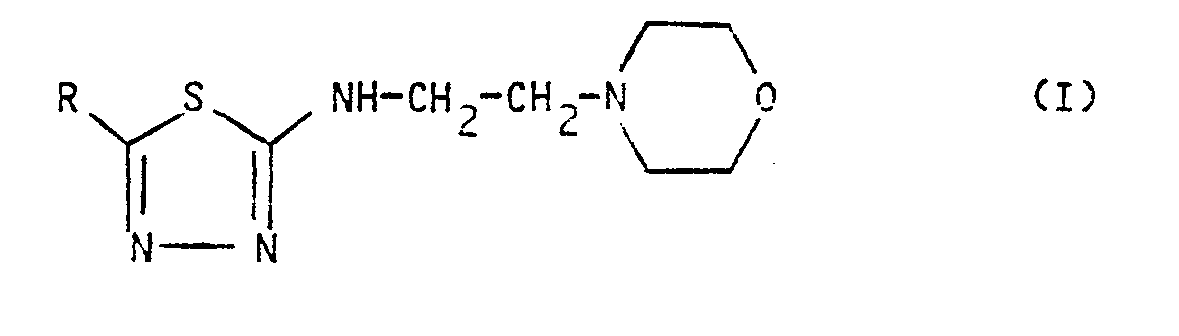
dans laquelle R représente :
- - un groupe alkyle droit ou ramifié ayant de 1 à 5 atomes de carbone ;
- - un groupe cycloalkyle ayant 5 ou 6 atomes de carbone ;
- - un groupe phényle, éventuellement substitué par 1 ou 2 atomes d'halogène de préférence le chlore, par 1 ou 2 groupes alkyle inférieur ou alcoxy inférieur ou par 1 ou 2 groupes hydroxy ou par un groupe nitro ou trifluorométhyle ;
- - un groupe biphénylyle ;
- - un groupe alpha-naphtyle ;
- et les sels pharmaceutiquement acceptables desdits dérivé. Elle concerne également un procédé d'obtention desdits dérivés et les compositions pharmaceutiques les contenant. Lesdits dérivés sont actifs sur le système nerveux central.
Description
- La présente invention concerne en tant que produits nouveaux des dérivés du thiadiazole présentant d'intéressantes propriétés sur le système nerveux central. Elle concerne également un procédé d'obtention desdits dérivés et les compositions pharmaceutiques les contenant. Plus précisément, les composés selon l'invention répondent à la formule générale :

- - un groupe alkyle droit ou ramifié ayant de 1 à 5 atomes de carbone;
- - un groupe cycloalkyle ayant 5 ou 6 atomes de carbone;
- - un groupe phényle éventuellement substitué par 1 ou 2 atomes d'halogène, de préférence le chlore, par 1 ou 2 groupes alkyle inférieur ou alcoxy inférieur ou par 1 ou 2 groupes hydroxy ou par un groupe nitro ou trifluorométhyle;
- - un groupe biphénylyle; un groupe a-naphtyle. Les sels que donnent les composés de formule (I) avec les acides minéraux ou organiques pharmaceutiquement acceptables font partie intégrante de l'invention.
- Dans la présente demande, on entend par groupe alkyle inférieur ou alcoxy inférieur des groupes alkyle ou alcoxy comportant de 1 à 5 atomes de carbone.
- Des composés voisins des composés selon l'invention ont été décrits dans la littérature chimique. Ainsi, dans Journal of Pharmaceutical Sciences 64 (7), 1250-1252, (1975), il est mentionné des composés répondant à la formule :

dans laquelle R' représente un groupe méthyle ou éthyle et R, représente un groupe tolyle, méthoxyphényle ou ni- trophényle. - Ces composés sont décrits comme présentant des propriétés antihistaminiques et anticholinergiques.
- D'une façon surprenante, il a été trouvé que les composés de l'art antérieur ne possèdent que très faiblement les propriétés sur le système nerveux central dont sont dotés les composés selon l'invention.
- Les composés selon l'invention peuvent être préparés à partir des halogéno-2 thiadiazoles-1,3,4 convenablement substitués en position 5 selon le schéma réactionnel

(X =CI ou Br) - La réaction est effectuée par chauffage des deux réactifs au sein d'un solvant tel qu'un alcanol comme l'éthanol ou le n-butanol. Le plus souvent, on opère avec un excès de l'amine 2pour fixer l'hydracide formé au cours de la réaction. Enfin, lorsque X est le chlore, on peut faciliter la réaction en opérant en présence d'iodure de potassium. Le composé (1) est isolé par extraction en milieu acide dilué et la base est libérée par alcalinisation de la solution aqueuse. Eventuellement, le produit ainsi isolé peut être salifié par les méthodes habituelles. Lorsque R représente un groupe hydroxyphényle ou dihydroxyphényle, les composés (1) s'obtiennent par déméthylation des composés (1) correspondants où R représente un groupe méthoxyphényle ou diméthoxyphényle selon un procédé connu, par exemple par chauffage avec l'acide bromhydrique concentré. Les produits de départ halogénés 1 sont connus ou peuvent être préparés par des méthodes connues. Ainsi, les produits 1peuvent être obtenus à partir des composés aminés correspondants :

par diazotation et décomposition du sel de diazonium en présence de l'hydracide XH selon les méthodes décrites dans Chemische Berichte 89, 1534-1543, (1956) et Tetra- hedron 24; 3209-3217, (1968). - Les composés aminés 3 sont connus ou peuvent être préparés selon des procédés connus [Journal of Pharmaceutical Society of Japan 72, 373-375, (1952); Journal of the Chemical Society (1949), 1163-1167 et Canadian Journal of Chemistry 37, 1121-1123, (1959)] qui consistent à transformer l'acide RCOOH ou le chlorure d'acide RCOCI en thiosemicarbazide correspondant et à cycliser ce dernier par un agent de déshydratation tel que l'acide sulfurique.
- Les exemples suivants non limitatifs permettront de mieux comprendre l'invention.
- (Morpholino-2 éthylamino)-2 phényl-5 thiadiazole-1,3,4, dichlorhydrate. (I R = C,H ); SR 95311 A.
- Le chloro-2 phényl-5 thiadiazole-1,3,4 utilisé comme produit de départ est préparé comme indiqué dans Tetrahe- dron 24, 3214, (1968).
- A la solution de 3,93 g du chloro-2 phényl-5 thiadiazole-1,3,4 dans 30 ml de butanol-1, on ajoute 5,2 g de morpholino-2 éthylamine et 0,01 g d'iodure de potassium.
- On chauffe sous agitation au reflux pendant 2 heures puis on élimine le solvant sous vide. On reprend le résidu dans l'acétate d'éthyle et épuise la solution organique avec une solution aqueuse d'acide chlorhydrique à 10%. On alcalinise la phase aqueuse jusqu'à pH 8-9 par addition de bicarbonate de sodium. On extrait avec de l'acétate d'éthyle, lave la solution organique deux fois avec de l'eau puis sèche sur sulfate de magnésium. On évapore le solvant sous vide. Le résidu huileux est dissous à chaud dans le minimum (3 à 4 ml) d'isopropanol puis on ajoute à la solution 2 ml de solution concentrée d'acide chlorhydrique.
- Il se sépare un précipité incolore qu'on essore, sèche sous vide et recristallise dans le méthanol.
- Finalement, on obtient un solide incolore. Poids : 2,9 g; F. : 222-224°C.
- On obtient le même produit en remplaçant le dérivé chloré de départ par une quantité équivalente du dérivé bromé correspondant. Dans ce cas, il est inutile d'ajouter de l'iodure de potassium.
- (Morpholino-2 éthylamino)-2 cyclohexyl-5 thiadiazole- 1,3,4. (1 R = C6H11); SR 43058. a) Amino-2 Cyclohexyl-5 thiadiazole-1,3,4
- En refroidissant au bain d'eau, on mélange 25,6 g d'acide cyclohexane carboxylique, 21 ml d'acide sulfurique concentré et 15.2 g de thiosemicarbazide. On chauffe ensuite le mélange sous agitation à 90-100°C pendant 15 heures.
- Après refroidissement, on verse le mélange dans 400 ml d'eau froide et sépare un insoluble. La solution aqueuse est alcalinisée par 150 ml d'ammoniaque concentrée. On essore le précipité, lave avec de l'eau, sèche et recristallise dans l'éthanol.
- F. : 254-256°C, Poids : 14 g.
- A une suspension refroidie à -20°C de 2,6 g de poudre de cuivre dans 200 ml de solution d'acide bromhydrique à 48%, on ajoute par petites fractions, en environ 1 heure, le mélange intime finement broyé de 60 g de nitrite de sodium et 13,8 g d'amino-2 cyclohexyl-5 thiadiazole-1,3,4.
- Pendant toute la durée de l'addition, la température est maintenue entre -20 et -10°C. L'addition terminée, on retire le bain réfrigérant et agite à température ambiante pendant 2 heures puis à 40-45°C pendant 1 heure 30 minutes. On laisse une nuit au repos puis on ajoute 500 ml d'eau et éxtrait avec de l'acétate d'éthyle. On lave la phase organique avec de l'eau salée puis on neutralise par addition de soude concentrée. On décante la phase organique, lave avec de l'eau salée et sèche sur sulfate de magnésium. On évapore le solvant à siccité. Il reste une huile (13 g) qui- concrétise lentement et sera utilisée telle quelle pour l'étape suivante.
- c) SR 43058
- A partir du dérivé bromé obtenu ci-dessus, on opère comme dans l'exemple 1.
- Dans ce cas, la base obtenue par alcalinisation au bicarbonate de sodium cristallise après évaporation du solvant.
- On ne procède donc pas à la salification mais recristallise dans l'éther isopropylique. F. : 102-104°C.
- En opérant comme dans les exemples précédents, mais en faisant varier le produit de départ, on obtient les produits (I) figurant dans le tableau suivant.


- (Morpholino-2 éthylamino)-2 (hydroxy-4 phényl)-5 thiadiazole-1,3,4, dichlorhydrate.

- On chauffe au reflux sous agitation pendant 20 heures le mélange de 7,1 g de (morpholino-2 éthylamino)-2 (méthoxy-4 phényl)-5 thiadiazole-1,3,4 (SR 43198, exemple 13) et 150 ml de solution d'acide bromhydrique à 48%.
- On ajoute 200 ml de solution de soude à 30%. On lave la phase aqueuse avec 500 ml d'acétate d'éthyle puis on y ajoute 500 ml de solution saturée de chlorure d'ammonium et laisse 2 heure sous agitation. On essore le précipité et lave avec de l'eau. On dissout le solide dans 100 ml d'éthanol et ajoute 9,2 ml d'acide chlorhydrique concentré. On essore le chlorhydrate et recristallise dans le méthanol.
- On obtient 5 g du dichlorhydrate qui cristallise avec 0,5 molécule d'eau; F. : 250-252°C.
- (Morpholino-2 éthylamino)-2 (dihydroxy-3,4 phényl)-5 thiadiazole-1,3,4, dichlorhydrate.
-

- On opère comme dans l'exemple 17 à partir de (morpholino-2 éthylamino)-2 (diméthoxy-3,4 phényl)-5 thiadiazole-1,3,4 (SR 43295, exemple 14).
- De la même façon, on obtient SR 43296 A; F. : 161-163°C; qui cristallise avec 1 molécule d'eau.
- Les composés selon l'invention ont été étudiés en ce qui concerne leurs propriétés thérapeutiques et plus spécialement leur activité sur le système nerveux central.
- Dans cette étude, les produits selon l'invention ont été comparés à deux composés voisins substitués en position 2 par une chaîne dialkylamino éthylamino identique à celle des composés connus dans l'art antérieur.
- Ces composés répondent aux formules :

-

- Les produits à étudier ont été administrés par voie intrapéritonéale à doses croissantes à des lots de 10 souris (CD1, Chartes River; 20 ± 1 g). La mortalité provoquée par les produits étudiés a été notée pendant les 24 heures ayant suivi l'administration du produit.
- A partir des résultats obtenus, on a déterminé pour chacun des produits étudiés la dose létale 50, c'est-à-dire la dose provoquant la mort de 50% des animaux.
- Tous les produits selon l'invention possèdent une dose létale 50 supérieure ou égale à 300 mg/kg, alors que,pour les composés de comparaison, la mortalité à la dose de 300 mg/kg est de 70% pour le composé A et de 90% pour le composé B.
- Ce test décrit par GOURET et Coll. (Journal de Pharmacologie, Paris, 8, 333-350, 1977) a été réalisé chez la souris femelle CD1 (Charles River) pesant 20 ± 1 g. La réserpine entraîne un ptôsis 1 heure après son administration intraveineuse; la plupart des antidépresseurs s'opposent à ce ptôsis.
- Le protocole suivant a été choisi. Les substances à étudier ont été administrées i.p. et la réserpine a été administrée simultanément par voie intraveineuse à la dose de 2 mg/kg. 1 heure après l'administration de réserpine, on a noté le nombre d'animaux ne présentant pas de ptôsis.
- Ce test a été réalisé sur des lots de 10 souris; les résultats sont exprimés en DE50 (dose efficace 50%), soit la dose qui bloque complètement le ptôsis réserpinique chez 50% d'animaux.
- Avec divers produits selon l'invention, les résultats obtenus ont été les suivants :
- SR 95311 A DE50 : 4,6 mg/kg
- SR 95340 A DE50 : 8,8 mg/kg
- SR 95396 A DE50 : 11,3 mg/kg
- SR 95397 A DE50 : 18 mg/kg
- SR 43058 DE,. : 22 mg/kg
- SR 43057 A DE,. : 23 mg/kg
- Dans les mêmes conditions, les produits de comparaison ont donné les résultats suivants :
- Composé A DE50 : 32 mg/kg
- Composé B DE,. : 43 mg/kg
- Le L-5-HTP (L-5-hydroxytryptophane) est le précurseur de biosynthèse de la sérotonine. Son injection chez la souris provoque un syndrome comportemental caractérisé en particulier par un fort tremblement. Les antidépresseurs inhibiteurs de la recapture de sérotonine, ou inhibiteurs de la monoamine oxydase (IMAO),potentialisent cet effet du L-5-HTP (LESSIN, 1959).
- Le protocole décrit par LESSIN (Biochem. Pharmacol., 2, 290-298, 1959) a été utilisé. Les produits à étudier ont été administrés par voie i.p. à des souris femelles CD1 (Charles River; 20 ± 1 g) 1 heure avant une injection de L-5-HTP à la dose de 200 mg/kg i.p. (dose maximale n'induisant pas de tremblement). L'absence ou la présence d'un tremblement net a été observée pendant les 20 minutes suivantes.
- Les résultats sont exprimés en DE,., c'est-à-dire la dose induisant les tremblements chez 50% des animaux traités.
- Les résultats suivants ont été obtenus :
- SR 95311 A DE,. : 6 mg/kg
- SR 95340 A DE50 : 3,6 mg/kg
- SR 43058 DE,. : 17 mg/kg
- SR 43056 A DE,. : 12 mg/kg
- SR 95397 A DE50 : 14,5 mg/kg
- SR 43531 A DE50 : 7,8 mg/kg
- SR 43530 DE50 : 6,2 mg/kg
- SR 43198 DE,o : 7 mg/kg
- alors que, avec les deux produits de comparaison, la DE50 est supérieure à 60 mg/kg.
- Ce test est celui décrit par PROTAIS et Coll. (Journal de Pharmacologie, Paris, 7, 251-255, 1976). Des souris femelles (Charles River, CD1) pesant de 25 à 30 g ont fait préalablement l'objet d'une lésion unilatérale du striatum par injection stéréotaxique de 6-hydroxydopamine à raison de 8 pg par animal. Une semaine après cette opération, les produits ont été administrés par voie i.p. à des groupes de 7 souris. Le nombre de rotations a été évalué pendant 2 minutes 1 heure après l'administration du produit Les rotations ipsilatérales à la lésion ont été comptées positivement, celles contralatérales comptées négativement
- La somme algébrique des rotations pour un groupe d'animaux traités a été comparée à celle du groupe d'animaux témoins n'ayant reçu que le véhicule (eau gommée).
- Dans ce test, les stimulants des récepteurs dopaminer- giques (type apomorphine) diminuent les rotations spontanées, alors que les agents dopaminomimétiques indirects (type amphétamine) les augmentent
- Les résultats sont exprimés en D.E.M. (dose efficace minimale) ou dose minimale nécessaire pour diminuer significativement (test du t Student) le nombre de rotations ipsilatérales spontanément observées chez les témoins.
- Les résultats suivants ont été obtenus :
- SR 95311 A D.E.M. : 0,1 mg/kg
- SR 95396 A D.E.M. : 0,1 mg/kg
- SR 95397 A D.E.M. : 0,1 mg/kg
- SR 43604 D.E.M. : 0,1 mg/kg
- SR 43530 D.E.M. : 0,1 mg/kg
- SR 43202 A D.E.M. : 0,1 mg/kg
- SR 43295 D.E.M. : 0,1 mg/kg
- SR 43296 A D.E.M. : 0,1 mg/kg
- SR 43294 D.E.M. : 0,1 mg/kg
- SR 95559 A D.E.M. : 0,1 mg/kg
- alors que, pour les deux produits de comparaison, la D.E.M. est supérieure à 2 mg/kg.
- Suivant ces résultats, les produits selon l'invention présentent des propriétés antidépressives et dopaminomimétiques, alliées à un coefficient thérapeutique très favorable.
- Par suite, les produits selon l'invention peuvent être utilisés en thérapeutique humaine dans diverses affections neurologiques et psychiatriques : trattement des troubles de l'humeur et du comportement, dépressions névrotiques et endogènes, troubles de la mémoire chez les sujets âgés, hyperkinésie infantile, autisme, insuffisance sexuelle d'origine psychogène, maladie de Parkinson.
- Ces produits peuvent être administrés par voie orale ou par voie parenteraie. Ainsi, la présente demande a également pour objet les compositions pharmaceutiques contenant, à titre d'ingrédients actifs, un composé selon l'invention en combinaison avec un véhicule pharmaceutiquement acceptable.
- La posologie peut varier dans de larges proportions, en particulier suivant le type et la gravité de l'affection à traiter et suivant la voie d'administration. En général, chez l'adulte, la posologie par voie orale variera entre 1 et 500 mg par jour, en une ou plusieurs prises.
- A titre d'exemple de préparation galénique, on peut indiquer des gélules contenant :

Claims (8)

dans laquelle R représente :

dans laquelle X représente le chlore ou le brome et R est tel que défini à la revendication 1, mais différent d'un groupe hydroxyphényle ou dihydroxyphényle, avec une amine de formule :

à extraire le dérivé résultant du milieu réactionnel;à éventuellement déméthyler, selon un procédé connu, les dérivés obtenus de formule (1) dans laquelle R représente un groupe méthoxyphényle ou diméthoxyphényle pour obtenir ceux de formule (1) dans laquelle R représente un groupe hydroxyphényle ou dihydroxyphényle;et éventuellement à transformer le composé obtenu en l'un de ses sels pharmaceutiquement acceptable.

dans laquelle R représente :
groupes hydroxy ou par un groupe nitro ou trifluorométhyle ;

dans laquelle X représente le chlore ou le brome et R est tel que défini ci-dessus mais différent d'un groupe hydroxyphényle ou dihydroxyphényle, avec une amine de formule

à extraire le dérivé résultant du milieu réactionnel ; à éventuellement déméthyler, selon un procédé connu, les dérivés obtenus de formule (I) dans laquelle R représente un groupe méthoxyphényle ou diméthoxyphényle pour obtenir ceux de formule (1) dans laquelle R représente un groupe hydroxyphényle ou dihydroxyphényle; et éventuellement à transformer le composé obtenu en l'un de ses sels pharmaceutiquement acceptable.
Priority Applications (1)
| Application Number | Priority Date | Filing Date | Title |
|---|---|---|---|
| AT85401972T ATE50253T1 (de) | 1984-10-18 | 1985-10-10 | Auf das zentralnervensystem wirksame thiadiazolderivate, verfahren zu ihrer herstellung und sie enthaltende arzneimittel. |
Applications Claiming Priority (2)
| Application Number | Priority Date | Filing Date | Title |
|---|---|---|---|
| FR8415991A FR2572074B1 (fr) | 1984-10-18 | 1984-10-18 | Derives du thiadiazole actifs sur le systeme nerveux central, procede d'obtention et compositions pharmaceutiques les contenant |
| FR8415991 | 1984-10-18 |
Publications (2)
| Publication Number | Publication Date |
|---|---|
| EP0183577A1 true EP0183577A1 (fr) | 1986-06-04 |
| EP0183577B1 EP0183577B1 (fr) | 1990-02-07 |
Family
ID=9308790
Family Applications (1)
| Application Number | Title | Priority Date | Filing Date |
|---|---|---|---|
| EP85401972A Expired - Lifetime EP0183577B1 (fr) | 1984-10-18 | 1985-10-10 | Dérivés du thiadiazole actifs sur le système nerveux central, procédé d'obtension et compositions pharmaceutiques les contenant |
Country Status (16)
| Country | Link |
|---|---|
| US (1) | US4596802A (fr) |
| EP (1) | EP0183577B1 (fr) |
| JP (1) | JPS6197274A (fr) |
| KR (1) | KR860003245A (fr) |
| AT (1) | ATE50253T1 (fr) |
| AU (1) | AU577159B2 (fr) |
| CA (1) | CA1259990A (fr) |
| DE (1) | DE3575923D1 (fr) |
| DK (1) | DK469285A (fr) |
| ES (1) | ES8605269A1 (fr) |
| FR (1) | FR2572074B1 (fr) |
| GR (1) | GR852530B (fr) |
| IL (1) | IL76652A0 (fr) |
| NZ (1) | NZ213865A (fr) |
| PT (1) | PT81314B (fr) |
| ZA (1) | ZA858030B (fr) |
Cited By (2)
| Publication number | Priority date | Publication date | Assignee | Title |
|---|---|---|---|---|
| EP0356333A1 (fr) * | 1988-08-25 | 1990-02-28 | Elf Sanofi | Dérivés du thiadiazole-1,3,4, leur procédé d'obtention et compositions pharmaceutiques en contenant |
| EP0579129A3 (fr) * | 1992-07-14 | 1994-04-20 | Ct Lab Farm Srl |
Families Citing this family (3)
| Publication number | Priority date | Publication date | Assignee | Title |
|---|---|---|---|---|
| GB8625774D0 (en) * | 1986-10-28 | 1986-12-03 | Reckitt & Colmann Prod Ltd | Thiadiazole derivative |
| JP4931823B2 (ja) * | 2004-10-18 | 2012-05-16 | アムジエン・インコーポレーテツド | チアジアゾール化合物及び使用方法 |
| US7919504B2 (en) * | 2007-07-17 | 2011-04-05 | Amgen Inc. | Thiadiazole modulators of PKB |
Citations (2)
| Publication number | Priority date | Publication date | Assignee | Title |
|---|---|---|---|---|
| FR2092714A1 (fr) * | 1970-06-11 | 1972-01-28 | Melle Bezons | |
| US3919428A (en) * | 1972-01-17 | 1975-11-11 | Sandoz Ag | 2-Amino-5-(substituted or unsubstituted phenylalkyl)1,3,4-thiadiazoles for treating anxiety |
Family Cites Families (1)
| Publication number | Priority date | Publication date | Assignee | Title |
|---|---|---|---|---|
| GB1053085A (fr) * | 1964-03-26 |
-
1984
- 1984-10-18 FR FR8415991A patent/FR2572074B1/fr not_active Expired
-
1985
- 1985-10-10 DE DE8585401972T patent/DE3575923D1/de not_active Expired - Fee Related
- 1985-10-10 AU AU48480/85A patent/AU577159B2/en not_active Ceased
- 1985-10-10 AT AT85401972T patent/ATE50253T1/de not_active IP Right Cessation
- 1985-10-10 IL IL76652A patent/IL76652A0/xx not_active IP Right Cessation
- 1985-10-10 EP EP85401972A patent/EP0183577B1/fr not_active Expired - Lifetime
- 1985-10-10 CA CA000492711A patent/CA1259990A/fr not_active Expired
- 1985-10-11 US US06/786,465 patent/US4596802A/en not_active Expired - Fee Related
- 1985-10-14 DK DK469285A patent/DK469285A/da not_active Application Discontinuation
- 1985-10-16 PT PT81314A patent/PT81314B/pt not_active IP Right Cessation
- 1985-10-16 JP JP60228991A patent/JPS6197274A/ja active Pending
- 1985-10-17 NZ NZ213865A patent/NZ213865A/en unknown
- 1985-10-17 ES ES547962A patent/ES8605269A1/es not_active Expired
- 1985-10-18 KR KR1019850007696A patent/KR860003245A/ko not_active Withdrawn
- 1985-10-18 GR GR852530A patent/GR852530B/el unknown
- 1985-10-18 ZA ZA858030A patent/ZA858030B/xx unknown
Patent Citations (2)
| Publication number | Priority date | Publication date | Assignee | Title |
|---|---|---|---|---|
| FR2092714A1 (fr) * | 1970-06-11 | 1972-01-28 | Melle Bezons | |
| US3919428A (en) * | 1972-01-17 | 1975-11-11 | Sandoz Ag | 2-Amino-5-(substituted or unsubstituted phenylalkyl)1,3,4-thiadiazoles for treating anxiety |
Non-Patent Citations (1)
| Title |
|---|
| JOURNAL OF PHARMACEUTICAL SCIENCES, vol. 64, no. 7, juillet 1975, pages 1250-1252, Washington, US; I. LALEZARI et al.: "Synthesis and pharmacological activity of 5-substituted 2-(N,N-dialkylaminoethyl)amino- and 2-N-methylpiperazinyl-1,3,4-thiadiazoles" * |
Cited By (3)
| Publication number | Priority date | Publication date | Assignee | Title |
|---|---|---|---|---|
| EP0356333A1 (fr) * | 1988-08-25 | 1990-02-28 | Elf Sanofi | Dérivés du thiadiazole-1,3,4, leur procédé d'obtention et compositions pharmaceutiques en contenant |
| FR2636628A1 (fr) * | 1988-08-25 | 1990-03-23 | Sanofi Sa | Derives du thiadiazole-1,3,4, leur procede d'obtention et compositions pharmaceutiques en contenant |
| EP0579129A3 (fr) * | 1992-07-14 | 1994-04-20 | Ct Lab Farm Srl |
Also Published As
| Publication number | Publication date |
|---|---|
| ES547962A0 (es) | 1986-03-16 |
| GR852530B (fr) | 1986-02-19 |
| CA1259990A (fr) | 1989-09-26 |
| ATE50253T1 (de) | 1990-02-15 |
| PT81314A (fr) | 1985-11-01 |
| DK469285A (da) | 1986-04-19 |
| FR2572074B1 (fr) | 1987-07-17 |
| AU4848085A (en) | 1986-04-24 |
| DE3575923D1 (de) | 1990-03-15 |
| ES8605269A1 (es) | 1986-03-16 |
| AU577159B2 (en) | 1988-09-15 |
| PT81314B (pt) | 1987-11-30 |
| EP0183577B1 (fr) | 1990-02-07 |
| US4596802A (en) | 1986-06-24 |
| NZ213865A (en) | 1988-05-30 |
| FR2572074A1 (fr) | 1986-04-25 |
| KR860003245A (ko) | 1986-05-21 |
| ZA858030B (en) | 1986-06-25 |
| DK469285D0 (da) | 1985-10-14 |
| IL76652A0 (en) | 1986-02-28 |
| JPS6197274A (ja) | 1986-05-15 |
Similar Documents
| Publication | Publication Date | Title |
|---|---|---|
| EP0072726B1 (fr) | Composés aminés dérivés de la pyridazine actifs sur le système nerveux central | |
| EP0117779B1 (fr) | Dérivés de la pyridazine actifs sur le système nerveux central, procédé d'obtention et médicaments en contenant | |
| EP0073161B1 (fr) | Nouveaux dérivés de la pyrazine actifs sur le système nerveux central | |
| EP0072299B1 (fr) | Nouveaux dérivés de la méthyl-4 phényl-6 pyridazines actifs sur le système nerveux central | |
| EP0040591A1 (fr) | Dérivés de pyridoxine, leur procédé de préparation ainsi que leur utilisation en thérapeutique | |
| EP0116494B1 (fr) | Dérivés de la pyridazine ayant une action psychotrope, procédé d'obtention, intermédiaires et médicaments en contenant | |
| EP0382634A1 (fr) | Nouveaux dérivés de la pyridazine, procédé de préparation et compositions pharmaceutiques en contenant | |
| FR2612517A1 (fr) | Derives de benzoxazine, procedes de preparation de ces derives et compositions pharmaceutiques les contenant | |
| EP0063509A1 (fr) | Nouveaux dérivés de pipérazino-2 pyrimidine, procédés pour leur préparation, médicaments les contenant et leur utilisation comme intermédiaires pour la fabrication de médicaments | |
| EP0183577B1 (fr) | Dérivés du thiadiazole actifs sur le système nerveux central, procédé d'obtension et compositions pharmaceutiques les contenant | |
| EP0079810B1 (fr) | Nouveaux dérivés de la phényl-4 quinazoline actifs sur le système nerveux central | |
| EP0008259A1 (fr) | Nouveaux dérivés de la pipéridylbenzimidazolinone, leurs procédés de préparation et les compositions pharmaceutiques les renfermant | |
| EP0201400B1 (fr) | Dérivés du 4-phénylpropyl indole et leurs sels, leur procédé de préparation, leur application à titre de médicaments et les compositions pharmaceutiques les renfermant | |
| EP0117171B1 (fr) | Dérivés aminés de la pyridazine substitués en position 6 par un hétérocycle ou un alicycle, procédé d'obtention et médicaments les contenant | |
| EP0000452B1 (fr) | Dérivés d'oxadiazole-1,2,4, leur préparation et leur application en thérapeutique. | |
| EP0094283B1 (fr) | Forme médicamenteuse de théophylline à action prolongée | |
| EP0176444B1 (fr) | Nouveau procédé de préparation de dérivés du 4 H-1,2-4-triazole, nouveaux triazoles ainsi obtenus, leur applicication comme médicaments et les compositions pharmaceutiques les renfermant | |
| EP0101379B1 (fr) | Benzamides, leurs sels, procédé pour leur préparation et compositions pharmaceutiques les renfermant | |
| FR2615188A1 (fr) | Derives d'hydrazine, procede d'obtention et compositions pharmaceutiques les contenant | |
| EP0107536B1 (fr) | Benzo-et thiéno-triazine-1,2,3 ones-4, procédés de préparation et médicaments les contenant | |
| EP0221820B1 (fr) | Dérivés de l'imino-3 pyridazine, procédé d'obtention et compositions pharmaceutiques en contenant | |
| FR2540115A1 (fr) | Derive de la pyridazine ayant une action psychotrope, son mode de preparation et les medicaments en contenant | |
| FR2539414A1 (fr) | Derives de la pyrimidine, leur procede de preparation et les medicaments ayant une activite sur le systeme nerveux central qui en contiennent | |
| CA1068270A (fr) | Diamino-2,4-bromo-5 chloro-6 pyrimidines utilisables comme medicaments et procede pour leur preparation | |
| FR2479812A1 (fr) | Cycloalcoyl propanol amines utiles comme medicaments et procede pour leur preparation |
Legal Events
| Date | Code | Title | Description |
|---|---|---|---|
| PUAI | Public reference made under article 153(3) epc to a published international application that has entered the european phase |
Free format text: ORIGINAL CODE: 0009012 |
|
| AK | Designated contracting states |
Kind code of ref document: A1 Designated state(s): AT BE CH DE FR GB IT LI LU NL SE |
|
| 17P | Request for examination filed |
Effective date: 19861106 |
|
| 17Q | First examination report despatched |
Effective date: 19880209 |
|
| GRAA | (expected) grant |
Free format text: ORIGINAL CODE: 0009210 |
|
| AK | Designated contracting states |
Kind code of ref document: B1 Designated state(s): AT BE CH DE FR GB IT LI LU NL SE |
|
| REF | Corresponds to: |
Ref document number: 50253 Country of ref document: AT Date of ref document: 19900215 Kind code of ref document: T |
|
| ITF | It: translation for a ep patent filed | ||
| REF | Corresponds to: |
Ref document number: 3575923 Country of ref document: DE Date of ref document: 19900315 |
|
| GBT | Gb: translation of ep patent filed (gb section 77(6)(a)/1977) | ||
| PLBE | No opposition filed within time limit |
Free format text: ORIGINAL CODE: 0009261 |
|
| STAA | Information on the status of an ep patent application or granted ep patent |
Free format text: STATUS: NO OPPOSITION FILED WITHIN TIME LIMIT |
|
| 26N | No opposition filed | ||
| PGFP | Annual fee paid to national office [announced via postgrant information from national office to epo] |
Ref country code: AT Payment date: 19920925 Year of fee payment: 8 |
|
| PGFP | Annual fee paid to national office [announced via postgrant information from national office to epo] |
Ref country code: GB Payment date: 19921002 Year of fee payment: 8 |
|
| PGFP | Annual fee paid to national office [announced via postgrant information from national office to epo] |
Ref country code: CH Payment date: 19921021 Year of fee payment: 8 |
|
| PGFP | Annual fee paid to national office [announced via postgrant information from national office to epo] |
Ref country code: DE Payment date: 19921023 Year of fee payment: 8 |
|
| PGFP | Annual fee paid to national office [announced via postgrant information from national office to epo] |
Ref country code: SE Payment date: 19921028 Year of fee payment: 8 Ref country code: FR Payment date: 19921028 Year of fee payment: 8 |
|
| PGFP | Annual fee paid to national office [announced via postgrant information from national office to epo] |
Ref country code: LU Payment date: 19921030 Year of fee payment: 8 |
|
| ITTA | It: last paid annual fee | ||
| PGFP | Annual fee paid to national office [announced via postgrant information from national office to epo] |
Ref country code: NL Payment date: 19921031 Year of fee payment: 8 |
|
| PGFP | Annual fee paid to national office [announced via postgrant information from national office to epo] |
Ref country code: BE Payment date: 19921116 Year of fee payment: 8 |
|
| EPTA | Lu: last paid annual fee | ||
| PG25 | Lapsed in a contracting state [announced via postgrant information from national office to epo] |
Ref country code: LU Free format text: LAPSE BECAUSE OF NON-PAYMENT OF DUE FEES Effective date: 19931010 Ref country code: GB Effective date: 19931010 Ref country code: AT Effective date: 19931010 |
|
| PG25 | Lapsed in a contracting state [announced via postgrant information from national office to epo] |
Ref country code: SE Effective date: 19931011 |
|
| PG25 | Lapsed in a contracting state [announced via postgrant information from national office to epo] |
Ref country code: LI Effective date: 19931031 Ref country code: CH Effective date: 19931031 Ref country code: BE Effective date: 19931031 |
|
| BERE | Be: lapsed |
Owner name: SANOFI Effective date: 19931031 |
|
| PG25 | Lapsed in a contracting state [announced via postgrant information from national office to epo] |
Ref country code: NL Effective date: 19940501 |
|
| GBPC | Gb: european patent ceased through non-payment of renewal fee |
Effective date: 19931010 |
|
| NLV4 | Nl: lapsed or anulled due to non-payment of the annual fee | ||
| PG25 | Lapsed in a contracting state [announced via postgrant information from national office to epo] |
Ref country code: FR Effective date: 19940630 |
|
| REG | Reference to a national code |
Ref country code: CH Ref legal event code: PL |
|
| PG25 | Lapsed in a contracting state [announced via postgrant information from national office to epo] |
Ref country code: DE Effective date: 19940701 |
|
| REG | Reference to a national code |
Ref country code: FR Ref legal event code: ST |
|
| EUG | Se: european patent has lapsed |
Ref document number: 85401972.6 Effective date: 19940510 |