EP0184556A2 - Verfahren zur Herstellung konzentrierter salzarmer wässriger Lösungen von Aminotriazinyl-Reaktivfarbstoffen - Google Patents
Verfahren zur Herstellung konzentrierter salzarmer wässriger Lösungen von Aminotriazinyl-Reaktivfarbstoffen Download PDFInfo
- Publication number
- EP0184556A2 EP0184556A2 EP85810571A EP85810571A EP0184556A2 EP 0184556 A2 EP0184556 A2 EP 0184556A2 EP 85810571 A EP85810571 A EP 85810571A EP 85810571 A EP85810571 A EP 85810571A EP 0184556 A2 EP0184556 A2 EP 0184556A2
- Authority
- EP
- European Patent Office
- Prior art keywords
- dye
- salt
- lithium
- concentrated
- aminotriazinyl
- Prior art date
- Legal status (The legal status is an assumption and is not a legal conclusion. Google has not performed a legal analysis and makes no representation as to the accuracy of the status listed.)
- Granted
Links
Classifications
-
- D—TEXTILES; PAPER
- D06—TREATMENT OF TEXTILES OR THE LIKE; LAUNDERING; FLEXIBLE MATERIALS NOT OTHERWISE PROVIDED FOR
- D06P—DYEING OR PRINTING TEXTILES; DYEING LEATHER, FURS OR SOLID MACROMOLECULAR SUBSTANCES IN ANY FORM
- D06P3/00—Special processes of dyeing or printing textiles, or dyeing leather, furs, or solid macromolecular substances in any form, classified according to the material treated
- D06P3/58—Material containing hydroxyl groups
- D06P3/60—Natural or regenerated cellulose
- D06P3/66—Natural or regenerated cellulose using reactive dyes
-
- C—CHEMISTRY; METALLURGY
- C09—DYES; PAINTS; POLISHES; NATURAL RESINS; ADHESIVES; COMPOSITIONS NOT OTHERWISE PROVIDED FOR; APPLICATIONS OF MATERIALS NOT OTHERWISE PROVIDED FOR
- C09B—ORGANIC DYES OR CLOSELY-RELATED COMPOUNDS FOR PRODUCING DYES, e.g. PIGMENTS; MORDANTS; LAKES
- C09B62/00—Reactive dyes, i.e. dyes which form covalent bonds with the substrates or which polymerise with themselves
- C09B62/02—Reactive dyes, i.e. dyes which form covalent bonds with the substrates or which polymerise with themselves with the reactive group directly attached to a heterocyclic ring
- C09B62/04—Reactive dyes, i.e. dyes which form covalent bonds with the substrates or which polymerise with themselves with the reactive group directly attached to a heterocyclic ring to a triazine ring
-
- C—CHEMISTRY; METALLURGY
- C09—DYES; PAINTS; POLISHES; NATURAL RESINS; ADHESIVES; COMPOSITIONS NOT OTHERWISE PROVIDED FOR; APPLICATIONS OF MATERIALS NOT OTHERWISE PROVIDED FOR
- C09B—ORGANIC DYES OR CLOSELY-RELATED COMPOUNDS FOR PRODUCING DYES, e.g. PIGMENTS; MORDANTS; LAKES
- C09B67/00—Influencing the physical, e.g. the dyeing or printing properties of dyestuffs without chemical reactions, e.g. by treating with solvents grinding or grinding assistants, coating of pigments or dyes; Process features in the making of dyestuff preparations; Dyestuff preparations of a special physical nature, e.g. tablets, films
- C09B67/0071—Process features in the making of dyestuff preparations; Dehydrating agents; Dispersing agents; Dustfree compositions
- C09B67/0072—Preparations with anionic dyes or reactive dyes
- C09B67/0073—Preparations of acid or reactive dyes in liquid form
-
- C—CHEMISTRY; METALLURGY
- C09—DYES; PAINTS; POLISHES; NATURAL RESINS; ADHESIVES; COMPOSITIONS NOT OTHERWISE PROVIDED FOR; APPLICATIONS OF MATERIALS NOT OTHERWISE PROVIDED FOR
- C09B—ORGANIC DYES OR CLOSELY-RELATED COMPOUNDS FOR PRODUCING DYES, e.g. PIGMENTS; MORDANTS; LAKES
- C09B67/00—Influencing the physical, e.g. the dyeing or printing properties of dyestuffs without chemical reactions, e.g. by treating with solvents grinding or grinding assistants, coating of pigments or dyes; Process features in the making of dyestuff preparations; Dyestuff preparations of a special physical nature, e.g. tablets, films
- C09B67/0096—Purification; Precipitation; Filtration
Definitions
- the invention relates to a process for the preparation of concentrated, low-salt, aqueous solutions of aminotriazinyl reactive dyes, the dye solutions obtained by this process and their use.
- Liquid preparations of reactive dyes have a number of advantages over the solid commercial form such as powder or granules, e.g. no dust development when preparing the padding and dyeing liquors or printing pastes; no wetting problems due to lump formation, no stained stains due to insufficiently dissolved dye particles.
- solid commercial form such as powder or granules
- no dust development when preparing the padding and dyeing liquors or printing pastes no wetting problems due to lump formation
- no stained stains due to insufficiently dissolved dye particles.
- liquid brands are increasingly to be found on the market today, with the trend towards increasingly concentrated solutions, since considerable savings in transport and storage are possible.
- solubilizers may help. However, these get into the wastewater after dyeing and pollute the sewage treatment plants.
- water solubility can also be improved by converting the dye, which at the end of the synthesis, after salting out, is usually in the sodium salt form, into a more soluble salt, e.g. transferred the lithium salt. This is achieved, for example, with the help of Donnan dialysis (see EP-A-0 126 830). With this elegant process, an acidic dye can be converted almost completely from the sodium to the lithium salt form.
- the disadvantage of this method is that relatively large amounts of dialysis solution are used.
- the object of the present invention was therefore to prepare readily water-soluble dye salts of reactive dyes of the aminotriazinyl series without great outlay on equipment. It has been found that, surprisingly, a drastic improvement in the water solubility of such dyes is achieved if they are converted into a mixed lithium / ammonium salt, which is possible in a simple manner by starting from a non-reactive dye containing sulfo groups, at least partially is in the ammonium salt form (-SO 3 ⁇ NH 4 ⁇ ) and this is reacted with cyanuric halide - the reactive component - in the presence of lithium hydroxide. The salt-containing synthesis solution containing the finished reactive dye is then desalted and concentrated using a membrane separation process.
- the present invention thus relates to a process for the preparation of concentrated low-salt aqueous solutions of aminotriazinyl reactive dyes, which is characterized in that one starts from a dye containing sulfo groups which contains one or more radicals which are reactive with cyanuric halide and which is at least partially present as an ammonium salt reacted with a cyanuric halide in the presence of lithium hydroxide and the salt-containing synthesis solution was desalted and concentrated by means of a membrane separation process.
- the mixed lithium / ammonium salts of the acidic aminotriazinyl reactive dyes are approximately twice as soluble in water as the corresponding sodium, potassium or ammonium salts. They are therefore ideally suited for the production of concentrated dye solutions, such as those used for example in continuous dyeing because of their easy meterability.
- monoazo dyes are primarily suitable as dyes containing sulfo groups, which are reacted with a cyanuric halide to give the corresponding reactive dyes by the process according to the invention.
- the Azo dyes can be both metallized and metal-free.
- acidic anthraquinone, formazan, phthalocyanine or dioxazine dyes can also be converted into fiber-reactive dye salts by the present process.
- Cyanuric fluoride and especially cyanuric chloride are primarily used as cyanuric halides.
- a halogen atom of the cyanuric halide is replaced by the dye residue and a second atom by an amino group. Since the condensation is carried out in the presence of lithium hydroxide, some of the sulfo groups are present as a lithium salt at the end of the reaction. In other words, counterions of the sulfo groups (-SO 3 ⁇ ), the aminotriazinyl reactive dyes produced in this way, are lithium and ammonium cations.
- the lithium / ammonium content of the final dye can be controlled via the ammonium content of the starting dye and the amount of lithium hydroxide that is used in the condensation reaction.
- the ratio of lithium to ammonium in the final dye is advantageously 1: 1 to 3: 1. With this ratio, dyes with very good water solubility are obtained, which in concentrated solutions do not tend to flocculate or recrystallize.
- the dye is obtained in the form of a dilute aqueous synthesis solution or suspension which, in addition to the dye salt, contains a number of synthesis-related inert salts, such as, for example, alkali metal halides or sulfates. These are removed from the dye solution using a membrane separation process
- membrane separation process is understood in particular to mean hyperfiltration. In contrast to conventional filtration, in which solid particles are separated from a liquid, this separation process is a selective molecular separation method.
- the membrane acts as a molecular sieve and is able to retain dissolved substances at the membrane interface if the molecule size is sufficient. It is expedient to use membranes with a "cut off level" which ensures a retention of at least 90 Z when they are subjected to continuous hyperfiltration for 20 to 30 minutes.
- These are membranes whose separation limit is in the molecular weight range from 300 to 800, preferably 400 to 500, and which are symmetrical or, in particular, asymmetrical. They allow water and dissolved substances, which are below the separation limit due to their molecular weight, to pass through at low to medium pressure. According to the invention, pressures from 10 to 100 bar and preferably from 10 to 30 bar are used.
- the membranes which are preferably used in the process according to the invention due to their good separation properties consist of a polymeric material which is mainly modified on the surface by acidic or basic groups.
- the polymeric membrane material is natural, semisynthetic or synthetic materials which, for example, are hydroxyl, amino and / or as reactive groups Contain amidoxime groups. Such materials can be reacted with suitable reagents which contain acidic or basic groups on the one hand and at least one group which is reactive to form a chemical (covalent) bond on the other hand.
- the acidic groups are primarily carboxyl and sulfonic acid groups and the basic groups are primary, secondary or tertiary amino groups, furthermore phosphonium or sulfonium groups.
- Acidic reactive dyes which can belong to different classes, such as anthraquinone, azo or formazan dyes, are suitable as reactive reagents which contain an acidic or basic group. You may also have 4 1s of metal complexes.
- the polymer membranes that are modified by an azo dye containing sulfonic acid groups are particularly valuable and versatile.
- the azo dye can also contain complex-bound metal, for example copper.
- Such membranes are described for example in DE-OS 25 05 254 and 30 35 134 and in European patent application 26399.
- the membranes used in the process according to the invention preferably have a pore diameter of 0.1 to 50 nm.
- Suitable membranes with which a good desalination effect is also achieved are e.g. those based on optionally modified polysulfone, polyamide or polystyrene.
- the cleaning / desalination effect can be up to 70% and more without any significant loss of dye.
- the volume of the solution of the retained substances (on the concentrate side) decreases accordingly and the concentration of the retained part increases.
- the synthesis solution preferably has a dry substance content of 5 to 15% by weight and the concentration is carried out until the dry substance content has risen to a value of 20 to 50%.
- the membrane separation process is advantageously carried out in such a way that the dye solution or suspension is initially largely desalted.
- the separated permeate on the dye side is replaced by the appropriate amount of water, it is expedient to use demineralized water, and the dye solution is washed free of salt except for a low residual salt content.
- the fresh water supply is then interrupted and enough permeate is separated off until the desired dry matter content is reached.
- a component which improves the water solubility of the dye can optionally be added to the concentrated and desalted solution.
- ⁇ -caprolactam and N-methylpyrrolidone can be used as such an additive.
- the dye solutions prepared by the process according to the invention can also be provided with smaller amounts (each about 1 to 10 g / 1) of further property-improving auxiliaries which are inert to the reactive dye, such as e.g. Surfactants, foam-suppressing aids, antifreeze, substances that inhibit fungal and / or bacterial growth.
- auxiliaries which are inert to the reactive dye, such as e.g. Surfactants, foam-suppressing aids, antifreeze, substances that inhibit fungal and / or bacterial growth.
- the invention further relates to the storage-stable, aqueous solutions of fiber-reactive aminotriazinyl dyes obtained by the process according to the invention, and to their use for the production of padding liquors, dye baths and printing pastes for dyeing and printing natural and regenerated cellulosic fiber materials, especially cotton and viscose; or also nitrogen-containing fiber material, e.g. Polyamide.
- the salt content of the dye solutions, apart from the buffer salts to stabilize the pH, is significantly below 1% by weight.
- the dye solutions are thin and can be stored for several months at temperatures around freezing and up to + 40 ° C without the formation of agglomerates or a solid sediment.
- the dye solutions are largely insensitive to temperature fluctuations; no recrystallization phenomena occur even with prolonged storage.
- the dye solution for desalination, it is expedient to dilute the dye solution (synthesis solution) and, if necessary, to adjust the pH to about 6 to 8.
- the dye solution is then hyperfiltrated, the permeate separated being continuously replaced by fresh water.
- the hyperfiltration can be carried out, for example, in a tubular membrane module which is equipped with an anionically modified membrane, at a working pressure of 20 to 30 bar.
- the concentration is started tion until the dye content of the solution is 20 to 30% by weight.
- the dye solution is mixed with a tripolyphosphate as a buffer substance and diluted to the standard color strength.
- the ready-to-sell dye solution has a pH of 7 to 8 and is perfectly stable in storage.
- the dye containing sulfo groups is reacted with a colorless amine after the triazine reactive residue has been condensed.
- the corresponding N-substituted aminotriazine dyes are obtained in this way. It proves to be expedient to use the starting dye in the form of the ammonium salt and to carry out the condensation with the cyanuric halide and the subsequent reaction with the amine with the addition of lithium hydroxide.
- the dye is then obtained as a mixed lithium / ammonium salt, and the ratio of the cations to one another can be shifted in favor of the ammonium portion by replacing part of the lithium hydroxide solution used for the condensation with aqueous ammonia solution.
- Colorless amines that are condensed on the triazine residue are e.g. aliphatic mono- and dialkylamines with 1 to 4 carbon atoms in the alkyl radical, such as methylamine, dimethylamine, ethylamine, diethylamine or also hydroxyalkylamines, such as ⁇ -hydroxyethylamine; Aromatic amines such as aniline, toluidine or in particular aniline sulfonic acids such as aniline-2-sulfonic acid, aniline-3-sulfonic acid or aniline-4-sulfonic acid are also suitable.
- Example 1 545 parts of the diammonium salt of 3-ureido-4- (3 ', 6', 8'-trisulfonaphth-2'-ylazo) aniline are dissolved at room temperature in 5,000 parts by volume of water with the addition of 250 parts by volume of 4N lithium hydroxide solution and then cooled to 0 ° C. by adding 1,000 parts of ice. Then you give 185 pieces
- Cyanuric chloride which was previously slurried with 100 parts of water and 200 parts of ice.
- the pH of the reaction mixture which has a temperature of 0 to 5 ° C., is kept in the range from 4.5 to 5.0 by means of aqueous lithium hydroxide. About 250 volumes of 4 N lithium hydroxide solution are required.
- the reaction is complete after about an hour.
- the reaction mass is then mixed with 500 parts by volume of 4N lithium hydroxide solution and heated to 40 ° C.
- the aminotriazinyl reactive dye of the following formula (Formula 1) is in the form of a mixed lithium ammonium salt.
- M Li + and NH 4 + in a 3: 2 ratio.
- 5600 parts of the salt-containing synthesis suspension are subsequently diluted with 600 parts of water (dry content of the suspension: 8.5% by weight, dye content: approx. 7% by weight., Salt content: 1.5% by weight) and on one system for hyperfiltration (membrane area 0.84 m 2 ) desalted and concentrated.
- An anionically modified cellulose acetate membrane is used as the membrane; whose manufacture is described in Example 1 of DE-OS 25 05 254, and which has a cut-off level of 500.
- the hyperfiltration is carried out in two stages at a temperature of approx. 20 ° C and a pressure of 25 bar; the pH value of the dye suspension is 6.5 to 7.5.
- Desalination is carried out first, for this purpose 6 600 parts of demineralized water are added to the dye suspension and 6 600 parts of saline permeate are separated off. By this measure the chloride content drops to 0.45% by weight and the dye goes into solution. The dye solution is then concentrated. To do this, another 4 500 parts of permeate are removed. 1,700 parts of a concentrated dye solution with a dry matter content of 25% by weight are obtained, the chloride content (lithium chloride, ammonium chloride) of which is less than 0.1% by weight. About 60% of the dye is in solution as the lithium salt and about 40% as the ammonium salt.
- the liquid formulation is low-viscosity and can be kept unchanged for several months at temperatures around freezing and up to + 40 ° C.
- the ratio Li + / NH + 4 can be changed by partial replacement of lithium hydroxide with ammonia by 30% in favor of the ammonium content.
- the following aminotriazinyl reactive dyes are obtained as mixed lithium ammonium salts from the ammonium salts of the corresponding aminoazo dyes (formulas 3 and 4).
- the salt-containing synthesis suspensions of the so-prepared colors are desalted and concentrated using hyperfiltration as described in Example 1.
- the following table shows the dye content of the low-salt dye solutions prepared in this way and is compared with the dye content of the corresponding solutions which contain the dye in the form of the sodium salt. One can clearly see the increase in solubility when the dye is present in the form of the Li + / NH + 4 salt.
- the liquid formulations prepared with the lithium / ammonium salts of dyes 2 to 4 are thin (viscosity approx. 6 to 10 cP at 20 ° C) and can be kept unchanged at -10 ° C to + 40 ° C for several months.
- the Li + / NH + 4 ratio which is initially> 1, can be shifted in favor of the ammonium portion by partially replacing the lithium hydroxide solution with aqueous ammonia solution in one or both of the reaction steps.
- the salt-containing suspension of the raw dye is desalted and concentrated using hyperfiltration as described in Example 1.
- the dye content of the solution is 34% by weight and is significantly higher than the dye content of a solution which is obtained using the dye of the formula (5b) as the sodium salt; here the solution is already saturated at a concentration of 27% by weight of dye.
Landscapes
- Chemical & Material Sciences (AREA)
- Organic Chemistry (AREA)
- Chemical Kinetics & Catalysis (AREA)
- Engineering & Computer Science (AREA)
- Textile Engineering (AREA)
- Coloring (AREA)
- Separation Using Semi-Permeable Membranes (AREA)
Abstract
Description
- Die Erfindung betrifft ein Verfahren zur Herstellung konzentrierter salzarmer, wässriger Lösungen von Aminotriazinyl-Reaktivfarbstoffen, die nach diesem Verfahren erhaltenen Farbstofflösungen, sowie deren Verwendung.
- Flüssige Präparate von Reaktivfarbstoffen weisen gegenüber der festen Handelsform wie Pulver oder Granulat, eine Reihe von Vorteilen auf, z.B. keine Staubentwicklung beim Ansetzen der Klotz-und Färbeflotten oder auch Druckpasten; keine Benetzungsprobleme durch Klumpenbildung, keine fleckigen Färbungen durch ungenügend gelöste Farbstoffteilchen. Nicht zuletzt wegen dieser Vorteile, verbunden mit einer guten Dosierbarkeit der flüssigen Handelsform findet man heute in zunehmendem Masse Flüssigmarken auf dem Markt, wobei der Trend zu immer konzentrierteren Lösungen geht, da so erhebliche Einsparungen bei Transport und Lagerhaltung möglich sind.
- Bei Farbstofflösungen generell und insbesondere bei konzentrierten Präparaten treten jedoch immer wieder Schwierigkeiten in bezug auf deren Lagerfähigkeit auf. Je konzentrierter eine Farbstofflösung ist, um so leichter kommt es während der Lagerung zu Rekristallisationserscheinungen und es bilden sich mehr oder weniger grosse Agglomerate, die sich z.B. bei der Anwendung derartiger Präparate im Textildruck in Form von Spickeln als äusserst störend bemerkbar machen. Darüberhinaus wird auch oft die Bildung eines festen Bodensatzes beobachtet, der sich nur mit Mühe aufrühren lässt. Der Farbstoff ist in solchen Fällen nicht mehr vollständig in Lösung zu bringen.
- Es gibt verschiedene Möglichkeiten, die Löslichkeit anionischer Farbstoffe zu erhöhen und auf diese Weise die Stabilität der Farbstofflösungen zu verbessern. Eine ganz wesentliche Massnahme besteht darin, den synthesebedingten Salzgehalt der Farbstofflösung zu senken. Dies geschieht heute mehr und mehr durch Membrantrennverfahren, die eine rasche Entsalzung des Farbstoffs erlauben (siehe z.B. EP-A-0059782), wobei man sowohl von der rohen Syntheselösung, als auch dem angeschlämmten Farbstoffpresskuchen ausgehen kann.
- Doch auch entsalzte Farbstofflösungen lassen sich oft nicht genügend aufkonzentrieren oder man erhält konzentrierte Lösungen, aus denen der Farbstoff bei Lagertemperaturen um den Gefrierpunkt irreversibel ausfällt. In solchen Fällen kann unter Umständen der Zusatz von Lösungsvermittlern weiterhelfen. Diese gelangen jedoch nach der Färbung ins Abwasser und belasten die Kläranlagen. Um derartige Zusätze zu vermeiden, kann man die Wasserlöslichkeit auch dadurch verbessern, dass man den Farbstoff, der am Ende der Synthese, nach dem Aussalzen, üblicherweise in der Natriumsalzform vorliegt, in ein leichter lösliches Salz, z.B. das Lithiumsalz überführt. Dies gelingt beispielsweise mit Hilfe der Donnan-Dialyse (siehe EP-A-0 126 830). Nach diesem eleganten Verfahren kann ein saurer Farbstoff praktisch vollständig von der Natrium- in die Lithiumsalzform umgewandelt werden. Nachteil dieses Verfahrens ist jedoch, dass relativ grosse Mengen an Dialyselösung verbraucht werden.
- Die Aufgabe der vorliegenden Erfindung bestand demnach darin, ohne grossen apparativen Aufwand gut wasserlösliche Farbstoffsalze von Reaktivfarbstoffen der Aminotriazinyl-Reihe herzustellen. Gefunden wurde, dass überraschenderweise eine drastische Verbesserung der Wasserlöslichkeit derartiger Farbstoffe bereits dadurch erreicht wird, wenn diese in ein gemischtes Lithium/Ammonium- salz überführt werden, was in einfacher Weise dadurch möglich ist, dass man von einem sulfogruppenhaltigen nichtreaktiven Farbstoff ausgeht, der zumindest teilweise in der Ammoniumsalzform (-SO3 ⊖NH4 ⊕) vorliegt und diesen in Gegenwart von Lithiumhydroxid mit Cyanurhalogenid - der Reaktivkomponente - umsetzt. Anschliessend wird die salzhaltige, den fertigen Reaktivfarbstoff enthaltende Syntheselösung mit Hilfe eines Membrantrennverfahrens entsalzt und aufkonzentriert.
- Gegenstand der vorliegenden Erfindung ist somit ein Verfahren zur Herstellung konzentrierter salzarmer wässriger Lösungen von Aminotriazinyl-Reaktivfarbstoffen, das dadurch gekennzeichnet ist, dass man von einem sulfogruppenhaltigen Farbstoff ausgeht, der einen oder mehrere mit Cyanurhalogenid reaktionsfähige Reste enthält und der zumindest teilweise als Ammoniumsalz vorliegt, diesen mit einem Cyanurhalogenid in Gegenwart von Lithiumhydroxid umsetzt und die salzhaltige Syntheselösung mittels eines Membrantrennverfahrens entsalzt und aufkonzentriert.
- Die gemischten Lithium/Ammoniumsalze der sauren Aminotriazinyl-Reaktivfarbstoffe sind etwa doppelt so gut wasserlöslich, wie die entsprechenden Natrium-, Kalium- oder Ammoniumsalze. Sie eignen sich daher hervorragend zur Herstellung konzentrierter Farbstofflösungen, wie sie beispielsweise in der Kontinuefärbung wegen der leichten Dosierbarkeit bevorzugt eingesetzt werden.
- Als sulfogruppenhaltige Farbstoffe, die nach dem erfindungsgemässen Verfahren mit einem Cyanurhalogenid zu den entsprechenden Reaktivfarbstoffen umgesetzt werden, kommen neben Dis- und Polyazofarbstoffen in erster Linie Monoazofarbstoffe in Frage. Die Azofarbstoffe können sowohl metallisiert, wie auch metallfrei sein. Natürlich können auch saure Anthrachinon-, Formazan-, Phthalocyanin- oder Dioxazinfarbstoffe nach vorliegendem Verfahren zu faserreaktiven Farbstoffsalzen umgesetzt werden.
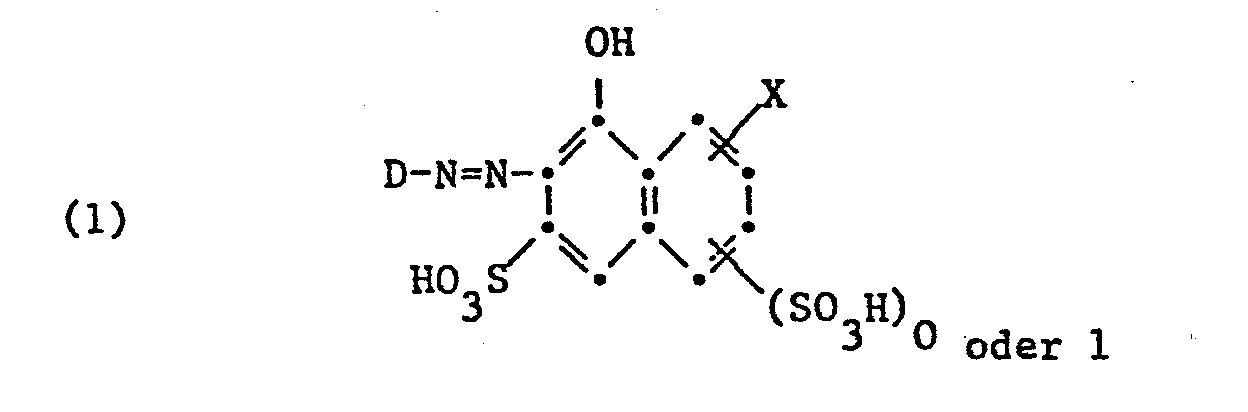
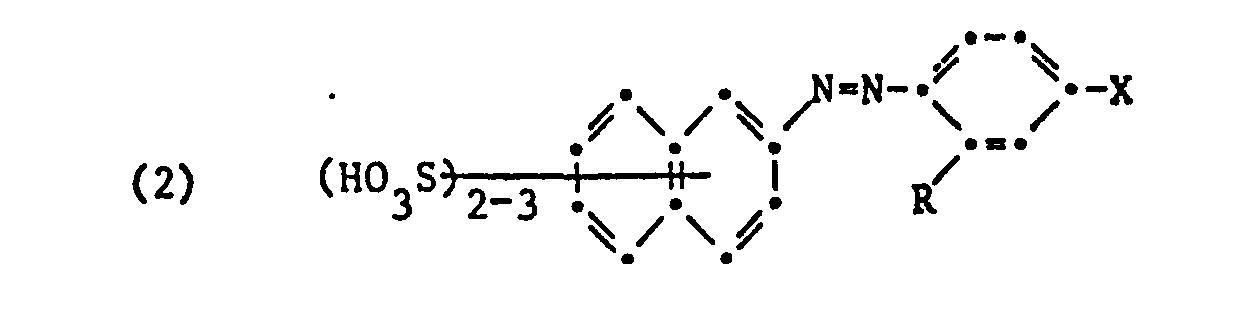
- Derartige Farbstoffe sind in grosser Zahl bekannt oder können nach bekannten Methoden erhalten werden. Wesentlich ist, dass die Farbstoffe einen oder mehrere geeignete Reste aufweisen, über die sich das Cyanurhalogenid ankondensieren lässt. Als solche Reste kommen in erster Linie gegebenenfalls monoalkylierte Aminogruppen,wie z.B. die -NH2, -NHCH3' -NHC2H5 oder -NHC3H7 Gruppe in Frage. Diese Gruppen können direkt oder über ein Brückenglied an das aromatische System des Farbstoffs gebunden sein. In Betracht kommen in erster Linie Farbstoffe, die den folgenden Klassen angehören:
- 1. Monoazofarbstoffe der Formel
- 2. Monoazofarbstoffe der Formel
- 3. Disazofarbstoffe der Formel

- 4. Disazofarbstoffe der Formel

- Nach dem erfindungsgemässen Verfahren werden bevorzugt Monoazofarbstoffe der unter 2 angegebenen Struktur mit einem Cyanurhalogenid umgesetzt und anschliessend zu einem lagerfähigen Flüssigpräparat verarbeitet.
- Erfindungswesentlich ist, dass im vorliegenden Verfahren nur solche Farbstoffe eingesetzt werden können, die mindestens 2 Sulfogruppen enthalten, bevorzugt verwendet werden solche mit 2 bis 5 Sulfogruppen, wobei die Sulfogruppen zum Teil oder ganz in der Ammoniumsalzform vorliegen. Die Ammoniumsalze der Farbstoffe sind auf einfache Weise zugänglich, beispielswiese durch Neutralisieren der sauren Syntheselösung des Farbstoffs mit wässrigem Ammoniak.
- Als Cyanurhalogenide werden in erster Linie Cyanurfluorid und vor allem Cyanurchlorid eingesetzt. Im Verlauf der Kondensationsreaktion wird ein Halogenatom des Cyanurhalogenids gegen den Farbstoffrest und ein zweites gegen eine Aminogruppe ausgetauscht. Da die Kondensation in Gegenwart von Lithiumhydroxid durchgeführt wird, liegen ein Teil der Sulfogruppen dem Ende der Reaktion als Lithiumsalz vor. Mit anderen Worten, Gegenionen der Sulfogruppen (-SO3 ⊖), der auf diese Weise hergestellten Aminotriazinyl-Reaktivfarbstoffe, sind Lithium- und Ammoniumkationen. Der Lithium/Ammoniumgehalt des Endfarbstoffs lässt sich über den Ammoniumgehalt des Ausgangsfarbstoffs und die Menge an Lithiumhydroxid steuern, die bei der Kondensationsreaktion eingesetzt wird. Vorteilhaft liegt das Verhältnis von Lithium zu Ammonium im Endfarbstoff bei 1:1 bis 3:1. Bei diesem Verhältnis werden Farbstoffe mit sehr guter Wasserlöslichkeit erhalten, die in konzentrierten Lösungen weder zum Ausflocken noch zur Rekristallisation neigen.
- Am Ende der Kondensationsreaktion fällt der Farbstoff in Form einer verdünnten wässrigen Syntheselösung oder -Suspension an, die neben dem Farbstoffsalz eine Reihe von synthesebedingten Inertsalzen enthält, wie z.B. Alkalimetallhalogenide oder -sulfate. Diese werden mit Hilfe eines Membrantrennverfahrens aus der Farbstofflösung
- bzw. -suspension entfernt, denn ein geringer Salzgehalt der Farbstofflösung ist für deren Lagerfähigkeit von entscheidender Bedeutung. Angestrebt wird eine praktisch vollständige Entsalzung, so dass weniger als 1 Gew.-Z, vorzugsweise weniger als 0,5 Gew.-Z Salz in der Farbstofflösung verbleiben.
- Unter dem Ausdruck Membrantrennverfahren wird insbesondere die Hyperfiltration verstanden. Bei diesem Trennverfahren handelt es sich im Gegensatz zur üblichen Filtration, wobei Feststoffteilchen von einer Flüssigkeit abgetrennt werden, um eine selektive Molekulartrennmethode. Die Membran wirkt als Molekularsieb, und vermag aufgelöste Stoffe, bei ausreichender Molekülgrösse an der Membrangrenzfläche zurückzuhalten. Zweckmässig verwendet man Membranen mit einem "cut off level", der eine mindestens 90 Z-ige Retention gewährleistet, wenn diese einer kontinuierlichen Hyperfiltration während 20 bis 30 Minuten unterworfen werden. Hierbei handelt es sich um solche Membranen, deren Trenngrenze im Molekulargewichtsbereich von 300 bis 800, vorzugsweise 400 bis 500 liegt, und die symmetrisch oder insbesondere asymmetrisch sind. Sie lassen Wasser und aufgelöste Stoffe, die auf Grund ihres Molekulargewichts unterhalb der Trenngrenze liegen, bei geringem bis mittlerem Druck durchtreten. Erfindungsgemäss werden Drucke von 10 bis 100 bar und vorzugsweise von 10 bis 30 bar verwendet.
- Die im erfindungsgemässen Verfahren aufgrund ihrer guten Trenneigenschaften bevorzugt verwendeten Membranen bestehen aus einem polymeren Material, das vorwiegend an der Oberfläche durch saure oder basische Gruppen modifiziert ist.
- Bei dem polymeren Membranmaterial handelt es sich um natürliche, halbsynthetische oder synthetische Materialien, die als reaktionsfähige Gruppen beispielsweise Hydroxyl, Amino- und/oder Amidoximgruppen enthalten. Derartige Materialien können mit geeigneten Reagenzien umgesetzt werden, die einerseits saure oder basische Gruppen und andererseits mindestens eine unter Bildung einer chemischen (kovalenten) Bindung reaktionsfähige Gruppierung enthalten.
- Bei den sauren Gruppen handelt es sich in erster Linie um Carboxyl-und Sulfonsäuregruppen und bei den basischen Gruppen um primäre, sekundäre oder tertiäre Aminogruppen, ferner Phosphonium- oder Sulfoniumgruppen.
- Beispielsweise können folgende Polymere in der angegebenen Weise modifiziert werden:
- - Celluloseacetate, z.B. solche mit niedrigem Acetylgruppengehalt, aber auch höher acylierte Cellulose, z.B. sog. Zweieinhalbacetat, oder
- - Polyvinylalkohole, oder
- - Polyacrylnitril und Copolymere aus Acrylnitril und anderen äthylenisch ungesättigten Monomeren.
- Als reaktive Reagenzien, die eine saure oder basiche Gruppe enthalten, kommen farblose und farbige Verbindungen in Betracht, vor allem saure Reaktivfarbstoffe, die verschiedenen Klassen angehören können, wie Anthrachinon-, Azo- oder Formazanfarbstoffe. Sie können gegebenenfalls auch 41s Metallkomplexe vorliegen.
- Besonders wertvoll und vielseitig anwendbar sind die Polymermembranen, die durch einen sulfonsäuregruppenhaltigen Azofarbstoff modifiziert sind. Der Azofarbstoff kann auch komplex gebundenes Metall, beispielsweise Kupfer, enthalten. Derartige Membranen sind z.B. in der DE-OS 25 05 254 und 30 35 134 und in der europäischen Patentanmeldung 26399 beschrieben.
- Die im erfindungsgemässen Verfahren verwendeten Membranen weisen vorzugsweise einen Porendurchmesser von 0,1 bis 50 nm auf.
- Weitere geeignete Membranen, mit denen ebenfalls ein guter Entsalzungseffekt erzielt wird, sind z.B. solche auf Basis von gegebenenfalls modifiziertem Polysulfon, Polyamid oder Polystyrol.
- Bei einem einmaligen Durchgang durch die Membran kann der Reinigungs/Entsalzungseffekt ohne nennenswerten Farbstoffverlust bis zu 70 Z und mehr betragen. Dabei nimmt das Volumen der Lösung der zurückgehaltenen Substanzen (konzentratseitig) entsprechend ab und die Konzentration des zurückgehaltenen Teils zu.
- Vorzugsweise hat die Syntheselösung vor dem Membrantrennverfahren einen Trockensubstanzgehalt von 5 bis 15 Gew.-% und die Aufkonzentrierung wird so lang durchgeführt, bis der Trockensubstanzgehalt auf einen Wert von 20 bis 50 % gestiegen ist.
- Das Membrantrennverfahren wird vorteilhaft so durchgeführt, dass die Farbstofflösung, bzw. -Suspension zunächst weitgehend entsalzt wird. Zu diesem Zweck ersetzt man das abgetrennte Permeat farbstoffseitig durch die entsprechende Menge Wasser, zweckmässigerweise verwendet man demineralisiertes Wasser, und wäscht auf diese Weise die Farbstofflösung bis auf einen geringen Restsalzgehalt salzfrei. Anschliessend unterbricht man die Frischwasserzufuhr und trennt soviel Permeat ab, bis der gewünschte Trockengehalt erreicht ist. Vorteil dieser zweistufigen Fahrweise ist, dass keine hochviskosen thixothropen Farbstofflösungen entstehen, die sich leicht bilden, wenn die Farbstofflösung vor Entfernen der Hauptsalzmenge zu stark aufkonzentiert wird.
- Zur Stabilisierung der Farbstofflösung gegen Hydrolyse erweist es sich als zweckmässig, diese auf einen pH-Wert um den Neutralpunkt, insbesondere auf einen pH von 7 bis 8 zu puffern, beispielsweise durch Zusatz eines Polyphosphats oder eines Hydrogen/Dihydrogenphosphat-Puffers.
- Neben dem Puffer kann der aufkonzentrierten und entsalzten Lösung gegebenenfalls noch eine die Wasserlöslichkeit des Farbstoffs verbessernde Komponente zugegeben werden. Als derartiger Zusatz kommt insbesondere ε-Caprolactam und N-Methylpyrrolidon in Frage. Solche Zusätze, und das ist ein wesentlicher Vorteil des vorliegenden Verfahrens, sind im allgemeinen jedoch nicht oder in deutlich geringerer Menge nötig, als in bekannten Präparaten.
- Ferner können die nach dem erfindungsgemässen Verfahren hergestellten Farbstofflösungen noch mit kleineren Mengen (je ca. 1 bis 10 g/1) weiterer eigenschaftsverbessernder Hilfsmittel versehen werden, welche gegenüber dem Reaktivfarbstoff inert sind, wie z.B. Tenside, schaumdämpfende Hilfsmittel, Frostschutzmittel, Pilz- und/oder Bakterienwachstum hemmende Stoffe.
- Gegenstand der Erfindung sind ferner die nach dem erfindungsgemässen Verfahren erhaltenen lagerstabilen, wässrigen Lösungen faserreaktiver Aminotriazinylfarbstoffe, sowie deren Verwendung zur Herstellung von Klotzflotten, Färbebädern und Druckpasten zum Färben und Bedrucken von natürlichen und regenerierten cellulosischen Fasermaterialien, vor allem Baumwolle und Viskose; oder auch stickstoffhaltigem Fasermaterial, wie z.B. Polyamid.
- Die Farbstofflösungen weisen bevorzugt die folgende Zusammensetzung auf:
- 10 bis 40 Gew.-% Aminotriazinylfarbstoff als Lithium/Ammonium-Salz 0,5 bis 5 Gew.-%, insbesondere 1,5 bis 2 Gew.% Polyphosphat oder
- Hydrogen/Dihydrogenphosphat-Puffer; der Rest ist Wasser.
- Der Salzgehalt der Farbstofflösungen, abgesehen von den Puffersalzen zur Stabilisierung des pH-Wertes, liegt deutlich unter 1 Gew.-7.
- Die Farbstofflösungen sind dünnflüssig und lassen sich über mehrere Monate bei Temperaturen um den Gefrierpunkt und bis +40°C aufbewahren, ohne dass sich Agglomerate oder ein festes Sediment bilden. Die Farbstofflösungen sind gegenüber Temperaturschwankungen weitgehend unempfindlich; auch bei längerer Lagerung kommt es zu keinen Rekristallisationserscheinungen.
- Das erfindungsgemässe Verfahren lässt sich beispielsweise wie folgt durchführen:
- Das Ammoniumsalz eines sulfogruppenhaltigen Azofarbstoffs wird
- in Wasser gelöst, die Lösung mit Lithiumhydroxid versetzt und
- auf ca. 0°C abgekühlt. In die kalte Lösung wird Cyanurchlorid eingetragen. Der pH-Wert der Lösung wird während der Kondensationsreaktion durch Zugabe von Lithiumhydroxid im Bereich von 4 bis
- 6 gehalten. Ist die Kondensation abgeschlossen, wird die Reaktionslösung nochmals mit Lithiumhydroxid versetzt und für die Dauer
- von ca. 5 bis 12 Stunden auf etwa 30 bis 70°C erhitzt. Der auf
- diese Weise hergestellte Aminotriazinylfarbstoff liegt als gemischtes Lithium/Ammonium-Salz vor und wird anschliessend mit Hilfe der Hyperfiltration entsalzt und aufkonzentriert.
- Zur Entsalzung ist es zweckmässig, die Farbstofflösung (Syntheselösung) zu verdünnen und gegebenenfalls den pH-Wert auf etwa 6 bis 8 einzustellen. Anschliessend wird die Farbstofflösung hyperfiltriert, wobei das abgetrennte Permeat laufend durch Frischwasser ersetzt wird. Die Hyperfiltration kann beispielsweise in einem Rohrmembran-Modul durchgeführt werden, der mit einer anionisch modifizierten Membran bestückt ist, bei einem Arbeitsdruck von 20 bis 30 bar. Nachdem die Farbstofflösung weitgehend entsalzt ist (Restsalzgehalt « 1 Gew.-%) beginnt man mit der Aufkonzentrierung bis der Farbstoffgehalt der Lösung bei 20 bis 30 Gew.-2 liegt. Schliesslich versetzt man die Farbstofflösung noch mit einem Tripolyphosphat als Puffersubstanz und verdünnt auf die handelsübliche Farbstärke. Die verkaufsfertige Farbstofflösung hat einen pH-Wert von 7 bis 8 und ist einwandfrei lagerstabil.
- Gemäss einer Abwandlung des Verfahrens wird der sulfogruppenhaltige Farbstoff nach Ankondensieren des Triazin-Reaktivrestes noch mit einem farblosen Amin umgesetzt. Man erhält auf diese Weise die entsprechenden N-substituierten Aminotriazinfarbstoffe. Hierbei erweist es sich als zweckmässig, den Ausgangsfarbstoff in Form des Ammoniumsalzes einzusetzen und die Kondensation mit dem Cyanurhalogenid und die nachfolgende Umsetzung mit dem Amin unter Zusatz von Lithiumhydroxid durchzuführen. Der Farbstoff fällt dann als gemischtes Lithium/ Ammoniumsalz an, wobei das Verhältnis der Kationen zueinander zugunsten des Ammoniumanteils verschoben werden kann, indem man einen Teil der zur Kondensation verwendeten Lithiumhydroxidlösung durch wässrige Ammoniaklösung ersetzt. Farblose Amine, die am Triazinrest ankondensiert werden, sind z.B. aliphatische Mono- und Dialkylamine mit 1 bis 4 C-Atomen im Alkylrest, wie Methylamin, Dimethylamin, Aethylamin, Diäthylamin oder auch Hydroxyalkylamine, wie β-Hydroxyäthylamin; in Frage kommen ferner aromatische Amine wie Anilin, Toluidin oder insbesondere Anilinsulfonsäuren, wie Anilin-2-sulfonsäure, Anilin-3-sulfonsäure oder Anilin-4-sulfonsäure.
- In den nachfolgenden Beispielen, welche die Erfindung näher erläutern, bedeuten Teile, wenn nichts anderes angegeben, Gewichtsteile und Prozente Gewichtsprozente.
- Beispiel 1: 545 Teile des Diammoniumsalzes von 3-Ureido-4-(3',6',8'- trisulfonaphth-2'-ylazo)-anilin werden bei Raumtemperatur in 5 000 Volumenteilen Wasser unter Zusatz von 250 Volumenteilen 4 N Lithiumhydroxidlösung gelöst und anschliessend durch Zugabe von 1 000 Teilen Eis auf 0°C abgekühlt. Dann gibt man 185 Teile
- Cyanurchlorid zu, das zuvor mit 100 Teilen Wasser und 200 Teilen Eis angeschlämmt wurde. Der pH-Wert des Reaktionsgemisches, das eine Temperatur von 0 bis 5°C aufweist, wird mittels wässrigem Lithiumhydroxid im Bereich von 4,5 bis 5,0 gehalten. Man benötigt dazu ca. 250 Volumenteile 4 N Lithiumhydroxidlösung. Die Reaktion ist nach etwa einer Stunde beendet. Die Reaktionsmasse wird dann mit 500 Volumenteilen 4N Lithiumhydroxidlösung versetzt und auf 40°C aufgeheizt. Nach 9 Stunden liegt der Aminotriazinyl-Reaktivfarbstoff der folgenden Formel (Formel 1) als gemischtes Lithium Ammonium-Salz vor.

M = Li + und NH4 + im Verhältnis 3:2. - 5600 Teile der salzhaltigen Synthesesuspension werden anshliessend mit 600 Teilen Wasser verdünnt (Trockengehalt der Suspension: 8,5 Gew.-Z, Farbstoffgehalt: ca. 7 Gew.-%., Salzgehalt: 1,5 Gew.-%) und auf einer Anlage für Hyperfiltration (Membranfläche 0,84 m2) entsalzt und aufkonzentriert. Als Membran verwendet man eine anionisch modifizierte Celluloseacetatmembran; deren Herstellung im Beispiel 1 der DE-OS 25 05 254 beschrieben ist, und die einen cut-off-level von 500 aufweist. Die Hyperfiltration wird in zwei Stufen bei einer Temperatur von ca. 20°C und einem Druck von 25 bar durchgeführt; der pH-Wert der Farbstoffsuspension liegt bei 6,5 bis 7,5.
- Zunächst erfolgt die Entsalzung, hierzu versetzt man die Farbstoffsuspension mit 6 600 Teilen demineralisiertem Wasser und trennt 6 600 Teile salzhaltiges Permeat ab. Durch diese Massnahmen sinkt der Chloridgehalt auf 0,45 Gew.-X und der Farbstoff geht in Lösung. Anschliessend wird die Farbstofflösung aufkonzentriert. Hierzu entfernt man nochmals 4 500 Teile Permeat. Man erhält 1 700 Teile einer konzentrierten Farbstofflösung mit einem Trockensubstanzgehalt von 25 Gew.-%, deren Chloridgehalt (Lithiumchlorid, Ammoniumchlorid) geringer ist als 0,1 Gew.X. Der Farbstoff liegt in Lösung zu ca. 60 % als Lithiumsalz und zu ca. 40 X als Ammoniumsalz vor.
- 92 Teile der so erhaltenen Farbstofflösung werden unter Rühren mit 1,0 Teil Natriumtripolyphosphat gepuffert und mit 7,0 Teilen demineralisiertem Wasser verdünnt. Man erhält eine chemisch und physikalisch stabile Flüssighandelsform mit einem pH-Wert von ca. 7,5 der folgenden Zusammensetzung:
- 23 Gew.-X Farbstoff (Li/NH4-Salz)
- 1 Gew.-X Natriumtripolyphosphat
- 76 Gew.-X Wasser
- Die Flüssigformulierung ist niederviskos und bei Temperaturen um den Gefrierpunkt und bis +40°C während mehrerer Monate unverändert haltbar.
- Arbeitet man genau wie im obigen Beispiel beschrieben, führt jedoch die Kondensationsreaktion so durch, dass der Farbstoff als Natrium-, Natrium/Lithium-, Kalium-, Kalium/Lithium- oder Ammoniumsalz anfällt, so lässt sich keine lagerstabile Flüssigformulierung herstellen. Insbesondere bei Lagertemperaturen um 0°C kommt es zur Bildung von Ausfällungen, die in der Wärme nicht mehr in Lösung gehen.
- Beispiel 2: Verfährt man analog Beispiel 1 mit einer Lösung von 464 Teilen des Diammoniumsalzes von 3-Acetamido-4-(4',8'-disulfo-naphth-2'- ylazo)-anilin in 4000 Volumenteilen Wasser, so erhält man den Aminotriazinyl-Reaktivfarbstoff der folgenden Formel (Formel 2) als Lithium/Ammonium-Salz

- Das Verhältnis Li+/NH+ 4 kann durch partiellen Ersatz von Lithiumhydroxid durch Ammoniak um 30% zugunsten des Ammoniumanteils verändert. werden.
- Auf gleiche Art werden aus den Ammonium-Salzen der entsprechenden Aminoazofarbstoffe folgende Aminotriazinyl-Reaktivfarbstoffe als gemischte Lithium-Ammonium-Salze erhalten (Formeln 3 und 4).


- Die mit den Lithium/Ammoniumsalzen der Farbstoffe 2 bis 4 hergestellten Flüssigformulierungen sind dünnflüssig (Viskosität ca. 6 bis 10 cP bei 20°C) und während mehrerer Monate bei -10°C bis +40°C unverändert haltbar.
- Beispiel 3: 531 Teile des Farbstoffs der Formel 5a
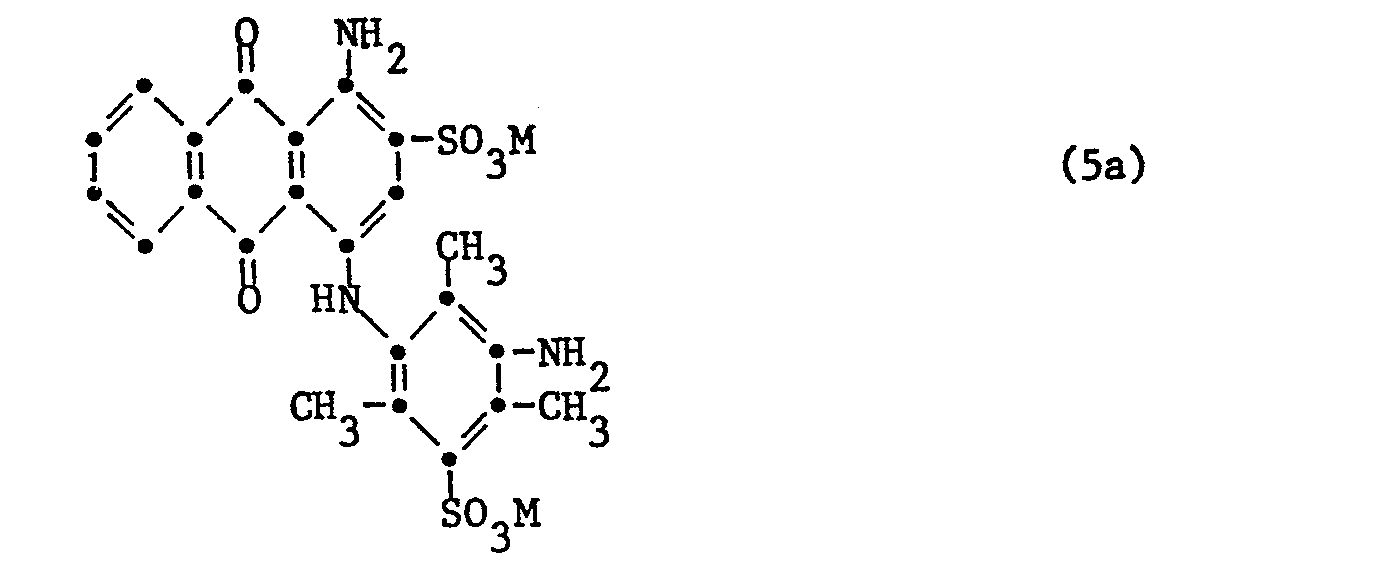
- unter Zusatz von 250 Volumenteilen 4N Lithiumhydroxidlösung gelöst wurden, zugegeben. Nun wird bei pH - 5.0 und bis auf 80°C ansteigender Temperatur gerührt. Man benötigt dazu ca. 250 Volumenteile 4N Lithiumhydroxidlösung. Die Reaktion ist nach etwa 2 Stunden beendet. Man erhält den Reaktivfarbstoff der folgenden Formel (Formel 5b) als gemischtes Lithium/Ammonium-Salz.

- Das Li+/NH+ 4-Verhältnis, das zunächst >1 ist, kann beliebig zugunsten des Ammoniumanteils verschoben werden über den teilweisen Ersatz der Lithiumhydroxidlösung durch wässrige Ammoniaklösung in einem der beiden oder beiden Reaktionsschritten.
- Die salzhaltige Suspension des Rohfarbstoffs wird wie in Beispiel 1 beschrieben mittels Hyperfiltration entsalzt und aufkonzentriert. Man erhält so eine konzentrierte Farbstofflösung mit einem Chloridgehalt von ca. 0,4 Gew.%, die sich problemlos zu einer lagerstabilen Flüssigformulierung verarbeiten lässt. Der Farbstoffgehalt der Lösung liegt bei 34 Gew.% und ist deutlich höher als der Farbstoffgehalt einer Lösung, die unter Verwendung des Farbstoffs der Formel (5b) als Natriumsalz erhalten wird; hier ist die Lösung bereits bei einer Konzentration von 27 Gew.% Farbstoff gesättigt.
Claims (9)
Applications Claiming Priority (2)
| Application Number | Priority Date | Filing Date | Title |
|---|---|---|---|
| CH5821/84 | 1984-12-07 | ||
| CH5821/84A CH660493A5 (de) | 1984-12-07 | 1984-12-07 | Verfahren zur herstellung konzentrierter salzarmer waessriger loesungen von aminotriazinyl-reaktivfarbstoffen. |
Publications (3)
| Publication Number | Publication Date |
|---|---|
| EP0184556A2 true EP0184556A2 (de) | 1986-06-11 |
| EP0184556A3 EP0184556A3 (en) | 1989-09-06 |
| EP0184556B1 EP0184556B1 (de) | 1991-06-12 |
Family
ID=4299858
Family Applications (1)
| Application Number | Title | Priority Date | Filing Date |
|---|---|---|---|
| EP85810571A Expired - Lifetime EP0184556B1 (de) | 1984-12-07 | 1985-12-02 | Verfahren zur Herstellung konzentrierter salzarmer wässriger Lösungen von Aminotriazinyl-Reaktivfarbstoffen |
Country Status (8)
| Country | Link |
|---|---|
| US (1) | US4955987A (de) |
| EP (1) | EP0184556B1 (de) |
| JP (1) | JPH0649839B2 (de) |
| KR (1) | KR930000308B1 (de) |
| BR (1) | BR8506134A (de) |
| CH (1) | CH660493A5 (de) |
| DE (1) | DE3583219D1 (de) |
| MX (1) | MX163457B (de) |
Cited By (4)
| Publication number | Priority date | Publication date | Assignee | Title |
|---|---|---|---|---|
| US4689048A (en) * | 1985-03-29 | 1987-08-25 | Ciba-Geigy Corporation | Process for the preparation of formulations of water-soluble organic dyes by two-stage membrane separation of crude dye suspension |
| EP0259088A3 (en) * | 1986-08-27 | 1989-10-11 | Hewlett-Packard Company | Ink-jet printing inks |
| EP0433810A3 (en) * | 1989-12-22 | 1992-01-15 | Bayer Ag | Process for the manufacture of storage stable solutions of dye |
| EP0539825A1 (de) * | 1991-10-30 | 1993-05-05 | Bayer Ag | Lagerstabile Präparation von Reaktivfarbstoffen |
Families Citing this family (6)
| Publication number | Priority date | Publication date | Assignee | Title |
|---|---|---|---|---|
| JPH0794617B2 (ja) * | 1987-07-14 | 1995-10-11 | 日本化薬株式会社 | 水性液状組成物 |
| JP2765989B2 (ja) * | 1989-09-22 | 1998-06-18 | 三洋電機株式会社 | 電話装置 |
| ATE352588T1 (de) * | 2000-05-26 | 2007-02-15 | Ciba Sc Holding Ag | Verfahren zur herstellung von lösungen anionischer organischer verbindungen |
| US7597721B2 (en) * | 2003-12-04 | 2009-10-06 | Clariant Finance (Bvi) Limited | Concentrated aqueous compositions of dyestuffs |
| CN102504597B (zh) * | 2011-12-02 | 2013-11-27 | 西南大学 | 一种疏水可控活性染料d-w-r的制备方法 |
| KR20140031737A (ko) * | 2012-09-05 | 2014-03-13 | 삼성디스플레이 주식회사 | 포토레지스트 조성물 및 이를 이용한 블랙 매트릭스의 형성 방법 |
Family Cites Families (11)
| Publication number | Priority date | Publication date | Assignee | Title |
|---|---|---|---|---|
| US3621008A (en) * | 1968-10-03 | 1971-11-16 | Du Pont | Direct disazo and tetraazo urea dyes and method of preparation |
| GB1318111A (en) * | 1970-01-09 | 1973-05-23 | Ici Ltd | Reactive dyestuff compositions |
| IT949703B (it) * | 1971-02-02 | 1973-06-11 | Ciba Geigy Ag | Procedimento per produrre prepara ti coloranti liquidi concentrati poveri di sali |
| US4189380A (en) * | 1976-11-18 | 1980-02-19 | Dynapol | Salt addition in ultrafiltration purification of solutions of polymeric colorants |
| JPS5848672B2 (ja) * | 1979-07-06 | 1983-10-29 | 住友化学工業株式会社 | セルロ−ズ系繊維の染色法 |
| CH643583A5 (de) * | 1979-08-16 | 1984-06-15 | Sandoz Ag | Reaktivfarbstoffe sowie deren herstellung. |
| DE2948292A1 (de) * | 1979-11-30 | 1981-06-04 | Bayer Ag, 5090 Leverkusen | Waessrige, loesungsmittelfreie konzentrierte praeparationen von raktivfarbstoffen und verfahren zu ihrer herstellung |
| DE3174666D1 (en) * | 1981-03-06 | 1986-06-26 | Ciba Geigy Ag | Process for producing concentrated aqueous dyestuff preparations of anionic paper or wool dyes |
| US4523924A (en) * | 1982-12-20 | 1985-06-18 | Ciba-Geigy Corporation | Process for the preparation of stable aqueous solutions of water-soluble reactive dyes by membrane separation |
| US4560746A (en) * | 1983-03-28 | 1985-12-24 | The Hilton-Davis Chemical Co. | Ultrafiltration process for purification of dyes useful in foodstuffs |
| CH657144A5 (de) * | 1983-05-04 | 1986-08-15 | Ciba Geigy Ag | Verfahren zur umwandlung schwerloeslicher salze anionischer farbstoffe und optischer aufheller in leichter loesliche salze mittels kationenaustausch. |
-
1984
- 1984-12-07 CH CH5821/84A patent/CH660493A5/de not_active IP Right Cessation
-
1985
- 1985-12-02 DE DE8585810571T patent/DE3583219D1/de not_active Expired - Lifetime
- 1985-12-02 EP EP85810571A patent/EP0184556B1/de not_active Expired - Lifetime
- 1985-12-06 BR BR8506134A patent/BR8506134A/pt not_active IP Right Cessation
- 1985-12-06 US US06/805,601 patent/US4955987A/en not_active Expired - Fee Related
- 1985-12-06 KR KR1019850009166A patent/KR930000308B1/ko not_active Expired - Fee Related
- 1985-12-06 JP JP60273596A patent/JPH0649839B2/ja not_active Expired - Lifetime
- 1985-12-09 MX MX860A patent/MX163457B/es unknown
Cited By (4)
| Publication number | Priority date | Publication date | Assignee | Title |
|---|---|---|---|---|
| US4689048A (en) * | 1985-03-29 | 1987-08-25 | Ciba-Geigy Corporation | Process for the preparation of formulations of water-soluble organic dyes by two-stage membrane separation of crude dye suspension |
| EP0259088A3 (en) * | 1986-08-27 | 1989-10-11 | Hewlett-Packard Company | Ink-jet printing inks |
| EP0433810A3 (en) * | 1989-12-22 | 1992-01-15 | Bayer Ag | Process for the manufacture of storage stable solutions of dye |
| EP0539825A1 (de) * | 1991-10-30 | 1993-05-05 | Bayer Ag | Lagerstabile Präparation von Reaktivfarbstoffen |
Also Published As
| Publication number | Publication date |
|---|---|
| MX163457B (es) | 1992-05-18 |
| KR930000308B1 (ko) | 1993-01-15 |
| EP0184556A3 (en) | 1989-09-06 |
| DE3583219D1 (de) | 1991-07-18 |
| KR860005086A (ko) | 1986-07-18 |
| EP0184556B1 (de) | 1991-06-12 |
| JPS61138668A (ja) | 1986-06-26 |
| CH660493A5 (de) | 1987-04-30 |
| US4955987A (en) | 1990-09-11 |
| BR8506134A (pt) | 1986-08-26 |
| JPH0649839B2 (ja) | 1994-06-29 |
Similar Documents
| Publication | Publication Date | Title |
|---|---|---|
| EP0114031B2 (de) | Verfahren zur Herstellung lagerstabiler wässriger Farbstofflösungen von wasserlöslichen Reaktivfarbstoffen | |
| EP0197006B1 (de) | Verfahren zur Herstellung von Präparaten wasserlöslicher organischer Farbstoffe | |
| EP0041240B1 (de) | Verfahren zum Spritzfärben von Leder | |
| DE60126268T2 (de) | Verfahren zur herstellung von lösungen anionischer organischer verbindungen | |
| EP0210378B2 (de) | Verfahren zur Herstellung konzentrierter Lösungen von anionischen Farbstoffen und Farbstoffadditiven | |
| EP0287515B1 (de) | Verfahren zur Herstellung von konzentrierten, wässrigen Farbstoffzubereitungen wasserlöslicher organischer Farbstoffe | |
| EP0596383B1 (de) | Kupferphthalocyanin-Flüssigformierung | |
| EP0169811B1 (de) | Verfahren zur Herstellung lagerstabiler wässriger Präparate von anionischen Farbstoffen | |
| EP0288434B1 (de) | Verfahren zur Herstellung konzentrierter wässriger Farbstoffzubereitungen | |
| EP0184556B1 (de) | Verfahren zur Herstellung konzentrierter salzarmer wässriger Lösungen von Aminotriazinyl-Reaktivfarbstoffen | |
| EP0059782B1 (de) | Verfahren zur Herstellung konzentrierter wässriger Farbstoffpräparate von anionischen Papier- oder Wollfarbstoffen | |
| EP0062304A1 (de) | Verfahren zur Herstellung von Azopigmentpräparationen und ihre Verwendung | |
| EP0212345B1 (de) | Wässrige Farbstoffzubereitung, ihre Herstellung und Verwendung | |
| DE2740152A1 (de) | Verfahren zur herstellung von disazofarbstoffen | |
| DE3410611A1 (de) | Verfahren zur herstellung von festen photoaktivatorpraeparaten | |
| DE2555533A1 (de) | Organische verbindungen | |
| DE69311402T2 (de) | Zusammensetzungen und wässrige Lösungen reaktiver Azofarbstoffe | |
| EP0035152B1 (de) | Polyazofarbstoffe und deren konzentrierte wässrige Lösungen sowie ihre Verwendung zum Färben cellulosehaltiger Materialien und Leder | |
| EP0122224B1 (de) | Konzentrierte lagerstabile wässrige Lösungen gelber bis grünstichig gelber Stilbenazo(xy)farbstoffe | |
| EP0088727B1 (de) | Verfahren zur Herstellung von Metallkomplexfarbstoff-Präparaten | |
| EP0182743B1 (de) | Konzentrierte lagerstabile wässrige Lösungen gelber Stilbenazo(xy)-farbstoffe | |
| EP0433810A2 (de) | Verfahren zur Herstellung lagerstabiler Farbstofflösungen | |
| EP0352229B1 (de) | Verfahren zum Färben von Papier | |
| DE3410620A1 (de) | Verfahren zur verhinderung des gelierens von konzentrierten waessrigen photoaktivatorloesungen | |
| EP0426617A1 (de) | Faserreaktive Formazanfarbstoffe, Verfahren zu deren Herstellung und deren Verwendung |
Legal Events
| Date | Code | Title | Description |
|---|---|---|---|
| PUAI | Public reference made under article 153(3) epc to a published international application that has entered the european phase |
Free format text: ORIGINAL CODE: 0009012 |
|
| 17P | Request for examination filed |
Effective date: 19851204 |
|
| AK | Designated contracting states |
Kind code of ref document: A2 Designated state(s): BE CH DE FR GB LI |
|
| PUAL | Search report despatched |
Free format text: ORIGINAL CODE: 0009013 |
|
| AK | Designated contracting states |
Kind code of ref document: A3 Designated state(s): BE CH DE FR GB LI |
|
| 17Q | First examination report despatched |
Effective date: 19900904 |
|
| GRAA | (expected) grant |
Free format text: ORIGINAL CODE: 0009210 |
|
| AK | Designated contracting states |
Kind code of ref document: B1 Designated state(s): BE CH DE FR GB LI |
|
| ET | Fr: translation filed | ||
| REF | Corresponds to: |
Ref document number: 3583219 Country of ref document: DE Date of ref document: 19910718 |
|
| GBT | Gb: translation of ep patent filed (gb section 77(6)(a)/1977) | ||
| PLBI | Opposition filed |
Free format text: ORIGINAL CODE: 0009260 |
|
| 26 | Opposition filed |
Opponent name: BASF AKTIENGESELLSCHAFT, LUDWIGSHAFEN Effective date: 19920316 |
|
| PLBN | Opposition rejected |
Free format text: ORIGINAL CODE: 0009273 |
|
| STAA | Information on the status of an ep patent application or granted ep patent |
Free format text: STATUS: OPPOSITION REJECTED |
|
| 27O | Opposition rejected |
Effective date: 19930329 |
|
| PGFP | Annual fee paid to national office [announced via postgrant information from national office to epo] |
Ref country code: FR Payment date: 19931025 Year of fee payment: 9 |
|
| PGFP | Annual fee paid to national office [announced via postgrant information from national office to epo] |
Ref country code: GB Payment date: 19931123 Year of fee payment: 9 |
|
| PGFP | Annual fee paid to national office [announced via postgrant information from national office to epo] |
Ref country code: CH Payment date: 19931229 Year of fee payment: 9 |
|
| PGFP | Annual fee paid to national office [announced via postgrant information from national office to epo] |
Ref country code: BE Payment date: 19940105 Year of fee payment: 9 |
|
| PG25 | Lapsed in a contracting state [announced via postgrant information from national office to epo] |
Ref country code: GB Effective date: 19941202 |
|
| PG25 | Lapsed in a contracting state [announced via postgrant information from national office to epo] |
Ref country code: LI Effective date: 19941231 Ref country code: CH Effective date: 19941231 Ref country code: BE Effective date: 19941231 |
|
| BERE | Be: lapsed |
Owner name: CIBA-GEIGY A.G. Effective date: 19941231 |
|
| GBPC | Gb: european patent ceased through non-payment of renewal fee |
Effective date: 19941202 |
|
| PG25 | Lapsed in a contracting state [announced via postgrant information from national office to epo] |
Ref country code: FR Effective date: 19950831 |
|
| REG | Reference to a national code |
Ref country code: CH Ref legal event code: PL |
|
| REG | Reference to a national code |
Ref country code: FR Ref legal event code: ST |
|
| PGFP | Annual fee paid to national office [announced via postgrant information from national office to epo] |
Ref country code: DE Payment date: 19981106 Year of fee payment: 14 |
|
| PG25 | Lapsed in a contracting state [announced via postgrant information from national office to epo] |
Ref country code: DE Free format text: LAPSE BECAUSE OF NON-PAYMENT OF DUE FEES Effective date: 20001003 |