EP0184901A2 - Correction de non-uniformité pour un affichage couleur à tube à rayons cathodiques - Google Patents
Correction de non-uniformité pour un affichage couleur à tube à rayons cathodiques Download PDFInfo
- Publication number
- EP0184901A2 EP0184901A2 EP19850307837 EP85307837A EP0184901A2 EP 0184901 A2 EP0184901 A2 EP 0184901A2 EP 19850307837 EP19850307837 EP 19850307837 EP 85307837 A EP85307837 A EP 85307837A EP 0184901 A2 EP0184901 A2 EP 0184901A2
- Authority
- EP
- European Patent Office
- Prior art keywords
- correction
- signals
- display
- color
- video
- Prior art date
- Legal status (The legal status is an assumption and is not a legal conclusion. Google has not performed a legal analysis and makes no representation as to the accuracy of the status listed.)
- Granted
Links
Images


Classifications
-
- H—ELECTRICITY
- H04—ELECTRIC COMMUNICATION TECHNIQUE
- H04N—PICTORIAL COMMUNICATION, e.g. TELEVISION
- H04N9/00—Details of colour television systems
- H04N9/64—Circuits for processing colour signals
- H04N9/68—Circuits for processing colour signals for controlling the amplitude of colour signals, e.g. automatic chroma control circuits
- H04N9/69—Circuits for processing colour signals for controlling the amplitude of colour signals, e.g. automatic chroma control circuits for modifying the colour signals by gamma correction
-
- H—ELECTRICITY
- H04—ELECTRIC COMMUNICATION TECHNIQUE
- H04N—PICTORIAL COMMUNICATION, e.g. TELEVISION
- H04N9/00—Details of colour television systems
- H04N9/64—Circuits for processing colour signals
- H04N9/73—Colour balance circuits, e.g. white balance circuits or colour temperature control
Definitions
- This invention relates to displays and, more particularly, to electrical circuitry for the correction of uniformity in a cathode ray tube (CRT) having red, green, and blue phosphors for presenting an image in color.
- CTR cathode ray tube
- CRTs are widely used for the presentation of data in many forms. In some applications, it is important to present the data with high accuracy in respect to both the color and the brightness of the data. For example, CRT's which are used for previewing or color correction must provide accurate color presentation. In particular, the display of a white screen should show no coloring or hues.
- Color CRT's are usually constructed with three electron guns which direct electron beams respectively at red, green, and blue phosphors located on the viewing screen. Modulation of the intensity of these beams shifts a region of the display from a uniform white to a color, and also changes the brightness of the screen.
- An apertured mask is placed between the screen and the guns, the apertures guiding a bundle of three beams simultaneously to the requisite phosphors.
- An electromagnetic coil or yoke scans the bundle of the three beams across the screen. Red, green, and blue video signals are applied to electrodes of the respective guns for modulation of the intensities of the respective beams.
- a calibration and uniformity correction system which, in accordance with the invention, introduces correction signals which are combined with the red, green, and blue video signals.
- the correction signals are obtained by photographing the display by a television camera three times, one time for each of the primary colors red, green, and blue. Any deviations from uniformity, as a function of location on the display screen, is expressed as a correction signal, which signal is the ratio of the observed signal to a reference signal.
- the video signals are altered in amplitude, as a function of location on the display, to compensate for the nonuniformity.
- the alteration in amplitude is accomplished by summing a correction term with the video, the correction term varying in amplitude from zero for a dark display to maximum for maximum brilliance in the absence of a video signal.
- the variation in the amplitude of the correction term for any one of the primary colors is attained by scaling the correction signal by a scale factor equal to the difference between a reference voltage and the video voltage for the corresponding primary color.
- a scale factor equal to the difference between a reference voltage and the video voltage for the corresponding primary color.
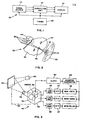
- Figure 1 shows a system 20 which incorporates the invention for correction of uniformity of both color and brightness in a CRT display 22.
- a signal source provides red, green, and blue video signals for driving the red, green, and blue electron guns of the display 22.
- the display 22 shows a bright white screen associated with maximum brilliance of all the primary colors red, green, and blue.
- Introduction of a video signal of any one color reduces the intensity of that color on the display screen and shifts the presentation of the screen from white to a colored presentation.
- the system 20 further comprises a correction unit 26 for combining correction signals with the video signals prior to the application of the video signal to the display 22.
- the correction signals are obtained initially from a bright display.
- the signals are scaled inversely with the magnitude of the respective video signals resulting in correction of the uniformity of the display 22 under conditions of varying brightness.
- a timing unit 28 synchronizes the respective operations of the source 24, the correction unit 26 and the display 22.
- FIG 2 there is provided a stylized view of a portion of a color CRT 30 as is used in the display 22 to demonstrate the causes of the nonuniformity in color and in brightness.
- the CRT 30 includes a screen 32 having phosphors 34 thereon.
- a group of three contiguous phosphors 34 is shown in heavy lines and comprises a set of red, green, and blue phosphors which generate light in response to electron beams 36 directed upon the respective phosphors by a corresponding set of red, green, and blue electron guns 38.
- the beams 36 are transmitted as a bundle of beams through an aperture 40 in a mask 42.
- the relative angulations of the beams 36 through the aperture 40 provide for the direction of the beams upon the corresponding ones of the phosphors 34.
- a separate aperture 40 is used with each three color group of three contiguous phosphors 34.
- a magnetic deflection yoke 44 scans the bundle of beams 36 across the screen 32 for the generation of an image thereon. The data presented in the image is provided by modulation of the beams 36 by the video signals. Uniformity in the color and brightness of the image is dependent on the precision in the shaping and the positioning of the apertures 40 and the amount of phosphor material deposited at each site of phosphor on the screen 32. Variations in the manufacturing tolerances in the construction of the foregoing parts of the CRT 30 introduce nonuniformities which are to be compensated by the system 26 for correction of the presentation on the display 22.
- the equipment 46 utilized in the generation of correction signals for use by the correction unit 26 of Figure 1.
- the equipment 46 comprises a television camera 48 pointing towards a subject 50 rigidly positioned relative to the camera 48 by a support 52 which is indicated diagrammatically.
- the camera 48 incorporates a vidicon 54 and sweep unit 56 for scanning the electron beams in the vidicon 54.
- a lens assembly 58 is secured to the front end of the vidicon 54 for focusing and magnifying the subject 50 to the desired size for filling a predetermined region of the viewing surface of the vidicon 54.
- the subject 50 is a white card which is uniformly illuminated by a source 60 of white light.
- a clock 62 Also included in the equipment 46 is a clock 62, an address generator 64, three logarithmic amplifiers 66 which are employed respectively for the red, green, and blue output channels of the vidicon 54, three digital-to-analog converters 67, and a set of three memory 68 which are used respectively for the red, green and blue output channels of the vidicon 54.
- the camera 48 photographs the subject 50. Since the subject is white, the three output channels of the vidicon 54 provides, ideally, three equal-amplitude video signals, respectively, the red, green and blue video signals. These signals are coupled via the amplifier 66 to the memory 68 wherein the video signals are stored.
- the clock 62 strobes the sweep unit 56 and the address generator 64, the latter addressing the memory 68 for receipt and storage of the video signals.
- the clock 62 maintains synchronism between the addressing of the memory 68 and the operation of the sweep unit 56 so that each location in memory corresponds to an image point on the photograph of the subject 50.
- the values of signals stored in the memory 68 correspond to those actually produced by the vidicon 54.
- each output channel of the camera 48 provides a video signal to the amplifier 66 and memory 68.
- the video signals can be provided by a voltage source since it has been found that the video signals tend to be in a narrow range and are fairly consistent.
- FIG 4 there is shown equipment 70 for accomplishing a further step in the generation of the correction signals for use by the correction unit 26 of Figure 1.
- the equipment 70 includes the camera 48, the memory (RAM) 68, the logarithmic amplifiers 66, the address generator 64 and the clock 62 previously described with reference to Figure 3.
- the subject 50 of Figure 3 has been replaced with the display 22 in Figure 4.
- the equipment 70 provides for the photographing of the display 22 (first disclosed in Figure 1) in a manner corresponding to that disclosed in Figure 3 for the purpose of storing values of signals which indicate the presence of any nonuniformity.
- An additional feature in the operation of the equipment 70 is the automatic compensation for any nonuniformities of the camera 48 so that the resulting signals obtained from the photographing of the display 22 do, in fact, accurately represent the presence of any nonuniformities.
- the display 22 includes the components of a CRT as has been disclosed hereinabove in Figure 2, these components being the set of red, green, and blue guns 38, the mask 42, and the screen 32. Also, the display 22 includes a sweep unit 72 for driving a deflection yoke (such as the yoke 44 of Figure 2) to scan the electron beams of the guns 38.
- a deflection yoke such as the yoke 44 of Figure 2
- the equipment 70 further comprises a source 74 of reference voltage, two sets 75 and 76 of three-position, sequentially operated switches which are ganged together as indicated diagrammatically by a dashed line 78, three differential amplifiers 80, sequentially operated three-position switch 82, three analog-to-digital converters 84, and three memories 86 which are in the form of electronically programmable read-only memories (EPROM).
- a source 74 of reference voltage two sets 75 and 76 of three-position, sequentially operated switches which are ganged together as indicated diagrammatically by a dashed line 78, three differential amplifiers 80, sequentially operated three-position switch 82, three analog-to-digital converters 84, and three memories 86 which are in the form of electronically programmable read-only memories (EPROM).
- EPROM electronically programmable read-only memories
- the display 22 is illuminated sequentially by the red, green, and blue guns 38 in response to the successive application of a video signal to the respective guns 38 by the switches of the set 75.
- the video signal is of a constant amplitude in accordance with a preselected value of voltage provided by the source 74.
- the switches of the switch sets 75, 76 are ganged in accordance with the arrangement wherein the switches carrying red signals are ganged together for simultaneous operation, the switches carrying the green signals are ganged together for simultaneous operation independently of the operation of the red-signal switches, and the switches carrying the blue signals are ganged together for simultaneous operation independently of the operation of the red-signal switches and the green-signal switches of the two switch sets 75, 76.
- the clock 62 drives the camera 48 and the address generator 64 in the same manner as has been disclosed with reference to Figure 3.
- the clock 62 drives the sweep unit 72 in the synchronism with the sweep unit 56 (Fig. 3) of the camera 48. Thereby, the operation of the display 22 and the operation of the camera 48 are synchronized.
- the camera 48 first photographs the screen 32 when illuminated by the red gun, the resulting red video signal being outputted by the red channel of the camera 48 to the corresponding logarithmic amplifier 66 of the red channel.
- the red switch of the set 76 is closed for coupling the red output signal of the camera 48 to the red amplifier 66.
- the green switch of the set 76 is closed for coupling the green video output to the amplifier 66 of the green channel.
- the procedure is repeated for the photographing of the blue screen by the closing of the blue switch of the set 76 for coupling the blue video to the amplifier 66 of the blue channel.
- the output signals of the logarithmic amplifiers 66 are coupled via the respective ones, of the differential amplifiers 80 to the respective ones of the converters 84 to the respective ones of the memories 86.
- the data stored in the memory 68 with respect to the camera 48 is stored in the form of logarithmic values.
- the correction circuitry 77 includes the stored data in the memory 68 which is outputted concurrently with the outputting of the signals from the logarithmic amplifiers 66 to be subtracted from the signals of the logarithmic amplifiers 66 at the amplifiers 80.
- the amplifiers 66 are connected to the positive input terminals of the respective ones of the amplifiers 80, while the memory 68 are coupled via digital-to-analog converters 88 to the negative input terminals of the respective amplifiers 80 to accomplish the foregoing subtraction.
- the commonly used forms of construction may be employed.
- the analog-to-digital converters 67 (Fig. 3) and the digital-to-analog converters 88 (Fig. 4) would not be required.
- the memory 68 store digitized signals as in the case of construction as a random-access memory, then the converters 67 and 88 are required to provide the digitized form of signal for storage, and then to convert the signals back to the analog form for subtraction at the amplifiers 80.
- the use of the logarithmic amplifiers in both Figures 3 and 4 provide for the subtraction of the logarithmic values of the signals at the amplifiers 80, this corresponding to a division of the camera signals (Fig. 4) by the reference signals of the memory 68.
- the logarithms of the qoutients appear at the output terminals of the amplifiers 80.
- correction circuitry 77 is optional and the output of log amplifiers 66 may be directly applied to converters 84. If correction circuitry 77 is not used, a correction voltage 110 must be subtracted from the output of converters 94 (see Figure 5).
- the exponential amplifiers 82 introduce the inverse logarithmic function so as to convert the camera signals back to the usual analog format.
- the effect of the division by the reference values in the memory 68 is to normalize the camera signals with respect to any nonuniformities that may be present in the camera 48 itself.
- the camera signals appearing at the output terminals of the exponential amplifiers 82 are true representations of the image of the screen 32 of the display 22.
- the logarithmic amplifiers 66 and the exponential amplifiers 82 it is noted that these amplifiers are available commercially, and are also available as matched sets so as to provide for an accurate conversion from the analog format to the logarithmic format and back to the analog format.
- the camera signals at the output terminals of the respective amplifiers 82 are then converted from analog form to digital form by the converters 84 and stored in the memories 86.
- the red, green, and blue video signals stored in the memories 86 serve as an accurate representation of the image of the screen 32, including the presence of any nonuniformities. Accordingly, the signals in the memories 86 are in the proper form for use as correction signals in the correction unit 26 of Figure 1.
- the addressing of the memories 86 is provided by the address generator 64 through the switches of the switch set 77 as is indicated by the legends R, G and B which identify the respective address terminals of the memories 86. Thereby, the storage locations of the memories 86 correspond to those utilized in the memory 68.
- the system 20 comprises the memories 86 which store the correction signals as has been described with reference to Figure 4, the system 20 further comprising a clock 90 and an address generator 92 which function in the same manner as the clock 62 and the generator 64 of Figure 4 for addressing the memories 86.
- the system 20 further comprises three digital-to-analog converters 94, three multipliers 96, three summers 98, three differential amplifiers 100 and a source 102 of reference voltage.
- the correction signals of the respective memories 86 are converted from digital to analog format by the converters 94 and applied to the multipliers 96.
- the multipliers 96 are analog multipliers, and are readily available commercially.
- the multipliers 96 serve to scale the correction signals prior to the combining of the correction signals with the video signals at the summers 98.
- the summers 98 which may be summing amplifiers, sum the scaled correction signals with the video signals, and apply the sums as input signals to the display 22. It is noted that each of the video signals is separately treated; thus, the red video signal is combined with a scaled correction signal from the red memories 86. Similarly, the green and blue video signals are combined with scale correction signals from the green and blue memories 86, respectively.
- the source 24 may be a memory, or camera, or other suitable source of video signals which is operable in response to clock pulses from the clock 90. Thereby, the operation of the source 24 is synchronized with that of the address generator 92 by the clock 90. This synchronization insures that the video signals from each site of an image are combined with the correction signals stored at the corresponding locations in the corresponding memories 86.
- the scale factors are developed by the differential amplifiers 100, the output terminals of which are coupled to respective ones of the multipliers 96.
- Each differential amplifier has a positive input terminal and a negative input terminal, the positive input terminals of the amplifiers 100 being connected together and to the source 102 for receiving a predetermined level of voltage.
- the display 22 presents maximum brilliance. Accordingly, the value of the reference voltage of the source 102, as multiplied by the respective correction signals, is of the appropriate value to provide the foregoing maximum brilliance.
- the video signals are connected to the negative input terminals in respective ones of the differential ampliers 100.
- the amplifiers 100 output a value of zero to the multipliers 96 which, in turn, output values of zero to the summers 98.
- the values of the input signals presented to the display 22 are equal to the values of the red, green, and blue video signals of the source 24.
- These values of the video signals reduce the energies of the electron beams of the guns 38 (Figs. 2 and 4) sufficiently for darkening the display 22.
- the reference of the source 102 is also of the appropriate value for attaining the dark current.
- the foregoing description has presented a system which incorporates the invention to compensate for nonuniformities in a color CRT display so as to correct the resulting image.
- the resulting image is thus a true representation of the data provided by the video signals and is free of nonuniformities which would be introduced, otherwise, into the displayed image.
- the correction sigals are generated by the photographing of a bright white display wherein all of the primary colors, namely the red, green, and blue, are present.
- the correction signals are attained as a function of location upon the face of the display with the result that the totality of the stored correction signals includes information as to nonuniformities in the display.
- the camera utilized in photographing the display is also calibrated by the initial photographing of a uniformly white subject.
- the calibration signals of the camera are used as reference signals for normalizing the correction signals so as to be free of any perturbations or nonuniformities which might have been present in the camera.
- the correction signals are of true representation of a white image of the display at maximum intended brilliance.
- the scaling of the correction signal permits a maximum amount of correction signal to be present at the input terminals of the display in the absence of the video signals, with progressively smaller amounts of correction signal being combined with the video as the video signals increase. Thereby, the correction signals are useful over a range of varying intensity of displayed image.
Landscapes
- Engineering & Computer Science (AREA)
- Multimedia (AREA)
- Signal Processing (AREA)
- Processing Of Color Television Signals (AREA)
- Video Image Reproduction Devices For Color Tv Systems (AREA)
- Testing, Inspecting, Measuring Of Stereoscopic Televisions And Televisions (AREA)
- Color Television Image Signal Generators (AREA)
Applications Claiming Priority (2)
| Application Number | Priority Date | Filing Date | Title |
|---|---|---|---|
| US671137 | 1984-11-13 | ||
| US06/671,137 US4631576A (en) | 1984-11-13 | 1984-11-13 | Nonuniformity correction system for color CRT display |
Publications (3)
| Publication Number | Publication Date |
|---|---|
| EP0184901A2 true EP0184901A2 (fr) | 1986-06-18 |
| EP0184901A3 EP0184901A3 (en) | 1988-10-19 |
| EP0184901B1 EP0184901B1 (fr) | 1991-10-16 |
Family
ID=24693273
Family Applications (1)
| Application Number | Title | Priority Date | Filing Date |
|---|---|---|---|
| EP85307837A Expired EP0184901B1 (fr) | 1984-11-13 | 1985-10-29 | Correction de non-uniformité pour un affichage couleur à tube à rayons cathodiques |
Country Status (6)
| Country | Link |
|---|---|
| US (1) | US4631576A (fr) |
| EP (1) | EP0184901B1 (fr) |
| JP (1) | JPS61125297A (fr) |
| CA (1) | CA1235538A (fr) |
| DE (1) | DE3584431D1 (fr) |
| IL (1) | IL76829A0 (fr) |
Cited By (4)
| Publication number | Priority date | Publication date | Assignee | Title |
|---|---|---|---|---|
| US4746970A (en) * | 1985-01-09 | 1988-05-24 | Sony Corporation | White uniformity correcting apparatus for a three-color display wherein correction signals are stored in a memory |
| WO1991015923A1 (fr) * | 1990-04-09 | 1991-10-17 | Rank Brimar Limited | Systemes de projection |
| EP0440216A3 (en) * | 1990-01-30 | 1993-03-03 | Pioneer Electronic Corporation | White balance control system |
| EP0755042A1 (fr) * | 1995-07-20 | 1997-01-22 | STMicroelectronics S.r.l. | Méthode et dispositif pour uniformiser la luminosité et pour réduire la dégradation de la matière fluorescente dans un dispositif d'affichage plat à émission de champ |
Families Citing this family (25)
| Publication number | Priority date | Publication date | Assignee | Title |
|---|---|---|---|---|
| US4742397A (en) * | 1986-01-16 | 1988-05-03 | Polaroid Corporation | System and method for adjusting image brightness in electronic printer |
| JPH0516765Y2 (fr) * | 1986-05-14 | 1993-05-06 | ||
| JPS6362489A (ja) * | 1986-09-03 | 1988-03-18 | Fuji Photo Film Co Ltd | 画像出力装置のシエ−デイング検出装置 |
| US4875032A (en) * | 1987-10-26 | 1989-10-17 | Mcmanus Paul A | Method and apparatus for processing colorimetric parameters of a color sample |
| FR2622724B1 (fr) * | 1987-10-30 | 1993-02-12 | Thomson Csf | Dispositif de generation de niveaux de brillance sur un ecran de visualisation |
| US5293224A (en) * | 1990-01-30 | 1994-03-08 | Pioneer Electronic Corporation | White balance control system |
| US5081687A (en) * | 1990-11-30 | 1992-01-14 | Photon Dynamics, Inc. | Method and apparatus for testing LCD panel array prior to shorting bar removal |
| DE4109856A1 (de) * | 1991-03-26 | 1992-10-01 | Thomson Brandt Gmbh | Farbbildroehre mit waagerechten farbstreifen |
| US5175504A (en) * | 1991-06-17 | 1992-12-29 | Photon Dynamics, Inc. | Method and apparatus for automatically inspecting and repairing a simple matrix circuit panel |
| US5235272A (en) * | 1991-06-17 | 1993-08-10 | Photon Dynamics, Inc. | Method and apparatus for automatically inspecting and repairing an active matrix LCD panel |
| US5432461A (en) * | 1991-06-28 | 1995-07-11 | Photon Dynamics, Inc. | Method of testing active matrix liquid crystal display substrates |
| US5465052A (en) * | 1991-09-10 | 1995-11-07 | Photon Dynamics, Inc. | Method of testing liquid crystal display substrates |
| US5444385A (en) * | 1991-09-10 | 1995-08-22 | Photon Dynamics, Inc. | Testing apparatus for liquid crystal display substrates |
| US5406213A (en) * | 1991-09-10 | 1995-04-11 | Photon Dynamics, Inc. | Instrument for testing liquid crystal display base plates |
| US5459409A (en) * | 1991-09-10 | 1995-10-17 | Photon Dynamics, Inc. | Testing device for liquid crystal display base plate |
| US5504438A (en) * | 1991-09-10 | 1996-04-02 | Photon Dynamics, Inc. | Testing method for imaging defects in a liquid crystal display substrate |
| US5543729A (en) * | 1991-09-10 | 1996-08-06 | Photon Dynamics, Inc. | Testing apparatus and connector for liquid crystal display substrates |
| US5483259A (en) * | 1994-04-12 | 1996-01-09 | Digital Light & Color Inc. | Color calibration of display devices |
| CN1070013C (zh) * | 1994-12-14 | 2001-08-22 | 松下电器产业株式会社 | 具有校正亮度不均匀性的电路的投影型图像显示装置 |
| JPH09107515A (ja) * | 1995-10-12 | 1997-04-22 | Mitsubishi Electric Corp | 投射形映像表示装置 |
| US6285397B1 (en) | 1997-01-16 | 2001-09-04 | Display Laboratories, Inc. | Alignment of cathode ray tube video displays using a host computer processor |
| US5969486A (en) * | 1997-01-16 | 1999-10-19 | Display Laboratories, Inc. | Detecting horizontal blanking time in cathode ray tube devices |
| US6437829B1 (en) | 1997-01-16 | 2002-08-20 | Display Laboratories, Inc. | Alignment of cathode ray tube displays using a video graphics controller |
| JP2006007065A (ja) * | 2004-06-24 | 2006-01-12 | Watanabe Kikai Kogyo Kk | 排水浄化装置 |
| JP2009039697A (ja) * | 2007-08-10 | 2009-02-26 | Fulta Electric Machinery Co Ltd | 排水再利用における微細異物の脱水濾過装置 |
Family Cites Families (9)
| Publication number | Priority date | Publication date | Assignee | Title |
|---|---|---|---|---|
| JPS5420614A (en) * | 1977-07-18 | 1979-02-16 | Hitachi Ltd | Coding circuit |
| JPS54115021A (en) * | 1978-02-28 | 1979-09-07 | Sharp Corp | Corrector for color spots for color television camera |
| JPS5675789A (en) * | 1979-11-27 | 1981-06-23 | Nec Corp | Compensation device for nonlinear distortion |
| JPS56104585A (en) * | 1980-01-23 | 1981-08-20 | Sony Corp | Automatic luminance adjusting device of picture tube |
| NL8005186A (nl) * | 1980-09-17 | 1982-04-16 | Koninkl Philips Electronics Nv | Televisieschakeling voor toepassing bij signaalopname respectievelijk -weergave. |
| JPS5820095A (ja) * | 1981-07-29 | 1983-02-05 | Toshiba Corp | デイジタル可変ガンマ補正回路 |
| JPS5851676A (ja) * | 1981-09-24 | 1983-03-26 | Ikegami Tsushinki Co Ltd | シエ−デイング補正装置 |
| US4547797A (en) * | 1982-10-12 | 1985-10-15 | Sperry Corporation | Apparatus for color tracking and brightness correction for multi-gun color cathode ray tube display |
| JPS59181880A (ja) * | 1983-03-31 | 1984-10-16 | Toshiba Electric Equip Corp | 映像表示装置 |
-
1984
- 1984-11-13 US US06/671,137 patent/US4631576A/en not_active Expired - Fee Related
-
1985
- 1985-10-22 CA CA000493597A patent/CA1235538A/fr not_active Expired
- 1985-10-25 IL IL76829A patent/IL76829A0/xx not_active IP Right Cessation
- 1985-10-29 DE DE8585307837T patent/DE3584431D1/de not_active Expired - Fee Related
- 1985-10-29 EP EP85307837A patent/EP0184901B1/fr not_active Expired
- 1985-11-13 JP JP60254609A patent/JPS61125297A/ja active Pending
Cited By (6)
| Publication number | Priority date | Publication date | Assignee | Title |
|---|---|---|---|---|
| US4746970A (en) * | 1985-01-09 | 1988-05-24 | Sony Corporation | White uniformity correcting apparatus for a three-color display wherein correction signals are stored in a memory |
| EP0440216A3 (en) * | 1990-01-30 | 1993-03-03 | Pioneer Electronic Corporation | White balance control system |
| WO1991015923A1 (fr) * | 1990-04-09 | 1991-10-17 | Rank Brimar Limited | Systemes de projection |
| US5386253A (en) * | 1990-04-09 | 1995-01-31 | Rank Brimar Limited | Projection video display systems |
| EP0755042A1 (fr) * | 1995-07-20 | 1997-01-22 | STMicroelectronics S.r.l. | Méthode et dispositif pour uniformiser la luminosité et pour réduire la dégradation de la matière fluorescente dans un dispositif d'affichage plat à émission de champ |
| US5708451A (en) * | 1995-07-20 | 1998-01-13 | Sgs-Thomson Microelectronics, S.R.L. | Method and device for uniforming luminosity and reducing phosphor degradation of a field emission flat display |
Also Published As
| Publication number | Publication date |
|---|---|
| JPS61125297A (ja) | 1986-06-12 |
| IL76829A0 (en) | 1986-02-28 |
| CA1235538A (fr) | 1988-04-19 |
| EP0184901B1 (fr) | 1991-10-16 |
| US4631576A (en) | 1986-12-23 |
| DE3584431D1 (de) | 1991-11-21 |
| EP0184901A3 (en) | 1988-10-19 |
Similar Documents
| Publication | Publication Date | Title |
|---|---|---|
| US4631576A (en) | Nonuniformity correction system for color CRT display | |
| US4379292A (en) | Method and system for displaying colors utilizing tristimulus values | |
| Berns et al. | CRT colorimetry. part II: Metrology | |
| Berns et al. | CRT colorimetry. Part I: Theory and practice | |
| US5821917A (en) | System and method to compensate for the effects of aging of the phosphors and faceplate upon color accuracy in a cathode ray tube | |
| US5081523A (en) | Display image correction system and method | |
| US5512961A (en) | Method and system of achieving accurate white point setting of a CRT display | |
| US5357110A (en) | Visual color mapping X-ray analysis apparatus | |
| KR940005176B1 (ko) | 동적 균일성 보정장치 | |
| US7190411B2 (en) | Gamma calibration | |
| US20010035850A1 (en) | Image reproducing method, image display apparatus and picture signal compensation device | |
| WO1995010160A1 (fr) | Procede et appareil de decodage de signaux video couleur destines a etre affiches | |
| HU212690B (en) | Method and device for producing color picture points of a television picture | |
| US3196205A (en) | Color television camera system | |
| US5619230A (en) | System and method for real-time image display palette mapping | |
| US4730214A (en) | Method and apparatus for correlating video and film images produced from electronic data | |
| Lucassen et al. | Evaluation of a simple method for color monitor recalibration | |
| US4701788A (en) | Color temperature correction of color video projectors | |
| JPH07333760A (ja) | 自動調整システム | |
| Mollon et al. | The use of CRT displays in research on colour vision | |
| US4670778A (en) | Method of correcting phosphor luminance unevenness in a color fiber optic cathode-ray tube | |
| US2763833A (en) | Television film recording | |
| JPH0698346A (ja) | ホワイトバランス自動調整装置 | |
| WO2005067636A2 (fr) | Circuit de correction de couleurs ameliore pouvant faire appel a des valeurs rouge-vert-bleu negatives | |
| Compton | Image performance in CRT displays |
Legal Events
| Date | Code | Title | Description |
|---|---|---|---|
| PUAI | Public reference made under article 153(3) epc to a published international application that has entered the european phase |
Free format text: ORIGINAL CODE: 0009012 |
|
| AK | Designated contracting states |
Kind code of ref document: A2 Designated state(s): DE FR GB |
|
| PUAL | Search report despatched |
Free format text: ORIGINAL CODE: 0009013 |
|
| AK | Designated contracting states |
Kind code of ref document: A3 Designated state(s): DE FR GB |
|
| 17P | Request for examination filed |
Effective date: 19881125 |
|
| 17Q | First examination report despatched |
Effective date: 19900706 |
|
| GRAA | (expected) grant |
Free format text: ORIGINAL CODE: 0009210 |
|
| RAP3 | Party data changed (applicant data changed or rights of an application transferred) |
Owner name: HAZELTINE CORPORATION |
|
| AK | Designated contracting states |
Kind code of ref document: B1 Designated state(s): DE FR GB |
|
| REF | Corresponds to: |
Ref document number: 3584431 Country of ref document: DE Date of ref document: 19911121 |
|
| ET | Fr: translation filed | ||
| PLBE | No opposition filed within time limit |
Free format text: ORIGINAL CODE: 0009261 |
|
| STAA | Information on the status of an ep patent application or granted ep patent |
Free format text: STATUS: NO OPPOSITION FILED WITHIN TIME LIMIT |
|
| PGFP | Annual fee paid to national office [announced via postgrant information from national office to epo] |
Ref country code: FR Payment date: 19920918 Year of fee payment: 8 |
|
| 26N | No opposition filed | ||
| PGFP | Annual fee paid to national office [announced via postgrant information from national office to epo] |
Ref country code: GB Payment date: 19930922 Year of fee payment: 9 |
|
| PGFP | Annual fee paid to national office [announced via postgrant information from national office to epo] |
Ref country code: DE Payment date: 19931231 Year of fee payment: 9 |
|
| PG25 | Lapsed in a contracting state [announced via postgrant information from national office to epo] |
Ref country code: FR Effective date: 19940630 |
|
| REG | Reference to a national code |
Ref country code: FR Ref legal event code: ST |
|
| PG25 | Lapsed in a contracting state [announced via postgrant information from national office to epo] |
Ref country code: GB Effective date: 19941029 |
|
| GBPC | Gb: european patent ceased through non-payment of renewal fee |
Effective date: 19941029 |
|
| PG25 | Lapsed in a contracting state [announced via postgrant information from national office to epo] |
Ref country code: DE Effective date: 19950701 |