EP0186787A2 - Procédé de fabrication d'un verre laminé - Google Patents
Procédé de fabrication d'un verre laminé Download PDFInfo
- Publication number
- EP0186787A2 EP0186787A2 EP85115083A EP85115083A EP0186787A2 EP 0186787 A2 EP0186787 A2 EP 0186787A2 EP 85115083 A EP85115083 A EP 85115083A EP 85115083 A EP85115083 A EP 85115083A EP 0186787 A2 EP0186787 A2 EP 0186787A2
- Authority
- EP
- European Patent Office
- Prior art keywords
- bonding
- bag
- laminate
- press
- packaging bag
- Prior art date
- Legal status (The legal status is an assumption and is not a legal conclusion. Google has not performed a legal analysis and makes no representation as to the accuracy of the status listed.)
- Granted
Links
Images

Classifications
-
- B—PERFORMING OPERATIONS; TRANSPORTING
- B32—LAYERED PRODUCTS
- B32B—LAYERED PRODUCTS, i.e. PRODUCTS BUILT-UP OF STRATA OF FLAT OR NON-FLAT, e.g. CELLULAR OR HONEYCOMB, FORM
- B32B17/00—Layered products essentially comprising sheet glass, or glass, slag, or like fibres
- B32B17/06—Layered products essentially comprising sheet glass, or glass, slag, or like fibres comprising glass as the main or only constituent of a layer, next to another layer of a specific material
- B32B17/10—Layered products essentially comprising sheet glass, or glass, slag, or like fibres comprising glass as the main or only constituent of a layer, next to another layer of a specific material of synthetic resin
- B32B17/10005—Layered products essentially comprising sheet glass, or glass, slag, or like fibres comprising glass as the main or only constituent of a layer, next to another layer of a specific material of synthetic resin laminated safety glass or glazing
- B32B17/10807—Making laminated safety glass or glazing; Apparatus therefor
- B32B17/10816—Making laminated safety glass or glazing; Apparatus therefor by pressing
- B32B17/10825—Isostatic pressing, i.e. using non rigid pressure-exerting members against rigid parts
- B32B17/10834—Isostatic pressing, i.e. using non rigid pressure-exerting members against rigid parts using a fluid
- B32B17/10844—Isostatic pressing, i.e. using non rigid pressure-exerting members against rigid parts using a fluid using a membrane between the layered product and the fluid
- B32B17/10853—Isostatic pressing, i.e. using non rigid pressure-exerting members against rigid parts using a fluid using a membrane between the layered product and the fluid the membrane being bag-shaped
-
- B—PERFORMING OPERATIONS; TRANSPORTING
- B32—LAYERED PRODUCTS
- B32B—LAYERED PRODUCTS, i.e. PRODUCTS BUILT-UP OF STRATA OF FLAT OR NON-FLAT, e.g. CELLULAR OR HONEYCOMB, FORM
- B32B17/00—Layered products essentially comprising sheet glass, or glass, slag, or like fibres
- B32B17/06—Layered products essentially comprising sheet glass, or glass, slag, or like fibres comprising glass as the main or only constituent of a layer, next to another layer of a specific material
- B32B17/10—Layered products essentially comprising sheet glass, or glass, slag, or like fibres comprising glass as the main or only constituent of a layer, next to another layer of a specific material of synthetic resin
- B32B17/10005—Layered products essentially comprising sheet glass, or glass, slag, or like fibres comprising glass as the main or only constituent of a layer, next to another layer of a specific material of synthetic resin laminated safety glass or glazing
- B32B17/10009—Layered products essentially comprising sheet glass, or glass, slag, or like fibres comprising glass as the main or only constituent of a layer, next to another layer of a specific material of synthetic resin laminated safety glass or glazing characterized by the number, the constitution or treatment of glass sheets
- B32B17/10036—Layered products essentially comprising sheet glass, or glass, slag, or like fibres comprising glass as the main or only constituent of a layer, next to another layer of a specific material of synthetic resin laminated safety glass or glazing characterized by the number, the constitution or treatment of glass sheets comprising two outer glass sheets
-
- B—PERFORMING OPERATIONS; TRANSPORTING
- B32—LAYERED PRODUCTS
- B32B—LAYERED PRODUCTS, i.e. PRODUCTS BUILT-UP OF STRATA OF FLAT OR NON-FLAT, e.g. CELLULAR OR HONEYCOMB, FORM
- B32B17/00—Layered products essentially comprising sheet glass, or glass, slag, or like fibres
- B32B17/06—Layered products essentially comprising sheet glass, or glass, slag, or like fibres comprising glass as the main or only constituent of a layer, next to another layer of a specific material
- B32B17/10—Layered products essentially comprising sheet glass, or glass, slag, or like fibres comprising glass as the main or only constituent of a layer, next to another layer of a specific material of synthetic resin
- B32B17/10005—Layered products essentially comprising sheet glass, or glass, slag, or like fibres comprising glass as the main or only constituent of a layer, next to another layer of a specific material of synthetic resin laminated safety glass or glazing
- B32B17/1055—Layered products essentially comprising sheet glass, or glass, slag, or like fibres comprising glass as the main or only constituent of a layer, next to another layer of a specific material of synthetic resin laminated safety glass or glazing characterized by the resin layer, i.e. interlayer
- B32B17/10761—Layered products essentially comprising sheet glass, or glass, slag, or like fibres comprising glass as the main or only constituent of a layer, next to another layer of a specific material of synthetic resin laminated safety glass or glazing characterized by the resin layer, i.e. interlayer containing vinyl acetal
-
- B—PERFORMING OPERATIONS; TRANSPORTING
- B32—LAYERED PRODUCTS
- B32B—LAYERED PRODUCTS, i.e. PRODUCTS BUILT-UP OF STRATA OF FLAT OR NON-FLAT, e.g. CELLULAR OR HONEYCOMB, FORM
- B32B2367/00—Polyesters, e.g. PET, i.e. polyethylene terephthalate
Definitions
- the present invention relates to a novel process for producing a laminated glass.
- a laminated glass is widely used as a window glass for various transportation vehicles such as automobiles, trains, air planes or ships, or as a window glass for buildings.
- such a laminated glass has been prepared by preliminarily press-bonding a laminate comprising a plurality of transparent sheets and an adhesive synthetic resin interlayer interposed therebetween, either by passing the laminate between nip rollers or by inserting the laminate into a rubber bag for preliminary press-bonding, followed by sealing and deaerating, and then placing the preliminarily press-bonded laminate into an autoclave and press-bonding it under a high temperature and high pressure condition.
- the present invention provides a process for producing a laminated glass, which comprises inserting a laminate comprising at least two transparent sheets and an adhesive synthetic resin interlayer, into a vacuum packaging bag, vacuuming the bag, sealing the vacuumed bag, preliminarily press-bonding the laminate in the vacuum-sealed bag, and then heating the preliminarily press-bonded laminate for final press-bonding to integrally bond the transparent sheets to the adhesive synthetic resin interlayer.
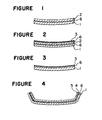
- Figures 1 to 4 show cross-sectional views of various types of laminated glasses produced by the process of the present invention.
- Figures 5 to 7 are diagrammatic views illustrating a preliminary press-bonding apparatus according to the present invention.
- the transparent sheets used in the present invention are inorganic glass sheets or plastic sheets made of a polycarbonate, an acrylic resin or various other types of plastics, or plastic films made of a polyethylene terephthalate, nylon or various other types of plastics.
- Such transparent sheets may be the ones subjected to bending processing or tempering processing, or the ones to which a transparent surface coating, a translucent surface coating or an opaque surface coating such as a conductive coating, an infrared reflecting coating, a color coating or a hard coating, is applied partially or wholely.
- the adhesive synthetic resin interlayer serves to bond a plurality of such transparent sheets.
- the adhesive synthetic resin interlayer is preferably made of a material which, when bonded, provides transparency and r a refractive index substantially equal to the transparent sheets and which has excellent adhesive properties to the transparent sheets.
- an interlayer for lamination composed of an adhesive synthetic resin interlayer made of polyvinyl butyral, polyurethane, an ethylene-vinyl acetate copolymer or a silicone resin.
- Figures 1 to 4 diagrammatically illustrate some examples of the laminated glass structures which can be produced by the process of the present invention.
- Figure 1 is a cross-sectional view of a laminated glass comprising glass sheets 1 and 2 and an adhesive synthetic resin interlayer 6.
- Figure 2 illustrates a laminated glass comprising a pair of glass sheets 1 and 2 with an adhesive synthetic resin interlayer 6, which further includes a plastic film 3 made of e.g. polyethylene terephthalate or nylon, overlaid on the glass plate 2 with an adhesive synthetic resin interlayer 6 interposed therebetween.
- Figure 3 illustrates a laminated glass wherein an adhesive synthetic resin interlayer 6 is sandwiched between and bonded integrally to a sheet of glass plate 1 and a sheet of plastic film 3.
- Figure 4 is a laminated glass in which an adhesive synthetic resin interlayer 6 is sandwiched between and bonded integrally to a glass sheet 1 and a glass sheet 5 provided with a surface coating 4 such as a conductive coating or infrared reflecting coating.
- a laminate is prepared in which at least one sheet of an adhesive synthetic resin interlayer is sandwiched between at least two transparent sheets such as glass plate-glass plate, glass plate-plastic plate, glass plate-plastic film, glass plate-glass plate-plastic film or glass plate-plastic film- glass plate.
- a cover glass plate or other supporting plate may be overlaid on the plastic film in order to improve the press-bonding properties of the plastic film to the adhesive synthetic resin interlayer, and to improve the flatness of the plastic film for an improvement of the optical properties.
- the laminate thus prepared is inserted into a vacuum packaging bag, and the vacuum packaging bag is then vacuumed to evacuate the interior of the bag for preliminary press-bonding, and then the vacuumed bag is sealed.
- a process is preferably conducted as illustrated in Figure 5 wherein a laminate 10 is inserted in a vacuum packaging bag 11 wherein at least the sealing portion around the opening 14 has a heat-sealable property, and then the vacuum packaging bag 11 is introduced into a vacuum chamber 12, or a laminate 10 is inserted into such a vacuum packaging bag 11 already located in such a vacuum chamber 12, and then the vacuum chamber 12 is vacuumed by a deaerating pipe 13 to evacuate the vacuum chamber and the vacuum packaging bag 11, and then the opening portion 14 of the bag is heat-sealed by heat sealing members 15 and 16 to seal the vacuum packaging bag 11.
- a laminate 10 is inserted in a vacuum packaging bag 11 wherein at least the sealing portion around the opening 14 has a heat-sealable property, and then the bag 11 is introduced into a vacuum chamber 12, or a laminate 10 is inserted into such a vacuum packaging bag 11 already located in such a vacuum chamber 12, the opening portion of the vacuum packaging bag 11 is held open, and the vacuum chamber 12 and the vacuum packaging bag 11 are respectively vacuumed by a deaerating pipe 13 for the vacuum chamber and a deaerating pipe 17 for the vacuum packaging bag to evacuate the interiors of the vacuum chamber 12 and the vacuum packaging bag 11, and then the opening portion 14 of the vacuum packaging bag 11 is heat-sealed by heat sealing members 15 and 16 to seal the vacuum packaging bag 11.
- the process of the present invention may also be carried out as shown in Figure 7, wherein a laminate 10 is inserted in a vacuum packaging bag 11 wherein at least the opening portion 14 has a heat sealable property, and then the vacuum packaging bag 11 is vacuumed by a deaerating pipe 17 to evacuate the interior of the bag 11, without introducing the bag 11 into a vacuum chamber, and then the opening portion 14 of the bag 11 is heat-sealed by heat sealing members 15 and 16 to seal the vacuumed bag 11.
- the atmospheric air is introduced via an air supply pipe 21 into the vacuum chamber to bring the pressure to atmospheric pressure, and then the vacuumed bag containing the laminate is taken out from the vacuum chamber.
- the process step for the preliminary press-bonding by the evacuation of the interior of the vacuum packaging bag 11 may adequately be conducted at room temperature. However, in some cases, the preliminary press-bonding may be conducted under heating at an optional temperature of not higher than about 120°C.
- the sealing of the vacuum packaging bag is conducted by heat sealing.
- the sealing of the opening portion of the vacuum packaging bag may be conducted by a suitable method other than heat sealing, for instance, by the pressure contact, press-bonding or heating, by imparting adhesive or bonding properties to the sealing portion of the opening of the bag.
- the laminate thus vacuum-packed in the vacuum packaging bag is, preferably in the state packed in the vacuumed bag, introduced into a heating chamber or passed through a heating zone and thereby heated for final press-bonding, or introduced into an autoclave and subjected to heat pressing for final press-bonding.
- the laminate may be taken out from the vacuum packaging bag before it is subjected to the final press-bonding.
- the conditions for the final press-bonding vary depending upon the type of the adhesive synthetic resin interlayer used, and the conditions are optionally selected depending upon the type of the interlayer.
- the final press-bonding is preferably conducted in an autoclave at a temperature of from 110 to 140°C under a pressure of 5 to 15 atm for from 15 minutes to 2 hours.
- the final press-bonding is preferably conducted in a heating chamber at a temperature of from 50 to 150°C.
- the laminate After the final press-bonding, the laminate is taken out from the heating chamber or the autoclave and, if necessary, cooled to room temperature, to obtain a laminated glass product.
- the cover glass plate is removed after the final press-bonding to obtain a final product.
- the vacuum packaging bag used in the present invention is preferably made of a heat-sealable or a hot meltable material in its entirety or at least at the sealing portion of the opening of the vacuum packaging bag, when the sealing of the bag is conducted by heat sealing. Otherwise, the bonding surface of the sealing portion of the opening of the vacuum packaging bag may be made of a material having adhesive or bonding properties, and the sealing of the opening of the vacuum packaging bag may be conducted by utilizing such adhesive or bonding properties or by further applying heat.
- a vacuum packaging bag made of a material having adequate heat resistance so that it will not melt or soften even at the above-mentioned heating temperature, e.g. a temperature of from 50 to 150°C.
- a material having a softening point of at least about 90°C it is common to employ a film made of a single layer or a plurality of layers of plastic films as the vacuum packaging bag.
- thermoplastic single layer plastic film made of polyethylene, polypropylene, a vinyl chloride resin or an ethylene-vinyl acetate copolymer for the heat sealing type.
- double layer type comprising the above-mentioned plastic film on the inner side for heat sealing and a nylon film or a polyester film on the outer side, as a typical example.
- the vacuum packaging bag is not restricted to such specific examples.
- the shape of the vacuum packaging bag is optionally selected depending upon the shape of the laminate to be subjected to the preliminary press-bonding, and is not particularly restricted.
- the vacuum packaging bags shown in Figures 5 to 7 are in the form of envelopes with their one side being an opening. The bags of this type are convenient, since the sealing operation can readily be completed by the heat sealing of said cne side.
- vacuum packaging bags in a vacuum chamber from a strip-shaped or an envelope-shaped continuous plastic film by heat sealing, and insert laminates into such vacuum packaging bags.
- the preliminary press-bonding operation by means of the vacuum packaging bags in the vacuum chamber may be conducted simultaneously with respect to a plurality of laminates. Or, the preliminary press-bonding of laminates may continuously be carried out.
- the vacuum chamber illustrated in Figure 5 or 6 is defined by a closure 18 detachably mounted on a base plate 19 so that a laminate may be introduced into the vacuum chamber.
- a closure 18 detachably mounted on a base plate 19 so that a laminate may be introduced into the vacuum chamber.
- the closure is closed on the base plate, the hermetic sealing of the vacuum chamber is maintained by a packing 20.
- Various types of systems or mechanisms may be employed for the opening and closing of the vacuum chamber for the introduction of the laminates or the vacuum packaging bags containing laminates into the vacuum chamber.
- the vacuum packaging bags may be made of a relatively thin plastic film since they are required to be durable only for one operation for the preparation of laminated glass.
- the adhesive synthetic resin interlayer may preliminarily be formed as an adhesive layer on one side of the plastic film.
- a polyvinyl butyral interlayer (thickness: 30 mil) having the same size was sandwiched to obtain a laminate.
- This laminate was inserted in a vacuum packaging bag made of a laminated film of nylon and polyethylene (thickness: 125 ⁇ m, the inside being polyethylene) and having an opening along one side.
- the bag containing the laminate was then introduced into a vacuum chamber as shown in Figure 5, and after sealing the vacuum chamber, the air was withdrawn from a deaerating pipe by the operation of a vacuum pump to evacuate the vacuum chamber and the vacuum packaging bag to a vacuum level of -700 mmHg.
- the opening portion of the vacuum packaging bag was pressed by heat sealing members heated to a temperature of 150°C and heat sealed. Then, the vacuum chamber was returned to normal pressure, and then the preliminarily press-bonded laminate was withdrawn from the vacuum chamber. Such an operation was conducted at room temperature. The preliminarily press-bonded laminate was transparent and free from air bubbles. Then, this laminate was introduced into an autoclave as vacuum-packed in the vacuum packaging bag, and subjected to final press-bonding at a temperature of 120°C under 12 atm for 30 minutes. After the final press-bonding, the product was taken out from the autoclave.
- the laminated glass having a structure of glass plate/polyvinyl butyral interlayer/ glass plate taken out of the vacuum packaging bag was a laminated glass having high adhesive strength and being transparent and free from turbidity or air bubbles.
- a polyvinyl butyral interlayer (thickness: 30 mil) having the same size was sandwiched, and a polyethylene terephthalate film (thickness: 15pm) with a surface hardening coating having the same size as the glass sheets was overlaid thereon with a polyvinyl butyral interlayer (thickness: 15 mil) interposed therebetween. Further, a cover glass plate treated with a releasing agent and having the same size was overlaid on the polyethylene terephthalate film, to obtain a laminate.
- This laminate was inserted into a vacuum packaging bag made of nylon and polyethylene and having an opening along one side.
- the bag containing the laminate was introduced into a vacuum chamber as shown in Figure 5, and after sealing the vacuum chamber, air was withdrawn from a deaerating pipe by the operation of a vacuum pump to evacuate the vacuum chamber and the vacuum packaging bag to a vacuum level of -700 mmHg..Then, the opening of the vacuum packaging bag was pressed by heat sealing members heated to a temperature of 150 0 C and heat-sealed. Then, the vacuum chamber was returned to normal pressure, and the preliminarily press-bonded laminate was withdrawn from the vacuum chamber. The operation was conducted at room temperature. The preliminarily press-bonded laminate was transparent and free from air bubbles.
- the laminated glass obtained by peeling off the cover glass plate and having a structure of glass plate/polyvinyl butyral interlayer/glass plate/polyvinyl butyral interlayer/polyethylene terephthalate film, was transparent and free from optical strain and had excellent adhesive properties.
- the preliminary press-bonding can be completed in a short period of time simply by inserting a laminate prepared for the production of a laminated glass into a vacuum packaging bag, then vacuuming the bag and sealing the opening of the vacuumed bag without any special heating.
- the final press-bonding can readily be conducted by simply heat pressing the preliminarily press-bonded laminate in an autoclave, whereby the process step for the final press-bonding can be simplified and there is an additional advantage that the production time can be shortened.
- the vacuum packaging bag is thin and light, and thus provides an advantage for consevation of energy in the heat treatment.
- such a vacuum packaging bag serves as a substitute for a packaging bag of the laminated glass, whereby the packaging operation for the laminated glas can be omitted, and no fresh packaging material is required, thus saving the cost.
Landscapes
- Joining Of Glass To Other Materials (AREA)
- Laminated Bodies (AREA)
Applications Claiming Priority (2)
| Application Number | Priority Date | Filing Date | Title |
|---|---|---|---|
| JP25503784A JPS61134249A (ja) | 1984-12-04 | 1984-12-04 | 合せガラスの製造方法 |
| JP255037/84 | 1984-12-04 |
Publications (3)
| Publication Number | Publication Date |
|---|---|
| EP0186787A2 true EP0186787A2 (fr) | 1986-07-09 |
| EP0186787A3 EP0186787A3 (en) | 1987-08-26 |
| EP0186787B1 EP0186787B1 (fr) | 1993-02-24 |
Family
ID=17273290
Family Applications (1)
| Application Number | Title | Priority Date | Filing Date |
|---|---|---|---|
| EP19850115083 Expired - Lifetime EP0186787B1 (fr) | 1984-12-04 | 1985-11-28 | Procédé de fabrication d'un verre laminé |
Country Status (3)
| Country | Link |
|---|---|
| EP (1) | EP0186787B1 (fr) |
| JP (1) | JPS61134249A (fr) |
| DE (1) | DE3587118T2 (fr) |
Cited By (8)
| Publication number | Priority date | Publication date | Assignee | Title |
|---|---|---|---|---|
| FR2616426A1 (fr) * | 1987-06-11 | 1988-12-16 | Quimal International Ltd | Vitrage composite presentant des proprietes de resistance aux chocs |
| EP0297027A1 (fr) * | 1987-05-27 | 1988-12-28 | Fela Planungs Ag | Méthode et appareil pour la fabrication des circuits imprimés muticouches par pression sous vide |
| DE3919290A1 (de) * | 1988-06-15 | 1989-12-21 | Glaverbel | Verfahren zur erhoehung der eindringbestaendigkeit durch eine verglaste oeffnung und verglasung mit erhoehter einbruchsicherheit |
| US4911984A (en) * | 1987-04-06 | 1990-03-27 | Libbey-Owens-Ford Co. | Laminated glazing unit |
| US5939188A (en) * | 1991-07-15 | 1999-08-17 | Pilkington Aerospace, Inc. | Transparent coating systems for improving the environmental durability of transparency substrates |
| US7438781B2 (en) * | 2002-03-26 | 2008-10-21 | Raytheon Company | System and method for vacuum bag fabrication |
| NL2005667C2 (en) * | 2010-11-11 | 2012-05-14 | Univ Delft Tech | Method for fabrication of a fiber metal laminate. |
| CN109955473A (zh) * | 2019-04-08 | 2019-07-02 | 东莞市德派精密机械有限公司 | 一种全自动无定位承载膜真空贴膜机及贴膜工艺 |
Families Citing this family (9)
| Publication number | Priority date | Publication date | Assignee | Title |
|---|---|---|---|---|
| JPH0357992A (ja) * | 1989-07-26 | 1991-03-13 | Matsushita Electric Works Ltd | 人体検出装置 |
| JPH04119949A (ja) * | 1990-09-11 | 1992-04-21 | Japan Steel Works Ltd:The | 光学部品の接着方法及び装置 |
| US7189447B2 (en) * | 2002-01-04 | 2007-03-13 | 3M Innovative Properties Company | Laminates |
| JP4630277B2 (ja) * | 2003-05-28 | 2011-02-09 | デプナー バウエレメンテ ゲーエムベーハー ウント コー カーゲー | 複合体を製造する方法および装置、並びに複合体 |
| EP2858822A1 (fr) * | 2012-06-08 | 2015-04-15 | Corning Incorporated | Procédé pour stratifier des stratifiés de verre minces |
| EP3438062B1 (fr) * | 2016-03-31 | 2020-07-01 | Panasonic Intellectual Property Management Co., Ltd. | Procédé de fabrication d'une unité panneau en verre |
| JP2019142752A (ja) * | 2018-02-22 | 2019-08-29 | 大日本印刷株式会社 | 合わせガラス製造方法 |
| JP7153527B2 (ja) * | 2018-10-17 | 2022-10-14 | 三井化学株式会社 | 積層体の製造方法 |
| KR102041121B1 (ko) * | 2019-06-27 | 2019-11-27 | 주식회사 휴먼스 | 양면 거울을 포함하는 접합유리 및 그 제조방법 |
Family Cites Families (5)
| Publication number | Priority date | Publication date | Assignee | Title |
|---|---|---|---|---|
| US4180426A (en) * | 1969-02-17 | 1979-12-25 | Saint-Gobain Industries | Process and apparatus for making multiply sheets |
| BE754525R (fr) * | 1970-05-21 | 1971-02-08 | Saint Gobain Pont A Mousson | Perfectionnement a la fabrication des vitrages |
| JPS5730825A (en) * | 1980-07-31 | 1982-02-19 | Olympus Optical Co Ltd | Strobe tuning device |
| JPS58145678A (ja) * | 1982-02-17 | 1983-08-30 | 松下冷機株式会社 | 真空断熱材の製造方法 |
| JPS59128236A (ja) * | 1982-12-28 | 1984-07-24 | Mitsubishi Monsanto Chem Co | 合せガラスの製造方法及び予備圧着用ラバ−バツグ |
-
1984
- 1984-12-04 JP JP25503784A patent/JPS61134249A/ja active Granted
-
1985
- 1985-11-28 EP EP19850115083 patent/EP0186787B1/fr not_active Expired - Lifetime
- 1985-11-28 DE DE19853587118 patent/DE3587118T2/de not_active Expired - Fee Related
Cited By (10)
| Publication number | Priority date | Publication date | Assignee | Title |
|---|---|---|---|---|
| US4911984A (en) * | 1987-04-06 | 1990-03-27 | Libbey-Owens-Ford Co. | Laminated glazing unit |
| EP0297027A1 (fr) * | 1987-05-27 | 1988-12-28 | Fela Planungs Ag | Méthode et appareil pour la fabrication des circuits imprimés muticouches par pression sous vide |
| FR2616426A1 (fr) * | 1987-06-11 | 1988-12-16 | Quimal International Ltd | Vitrage composite presentant des proprietes de resistance aux chocs |
| EP0372144A1 (fr) * | 1987-06-11 | 1990-06-13 | Morton International, Inc. | Vitrage composite présentant des propriétés de résistance aux chocs |
| DE3919290A1 (de) * | 1988-06-15 | 1989-12-21 | Glaverbel | Verfahren zur erhoehung der eindringbestaendigkeit durch eine verglaste oeffnung und verglasung mit erhoehter einbruchsicherheit |
| DE3919290C2 (de) * | 1988-06-15 | 1999-02-18 | Glaverbel | Verfahren zur Erhöhung der Eindringbeständigkeit durch eine verglaste Öffnung und Verglasung mit erhöhter Einbruchsicherheit |
| US5939188A (en) * | 1991-07-15 | 1999-08-17 | Pilkington Aerospace, Inc. | Transparent coating systems for improving the environmental durability of transparency substrates |
| US7438781B2 (en) * | 2002-03-26 | 2008-10-21 | Raytheon Company | System and method for vacuum bag fabrication |
| NL2005667C2 (en) * | 2010-11-11 | 2012-05-14 | Univ Delft Tech | Method for fabrication of a fiber metal laminate. |
| CN109955473A (zh) * | 2019-04-08 | 2019-07-02 | 东莞市德派精密机械有限公司 | 一种全自动无定位承载膜真空贴膜机及贴膜工艺 |
Also Published As
| Publication number | Publication date |
|---|---|
| EP0186787B1 (fr) | 1993-02-24 |
| EP0186787A3 (en) | 1987-08-26 |
| DE3587118T2 (de) | 1993-06-09 |
| JPS61134249A (ja) | 1986-06-21 |
| DE3587118D1 (de) | 1993-04-01 |
| JPS6312786B2 (fr) | 1988-03-22 |
Similar Documents
| Publication | Publication Date | Title |
|---|---|---|
| EP0186787B1 (fr) | Procédé de fabrication d'un verre laminé | |
| EP0194555B1 (fr) | Procédé pour fabriquer un laminé | |
| AU645328B2 (en) | Laminate for a safety glazing | |
| US5208080A (en) | Lamination of semi-rigid material between glass | |
| US5264058A (en) | Forming a shaped prelaminate and bilayer glazing of glass and plastic | |
| US6242088B1 (en) | Method for producing a laminated glass pane free of optical obstruction caused by warping, use of a particular carrier film for the production of the laminated glass pane and carrier films particularly suitable for the method or the use | |
| US3933552A (en) | Preparing transparent assemblies for lamination | |
| US4647327A (en) | Process of forming multi-play laminates | |
| US5529654A (en) | Process forming a shaped laminate | |
| US5147485A (en) | Lamination of semi-rigid material between glass | |
| EP0748687B1 (fr) | Procédé de fabrication d'un laminé de verre et plastique | |
| JPH04234643A (ja) | ラミネート構造を有する安全ガラスの製造方法 | |
| AU644191B2 (en) | Process forming and dimensionally stabilizing shaped laminate | |
| US5069734A (en) | Dimensional stabilizing process | |
| KR102441324B1 (ko) | 적층 판유리의 생산 방법 | |
| US20210221104A1 (en) | Laminates and methods with multiple interlayers and multiple substrates | |
| JPS6371332A (ja) | 積層体の製造方法 | |
| MXPA99008487A (en) | Process for producing a curved laminated safety glass sheet |
Legal Events
| Date | Code | Title | Description |
|---|---|---|---|
| PUAI | Public reference made under article 153(3) epc to a published international application that has entered the european phase |
Free format text: ORIGINAL CODE: 0009012 |
|
| AK | Designated contracting states |
Kind code of ref document: A2 Designated state(s): BE DE FR GB IT |
|
| PUAL | Search report despatched |
Free format text: ORIGINAL CODE: 0009013 |
|
| AK | Designated contracting states |
Kind code of ref document: A3 Designated state(s): BE DE FR GB IT |
|
| 17P | Request for examination filed |
Effective date: 19880212 |
|
| 17Q | First examination report despatched |
Effective date: 19881003 |
|
| GRAA | (expected) grant |
Free format text: ORIGINAL CODE: 0009210 |
|
| AK | Designated contracting states |
Kind code of ref document: B1 Designated state(s): BE DE FR GB IT |
|
| ITF | It: translation for a ep patent filed | ||
| REF | Corresponds to: |
Ref document number: 3587118 Country of ref document: DE Date of ref document: 19930401 |
|
| ET | Fr: translation filed | ||
| PLBE | No opposition filed within time limit |
Free format text: ORIGINAL CODE: 0009261 |
|
| STAA | Information on the status of an ep patent application or granted ep patent |
Free format text: STATUS: NO OPPOSITION FILED WITHIN TIME LIMIT |
|
| 26N | No opposition filed | ||
| PGFP | Annual fee paid to national office [announced via postgrant information from national office to epo] |
Ref country code: FR Payment date: 19981110 Year of fee payment: 14 |
|
| PGFP | Annual fee paid to national office [announced via postgrant information from national office to epo] |
Ref country code: GB Payment date: 19981204 Year of fee payment: 14 |
|
| PGFP | Annual fee paid to national office [announced via postgrant information from national office to epo] |
Ref country code: DE Payment date: 19981207 Year of fee payment: 14 |
|
| PGFP | Annual fee paid to national office [announced via postgrant information from national office to epo] |
Ref country code: BE Payment date: 19990119 Year of fee payment: 14 |
|
| PG25 | Lapsed in a contracting state [announced via postgrant information from national office to epo] |
Ref country code: GB Free format text: LAPSE BECAUSE OF NON-PAYMENT OF DUE FEES Effective date: 19991128 |
|
| PG25 | Lapsed in a contracting state [announced via postgrant information from national office to epo] |
Ref country code: BE Free format text: LAPSE BECAUSE OF NON-PAYMENT OF DUE FEES Effective date: 19991130 |
|
| BERE | Be: lapsed |
Owner name: ASAHI GLASS CY LTD Effective date: 19991130 |
|
| GBPC | Gb: european patent ceased through non-payment of renewal fee |
Effective date: 19991128 |
|
| PG25 | Lapsed in a contracting state [announced via postgrant information from national office to epo] |
Ref country code: FR Free format text: LAPSE BECAUSE OF NON-PAYMENT OF DUE FEES Effective date: 20000731 |
|
| PG25 | Lapsed in a contracting state [announced via postgrant information from national office to epo] |
Ref country code: DE Free format text: LAPSE BECAUSE OF NON-PAYMENT OF DUE FEES Effective date: 20000901 |
|
| REG | Reference to a national code |
Ref country code: FR Ref legal event code: ST |