EP0187050A2 - Matériaux multicouches en forme de feuilles - Google Patents
Matériaux multicouches en forme de feuilles Download PDFInfo
- Publication number
- EP0187050A2 EP0187050A2 EP85309543A EP85309543A EP0187050A2 EP 0187050 A2 EP0187050 A2 EP 0187050A2 EP 85309543 A EP85309543 A EP 85309543A EP 85309543 A EP85309543 A EP 85309543A EP 0187050 A2 EP0187050 A2 EP 0187050A2
- Authority
- EP
- European Patent Office
- Prior art keywords
- layer
- sheet material
- layers
- package
- polyethylene
- Prior art date
- Legal status (The legal status is an assumption and is not a legal conclusion. Google has not performed a legal analysis and makes no representation as to the accuracy of the status listed.)
- Withdrawn
Links
Images


Classifications
-
- B—PERFORMING OPERATIONS; TRANSPORTING
- B32—LAYERED PRODUCTS
- B32B—LAYERED PRODUCTS, i.e. PRODUCTS BUILT-UP OF STRATA OF FLAT OR NON-FLAT, e.g. CELLULAR OR HONEYCOMB, FORM
- B32B27/00—Layered products comprising a layer of synthetic resin
- B32B27/06—Layered products comprising a layer of synthetic resin as the main or only constituent of a layer, which is next to another layer of the same or of a different material
- B32B27/08—Layered products comprising a layer of synthetic resin as the main or only constituent of a layer, which is next to another layer of the same or of a different material of synthetic resin
-
- B—PERFORMING OPERATIONS; TRANSPORTING
- B32—LAYERED PRODUCTS
- B32B—LAYERED PRODUCTS, i.e. PRODUCTS BUILT-UP OF STRATA OF FLAT OR NON-FLAT, e.g. CELLULAR OR HONEYCOMB, FORM
- B32B15/00—Layered products comprising a layer of metal
- B32B15/04—Layered products comprising a layer of metal comprising metal as the main or only constituent of a layer, which is next to another layer of the same or of a different material
- B32B15/08—Layered products comprising a layer of metal comprising metal as the main or only constituent of a layer, which is next to another layer of the same or of a different material of synthetic resin
- B32B15/082—Layered products comprising a layer of metal comprising metal as the main or only constituent of a layer, which is next to another layer of the same or of a different material of synthetic resin comprising vinyl resins; comprising acrylic resins
-
- B—PERFORMING OPERATIONS; TRANSPORTING
- B32—LAYERED PRODUCTS
- B32B—LAYERED PRODUCTS, i.e. PRODUCTS BUILT-UP OF STRATA OF FLAT OR NON-FLAT, e.g. CELLULAR OR HONEYCOMB, FORM
- B32B15/00—Layered products comprising a layer of metal
- B32B15/04—Layered products comprising a layer of metal comprising metal as the main or only constituent of a layer, which is next to another layer of the same or of a different material
- B32B15/08—Layered products comprising a layer of metal comprising metal as the main or only constituent of a layer, which is next to another layer of the same or of a different material of synthetic resin
- B32B15/085—Layered products comprising a layer of metal comprising metal as the main or only constituent of a layer, which is next to another layer of the same or of a different material of synthetic resin comprising polyolefins
-
- B—PERFORMING OPERATIONS; TRANSPORTING
- B32—LAYERED PRODUCTS
- B32B—LAYERED PRODUCTS, i.e. PRODUCTS BUILT-UP OF STRATA OF FLAT OR NON-FLAT, e.g. CELLULAR OR HONEYCOMB, FORM
- B32B15/00—Layered products comprising a layer of metal
- B32B15/04—Layered products comprising a layer of metal comprising metal as the main or only constituent of a layer, which is next to another layer of the same or of a different material
- B32B15/08—Layered products comprising a layer of metal comprising metal as the main or only constituent of a layer, which is next to another layer of the same or of a different material of synthetic resin
- B32B15/088—Layered products comprising a layer of metal comprising metal as the main or only constituent of a layer, which is next to another layer of the same or of a different material of synthetic resin comprising polyamides
-
- B—PERFORMING OPERATIONS; TRANSPORTING
- B32—LAYERED PRODUCTS
- B32B—LAYERED PRODUCTS, i.e. PRODUCTS BUILT-UP OF STRATA OF FLAT OR NON-FLAT, e.g. CELLULAR OR HONEYCOMB, FORM
- B32B15/00—Layered products comprising a layer of metal
- B32B15/04—Layered products comprising a layer of metal comprising metal as the main or only constituent of a layer, which is next to another layer of the same or of a different material
- B32B15/08—Layered products comprising a layer of metal comprising metal as the main or only constituent of a layer, which is next to another layer of the same or of a different material of synthetic resin
- B32B15/09—Layered products comprising a layer of metal comprising metal as the main or only constituent of a layer, which is next to another layer of the same or of a different material of synthetic resin comprising polyesters
-
- B—PERFORMING OPERATIONS; TRANSPORTING
- B32—LAYERED PRODUCTS
- B32B—LAYERED PRODUCTS, i.e. PRODUCTS BUILT-UP OF STRATA OF FLAT OR NON-FLAT, e.g. CELLULAR OR HONEYCOMB, FORM
- B32B15/00—Layered products comprising a layer of metal
- B32B15/20—Layered products comprising a layer of metal comprising aluminium or copper
-
- B—PERFORMING OPERATIONS; TRANSPORTING
- B32—LAYERED PRODUCTS
- B32B—LAYERED PRODUCTS, i.e. PRODUCTS BUILT-UP OF STRATA OF FLAT OR NON-FLAT, e.g. CELLULAR OR HONEYCOMB, FORM
- B32B27/00—Layered products comprising a layer of synthetic resin
- B32B27/28—Layered products comprising a layer of synthetic resin comprising synthetic resins not wholly covered by any one of the sub-groups B32B27/30 - B32B27/42
-
- B—PERFORMING OPERATIONS; TRANSPORTING
- B32—LAYERED PRODUCTS
- B32B—LAYERED PRODUCTS, i.e. PRODUCTS BUILT-UP OF STRATA OF FLAT OR NON-FLAT, e.g. CELLULAR OR HONEYCOMB, FORM
- B32B27/00—Layered products comprising a layer of synthetic resin
- B32B27/30—Layered products comprising a layer of synthetic resin comprising vinyl (co)polymers; comprising acrylic (co)polymers
- B32B27/306—Layered products comprising a layer of synthetic resin comprising vinyl (co)polymers; comprising acrylic (co)polymers comprising vinyl acetate or vinyl alcohol (co)polymers
-
- B—PERFORMING OPERATIONS; TRANSPORTING
- B32—LAYERED PRODUCTS
- B32B—LAYERED PRODUCTS, i.e. PRODUCTS BUILT-UP OF STRATA OF FLAT OR NON-FLAT, e.g. CELLULAR OR HONEYCOMB, FORM
- B32B27/00—Layered products comprising a layer of synthetic resin
- B32B27/32—Layered products comprising a layer of synthetic resin comprising polyolefins
-
- B—PERFORMING OPERATIONS; TRANSPORTING
- B32—LAYERED PRODUCTS
- B32B—LAYERED PRODUCTS, i.e. PRODUCTS BUILT-UP OF STRATA OF FLAT OR NON-FLAT, e.g. CELLULAR OR HONEYCOMB, FORM
- B32B27/00—Layered products comprising a layer of synthetic resin
- B32B27/36—Layered products comprising a layer of synthetic resin comprising polyesters
-
- B—PERFORMING OPERATIONS; TRANSPORTING
- B32—LAYERED PRODUCTS
- B32B—LAYERED PRODUCTS, i.e. PRODUCTS BUILT-UP OF STRATA OF FLAT OR NON-FLAT, e.g. CELLULAR OR HONEYCOMB, FORM
- B32B7/00—Layered products characterised by the relation between layers; Layered products characterised by the relative orientation of features between layers, or by the relative values of a measurable parameter between layers, i.e. products comprising layers having different physical, chemical or physicochemical properties; Layered products characterised by the interconnection of layers
- B32B7/04—Interconnection of layers
- B32B7/12—Interconnection of layers using interposed adhesives or interposed materials with bonding properties
-
- B—PERFORMING OPERATIONS; TRANSPORTING
- B65—CONVEYING; PACKING; STORING; HANDLING THIN OR FILAMENTARY MATERIAL
- B65D—CONTAINERS FOR STORAGE OR TRANSPORT OF ARTICLES OR MATERIALS, e.g. BAGS, BARRELS, BOTTLES, BOXES, CANS, CARTONS, CRATES, DRUMS, JARS, TANKS, HOPPERS, FORWARDING CONTAINERS; ACCESSORIES, CLOSURES, OR FITTINGS THEREFOR; PACKAGING ELEMENTS; PACKAGES
- B65D75/00—Packages comprising articles or materials partially or wholly enclosed in strips, sheets, blanks, tubes or webs of flexible sheet material, e.g. in folded wrappers
- B65D75/26—Articles or materials wholly enclosed in laminated sheets or wrapper blanks
-
- C—CHEMISTRY; METALLURGY
- C08—ORGANIC MACROMOLECULAR COMPOUNDS; THEIR PREPARATION OR CHEMICAL WORKING-UP; COMPOSITIONS BASED THEREON
- C08J—WORKING-UP; GENERAL PROCESSES OF COMPOUNDING; AFTER-TREATMENT NOT COVERED BY SUBCLASSES C08B, C08C, C08F, C08G or C08H
- C08J3/00—Processes of treating or compounding macromolecular substances
- C08J3/20—Compounding polymers with additives, e.g. colouring
- C08J3/22—Compounding polymers with additives, e.g. colouring using masterbatch techniques
- C08J3/223—Packed additives
-
- C—CHEMISTRY; METALLURGY
- C09—DYES; PAINTS; POLISHES; NATURAL RESINS; ADHESIVES; COMPOSITIONS NOT OTHERWISE PROVIDED FOR; APPLICATIONS OF MATERIALS NOT OTHERWISE PROVIDED FOR
- C09J—ADHESIVES; NON-MECHANICAL ASPECTS OF ADHESIVE PROCESSES IN GENERAL; ADHESIVE PROCESSES NOT PROVIDED FOR ELSEWHERE; USE OF MATERIALS AS ADHESIVES
- C09J7/00—Adhesives in the form of films or foils
- C09J7/50—Adhesives in the form of films or foils characterised by a primer layer between the carrier and the adhesive
-
- B—PERFORMING OPERATIONS; TRANSPORTING
- B32—LAYERED PRODUCTS
- B32B—LAYERED PRODUCTS, i.e. PRODUCTS BUILT-UP OF STRATA OF FLAT OR NON-FLAT, e.g. CELLULAR OR HONEYCOMB, FORM
- B32B2255/00—Coating on the layer surface
- B32B2255/26—Polymeric coating
-
- B—PERFORMING OPERATIONS; TRANSPORTING
- B32—LAYERED PRODUCTS
- B32B—LAYERED PRODUCTS, i.e. PRODUCTS BUILT-UP OF STRATA OF FLAT OR NON-FLAT, e.g. CELLULAR OR HONEYCOMB, FORM
- B32B2305/00—Condition, form or state of the layers or laminate
- B32B2305/72—Cured, e.g. vulcanised, cross-linked
-
- B—PERFORMING OPERATIONS; TRANSPORTING
- B32—LAYERED PRODUCTS
- B32B—LAYERED PRODUCTS, i.e. PRODUCTS BUILT-UP OF STRATA OF FLAT OR NON-FLAT, e.g. CELLULAR OR HONEYCOMB, FORM
- B32B2307/00—Properties of the layers or laminate
- B32B2307/70—Other properties
- B32B2307/704—Crystalline
-
- B—PERFORMING OPERATIONS; TRANSPORTING
- B32—LAYERED PRODUCTS
- B32B—LAYERED PRODUCTS, i.e. PRODUCTS BUILT-UP OF STRATA OF FLAT OR NON-FLAT, e.g. CELLULAR OR HONEYCOMB, FORM
- B32B2311/00—Metals, their alloys or their compounds
- B32B2311/24—Aluminium
-
- B—PERFORMING OPERATIONS; TRANSPORTING
- B32—LAYERED PRODUCTS
- B32B—LAYERED PRODUCTS, i.e. PRODUCTS BUILT-UP OF STRATA OF FLAT OR NON-FLAT, e.g. CELLULAR OR HONEYCOMB, FORM
- B32B2323/00—Polyalkenes
- B32B2323/04—Polyethylene
- B32B2323/043—HDPE, i.e. high density polyethylene
-
- B—PERFORMING OPERATIONS; TRANSPORTING
- B32—LAYERED PRODUCTS
- B32B—LAYERED PRODUCTS, i.e. PRODUCTS BUILT-UP OF STRATA OF FLAT OR NON-FLAT, e.g. CELLULAR OR HONEYCOMB, FORM
- B32B2331/00—Polyvinylesters
- B32B2331/04—Polymers of vinyl acetate, e.g. PVA
-
- B—PERFORMING OPERATIONS; TRANSPORTING
- B32—LAYERED PRODUCTS
- B32B—LAYERED PRODUCTS, i.e. PRODUCTS BUILT-UP OF STRATA OF FLAT OR NON-FLAT, e.g. CELLULAR OR HONEYCOMB, FORM
- B32B2367/00—Polyesters, e.g. PET, i.e. polyethylene terephthalate
-
- B—PERFORMING OPERATIONS; TRANSPORTING
- B32—LAYERED PRODUCTS
- B32B—LAYERED PRODUCTS, i.e. PRODUCTS BUILT-UP OF STRATA OF FLAT OR NON-FLAT, e.g. CELLULAR OR HONEYCOMB, FORM
- B32B2377/00—Polyamides
-
- B—PERFORMING OPERATIONS; TRANSPORTING
- B32—LAYERED PRODUCTS
- B32B—LAYERED PRODUCTS, i.e. PRODUCTS BUILT-UP OF STRATA OF FLAT OR NON-FLAT, e.g. CELLULAR OR HONEYCOMB, FORM
- B32B2439/00—Containers; Receptacles
-
- B—PERFORMING OPERATIONS; TRANSPORTING
- B32—LAYERED PRODUCTS
- B32B—LAYERED PRODUCTS, i.e. PRODUCTS BUILT-UP OF STRATA OF FLAT OR NON-FLAT, e.g. CELLULAR OR HONEYCOMB, FORM
- B32B2553/00—Packaging equipment or accessories not otherwise provided for
-
- Y—GENERAL TAGGING OF NEW TECHNOLOGICAL DEVELOPMENTS; GENERAL TAGGING OF CROSS-SECTIONAL TECHNOLOGIES SPANNING OVER SEVERAL SECTIONS OF THE IPC; TECHNICAL SUBJECTS COVERED BY FORMER USPC CROSS-REFERENCE ART COLLECTIONS [XRACs] AND DIGESTS
- Y10—TECHNICAL SUBJECTS COVERED BY FORMER USPC
- Y10T—TECHNICAL SUBJECTS COVERED BY FORMER US CLASSIFICATION
- Y10T428/00—Stock material or miscellaneous articles
- Y10T428/13—Hollow or container type article [e.g., tube, vase, etc.]
- Y10T428/1334—Nonself-supporting tubular film or bag [e.g., pouch, envelope, packet, etc.]
-
- Y—GENERAL TAGGING OF NEW TECHNOLOGICAL DEVELOPMENTS; GENERAL TAGGING OF CROSS-SECTIONAL TECHNOLOGIES SPANNING OVER SEVERAL SECTIONS OF THE IPC; TECHNICAL SUBJECTS COVERED BY FORMER USPC CROSS-REFERENCE ART COLLECTIONS [XRACs] AND DIGESTS
- Y10—TECHNICAL SUBJECTS COVERED BY FORMER USPC
- Y10T—TECHNICAL SUBJECTS COVERED BY FORMER US CLASSIFICATION
- Y10T428/00—Stock material or miscellaneous articles
- Y10T428/13—Hollow or container type article [e.g., tube, vase, etc.]
- Y10T428/1334—Nonself-supporting tubular film or bag [e.g., pouch, envelope, packet, etc.]
- Y10T428/1338—Elemental metal containing
-
- Y—GENERAL TAGGING OF NEW TECHNOLOGICAL DEVELOPMENTS; GENERAL TAGGING OF CROSS-SECTIONAL TECHNOLOGIES SPANNING OVER SEVERAL SECTIONS OF THE IPC; TECHNICAL SUBJECTS COVERED BY FORMER USPC CROSS-REFERENCE ART COLLECTIONS [XRACs] AND DIGESTS
- Y10—TECHNICAL SUBJECTS COVERED BY FORMER USPC
- Y10T—TECHNICAL SUBJECTS COVERED BY FORMER US CLASSIFICATION
- Y10T428/00—Stock material or miscellaneous articles
- Y10T428/28—Web or sheet containing structurally defined element or component and having an adhesive outermost layer
- Y10T428/2804—Next to metal
-
- Y—GENERAL TAGGING OF NEW TECHNOLOGICAL DEVELOPMENTS; GENERAL TAGGING OF CROSS-SECTIONAL TECHNOLOGIES SPANNING OVER SEVERAL SECTIONS OF THE IPC; TECHNICAL SUBJECTS COVERED BY FORMER USPC CROSS-REFERENCE ART COLLECTIONS [XRACs] AND DIGESTS
- Y10—TECHNICAL SUBJECTS COVERED BY FORMER USPC
- Y10T—TECHNICAL SUBJECTS COVERED BY FORMER US CLASSIFICATION
- Y10T428/00—Stock material or miscellaneous articles
- Y10T428/28—Web or sheet containing structurally defined element or component and having an adhesive outermost layer
- Y10T428/2813—Heat or solvent activated or sealable
- Y10T428/2817—Heat sealable
- Y10T428/2826—Synthetic resin or polymer
-
- Y—GENERAL TAGGING OF NEW TECHNOLOGICAL DEVELOPMENTS; GENERAL TAGGING OF CROSS-SECTIONAL TECHNOLOGIES SPANNING OVER SEVERAL SECTIONS OF THE IPC; TECHNICAL SUBJECTS COVERED BY FORMER USPC CROSS-REFERENCE ART COLLECTIONS [XRACs] AND DIGESTS
- Y10—TECHNICAL SUBJECTS COVERED BY FORMER USPC
- Y10T—TECHNICAL SUBJECTS COVERED BY FORMER US CLASSIFICATION
- Y10T428/00—Stock material or miscellaneous articles
- Y10T428/28—Web or sheet containing structurally defined element or component and having an adhesive outermost layer
- Y10T428/2843—Web or sheet containing structurally defined element or component and having an adhesive outermost layer including a primer layer
-
- Y—GENERAL TAGGING OF NEW TECHNOLOGICAL DEVELOPMENTS; GENERAL TAGGING OF CROSS-SECTIONAL TECHNOLOGIES SPANNING OVER SEVERAL SECTIONS OF THE IPC; TECHNICAL SUBJECTS COVERED BY FORMER USPC CROSS-REFERENCE ART COLLECTIONS [XRACs] AND DIGESTS
- Y10—TECHNICAL SUBJECTS COVERED BY FORMER USPC
- Y10T—TECHNICAL SUBJECTS COVERED BY FORMER US CLASSIFICATION
- Y10T428/00—Stock material or miscellaneous articles
- Y10T428/31504—Composite [nonstructural laminate]
- Y10T428/31678—Of metal
- Y10T428/31692—Next to addition polymer from unsaturated monomers
-
- Y—GENERAL TAGGING OF NEW TECHNOLOGICAL DEVELOPMENTS; GENERAL TAGGING OF CROSS-SECTIONAL TECHNOLOGIES SPANNING OVER SEVERAL SECTIONS OF THE IPC; TECHNICAL SUBJECTS COVERED BY FORMER USPC CROSS-REFERENCE ART COLLECTIONS [XRACs] AND DIGESTS
- Y10—TECHNICAL SUBJECTS COVERED BY FORMER USPC
- Y10T—TECHNICAL SUBJECTS COVERED BY FORMER US CLASSIFICATION
- Y10T428/00—Stock material or miscellaneous articles
- Y10T428/31504—Composite [nonstructural laminate]
- Y10T428/31678—Of metal
- Y10T428/31692—Next to addition polymer from unsaturated monomers
- Y10T428/31699—Ester, halide or nitrile of addition polymer
-
- Y—GENERAL TAGGING OF NEW TECHNOLOGICAL DEVELOPMENTS; GENERAL TAGGING OF CROSS-SECTIONAL TECHNOLOGIES SPANNING OVER SEVERAL SECTIONS OF THE IPC; TECHNICAL SUBJECTS COVERED BY FORMER USPC CROSS-REFERENCE ART COLLECTIONS [XRACs] AND DIGESTS
- Y10—TECHNICAL SUBJECTS COVERED BY FORMER USPC
- Y10T—TECHNICAL SUBJECTS COVERED BY FORMER US CLASSIFICATION
- Y10T428/00—Stock material or miscellaneous articles
- Y10T428/31504—Composite [nonstructural laminate]
- Y10T428/31855—Of addition polymer from unsaturated monomers
- Y10T428/31909—Next to second addition polymer from unsaturated monomers
- Y10T428/31913—Monoolefin polymer
Definitions
- cyanoacrylate adhesives have been packaged in plastic bottles and metal tubes.
- the plastic containers d& not provide adequate vapor barrier, such that the shelf life of products packaged in conventional plastic containers is undesirably short.
- Metal tubes also have some undesirable characteristics. They are relatively inflexible such that they can be flexed only a few times as in repeated dispensing before cracks develop in the tube sidewall.
- shelf life of cyanoacrylatc products is better in metal tubes than in plastic, at least until the tube is initially opened. Nevertheless, the shelf life, even in metal tubes, is less than desired.
- cyanoacrylates are readily identified as being difficult to hold in a package over a desirable shelf life period.
- the first type is a metal tube. Such tubes provide excellent barrier properties, but have undesirable functional properties as discussed above.
- the second type is a plastic tube made from either single or multiple layers of plastics. While plastic tubes may be excellent for many products, no plastic packaging materials are known which are excellent for holding cyanoacrylate-type products.
- the third type is a tube made from previously formed multiple layer sheet'materials containing a layer of metal foil and a plurality of layers of plastic materials, generally referred to hereinafter as laminated tubes.
- the third type of tube container has been used conventionally for holding hygienic-type products such as toothpaste. Toothpaste is chemically quite active, and is generally considered difficult to hold in a package.
- Cyanoacrylate also tends to cause swelling of polymers. In trials with some experimental multiple layer tubes, polymer layers disappeared as distinct layers, presumably having been either dissolved into the cyanoacrylate or otherwise absorbed into it.
- the sheet material has a first layer of high density polyethylene (HDPE), a second layer which may be a polymer or an adhesive, and a third primer layer of polyethylene imine (PEI).
- the third primer layer is between the first and second layers.
- each of the layers has preferred features which, while not critical to the invention contribute to its efficiency or optimization.
- the resin density of the HDPE as determined by ASTM D-2839 is preferably at least 0.950. It should also preferably have a narrow molecular weight distribution and should be substantially free of amine components. Preferably its crysLallinity is relatively high as developed in formation of that film-like layer.
- the second layer may be any of a wide variety of functional materials which exhibit the desired properties.
- Preferred for the second layer is ethylene acrylic acid copolymer (EAA).
- the primer in the third layer is preferably applied as a liquid solution containing a cross-linking type PEI.
- Preferred embodiments of the sheet material include a fourth layer of metal foil so positioned in the structure that the second layer is between the third and fourth layers.
- a fifth layer adheres a sixth layer, as of polyethylene, to the metal foil.
- a package which include the novel packaging sheet material herein in the form of a package and a quantity of product therein where the product contains a substantial fraction of a cyanoacrylate-type component
- the package is configured such that no edge of the sheet material is exposed to the product.
- Still another aspect of the invention is seen in a package wherein the packaging sheet material has been modified by virtue of contact with cyanoacrylate-type components.
- the primer layer includes reacted components from the cyanoacrylate products.
- FIGURE 1 a cross-section of a simple sheet structure 110 of the invention, including two polymeric layers 112 and 116 and a thin primer layer 114 therebetween.
- Layer. 112 is HDPE.
- the composition of layer 116 is usually polymeric and may be chosen with substantial freedom.
- Layer 114 is a thin layer of primer.
- the first digit represents the FIGURE number.
- the second and third digits represent the element in the FIGURE.
- Common second and third digit numbers in the various FIGURES represent common elements.
- 14 represents the primer layer in any of the FIGURES where it is shown.
- 114 represents the primer layer in only FIGURE 1.
- FIGURE 2 shows a cross-section of a sheet structure 210 of the invention of intermediate complexity.
- Layer 212 is HDPE.
- Layer 214 is a thin primer layer.
- Layer 216 is an adhesive which is effective to adhere to a foil layer 218. With the introduction of the foil layer into the structure, the composition of adhesive layer 216 is selected such that it provides good adhesion between the foil layer 218 and the HDPE layer 212 through the primer 214. EAA is preferred for layer 216.
- FIGURE 3 shows a cross-section of a sheet structure 310 of the invention having more complexity than the structures of FIGURES 1 and 2, and also having more-preferred functional properties.
- Layers 312, 314, 316, and 318 are equivalent to the respective ones of those layers in FIGURE 2.
- Layer 320 is an adhesive layer which adheres layer 322 to the foil layer 318.
- Layer 322 is protective of the foil layer and its composition is selected with that protection property as an important criteria.
- cyanoacrylate is highly reactive as a chemical product. It is this strong tendency toward reaction that makes it so difficult to design a packaging material to hold it. It is further important that certain layers of the packaging material of this invention not be permitted to come into direct contact with the cyanoacrylate product. As it has been founds that direct contact with cyanoacrylate can be tolerated by HDPE, it is preferred, and highly functional for the cyanoacrylate-type product to be in direct contact with only the IIDPE layer in the finished packages of this invention.
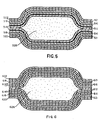
- An acceptable package structure is a fin-sealed pouch 411 as seen in FIGURE 4. The peripheral seals 424 are pointed out on 2 of the 4 sides of the pouch.
- FIGURE 5 shows a cross-section of the pouch of FIGURE 4.
- Each of the layers 12, 14, 16, 18, 20, and 22 is shown in its overall relationship to the sheet structure, the package, and the product. It is seen that the fin-sealed type of construction ensures that the cyanoacrylate product has direct contact only with the HDPE layer.
- the FIGURE 5 structure is accurately descriptive of the package at the time the product is put into the package.
- the primer layer 14 is extremely thin. It is important that the primer layer be continuous, in order to meet its minimum required functional parameter. Meeting the minimum required functional parameters, however, does not impose any minimum requirements for physical thickness of the primer layer beyond that required for continuity.
- the typical quantity of a PEI present in the sheet structure is of the order of 0.04 lbs. per 3000 square foot ream. In practice, the presence of layer 14 as a distinct layer is not visually detectable by normal microscopic examination of a cross-section of the sheet structure up to the time it is brought into contact with a cyanoacrylate-type product.
- FIGURE 6 represents the cross-section as in FIGURE 5, but after the cyanoacrylate product has been in the package for a while.
- the significant change is that a visible layer 614R has developed at layer 14, which was also the interface of layers 12 and 16 for appearance purposes when the sheet material was formed.
- the new layer as at 614R was 0.4 to 0.7 mil thick.
- Packages evaluated after four weeks of storage at 120°F. had layers 614R which were 0.9 to 1.6 mils thick.
- a primary component of the new layer 614R is reacted polymer of cyanoacrylate.
- the storage conditions cited herein are unusual in that they accelerate, in many respects, the normal process of aging for both the packaging material and the product. Thus, the tests iterated herein may represent the entire normal shelf life of the packaged product, or even beyond.
- the primer layer 14 was not continuous, but unintentionally had small discontinuities of pin-hole size. Packages made with these sheet materials were not satisfactory. On inspection of the filled and sealed packages after a short storage period of 1 or 2 weeks, spot delaminations were unexpectedly observed. On detailed inspection, discontinuities were identified adjacent each spot delamination. The discontinuities were visible to microscopic inspection, in the reacted layer 614R. No spot delaminations were observed which could not be associated with a discontinuity. Thus the inventors have reached the conclusion that the primer layer 14 serves some function of the nature of impeding the migration of the cyanoacrylate product to the surfac of the foil 18.
- primery layer 14 is critical to operability of the invention. To that end, it is desirable to treat the surface of the HDPE layer, as necessary, such as by corona discharge, to ensure good wetting of the HDPE layer by the PEI when it is applied.
- HDPE layer 12 it may be desirable to have additional layers between HDPE layer 12 and the primer 14.
- additional layers may be used so long as any interaction they may have with, or as a result of, the product is acceptable and so long as the primer layer is continuous as described earlier and is separated from any foil layer by at least one intervening layer.
- the cross linking types are preferable over the non-crosslinking types.
- the PEI may act as a chemically basic electron donor material, and may interact with the product in polymerization, or other reaction of the cyanoacrylate product. Once the cyanoacrylate has reacted, the size of the reacted molecule is apparently such that it is no longer as mobile in the laminated sheet structure, and remains in the vicinity of the reaction site to form a part of the visible layer 14R.
- other Lewis bases such as amines and salts of weak acids, should function in a similar manner to impede migration of the product.
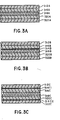
- FIGURE 3A represents a cross-section of sheet structure similar to the six layer structure of FIGURE 3, but without the primer layer 14.
- layers 312A, 316A, 318A, 320A and 322A all represent layers equivalent to the respective layers in the sheet structures of the invention.
- the sheet structure is not capable of satisfactorily holding cyanoacrylate-type products without significant deleterious affect on the packaging sheet structure. Typical affects arc swelling of polymer layers and delamination.
- FIGURE 38 represents a cross-section of sheet structure similar to the structure of FIGURE 3, but with the primer layer 14 in the wrong place.
- Layers 312B, 314B, 316B, 3188, 320B, and 322 11 all represent layers equivalent to the respective layers in the sheet structure of the invention.
- Primer layer 14 is at the interface between the foil 18 and the EAA 16, rather than at the interface between the HDPE 12 and the EAA 16. With the primer thus improperly positioned, namely adjacent the foil rather than displaced from it, the sheet structure is not capable of satisfactorily holding cyanoacrylate-type products. Typical affects are swelling, especially layer 16, and delamination, particularly at the foil interface. Primers may be used elsewhere in the invention, as seen in FIGURE 3C, so long as the primary layer of primer between layers 12 and 16 is retained.
- Layers 314C2 is an additional primer layer which may, for example, be used to promote adhesion between layers 320C and 322C.
- This practice of using one or more additional primer layers, in addition to the primary primer layer at the interface of layers 12 and 16, is fully satisfactory so long as primary primer layer 14, as described herein, is displaced from the product and from the foil by at least one layer, and is between the product and the foil.
- HDPE is the least affected by cyanoacrylate-type product.
- Other polymers are caused, by cyanoacrylate-type products, to swell by 50% to over 150%.
- LLDPE linear low density polyethylene copolymer
- some polymeric materials are even absorbed into the product.
- HDPE is also swelled somewhat, in the better HDPE's, the swelling is limited to only about 30%, and overall strength of the package is sustained satisfactorily.
- most high density polyethylenes are acceptable, some are more preferred.
- the preferred polymers are characterized by the following properties. Resin density should be at least 0.950.
- the HDPE preferably has a narrow molecular weight distribution. A high degree of crystallinity in the HDPE layer is desirable, and can be somewhat controlled by the rate of cooling when the HDPE layer is formed by some melt forming process such as extrusion.
- the critical elements of the invent.ion are the HDPE layer 12 which serves as the sealant layer without being unacceptably affected by the cyanoacrylate product, and the primer layer 14.
- the presence of the primer layer at the disclosed location causes the mobility of the cyanoacrylate product to be impeded such that it does not readily pass through layer 14 and have harmful affect on the layers 16, 18, etc., which are beyond layers 12 and 14, as viewed from the layer 12 surface through the sheet material.
- the compositions of the various layers 16, 18, etc., beyond layer 14 may not need to be selected for their resistance to cyanoacrylate. Rather, they may be selected for their other desirable properties.
- layer 16 is defined rather broadly, as a polymer or an adhesive, and may be selected for the properties desired.
- layer 16 may, for example, conveniently be any polymer which adheres well to the primed side of the HDPE layer.
- Typical layer 16 polymers would be low density polyethylene (LDPE), HDPE, and propylene ethylene copolymer (PPE).
- LDPE low density polyethylene
- HDPE high density polyethylene
- PPE propylene ethylene copolymer
- layer 16 may be considered to be a layer serving primarily an adhesive function.
- the adhesive layer may be a polymeric adhesive. Where the fourth layer is metal foil, and adhesive polymer such as EAA is known to adhere well to foil and is preferred for layer 16.
- an adhesive polymer with graft substitutions of carboxy moieties such as maleic anhydride may be preferred.
- adhesive emulsions may be used.
- the selection of material for layer 16 depends on the definition of its function in the sheet structure, whether it be of a protective nature, as may be true in a three layer structure, or of an adhesive nature in structures having more than three layers.
- compositions, then, of layers 12 and 14 are selected with the primary purpose - in addition to their normal package structural functions - of controlling migration of the cyanoacrylate product through the sheet material.
- they functionally control the migration of the cyanoacrylate through the sheet material, such that the compositions of all the other layers may be selected without primary consideration of their susceptibility to cyanoacrylate.
- layer 18 is a metal foil layer which would be highly susceptible to loss of adhesion to polymers in the presence of cyanoacrylate-type products. Rather it is selected for its excellent properties as a barrier against passage of any matter through the package sheet material, into or out of the package. Other barrier materials may be used in the invention.
- barrier material if one is used, proper materials are selected from those known in the art, for the layers adjacent the barrier layer to ensure adhesion to, and compatibility with, the rest of the sheet structure.
- exemplary of possible alternate barrier materials are vinylidene chloride copolymers, ethylene vinyl alcohol copolymers, and blends including major fractions of these.
- Layer 16 is preferably EAA, another material susceptible of being greatly swelled by cyanoacrylate. But, with the protection provided by layers 12 and 14, the EAA is not thus disastrously affected by the product and may be selected for its excellent adhesive properties to the metal foil. Likewise layers 20 and 22 may also be selected without primary consideration of direct interaction with the product. By the same consideration, the layers-16 through 22, as well as additional layers may be selected with substantial freedom as long as the layers 12 and 14 serve a protective function between the layers 16 through 22 and the product.
- the sealant layer 12 and the primer layer 14 are narrow molecular weight HDPE and crosslinking PEI respectively.
- “Narrow molecular weight” is a relative term, used by the industry, that identifies the subject group of HDPE polymers by subjectively comparing their molecular weight distributions with those of other HDPE polymers.
- Layer 16 is EAR which serves as an adhesive to the metal foil barrier layer 18.
- Layer 20 is preferably EAA which serves as an adhesive between the foil layer 18 and layer 22 which is desirably a layer of polymer which is selected for either its excellent abuse resistance or its heat resistance. While a preferred composition for layer 22 is HDPE, other materials may be preferred for some uses.
- the layer 22 composition is LDPE.
- the composition of the adhesive layer 20 is selected in view of the selected compositions of both layers 18 and 22. Additional layers may be used as dictated by the situation, such as for printing, pigmenting, etc.
- the HDPE and PEI layers be interposed between the cyanoacrylate and the other layers at all areas where the cyanoacrylate is in contact with the packaging sheet material.
- Illustrative of this principle is a fin-sealed package as illustrated in FIGURES 4, 5, and 6. Formation of a finished package as shown in FIGURE 4, from multiple layer sheet materials, is conventionally known in the industry. While the sheet structures disclosed herein are highly unusual, forming them into a finished package is relatively straight forward. as by means of conventionally forming heat seals about the periphery as shown in FIGURE 4. The development of the visible layer 614R is, of course, highly novel and unexpected, and especially in its role in impeding penetration of cyanoacrylate into the rest of the packaging structure.
- a layer of HDPE is formed, as by an extrusion process.
- the process is designed for relatively slow cooling of the extruded HDPE layer in order to encourage development of crystallinity.
- a preferred process is tubular blown extrusion.
- Another acceptable process is cast extrusion where the sheet is cast onto a relatively warm roll and where the elevated temperatures are held over a period of time, down stream of the extrusion, which is conducive to development of crystallinity.
- the HDPE layer is then preferably corona treated to a level of at least 38 dynes/cm. of surface energy.
- the treated side of the HDPE is then primed with a PEI primer solution and dried, leaving a continuous layer of PEI on the surface of the HDPE.
- the primed side of the HDPE layer is then extrusion laminated to aluminum foil using EAA as the extrusion laminant.
- the structure at this state is represented by FIGURE 2.
- the structure as represented by FIGURE 3 is completed by extrusion laminating a previously formed abuse resistant layer, such as HDPE, to the exposed side of the foil, using EAA as the extrusion laminant.
- the sheet material may then be reacted with cyanoacrylate moieties, to form a sheet material having a reacted primer layer 14R, before forming it into a package structure as in FIGURE 4.
- the reaction may be carried out by contacting the HOPS layer 12 with the cyanoacrylate moieties.
- the HD PE layer is formed, treated and primed as previously discussed.
- Layer 16 is then added by an appropriate process.
- a typical process is extrusion coating of the appropriate material onto the primed surface.
- layer 16 is formed in a separate operation and is joined to primer layer 14 by heat and pressure lamination at a hot nip, or may be extrusion laminated to layer 14 by using an intervening layer of an extrusion laminant.
- the invention provides a packagingf- sheet material capable of holding cyanoacrylate-type products. It further provides a sheet material which has excellent barrier properties to passage of matter through the sheet material. Even more significantly, the invention provides a sheet material which can be made into a closed and sealed package capable of holding a cyanoacrylate-type product.
- the sheet materials of this invention are also, of course, capable of holding products which have lower chemical activity than cyanoacrylate. In those cases, materials which are less preferred for holding cyanoacrylate may be more desirable because of other advantages such as economics or processing advantages.
Landscapes
- Chemical & Material Sciences (AREA)
- Organic Chemistry (AREA)
- Health & Medical Sciences (AREA)
- Chemical Kinetics & Catalysis (AREA)
- Medicinal Chemistry (AREA)
- Polymers & Plastics (AREA)
- Engineering & Computer Science (AREA)
- Mechanical Engineering (AREA)
- Laminated Bodies (AREA)
- Wrappers (AREA)
Applications Claiming Priority (2)
| Application Number | Priority Date | Filing Date | Title |
|---|---|---|---|
| US06/687,202 US4777085A (en) | 1984-12-28 | 1984-12-28 | Multiple layer sheet material |
| US687202 | 1984-12-28 |
Publications (2)
| Publication Number | Publication Date |
|---|---|
| EP0187050A2 true EP0187050A2 (fr) | 1986-07-09 |
| EP0187050A3 EP0187050A3 (fr) | 1987-11-11 |
Family
ID=24759474
Family Applications (1)
| Application Number | Title | Priority Date | Filing Date |
|---|---|---|---|
| EP85309543A Withdrawn EP0187050A3 (fr) | 1984-12-28 | 1985-12-30 | Matériaux multicouches en forme de feuilles |
Country Status (11)
| Country | Link |
|---|---|
| US (1) | US4777085A (fr) |
| EP (1) | EP0187050A3 (fr) |
| JP (1) | JPH0624803B2 (fr) |
| AU (1) | AU587002B2 (fr) |
| DK (1) | DK608785A (fr) |
| ES (2) | ES8802287A1 (fr) |
| FI (1) | FI855166L (fr) |
| GR (1) | GR853143B (fr) |
| NO (1) | NO855335L (fr) |
| NZ (1) | NZ215331A (fr) |
| ZA (1) | ZA859862B (fr) |
Families Citing this family (24)
| Publication number | Priority date | Publication date | Assignee | Title |
|---|---|---|---|---|
| US6348246B1 (en) * | 1992-01-09 | 2002-02-19 | Arnold B. Finestone | Laminate sheeting for pouches |
| US20020068136A1 (en) * | 1994-10-24 | 2002-06-06 | Finestone Arnold B. | Laminate sheeting for pouches |
| KR100344580B1 (ko) * | 1999-01-27 | 2002-07-20 | 가부시키가이샤 아루화기겐 | 포장체 |
| US6896838B2 (en) * | 2001-11-21 | 2005-05-24 | Closure Medical Corporation | Halogenated polymeric containers for 1, 1-disubstituted monomer compositions |
| US20040117265A1 (en) * | 2002-12-12 | 2004-06-17 | Paul Hoffman | Method and system for labeling and managing the sale of manufactured concrete blocks |
| DE102004036606A1 (de) * | 2004-07-28 | 2006-03-23 | Henkel Kgaa | Packmittel |
| US9309019B2 (en) | 2010-05-21 | 2016-04-12 | Adhezion Biomedical, Llc | Low dose gamma sterilization of liquid adhesives |
| US8550737B2 (en) | 2010-09-20 | 2013-10-08 | Adhezion Biomedical, Llc | Applicators for dispensing adhesive or sealant material |
| USD687710S1 (en) | 2010-10-29 | 2013-08-13 | Ball Corporation | Beverage container |
| USD697404S1 (en) | 2010-10-29 | 2014-01-14 | Ball Corporation | Beverage container |
| USD678772S1 (en) | 2010-10-29 | 2013-03-26 | Ball Corporation | Beverage container |
| USD684059S1 (en) | 2011-03-02 | 2013-06-11 | Ball Corporation | Beverage container |
| USD696116S1 (en) | 2011-03-02 | 2013-12-24 | Ball Corporation | Beverage container |
| US9066711B2 (en) | 2011-11-02 | 2015-06-30 | Adhezion Biomedical, Llc | Applicators for storing sterilizing, and dispensing an adhesive |
| USD725472S1 (en) | 2012-01-25 | 2015-03-31 | Ball Corporation | Beverage container |
| USD697407S1 (en) | 2012-11-13 | 2014-01-14 | Ball Corporation | Metal beverage container |
| USD702553S1 (en) | 2013-03-07 | 2014-04-15 | Ball Corporation | Metallic beverage container |
| USD696946S1 (en) | 2013-04-25 | 2014-01-07 | Ball Corporation | Metal bottle |
| USD812478S1 (en) | 2014-09-15 | 2018-03-13 | Ball Corporation | Metal bottle |
| USD809390S1 (en) | 2015-01-05 | 2018-02-06 | Ball Corporation | Metal bottle |
| USD804309S1 (en) | 2016-02-17 | 2017-12-05 | Ball Corporation | Metal bottle |
| US10988274B2 (en) | 2017-02-07 | 2021-04-27 | Adhezion Biomedical, Llc | Packaging for adhesive compositions |
| USD1047693S1 (en) | 2020-06-09 | 2024-10-22 | Ball Corporation | Metal bottle |
| USD1043246S1 (en) | 2022-08-05 | 2024-09-24 | Ball Corporation | Bottle |
Family Cites Families (29)
| Publication number | Priority date | Publication date | Assignee | Title |
|---|---|---|---|---|
| US2953475A (en) * | 1955-03-11 | 1960-09-20 | Johnson & Johnson | Pressure sensitive adhesive tape |
| NL250677A (fr) * | 1959-04-27 | 1900-01-01 | ||
| US3111418A (en) * | 1959-10-28 | 1963-11-19 | Milprint Inc | Method and apparatus for treating plastic packaging materials and articles prepared thereby |
| US3340088A (en) * | 1964-08-11 | 1967-09-05 | Norton Co | Chloroprene-acrylonitrile copolymer primer for pressure-sensitive adhesive tape |
| US3471359A (en) * | 1965-08-02 | 1969-10-07 | Chemirad Corp | Partially cross-linked polyethylenimine anchoring agent and laminate therefor |
| US3976224A (en) * | 1972-01-10 | 1976-08-24 | The Procter & Gamble Company | Collapsible dispensing tubes |
| CA1098764A (fr) * | 1976-01-26 | 1981-04-07 | Norman J. Pozniak | Traduction non-disponible |
| US4085244A (en) * | 1976-02-10 | 1978-04-18 | Champion International Corporation | Balanced orientated flexible packaging composite |
| US4096309A (en) * | 1976-08-12 | 1978-06-20 | Champion International Corporation | Laminated packaging material |
| US4190477A (en) * | 1978-01-04 | 1980-02-26 | American Can Company | Pouch |
| US4308084A (en) * | 1979-03-28 | 1981-12-29 | Morton-Norwich Products, Inc. | Process for preparing retort-proof metal layer laminates for packaging foodstuffs using aluminum hydroxide-modified copolymers as adhesives |
| US4311742A (en) * | 1979-08-17 | 1982-01-19 | Toyo Seikan Kaisha, Ltd. | Retort-sterilizable laminated pouch comprising a flexible gas-barrier substrate and blended crystalline olefin layer |
| US4360550A (en) * | 1979-09-12 | 1982-11-23 | Toyo Kagaku Kabushiki Kaisha | Composite packing film and packing bag made of the same |
| US4257536A (en) * | 1979-10-15 | 1981-03-24 | American Can Company | Laminate structure for collapsible dispensing container |
| JPS5688643U (fr) * | 1979-12-12 | 1981-07-15 | ||
| US4284672A (en) * | 1979-12-18 | 1981-08-18 | Champion International Corporation | Flexible packaging composite comprising an outer polyamide layer, an intermediate metal foil layer and an interior heat-sealable layer |
| JPS56161145A (en) * | 1980-05-16 | 1981-12-11 | Takigawa Kagaku Kogyo Kk | Cylindrical body molding |
| AU530007B2 (en) * | 1981-04-02 | 1983-06-30 | Dow Chemical Company, The | Laminated container body and manufacture thereof |
| US4418841A (en) * | 1982-11-23 | 1983-12-06 | American Can Company | Multiple layer flexible sheet structure |
| US4568000A (en) * | 1982-01-18 | 1986-02-04 | American Can Company | Laminate web produced with polyacrylic acid complex primer |
| US4387126A (en) * | 1982-02-10 | 1983-06-07 | Champion International Corporation | Laminated packaging material |
| JPS58220738A (ja) * | 1982-06-18 | 1983-12-22 | 日産自動車株式会社 | ブロ−成形容器 |
| US4424256A (en) * | 1982-08-06 | 1984-01-03 | American Can Company | Retortable foil-based packaging structure |
| US4578294A (en) * | 1983-02-25 | 1986-03-25 | Kureha Kagaku Kogyo Kabushiki Kaisha | Heat-resistant laminates |
| US4659408A (en) * | 1984-05-29 | 1987-04-21 | American Can Company | Multi-layer sheet structure, method of making same and containers made therefrom |
| JPS62500177A (ja) * | 1984-09-04 | 1987-01-22 | エ−ヴイング ウイリアム デイ | 変形自在ラベル |
| US4686125A (en) * | 1984-09-28 | 1987-08-11 | Baxter Travenol Laboratories, Inc. | Film laminate for sterile flexible containers |
| US4564558A (en) * | 1984-12-28 | 1986-01-14 | Mobil Oil Corporation | Oriented multi-layer heat sealable film |
| US4685591A (en) * | 1984-12-28 | 1987-08-11 | American Can Company | Dispensing tube package |
-
1984
- 1984-12-28 US US06/687,202 patent/US4777085A/en not_active Expired - Fee Related
-
1985
- 1985-12-27 ES ES550492A patent/ES8802287A1/es not_active Expired
- 1985-12-27 GR GR853143A patent/GR853143B/el unknown
- 1985-12-27 FI FI855166A patent/FI855166L/fi not_active IP Right Cessation
- 1985-12-28 JP JP60299783A patent/JPH0624803B2/ja not_active Expired - Lifetime
- 1985-12-30 NO NO855335A patent/NO855335L/no unknown
- 1985-12-30 ZA ZA859862A patent/ZA859862B/xx unknown
- 1985-12-30 AU AU51729/85A patent/AU587002B2/en not_active Ceased
- 1985-12-30 DK DK608785A patent/DK608785A/da not_active Application Discontinuation
- 1985-12-30 EP EP85309543A patent/EP0187050A3/fr not_active Withdrawn
-
1986
- 1986-02-28 NZ NZ215331A patent/NZ215331A/xx unknown
-
1988
- 1988-01-12 ES ES557796A patent/ES8900086A1/es not_active Expired
Also Published As
| Publication number | Publication date |
|---|---|
| ES557796A0 (es) | 1988-12-01 |
| AU587002B2 (en) | 1989-08-03 |
| GR853143B (fr) | 1986-04-29 |
| NZ215331A (en) | 1988-09-29 |
| US4777085A (en) | 1988-10-11 |
| JPH0624803B2 (ja) | 1994-04-06 |
| FI855166A0 (fi) | 1985-12-27 |
| FI855166A7 (fi) | 1986-06-29 |
| FI855166L (fi) | 1986-06-29 |
| EP0187050A3 (fr) | 1987-11-11 |
| ES8802287A1 (es) | 1988-05-01 |
| ES8900086A1 (es) | 1988-12-01 |
| JPS61217244A (ja) | 1986-09-26 |
| ES550492A0 (es) | 1988-05-01 |
| DK608785D0 (da) | 1985-12-30 |
| NO855335L (no) | 1986-06-30 |
| AU5172985A (en) | 1986-07-03 |
| DK608785A (da) | 1986-06-29 |
| ZA859862B (en) | 1987-09-30 |
Similar Documents
| Publication | Publication Date | Title |
|---|---|---|
| US4777085A (en) | Multiple layer sheet material | |
| US4685591A (en) | Dispensing tube package | |
| US6120860A (en) | Multilayer film structure and packages therefrom for organics | |
| US8597746B2 (en) | Peelable vacuum skin packages | |
| US4720427A (en) | Oriented multi-layer heat sealable film | |
| US4698247A (en) | Multiple layer sheet material | |
| JPH0737129B2 (ja) | 多層フイルム | |
| JP7331473B2 (ja) | シーラント層形成用樹脂組成物、並びに、それを用いたシーラントフィルム、積層フィルム及び包装材 | |
| WO1996004178A1 (fr) | Structure de film pelable | |
| JP6740837B2 (ja) | 再封性およびデッドホールド性を有するシーラントフィルム | |
| US20020160135A1 (en) | Polylmeric films and packages produced therefrom | |
| JP6805685B2 (ja) | 再封性シーラントフィルム | |
| US4731268A (en) | Multiple layer sheet material | |
| JP2012045886A (ja) | 共押出多層フィルム及びこれを用いる蓋材 | |
| KR102582556B1 (ko) | 적층체 및 포장 용기 | |
| EP1415930A1 (fr) | Récipient d'emballage flexible amélioré et procédé de scellage d'un récipient flexible | |
| CA1268409A (fr) | Materiau en feuille multicouche | |
| JP6801342B2 (ja) | 再封性およびデッドホールド性を有するシーラントフィルム | |
| JP5880020B2 (ja) | ヘアカラー1剤用のラミネートチューブ | |
| JP7497612B2 (ja) | 積層蓋材および包装容器 | |
| EP0666800B1 (fr) | Film detachable et procede de fabrication | |
| WO2025192296A1 (fr) | Film multicouche anticondensation, stratifié, matériau d'emballage, matériau de couvercle et récipient de scellage supérieur | |
| JP2023124460A (ja) | 多層フィルム、容器、及び容器製造方法 | |
| JPH0557904B2 (fr) | ||
| JPH1095038A (ja) | レトルト包装用フィルムの製造方法 |
Legal Events
| Date | Code | Title | Description |
|---|---|---|---|
| PUAI | Public reference made under article 153(3) epc to a published international application that has entered the european phase |
Free format text: ORIGINAL CODE: 0009012 |
|
| AK | Designated contracting states |
Kind code of ref document: A2 Designated state(s): AT BE CH DE FR GB IT LI LU NL SE |
|
| PUAL | Search report despatched |
Free format text: ORIGINAL CODE: 0009013 |
|
| AK | Designated contracting states |
Kind code of ref document: A3 Designated state(s): AT BE CH DE FR GB IT LI LU NL SE |
|
| RAP1 | Party data changed (applicant data changed or rights of an application transferred) |
Owner name: AMERICAN NATIONAL CAN COMPANY |
|
| RAP1 | Party data changed (applicant data changed or rights of an application transferred) |
Owner name: AMERICAN NATIONAL CAN COMPANY |
|
| 17P | Request for examination filed |
Effective date: 19880416 |
|
| 17Q | First examination report despatched |
Effective date: 19891120 |
|
| RAP1 | Party data changed (applicant data changed or rights of an application transferred) |
Owner name: AMERICAN NATIONAL CAN COMPANY |
|
| STAA | Information on the status of an ep patent application or granted ep patent |
Free format text: STATUS: THE APPLICATION IS DEEMED TO BE WITHDRAWN |
|
| 18D | Application deemed to be withdrawn |
Effective date: 19920211 |
|
| RIN1 | Information on inventor provided before grant (corrected) |
Inventor name: MURRAY, LEE J., JR. Inventor name: SCHAEFER, SUZANNE E. |