EP0187974B1 - Geformtes Gebilde aus Polyethylen von mittlerem Molekulargewicht mit hohem Modul - Google Patents
Geformtes Gebilde aus Polyethylen von mittlerem Molekulargewicht mit hohem Modul Download PDFInfo
- Publication number
- EP0187974B1 EP0187974B1 EP85116065A EP85116065A EP0187974B1 EP 0187974 B1 EP0187974 B1 EP 0187974B1 EP 85116065 A EP85116065 A EP 85116065A EP 85116065 A EP85116065 A EP 85116065A EP 0187974 B1 EP0187974 B1 EP 0187974B1
- Authority
- EP
- European Patent Office
- Prior art keywords
- solvent
- gel
- solution
- stretching
- polyethylene
- Prior art date
- Legal status (The legal status is an assumption and is not a legal conclusion. Google has not performed a legal analysis and makes no representation as to the accuracy of the status listed.)
- Expired - Lifetime
Links
- -1 polyethylene Polymers 0.000 title claims description 44
- 239000004698 Polyethylene Substances 0.000 title claims description 40
- 229920000573 polyethylene Polymers 0.000 title claims description 40
- 239000002904 solvent Substances 0.000 claims description 67
- 238000000034 method Methods 0.000 claims description 45
- 238000010791 quenching Methods 0.000 claims description 15
- 238000001816 cooling Methods 0.000 claims description 10
- 238000001035 drying Methods 0.000 claims description 8
- 239000007788 liquid Substances 0.000 claims description 3
- 230000000171 quenching effect Effects 0.000 claims description 3
- 239000000835 fiber Substances 0.000 description 74
- 229920000642 polymer Polymers 0.000 description 67
- 239000000499 gel Substances 0.000 description 59
- 239000000047 product Substances 0.000 description 29
- 238000002844 melting Methods 0.000 description 12
- 230000008018 melting Effects 0.000 description 12
- 238000001879 gelation Methods 0.000 description 11
- BOSAWIQFTJIYIS-UHFFFAOYSA-N 1,1,1-trichloro-2,2,2-trifluoroethane Chemical compound FC(F)(F)C(Cl)(Cl)Cl BOSAWIQFTJIYIS-UHFFFAOYSA-N 0.000 description 7
- 108700005457 microfibrillar Proteins 0.000 description 7
- 238000009987 spinning Methods 0.000 description 7
- IJGRMHOSHXDMSA-UHFFFAOYSA-N Atomic nitrogen Chemical compound N#N IJGRMHOSHXDMSA-UHFFFAOYSA-N 0.000 description 6
- YMWUJEATGCHHMB-UHFFFAOYSA-N Dichloromethane Chemical compound ClCCl YMWUJEATGCHHMB-UHFFFAOYSA-N 0.000 description 6
- 239000005662 Paraffin oil Substances 0.000 description 6
- 238000001125 extrusion Methods 0.000 description 6
- VLKZOEOYAKHREP-UHFFFAOYSA-N n-Hexane Chemical compound CCCCCC VLKZOEOYAKHREP-UHFFFAOYSA-N 0.000 description 6
- 229920000098 polyolefin Polymers 0.000 description 6
- 230000000694 effects Effects 0.000 description 5
- 229930195733 hydrocarbon Natural products 0.000 description 5
- 150000002430 hydrocarbons Chemical class 0.000 description 5
- 239000000463 material Substances 0.000 description 5
- 238000000638 solvent extraction Methods 0.000 description 5
- 239000013078 crystal Substances 0.000 description 4
- NNBZCPXTIHJBJL-UHFFFAOYSA-N decalin Chemical compound C1CCCC2CCCCC21 NNBZCPXTIHJBJL-UHFFFAOYSA-N 0.000 description 4
- 230000001747 exhibiting effect Effects 0.000 description 4
- 238000000605 extraction Methods 0.000 description 4
- 238000002156 mixing Methods 0.000 description 4
- 239000004215 Carbon black (E152) Substances 0.000 description 3
- RTZKZFJDLAIYFH-UHFFFAOYSA-N Diethyl ether Chemical compound CCOCC RTZKZFJDLAIYFH-UHFFFAOYSA-N 0.000 description 3
- YXFVVABEGXRONW-UHFFFAOYSA-N Toluene Chemical compound CC1=CC=CC=C1 YXFVVABEGXRONW-UHFFFAOYSA-N 0.000 description 3
- 238000002441 X-ray diffraction Methods 0.000 description 3
- 230000004927 fusion Effects 0.000 description 3
- 239000002480 mineral oil Substances 0.000 description 3
- 235000010446 mineral oil Nutrition 0.000 description 3
- 229910052757 nitrogen Inorganic materials 0.000 description 3
- 238000002360 preparation method Methods 0.000 description 3
- 238000005086 pumping Methods 0.000 description 3
- 239000007787 solid Substances 0.000 description 3
- XKRFYHLGVUSROY-UHFFFAOYSA-N Argon Chemical compound [Ar] XKRFYHLGVUSROY-UHFFFAOYSA-N 0.000 description 2
- IMNFDUFMRHMDMM-UHFFFAOYSA-N N-Heptane Chemical compound CCCCCCC IMNFDUFMRHMDMM-UHFFFAOYSA-N 0.000 description 2
- OFBQJSOFQDEBGM-UHFFFAOYSA-N Pentane Chemical compound CCCCC OFBQJSOFQDEBGM-UHFFFAOYSA-N 0.000 description 2
- VYPSYNLAJGMNEJ-UHFFFAOYSA-N Silicium dioxide Chemical compound O=[Si]=O VYPSYNLAJGMNEJ-UHFFFAOYSA-N 0.000 description 2
- 239000000654 additive Substances 0.000 description 2
- 239000003963 antioxidant agent Substances 0.000 description 2
- 235000006708 antioxidants Nutrition 0.000 description 2
- 238000009835 boiling Methods 0.000 description 2
- 238000001739 density measurement Methods 0.000 description 2
- 230000001419 dependent effect Effects 0.000 description 2
- 238000000113 differential scanning calorimetry Methods 0.000 description 2
- 238000004090 dissolution Methods 0.000 description 2
- 238000009826 distribution Methods 0.000 description 2
- 239000007789 gas Substances 0.000 description 2
- 238000010438 heat treatment Methods 0.000 description 2
- 230000003301 hydrolyzing effect Effects 0.000 description 2
- 239000011261 inert gas Substances 0.000 description 2
- 238000011835 investigation Methods 0.000 description 2
- 239000011159 matrix material Substances 0.000 description 2
- 238000005259 measurement Methods 0.000 description 2
- 239000000178 monomer Substances 0.000 description 2
- 238000012545 processing Methods 0.000 description 2
- 230000001105 regulatory effect Effects 0.000 description 2
- 239000002002 slurry Substances 0.000 description 2
- VZGDMQKNWNREIO-UHFFFAOYSA-N tetrachloromethane Chemical compound ClC(Cl)(Cl)Cl VZGDMQKNWNREIO-UHFFFAOYSA-N 0.000 description 2
- 238000011144 upstream manufacturing Methods 0.000 description 2
- PXXNTAGJWPJAGM-UHFFFAOYSA-N vertaline Natural products C1C2C=3C=C(OC)C(OC)=CC=3OC(C=C3)=CC=C3CCC(=O)OC1CC1N2CCCC1 PXXNTAGJWPJAGM-UHFFFAOYSA-N 0.000 description 2
- RYHBNJHYFVUHQT-UHFFFAOYSA-N 1,4-Dioxane Chemical compound C1COCCO1 RYHBNJHYFVUHQT-UHFFFAOYSA-N 0.000 description 1
- NLZUEZXRPGMBCV-UHFFFAOYSA-N Butylhydroxytoluene Chemical compound CC1=CC(C(C)(C)C)=C(O)C(C(C)(C)C)=C1 NLZUEZXRPGMBCV-UHFFFAOYSA-N 0.000 description 1
- 239000004677 Nylon Substances 0.000 description 1
- 239000004952 Polyamide Substances 0.000 description 1
- 239000004743 Polypropylene Substances 0.000 description 1
- 244000078856 Prunus padus Species 0.000 description 1
- 229910000831 Steel Inorganic materials 0.000 description 1
- 238000000333 X-ray scattering Methods 0.000 description 1
- 238000013019 agitation Methods 0.000 description 1
- 150000001338 aliphatic hydrocarbons Chemical class 0.000 description 1
- 230000003078 antioxidant effect Effects 0.000 description 1
- 229910052786 argon Inorganic materials 0.000 description 1
- 150000004945 aromatic hydrocarbons Chemical class 0.000 description 1
- 229920003235 aromatic polyamide Polymers 0.000 description 1
- 230000002902 bimodal effect Effects 0.000 description 1
- 230000005540 biological transmission Effects 0.000 description 1
- 230000015572 biosynthetic process Effects 0.000 description 1
- 238000009435 building construction Methods 0.000 description 1
- 125000004432 carbon atom Chemical group C* 0.000 description 1
- 229950005499 carbon tetrachloride Drugs 0.000 description 1
- 239000003795 chemical substances by application Substances 0.000 description 1
- 150000008280 chlorinated hydrocarbons Chemical class 0.000 description 1
- 238000005345 coagulation Methods 0.000 description 1
- 230000015271 coagulation Effects 0.000 description 1
- 239000003086 colorant Substances 0.000 description 1
- 230000000052 comparative effect Effects 0.000 description 1
- 230000002860 competitive effect Effects 0.000 description 1
- 239000004567 concrete Substances 0.000 description 1
- 239000004035 construction material Substances 0.000 description 1
- 229920001577 copolymer Polymers 0.000 description 1
- 229920006240 drawn fiber Polymers 0.000 description 1
- 238000005553 drilling Methods 0.000 description 1
- 229920001971 elastomer Polymers 0.000 description 1
- 239000000806 elastomer Substances 0.000 description 1
- 239000012467 final product Substances 0.000 description 1
- 229920006158 high molecular weight polymer Polymers 0.000 description 1
- 238000011068 loading method Methods 0.000 description 1
- 229920001684 low density polyethylene Polymers 0.000 description 1
- 239000004702 low-density polyethylene Substances 0.000 description 1
- 239000000314 lubricant Substances 0.000 description 1
- 238000004519 manufacturing process Methods 0.000 description 1
- 210000001724 microfibril Anatomy 0.000 description 1
- 150000005673 monoalkenes Chemical class 0.000 description 1
- 229920001778 nylon Polymers 0.000 description 1
- 239000003921 oil Substances 0.000 description 1
- 229920002647 polyamide Polymers 0.000 description 1
- 229920001748 polybutylene Polymers 0.000 description 1
- 229920000728 polyester Polymers 0.000 description 1
- 229920000139 polyethylene terephthalate Polymers 0.000 description 1
- 239000005020 polyethylene terephthalate Substances 0.000 description 1
- 238000012667 polymer degradation Methods 0.000 description 1
- 229920006324 polyoxymethylene Polymers 0.000 description 1
- 229920001155 polypropylene Polymers 0.000 description 1
- 239000011148 porous material Substances 0.000 description 1
- 238000001556 precipitation Methods 0.000 description 1
- 230000005855 radiation Effects 0.000 description 1
- 230000002787 reinforcement Effects 0.000 description 1
- 238000011160 research Methods 0.000 description 1
- 229920005989 resin Polymers 0.000 description 1
- 239000011347 resin Substances 0.000 description 1
- 231100000817 safety factor Toxicity 0.000 description 1
- 238000012216 screening Methods 0.000 description 1
- 239000013535 sea water Substances 0.000 description 1
- 239000000377 silicon dioxide Substances 0.000 description 1
- 238000000235 small-angle X-ray scattering Methods 0.000 description 1
- 239000010959 steel Substances 0.000 description 1
- 230000008961 swelling Effects 0.000 description 1
- 229920001169 thermoplastic Polymers 0.000 description 1
- 229920001187 thermosetting polymer Polymers 0.000 description 1
- 239000004416 thermosoftening plastic Substances 0.000 description 1
- 238000005406 washing Methods 0.000 description 1
- XLYOFNOQVPJJNP-UHFFFAOYSA-N water Substances O XLYOFNOQVPJJNP-UHFFFAOYSA-N 0.000 description 1
- 239000011240 wet gel Substances 0.000 description 1
Images


Classifications
-
- D—TEXTILES; PAPER
- D01—NATURAL OR MAN-MADE THREADS OR FIBRES; SPINNING
- D01F—CHEMICAL FEATURES IN THE MANUFACTURE OF ARTIFICIAL FILAMENTS, THREADS, FIBRES, BRISTLES OR RIBBONS; APPARATUS SPECIALLY ADAPTED FOR THE MANUFACTURE OF CARBON FILAMENTS
- D01F6/00—Monocomponent artificial filaments or the like of synthetic polymers; Manufacture thereof
- D01F6/02—Monocomponent artificial filaments or the like of synthetic polymers; Manufacture thereof from homopolymers obtained by reactions only involving carbon-to-carbon unsaturated bonds
- D01F6/04—Monocomponent artificial filaments or the like of synthetic polymers; Manufacture thereof from homopolymers obtained by reactions only involving carbon-to-carbon unsaturated bonds from polyolefins
-
- B—PERFORMING OPERATIONS; TRANSPORTING
- B29—WORKING OF PLASTICS; WORKING OF SUBSTANCES IN A PLASTIC STATE IN GENERAL
- B29C—SHAPING OR JOINING OF PLASTICS; SHAPING OF MATERIAL IN A PLASTIC STATE, NOT OTHERWISE PROVIDED FOR; AFTER-TREATMENT OF THE SHAPED PRODUCTS, e.g. REPAIRING
- B29C48/00—Extrusion moulding, i.e. expressing the moulding material through a die or nozzle which imparts the desired form; Apparatus therefor
- B29C48/022—Extrusion moulding, i.e. expressing the moulding material through a die or nozzle which imparts the desired form; Apparatus therefor characterised by the choice of material
-
- C—CHEMISTRY; METALLURGY
- C08—ORGANIC MACROMOLECULAR COMPOUNDS; THEIR PREPARATION OR CHEMICAL WORKING-UP; COMPOSITIONS BASED THEREON
- C08J—WORKING-UP; GENERAL PROCESSES OF COMPOUNDING; AFTER-TREATMENT NOT COVERED BY SUBCLASSES C08B, C08C, C08F, C08G or C08H
- C08J5/00—Manufacture of articles or shaped materials containing macromolecular substances
- C08J5/18—Manufacture of films or sheets
-
- D—TEXTILES; PAPER
- D01—NATURAL OR MAN-MADE THREADS OR FIBRES; SPINNING
- D01D—MECHANICAL METHODS OR APPARATUS IN THE MANUFACTURE OF ARTIFICIAL FILAMENTS, THREADS, FIBRES, BRISTLES OR RIBBONS
- D01D5/00—Formation of filaments, threads, or the like
-
- D—TEXTILES; PAPER
- D07—ROPES; CABLES OTHER THAN ELECTRIC
- D07B—ROPES OR CABLES IN GENERAL
- D07B1/00—Constructional features of ropes or cables
- D07B1/02—Ropes built-up from fibrous or filamentary material, e.g. of vegetable origin, of animal origin, regenerated cellulose, plastics
-
- D—TEXTILES; PAPER
- D07—ROPES; CABLES OTHER THAN ELECTRIC
- D07B—ROPES OR CABLES IN GENERAL
- D07B1/00—Constructional features of ropes or cables
- D07B1/02—Ropes built-up from fibrous or filamentary material, e.g. of vegetable origin, of animal origin, regenerated cellulose, plastics
- D07B1/025—Ropes built-up from fibrous or filamentary material, e.g. of vegetable origin, of animal origin, regenerated cellulose, plastics comprising high modulus, or high tenacity, polymer filaments or fibres, e.g. liquid-crystal polymers
-
- B—PERFORMING OPERATIONS; TRANSPORTING
- B29—WORKING OF PLASTICS; WORKING OF SUBSTANCES IN A PLASTIC STATE IN GENERAL
- B29C—SHAPING OR JOINING OF PLASTICS; SHAPING OF MATERIAL IN A PLASTIC STATE, NOT OTHERWISE PROVIDED FOR; AFTER-TREATMENT OF THE SHAPED PRODUCTS, e.g. REPAIRING
- B29C48/00—Extrusion moulding, i.e. expressing the moulding material through a die or nozzle which imparts the desired form; Apparatus therefor
- B29C48/03—Extrusion moulding, i.e. expressing the moulding material through a die or nozzle which imparts the desired form; Apparatus therefor characterised by the shape of the extruded material at extrusion
- B29C48/05—Filamentary, e.g. strands
-
- B—PERFORMING OPERATIONS; TRANSPORTING
- B29—WORKING OF PLASTICS; WORKING OF SUBSTANCES IN A PLASTIC STATE IN GENERAL
- B29C—SHAPING OR JOINING OF PLASTICS; SHAPING OF MATERIAL IN A PLASTIC STATE, NOT OTHERWISE PROVIDED FOR; AFTER-TREATMENT OF THE SHAPED PRODUCTS, e.g. REPAIRING
- B29C48/00—Extrusion moulding, i.e. expressing the moulding material through a die or nozzle which imparts the desired form; Apparatus therefor
- B29C48/03—Extrusion moulding, i.e. expressing the moulding material through a die or nozzle which imparts the desired form; Apparatus therefor characterised by the shape of the extruded material at extrusion
- B29C48/07—Flat, e.g. panels
- B29C48/08—Flat, e.g. panels flexible, e.g. films
-
- B—PERFORMING OPERATIONS; TRANSPORTING
- B29—WORKING OF PLASTICS; WORKING OF SUBSTANCES IN A PLASTIC STATE IN GENERAL
- B29K—INDEXING SCHEME ASSOCIATED WITH SUBCLASSES B29B, B29C OR B29D, RELATING TO MOULDING MATERIALS OR TO MATERIALS FOR MOULDS, REINFORCEMENTS, FILLERS OR PREFORMED PARTS, e.g. INSERTS
- B29K2023/00—Use of polyalkenes or derivatives thereof as moulding material
- B29K2023/04—Polymers of ethylene
- B29K2023/06—PE, i.e. polyethylene
-
- B—PERFORMING OPERATIONS; TRANSPORTING
- B29—WORKING OF PLASTICS; WORKING OF SUBSTANCES IN A PLASTIC STATE IN GENERAL
- B29K—INDEXING SCHEME ASSOCIATED WITH SUBCLASSES B29B, B29C OR B29D, RELATING TO MOULDING MATERIALS OR TO MATERIALS FOR MOULDS, REINFORCEMENTS, FILLERS OR PREFORMED PARTS, e.g. INSERTS
- B29K2105/00—Condition, form or state of moulded material or of the material to be shaped
- B29K2105/0058—Liquid or visquous
- B29K2105/0061—Gel or sol
-
- B—PERFORMING OPERATIONS; TRANSPORTING
- B29—WORKING OF PLASTICS; WORKING OF SUBSTANCES IN A PLASTIC STATE IN GENERAL
- B29K—INDEXING SCHEME ASSOCIATED WITH SUBCLASSES B29B, B29C OR B29D, RELATING TO MOULDING MATERIALS OR TO MATERIALS FOR MOULDS, REINFORCEMENTS, FILLERS OR PREFORMED PARTS, e.g. INSERTS
- B29K2223/00—Use of polyalkenes or derivatives thereof as reinforcement
- B29K2223/04—Polymers of ethylene
- B29K2223/06—PE, i.e. polyethylene
-
- B—PERFORMING OPERATIONS; TRANSPORTING
- B29—WORKING OF PLASTICS; WORKING OF SUBSTANCES IN A PLASTIC STATE IN GENERAL
- B29K—INDEXING SCHEME ASSOCIATED WITH SUBCLASSES B29B, B29C OR B29D, RELATING TO MOULDING MATERIALS OR TO MATERIALS FOR MOULDS, REINFORCEMENTS, FILLERS OR PREFORMED PARTS, e.g. INSERTS
- B29K2995/00—Properties of moulding materials, reinforcements, fillers, preformed parts or moulds
- B29K2995/0037—Other properties
- B29K2995/0088—Molecular weight
-
- C—CHEMISTRY; METALLURGY
- C08—ORGANIC MACROMOLECULAR COMPOUNDS; THEIR PREPARATION OR CHEMICAL WORKING-UP; COMPOSITIONS BASED THEREON
- C08J—WORKING-UP; GENERAL PROCESSES OF COMPOUNDING; AFTER-TREATMENT NOT COVERED BY SUBCLASSES C08B, C08C, C08F, C08G or C08H
- C08J2323/00—Characterised by the use of homopolymers or copolymers of unsaturated aliphatic hydrocarbons having only one carbon-to-carbon double bond; Derivatives of such polymers
- C08J2323/02—Characterised by the use of homopolymers or copolymers of unsaturated aliphatic hydrocarbons having only one carbon-to-carbon double bond; Derivatives of such polymers not modified by chemical after treatment
- C08J2323/04—Homopolymers or copolymers of ethene
- C08J2323/06—Polyethene
-
- D—TEXTILES; PAPER
- D07—ROPES; CABLES OTHER THAN ELECTRIC
- D07B—ROPES OR CABLES IN GENERAL
- D07B2205/00—Rope or cable materials
- D07B2205/20—Organic high polymers
- D07B2205/201—Polyolefins
- D07B2205/2014—High performance polyolefins, e.g. Dyneema or Spectra
-
- D—TEXTILES; PAPER
- D10—INDEXING SCHEME ASSOCIATED WITH SUBLASSES OF SECTION D, RELATING TO TEXTILES
- D10B—INDEXING SCHEME ASSOCIATED WITH SUBLASSES OF SECTION D, RELATING TO TEXTILES
- D10B2321/00—Fibres made from polymers obtained by reactions only involving carbon-to-carbon unsaturated bonds
- D10B2321/02—Fibres made from polymers obtained by reactions only involving carbon-to-carbon unsaturated bonds polyolefins
- D10B2321/021—Fibres made from polymers obtained by reactions only involving carbon-to-carbon unsaturated bonds polyolefins polyethylene
- D10B2321/0211—Fibres made from polymers obtained by reactions only involving carbon-to-carbon unsaturated bonds polyolefins polyethylene high-strength or high-molecular-weight polyethylene, e.g. ultra-high molecular weight polyethylene [UHMWPE]
-
- Y—GENERAL TAGGING OF NEW TECHNOLOGICAL DEVELOPMENTS; GENERAL TAGGING OF CROSS-SECTIONAL TECHNOLOGIES SPANNING OVER SEVERAL SECTIONS OF THE IPC; TECHNICAL SUBJECTS COVERED BY FORMER USPC CROSS-REFERENCE ART COLLECTIONS [XRACs] AND DIGESTS
- Y10—TECHNICAL SUBJECTS COVERED BY FORMER USPC
- Y10T—TECHNICAL SUBJECTS COVERED BY FORMER US CLASSIFICATION
- Y10T428/00—Stock material or miscellaneous articles
- Y10T428/29—Coated or structually defined flake, particle, cell, strand, strand portion, rod, filament, macroscopic fiber or mass thereof
- Y10T428/2913—Rod, strand, filament or fiber
-
- Y—GENERAL TAGGING OF NEW TECHNOLOGICAL DEVELOPMENTS; GENERAL TAGGING OF CROSS-SECTIONAL TECHNOLOGIES SPANNING OVER SEVERAL SECTIONS OF THE IPC; TECHNICAL SUBJECTS COVERED BY FORMER USPC CROSS-REFERENCE ART COLLECTIONS [XRACs] AND DIGESTS
- Y10—TECHNICAL SUBJECTS COVERED BY FORMER USPC
- Y10T—TECHNICAL SUBJECTS COVERED BY FORMER US CLASSIFICATION
- Y10T428/00—Stock material or miscellaneous articles
- Y10T428/29—Coated or structually defined flake, particle, cell, strand, strand portion, rod, filament, macroscopic fiber or mass thereof
- Y10T428/2913—Rod, strand, filament or fiber
- Y10T428/2933—Coated or with bond, impregnation or core
- Y10T428/2964—Artificial fiber or filament
- Y10T428/2967—Synthetic resin or polymer
-
- Y—GENERAL TAGGING OF NEW TECHNOLOGICAL DEVELOPMENTS; GENERAL TAGGING OF CROSS-SECTIONAL TECHNOLOGIES SPANNING OVER SEVERAL SECTIONS OF THE IPC; TECHNICAL SUBJECTS COVERED BY FORMER USPC CROSS-REFERENCE ART COLLECTIONS [XRACs] AND DIGESTS
- Y10—TECHNICAL SUBJECTS COVERED BY FORMER USPC
- Y10T—TECHNICAL SUBJECTS COVERED BY FORMER US CLASSIFICATION
- Y10T428/00—Stock material or miscellaneous articles
- Y10T428/31504—Composite [nonstructural laminate]
- Y10T428/31855—Of addition polymer from unsaturated monomers
Definitions
- the present invention relates to a process of making intermediate molecular weight shaped polyethylene articles such as polyethylene fibers exhibiting relatively high tenacity, modulus and toughness.
- Lemstra discloses a process in which a solution of a polymer is spun and the filaments are drawn at a stretch ratio which is related to the polymer molecular weight, at a drawing temperature such that at the draw ratio used, the modulus of the filaments is at least 20 GPa (the application notes that to obtain the high modulus values required, drawing must be performed below the melting point of the polyethylene; in general, at most 135°C). Kalb and Pennings in Polymer Bulletin , Volume 1, pp. 879-80 (1979), J. Mat. Sci. , Vol. 15, pp. 2584-90 (1980) and Smook et al. in Polymer Mol. , Vol 2, pp.
- 775-83 (1980) describe a process in which the polyethylene is dissolved in a non-volatile solvent (paraffin oil), the solution is cooled to room temperature to form a gel which is cut into pieces, fed to an extruder and spun into a gel filament, the gel filament being extracted with hexane to remove the paraffin oil, vacuum dried and stretched to form the desired fiber.
- a non-volatile solvent paraffin oil
- U.S. 4,413,110 to Kavesh and Prevorsek describes a solution spun fiber of from 500,000 molecular weight to about 8,000,000 molecular weight which exhibits exceptional modulus and tenacity.
- U.S. Pat. Nos. 4,430,383 and 4,422,993 to Smith and Lemstra also describe a solution spun and drawn fibers having a minimum molecular weight of about 800,000.
- U.S. Pat. No. 4,436,689 to Smith, Lemstra, Kirschbaum and Pijers describes solution spun filaments of molecular weight greater than 400,000 (and a Mw/Mn ⁇ 5).
- U.S. Pat. No. 4,268,470 to Ward and Capaccio also discloses high molecular weight polyolefin fibers.
- the known processes for forming polyethylene and other polyolefin fibers may be observed as belonging in one of two groups: those which describe fibers of low average molecular weight (200,000 or less) and those which describe fibers of high average molecular weight (800,000 or more). Between the two groups, there is a molecular weight range which has not been accessible to the prior art methods for preparing fibers of high tensile properties.
- the present invention relates to a process for producing shaped polyethylene articles, for example fibers, which comprises the steps of:
- the products of the process comprise a shaped polyethylene article having an average molecular weight, tenacity and modulus as defined in claim 1, exhibiting a peak intensity of X-ray scattering which is characteristic of a transverse micro-fibrillar spacing of less than 5nm and having a crystalline orientation function of at least 0.95, a main melting temperature of at least 140°C (measured at 10°C/minute heating rate by differential scanning calorimetry), said main melting temperature being greater than the main melting temperature of a shaped polyethylene article of substantially the same weight average molecular weight produced from a polymer solution of substantially the same polymer concentration, spun at substantially the same throughput rate and subjected to solution stretching at a ratio of less than 3:1.
- FIG 1 illustrates in schematic form the preferred embodiment of the apparatus used for the present process.
- Figure 2 graphically depicts the effects of polymer concentration and die draw ratio on fiber tenacity.
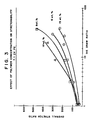
- Figure 3 graphically shows the effects of polymer concentration and die draw ratio on the overall stretchability of fibers.
- marine ropes and cables such as the mooring lines used to secure tankers to loading stations and the cables used to secure drilling platforms to underwater anchorage, are presently constructed of materials such as nylon, polyester, aramids and steel which are subject to hydrolytic or corrosive attack by sea water. Consequently, such mooring lines and cables are constructed with significant safety factors and are replaced frequently. The greatly increased weight and the need for frequent replacement creates substantial operational and economic burdens.
- the fibers and films produced by the process of this invention exhibit relatively high strength, high modulus and very good toughness. Also, they are dimensionally and hydrolytically stable.
- the fibers and films prepared by our unique process possess all these properties and are, therefore, quite useful materials. Consequently, our fibers and films offer significant advantages when employed as, for example, marine ropes and cables.
- Fibers and films prepared according to our invention include: reinforcement of thermoplastics, thermosetting resins, elastomers, and concretes for uses such as pressure vessels, hoses, power transmission belts, sports and automotive equipment; and, building construction materials.
- crystallizable polyethylene is meant a polymer which is capable of exhibiting a relatively high degree of order when shaped, attributable in part to its molecular weight and high degree of linearity.
- polyethylene shall mean a predominantly linear polyethylene material that may contain minor amounts of chain branching or comonomers not exceeding 5 modifying units per 100 main chain carbon atoms, and that may also contain admixed therewith not more than 25 wt% of one or more polymeric additives such as alkene-1-polymers, in particular low density polyethylene, polypropylene or polybutylene, copolymers containing mono-olefins as primary monomers, oxidixed polyolefins, graft polyolefin copolymers and polyoxymethylenes, or low molecular weight additives such as anti-oxidants, lubricants, ultra-violet screening agents, colorants and the like which are commonly incorporated therewith.
- polymeric additives such as alkene-1-polymers, in particular low density polyethylene, polypropylene or polybutylene, copolymers containing mono-olefins as primary monomers, oxidixed polyolefins, graft
- Suitable polymers have molecular weights (by intrinsic viscosity) in the range of 200,000 to 4,000,000. This corresponds to a weight average chain length of 8,333 to 166,666 monomer units or 16,666 to 333,332 carbons.
- the preferred weight average molecular weight of polyethylene used in our process is between 200,000 (3.2 IV) and 800,000 (8.4 IV), more preferably between 250,000 (3.7 IV) and 750,000 (8.0 IV), and most preferably between 300,000 (4.2 IV) and 700,000 (7.6 IV).
- the IV numbers represent intrinsic viscosity of the polymer in decalin at 135°C.
- the polymers used in the present invention have a weight to number average molecular weight ratio (Mw/Mn) which is variable over a wide range.
- Mw/Mn weight to number average molecular weight ratio
- the first solvent should be a non-volatile solvent under the processing conditions. This is necessary in order to maintain essentially constant concentration of solvent upstream and through the aperture (die or spinnerette) and to prevent non-uniformity in liquid content of the gel fiber or film containing first solvent.
- the vapor pressure of the first solvent should be no more than about one fifth of an atmosphere (20kPa) at 175°C., or at the first temperature.
- Preferred first solvents for hydrocarbon polymers are aliphatic and aromatic hydrocarbons of the desired non-volatility and solubility for the polymer.
- Preferred first solvents for polyethylene include paraffin or mineral oil.
- the polymer may be present in the first solvent in a first concentration which is selected from a range from 5 to 25 weight percent. The optimum concentration is dependent upon the polymer molecular weight. For a polymer of about 650,000 (Mw), the first concentration is preferably 5 to 15 weight percent and more preferably 6 to 10 weight percent; however, once chosen, the concentration should not vary adjacent the die or otherwise prior to cooling to the second temperature. The concentration should also remain reasonably constant over time (i.e., over the length of the fiber or film).
- the first temperature is chosen to achieve complete dissolution of the polymer in the first solvent.
- the first temperature is the minimum temperature at any point between where the solution is formed and the die face, and must be greater than the gelation temperature for the polymer in the solvent at the first concentration.
- the gelation temperature is approximately 100-130°C; therefore, a preferred temperature can be between 180°C and 250°C, or more preferably between 200 and 240°C. While temperatures may vary above the first temperature at various points upstream of the die face, excessive temperatures causative of polymer degradation should be avoided.
- a first temperature is chosen whereat the solubility of the polymer exceeds the first concentration, and is typically at least 100 percent greater.
- the second temperature is chosen whereat the solubility of the polymer is much less than the first concentration.
- the rate at which the extruded polymer solution is cooled from the first temperature to the second temperature should be at least 50°C/minute.
- a critical aspect of our invention is the step of stretching (solution stretching) the extrudate (solution product) at a ratio of at least 3:1 and e.g. up to 200:1.
- the preferred ratio of stretching depends upon the polymer molecular weight and the first concentration. For a polymer of about 650,000 (Mw) at a first concentration between 6% and 10%, the preferred stretch ratio is between 3:1 and 50:1 and the most preferred ratio of stretching is between 10:1 and 50:1.
- Solution stretching i.e., stretching the spun solution product prior to forming a gel therefrom, occurs between the aperture of the die and the quench bath (normally within the space of a few inches (2.54 cm's)).
- Stretching can be accomplished by regulating the spinning rate (measured by the length of product formed per unit time) through the die relative to the angular velocity of the quench bath roller.
- Solution stretching of at least 3:1 results in the formation of a gel (upon cooling to the second temperature) which consist of continuous polymeric networks highly swollen with solvent. Each gel has substantially uniform polymer density with polymer voids constituting less than 10% (by volume), normally less than 5%, of the fiber.
- a solution stretch ratio of at least 3:1 unexpectedly aids in forming high strength articles of intermediate molecular weight (cf. U.S. 4,413,110). Within the limitations of the solution stretch ratio range, the higher the pump rate of polymer through the die or spinnerette, the lower the solution stretch ratio because of the degree of alignment (orientation) imparted by shear through the die or spinnerette.
- the extraction with second solvent is conducted in a manner (ordinarily in a washer cabinet) that replaces the first solvent in the gel with second solvent without significant changes in gel structure. Some swelling or shrinkage of the gel may occur, but preferably no substantial dissolution, coagulation or precipitation of the polymer occurs.
- suitable second solvents include hydrocarbons, chlorinated hydrocarbons, chlorofluorinated hydrocarbons and others, such as pentane, hexane, heptane, toluene, methylene chloride, carbontetrachloride, trichlorotrifluoroethane (TCTFE), diethyl ether and dioxane.
- the most preferred second solvents are methylene chloride (B.P. 39.8°C) and TCTFE (B.P. 47.5°C).
- Preferred second solvents are the non-flammable volatile solvents having an atmospheric boiling point below 80°C., more preferably below 70°C and most preferably below 50°C. Conditions of extractions should be chosen so as to remove the first solvent to a level of less than 0.1 percent of the total solvent in the gel.
- a preferred combination of the conditions is a first temperature between 150°C and 250°C, a second temperature between minus 40°C and 40°C and a cooling rate between the first temperature and the second temperature of at least 50°C/minute.
- the first solvent does not experience a phase change at the second temperature.
- the first solvent be a hydrocarbon, when the polymer is an intermediate molecular weight polyethylene.
- the first solvent should be substantially non-volatile, one measure of which is that its vapor pressure at the first temperature should be less than 20kPa, and more preferably less than 2kPa.
- the primary desired difference relates to volatility as discussed above. It is also preferred that the polymers be less soluble in the second solvent at 40°C than in the first solvent at 150°C.
- the second gel is then dried under conditions where the second solvent is removed leaving the solid network of polymer substantially intact.
- the resulting material is called a "xerogel” meaning a solid matrix corresponding to a solid matrix of a wet gel, with the liquid having been replaced by gas (e.g., by an inert gas such as nitrogen or by air).
- gas e.g., by an inert gas such as nitrogen or by air.
- the term "xerogel” is not intended to delineate any particular type of surface area, degree of porosity or pore size.
- Stretching may be performed upon the gel after cooling to the second temperature, or during or after extraction.
- stretching of the xerogel may be conducted, or a combination of gel stretching and xerogel stretching may be performed.
- Stretching after gelation most preferably is conducted in two or more stages.
- the first stage of stretching may be conducted at room temperature or at an elevated temperature, ordinarily at a temperature between 115°C and 135°C.
- stretching is conducted in the last of the stages at a temperature between 120°C and 155°C.
- the stretching is conducted in the last of the stages at a temperature between 135°C and 150°C.
- Stretching subsequent to gelation is another critical aspect of our invention. Stretching subsequent to gelation can be accomplished during quenching, washing, and/or drying of the gels, and can also be accomplished by a xerogel stretching step. As noted above, stretching subsequent to gelation most preferably occurs in at least two stages.
- the amount of acceptable stretching subsequent to gelation at various stages of the process is as follows: stretching of the gels is normally at least 1.5:1; stretching of the xerogel in a first stage, preferably occurring between 115°C and 135°C, is generally more than 2:1; and stretching of the xerogel in a second stage, preferably occurring between 130°C and 155°C, is normally about 1.5:1.
- the overall stretch ratio of the product is usually between 30:1 and 500:1 or more.
- the total combined stretch ratio (of the solution product, the gel and/or the xerogel) of at least 30:1 produces articles exhibiting an advantageous combination of properties.
- the stretching steps of the process are interrelated in such a fashion that an increase in the solution stretch ratio is coupled with a decrease in the subsequent gel and/or xerogel stretch ratios.
- the Examples described hereinbelow illustrate how the stretch ratios are interrelated in obtaining particular improved fiber properties.
- the intermediate weight polyethylene articles, such as fibers, produced by the present process exhibit the following combination of properties: a tensile modulus at least 3.09x10⁴ mN/tex (350 grams/denier) (preferably at least 4.4x10⁴ mN/tex (500 grams/denier), more preferably at least 6.6x10⁴ mN/tex (750 grams/denier), and most prererably at least 8.8x10⁴ mN/tex (1,000 grams/denier), a tenacity at least 1147 mN/tex (13 grams/denier), preferably at least 1324 mN/tex (15 grams/denier), more preferably at least 1589 mN/tex (18 grams/denier) and most preferably at least 1765 mN/tex (20 grams/denier), a main melting temperature (measured at 10°C/minute heating rate by differential scanning calorimetry) of at least 140°C, preferably at least 141°C, and wherein said main melting temperature is greater than the main melting temperature of a shaped polyethylene article of
- the crystalline orientation function is a measurement of the degree of alignment of the axis of the polymer crystals with the major axis of the product. It has been shown that the higher the crystalline orientation function the higher the tensile strength of the product.
- the crystalline orientation function is at least 0.95.
- the degree of crystallinity of the product is related to the tensile strength in a similar fashion as the orientation factor.
- Crystallinity of the product can be measured by a variety of methods including x-ray diffraction, heat of fusion and density measurement and is at least 0.70 or higher.
- x-ray diffraction we measured the degree of crystallinity of a fibrous product produced by our process to be about 0.65.
- density measurements of the same fiber indicate a degree of crystallinity of about 0.77. See Example 13.
- transverse microfibrillar spacing An important and unique property of products produced by our process is the transverse microfibrillar spacing.
- Products produced by our process exhibit microstructure (transverse microfibrillar spacing) below 15nm (150 ⁇ ) that appears to be sensitive to the critical process variables and may have a direct role in the final properties of the product.
- the spacing between the microfibrils i.e., the transverse microfibrillar spacing, exhibited by an article produced by employing a solution stretch of at least 3:1 is less than that which would exist in a shaped polyethylene article of substantially the same weight average molecular weight produced from a polymer solution of substantially the same polymer concentration, spun at substantially the same throughput rate and subjected to solution stretching at a ratio of less than 3:1.
- Figure 1 illustrates in schematic form the preferred embodiment of the apparatus used for the process of the present invention, wherein the stretching steps include solution filament stretching and stretching at least two of the gel containing the first solvent, the gel containing second solvent; and, the xerogel.
- a first mixing vessel 10 is fed with the intermediate molecular weight polyethylene 11 of weight average molecular weight between 200,000 and 4,000,000, and is also fed with a first, non-volatile solvent 12 such as paraffin oil.
- First mixing vessel 10 is equipped with an agitator 15. The residence time of polymer and first solvent in first mixing vessel 10 is sufficient to form a slurry. The slurry is removed from first mixing vessel via line 14 to a preheater 15.
- the residence time and temperature in preheater 15 are sufficient to dissolve between 5% and 50% of the polymer.
- the solution is fed to an extrusion device 18 containing a barrel 19 within which is a screw 20 operated by motor 22 to deliver polymer solution at reasonably high pressure to a gear pump in housing 23 at a controlled flow rate.
- Motor 24 is provided to drive gear pump 23 and extrude the polymer solution, still hot, through a spinnerette at 25 comprising a plurality of apertures, which may be circular, x-shaped or oval shaped, or in any of a variety of shapes having a relatively small major access in the plane of the spinnerette when it is desired to form fibers, and having a regtangular or other shape when an extended major access in the plane of the spinnerette when it is desired to form films or tapes.
- An aperture of circular cross section (or other cross section without a major axis in the plane perpendicular to the flow direction more than 8 times the smallest axis in the same plane, such as oval, y- or x-shaped aperture) is used so that both gels will be fiber gels, the xerogel will be a xerogel fiber and the product will be a fiber.
- the diameter of the aperture is not critical, with representative apertures being between 0.25 mm and 5 mm in diameter (or other major axis).
- the length of the aperture in the flow direction should normally be at least 10 times the diameter of the aperture (or other similar major access), preferably at least 15 times and more preferably at least 20 times the diameter (or other similar major access).
- the temperature of the solution in the preheater vessel 15, in the extrusion device 18 and at the spinnerette 25 should all equal or exceed a first temperature (e.g., 200°C) chosen to exceed the gelation temperature (approximately 100° to 130°C for polyethylene and paraffin oil).
- the temperature may vary (fluctuating between 200°C and 220°C) or maybe constant (e.g., about 220°C) from the preheater vessel 15 to the extrusion device 18 to the spinnerette 25.
- the concentration of polymer in the solution should be substantially the same.
- the number of aperatures in thus the numbers of fibers formed, is not critical, with convenient number of fibers being 16, 19, 120 or 240.
- the polymer solution passes through an airgap 27, optionally enclosed and filled with an inert gas such as nitrogen, and optionally provided with a flow of gas to facilitate cooling.
- a plurality of solution fibers 28 containing first solvent pass through the airgap 27 and into a quench bath 30 so as to cool the fibers, both in the airgap and in the quench bath 30 to a second temperature at which the solubility of the polymer in the first solvent is relatively low, such that the polymer solution forms a gel.
- solution fiber stretching occurs in the airgap 27 at a ratio of at least 3:1. This high stress draw of the solution fibers prior to gelation is critical in achieving the ultimate properties of the fibers.
- Rollers 31 and 32 in the quench bath operate to feed the fiber through the quench bath and operate in relation to the solution fiber rate of extrusion (determined by the length of extruded fiber per unit time) at an angular velocity sufficient to stretch the solution filament at a ratio of at least 3:1 prior to gelation.
- stretching of the gel filament may be desired. Normally, the degree of stretch imparted between roll 31 and 32 to the gel fiber would be more than 1.5:1. In the event that stretching of the gel fiber between rollers 31 and 32 is desired, some of first solvent may exude out of the fibers and can be collected as a layer in quench bath 30.
- the cool first solvent containing gel fibers (first gel fibers) 33 passed to a solvent extraction device 37 where a second solvent, being of relatively low boiling point, such as trichlorotrifluoroethane, is fed in through line 38.
- the solvent outflow through line 40 contains second solvent and substantially all of the first solvent from the cool first gel fibers 33.
- the polymer is now swollen by the second solvent.
- second solvent containing gel fibers (second gel fibers) 41 conducted out of the solvent extraction device 37 contain substantially only second solvent, and relatively little first solvent.
- the second gel fibers 41 may have shrunken somewhat compared to the first gel fibers 33, but otherwise have substantially the same polymer morphology.
- the second solvent is evaporated from the second gel fibers 41 forming essentially unstretched xerogel fibers 47 which are taken up on spool 52.
- the fibers are fed over driven feed roll 54 and idler roll 55 into a first heated tube 56 which may be rectangular, cylindrical or any other convenient shape. Sufficient heat is supplied to the tube 56 to cause the internal temperature to be between 115°C and 135°C.
- the fibers may be stretched at this stage if desired. In this embodiment stretching would occur at a relatively high ratio (generally more than 2:1, preferably 3:1) so as to form partially stretched fibers 58 taken out by a driven roll 61 and idler roller 62.
- the solution forming step (a) is conducted in preheater 15 and extrusion device 18.
- the extrusion step (b) is conducted with device 18 and 23, and especially through spinnerette 25.
- the solution product stretching step (c) is generally conducted in the airgap 27, and the cooling and quenching step (d) is conducted in the airgap 27 and in the quench bath 30.
- Extraction step (e) is conducted in solvent extraction device 37.
- the drying step (f) is conducted in the drying device 45.
- the stretching step (g) is preferably conducted in elements 52-72, and especially in heated tubes 56 (Zone 1) and 63 (Zone 2).
- stretching may occur within the quench bath 30, within the solvent extraction device 37, within drying device 45 and/or between solvent extraction device 37 and drying device 45.
- Helicone® An oil jacketed double Helical (Helicone®) mixer, constructed by Atlantic Research Corporation, was charged with 10 wt% linear polyethylene, 89.5 wt% mineral oil (Witco "Kaydol”), and 0.5 wt% antioxidant (Shell “Ionol”).
- the linear polyethylene was Allied Corporation FD60-018 having an intrinsic viscosity (IV) of 3.7 measured in decalin at 135°C, a weight average molecular weight of 284,000 kg/mol and an Mw/Mn of approximately 10.
- the charge was heated with agitation at 60 rpm to 240°C.
- the bottom discharge opening of the Helicone mixer was adapted to feed the polymer solution first to a gear pump and then to a 19-hole spinning die.
- the holes of the spinning die were each of 0.1016 cm (0.040") diameter.
- the gear pump speed was set to deliver 15.2 cm3/min of polymer solution to the die.
- the extruded solution filaments were stretched 39.8:1 in passing through a 5.08cm (2") air gap into a water quench bath at 15° wherein the filaments were quenched to a gel state.
- the gel "yarn” was passed into a washer cabinet in which the mineral oil content of the gel filaments was extracted and replaced by trichlorotrifluoroethane (TCTFE) at 35°C.
- TCTFE trichlorotrifluoroethane
- the gel yarn was stretched 1.14:1 in traversing the washer.
- the extracted gel yarn was passed into a dryer cabinet where the TCTFE was evaporated from the yarn at 60°C.
- the dried yarn was stretched 1.14:1 at 60°C as it exited the dryer cabinet.
- the extracted and dried xerogel yarn of 190 dtex (173 denier) was wound onto a roll at 63.2 meters/min.
- the roll of xerogel yarn from Example 1 was transferred to a two-zone stretch bench. Each zone consisted of a 3.04m (10-ft) heated tube maintained at uniform temperature and under nitrogen blanketing. The xerogel yarn was fed into the first stage at 16 m/min. Other stretch conditions and the properties of the yarns obtained are given in Table 2.
- the melting temperatures of the yarns of examples 6 and 9 were determined using a Perkin-Elmer DSC-2 Differential Scanning Calorimeter. Samples of about 3.2 mg were heated in argon at the rate of 10°C/min. The yarns showed a doublet endotherm in duplicate runs: Example 6 142°C (main) + 146°C Example 9 140°C (main) + 148°C
- the xerogel yarns of the following examples were prepared from solutions of polyethylene (Mitsui HI-ZEX 145M-60) having a 7.1 IV (a weight average molecular weight of 649,000 kg/mole and an Mw/Mn of approximately 8).
- the xerogel yarns were prepared essentially as in Example 1 except that the spinning solution concentrations, the pumping rate, the stretch of the solution yarns and the stretch of the gel yarns were varied as illustrated in Table 3.
- the gel yarn stretch ratios employed in Examples 10-31 were generally the highest that could be employed consistent with either of two constraints: breakage of the yarn, or physical limitations of the apparatus used. In general, physical limitations of the apparatus limited the gel yarn stretch ratio that could be employed with yarns spun with a solution stretch of above 20:1. Therefore, the gel yarn stretch ratios recited in the Examples should not be construed as fundamental limitations of the process as higher gel stretch ratios can be employed.
- the xerogel yarns of the following examples were prepared from a 6 wt% solution of polyethylene (Hercules HB-301) having a 9.0 IV, approximately 998,000 Mw, and an Mn/Mm of approximately 8.
- the yarns were spun essentially as in Example 1 except that the solution yarns and gel yarns were stretched as recited in Table 5.
- Pumping rate was 38 cm3/min in Examples 32 and 33 and was 17.3 cm3/min in Examples 34-36.
- the xerogel yarns were hot stretched as in Examples 2-9. Zone No. 1 temperature was maintained at 135°C and zone No. 2 temperature was 150°C. Feed speed to the first hot stretch zone was 12 m/min in Example 32, 24 m/min in Example 33 and 16 m/min in Examples 34-36. The stretch ratios and the properties of the yarns obtained are also given in Table 5.
- polyethylene solutions were prepared as in Example 1 except that the polymer was of 26 IV, approximately 4.5 x 10⁶ Mw, and Mw/Mn of approximately 8.
- the solutions were spun through a 16 hole spinning die whose holes were of 0.1016cm (0.040") diameter.
- the pumping rate was 16 cm3/min in Examples 37-39 and 41, 32 cm3/min in Example 40, and 48 cm3/min in Examples 42-47.
Landscapes
- Engineering & Computer Science (AREA)
- Chemical & Material Sciences (AREA)
- Manufacturing & Machinery (AREA)
- Mechanical Engineering (AREA)
- Textile Engineering (AREA)
- Chemical Kinetics & Catalysis (AREA)
- Materials Engineering (AREA)
- General Chemical & Material Sciences (AREA)
- Crystallography & Structural Chemistry (AREA)
- Health & Medical Sciences (AREA)
- Medicinal Chemistry (AREA)
- Polymers & Plastics (AREA)
- Organic Chemistry (AREA)
- Artificial Filaments (AREA)
- Shaping By String And By Release Of Stress In Plastics And The Like (AREA)
- Addition Polymer Or Copolymer, Post-Treatments, Or Chemical Modifications (AREA)
- Spinning Methods And Devices For Manufacturing Artificial Fibers (AREA)
Claims (7)
- Verfahren zur Herstellung geformter Gegenstände aus Polyethylen, welches die folgenden Schritte umfaßt:(a) Herstellen einer Lösung aus einem kristallisierbaren Polyethylen in einem nichtflüchtigen ersten Lösungsmittel, wobei das Polyethylen ein durchschnittliches Molekulargewicht zwischen 200.000 und 4.000.000 Kilogramm/kg mol besitzt;(b) Extrudieren dieser Lösung durch eine Öffnung, um ein Lösungsprodukt zu bilden;(c) Strecken des Lösungsproduktes über der Temperatur, bei der sich ein Gel bildet, bei einem Streckverhältnis von mindestens 3:1;(d) Abkühlen des Lösungsproduktes auf eine Temperatur unterhalb der Temperatur des Lösungsproduktes von Schritt b), um ein erstes Gel zu bilden, welches das erste Lösungsmittel enthält;(e) Extrahieren des ersten Lösungsmittels aus dem ersten Gel mit einem zweiten Lösungsmittel, um ein zweites Gel zu bilden, welches das zweite Lösungsmittel enthält und im wesentlichen frei ist von dem ersten Lösungsmittel;(f) Trocknen des Gels, welches das zweite Lösungsmittel enthält, um ein Xerogel zu bilden, das im wesentlichen frei ist von Lösungsmittel; und(g) Strecken von mindestens einem von dem ersten Gel, dem zweiten Gel und dem Xerogel,wobei das gesamte Streckverhältnis ausreicht, um einen Polyethylengegenstand herzustellen mit einer Zugfestigkeit von mindestens 1147 mN/tex (13 g/den), einer Porosität von weniger als 10 Vol.-% und einem Modul von mindestens 3,09x10⁴ mN/tex (350 g/den).
- Verfahren nach Anspruch 1, dadurch gekennzeichnet, daß das Lösungsprodukt mit einem Verhältnis von mindestens 10:1 gestreckt wird.
- Verfahren nach Anspruch 1 oder Anspruch 2, dadurch gekennzeichnet, daß die Konzentration von Polyethylen in dem ersten Lösungsmittel zwischen 5 und 25 Gew.-% beträgt.
- Verfahren nach einem der vorhergehenden Ansprüche, dadurch gekennzeichnet, daß das Polyethylen ein durchschnittliches Molekulargewicht zwischen 300.000 und 800.000 besitzt.
- Verfahren nach einem der vorhergehenden Ansprüche, dadurch gekennzeichnet, daß beim Strecken von mindestens einem von dem ersten Gel, dem zweiten Gel und dem Xerogel das erste Gel oder das zweite Gel und das Xerogel gestreckt wird.
- Verfahren nach einem der vorhergehenden Ansprüche, dadurch gekennzeichnet, daß beim Abkühlen des Lösungsproduktes das Lösungsprodukt in einem Abschreckbad abgeschreckt wird.
- Verfahren nach einem der vorhergehenden Ansprüche, dadurch gekennzeichnet, daß das erste Lösungsmittel eine Flüssigkeit mit der aus Schritt d) resultierenden Temperatur ist.
Priority Applications (1)
| Application Number | Priority Date | Filing Date | Title |
|---|---|---|---|
| EP91113687A EP0472114B1 (de) | 1985-01-11 | 1985-12-17 | Geformte Gebilde mit hohem Modul aus Polyethylen von mittlerem Molekulargewicht |
Applications Claiming Priority (2)
| Application Number | Priority Date | Filing Date | Title |
|---|---|---|---|
| US690914 | 1985-01-11 | ||
| US06/690,914 US4663101A (en) | 1985-01-11 | 1985-01-11 | Shaped polyethylene articles of intermediate molecular weight and high modulus |
Related Child Applications (2)
| Application Number | Title | Priority Date | Filing Date |
|---|---|---|---|
| EP91113687.7 Division-Into | 1985-12-17 | ||
| EP91113687A Division EP0472114B1 (de) | 1985-01-11 | 1985-12-17 | Geformte Gebilde mit hohem Modul aus Polyethylen von mittlerem Molekulargewicht |
Publications (3)
| Publication Number | Publication Date |
|---|---|
| EP0187974A2 EP0187974A2 (de) | 1986-07-23 |
| EP0187974A3 EP0187974A3 (en) | 1988-01-07 |
| EP0187974B1 true EP0187974B1 (de) | 1993-01-20 |
Family
ID=24774475
Family Applications (2)
| Application Number | Title | Priority Date | Filing Date |
|---|---|---|---|
| EP85116065A Expired - Lifetime EP0187974B1 (de) | 1985-01-11 | 1985-12-17 | Geformtes Gebilde aus Polyethylen von mittlerem Molekulargewicht mit hohem Modul |
| EP91113687A Expired - Lifetime EP0472114B1 (de) | 1985-01-11 | 1985-12-17 | Geformte Gebilde mit hohem Modul aus Polyethylen von mittlerem Molekulargewicht |
Family Applications After (1)
| Application Number | Title | Priority Date | Filing Date |
|---|---|---|---|
| EP91113687A Expired - Lifetime EP0472114B1 (de) | 1985-01-11 | 1985-12-17 | Geformte Gebilde mit hohem Modul aus Polyethylen von mittlerem Molekulargewicht |
Country Status (7)
| Country | Link |
|---|---|
| US (3) | US4663101A (de) |
| EP (2) | EP0187974B1 (de) |
| JP (1) | JPH0819563B2 (de) |
| AU (1) | AU593533B2 (de) |
| CA (1) | CA1276064C (de) |
| DE (2) | DE3587017T2 (de) |
| ES (1) | ES8701796A1 (de) |
Cited By (1)
| Publication number | Priority date | Publication date | Assignee | Title |
|---|---|---|---|---|
| US8535777B2 (en) | 2006-04-26 | 2013-09-17 | Dsm Ip Assets B.V. | Multilayered material sheet and process for its preparation |
Families Citing this family (145)
| Publication number | Priority date | Publication date | Assignee | Title |
|---|---|---|---|---|
| US4663101A (en) * | 1985-01-11 | 1987-05-05 | Allied Corporation | Shaped polyethylene articles of intermediate molecular weight and high modulus |
| JPH06102846B2 (ja) * | 1985-05-01 | 1994-12-14 | 三井石油化学工業株式会社 | 超高分子量ポリエチレン延伸物の製造方法 |
| DE3675079D1 (de) * | 1985-06-17 | 1990-11-29 | Allied Signal Inc | Polyolefinfaser mit hoher festigkeit, niedrigem schrumpfen, ultrahohem modul, sehr niedrigem kriechen und mit guter festigkeitserhaltung bei hoher temperatur sowie verfahren zu deren herstellung. |
| US5286435A (en) * | 1986-02-06 | 1994-02-15 | Bridgestone/Firestone, Inc. | Process for forming high strength, high modulus polymer fibers |
| ATE106428T1 (de) * | 1987-07-23 | 1994-06-15 | Dsm Nv | Verfahren zur herstellen von dünnen gestreckten folien aus polyolefinen mit ultrahoch-molekularem gewicht. |
| EP0300540B1 (de) * | 1987-07-23 | 1994-07-27 | Dsm N.V. | Verfahren zur Herstellung von teilweise mit Versteifungen ausgerüsteten Polymerfolien |
| WO1989001123A1 (en) * | 1987-08-03 | 1989-02-09 | Allied-Signal Inc. | Impact resistant helmet |
| US4820568A (en) * | 1987-08-03 | 1989-04-11 | Allied-Signal Inc. | Composite and article using short length fibers |
| US4883700A (en) * | 1987-08-03 | 1989-11-28 | Allied-Signal Inc. | Composite and article using short length fibers at oblique angles |
| US5175040A (en) * | 1987-08-03 | 1992-12-29 | Allied-Signal Inc. | Flexible multi-layered armor |
| US5176862A (en) * | 1989-05-19 | 1993-01-05 | Dsm N.V. | Process for the manufacture of stretched rope |
| AU642154B2 (en) * | 1989-09-22 | 1993-10-14 | Mitsui Chemicals, Inc. | Molecular orientation articles molded from high-molecular weight polyethylene and processes for preparing same |
| KR930006933B1 (ko) * | 1990-06-23 | 1993-07-24 | 한국과학기술연구원 | 폴리에틸렌 섬유/에폭시 수지 복합재의 접착력 증진 방법 |
| US5238634A (en) * | 1992-01-07 | 1993-08-24 | Exxon Chemical Patents Inc. | Disentangled chain telechelic polymers |
| FI93865C (fi) * | 1992-05-29 | 1995-06-12 | Borealis Holding As | Sulakehrätty luja polyeteenikuitu |
| WO1994009336A1 (en) * | 1992-10-13 | 1994-04-28 | Allied-Signal Inc. | Entangled high strength yarn |
| JP2612667B2 (ja) * | 1993-06-04 | 1997-05-21 | 財団法人工業技術研究院 | 高強度および高弾性率を有するポリエチレン繊維およびその製造法 |
| NL9400594A (nl) * | 1994-04-14 | 1995-11-01 | Hand Safe Holland Bv | Filterdoek-weefsel. |
| NL9401746A (nl) * | 1994-04-14 | 1995-11-01 | Hand Safe Holland Bv | Filterdoek-weefsel. |
| CN1047414C (zh) * | 1995-06-07 | 1999-12-15 | 刘兆峰 | 超高强聚乙烯纤维纺丝装置 |
| US5762840A (en) * | 1996-04-18 | 1998-06-09 | Kimberly-Clark Worldwide, Inc. | Process for making microporous fibers with improved properties |
| GB2312939B (en) * | 1996-05-09 | 2000-08-23 | Zyex Limited | Control cables |
| NL1010399C1 (nl) * | 1998-10-26 | 2000-04-27 | Dsm Nv | Werkwijze voor het vervaardigen van een vormdeel. |
| US6723267B2 (en) * | 1998-10-28 | 2004-04-20 | Dsm N.V. | Process of making highly oriented polyolefin fiber |
| US6448359B1 (en) | 2000-03-27 | 2002-09-10 | Honeywell International Inc. | High tenacity, high modulus filament |
| GB2408747B (en) * | 2003-01-31 | 2006-01-18 | Chevron Usa Inc | High purity olefinic naphthas for the production of ethylene and propylene |
| US6764764B1 (en) * | 2003-05-23 | 2004-07-20 | Honeywell International Inc. | Polyethylene protective yarn |
| BR0304322B1 (pt) * | 2003-10-03 | 2013-09-24 | processo de obtenção de fibra de polietileno de alto módulo, extrusável, e fibra assim obtida | |
| US7344668B2 (en) * | 2003-10-31 | 2008-03-18 | Honeywell International Inc. | Process for drawing gel-spun polyethylene yarns |
| EP1699954B1 (de) | 2004-01-01 | 2011-11-30 | DSM IP Assets B.V. | Verfahren zur herstellung von hochleistungsfähigem polyethylen-multifilamentgarn |
| ES2328948T3 (es) | 2004-09-03 | 2009-11-19 | Honeywell International Inc. | Hilos de polietileno estirados hilados en gel y proceso para estirado. |
| US7223470B2 (en) * | 2005-08-19 | 2007-05-29 | Honeywell International Inc. | Drawn gel-spun polyethylene yarns |
| US6969553B1 (en) * | 2004-09-03 | 2005-11-29 | Honeywell International Inc. | Drawn gel-spun polyethylene yarns and process for drawing |
| US7074483B2 (en) * | 2004-11-05 | 2006-07-11 | Innegrity, Llc | Melt-spun multifilament polyolefin yarn formation processes and yarns formed therefrom |
| US7147807B2 (en) * | 2005-01-03 | 2006-12-12 | Honeywell International Inc. | Solution spinning of UHMW poly (alpha-olefin) with recovery and recycling of volatile spinning solvent |
| CN100339514C (zh) * | 2005-06-03 | 2007-09-26 | 北京特斯顿新材料技术发展有限公司 | 超高分子量聚乙烯纤维制备中的超临界萃取及干燥方法 |
| US7445834B2 (en) * | 2005-06-10 | 2008-11-04 | Morin Brian G | Polypropylene fiber for reinforcement of matrix materials |
| US7892633B2 (en) * | 2005-08-17 | 2011-02-22 | Innegrity, Llc | Low dielectric composite materials including high modulus polyolefin fibers |
| US7648607B2 (en) * | 2005-08-17 | 2010-01-19 | Innegrity, Llc | Methods of forming composite materials including high modulus polyolefin fibers |
| US8057887B2 (en) * | 2005-08-17 | 2011-11-15 | Rampart Fibers, LLC | Composite materials including high modulus polyolefin fibers |
| US7370395B2 (en) * | 2005-12-20 | 2008-05-13 | Honeywell International Inc. | Heating apparatus and process for drawing polyolefin fibers |
| US20070202328A1 (en) * | 2006-02-24 | 2007-08-30 | Davis Gregory A | High tenacity polyolefin ropes having improved cyclic bend over sheave performance |
| US20070202329A1 (en) * | 2006-02-24 | 2007-08-30 | Davis Gregory A | Ropes having improved cyclic bend over sheave performance |
| US20070202331A1 (en) * | 2006-02-24 | 2007-08-30 | Davis Gregory A | Ropes having improved cyclic bend over sheave performance |
| US8444898B2 (en) | 2006-03-30 | 2013-05-21 | Honeywell International Inc | High molecular weight poly(alpha-olefin) solutions and articles made therefrom |
| BRPI0710757B1 (pt) * | 2006-04-26 | 2019-07-09 | Dsm Ip Assests B.V. | Folha de material de múltiplas camadas e artigo resistente à balística |
| CN101479101A (zh) * | 2006-04-26 | 2009-07-08 | 帝斯曼知识产权资产管理有限公司 | 复合制品、其制造方法以及用途 |
| EP2010856B1 (de) | 2006-04-26 | 2017-12-13 | DSM IP Assets B.V. | Flächengebilde aus mehrschichtigem material und herstellungsverfahren dafür |
| US8007202B2 (en) * | 2006-08-02 | 2011-08-30 | Honeywell International, Inc. | Protective marine barrier system |
| US7846363B2 (en) * | 2006-08-23 | 2010-12-07 | Honeywell International Inc. | Process for the preparation of UHMW multi-filament poly(alpha-olefin) yarns |
| US7674409B1 (en) * | 2006-09-25 | 2010-03-09 | Honeywell International Inc. | Process for making uniform high strength yarns and fibrous sheets |
| US8017529B1 (en) | 2007-03-21 | 2011-09-13 | Honeywell International Inc. | Cross-plied composite ballistic articles |
| US7994074B1 (en) | 2007-03-21 | 2011-08-09 | Honeywell International, Inc. | Composite ballistic fabric structures |
| BRPI0702310A2 (pt) * | 2007-05-24 | 2009-01-13 | Braskem Sa | processo para a preparaÇço de fios polimÉricos a partir de homopolÍmeros ou copolÍmeros de ultra alto peso molecular, fios polimÉricos, artigos polimÉricos moldados, e, uso de fios polimÉricos |
| BRPI0702313A2 (pt) * | 2007-05-24 | 2009-01-13 | Profil Ltda Braskem S A | processo para a preparaÇço de fios polimÉricos a partir de homopolÍmeros ou copolimeros de ultra alto peso molecular, fios polimÉricos, artigos polimÉricos moldados, e, uso de fios polimÉricos |
| US8889049B2 (en) | 2010-04-30 | 2014-11-18 | Honeywell International Inc | Process and product of high strength UHMW PE fibers |
| US9365953B2 (en) | 2007-06-08 | 2016-06-14 | Honeywell International Inc. | Ultra-high strength UHMWPE fibers and products |
| US7638191B2 (en) * | 2007-06-08 | 2009-12-29 | Honeywell International Inc. | High tenacity polyethylene yarn |
| US8747715B2 (en) | 2007-06-08 | 2014-06-10 | Honeywell International Inc | Ultra-high strength UHMW PE fibers and products |
| US8256019B2 (en) | 2007-08-01 | 2012-09-04 | Honeywell International Inc. | Composite ballistic fabric structures for hard armor applications |
| WO2009079062A2 (en) * | 2007-09-27 | 2009-06-25 | Honeywell International Inc. | Field installation of a vehicle protection system |
| CN101230499B (zh) * | 2008-02-26 | 2010-10-06 | 山东爱地高分子材料有限公司 | 一种有颜色的高强聚乙烯纤维及其制造方法 |
| EP2112259A1 (de) | 2008-04-22 | 2009-10-28 | DSM IP Assets B.V. | Abriebfestes Gewebe |
| US7858180B2 (en) * | 2008-04-28 | 2010-12-28 | Honeywell International Inc. | High tenacity polyolefin ropes having improved strength |
| CN101575756B (zh) * | 2008-05-05 | 2011-01-26 | 宁波荣溢化纤科技有限公司 | 一种超高分子量聚乙烯原丝的拉伸方法 |
| JP2011525456A (ja) | 2008-06-23 | 2011-09-22 | ディーエスエム アイピー アセッツ ビー.ブイ. | 積み荷ネット |
| US8658244B2 (en) * | 2008-06-25 | 2014-02-25 | Honeywell International Inc. | Method of making colored multifilament high tenacity polyolefin yarns |
| US8474237B2 (en) | 2008-06-25 | 2013-07-02 | Honeywell International | Colored lines and methods of making colored lines |
| US7966797B2 (en) * | 2008-06-25 | 2011-06-28 | Honeywell International Inc. | Method of making monofilament fishing lines of high tenacity polyolefin fibers |
| ES2720178T3 (es) * | 2008-07-17 | 2019-07-18 | Teijin Aramid Bv | Objetos con resistencia balística que comprenden cuerpos alargados |
| US20100063213A1 (en) * | 2008-09-05 | 2010-03-11 | Fredrickson Glenn H | Gel-processed polyolefin compositions |
| WO2010106143A1 (en) | 2009-03-20 | 2010-09-23 | Dsm Ip Assets B.V. | Net for aquaculture |
| CA2758494C (en) | 2009-04-23 | 2017-01-03 | Dsm Ip Assets B.V. | Compressed sheet |
| US9562744B2 (en) | 2009-06-13 | 2017-02-07 | Honeywell International Inc. | Soft body armor having enhanced abrasion resistance |
| IN2012DN00577A (de) | 2009-08-04 | 2015-06-12 | Dsm Ip Assets Bv | |
| US8845660B2 (en) | 2009-08-06 | 2014-09-30 | Dsm Ip Assets B.V. | Surgical repair article based on HPPE material |
| WO2011045321A1 (en) | 2009-10-12 | 2011-04-21 | Dsm Ip Assets B.V. | Flexible sheet, method of manufacturing said sheet and applications thereof |
| WO2011073405A1 (en) | 2009-12-17 | 2011-06-23 | Dsm Ip Assets B.V. | Electrical cable |
| US7964518B1 (en) | 2010-04-19 | 2011-06-21 | Honeywell International Inc. | Enhanced ballistic performance of polymer fibers |
| US20130047830A1 (en) | 2010-05-06 | 2013-02-28 | Dsm Ip Assets B.V. | Article comprising polymeric tapes |
| EP2598827B1 (de) | 2010-07-29 | 2016-09-21 | DSM IP Assets B.V. | Kugelsicherer artikel |
| US20130291712A1 (en) | 2010-09-08 | 2013-11-07 | Dsm Ip Assets B.V. | Multi-ballistic-impact resistant article |
| CN102002873A (zh) * | 2010-09-28 | 2011-04-06 | 浙江沪天胶带有限公司 | 超低伸多楔带线绳的生产设备及其生产工艺 |
| EP2641284B1 (de) | 2010-11-18 | 2017-01-04 | DSM IP Assets B.V. | Flexible elektrogeneratoren |
| CN103354826B (zh) | 2010-12-10 | 2015-08-19 | 帝斯曼知识产权资产管理有限公司 | Hppe构件和制备hppe构件的方法 |
| US9744741B2 (en) | 2010-12-14 | 2017-08-29 | Dsm Ip Assets B.V. | Material for radomes and process for making the same |
| CA2820423C (en) | 2010-12-14 | 2018-09-11 | Dsm Ip Assets B.V. | Tape and products containing the same |
| EP2481847A1 (de) | 2011-01-31 | 2012-08-01 | DSM IP Assets B.V. | UV-Stabilisierte hochfeste Faser |
| EP2678464B1 (de) | 2011-02-24 | 2016-06-29 | DSM IP Assets B.V. | Mehrstufiges reckverfahren zum recken von polymerisch länglichen objekten |
| US9397392B2 (en) | 2011-03-04 | 2016-07-19 | Dsm Ip Assets B.V. | Geodesic radome |
| JP5892352B2 (ja) | 2011-03-22 | 2016-03-23 | ディーエスエム アイピー アセッツ ビー.ブイ. | インフレータブルレードーム |
| EP2697436A1 (de) | 2011-04-12 | 2014-02-19 | DSM IP Assets B.V. | Absperrsystem |
| WO2012139934A1 (en) | 2011-04-13 | 2012-10-18 | Dsm Ip Assets B.V. | Creep-optimized uhmwpe fiber |
| CN103547719B (zh) | 2011-05-10 | 2017-09-29 | 帝斯曼知识产权资产管理有限公司 | 纱线、纱线的制造方法和包含纱线的产品 |
| EP2726656A1 (de) | 2011-06-28 | 2014-05-07 | DSM IP Assets B.V. | Gegenüber raubfischen resistentes netz |
| WO2013024148A1 (en) | 2011-08-18 | 2013-02-21 | Dsm Ip Assets B.V. | Abrasion resistant yarn |
| US20140327595A1 (en) | 2011-09-12 | 2014-11-06 | Dsm Ip Assets B.V.. | Composite radome wall |
| CA2855872C (en) | 2011-11-21 | 2020-02-25 | Dsm Ip Assets B.V. | Polyolefin fiber |
| US9623626B2 (en) | 2012-02-28 | 2017-04-18 | Dsm Ip Assets B.V. | Flexible composite material and use hereof, process for making a flexible composite material |
| WO2013092626A1 (en) | 2011-12-19 | 2013-06-27 | Dsm Ip Assets B.V. | Flexible composite material and use hereof, process for making a flexible composite material |
| US8609223B2 (en) * | 2011-12-30 | 2013-12-17 | Sca Hygiene Products Ab | Interfolded napkins and method for interfolding napkins |
| EA028685B1 (ru) | 2012-02-16 | 2017-12-29 | ДСМ АйПи АССЕТС Б.В. | Способ улучшения окрашивания изделия из свмпэ, окрашенное изделие и продукты, содержащие изделие |
| US9169581B2 (en) | 2012-02-24 | 2015-10-27 | Honeywell International Inc. | High tenacity high modulus UHMW PE fiber and the process of making |
| EP2820186A2 (de) | 2012-03-01 | 2015-01-07 | DSM IP Assets B.V. | Verfahren und vorrichtung zum imprägnieren eines seils mit einem flüssigen material |
| CN104170027A (zh) | 2012-03-12 | 2014-11-26 | 帝斯曼知识产权资产管理有限公司 | 脐管 |
| PT2828333T (pt) | 2012-03-20 | 2016-08-31 | Dsm Ip Assets Bv | Fibra de poliolefina |
| US20150093950A1 (en) | 2012-04-03 | 2015-04-02 | Dsm Ip Assets B.V. | Polymeric yarn and method for manufacturing |
| US9273418B2 (en) | 2012-05-17 | 2016-03-01 | Honeywell International Inc. | Hybrid fiber unidirectional tape and composite laminates |
| CN104364183B (zh) | 2012-06-11 | 2017-09-22 | 帝斯曼知识产权资产管理有限公司 | 环形制品 |
| KR20150036076A (ko) | 2012-07-17 | 2015-04-07 | 디에스엠 아이피 어셋츠 비.브이. | Uhmwpe 섬유를 포함하는 내마모성 제품 |
| WO2014058513A2 (en) | 2012-08-06 | 2014-04-17 | Honeywell International Inc. | Multidirectional fiber-reinforced tape/film articles and the method of making the same |
| EP2907243A1 (de) | 2012-10-11 | 2015-08-19 | DSM IP Assets B.V. | Drahtloses stromübertragungssystem |
| KR102115059B1 (ko) | 2012-10-11 | 2020-05-26 | 디에스엠 아이피 어셋츠 비.브이. | 단일 길이 계류 라인 및 단일 길이 계류 라인을 포함하는 계류 시스템을 포함하는 해양 시추 또는 생산 선박 |
| JP6436091B2 (ja) * | 2012-12-20 | 2018-12-12 | 東洋紡株式会社 | ポリオレフィン糸条及び製造方法 |
| US9243354B2 (en) | 2013-03-15 | 2016-01-26 | Honeywell International Inc. | Stab and ballistic resistant articles |
| WO2014165396A1 (en) | 2013-04-01 | 2014-10-09 | Generon Igs, Inc. | Polysulfone membrane having high selectivity |
| WO2014187948A1 (en) | 2013-05-23 | 2014-11-27 | Dsm Ip Assets B.V. | Uhmwpe fiber |
| EP3957780B1 (de) * | 2013-10-29 | 2025-10-29 | Braskem, S.A. | Kontinuierliches system und verfahren zur herstellung von mindestens einem polymergarn |
| US10370781B2 (en) | 2013-11-12 | 2019-08-06 | Dsm Ip Assets B.V. | Abrasion resistant fabric |
| WO2015086627A2 (en) | 2013-12-10 | 2015-06-18 | Dsm Ip Assets B.V. | Chain comprising polymeric links and a spacer |
| BR112016029232B1 (pt) | 2014-07-01 | 2022-05-03 | Dsm Ip Assets B.V. | Estrutura compreendendo elementos rígidos ligados entre si através de elementos de interligação e uso de fibra polimérica compreendendo polietileno de peso molecular ultraelevado |
| CN106715785A (zh) | 2014-09-16 | 2017-05-24 | 帝斯曼知识产权资产管理有限公司 | 包含聚合物片材的空间框架天线罩 |
| US9834872B2 (en) | 2014-10-29 | 2017-12-05 | Honeywell International Inc. | High strength small diameter fishing line |
| CA2966512C (en) | 2014-10-31 | 2022-06-07 | Hardwire, Llc | Soft ballistic resistant armor |
| US10612189B2 (en) | 2015-04-24 | 2020-04-07 | Honeywell International Inc. | Composite fabrics combining high and low strength materials |
| KR102588339B1 (ko) | 2015-05-28 | 2023-10-11 | 디에스엠 아이피 어셋츠 비.브이. | 하이브리드 체인 링크 |
| KR20180015135A (ko) | 2015-05-28 | 2018-02-12 | 디에스엠 아이피 어셋츠 비.브이. | 중합체 체인 링크 |
| US10870930B2 (en) | 2015-05-28 | 2020-12-22 | Dsm Ip Assets B.V. | Hybrid chain link |
| US10272640B2 (en) | 2015-09-17 | 2019-04-30 | Honeywell International Inc. | Low porosity high strength UHMWPE fabrics |
| EP3202702A1 (de) | 2016-02-02 | 2017-08-09 | DSM IP Assets B.V. | Verfahren zum biegen eines zugelements über einer riemenscheibe |
| US20170297295A1 (en) | 2016-04-15 | 2017-10-19 | Honeywell International Inc. | Blister free composite materials molding |
| EP3478490A1 (de) | 2016-07-01 | 2019-05-08 | DSM IP Assets B.V. | Mehrschichtiger hybrider verbundstoff |
| JP7468972B2 (ja) | 2017-07-14 | 2024-04-16 | アビエント プロテクティブ マテリアルズ ビー. ブイ. | 均一な充填剤入り糸 |
| JP7468963B2 (ja) | 2017-07-14 | 2024-04-16 | アビエント プロテクティブ マテリアルズ ビー. ブイ. | 均一な充填剤入り糸 |
| CN107460624A (zh) * | 2017-09-15 | 2017-12-12 | 常州克德制网有限公司 | 渔网结式经济作物防倾斜网的生产工艺及防倾斜网 |
| CN111491792B (zh) | 2017-12-18 | 2023-09-26 | 帝斯曼知识产权资产管理有限公司 | 防弹成形制品 |
| KR102743157B1 (ko) | 2017-12-18 | 2024-12-16 | 아비엔트 프로텍티브 머티리얼스 비.브이. | 만곡형 방탄 성형품 |
| US11739447B2 (en) | 2018-03-01 | 2023-08-29 | Avient Protective Materials B.V. | Abrasion resistant fabric |
| CN111867642A (zh) | 2018-03-06 | 2020-10-30 | 帝斯曼知识产权资产管理有限公司 | 骨传导纤维、包括这种骨传导纤维的医疗植入物以及制作方法 |
| AU2020231005B2 (en) | 2019-03-01 | 2025-06-19 | Dsm Ip Assets B.V. | Method of making a composite biotextile and a medical implant comprising such composite biotextile |
| KR102914918B1 (ko) | 2019-03-01 | 2026-01-22 | 디에스엠 아이피 어셋츠 비.브이. | 복합 바이오텍스타일을 포함하는 의료용 임플란트 컴포넌트 및 제조 방법 |
| BR112023003653A2 (pt) | 2020-09-01 | 2023-03-28 | Dsm Ip Assets Bv | Folha compósita de poliuretano, método de fabricação dessa folha compósita e uso da mesma na fabricação de um implante médico |
| KR20240048954A (ko) * | 2022-10-07 | 2024-04-16 | 코오롱인더스트리 주식회사 | 우수한 열적 특성을 갖는 폴리에틸렌 원사 및 그 제조 방법 |
| GB202317144D0 (en) | 2023-11-08 | 2023-12-20 | Fibre Extrusion Tech Limited | Extraction techniques |
| CN117535994B (zh) * | 2023-11-16 | 2025-09-23 | 如皋市顺源电力绳网带织造有限公司 | 一种超高分子量聚乙烯纤维电力绳索的制备方法 |
Family Cites Families (29)
| Publication number | Priority date | Publication date | Assignee | Title |
|---|---|---|---|---|
| CA621695A (en) * | 1961-06-06 | Jurgeleit Wolfgang | Process for the manufacture of fine threads of high molecular aliphatic polyolefins | |
| GB472051A (en) * | 1936-02-04 | 1937-09-16 | Michael Willcox Perrin | Improvements in or relating to artificial threads and their production |
| BE570563A (de) * | 1956-12-08 | |||
| US3017238A (en) * | 1960-04-07 | 1962-01-16 | Hercules Powder Co Ltd | Method for solvent spinning polyolefins |
| US3210452A (en) * | 1962-11-06 | 1965-10-05 | Monsanto Co | Dry spinning of polyethylene |
| NL142204B (nl) * | 1965-02-01 | 1974-05-15 | Tno | Werkwijze voor het vervaardigen van kunstmatige draden uit warmtegevoelige polymeren en aldus verkregen draden. |
| US3962205A (en) * | 1973-03-06 | 1976-06-08 | National Research Development Corporation | Polymer materials |
| US3846404A (en) * | 1973-05-23 | 1974-11-05 | Moleculon Res Corp | Process of preparing gelled cellulose triacetate products and the products produced thereby |
| GB1506565A (en) * | 1974-03-05 | 1978-04-05 | Nat Res Dev | Production of polyethylene filaments |
| GB1568964A (en) * | 1975-11-05 | 1980-06-11 | Nat Res Dev | Oriented polymer materials |
| US4276348A (en) * | 1977-11-03 | 1981-06-30 | Monsanto Company | High tenacity polyethylene fibers and process for producing same |
| US4228118A (en) * | 1977-11-03 | 1980-10-14 | Monsanto Company | Process for producing high tenacity polyethylene fibers |
| US4415525A (en) * | 1978-11-16 | 1983-11-15 | University Of Florida | Heterogeneous gas core reactor |
| NL177759B (nl) * | 1979-06-27 | 1985-06-17 | Stamicarbon | Werkwijze ter vervaardiging van een polyetheendraad, en de aldus verkregen polyetheendraad. |
| NL177840C (nl) * | 1979-02-08 | 1989-10-16 | Stamicarbon | Werkwijze voor het vervaardigen van een polyetheendraad. |
| US4530809A (en) * | 1980-10-14 | 1985-07-23 | Mitsubishi Rayon Co., Ltd. | Process for making microporous polyethylene hollow fibers |
| US4413110A (en) * | 1981-04-30 | 1983-11-01 | Allied Corporation | High tenacity, high modulus polyethylene and polypropylene fibers and intermediates therefore |
| AU549453B2 (en) * | 1981-04-30 | 1986-01-30 | Allied Corporation | High tenacity, high modulus, cyrstalline thermoplastic fibres |
| NL8104728A (nl) * | 1981-10-17 | 1983-05-16 | Stamicarbon | Werkwijze voor het vervaardigen van polyetheen filamenten met grote treksterkte. |
| US4536536A (en) * | 1982-03-19 | 1985-08-20 | Allied Corporation | High tenacity, high modulus polyethylene and polypropylene fibers and intermediates therefore |
| US4403012A (en) * | 1982-03-19 | 1983-09-06 | Allied Corporation | Ballistic-resistant article |
| US4551296A (en) * | 1982-03-19 | 1985-11-05 | Allied Corporation | Producing high tenacity, high modulus crystalline article such as fiber or film |
| DE3365055D1 (en) * | 1982-03-19 | 1986-09-11 | Allied Corp | Coated extended chain polyolefin fiber |
| US4501856A (en) * | 1982-03-19 | 1985-02-26 | Allied Corporation | Composite containing polyolefin fiber and polyolefin polymer matrix |
| US4455273A (en) * | 1982-09-30 | 1984-06-19 | Allied Corporation | Producing modified high performance polyolefin fiber |
| US4599267A (en) * | 1982-09-30 | 1986-07-08 | Allied Corporation | High strength and modulus polyvinyl alcohol fibers and method of their preparation |
| US4584347A (en) * | 1982-09-30 | 1986-04-22 | Allied Corporation | Modified polyolefin fiber |
| DE3363610D1 (en) | 1982-12-28 | 1986-06-26 | Mitsui Petrochemical Ind | Process for producing stretched articles of ultrahigh-molecular-weight polyethylene |
| US4663101A (en) * | 1985-01-11 | 1987-05-05 | Allied Corporation | Shaped polyethylene articles of intermediate molecular weight and high modulus |
-
1985
- 1985-01-11 US US06/690,914 patent/US4663101A/en not_active Expired - Lifetime
- 1985-12-03 AU AU50701/85A patent/AU593533B2/en not_active Expired
- 1985-12-17 DE DE8585116065T patent/DE3587017T2/de not_active Expired - Lifetime
- 1985-12-17 EP EP85116065A patent/EP0187974B1/de not_active Expired - Lifetime
- 1985-12-17 EP EP91113687A patent/EP0472114B1/de not_active Expired - Lifetime
- 1985-12-17 DE DE3588211T patent/DE3588211T2/de not_active Expired - Lifetime
-
1986
- 1986-01-08 CA CA000499202A patent/CA1276064C/en not_active Expired - Lifetime
- 1986-01-10 ES ES551405A patent/ES8701796A1/es not_active Expired
- 1986-01-11 JP JP61004100A patent/JPH0819563B2/ja not_active Expired - Lifetime
-
1995
- 1995-08-28 US US08/520,328 patent/US5736244A/en not_active Expired - Fee Related
-
1998
- 1998-03-23 US US09/046,317 patent/US5972498A/en not_active Expired - Fee Related
Cited By (2)
| Publication number | Priority date | Publication date | Assignee | Title |
|---|---|---|---|---|
| US8535777B2 (en) | 2006-04-26 | 2013-09-17 | Dsm Ip Assets B.V. | Multilayered material sheet and process for its preparation |
| US9625237B2 (en) | 2006-04-26 | 2017-04-18 | Dsm Ip Assets B.V. | Mutilayered material sheet and process for its preparation |
Also Published As
| Publication number | Publication date |
|---|---|
| JPH0819563B2 (ja) | 1996-02-28 |
| DE3588211T2 (de) | 1999-11-04 |
| US4663101A (en) | 1987-05-05 |
| AU593533B2 (en) | 1990-02-15 |
| ES551405A0 (es) | 1986-12-16 |
| DE3587017D1 (de) | 1993-03-04 |
| US5736244A (en) | 1998-04-07 |
| CA1276064C (en) | 1990-11-13 |
| EP0472114B1 (de) | 1999-04-14 |
| EP0472114A3 (en) | 1992-08-05 |
| EP0472114A2 (de) | 1992-02-26 |
| DE3587017T2 (de) | 1993-06-17 |
| ES8701796A1 (es) | 1986-12-16 |
| DE3588211D1 (de) | 1999-05-20 |
| AU5070185A (en) | 1986-07-17 |
| US5972498A (en) | 1999-10-26 |
| EP0187974A2 (de) | 1986-07-23 |
| EP0187974A3 (en) | 1988-01-07 |
| JPS61167010A (ja) | 1986-07-28 |
Similar Documents
| Publication | Publication Date | Title |
|---|---|---|
| EP0187974B1 (de) | Geformtes Gebilde aus Polyethylen von mittlerem Molekulargewicht mit hohem Modul | |
| JP2582985B2 (ja) | ポリオレフィンゲル繊維及びその製造法 | |
| US4536536A (en) | High tenacity, high modulus polyethylene and polypropylene fibers and intermediates therefore | |
| US4413110A (en) | High tenacity, high modulus polyethylene and polypropylene fibers and intermediates therefore | |
| US4551296A (en) | Producing high tenacity, high modulus crystalline article such as fiber or film | |
| US5032338A (en) | Method to prepare high strength ultrahigh molecular weight polyolefin articles by dissolving particles and shaping the solution | |
| US4455273A (en) | Producing modified high performance polyolefin fiber | |
| US4584347A (en) | Modified polyolefin fiber | |
| EP2054541B1 (de) | Verfahren zur herstellung von uhmw-multifilament-poly(alpha-olefin)-garnen | |
| EP2142689B1 (de) | Verfahren zur herstellung von polymergarnen aus ultrahochmolekularen homopolymeren oder copolymeren, polymergarne, polymerformkörper sowie verwendung der polymergarne | |
| US4867936A (en) | Process for producing high strength polyester yarn for improved fatigue resistance | |
| US4975326A (en) | High strength polyester yarn for improved fatigue resistance | |
| Bashir et al. | Melt drawing as a route to high performance polyethylene | |
| JPH08504891A (ja) | 溶融紡糸された高強度ポリエチレン繊維 | |
| AU642154B2 (en) | Molecular orientation articles molded from high-molecular weight polyethylene and processes for preparing same | |
| US5033523A (en) | High strength polyester yarn for improved fatigue resistance | |
| JP3734077B2 (ja) | 高強度ポリエチレン繊維 | |
| EP0251313B1 (de) | Polyethylenterephthalatfasern mit hoher Festigkeit und hohem Modul und Verfahren zur Herstellung derselben | |
| US5714101A (en) | Process of making polyketon yarn | |
| US5430119A (en) | Stretched molded article of ultra-high-molecular weight polypropylene and process for the preparation of the same | |
| CA2070925C (en) | Stretched molded article of ultra-high-molecular-weight polypropylene and process for the preparation of the same | |
| EP0212133B1 (de) | Verfahren zur Herstellung von Gegenständen mit hoher Festigkeit aus Polyolefinen mit sehr hohem Molekulargewicht durch Auflösen von Teilchen und Umformung der Lösung | |
| WO1990007592A1 (en) | Process for dimensionally stable polyester yarn | |
| JP2003096617A (ja) | 高強度ポリオレフィン繊維の製造方法 |
Legal Events
| Date | Code | Title | Description |
|---|---|---|---|
| PUAI | Public reference made under article 153(3) epc to a published international application that has entered the european phase |
Free format text: ORIGINAL CODE: 0009012 |
|
| AK | Designated contracting states |
Kind code of ref document: A2 Designated state(s): BE CH DE FR GB IT LI NL SE |
|
| PUAL | Search report despatched |
Free format text: ORIGINAL CODE: 0009013 |
|
| AK | Designated contracting states |
Kind code of ref document: A3 Designated state(s): BE CH DE FR GB IT LI NL SE |
|
| 17P | Request for examination filed |
Effective date: 19880704 |
|
| 17Q | First examination report despatched |
Effective date: 19890512 |
|
| ITF | It: translation for a ep patent filed | ||
| RAP1 | Party data changed (applicant data changed or rights of an application transferred) |
Owner name: ALLIED-SIGNAL INC. (A DELAWARE CORPORATION) |
|
| GRAA | (expected) grant |
Free format text: ORIGINAL CODE: 0009210 |
|
| AK | Designated contracting states |
Kind code of ref document: B1 Designated state(s): BE CH DE FR GB IT LI NL SE |
|
| XX | Miscellaneous (additional remarks) |
Free format text: TEILANMELDUNG 91113687.7 EINGEREICHT AM 17/12/85. |
|
| ET | Fr: translation filed | ||
| REF | Corresponds to: |
Ref document number: 3587017 Country of ref document: DE Date of ref document: 19930304 |
|
| PLBE | No opposition filed within time limit |
Free format text: ORIGINAL CODE: 0009261 |
|
| STAA | Information on the status of an ep patent application or granted ep patent |
Free format text: STATUS: NO OPPOSITION FILED WITHIN TIME LIMIT |
|
| 26N | No opposition filed | ||
| EAL | Se: european patent in force in sweden |
Ref document number: 85116065.5 |
|
| REG | Reference to a national code |
Ref country code: GB Ref legal event code: IF02 |
|
| PGFP | Annual fee paid to national office [announced via postgrant information from national office to epo] |
Ref country code: GB Payment date: 20041104 Year of fee payment: 20 |
|
| PGFP | Annual fee paid to national office [announced via postgrant information from national office to epo] |
Ref country code: NL Payment date: 20041111 Year of fee payment: 20 |
|
| PGFP | Annual fee paid to national office [announced via postgrant information from national office to epo] |
Ref country code: FR Payment date: 20041201 Year of fee payment: 20 |
|
| PGFP | Annual fee paid to national office [announced via postgrant information from national office to epo] |
Ref country code: SE Payment date: 20041202 Year of fee payment: 20 |
|
| PGFP | Annual fee paid to national office [announced via postgrant information from national office to epo] |
Ref country code: DE Payment date: 20041230 Year of fee payment: 20 |
|
| PGFP | Annual fee paid to national office [announced via postgrant information from national office to epo] |
Ref country code: CH Payment date: 20050107 Year of fee payment: 20 |
|
| PGFP | Annual fee paid to national office [announced via postgrant information from national office to epo] |
Ref country code: BE Payment date: 20050113 Year of fee payment: 20 |
|
| PG25 | Lapsed in a contracting state [announced via postgrant information from national office to epo] |
Ref country code: GB Free format text: LAPSE BECAUSE OF EXPIRATION OF PROTECTION Effective date: 20051216 |
|
| PG25 | Lapsed in a contracting state [announced via postgrant information from national office to epo] |
Ref country code: NL Free format text: LAPSE BECAUSE OF EXPIRATION OF PROTECTION Effective date: 20051217 |
|
| REG | Reference to a national code |
Ref country code: GB Ref legal event code: PE20 |
|
| REG | Reference to a national code |
Ref country code: CH Ref legal event code: PL |
|
| NLV7 | Nl: ceased due to reaching the maximum lifetime of a patent |
Effective date: 20051217 |
|
| EUG | Se: european patent has lapsed | ||
| BE20 | Be: patent expired |
Owner name: *ALLIED-SIGNAL INC. (A DELAWARE CORP.) Effective date: 20051217 |