EP0188941A1 - Elektrochromische flüssige Kristalle auf der Basis von substituierten Phthalocyaninen - Google Patents
Elektrochromische flüssige Kristalle auf der Basis von substituierten Phthalocyaninen Download PDFInfo
- Publication number
- EP0188941A1 EP0188941A1 EP85402498A EP85402498A EP0188941A1 EP 0188941 A1 EP0188941 A1 EP 0188941A1 EP 85402498 A EP85402498 A EP 85402498A EP 85402498 A EP85402498 A EP 85402498A EP 0188941 A1 EP0188941 A1 EP 0188941A1
- Authority
- EP
- European Patent Office
- Prior art keywords
- radical
- compound
- radicals
- por
- chosen
- Prior art date
- Legal status (The legal status is an assumption and is not a legal conclusion. Google has not performed a legal analysis and makes no representation as to the accuracy of the status listed.)
- Granted
Links
- 0 CC1C(C2)C2C(C)*1 Chemical compound CC1C(C2)C2C(C)*1 0.000 description 1
Images




Classifications
-
- C—CHEMISTRY; METALLURGY
- C07—ORGANIC CHEMISTRY
- C07D—HETEROCYCLIC COMPOUNDS
- C07D487/00—Heterocyclic compounds containing nitrogen atoms as the only ring hetero atoms in the condensed system, not provided for by groups C07D451/00 - C07D477/00
- C07D487/22—Heterocyclic compounds containing nitrogen atoms as the only ring hetero atoms in the condensed system, not provided for by groups C07D451/00 - C07D477/00 in which the condensed system contains four or more hetero rings
-
- C—CHEMISTRY; METALLURGY
- C09—DYES; PAINTS; POLISHES; NATURAL RESINS; ADHESIVES; COMPOSITIONS NOT OTHERWISE PROVIDED FOR; APPLICATIONS OF MATERIALS NOT OTHERWISE PROVIDED FOR
- C09B—ORGANIC DYES OR CLOSELY-RELATED COMPOUNDS FOR PRODUCING DYES, e.g. PIGMENTS; MORDANTS; LAKES
- C09B47/00—Porphines; Azaporphines
- C09B47/04—Phthalocyanines abbreviation: Pc
- C09B47/045—Special non-pigmentary uses, e.g. catalyst, photosensitisers of phthalocyanine dyes or pigments
-
- C—CHEMISTRY; METALLURGY
- C09—DYES; PAINTS; POLISHES; NATURAL RESINS; ADHESIVES; COMPOSITIONS NOT OTHERWISE PROVIDED FOR; APPLICATIONS OF MATERIALS NOT OTHERWISE PROVIDED FOR
- C09B—ORGANIC DYES OR CLOSELY-RELATED COMPOUNDS FOR PRODUCING DYES, e.g. PIGMENTS; MORDANTS; LAKES
- C09B47/00—Porphines; Azaporphines
- C09B47/04—Phthalocyanines abbreviation: Pc
- C09B47/06—Preparation from carboxylic acids or derivatives thereof, e.g. anhydrides, amides, mononitriles, phthalimide, o-cyanobenzamide
- C09B47/067—Preparation from carboxylic acids or derivatives thereof, e.g. anhydrides, amides, mononitriles, phthalimide, o-cyanobenzamide from phthalodinitriles naphthalenedinitriles, aromatic dinitriles prepared in situ, hydrogenated phthalodinitrile
- C09B47/0673—Preparation from carboxylic acids or derivatives thereof, e.g. anhydrides, amides, mononitriles, phthalimide, o-cyanobenzamide from phthalodinitriles naphthalenedinitriles, aromatic dinitriles prepared in situ, hydrogenated phthalodinitrile having alkyl radicals linked directly to the Pc skeleton; having carbocyclic groups linked directly to the skeleton
-
- C—CHEMISTRY; METALLURGY
- C09—DYES; PAINTS; POLISHES; NATURAL RESINS; ADHESIVES; COMPOSITIONS NOT OTHERWISE PROVIDED FOR; APPLICATIONS OF MATERIALS NOT OTHERWISE PROVIDED FOR
- C09K—MATERIALS FOR MISCELLANEOUS APPLICATIONS, NOT PROVIDED FOR ELSEWHERE
- C09K19/00—Liquid crystal materials
- C09K19/04—Liquid crystal materials characterised by the chemical structure of the liquid crystal components, e.g. by a specific unit
- C09K19/40—Liquid crystal materials characterised by the chemical structure of the liquid crystal components, e.g. by a specific unit containing elements other than carbon, hydrogen, halogen, oxygen, nitrogen or sulfur, e.g. silicon, metals
-
- C—CHEMISTRY; METALLURGY
- C09—DYES; PAINTS; POLISHES; NATURAL RESINS; ADHESIVES; COMPOSITIONS NOT OTHERWISE PROVIDED FOR; APPLICATIONS OF MATERIALS NOT OTHERWISE PROVIDED FOR
- C09K—MATERIALS FOR MISCELLANEOUS APPLICATIONS, NOT PROVIDED FOR ELSEWHERE
- C09K19/00—Liquid crystal materials
- C09K19/52—Liquid crystal materials characterised by components which are not liquid crystals, e.g. additives with special physical aspect: solvents, solid particles
- C09K19/60—Pleochroic dyes
Definitions
- the present invention relates to new organometallic compounds, methods for their preparation and the application of these compounds in the field of electronics and optoelectronics.
- the new organometallic compounds according to the present invention consist of two parts, firstly a ligand capable of complexing a metal ion; more particularly they are compounds in which the ligand is a phthalocyanine or a porphyrin and the metal can be of varied nature.
- the ligand consisting of a porphyrin or a phthalocyanine preferably has substituents of the paraffinic type, the nature of which, as well as that of the metal, makes it possible to obtain organized phases of different types and of varied properties.
- the compounds according to the present invention are capable of constituting discotic type mesophases, this corresponds to an organization in which the central aromatic ligand is surrounded by several flexible paraffinic chains, the rigid hearts of these compounds made up of the phthalocyanine or porphyrin cycle come to stack one on the other to form columns which crystallize in two-dimensional hexagonal form.
- the compounds according to the present invention are therefore capable of leading to the formation of discotic liquid crystals; in addition, the presence of a metal ion in the structure makes it possible to give them electrochromic properties, that is to say that the color of the compounds varies according to the characteristics of the electrical potential which is applied to them.
- This type of component can be of great interest in electronics and optoelectronics, in particular in display devices where derivatives of rare earth diphthalocyanines are already used.
- the compounds of formula I must preferably have more than 4 lateral aliphatic chains, this in order to allow an organized phase to be obtained, in particular a discotic phase.
- the carbon chain is sufficiently long, that is to say that it contains at least 6 atoms, whether these are carbon atoms or heteroatoms. .
- peripheral carbon atoms is meant the carbon atoms furthest from the geometric center of the Por ring.
- this value will depend on the nature of the metal used and, optionally, on its degree of oxidation.
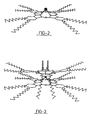
- the phthalocyanine radical has been simplified and represented only by the peripheral carbon atoms, its complete structure is shown in FIG. 1.
- radicals R 1 to R 8 are H or a radical selected from alkyl radicals, C 6 to C 50 straight or branched alkyl radicals, C 6 -C 50 having one or more heteroatoms choose from 0, S or N in the chain.
- the metals used can be very varied; they are preferably metals from the lanthanide and yttrium group such as lutetium or dysprosium for example, or metals such as uranium, thorium or tin.
- the metals of the lanthanide group give organometallic compounds in which each metal atom is sandwiched between two phthalocyanine cycles. However, it is possible to produce compounds with a single cycle per metal atom with metals such as lead for example.
- the compounds which are particularly advantageous for their liquid crystal properties and their electrochromic properties are the compounds Ia and If which will be studied in more detail in the examples.
- the compounds synthesized can be asymmetrical, in this case we prefer the compounds in which R 1 and R 8 represent the cyano radical, these compounds have the particularity of having a dipole moment in the very important plane which can make them valuable in electronic or opto-electronic devices.
- this metal atom when the metal atom has a sufficiently large atomic radius, this metal atom cannot lodge in the plane of porphyrin or phthalocyanines, it is therefore above the plane of the molecule and thus induces a dipole moment for this molecule which will be perpendicular to the plane, this is the case for example of organometallic compounds with lead. Again, the existence of a dipole moment perpendicular to the molecule can allow interesting uses of these compounds.
- the compounds according to the present invention can be prepared by various methods.
- the organometallic compounds can be prepared from the non-metallized compound by the action of a salt of the metal on the dianion of the organic ligand, preferably the dianion is prepared by the action of an alkali metal alcoholate on the organic compound.
- the non-metallized organic part of the compounds according to the invention can be prepared in particular according to the following scheme:
- the o-xylene is treated with bromine to give the 4,5-dibromo derivative.
- the methyl groups are then brominated with N-bromosuccinimide by a radical mechanism, which leads to higher yields than direct bromination with Br 2 .
- paraffinic side chains are then grafted by reaction of the corresponding ROH alcoholates with the tetrabrominated derivative.
- This reaction requires the use of an anhydrous protic solvent, for example an excess of the corresponding alcohol or t-butanol, so as to avoid the elimination reactions which occur in aprotic solvents such as DMF or THF. .
- anhydrous protic solvent for example an excess of the corresponding alcohol or t-butanol
- the corresponding dicyane derivative (7) is obtained by treating the dibromo derivative (6) with cuprous cyanide in DMF.
- concentration of reagents should be low enough to prevent the formation of copper phthalocyanine.
- the corresponding phthalocyanine can be prepared by various routes.
- Compound (7) can also be treated in a solvent with a high melting point (1-chloronaphthalene or quinoline for example) in the presence of finely divided metal or a metal salt to give the corresponding metallized phthalocyanine.
- Pc can also be obtained electrochemically.
- the compounds according to the present invention can be used in electronics and optoelectronics, in particular in display devices as is already known for electrochromic compounds or liquid crystals but by allowing the advantages of the two types to be used to the best advantage component.
- the title compound is prepared by adding dropwise under a nitrogen atmosphere 23 g (0.249 mole) of epichlorohydrin in 300 g (1.61 mole) of 1-dodecanol containing 20 g (0.5 mole) of finely divided sodium hydroxide. The mixture is heated to 120 ° C and stirred overnight at this temperature. At normal temperature, 200 ml of water are added. The aqueous phase is then extracted with three times 150 ml of CHC1 3 . The combined organic extracts are dried over Na 2 SO 4 , filtered and evaporated to dryness. The oily residue is distilled under vacuum (10 -2 Torr); dodecanol is first recovered at around 90 ° C. The title derivative distills at a temperature between 180 and 210 ° C. The alcohol thus obtained is again purified by recrystallization from heptane.
- the monomethyl ether polyethylene oxide alcohols which are commercially available and sold by the company Polysciences exhibit a very high polydispersion.
- the alcohol having a molecular weight of about 350 was analyzed by gas chromatography after silylation of the terminal hydroxy groups.
- the phthalocyanines of the compounds obtained in the preceding examples can be obtained directly by treating the dicyane derivative in N, N-dimethylamino-2-propanol in the presence of ammonia or optionally by converting the dicyane derivative into the corresponding diimino-isoindole derivative which is then reprocessed at reflux in N, N-dimethylamino-ethanol.
- the second method provides more reproducible results.
- the yield is 40 to 60% and varies without it being possible to demonstrate the influence of parameters such as the purity of the solvent, the temperature, for example.
- Compound 1a obtained has the following characteristics:
- the diimino-isoindole derivative is formed by treating 500 mg (1.27 mmol) of the dicyano 6c derivative in 2.5 ml of anhydrous methanol with 0.69 ml of a sodium methanolate solution (0.037 M). Ammonia is then bubbled into the reaction mixture at room temperature for 1 hour, then heated to reflux for an additional 4 hours. When the reaction is complete the solvent is evaporated to dryness and the residue is filtered through a column of Si0 2 (eluent: MeOH). The greenish oily residue obtained is used without being purified.
- the corresponding phthalocyanine is formed by heating at reflux and under nitrogen 520 mg (1.27 mmol) of the diinino-isoindole obtained previously in 1 ml of freshly distilled N, N-dimethylaminoethanol. The reflux is maintained for 7 hours. The solvent is then evaporated to dryness and the residue is purified by chromatography on SiO 2 (eluent: CHCl 3 / MeOH, 98/2).
- the tetracyane derivative (250 mg, 1.4 mmol) is dissolved in 10 ml of pentanol at 80 ° C. Ammonia is bubbled through the solution; after 10 minutes, 0.25 ml of sodium amylate (0.19 mol) is added to the amyl alcohol. It returns to ambient temperature and is left to stir for 2 hours. It is brought to 60 ° C for another 2 hours then 1 hour to 100 ° C. Filtered while hot and rinsed twice with ethanol, dried under vacuum in a desiccator. Molecular Weight: 195.18
- Example 14 50 mg of the compound of Example 14 are dissolved at 140 ° C in 1 ml of 1,2-propanediol. 0.5 ml of a 0.143 molar solution of potassium amylate in amyl alcohol is then added. 25 mg of lutecium acetate dissolved in 1 ml of 1,2-propanediol are then added. When the reaction is complete, evaporate to dryness and chromatograph on silica (eluent: 5% AcOEt / heptane).
- a liquid crystalline metastable phase can be observed between 24 and 30 ° C.
- [(C 12 ) 8 Pc] 2 Lu can be oxidized either electrochemically or chemically (H 2 0 2: H 2 S0 4 ). A reddish compound is then obtained. The transitions observable by polarized light microscopy are then strongly altered compared to the initial state:
- the latter temperature is dependent on the oxidation rate of the product.
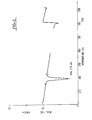
- the integration of the RPE signal makes it possible to calculate that the green form, that initially formed, comprises 1 spin per molecule of lutetium diphthalocyanine with g - 2.0 close to the free electron. It is possible to follow the different transitions K ⁇ CL ⁇ I by observing the line width RPE as a function of the temperature in the vicinity of the transition points as shown in FIG. 7.
Landscapes
- Chemical & Material Sciences (AREA)
- Organic Chemistry (AREA)
- Crystallography & Structural Chemistry (AREA)
- Engineering & Computer Science (AREA)
- Materials Engineering (AREA)
- Chemical Kinetics & Catalysis (AREA)
- Nitrogen Condensed Heterocyclic Rings (AREA)
- Organic Low-Molecular-Weight Compounds And Preparation Thereof (AREA)
Applications Claiming Priority (2)
| Application Number | Priority Date | Filing Date | Title |
|---|---|---|---|
| FR8419348A FR2574806B1 (fr) | 1984-12-18 | 1984-12-18 | Cristaux liquides electrochromes a base de phtalocyanine substituee |
| FR8419348 | 1984-12-18 |
Publications (2)
| Publication Number | Publication Date |
|---|---|
| EP0188941A1 true EP0188941A1 (de) | 1986-07-30 |
| EP0188941B1 EP0188941B1 (de) | 1989-04-12 |
Family
ID=9310719
Family Applications (1)
| Application Number | Title | Priority Date | Filing Date |
|---|---|---|---|
| EP85402498A Expired EP0188941B1 (de) | 1984-12-18 | 1985-12-16 | Elektrochromische flüssige Kristalle auf der Basis von substituierten Phthalocyaninen |
Country Status (3)
| Country | Link |
|---|---|
| EP (1) | EP0188941B1 (de) |
| DE (1) | DE3569388D1 (de) |
| FR (1) | FR2574806B1 (de) |
Cited By (5)
| Publication number | Priority date | Publication date | Assignee | Title |
|---|---|---|---|---|
| WO1988006175A1 (en) * | 1987-02-13 | 1988-08-25 | The Secretary Of State For Defence In Her Britanni | Substituted phthalocyanines |
| EP0352182A1 (de) * | 1988-07-20 | 1990-01-24 | Commissariat A L'energie Atomique | Octasubstituierte Lithium-Phthalocyanine, Verfahren zu ihre Herstellung und ihrer Verwendung in EPR |
| EP0337209A3 (en) * | 1988-04-01 | 1990-07-25 | Mitsui Toatsu Chemicals, Incorporated | Alkylphthalocyanine near-infrared absorbers and recording/display materials using the same |
| GB2256283A (en) * | 1991-05-01 | 1992-12-02 | British Tech Group | Electrochromic device. |
| KR100448100B1 (ko) * | 2001-01-05 | 2004-09-14 | 이승영 | 상자성 금속-프탈로시아닌 착화합물 및 이를 이용한영상화용 조영제 |
Citations (7)
| Publication number | Priority date | Publication date | Assignee | Title |
|---|---|---|---|---|
| FR1207348A (fr) * | 1957-11-13 | 1960-02-16 | Monsanto Chemicals | Polyphtalocyanines et leur préparation |
| FR1389808A (fr) * | 1963-03-13 | 1965-02-19 | Geigy Ag J R | Procédé de production de phtalocyanines de cuivre fortement halogénées |
| CH414044A (de) * | 1959-10-15 | 1966-05-31 | Basf Ag | Verfahren zur Herstellung neuer wasserlöslicher Farbstoffe der Phthalocyaninreihe |
| FR1580683A (de) * | 1967-09-15 | 1969-09-05 | ||
| GB2058114A (en) * | 1979-09-04 | 1981-04-08 | Marconi Co Ltd | Electrochromic compounds |
| EP0134518A1 (de) * | 1983-07-19 | 1985-03-20 | Yamamoto Chemicals, Inc. | Naphthalocyaninverbindungen |
| EP0140133A2 (de) * | 1983-09-21 | 1985-05-08 | BASF Aktiengesellschaft | Flüssig-kristalline Phasen bildende Polymere |
-
1984
- 1984-12-18 FR FR8419348A patent/FR2574806B1/fr not_active Expired
-
1985
- 1985-12-16 DE DE8585402498T patent/DE3569388D1/de not_active Expired
- 1985-12-16 EP EP85402498A patent/EP0188941B1/de not_active Expired
Patent Citations (7)
| Publication number | Priority date | Publication date | Assignee | Title |
|---|---|---|---|---|
| FR1207348A (fr) * | 1957-11-13 | 1960-02-16 | Monsanto Chemicals | Polyphtalocyanines et leur préparation |
| CH414044A (de) * | 1959-10-15 | 1966-05-31 | Basf Ag | Verfahren zur Herstellung neuer wasserlöslicher Farbstoffe der Phthalocyaninreihe |
| FR1389808A (fr) * | 1963-03-13 | 1965-02-19 | Geigy Ag J R | Procédé de production de phtalocyanines de cuivre fortement halogénées |
| FR1580683A (de) * | 1967-09-15 | 1969-09-05 | ||
| GB2058114A (en) * | 1979-09-04 | 1981-04-08 | Marconi Co Ltd | Electrochromic compounds |
| EP0134518A1 (de) * | 1983-07-19 | 1985-03-20 | Yamamoto Chemicals, Inc. | Naphthalocyaninverbindungen |
| EP0140133A2 (de) * | 1983-09-21 | 1985-05-08 | BASF Aktiengesellschaft | Flüssig-kristalline Phasen bildende Polymere |
Non-Patent Citations (2)
| Title |
|---|
| CHEMICAL ABSTRACTS, vol. 100, no. 10, mars 1984, page 79, abrégé no. 69847g, Columbus, Ohio, US; L.G. TOMILOVA et al.: "Phthalocynines and related compounds. XXII. Synthesis and spectroscopic-electrochemical study of rare earth element diphthalocyanines" & ZH. OBSHCH. KHIM. 1983, 53(11), 2594-601 * |
| MOLECULAR CRYSTALS AND LIQUID CRYSTALS + LETTERS, vol. 100, no. 3/4, 1983, pages 275-284, Gordon and Breach, Science Publishers, Inc., New York, US; D. GUILLON et al.: "Discotic mesophases of the metal-free derivative of octa (dodecyloxymethyl) phthalocyanine" * |
Cited By (11)
| Publication number | Priority date | Publication date | Assignee | Title |
|---|---|---|---|---|
| WO1988006175A1 (en) * | 1987-02-13 | 1988-08-25 | The Secretary Of State For Defence In Her Britanni | Substituted phthalocyanines |
| GB2229190A (en) * | 1987-02-13 | 1990-09-19 | Nat Res Dev | Substituted phthalocyanines |
| GB2229190B (en) * | 1987-02-13 | 1991-10-02 | Nat Res Dev | Substituted phthalocyanines |
| EP0337209A3 (en) * | 1988-04-01 | 1990-07-25 | Mitsui Toatsu Chemicals, Incorporated | Alkylphthalocyanine near-infrared absorbers and recording/display materials using the same |
| US5582774A (en) * | 1988-04-01 | 1996-12-10 | Mitsui Toatsu Chemicals, Incorporated | Alkylphthalocyanine near-infrared absorbers and recording/display materials using the same |
| EP0352182A1 (de) * | 1988-07-20 | 1990-01-24 | Commissariat A L'energie Atomique | Octasubstituierte Lithium-Phthalocyanine, Verfahren zu ihre Herstellung und ihrer Verwendung in EPR |
| FR2634484A1 (fr) * | 1988-07-20 | 1990-01-26 | Commissariat Energie Atomique | Phtalocyanines de lithium octasubstituees, leur procede de preparation et leur utilisation en magnetometrie rpe |
| US4996311A (en) * | 1988-07-20 | 1991-02-26 | Commissariat A. L'energie Atomique | Octasubstituted lithium phthalocyanines, their method of preparation and their use in EPR (electronic paramagnetic resonance) magnetometry |
| GB2256283A (en) * | 1991-05-01 | 1992-12-02 | British Tech Group | Electrochromic device. |
| GB2256283B (en) * | 1991-05-01 | 1994-11-16 | British Tech Group | Electrochromic device |
| KR100448100B1 (ko) * | 2001-01-05 | 2004-09-14 | 이승영 | 상자성 금속-프탈로시아닌 착화합물 및 이를 이용한영상화용 조영제 |
Also Published As
| Publication number | Publication date |
|---|---|
| FR2574806A1 (fr) | 1986-06-20 |
| DE3569388D1 (en) | 1989-05-18 |
| EP0188941B1 (de) | 1989-04-12 |
| FR2574806B1 (fr) | 1987-09-04 |
Similar Documents
| Publication | Publication Date | Title |
|---|---|---|
| EP2380882B1 (de) | Salze von heterocyclischen Anionen und ihre Verwendungen als ionisch leitfähige Materialien | |
| EP3505592B1 (de) | Leuchtende partikel und verbindung | |
| Law et al. | Synthesis and spectroscopic properties of octasubstituted (phthalocyaninato) titanium (IV) complexes | |
| EP0346354A1 (de) | Substituierte phthalocyanine. | |
| EP0188941B1 (de) | Elektrochromische flüssige Kristalle auf der Basis von substituierten Phthalocyaninen | |
| FR2567877A1 (fr) | Compose organique a structure chirale, son utilisation dans un melange de cristaux liquides et son procede de fabrication | |
| BE1009532A3 (fr) | Procede de preparation du dichlorure d'acide l-5-(2-acetoxy-propionylamino)-2,4,6-triiodo-isophtalique. | |
| EP0352182B1 (de) | Octasubstituierte Lithium-Phthalocyanine, Verfahren zu ihre Herstellung und ihrer Verwendung in EPR | |
| Bui et al. | Synthesis and preliminary physical properties of new neutral tetraalkoxy-substituted nickel bis (1, 2-dithiolene) complexes | |
| EP0440643A1 (de) | Fluorinierte 4"-cyanosubstituierte terphenyle. | |
| JPS59500716A (ja) | 置換されたポリシクロ−アルキリデン ポリシクロ−アルカン及び対応するエピジオキシ化合物の製造方法;ならびに前記の置換されたポリシクロ−アルキリデン ポリシクロ−アルカン及び対応するエピジオキシ化合物 | |
| JP5381976B2 (ja) | 液状ポルフィリン誘導体、及びその製造方法 | |
| FR2590258A1 (fr) | Halogenures de (tetraseleno-5, 6, 11, 12 tetracenes)2 difluores, procede pour les preparer et leur application | |
| JP2001011070A (ja) | カルコゲノピリリウム化合物の製造方法 | |
| JPH06172361A (ja) | フタロシアニン化合物 | |
| JPH09279054A (ja) | アゾ化合物 | |
| JPH0653744B2 (ja) | アルキルシアノフタロシアニン化合物 | |
| EP1648883B1 (de) | Herstellung von lanthanidkomplexen und deren verwendungen | |
| JP2513487B2 (ja) | 新規なフタロシアニン化合物 | |
| WO2008104658A1 (fr) | Thiacalix[2]thianthrenes | |
| JPH07107138B2 (ja) | ゲルマニウムナフタロシアニン誘導体 | |
| JP4437637B2 (ja) | フタロシアニン類の製造方法 | |
| EP0165100B1 (de) | Tri(cyclopentadienyl)cerium und Verfahren zu dessen Herstellung | |
| WO2009141562A2 (fr) | Nouvelles quinones, leurs syntheses et utilisations. | |
| FR3110572A1 (fr) | Dérivé de xanthène, mélanges le comprenant, procédé de fabrication et utilisations correspondants |
Legal Events
| Date | Code | Title | Description |
|---|---|---|---|
| PUAI | Public reference made under article 153(3) epc to a published international application that has entered the european phase |
Free format text: ORIGINAL CODE: 0009012 |
|
| AK | Designated contracting states |
Kind code of ref document: A1 Designated state(s): CH DE GB IT LI NL |
|
| 17P | Request for examination filed |
Effective date: 19861215 |
|
| 17Q | First examination report despatched |
Effective date: 19871030 |
|
| RAP3 | Party data changed (applicant data changed or rights of an application transferred) |
Owner name: ESPCI ECOLE SUPERIEURE DE PHYSIQUE ET DE CHIMIE I Owner name: ETAT FRANCAIS REPRESENTE PAR LE MINISTRE DES PTT ( |
|
| GRAA | (expected) grant |
Free format text: ORIGINAL CODE: 0009210 |
|
| AK | Designated contracting states |
Kind code of ref document: B1 Designated state(s): CH DE GB IT LI NL |
|
| REF | Corresponds to: |
Ref document number: 3569388 Country of ref document: DE Date of ref document: 19890518 |
|
| ITF | It: translation for a ep patent filed | ||
| GBT | Gb: translation of ep patent filed (gb section 77(6)(a)/1977) | ||
| PG25 | Lapsed in a contracting state [announced via postgrant information from national office to epo] |
Ref country code: GB Effective date: 19891216 |
|
| PG25 | Lapsed in a contracting state [announced via postgrant information from national office to epo] |
Ref country code: LI Effective date: 19891231 Ref country code: CH Effective date: 19891231 |
|
| PG25 | Lapsed in a contracting state [announced via postgrant information from national office to epo] |
Ref country code: NL Effective date: 19900701 |
|
| GBPC | Gb: european patent ceased through non-payment of renewal fee | ||
| NLV4 | Nl: lapsed or anulled due to non-payment of the annual fee | ||
| REG | Reference to a national code |
Ref country code: CH Ref legal event code: PL |
|
| PG25 | Lapsed in a contracting state [announced via postgrant information from national office to epo] |
Ref country code: DE Effective date: 19900901 |
|
| PLBE | No opposition filed within time limit |
Free format text: ORIGINAL CODE: 0009261 |
|
| STAA | Information on the status of an ep patent application or granted ep patent |
Free format text: STATUS: NO OPPOSITION FILED WITHIN TIME LIMIT |
|
| 26N | No opposition filed |