EP0189825B1 - Dehnungsaufnehmer - Google Patents
Dehnungsaufnehmer Download PDFInfo
- Publication number
- EP0189825B1 EP0189825B1 EP19860100741 EP86100741A EP0189825B1 EP 0189825 B1 EP0189825 B1 EP 0189825B1 EP 19860100741 EP19860100741 EP 19860100741 EP 86100741 A EP86100741 A EP 86100741A EP 0189825 B1 EP0189825 B1 EP 0189825B1
- Authority
- EP
- European Patent Office
- Prior art keywords
- strain
- strain transducer
- magnetization
- thin film
- amorphous metal
- Prior art date
- Legal status (The legal status is an assumption and is not a legal conclusion. Google has not performed a legal analysis and makes no representation as to the accuracy of the status listed.)
- Expired - Lifetime
Links
- 230000005415 magnetization Effects 0.000 claims abstract description 25
- 230000008859 change Effects 0.000 claims abstract description 12
- 239000000758 substrate Substances 0.000 claims abstract description 10
- 239000005300 metallic glass Substances 0.000 claims abstract description 8
- 239000010409 thin film Substances 0.000 claims abstract 8
- 239000010408 film Substances 0.000 claims abstract 5
- 230000005291 magnetic effect Effects 0.000 claims description 20
- 239000000463 material Substances 0.000 claims description 9
- 230000005355 Hall effect Effects 0.000 claims description 8
- 229910045601 alloy Inorganic materials 0.000 claims description 6
- 239000000956 alloy Substances 0.000 claims description 6
- XEEYBQQBJWHFJM-UHFFFAOYSA-N Iron Chemical group [Fe] XEEYBQQBJWHFJM-UHFFFAOYSA-N 0.000 claims description 4
- 230000005352 galvanomagnetic phenomena Effects 0.000 claims description 4
- 229910052723 transition metal Inorganic materials 0.000 claims description 4
- 150000003624 transition metals Chemical class 0.000 claims description 4
- 229910052799 carbon Inorganic materials 0.000 claims description 2
- 229910052732 germanium Inorganic materials 0.000 claims description 2
- 229910052752 metalloid Inorganic materials 0.000 claims description 2
- 150000002738 metalloids Chemical class 0.000 claims description 2
- 229910052758 niobium Inorganic materials 0.000 claims description 2
- 239000010955 niobium Substances 0.000 claims description 2
- GUCVJGMIXFAOAE-UHFFFAOYSA-N niobium atom Chemical compound [Nb] GUCVJGMIXFAOAE-UHFFFAOYSA-N 0.000 claims description 2
- 229910052698 phosphorus Inorganic materials 0.000 claims description 2
- 229910052710 silicon Inorganic materials 0.000 claims description 2
- 239000004020 conductor Substances 0.000 claims 2
- QCWXUUIWCKQGHC-UHFFFAOYSA-N Zirconium Chemical compound [Zr] QCWXUUIWCKQGHC-UHFFFAOYSA-N 0.000 claims 1
- 239000003302 ferromagnetic material Substances 0.000 claims 1
- 229910052735 hafnium Inorganic materials 0.000 claims 1
- VBJZVLUMGGDVMO-UHFFFAOYSA-N hafnium atom Chemical compound [Hf] VBJZVLUMGGDVMO-UHFFFAOYSA-N 0.000 claims 1
- 238000004804 winding Methods 0.000 claims 1
- 229910052726 zirconium Inorganic materials 0.000 claims 1
- 238000000034 method Methods 0.000 abstract description 5
- 230000005294 ferromagnetic effect Effects 0.000 abstract description 3
- 230000035945 sensitivity Effects 0.000 abstract description 2
- 238000005259 measurement Methods 0.000 description 5
- VYPSYNLAJGMNEJ-UHFFFAOYSA-N Silicium dioxide Chemical compound O=[Si]=O VYPSYNLAJGMNEJ-UHFFFAOYSA-N 0.000 description 4
- 230000006835 compression Effects 0.000 description 3
- 238000007906 compression Methods 0.000 description 3
- 238000001514 detection method Methods 0.000 description 3
- 230000005672 electromagnetic field Effects 0.000 description 3
- 230000015572 biosynthetic process Effects 0.000 description 2
- 239000002800 charge carrier Substances 0.000 description 2
- 229910052681 coesite Inorganic materials 0.000 description 2
- 229910052906 cristobalite Inorganic materials 0.000 description 2
- 230000000694 effects Effects 0.000 description 2
- 230000002349 favourable effect Effects 0.000 description 2
- 230000004907 flux Effects 0.000 description 2
- 238000009413 insulation Methods 0.000 description 2
- 239000000696 magnetic material Substances 0.000 description 2
- 229910052751 metal Inorganic materials 0.000 description 2
- 239000002184 metal Substances 0.000 description 2
- 150000002739 metals Chemical class 0.000 description 2
- 239000000203 mixture Substances 0.000 description 2
- 239000000377 silicon dioxide Substances 0.000 description 2
- 235000012239 silicon dioxide Nutrition 0.000 description 2
- 229910052682 stishovite Inorganic materials 0.000 description 2
- 229910052905 tridymite Inorganic materials 0.000 description 2
- 229910019236 CoFeB Inorganic materials 0.000 description 1
- 229910000640 Fe alloy Inorganic materials 0.000 description 1
- PWHULOQIROXLJO-UHFFFAOYSA-N Manganese Chemical compound [Mn] PWHULOQIROXLJO-UHFFFAOYSA-N 0.000 description 1
- 230000001133 acceleration Effects 0.000 description 1
- 238000005275 alloying Methods 0.000 description 1
- 238000000137 annealing Methods 0.000 description 1
- 238000009530 blood pressure measurement Methods 0.000 description 1
- 229910052796 boron Inorganic materials 0.000 description 1
- ZDVYABSQRRRIOJ-UHFFFAOYSA-N boron;iron Chemical compound [Fe]#B ZDVYABSQRRRIOJ-UHFFFAOYSA-N 0.000 description 1
- 230000001419 dependent effect Effects 0.000 description 1
- 238000006073 displacement reaction Methods 0.000 description 1
- 238000010410 dusting Methods 0.000 description 1
- 239000001530 fumaric acid Substances 0.000 description 1
- 230000003993 interaction Effects 0.000 description 1
- UGKDIUIOSMUOAW-UHFFFAOYSA-N iron nickel Chemical compound [Fe].[Ni] UGKDIUIOSMUOAW-UHFFFAOYSA-N 0.000 description 1
- 229910052748 manganese Inorganic materials 0.000 description 1
- 239000011572 manganese Substances 0.000 description 1
- 238000004519 manufacturing process Methods 0.000 description 1
- 239000012528 membrane Substances 0.000 description 1
- 230000000704 physical effect Effects 0.000 description 1
- 230000008569 process Effects 0.000 description 1
- 239000000523 sample Substances 0.000 description 1
- 230000007704 transition Effects 0.000 description 1
- 238000007740 vapor deposition Methods 0.000 description 1
- 229910052845 zircon Inorganic materials 0.000 description 1
- GFQYVLUOOAAOGM-UHFFFAOYSA-N zirconium(iv) silicate Chemical compound [Zr+4].[O-][Si]([O-])([O-])[O-] GFQYVLUOOAAOGM-UHFFFAOYSA-N 0.000 description 1
Images
Classifications
-
- G—PHYSICS
- G01—MEASURING; TESTING
- G01L—MEASURING FORCE, STRESS, TORQUE, WORK, MECHANICAL POWER, MECHANICAL EFFICIENCY, OR FLUID PRESSURE
- G01L1/00—Measuring force or stress, in general
- G01L1/20—Measuring force or stress, in general by measuring variations in ohmic resistance of solid materials or of electrically-conductive fluids; by making use of electrokinetic cells, i.e. liquid-containing cells wherein an electrical potential is produced or varied upon the application of stress
- G01L1/22—Measuring force or stress, in general by measuring variations in ohmic resistance of solid materials or of electrically-conductive fluids; by making use of electrokinetic cells, i.e. liquid-containing cells wherein an electrical potential is produced or varied upon the application of stress using resistance strain gauges
- G01L1/2287—Measuring force or stress, in general by measuring variations in ohmic resistance of solid materials or of electrically-conductive fluids; by making use of electrokinetic cells, i.e. liquid-containing cells wherein an electrical potential is produced or varied upon the application of stress using resistance strain gauges constructional details of the strain gauges
-
- G—PHYSICS
- G01—MEASURING; TESTING
- G01B—MEASURING LENGTH, THICKNESS OR SIMILAR LINEAR DIMENSIONS; MEASURING ANGLES; MEASURING AREAS; MEASURING IRREGULARITIES OF SURFACES OR CONTOURS
- G01B7/00—Measuring arrangements characterised by the use of electric or magnetic techniques
- G01B7/16—Measuring arrangements characterised by the use of electric or magnetic techniques for measuring the deformation in a solid, e.g. by resistance strain gauge
- G01B7/24—Measuring arrangements characterised by the use of electric or magnetic techniques for measuring the deformation in a solid, e.g. by resistance strain gauge using change in magnetic properties
-
- G—PHYSICS
- G01—MEASURING; TESTING
- G01L—MEASURING FORCE, STRESS, TORQUE, WORK, MECHANICAL POWER, MECHANICAL EFFICIENCY, OR FLUID PRESSURE
- G01L1/00—Measuring force or stress, in general
- G01L1/12—Measuring force or stress, in general by measuring variations in the magnetic properties of materials resulting from the application of stress
-
- G—PHYSICS
- G01—MEASURING; TESTING
- G01L—MEASURING FORCE, STRESS, TORQUE, WORK, MECHANICAL POWER, MECHANICAL EFFICIENCY, OR FLUID PRESSURE
- G01L1/00—Measuring force or stress, in general
- G01L1/12—Measuring force or stress, in general by measuring variations in the magnetic properties of materials resulting from the application of stress
- G01L1/125—Measuring force or stress, in general by measuring variations in the magnetic properties of materials resulting from the application of stress by using magnetostrictive means
Definitions
- the invention relates to a strain sensor according to the preamble of claim 1.
- Such strain transducers are used as sensors for measuring force, displacement, weight, acceleration, pressure, torques or mechanical stresses.
- DE-A 23 16 344 discloses a method for measuring a mechanical stress in a magnetic layer by measuring the change in magnetostriction.
- the magnetic layer is separated by a non-magnetic layer on a magnetic wave.
- the magnetic flux in the magnetic layer is generated by a magnetization coil and the change in magnetization is measured by a detection coil.
- the magnetostrictive layer is a ferromagnetic anisotropic layer.
- This method has the disadvantage that two additional coils, a magnetizing coil for generating the magnetic field and a detection coil for determining the magnetic flux, are required.
- a device for measuring the mechanical tension in which a mechanical tension is transferred to a magnetic material having a high magnetostrictive effect and is measured there inductively.
- the magnetic material is designed as a self-supporting spring.
- a disadvantage of this embodiment is that the measurement, as in DE-A-23 16 344, is also measured inductively via a detection coil.
- the invention has for its object to provide a strain sensor which has a high sensitivity, is versatile and easy to manufacture.
- the object is achieved according to the invention by a strain sensor according to claim 1.
- the extensometer is manufactured by vapor deposition or dusting of the material. The mixture makes it necessary that both components are applied according to their proportion.
- the layer is applied to a substrate and then the desired shape of the surface is lithographically etched. The dimensions of the layer are 3 mm long, 1 mm wide and between 10 and 100 nm thick.
- the process takes four hours.
- the direction of the magnetization impressed in this way is the most energetically favorable direction and the magnetization will always fall back into this most favorable direction at room temperature after a deflection. This direction is also called "easy direction".
- the function of the strain sensor lies in the interaction of several physical properties.
- the magnetization causes an anisotropy of the conductivity.
- the magnetostrictive behavior has a change in the direction of magnetization when the strain sensor experiences stretching and / or compression. Proportional to mechanical stress changes the magnetization up to 90 °.
- the strain measuring range is determined by the anisotropy field strength H k .
- H k in turn depends on the material used and the magnetic pretreatment. Since the axis of the anisotropy of conductivity rotates with the magnetization, the electrical resistance between two points, the connecting line of which lies in the rotating bed, also changes in proportion to the mechanical stress. An elongation or compression can therefore be measured as a change in the electrical conductivity due to the magnetostriction, which is a first galvanomagnetic effect.
- the planar Hall effect is used as the second galvanomagnetic effect to determine the elongation.
- a different arrangement of the strain sensor is chosen so that a driving current flows through the thin layer as in the normal Hall effect.
- a magnetic field is also necessary to move the charge carriers from their original direction due to the Lorentz force that occurs.
- the motive current flows in one direction.
- the component of a magnetic field that is perpendicular to the current direction now causes the charge carriers to be deflected in the third direction, which is perpendicular to the other two.
- the Hall voltage is tapped in this third direction.
- the tape-shaped strain gauge must be connected to the substrate via a side surface.
- the planar Hall effect is used in the strain transducer according to the invention, which enables the connection of the large strip area to the substrate. Specifically, this means that the driving current flows in the plane of the thin layer and that the magnetization also lies in the plane. I'm not stretched state, magnetization and driving current lie in parallel. There is therefore no magnetic component perpendicular to the driving current and therefore no Hall effect (neither planar nor normal). If the magnetization rotates, a component is created and Hall voltage thus occurs.
- the planar Hall voltage is measured perpendicular to the direction of the drive current in the plane spanned by the drive current and magnetization.
- the easy direction lies in the plane of the strip surface and perpendicular to the longitudinal axis.
- the two contacts 12 are attached to the ends of the strip 13 so that they each cover the end faces of the strip; in addition, the contacts still adhere to the substrate 11. They consist of an alloy of CrAu or CoFeB and are vapor-deposited or sputtered on.
- the change in the electrical conductivity between the two contacts is the measure of the elongation.
- the conductivity is measured electrically.
- This version is particularly suitable for digital display of the stretch. There is a danger here that two adjacent domains will short-circuit magnetically, and that parts of the domains will rotate from the easy direction, even without stretching.
- the strain gauge (Fig. 2a, 2b) is built up as a double layer.
- the two FeB strips 23, 24 are separated by an SiO2 layer 25 so that the strips are in contact at one end 26.
- the Contacts 22 are each attached to the other end of the strip, as shown in Fig. 2a. It is necessary to change the stripe shape according to Fig. 2a.
- the layers are evaporated or dusted one after the other. This arrangement causes only one domain to be formed in each stripe.
- the easy direction is perpendicular to the longitudinal axis of the strip, the domains of the two strips are antiparallel.
- the elongation is measured via the direct current conductivity as in the exemplary embodiment shown in FIGS. 1a, 1b.
- the measurement signal between elongation and compression still shows a hysteresis.
- the magnetization is superimposed with an external alternating electromagnetic field of frequency ⁇ , the H component of which is perpendicular to the easy direction.
- the magnetization thus oscillates with the frequency ⁇ around the respective rest position, which is determined by stretching.
- the maximum frequency is in the MHz range.
- the electrical conductivity now oscillates, with the frequency ⁇ or 2 ⁇ , or a combination of both frequencies, around a medium conductivity.
- the measured conductivity depends on the rest position of the magnetization and the amplitude of the external alternating field.
- the measure of the elongation is the difference between the maximum and minimum amplitude of the conductivity.
- the corresponding arrangement is shown in Fig. 3a, 3b.
- the amorphous layer 33 is applied as a strip to the substrate 31.
- the easy direction is parallel to the longitudinal axis of the strip.
- the contacts 32 are attached at the ends.
- a strip-shaped layer 35 made of CrAu or Al is located above the insulation layer 34, the direction of which runs parallel to the FeB strip 33.
- the AC voltage applied here provides the alternating magnetic field.
- the stretch to be recorded does not have to be parallel to the longitudinal axis of the strip, it only has to be transmitted via the stretch strip. Since the signal fluctuates periodically, the DC and AC voltage components can be separated electronically and the relevant signal can be further processed as a pure AC voltage signal.
- FIGS. 4, 5 The following two exemplary embodiments (FIGS. 4, 5) are based on the use of the planar Hall effect.
- a circular strain sensor 43 is applied to the substrate 41, with five contacts 44 to 48 abutting the strain sensor.
- the drive current I t flows between the contacts 44 and 45.
- the planar Hall voltage is tapped between the contacts 46 and 47 with 48, the voltage drop along the drive current direction is tapped via the contacts 47 and 48 and can thus be taken into account when determining the Hall voltage.
- the light direction LR runs parallel to the driving current I t .
- the strain can be read off directly as a voltage with a constant driving current I t .
- a superposition of the magnetization with an alternating electromagnetic field is also possible when using the planar effect (FIG. 5).
- the sign of the magnetization is also included in the measurement result, ie there is an AC voltage as the Hall voltage.
- the pure AC voltage signal must first be generated by electronically separating the periodically fluctuating DC voltage signal.
- the Hall voltage oscillates with the frequency of the alternating field ⁇ or with 2 ⁇ or a superposition of both frequencies.
- the measure of the strain is the amplitude of the Hall voltage, which changes in proportion to the strain.
- the strain sensor consists of a Hall probe (Fig. 5); the amorphous layer is vapor-deposited onto a substrate 51 as a square plate 53.
- Four electrical contacts 54 to 57 are attached to the corners.
- the driving current I t flows between the contacts 54 and 55 and the planar Hall voltage is tapped between the contacts 56 and 57.
- the slight direction LR also forms an angle of 45 ° with the direction of expansion and lies in the plane of the leaflet.
- the alternating electromagnetic field is generated in a flat coil 52, the turns of which run parallel to the easy direction.
- the AC electrical voltage is applied to contacts 58 and 59 of coil 52.
- strain transducers R1, R2 are attached to a membrane for pressure measurement.
- the strain transducers R3 and R4 are not subject to stretching, but they serve for temperature compensation when used in a bridge circuit according to FIG. 7.
- U o represents the applied voltage and U s the measurement signal.
- the strain sensor according to the invention does not of course have to consist of an amorphous boron-iron alloy (positive magnetostriction coefficient).
- the amorphous metal of the nickel-iron composition is particularly interesting.
- the magnetostriction coefficient changes its sign at Ni81 Fe19 (atomic percent), which enables further technical designs.
- the amorphous metals show the lowest coercive field strengths, which can be varied by alloying with the metalloids (B, C, Si, Ge, P), zircon or niobium.
- transition metals of the iron group or an alloy consisting of transition metals of the iron group can also be used.
- these show a high coercive field strength and thus a wide hysteresis of the measurement signal.
Landscapes
- Physics & Mathematics (AREA)
- General Physics & Mathematics (AREA)
- Measurement Of Length, Angles, Or The Like Using Electric Or Magnetic Means (AREA)
- Transmission And Conversion Of Sensor Element Output (AREA)
- Fire-Detection Mechanisms (AREA)
- Control Of High-Frequency Heating Circuits (AREA)
- Analysing Materials By The Use Of Radiation (AREA)
Description
- Die Erfindung betrifft einen Dehnungsaufnehmer nach dem Oberbegriff des Anspruchs 1.
- Derartige Dehnungsaufnehmer finden ihre Anwendung als Sensoren zur Messung von Kraft, Weg, Gewicht, Beschleunigung, Druck, Drehmomenten oder mechanischen Spannungen.
- Es ist aus der DE-A 23 16 344 ein Verfahren zum Messen einer mechanischen Spannung in einer magnetischen Schicht durch Messen der Magnetostriktionsänderung bekannt. Die magnetische Schicht befindet sich durch eine nicht magnetische Schicht getrennt auf einer magnetischen Welle. Der magnetische Fluß in der magnetischen Schicht wird durch eine Magnetisierungsspule erzeugt und die Änderung der Magnetisierung durch eine Detektionsspule gemessen. Im einleitenden Teil der Beschreibung wird es als nachteilig angegeben, die magnetostriktive Schicht als ferromagnetische anisotrope Schicht auszubilden.
- Dieses Verfahren weist den Nachteil auf, daß durch zwei zusätzliche Spulen, eine Magnetisierungsspule zur Erzeugung des Magnetfeldes und eine Detektionsspule zur Bestimmung des magnetischen Flusses, erforderlich sind.
- Aus der Druckschrift EP-A-0046381 ist eine Vorrichtung zur Messung der mechanischen Spannung bekannt, bei der eine mechanische Spannung auf ein magnetisches, ein einen hohen magnetostriktiven Effekt aufweisendes Material übertragen und dort induktiv gemessen wird. Dasbei ist das magnetische Material als selbsttragende Feder ausgebildet.
- Nachteilig an dieser Ausführung ist, daß die Messung ebenfalls, wie bei der DE-A-23 16 344, über eine Detektionsspule induktiv gemessen wird.
- Aus den PATENT ABSTRACTS OF JAPAN Band 9, Nr. 39 (E-297)(1762) (Toshiba K.K.) Ist ein funktionell nicht näher beschriebener Drehmomentsensor bekannt, der aus magnetisch anisotropem, ferromagnetischem, magnetostriktivem Material besteht. Es ist dabei nicht nähers erläutert, wie das Drehmoment letztendlich gemessen wird.
- Aus dem PATENT ABSTRACT OF JAPAN Band 8, Nr. 165 (P-291)(1602) (Toshiba K.K.) Ist ein Drehmomentsensor bekannt, bei dem auf einer Welle eine dünne magnetisch anisotrope magnetostriktive Legierungsschicht mit eingeprägter Magnetisierung aufgebracht ist. Das Anliegen eines Drehmoments erzeugt in der Legierungsschicht eine Veränderung der magnetischen Eigenschaften, die wiederum über die Magnetostriktion eine Änderung der Leitfähigkeit hervorrufen. Diese Änderung der elektrischen Leitfähigkeit wird berührungslos elektrisch gemessen.
- Die Dokumente J. APPL. PHYS. Band 52, Nr. 3, März 1981, Seiten 2468 bis 2470, J H. Fluitmann: "Applicability of the planar Hall effect" und IEEE TRANSACTIONS ON MAGNETICS Band MAG - 16, Nr. 5, September 1980, Seiten 905, 906, T.R. McGuire et al.: "Galvanomagnetic properties of transition Metal-Boron Films" erläutern verschiedene Möglichkeiten der Untersuchung des Hall-Effekts in magnetisch anisotropen Materialien offenbaren verschiedene Materialien, die galvanomagnetische Effekte zeigen und beinhalten die Ausbildung entsprechender Aufnehmer als Film und in Form von Streifen. In den Dokumenten ist kein Bezug zu den gattungsgemäßen Dehnungsaufnehmern vorhanden.
- Der Erfindung liegt die Aufgabe zugrunde, einen Dehnungsaufnehmer zu schaffen, der eine hohe Empfindlichkeit aufweist, vielseitig verwendbar und einfach herstellbar ist.
- Die Aufgabe wird erfindungsgemäß durch einen Dehnungsaufnehmer gemäß Anspruch 1 gelöst.
- Vorteilhafte Ausgestaltungen der Erfindung sind den abhängigen Ansprüchen zu entnehmen.
- Die Herstellung des Dehnungsaufnehmers erfolgt durch Aufdampfen oder Aufstäuben des Materials. Die Mischung macht es dabei erforderlich, daß beide Komponenten entsprechend ihrem Anteil aufgebracht werden. Die Schicht wird auf ein Substrat aufgebracht und danach die gewünschte Form der Fläche lithographisch geätzt. Die Ausmaße der Schicht liegen bei einer Länge von 3 mm, einer Breite von 1 mm und einer Schichtdicke zwischen 10 bis 100 nm.
- Zur Einprägung der magnetischen Anisotropie wird die Schicht bei T = 300°C getempert, dabei liegt ein Magnetfeld H an, dessen Richtung z.B. parallel zur Fläche verläuft und eine Feldstärke von H ≧ 4,8·10³A/m (60 Oe) aufweist. Der Vorgang dauert vier Stunden. Die derart eingeprägte Richtung der Magnetisierung ist die energetisch günstigste Richtung und die Magnetisierung wird bei Zimmertemperatur nach einer Auslenkung immer wieder in diese günstigste Richtung zurückfallen. Diese Richtung wird auch "leichte Richtung" genannt.
- Der Dehnungsaufnehmer ist umso empfindlicher, je kleiner die magnetische Anisotropie der Schicht ist. Die Anisotropie wird verkleinert, indem nochmals vier Stunden bei T = 300°C mit H ≧ 4,8·10³A/m (60 Oe) getempert wird, wobei das Magnetfeld in der Ebene der Schicht rotiert.
- Die Funktion des Dehnungsaufnehmers liegt im Zusammenwirken mehrerer physikalischer Eigenschaften. Die Magnetisierung bewirkt eine Anisotropie der Leitfähigkeit. Das magnetostriktive Verhalten hat eine Änderung der Magnetisierungsrichtung zufolge, wenn der Dehnungsaufnehmer eine Dehnung und/oder Kompression erfährt. Proportional zur mechanischen Beanspruchung ändert die Magnetisierung ihre Richtung bis zu 90°. Der Dehnungsmeßbereich ist dabei durch die Anisotropiefeldstärke Hk bestimmt. Hk hängt wiederum vom verwendeten Material und der magnetischen Vorbehandlung ab. Da sich die Achse der Anisotropie der Leitfähigkeit mit der Magnetisierung dreht, verändert sich der elektrische Widerstand zwischen zwei Punkten, deren Verbindungsgerade in der Drehebette liegt, ebenfalls proportional zur mechanischen Beanspruchung. Eine Dehnung oder Stauchung kann somit aufgrund der Magnetostriktion, die einen ersten galvanomagnetischen Effekt darstellt, als Änderung der elektrischen Leitfähigkeit gemessen werden.
- Als zweiter galvanomagnetischer Effekt wird der planare Hall-Effekt zur Bestimmung der Dehnung herangezogen. Hierfür wird eine andere Anordnung des Dehnungsaufnehmers so gewählt, daß durch die dünne Schicht wie beim normalen Hall-Effekt ein Treibstrom fließt. Genauso ist ein Magnetfeld notwendig, um die Ladungsträger aufgrund der auftretenden Lorentzkraft von ihrer ursprünglichen Richtung abzubringen. Der Treibstrom fließt in einer Richtung. Die Komponente eines Magnetfeldes, die senkrecht zur Stromrichtung steht, bewirkt nun die Ablenkung der Ladungsträger in die dritte Richtung, die senkrecht zu den beiden anderen steht.
- In dieser dritten Richtung wird die Hall-Spannung abgegriffen. Dabei muß aber bei der verwendeten Technik der bandförmige Dehnunysmeßstreifen über eine Seitenfläche mit dem Substrat verbunden sein. Beim erfindungsgemäßen Dehnungsaufnehmer wird der planare Hall-Effekt ausgenützt, was die Verbindung der großen Streifenfläche mit dem Substrat ermöglicht. Konkret bedeutet dies, daß der Treibstrom in der Ebene der dünnen Schicht fließt und daß oie Magnetisierung ebenfalls in der Ebene liegt. Im nicht gedehnten Zustand liegen Magnetisierung und Treibstrom parallel. Es gibt somit keine magnetische Komponente senkrecht zum Treibstrom und somit auch keinen Hall-Effekt (weder planar noch normal). Dreht sich die Magnetisierung, entsteht eine Komponente und es tritt somit Hall-Spannung auf. Die planare Hall-Spannung wird senkrecht zur Treibstromrichtung in der Ebene, die von Triebstrom und Magnetisierung aufgespannt wird, gemessen.
- Die Erfindung wird im folgenden anhand von durch Figuren veranschaulichten Ausführungsbeispielen näher erläutert. Es zeigen
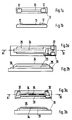
- Fig. 1a
- eine Anordnung eines einfachen Dehnungsaufnehmers in der Draufsicht,
- Fig. 1b
- die gemäß Fig. 1a dargestellte Anordnung in einer Seitenansicht,
- Fig. 2a
- einen doppelbeschichteten Dehnungsaufnehmer in der Draufsicht,
- Fig. 2b
- die gemäß Fig. 2a dargestellte Anordnung in einer Schnittzeichnung,
- Fig. 3a
- einen durch ein mangetisches Wechselfeld modulierten Dehnungsaufnehmer,
- Fig. 3b
- die gemäß Fig. 3a dargestellte Anordnung in einer Schnittzeichnung,
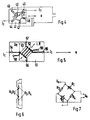
- Fig. 4
- die Anordnung eines Dehnungsaufnehmers, bei dem die planare Hall-Spannung abgegriffen wird,
- Fig. 5
- die Anordnung eines Dehnungsaufnehmers, bei dem die planare Hall-Spannung abgegriffen und mit einem magnetischen Wechselfeld moduliert wird,
- Fig. 6
- einen Dehnungsaufnehmer in der Anwendung eines Druckmessers und
- Fig. 7
- eine Brückenschaltung zur Temperaturkompensation.
- In Fig. 1 ist eine amorphe Metallschicht 13, die aus FE₈₀B₂₀ besteht, als Dehnungsmeßstreifen auf ein Substrat 11 aufgebracht. Die leichte Richtung liegt in der Ebene der Streifenfläche und senkrecht zur Längsachse. Die beiden Kontakte 12 sind so an den Enden des Streifens 13 angebracht, daß sie jeweils die Stirnseiten des Streifens bedecken; zusätzlich haften die Kontakte noch auf dem Substrat 11. Sie bestehen aus einer Legierung von CrAu oder CoFeB und sind aufgedampft oder aufgestäubt Die Änderung der elektrischen Leitfähigkeit zwischen den beiden Kontakten ist das Maß für die Dehnung. Die Leitfähigkeit wird electrisch gemessen. Diese Ausführung eignet sich besonders zur digitalen Anzeige der Dehnung. Es besteht hierbei die Gefahr, daß sich zwei benachbarte Domänen magnetisch kurzschließen, und daß sich dabei Teile der Domänen, auch ohne Dehnung, aus der leichten Richtung drehen.
- Um die Domänenausbildung vollständig unter Kontrolle zu bringen, wird der Dehnungsmesser (Fig. 2a, 2b) als Doppelschicht aufgebaut. Die beiden FeB-Streifen 23, 24 sind so durch eine SiO₂-Schicht 25 getrennt, daß sich die Streifen an einem Ende 26 miteinander Kontakt haben. Die Kontakte 22 sind jeweils am anderen Ende des Streifens, wie in Fig. 2a dargestellt angebracht. Es ist dabei notwendig, die Streifenform nach Abb. 2a zu verändern. Die Schichten werden nacheinander aufgedampft oder aufgestäubt. Diese Anordnung bewirkt, daß in jedem Streifen nur eine Domäne gebildet wird. Die leichte Richtung liegt dabei jeweils senkrecht zur Längsachse des Streifens, die Domänen der beiden Streifen liegen antiparallel. Die Dehnung wird wie im in Fig. 1a, 1b dargestellten Ausführungsbeispiel über die Gleichstromleitfähigkeit gemessen.
- Bei den obengenannten Ausführungsbeispielen zeigt das Meßsignal zwischen Dehnung und Kompression noch eine Hysterese. Um diese zu unterdrücken, wird die Magnetisierung mit einem externen elektromagnetischen Wechselfeld der Frequenzν überlagert, dessen H-Komponente senkrecht zur leichten Richtung steht. Die Magnetisierung oszilliert somit mit der Frequenzν um die jeweilige Ruhelage, die durch Dehnung bestimmt wird. Die maximale Frequenz liegt im MHz-Bereich. Die elektrische Leitfähigkeit oszilliert nun, mit der Frequenzν oder 2ν, oder einer Kombination beider Frequenzen, um eine mittlere Leitfähigkeit. Die gemessene Leitfähigkeit hängt von der Ruhelage der Magnetisierung und der Amplitude des externen Wechselfeldes ab. Das Maß für die Dehnung ist die Differenz zwischen maximaler und minimaler Amplitude der Leitfähigkeit.
- Die entsprechende Anordnung ist in Fig. 3a, 3b dargestellt. Auf das Substrat 31 ist die amorphe Schicht 33 als Streifen aufgebracht. Die leichte Richtung liegt parallel zur Längsachse des Streifens. An den Enden sind die Kontakte 32 angebracht. Darüber liegt eine Isolationsschicht 34 aus SiO₂, die Kontakte bleiben frei. Über der Isolationsschicht 34 befindet sich eine streifenförmige Schicht 35 aus CrAu oder Al, deren Richtung parallel zum FeB-Streifen 33 verläuft. Die hier angelegte Wechselspannung sorgt für das magnetische Wechselfeld.
- Die zu erfassende Dehnung muß nicht parallel zur Längsachse des Streifens erfolgen, sie muß nur über den Dehnungsstreifen übertragen werden. Da das Signal periodisch schwankt, kann Gleich- und Wechselspannungsanteil elektronisch getrennt und das relevante Signal als reines Wechelspannungssignal weiterverarbeitet werden.
- Den folgenden beiden Ausführungsbeispielen (Fig. 4, 5) liegt die Anwendung des planaren Hall-Effekts zugrunde. In Fig. 4 ist ein kreisförmiger Dehnungsaufnehmer 43 auf das Substrat 41 aufgebracht, wobei am Dehnungsaufnehmer fünf Kontakte 44 bis 48 anliegen. Zwischen den Kontakten 44 und 45 fließt der Treibstrom It. Zwischen den Kontakten 46 und 47 mit 48 wird die planare Hall-Spannung abgegriffen, dabei wird über die Kontakte 47 und 48 der Spannunggsabfall entlang der Treibstromrichtung abgegriffen und kann somit bei der Bestimmung der Hall-Spannung berücksichtigt werden. Die leichte Richtung L.R. verläuft im ungedehnten Zustand parallel zum Treibstrom It. Günstigerweise bilden die mechanische Spannung und die Flußrichtung It im ungedehnten Zustand einen Winkel von ρ=45°. Mit UH∼ sin 2ρ bedeutet dies auf jeden Fall eine Spannungsabnahme bei Dehnung, ausgehend von einer maximalen Hall-Spannung.
- Die Dehnung läßt sich bei konstantem Treibstrom It direkt als Spannung ablesen.
- Eine überlagerung der Magnetisierung mit einem elektromagnetischen Wechselfeld, wie sie bei der Anwendung der Magnetoresistenz in den Ausführungsbeispielen in Fig. 2 zu Fig. 3 vorgesehen ist, ist bei der Anwendung des planaren Effekts ebenfalls möglich (Fig. 5). Dabei geht zusätzlich noch das Vorzeichen der Magnetisierung in das Meßergebnis ein, d.h. es liegt eine Wechselspannung als Hall-Spannung an. (Bei der Magnetoresistenz muß das reine Wechselspannungssignal erst durch elektronische Trennung des periodisch schwankenden Gleichspannungssignales erzeugt werden.) Die Hall-Spannung oszilliert wie beim Ausführungsbeispiel von Fig. 3a, 3b mit der Frequenz des Wechselfeldes ν oder mit 2ν oder einer überlagerung beider Frequenzen. Das Maß für die Dehnung ist die Amplitude der Hall-Spannung, die sich proportional zur Dehnung ändert. Der Dehnungsaufnehmer besteht aus einer Hall-Sonde (Fig. 5); dabei ist die amorphe Schicht als quadratisches Blättchen 53 auf ein Substrat 51 aufgedampft. An den Ecken sind vier elektrische Kontakte 54 bis 57 angebracht. Der Treibstrom It fließt zwischen den Kontakten 54 und 55 und zwischen den Kontakten 56 und 57 wird die planare Hall-Spannung abgegriffen. Die leichte Richtung L.R. und die Flußrichtung des Treibstromes It schließen im ungedehnten Zustand einen Winkel φ = 45° ein. Die leichte Richtung L.R. bildet mit der Dehnungsrichtung ebenfalls einen Winkel von 45° und liegt in der Ebene des Blättchens. Das elektromagnetische Wechselfeld wird in einer flachen Spule 52 erzeugt, deren Windungen parallel zur leichten Richtung verlaufen. Die elektrische Wechselspannung wird an den Kontakten 58 und 59 der Spule 52 angelegt.
- In Fig. 6 sind zwei erfindungsgemäße Dehnungsaufnehmer R₁, R₂ auf einer Membran zur Druckmessung angebracht. Die Dehnungsaufnehmer R₃ und R₄ unterliegen keiner Dehnung, sondern sie dienen bei Verwendung in einer Brükkenschaltung gemäß Fig. 7 der Temperaturkompensation. Dabei stellt Uo die angelegte Spannung, und Us das Meßsignal dar.
- Der erfindungsgemäße Dehnungsaufnehmer muß natürlich nicht aus einer amorphen Bor-Eisen-Legierung (positiver Magnetostriktionkoeffizient) bestehen. Besonders interessant ist das amorphe Metall der Zusammensetzung Nickel-Eisen. Der Magnetostriktions-Koeffizient ändert bei Ni₈₁ Fe₁₉ (Atomprozent) sein Vorzeichen, was weitere technische Ausführungen ermöglicht. Die amorphen Metalle zeigen die niedrigsten Koerzitivfeldstärken, die sich durch Legierungen mit den Metalloiden (B, C, Si, Ge, P), Zirkon oder Niob variieren lassen.
- Trotzdem können auch ubergangsmetalle der Eisengruppe oder einer Legierung, bestehend aus ubergangsmetallen der Eisengruppe verwendet werden. Diese zeigen aber gegenüber den amorphen Metallen eine hohe Koerzitivfeldstärke und somit eine breite Hysterese des Meßsignals.
Claims (14)
- Dehnungsaufnehmer, welcher eine auf eine Unterlage aufgebrachte und aus einem magnetostriktiven ferromagnetischen Material bestehende dünne Schicht (13, 23, 24, 33, 43, 53) aufweist, deren Magnetisierung sich aufgrund der magnetostriktiven Eigenschaft des Materials infolge einer Längenänderung ändert,
dadurch gekennzeichnet,- daß die dünne Schicht (13, 23, 24, 33, 43, 53) magnetisch anisotrop ist,- daß die magnetische Anisotropie eine Vorzugsrichtung (LR) aufweist, zu der die Magnetisierung im ungedehnten Zustand parallel liegt und sich die Richtung der Magnetisierung durch eine Längenänderung in der Ebene der dünnen Schicht (13, 23, 24, 33, 43, 53) dreht, und- daß wenigstens zwei mit der dünnen Schicht (13, 23, 24, 33, 43, 53) verbundene elektrische Kontakte (12, 22, 32, 44, 45, 46, 47, 48, 54, 55, 56, 57), die vorzugsweise an sich gegenüberliegenden Seiten der dünnen Schicht (13, 23, 24, 33, 43, 53) zur Messung einer infolge des galvanomagnetischen Effekts auftretenden Spannungswertes angebracht sind. - Dehnungsaufnehmer nach Anspruch 1, dadurch gekennzeichnet, daß der Dehnungsaufnehmer unter Ausnutzung der Magnetoresistenz als Dehnungsmeßstreifen (13) ausgebildet ist, und daß die Längsachse des Dehnungsmeßstreifens und die Vorzugsrichtung (L.R.) entweder parallel oder im rechten Winkel gerichtet sind.
- Dehnungsaufnehmer nach Anspruch 2, dadurch gekennzeichnet, daß zwei Dehnungsmeßstrei£en (23, 24) so durch eine Isolierschicht (25) getrennt gestapelt sind, daß die Dehnungsmeßstrei£en (23, 24) an einem Ende des Stapels (26) miteinander galvanisch verbunden sind, und daß am entgegengesetzten Ende des Stapels jeweils ein elektrischer Kontakt (22) an den Dehnungsmeßstreifen (23, 24) anliegt.
- Dehnungsaufnehmer nach einem der Ansprüche 1 bis 3, dadurch gekennzeichnet, daß ein elektrischer Leiter (35) durch eine Isolierschicht (34) vom Dehnungsmeßstreifen (33) getrennt, parallel zur magnetischen Vorzugsrichtung angeordnet ist, und daß am elektrischen Leiter (35) eine Wechselspannung mit der Frequenz ν anliegt, wobei 1Hz < ν < 100 MHz ist.
- Dehnungsaufnehmer nach Anspruch 1, dadurch gekennzeichnet, daß der Dehnungsaufnehmer unter Ausnutzung des planaren Hall-Effekts als dünne Schicht (43, 53) ausgebildet ist, deren Fläche zwei etwa gleich groß ausgeprägte Dimensionen, z.B. einen Kreis oder ein Quadrat, aufweist, und daß die Vorzugsrichtung (L.R.) und die Dehnungsrichtung (σ) vorzugsweise einen Winkel von 45° bilden.
- Dehnungsaufnehmer nach einem der Ansprüche 1, 2, 3 oder 5, dadurch gekennzeichnet, daß er von einer Flachspule umschlossen ist, deren Wicklung im ungedehnten Zustand parallel zur magentischen Vorzugsrichtung liegt und daß an der Spule eine Wechselspannung mit der Frequenz ν anliegt, wobei 1Hz < ν < 100 MHz ist.
- Dehnungsaufnehmer nach einem der Ansprüche 1 bis 6, dadurch gekennzeichnet, daß das Material ein Übergangsmetall der Eisengruppe ist.
- Dehnungsaufnehmer nach einem der Ansprüche 1 bis 7, dadurch gekennzeichnet, daß das Material eine Legierung ist, die auf Übergangsmetallen der Eisengruppe basiert.
- Dehnungsaufnehmer nach einem der Ansprüche 1 bis 8, dadurch gekennzeichnet, daß das Material ein amorphes Metall ist.
- Dehnungsaufnehmer nach einem der Ansprüche 1 bis 9, dadurch gekennzeichnet, daß das amorphe Metall Metalloide (B, C, Si, Ge, P) enthält.
- Dehnungsaufnehmer nach einem der Ansprüche 1 bis 10, dadurch gekennzeichnet, daß das amorphe Metall Zirkon, Hafnium und/oder Niob enthält.
- Dehnungsaufnehmer nach einem der Ansprüche 1 bis 11, dadurch gekennzeichnet, daß das amorphe Metall aus einer Legierung NiXFe(100 - x) mit 65≦ x ≦ 80 Atomprozent und 82 ≦ x ≦ 90 Atomprozent besteht.
- Dehnungsaufnehmer nach einem der Ansprüche 1 bis 12, dadurch gekennzeichnet, daß das amorphe Metall aus FezB(100-z) mit 60 ≦ z ≦ 90 Atomprozent besteht.
- Dehnungsaufnehmer nach einem der Ansprüche 1 bis 13, dadurch gekennzeichnet, daß die dünne Schicht eine Dicke von 10 nm bis 100 nm aufweist.
Priority Applications (1)
| Application Number | Priority Date | Filing Date | Title |
|---|---|---|---|
| AT86100741T ATE74205T1 (de) | 1985-01-23 | 1986-01-21 | Dehnungsaufnehmer. |
Applications Claiming Priority (2)
| Application Number | Priority Date | Filing Date | Title |
|---|---|---|---|
| DE19853502008 DE3502008A1 (de) | 1985-01-23 | 1985-01-23 | Dehnungsaufnehmer |
| DE3502008 | 1985-01-23 |
Publications (3)
| Publication Number | Publication Date |
|---|---|
| EP0189825A2 EP0189825A2 (de) | 1986-08-06 |
| EP0189825A3 EP0189825A3 (en) | 1989-07-26 |
| EP0189825B1 true EP0189825B1 (de) | 1992-03-25 |
Family
ID=6260453
Family Applications (1)
| Application Number | Title | Priority Date | Filing Date |
|---|---|---|---|
| EP19860100741 Expired - Lifetime EP0189825B1 (de) | 1985-01-23 | 1986-01-21 | Dehnungsaufnehmer |
Country Status (7)
| Country | Link |
|---|---|
| US (2) | US4782705A (de) |
| EP (1) | EP0189825B1 (de) |
| JP (1) | JPS61181902A (de) |
| AT (1) | ATE74205T1 (de) |
| CA (1) | CA1255922A (de) |
| DE (2) | DE3502008A1 (de) |
| ES (1) | ES8802344A1 (de) |
Families Citing this family (50)
| Publication number | Priority date | Publication date | Assignee | Title |
|---|---|---|---|---|
| US4931729A (en) * | 1987-12-22 | 1990-06-05 | Allied-Signal Inc. | Method and apparatus for measuring strain or fatigue |
| US4979395A (en) * | 1987-12-22 | 1990-12-25 | Allied-Signal Inc. | Apparatus and method of forming a magnetic domain strain gage |
| JPH01212301A (ja) * | 1988-02-19 | 1989-08-25 | Toshiba Corp | ひずみセンサ |
| US5136883A (en) * | 1990-08-24 | 1992-08-11 | Jannotta Louis J | Liquid level gage system |
| US5654900A (en) * | 1991-01-10 | 1997-08-05 | Ratner; Leah | Method of and apparatus for optimization of structures |
| SE9102122D0 (sv) * | 1991-07-08 | 1991-07-08 | Skf Nova Ab | Sensor respektive foerfarande foer maetning av vridmoment och/eller krafter |
| DE4203124A1 (de) * | 1992-02-04 | 1992-08-13 | Siemens Ag | Taktiler sensor |
| US5681998A (en) * | 1992-06-09 | 1997-10-28 | Yazaki Corporation | Load measuring device for a vehicle |
| US5631559A (en) * | 1993-03-05 | 1997-05-20 | Northeastern University | Method and apparatus for performing magnetic field measurements using magneto-optic kerr effect sensors |
| US5493220A (en) * | 1993-03-05 | 1996-02-20 | Northeastern University | Magneto-optic Kerr effect stress sensing system |
| DE4408762C2 (de) * | 1993-03-16 | 1999-02-11 | Yazaki Corp | Fahrzeuglastmeßvorrichtung |
| FR2714478B1 (fr) * | 1993-12-23 | 1996-01-26 | Thomson Csf | Détecteur de champ magnétique en couches minces. |
| US5589770A (en) * | 1994-06-27 | 1996-12-31 | Matsushita Electric Industrial Co., Ltd. | Mechanical sensor for detecting stress or distortion with high sensitivity |
| US5505093A (en) * | 1994-11-21 | 1996-04-09 | Brewer Science, Inc. | Homogeneously conductive polymer films as strain gauges |
| US5856617A (en) * | 1997-09-02 | 1999-01-05 | International Business Machines Corporation | Atomic force microscope system with cantilever having unbiased spin valve magnetoresistive strain gauge |
| US6134971A (en) * | 1998-08-27 | 2000-10-24 | University Of Hawaii | Stress induced voltage fluctuation for measuring stress and strain in materials |
| US6579612B1 (en) | 1999-06-24 | 2003-06-17 | International Business Machines Corporation | Magnetostrictive sensor structure |
| US6889555B1 (en) * | 1999-07-20 | 2005-05-10 | Fidelica Microsystems, Inc. | Magnetoresistive semiconductor pressure sensors and fingerprint identification/verification sensors using same |
| US6694822B1 (en) * | 1999-07-20 | 2004-02-24 | Fidelica Microsystems, Inc. | Use of multi-layer thin films as stress sensor |
| DE10023838C2 (de) * | 2000-05-16 | 2002-11-28 | Siemens Ag | Vorrichtung zum Messen einer Wegänderung zwischen Abschnitten eines Bauteils und Verwendung dieser Vorrichtung |
| DE10063535C2 (de) * | 2000-12-20 | 2003-08-14 | Deutsch Zentr Luft & Raumfahrt | Verfahren zur Bestimmung von veränderlichen Zustandsgrößen eines elastischen Systems |
| GB0107182D0 (en) * | 2001-03-22 | 2001-05-09 | Secr Defence | Stress sensor |
| WO2002077528A1 (de) * | 2001-03-23 | 2002-10-03 | Gvp Gesellschaft Zur Vermarktung Der Porenbrennertechnik Mbh | Verfahren und vorrichtung zur einstellung der luftzahl |
| US6794862B2 (en) * | 2001-05-08 | 2004-09-21 | Ramot At Tel-Aviv University Ltd. | Magnetic thin film sensor based on the extraordinary hall effect |
| US20040164840A1 (en) * | 2003-02-21 | 2004-08-26 | Brown University Research Foundation | Extraordinary hall effect sensors and arrays |
| DE102004032482B4 (de) | 2004-07-05 | 2008-01-31 | Infineon Technologies Ag | Sensor und Verfahren zum Erfassen einer Verformung |
| DE102004032484B3 (de) | 2004-07-05 | 2005-11-24 | Infineon Technologies Ag | Sensor und Verfahren zum Herstellen eines Sensors |
| DE102004034277B4 (de) * | 2004-07-15 | 2009-12-03 | Infineon Technologies Ag | Vorrichtung, insbesondere in einer integrierten Schaltungsanordnung, und Verfahren zur Erfassung eines mechanischen Stresszustands in einem Halbleitersubstrat |
| DE102005005354A1 (de) * | 2005-02-05 | 2006-08-10 | Bosch Rexroth Aktiengesellschaft | Kraftmessvorrichtung und Dehnungsmesselement |
| US8307715B2 (en) * | 2009-03-24 | 2012-11-13 | Direct Measurments, Inc. | Directly applied read and transmit—digital strain encoder and digital load cell |
| JP5680513B2 (ja) * | 2011-09-22 | 2015-03-04 | 住友重機械工業株式会社 | 歪センサの取り付け構造及び歪測定装置 |
| US9394853B2 (en) | 2011-10-12 | 2016-07-19 | Orbital Atk, Inc. | Strain measurement device, a solid rocket motor including same, and related methods |
| US9909860B2 (en) | 2015-04-15 | 2018-03-06 | General Electric Company | Systems and methods for monitoring component deformation |
| US10697760B2 (en) | 2015-04-15 | 2020-06-30 | General Electric Company | Data acquisition devices, systems and method for analyzing strain sensors and monitoring component strain |
| US9557164B2 (en) | 2015-04-15 | 2017-01-31 | General Electric Company | Data acquisition devices, systems and method for analyzing strain sensors and monitoring turbine component strain |
| US9932853B2 (en) | 2015-04-28 | 2018-04-03 | General Electric Company | Assemblies and methods for monitoring turbine component strain |
| US9933321B2 (en) * | 2015-05-14 | 2018-04-03 | Vishay Measurements Group, Inc. | High gage factor strain gage |
| US9846933B2 (en) | 2015-11-16 | 2017-12-19 | General Electric Company | Systems and methods for monitoring components |
| US9953408B2 (en) | 2015-11-16 | 2018-04-24 | General Electric Company | Methods for monitoring components |
| US10012552B2 (en) * | 2015-11-23 | 2018-07-03 | General Electric Company | Systems and methods for monitoring component strain |
| US9967523B2 (en) | 2015-12-16 | 2018-05-08 | General Electric Company | Locating systems and methods for components |
| US9879981B1 (en) | 2016-12-02 | 2018-01-30 | General Electric Company | Systems and methods for evaluating component strain |
| US10132615B2 (en) | 2016-12-20 | 2018-11-20 | General Electric Company | Data acquisition devices, systems and method for analyzing passive strain indicators and monitoring turbine component strain |
| US10126119B2 (en) | 2017-01-17 | 2018-11-13 | General Electric Company | Methods of forming a passive strain indicator on a preexisting component |
| US10872176B2 (en) | 2017-01-23 | 2020-12-22 | General Electric Company | Methods of making and monitoring a component with an integral strain indicator |
| US11313673B2 (en) | 2017-01-24 | 2022-04-26 | General Electric Company | Methods of making a component with an integral strain indicator |
| US10345179B2 (en) | 2017-02-14 | 2019-07-09 | General Electric Company | Passive strain indicator |
| US10502551B2 (en) | 2017-03-06 | 2019-12-10 | General Electric Company | Methods for monitoring components using micro and macro three-dimensional analysis |
| US10451499B2 (en) | 2017-04-06 | 2019-10-22 | General Electric Company | Methods for applying passive strain indicators to components |
| CN108955969B (zh) * | 2018-08-31 | 2021-03-02 | 纳恩博(北京)科技有限公司 | 电阻应变片、感应组件、力传感器和滑板 |
Family Cites Families (20)
| Publication number | Priority date | Publication date | Assignee | Title |
|---|---|---|---|---|
| JPS4218911B1 (de) * | 1965-04-12 | 1967-07-26 | ||
| US3807223A (en) * | 1972-04-20 | 1974-04-30 | Lignes Telegraph Telephon | Stress sensor with digital output |
| US3943481A (en) * | 1972-06-10 | 1976-03-09 | Denki Onkyo Co., Ltd. | Galvano-magnetic effect device |
| US3774134A (en) * | 1972-12-01 | 1973-11-20 | Honeywell Inc | Antisotropic thin film plated wire magnetostrictive transducer |
| US3858138A (en) * | 1973-03-05 | 1974-12-31 | Rca Corp | Tuneable thin film inductor |
| US3838595A (en) * | 1973-03-16 | 1974-10-01 | Lignes Telegraph Telephon | Data acquisition circuit for a magnetostrictive digital thin film sensor |
| SE376077B (de) * | 1973-09-13 | 1975-05-05 | Asea Ab | |
| US4138783A (en) * | 1973-10-09 | 1979-02-13 | Soletanche | Method for measuring stresses or forces |
| JPS5442166A (en) * | 1977-09-10 | 1979-04-03 | Toshiba Corp | Pressure transmitter |
| JPS54113379A (en) * | 1978-02-23 | 1979-09-04 | Nec Corp | Pressure gauge |
| EP0033749B2 (de) * | 1980-02-06 | 1987-11-11 | Hans W. Dipl.-Phys. Keller | Piezoresistive zylinderdosenartige Druckmesszelle |
| JPS56154637A (en) * | 1980-04-30 | 1981-11-30 | Toshiba Corp | Temperature compensating circuit for pressure converter |
| JPS5737233A (en) * | 1980-08-18 | 1982-03-01 | Matsushita Electric Ind Co Ltd | Tension sensor |
| US4374665A (en) * | 1981-10-23 | 1983-02-22 | The United States Of America As Represented By The Secretary Of The Navy | Magnetostrictive devices |
| JPS5884477A (ja) * | 1981-11-13 | 1983-05-20 | Victor Co Of Japan Ltd | プレ−ナ・ホ−ル素子 |
| CA1214660A (en) * | 1982-09-30 | 1986-12-02 | Koichiro Inomata | Torque sensor and method for manufacturing the same |
| US4763030A (en) * | 1982-11-01 | 1988-08-09 | The United States Of America As Represented By The Secretary Of The Navy | Magnetomechanical energy conversion |
| JPS59181575A (ja) * | 1983-03-31 | 1984-10-16 | Toshiba Corp | トルクセンサ |
| US4561314A (en) * | 1983-10-27 | 1985-12-31 | General Electric Company | Magnetoelastic force/pressure sensor |
| DE3346643A1 (de) * | 1983-12-23 | 1985-07-04 | Standard Elektrik Lorenz Ag, 7000 Stuttgart | Sensor fuer magnetisierbare materialien |
-
1985
- 1985-01-23 DE DE19853502008 patent/DE3502008A1/de not_active Withdrawn
-
1986
- 1986-01-16 CA CA000499724A patent/CA1255922A/en not_active Expired
- 1986-01-21 DE DE8686100741T patent/DE3684488D1/de not_active Expired - Lifetime
- 1986-01-21 AT AT86100741T patent/ATE74205T1/de not_active IP Right Cessation
- 1986-01-21 EP EP19860100741 patent/EP0189825B1/de not_active Expired - Lifetime
- 1986-01-22 JP JP61010324A patent/JPS61181902A/ja active Pending
- 1986-01-23 ES ES551152A patent/ES8802344A1/es not_active Expired
-
1987
- 1987-07-10 US US07/073,355 patent/US4782705A/en not_active Expired - Fee Related
-
1988
- 1988-07-22 US US07/222,799 patent/US4884453A/en not_active Expired - Fee Related
Also Published As
| Publication number | Publication date |
|---|---|
| ES8802344A1 (es) | 1988-05-01 |
| US4884453A (en) | 1989-12-05 |
| EP0189825A3 (en) | 1989-07-26 |
| DE3502008A1 (de) | 1986-07-24 |
| ES551152A0 (es) | 1988-05-01 |
| CA1255922A (en) | 1989-06-20 |
| US4782705A (en) | 1988-11-08 |
| DE3684488D1 (de) | 1992-04-30 |
| ATE74205T1 (de) | 1992-04-15 |
| EP0189825A2 (de) | 1986-08-06 |
| JPS61181902A (ja) | 1986-08-14 |
Similar Documents
| Publication | Publication Date | Title |
|---|---|---|
| EP0189825A2 (de) | Dehnungsaufnehmer | |
| EP0030041B1 (de) | Messwandler zum Messen eines insbesondere von einem Messstrom erzeugten Magnetfeldes | |
| JP3574186B2 (ja) | 磁気抵抗効果素子 | |
| DE69315665T2 (de) | Ein mechanischer Sensor | |
| DE4427495C2 (de) | Sensoreinrichtung mit einem GMR-Sensorelement | |
| DE10319319A1 (de) | Sensoreinrichtung mit magnetostriktivem Kraftsensor | |
| DE10214946B4 (de) | TMR-Sensor | |
| EP0529959A2 (de) | Magneto-resistiver Fühler | |
| US5142227A (en) | Method and apparatus for measuring strain within a ferromagnetic material by sensing change in coercive field | |
| EP0680614A1 (de) | Vorrichtung zum erfassen einer winkelposition eines objektes. | |
| WO1994015223A1 (de) | Magnetowiderstands-sensor mit künstlichem antiferromagneten und verfahren zu seiner herstellung | |
| DE102009007479A1 (de) | Dünnfilm-Magnetsensor | |
| DE2107076C3 (de) | Magnetischer Schicht-Dickenmesser | |
| DE4232244C2 (de) | Magnetowiderstands-Sensor | |
| DE102011005764A1 (de) | Vorrichtung und Verfahren zum Messen von Magnetfeldern | |
| DE2409323C3 (de) | ||
| EP0321791A2 (de) | Magnetischer Dehnungsmessstreifen | |
| EP0526044B1 (de) | Magnetoresistant-Effekt Element | |
| DE69432967T2 (de) | Magnetfeldsonde in Dünnschichtechnik | |
| DE112017003371T5 (de) | Magnetsensor | |
| US5658658A (en) | Magnetoresistance effect elements and method of fabricating the same | |
| EP0460291A2 (de) | Magnetfeldsensitive Einrichtung mit mehreren Magnetfeldsensoren | |
| WO2019064994A1 (ja) | 交換結合膜ならびにこれを用いた磁気抵抗効果素子および磁気検出装置 | |
| DE102022106912A1 (de) | Magnetsensor | |
| US4212688A (en) | Alloy for magnetoresistive element and method of manufacturing the same |
Legal Events
| Date | Code | Title | Description |
|---|---|---|---|
| PUAI | Public reference made under article 153(3) epc to a published international application that has entered the european phase |
Free format text: ORIGINAL CODE: 0009012 |
|
| AK | Designated contracting states |
Kind code of ref document: A2 Designated state(s): AT CH DE FR GB IT LI SE |
|
| RAP1 | Party data changed (applicant data changed or rights of an application transferred) |
Owner name: STANDARD ELEKTRIK LORENZ AKTIENGESELLSCHAFT Owner name: ALCATEL N.V. |
|
| RAP3 | Party data changed (applicant data changed or rights of an application transferred) |
Owner name: STANDARD ELEKTRIK LORENZ AKTIENGESELLSCHAFT Owner name: ALCATEL N.V. |
|
| PUAL | Search report despatched |
Free format text: ORIGINAL CODE: 0009013 |
|
| RHK1 | Main classification (correction) |
Ipc: G01L 1/12 |
|
| AK | Designated contracting states |
Kind code of ref document: A3 Designated state(s): AT CH DE FR GB IT LI SE |
|
| 17P | Request for examination filed |
Effective date: 19900120 |
|
| 17Q | First examination report despatched |
Effective date: 19900925 |
|
| GRAA | (expected) grant |
Free format text: ORIGINAL CODE: 0009210 |
|
| ITF | It: translation for a ep patent filed | ||
| AK | Designated contracting states |
Kind code of ref document: B1 Designated state(s): AT CH DE FR GB IT LI SE |
|
| REF | Corresponds to: |
Ref document number: 74205 Country of ref document: AT Date of ref document: 19920415 Kind code of ref document: T |
|
| REF | Corresponds to: |
Ref document number: 3684488 Country of ref document: DE Date of ref document: 19920430 |
|
| ET | Fr: translation filed | ||
| GBT | Gb: translation of ep patent filed (gb section 77(6)(a)/1977) | ||
| RAP4 | Party data changed (patent owner data changed or rights of a patent transferred) |
Owner name: ALCATEL SEL AKTIENGESELLSCHAFT Owner name: ALCATEL N.V. |
|
| PLBE | No opposition filed within time limit |
Free format text: ORIGINAL CODE: 0009261 |
|
| STAA | Information on the status of an ep patent application or granted ep patent |
Free format text: STATUS: NO OPPOSITION FILED WITHIN TIME LIMIT |
|
| 26N | No opposition filed | ||
| EAL | Se: european patent in force in sweden |
Ref document number: 86100741.7 |
|
| PGFP | Annual fee paid to national office [announced via postgrant information from national office to epo] |
Ref country code: GB Payment date: 19991213 Year of fee payment: 15 |
|
| PGFP | Annual fee paid to national office [announced via postgrant information from national office to epo] |
Ref country code: DE Payment date: 19991217 Year of fee payment: 15 Ref country code: CH Payment date: 19991217 Year of fee payment: 15 |
|
| PGFP | Annual fee paid to national office [announced via postgrant information from national office to epo] |
Ref country code: SE Payment date: 19991220 Year of fee payment: 15 |
|
| PGFP | Annual fee paid to national office [announced via postgrant information from national office to epo] |
Ref country code: FR Payment date: 19991221 Year of fee payment: 15 Ref country code: AT Payment date: 19991221 Year of fee payment: 15 |
|
| PG25 | Lapsed in a contracting state [announced via postgrant information from national office to epo] |
Ref country code: GB Free format text: LAPSE BECAUSE OF NON-PAYMENT OF DUE FEES Effective date: 20010121 Ref country code: AT Free format text: LAPSE BECAUSE OF NON-PAYMENT OF DUE FEES Effective date: 20010121 |
|
| PG25 | Lapsed in a contracting state [announced via postgrant information from national office to epo] |
Ref country code: SE Free format text: LAPSE BECAUSE OF NON-PAYMENT OF DUE FEES Effective date: 20010122 |
|
| PG25 | Lapsed in a contracting state [announced via postgrant information from national office to epo] |
Ref country code: LI Free format text: LAPSE BECAUSE OF NON-PAYMENT OF DUE FEES Effective date: 20010131 Ref country code: CH Free format text: LAPSE BECAUSE OF NON-PAYMENT OF DUE FEES Effective date: 20010131 |
|
| EUG | Se: european patent has lapsed |
Ref document number: 86100741.7 |
|
| GBPC | Gb: european patent ceased through non-payment of renewal fee |
Effective date: 20010121 |
|
| REG | Reference to a national code |
Ref country code: CH Ref legal event code: PL |
|
| PG25 | Lapsed in a contracting state [announced via postgrant information from national office to epo] |
Ref country code: FR Free format text: LAPSE BECAUSE OF NON-PAYMENT OF DUE FEES Effective date: 20010928 |
|
| PG25 | Lapsed in a contracting state [announced via postgrant information from national office to epo] |
Ref country code: DE Free format text: LAPSE BECAUSE OF NON-PAYMENT OF DUE FEES Effective date: 20011101 |
|
| REG | Reference to a national code |
Ref country code: FR Ref legal event code: ST |
|
| PG25 | Lapsed in a contracting state [announced via postgrant information from national office to epo] |
Ref country code: IT Free format text: LAPSE BECAUSE OF NON-PAYMENT OF DUE FEES;WARNING: LAPSES OF ITALIAN PATENTS WITH EFFECTIVE DATE BEFORE 2007 MAY HAVE OCCURRED AT ANY TIME BEFORE 2007. THE CORRECT EFFECTIVE DATE MAY BE DIFFERENT FROM THE ONE RECORDED. Effective date: 20050121 |