EP0193074B1 - Procédé et dispositif pour fabriquer des articles de brosserie - Google Patents
Procédé et dispositif pour fabriquer des articles de brosserie Download PDFInfo
- Publication number
- EP0193074B1 EP0193074B1 EP86102028A EP86102028A EP0193074B1 EP 0193074 B1 EP0193074 B1 EP 0193074B1 EP 86102028 A EP86102028 A EP 86102028A EP 86102028 A EP86102028 A EP 86102028A EP 0193074 B1 EP0193074 B1 EP 0193074B1
- Authority
- EP
- European Patent Office
- Prior art keywords
- cross
- bristle
- section
- strand
- continuous
- Prior art date
- Legal status (The legal status is an assumption and is not a legal conclusion. Google has not performed a legal analysis and makes no representation as to the accuracy of the status listed.)
- Expired
Links
Images


Classifications
-
- A—HUMAN NECESSITIES
- A46—BRUSHWARE
- A46B—BRUSHES
- A46B9/00—Arrangements of the bristles in the brush body
- A46B9/02—Position or arrangement of bristles in relation to surface of the brush body, e.g. inclined, in rows, in groups
-
- A—HUMAN NECESSITIES
- A46—BRUSHWARE
- A46D—MANUFACTURE OF BRUSHES
- A46D1/00—Bristles; Selection of materials for bristles
- A46D1/08—Preparing uniform tufts of bristles
-
- A—HUMAN NECESSITIES
- A46—BRUSHWARE
- A46D—MANUFACTURE OF BRUSHES
- A46D3/00—Preparing, i.e. Manufacturing brush bodies
- A46D3/08—Parts of brush-making machines
- A46D3/082—Magazines for bristles; Feeding bristles to magazines; Knot picking
Definitions
- the invention relates to a process for the production of bristle goods, such as brushes, brushes, brooms or the like, consisting of a bristle carrier and bundles of bristles attached thereto, by pulling plastic bristles combined into an endless strand from a supply spool, bringing them up to the bristle carrier, securing them to length and length get cut.
- the invention further relates to an apparatus for performing the method.
- bristle articles Since the endless strand has an approximately round to flat-oval cross-section due to production, only those bristle articles can be produced in which bristle bundles with a corresponding cross-section are desired or can be accepted, which is the case with the majority of bristle articles. In certain cases, however, bristle bundles with others, e.g. B. prismatic cross-section, required or at least desirable, which applies for example to brushes. In addition, there are bristle products in which bristle bundles of a different cross-sectional shape and different cross-sectional area would also be advantageous, but so far such bristle bundles have not been used due to the lack of rational production methods.
- the invention is based on the object of proposing a method and a device for producing bristle products with the aid of which bristle bundles of any cross section can be produced and these can be processed into bristle products with any bristle fields.
- this object is achieved in that the endless strand is deformed when it is brought up to the bristle carrier by pressure acting laterally on its entire circumference to a cross-section deviating from the original shape, and after the desired cross-sectional shape has been reached on the Bristle holder is attached.
- the invention first makes use of the advantages of processing the endless strand, which have been recognized but have not yet been implemented in practice and opens up the possibility of converting the endless strand into any cross-sectional shape by reshaping the endless strand by means of lateral pressure, and of this endless strand while maintaining the to give him the cross-sectional shape to attach the bristles to the bristle carrier. It is therefore no longer necessary to first produce the cut material when processing the bristle material and then to cut the cut bristles from one from this cut material by means of suitable receiving devices (e.g. DE-PS 23 35 468, DE-AS 26 46 048) cut out the larger magazine and bring it to the bristle holder.
- suitable receiving devices e.g. DE-PS 23 35 468, DE-AS 26 46 048
- the invention works from the endless strand via a forming process, as is used similarly when profiling other endless material.
- the pressure acting laterally on the entire circumference of the endless strand must be obtained in this way. be that the individual monofilaments within the strand are displaced and rearranged so that the desired cross-section is finally established and this is maintained up to the point of attachment.
- the pressure acting laterally on the endless strand is lower in the area in front of the fastening point than in the area in front.
- the strand is therefore initially subjected to a pressure necessary for its forming and this is then reduced after the desired cross section has been reached, so that the individual bristles within the strand again have a certain freedom of movement.
- This ensures that the bristles spread slightly at the leading end of the strand, which, after the bristles have been fastened to the bristle carrier, means that there are small gaps between the individual bristles in the region of the bristle carrier. This is in.
- Individual case e.g. B. with application devices such as brushes, painter's brushes, etc. desired in order to store the application medium within the device between the bristles and to be able to release it successively.
- a plurality of endless strands are brought together and shaped together to any cross section by lateral pressure.
- the invention provides in particular the possibility of reshaping the endless strands into prismatic cross sections, which are particularly favorable, even a requirement, especially when the bristle carrier is covered over the entire surface.
- the number of endless strands and their cross-sectional shape can be selected such that the bristle carrier is completely covered with the distance between the mutually facing sides of the bristle bundles that is largely constant on the fastening surface.
- areas of any size can be covered with bristles over their entire area, only narrow channels being present between the individual bristle bundles. In the case of application devices, these in turn can be used to hold the application medium in the device.
- the method according to the invention with the features described above has the advantage that the packing density of the bristles can be varied by the lateral pressure during the shaping or afterwards, which is the case with the known cutting out of bristle bundles or packages of any cross-section from material recorded with magazines (DE- PS 2 335 468, DE-AS 2 646 048) is not possible.
- a lateral pressure of the cut-out mold achieved primarily by wedging, must be exerted on the bristles, which then remains in the cut-out mold until the bristles are attached to the bristle holder.
- the method according to the invention has the great advantage that even very thin bristles could be processed properly, which is not possible when cutting out magazines with cut material, since such bristles easily deflect, kink and ultimately also deform permanently. This applies especially to the production of brushes, toothbrushes, etc.
- the invention is based on a known device (DE-OS 2 847 781, 2849510) with at least one supply spool which receives at least one bristle endless strand, a take-off device for the endless strand, a cutting device, a holding device for the bristle holder and a device for attaching the bristles to the bristle carrier.
- a known device DE-OS 2 847 781, 2849510
- such a device is characterized in that a mold with at least one channel leading the endless strand, the cross-section of which deviates from the original cross-sectional shape corresponds to the desired cross-section of the bristle bundle and the cross-sectional area of which corresponds approximately to that of the endless strand, is arranged in front of the device for fastening the bristles is.
- the endless strand is withdrawn from the spool and passed through the molding tool, in which the endless strand is brought from its original round cross-section into the desired cross-sectional shape.
- the cross-sectional area remains approximately the same, so that the bristles in the molding tool are only displaced and displaced relative to one another, but an excessive tensile stress is not built up due to excessive lateral pressure.
- the endless strand is then brought up to the device for fastening the bristles to the bristle carrier and, after fastening, cut to length by welding, gluing, and injection by means of the cutting device.
- the molding tool has a plurality of guide channels arranged next to one another at a small distance, each for one of a plurality of endless strands. In this way, all or large parts of a cutlery area on the bristle carrier can be simultaneously occupied with bristle bundles of any cross-section.
- the distance between the individual guide channels is selected in accordance with the requirements for the property of the bristle product to be produced.
- each guide channel on the entry side of the endless strand has a round cross-section, the cross-sectional area of which is at least as large as that of the unshaped endless strand, and when the round cross section gradually changes into the final cross section.
- the introduction of the leading end of the endless strand is facilitated during commissioning and, at the same time, the greatest possible force-free transformation from the original into the desired cross section is achieved.
- the cross section of the guide channels on the exit side of the endless strands is somewhat enlarged.
- the partition walls arranged between the guide channels taper to pointed edges on the outlet side of the endless strands. This ensures that the bristles spread apart at the leading end of the endless strands and the bristles of adjacent strands are brought together even when several endless strands are fed. This effect can also be favorably influenced by the fact that the partition walls arranged between the guide channels end at a distance from the end face of the molding tool on the outlet side.
- adjacent guide channels or adjacent rows of guide channels diverge at a small angle towards the exit side.
- the endless strands are moved slightly apart in the direction of the bristle carrier arranged behind the molding tool, this being possible for each individual bristle bundle or for entire rows of bristle bundles or bristle fields at the same or different angles.
- the bristles After the bristles have been attached to the bristle carrier, the bristles are inclined toward one another towards the free end, which in turn is particularly desirable in application devices. As a result, a bristle closure is obtained at the free ends, which prevents the application medium from escaping freely, so that it only emerges under the application pressure and the application movement.
- the device shown schematically in Fig. 1 has a plurality of coils 1, which are mounted in a frame, not shown. Each coil receives at least one endless strand 2 made of bristle material.
- an unwinding device (not shown) is provided, by means of which the endless strands 2 are fed to a molding tool, which is denoted overall by 3.
- the device has a device 4 for holding a bristle holder and a cutting device 6, by means of which the endless strands 2 passed through the molding tool 3 are cut to size as desired after the attachment of their leading ends to the bristle holder 5.
- a device 7 for attaching the bristle bundle or the leading ends of the endless strands 2 to the bristle carrier 5 is also indicated schematically.
- This fastening device can, for example, be a welding device by means of which both the leading ends of the endless strands 2 and the bristle carrier 5 made of plastic are melted and after their removal the bristle carrier 5 is brought to the melted bristle ends by means of the holding device 4. After the melt has cooled sufficiently, the holder 4 with the bristle carrier 5 and the welded-on endless strands can be pulled further by a bristle length, then the cutting device 6 can be activated and a bristle carrier can be fed again.
- the originally round or flat oval continuous strands 2 are shaped by pressure acting laterally over the entire circumference.
- the molding tool 3 has a preferably conical, circular inlet section 8 which tapers downwards and whose cross-sectional shape changes at the same time in the transition region 9 and finally merges into a guide channel 10 which is rectangular in the cross-sectional plane 11, e.g. B. quadra table is formed.
- the endless strand 2 is formed into a rectangular, in particular square cross-section 12 as it passes through the molding tool 3, so that square bristle bundles are obtained with this molding tool.
- any other prismatic cross-sectional shape can of course be produced.
- the molding tool 3 shows a molding tool 3 with a multiplicity of guide channels 10, the conical inlet area not being shown for the sake of simplicity.
- the partition walls 13 taper to a point in the region 15 on the outlet-side end face 14.
- the guide channels 10, as shown in FIG. 5 are arranged side by side in two rows. The ends of the endless strands emerging from the molding tool 3 can, as has already been described with reference to FIG. 1, be connected to one another and to the bristle carrier by melting.
- FIGS. 6 and 7 differs from that according to FIGS. 4 and 5 in that the partitions 13 end at a distance in front of the outlet-side end face 14 of the molding tool 3; this further supports the fanning out of the leading ends of the bristles within the endless strands.
- the partition walls 13 between adjacent rows of guide channels 10 have a wall thickness that increases towards the outlet-side end face 14. As a result, the guide channels 10 diverge in the direction of the end face 14, so that the endless strands formed in the two rows of the guide channels 10 emerge at an angle to one another.
- Fig. 8 shows schematically the cutlery area of a brush 17. It consists of two rows of rectangular bundles 18 arranged at a distance from one another, the bundles also being at a short distance from one another. In this way, a central chamber 19 and a plurality of narrow chambers 20 are formed, which in turn the application medium, for. B. the color, hold back. If necessary, the bristle bundles 18 can deviate slightly from the rectangular shape, so that the chambers 20 formed between them have an increasing cross-section from the outside inwards. In addition, the trim can be designed so that the chambers are closed on the outer outline. In the area of the narrow sides of the brush 17, either a larger rectangular bundle or, as shown in the drawing, several bundles 21 of triangular cross section can be provided.
- Fig. 9 shows the cutlery area of a brush or a brush for applying media, which are housed in a container.
- the bristle carrier 23 has, for example, a hole or channel 24.
- bristle bundles 25 are provided, the bristle bundles 26 arranged in the corners having a somewhat modified cross section in that the corners are rounded.
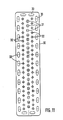
- FIG. 10 shows a modified cutlery field for a brush, in which the round endless strands have been formed into bristle bundles 27, 28 and 29 which form a largely closed outside of the bristle field.
- the bristle field is fully occupied.
- the special peculiarity is that the bristle bundles 27, 28, 29 have the same cross-sectional area despite the different cross-sectional shape.
- a series of bristle bundles 31 with a square cross section and a row with bristle bundles 32 with a round cross section are arranged on the bristle carrier 30 in the central region, each with an endless strand round cross section have been obtained.
- continuous strands that have not been formed can be used for the bristle bundles 32.
- the three rows of bristle bundles 31 and 32 are surrounded on the outside by bristle bundles 33 with an elongated, rounded cross section, which have been produced, for example, from three endless strands by merging and correspondingly reshaping them.
- the various cross-sectional shapes can be selected as they are particularly desirable for the use of the respective device, for example a relatively rigid design of the bristle bundles in the middle and a soft design in the outer area or vice versa.
Landscapes
- Engineering & Computer Science (AREA)
- Manufacturing & Machinery (AREA)
- Brushes (AREA)
- Polishing Bodies And Polishing Tools (AREA)
- Pens And Brushes (AREA)
- Treatment Of Fiber Materials (AREA)
Claims (14)
Priority Applications (1)
| Application Number | Priority Date | Filing Date | Title |
|---|---|---|---|
| AT86102028T ATE48516T1 (de) | 1985-02-21 | 1986-02-18 | Verfahren und vorrichtung zur herstellung von borstenwaren. |
Applications Claiming Priority (2)
| Application Number | Priority Date | Filing Date | Title |
|---|---|---|---|
| DE19853505972 DE3505972A1 (de) | 1985-02-21 | 1985-02-21 | Verfahren und vorrichtung zur herstellung von borstenwaren |
| DE3505972 | 1985-02-21 |
Publications (3)
| Publication Number | Publication Date |
|---|---|
| EP0193074A2 EP0193074A2 (fr) | 1986-09-03 |
| EP0193074A3 EP0193074A3 (en) | 1987-11-04 |
| EP0193074B1 true EP0193074B1 (fr) | 1989-12-13 |
Family
ID=6263115
Family Applications (1)
| Application Number | Title | Priority Date | Filing Date |
|---|---|---|---|
| EP86102028A Expired EP0193074B1 (fr) | 1985-02-21 | 1986-02-18 | Procédé et dispositif pour fabriquer des articles de brosserie |
Country Status (7)
| Country | Link |
|---|---|
| US (1) | US4749233A (fr) |
| EP (1) | EP0193074B1 (fr) |
| JP (1) | JP2513621B2 (fr) |
| AT (1) | ATE48516T1 (fr) |
| DE (2) | DE3505972A1 (fr) |
| ES (2) | ES8704341A1 (fr) |
| NO (1) | NO860620L (fr) |
Cited By (1)
| Publication number | Priority date | Publication date | Assignee | Title |
|---|---|---|---|---|
| EP2886010A1 (fr) | 2013-12-20 | 2015-06-24 | Ranir GmbH | Dispositif et procédé de fabrication de compartiments de soies |
Families Citing this family (26)
| Publication number | Priority date | Publication date | Assignee | Title |
|---|---|---|---|---|
| DK148073C (da) * | 1982-06-22 | 1985-09-30 | Svensk Eldental Aktiebolaget | Fremgangsmaade til fremstilling af et boerstehoved, fortrinsvis til tandbehandling |
| DE3643202C1 (de) * | 1986-12-18 | 1988-03-24 | Schlerf Coronet Werke | Verfahren zur Herstellung von Borstenwaren |
| JPS6461554A (en) * | 1987-08-31 | 1989-03-08 | Kuraray Co | Apparatus for molding fiber bundle |
| DE3820372C2 (de) * | 1988-06-15 | 1997-07-24 | Coronet Werke Gmbh | Verfahren und Vorrichtung zur Herstellung von Borstenwaren |
| DE3833428C1 (fr) * | 1988-10-01 | 1990-02-22 | Blendax Gmbh, 6500 Mainz, De | |
| US4884849A (en) * | 1988-12-12 | 1989-12-05 | Better Health Concepts Co Inc. | Apparatus for manufacture of end brush |
| US5165758A (en) * | 1991-08-07 | 1992-11-24 | Technetics Corporation | Place and bundle method for the manufacture of brush seals |
| US5165761A (en) * | 1991-12-30 | 1992-11-24 | The Procter & Gamble Company | Method of making improved toothbrush having multi-level tufts with substantially uniformly rounded bristle ends in each tuft |
| US5224763A (en) | 1991-12-30 | 1993-07-06 | The Procter & Gamble Company | Method of fastening bristle tufts to bristle carrier |
| DE4314692C2 (de) * | 1993-05-04 | 1998-11-26 | Zahoransky Anton Gmbh & Co | Verfahren und Vorrichtung zur Herstellung von Bürsten |
| GB2287901B (en) * | 1994-03-29 | 1998-05-06 | Boucherie Nv G B | A brush making machine |
| ATE207321T1 (de) | 1994-12-01 | 2001-11-15 | Procter & Gamble | Zahnbürste mit verlängerten borsten |
| DE29515391U1 (de) * | 1995-09-15 | 1996-02-29 | Hoeft, Bernd, Dipl.-Ing., 12555 Berlin | Vorrichtung zur Herstellung von Borstenwaren |
| US6886207B1 (en) | 1999-06-14 | 2005-05-03 | The Procter & Gamble Company | Toothbrush |
| DE19748925C2 (de) * | 1997-10-30 | 1999-01-07 | Stiawa Paul Dipl Oec Ing | Verfahren zum Abschneiden von Borstenfeldern bei der Herstellung von Bürstenerzeugnissen aus Kunststoff und Vorrichtung dafür |
| ES2177106T3 (es) | 1997-10-30 | 2002-12-01 | Schlesinger Maschb Gmbh | Procedimiento y dispositivo para la fabricacion de productos de cerdas. |
| DE19909435A1 (de) | 1999-03-04 | 2000-09-07 | Coronet Werke Gmbh | Verfahren und Vorrichtung zur Herstellung von Borstenwaren und danach hergestellte Borstenwaren |
| US6485105B1 (en) * | 2000-02-01 | 2002-11-26 | Moll Industries, Inc. | Method of bristle insertion for brush production |
| US20030094848A1 (en) * | 2001-11-20 | 2003-05-22 | Chih-Yuan Shia | Fused filament tuft and fused brush strip |
| WO2004093719A2 (fr) | 2003-04-23 | 2004-11-04 | The Procter & Gamble Company | Brosses a dents electriques |
| US7677675B2 (en) * | 2005-10-24 | 2010-03-16 | United Rotary Brush Corporation | Method and apparatus for making brushes |
| US8308246B2 (en) * | 2010-03-19 | 2012-11-13 | Chung Tae Sang | Method for manufacturing toothbrush and toothbrush manufactured by the method |
| DE102010015118A1 (de) | 2010-04-16 | 2011-10-20 | Zahoransky Ag | Vorrichtung zum Herstellen von Borstenfeldern für Bürsten |
| DE102011122106A1 (de) * | 2011-12-22 | 2013-06-27 | Carl Freudenberg Kg | Besenblock mit Borstenstruktur |
| EP3964101A1 (fr) * | 2014-10-23 | 2022-03-09 | Colgate-Palmolive Company | Instrument d´hygiène buccale |
| EP3138437B1 (fr) | 2015-09-03 | 2021-11-10 | Braun GmbH | Procédé de fabrication d'une brosse |
Family Cites Families (9)
| Publication number | Priority date | Publication date | Assignee | Title |
|---|---|---|---|---|
| US2035709A (en) * | 1932-07-08 | 1936-03-31 | Laub | Tooth brush and manufacture thereof |
| FR1206765A (fr) * | 1957-05-11 | 1960-02-11 | Dispositif utilisable pour la fabrication de brosses, de balais et de pinceaux | |
| US3311416A (en) * | 1964-02-28 | 1967-03-28 | Zahoransky Heinz | Brush making machine |
| BE677121A (fr) * | 1965-03-05 | 1966-08-29 | ||
| CH546550A (de) * | 1971-10-20 | 1974-03-15 | Blankschein Werner | Verfahren und vorrichtung zum herstellen von haar- oder borstenbuendeln aus einem haar- oder borstenbund. |
| JPS5424349B2 (fr) * | 1973-06-11 | 1979-08-20 | ||
| JPS50152560A (fr) * | 1974-05-27 | 1975-12-08 | ||
| US4132449A (en) * | 1977-08-26 | 1979-01-02 | Blair Tool & Machine Corporation | Method and apparatus for mounting bristles on brush backs |
| DE8403491U1 (de) * | 1984-02-07 | 1984-05-03 | Blendax-Werke R. Schneider Gmbh & Co, 6500 Mainz | Zahnbuerste |
-
1985
- 1985-02-21 DE DE19853505972 patent/DE3505972A1/de not_active Withdrawn
-
1986
- 1986-02-18 AT AT86102028T patent/ATE48516T1/de not_active IP Right Cessation
- 1986-02-18 EP EP86102028A patent/EP0193074B1/fr not_active Expired
- 1986-02-18 DE DE8686102028T patent/DE3667385D1/de not_active Expired - Lifetime
- 1986-02-19 NO NO860620A patent/NO860620L/no unknown
- 1986-02-20 ES ES552217A patent/ES8704341A1/es not_active Expired
- 1986-02-21 US US06/831,575 patent/US4749233A/en not_active Expired - Lifetime
- 1986-02-21 JP JP61035396A patent/JP2513621B2/ja not_active Expired - Fee Related
- 1986-07-29 ES ES556982A patent/ES8707420A1/es not_active Expired
Cited By (1)
| Publication number | Priority date | Publication date | Assignee | Title |
|---|---|---|---|---|
| EP2886010A1 (fr) | 2013-12-20 | 2015-06-24 | Ranir GmbH | Dispositif et procédé de fabrication de compartiments de soies |
Also Published As
| Publication number | Publication date |
|---|---|
| US4749233A (en) | 1988-06-07 |
| ES556982A0 (es) | 1987-08-01 |
| EP0193074A2 (fr) | 1986-09-03 |
| ES552217A0 (es) | 1987-04-01 |
| JPS61240911A (ja) | 1986-10-27 |
| EP0193074A3 (en) | 1987-11-04 |
| ATE48516T1 (de) | 1989-12-15 |
| DE3505972A1 (de) | 1986-08-21 |
| JP2513621B2 (ja) | 1996-07-03 |
| ES8707420A1 (es) | 1987-08-01 |
| DE3667385D1 (de) | 1990-01-18 |
| NO860620L (no) | 1986-08-22 |
| ES8704341A1 (es) | 1987-04-01 |
Similar Documents
| Publication | Publication Date | Title |
|---|---|---|
| EP0193074B1 (fr) | Procédé et dispositif pour fabriquer des articles de brosserie | |
| EP1158880B1 (fr) | Procede et dispositif pour produire des articles de brosserie et articles de brosserie ainsi obtenus | |
| EP1138222B1 (fr) | Tête de brosse et procédé pour la fabrication de cette tête de brosse | |
| EP0472863B1 (fr) | Dispositif pour préparer des faisceaux de poils pour la fabrication des brosses | |
| DE2812746C2 (de) | Maschine zur Herstellung von Bürsten | |
| EP3267835B1 (fr) | Dispositif d'alimentation d'une cassette de filaments de poils en charges de filaments de poils | |
| EP2676781B1 (fr) | Procédé et dispositif de fabrication d'une brosse à plusieurs composants moulée par injection d'une seule pièce | |
| EP3223650A1 (fr) | Procédé et dispositif de fabrication d'un nettoyeur inter-dentaire | |
| EP3236806B1 (fr) | Procédé de fabrication d'une brosse ou d'un pinceau ainsi que dispositif à cette fin | |
| DE2849510A1 (de) | Buerstenherstellungsmaschine sowie verfahren zum herstellen von buersten | |
| DE3832520A1 (de) | Verfahren und vorrichtung zum herstellen von buersten, insbesondere von buersten fuer hygienische beduerfnisse, wie zahnbuersten | |
| EP0895455B1 (fr) | Procede de production de materiau pour poils de brosserie pour articles a poils de brosserie | |
| DE3205641C2 (de) | Verfahren und Vorrichtung zur Herstellung von Borstenbündeln oder Einzelborsten aus Kunststoff | |
| EP0626141A1 (fr) | Procédé de mise en place de faisceaux de soies | |
| DE2907667A1 (de) | Verfahren zum herstellen von buersten | |
| EP0710534B1 (fr) | Procédé et dispositif pour fabriquer des corps de brosse à partir d'au moins deux composants de matière plastique | |
| DE3719823C1 (de) | Verfahren und Vorrichtung zur Herstellung von Borstenwaren sowie Anwendung des Verfahrens fuer Geraete aehnlichen Aufbaus | |
| DE10108339A1 (de) | Verfahren zur Herstellung von Bürsten im Wege des Spritzgießens | |
| DE4041475A1 (de) | Buerstenherstellungsmaschine mit einem materialspeicher sowie verfahren zum maschinellen herstellen von buersten | |
| DE2207135A1 (de) | Verfahren zum zusammenfassen von moebelbeschlaegen und zum fuellen eines magazins sowie speichertraeger fuer moebelbeschlaege | |
| DE19949772B4 (de) | Verfahren zur Herstellung einer Bürste | |
| DE3801589C2 (fr) | ||
| DE4328050B4 (de) | Verfahren und Vorrichtung zum Vorbereiten der zur Bildung einer Borstenware dienenden Borstenbündel | |
| DE3835503C2 (fr) | ||
| DE2257359A1 (de) | Einrichtung zur herstellung von strangfoermigem fasermaterial |
Legal Events
| Date | Code | Title | Description |
|---|---|---|---|
| PUAI | Public reference made under article 153(3) epc to a published international application that has entered the european phase |
Free format text: ORIGINAL CODE: 0009012 |
|
| AK | Designated contracting states |
Kind code of ref document: A2 Designated state(s): AT BE CH DE FR GB IT LI NL SE |
|
| PUAL | Search report despatched |
Free format text: ORIGINAL CODE: 0009013 |
|
| AK | Designated contracting states |
Kind code of ref document: A3 Designated state(s): AT BE CH DE FR GB IT LI NL SE |
|
| 17P | Request for examination filed |
Effective date: 19880423 |
|
| 17Q | First examination report despatched |
Effective date: 19890519 |
|
| GRAA | (expected) grant |
Free format text: ORIGINAL CODE: 0009210 |
|
| AK | Designated contracting states |
Kind code of ref document: B1 Designated state(s): AT BE CH DE FR GB IT LI NL SE |
|
| REF | Corresponds to: |
Ref document number: 48516 Country of ref document: AT Date of ref document: 19891215 Kind code of ref document: T |
|
| REF | Corresponds to: |
Ref document number: 3667385 Country of ref document: DE Date of ref document: 19900118 |
|
| ET | Fr: translation filed | ||
| GBT | Gb: translation of ep patent filed (gb section 77(6)(a)/1977) | ||
| ITF | It: translation for a ep patent filed | ||
| PLBE | No opposition filed within time limit |
Free format text: ORIGINAL CODE: 0009261 |
|
| STAA | Information on the status of an ep patent application or granted ep patent |
Free format text: STATUS: NO OPPOSITION FILED WITHIN TIME LIMIT |
|
| 26N | No opposition filed | ||
| ITTA | It: last paid annual fee | ||
| EAL | Se: european patent in force in sweden |
Ref document number: 86102028.7 |
|
| REG | Reference to a national code |
Ref country code: GB Ref legal event code: IF02 |
|
| PGFP | Annual fee paid to national office [announced via postgrant information from national office to epo] |
Ref country code: AT Payment date: 20020214 Year of fee payment: 17 |
|
| PGFP | Annual fee paid to national office [announced via postgrant information from national office to epo] |
Ref country code: GB Payment date: 20030203 Year of fee payment: 18 |
|
| PGFP | Annual fee paid to national office [announced via postgrant information from national office to epo] |
Ref country code: SE Payment date: 20030217 Year of fee payment: 18 Ref country code: NL Payment date: 20030217 Year of fee payment: 18 |
|
| PG25 | Lapsed in a contracting state [announced via postgrant information from national office to epo] |
Ref country code: AT Free format text: LAPSE BECAUSE OF NON-PAYMENT OF DUE FEES Effective date: 20030218 |
|
| PGFP | Annual fee paid to national office [announced via postgrant information from national office to epo] |
Ref country code: FR Payment date: 20030218 Year of fee payment: 18 |
|
| PGFP | Annual fee paid to national office [announced via postgrant information from national office to epo] |
Ref country code: BE Payment date: 20030220 Year of fee payment: 18 |
|
| PGFP | Annual fee paid to national office [announced via postgrant information from national office to epo] |
Ref country code: DE Payment date: 20030221 Year of fee payment: 18 |
|
| PGFP | Annual fee paid to national office [announced via postgrant information from national office to epo] |
Ref country code: CH Payment date: 20030502 Year of fee payment: 18 |
|
| PG25 | Lapsed in a contracting state [announced via postgrant information from national office to epo] |
Ref country code: GB Free format text: LAPSE BECAUSE OF NON-PAYMENT OF DUE FEES Effective date: 20040218 |
|
| PG25 | Lapsed in a contracting state [announced via postgrant information from national office to epo] |
Ref country code: SE Free format text: LAPSE BECAUSE OF NON-PAYMENT OF DUE FEES Effective date: 20040219 |
|
| PG25 | Lapsed in a contracting state [announced via postgrant information from national office to epo] |
Ref country code: BE Free format text: LAPSE BECAUSE OF NON-PAYMENT OF DUE FEES Effective date: 20040228 |
|
| PG25 | Lapsed in a contracting state [announced via postgrant information from national office to epo] |
Ref country code: LI Free format text: LAPSE BECAUSE OF NON-PAYMENT OF DUE FEES Effective date: 20040229 Ref country code: CH Free format text: LAPSE BECAUSE OF NON-PAYMENT OF DUE FEES Effective date: 20040229 |
|
| BERE | Be: lapsed |
Owner name: *CORONET-WERKE HEINRICH SCHLERF G.M.B.H. Effective date: 20040228 |
|
| PG25 | Lapsed in a contracting state [announced via postgrant information from national office to epo] |
Ref country code: NL Free format text: LAPSE BECAUSE OF NON-PAYMENT OF DUE FEES Effective date: 20040901 Ref country code: DE Free format text: LAPSE BECAUSE OF NON-PAYMENT OF DUE FEES Effective date: 20040901 |
|
| EUG | Se: european patent has lapsed | ||
| GBPC | Gb: european patent ceased through non-payment of renewal fee |
Effective date: 20040218 |
|
| REG | Reference to a national code |
Ref country code: CH Ref legal event code: PL |
|
| PG25 | Lapsed in a contracting state [announced via postgrant information from national office to epo] |
Ref country code: FR Free format text: LAPSE BECAUSE OF NON-PAYMENT OF DUE FEES Effective date: 20041029 |
|
| NLV4 | Nl: lapsed or anulled due to non-payment of the annual fee |
Effective date: 20040901 |
|
| REG | Reference to a national code |
Ref country code: FR Ref legal event code: ST |
|
| PG25 | Lapsed in a contracting state [announced via postgrant information from national office to epo] |
Ref country code: IT Free format text: LAPSE BECAUSE OF NON-PAYMENT OF DUE FEES;WARNING: LAPSES OF ITALIAN PATENTS WITH EFFECTIVE DATE BEFORE 2007 MAY HAVE OCCURRED AT ANY TIME BEFORE 2007. THE CORRECT EFFECTIVE DATE MAY BE DIFFERENT FROM THE ONE RECORDED. Effective date: 20050218 |