EP0194546A2 - Membranes à pores - Google Patents
Membranes à pores Download PDFInfo
- Publication number
- EP0194546A2 EP0194546A2 EP19860102768 EP86102768A EP0194546A2 EP 0194546 A2 EP0194546 A2 EP 0194546A2 EP 19860102768 EP19860102768 EP 19860102768 EP 86102768 A EP86102768 A EP 86102768A EP 0194546 A2 EP0194546 A2 EP 0194546A2
- Authority
- EP
- European Patent Office
- Prior art keywords
- membrane
- plasma
- pore
- discharge
- pore membranes
- Prior art date
- Legal status (The legal status is an assumption and is not a legal conclusion. Google has not performed a legal analysis and makes no representation as to the accuracy of the status listed.)
- Granted
Links
- 0 Cc1ccc(*)cc1C Chemical compound Cc1ccc(*)cc1C 0.000 description 2
Images
Classifications
-
- B—PERFORMING OPERATIONS; TRANSPORTING
- B01—PHYSICAL OR CHEMICAL PROCESSES OR APPARATUS IN GENERAL
- B01D—SEPARATION
- B01D67/00—Processes specially adapted for manufacturing semi-permeable membranes for separation processes or apparatus
- B01D67/0081—After-treatment of organic or inorganic membranes
- B01D67/009—After-treatment of organic or inorganic membranes with wave-energy, particle-radiation or plasma
-
- B—PERFORMING OPERATIONS; TRANSPORTING
- B01—PHYSICAL OR CHEMICAL PROCESSES OR APPARATUS IN GENERAL
- B01D—SEPARATION
- B01D67/00—Processes specially adapted for manufacturing semi-permeable membranes for separation processes or apparatus
- B01D67/0081—After-treatment of organic or inorganic membranes
- B01D67/0093—Chemical modification
- B01D67/00931—Chemical modification by introduction of specific groups after membrane formation, e.g. by grafting
-
- B—PERFORMING OPERATIONS; TRANSPORTING
- B01—PHYSICAL OR CHEMICAL PROCESSES OR APPARATUS IN GENERAL
- B01D—SEPARATION
- B01D69/00—Semi-permeable membranes for separation processes or apparatus characterised by their form, structure or properties; Manufacturing processes specially adapted therefor
- B01D69/12—Composite membranes; Ultra-thin membranes
- B01D69/125—In situ manufacturing by polymerisation, polycondensation, cross-linking or chemical reaction
- B01D69/127—In situ manufacturing by polymerisation, polycondensation, cross-linking or chemical reaction using electrical discharge or plasma-polymerisation
-
- B—PERFORMING OPERATIONS; TRANSPORTING
- B29—WORKING OF PLASTICS; WORKING OF SUBSTANCES IN A PLASTIC STATE IN GENERAL
- B29C—SHAPING OR JOINING OF PLASTICS; SHAPING OF MATERIAL IN A PLASTIC STATE, NOT OTHERWISE PROVIDED FOR; AFTER-TREATMENT OF THE SHAPED PRODUCTS, e.g. REPAIRING
- B29C59/00—Surface shaping of articles, e.g. embossing; Apparatus therefor
- B29C59/14—Surface shaping of articles, e.g. embossing; Apparatus therefor by plasma treatment
Definitions
- the present invention relates to pore membranes and their use for the separation of particles dissolved or suspended in the liquid medium.
- RO reverse osmosis membranes
- Salts from aqueous solution can retain more than 90% and uttrafiltration membranes (pores 0 50 ⁇ - 1 ⁇ m), whereby the retention capacity for such salts is less than 10%.
- UF / RO intermediate membrane there are also membranes whose separating properties are between these border areas and thus are to be referred to as the UF / RO intermediate membrane.
- the pore diameters are between 20 ⁇ and 500 ⁇ .
- Asymmetric, porous membranes are primarily used for ultrafiltration.
- Asymmetric membranes consist of a supporting main layer and a cover or Separating layer In general, this separating layer has a thickness of 500 ⁇ -3000 ⁇ .
- hydrophilic polymers cellulose acetate
- hydrophobic polymers such as polysulfone or polyvinylidene fluoride, which have a higher temperature and chemical resistance.
- the production of asymmetric membranes from the base polymers mentioned is state of the art and is carried out using casting processes known from the literature (cf., for example, US Pat. No. 3,615,024, US Pat. No. 4,029,582, US Pat. No. 3,556,305, US Pat. No. 3,567,810).
- Areas of application for the use of ultrafiltration membranes are, for example: cleaning and concentration of polymer solutions and fruit juices, protein extraction from dairy waste water or wastewater treatment.
- prior art is the desalination and concentration of dye solutions according to DE-A 3 148 878, DE-A 2 948 292, DE-A 2 805 891, DE-A 3 311 294 and FR-A 2 129 359 using previously commercially available asymmetric membranes consisting of polyacrylonitrile, polyamide, polysulfone, acetyl cellulose or potyvinylidene fluoride.
- the desalination of dye solutions is usually carried out under elevated pressure of 5-50 bar.
- the compacting behavior of the membrane often has a disadvantageous effect, with the result that the permeate flow is greatly reduced over time
- the object of the present invention is now the development of membranes with e.g. improved dye retention with at the same time significantly improved flow properties for solvents and salts, or the provision of a method for the subsequent functionalization of the surfaces of pore membranes of any shape and any chemical composition of the membrane-forming material, without impairing the predetermined membrane structure and function.
- This object is achieved by treating the membrane surface with a gas discharge in the presence of gaseous substances, the pore structure being changed, but being retained overall
- the invention thus relates to pore membranes with an average pore diameter of> 50 ⁇ on the surface, which are obtained by plasma or corona charging in the presence of gaseous substances on pore membranes and, if appropriate, subsequent chemical modification.
- the gas discharge at pressures between 10- 4 mbar and 10 2 mbar, preferably between 10- 'mbar and ignited 1 mbar, but also any other gas pressure between 10 mbar and atmospheric pressure is suitable for the proposed gas discharge.
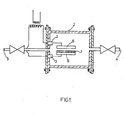
- the electrical energy is fed into the discharge zone e.g. Via two plate electrodes (6) lying horizontally and plane-parallel one above the other within the evacuable reactor (e.g. in A4 format with a distance of up to 15 cm, preferably 7 cm).
- the membrane to be treated is suitably fixed on one of the two electrodes, preferably the lower one.
- the discharge gas is metered directly into the electrode gap via a nozzle system. Any other type of energy supply is also possible, such as over external plates, rings or a coil.
- the working gas supply is preferably kept constant during the discharge and, depending on the desired treatment effect, is between o and 10- 'ml (NPT) min-' cm -3 based on the discharge space volume above the membrane in the electrode gap, preferably between 10 -3 and 10 - 2 ml (NTP) min -1 cm -3 .
- the high-voltage generator used according to the invention for the ignition and maintenance of the gas discharge operates in the kHz range and is in resonance at all working conditions, ie maximum energy output into the discharge zone.
- its operating frequency is between 10 and 100 kHz, preferably around 30 kHz.
- the method according to the invention is not restricted by the choice of generator frequency and can also be carried out with direct current generators and generators which operate in the MHz range (for example 1 3, 5 6 MHz) or GHz range (for example 2.45 GHz).
- the quality of the functionalization (type of chemical function, density of the surface coverage) is essentially determined by the energy converted in the gas discharge per time and membrane area (power density) as well as the total energy per membrane area (energy density).
- the power densities are in the gas discharge reactor used according to the invention the gas discharge zone typically between 2 and 10 -2 Wom -2 , preferably between 1 x 10 -1 and 1 Wom -2 with treatment times between 1 and 10 min and resulting energy densities between 6 and 600 Wscm- 2.
- pore membranes in particular asymmetrical porous membranes come from a supporting main layer and a cover or cover layer located only on one side. Separation layer in question, wherein this separation layer generally has a thickness of about 500-3000 A.
- the production of such membranes is described, for example, in the following US Pat. Nos. 3,615,024, 4,029,582, 3,556,305, 3,567,810.
- pore membranes are understood to mean those which have an average pore diameter of approximately 20 ⁇ -1 ⁇ m, preferably 20-500 ⁇ .
- the pore membranes consist, for example, of organic polymers such as polyacrylonitrile, polyamide, polysulfone, acetyl cellulose or polyvinylidene fluoride, metallic compounds or alloys or inorganic glasses. Those made from organic polymers are preferably used.
- Such polymer membranes are used for a variety of separation processes, e.g. Cleaning and concentration of fruit juices and polymer solutions, protein extraction from dairy wastewater, wastewater treatment and concentration of dye solutions (DE-A 3 148 878, 2 948 292, 2 805 891, 3 311 294 and FR-A 2 129 359.
- Gases which, under the chosen discharge conditions, lead to polymer deposition on the membrane surface without closing the pores and which already contain the desired chemical function (s) or form them under discharge conditions are all organic and organometallic compounds which can be converted into the gas phase, for example aliphatic saturated hydrocarbons (for example methane, ethane), non-aromatic carbo- and heterocyclic compounds (for example cyclohexane, tetrahydrofuran, pyrrolidone), unsaturated aliphatic hydrocarbons (for example ethene, propene) , Hexene, C-hexene), aromatic-carbocyclic and aromatic-heterocyclic compounds (e.g.
- aliphatic saturated hydrocarbons for example methane, ethane
- non-aromatic carbo- and heterocyclic compounds for example cyclohexane, tetrahydrofuran, pyrrolidone
- unsaturated aliphatic hydrocarbons for example
- benzene, toluene, pyridine, furan), halogen derivatives of the abovementioned compounds e.g. CH 3 CI, CHCl 3 , COCl 2 , fluorine-chloro-KW, chlorobenzene
- Derivatives of the above-mentioned compounds with one or more heteroatoms - alcohols, acids, amides, nitriles, sulfites, thioethers, phosphines, phosphates
- organometallic compounds e.g. Li (C 4 H 9 ), Pb (C 2 H 5 ) 4
- Si-organic compounds e.g. silanes, silazanes, siloxanes.
- a gas discharge with toluene provides aromatic structures, with allylamine amine functions, with tetrafluoroethyl len fluorine functions in the polymer deposit deposited on the membrane surface.
- the amount of the deposit is to be kept so small that the pores of the membrane separation layer are not blocked.
- a chemical modification (reaction of the reactive centers or groups introduced by means of gas discharge, such as amino groups or hydroxyl groups) can optionally be carried out, for example by reaction with acylating agents, esterifying agents and the like. ⁇ . (chemical functionalization).
- the corresponding reactions take place under customary conditions using suitable gaseous, liquid or dissolved compounds in a preferably aqueous medium. If appropriate polyfunctional compounds are used, further reactions can then be carried out, e.g. with proteins, dispersants which contain amino or OH groups, amino or OH-containing crown ethers, cryptands, lipids, oligosaccharides or polysaccharides.
- suitable compounds for chemical functionalization are in particular mono- or.
- Reactive dyes or precursors of dyes such as diazo or coupling components with a reactive group are very particularly preferred, particularly for the use of the membranes for ultrafiltration of dye solutions.
- Suitable reactive dyes are in particular those which contain 1-5 water-solubilizing groups, in particular sulfo groups and one or more reaction groups d.
- H Groups that react with the hydroxyl groups of cellulose or amide groups of polyamides under coloring conditions to form covalent bonds.
- reactive dyes there are also those with two or more identical or different reactive groups.
- the reactive dyes can belong to a wide variety of classes, e.g. the series of metal-free or metal-containing mono- or polyazo dyes, metal-free or metal-containing azaporphine dyes such as copper, cobalt or nickel phthalocyanine dyes, the anthraquinone, oxazine, dioxazine, triphenylmethane, nitro, azomethine, metal-free or metal-containing formazan dye.
- metal-free or metal-containing mono- or polyazo dyes such as copper, cobalt or nickel phthalocyanine dyes, the anthraquinone, oxazine, dioxazine, triphenylmethane, nitro, azomethine, metal-free or metal-containing formazan dye.
- the chemical functionalization process is independent of the respective membrane material.
- Membrane surfaces made of organic polymers, metallic compounds and inorganic glasses are suitable. Preferred are those made from organic polymers such as cellulosic polymers, polyamides, polyhydrazides, polyimides, polysulfones, polyacrylonitrile, fluoropolymers and silicones.
- the method is also independent of the respective membrane structure and is therefore suitable for modifying both symmetrical and asymmetrical pore membranes.
- Proteins, starches or fats can be retained as valuable wastewater ingredients.
- star ker meaning is e.g. the recovery of milk protein from whey.
- the membranes according to the invention in particular those whose amino groups have been modified with reactive dyes, show high dye retention in ultrafiltration with, at the same time, excellent permeate flow for solvents and, in particular, inorganic salts such as NaCl or Na 2 SO 4 .
- the membranes according to the invention can be stored dry, in contrast to the membranes customary hitherto, and can then be used again without any major change in the separation properties.
- the membranes according to the invention show no significant undesired compaction even when used for a long time.
- the method according to the invention very generally offers the possibility of introducing advantageous functionalities into the membrane surface for certain desired separation effects which either improve the separation properties and / or handling by themselves or only after further chemical modification.
- the method thus allows customized membranes to be made available for the respective separation problem.
- a commercially available asymmetrical ultrafiltration flat membrane made of polysulfone (type DDS-GR 81 PP -143-004) molecular weight cut-off 6000 is first used by preservatives and manufacturing aids e.g. 50% glycerin, 45% H 2 O, 4% propionic acid, 1% NaOH, etc. cleaned by storing the membrane in renewed demineralized water at 40 ° C for approx. 100 h, then the membrane is dried at 70 ° C for approx. 12 h under reduced pressure ( ⁇ 10 -2 mbar).
- the dried membrane is then placed in the previously described plasma reactor on the lower, grounded, thermostatted electrode at 30 ° C.
- the plasma gas is fed via a nozzle system directly into the electrode gap.
- the NH 3 gas pressure is regulated to 0.6 mbar using a pressure control system
- the plasma discharge is ignited with the aid of the high voltage generator between the two Pfatfen electrodes and the membrane is treated for 2.25 min at a plasma power density of 0.29 Wcm -2 , corresponding to an energy density of 39 Wscm -2 .
- a high-frequency AC voltage of 730 V peak voltage with a frequency of 32 kHz was applied to the upper electrode.
- the pH is reduced by adding Na 2 CO 3 . Set the value to 10 and heated to 40 ° C for 5 h. After the reaction is rinsed neutral with noble water
- Example 1 an asymmetric ultrafiltration flat membrane made of polysulfone is exposed to an NH 3 plasma discharge, with the difference from Example 1 that the membrane is treated for 4 minutes at a plasma power density of 0.2 Wcm -2 , corresponding to an energy density of 48 Wscm -2 .
- a high-frequency alternating voltage of 640 V billets (voltage with a frequency of 39 kHz) was present on the upper electrode.
- the chemical modification corresponds to Example 1.
- Table 1 shows the permeate flow and the retention capacity of the membranes from Examples 1 and 2, which are colored deep red on the surface, in comparison with the untreated membrane.
- the sequence given corresponds to the chronological sequence of the experiments and shows the improved long-term stability of the modified membranes.
- Example 1 an asymmetrical ultrafiltration flat membrane made of polysulfone is exposed to an NH 3 plasma discharge, with the difference from Example 1 that the membrane for 2 min at a plasma power density of 0.34 Wcm -2 corresponding to an energy density of 41 Wscm -2 , and one NH 3 gas flow of 34 ml (NTP) min -1 cm -3 , corresponding to 7.8 x 10 ' ' ml (NTP) min -1 cm -3 , discharge gap volume is treated.
- a high-frequency AC voltage of 775 V Scheifet voltage with a frequency of 32 kHz was applied to the upper electrode.
- the chemical modification corresponds to example 1 .
- Example 1 an asymmetrical ultrafiltration flat membrane made of polysulfone is exposed to an NH 3 plasma discharge, with the difference from Example 1 that the membrane is 6.6 min at a plasma power density of 0.2 Wcm -2 , corresponding to an energy density of 79 Wscm- 2 , and an NH 3 gas flow of 34 ml- (NTP) min -1 , corresponding to 7.8 x 10- 3 ml (NTP) min- 'cm -3 discharge gap volume.
- a high-frequency alternating voltage of 670 V peak voltage with a frequency of 41 kHz was applied to the upper electrode.
- the chemical modification corresponds to example 1.
- Table 2 shows the flow and retention capacity of the membranes from Examples 3 and 4, which are colored deep red on the surface, in comparison with the untreated membrane
- Example 1 an asymmetric ultrafittration flat membrane made of polysulfone is exposed to an NH 3 plasma discharge, with the difference from Example 1 that it is a UF membrane from Kalle, type Nadir TU-AO-40 4 5. 4 25T670 , with a molecular weight exclusion limit of 60,000, which is treated for 2.25 min at a plasma power density of 0.28 Wcm -2 , corresponding to an energy density of 38 Wscm- 2 . A high-frequency AC voltage of 730 V peak voltage with a frequency of 32 kHz was applied to the upper electrode.
- the membrane is reacted on the surface with reactive dye 9 analogously to Example 1.
- Table 3 shows the flow rate compared to the aid-free washed, dried and non-plasma-treated membrane.
- an asymmetric ultrafiltration flat membrane made of polysulfone is an NH; Exposed to plasma discharge with the difference from example 1 that the membrane had a molecular weight cut-off of 20,000 (type DDS-GR 61 PP-350-001) and 2 minutes at a plasma power density of 0.35 Wcm- 2 , corresponding to an energy density of 4 2 Wscm -2 , is treated. A high-frequency AC voltage of 770 V peak voltage with a frequency of 33 kHz was applied to the upper electrode. The chemical modification corresponds to example 1 .
- the flow / retention properties are set out in Tables 5 to 6.
- Example 7 a membrane treated with NH 3 plasma discharge is surface-dyed with dye (21) according to the same recipe.
- Example 1 an asymmetric ultrafiltration flat membrane made of polysulfone from DDS GR 61 PP with a cut-off of 20,000 is exposed to an NH 3 plasma discharge, with the difference from Example 1 that the membrane is 4 minutes at a plasma conduction density of 0.2 Wcm -2 is treated, corresponding to an energy density of 48 Wscm -2 .
- a high-frequency AC voltage of 640 V peak voltage with a frequency of 39 kHz was applied to the upper electrode.
- the surface is colored according to recipe example 7 with dye (20).
- a polysulfone membrane DDS GR 61 PP treated according to Example 9 is colored with dye (22)
- Example 1 an asymmetrical ultrafiltration flat membrane made of polysulfone is subjected to a plasma discharge, with the difference from Example 1 that hexamethyldisilazane (HMDSZ) is used as the plasma gas and the membrane for 0.5 min at a plasma power density of 0.25 Wcm- 2 , corresponding to one Energy density of 7.5 Wscm -2 , with an HMDSZ gas flow of 5 ml (NTP) min- ', corresponding to 1.2 x 10 -3 ml (NTP) min -1 cm -3 discharge volume, and a gas pressure of 0, 3 mbar is treated.
- a high-frequency AC voltage of 780 V peak voltage with a frequency of 42 kHz was applied to the upper electrode.
- the chemical modification with dye (16) is carried out according to Example 7.
- Example 1 an asymmetric ultrafiltration flat membrane made of polysulfone is subjected to a plasma discharge, with the difference from Example 1 that a mixture of chloroform (CHCl 3 ) in nitrogen (N 2 ) (N 2 at 30 ° C. saturated with CHCl 3 ) is used as the plasma gas. is used and the membrane for 2 min at a plasma power density of 0.24 Wcm -2 , with a CHCl 3 / N 2 gas buss of 50 ml (NTP) min -1 , corresponding to 12 x 10 -3 ml (NTP) min -1 cm -3 discharge volume, is treated.
- NTP chloroform
- N 2 nitrogen
- Example 1 an asymmetrical ultrafiltration flat membrane made of polysulfone is subjected to a plasma discharge, with the difference from Example 1 that a mixture of water (H 2 O) in air (air at 30 ° C. saturated with H20) is used as the plasma gas and that Membrane 2 min with a plasma power density of 0.23 Wcm- 2 , corresponding to an energy density of 28 Wscm -2 , with an H 2 O / air gas flow of 50 ml (NTP) min -1 , corresponding to 12 x 10 -3 ml ( NTP) miw -1 cm -3 discharge gap volume, is treated.
- a high-frequency AC voltage of 710 V peak voltage and a frequency of 43 kHz was applied to the upper electrode.
- the chemical modification is carried out using dye ( 1 6) according to Example 7.
- Example 1 an asymmetric ultrafiltration flat membrane made of polysulfone is subjected to a plasma discharge, with the difference from Example 1 that a mixture of hexamethyldisilazane - (HMDSZ) in ammonia (NH,) (NH 3 at 30 ° C. saturated with HMDSZ) is used as the plasma gas and the membrane for 2 min at a plasma power density of 0.2 Wcm -2 , corresponding to an energy density of 24 Wscm -2 , with an HMDSZ / NH 3 gas flow of 17 ml (NTP) min -1 , corresponding to 3.9 x 10 -3 ml (NTP) min -1 cm- 3 discharge gap volume, is treated.
- a high-frequency AC voltage of 860 V peak voltage and a frequency of 37 kHz was applied to the upper electrode.
- the chemical modification is carried out using dye (16) according to Example 7.
- Example 1 an asymmetric ultrafiltration flat membrane made of polysulfone is subjected to a plasma discharge, with the difference from Example 1 that Frigen 22 (CHClF 2 ) is used as the plasma gas and the membrane for 0.5 min at a plasma power density of 0.15 Wcm -2 ; corresponding to an energy density of 4.5 Wscm -2 with a Frigen 22 gas flow of 11 ml (NTP) min -1 , corresponding to 2.5 x 50 -3 ml (NTP) min -1 cm -3 discharge gap volume and a gas pressure of 0 , 2 mbar is treated.
- a high-frequency AC voltage of 810 V peak voltage and a frequency of 52 kHz was applied to the upper electrode.
- Example 1 an asymmetric ultrafiftration flat membrane made of polysulfone is subjected to a plasma discharge, with the difference from Example 1 that krypton is used as the plasma gas and the membrane for 2.5 min at a plasma power density of 0.11 Wcmr -2 , corresponding to an energy density of 16 .5 Wscm -2 ; with a Krypton gas flow of 37 ml (NTP) min -1 , corresponding to 8.6 x 10 -3 ml (NTP) min -1 cm -3 discharge gap volume.
- NTP 37 ml
- NTP 8.6 x 10 -3 ml
- Example 1 an asymmetric ultrafittration flat membrane made of polysulfone is exposed to an NH 3 plasma discharge, with the difference from Example 1 that the membrane had a molecular weight cutoff of 3,000 (type DDS-GR 90 PP) and 2.5 min at a plasma power density of 0 , 24 Wcm- 2 , corresponding to an energy density of 36 Wscm- 2 , is treated.
- a high-frequency alternating voltage of 750 V peak voltage with a frequency of 29 kHz was applied to the upper electrode.
- the chemical modification is carried out using dye ( 1 6) according to Example 7.
- a membrane type DDS GR 90 PP modified according to Example 18 via plasma discharge is then reacted with dye (12) under the reaction conditions listed in Example 7
- a membrane type DDS GR 81 PP modified according to example 1 via plasma discharge is in a 4% aqueous solution of the coupling component of the formula swollen for 24 hours. The mixture is then heated to 50 ° C. for 5 hours and adjusted to pH 9 with sodium carbonate and rinsed. The membrane treated in this way is placed in a 4% aqueous solution of diazotized orthanilic acid for 1 hour and then a coupling pH of 7 is set. After 10 minutes, the membrane is rinsed. The membrane exhibits properties similar to those described in the examples above.
Landscapes
- Chemical & Material Sciences (AREA)
- Engineering & Computer Science (AREA)
- Chemical Kinetics & Catalysis (AREA)
- Inorganic Chemistry (AREA)
- Manufacturing & Machinery (AREA)
- Physics & Mathematics (AREA)
- Plasma & Fusion (AREA)
- Health & Medical Sciences (AREA)
- Transplantation (AREA)
- Separation Using Semi-Permeable Membranes (AREA)
- Manufacture Of Porous Articles, And Recovery And Treatment Of Waste Products (AREA)
- Treatments Of Macromolecular Shaped Articles (AREA)
Applications Claiming Priority (2)
| Application Number | Priority Date | Filing Date | Title |
|---|---|---|---|
| DE3509068 | 1985-03-14 | ||
| DE19853509068 DE3509068A1 (de) | 1985-03-14 | 1985-03-14 | Porenmembranen |
Publications (3)
| Publication Number | Publication Date |
|---|---|
| EP0194546A2 true EP0194546A2 (fr) | 1986-09-17 |
| EP0194546A3 EP0194546A3 (en) | 1988-08-31 |
| EP0194546B1 EP0194546B1 (fr) | 1991-12-11 |
Family
ID=6265134
Family Applications (1)
| Application Number | Title | Priority Date | Filing Date |
|---|---|---|---|
| EP86102768A Expired - Lifetime EP0194546B1 (fr) | 1985-03-14 | 1986-03-03 | Membranes à pores |
Country Status (3)
| Country | Link |
|---|---|
| EP (1) | EP0194546B1 (fr) |
| JP (1) | JPS61212303A (fr) |
| DE (2) | DE3509068A1 (fr) |
Cited By (6)
| Publication number | Priority date | Publication date | Assignee | Title |
|---|---|---|---|---|
| EP0396329A1 (fr) * | 1989-04-27 | 1990-11-07 | The British Petroleum Company p.l.c. | Procédé pour réduire l'encrassement |
| EP0407172A1 (fr) * | 1989-07-05 | 1991-01-09 | Mitsubishi Kasei Corporation | Membrane de séparation à base d'un polyimide aromatique |
| EP0513389B1 (fr) * | 1990-11-29 | 1996-02-14 | Nitto Denko Corporation | Pellicule de filtration de liquide et dispositif de filtration utilisant cette pellicule |
| WO2003097219A1 (fr) * | 2002-05-17 | 2003-11-27 | Millipore Corporation | Membrane asymetrique a haut debit |
| EP1254971A3 (fr) * | 2001-05-02 | 2003-12-10 | Plasma Treat GmbH | Procédé de prétraitement de matériau solide |
| GB2493090A (en) * | 2011-07-19 | 2013-01-23 | Surface Innovations Ltd | Producing a porous polymer, using an exciting medium and an emulsion |
Families Citing this family (9)
| Publication number | Priority date | Publication date | Assignee | Title |
|---|---|---|---|---|
| JPH0761434B2 (ja) * | 1988-03-18 | 1995-07-05 | セントラル硝子株式会社 | 物質透過膜 |
| DE3923128A1 (de) * | 1989-07-13 | 1991-01-24 | Akzo Gmbh | Flach- oder kapillarmembran auf der basis eines homogenen gemisches aus polyvinylidenfluorid und eines zweiten, durch chemische umsetzung hydrophilierbaren polymeren |
| DE3929648C1 (fr) * | 1989-09-06 | 1990-11-29 | Sartorius Gmbh, 3400 Goettingen, De | |
| JPH03290446A (ja) * | 1990-04-07 | 1991-12-20 | Fukui Pref Gov | 多孔性フィルムの加工法 |
| JPH08506741A (ja) * | 1993-02-10 | 1996-07-23 | アクゾ ノーベル ナムローゼ フェンノートシャップ | 医療目的のための変性膜 |
| DE4308633C2 (de) * | 1993-03-18 | 2001-07-19 | Leybold Ag | Verfahren und Vorrichtung zur Behandlung unbeschichteter Kunststoff-Folien |
| DE4343114C2 (de) * | 1993-12-17 | 1998-01-29 | Geesthacht Gkss Forschung | Verfahren zur Herstellung von Stofftrennmembranen |
| US7942274B2 (en) | 2000-05-24 | 2011-05-17 | Millipore Corporation | High-throughput asymmetric membrane |
| JP6044545B2 (ja) * | 2011-10-20 | 2016-12-14 | 東レバッテリーセパレータフィルム株式会社 | 多孔質膜の製造方法及びその多孔質膜、電池用セパレーター及び電池 |
Family Cites Families (5)
| Publication number | Priority date | Publication date | Assignee | Title |
|---|---|---|---|---|
| JPS5226380A (en) * | 1975-08-25 | 1977-02-26 | Sumitomo Chem Co Ltd | Method of making semipermeable membranes |
| JPS5857205B2 (ja) * | 1976-02-02 | 1983-12-19 | 住友化学工業株式会社 | 半透膜の製造方法 |
| JPS5581706A (en) * | 1978-12-15 | 1980-06-20 | Sumitomo Chem Co Ltd | Preparation of semi-permeable membrane |
| US4439292A (en) * | 1981-08-13 | 1984-03-27 | Bayer Aktiengesellschaft | Treatment of perfluorinated polymer membranes containing carboxyl groups |
| DE3220037A1 (de) * | 1982-05-27 | 1983-12-01 | Sumitomo Electric Industries, Ltd., Osaka | Selektiv gasdurchlaessige verbundmembranen und verfahren zu ihrer herstellung |
-
1985
- 1985-03-14 DE DE19853509068 patent/DE3509068A1/de not_active Withdrawn
-
1986
- 1986-03-03 DE DE8686102768T patent/DE3682791D1/de not_active Expired - Fee Related
- 1986-03-03 EP EP86102768A patent/EP0194546B1/fr not_active Expired - Lifetime
- 1986-03-13 JP JP61053848A patent/JPS61212303A/ja active Pending
Cited By (9)
| Publication number | Priority date | Publication date | Assignee | Title |
|---|---|---|---|---|
| EP0396329A1 (fr) * | 1989-04-27 | 1990-11-07 | The British Petroleum Company p.l.c. | Procédé pour réduire l'encrassement |
| US5028453A (en) * | 1989-04-27 | 1991-07-02 | The British Petroleum Company P.L.C. | Method for reducing fouling |
| EP0407172A1 (fr) * | 1989-07-05 | 1991-01-09 | Mitsubishi Kasei Corporation | Membrane de séparation à base d'un polyimide aromatique |
| US5112941A (en) * | 1989-07-05 | 1992-05-12 | Mitsubishi Kasei Corporation | Aromatic polymide separation membrane |
| EP0513389B1 (fr) * | 1990-11-29 | 1996-02-14 | Nitto Denko Corporation | Pellicule de filtration de liquide et dispositif de filtration utilisant cette pellicule |
| EP1254971A3 (fr) * | 2001-05-02 | 2003-12-10 | Plasma Treat GmbH | Procédé de prétraitement de matériau solide |
| WO2003097219A1 (fr) * | 2002-05-17 | 2003-11-27 | Millipore Corporation | Membrane asymetrique a haut debit |
| GB2493090A (en) * | 2011-07-19 | 2013-01-23 | Surface Innovations Ltd | Producing a porous polymer, using an exciting medium and an emulsion |
| GB2493090B (en) * | 2011-07-19 | 2013-09-18 | Surface Innovations Ltd | Method for producing porous polymer structures |
Also Published As
| Publication number | Publication date |
|---|---|
| DE3509068A1 (de) | 1986-09-18 |
| JPS61212303A (ja) | 1986-09-20 |
| DE3682791D1 (de) | 1992-01-23 |
| EP0194546B1 (fr) | 1991-12-11 |
| EP0194546A3 (en) | 1988-08-31 |
Similar Documents
| Publication | Publication Date | Title |
|---|---|---|
| EP0194546B1 (fr) | Membranes à pores | |
| DE2638065C2 (fr) | ||
| DE69522209T2 (de) | Verfahren zur Oberflächen-Modifizierung einer polymeren Membran und die dabei anfallende Membran | |
| DE69122934T2 (de) | Semipermeable Verbundmembran, Verfahren zu ihrer Herstellung und Verfahren zu deren Verwendung für die Erzeugung hochreinen Wassers | |
| DE3129702C2 (fr) | ||
| DE69534096T2 (de) | Hochpermeable Umkehrosmose-Verbundmembran, Verfahren zu deren Herstellung und Verfahren zu deren Verwendung | |
| DE2703587C2 (de) | Verfahren zur Herstellung von semipermeablen Membranen | |
| DE2359535A1 (de) | Durch plasmapolymerisation von allylamin hergestelltes polymerisat und verfahren zu seiner herstellung | |
| DE2236663C2 (de) | Verfahren zur Herstellung einer makroskopisch homogenen Membran | |
| DE2539408C3 (de) | Membrane, Verfahren zu ihrer Herstellung und ihre Verwendung zur umgekehrten Osmose und Ultrafiltration | |
| DE3784410T2 (de) | Permeable, poroese polymermembran mit hydrophilen eigenschaften, verfahren zu ihrer herstellung und ihre anwendung. | |
| DE2442209C2 (de) | Membran, hergestellt durch Behandlung eines geformten Polymergebildes mit einem Plasma | |
| EP0061610B1 (fr) | Membranes semiperméables en polymères à base d'acrylonitrile, procédé pour leur fabrication et leur utilisation | |
| DE2713677C3 (de) | Hydraulisch undurchlässige kationenaustauschende Membran | |
| DE3856177T2 (de) | Verfahren zur Herstellung von stabilen Umkehrosmose-Membranen aus sulfonierten Polyaryläthern | |
| DE2735443A1 (de) | Verfahren zur herstellung von asymmetrischen membranen | |
| DE2211318B2 (de) | Verfahren und Vorrichtung zum Steuern der Zusammensetzung eines Bades für die elektrophoretische Ablagerung von filmbildenden Harzen | |
| EP0197006A2 (fr) | Procédé de fabrication de préparations de colorants organiques solubles dans l'eau | |
| DE102009043869A1 (de) | Verfahren zum Formen hydrophiler Membranen und poröse Membranen daraus | |
| EP0287515A1 (fr) | Procédé de fabrication de solutions concentrées, aqueuses de colorants organiques solubles dans l'eau | |
| DE2243953A1 (de) | Membran fuer eine vorrichtung zur ultrafiltration | |
| DE69229795T2 (de) | Polyionkomplex-membran | |
| DE3835612A1 (de) | Verfahren zum hydrophilisieren einer poroesen membran | |
| DE2726055C2 (fr) | ||
| DE2855775C2 (fr) |
Legal Events
| Date | Code | Title | Description |
|---|---|---|---|
| PUAI | Public reference made under article 153(3) epc to a published international application that has entered the european phase |
Free format text: ORIGINAL CODE: 0009012 |
|
| 17P | Request for examination filed |
Effective date: 19860303 |
|
| AK | Designated contracting states |
Kind code of ref document: A2 Designated state(s): CH DE FR GB IT LI |
|
| PUAL | Search report despatched |
Free format text: ORIGINAL CODE: 0009013 |
|
| AK | Designated contracting states |
Kind code of ref document: A3 Designated state(s): CH DE FR GB IT LI |
|
| 17Q | First examination report despatched |
Effective date: 19890704 |
|
| RAP1 | Party data changed (applicant data changed or rights of an application transferred) |
Owner name: STEINHAUSER, HERMANN Owner name: ELLINGHORST, GUIDO, DR. Owner name: WOLFF, JOACHIM, DR. |
|
| RAP3 | Party data changed (applicant data changed or rights of an application transferred) |
Owner name: STEINHAUSER, HERMANN Owner name: ELLINGHORST, GUIDO, DR. Owner name: WOLFF, JOACHIM, DR. |
|
| RBV | Designated contracting states (corrected) |
Designated state(s): DE |
|
| GRAA | (expected) grant |
Free format text: ORIGINAL CODE: 0009210 |
|
| AK | Designated contracting states |
Kind code of ref document: B1 Designated state(s): DE |
|
| REF | Corresponds to: |
Ref document number: 3682791 Country of ref document: DE Date of ref document: 19920123 |
|
| PLBE | No opposition filed within time limit |
Free format text: ORIGINAL CODE: 0009261 |
|
| STAA | Information on the status of an ep patent application or granted ep patent |
Free format text: STATUS: NO OPPOSITION FILED WITHIN TIME LIMIT |
|
| PG25 | Lapsed in a contracting state [announced via postgrant information from national office to epo] |
Ref country code: DE Effective date: 19921201 |
|
| 26N | No opposition filed |