EP0196208A2 - Steuerung der Papiergeschwindigkeit in einem Hard-Copy-Gerät - Google Patents
Steuerung der Papiergeschwindigkeit in einem Hard-Copy-Gerät Download PDFInfo
- Publication number
- EP0196208A2 EP0196208A2 EP86302157A EP86302157A EP0196208A2 EP 0196208 A2 EP0196208 A2 EP 0196208A2 EP 86302157 A EP86302157 A EP 86302157A EP 86302157 A EP86302157 A EP 86302157A EP 0196208 A2 EP0196208 A2 EP 0196208A2
- Authority
- EP
- European Patent Office
- Prior art keywords
- paper
- signal
- tension
- film
- hard copy
- Prior art date
- Legal status (The legal status is an assumption and is not a legal conclusion. Google has not performed a legal analysis and makes no representation as to the accuracy of the status listed.)
- Withdrawn
Links
Images


Classifications
-
- H—ELECTRICITY
- H04—ELECTRIC COMMUNICATION TECHNIQUE
- H04N—PICTORIAL COMMUNICATION, e.g. TELEVISION
- H04N1/00—Scanning, transmission or reproduction of documents or the like, e.g. facsimile transmission; Details thereof
- H04N1/40—Picture signal circuits
- H04N1/40025—Circuits exciting or modulating particular heads for reproducing continuous tone value scales
- H04N1/4005—Circuits exciting or modulating particular heads for reproducing continuous tone value scales with regulating circuits, e.g. dependent upon ambient temperature or feedback control
-
- B—PERFORMING OPERATIONS; TRANSPORTING
- B65—CONVEYING; PACKING; STORING; HANDLING THIN OR FILAMENTARY MATERIAL
- B65H—HANDLING THIN OR FILAMENTARY MATERIAL, e.g. SHEETS, WEBS, CABLES
- B65H23/00—Registering, tensioning, smoothing or guiding webs
- B65H23/04—Registering, tensioning, smoothing or guiding webs longitudinally
- B65H23/18—Registering, tensioning, smoothing or guiding webs longitudinally by controlling or regulating the web-advancing mechanism, e.g. mechanism acting on the running web
- B65H23/182—Registering, tensioning, smoothing or guiding webs longitudinally by controlling or regulating the web-advancing mechanism, e.g. mechanism acting on the running web in unwinding mechanisms or in connection with unwinding operations
-
- H—ELECTRICITY
- H04—ELECTRIC COMMUNICATION TECHNIQUE
- H04N—PICTORIAL COMMUNICATION, e.g. TELEVISION
- H04N1/00—Scanning, transmission or reproduction of documents or the like, e.g. facsimile transmission; Details thereof
- H04N1/40—Picture signal circuits
- H04N1/40025—Circuits exciting or modulating particular heads for reproducing continuous tone value scales
-
- H—ELECTRICITY
- H04—ELECTRIC COMMUNICATION TECHNIQUE
- H04N—PICTORIAL COMMUNICATION, e.g. TELEVISION
- H04N1/00—Scanning, transmission or reproduction of documents or the like, e.g. facsimile transmission; Details thereof
- H04N1/40—Picture signal circuits
- H04N1/407—Control or modification of tonal gradation or of extreme levels, e.g. background level
- H04N1/4076—Control or modification of tonal gradation or of extreme levels, e.g. background level dependent on references outside the picture
- H04N1/4078—Control or modification of tonal gradation or of extreme levels, e.g. background level dependent on references outside the picture using gradational references, e.g. grey-scale test pattern analysis
-
- Y—GENERAL TAGGING OF NEW TECHNOLOGICAL DEVELOPMENTS; GENERAL TAGGING OF CROSS-SECTIONAL TECHNOLOGIES SPANNING OVER SEVERAL SECTIONS OF THE IPC; TECHNICAL SUBJECTS COVERED BY FORMER USPC CROSS-REFERENCE ART COLLECTIONS [XRACs] AND DIGESTS
- Y10—TECHNICAL SUBJECTS COVERED BY FORMER USPC
- Y10S—TECHNICAL SUBJECTS COVERED BY FORMER USPC CROSS-REFERENCE ART COLLECTIONS [XRACs] AND DIGESTS
- Y10S388/00—Electricity: motor control systems
- Y10S388/907—Specific control circuit element or device
- Y10S388/912—Pulse or frequency counter
-
- Y—GENERAL TAGGING OF NEW TECHNOLOGICAL DEVELOPMENTS; GENERAL TAGGING OF CROSS-SECTIONAL TECHNOLOGIES SPANNING OVER SEVERAL SECTIONS OF THE IPC; TECHNICAL SUBJECTS COVERED BY FORMER USPC CROSS-REFERENCE ART COLLECTIONS [XRACs] AND DIGESTS
- Y10—TECHNICAL SUBJECTS COVERED BY FORMER USPC
- Y10S—TECHNICAL SUBJECTS COVERED BY FORMER USPC CROSS-REFERENCE ART COLLECTIONS [XRACs] AND DIGESTS
- Y10S388/00—Electricity: motor control systems
- Y10S388/923—Specific feedback condition or device
- Y10S388/933—Radiant energy responsive device
Definitions
- This invention relates to hard copy recorders in which light-sensitive paper or film is exposed by a cathode ray tube image and then thermally developed, and particularly to apparatus for controlling the speed at which the paper or film moves through the recorder.
- a typical hard copy recorder light-sensitive paper or film is stored in a roll in the recorder.
- the paper or film is threaded through the recorder so that it will pass by the face of a cathode ray tube, through a paper cutter, around a heated platen, then fed out of the recorder to the user.
- the paper path through the recorder is generally quite lengthy, and the paper usually makes several turns as it passes through the machine. It is important for the paper to move at a uniform velocity and to be under relatively constant tension as it is pulled through the recorder by one or more powered metering rollers. If the paper speed or tension vary substantially, the paper can be stretched between the motor-driven rollers which are moving the paper at differing speeds.
- the motors can draw excess current, or the paper will slip as it is pulled non-uniformly through the recorder. The slipping paper will then no longer move uniformly down the center of the paper path, thereby producing images of poor quality. Alternatively, too little paper tension can result in buckling by the loose paper which will crumple, causing the paper feed mechanism to become jammed with folded paper.
- a tension-measuring "dancer” is included in the paper path of a hard copy recorder.
- the dancer is in contact with the paper or film, and its position, which is determined by the paper or film tension, is sensed by an optical sensor.
- the position signal produced by-the sensor is processed and used to adjust the speed of a powered roller which moves the paper or film through the recorder. In this way the paper or film will experience a relatively constant tension over a number of different paper or film speeds, and will not tear or crumple as it moves through the recorder.
- FIGURE 1 the paper path of a hard copy recorder constructed in accordance with the principles of the present invention is shown.
- Light-sensitive paper 12 unrolls from a roll 10 of paper.
- the paper passes in front of a cathode ray tube 14, where the paper is exposed, line by line, to an image.
- the paper is pulled past the cathode ray tube by a motor driven constant velocity metering roller 16.
- the paper then passes through a paper cutter 18 and over a tension measuring dancer 20 mounted on a shaft 30.
- the exposed paper wraps around another roller 22 and onto a developing drum 24.
- the developing drum 24 is covered with a soft covering of Nomex material, which pulls the paper past sections of a heated platen 26 for developing.
- the drum 24 with its Nomex covering appears much like a paint roller and the felt-like nap of the Nomex pulls the paper without scratching the exposed surface.
- the paper passes around a further roller 28 and is then presented to the user.
- the Nomex nap of the developing drum can become compressed.
- the compression of the nap will reduce the effective circumference of the drum. Since the drum is motor driven so as to pull the paper past the platen. the change in the circumference of the drum will change the speed at which the paper moves. The paper will thus be pulled at different speeds by the metering roller 16 and the drum 24. This speed differential will change the tension of the paper between the roller 16 and the drum 24.
- the tension of the paper is monitored by the tension measuring dancer 20.
- the dancer 20 is shown in partial detail in FIGURE 2a.
- the dancer is formed of an arcuate piece of metal which has a length I that is slightly longer than the width of the paper.
- the dancer is folded around a shaft 30 along one edge, with the shaft serving to hold the dancer in position in the recorder.
- a spring 32 acts to urge the dancer up against the paper.
- a small metal fin 34 is mounted oh a corner of the dancer remote from the shaft.
- the fin 34 is nominally positioned in an optical interrupter 36.
- the optical interrupter contains a light source and a photocell. The light path between these elements is interrupted by the fin 34, as diagrammatically represented in FIGURE 2b.
- the dancer 20 moves upward and the fin 34 blocks most or all of the light directed to the photocell.
- the dancer is pressed downward and the fin 34 allows an increasing amount of light to reach the photocell.
- the amount of light that impinges upon the photocell is a measure of paper tension.
- the control circuitry for the drum motor is shown schematically in FIGURE 3.
- the optical interrupter light source is shown as a light emitting diode 35 which directs light toward a photocell 37.
- the fin 34 is located between the diode 35 and the photocell 37.
- the photocell is biased to ground by a resistor 42.
- the output of the photocell is coupled to one input of a summing junction 40.
- the summing junction is coupled to the positive input of a comparator 50, and a threshold reference voltage. VTHR, of 4.2 volts is applied to the negative input of the comparator.
- the output of the comparator is coupled to the "D" input of a data-type flip-flop 52.
- the Q output of the flip-flop 52 is coupled to the "select" input of a switch 54, and to the second input of the summing junction 40 by a resistor 44.
- the switch 54 receives as inputs two reference frequencies. f H and f Le from frequency sources 56 and 58.
- a motor reference signal F R is produced at the output (common) terminal of the switch 54. This F a signal is used to clock the flip-flop 52 and is also applied to a servo control system 60 for the motor 64 of the developing drum 24.
- a slotted wheel (not shown) is mounted on the shaft of the motor 64. As the motor turns, photo interrupters in a sensor 62 sense the passage of the slots in the wheel, thereby producing a signal indicative of the motor speed for the servo system 60. The motor speed signal is compared with the motor reference signal F R in the servo to develop a speed control signal for the motor 64.
- the motor 64 is thus controlled by a typical photo interrupter, tachonometric feedback servo system
- the arrangement of FIGURE 3 will switch the F R motor reference signal applied to servo 60 between a high frequency signal and a low frequency signal, depending upon the sensing of not enough or too much paper tension by the dancer 20. For example, when there is no paper tension the fin 34 will completely block the light path in the interrupter 36, and a "low” signal will be produced at the output of the comparator 50.
- the flip-flop 52 will be clocked to a "high” state at its 6 output, which will select the f H frequency source.
- the high frequency f H signal will be applied to the servo 60, which will increase the motor speed and hence the paper tension.
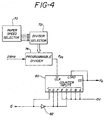
- FIGURE 4 An alternate configuration for implementing the frequency sources 56 and 58 and the switch 54 is shown in FIGURE 4.
- a user-operated paper speed selector is provided on the recorder to allow a user to select one of five different paper speeds: 100 mm/sec., 75 mm/sec., 50 mm/sec.. 25 mm/sec., or 10 mm/sec.
- the paper speed select lines are coupled to a divisor selector 72, where the selected paper speed is used to select a numeric divisor code for a programmable divider 74.
- the divider 74 receives a 2 MHz input signal and divides this frequency by the applied divisor. For a paper speed of 100 mm/sec., the 2 MHz frequency is divided by three. For the other paper speeds the divisors are 4, 6, 12 and 30, respectively.
- the divided-down signal, F ps is used as a clock signal for a counter 80. and it may be seen that this F ps clock signal is representative of paper speed.
- the counter 80 counts up from a preset starting number to 256, at which count it overflows and produces a pulse at its carry-out output CO. Since the CO output is connected to the "load” input, the CO pulse will immediately reload the counter with the preset number and again count up to 256 from that number.
- the preset number is determined by the state of the Q output of the flip-flop 52.
- the Q output is "high"
- the preset bit pattern loaded into inputs H-A of counter 80 is 10010111, which is a count of 151.
- the counter 80 will reach 256 and produce a CO pulse after 105 clock pulses.
- the bit pattern loaded into the counter is 01111111, or a count of 127.
- the counter will therefore count 129 clock pulses before producing a CO pulse.
- the difference between the clock pulses that must be counted between CO pulses for the two preset numbers is 129 minus 105. or a 24 count difference.
- the average of the two is 117 counts.
- the CO output of the counter 80 thus produces an F R motor reference signal which is t10% of an average frequency, F AVG' regardless of the speed of the paper or the frequency of the F ps signal.
- FIGURE 5a The relationship between the comparator output signal and the Q output of flip-flop 52 when paper tension changes from too much tension to too little tension is illustrated in FIGURE 5a.
- a motor reference signal frequency for proper paper tension is 70 Hz/mm/sec.
- This figure is a function of paper speed, as discussed above, where the paper speed is selectable from five possible speeds.
- the f H and f L signals are also a function of paper speed, and are ⁇ 10% of the desired frequency: f H is 77 Hz/mm/sec. and f L is 63 Hz/mm sec.
- the comparator and flip-flop When the paper tension is correct, the comparator and flip-flop will change state every cycle of the motor reference signal, which clocks the flip-flop.
- the motor 64 with its load, the developing drum 24 and the paper exhibit a mechanical time constant which is too slow to respond to this cycle-by-cycle change in motor reference frequency.
- the effect of this mechanical time constant is to integrate the effect of the frequency variation and the motor will turn at an intermediate, or average speed.
- the variation of the reference frequency between 77 Hz/mm/sec. and 63 Hz/mm/sec. is an average value, f AVG , of 70 Hz/mm/sec., the desired frequency when the paper tension is correct.
- This cycle-by-cycle switching of the F R signal frequency is obtained by feeding back the Q flip-flop signal by way of resistor 44 to the comparator input summing junction 40.
- the value of resistor 44 is chosen to be much larger than the value of resistor 42 so that the relative contribution of the feedback signal is small compared to that of the photocell signal.
Landscapes
- Engineering & Computer Science (AREA)
- Multimedia (AREA)
- Signal Processing (AREA)
- Controlling Rewinding, Feeding, Winding, Or Abnormalities Of Webs (AREA)
- Paper Feeding For Electrophotography (AREA)
- Projection-Type Copiers In General (AREA)
- Facsimile Scanning Arrangements (AREA)
- Facsimile Image Signal Circuits (AREA)
Applications Claiming Priority (2)
| Application Number | Priority Date | Filing Date | Title |
|---|---|---|---|
| GB858507652A GB8507652D0 (en) | 1985-03-25 | 1985-03-25 | Hard copy recorders |
| GB8507652 | 1985-03-25 |
Publications (2)
| Publication Number | Publication Date |
|---|---|
| EP0196208A2 true EP0196208A2 (de) | 1986-10-01 |
| EP0196208A3 EP0196208A3 (de) | 1988-08-17 |
Family
ID=10576570
Family Applications (2)
| Application Number | Title | Priority Date | Filing Date |
|---|---|---|---|
| EP86302158A Withdrawn EP0196851A3 (de) | 1985-03-25 | 1986-03-24 | Bildkontraststeuerung eines photographischen Kopiergerätes |
| EP86302157A Withdrawn EP0196208A3 (de) | 1985-03-25 | 1986-03-24 | Steuerung der Papiergeschwindigkeit in einem Hard-Copy-Gerät |
Family Applications Before (1)
| Application Number | Title | Priority Date | Filing Date |
|---|---|---|---|
| EP86302158A Withdrawn EP0196851A3 (de) | 1985-03-25 | 1986-03-24 | Bildkontraststeuerung eines photographischen Kopiergerätes |
Country Status (4)
| Country | Link |
|---|---|
| US (2) | US4706131A (de) |
| EP (2) | EP0196851A3 (de) |
| JP (2) | JPH0688707B2 (de) |
| GB (1) | GB8507652D0 (de) |
Families Citing this family (14)
| Publication number | Priority date | Publication date | Assignee | Title |
|---|---|---|---|---|
| DE3629422C2 (de) * | 1986-08-29 | 1994-02-17 | Agfa Gevaert Ag | Verfahren und Vorrichtung zum Einstellen von Belichtungsgrößen an einem Kopiergerät |
| JPS6469282A (en) * | 1987-09-07 | 1989-03-15 | Yamaha Corp | Error detection circuit for variable servo controller |
| US5021978A (en) * | 1989-04-21 | 1991-06-04 | Camtronics, Ltd. | Apparatus and method for controlling film density for an apparatus for exposing photographic film with image data |
| ATE169440T1 (de) * | 1990-09-21 | 1998-08-15 | Canon Kk | Abdruckbewertungsvorrichtung |
| JPH04263155A (ja) * | 1991-01-11 | 1992-09-18 | Alps Electric Co Ltd | テーププレーヤのテンション制御装置 |
| US5390020A (en) * | 1992-09-14 | 1995-02-14 | Eastman Kodak Company | Video amplifier stabilization for CRT printing |
| JPH09500514A (ja) * | 1994-05-06 | 1997-01-14 | フィリップス エレクトロニクス エヌ ベー | ハードコピーユニットの調整方法及び装置 |
| AUPP398798A0 (en) * | 1998-06-09 | 1998-07-02 | Silverbrook Research Pty Ltd | Image creation method and apparatus (ij43) |
| US6247792B1 (en) * | 1997-07-15 | 2001-06-19 | Silverbrook Research Pty Ltd | PTFE surface shooting shuttered oscillating pressure ink jet printing mechanism |
| US6840600B2 (en) * | 1997-07-15 | 2005-01-11 | Silverbrook Research Pty Ltd | Fluid ejection device that incorporates covering formations for actuators of the fluid ejection device |
| US6385346B1 (en) | 1998-08-04 | 2002-05-07 | Sharp Laboratories Of America, Inc. | Method of display and control of adjustable parameters for a digital scanner device |
| US7248284B2 (en) * | 2002-08-12 | 2007-07-24 | Edward Alan Pierce | Calibration targets for digital cameras and methods of using same |
| JP6344600B2 (ja) * | 2014-05-28 | 2018-06-20 | パナソニックIpマネジメント株式会社 | ウェブ処理装置 |
| CN111992589B (zh) * | 2019-05-27 | 2022-03-18 | 宝山钢铁股份有限公司 | 一种基于带钢表面亮度检测的bmd产线速度控制方法 |
Family Cites Families (24)
| Publication number | Priority date | Publication date | Assignee | Title |
|---|---|---|---|---|
| US3441825A (en) * | 1965-11-29 | 1969-04-29 | Gen Electric | Selected gain control system |
| FR1492164A (fr) * | 1966-06-07 | 1967-08-18 | Etudes De Machines Speciales | Dispositif de contrôle et de réglage de la tension d'une nappe débitée à partir d'une bobine |
| US3844463A (en) * | 1972-04-13 | 1974-10-29 | Park Air Corp | Plastic bag winding machine |
| JPS5282113A (en) * | 1975-12-29 | 1977-07-09 | Keisatsuchiyou Chiyoukan | Automatic brightness adjusting circuit for recording light sources |
| US4232257A (en) * | 1976-05-03 | 1980-11-04 | Ampex Corporation | Web transport capstan control system |
| JPS53141148A (en) * | 1977-05-17 | 1978-12-08 | Toshiba Corp | Reel driving method |
| JPS5444140U (de) * | 1977-09-01 | 1979-03-27 | ||
| GB2039197B (en) * | 1978-12-27 | 1982-11-24 | Ibm | Cathode ray tube printing apparatus and method |
| JPS55121431A (en) * | 1979-03-13 | 1980-09-18 | Fuji Photo Film Co Ltd | Cathode ray tube image recorder |
| JPS55135483A (en) * | 1979-04-09 | 1980-10-22 | Toshiba Corp | Color television camera device |
| GB2077238B (en) * | 1980-05-27 | 1984-06-13 | Data Recording Instr Co | Tensioning multilayer web fed through printer |
| JPS5760262A (en) * | 1980-09-29 | 1982-04-12 | Hitachi Ltd | Rotary detector for rotary object |
| US4429261A (en) * | 1980-12-06 | 1984-01-31 | Victor Company Of Japan, Limited | Apparatus for controlling the tension of a cassette tape |
| JPS57167154A (en) * | 1981-04-06 | 1982-10-14 | Sony Corp | Tape slip compensating device |
| JPS57208768A (en) * | 1981-06-19 | 1982-12-21 | Hitachi Ltd | Digitizing system for video signal |
| JPS5869355U (ja) * | 1981-11-04 | 1983-05-11 | ソニー株式会社 | テ−プテンシヨンコントロ−ル装置 |
| JPS58131088A (ja) * | 1982-01-29 | 1983-08-04 | Fujitsu Ltd | 媒体送り方式 |
| JPS59118645A (ja) * | 1982-12-23 | 1984-07-09 | Fuji Tekkosho:Kk | シ−ト状物速度差整合装置 |
| JPS59163967A (ja) * | 1983-03-08 | 1984-09-17 | Canon Inc | 像再生装置 |
| JPS6043972A (ja) * | 1983-08-22 | 1985-03-08 | Sony Corp | 映像の黒レベル再生回路 |
| EP0144188A2 (de) * | 1983-12-07 | 1985-06-12 | Xerox Corporation | Einrichtung zur Dichtenkorrektur einer Kopie |
| US4542281A (en) * | 1984-03-02 | 1985-09-17 | Combustion Engineering, Inc. | Thermal printer contrast control |
| US4568975A (en) * | 1984-08-02 | 1986-02-04 | Visual Information Institute, Inc. | Method for measuring the gray scale characteristics of a CRT display |
| JPS6164478A (ja) * | 1984-09-07 | 1986-04-02 | Kanzaki Paper Mfg Co Ltd | 速送り可能なプリンタ |
-
1985
- 1985-03-25 GB GB858507652A patent/GB8507652D0/en active Pending
-
1986
- 1986-03-10 US US06/837,994 patent/US4706131A/en not_active Expired - Lifetime
- 1986-03-10 US US06/838,076 patent/US4672396A/en not_active Expired - Fee Related
- 1986-03-24 JP JP61064282A patent/JPH0688707B2/ja not_active Expired - Lifetime
- 1986-03-24 EP EP86302158A patent/EP0196851A3/de not_active Withdrawn
- 1986-03-24 JP JP61064283A patent/JPS61224663A/ja active Pending
- 1986-03-24 EP EP86302157A patent/EP0196208A3/de not_active Withdrawn
Also Published As
| Publication number | Publication date |
|---|---|
| EP0196208A3 (de) | 1988-08-17 |
| EP0196851A3 (de) | 1988-08-17 |
| JPH0688707B2 (ja) | 1994-11-09 |
| JPS61224663A (ja) | 1986-10-06 |
| EP0196851A2 (de) | 1986-10-08 |
| US4672396A (en) | 1987-06-09 |
| JPS61226447A (ja) | 1986-10-08 |
| GB8507652D0 (en) | 1985-05-01 |
| US4706131A (en) | 1987-11-10 |
Similar Documents
| Publication | Publication Date | Title |
|---|---|---|
| US4672396A (en) | Hard copy recorder paper speed control | |
| FI75543C (fi) | Foerfarande och anordning foer frammatning av en datamaskinsblankettremsa. | |
| US3796117A (en) | Apparatus for intermittent processing for web materials | |
| GB1451738A (en) | Sheet guiding arrangements for copying machines | |
| US4560995A (en) | Recorder with self loading feed | |
| US3715944A (en) | Photocopying apparatus | |
| EP0393158B1 (de) | Überwachungsvorrichtung für den farbbandtransport | |
| GB1430047A (en) | Printer apparatus | |
| US4426653A (en) | Printing system for facsimile reception apparatus | |
| EP0110381A2 (de) | Vorrichtung zum Regeln der Bewegung eines beweglichen Bestandteils | |
| DE3407064C2 (de) | ||
| US5097273A (en) | Recording medium detecting apparatus | |
| US3948130A (en) | Device for controlling the feed of copying material in copying machines | |
| DE3247841C2 (de) | Elektrophotographisches Kopiergerät mit einer Auswahleinheit zur Steuerung der Kopienbilddichte | |
| GB1142717A (en) | Feed device for photocopy machine | |
| JPS5629256A (en) | Roll paper feeder in electrophotographic apparatus | |
| US4777418A (en) | Motor control method and apparatus | |
| JPS57108876A (en) | Pressure fixation device | |
| JPH0145066B2 (de) | ||
| JPS57182759A (en) | Copying machine | |
| DE4201682A1 (de) | Papierzufuhrmechanismus einer bilderzeugungsvorrichtung | |
| US4597652A (en) | Paper guide with width sensing and width indication system | |
| US4154528A (en) | Photographic film printer | |
| JPS5760769A (en) | Developing device | |
| JPS59128152A (ja) | 記録紙残量検出方法 |
Legal Events
| Date | Code | Title | Description |
|---|---|---|---|
| PUAI | Public reference made under article 153(3) epc to a published international application that has entered the european phase |
Free format text: ORIGINAL CODE: 0009012 |
|
| AK | Designated contracting states |
Kind code of ref document: A2 Designated state(s): AT BE CH DE FR GB IT LI LU NL SE |
|
| PUAL | Search report despatched |
Free format text: ORIGINAL CODE: 0009013 |
|
| AK | Designated contracting states |
Kind code of ref document: A3 Designated state(s): AT BE CH DE FR GB IT LI LU NL SE |
|
| STAA | Information on the status of an ep patent application or granted ep patent |
Free format text: STATUS: THE APPLICATION IS DEEMED TO BE WITHDRAWN |
|
| 18D | Application deemed to be withdrawn |
Effective date: 19890401 |
|
| RIN1 | Information on inventor provided before grant (corrected) |
Inventor name: PAPPAS, DEAN Inventor name: FIDEL, HOWARD FRANCIS |