EP0197402A2 - Vorrichtung zur Förderung von Dickstoffsuspensionen und Verfahren zu ihrem Betrieb - Google Patents
Vorrichtung zur Förderung von Dickstoffsuspensionen und Verfahren zu ihrem Betrieb Download PDFInfo
- Publication number
- EP0197402A2 EP0197402A2 EP86103935A EP86103935A EP0197402A2 EP 0197402 A2 EP0197402 A2 EP 0197402A2 EP 86103935 A EP86103935 A EP 86103935A EP 86103935 A EP86103935 A EP 86103935A EP 0197402 A2 EP0197402 A2 EP 0197402A2
- Authority
- EP
- European Patent Office
- Prior art keywords
- pumps
- cylinder
- delivery
- cycle
- thick matter
- Prior art date
- Legal status (The legal status is an assumption and is not a legal conclusion. Google has not performed a legal analysis and makes no representation as to the accuracy of the status listed.)
- Granted
Links
Images

Classifications
-
- F—MECHANICAL ENGINEERING; LIGHTING; HEATING; WEAPONS; BLASTING
- F04—POSITIVE - DISPLACEMENT MACHINES FOR LIQUIDS; PUMPS FOR LIQUIDS OR ELASTIC FLUIDS
- F04B—POSITIVE-DISPLACEMENT MACHINES FOR LIQUIDS; PUMPS
- F04B15/00—Pumps adapted to handle specific fluids, e.g. by selection of specific materials for pumps or pump parts
- F04B15/02—Pumps adapted to handle specific fluids, e.g. by selection of specific materials for pumps or pump parts the fluids being viscous or non-homogeneous
-
- F—MECHANICAL ENGINEERING; LIGHTING; HEATING; WEAPONS; BLASTING
- F04—POSITIVE - DISPLACEMENT MACHINES FOR LIQUIDS; PUMPS FOR LIQUIDS OR ELASTIC FLUIDS
- F04B—POSITIVE-DISPLACEMENT MACHINES FOR LIQUIDS; PUMPS
- F04B7/00—Piston machines or pumps characterised by having positively-driven valving
- F04B7/0019—Piston machines or pumps characterised by having positively-driven valving a common distribution member forming a single discharge distributor for a plurality of pumping chambers
- F04B7/0026—Piston machines or pumps characterised by having positively-driven valving a common distribution member forming a single discharge distributor for a plurality of pumping chambers and having an oscillating movement
Definitions
- the invention relates to a device for conveying thick matter suspensions with two-cylinder pumps, the cylinders of which can be alternately connected to the inflow of the thick matter suspension and the pressure line via a slide, and to a method for operating such a device.
- These two-cylinder or twin-piston pumps which are also known under the name of concrete pumps, are long-stroke piston pumps with hydraulic drive, whereby the respective working cylinder is alternately connected to the pressure delivery line and the cylinder head opening by means of a slide element which is arranged in the region of the cylinder heads of the counter cylinder is released for the suction stroke.
- Such a two-cylinder pump is described, for example, in DOS 21 53 204, in which the cylinder is alternately designed with a pressure or suction line as a swivel tube, so that both pressure line and suction line are common to both cylinders.
- the delivery pistons of the respective cylinders are driven hydraulically or, as is also known from DAS 21 06 713, via a pull rope.
- twin piston pumps are also used in mining, for example for pumping backfills, for example floating mountains from ore processing for backfilling of underground spaces.
- a disadvantage is the fact that the masses to be delivered in the delivery line, which are only to be pumped under high pump pressure, have to be started again after each work interruption, ie after each slide actuation, and accelerated to the conveying speed.
- the start-up pressure exceeds the pressure required for the actual conveying quite considerably, so that the installed capacity must be oversized in such an order of magnitude and so again excessive energy consumption occurs.
- the working cycle of a pump cylinder is such; two-cylinder piston pump from the delivery stroke, the shifting into the suction position, the suction stroke and the shifting into the delivery position, i.e. from four functions, three of which represent an interruption of the delivery process.
- a conventional two-cylinder piston pump allows the two cylinders to perform suction and delivery strokes alternately, so that delivery takes place during the duration of the two functions during the entire cycle duration of the four functions, but this is interrupted each time the slide is actuated.
- the object of the present invention is therefore to largely eliminate the disadvantages of the two-cylinder piston pump described above when pumping highly consistent sludges, which result in the alternating braking and acceleration of the flow and the resulting load on the entire device and system, so that a Device is obtained that delivers a continuous flow of material to be conveyed, represents a lower load on the entire system and has a lower energy requirement.
- This object is achieved according to the invention in that two two-cylinder pumps are connected with their pressure lines via a rotary valve to a common pressure line, the second two-cylinder piston pump being operated at a time delayed by a quarter cycle in such a way that a total of four delivery cycles are carried out in a complete working cycle occur.
- twin piston pumps of the type described in the introduction are preferably switched on mutually accordingly via an electrical / electronic control, whereby, in contrast to the normal operation of the twin pump, the respective operating cycle of a cylinder does not start at full power, but rather starts up over a time-stretched phase and also also the end of the delivery stroke runs smoothly, d. H. doesn't suddenly end.
- There are delayed start-up and run-down phases with each delivery stroke and in these delayed start-up and run-down phases two successive cylinders each overlap, so that an essentially continuous delivery flow is produced while maintaining the delivery pressure and the delivery rate.
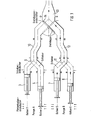
- Fig. 1 the two pistons 1, 2 and the two cylinders 3, 4 of the one pump A are shown schematically and the pistons 5, 6 and the two cylinders 7, 8 of the second pump B.
- the pump A delivers in the area 9 slide located in the delivery line 10, alternately from the cylinder 3 or 4 and the pump B delivers via a slide located in the region 11 into the delivery line 12, also alternately from the cylinder 7 or 8.
- the delivery lines 10 and 12 open into a pressure line 13, a rotary valve slide 14 being provided at the junction point, so that the successive delivery strokes can be supplied to the pressure line 13 in a controlled manner by the two pumps.
- the movement of the pistons 1, 2, 5 and 6 of the pumps A and B is effected hydraulically or by another drive means and is regulated in their final phases by electrical or electronic switching devices, for example limit switches.
- electrical or electronic switching devices for example limit switches.
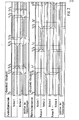
- FIG. 2 the operation with the device according to the invention is shown, specifically with the device as shown schematically in FIG. 1, consisting of pumps A and B, of pistons 1, 2 and 5, 6. It can be seen, from the bottom row, "Addition of the delivery quantities", that an essentially continuous flow of material or flow quantity is achieved.
- the delivery strokes of the individual pistons of the two pumps are controlled by a corresponding electrical or electronic control so that the delivery strokes connect to one another in a stepless manner.
- This distribution of shares is brought about by the slide member 14, referred to as the rotary valve, between the pumps, which either takes place automatically according to the delivery volume distribution between pumps A and B, or is actuated in that its opening or closing play extends over the duration of the delivery forecast overlap and at the end of this Overlapping process she has reached the position 100: 0 or 0: 100. If the rotary valve 14 is provided with its own drive, it is equipped with end position indicators, the impulses of which are processed in the control of the pumps.
- the electrohydraulic drive (power packs) can be carried out individually for each twin pump with a possibility of reducing the amount of pressure medium, eg. B. oil, up and down in accordance with the desired marching speed of the individual piston or as a central drive for both twin pumps, the amount of pressure medium being supplied to the working cylinders in operation. In the latter case, a smooth transition is ensured in the switching process by positive overlap (FIG. 2).
- pressure medium eg. B. oil
- FIG. 3 shows such an enlarged device which comprises a number of pumps which are a multiple of two, namely twice two and which are operated in the same way as explained above.
- the units C and D feed into a common pressure line 15.
- valve 17 is not required if the switching processes of pumps 1 and 2 and 3 and 4 take place simultaneously. More than two pumps will only run in parallel for the purpose of increasing performance - so cylinders have to deliver at the same time.
Landscapes
- Engineering & Computer Science (AREA)
- Mechanical Engineering (AREA)
- General Engineering & Computer Science (AREA)
- Reciprocating Pumps (AREA)
- Spinning Or Twisting Of Yarns (AREA)
- Farming Of Fish And Shellfish (AREA)
- Excavating Of Shafts Or Tunnels (AREA)
- Treatment Of Sludge (AREA)
- Load-Engaging Elements For Cranes (AREA)
Abstract
Description
- Die Erfindung betrifft eine Vorrichtung zur Förderung von Dickstoffsuspensionen mit zweizylindrigen Pumpen, deren Zylinder über einen Schieber wechselweise mit dem Zufluß der Dickstoffsuspension und der Druckleitung verbindbar sind sowie ein Verfahren zum Betrieb einer solchen Vorrichtung.
- Bei diesen zweizylindrigen oder Zwillingskolbenpumpen, die auch unter der Bezeichnung Betonpumpen bekannt sind, handelt es sich um langhubige Kolbenpumpen mit hydraulischem Antrieb, wobei vermittels eines Schieberelements, welches im Bereiche der Zylinderköpfe angeordnet ist, wechselweise der jeweilige Arbeitszylinder mit der Druckförderleitung verbunden ist und die Zylinderkopföffnung des Gegenzylinders für den Saughub freigegeben ist.
- Eine solche zweizylindrige Pumpe ist beispielsweise beschrieben in der DOS 21 53 204, bei der der Zylinder wechselweise mit Druck- bzw. Saugleitung als Schwenkrohr ausgeführt ist, so daß beiden Zylindern sowohl Druckleitung als auch Saugleitung gemeinsam sind. Der Antrieb der Förderkolben des jeweiligen Zylinders erfolgt hydraulisch oder wie aus der DAS 21 06 713 auch bekannt, über ein Zugseil.
- Diese Zwillingskolbenpumpen werden auch im Bergbau eingesetzt, beispielsweise zum Fördern von Versatzbergen, beispielsweise Schwimmbergen aus der Erzaufbereitung zum Versatz von untertägigen Räumen.
- Bei dieser Art des Einsatzes wird über relativ lange Strecken durch Rohrleitungen eine hochkonsistente Dickstoffsuspension oder Schlamm gefördert.
- Das Kritische an solchen Pumpen bei dem oben geschilderten Einsatz ist der Umstand, daß sich der Schieber, das Herzstück einer Pumpe, in dem zu verpumpenden abrasiven Material bewegen muß und insbesondere an seinen Dichtflächen hohem Verschleiß unterliegt. Dieser Verschleiß nimmt zu mit der Abrasivität des zu verpumpenden Materials und seiner Grobkörnigkeit, besonders aber auch mit dem Arbeitsdruck der Pumpe. Daher handelt es sich bei allen Ausführungsformen dieser Schieber um einfache, ganz besonders robuste Konstruktionen, deren Betätigung lansam und schwerfällig abläuft.
- Es ist dabei ferner zu beachten, daß während des Umschieberns der Fördervorgang jeweils zum Stillstand kommt. Darin liegt für die Dickstofförderung allgemein ein beträchtlicher Nachteil, der umso stärker zum Tragen kommt, je höher die Konsistenz des Fördermaterials ist oder je weiter die Förderwege sind und/oder je höher die Pumpendrücke sind oder bei Hochleistungseinsätzen und Dauereinsätzen.
- Ein Nachteil ist nämlich die Tatsache, daß die nur unter hohem Pumpendruck zu fördernden, in der Förderleitung stehenden Massen nach jeder Arbeitsunterbrechung, d. h. nach jeder Schieberbetätigung, wieder angefahren und auf Fördergeschwindigkeit beschleunigt werden müssen. Dabei übersteigt der Anfahrdruck den zur eigentlichen Förderung erforderlichen Druck ganz erheblich, so daß in entsprechender Größenordnung die installierte Leistung überdimensioniert werden muß und so wiederum übermäßiger Energieverbrauch auftritt.
- Das bedeutet wiederum auch eine entsprechende Oberdimnensionierung der statisch beanspruchten Bauteile der mit dem Förderdruck in Berührung stehenden Vorrichtung. Zunehmend mit wachsendem Pumpendruck erleidet die Pumpe selbst, aber auch die angeschlossene Förderleitung, bei jedem neuen Arbeitshub einen starken Schlag, der im Dauerbetrieb mechanische Schäden herbeiführt und die Betriebssicherheit in Frage stelJt. Es ist nicht einmal ausgeschlossen, daß die Arbeitssicherheit nahe bei Pumpen und Rohrleitungen gefährdet ist.
- Unter Berücksichtigung des oben geschilderten Sachverhalts be - steht der Arbeitszyklus eines Pumpenzylinders einer solchen; zweizylindrigen Kolbenpumpe aus dem Förderhub, dem Umschiebern in die Saugstellung, dem Saughub und dem Umschiebern in die Förderstellung, also aus vier Funktionen, von denen drei eine Unterbechung des Fördervorgangs darstellen. Eine herkömmliche zweizylindrige Kolbenpumpe, wie oben beschrieben, läßt die beiden Zylinder wechselweise Saug-und Förderhübe ausführen, so daß während der Gesamtzyklusdauer der vier Funktionen Förderung während der Dauer zweier Funktionen stattfindet, die aber jeweils für die Zeit der Schieberbetätigung unterbrochen wird.
- Aufgabe der vorliegenden Erfindung ist es daher, die oben beschriebenen Nachteile der zweizylindrigen Kolbenpumpe beim Fördern von hochkonsistenten Schlämmen, welche in der wechselnden Abbremsung und Beschleunigung des Förderstromes und der sich daraus ergebenden Belastung der gesamten Vorrichtung und Anlage ergeben, weitgehend zu beseitigen, so daß eine Vorrichtung erhalten wird, die einen kontinuierlichen Fördergutstrom liefert, eine geringere Belastung der gesamten Anlage darstellt und einen niedrigeren Energiebedarf aufweist.
- Gelöst wird diese Aufgabe erfindungsgemäß dadurch, daß zwei zweizylindrige Pumpen mit ihren Druckleitungen über einen Drehklappenschieber an eine gemeinsame Druckleitung angeschlossen sind, wobei die zweite zweizylindrige Kolbenpumpe um einen Viertel Zyklus zeitlich verschoben zur ersten betrieben wird, derart, daß in einem vollständigen Arbeitszyklus insgesamt vier Fördertakte stattfinden.
- In Verfolg des Erfindungsgedankens werden vorzugsweise über eine elektrisch/elektronische Steuerung Zwillingskolbenpumpen der eingangs beschriebenen Art gegenseitig entsprechend zugeschaltet, wobei abweichend vom üblichen Betrieb der Zwillingspumpe der jeweilige Arbeitstakt eines Zylinders nicht mit der vollen Leistung einsetzt, sondern über eine zeitlich gedehnte Phase anläuft und ebenso auch das Ende des Förderhubes weich ausläuft, d. h. nicht plötzlich endet. Es sind also bei jedem Förderhub verzögerte An- und Auslaufphasen vorhanden, und in diesen verzögerten An- und Auslaufphasen überlappen sich jeweils zwei aufeinanderfolgende Zylinder, so daß ein im wesentlichen kontinuierlicher Förderstrom unter ununterbrochener Aufrechterhaltung des Förderdruckes und der Fördermenge entsteht.
- Die Erfindung wird nun anhand einer zeichnerischen Darstellung näher erläutert, in der
- Fig. 1 die erfindungsgemäße Vorrichtung in schematischer vereinfachter Darstellung zeigt,
- Fig. 2 ein Diagramm, in dem in vergleichender Darstellung die Förderung einer zweizylindrigen Kolbenpumpe und der erfindungsgemäßen Mehrkolbenpumpe dargestellt ist (Fördermengendiagramm) und
- Fig. 3 eine Ausgestaltung mit vier zweizylindrigen Pumpen.
- In Fig. 1 sind schematisch die beiden Kolben 1, 2 und die beiden Zylinder 3, 4 der einen Pumpe A dargestellt und die Kolben 5,6 und die beiden Zylinder 7, 8 der zweiten Pumpe B. Die Pumpe A fördert über den im Bereich 9 liegenden Schieber in die Förderleitung 10, und zwar wechselweise aus dem Zylinder 3 bzw. 4 und die Pumpe B fördert über einen im Bereich 11 liegenden Schieber in die Förderleitung 12, ebenfalls wechselweise aus dem Zylinder 7 bzw. 8.
- Die Förderleitungen 10 und 12 münden in eine Druckleitung 13, wobei an der Einmündungsstelle ein Drehklappenschieber 14 vorgesehen ist, damit die aufeinanderfolgenden Förderhübe von den beiden Pumpen in gesteuerter Weise der Druckleitung 13 zugeleitet werden können. Die Bewegung der Kolben 1, 2, 5 und 6 der Pumpen A und B wird hydraulisch oder durch ein anderes Antriebsmittel bewirkt und in ihren Endphasen durch elektrische oder eiektronische Schalteinrichtungen, beispielsweise Endschalter, geregelt. Für den erfindungsgemäßen Betrieb der Vorrichtung ist es von besonderem Vorteil, den jeweiligen Arbeitstakt eines Zylinders langsam anlaufen und auch langsam zu Ende gehen zu lassen, d. h. über eine zeitlich gedehnte Phase, was in Fig. 2 durch die Bezeichnung t1....tn angedeutet ist.
- In Fig. 2 ist der Druckverlauf beim Wechsel des fördernden Zylinders einer Zweizylinderpumpe dargestellt. Man erkennt deutlich die Druckeinbrüche und die Druckspitzen, und zwar aus der horizontalen Reihe, die links für den Zweikolbenbetrieb mit Addition der Fördermengen bezeichnet ist, und zwar in der Zeit t1 und t3 bzw. t5, t7 usw. In den Zeiten t2 und t6 schaltet der Schieber gerade von einem Kolben auf den anderen um.
- In dem unteren Teil der Fig. 2 ist der Betrieb mit der erfindungsgemäßen Vorrichtung dargestellt, und zwar mit der Vorrichtung, wie sie schematisch in Fig. 1 gezeigt ist, bestehend aus Pumpen A und B, aus Kolben 1, 2 und 5, 6. Es ist zu erkennen, und zwar aus der unteren Reihe, "Addition der Fördermengen", daß ein im wesentlichen kontinuierlicher Gutstrom oder Fördermengenstrom erzielt wird. Die Förderhübe der einzelnen Kolben der beiden Pumpen sind durch eine entsprechende elektrische oder elektronische Steuerung so gesteuert, daß sich die Förderhübe stufenlos aneinander anschließen.
- Es ist also wesentlich für die Erfindung, daß während der Dauer des Oberlappens zweier Förderhübe, was sich aus den Spalten t1, t3, t5 und t7 erkennen läßt, die Beschickung der Förderleitung 13 gleichzeitig von zwei Zylindern wahrgenommen wird. Für diese Dauer des Fördervorganges steht an beiden Zylindern der volle Förderdruck an, während gleichzeitig die Fördermenge sich von einer Anteilsaufteilung 100 : 0 zu einer solchen 0 : 100 entwickelt. Diese Anteilsaufteilung wird von dem als Drehklappe bezeichneten Schieberorgan 14 zwischen den Pumpen herbeigeführt, was entweder selbsttätig erfolgt entsprechend der Fördermengenverteilung zwischen Pumpen A und B oder zwangsbetätigt, indem ihr Öffnungs- bzw. Schließspiel sich zeitlich über die Dauer der Fördervorgnagsüberlappung erstreckt und am Ende dieses Oberlappungsvorganges sie die Stellung 100 : 0 respektive 0 : 100 erreicht hat. Wenn die Drehklappe 14 mit einem eigenen Antrieb versehen wird, ist sie mit Endstellungsmeldern ausgerüstet, deren Impulse bei der Steuerung der Pumpen verarbeitet werden.
- In Verfolg des Erfindungsgedankens kann der elektrohydraulische Antrieb (Power Packs) für jede Zwillingspumpe einzeln ausgesführt sein mit einer Möglichkeit, die Druckmittelmenge, z. B. Öl, jeweils entsprechend der gewünschten Marschgeschwindigkeit des Einzelkolbens auf-und abzuregeln oder als zentraler Antrieb für beide Zwillingspumpen, wobei die Druckmittelmenge den jeweils im Betrieb befindlichen Arbeitszylindern zugeführt wird. Im letzteren Fall wird beim Umschaltungsvorgang durch positive Oberschneidung für einen weichen Obergang gesorgt (Fig. 2).
- Es kann durchaus sinnvoll sein, auch aus Gründen der Leistungssteigerung, mehr als eine einzelne zweizylindrige Kolbenpumpe gleichzeitig zu betreiben und in eine gemeinsame Förderleitung einspeisen zu lassen. Während aber bei herkömmlicher Betriebsweise der Pumpen sich auf solche Weise die Schläge im Zusammenhang mit Förderunterbrechungen nacn Anzahl bzw. Intensität erhöhen müssen, ist es bei der erfindungsgemäßen Vorrichtung und Betriebsweise bzw. Schaltung der Pumpen und Fahrweise möglich, jede Anzahl von Pumpen, die einem Vielfachen von zwei entspricht, ebenso vorteilhaft zu betreiben, wie dies oben für zwei Pumpen geschildert ist.
- In Fig. 3 ist eine solche vergrößerte Vorrichtung dargestellt, die eine Anzahl von Pumpen umfaßt, die ein Vielfaches von zwei sind, nämlich zweimal zwei und die ebenso betrieben werden wie oben erläutert. Die Aggregate C und D fördern in eine gemeinsame Druckleitung 15.
- Das Ventil 17 ist nicht erforderlich, wenn die Schaltvorgänge der Pumpen 1 und 2 sowie 3 und 4 zeitgleich erfolgen. Mehr als zwei Pumpen werden nur zu dem Zweck parallel gefahren werden, die Leistung zu erhöhen - also müssen Zylinder gleichzeitig fördern.
Claims (5)
Priority Applications (1)
| Application Number | Priority Date | Filing Date | Title |
|---|---|---|---|
| AT86103935T ATE53635T1 (de) | 1985-04-11 | 1986-03-22 | Vorrichtung zur foerderung von dickstoffsuspensionen und verfahren zu ihrem betrieb. |
Applications Claiming Priority (2)
| Application Number | Priority Date | Filing Date | Title |
|---|---|---|---|
| DE19853512946 DE3512946A1 (de) | 1985-04-11 | 1985-04-11 | Vorrichtung zur foerderung von dickstoffsuspensionen und verfahren zu ihrem betrieb |
| DE3512946 | 1985-04-11 |
Publications (3)
| Publication Number | Publication Date |
|---|---|
| EP0197402A2 true EP0197402A2 (de) | 1986-10-15 |
| EP0197402A3 EP0197402A3 (en) | 1987-08-05 |
| EP0197402B1 EP0197402B1 (de) | 1990-06-13 |
Family
ID=6267704
Family Applications (1)
| Application Number | Title | Priority Date | Filing Date |
|---|---|---|---|
| EP86103935A Expired - Lifetime EP0197402B1 (de) | 1985-04-11 | 1986-03-22 | Vorrichtung zur Förderung von Dickstoffsuspensionen und Verfahren zu ihrem Betrieb |
Country Status (7)
| Country | Link |
|---|---|
| EP (1) | EP0197402B1 (de) |
| JP (1) | JPS61252876A (de) |
| AT (1) | ATE53635T1 (de) |
| AU (1) | AU587816B2 (de) |
| CA (1) | CA1281592C (de) |
| DE (2) | DE3512946A1 (de) |
| ZA (1) | ZA862657B (de) |
Cited By (5)
| Publication number | Priority date | Publication date | Assignee | Title |
|---|---|---|---|---|
| EP0315750A1 (de) * | 1987-11-12 | 1989-05-17 | Putzmeister-Werk Maschinenfabrik Gmbh | Dickstoff-Pumpe |
| EP0340050A1 (de) * | 1988-03-04 | 1989-11-02 | Societe Auxiliaire De Transport Et De Materiel (S.A.T.M.) | Verfahren und Vorrichtung zum Transport von Feststoffen durch Aufschlämmen und Pumpen |
| EP0964271A3 (de) * | 1998-06-10 | 2000-07-05 | STN ATLAS Elektronik GmbH | Unterwasser-Schleppantenne |
| WO2006125606A1 (de) * | 2005-05-23 | 2006-11-30 | Friedrich Schwing | Verfahren zum steuern einer pumpvorrichtung zur förderung breiiger massen sowie steuerung einer pumpvorrichtung zur förderung breiiger massen |
| CN111878343A (zh) * | 2020-07-31 | 2020-11-03 | 温艳东 | 混凝土泵送设备及其控制方法 |
Families Citing this family (3)
| Publication number | Priority date | Publication date | Assignee | Title |
|---|---|---|---|---|
| JPH07103847B2 (ja) * | 1991-02-12 | 1995-11-08 | 株式会社新潟鉄工所 | 多連コンクリートポンプ装置 |
| JPH07103848B2 (ja) * | 1991-02-12 | 1995-11-08 | 株式会社新潟鉄工所 | 多連コンクリートポンプ装置 |
| CN106968908B (zh) * | 2017-03-29 | 2020-06-30 | 长乐智睿恒创节能科技有限责任公司 | 一种平稳输送混凝土泵以及控制方法 |
Family Cites Families (7)
| Publication number | Priority date | Publication date | Assignee | Title |
|---|---|---|---|---|
| US3279382A (en) * | 1964-04-14 | 1966-10-18 | Royal Industries | Pump |
| JPS5011083A (de) * | 1973-05-29 | 1975-02-04 | ||
| JPS573835B2 (de) * | 1974-03-25 | 1982-01-22 | ||
| GB1585073A (en) * | 1976-05-15 | 1981-02-25 | Ackermann R A | Pumping devices |
| DE2909964A1 (de) * | 1979-03-14 | 1980-09-25 | Schwing Gmbh F | Dickstoffpumpe, insbesondere fuer beton |
| US4580954A (en) * | 1983-05-23 | 1986-04-08 | Boyle Bede Alfred | Oscillating-deflector pump |
| AU561932B2 (en) * | 1983-05-23 | 1987-05-21 | Bede Alfred Boyle | Opposed piston hydraulic slurry pump with flow control valve |
-
1985
- 1985-04-11 DE DE19853512946 patent/DE3512946A1/de not_active Ceased
-
1986
- 1986-03-22 AT AT86103935T patent/ATE53635T1/de not_active IP Right Cessation
- 1986-03-22 DE DE8686103935T patent/DE3671939D1/de not_active Expired - Fee Related
- 1986-03-22 EP EP86103935A patent/EP0197402B1/de not_active Expired - Lifetime
- 1986-04-09 ZA ZA862657A patent/ZA862657B/xx unknown
- 1986-04-11 CA CA000506435A patent/CA1281592C/en not_active Expired - Fee Related
- 1986-04-11 AU AU56043/86A patent/AU587816B2/en not_active Ceased
- 1986-04-11 JP JP61082446A patent/JPS61252876A/ja active Pending
Cited By (5)
| Publication number | Priority date | Publication date | Assignee | Title |
|---|---|---|---|---|
| EP0315750A1 (de) * | 1987-11-12 | 1989-05-17 | Putzmeister-Werk Maschinenfabrik Gmbh | Dickstoff-Pumpe |
| EP0340050A1 (de) * | 1988-03-04 | 1989-11-02 | Societe Auxiliaire De Transport Et De Materiel (S.A.T.M.) | Verfahren und Vorrichtung zum Transport von Feststoffen durch Aufschlämmen und Pumpen |
| EP0964271A3 (de) * | 1998-06-10 | 2000-07-05 | STN ATLAS Elektronik GmbH | Unterwasser-Schleppantenne |
| WO2006125606A1 (de) * | 2005-05-23 | 2006-11-30 | Friedrich Schwing | Verfahren zum steuern einer pumpvorrichtung zur förderung breiiger massen sowie steuerung einer pumpvorrichtung zur förderung breiiger massen |
| CN111878343A (zh) * | 2020-07-31 | 2020-11-03 | 温艳东 | 混凝土泵送设备及其控制方法 |
Also Published As
| Publication number | Publication date |
|---|---|
| JPS61252876A (ja) | 1986-11-10 |
| EP0197402A3 (en) | 1987-08-05 |
| ZA862657B (en) | 1986-12-30 |
| CA1281592C (en) | 1991-03-19 |
| AU5604386A (en) | 1986-11-20 |
| AU587816B2 (en) | 1989-08-31 |
| DE3512946A1 (de) | 1986-10-16 |
| DE3671939D1 (de) | 1990-07-19 |
| EP0197402B1 (de) | 1990-06-13 |
| ATE53635T1 (de) | 1990-06-15 |
Similar Documents
| Publication | Publication Date | Title |
|---|---|---|
| DE1296524B (de) | Kolbenpumpe fuer dickfluessige, breiige Massen, insbesondere Beton od. dgl. | |
| DE2129322A1 (de) | Einrichtung zum Synchronisieren einer Mehrzahl von hydraulischen Kolbenkrafttrieben | |
| EP0231735A1 (de) | Gleichlaufregeleinrichtung für einen hydraulischen Mehrzylinderantrieb | |
| EP0465474B1 (de) | Steuerungsanordnung für eine zweizylinder-dickstoffpumpe | |
| EP0446206B1 (de) | Verfahren und vorrichtung zur steuerung einer zweizylinder-dickstoffpumpe | |
| EP0197402B1 (de) | Vorrichtung zur Förderung von Dickstoffsuspensionen und Verfahren zu ihrem Betrieb | |
| DE3030005C2 (de) | Hydraulischer Antrieb für eine Zweizylinder-Betonpumpe | |
| DE2646290A1 (de) | 4/2-wegeventil | |
| DE3032430C2 (de) | ||
| DE2349351C3 (de) | Hydrauliksystem für eine Presse | |
| EP0034745A1 (de) | Steuerschieber für Dickstoffpumpen | |
| DE4446580A1 (de) | Doppelpresse | |
| DE3525003A1 (de) | Verfahren und vorrichtung zum foerdern von beton aus einem behaelter in eine lieferleitung | |
| DE3919640C2 (de) | Steuerventileinrichtung mit zwei Steuerblöcken und Pumpensteuerung für mehrere hydraulische Antriebe | |
| DE2814525A1 (de) | Extruder-presse | |
| DE2721678A1 (de) | Schlammpumpe | |
| DE2626971A1 (de) | Kolbenpumpe zur verwendung mit einer druckoel fuehrenden hydraulikanlage | |
| DE2542392A1 (de) | Hochdruckmembranpumpe | |
| AT403949B (de) | Fördervorrichtung | |
| DE69103301T3 (de) | Schmiedeverfahren und Schmiedemaschine zur Durchführung des Verfahrens. | |
| DE3505541A1 (de) | Verfahren zum antrieb einer pumpe fuer beton o.dgl. sowie eine pumpe zur ausuebung des verfahrens | |
| DE2139188C3 (de) | Einrichtung zum periodischen Unterbrechen der Vorschubbewegung eines Arbeitsschlittens | |
| DE102023212034A1 (de) | Strang- und Rohrpresse | |
| DE10054834B4 (de) | Dosiervorrichtung | |
| DD148868A3 (de) | Pressenstrasse |
Legal Events
| Date | Code | Title | Description |
|---|---|---|---|
| PUAI | Public reference made under article 153(3) epc to a published international application that has entered the european phase |
Free format text: ORIGINAL CODE: 0009012 |
|
| AK | Designated contracting states |
Kind code of ref document: A2 Designated state(s): AT BE CH DE FR GB IT LI LU NL SE |
|
| ITCL | It: translation for ep claims filed |
Representative=s name: FIAMMENGHI FIAMMENGHI RACHELI |
|
| TCNL | Nl: translation of patent claims filed | ||
| EL | Fr: translation of claims filed | ||
| PUAL | Search report despatched |
Free format text: ORIGINAL CODE: 0009013 |
|
| AK | Designated contracting states |
Kind code of ref document: A3 Designated state(s): AT BE CH DE FR GB IT LI LU NL SE |
|
| RHK1 | Main classification (correction) |
Ipc: F04B 15/02 |
|
| 17P | Request for examination filed |
Effective date: 19870821 |
|
| 17Q | First examination report despatched |
Effective date: 19880209 |
|
| ITF | It: translation for a ep patent filed | ||
| GRAA | (expected) grant |
Free format text: ORIGINAL CODE: 0009210 |
|
| AK | Designated contracting states |
Kind code of ref document: B1 Designated state(s): AT BE CH DE FR GB IT LI LU NL SE |
|
| REF | Corresponds to: |
Ref document number: 53635 Country of ref document: AT Date of ref document: 19900615 Kind code of ref document: T |
|
| ET | Fr: translation filed | ||
| GBT | Gb: translation of ep patent filed (gb section 77(6)(a)/1977) | ||
| REF | Corresponds to: |
Ref document number: 3671939 Country of ref document: DE Date of ref document: 19900719 |
|
| ITTA | It: last paid annual fee | ||
| PLBE | No opposition filed within time limit |
Free format text: ORIGINAL CODE: 0009261 |
|
| STAA | Information on the status of an ep patent application or granted ep patent |
Free format text: STATUS: NO OPPOSITION FILED WITHIN TIME LIMIT |
|
| 26N | No opposition filed | ||
| EPTA | Lu: last paid annual fee | ||
| EAL | Se: european patent in force in sweden |
Ref document number: 86103935.2 |
|
| PGFP | Annual fee paid to national office [announced via postgrant information from national office to epo] |
Ref country code: AT Payment date: 20010207 Year of fee payment: 16 |
|
| PGFP | Annual fee paid to national office [announced via postgrant information from national office to epo] |
Ref country code: FR Payment date: 20010208 Year of fee payment: 16 |
|
| PGFP | Annual fee paid to national office [announced via postgrant information from national office to epo] |
Ref country code: CH Payment date: 20010216 Year of fee payment: 16 |
|
| PGFP | Annual fee paid to national office [announced via postgrant information from national office to epo] |
Ref country code: GB Payment date: 20010219 Year of fee payment: 16 |
|
| PGFP | Annual fee paid to national office [announced via postgrant information from national office to epo] |
Ref country code: SE Payment date: 20010223 Year of fee payment: 16 |
|
| PGFP | Annual fee paid to national office [announced via postgrant information from national office to epo] |
Ref country code: NL Payment date: 20010226 Year of fee payment: 16 |
|
| PGFP | Annual fee paid to national office [announced via postgrant information from national office to epo] |
Ref country code: LU Payment date: 20010306 Year of fee payment: 16 |
|
| PGFP | Annual fee paid to national office [announced via postgrant information from national office to epo] |
Ref country code: BE Payment date: 20010309 Year of fee payment: 16 |
|
| PGFP | Annual fee paid to national office [announced via postgrant information from national office to epo] |
Ref country code: DE Payment date: 20010312 Year of fee payment: 16 |
|
| REG | Reference to a national code |
Ref country code: GB Ref legal event code: IF02 |
|
| PG25 | Lapsed in a contracting state [announced via postgrant information from national office to epo] |
Ref country code: LU Free format text: LAPSE BECAUSE OF NON-PAYMENT OF DUE FEES Effective date: 20020322 Ref country code: GB Free format text: LAPSE BECAUSE OF NON-PAYMENT OF DUE FEES Effective date: 20020322 Ref country code: AT Free format text: LAPSE BECAUSE OF NON-PAYMENT OF DUE FEES Effective date: 20020322 |
|
| PG25 | Lapsed in a contracting state [announced via postgrant information from national office to epo] |
Ref country code: SE Free format text: LAPSE BECAUSE OF NON-PAYMENT OF DUE FEES Effective date: 20020323 |
|
| PG25 | Lapsed in a contracting state [announced via postgrant information from national office to epo] |
Ref country code: LI Free format text: LAPSE BECAUSE OF NON-PAYMENT OF DUE FEES Effective date: 20020331 Ref country code: CH Free format text: LAPSE BECAUSE OF NON-PAYMENT OF DUE FEES Effective date: 20020331 Ref country code: BE Free format text: LAPSE BECAUSE OF NON-PAYMENT OF DUE FEES Effective date: 20020331 |
|
| BERE | Be: lapsed |
Owner name: *PREUSSAG A.G. METALL Effective date: 20020331 |
|
| PG25 | Lapsed in a contracting state [announced via postgrant information from national office to epo] |
Ref country code: NL Free format text: LAPSE BECAUSE OF NON-PAYMENT OF DUE FEES Effective date: 20021001 Ref country code: DE Free format text: LAPSE BECAUSE OF NON-PAYMENT OF DUE FEES Effective date: 20021001 |
|
| EUG | Se: european patent has lapsed |
Ref document number: 86103935.2 |
|
| GBPC | Gb: european patent ceased through non-payment of renewal fee |
Effective date: 20020322 |
|
| REG | Reference to a national code |
Ref country code: CH Ref legal event code: PL |
|
| PG25 | Lapsed in a contracting state [announced via postgrant information from national office to epo] |
Ref country code: FR Free format text: LAPSE BECAUSE OF NON-PAYMENT OF DUE FEES Effective date: 20021129 |
|
| NLV4 | Nl: lapsed or anulled due to non-payment of the annual fee |
Effective date: 20021001 |
|
| REG | Reference to a national code |
Ref country code: FR Ref legal event code: ST |
|
| PG25 | Lapsed in a contracting state [announced via postgrant information from national office to epo] |
Ref country code: IT Free format text: LAPSE BECAUSE OF NON-PAYMENT OF DUE FEES;WARNING: LAPSES OF ITALIAN PATENTS WITH EFFECTIVE DATE BEFORE 2007 MAY HAVE OCCURRED AT ANY TIME BEFORE 2007. THE CORRECT EFFECTIVE DATE MAY BE DIFFERENT FROM THE ONE RECORDED. Effective date: 20050322 |