EP0198925A1 - Composition capable de convertir dans en materials refractaire compose de l'oxyde de nitrure d'aluminium - Google Patents
Composition capable de convertir dans en materials refractaire compose de l'oxyde de nitrure d'aluminium Download PDFInfo
- Publication number
- EP0198925A1 EP0198925A1 EP85905105A EP85905105A EP0198925A1 EP 0198925 A1 EP0198925 A1 EP 0198925A1 EP 85905105 A EP85905105 A EP 85905105A EP 85905105 A EP85905105 A EP 85905105A EP 0198925 A1 EP0198925 A1 EP 0198925A1
- Authority
- EP
- European Patent Office
- Prior art keywords
- refractory
- nozzle
- aluminum oxynitride
- molten
- graphite
- Prior art date
- Legal status (The legal status is an assumption and is not a legal conclusion. Google has not performed a legal analysis and makes no representation as to the accuracy of the status listed.)
- Withdrawn
Links
- XAGFODPZIPBFFR-UHFFFAOYSA-N aluminium Chemical compound [Al] XAGFODPZIPBFFR-UHFFFAOYSA-N 0.000 title claims description 62
- 229910052782 aluminium Inorganic materials 0.000 title claims description 56
- 239000000203 mixture Substances 0.000 title description 13
- 239000004411 aluminium Substances 0.000 title 1
- OKTJSMMVPCPJKN-UHFFFAOYSA-N Carbon Chemical compound [C] OKTJSMMVPCPJKN-UHFFFAOYSA-N 0.000 claims abstract description 42
- 229910000831 Steel Inorganic materials 0.000 claims abstract description 33
- 229910002804 graphite Inorganic materials 0.000 claims abstract description 33
- 239000010439 graphite Substances 0.000 claims abstract description 33
- 239000010959 steel Substances 0.000 claims abstract description 33
- 229910052799 carbon Inorganic materials 0.000 claims abstract description 21
- 238000005266 casting Methods 0.000 claims abstract description 11
- 150000001875 compounds Chemical class 0.000 claims abstract description 11
- PNEYBMLMFCGWSK-UHFFFAOYSA-N aluminium oxide Inorganic materials [O-2].[O-2].[O-2].[Al+3].[Al+3] PNEYBMLMFCGWSK-UHFFFAOYSA-N 0.000 claims description 24
- 239000000126 substance Substances 0.000 claims description 20
- 239000005011 phenolic resin Substances 0.000 claims description 8
- HBMJWWWQQXIZIP-UHFFFAOYSA-N silicon carbide Chemical compound [Si+]#[C-] HBMJWWWQQXIZIP-UHFFFAOYSA-N 0.000 claims description 7
- XUIMIQQOPSSXEZ-UHFFFAOYSA-N Silicon Chemical compound [Si] XUIMIQQOPSSXEZ-UHFFFAOYSA-N 0.000 claims description 6
- 229910010271 silicon carbide Inorganic materials 0.000 claims description 5
- 239000011863 silicon-based powder Substances 0.000 claims 1
- 230000007797 corrosion Effects 0.000 abstract description 43
- 238000005260 corrosion Methods 0.000 abstract description 43
- 229910000805 Pig iron Inorganic materials 0.000 abstract description 13
- 239000011819 refractory material Substances 0.000 abstract description 10
- PMHQVHHXPFUNSP-UHFFFAOYSA-M copper(1+);methylsulfanylmethane;bromide Chemical compound Br[Cu].CSC PMHQVHHXPFUNSP-UHFFFAOYSA-M 0.000 abstract description 8
- 230000002035 prolonged effect Effects 0.000 abstract 1
- UQSXHKLRYXJYBZ-UHFFFAOYSA-N Iron oxide Chemical compound [Fe]=O UQSXHKLRYXJYBZ-UHFFFAOYSA-N 0.000 description 36
- 239000002893 slag Substances 0.000 description 26
- 239000000463 material Substances 0.000 description 22
- VYPSYNLAJGMNEJ-UHFFFAOYSA-N Silicium dioxide Chemical compound O=[Si]=O VYPSYNLAJGMNEJ-UHFFFAOYSA-N 0.000 description 21
- 239000011230 binding agent Substances 0.000 description 18
- 239000011449 brick Substances 0.000 description 15
- 238000000034 method Methods 0.000 description 15
- MCMNRKCIXSYSNV-UHFFFAOYSA-N Zirconium dioxide Chemical compound O=[Zr]=O MCMNRKCIXSYSNV-UHFFFAOYSA-N 0.000 description 12
- 229910052751 metal Inorganic materials 0.000 description 12
- 239000002184 metal Substances 0.000 description 12
- 238000009749 continuous casting Methods 0.000 description 10
- 238000004519 manufacturing process Methods 0.000 description 10
- 239000000377 silicon dioxide Substances 0.000 description 10
- 239000007858 starting material Substances 0.000 description 9
- CPLXHLVBOLITMK-UHFFFAOYSA-N Magnesium oxide Chemical compound [Mg]=O CPLXHLVBOLITMK-UHFFFAOYSA-N 0.000 description 7
- 230000000694 effects Effects 0.000 description 6
- 239000012768 molten material Substances 0.000 description 6
- 238000000465 moulding Methods 0.000 description 6
- 230000003647 oxidation Effects 0.000 description 6
- 238000007254 oxidation reaction Methods 0.000 description 6
- 239000000843 powder Substances 0.000 description 6
- QVGXLLKOCUKJST-UHFFFAOYSA-N atomic oxygen Chemical compound [O] QVGXLLKOCUKJST-UHFFFAOYSA-N 0.000 description 5
- 239000001301 oxygen Substances 0.000 description 5
- 229910052760 oxygen Inorganic materials 0.000 description 5
- 238000010079 rubber tapping Methods 0.000 description 5
- 239000010703 silicon Substances 0.000 description 5
- 229910052710 silicon Inorganic materials 0.000 description 5
- 230000000903 blocking effect Effects 0.000 description 4
- 239000003575 carbonaceous material Substances 0.000 description 4
- 239000000571 coke Substances 0.000 description 4
- 230000000052 comparative effect Effects 0.000 description 4
- 239000007789 gas Substances 0.000 description 4
- 238000010438 heat treatment Methods 0.000 description 4
- 239000010410 layer Substances 0.000 description 4
- 239000000395 magnesium oxide Substances 0.000 description 4
- 238000002844 melting Methods 0.000 description 4
- 230000008018 melting Effects 0.000 description 4
- 230000009467 reduction Effects 0.000 description 4
- 239000011269 tar Substances 0.000 description 4
- 229910000519 Ferrosilicon Inorganic materials 0.000 description 3
- 229910052581 Si3N4 Inorganic materials 0.000 description 3
- 229910052681 coesite Inorganic materials 0.000 description 3
- 229910052906 cristobalite Inorganic materials 0.000 description 3
- KZHJGOXRZJKJNY-UHFFFAOYSA-N dioxosilane;oxo(oxoalumanyloxy)alumane Chemical compound O=[Si]=O.O=[Si]=O.O=[Al]O[Al]=O.O=[Al]O[Al]=O.O=[Al]O[Al]=O KZHJGOXRZJKJNY-UHFFFAOYSA-N 0.000 description 3
- 238000010304 firing Methods 0.000 description 3
- 239000011799 hole material Substances 0.000 description 3
- 150000002739 metals Chemical class 0.000 description 3
- 229910052863 mullite Inorganic materials 0.000 description 3
- 239000011295 pitch Substances 0.000 description 3
- 239000012254 powdered material Substances 0.000 description 3
- HQVNEWCFYHHQES-UHFFFAOYSA-N silicon nitride Chemical compound N12[Si]34N5[Si]62N3[Si]51N64 HQVNEWCFYHHQES-UHFFFAOYSA-N 0.000 description 3
- 239000006104 solid solution Substances 0.000 description 3
- 238000004901 spalling Methods 0.000 description 3
- 229910052682 stishovite Inorganic materials 0.000 description 3
- 238000012360 testing method Methods 0.000 description 3
- 230000008646 thermal stress Effects 0.000 description 3
- 229910052905 tridymite Inorganic materials 0.000 description 3
- XLYOFNOQVPJJNP-UHFFFAOYSA-N water Substances O XLYOFNOQVPJJNP-UHFFFAOYSA-N 0.000 description 3
- 229910001868 water Inorganic materials 0.000 description 3
- ATUOYWHBWRKTHZ-UHFFFAOYSA-N Propane Chemical compound CCC ATUOYWHBWRKTHZ-UHFFFAOYSA-N 0.000 description 2
- 238000002441 X-ray diffraction Methods 0.000 description 2
- 238000005299 abrasion Methods 0.000 description 2
- 239000000654 additive Substances 0.000 description 2
- MWPLVEDNUUSJAV-UHFFFAOYSA-N anthracene Chemical compound C1=CC=CC2=CC3=CC=CC=C3C=C21 MWPLVEDNUUSJAV-UHFFFAOYSA-N 0.000 description 2
- 229910021383 artificial graphite Inorganic materials 0.000 description 2
- 238000001354 calcination Methods 0.000 description 2
- 239000006229 carbon black Substances 0.000 description 2
- 239000004927 clay Substances 0.000 description 2
- 229910052570 clay Inorganic materials 0.000 description 2
- 230000003247 decreasing effect Effects 0.000 description 2
- 238000011161 development Methods 0.000 description 2
- 238000005516 engineering process Methods 0.000 description 2
- 239000007849 furan resin Substances 0.000 description 2
- 239000007770 graphite material Substances 0.000 description 2
- 238000007654 immersion Methods 0.000 description 2
- 230000006698 induction Effects 0.000 description 2
- 238000011835 investigation Methods 0.000 description 2
- -1 metallic silicon Chemical compound 0.000 description 2
- 229910021382 natural graphite Inorganic materials 0.000 description 2
- 238000012856 packing Methods 0.000 description 2
- 230000009257 reactivity Effects 0.000 description 2
- 239000011347 resin Substances 0.000 description 2
- 229920005989 resin Polymers 0.000 description 2
- 239000002356 single layer Substances 0.000 description 2
- 239000002344 surface layer Substances 0.000 description 2
- 229920001187 thermosetting polymer Polymers 0.000 description 2
- PIGFYZPCRLYGLF-UHFFFAOYSA-N Aluminum nitride Chemical compound [Al]#N PIGFYZPCRLYGLF-UHFFFAOYSA-N 0.000 description 1
- 229910052582 BN Inorganic materials 0.000 description 1
- PZNSFCLAULLKQX-UHFFFAOYSA-N Boron nitride Chemical compound N#B PZNSFCLAULLKQX-UHFFFAOYSA-N 0.000 description 1
- 239000004115 Sodium Silicate Substances 0.000 description 1
- ATRMIFNAYHCLJR-UHFFFAOYSA-N [O].CCC Chemical compound [O].CCC ATRMIFNAYHCLJR-UHFFFAOYSA-N 0.000 description 1
- 230000009471 action Effects 0.000 description 1
- ILRRQNADMUWWFW-UHFFFAOYSA-K aluminium phosphate Chemical compound O1[Al]2OP1(=O)O2 ILRRQNADMUWWFW-UHFFFAOYSA-K 0.000 description 1
- 229910003481 amorphous carbon Inorganic materials 0.000 description 1
- 229910001570 bauxite Inorganic materials 0.000 description 1
- 230000008901 benefit Effects 0.000 description 1
- 238000006243 chemical reaction Methods 0.000 description 1
- 239000011280 coal tar Substances 0.000 description 1
- 238000001816 cooling Methods 0.000 description 1
- 238000005336 cracking Methods 0.000 description 1
- 239000013078 crystal Substances 0.000 description 1
- 238000000151 deposition Methods 0.000 description 1
- 238000007599 discharging Methods 0.000 description 1
- 238000001035 drying Methods 0.000 description 1
- 229920001971 elastomer Polymers 0.000 description 1
- 239000003822 epoxy resin Substances 0.000 description 1
- 238000011156 evaluation Methods 0.000 description 1
- 238000011049 filling Methods 0.000 description 1
- 238000007667 floating Methods 0.000 description 1
- 230000005484 gravity Effects 0.000 description 1
- 239000012535 impurity Substances 0.000 description 1
- 239000011261 inert gas Substances 0.000 description 1
- AXZKOIWUVFPNLO-UHFFFAOYSA-N magnesium;oxygen(2-) Chemical compound [O-2].[Mg+2] AXZKOIWUVFPNLO-UHFFFAOYSA-N 0.000 description 1
- 239000000155 melt Substances 0.000 description 1
- 239000011823 monolithic refractory Substances 0.000 description 1
- 239000003921 oil Substances 0.000 description 1
- TWNQGVIAIRXVLR-UHFFFAOYSA-N oxo(oxoalumanyloxy)alumane Chemical compound O=[Al]O[Al]=O TWNQGVIAIRXVLR-UHFFFAOYSA-N 0.000 description 1
- 230000000704 physical effect Effects 0.000 description 1
- 238000006068 polycondensation reaction Methods 0.000 description 1
- 229920000647 polyepoxide Polymers 0.000 description 1
- 238000002360 preparation method Methods 0.000 description 1
- 230000008569 process Effects 0.000 description 1
- 239000001294 propane Substances 0.000 description 1
- 238000003908 quality control method Methods 0.000 description 1
- 230000001603 reducing effect Effects 0.000 description 1
- 238000007493 shaping process Methods 0.000 description 1
- 229910052814 silicon oxide Inorganic materials 0.000 description 1
- NTHWMYGWWRZVTN-UHFFFAOYSA-N sodium silicate Chemical compound [Na+].[Na+].[O-][Si]([O-])=O NTHWMYGWWRZVTN-UHFFFAOYSA-N 0.000 description 1
- 229910052911 sodium silicate Inorganic materials 0.000 description 1
- 229910052596 spinel Inorganic materials 0.000 description 1
- 239000011029 spinel Substances 0.000 description 1
- 238000009628 steelmaking Methods 0.000 description 1
- 238000005979 thermal decomposition reaction Methods 0.000 description 1
- 229920001169 thermoplastic Polymers 0.000 description 1
- 229920002803 thermoplastic polyurethane Polymers 0.000 description 1
- 239000004416 thermosoftening plastic Substances 0.000 description 1
- 238000012546 transfer Methods 0.000 description 1
- 238000009736 wetting Methods 0.000 description 1
- 229910052845 zircon Inorganic materials 0.000 description 1
- GFQYVLUOOAAOGM-UHFFFAOYSA-N zirconium(iv) silicate Chemical compound [Zr+4].[O-][Si]([O-])([O-])[O-] GFQYVLUOOAAOGM-UHFFFAOYSA-N 0.000 description 1
Images

Classifications
-
- C—CHEMISTRY; METALLURGY
- C04—CEMENTS; CONCRETE; ARTIFICIAL STONE; CERAMICS; REFRACTORIES
- C04B—LIME, MAGNESIA; SLAG; CEMENTS; COMPOSITIONS THEREOF, e.g. MORTARS, CONCRETE OR LIKE BUILDING MATERIALS; ARTIFICIAL STONE; CERAMICS; REFRACTORIES; TREATMENT OF NATURAL STONE
- C04B35/00—Shaped ceramic products characterised by their composition; Ceramics compositions; Processing powders of inorganic compounds preparatory to the manufacturing of ceramic products
- C04B35/515—Shaped ceramic products characterised by their composition; Ceramics compositions; Processing powders of inorganic compounds preparatory to the manufacturing of ceramic products based on non-oxide ceramics
- C04B35/58—Shaped ceramic products characterised by their composition; Ceramics compositions; Processing powders of inorganic compounds preparatory to the manufacturing of ceramic products based on non-oxide ceramics based on borides, nitrides, i.e. nitrides, oxynitrides, carbonitrides or oxycarbonitrides or silicides
-
- B—PERFORMING OPERATIONS; TRANSPORTING
- B22—CASTING; POWDER METALLURGY
- B22D—CASTING OF METALS; CASTING OF OTHER SUBSTANCES BY THE SAME PROCESSES OR DEVICES
- B22D41/00—Casting melt-holding vessels, e.g. ladles, tundishes, cups or the like
- B22D41/14—Closures
- B22D41/22—Closures sliding-gate type, i.e. having a fixed plate and a movable plate in sliding contact with each other for selective registry of their openings
- B22D41/28—Plates therefor
- B22D41/30—Manufacturing or repairing thereof
- B22D41/32—Manufacturing or repairing thereof characterised by the materials used therefor
-
- B—PERFORMING OPERATIONS; TRANSPORTING
- B22—CASTING; POWDER METALLURGY
- B22D—CASTING OF METALS; CASTING OF OTHER SUBSTANCES BY THE SAME PROCESSES OR DEVICES
- B22D41/00—Casting melt-holding vessels, e.g. ladles, tundishes, cups or the like
- B22D41/50—Pouring-nozzles
- B22D41/52—Manufacturing or repairing thereof
- B22D41/54—Manufacturing or repairing thereof characterised by the materials used therefor
-
- C—CHEMISTRY; METALLURGY
- C04—CEMENTS; CONCRETE; ARTIFICIAL STONE; CERAMICS; REFRACTORIES
- C04B—LIME, MAGNESIA; SLAG; CEMENTS; COMPOSITIONS THEREOF, e.g. MORTARS, CONCRETE OR LIKE BUILDING MATERIALS; ARTIFICIAL STONE; CERAMICS; REFRACTORIES; TREATMENT OF NATURAL STONE
- C04B35/00—Shaped ceramic products characterised by their composition; Ceramics compositions; Processing powders of inorganic compounds preparatory to the manufacturing of ceramic products
-
- C—CHEMISTRY; METALLURGY
- C04—CEMENTS; CONCRETE; ARTIFICIAL STONE; CERAMICS; REFRACTORIES
- C04B—LIME, MAGNESIA; SLAG; CEMENTS; COMPOSITIONS THEREOF, e.g. MORTARS, CONCRETE OR LIKE BUILDING MATERIALS; ARTIFICIAL STONE; CERAMICS; REFRACTORIES; TREATMENT OF NATURAL STONE
- C04B35/00—Shaped ceramic products characterised by their composition; Ceramics compositions; Processing powders of inorganic compounds preparatory to the manufacturing of ceramic products
- C04B35/515—Shaped ceramic products characterised by their composition; Ceramics compositions; Processing powders of inorganic compounds preparatory to the manufacturing of ceramic products based on non-oxide ceramics
- C04B35/58—Shaped ceramic products characterised by their composition; Ceramics compositions; Processing powders of inorganic compounds preparatory to the manufacturing of ceramic products based on non-oxide ceramics based on borides, nitrides, i.e. nitrides, oxynitrides, carbonitrides or oxycarbonitrides or silicides
- C04B35/581—Shaped ceramic products characterised by their composition; Ceramics compositions; Processing powders of inorganic compounds preparatory to the manufacturing of ceramic products based on non-oxide ceramics based on borides, nitrides, i.e. nitrides, oxynitrides, carbonitrides or oxycarbonitrides or silicides based on aluminium nitride
Definitions
- the present invention relates to an aluminum oxynitride-containing refractory which is of high durability against pig iron, steel and slag, an aluminum oxynitride-containing refractory for a sliding nozzle, which is excellent in corrosion resistance against molten slag, particularly FeO and also in thermal impact resistance, and further to a nozzle for use in continuous steel casting, which is excellent in corrosion resistance and thermal impact resistance and thus is of high durability.
- a refractory is used under increasingly severer conditions.
- molten materials such as molten pig iron, molten steel and molten slag even when it comes into contact with the molten materials.
- This object has been attained by development of production technology such as by employing high pressure molding and uniform molding.
- the object can be attained by suitably selecting the quality of the refractory material, the method of molding the material, and also by suitably combining various starting materials.
- the MgO-C refractory however, has a disadvantage in that when it is repeatedly heated and cooled during the operation, cracks develop in the refractory. Thus, the MgO-C refractory is limited in its application.
- the Al 2 O 3 -SiC-C and Al 2 O 3 -C refractories are not sufficiently satisfactory in corrosion resistance.
- Refractories comprising a refractory made mainly of an oxide-based starting material such as the Ai 2 0 3 -SiC-C-based refractory and a non-oxide-based material, such as silicon carbide, silicon nitride or silicon oxynitride, incorporated in the above main refractory are excellent in corrosion resistance and thermal impact resistance.
- the non-oxide-based material is converted into SiO 2 when oxidized and then easily reacts with the molten metal, particularly FeO in the molten metal and slag.
- the above refractories are necessary to more improve.
- known refractory materials it is necessary to make extensive investigations on many factors such as the type, amount and quality of the starting material, molding conditions, and combinations of the above factors and production techniques. Accordingly, extraordinary long periods of time and high costs are needed in development of the desired refractory.
- Bricks for the sliding nozzle are corroded by not only the physical action such as cracking and peeling-apart by rapid thermal impact due to the molten metal and abrasion by the molten metal but also the chemical action of the molten metal and molten slag, particularly FeO.
- the bricks for the sliding nozzle are used in a stabilized manner, it is necessary for the bricks to be made of a refractory having excellent thermal impact resistance and corrosion resistance.
- the sliding nozzle has been made of a refractory prepared using alumina as the major component and clay as a binder.
- a refractory containing carbon has been employed.
- the refractory containing carbon is still unsatisfactory in corrosion resistance against slag.
- the melt-deterioration or damage of the sliding nozzle is caused by the phenomenon that alumina,.steel and slag react with each other and the alumina elutes as a low melting substance.
- the refractory containing carbon prevents the above reaction and thus is increased in corrosion resistance.
- a nozzle for continuous casting is usually made of a refractory comprising oxides such as alumina and zirconia and graphite.
- An alumina-graphite refractory is excellent in corrosion resistance against molten steel, but is poor in corrosion resistance against slag and powder floating on the surface of molten steel and, furthermore, is not sufficiently satisfactory in thermal impact resistance.
- molten silica is introduced in the alumina-graphite, and at present a nozzle made of an alumina-silica-graphite material is used.
- a nozzle made of a material having a high silica content has poor corrosion resistance against steel slag having a high FeO content because SiO 2 reacts with FeO to thereby form a low melting substance and, as a result, is eluted as the low melting substance.
- a zirconia-graphite refractory is excellent in corrosion resistance against molten steel and slag, but has disadvantages in that since zirconia has a high specific gravity and is expensive, the nozzle is heavy and is inconvenient to handle, and furthermore is expensive.
- a two-layer structure refractory comprising a main body made of an alumina-graphite or alumina-silica-graphite refractory and a surface layer made of a zirconia-graphite refractory, said surface layer coming into contact with slag or powder is used.
- an alumina-graphite or alumina-silica-graphite refractory is sufficiently durable, but in two or more charge-continuous casting procedure, a two-layer structure using zirconia-graphite is used.
- a first invention of the present invention is to provide a refractory which is of high durability against molten pig iron, molten steel, molten slag, and so forth.
- the first invention is concerned with an aluminum oxynitride-containing refractory comprising at least 3 parts by weight of aluminum oxynitride and 0.5 to 60 parts by weight of carbon and/or a carbonaceous compound, the balance being other refractory substances.
- Aluminum oxynitride is a solid solution of aluminum nitride and aluminum oxide.
- Aluminum oxynitride possesses such characteristics that heat resistance is high (it neither melts nor decomposes at temperatures not more than 2,000°C), chemical reactivity at high temperatures is poor (it is excellent in corrosion resistance particularly to FeO), a coefficient of thermal expansion is smaller than those of refractory materials such as alumina, magnesia and zirconia, and it hardly reacts with various molten metals.
- aluminum oxynitride is suitable for use as a starting material of a refractory to be used in areas which come into contact with molten pig iron, molten steel or a molten slag, for example, and thus which is necessary to have good corrosion resistance and thermal impact resistance.
- Aluminum oxynitride is, as described above, a solid solution (x AlN ⁇ y Al 2 O 3 ) of aluminum nitride (AlN) and alumina (Al 2 O 3 ), and depending on preparation ccndi- tions, aluminum oxynitride and so forth are accompanied.
- aluminum oxynitride to be used as a starting material in the present invention be of high purity.
- aluminum oxynitride with the above impurities accompanied therein can also be used.
- the metallic aluminum content be small. From a viewpoint of the dense, hardness and chemical stability of the starting material, aluminum oxynitride with alumina accompanied therein is preferred over aluminum oxynitride with aluminum nitride accompanied therein.
- the aluminum oxynitride content of the refractory of the first invention is at least 3 parts by weight. If the aluminum oxynitride content is less than 3 parts by weighs, the above described effects cannot be obtained. As the aluminum oxynitride content is increased, the coefficient of thermal expansion of the refractory is decreased and, as a result, the refractory is excellent in thermal volume stability and is increased in corrosion resistance.
- the amount of the carbon or carbonaceous compound used is 0.5 to 60 parts by weight. As the carbon, cokes, earthy graphite, flake graphite, and so forth are used.
- the carbonaceous compound is a binder for the refractory, such as tar, pitch and resins, which is converted into carbon by thermal decomposition or polycondensation.
- the carbon component has corrosion resistance against molten pig iron, molten steel and molten slag and is excellent in thermal impact resistance and, furthermore, is effective in preventing oxidation of aluminum oxynitride. If the amount of the carbon and/or carbonaceous compound used is not more than 0.5 part by weight, the above described effects cannot be obtained. On the other hand, if it is not less than 60 parts by weight, the performance of aluminum oxynitride is reduced and it becomes carbonaceous in quality.
- non-oxide materials such as silicon carbide and silicon nitride, oxide materials such as zircon, zirconia, alumina, mullite, and magnesia, additives such as metallic silicon, ferrosilicon, and aluminum powder, binders such as aluminum phosphate, sodium silicate, clay and water, and auxiliary binders are used, if necessary.
- binders such as aluminum phosphate, sodium silicate, clay and water, and auxiliary binders are used, if necessary.
- silicon carbide powder is used in combination, oxidation of the carbon in the refractory is prevented.
- silicon oxide is oxidized during use, the silicon carbide powder makes the structure of the refractory have reducing properties and thus it possesses an effect of preventing oxidation of aluminum oxynitride.
- the second invention relates to a refractory for a sliding nozzle, which is made of a refractory substance containing 10 to 98 wt% of aluminum oxynitride.
- the amount of aluminum oxynitride used is not more than 10 wt%, the effect of addition of aluminum oxynitride can be obtained only insufficiently.
- the amount of aluminum oxynitride added is not less than 98 wt%, the amounts of other essential refractory substances being added are inevitably reduced and thus the desired sliding nozzle becomes difficult to produce.
- Other refractory substances include alumina, mullite, flake graphite, earthy graphite, graphite electrode, metallic silicon, ferrosilicone, metallic aluminum powder, a phenol resin, pitch, and tar.
- One or more of these refractory substances are mixed with aluminum oxynitride, kneaded and then molded into a desired shape, such as a plate brick and a nozzle brick.
- a phenol resin When a phenol resin is used, either low temperature heating or high temperature firing is employed.
- the former heating method is employed mainly in the production of nozzle bricks, and the latter firing method is employed mainly in the production of plate bricks.
- Aluminum oxynitride is, as described above, a solid solution of aluminum nitride (A£N) and alumina (Al 2 O 3 ), and has such characteristics that heat resistance is high, chemical reactivity at'high temperatures is low, and the coefficient or thermal expansion is smaller than those of refractory materials such as alumina, magnesia and zirconia. Therefore, a refractory for a sliding nozzle made of the aluminum oxynitride is greatly increased in resistance against slag, particularly resistance against FeO and thermal impact resistance.
- the amount of aluminum oxynitride used in the refractory of the second invention is as described above.
- alumina conventionally used in a sliding nozzle
- sintered alumina, fused alumina, and mullite for example, can all be used.
- carbon material those commonly used can be used. For example, cokes, earthy graphite, flake graphite, artificial graphite, and carbon black can be used.
- the amount of the carbon material added is not more than about 15 wt%. If the amount of the carbon material added is excess of about 15 wt%, the strength is not sufficiently high and the resistance against impact and abrasion is reduced.
- Metallic silicon, ferrosilicon, metallic aluminum powder and so forth combine together with an organic binder or a carbonaceous material, for example, to thereby form a carbide and increase the strength of the refractory.
- One or more of such compounds is preferably added in an amount of 1 to 10 wt%.
- the organic binder such as a phenol resin
- those compounds capable of improving the packing properties cf formulated, processed and aged material before shaping and imparting a strength to bricks after molding, hardening or calcining can be used.
- compounds capable of maintaining the strength during the use at high temperatures are effectively used.
- a phenol resin has a sufficiently high strength even after being hardened at low temperatures and during the use, is carbonized to form a strong bonded member.
- the organic binder includes a phenol resin, a furan resin, a resin-modified tar, and a pitch.
- the amount of the organic binder added is preferably 2 to 15 wt% and more preferably 4 to 7 wt%.
- the amount of the organic binder added is less than 2 wt%, packing and molding properties are poor and the strength is insufficiently low.
- the amount is more than 15 wt%, the volatile content is increased and during the hardening process, cracks are easily formed. Moreover, the refractory becomes porous and, as a result, its corrosion resistance is reduced.
- Another object of the present invention is to provide a nozzle for continuous casting, particularly a nozzle which can be used in multi continuous casting in which a single product is continuously cast, and also in continuous casting of high oxygen content steel.
- the third invention relates to a nozzle for continuous steel casting, which is made of-a reffactory substance containing 3 to 60 wt% of aluminum oxynitride and 10 to 40 wt% of carbon and/or graphite.
- Aluminum oxynitride is used in a proportion of 3 to 60 wt%, and carbon and/or graphite in a proportion ... of 10 to 40 wt%.
- Aluminum oxynitride possesses good fire resistance and heat resistance as described above, excellent corrosion resistance against molten materials, a lower coefficient of thermal expansion compared with alumina, and is of low wetting.
- a nozzle containing aluminum oxynitride is excellent in thermal impact resistance even if molten silica is not added because the coefficient of thermal expansion of aluminum oxynitride is low. Furthermore, since the silica content of the nozzle is low, the nozzle has good corrosion resistance, partfcularly against steel slag having a high FeO content. The low wettability to molten material weakens the adhesion force of alumina depositing in the nozzle. This yields an advantage that the blocking in the nozzle is reduced.
- the aluminum oxynitride content is less than 3 wt%, the above good corrosion resistance and thermal impact resistance are obtained only insufficiently. As the aluminum oxynitride content is increased, the corrosion resistance and thermal impact resistance are increased. However, if the aluminum oxynitride content is not less than 60 wt%, the corrosion resistance and thermal impact resistance are improved only to a limited extent and, furthermore, since the proportion of other materials to be mixed is decreased, a good nozzle becomes difficult to produce.
- Carbon and/or graphite is mixed in a proportion of 10 to 40 wt%.
- amorphous carbon artificial graphite, natural graphite, carbon black, pyrolytic graphite, carbon powder, and the like can be used.
- natural graphite is suitable from a viewpoint of increasing thermal impact resistance and oxidation resistance. If the proportion of carbon and/or graphite used is not more than 10 wt%, thermal impact resistance and corrosion resistance are reduced. On the other hand, if the proportion is not less than 40 wt%, the thermal conductivity is increased and nozzle blocking readily occurs.
- powdered materials and a binder are used as refractory substances which are added as the remainder.
- Powdered materials which can be used include alumina, bauxite, zirconia, molten silica, silicon carbide, silicon nitride, boron nitride, metallic aluminum, metallic silicon, ferrosilicon, magnesium oxide, and magnesia-alumina-spinel.
- thermoplastic or thermosetting binders such as a phenol resin, an epoxy resin, a furan resin, a urethane resin, pitch, tar, anthracene oil and the like can be used.
- a two layer structure nozzle of alumina-graphite or alumina-silica-graphite and zirconia-graphite has been forced to use.
- the nozzle for casting of the present invention contains aluminum oxynitride which possesses good fire resistance, heat resistance, corrosion resistance, a low coefficient of thermal expansion, and low wettability to molten metals, it is sufficient to employ a single layer structure in the case of two or three charges. That is, in such a case, it is sufficient to use a nozzle of a single material.
- nozzle blocking is improved.
- Sample Nos. 1 to 6 of Table 1 are examples of the monolithic refractory of the present invention. Compositions of starting materials shown in Table 1 are each well mixed and then, after addition of water, kneaded. Aluminum oxynitride was synthesized in an experimental room.
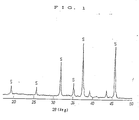
- Fig. 1 is an X-ray diffraction pattern of the aluminum oxynitride. In the figure, S indicates aluminum oxynitride.
- Each composition was poured into a mold having a height of 120 mm and a trapezoidal cross-section (bottom length: 53 mm; upper length: 36 mm; height: 20 mm), and also into a mold of 230 x 115 x 65 mm (in the form of a standard shape brick according to JIS R 2101), and then allowed to age therein for 24 hours under conditions of temperature 20 ⁇ 5°C and humidity 80 to 85% and taken out of the molds.
- the molds thus produced were dried in an oven maintained at 105 to 110°C for 12 hours and, after embedding in cokes powder, heated in an electric furnace to 350°C and calcined at that temperature for 4 hours.
- 350°C was a temperature at which crystal water and volatile materials were removed.
- the calcined mold having the trapezoidal cross-section described above was used. These calcined molds were stuck to the inside of a crucible in a 15 kw output high frequency induction furnace to produce a cylinder. After introduction of pig iron (FC 25 according to JIS G 5501) in the cylinder, induction heating was started. When the temperature in the cylinder reached a temperature above 1,200°C, ferrous oxide (FeO) was introduced and raised in temperature to 1,550°C to melt the contents. The sample was allowed to react with the molten metal by maintaining it at 1,550°C for 5 hours. After discharging the molten metal and cooling, the sample was taken out and a degree of reduction in the thickness of an area which was most seriously corroded was calculated to compare corrosion resistance.
- FC 25 pig iron
- FeO ferrous oxide
- AE method acoustic emission method
- This AE method is a method recently employed for evaluation of thermal impact resistance of a refractory because it makes easy quantitative comparison.
- an elastic wave generated at the time of breakage of the structure of a refractory when a thermal stress is abruptly applied onto the refractory is read with as an AE generation amount by the use of a sensor, and the thermal impact resistance is evaluated based on the amount of the wave. As the total amount of AE generated (number of counts) is smaller, it is evaluated that thermal impact resistance is better.
- the calcined mold having the standard shape brick according to the JIS R 2101 was locally heated for about 20 sec. by applying a flame of oxygen- propane gas of about 1,650°C onto the center of the 230 x 115 mm surface.
- the total amount of AE generated (number of counts) was read with a commercially available apparatus (Model 302A produced by Dungan/Endevco Co., Ltd.).
- Sample Nos. 1 to 3 of Table 2 are examples of the shaped refractory of the present invention.
- Sample Nos. 1 to 3 of Table 3 are examples of a blast furnace tapping hole material, which is made of the refractory of the present invention.
- Compositions comprising the starting materials shown in Table 3 were each well mixed and after addition of a binder, kneaded. Aluminum oxynitride having the same purity as in Examples 1 and 2 was used.
- Each kneaded composition was molded into a trapezoidal column-shaped form of the same size as in Example 1 under a pressure of 100 kg/cm 2 .
- the mold thus obtained was dried in an oven maintained at 105 to 110°C for 12 hours, and then temperature was raised to 350°C at a temperature raising rate of 150°C per hour in an electric furnace and maintained at that temperature for 6 hours so as to achieve baking treatment.
- the sample thus heat-treated was stuck to the inside of the usual rotary corrosion test furnace to produce a cylinder.
- the inside surface of the cylinder sample was abruptly heated to 1,500°C by the use of an oxygen/ propane gas burner and, thereafter, pig iron for the blast furnace for production of steel and blast furnace slag having a base (CaO/SiO 2 ) of 1.22 were introduced in the cylinder at a weight ratio of 10:3. While heating with the burner so as to maintain the temperature in the cylinder at 1,550 ⁇ 20°C, the furnace was rotated at 30 rpm. In this way, the sample, molten metal and molten slag were reacted. After 2 hours, fhe molten mass was discharged from the cylinder.
- the same material as above was reacted with the sample under the same conditions as described above and then discharged. This procedure was repeated four times and the amount of the sample corroded was measured. A rate of reduction in the thickness of an area which was seriously corroded was calculated, and corrosion resistance was compared. It can be seen from Table 3 that the products of the present invention are superior in corrosion resistance to the conventional one. By using aluminum oxynitride in place of fused alumina which has been considered superior as an aggregate of high corrosion resistance, the corrosion resistance of the blast furnace tapping hole material can be increased. The product of the present invention can be applied to those tapping holes for filling up not only of blast furnace but also all other ferro and non-ferro melting furnaces. Although in this example anhydrous coal tar is used as a binder, other binders such as a thermosetting resin can be used.
- compositions wt%) and characteristics of a sliding nozzle and calcined bricks for a plate are shown in Table 4.
- Sample No. 5 The plate brick of Sample No. 5 was tested in a 150 ton ladle. Sample No. 1 was 3 charges whereas Sample No. 5 was 3-5 charges. The average number was increased to 3.70.
- compositions (wt%) and characteristics of a sliding nozzle and uncalcined brick for the nozzle are shown in Table 5.
- Sample No. 1 not containing aluminum oxynitride is a comparative example. Drying was conducted at 200°C for 30 minutes.
- compositions and characteristics of the products of the present invention are shown in Table 6.
- Figs. 2 to 9 illustrate embodiments of the nozzle for casting of the present invention.
- the reference numeral 1 indicates the material of the present invention; 2, zirconia-graphite; and 3, conventional material such as alumina-graphite.
- Fi g . 2 illustrates an embodiment in which the zirconia-graphite material 2 is provided on the outside of the material of the present invention 1, particularly on a part coming into contact with slag.
- Figs. 3 and 4 illustrate two and three-layer structures, respectively, in which the material of the present invention 1 is used as the inner surface of a nozzle, and the conventional material 3 is used as the outside surface of the nozzle.
- Fi g . 5 illustrates a single layer structure in which only the material of the present invention 1 is used. Figs.
- FIGS. 6 and 7 illustrate embodiments in which a slit 4 for discharge of gas is provided.
- FIGs. 8 and 9 illustrate embodiments in which the material of the present invention 1 is provided in the neighborhood of a molten steel inlet 5 or outlet 6 which is a part deposits are liable to yield.
- the aluminum oxynitride-containing refractory of the present invention is excellent in corrosion resistance against molten pig iron, molten steel and molten slag, and also in thermal impact resistance, it can be used as a refractory lining material coming contact with molten materials.
- a blast furnace for linina a tapping spout; a pi g iron ladle, a pig iron transfer ladle and car, a tundish, an immersion nozzle, a tapping spout material of electric furnace, etc.
- the sliding nozzle refractory of the present invention is greatly increased in slag resistance, FeO resistance and spalling resistance. Thus, the life time of the sliding nozzle can be greatly increased.
- the nozzle for continuous steel casting of the present invention is durable to multi-continuous casting and furthermore to continuous casting of high oxygen content steel.
Landscapes
- Engineering & Computer Science (AREA)
- Chemical & Material Sciences (AREA)
- Ceramic Engineering (AREA)
- Manufacturing & Machinery (AREA)
- Materials Engineering (AREA)
- Structural Engineering (AREA)
- Organic Chemistry (AREA)
- Mechanical Engineering (AREA)
- Compositions Of Oxide Ceramics (AREA)
- Casting Support Devices, Ladles, And Melt Control Thereby (AREA)
- Ceramic Products (AREA)
Abstract
Applications Claiming Priority (6)
| Application Number | Priority Date | Filing Date | Title |
|---|---|---|---|
| JP222486/84 | 1984-10-23 | ||
| JP59222486A JPS61101454A (ja) | 1984-10-23 | 1984-10-23 | 酸窒化アルミニウム含有耐火物 |
| JP60121667A JPS61281064A (ja) | 1985-06-05 | 1985-06-05 | スライデイングノズル用耐火物 |
| JP121667/85 | 1985-06-05 | ||
| JP144392/85 | 1985-07-01 | ||
| JP60144392A JPS627671A (ja) | 1985-07-01 | 1985-07-01 | 鋼連続鋳造用ノズル |
Publications (2)
| Publication Number | Publication Date |
|---|---|
| EP0198925A1 true EP0198925A1 (fr) | 1986-10-29 |
| EP0198925A4 EP0198925A4 (fr) | 1989-02-09 |
Family
ID=27314294
Family Applications (1)
| Application Number | Title | Priority Date | Filing Date |
|---|---|---|---|
| EP19850905105 Withdrawn EP0198925A4 (fr) | 1984-10-23 | 1985-10-09 | Composition capable de convertir dans en materials refractaire compose de l'oxyde de nitrure d'aluminium. |
Country Status (8)
| Country | Link |
|---|---|
| EP (1) | EP0198925A4 (fr) |
| KR (1) | KR930005250B1 (fr) |
| CN (1) | CN1003011B (fr) |
| AU (1) | AU581035B2 (fr) |
| BR (1) | BR8506995A (fr) |
| CA (1) | CA1251222A (fr) |
| MX (1) | MX167733B (fr) |
| WO (1) | WO1986002633A1 (fr) |
Cited By (7)
| Publication number | Priority date | Publication date | Assignee | Title |
|---|---|---|---|---|
| EP0482981A1 (fr) * | 1990-10-24 | 1992-04-29 | Savoie Refractaires | Nouveaux matériaux réfractaires constitués de grains liés par une phase liante à base de nitrure d'aluminium contenant des particules de nitrure de bore et/ou de graphite, et procédé |
| US5286685A (en) * | 1990-10-24 | 1994-02-15 | Savoie Refractaires | Refractory materials consisting of grains bonded by a binding phase based on aluminum nitride containing boron nitride and/or graphite particles and process for their production |
| WO1995034395A1 (fr) * | 1994-06-15 | 1995-12-21 | Vesuvius France S.A. | Piece de coulee comportant une couche externe apte a former une couche impermeable aux gaz et procede de mise en ×uvre |
| US5516734A (en) * | 1991-06-19 | 1996-05-14 | Lanxide Technology Company, Lp | Aluminum nitride refractory materials and methods for making the same |
| US5681499A (en) * | 1994-06-15 | 1997-10-28 | Vesuvius Crucible Company | Method and compositions for making refractory shapes having dense, carbon free surfaces and shapes made therefrom |
| US5691061A (en) * | 1994-06-15 | 1997-11-25 | Vesuvius Crucible Company | Refractory shape having an external layer capable of forming a layer impermeable to gases and process for its preparation |
| CN110023268A (zh) * | 2016-12-28 | 2019-07-16 | 黑崎播磨株式会社 | 高炉炉床部用砖及使用高炉炉床部用砖的高炉炉床部以及高炉炉床部用砖的制造方法 |
Families Citing this family (10)
| Publication number | Priority date | Publication date | Assignee | Title |
|---|---|---|---|---|
| CN100425569C (zh) * | 2006-10-19 | 2008-10-15 | 武汉科技大学 | 一种含碳氮化钛滑板耐火材料及其制备方法 |
| CN101492303B (zh) * | 2009-03-09 | 2012-10-24 | 浙江锦诚耐火材料有限公司 | 三次风管闸板专用耐火浇注料 |
| CN103121099B (zh) * | 2012-07-04 | 2015-05-27 | 河南熔金高温材料股份有限公司 | 含无定形硼的不烧金属结合铝碳锆质滑动水口耐火砖及其生产方法 |
| CN102744397B (zh) * | 2012-07-26 | 2015-05-20 | 阳泉市东风耐火材料有限责任公司 | 多炉连浇刚玉-莫来石复合下水口 |
| CN105967703A (zh) * | 2016-05-10 | 2016-09-28 | 武汉科技大学 | 一种MgO-Si2N2O-C质耐火材料及其制备方法 |
| KR101930748B1 (ko) * | 2017-08-02 | 2018-12-19 | 주식회사 포스코 | 주조용 슬라이딩 게이트 |
| ES2802424T3 (es) * | 2017-11-08 | 2021-01-19 | Refractory Intellectual Property Gmbh & Co Kg | Placa refractaria para un cierre de deslizamiento, uso de una materia prima fundida como material en una placa de este tipo, así como un recipiente de fusión que presenta una placa de este tipo |
| CN109809805B (zh) * | 2019-02-20 | 2021-04-13 | 江苏泰瑞耐火有限公司 | 一种用于冶金水口的碳化硅陶瓷膜制备方法 |
| CN109928781B (zh) * | 2019-02-20 | 2021-05-25 | 江苏泰瑞耐火有限公司 | 一种用于冶金水口的石墨烯陶瓷膜制备方法 |
| CN110467443A (zh) * | 2019-09-19 | 2019-11-19 | 广东工业大学 | 一种氮化铝/氧化铝复相陶瓷及其制备方法 |
Family Cites Families (1)
| Publication number | Priority date | Publication date | Assignee | Title |
|---|---|---|---|---|
| JPS5727971A (en) * | 1980-07-22 | 1982-02-15 | Kurosaki Refractories Co | Plate brick for sliding nozzle |
-
1985
- 1985-10-09 KR KR1019860700383A patent/KR930005250B1/ko not_active Expired - Fee Related
- 1985-10-09 EP EP19850905105 patent/EP0198925A4/fr not_active Withdrawn
- 1985-10-09 WO PCT/JP1985/000561 patent/WO1986002633A1/fr not_active Ceased
- 1985-10-09 AU AU49584/85A patent/AU581035B2/en not_active Ceased
- 1985-10-09 BR BR8506995A patent/BR8506995A/pt not_active IP Right Cessation
- 1985-10-22 MX MX000351A patent/MX167733B/es unknown
- 1985-10-22 CA CA000493513A patent/CA1251222A/fr not_active Expired
- 1985-10-23 CN CN85109111A patent/CN1003011B/zh not_active Expired
Non-Patent Citations (2)
| Title |
|---|
| No relevant documents have been disclosed. * |
| See also references of WO8602633A1 * |
Cited By (11)
| Publication number | Priority date | Publication date | Assignee | Title |
|---|---|---|---|---|
| EP0482981A1 (fr) * | 1990-10-24 | 1992-04-29 | Savoie Refractaires | Nouveaux matériaux réfractaires constitués de grains liés par une phase liante à base de nitrure d'aluminium contenant des particules de nitrure de bore et/ou de graphite, et procédé |
| FR2668476A1 (fr) * | 1990-10-24 | 1992-04-30 | Savoie Refractaires | Materiaux refractaires constitues de grains et procede pour leur fabrication. |
| US5286685A (en) * | 1990-10-24 | 1994-02-15 | Savoie Refractaires | Refractory materials consisting of grains bonded by a binding phase based on aluminum nitride containing boron nitride and/or graphite particles and process for their production |
| US5516734A (en) * | 1991-06-19 | 1996-05-14 | Lanxide Technology Company, Lp | Aluminum nitride refractory materials and methods for making the same |
| WO1995034395A1 (fr) * | 1994-06-15 | 1995-12-21 | Vesuvius France S.A. | Piece de coulee comportant une couche externe apte a former une couche impermeable aux gaz et procede de mise en ×uvre |
| FR2721241A1 (fr) * | 1994-06-15 | 1995-12-22 | Vesuvius France Sa | Busette de coulée comportant une chemise interne apte à former une couche imperméable au gaz et procédé de mise en Óoeuvre. |
| US5681499A (en) * | 1994-06-15 | 1997-10-28 | Vesuvius Crucible Company | Method and compositions for making refractory shapes having dense, carbon free surfaces and shapes made therefrom |
| US5691061A (en) * | 1994-06-15 | 1997-11-25 | Vesuvius Crucible Company | Refractory shape having an external layer capable of forming a layer impermeable to gases and process for its preparation |
| RU2146186C1 (ru) * | 1994-06-15 | 2000-03-10 | Везювью Франс С.А. | Деталь для разливки стали и способ ее изготовления |
| CN110023268A (zh) * | 2016-12-28 | 2019-07-16 | 黑崎播磨株式会社 | 高炉炉床部用砖及使用高炉炉床部用砖的高炉炉床部以及高炉炉床部用砖的制造方法 |
| EP3564201A4 (fr) * | 2016-12-28 | 2020-08-19 | Krosakiharima Corporation | Brique pour soles de haut-fourneau et foyer de haut-fourneau l'utilisant, et procédé de production de briques pour soles de haut-fourneau |
Also Published As
| Publication number | Publication date |
|---|---|
| WO1986002633A1 (fr) | 1986-05-09 |
| CN1003011B (zh) | 1989-01-04 |
| KR870700582A (ko) | 1987-12-30 |
| CA1251222A (fr) | 1989-03-14 |
| KR930005250B1 (ko) | 1993-06-17 |
| AU4958485A (en) | 1986-05-15 |
| MX167733B (es) | 1993-04-12 |
| EP0198925A4 (fr) | 1989-02-09 |
| CN85109111A (zh) | 1986-08-27 |
| AU581035B2 (en) | 1989-02-09 |
| BR8506995A (pt) | 1987-01-06 |
Similar Documents
| Publication | Publication Date | Title |
|---|---|---|
| EP0198925A1 (fr) | Composition capable de convertir dans en materials refractaire compose de l'oxyde de nitrure d'aluminium | |
| JPH0665624B2 (ja) | アルミナ含有量の高い新規な耐火物と、その製造方法 | |
| US4208214A (en) | Refractory compositions | |
| Thethwayo et al. | A review of carbon-based refractory materials and their applications | |
| US4497901A (en) | Forsterite-carbon refractory | |
| US4605635A (en) | Carbon-containing refractory | |
| CA2101132C (fr) | Brique de manganese et carbone contenant un graphite nouveau | |
| US4431745A (en) | Carbon-bonded magnesia carbon bricks | |
| EP0116194B1 (fr) | Matériau réfractaire contenant du carbone | |
| JP2633018B2 (ja) | 炭素含有耐火物 | |
| JP2552987B2 (ja) | 流し込み成形用耐火物 | |
| JPH0421625B2 (fr) | ||
| JP2004141899A (ja) | 取鍋用スライディングノズルプレート | |
| JP3330811B2 (ja) | 炭素含有耐火物及び該耐火物を内張りした溶融金属用溶解・精錬容器 | |
| JP3336187B2 (ja) | MgO−CaO質炭素含有耐火物 | |
| JPS6153150A (ja) | 溶鋼鋳造用ノズル | |
| JP2868809B2 (ja) | マグネシア・カーボンれんが | |
| JP3330810B2 (ja) | 炭素含有塩基性耐火物及び該耐火物を内張りした溶融金属用溶解・精錬容器 | |
| WO2025146742A1 (fr) | Réfractaire façonné, procédé de production de réfractaire façonné, procédé de construction de réfractaire façonné et structure de revêtement pour four électrique | |
| JPH03141152A (ja) | 含炭素不焼成耐火れんが | |
| JPH085718B2 (ja) | 高炉炉壁用炭化珪素―炭素質れんがの製造方法 | |
| JPH11147776A (ja) | 不定形耐火物 | |
| JP2002087889A (ja) | 低熱伝導性炭素含有耐火物 | |
| JPH0676252B2 (ja) | 不焼成アルミナ・マグネシア質煉瓦 | |
| JPH09278544A (ja) | 溶銑容器内張り用不定形耐火物 |
Legal Events
| Date | Code | Title | Description |
|---|---|---|---|
| PUAI | Public reference made under article 153(3) epc to a published international application that has entered the european phase |
Free format text: ORIGINAL CODE: 0009012 |
|
| 17P | Request for examination filed |
Effective date: 19860618 |
|
| AK | Designated contracting states |
Kind code of ref document: A1 Designated state(s): DE GB IT |
|
| RIN1 | Information on inventor provided before grant (corrected) |
Inventor name: NAGAO, YOSHITAKA Inventor name: TANAKA, MASAHARU Inventor name: IWASAKI, AKIRA Inventor name: UEDA, MISAO Inventor name: AKATSUKA, YOSHIHIKO Inventor name: YAMANAKA, SHINGO Inventor name: HOSAKA, TAKAO Inventor name: SASAKI, TADAO |
|
| A4 | Supplementary search report drawn up and despatched |
Effective date: 19890209 |
|
| 17Q | First examination report despatched |
Effective date: 19910221 |
|
| STAA | Information on the status of an ep patent application or granted ep patent |
Free format text: STATUS: THE APPLICATION HAS BEEN WITHDRAWN |
|
| 18W | Application withdrawn |
Withdrawal date: 19920820 |
|
| RIN1 | Information on inventor provided before grant (corrected) |
Inventor name: YAMANAKA, SHINGO Inventor name: AKATSUKA, YOSHIHIKO Inventor name: NAGAO, YOSHITAKA Inventor name: UEDA, MISAO Inventor name: SASAKI, TADAO Inventor name: HOSAKA, TAKAO Inventor name: IWASAKI, AKIRA Inventor name: TANAKA, MASAHARU |