EP0201690A2 - Verfahren zur Herstellung aromatischer Diazoniumsalze und von Azofarbstoffen - Google Patents
Verfahren zur Herstellung aromatischer Diazoniumsalze und von Azofarbstoffen Download PDFInfo
- Publication number
- EP0201690A2 EP0201690A2 EP86103541A EP86103541A EP0201690A2 EP 0201690 A2 EP0201690 A2 EP 0201690A2 EP 86103541 A EP86103541 A EP 86103541A EP 86103541 A EP86103541 A EP 86103541A EP 0201690 A2 EP0201690 A2 EP 0201690A2
- Authority
- EP
- European Patent Office
- Prior art keywords
- acid
- organic
- aqueous
- groups
- compounds
- Prior art date
- Legal status (The legal status is an assumption and is not a legal conclusion. Google has not performed a legal analysis and makes no representation as to the accuracy of the status listed.)
- Granted
Links
- 238000000034 method Methods 0.000 title claims abstract description 24
- 239000000987 azo dye Substances 0.000 title claims abstract description 9
- 239000012954 diazonium Substances 0.000 title claims abstract description 8
- -1 aromatic diazonium salts Chemical class 0.000 title claims description 24
- 238000004519 manufacturing process Methods 0.000 title description 3
- 239000002253 acid Substances 0.000 claims abstract description 20
- 230000008878 coupling Effects 0.000 claims abstract description 20
- 238000010168 coupling process Methods 0.000 claims abstract description 20
- 238000005859 coupling reaction Methods 0.000 claims abstract description 20
- 238000006193 diazotization reaction Methods 0.000 claims abstract description 19
- 150000003839 salts Chemical class 0.000 claims abstract description 14
- 230000002378 acidificating effect Effects 0.000 claims abstract description 11
- IOVCWXUNBOPUCH-UHFFFAOYSA-N Nitrous acid Chemical compound ON=O IOVCWXUNBOPUCH-UHFFFAOYSA-N 0.000 claims abstract description 8
- 150000001989 diazonium salts Chemical class 0.000 claims abstract description 6
- 150000002892 organic cations Chemical class 0.000 claims abstract description 5
- 150000001767 cationic compounds Chemical class 0.000 claims abstract description 4
- 229910001411 inorganic cation Inorganic materials 0.000 claims abstract description 4
- 239000012429 reaction media Substances 0.000 claims abstract description 3
- 150000001875 compounds Chemical class 0.000 claims description 12
- 238000002360 preparation method Methods 0.000 claims description 12
- 150000001412 amines Chemical class 0.000 claims description 10
- 125000000020 sulfo group Chemical group O=S(=O)([*])O[H] 0.000 claims description 9
- 239000000975 dye Substances 0.000 claims description 8
- 239000011973 solid acid Substances 0.000 claims description 8
- 150000007513 acids Chemical class 0.000 claims description 7
- 238000006243 chemical reaction Methods 0.000 claims description 6
- 239000002270 dispersing agent Substances 0.000 claims description 6
- 230000003165 hydrotropic effect Effects 0.000 claims description 6
- VHUUQVKOLVNVRT-UHFFFAOYSA-N Ammonium hydroxide Chemical compound [NH4+].[OH-] VHUUQVKOLVNVRT-UHFFFAOYSA-N 0.000 claims description 5
- 239000000908 ammonium hydroxide Substances 0.000 claims description 5
- 239000002904 solvent Substances 0.000 claims description 4
- 125000000542 sulfonic acid group Chemical group 0.000 claims description 3
- 150000003973 alkyl amines Chemical group 0.000 claims description 2
- 125000005210 alkyl ammonium group Chemical group 0.000 claims description 2
- 150000002642 lithium compounds Chemical class 0.000 claims description 2
- 239000003795 chemical substances by application Substances 0.000 abstract description 6
- WSFSSNUMVMOOMR-UHFFFAOYSA-N Formaldehyde Chemical compound O=C WSFSSNUMVMOOMR-UHFFFAOYSA-N 0.000 description 27
- 239000000243 solution Substances 0.000 description 20
- 239000004793 Polystyrene Substances 0.000 description 16
- XLYOFNOQVPJJNP-UHFFFAOYSA-N water Substances O XLYOFNOQVPJJNP-UHFFFAOYSA-N 0.000 description 15
- 150000001768 cations Chemical class 0.000 description 14
- 239000000985 reactive dye Substances 0.000 description 13
- WMFOQBRAJBCJND-UHFFFAOYSA-M Lithium hydroxide Chemical compound [Li+].[OH-] WMFOQBRAJBCJND-UHFFFAOYSA-M 0.000 description 12
- 239000007859 condensation product Substances 0.000 description 8
- 125000003178 carboxy group Chemical group [H]OC(*)=O 0.000 description 7
- 239000011734 sodium Substances 0.000 description 7
- 125000000217 alkyl group Chemical group 0.000 description 6
- 239000000203 mixture Substances 0.000 description 6
- 229920005989 resin Polymers 0.000 description 6
- 239000011347 resin Substances 0.000 description 6
- 125000004178 (C1-C4) alkyl group Chemical group 0.000 description 5
- IAYPIBMASNFSPL-UHFFFAOYSA-N Ethylene oxide Chemical compound C1CO1 IAYPIBMASNFSPL-UHFFFAOYSA-N 0.000 description 5
- 229910052784 alkaline earth metal Inorganic materials 0.000 description 5
- 239000002609 medium Substances 0.000 description 5
- 229920002223 polystyrene Polymers 0.000 description 5
- 125000001424 substituent group Chemical group 0.000 description 5
- 239000000725 suspension Substances 0.000 description 5
- MYRTYDVEIRVNKP-UHFFFAOYSA-N 1,2-Divinylbenzene Chemical compound C=CC1=CC=CC=C1C=C MYRTYDVEIRVNKP-UHFFFAOYSA-N 0.000 description 4
- YNAVUWVOSKDBBP-UHFFFAOYSA-N Morpholine Chemical compound C1COCCN1 YNAVUWVOSKDBBP-UHFFFAOYSA-N 0.000 description 4
- ISWSIDIOOBJBQZ-UHFFFAOYSA-N Phenol Chemical compound OC1=CC=CC=C1 ISWSIDIOOBJBQZ-UHFFFAOYSA-N 0.000 description 4
- GSEJCLTVZPLZKY-UHFFFAOYSA-N Triethanolamine Chemical compound OCCN(CCO)CCO GSEJCLTVZPLZKY-UHFFFAOYSA-N 0.000 description 4
- 125000000129 anionic group Chemical group 0.000 description 4
- 239000000872 buffer Substances 0.000 description 4
- 229910052739 hydrogen Inorganic materials 0.000 description 4
- 229910052708 sodium Inorganic materials 0.000 description 4
- 239000007787 solid Substances 0.000 description 4
- HHVIBTZHLRERCL-UHFFFAOYSA-N sulfonyldimethane Chemical compound CS(C)(=O)=O HHVIBTZHLRERCL-UHFFFAOYSA-N 0.000 description 4
- 229910006069 SO3H Inorganic materials 0.000 description 3
- ZMANZCXQSJIPKH-UHFFFAOYSA-N Triethylamine Chemical compound CCN(CC)CC ZMANZCXQSJIPKH-UHFFFAOYSA-N 0.000 description 3
- 150000004982 aromatic amines Chemical class 0.000 description 3
- 125000003118 aryl group Chemical group 0.000 description 3
- XSCHRSMBECNVNS-UHFFFAOYSA-N benzopyrazine Natural products N1=CC=NC2=CC=CC=C21 XSCHRSMBECNVNS-UHFFFAOYSA-N 0.000 description 3
- 238000009833 condensation Methods 0.000 description 3
- 230000005494 condensation Effects 0.000 description 3
- 125000000664 diazo group Chemical group [N-]=[N+]=[*] 0.000 description 3
- JBKVHLHDHHXQEQ-UHFFFAOYSA-N epsilon-caprolactam Chemical compound O=C1CCCCCN1 JBKVHLHDHHXQEQ-UHFFFAOYSA-N 0.000 description 3
- 238000001914 filtration Methods 0.000 description 3
- 229910052731 fluorine Inorganic materials 0.000 description 3
- 239000008187 granular material Substances 0.000 description 3
- 239000000126 substance Substances 0.000 description 3
- 125000000229 (C1-C4)alkoxy group Chemical group 0.000 description 2
- JYEUMXHLPRZUAT-UHFFFAOYSA-N 1,2,3-triazine Chemical compound C1=CN=NN=C1 JYEUMXHLPRZUAT-UHFFFAOYSA-N 0.000 description 2
- APRRQJCCBSJQOQ-UHFFFAOYSA-N 4-amino-5-hydroxynaphthalene-2,7-disulfonic acid Chemical compound OS(=O)(=O)C1=CC(O)=C2C(N)=CC(S(O)(=O)=O)=CC2=C1 APRRQJCCBSJQOQ-UHFFFAOYSA-N 0.000 description 2
- 125000002373 5 membered heterocyclic group Chemical group 0.000 description 2
- 125000004070 6 membered heterocyclic group Chemical group 0.000 description 2
- LSNNMFCWUKXFEE-UHFFFAOYSA-M Bisulfite Chemical compound OS([O-])=O LSNNMFCWUKXFEE-UHFFFAOYSA-M 0.000 description 2
- RTZKZFJDLAIYFH-UHFFFAOYSA-N Diethyl ether Chemical compound CCOCC RTZKZFJDLAIYFH-UHFFFAOYSA-N 0.000 description 2
- MYMOFIZGZYHOMD-UHFFFAOYSA-N Dioxygen Chemical compound O=O MYMOFIZGZYHOMD-UHFFFAOYSA-N 0.000 description 2
- UFHFLCQGNIYNRP-UHFFFAOYSA-N Hydrogen Chemical group [H][H] UFHFLCQGNIYNRP-UHFFFAOYSA-N 0.000 description 2
- DGAQECJNVWCQMB-PUAWFVPOSA-M Ilexoside XXIX Chemical compound C[C@@H]1CC[C@@]2(CC[C@@]3(C(=CC[C@H]4[C@]3(CC[C@@H]5[C@@]4(CC[C@@H](C5(C)C)OS(=O)(=O)[O-])C)C)[C@@H]2[C@]1(C)O)C)C(=O)O[C@H]6[C@@H]([C@H]([C@@H]([C@H](O6)CO)O)O)O.[Na+] DGAQECJNVWCQMB-PUAWFVPOSA-M 0.000 description 2
- 229920001732 Lignosulfonate Polymers 0.000 description 2
- MGJKQDOBUOMPEZ-UHFFFAOYSA-N N,N'-dimethylurea Chemical compound CNC(=O)NC MGJKQDOBUOMPEZ-UHFFFAOYSA-N 0.000 description 2
- UFWIBTONFRDIAS-UHFFFAOYSA-N Naphthalene Chemical compound C1=CC=CC2=CC=CC=C21 UFWIBTONFRDIAS-UHFFFAOYSA-N 0.000 description 2
- JUJWROOIHBZHMG-UHFFFAOYSA-N Pyridine Chemical compound C1=CC=NC=C1 JUJWROOIHBZHMG-UHFFFAOYSA-N 0.000 description 2
- SMWDFEZZVXVKRB-UHFFFAOYSA-N Quinoline Chemical compound N1=CC=CC2=CC=CC=C21 SMWDFEZZVXVKRB-UHFFFAOYSA-N 0.000 description 2
- XSQUKJJJFZCRTK-UHFFFAOYSA-N Urea Chemical compound NC(N)=O XSQUKJJJFZCRTK-UHFFFAOYSA-N 0.000 description 2
- DZBUGLKDJFMEHC-UHFFFAOYSA-N acridine Chemical compound C1=CC=CC2=CC3=CC=CC=C3N=C21 DZBUGLKDJFMEHC-UHFFFAOYSA-N 0.000 description 2
- 229910052783 alkali metal Inorganic materials 0.000 description 2
- 150000001340 alkali metals Chemical class 0.000 description 2
- 125000003710 aryl alkyl group Chemical group 0.000 description 2
- 125000000852 azido group Chemical group *N=[N+]=[N-] 0.000 description 2
- 150000007514 bases Chemical class 0.000 description 2
- 125000001797 benzyl group Chemical group [H]C1=C([H])C([H])=C(C([H])=C1[H])C([H])([H])* 0.000 description 2
- 230000015572 biosynthetic process Effects 0.000 description 2
- 239000004202 carbamide Substances 0.000 description 2
- 229910052801 chlorine Inorganic materials 0.000 description 2
- JHIVVAPYMSGYDF-UHFFFAOYSA-N cyclohexanone Chemical compound O=C1CCCCC1 JHIVVAPYMSGYDF-UHFFFAOYSA-N 0.000 description 2
- 238000004043 dyeing Methods 0.000 description 2
- 238000005755 formation reaction Methods 0.000 description 2
- 229910052736 halogen Inorganic materials 0.000 description 2
- 150000002367 halogens Chemical class 0.000 description 2
- 125000000623 heterocyclic group Chemical group 0.000 description 2
- 229910052500 inorganic mineral Inorganic materials 0.000 description 2
- 125000003010 ionic group Chemical group 0.000 description 2
- 150000002500 ions Chemical class 0.000 description 2
- 229910052744 lithium Inorganic materials 0.000 description 2
- 125000002496 methyl group Chemical group [H]C([H])([H])* 0.000 description 2
- 239000011707 mineral Substances 0.000 description 2
- PSZYNBSKGUBXEH-UHFFFAOYSA-N naphthalene-1-sulfonic acid Chemical compound C1=CC=C2C(S(=O)(=O)O)=CC=CC2=C1 PSZYNBSKGUBXEH-UHFFFAOYSA-N 0.000 description 2
- 230000007935 neutral effect Effects 0.000 description 2
- 150000002826 nitrites Chemical class 0.000 description 2
- 239000003921 oil Substances 0.000 description 2
- LCPDWSOZIOUXRV-UHFFFAOYSA-N phenoxyacetic acid Chemical compound OC(=O)COC1=CC=CC=C1 LCPDWSOZIOUXRV-UHFFFAOYSA-N 0.000 description 2
- 229920000642 polymer Polymers 0.000 description 2
- 239000000843 powder Substances 0.000 description 2
- 150000003254 radicals Chemical class 0.000 description 2
- GHMLBKRAJCXXBS-UHFFFAOYSA-N resorcinol Chemical compound OC1=CC=CC(O)=C1 GHMLBKRAJCXXBS-UHFFFAOYSA-N 0.000 description 2
- LPXPTNMVRIOKMN-UHFFFAOYSA-M sodium nitrite Chemical compound [Na+].[O-]N=O LPXPTNMVRIOKMN-UHFFFAOYSA-M 0.000 description 2
- GEHJYWRUCIMESM-UHFFFAOYSA-L sodium sulfite Chemical compound [Na+].[Na+].[O-]S([O-])=O GEHJYWRUCIMESM-UHFFFAOYSA-L 0.000 description 2
- QTYUSOHYEPOHLV-FNORWQNLSA-N 1,3-Octadiene Chemical compound CCCC\C=C\C=C QTYUSOHYEPOHLV-FNORWQNLSA-N 0.000 description 1
- CRTIGUQLTBDWKN-UHFFFAOYSA-N 1-aminocyclohexa-2,4-diene-1-sulfonic acid Chemical compound OS(=O)(=O)C1(N)CC=CC=C1 CRTIGUQLTBDWKN-UHFFFAOYSA-N 0.000 description 1
- LDMOEFOXLIZJOW-UHFFFAOYSA-N 1-dodecanesulfonic acid Chemical compound CCCCCCCCCCCCS(O)(=O)=O LDMOEFOXLIZJOW-UHFFFAOYSA-N 0.000 description 1
- LWEAHXKXKDCSIE-UHFFFAOYSA-M 2,3-di(propan-2-yl)naphthalene-1-sulfonate Chemical compound C1=CC=C2C(S([O-])(=O)=O)=C(C(C)C)C(C(C)C)=CC2=C1 LWEAHXKXKDCSIE-UHFFFAOYSA-M 0.000 description 1
- GLDQAMYCGOIJDV-UHFFFAOYSA-N 2,3-dihydroxybenzoic acid Chemical compound OC(=O)C1=CC=CC(O)=C1O GLDQAMYCGOIJDV-UHFFFAOYSA-N 0.000 description 1
- VEPOHXYIFQMVHW-XOZOLZJESA-N 2,3-dihydroxybutanedioic acid (2S,3S)-3,4-dimethyl-2-phenylmorpholine Chemical compound OC(C(O)C(O)=O)C(O)=O.C[C@H]1[C@@H](OCCN1C)c1ccccc1 VEPOHXYIFQMVHW-XOZOLZJESA-N 0.000 description 1
- SMZOUWXMTYCWNB-UHFFFAOYSA-N 2-(2-methoxy-5-methylphenyl)ethanamine Chemical compound COC1=CC=C(C)C=C1CCN SMZOUWXMTYCWNB-UHFFFAOYSA-N 0.000 description 1
- NIXOWILDQLNWCW-UHFFFAOYSA-N 2-Propenoic acid Natural products OC(=O)C=C NIXOWILDQLNWCW-UHFFFAOYSA-N 0.000 description 1
- WZFUQSJFWNHZHM-UHFFFAOYSA-N 2-[4-[2-(2,3-dihydro-1H-inden-2-ylamino)pyrimidin-5-yl]piperazin-1-yl]-1-(2,4,6,7-tetrahydrotriazolo[4,5-c]pyridin-5-yl)ethanone Chemical compound C1C(CC2=CC=CC=C12)NC1=NC=C(C=N1)N1CCN(CC1)CC(=O)N1CC2=C(CC1)NN=N2 WZFUQSJFWNHZHM-UHFFFAOYSA-N 0.000 description 1
- SCVJRXQHFJXZFZ-KVQBGUIXSA-N 2-amino-9-[(2r,4s,5r)-4-hydroxy-5-(hydroxymethyl)oxolan-2-yl]-3h-purine-6-thione Chemical compound C1=2NC(N)=NC(=S)C=2N=CN1[C@H]1C[C@H](O)[C@@H](CO)O1 SCVJRXQHFJXZFZ-KVQBGUIXSA-N 0.000 description 1
- BCHZICNRHXRCHY-UHFFFAOYSA-N 2h-oxazine Chemical compound N1OC=CC=C1 BCHZICNRHXRCHY-UHFFFAOYSA-N 0.000 description 1
- AGIJRRREJXSQJR-UHFFFAOYSA-N 2h-thiazine Chemical compound N1SC=CC=C1 AGIJRRREJXSQJR-UHFFFAOYSA-N 0.000 description 1
- PPVRMPPLECDING-UHFFFAOYSA-N 4-[(4-aminophenyl)diazenyl]benzenesulfonic acid Chemical compound C1=CC(N)=CC=C1N=NC1=CC=C(S(O)(=O)=O)C=C1 PPVRMPPLECDING-UHFFFAOYSA-N 0.000 description 1
- GOYNRDSJTYLXBU-UHFFFAOYSA-N 5-chloro-2,4,6-trifluoropyrimidine Chemical compound FC1=NC(F)=C(Cl)C(F)=N1 GOYNRDSJTYLXBU-UHFFFAOYSA-N 0.000 description 1
- RMULVUFPLMJWOK-UHFFFAOYSA-N 5-chloro-2,4-difluoro-6-methylpyrimidine Chemical compound CC1=NC(F)=NC(F)=C1Cl RMULVUFPLMJWOK-UHFFFAOYSA-N 0.000 description 1
- 125000004008 6 membered carbocyclic group Chemical group 0.000 description 1
- CLFZUMWQCKAKMP-UHFFFAOYSA-N 7-amino-5-benzoyl-4-hydroxynaphthalene-2-sulfonic acid Chemical compound C=12C(O)=CC(S(O)(=O)=O)=CC2=CC(N)=CC=1C(=O)C1=CC=CC=C1 CLFZUMWQCKAKMP-UHFFFAOYSA-N 0.000 description 1
- BVKZGUZCCUSVTD-UHFFFAOYSA-M Bicarbonate Chemical compound OC([O-])=O BVKZGUZCCUSVTD-UHFFFAOYSA-M 0.000 description 1
- BVKZGUZCCUSVTD-UHFFFAOYSA-L Carbonate Chemical compound [O-]C([O-])=O BVKZGUZCCUSVTD-UHFFFAOYSA-L 0.000 description 1
- 229920003043 Cellulose fiber Polymers 0.000 description 1
- CERQOIWHTDAKMF-UHFFFAOYSA-N Methacrylic acid Chemical compound CC(=C)C(O)=O CERQOIWHTDAKMF-UHFFFAOYSA-N 0.000 description 1
- GYHKCSKXDZSFQW-UHFFFAOYSA-N NC1=CC=C(C(=O)C2=C(C(=CC3=CC(=CC(=C23)O)S(=O)(=O)O)S(=O)(=O)O)N)C=C1 Chemical compound NC1=CC=C(C(=O)C2=C(C(=CC3=CC(=CC(=C23)O)S(=O)(=O)O)S(=O)(=O)O)N)C=C1 GYHKCSKXDZSFQW-UHFFFAOYSA-N 0.000 description 1
- 229910003204 NH2 Inorganic materials 0.000 description 1
- 229910003202 NH4 Inorganic materials 0.000 description 1
- IOVCWXUNBOPUCH-UHFFFAOYSA-M Nitrite anion Chemical compound [O-]N=O IOVCWXUNBOPUCH-UHFFFAOYSA-M 0.000 description 1
- 229910019142 PO4 Inorganic materials 0.000 description 1
- PCNDJXKNXGMECE-UHFFFAOYSA-N Phenazine Natural products C1=CC=CC2=NC3=CC=CC=C3N=C21 PCNDJXKNXGMECE-UHFFFAOYSA-N 0.000 description 1
- 239000004952 Polyamide Substances 0.000 description 1
- GOOHAUXETOMSMM-UHFFFAOYSA-N Propylene oxide Chemical compound CC1CO1 GOOHAUXETOMSMM-UHFFFAOYSA-N 0.000 description 1
- CZPWVGJYEJSRLH-UHFFFAOYSA-N Pyrimidine Chemical compound C1=CN=CN=C1 CZPWVGJYEJSRLH-UHFFFAOYSA-N 0.000 description 1
- ULUAUXLGCMPNKK-UHFFFAOYSA-N Sulfobutanedioic acid Chemical class OC(=O)CC(C(O)=O)S(O)(=O)=O ULUAUXLGCMPNKK-UHFFFAOYSA-N 0.000 description 1
- QTBSBXVTEAMEQO-UHFFFAOYSA-N acetic acid Substances CC(O)=O QTBSBXVTEAMEQO-UHFFFAOYSA-N 0.000 description 1
- 239000000654 additive Substances 0.000 description 1
- 230000000996 additive effect Effects 0.000 description 1
- 150000001298 alcohols Chemical class 0.000 description 1
- 150000008431 aliphatic amides Chemical class 0.000 description 1
- 239000003513 alkali Substances 0.000 description 1
- 150000001447 alkali salts Chemical class 0.000 description 1
- 150000008055 alkyl aryl sulfonates Chemical class 0.000 description 1
- 229940045714 alkyl sulfonate alkylating agent Drugs 0.000 description 1
- 150000008052 alkyl sulfonates Chemical class 0.000 description 1
- 125000002947 alkylene group Chemical group 0.000 description 1
- 125000005529 alkyleneoxy group Chemical group 0.000 description 1
- 150000003868 ammonium compounds Chemical class 0.000 description 1
- 239000012736 aqueous medium Substances 0.000 description 1
- 239000007864 aqueous solution Substances 0.000 description 1
- HNYOPLTXPVRDBG-UHFFFAOYSA-N barbituric acid Chemical compound O=C1CC(=O)NC(=O)N1 HNYOPLTXPVRDBG-UHFFFAOYSA-N 0.000 description 1
- 239000011324 bead Substances 0.000 description 1
- SRSXLGNVWSONIS-UHFFFAOYSA-N benzenesulfonic acid Chemical compound OS(=O)(=O)C1=CC=CC=C1 SRSXLGNVWSONIS-UHFFFAOYSA-N 0.000 description 1
- 229940092714 benzenesulfonic acid Drugs 0.000 description 1
- UIAFKZKHHVMJGS-UHFFFAOYSA-N beta-resorcylic acid Natural products OC(=O)C1=CC=C(O)C=C1O UIAFKZKHHVMJGS-UHFFFAOYSA-N 0.000 description 1
- 239000011230 binding agent Substances 0.000 description 1
- KGBXLFKZBHKPEV-UHFFFAOYSA-N boric acid Chemical compound OB(O)O KGBXLFKZBHKPEV-UHFFFAOYSA-N 0.000 description 1
- 239000004327 boric acid Substances 0.000 description 1
- 229910052794 bromium Inorganic materials 0.000 description 1
- 229910052799 carbon Inorganic materials 0.000 description 1
- 125000004432 carbon atom Chemical group C* 0.000 description 1
- 238000005341 cation exchange Methods 0.000 description 1
- 125000002091 cationic group Chemical group 0.000 description 1
- 239000001913 cellulose Substances 0.000 description 1
- 229920002678 cellulose Polymers 0.000 description 1
- 239000007795 chemical reaction product Substances 0.000 description 1
- WCZVZNOTHYJIEI-UHFFFAOYSA-N cinnoline Chemical compound N1=NC=CC2=CC=CC=C21 WCZVZNOTHYJIEI-UHFFFAOYSA-N 0.000 description 1
- 239000004927 clay Substances 0.000 description 1
- 238000006482 condensation reaction Methods 0.000 description 1
- 239000003431 cross linking reagent Substances 0.000 description 1
- 150000003950 cyclic amides Chemical class 0.000 description 1
- QGBSISYHAICWAH-UHFFFAOYSA-N dicyandiamide Chemical compound NC(N)=NC#N QGBSISYHAICWAH-UHFFFAOYSA-N 0.000 description 1
- 235000014113 dietary fatty acids Nutrition 0.000 description 1
- HNPSIPDUKPIQMN-UHFFFAOYSA-N dioxosilane;oxo(oxoalumanyloxy)alumane Chemical class O=[Si]=O.O=[Al]O[Al]=O HNPSIPDUKPIQMN-UHFFFAOYSA-N 0.000 description 1
- 239000006185 dispersion Substances 0.000 description 1
- YRIUSKIDOIARQF-UHFFFAOYSA-N dodecyl benzenesulfonate Chemical compound CCCCCCCCCCCCOS(=O)(=O)C1=CC=CC=C1 YRIUSKIDOIARQF-UHFFFAOYSA-N 0.000 description 1
- 229940071161 dodecylbenzenesulfonate Drugs 0.000 description 1
- 239000003792 electrolyte Substances 0.000 description 1
- 239000003995 emulsifying agent Substances 0.000 description 1
- 150000002170 ethers Chemical class 0.000 description 1
- LYCAIKOWRPUZTN-UHFFFAOYSA-N ethylene glycol Natural products OCCO LYCAIKOWRPUZTN-UHFFFAOYSA-N 0.000 description 1
- 239000000194 fatty acid Substances 0.000 description 1
- 229930195729 fatty acid Natural products 0.000 description 1
- 150000004665 fatty acids Chemical class 0.000 description 1
- AHAREKHAZNPPMI-UHFFFAOYSA-N hexa-1,3-diene Chemical compound CCC=CC=C AHAREKHAZNPPMI-UHFFFAOYSA-N 0.000 description 1
- SSILHZFTFWOUJR-UHFFFAOYSA-M hexadecane-1-sulfonate Chemical compound CCCCCCCCCCCCCCCCS([O-])(=O)=O SSILHZFTFWOUJR-UHFFFAOYSA-M 0.000 description 1
- 239000001257 hydrogen Substances 0.000 description 1
- 239000003752 hydrotrope Substances 0.000 description 1
- 125000002887 hydroxy group Chemical group [H]O* 0.000 description 1
- WGCNASOHLSPBMP-UHFFFAOYSA-N hydroxyacetaldehyde Natural products OCC=O WGCNASOHLSPBMP-UHFFFAOYSA-N 0.000 description 1
- 229910017053 inorganic salt Inorganic materials 0.000 description 1
- 238000002955 isolation Methods 0.000 description 1
- 150000003951 lactams Chemical class 0.000 description 1
- FPYJFEHAWHCUMM-UHFFFAOYSA-N maleic anhydride Chemical compound O=C1OC(=O)C=C1 FPYJFEHAWHCUMM-UHFFFAOYSA-N 0.000 description 1
- 229910052680 mordenite Inorganic materials 0.000 description 1
- 229910052674 natrolite Inorganic materials 0.000 description 1
- 125000004433 nitrogen atom Chemical group N* 0.000 description 1
- GVRNEIKWGDQKPS-UHFFFAOYSA-N nonyl benzenesulfonate Chemical compound CCCCCCCCCOS(=O)(=O)C1=CC=CC=C1 GVRNEIKWGDQKPS-UHFFFAOYSA-N 0.000 description 1
- CACRRXGTWZXOAU-UHFFFAOYSA-N octadecane-1-sulfonic acid Chemical compound CCCCCCCCCCCCCCCCCCS(O)(=O)=O CACRRXGTWZXOAU-UHFFFAOYSA-N 0.000 description 1
- JRZJOMJEPLMPRA-UHFFFAOYSA-N olefin Natural products CCCCCCCC=C JRZJOMJEPLMPRA-UHFFFAOYSA-N 0.000 description 1
- 150000002894 organic compounds Chemical class 0.000 description 1
- RDOWQLZANAYVLL-UHFFFAOYSA-N phenanthridine Chemical group C1=CC=C2C3=CC=CC=C3C=NC2=C1 RDOWQLZANAYVLL-UHFFFAOYSA-N 0.000 description 1
- 150000007965 phenolic acids Chemical class 0.000 description 1
- 150000002989 phenols Chemical class 0.000 description 1
- 125000001997 phenyl group Chemical group [H]C1=C([H])C([H])=C(*)C([H])=C1[H] 0.000 description 1
- NBIIXXVUZAFLBC-UHFFFAOYSA-K phosphate Chemical compound [O-]P([O-])([O-])=O NBIIXXVUZAFLBC-UHFFFAOYSA-K 0.000 description 1
- 239000010452 phosphate Substances 0.000 description 1
- LFSXCDWNBUNEEM-UHFFFAOYSA-N phthalazine Chemical compound C1=NN=CC2=CC=CC=C21 LFSXCDWNBUNEEM-UHFFFAOYSA-N 0.000 description 1
- 150000003021 phthalic acid derivatives Chemical class 0.000 description 1
- 229920002647 polyamide Polymers 0.000 description 1
- 239000001205 polyphosphate Substances 0.000 description 1
- 235000011176 polyphosphates Nutrition 0.000 description 1
- 229920006216 polyvinyl aromatic Polymers 0.000 description 1
- 239000001267 polyvinylpyrrolidone Substances 0.000 description 1
- 229920000036 polyvinylpyrrolidone Polymers 0.000 description 1
- 235000013855 polyvinylpyrrolidone Nutrition 0.000 description 1
- 239000000047 product Substances 0.000 description 1
- PBMFSQRYOILNGV-UHFFFAOYSA-N pyridazine Chemical compound C1=CC=NN=C1 PBMFSQRYOILNGV-UHFFFAOYSA-N 0.000 description 1
- UMJSCPRVCHMLSP-UHFFFAOYSA-N pyridine Natural products COC1=CC=CN=C1 UMJSCPRVCHMLSP-UHFFFAOYSA-N 0.000 description 1
- JWVCLYRUEFBMGU-UHFFFAOYSA-N quinazoline Chemical compound N1=CN=CC2=CC=CC=C21 JWVCLYRUEFBMGU-UHFFFAOYSA-N 0.000 description 1
- 238000004045 reactive dyeing Methods 0.000 description 1
- 239000004627 regenerated cellulose Substances 0.000 description 1
- 238000007873 sieving Methods 0.000 description 1
- 235000010288 sodium nitrite Nutrition 0.000 description 1
- 159000000000 sodium salts Chemical class 0.000 description 1
- 235000010265 sodium sulphite Nutrition 0.000 description 1
- QUCDWLYKDRVKMI-UHFFFAOYSA-M sodium;3,4-dimethylbenzenesulfonate Chemical compound [Na+].CC1=CC=C(S([O-])(=O)=O)C=C1C QUCDWLYKDRVKMI-UHFFFAOYSA-M 0.000 description 1
- 230000002269 spontaneous effect Effects 0.000 description 1
- 238000001694 spray drying Methods 0.000 description 1
- 125000003011 styrenyl group Chemical group [H]\C(*)=C(/[H])C1=C([H])C([H])=C([H])C([H])=C1[H] 0.000 description 1
- 150000005846 sugar alcohols Polymers 0.000 description 1
- SEEPANYCNGTZFQ-UHFFFAOYSA-N sulfadiazine Chemical compound C1=CC(N)=CC=C1S(=O)(=O)NC1=NC=CC=N1 SEEPANYCNGTZFQ-UHFFFAOYSA-N 0.000 description 1
- IIACRCGMVDHOTQ-UHFFFAOYSA-N sulfamic acid Chemical compound NS(O)(=O)=O IIACRCGMVDHOTQ-UHFFFAOYSA-N 0.000 description 1
- 125000000446 sulfanediyl group Chemical group *S* 0.000 description 1
- HXJUTPCZVOIRIF-UHFFFAOYSA-N sulfolane Chemical compound O=S1(=O)CCCC1 HXJUTPCZVOIRIF-UHFFFAOYSA-N 0.000 description 1
- 229940124530 sulfonamide Drugs 0.000 description 1
- 150000003871 sulfonates Chemical class 0.000 description 1
- 229910052717 sulfur Inorganic materials 0.000 description 1
- 239000011593 sulfur Substances 0.000 description 1
- 229920003002 synthetic resin Polymers 0.000 description 1
- 239000000057 synthetic resin Substances 0.000 description 1
- 150000003573 thiols Chemical class 0.000 description 1
- 125000004306 triazinyl group Chemical group 0.000 description 1
- 239000010457 zeolite Substances 0.000 description 1
Classifications
-
- C—CHEMISTRY; METALLURGY
- C09—DYES; PAINTS; POLISHES; NATURAL RESINS; ADHESIVES; COMPOSITIONS NOT OTHERWISE PROVIDED FOR; APPLICATIONS OF MATERIALS NOT OTHERWISE PROVIDED FOR
- C09B—ORGANIC DYES OR CLOSELY-RELATED COMPOUNDS FOR PRODUCING DYES, e.g. PIGMENTS; MORDANTS; LAKES
- C09B41/00—Special methods of performing the coupling reaction
- C09B41/001—Special methods of performing the coupling reaction characterised by the coupling medium
-
- C—CHEMISTRY; METALLURGY
- C09—DYES; PAINTS; POLISHES; NATURAL RESINS; ADHESIVES; COMPOSITIONS NOT OTHERWISE PROVIDED FOR; APPLICATIONS OF MATERIALS NOT OTHERWISE PROVIDED FOR
- C09B—ORGANIC DYES OR CLOSELY-RELATED COMPOUNDS FOR PRODUCING DYES, e.g. PIGMENTS; MORDANTS; LAKES
- C09B67/00—Influencing the physical, e.g. the dyeing or printing properties of dyestuffs without chemical reactions, e.g. by treating with solvents grinding or grinding assistants, coating of pigments or dyes; Process features in the making of dyestuff preparations; Dyestuff preparations of a special physical nature, e.g. tablets, films
- C09B67/0071—Process features in the making of dyestuff preparations; Dehydrating agents; Dispersing agents; Dustfree compositions
- C09B67/0072—Preparations with anionic dyes or reactive dyes
- C09B67/0073—Preparations of acid or reactive dyes in liquid form
Definitions
- the present invention relates to a process for the preparation of diazonium salts by diazotization of diazotizable amines by means of salts of nitrous acid, in particular alkali salts such as the Na salts or alkaline earth metal salts, and acids, characterized in that the acids are insoluble, preferably high molecular weight, solid acids in the reaction medium , especially acidic organic or inorganic cation exchangers used.
- the process is preferably carried out in an aqueous or aqueous-organic medium, but can also be carried out in a purely organic medium at temperatures of from -20 ° C. to + 50 ° C.
- the second equivalent of acid required for the diazotization reaction can be a customary strong mineral acid such as HCl or H 2 SO 4 , but preferably a sulfo or carboxy group of the amine to be diazotized or, as in the case of amines, which are free of sulfo or carboxy groups, the sulfo or carboxy group of optionally added dispersants such as lignin sulfonates or condensation products of formaldehyde with aromatic sulfonic acids.
- a customary strong mineral acid such as HCl or H 2 SO 4
- a sulfo or carboxy group of the amine to be diazotized or, as in the case of amines, which are free of sulfo or carboxy groups, the sulfo or carboxy group of optionally added dispersants such as lignin sulfonates or condensation products of formaldehyde with aromatic sulfonic acids.
- the cation exchanger can preferably be present directly in the diazotization mixture, or outside, or in the separate medium in which the salt of the nitrous acid is located.
- Weakly acidic cation exchangers with -COOH groups in pearl or granular form, but preferably in pearl form, can also be used as solid acids. These include cation exchangers based on cross-linked acrylic acid or cross-linked methacrylic acid, cross-linked and then saponified maleic anhydride. Polyvinyl aromatics, preferably divinylbenzene and octadiene 1.7 or hexadiene 1.5, are used as crosslinking agents, either alone or in combination with divinylbenzene.
- Solid ion exchangers with acidic groups which have been prepared by condensation reactions are also suitable. These include cation exchangers based on phenol or phenol derivatives that have been condensed with formaldehyde. Strongly acidic cation exchangers with sulfonic acid groups result from the condensation of aromatics sulfonated at the core (phenolic acid or naphthalenesulfonic acid) with formaldehyde. Furthermore, resins with -CH 2 -SO, H groups based on phenol can be produced by simultaneous reaction of HCHO, sodium sulfite and phenol.
- Corresponding condensation resins with carboxyl groups are obtained by reacting HCHO with z. B. 1,3,5 resorcylic acid or by reacting HCHO with phenoxy-acetic acid, resorcinol-0-acetic acid or analogous compounds.
- weakly acidic resins prepared by the condensation of phenol or resorcinol with formaldehyde are also suitable.
- inorganic cation exchangers can also be used as solid acids. This includes in particular the large class of zeolite minerals or the class of glauconites (green sands).
- the zeolites include, inter alia, mordenite (Ca, K 2 , Na2) [Al Si 5 O 12 ] 2 .6.6 H20 and natrolite Na 2 [Si 3 Al 2 O 10 ]. 2 H20.
- the process according to the invention is particularly suitable for the diazotization of ionic groups, in particular amines containing sulfo groups, in an aqueous or organic-aqueous medium.
- the diazotization can take place both directly and indirectly.
- a dispersion or solution of the aromatic amine, which preferably contains ionic groups is diazotized in water in the presence of at least equivalent amounts of a water-insoluble acid, preferably with an alkali metal or alkaline earth metal nitrite.
- the nitrous acid required for the diazotization is formed spontaneously by contact of the nitrite salt with the water-insoluble acid via cation exchange for H + .
- the salt formed in the diazotization reaction in particular the alkali or alkaline earth metal salt of the water-insoluble acid, is removed in a simple manner by sieving or filtration, specifically immediately after the diazotization or after the subsequent coupling to the azo dye.
- the reaction is carried out in a conventional manner with coupling components, preferably in the presence of inorganic or organic basic compounds, optionally in the presence of water-miscible organic solubilizers or hydrotropic compounds or anionic or nonionic dispersants, for example condensation products from aromatic sulfonic acids, for example naphthalene mono-, di- or trisulfonic acids, ditolyl ether sulfonic acids, terphenyl sulfonic acids and formaldehyde or reaction products of alkanols with alkylene oxides such as ethylene oxide.
- coupling components preferably in the presence of inorganic or organic basic compounds, optionally in the presence of water-miscible organic solubilizers or hydrotropic compounds or anionic or nonionic dispersants, for example condensation products from aromatic sulfonic acids, for example naphthalene mono-, di- or trisulfonic acids, ditolyl ether sulfonic acids, terphenyl sul
- solubilizers, hydrotropic compounds and dispersants mentioned can also be added to the diazotization mixture.
- Suitable basic compounds for the coupling are - especially for anionic dyes - those whose cation leads to an improvement in the solubility of the dye, preferably basic Li compounds such as LiOH, Li 2 CO 3 , primary, secondary, tertiary or quaternary amines, especially mono -, Di- and trialkanolamines or the corresponding ethoxylated or propoxylated derivatives, morpholine or ammonium hydroxide.
- basic Li compounds such as LiOH, Li 2 CO 3 , primary, secondary, tertiary or quaternary amines, especially mono -, Di- and trialkanolamines or the corresponding ethoxylated or propoxylated derivatives, morpholine or ammonium hydroxide.
- Suitable water-miscible organic compounds and / or hydrotropic compounds are, for example, monohydric or polyhydric alcohols, low molecular weight ethers, glycol ethers, water-soluble aliphatic or cyclic amides, lactams, preferably E- caprolactam or N-alkylpyrrolidones, and / or lower aliphatic sulfoxides and / or - sulfur-containing Compounds such as dimethyl sulfone, sulfolane and the derivatives substituted in the a and ⁇ positions and / or hydrotropic compounds such as urea and its derivatives, particularly preferably N, N'-dimethyl urea and / or mixtures with amines such as triethylamine, triethanolamine.
- the present invention accordingly also relates to a process for the preparation of azo dyes, preferably sulfo-containing reactive dyes, by reacting diazonium salts with coupling components, characterized in that the diazonium salts are prepared by the process described above.
- the process is preferably carried out in an aqueous or aqueous-organic medium under the reaction conditions given above carried out and is preferably used for the production of ionic water-solubilizing groups having azo dyes, in particular those having sulfo, carboxy, phosphoric acid sulfonamide and disulfimide groups.
- the coupling is preferably carried out using basic Li compounds such as LiOH or Li z CO 3 and primary, secondary, tertiary or quaternary alkylamines or alkylammonium compounds, in particular those having a C 1 -C 4 -alkyl group or a C 2 -C 4 -hydroxyalkyl group or, if appropriate carried out with ethylene oxide or propylene oxide etherified C 2 -C 4 hydroxyalkyl group, morpholine or ammonium hydroxide.
- basic Li compounds such as LiOH or Li z CO 3 and primary, secondary, tertiary or quaternary alkylamines or alkylammonium compounds, in particular those having a C 1 -C 4 -alkyl group or a C 2 -C 4 -hydroxyalkyl group or, if appropriate carried out with ethylene oxide or propylene oxide etherified C 2 -C 4 hydroxyalkyl group, morpholine or ammonium hydroxide.
- azo dyes are obtained which are practically free of inorganic salts.
- the invention accordingly also relates to a process for the preparation of concentrated, aqueous, aqueous-organic or organic solutions of azo dyes, characterized in that an aromatic amine is diazotized in an aqueous, aqueous-organic or organic medium by the process described above and then with a Reacts coupling component, wherein the high molecular weight, solid acid is separated before or after the coupling.
- the new process is particularly suitable for the production of low-salt or salt-free preparations, in particular concentrated aqueous solutions or powder or granule formations of reactive dyes.
- Reactive dye preparations are generally added buffer substances for the pH range 4.5-8.5, for example boric acid, phosphate and bicarbonate buffers.
- the solutions can be brought to dryness in the usual way, if necessary after the addition of customary setting agents, for example by spray drying. This gives low-salt powder or. Granulate formations.
- Standard setting means come as setting means, i. H. solid compounds in question, which do not react with the reactive group such.
- Reactive radicals R are understood to mean those which have one or more reactive groups or removable substituents which, under dyeing conditions in the presence of acid-binding agents, are able to react with the hydroxyl groups of cellulose or the NH groups of natural or synthetic polyamides to form covalent bonds.
- Suitable reactive groups which contain at least one removable substituent attached to a heterocyclic radical include those which contain at least one reactive substituent attached to a 5- or 6-membered heterocyclic ring, such as a monazine, diazine, triazine, e.g. B.
- pyridine pyrimidine, pyridazine, thiazine, oxazine or asymmetrical or symmetrical triazine ring, or to such a Rihgsystem, which has one or more fused rings, such as a quinoline, phthalazine, cinnoline, quinazoline, Quinoxaline, acridine, phenazine and phenanthridine ring system; the 5-membered or 6-membered heterocyclic rings which have at least one reactive substituent are accordingly preferably those which contain one or more nitrogen atoms and may contain 5-membered or preferably 6-membered carbocyclic rings fused on.
- fused rings such as a quinoline, phthalazine, cinnoline, quinazoline, Quinoxaline, acridine, phenazine and phenanthridine ring system
- non-heterocyclic reactive radicals are, for example, ⁇ -chloroethylsulfonyl, ⁇ -acetoxyethylsulfonyl, ⁇ -sulfatoethylsulfonyl, ⁇ -thiosulfatoethylsulfonyl, ⁇ sulfatoethylsulfonylmethylamino and vinylsulfonylmethylamino groups.
- 1 mol aminobenzenesulfonic acid-2 is dissolved in 600 ml water with UOH ⁇ H 2 O until neutral.
- diazotization with 1 mol 30% NaNO 2 solution at 5 ° C.
- 700 g of ⁇ -caprolactam and 1,000 ml of water are added.
- a concentrated solution is obtained which contains 15% of the reactive dye with the formula (5), based on free acid.
- 1 mol of 1-amino-8-hydroxynaphthalene-3.6-disulfonic acid is dissolved in 1,000 ml of water with LiOH ⁇ H 2 O and reacted with 1.15 mol of 2,4-difluoro-5-chloro-6-methylpyrimidine.
- 1 mol of 1-aminobenzenesulfonic acid 2 is dissolved in 800 ml of water with LiOH until neutral and 1,200 ml of a strongly acidic gel-type cation exchanger based on crosslinked polystyrene with a capacity of 2 mol of SO, H groups per 1 are added.
- 1 mol of 30% sodium nitrite solution is added to this suspension at 5 ° C.
- the solution of the condensation product of 1-amino-8-hydroxynaphthalene-3,6-disulfonic acid prepared as described above is coupled with 2,4-difluoro-5-chloro-6-methylpirimidine in the presence of 570 g of e-caprolactam.
- the pH is kept at 6 with LiOH ⁇ H 2 O.
- the cation exchanger is filtered off and a concentrated solution is obtained which contains 15% of the reactive dye.
- this concentrated reactive dye solution has been introduced into water with the addition of the auxiliaries customary for reactive dyeing, a preparation is obtained for dyeing or printing natural and regenerated cellulose fibers in red clay.
- the pH is adjusted to 8 with (A) and enough water is added that the storage-stable solution contains 13% of dye.
Landscapes
- Chemical & Material Sciences (AREA)
- Chemical Kinetics & Catalysis (AREA)
- Organic Chemistry (AREA)
- Organic Low-Molecular-Weight Compounds And Preparation Thereof (AREA)
- Coloring (AREA)
Abstract
Description
- Gegenstand der vorliegenden Erfindung ist ein Verfahren zur Herstellung von Diazoniumsalzen durch Diazotierung diazotierbarer Amine mittels Salzen der salpetrigen -Säure, insbesondere Alkalisalzen wie den Na-Salzen oder Erdalkalisalzen, und Säuren, dadurch gekennzeichnet daß man als Säuren im Reaktionsmedium unlösliche, bevorzugt hochmolekulare, feste Säuren, insbesondere saure Gruppen aufweisende organische oder anorganische Kationenaustauscher verwendet.
- Das Verfahren wird vorzugsweise in wäßrigem oder wäßrigorganischem Medium durchgeführt, kann aber auch in rein organischem Medium durchgeführt werden und zwar bei Temperaturen von -20°C bis +50°C.
- Im allgemeinen werden mindestens stöchiometrische Mengen der festen Säuren verwendet, d.h. mindestens 1 Äquivalent Säure pro Mol Salz der salpetrigen Säure.
- Das für die Diazotierungsreaktion erforderliche zweite Äquivalent Säure kann eine übliche starke Mineralsäure wie HCI oder H2SO4 sein, bevorzugt jedoch eine Sulfo-oder Carboxygruppe des zu diazotierenden Amins oder aber wie im Falle von Aminen, die frei von Sulfo-oder Carboxygruppen sind, die Sulfo-oder Carboxygruppe von gegebenenfalls zugesetzten Dispergiermitteln wie Ligninsulfonaten oder Kondensationsprodukten von Formaldehyd mit aromatischen Sulfonsäuren.
- Der Kationenaustauscher kann dabei bevorzugt unmittelbar im Diazotierungsgemisch vorliegen, oder außerhalb, bzw. im getrennt vorliegenden Medium, in dem sich das Salz der salpetrigen Säure befindet.
- Als feste Säuren finden vorzugsweise Verwendung:
- Feste Kationenaustauscher, die saure Gruppen tragen, z.B. synthetische organische lonenaustauscher auf Kunstharz-Basis, in Perl-oder Granulatform, bspw. stark saure makroporöse oder gelförmige Perlpolymerisate auf der Basis von vernetztem Polystyrol, die Sulfonsäuregruppen tragen, so z.B. der Kationenaustauscher der BAYER AG SC 108. Ferner kommen in Betracht Perlpolymere auf Polystyrolbasis, bei denen die Styrolkeme durch folgende Gruppen substituiert sein können:


- Als feste Säuren können auch schwach saure Kationenaustauscher mit -COOH Gruppen in PerI-oder Granulatform, bevorzugt aber in Perlform, eingesetzt werden. Dazu gehören Kationenaustauscher auf der Basis von vemetzter Acrylsäure oder vemetzter Methacrylsäure, vemetztem und anschließend verseiftem Maleinsäureanhydrid. Als Vernetzer werden dabei Polyvinylaromaten und hierbei bevorzugt Divinylbenzol sowie Octadien 1.7 bzw. Hexadien 1.5 alleine oder in Kombination mit Divinylbenzol eingesetzt.
- In Betracht kommen auch feste Ionenaustauscher mit sauren Gruppen, die durch Kondensationsreaktionen hergestellt wurden. Hierzu gehören Kationenaustauscher auf der Basis von Phenol oder Phenolderivaten, die mit Formaldehyd kondensiert wurden. Stark saure Kationenaustauscher mit Sulfonsäuregruppen entstehen durch Kondensation von am Kern sulfonierten Aromaten (Phenolsäure oder Naphthalinsulfonsäure) mit Formaldehyd. Ferner können Harze mit -CH2-SO,H-Gruppen auf Phenolbasis durch gleichzeitige Reaktion von HCHO, Natriumsulfit und Phenol hergestellt werden.
- Entsprechende Kondensationsharze mit Carboxylgruppen werden durch Reaktion von HCHO mit z. B. 1,3,5 Resorcylsäure oder durch Umsetzung von HCHO mit Phenoxy-essigsäure, Resorcin-0- essigsäure oder analogen Verbindungen hergestellt.
- In Betracht kommen auch schwach saure Harze, die durch Kondensation von Phenol oder Resorcin mit Formaldehyd hergestellt wurden. Neben den synthetischen organischen Kationenaustauschern können auch anorganische Kationenaustauscher als feste Säuren eingesetzt werden. Dazu gehört insbesondere die große Klasse der Zeolith-Minerale oder die Klasse der Glaukonite (Grünsande). Zu den Zeolithen gehören u. a. Mordenit (Ca, K2, Na2) [AI Si5O12]2 · 6,6 H20 und Natrolith Na2[Si3Al2O10] · 2 H20.
- Kationenaustauscher der genannten Art sind in großer Zahl im Handel und in der Literatur beschrieben, vgl. z.B. Ullmanns Enzyklopädie d. Technischen Chemie, 4. Auflage, Band 13, Seite 279-346.
- Das erfindungsgemäße Verfahren eignet sich ganz besonders zur Diazotierung ionischer Gruppen, insbesondere Sulfogruppen aufweisender Amine in wäßrigem oder organisch-wäßrigem Medium.
- Die Diazotierung kann dabei sowohl direkt als auch indirekt erfolgen. Bei der einen Verfahrensvariante wird eine Dispersion oder Lösung des bevorzugt ionische Gruppen enthaltenden aromatischen Amins in Wasser in Gegenwart mindestens äquivalenter Mengen einer wasserunlöslichen Säure bevorzugt mit einem Alkali-oder Erdalkalinitrit diazotiert. Die für die Diazotierung notwendige salpetrige Säure wird spontan durch Kontakt des Nitritsalzes mit der wasserunlöslichen Säure über Kationenaustausch gegen H+ gebildet. In einer weiteren Verfahrensvariante (indirekt) wird das aromatische Amin in Wasser bei pH = 6 -12, bevorzugt 6 -9, mit der für die Diazotierung notwendigen Menge an Alkali-oder Erdalkalinitrit oder auch anderen Nitritsalzen, versetzt und die so erhaltene Lösung oder Suspension zu einer Suspension der wasserunlöslichen Säure gegeben, wobei spontan Diazotierung einsetzt.
- Die Entfernung des bei der Diazotierungsreaktion gebildeten Salzes, insbesondere Alkali-oder Erdalkalisalzes der wasserunlöslichen Säure erfolgt in einfacher Weise durch Siebung oder Filtration und zwar unmittelbar nach der Diazotierung oder aber nach der anschließenden Kupplung zum Azofarbstoff.
- Nach erfolgter Diazotierung wird in üblicher Weise mit Kupplungskomponenten umgesetzt, vorzugsweise in Gegenwart anorganischer oder organischer basischer Verbindungen, gegebenenfalls in Gegenwart wassermischbarer organischer Lösungsvermittler oder hydrotroper Verbindungen oder anionischer oder nichtionischer Dispergiermittel, bspw. Kondensationsprodukten aus aromatischen Sulfonsäuren bspw. Naphthalinmono-, -di-oder -trisulfonsäuren, Ditolylethersulfonsäuren, Terphenylsulfonsäuren und Formaldehyd oder Umsetzungsprodukten von Alkanolen mit Alkylenoxiden wie Ethylenoxid.
- Die genannten Lösungsvermittler, hydrotropen Verbindungen und Dispergiermittel können auch bereits dem Diazotierungsgemisch zugesetzt werden.
- Geeignete basische Verbindungen für die Kupplung sind-insbesondere für anionische Farbstoffe -solche, deren Kation zu einer Verbesserung der Löslichkeit des Farbstoffs führt, bevorzugt basische Li-Verbindungen wie LiOH, Li2CO3, primäre, sekundäre, tertiäre oder quartäre Amine, insbesondere Mono-, Di-und Trialkanolamine oder die entsprechenden ethoxylierten oder propoxylierten Derivate, Morpholin oder Ammoniumhydroxid.
- Geeignete wassermischbare organische Verbindungen und/oder hydrotrope Verbindungen sind beispielsweise ein-oder mehrwertige Alkohole, niedrigmolekulare Ether, Glykolether, wasserlösliche aliphatische oder cyclische Amide, Lactame, bevorzugt E-Caprolactam oder N-Alkylpyrrolidone, und/oder nieder aliphatische Sulfoxide und/oder - schwefelhaltige Verbindungen wie Dimethylsulfon, Sulfolan und der in a-und ß-Stellung substituierten Derivate und/oder hydrotrope Verbindungen wie Harnstoff sowie dessen Derivate, besonders bevorzugt N,N'-Dimethylharnstoff und/oder Mischungen mit Aminen wie Triethylamin, Triethanolamin.
- Im Falle von Reaktivfarbstoffen kommen selbstverständlich nur solche Verbindungen in Frage, die zu keiner die Farbstärke senkenden Reaktion mit der Reaktivgruppe fähig sind, als da bevorzugt gelten E-Caprolactam, N-AI-kyl-Pyrrolidon, Dicyandiamid, Dimethylsulfon und/oder N,N'-Dimethylharnstoff.
- Gegenstand der vorliegenden Erfindung ist demnach auch ein Verfahren zur Herstellung von Azofarbstoffen, vorzugsweise sulfogruppenhaltiger Reaktivfarbstoffen, durch Umsetzung von Diazoniumsalzen mit Kupplungskomponenten, dadurch gekennzeichnet, daß die Herstellung der Diazoniumsalze nach dem oben beschriebenen Verfahren erfolgt. Das Verfahren wird vorzugsweise im wäßrigen oder wäßrigorganischen Medium unter den oben angegebenen Reaktionsbedingungen durchgeführt und findet vorzugsweise Anwendung für die Herstellung ionische wasserlöslichmachende Gruppen aufweisender Azofarbstoffe, insbesondere solchen mit Sulfo-, Carboxy-, Phosphorsäure-Sulfonamid-und Disulfimidgruppen.
- Vorzugsweise wird die Kupplung unter Verwendung von basichen Li-Verbindungen wie LiOH oder LizCO3 sowie primären, sekundären, tertiären oder quartären Alkylaminen bzw. Alkylammoniumverbindungen, insbesondere solchen mit C,-C4-Alkylgruppe oder C2-C4-Hydroxyalkylgruppe oder gegebenenfalls mit Ethylenoxid oder Propylenoxid verätherter C2-C4-Hydroxyalkylgruppe, Morpholin oder Ammoniumhydroxid durchgeführt.
- Bei Verwendung von Aminen oder Ammoniumhydroxid erhält man dabei Azofarbstoffe, die praktisch frei von anorganischen Salzen sind.
- Gegenstand der Erfindung ist demnach auch ein Verfahren zur Herstellung konzentrierter, wäßriger, wäßrig-organischer oder organischer Lösungen von Azofarbstoffen, dadurch gekennzeichnet, daß man in wäßrigem, wäßrig-organischem oder organischem Medium ein aromatisches Amin nach dem oben beschriebenen Verfahren diazotiert und anschließend mit einer Kupplungskomponente umsetzt, wobei die hochmolekulare, feste Säure vor oder nach der Kupplung abgetrennt wird.
- Im Falle der Verwendung basischer Lithiumverbindungen als Säurefänger bei der Kupplung erhält man direkt und ohne Zwischenisolierung der Farbstoffe stabile konzentrierte Lösungen mit einem sehr geringen Gehalt an Na-Kationen, im Falle der Verwendung von Ammoniumhydroxid oder Aminen oder Ammoniumverbindungen Lösungen, die praktisch frei von anorganischen Salzen sind.
- Bevorzugte Lösungen enthalten neben Wasser beispielsweise
- 7-35 Gew.-%, vorzugsweise 10-35 Gew.-% Farbstoff
- 0-30 Gew.-% organische Lösungsvermittler und/oder hydrotrope Verbindungen und/oder Dispergiermittel
- 0-2 Gew.-%, vorzugsweise < 1 % anorganische Salze und im Falle anionischer Reaktivfarbstoffe 0-3 Gew.-% Puffersubstanzen.
- Das neue Verfahren eignet sich insbesondere für die Herstellung salzarmer bzw. salzfreier Präparationen, insbesondere konzentrierter wäßriger Lösungen bzw. Pulver-oder Granulatformierungen von Reaktivfarbstoffen.
- Reaktivfarbstoff-Präparationen werden im allgemeinen Puffersubstanzen für den pH-Bereich 4,5-8,5 zugesetzt, beispielsweise Borsäure-, Phosphat-und Hydrogencarbonat-Puffer. Die Lösungen können in üblicher Weise gegebenenfalls nach Zusatz üblicher Einstellmittel zum Trocknen gebracht werden, beispielsweise durch Sprühtrocknung. Man erhält dabei salzarme Pulver-bzw. Granulatformierungen.
- Als Einstellmittel kommen übliche Einstellmittel, d. h. feste Verbindungen in Frage, die keine Reaktion mit der Reaktivgruppe eingehen wie z. B. Poly-phosphate, vorzugsweise aber Nichtelektrolyte wie Polyvinylpyrrolidon, Harnstoff, Salze von wasserlöslicher aromatischer Sulfosäure wie Benzolsulfonsäure und anionische Dispergiermittel wie sulfatierte primäre oder sekundäre aliphatische Alkohole mit 10 bis 18 Kohlenstoffatomen, sulfatierte Fettsäureamide, sulfatierte Alkylenoxyaddukte, sulfatierte partiell veresterte mehrwertige Alkohole, und vor allem Sulfonate, wie langkettige Alkylsulfonate, beispielsweise Lauryl-sulfonat, Cetylsulfonat, Stearylsulfonat, Mersolate, Natriumdialkylsulfosuccinate, wie Natriumdiociytsulfosuccinat, wie Tauride, beispielsweise Oleyfmethylfaurid (Natriumsaiz), Alkylarylsulfonate, wie Alkylbenzolsolfonate mit geradkettiger oder verzweigter Alkylkette mit 7 bis 20 Kohlenstoffatomen und Mono-und Dialkylnaphthalinsulfonate, wie Nonylbenzolsulfonat, Dodecylbenzolsulfonat und Hexadcylbenzolsulfonat, sowie 1-Isopropylnaphthalin-2-sulfanat, Diiso-propylnaphthalinsulfonat und insbesondere Kondensationsprodukte aus aromatischen Sulfonsäuren und Formaldehyd wie Naphthalinsulfonsäuren, Ditolytethersulfonsäuren oder Terphenylsulfonsäuren mit Formaldehyd und/oder Kondensationsprodukte aus Cyclohexanon, Formaldehyd und Bisulfit und/oder Ligninsulfonate. Weiterhin können noch übliche Entstaubungsmittel wie Öle, Öl/Emulgator-Mischungen oder Phthalsäureester zugesetzt werden.
- Die nach dem erfindungsgemäßen Verfatahren hergestellten salzarmen festen Präparationen der Azo-Reaktivfarbstoffe (1) haben vorzugsweise folgende Zusammensetzung:
- 20-90 Gew.-% (bevorzugt 30-80 Gew.-%) Reaktivfarbstoff, bis zu 5 Gew.-%, bevorzugt < 2 Gew.-% anorganisches Salz, bis zu 3 Gew.-% Puffersubstanzen für den pH-Wert 6,5-8,5, weiterhin gegebenenfalls 10-70 % eines konzentrationserhöhenden Zusatzstoffes 0-50 %, der üblichen Einstellmittel.
- Besonders geeignete Reaktivfarbstoffe sind solche der Formel

- A = Rest einer Diazokomponente
- K = Rest einer Kupplungskomponente M+ = H, Li, Na, NH4 oder N(R1)4 wobei
- R2= Alkyl, insbesondere gegebenenfalls durch OH substituiertes C1-C4-Alkyl oder -(R3O)-t H mit R3 = C2-C3-Alkyl und t = 2-5
- R = Reaktivrest
- R' = Wasserstoff oder Alkyl (C1-C4)
- m, n = ganze Zahl von 0-6, wobei n + m = 1-6
- o = 1 bis 4
- p, q = 0 oder 1, wobei p + q = 1 oder 2
- y, z = 0 oder 1, wobei y + z = 1 oder 0
- Unter Reaktivresten R werden dabei solche verstanden, die eine oder mehrere reaktive Gruppen oder abspaltbare Substituenten aufweisen, welche unter Färbebedingungen in Gegenwart säurebindender Mittel, mit den Hydroxylgruppen der Cellulose oder den NH-Gruppen von natürlichen oder synthetischen Polyamiden unter Ausbildung kovalenter Bindungen zu reagieren vermögen.
- Geeignete Reaktivgruppen, welche mindestens einen abspaltbaren Substituenten an einem heterocyclischen Rest gebunden erhalten, sind unter anderem solche, die mindestens einen reaktiven Substituenten an einen 5-oder 6-gliedrigen heterocyclischen Ring gebunden enthalten, wie an einen Monazin-, Diazin-, Triazin-, z. B. Pyridin-, Pyrimidin-, Pyridazin-, Thiazin-, Oxazin-oder asymmetrischen oder symmetrischen Triazinring, oder an ein derartiges Rihgsystem, welches einen oder mehrere ankondensierte Ringe aufweist, wie ein Chinolin-, Phthalazin-, Cinnolin-, Chinazolin-, Chinoxalin-, Acridin-, Phenazin-und Phenanthridin-Ringsystem; die 5-oder 6-gliedrigen heterocyclischen Ringe, welche mindestens einen reaktiven Substituenten aufweisen, sind demnach bevorzugt solche, die ein oder mehrere Stickstoffatome enthalten und 5-oder bevorzugt 6-gliedrige carbocyclische Ringe ankondensiert enthalten können.
- Unter den reaktiven Substituenten am Heterocyclus sind beispielsweise zu erwähnen:
- Halogen (CI, Br oder F), Azido(-N,), Rhodanido, Thio, Thiolether, Oxyether.
- Bevorzugt sind im Fall der vorliegenden Erfindung Reaktivfarbstoffe mit Reaktivgruppen auf Basis folgender Systeme:
- Mono-oder Dihalogen-symmetrische Triazinylreste, Mono-, Di-oder Trihalogenpyrimidinylreste oder halogensubstituierte Chinoxalinylcarbonylreste.
- Insbesondere bevorzugt sind folgende Reaktivgruppen der Formel (2), (3) und (4):

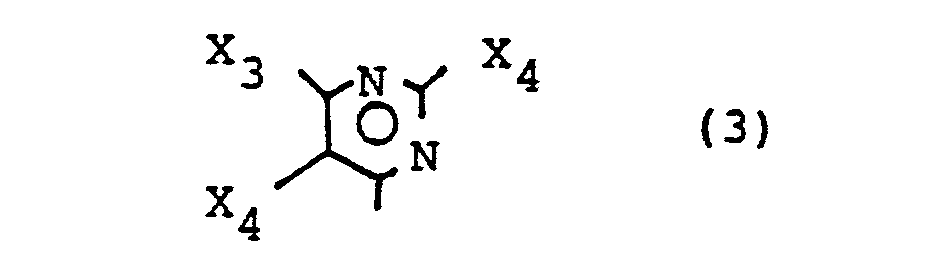

- X, = F
- X2 = Cl, F, NH2, NNR2, OR2, CH2R2, SR2
- X3 = CI, F, CH3
- X4 = CI, F und
- Xs = CI, F, CH3
- und wobei
- R2 = Alkyl (insbesondere gegebenenfalls durch OH, SO3H, COOH substituiertes C1-C4-Alkyl, Aryl - (insbesondere gegebenenfalls durch SO3H, C1-C4-Alkyl, C1-C4-Alkoxy substituiertes Phenyl), Aralkyl - (insbesondere gegebenenfalls durch SO3H. C1-C4-Alkyl, C1-C4-Alkoxy substituiertes Benzyl.
- Farbstoffe, welche die obengenannten Reaktivgruppensysteme enthalten, sind beispielsweise aus folgenden Publikationen bekannt:
- US-PS 3 377 336, US-PS 3 527 760
- GB-PS 1 169 254, US-PS 3 669 951
- DE-PS 1 644 208, GB-PS 1 188 606
- DE-OS 2 817 780, ES-PS 479 771
- Unter den nicht heterocyclischen Reaktivresten sind beispielsweise zu erwähnen β-Chlorethylsulfonyl, β-Acetoxyethylsulfonyl, β-Sulfatoethytsulfonyl, β-Thiosulfatoethylsulfonyl, β Sulfatoethylsulfonylmethylamino und Vinylsulfonylmethylamino-Gruppen.
- 1 mol 1 Amino-(4'Aminobenzoyl)-8 hydroxy-3,6-naphthalindisulfonsäure werden in 2200 ml Wasser mit LiOH·H2O bei pH = 4.5 mit 1.05 mol 2.4.6 Trifluor-5-Chlorpyrimidin bei 10°C umgesetzt. 1 mol Aminobenzolsulfonsäure-2 werden in 600 ml Wasser mit UOH·H2O neutral gelöst. Nach Zugabe von 1.200 ml eines stark sauren getförmigen Kationenaustauschers auf Basis von vemetztem Polystyrol mit einer Kapazität von 2 mol SO3H-Gruppen pro Liter wird mit 1 mol 30 %iger NaNO2-Lösung bei 5°C diazotiert. Nach beendeter Diazotierung gibt man die Mischung bei 10°C zur Kupplungskomponente, wobei der Kupplungs-pH-Wert durch Zugabe eines Kondensationsproduktes von Triethanolamin mit 3 mol Ethylenoxid bei pH = 6 gehalten wird. Nach erfolgter Kupplung gibt man 700 g ∈-Caprolactam und 1.000 ml Wasser zu. Nach Abfiltrieren des Austauscherharzes erhält man eine konzentrierte Lösung, die 15 % des Reaktivfarbstoffes mit der Formel (5) bezogen auf freie Säure enthält.
-

- Arbeitet man nach dem Verfahren der DE-OS 3 228 339.3 (Diazotierung in 2 mol H2SO4 und Kupplung mit 2 mol CaCO3) erhält man lediglich eine Suspension des Reaktivfarbstoffs (5).
- 1 mol 1-Amino-8-hydroxynaphthalin-3.6-disulfonsäure wird in 1.000 ml Wasser mit LiOH·H2O gelöst und mit 1.15 mol 2.4-Difluor-5-chlor-6-me- thylpyrimidin umgesetzt. 1 mol 1-Aminobenzolsulfonsäure-2 werden in 800 ml Wasser mit LiOH neutral gelöst und mit 1.200 ml eines stark sauren gelförmigen Kationenaustauschers auf Basis von vemetztem Polystyrol mit einer Kapazität von 2 mol SO,H-Gruppen pro 1 versetzt. Zu dieser Suspension gibt man bei 5°C 1 mol 30 %ige Natriumnitrit-Lösung.
- Nach beendeter Diazotierung wird mit der wie oben angegeben hergestellten Lösung des Kondensationsproduktes von 1-Amino-8-hydroxynaphthalin-3.6-disulfonsäure mit 2.4-Difluor-5-chlor-6-methylpirimidin in Gegenwart von 570 g e-Caprolactam gekuppelt. Der pH-Wert wird dabei mit LiOH·H2O bei 6 gehalten. Nach Zugabe von 1.000 g Wasser erhält man nach Abfiltrieren des Kationenaustauschers eine konzentrierte Lösung, die 15 % des Reaktivfarbstoffs enthält. Nach Eintragen dieser konzentrierten Reaktivfarbstofflösung in Wasser unter Zusatz der für die Reaktivfärberei üblichen Hilfsmittel erhält man eine Präparation zum Färben oder Bedrucken von natürlichen und regenerierten Cellulosefasern in rotem Ton.
- Verwendet man anstelle der oben angegebenen Diazokomponenten und Kupplungskomponenten die der folgenden Tabelle, erhält man ebenfalls stabile, konzentrierte Lösungen.

- 1 mol 4-Aminoazobenzol-4'-sulfonsäure werden in 1.050 ml Wasser mit 1.05 mol NaN02 bei pH = 8 suspendiert. Diese Suspension gibt man langsam in eine Vorlage, bestehend aus 2.1 I eines Kationenaustauschers, beschrieben in Beispiel 1, 1.050 ml Wasser und 10 g H2SO4. Nach beendeter Diazotierung wird überschüssiges Nitrit mit Amidosulfonsäure zerstört und die erhaltene Lösung zu einer Lösung aus 1.05 mol Benzoyl-3-amino-8-hydroxy-naphthalin-6-sulfonsäure in 1.400 ml Wasser und ca. 2 mol eines Kondensationsproduktes von Triethanolamin mit 3 mol Ethylenoxid (A) gegeben. Der pH-Wert wird während der Kupplung durch Zugabe von (A) bei 5 gehalten.
- Nach beendeter Reaktion wird mit (A) auf pH = 8 gestellt und soviel Wasser zugegeben, daß in der lagerstabilen Lösung 13 % Farbstoff enthalten sind.
-

und wobei q + y = 1, sowie p + z = 1
Claims (9)
Applications Claiming Priority (2)
| Application Number | Priority Date | Filing Date | Title |
|---|---|---|---|
| DE19853511752 DE3511752A1 (de) | 1985-03-30 | 1985-03-30 | Verfahren zur herstellung aromatischer diazoniumsalze, azofarbstoffe und konzentrierter loesungen von azofarbstoffen |
| DE3511752 | 1985-03-30 |
Publications (3)
| Publication Number | Publication Date |
|---|---|
| EP0201690A2 true EP0201690A2 (de) | 1986-11-20 |
| EP0201690A3 EP0201690A3 (en) | 1989-11-02 |
| EP0201690B1 EP0201690B1 (de) | 1992-12-02 |
Family
ID=6266902
Family Applications (1)
| Application Number | Title | Priority Date | Filing Date |
|---|---|---|---|
| EP86103541A Expired - Lifetime EP0201690B1 (de) | 1985-03-30 | 1986-03-15 | Verfahren zur Herstellung aromatischer Diazoniumsalze und von Azofarbstoffen |
Country Status (5)
| Country | Link |
|---|---|
| US (1) | US4754020A (de) |
| EP (1) | EP0201690B1 (de) |
| JP (1) | JPH0625096B2 (de) |
| BR (1) | BR8601341A (de) |
| DE (2) | DE3511752A1 (de) |
Cited By (2)
| Publication number | Priority date | Publication date | Assignee | Title |
|---|---|---|---|---|
| EP0235524A3 (en) * | 1986-01-29 | 1989-11-08 | Bayer Ag | Process for the preparation of concentrated solutions of anionic dyes |
| EP0553672A1 (de) * | 1992-01-30 | 1993-08-04 | Bayer Ag | Farbstoffmischungen enthaltend zwei verschiedene Monoazofarbstoffe |
Family Cites Families (10)
| Publication number | Priority date | Publication date | Assignee | Title |
|---|---|---|---|---|
| CA626925A (en) * | 1961-09-05 | Rosenlind Kjell | Manufacture of cellulosic products | |
| US2319265A (en) * | 1940-09-25 | 1943-05-18 | Du Pont | Azo dyestuffs |
| GB817001A (en) * | 1954-09-14 | 1959-07-22 | Ozalid Co Ltd | Improvements in or relating to diazonium compounds |
| US2845326A (en) * | 1955-08-08 | 1958-07-29 | Gen Aniline & Film Corp | Diazotizable amine compositions |
| US2812321A (en) * | 1955-11-15 | 1957-11-05 | American Cyanamid Co | Process for diazotization and coupling |
| BE555654A (de) * | 1956-03-09 | |||
| DE1231251B (de) * | 1963-11-28 | 1966-12-29 | Basf Ag | Verfahren zur kontinuierlichen Herstellung von Diazoverbindungen |
| CH509385A (de) * | 1969-12-29 | 1971-06-30 | Ciba Geigy Ag | Verfahren zur Herstellung von roten Monoazofarbstoffen |
| DE2910199A1 (de) * | 1979-03-15 | 1980-09-25 | Hoechst Ag | Verfahren zur herstellung von diazoniumsalzloesungen |
| DE3228339A1 (de) * | 1982-07-29 | 1984-02-09 | Bayer Ag, 5090 Leverkusen | Verfahren zur herstellung salzarmer praeparationen von azoreaktivfarbstoffen |
-
1985
- 1985-03-30 DE DE19853511752 patent/DE3511752A1/de not_active Withdrawn
-
1986
- 1986-03-07 US US06/837,490 patent/US4754020A/en not_active Expired - Lifetime
- 1986-03-15 EP EP86103541A patent/EP0201690B1/de not_active Expired - Lifetime
- 1986-03-15 DE DE8686103541T patent/DE3687182D1/de not_active Expired - Fee Related
- 1986-03-26 BR BR8601341A patent/BR8601341A/pt active Search and Examination
- 1986-03-26 JP JP61066109A patent/JPH0625096B2/ja not_active Expired - Lifetime
Cited By (3)
| Publication number | Priority date | Publication date | Assignee | Title |
|---|---|---|---|---|
| EP0235524A3 (en) * | 1986-01-29 | 1989-11-08 | Bayer Ag | Process for the preparation of concentrated solutions of anionic dyes |
| EP0553672A1 (de) * | 1992-01-30 | 1993-08-04 | Bayer Ag | Farbstoffmischungen enthaltend zwei verschiedene Monoazofarbstoffe |
| US5295999A (en) * | 1992-01-30 | 1994-03-22 | Bayer Aktiengesellschaft | Dyestuff mixtures |
Also Published As
| Publication number | Publication date |
|---|---|
| EP0201690A3 (en) | 1989-11-02 |
| DE3511752A1 (de) | 1986-10-02 |
| DE3687182D1 (de) | 1993-01-14 |
| BR8601341A (pt) | 1986-12-02 |
| EP0201690B1 (de) | 1992-12-02 |
| US4754020A (en) | 1988-06-28 |
| JPH0625096B2 (ja) | 1994-04-06 |
| JPS61231055A (ja) | 1986-10-15 |
Similar Documents
| Publication | Publication Date | Title |
|---|---|---|
| EP0210378B1 (de) | Verfahren zur Herstellung konzentrierter Lösungen von anionischen Farbstoffen und Farbstoffadditiven | |
| DE60126268T2 (de) | Verfahren zur herstellung von lösungen anionischer organischer verbindungen | |
| EP0069300B1 (de) | Flüssige Reaktivfarbstoffzubereitungen und ihre Verwendung | |
| EP0288434B1 (de) | Verfahren zur Herstellung konzentrierter wässriger Farbstoffzubereitungen | |
| EP0061151B1 (de) | Feste Präparationen von wasserlöslichen faserreaktiven Farbstoffen und ihre Verwendung zum Färben oder Bedrucken von Fasermaterialien | |
| EP0184556B1 (de) | Verfahren zur Herstellung konzentrierter salzarmer wässriger Lösungen von Aminotriazinyl-Reaktivfarbstoffen | |
| EP0095740B1 (de) | Feste Präparate von Metallkomplexfarbstoffen | |
| EP0201690B1 (de) | Verfahren zur Herstellung aromatischer Diazoniumsalze und von Azofarbstoffen | |
| DE4114587A1 (de) | Feste farbstoffpraeparationen mit verbesserter wasserloeslichkeit | |
| EP0087703B1 (de) | Verfahren zur Herstellung von Reaktivfarbstoffpräparationen | |
| EP0255890B1 (de) | Verfahren zur Umsetzung von Aminen mit heterocyclischen Reaktivkomponenten | |
| DE2607122C2 (de) | Verfahren zur Herstellung von Azofarbstoffen | |
| EP0235524B1 (de) | Verfahren zur Herstellung konzentrierter Lösungen von anionischen Farbstoffen | |
| EP0182743B1 (de) | Konzentrierte lagerstabile wässrige Lösungen gelber Stilbenazo(xy)-farbstoffe | |
| EP0550486B1 (de) | Verfahren zur herstellung von konzentrierten wässrigen lösungen von anionischen azofarbstoffen | |
| EP0122224B1 (de) | Konzentrierte lagerstabile wässrige Lösungen gelber bis grünstichig gelber Stilbenazo(xy)farbstoffe | |
| CH356438A (de) | Stabilisierte Farbstoffpräparate | |
| EP0100043A2 (de) | Verfahren zur Herstellung salzarmer Präparationen von Azoreaktivfarbstoffen | |
| EP0013919B1 (de) | Wässrige Farbstoffzubereitung und Verfahren zu ihrer Herstellung und ihre Verwendung zum Färben und Bedrucken | |
| EP0151792B1 (de) | Umsetzung von Aminen mit heterocyclischen Reaktivkomponenten | |
| DE2405855A1 (de) | Farbstoff und verfahren zur herstellung desselben | |
| EP0035000B1 (de) | Farbstoffpräparate, deren Herstellung und Verwendung | |
| EP0150158B1 (de) | Verfahren zur Sprühtrocknung leicht wasserlöslicher Farbstoffe und optischer Aufheller | |
| EP0260563B1 (de) | Farbstoffpräparationen | |
| EP0539825B1 (de) | Lagerstabile Präparation von Reaktivfarbstoffen |
Legal Events
| Date | Code | Title | Description |
|---|---|---|---|
| PUAI | Public reference made under article 153(3) epc to a published international application that has entered the european phase |
Free format text: ORIGINAL CODE: 0009012 |
|
| 17P | Request for examination filed |
Effective date: 19860315 |
|
| AK | Designated contracting states |
Kind code of ref document: A2 Designated state(s): CH DE FR GB LI |
|
| PUAL | Search report despatched |
Free format text: ORIGINAL CODE: 0009013 |
|
| AK | Designated contracting states |
Kind code of ref document: A3 Designated state(s): CH DE FR GB LI |
|
| 17Q | First examination report despatched |
Effective date: 19910516 |
|
| GRAA | (expected) grant |
Free format text: ORIGINAL CODE: 0009210 |
|
| AK | Designated contracting states |
Kind code of ref document: B1 Designated state(s): CH DE FR GB LI |
|
| GBT | Gb: translation of ep patent filed (gb section 77(6)(a)/1977) |
Effective date: 19921207 |
|
| REF | Corresponds to: |
Ref document number: 3687182 Country of ref document: DE Date of ref document: 19930114 |
|
| ET | Fr: translation filed | ||
| PLBE | No opposition filed within time limit |
Free format text: ORIGINAL CODE: 0009261 |
|
| STAA | Information on the status of an ep patent application or granted ep patent |
Free format text: STATUS: NO OPPOSITION FILED WITHIN TIME LIMIT |
|
| 26N | No opposition filed | ||
| REG | Reference to a national code |
Ref country code: GB Ref legal event code: IF02 |
|
| PGFP | Annual fee paid to national office [announced via postgrant information from national office to epo] |
Ref country code: DE Payment date: 20020208 Year of fee payment: 17 |
|
| PGFP | Annual fee paid to national office [announced via postgrant information from national office to epo] |
Ref country code: GB Payment date: 20020322 Year of fee payment: 17 Ref country code: FR Payment date: 20020322 Year of fee payment: 17 Ref country code: CH Payment date: 20020322 Year of fee payment: 17 |
|
| PG25 | Lapsed in a contracting state [announced via postgrant information from national office to epo] |
Ref country code: GB Free format text: LAPSE BECAUSE OF NON-PAYMENT OF DUE FEES Effective date: 20030315 |
|
| PG25 | Lapsed in a contracting state [announced via postgrant information from national office to epo] |
Ref country code: LI Free format text: LAPSE BECAUSE OF NON-PAYMENT OF DUE FEES Effective date: 20030331 Ref country code: CH Free format text: LAPSE BECAUSE OF NON-PAYMENT OF DUE FEES Effective date: 20030331 |
|
| PG25 | Lapsed in a contracting state [announced via postgrant information from national office to epo] |
Ref country code: DE Free format text: LAPSE BECAUSE OF NON-PAYMENT OF DUE FEES Effective date: 20031001 |
|
| GBPC | Gb: european patent ceased through non-payment of renewal fee |
Effective date: 20030315 |
|
| REG | Reference to a national code |
Ref country code: CH Ref legal event code: PL |
|
| PG25 | Lapsed in a contracting state [announced via postgrant information from national office to epo] |
Ref country code: FR Free format text: LAPSE BECAUSE OF NON-PAYMENT OF DUE FEES Effective date: 20031127 |
|
| REG | Reference to a national code |
Ref country code: FR Ref legal event code: ST |