EP0205455B1 - Polyepoxyd und halogeniertes dihydriertes phenol enthaltende vernetzbare zusammensetzungen und imprägnierte substrate und so hergestellte laminate - Google Patents
Polyepoxyd und halogeniertes dihydriertes phenol enthaltende vernetzbare zusammensetzungen und imprägnierte substrate und so hergestellte laminate Download PDFInfo
- Publication number
- EP0205455B1 EP0205455B1 EP19850905148 EP85905148A EP0205455B1 EP 0205455 B1 EP0205455 B1 EP 0205455B1 EP 19850905148 EP19850905148 EP 19850905148 EP 85905148 A EP85905148 A EP 85905148A EP 0205455 B1 EP0205455 B1 EP 0205455B1
- Authority
- EP
- European Patent Office
- Prior art keywords
- component
- value
- carbon atoms
- represented
- hydrocarbyl group
- Prior art date
- Legal status (The legal status is an assumption and is not a legal conclusion. Google has not performed a legal analysis and makes no representation as to the accuracy of the status listed.)
- Expired - Lifetime
Links
- 0 C*(CC1)CC*1C(C)(CCCC(C)C1)CC1O Chemical compound C*(CC1)CC*1C(C)(CCCC(C)C1)CC1O 0.000 description 6
- QEGNUYASOUJEHD-UHFFFAOYSA-N CC1(C)CCCCC1 Chemical compound CC1(C)CCCCC1 QEGNUYASOUJEHD-UHFFFAOYSA-N 0.000 description 1
- JPIXFVPLSJCELJ-UHFFFAOYSA-N [Os]C1CCCCC1 Chemical compound [Os]C1CCCCC1 JPIXFVPLSJCELJ-UHFFFAOYSA-N 0.000 description 1
Classifications
-
- H—ELECTRICITY
- H01—ELECTRIC ELEMENTS
- H01B—CABLES; CONDUCTORS; INSULATORS; SELECTION OF MATERIALS FOR THEIR CONDUCTIVE, INSULATING OR DIELECTRIC PROPERTIES
- H01B3/00—Insulators or insulating bodies characterised by the insulating materials; Selection of materials for their insulating or dielectric properties
- H01B3/18—Insulators or insulating bodies characterised by the insulating materials; Selection of materials for their insulating or dielectric properties mainly consisting of organic substances
- H01B3/30—Insulators or insulating bodies characterised by the insulating materials; Selection of materials for their insulating or dielectric properties mainly consisting of organic substances plastics; resins; waxes
- H01B3/40—Insulators or insulating bodies characterised by the insulating materials; Selection of materials for their insulating or dielectric properties mainly consisting of organic substances plastics; resins; waxes epoxy resins
-
- C—CHEMISTRY; METALLURGY
- C08—ORGANIC MACROMOLECULAR COMPOUNDS; THEIR PREPARATION OR CHEMICAL WORKING-UP; COMPOSITIONS BASED THEREON
- C08G—MACROMOLECULAR COMPOUNDS OBTAINED OTHERWISE THAN BY REACTIONS ONLY INVOLVING UNSATURATED CARBON-TO-CARBON BONDS
- C08G59/00—Polycondensates containing more than one epoxy group per molecule; Macromolecules obtained by polymerising compounds containing more than one epoxy group per molecule using curing agents or catalysts which react with the epoxy groups
- C08G59/02—Polycondensates containing more than one epoxy group per molecule
- C08G59/04—Polycondensates containing more than one epoxy group per molecule of polyhydroxy compounds with epihalohydrins or precursors thereof
- C08G59/06—Polycondensates containing more than one epoxy group per molecule of polyhydroxy compounds with epihalohydrins or precursors thereof of polyhydric phenols
- C08G59/066—Polycondensates containing more than one epoxy group per molecule of polyhydroxy compounds with epihalohydrins or precursors thereof of polyhydric phenols with chain extension or advancing agents
-
- C—CHEMISTRY; METALLURGY
- C08—ORGANIC MACROMOLECULAR COMPOUNDS; THEIR PREPARATION OR CHEMICAL WORKING-UP; COMPOSITIONS BASED THEREON
- C08G—MACROMOLECULAR COMPOUNDS OBTAINED OTHERWISE THAN BY REACTIONS ONLY INVOLVING UNSATURATED CARBON-TO-CARBON BONDS
- C08G59/00—Polycondensates containing more than one epoxy group per molecule; Macromolecules obtained by polymerising compounds containing more than one epoxy group per molecule using curing agents or catalysts which react with the epoxy groups
- C08G59/18—Macromolecules obtained by polymerising compounds containing more than one epoxy group per molecule using curing agents or catalysts which react with the epoxy groups ; e.g. general methods of curing
- C08G59/20—Macromolecules obtained by polymerising compounds containing more than one epoxy group per molecule using curing agents or catalysts which react with the epoxy groups ; e.g. general methods of curing characterised by the epoxy compounds used
- C08G59/32—Epoxy compounds containing three or more epoxy groups
- C08G59/3218—Carbocyclic compounds
-
- C—CHEMISTRY; METALLURGY
- C08—ORGANIC MACROMOLECULAR COMPOUNDS; THEIR PREPARATION OR CHEMICAL WORKING-UP; COMPOSITIONS BASED THEREON
- C08G—MACROMOLECULAR COMPOUNDS OBTAINED OTHERWISE THAN BY REACTIONS ONLY INVOLVING UNSATURATED CARBON-TO-CARBON BONDS
- C08G59/00—Polycondensates containing more than one epoxy group per molecule; Macromolecules obtained by polymerising compounds containing more than one epoxy group per molecule using curing agents or catalysts which react with the epoxy groups
- C08G59/18—Macromolecules obtained by polymerising compounds containing more than one epoxy group per molecule using curing agents or catalysts which react with the epoxy groups ; e.g. general methods of curing
- C08G59/40—Macromolecules obtained by polymerising compounds containing more than one epoxy group per molecule using curing agents or catalysts which react with the epoxy groups ; e.g. general methods of curing characterised by the curing agents used
- C08G59/62—Alcohols or phenols
- C08G59/621—Phenols
-
- C—CHEMISTRY; METALLURGY
- C08—ORGANIC MACROMOLECULAR COMPOUNDS; THEIR PREPARATION OR CHEMICAL WORKING-UP; COMPOSITIONS BASED THEREON
- C08K—Use of inorganic or non-macromolecular organic substances as compounding ingredients
- C08K5/00—Use of organic ingredients
- C08K5/36—Sulfur-, selenium-, or tellurium-containing compounds
- C08K5/41—Compounds containing sulfur bound to oxygen
- C08K5/42—Sulfonic acids; Derivatives thereof
-
- Y—GENERAL TAGGING OF NEW TECHNOLOGICAL DEVELOPMENTS; GENERAL TAGGING OF CROSS-SECTIONAL TECHNOLOGIES SPANNING OVER SEVERAL SECTIONS OF THE IPC; TECHNICAL SUBJECTS COVERED BY FORMER USPC CROSS-REFERENCE ART COLLECTIONS [XRACs] AND DIGESTS
- Y10—TECHNICAL SUBJECTS COVERED BY FORMER USPC
- Y10T—TECHNICAL SUBJECTS COVERED BY FORMER US CLASSIFICATION
- Y10T442/00—Fabric [woven, knitted, or nonwoven textile or cloth, etc.]
- Y10T442/20—Coated or impregnated woven, knit, or nonwoven fabric which is not [a] associated with another preformed layer or fiber layer or, [b] with respect to woven and knit, characterized, respectively, by a particular or differential weave or knit, wherein the coating or impregnation is neither a foamed material nor a free metal or alloy layer
- Y10T442/2213—Coating or impregnation is specified as weather proof, water vapor resistant, or moisture resistant
-
- Y—GENERAL TAGGING OF NEW TECHNOLOGICAL DEVELOPMENTS; GENERAL TAGGING OF CROSS-SECTIONAL TECHNOLOGIES SPANNING OVER SEVERAL SECTIONS OF THE IPC; TECHNICAL SUBJECTS COVERED BY FORMER USPC CROSS-REFERENCE ART COLLECTIONS [XRACs] AND DIGESTS
- Y10—TECHNICAL SUBJECTS COVERED BY FORMER USPC
- Y10T—TECHNICAL SUBJECTS COVERED BY FORMER US CLASSIFICATION
- Y10T442/00—Fabric [woven, knitted, or nonwoven textile or cloth, etc.]
- Y10T442/20—Coated or impregnated woven, knit, or nonwoven fabric which is not [a] associated with another preformed layer or fiber layer or, [b] with respect to woven and knit, characterized, respectively, by a particular or differential weave or knit, wherein the coating or impregnation is neither a foamed material nor a free metal or alloy layer
- Y10T442/2549—Coating or impregnation is chemically inert or of stated nonreactance
-
- Y—GENERAL TAGGING OF NEW TECHNOLOGICAL DEVELOPMENTS; GENERAL TAGGING OF CROSS-SECTIONAL TECHNOLOGIES SPANNING OVER SEVERAL SECTIONS OF THE IPC; TECHNICAL SUBJECTS COVERED BY FORMER USPC CROSS-REFERENCE ART COLLECTIONS [XRACs] AND DIGESTS
- Y10—TECHNICAL SUBJECTS COVERED BY FORMER USPC
- Y10T—TECHNICAL SUBJECTS COVERED BY FORMER US CLASSIFICATION
- Y10T442/00—Fabric [woven, knitted, or nonwoven textile or cloth, etc.]
- Y10T442/30—Woven fabric [i.e., woven strand or strip material]
- Y10T442/3382—Including a free metal or alloy constituent
- Y10T442/3415—Preformed metallic film or foil or sheet [film or foil or sheet had structural integrity prior to association with the woven fabric]
-
- Y—GENERAL TAGGING OF NEW TECHNOLOGICAL DEVELOPMENTS; GENERAL TAGGING OF CROSS-SECTIONAL TECHNOLOGIES SPANNING OVER SEVERAL SECTIONS OF THE IPC; TECHNICAL SUBJECTS COVERED BY FORMER USPC CROSS-REFERENCE ART COLLECTIONS [XRACs] AND DIGESTS
- Y10—TECHNICAL SUBJECTS COVERED BY FORMER USPC
- Y10T—TECHNICAL SUBJECTS COVERED BY FORMER US CLASSIFICATION
- Y10T442/00—Fabric [woven, knitted, or nonwoven textile or cloth, etc.]
- Y10T442/30—Woven fabric [i.e., woven strand or strip material]
- Y10T442/3472—Woven fabric including an additional woven fabric layer
-
- Y—GENERAL TAGGING OF NEW TECHNOLOGICAL DEVELOPMENTS; GENERAL TAGGING OF CROSS-SECTIONAL TECHNOLOGIES SPANNING OVER SEVERAL SECTIONS OF THE IPC; TECHNICAL SUBJECTS COVERED BY FORMER USPC CROSS-REFERENCE ART COLLECTIONS [XRACs] AND DIGESTS
- Y10—TECHNICAL SUBJECTS COVERED BY FORMER USPC
- Y10T—TECHNICAL SUBJECTS COVERED BY FORMER US CLASSIFICATION
- Y10T442/00—Fabric [woven, knitted, or nonwoven textile or cloth, etc.]
- Y10T442/60—Nonwoven fabric [i.e., nonwoven strand or fiber material]
- Y10T442/654—Including a free metal or alloy constituent
- Y10T442/656—Preformed metallic film or foil or sheet [film or foil or sheet had structural integrity prior to association with the nonwoven fabric]
-
- Y—GENERAL TAGGING OF NEW TECHNOLOGICAL DEVELOPMENTS; GENERAL TAGGING OF CROSS-SECTIONAL TECHNOLOGIES SPANNING OVER SEVERAL SECTIONS OF THE IPC; TECHNICAL SUBJECTS COVERED BY FORMER USPC CROSS-REFERENCE ART COLLECTIONS [XRACs] AND DIGESTS
- Y10—TECHNICAL SUBJECTS COVERED BY FORMER USPC
- Y10T—TECHNICAL SUBJECTS COVERED BY FORMER US CLASSIFICATION
- Y10T442/00—Fabric [woven, knitted, or nonwoven textile or cloth, etc.]
- Y10T442/60—Nonwoven fabric [i.e., nonwoven strand or fiber material]
- Y10T442/659—Including an additional nonwoven fabric
- Y10T442/67—Multiple nonwoven fabric layers composed of the same inorganic strand or fiber material
Definitions
- the present invention pertains to curable compositions containing polyglycidyl ethers of a polyphenol and halogenated bisphenols.
- FR-A-1,325 223 refers to novolac resins wherein the B-staging occurs so rapidly that a laminate cannot be prepared therefrom.
- compositions containing glycidyl ethers of bisphenols and halogenated bisphenols have been employed in the preparation of electrical laminates. However, they are usually lacking in one or more properties such as, for example, thermal performance, moisture resistance and high temperature mechanical strength.
- the components (A-2a) and (A-2b) are present in quantities such that the ratio of phenolic hydroxyl groups to epoxide groups is preferably from 0.05 : 1 to 0.25 : 1, most preferably from 0.1 : 1 to 0.2 : 1.
- the components (A) and (B) are present in quantities such that the ratio of phenolic hydroxyl groups to epoxide groups is preferably from 0.85 : 1 to 1 : 1, most preferably from 0.9 : 1 to 0.95 : 1.
- composition additionally comprises
- the present invention also pertains to substrates impregnated with the aforementioned compositions and to laminates prepared therefrom.
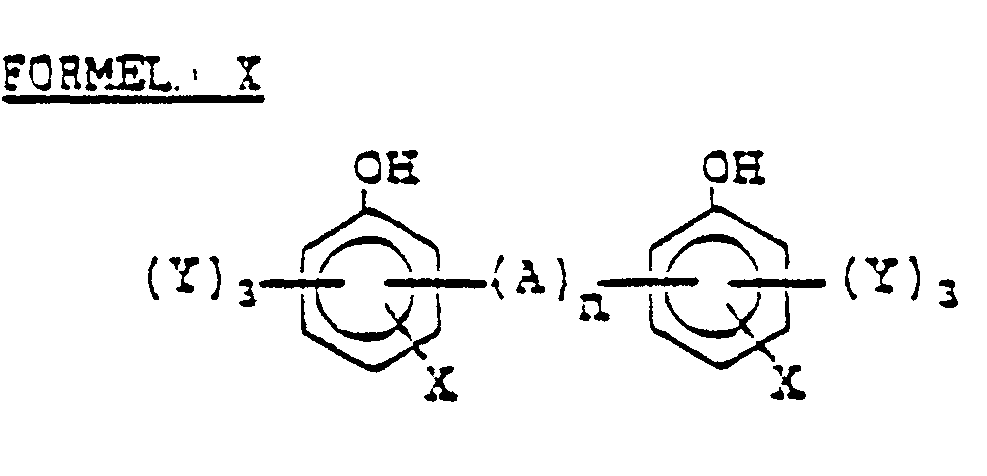
- component (A) is component (A-1) represented by formula I or II wherein Q and R are hydrogen; B,B', B", n, n', n", m, m', m" z and z' are as defined before; q has an average value of from 0.1 to 2 and component (B) is represented by formula X wherein A is a divalent hydrocarbyl group having from 1 to 6 carbon atoms, each X is bromine and n has a value of 1 and Y is as defined before.
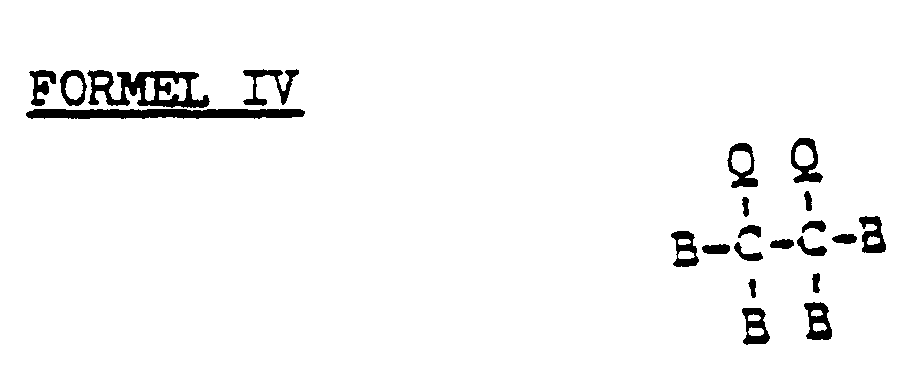
- component (A) is component (A-1) represented by formula IV or V wherein each Q and R are hydrogen, B and B" are as defined before, and component (B) is represented by formula X wherein A is a divalent hydrocarbyl group having from 1 to 6 carbon atoms; each X is bromine and n has a value of 1 and Y is as defined before.
- component (A) is component (A-1) represented by formula VI wherein each Q,R and R' is hydrogen and component (B) is represented by formula X wherein A is a divalent hydrocarbyl group having from 1 to 6 carbon atoms; each X is bromine and n has a value of 1 and Y is as defined before.
- Particularly suitable epoxy resins which can be employed herein include, for example, the triglycidyl ether of tris(hydroxyphenyl)methane, higher molecular weight homologs thereof, trisepoxides advanced with dihydric phenols, and mixtures thereof.
- dihydric phenols and halogenated dihydric phenols include, for example, bisphenol A, tetrabromobisphenol A, bisphenol S, tetrabromobisphenol S, biphenol, tetrabromobiphenol, tetrabromodihydroxybenzophenone, resorcinol, tetrabromoresorcinol, and mixtures thereof.
- Multifunctional phenolic compounds those having an average functionality of greater than 2, can be employed in this invention together with the diphenolic compounds, if desired, so as to change the cure behavior of the composition.
- Particularly suitable multifunctional phenolic compounds include, for example, phenol-formaldehyde condensation products having an average functionality of from 3 to 8, phenol-hydroxybenzaldehyde condensation products having an average functionality of from 3 to 7 and cresolformaldehyde condensation products having an average functionality of from 3 to 8.
- Suitable catalysts for effecting the reaction between the epoxy resin and the phenolic hydroxyl- containing compound include, for example, those disclosed in U.S -A- 3,306,872; 3,341,580; 3,379,684; 3,477,990; 3,547,881; 3,637,590; 3,843,605; 3,948,855; 3,956,237; 4,048,141; 4,093,650; 4,131,633; 4,132,706; 4,171,420; 4,177,216; 4,302,574; 4,320,222; 4,358,578; 4,366,295; and 4,389,520.
- catalysts are those quaternary phosphonium and ammonium compounds such as, for example, ethyltriphenylphosphonium chloride, ethyltriphenylphosphonium bromide, ethyltriphenylphosphonium iodide, ethyltriphenylphosphonium acetate, ethyltriphenylphosphonium diacetate (ethyltriphenylphosphonium acetate'acetic acid complex), ethyltriphenylphosphonium tetrahaloborate, tetrabutylphosphonium chloride, tetrabutylphosphonium acetate, tetrabutylphosphonium diacetate (tetrabutylphosphonium acetate'acetic acid complex), tetrabutylphosphonium tetrahaloborate, butyltriphenylphosphonium tetrabromobisphenate, butyltriphenylphospholphospho
- the catalyst when used, is employed in a catalytic quantity of from 0.001 to 10, more preferably from 0.05 to 5 percent by weight based upon the weight of the reactants.
- Suitable catalysts include tertiary amines such as, for example, triethylamine, tripropylamine, tributylamine, 2-methylimidazole, benzyldimethylamine, and mixtures thereof.
- Suitable catalysts include ammonium compounds such as, for example, triethylammonium chloride, triethylammonium bromide, triethylammonium iodide, triethylammonium tetrahaloborate, tributylammonium chloride, tributylammonium bromide, tributylammonium iodide, tributylammonium tetrahaloborate, N,N'-dimethyi-1,2-diaminoethane'tetrahaioboric acid complex, and mixtures thereof.
- ammonium compounds such as, for example, triethylammonium chloride, triethylammonium bromide, triethylammonium iodide, triethylammonium tetrahaloborate, tributylammonium chloride, tributylammonium bromide, tributy
- Suitable catalysts include quaternary and tertiary ammonium phosphonium, and arsonium adducts or complexes with suitable non-nucleophilic acids such as, for example, fluoboric, fluoarsenic, fluoantimonic, fluophosphoric, perchloric, perbromic, periodic, and mixtures thereof.
- Suitable solvents which can be employed herein include, for example, ketones, alcohols, glycol ethers and amides, such as, for example, acetone, methyl ethyl ketone, methanol, propylene glycol mono methyl ether and dimethyl formamide.
- compositions of the present invention may also contain, if desired, stabilizers, pigments, dyes, mold release agents, flow control agents, reinforcing agents, fillers, fire retardant agents, rubber modifiers, surfactants, accelerators, reactive diluents, and mixtures thereof.
- Suitable stabilizers which can be employed herein, are those represented by the formula wherein each R 1 is independently hydrogen, a hydrocarbyl group having from 1 to 10 carbon atoms or a halogen and R 2 is a hydrocarbyl group having from 1 to 10 carbon atoms.
- Particularly suitable stabilizers include, for example, methyl p-toluene sulfonate, ethyl p-toluene sulfonate, methyl chlorobenzene sulfonate, and combinations thereof.
- the stabilizer is methyl p-toluene sulfonate.
- the stabilizer component when used, is employed in a stabilizing quantity of from 0.001 to 10, more preferably from 0.01 to 2, percent by weight based upon the weight of the epoxy resin component.
- compositions of the present invention are suitable for such applications as impregnating substrates and as coatings, adhesives, castings, moldings, electronic encapsulations and in potting compositions.
- Suitable substrates which can be employed herein include, for example, fibers or filaments in woven, matt or non-woven form of glass, carbon, graphite, synthetic fibers, quartz, and combinations thereof.
- the impregnated substrates can be cured employing conditions known in the art.
- Structural or electrical laminates or composites can be prepared from one or more layers of cured impregnated substrates or a combination of substrates.
- the electrical laminates usually have at least one external layer of an electrically conductive material.
- the electrically conductive material is preferably copper.
- G 1c fracture toughness or "critical strain energy release rate”
- ASTM E-399 critical strain energy release rate
- the Tg was determined by Differential Scanning Calorimetry using a calibrated DuPont Instrument (Model No. 912 with a 1090 controller). Samples were run under a nitrogen atmosphere with a heat-up rate of 10° C per min. (0.1667° C/sec.).
- CTE Coefficient of thermal expansion
- Decomposition properties were determined using a DuPont Thermal Gravimetric Analyzer (Model No. 951 with a DuPont 1090 controller).
- the above mixture had a viscosity of 21 seconds measured in a No. 2 Zahn cup at (75° F) 23.9 C
- Burlington style 7628 glass cloth with an 1617 finish was impregnated with the varnish formulation of Example 2-A in a forced air vertical treater having a total length of 7.9 meters (26 feet) with the first feet) 7.9 meters- with the first 5.9 meters (19.5 feet) heated to 176.7 C (350° F) at a rate of 61 mm/sec (12 feet per min.).
- the resin contained in the impregnated glass cloth had a 73 second gel time at 171 ° C.
- the resultant impregnated glass cloth had a resin content of 47 percent by weight.
- the unclad laminate had the following properties.
- the clad laminate had a copper peel strength of 700 to 841 N/m (4 to 4.8 Ibs/in).
- a varnish formulation was prepared from the following.
- the above mixture had a viscosity of 20 seconds measured in a No. 2 Zahn cup at 23.9°C (75 F).
- Burlington style 7628 glass cloth with an 1617 finish was impregnated with the varnish formulation of Example 3-A in a forced air vertical treater having a total length of 7.9 meters (26 feet) with the first 5.9 meters (19.5 feet) heated to 176.7°C (350 F) at a rate of 50.8 mm/sec (10 feet per min.).
- the resin contained in the impregnated glass cloth had a 97 second gel time at 171 °C.
- the resultant impregnated glass cloth had a resin content of 44.4 percent by weight.
- Laminates both unclad and one sided copper clad, were prepared in the same manner described in Example 2-C.
- the unclad laminate had the following properties:
- the clad laminate had a copper peel strength of 841 to 981 N/m (4.8 to 5.6 Ibs/in).
- a formulation was made consisting of 100 g (0.4545 equiv.) of Epoxy Resin A, 114 g (0.41829 equiv.) of tetrabromobisphenol A and 110 g of methyl ethyl ketone.
- the resin solution was studied to determine its stability at 25° C and at 50° C. The stability was related to changes in the percent epoxide over a period of time. Also, methyl-p-toluene sulfonate was added to portions of the solution to determine its effects to the stability of the resin system. The results are given in Table II.
Landscapes
- Chemical & Material Sciences (AREA)
- Health & Medical Sciences (AREA)
- Chemical Kinetics & Catalysis (AREA)
- Medicinal Chemistry (AREA)
- Polymers & Plastics (AREA)
- Organic Chemistry (AREA)
- Physics & Mathematics (AREA)
- Spectroscopy & Molecular Physics (AREA)
- Epoxy Resins (AREA)
- Reinforced Plastic Materials (AREA)
- Laminated Bodies (AREA)
- Compositions Of Macromolecular Compounds (AREA)
Claims (9)
gekennzeichnet durch
Vermischen einer Mischung enthaltend




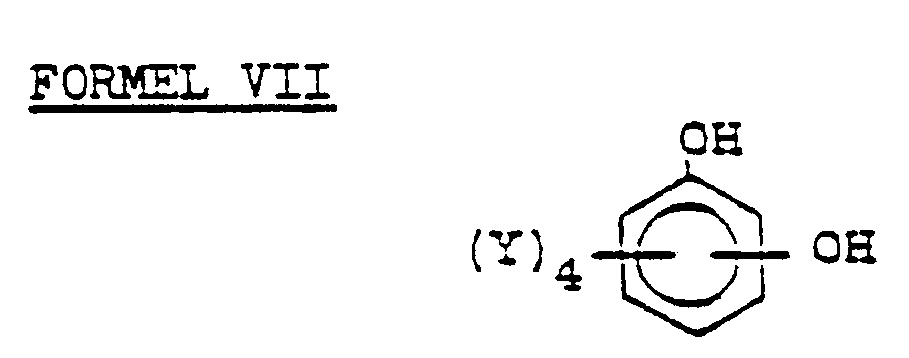
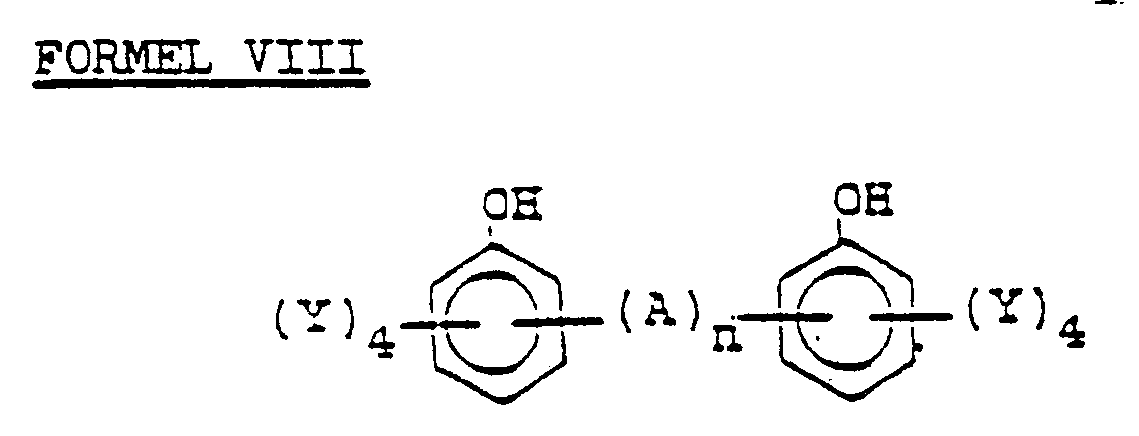


dadurch gekennzeichnet,
daß diese weiterhin (C) eine katalytische Menge von 0,001 bis 10 Gew.-%, bezogen auf das Gewicht der Ausgangsstoffe, wenigstens eines Katalysators enthält, um die Reaktion zwischen den Bestandteilen (A) und (B) zu bewirken und (D) 0 bis 50 Gew.-%, bezogen auf das Gesamtgewicht der Bestandteile (A), (B), (C) und (D), wenigstens eines Lösemittels.
dadurch gekennzeichnet,
daß diese zusätzlich eine stabilisierende Menge von 0,001 bis 10 Gew.-%, bezogen auf das Gewicht des Epoxyharzbestandteils, eines Stabilisators der Formel enthält:

dadurch gekennzeichnet,
daß Bestandteil (A) Bestandteil (A-1) ist, der durch die folgenden Formeln I und II dargestellt ist:


dadurch gekennzeichnet,
daß Bestandteil (A) Bestandteil (A-1) ist, dargestellt durch die folgenden Formeln IV oder V:


dadurch gekennzeichnet,
daß Bestandteil (A) Bestandteil (A-1) ist, dargestellt durch die folgende Formel VI:


gekennzeichnet durch Imprägnieren des Trägermaterials mit der Zusammensetzung erhalten nach Anspruch 2.
dadurch gekennzeichnet, daß es eine oder mehrere Schichten aus gehärtetem, imprägnierten Trägermaterial oder Kombinationen von Trägermaterialien erhalten nach Anspruch 7 enthält.
dadurch gekennzeichnet, daß es wenigstens eine äußere Schicht aus einem elektrisch leitenden Material aufweist.
Priority Applications (2)
| Application Number | Priority Date | Filing Date | Title |
|---|---|---|---|
| AT85905148T ATE61611T1 (de) | 1984-10-05 | 1985-09-30 | Polyepoxyd und halogeniertes dihydriertes phenol enthaltende vernetzbare zusammensetzungen und impraegnierte substrate und so hergestellte laminate. |
| MYPI87001534A MY102000A (en) | 1984-10-05 | 1987-09-03 | Curable compositions containing a polyepoxide and a halogenated dihyrdric phenol and impregnated substrates and laminates prepared therefrom |
Applications Claiming Priority (4)
| Application Number | Priority Date | Filing Date | Title |
|---|---|---|---|
| US65808384A | 1984-10-05 | 1984-10-05 | |
| US658083 | 1984-10-05 | ||
| US06/737,591 US4604317A (en) | 1984-10-05 | 1985-05-24 | Curable compositions containing a polyepoxide and a halogenated bisphenol |
| US737591 | 1985-05-24 |
Publications (3)
| Publication Number | Publication Date |
|---|---|
| EP0205455A1 EP0205455A1 (de) | 1986-12-30 |
| EP0205455A4 EP0205455A4 (de) | 1988-04-26 |
| EP0205455B1 true EP0205455B1 (de) | 1991-03-13 |
Family
ID=27097547
Family Applications (1)
| Application Number | Title | Priority Date | Filing Date |
|---|---|---|---|
| EP19850905148 Expired - Lifetime EP0205455B1 (de) | 1984-10-05 | 1985-09-30 | Polyepoxyd und halogeniertes dihydriertes phenol enthaltende vernetzbare zusammensetzungen und imprägnierte substrate und so hergestellte laminate |
Country Status (11)
| Country | Link |
|---|---|
| US (1) | US4604317A (de) |
| EP (1) | EP0205455B1 (de) |
| BR (1) | BR8506964A (de) |
| CA (1) | CA1242046A (de) |
| DE (1) | DE3582169D1 (de) |
| DK (1) | DK239286D0 (de) |
| FI (1) | FI862046A0 (de) |
| IE (1) | IE58759B1 (de) |
| IL (1) | IL76555A0 (de) |
| NO (1) | NO166042C (de) |
| WO (1) | WO1986002085A1 (de) |
Families Citing this family (23)
| Publication number | Priority date | Publication date | Assignee | Title |
|---|---|---|---|---|
| GB8519290D0 (en) * | 1985-07-31 | 1985-09-04 | Dow Chemical Rheinwerk Gmbh | Resin composition |
| JPS6274923A (ja) * | 1985-09-30 | 1987-04-06 | Mitsui Petrochem Ind Ltd | 新規エポキシ樹脂 |
| US4954603A (en) * | 1985-10-08 | 1990-09-04 | Mitsui Petrochemical Industries, Ltd. | Epoxy resin |
| US4684700A (en) * | 1986-02-14 | 1987-08-04 | The Dow Chemical Company | Advanced epoxy resins prepared from triglycidyl ethers and dihydri phenols |
| CA1272345A (en) * | 1986-02-24 | 1990-07-31 | The Dow Chemical Company | Curable compositions containing a polyepoxide and a halogenated bisphenol |
| US4975500A (en) * | 1986-04-14 | 1990-12-04 | The Dow Chemical Company | Adducts of metabrominated phenols and polyfunctional epoxides |
| US5028668A (en) * | 1986-04-14 | 1991-07-02 | The Dow Chemical Company | Adducts of metabrominated phenols and polyfunctional epoxides |
| US4914185A (en) * | 1986-04-14 | 1990-04-03 | The Dow Chemical Company | Adducts of metabrominated phenols and polyfunctional epoxides |
| US5098963A (en) * | 1986-04-14 | 1992-03-24 | The Dow Chemical Company | Adducts of metabrominated phenols and polyfunctional epoxides |
| US4783363A (en) * | 1986-09-24 | 1988-11-08 | The Dow Chemical Company | Curable compositions containing a polyepoxide and a halogenated bisphenol |
| US4868059A (en) * | 1987-11-16 | 1989-09-19 | The Dow Chemical Company | Curable composition containing a difunctional epoxy resin, a polyfunctional epoxy resin, a difunctional phenol and a polyfunctional phenol |
| US4874669A (en) * | 1988-08-15 | 1989-10-17 | The Dow Chemical Company | Curable compositions containing an epoxy resin, a difunctional phenol and a polyfunctional phenol |
| CA2017613A1 (en) * | 1989-05-29 | 1990-11-29 | Kiyomi Yasuda | Heat-resistant, flame-retardant epoxy resin compositions |
| US5210157A (en) * | 1989-08-15 | 1993-05-11 | Akzo N.V. | Interpenetrating network of ring-containing allyl polymers and epoxy resin, and a laminate prepared therefrom |
| CA2199390A1 (en) * | 1994-09-08 | 1996-03-14 | Jan Andre Jozef Schutyser | Allyl-containing epoxy resin composition comprising a copolymer of an ethylenically unsaturated anhydride and a vinyl compound |
| US6231959B1 (en) | 1995-02-27 | 2001-05-15 | Matsushita Electric Works, Ltd. | Prepreg of epoxy resin, hardener, and organodialkyurea promotor |
| DE69708908T2 (de) | 1996-10-29 | 2002-07-18 | Isola Laminate Systems Corp., Lacrosse | Copolymer aus styrol und maleinsäureanhydrid enthaltende epoxidharzzusammensetzung und covernetzer |
| US6201094B1 (en) * | 1998-09-22 | 2001-03-13 | Borden Chemical, Inc. | Phenol-novolacs with improved optical properties |
| US6001950A (en) | 1998-09-22 | 1999-12-14 | Borden Chemical, Inc. | Phenol-novolacs with improved optical properties |
| US6239248B1 (en) | 1998-09-22 | 2001-05-29 | Borden Chemical, Inc. | Phenol-novolacs with improved optical properties |
| BR0111221A (pt) * | 2000-06-05 | 2003-03-18 | Borden Chemicals Inc | Condensados glioxal-fenólicos com fluorescência intensificada |
| US6379800B1 (en) | 2000-06-05 | 2002-04-30 | Borden Chemical, Inc. | Glyoxal-phenolic condensates with enhanced fluorescence |
| US10238139B2 (en) | 2016-05-05 | 2019-03-26 | Adam Kittow | Tofu press and method of removing liquid from tofu |
Family Cites Families (13)
| Publication number | Priority date | Publication date | Assignee | Title |
|---|---|---|---|---|
| DE1643309U (de) * | 1952-02-11 | 1952-09-04 | Loewe Opta Ag | Schallplattengeraet mit mitteln zur inbetriebnahme von schallplatten verschiedener laufgeschwindigkeit. |
| DE1138542B (de) * | 1959-11-23 | 1962-10-25 | Reichhold Chemie Ag | Formmassen, die Epoxydverbindungen und Novolake enthalten |
| FR1325223A (fr) * | 1961-05-10 | 1963-04-26 | Dow Chemical Co | Composés époxydés et résines incombustibles obtenues avec ces composés |
| NL291723A (de) * | 1962-04-20 | 1900-01-01 | ||
| US3268619A (en) * | 1962-10-12 | 1966-08-23 | Michigan Chem Corp | Flame retardant epoxy resins |
| US3329737A (en) * | 1964-03-09 | 1967-07-04 | Minnesota Mining & Mfg | Curable composition containing a polyepoxide and an allylic polyphenolic novolac, free of methylol groups |
| NL133216C (de) * | 1964-09-22 | |||
| US3787451A (en) * | 1971-08-19 | 1974-01-22 | Dow Chemical Co | Epoxides of alkoxy-substituted tri(hydroxyphenyl)alkanes |
| US4394496A (en) * | 1971-08-19 | 1983-07-19 | The Dow Chemical Company | Epoxidation products of 1,1,1-tri-(hydroxyphenyl) alkanes |
| BE794087A (nl) * | 1972-01-21 | 1973-07-16 | Shell Int Research | Polyepoxyden |
| US3931109A (en) * | 1972-03-13 | 1976-01-06 | The Dow Chemical Company | Process for coating substrates with high molecular weight epoxy resins |
| US4322456A (en) * | 1972-03-13 | 1982-03-30 | The Dow Chemical Company | Process for coating substrates with high molecular weight epoxy resins |
| US4438254A (en) * | 1983-02-28 | 1984-03-20 | The Dow Chemical Company | Process for producing epoxy resins |
-
1985
- 1985-05-24 US US06/737,591 patent/US4604317A/en not_active Expired - Lifetime
- 1985-09-30 FI FI862046A patent/FI862046A0/fi not_active Application Discontinuation
- 1985-09-30 CA CA000491900A patent/CA1242046A/en not_active Expired
- 1985-09-30 BR BR8506964A patent/BR8506964A/pt unknown
- 1985-09-30 WO PCT/US1985/001868 patent/WO1986002085A1/en not_active Ceased
- 1985-09-30 EP EP19850905148 patent/EP0205455B1/de not_active Expired - Lifetime
- 1985-09-30 DE DE8585905148T patent/DE3582169D1/de not_active Expired - Lifetime
- 1985-10-03 IL IL76555A patent/IL76555A0/xx not_active IP Right Cessation
- 1985-10-04 IE IE243385A patent/IE58759B1/en not_active IP Right Cessation
-
1986
- 1986-05-22 DK DK239286A patent/DK239286D0/da unknown
- 1986-06-04 NO NO862223A patent/NO166042C/no unknown
Also Published As
| Publication number | Publication date |
|---|---|
| DK239286A (da) | 1986-05-22 |
| IE58759B1 (en) | 1993-11-03 |
| BR8506964A (pt) | 1986-12-23 |
| FI862046L (fi) | 1986-05-15 |
| DE3582169D1 (de) | 1991-04-18 |
| NO862223D0 (no) | 1986-06-04 |
| DK239286D0 (da) | 1986-05-22 |
| FI862046A7 (fi) | 1986-05-15 |
| IE852433L (en) | 1986-04-05 |
| IL76555A0 (en) | 1986-02-28 |
| US4604317A (en) | 1986-08-05 |
| NO166042C (no) | 1991-05-22 |
| FI862046A0 (fi) | 1986-05-15 |
| EP0205455A4 (de) | 1988-04-26 |
| WO1986002085A1 (en) | 1986-04-10 |
| NO166042B (no) | 1991-02-11 |
| NO862223L (no) | 1986-06-04 |
| CA1242046A (en) | 1988-09-13 |
| EP0205455A1 (de) | 1986-12-30 |
Similar Documents
| Publication | Publication Date | Title |
|---|---|---|
| US4604317A (en) | Curable compositions containing a polyepoxide and a halogenated bisphenol | |
| US4594291A (en) | Curable, partially advanced epoxy resins | |
| EP0187855B1 (de) | Teilweise geförderte epoxyharzzusammensetzungen und durch deren reaktion und vernetzung hergestellte erzeugnisse | |
| US20020032279A1 (en) | Flame retardant resin and flame retardant composition containing the same | |
| KR920002615B1 (ko) | 에폭시 수지 조성물 및 그로부터 적층판을 제조하는 방법 | |
| EP0316509A2 (de) | Härtbare Zusammensetzung aus: bifunktionellem Epoxydharz, polyfunktionellem Harz, bifunktionellem Phenol und polyfunktionellem Phenol | |
| EP0239784B1 (de) | Ein Polyepoxyd und ein halogeniertes Bisphenol enthaltende härtbare Zusammensetzungen | |
| EP0260571B1 (de) | Halogenierte Epoxydharze und damit hergestellte keltenverlängerte Harze | |
| US5066735A (en) | Curable composition containing a difunctional epoxy resin, a polyfunctional epoxy resin, a difunctional phenol and a polyfunctional phenol | |
| EP0296258B1 (de) | Laminierharz auf der Basis von Epoxydharzzusammensetzungen und damit hergestellte Verbundstoffe | |
| EP0507271A2 (de) | Epoxidharzzusammensetzungen verwendbar in der Herstellung von elektrischen Schichtstoffen | |
| US4895755A (en) | Halogenated advanced epoxy resins | |
| US4874669A (en) | Curable compositions containing an epoxy resin, a difunctional phenol and a polyfunctional phenol | |
| US4618526A (en) | Curable compositions containing multiglycidyl ethers and a sulfonic acid amide | |
| EP0234411A1 (de) | Epoxidharze hergestellt aus Triglycidylethern und Diphenolen | |
| US4783363A (en) | Curable compositions containing a polyepoxide and a halogenated bisphenol | |
| EP0556429A1 (de) | Epoxydharzzusammensetzung | |
| JP3141962B2 (ja) | エポキシ樹脂組成物及びその硬化物 | |
| JP3226515B2 (ja) | エポキシ基を含む含燐化合物の樹脂組成物およびその用途 | |
| EP0556421A1 (de) | Härtbare Harzzusammensetzungen | |
| US5364925A (en) | Epoxy resin advanced with a dihydric phenol and further chain extended with an additional dihydric phenol for use in electrical laminates | |
| JPS6331494B2 (de) | ||
| EP0497284A2 (de) | Epoxydharzzusammensetzung für elektrische Schichtstoffe |
Legal Events
| Date | Code | Title | Description |
|---|---|---|---|
| PUAI | Public reference made under article 153(3) epc to a published international application that has entered the european phase |
Free format text: ORIGINAL CODE: 0009012 |
|
| 17P | Request for examination filed |
Effective date: 19860527 |
|
| AK | Designated contracting states |
Kind code of ref document: A1 Designated state(s): AT BE CH DE FR GB IT LI NL SE |
|
| A4 | Supplementary search report drawn up and despatched |
Effective date: 19880426 |
|
| 17Q | First examination report despatched |
Effective date: 19891115 |
|
| GRAA | (expected) grant |
Free format text: ORIGINAL CODE: 0009210 |
|
| AK | Designated contracting states |
Kind code of ref document: B1 Designated state(s): AT BE CH DE FR GB IT LI NL SE |
|
| REF | Corresponds to: |
Ref document number: 61611 Country of ref document: AT Date of ref document: 19910315 Kind code of ref document: T |
|
| REF | Corresponds to: |
Ref document number: 3582169 Country of ref document: DE Date of ref document: 19910418 |
|
| ITF | It: translation for a ep patent filed | ||
| ET | Fr: translation filed | ||
| PLBE | No opposition filed within time limit |
Free format text: ORIGINAL CODE: 0009261 |
|
| STAA | Information on the status of an ep patent application or granted ep patent |
Free format text: STATUS: NO OPPOSITION FILED WITHIN TIME LIMIT |
|
| 26N | No opposition filed | ||
| PGFP | Annual fee paid to national office [announced via postgrant information from national office to epo] |
Ref country code: FR Payment date: 19940518 Year of fee payment: 10 |
|
| PGFP | Annual fee paid to national office [announced via postgrant information from national office to epo] |
Ref country code: CH Payment date: 19940525 Year of fee payment: 10 |
|
| PGFP | Annual fee paid to national office [announced via postgrant information from national office to epo] |
Ref country code: BE Payment date: 19940610 Year of fee payment: 10 |
|
| PGFP | Annual fee paid to national office [announced via postgrant information from national office to epo] |
Ref country code: GB Payment date: 19940701 Year of fee payment: 10 |
|
| PGFP | Annual fee paid to national office [announced via postgrant information from national office to epo] |
Ref country code: AT Payment date: 19940811 Year of fee payment: 10 |
|
| PGFP | Annual fee paid to national office [announced via postgrant information from national office to epo] |
Ref country code: NL Payment date: 19940930 Year of fee payment: 10 |
|
| EAL | Se: european patent in force in sweden |
Ref document number: 85905148.4 |
|
| PG25 | Lapsed in a contracting state [announced via postgrant information from national office to epo] |
Ref country code: LI Effective date: 19950930 Ref country code: GB Effective date: 19950930 Ref country code: CH Effective date: 19950930 Ref country code: BE Effective date: 19950930 Ref country code: AT Effective date: 19950930 |
|
| BERE | Be: lapsed |
Owner name: THE DOW CHEMICAL CY Effective date: 19950930 |
|
| PG25 | Lapsed in a contracting state [announced via postgrant information from national office to epo] |
Ref country code: NL Effective date: 19960401 |
|
| REG | Reference to a national code |
Ref country code: CH Ref legal event code: PL |
|
| GBPC | Gb: european patent ceased through non-payment of renewal fee |
Effective date: 19950930 |
|
| PG25 | Lapsed in a contracting state [announced via postgrant information from national office to epo] |
Ref country code: FR Effective date: 19960531 |
|
| NLV4 | Nl: lapsed or anulled due to non-payment of the annual fee |
Effective date: 19960401 |
|
| REG | Reference to a national code |
Ref country code: FR Ref legal event code: ST |
|
| PGFP | Annual fee paid to national office [announced via postgrant information from national office to epo] |
Ref country code: SE Payment date: 20020829 Year of fee payment: 18 |
|
| PGFP | Annual fee paid to national office [announced via postgrant information from national office to epo] |
Ref country code: DE Payment date: 20020907 Year of fee payment: 18 |
|
| PG25 | Lapsed in a contracting state [announced via postgrant information from national office to epo] |
Ref country code: SE Free format text: LAPSE BECAUSE OF NON-PAYMENT OF DUE FEES Effective date: 20031001 |
|
| PG25 | Lapsed in a contracting state [announced via postgrant information from national office to epo] |
Ref country code: DE Free format text: LAPSE BECAUSE OF NON-PAYMENT OF DUE FEES Effective date: 20040401 |
|
| EUG | Se: european patent has lapsed |