EP0207367A1 - Catalyseur pour la purification d'un gaz d'échappement - Google Patents
Catalyseur pour la purification d'un gaz d'échappement Download PDFInfo
- Publication number
- EP0207367A1 EP0207367A1 EP86108290A EP86108290A EP0207367A1 EP 0207367 A1 EP0207367 A1 EP 0207367A1 EP 86108290 A EP86108290 A EP 86108290A EP 86108290 A EP86108290 A EP 86108290A EP 0207367 A1 EP0207367 A1 EP 0207367A1
- Authority
- EP
- European Patent Office
- Prior art keywords
- catalyst
- exhaust gases
- weight
- alumina
- purifying
- Prior art date
- Legal status (The legal status is an assumption and is not a legal conclusion. Google has not performed a legal analysis and makes no representation as to the accuracy of the status listed.)
- Granted
Links
Images


Classifications
-
- B—PERFORMING OPERATIONS; TRANSPORTING
- B01—PHYSICAL OR CHEMICAL PROCESSES OR APPARATUS IN GENERAL
- B01D—SEPARATION
- B01D53/00—Separation of gases or vapours; Recovering vapours of volatile solvents from gases; Chemical or biological purification of waste gases, e.g. engine exhaust gases, smoke, fumes, flue gases, aerosols
- B01D53/34—Chemical or biological purification of waste gases
- B01D53/92—Chemical or biological purification of waste gases of engine exhaust gases
- B01D53/94—Chemical or biological purification of waste gases of engine exhaust gases by catalytic processes
- B01D53/9445—Simultaneously removing carbon monoxide, hydrocarbons or nitrogen oxides making use of three-way catalysts [TWC] or four-way-catalysts [FWC]
- B01D53/945—Simultaneously removing carbon monoxide, hydrocarbons or nitrogen oxides making use of three-way catalysts [TWC] or four-way-catalysts [FWC] characterised by a specific catalyst
-
- B—PERFORMING OPERATIONS; TRANSPORTING
- B01—PHYSICAL OR CHEMICAL PROCESSES OR APPARATUS IN GENERAL
- B01J—CHEMICAL OR PHYSICAL PROCESSES, e.g. CATALYSIS OR COLLOID CHEMISTRY; THEIR RELEVANT APPARATUS
- B01J23/00—Catalysts comprising metals or metal oxides or hydroxides, not provided for in group B01J21/00
- B01J23/02—Catalysts comprising metals or metal oxides or hydroxides, not provided for in group B01J21/00 of the alkali- or alkaline earth metals or beryllium
- B01J23/04—Alkali metals
-
- C—CHEMISTRY; METALLURGY
- C04—CEMENTS; CONCRETE; ARTIFICIAL STONE; CERAMICS; REFRACTORIES
- C04B—LIME, MAGNESIA; SLAG; CEMENTS; COMPOSITIONS THEREOF, e.g. MORTARS, CONCRETE OR LIKE BUILDING MATERIALS; ARTIFICIAL STONE; CERAMICS; REFRACTORIES; TREATMENT OF NATURAL STONE
- C04B35/00—Shaped ceramic products characterised by their composition; Ceramics compositions; Processing powders of inorganic compounds preparatory to the manufacturing of ceramic products
- C04B35/01—Shaped ceramic products characterised by their composition; Ceramics compositions; Processing powders of inorganic compounds preparatory to the manufacturing of ceramic products based on oxide ceramics
- C04B35/14—Shaped ceramic products characterised by their composition; Ceramics compositions; Processing powders of inorganic compounds preparatory to the manufacturing of ceramic products based on oxide ceramics based on silica
-
- Y—GENERAL TAGGING OF NEW TECHNOLOGICAL DEVELOPMENTS; GENERAL TAGGING OF CROSS-SECTIONAL TECHNOLOGIES SPANNING OVER SEVERAL SECTIONS OF THE IPC; TECHNICAL SUBJECTS COVERED BY FORMER USPC CROSS-REFERENCE ART COLLECTIONS [XRACs] AND DIGESTS
- Y02—TECHNOLOGIES OR APPLICATIONS FOR MITIGATION OR ADAPTATION AGAINST CLIMATE CHANGE
- Y02T—CLIMATE CHANGE MITIGATION TECHNOLOGIES RELATED TO TRANSPORTATION
- Y02T10/00—Road transport of goods or passengers
- Y02T10/10—Internal combustion engine [ICE] based vehicles
- Y02T10/12—Improving ICE efficiencies
Definitions
- the present invention relates to ceramic moldings small in thermal expansion coefficient, and, more particularly, to catalysts for purifying the combustion exhaust gases for use in vehicles, industries, public welfares.
- the cordierite series ceramics are mostly used as ceramics small in thermal expansion coefficient in the conventional catalyst carriers for purifying the exhaust gases.
- alumina series ceramics, mullite series ceramics are also used.
- these alumina series ceramics, mullite series ceramics have values three through five times in thermal expansion coefficient as many as the cordierite series ceramics, thus resulting in lower practical rate.
- the cordierite ceramics shown in 2MgO ⁇ 2Al 2 O 3 ⁇ 5SiO 2 and composed in the component ratio of the cordierite construction with a view to talc ( Mg 3 (Si 4 O 10 ) (OH) 2 ), kaolin (Al 2 Si 2 O 5 (OH) 4 ) and alumina (Al 2 O 3 ), is mixed deaired, molded, dried, sintered for manufacturing operation.
- the respective component % by weight of the theoretical composition cordierite is MgO 13.8 %, Al 2 O 3 34.9 %, SiO 2 51.3 %.
- the sintering temperature is about 1,400°C and the sintering is normally performed for about one week.
- This thermal expansion coefficient is 1.2 through 1.4 x 10 -6 /degree (room temperature ⁇ 1000°C). Even in the alumina series, mullite series ceramics, the sintering temperature is as high as 1,300°C or more, as disclosed in Japanese Patent Publications (examined) No. 54-1564 and No. 51-20358.
- the high-temperature sintering operation was performed to produce substances small in thermal expansion coefficient so as to improve the mechanical strength.
- these carriers of the conventional method were extremely glassed during the sintering operation, thus reducing the specific surface area extremely smaller i.e., the specific surface area in the case of the cordierite series ceramics was 1 m 2 or lower per gram. Accordingly it is difficult to carry the catalyst substance directly on the conventional catalyst carrier. Even if the catalyst carrying operation is performed, it is insufficient as the catalyst for purifying the exhaust gases. This is because the carried noble metal is likely to move and diffuse on the carrier through the heat, thus suddenly deteriorating the catalyst performance.
- the prior treatment as called wash coat, in which powders such as ⁇ -Al 2 O 3 or the like are coated on the surface is carried beforehand. Thereafter, the catalyst substance is carried.
- the catalyst carriers composed of the conventional cordierite series ceramics are sintered, contracted by about 3 0 % respectively in three-axis directions during the scattering operation, are difficult to maintain the size accuracy, are complicated in the manufacturing process, and are inferior in product yield. Also, the cost thereof becomes higher because of the high sintering temperature.
- an object of the present invention is to provide catalysts, for purifying the exhaust gases, of lower cost, and excellent properties wherein the thermal expansion coefficient is smaller than the conventional ones, the mechanical strength is provided at the low temperatures, even in the thermal processing temperatures, and the specific surface area is large.
- the present invention is to thermally process at comparative low temperatures the composition composed of at least rehydration alumina and alkali titanate to provide ceramics which have property matters superior as carriers.
- the ceramics are provided as catalyst carriers for purifying the exhaust gases after carrying the catalyst substance as catalysts for purifying after the exhaust gases.
- the re-hydrable alumina is transition alumina, such as ⁇ -Al 2 O 3 , amorphous alumina or the like, with the exception of ⁇ -Al 2 O 3 which is provided through the thermal cracking of the alumina hydrate.
- alumina hydrate such as alumina trihydrate or the like which is provided from, for example, Bayer process is normally brought into contact with the hot gas for a few minutes or alumina hydrate is normally heat- ingly retained for one minute through four hours at about 250 through 900°C under the decreased pressure, so that the loss on ignition of approximately 0.5 through"15 % by weight is provided.
- the alkali titanate is substance shown in a general formula M' 2 O ⁇ nTiO 2 , wherein M' shows the alkali metallic atom selected from lithium, sodium, potassium, rubidium, cesium, barium, strontium, calcium,w n is an integral number of 1 through 8.
- the catalyst carrier which is superior in thermal shock resistance although the reason is not clear, and is relatively large in specific surface area is provided through the thermal treatment of the composition composed of at least the above-described two components.
- the catalyst carrier for purifying the exhaust gases may have molding assistant, (for example, carboxy-methylcellulose, methylcellulose) and plasticizer (glycerin, vaseline), etc. optionally added in addition to the re-hydrable alumina, the alkali titanate. Also, heat-resisting material such as fused silica powder, synthetic cordierite powder, mullite powder chamotte or the like may be added.
- composition composed of bonding agent such as cement material or the like with the use of these heat-resisting materials is thermally processed to cause the cement agent and the synthetic cordierite powder to react to produce the new ceramics.
- the mixing ratio between the re-hydrable alumina and the alkali titanate is within the range of (1:1) through (10:1) by weight.
- the ratio between the re-hydrable alumina and the alkali titanate is preferable to stay within the range of the (1:1) through (1:10) by weight even in a case where the fused silica powder, the synthetic cordierite powder, the mullite powder, chamotte and so on may be added.
- the total amount of the re-hydrable alumina and the alkali titanate is preferably 10 % or more by weight in terms of pressure-resistance strength, thermal shock resistance, catalyst performance.
- the fused, silica is superior in terms of the thermal shock resistance, the catalyst performance from among the fused silica, the synthetic cordierite powder, the mullite powder, the chamotte, etc.
- the fused silica is the smallest among the substances in thermal expansion coefficient, which is 0.5 x 10 -6 /degree (room temperature through 1,000°C). Although it is known as a material for reducing the thermal expansion, it is a glass forming oxide. When it is thermally treated at the temperatures of 1,000 C or more with a mixture of the other substances (for example, alkali component such as sodium, potassium, calcium or the like, and alumina, titania, etc), crystal materials such as cristobalite or tridynite or the like are caused, the thermal expansion coefficient rapidly increases to 4 through 5 x 10 -6 /degree (room temperature m 1,000°C). In this respect, it is not used conventionally as ceramics superior in thermal shock resistance like the present invention.
- composition composed of the combination among at least the re-hydrable alumina, the alkali titanate, the fused silica is thermally treated in the range of 1,100 through 1,300°C to produce the catalyst carrier, which is superior in thermal shock resistance and comparatively large in specific surface area although the reason is not apparent.
- the property matter of the catalyst carrier produced through the present invention is 1.4 x 10 -6 /degree (room temperature ⁇ 1,000°C) in thermal expansion coefficient though it is somewhat different in compounding ratio, thermal treatment temperature. Also, the thermal shock resistance is superior with the thermal shock temperature being between 500° and 850°C.
- the specific surface area is 10 m 2 /g though it is different in the compounding ratio, the thermal treatment temperature.
- the honey-comb shaped ceramics provided in this manner are provided as the catalyst carrier, platinum (Pt) and rhodium (Rh) are carried 1.0 g and 200 mg per one l catalyst carrier to adjust the catalyst.
- the platinum uses chloroplatinate (H 2 PtC1 6 )
- the rhodium uses rhodium nitrate (Rh(N0 3 ) 3 ).
- the compound is mixed so that the weight ratio between the Pt and the Rh becomes 5:1 in weight ratio, the water solution is dipped in the carrier.
- the two catalysts for purifying the gases are evaluated by the two evaluation methods.
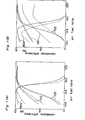
- the results by evaluation method 2 are shown in Fig. 1, A, b.
- the A is the results of the catalyst of the present invention
- the B shows the results of the comparison examples composed of the cordierite series carrier.
- the catalyst in the comparison example is larger in the thermal deterioration as compared with the catalyst of the present invention.
- the catalyst in the comparison example is larger in deterioration from the initial stage with respect to each of CO, HC and NO x component gases.
- honey-comb shaped ceramics examples include 4.0 parts by weight'of methylcellulose as molding assistant, 2.0 parts by weight of glycerin as plasticizer, 31 parts by weight of water are added to 30 parts by weight of re-hydrable alumina, 30 parts by weight of potassium titanate (K 2 O ⁇ 6TiO 2 ), 40 parts by weight of synthetic cordierite powder to manufacture the honey-comb shaped ceramics (sample No. 1) in the same manner as in embodiment 1. Also, even when 40 parts by weight of mullite powder, instead of 40 parts by weight of synthetic cordierite powder are added in the composition, the honey-comb shaped ceramics are manufactured in the same manner as in embodiment 1 for evaluation of the thermal shock resistance, the platinum, rhodium catalysts are also carried as in embodiment 1 for evaluation by evaluation method 1. The results are shown in Table 2.
- the ceramics superior in the thermal shock resistance are provided when they are combined with the indispensable component of the present invention, further the deterioration because of the heat of the catalyst performance is smaller.
- the mullite powder, ⁇ -Al 2 O 3 is used instead of the re-hydrable alumina, titanium oxide of anatase type is used instead of alkali titanate for evaluation, but they are not satisfactory in the thermal shock resistance, the catalyst performance.
- the honey-comb shaped ceramics are manufactured in the same manner as in embodiment 1 for the evaluation of the thermal shock resistance, the platinum, rhodium catalyst substances are also carried as in embodiment 1 for evaluation by evaluation method 1. The results are shown in Table 3.
- ceramics provided through the combination with the fused silica as compared with the combination between the synthetic cordierite powder - or mullite powder and the indispensable component of the invention are small in the deterioration of the thermal shock resistance, furthermore in the deterioration through the heat of the catalyst performance.
- the re-hydrable alumina, potassium titanate, fused silica are variably changed in ratio, the molding assistant, plasticizer, water are added as in embodiment 3, the honey-comb shaped ceramics are manufactured as in embodiment 3 for the evaluation of the thermal shock resistance.
- the platinum, rhodium catalyst substances are also carried as in embodiment 1 for the evaluation by evaluation method 1.
- the composition superior in the thermal shock resistance is in the range of 5 through 20 parts by weight of re-hydrable alumina in the inclined line portion of Fig. 3, 1 through 10 parts by weight of alkali titante, 70 through 94 parts by weight of fused silica.
- the thermal expansion-shrinkage ratio with respect to the temperature except for the range is as in'Fig. 4(a).
- the thermal deterioration is large.
- the thermal deterioration is smaller as compared with the catalyst, which comes from the conventional cordierite series catalyst carrier.
- the composition composed of re-hydrable alumina and each alkali titanate are superior because of small thermal deterioration.
- the composition composed of potassium titanate is small in thermal deterioration.
- each catalyst performance within the range of 1,000 through 1,400°C in the thermal treatment performance is measured and evaluated by evaluation method 1.
- the purification performance results after the thermal treatment are shown in Fig. 4.
- the 1,100°C or lower in the thermal treatment temperature of Fig. 4 the thermal deterioration of the catalyst is large. Also, even in 1,300°C or more, the thermal deterioration is large.
- the ceramic carrier provided in the thermal treatment temperature of 1,100°C or lower is unstable with respect to the heat, reacts with the platinum, rhodium noble metals to lower the catalyst performance.
- the ceramic carrier provided in the thermal treatment temperature of 1,300°C or more is extremely stable with respect to the heat, the surface is vitrified, the specific surface area becomes 1.0 m 2 or lower per gram, the carried platinum, rhodium catalyst substances are moved, diffused on the surface of the carrier to cause aggregation, are suddenly deteriorated.
- Fig. 5 A shows the scanning type electron microscope photograph 20,000 times as large as the honey-comb-shaped ceramic section provided through the thermal treatment at 1,000°C.
- Fig. 5, B shows the scanning type electron microscope photograph 20,000 times as large as the honey-comb-shaped ceramic section provided through the thermal treatment at 1,400°C.
- the catalystic carrier ceramics which are superior in catalystic performance, further are small in thermal expansion coefficient, are superior in thermal shock resistance may be provided at lower cost at comparative lower temperatures.
Landscapes
- Chemical & Material Sciences (AREA)
- Engineering & Computer Science (AREA)
- Organic Chemistry (AREA)
- Chemical Kinetics & Catalysis (AREA)
- Ceramic Engineering (AREA)
- Materials Engineering (AREA)
- Health & Medical Sciences (AREA)
- Combustion & Propulsion (AREA)
- Structural Engineering (AREA)
- Biomedical Technology (AREA)
- Environmental & Geological Engineering (AREA)
- Analytical Chemistry (AREA)
- General Chemical & Material Sciences (AREA)
- Oil, Petroleum & Natural Gas (AREA)
- Manufacturing & Machinery (AREA)
- Catalysts (AREA)
- Exhaust Gas Treatment By Means Of Catalyst (AREA)
Applications Claiming Priority (4)
| Application Number | Priority Date | Filing Date | Title |
|---|---|---|---|
| JP60134575A JPS61291040A (ja) | 1985-06-20 | 1985-06-20 | 排ガス浄化用触媒 |
| JP134574/85 | 1985-06-20 | ||
| JP60134574A JPS61291039A (ja) | 1985-06-20 | 1985-06-20 | 排ガス浄化用触媒 |
| JP134575/85 | 1985-06-20 |
Publications (2)
| Publication Number | Publication Date |
|---|---|
| EP0207367A1 true EP0207367A1 (fr) | 1987-01-07 |
| EP0207367B1 EP0207367B1 (fr) | 1990-01-17 |
Family
ID=26468648
Family Applications (1)
| Application Number | Title | Priority Date | Filing Date |
|---|---|---|---|
| EP86108290A Expired - Lifetime EP0207367B1 (fr) | 1985-06-20 | 1986-06-18 | Catalyseur pour la purification d'un gaz d'échappement |
Country Status (3)
| Country | Link |
|---|---|
| US (1) | US4769356A (fr) |
| EP (1) | EP0207367B1 (fr) |
| DE (1) | DE3668271D1 (fr) |
Cited By (2)
| Publication number | Priority date | Publication date | Assignee | Title |
|---|---|---|---|---|
| EP1923134A1 (fr) | 2006-11-17 | 2008-05-21 | Postech Foundation | Catalyseurs d'oxydation pour enlever des particules de suie des gaz d'échappement et méthode pour enlever des particules de suie utilisant ces catalyseurs |
| US7631488B2 (en) | 2006-10-27 | 2009-12-15 | Postech Foundation | Oxidation catalyst for removing fine soot particulates from exhaust gases and method of removing fine soot particulates using the same |
Families Citing this family (9)
| Publication number | Priority date | Publication date | Assignee | Title |
|---|---|---|---|---|
| US5686377A (en) * | 1995-01-17 | 1997-11-11 | Kabushiki Kaisha Toyota Chuo Kenkyusho | Catalyst for purifying exhaust gases |
| US5750082A (en) * | 1995-09-21 | 1998-05-12 | Ford Global Technologies, Inc. | Nox trap with improved performance |
| US5837212A (en) * | 1995-09-21 | 1998-11-17 | Ford Global Technologies, Inc. | Potassium/manganese nitrogen oxide traps for lean-burn engine operation |
| US5830421A (en) * | 1996-07-03 | 1998-11-03 | Low Emissions Technologies Research And Development Partnership | Material and system for catalytic reduction of nitrogen oxide in an exhaust stream of a combustion process |
| JP3428381B2 (ja) * | 1996-08-16 | 2003-07-22 | 三菱マテリアル株式会社 | NOx浄化舗装構造物 |
| US6497848B1 (en) | 1999-04-02 | 2002-12-24 | Engelhard Corporation | Catalytic trap with potassium component and method of using the same |
| JP4082559B2 (ja) * | 2001-11-22 | 2008-04-30 | 日本碍子株式会社 | 触媒体及びその製造方法 |
| DE102007034633A1 (de) † | 2007-04-05 | 2009-01-29 | Nano-X Gmbh | Beschichtungsmaterial mit einer katalytischen Aktivität und Verwendung des Beschichtungsmaterials |
| US20100098618A1 (en) * | 2008-10-20 | 2010-04-22 | Keller Alfred E | Sulfur removal from gases |
Citations (1)
| Publication number | Priority date | Publication date | Assignee | Title |
|---|---|---|---|---|
| DE2113940A1 (de) * | 1971-03-23 | 1972-09-28 | Aloys Dr Wuestefeld | Verfahren zur Steigerung der Reaktivitaet fester Stoffe |
Family Cites Families (17)
| Publication number | Priority date | Publication date | Assignee | Title |
|---|---|---|---|---|
| US3928533A (en) * | 1972-10-02 | 1975-12-23 | Corning Glass Works | Base metal titanate catalysts |
| US3892897A (en) * | 1972-10-02 | 1975-07-01 | Corning Glass Works | Process for making base metal titanate catalytic device |
| GB1495547A (en) * | 1974-03-22 | 1977-12-21 | British Petroleum Co | Polymerisation catalyst |
| US3903242A (en) * | 1974-04-08 | 1975-09-02 | Corning Glass Works | Cobalt-manganese titanate noble metal combination catalysts |
| GB1541928A (en) * | 1975-12-23 | 1979-03-14 | Sakai Chemical Industry Co | Production of shaped catalysts or carriers comprising titanium oxide |
| US4042615A (en) * | 1976-04-05 | 1977-08-16 | Exxon Research And Engineering Co. | Hydrocarbon synthesis from CO and H2 using Ni supported on a titanium oxide |
| US4120942A (en) * | 1976-06-14 | 1978-10-17 | American Cyanamid Company | Staged rehydration of alumina |
| DE2707229C2 (de) * | 1977-02-19 | 1983-08-25 | Bayer Ag, 5090 Leverkusen | Herstellung von Zink- und Erdalkalititanaten |
| US4273724A (en) * | 1979-07-09 | 1981-06-16 | Exxon Research & Engineering Co. | Hydrocarbon synthesis from CO and H2 using titanium promoted bulk nickel catalysts |
| DE3132674C2 (de) * | 1981-08-19 | 1983-12-08 | Degussa Ag, 6000 Frankfurt | Verfahren zur Herstellung von Preßlingen |
| US4496469A (en) * | 1982-01-12 | 1985-01-29 | Otsuka Kagaku Yakuhin Kabushiki Kaisha | Heat-insulating refractory material consisting alkali titanate and silicon resin |
| CA1213875A (fr) * | 1982-11-29 | 1986-11-12 | Shigeo Uno | Catalyseur de combustion |
| JPS60112619A (ja) * | 1983-11-21 | 1985-06-19 | Otsuka Chem Co Ltd | 変成されたチタン酸アルカリの製造方法 |
| DE3472420D1 (en) * | 1983-11-29 | 1988-08-04 | Sony Corp | Methods of manufacturing dielectric metal titanates |
| US4547525A (en) * | 1983-12-19 | 1985-10-15 | Exxon Research And Engineering Co. | Reducing methane production in Fischer-Tropsch reactions |
| JPS60191019A (ja) * | 1984-03-12 | 1985-09-28 | Otsuka Chem Co Ltd | 繊維状チタン酸アルカリ金属の製造法 |
| JPH0638075B2 (ja) * | 1984-10-08 | 1994-05-18 | 日本碍子株式会社 | 燃焼排ガスにおける雰囲気変化の迅速的検出方法 |
-
1986
- 1986-06-17 US US06/875,082 patent/US4769356A/en not_active Expired - Lifetime
- 1986-06-18 EP EP86108290A patent/EP0207367B1/fr not_active Expired - Lifetime
- 1986-06-18 DE DE8686108290T patent/DE3668271D1/de not_active Expired - Lifetime
Patent Citations (1)
| Publication number | Priority date | Publication date | Assignee | Title |
|---|---|---|---|---|
| DE2113940A1 (de) * | 1971-03-23 | 1972-09-28 | Aloys Dr Wuestefeld | Verfahren zur Steigerung der Reaktivitaet fester Stoffe |
Non-Patent Citations (1)
| Title |
|---|
| CHEMICAL ABSTRACTS, vol. 102, no. 18, May 1985, page 275, abstract no. 153672v, Columbus, Ohio, US; R.Ya. POPIL'SKII et al.: "Ceramics based on fused quartz and a modifying phase-strontium titanate", & IZV. AKAD. NAUK SSSR. NEORG. MATER. 1985, 21(2), 312-16 * |
Cited By (2)
| Publication number | Priority date | Publication date | Assignee | Title |
|---|---|---|---|---|
| US7631488B2 (en) | 2006-10-27 | 2009-12-15 | Postech Foundation | Oxidation catalyst for removing fine soot particulates from exhaust gases and method of removing fine soot particulates using the same |
| EP1923134A1 (fr) | 2006-11-17 | 2008-05-21 | Postech Foundation | Catalyseurs d'oxydation pour enlever des particules de suie des gaz d'échappement et méthode pour enlever des particules de suie utilisant ces catalyseurs |
Also Published As
| Publication number | Publication date |
|---|---|
| US4769356A (en) | 1988-09-06 |
| DE3668271D1 (de) | 1990-02-22 |
| EP0207367B1 (fr) | 1990-01-17 |
Similar Documents
| Publication | Publication Date | Title |
|---|---|---|
| EP0133021B1 (fr) | Produit céramique en titanate d'aluminium et de mullite et sa fabrication | |
| EP0278750B1 (fr) | Corps de cordiérite en structure en nid d'abeilles | |
| EP0037868B2 (fr) | Procédé pour la préparation de matériaux céramiques ayant une faible expansion thermique | |
| EP0535872B1 (fr) | Procédé de frittage de matériaux céramique à structure ennid d'abeille | |
| EP0036052B2 (fr) | Structure en nid d'abeille utilisée comme support pour catalyseur des gaz d'échappement d'automobile | |
| WO2005046840A1 (fr) | Corps en céramique à base de titanate d'aluminium | |
| EP1566214B1 (fr) | Corps de catalyseur | |
| EP1652830A1 (fr) | Support nid d'abeille pour catalyseur d'epuration des gaz d'echappement et procede permettant de produire ce support | |
| WO2000040521A1 (fr) | Fournee de cordierite a temperature de frittage basse et ceramique de cordierite produite a partir de cette fournee | |
| EP0207367A1 (fr) | Catalyseur pour la purification d'un gaz d'échappement | |
| JPS62256757A (ja) | 耐熱衝撃性セラミツクスの製造法 | |
| JP3311650B2 (ja) | コージェライト質セラミックハニカム構造体の製造方法 | |
| JPH10174885A (ja) | コーディエライトハニカム構造体およびその製造方法 | |
| JPH07242465A (ja) | コージェライトハニカムセラミックスおよびその製造方法 | |
| KR20050065607A (ko) | 탄화규소질 촉매체 및 그 제조 방법 | |
| JPH013067A (ja) | コージェライトハニカム構造体の製造方法 | |
| JPH0513102B2 (fr) | ||
| JPH06165939A (ja) | コージェライトハニカム構造体 | |
| JPH06165943A (ja) | コージェライトハニカム構造体 | |
| JPH0623275A (ja) | コージェライトハニカム構造体 | |
| JPS61291040A (ja) | 排ガス浄化用触媒 | |
| JP2016036782A (ja) | 粒子状物質燃焼触媒及び排ガス浄化フィルタ | |
| JPH0644997B2 (ja) | 排ガス浄化用触媒担体の製造方法 | |
| JPS61291039A (ja) | 排ガス浄化用触媒 | |
| JPH04166229A (ja) | 排ガス浄化用触媒 |
Legal Events
| Date | Code | Title | Description |
|---|---|---|---|
| PUAI | Public reference made under article 153(3) epc to a published international application that has entered the european phase |
Free format text: ORIGINAL CODE: 0009012 |
|
| AK | Designated contracting states |
Kind code of ref document: A1 Designated state(s): DE FR GB |
|
| 17P | Request for examination filed |
Effective date: 19870508 |
|
| 17Q | First examination report despatched |
Effective date: 19880212 |
|
| GRAA | (expected) grant |
Free format text: ORIGINAL CODE: 0009210 |
|
| AK | Designated contracting states |
Kind code of ref document: B1 Designated state(s): DE FR GB |
|
| ET | Fr: translation filed | ||
| REF | Corresponds to: |
Ref document number: 3668271 Country of ref document: DE Date of ref document: 19900222 |
|
| PLBE | No opposition filed within time limit |
Free format text: ORIGINAL CODE: 0009261 |
|
| STAA | Information on the status of an ep patent application or granted ep patent |
Free format text: STATUS: NO OPPOSITION FILED WITHIN TIME LIMIT |
|
| 26N | No opposition filed | ||
| REG | Reference to a national code |
Ref country code: GB Ref legal event code: 746 Effective date: 19960628 |
|
| REG | Reference to a national code |
Ref country code: GB Ref legal event code: IF02 |
|
| REG | Reference to a national code |
Ref country code: FR Ref legal event code: D6 |
|
| PGFP | Annual fee paid to national office [announced via postgrant information from national office to epo] |
Ref country code: FR Payment date: 20050608 Year of fee payment: 20 |
|
| PGFP | Annual fee paid to national office [announced via postgrant information from national office to epo] |
Ref country code: GB Payment date: 20050615 Year of fee payment: 20 |
|
| PGFP | Annual fee paid to national office [announced via postgrant information from national office to epo] |
Ref country code: DE Payment date: 20050616 Year of fee payment: 20 |
|
| REG | Reference to a national code |
Ref country code: GB Ref legal event code: PE20 |
|
| PG25 | Lapsed in a contracting state [announced via postgrant information from national office to epo] |
Ref country code: GB Free format text: LAPSE BECAUSE OF EXPIRATION OF PROTECTION Effective date: 20060617 |