EP0210657B1 - Aminosäurederivate und ihre Herstellung - Google Patents
Aminosäurederivate und ihre Herstellung Download PDFInfo
- Publication number
- EP0210657B1 EP0210657B1 EP86110533A EP86110533A EP0210657B1 EP 0210657 B1 EP0210657 B1 EP 0210657B1 EP 86110533 A EP86110533 A EP 86110533A EP 86110533 A EP86110533 A EP 86110533A EP 0210657 B1 EP0210657 B1 EP 0210657B1
- Authority
- EP
- European Patent Office
- Prior art keywords
- protective group
- mmol
- mixture
- methyl
- ethyl
- Prior art date
- Legal status (The legal status is an assumption and is not a legal conclusion. Google has not performed a legal analysis and makes no representation as to the accuracy of the status listed.)
- Expired
Links
- 0 CC(C)C(C(*)C(*)O)N Chemical compound CC(C)C(C(*)C(*)O)N 0.000 description 9
- WNWWXBFCAFKUOP-UHFFFAOYSA-N CC(C)C(C(C(C)O)C(O)=O)N Chemical compound CC(C)C(C(C(C)O)C(O)=O)N WNWWXBFCAFKUOP-UHFFFAOYSA-N 0.000 description 1
Classifications
-
- C—CHEMISTRY; METALLURGY
- C07—ORGANIC CHEMISTRY
- C07D—HETEROCYCLIC COMPOUNDS
- C07D261/00—Heterocyclic compounds containing 1,2-oxazole or hydrogenated 1,2-oxazole rings
- C07D261/02—Heterocyclic compounds containing 1,2-oxazole or hydrogenated 1,2-oxazole rings not condensed with other rings
- C07D261/06—Heterocyclic compounds containing 1,2-oxazole or hydrogenated 1,2-oxazole rings not condensed with other rings having two or more double bonds between ring members or between ring members and non-ring members
- C07D261/10—Heterocyclic compounds containing 1,2-oxazole or hydrogenated 1,2-oxazole rings not condensed with other rings having two or more double bonds between ring members or between ring members and non-ring members with hetero atoms or with carbon atoms having three bonds to hetero atoms with at the most one bond to halogen, e.g. ester or nitrile radicals, directly attached to ring carbon atoms
- C07D261/18—Carbon atoms having three bonds to hetero atoms, with at the most one bond to halogen
-
- Y—GENERAL TAGGING OF NEW TECHNOLOGICAL DEVELOPMENTS; GENERAL TAGGING OF CROSS-SECTIONAL TECHNOLOGIES SPANNING OVER SEVERAL SECTIONS OF THE IPC; TECHNICAL SUBJECTS COVERED BY FORMER USPC CROSS-REFERENCE ART COLLECTIONS [XRACs] AND DIGESTS
- Y02—TECHNOLOGIES OR APPLICATIONS FOR MITIGATION OR ADAPTATION AGAINST CLIMATE CHANGE
- Y02P—CLIMATE CHANGE MITIGATION TECHNOLOGIES IN THE PRODUCTION OR PROCESSING OF GOODS
- Y02P20/00—Technologies relating to chemical industry
- Y02P20/50—Improvements relating to the production of bulk chemicals
- Y02P20/55—Design of synthesis routes, e.g. reducing the use of auxiliary or protecting groups
Definitions
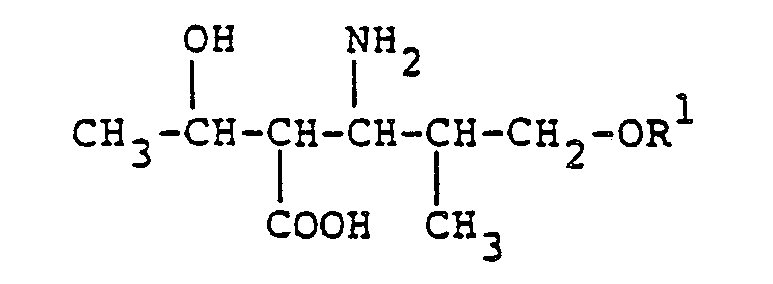
- the present invention relates to amino acid derivatives and their production. More particularly, it relates to amino acid derivatives of the formula: wherein R 1 is a protective group for hydroxyl, and their production.
- beta-lactam derivatives of the formula: (wherein R 4 is a protective group for hydroxyl) are useful as intermediates in the synthesis of said 1 ⁇ -methylcarbapenem compounds (EP-0071908A; Heterocycles, 21, 29 (1984)].
- beta-lactam derivatives (II) For the production of said beta-lactam derivatives (II) according to the known method as reported, a hydrogen atom at the 1'-position of the acetic acid residue present at the 4-position is withdrawn with a strong base and then a methyl group is introduced therein.
- this method has the disadvantage that the conversion must be carried out with the use of lithium diisopropylamide, which can only be handled with difficulty, at temperatures as low as -78°C. Further, said method affords unnecessary 1'a-epimers in very unfavourable proportions such as 1' ⁇ -epimer/1' ⁇ -epimer being 1:4.
- DE-A-2 841 292 discloses a compound of the formula: which comprises a beta-aminopropionic acid skeleton.
- This is a polyoxyalkylene chain derivative having a carboxylic acid group at the terminal position and useful as a surfactant.
- An amino group is present in the main chain.
- the compound (I) of the invention is a straight chain compound comprising a limited number of carbon atoms, i.e. 6 carbon atoms, and having a carboxylic acid group at the middle position and an amino group as the side chain. Due to such characteristic structure, it is useful as an intermediate in the synthesis of the precurser (II) for the carbapenem compounds such as thienamycin.
- an object of this invention is to provide the amino acid derivatives (I).
- Another object of this invention is to provide a process for preparing the amino acid derivatives (I).
- the objective amino acid derivatives represented by the plane formula (I) comprise four asymmetric carbon atoms and have many isomers based thereon. All of these isomers and their mixtures are included in this invention.
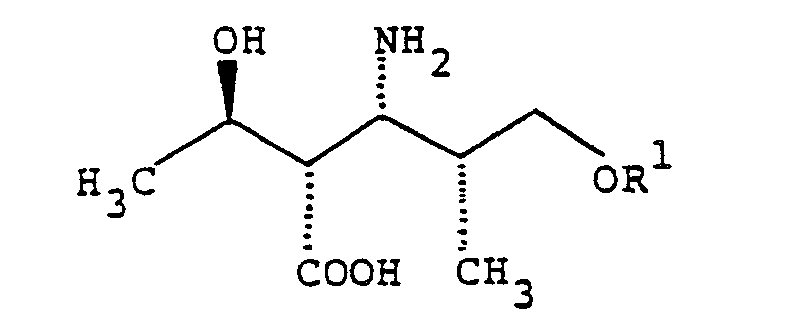
- the optical isomer of the formula: wherein R 1 is as defined above is particularly useful, therefore this invention will now be explained in greater detail with the optical isomer serving as an example. Needless to say, the conversions adopted for and use of the optical isomer (I') are equally applicable to other isomers.
- the protective group for hydroxyl may be any one generally employed for protecting a hydroxyl group from its conversion.
- the protective group for amino i.e. the amino-protective group
- the protective group for carboxyl i.e. the carboxyl-protective group
- Specific examples of the hydroxyl-protective group, the amino-protective group and the carboxyl-protective group as well as their introduction and elimination are described, for instance, in "Protective Groups in Organic Synthesis” (1981); published by John Wiley & Sons.
- optically active amino acid derivative (I') can be produced, for instance, according to the following conversions: wherein R1 is as defined above, R 2 is a protective group for amino and R 3 is a protective group for carboxyl.
- hydroxyl-protective group examples include tri(lower)alkylsilyl (e.g. trimethylsilyl, triethylsilyl, t-butyldimethylsilyl), mono(lower)alkyldiarylsilyl (e.g. t-butyldiphenylsilyl), alkoxy-, alkoxyalkoxy- or aralkoxy-substituted methyl (e.g. methoxymethyl, methylthiomethyl, benzyloxymethyl, t-butoxymethyl, 2-methoxyethoxymethyl), tetrahydropyranyl, substituted or unsubstituted arylmethyl (e.g.
- benzyl p-methoxybenzyl, 2,4-dimethoxybenzyl, o-nitrobenzyl, p-nitrobenzyl
- substituted or unsubstituted triarylmethyl e.g. triphenylmethyl, p-methoxyphenyldiphenylmethyl, bis-(methoxyphenyl)-phenylmethyl
- acyl e.g. acetyl, benzoyl
- amino-protective group examples include substituted or unsubstituted pheny(lower)alkyl (e.g. benzyl, p-methoxybenzyl, 2,4-dimethoxybenzyl, o-nitrobenzyl, p-nitrobenzyl), di(substituted or unsubstituted phenyl)methyl (e.g. diphenylmethyl, di-p-anisylmethyl), trityl, substituted or unsubstituted phenyl (e.g. p-methoxyphenyl, 2,4-dimethoxyphenyl, o-nitrophenyl, p-nitrophenyl, 2,4-dinitrophenyl), etc.
- pheny(lower)alkyl e.g. benzyl, p-methoxybenzyl, 2,4-dimethoxybenzyl, o-nitrobenzyl, p-nitrobenzyl
- Examples of the carboxyl-protective group are substituted or unsubstituted phenyl(lower)alkyl (e.g. benzyl, p-methoxybenzyl, 2,4-dimethoxybenzyl, o-nitrobenzyl, p-nitrobenzyl, p-chlorobenzyl), lower alkyl (e.g. methyl, ethyl, isopropyl, t-butyl), halo(lower)alkyl (e.g. 2-iodoethyl, 2,2,2-trichloroethyl), lower alkoxy-(lower)alkyl (e.g.
- phenyl(lower)alkyl e.g. benzyl, p-methoxybenzyl, 2,4-dimethoxybenzyl, o-nitrobenzyl, p-nitrobenzyl, p-chlorobenzyl
- lower alkyl e.g.
- lower alkoxycarbonyloxy(lower)alkyl e.g. 1-methoxycarbonyloxyethyl, 1-ethoxycarbonyloxyethyl
- lower alkenyl e.g. allyl, 2-methylallyl, 3-methylallyl
- di(substituted or unsubstituted phenyl)methyl e.g. diphenylmethyl, di-p-anisylmethyl
- substituted or unsubstituted phenyl e.g. phenyl, 4-nitrophenyl, 2,6-dimethylphenyl
- the first step comprises the recovery of two diastereomers from four diastereomers by means of asymmetric hydrolysis.
- the hydroysis of a mixture of four diasteromers of the oxazolidine derivative (III) results in selective hydrolysis of two diastereomers taking a trans-configuration at the 3- and 4-positions with non-conversion of two other diastereomers taking a cis-configuration at the said positions.
- a mixture of two 3,4-cis-diastereomers (Illa)] and (Illb) as non-converted can be recovered from the reaction mixture.
- the asymmetric hydrolysis may be carried out by treatment of the mixture of four diastereomers with a hydrolyzing agent, preferably in an inert solvent.
- a hydrolyzing agent for asymmetric hydrolysis are exemplified aqueous solutions of barium hydroxide, sodium hydroxide, potassium hydroxide, tetrabutylammonium hydroxide, etc.
- the inert solvent are tetrahydrofuran, acetone, methanol, pyridine, etc. Mixtures thereof with water can also be used as the inert solvent.
- the reaction may be effected during cooling or heating, and the preferred temperatures range from 0 to 70°C.
- Recovery of a mixture of non-hydrolyzed two diastereomers (Illa) and (Illb) may be performed by a per se conventional separation procedure, for instance, extracting the reaction mixture with an organic solvent, washing the extract with water, drying the washed extract and evaporation of the organic solvent from the extract.
- organic solvents for extraction are aromatic hydrocarbons (e.g. n-hexane, benzene, toluene), halogenated hydrocarbons (e.g. chloroform, dichloromethane), esters (e.g. ethyl acetate), ethers (e.g. diethyl ether), etc.
- the second step comprises hydrogenation of the diastereomers (Illa) and (Illb) for cleaving of the nitrogen-oxygen bond, followed by elimination of the amino-protective group and the carboxyl-protective group to render the optically active amino acid derivative (1').
- Hydrogenation may be carried out by catalytic hydrogenation, e.g. by treatment of a mixture of the diastereomers (Illa) and (lllb) with hydrogen in the presence of a hydrogenation catalyst such as palladium-carbon, platinum oxide, rhodium-carbon or platinum hydroxide, usually under a hydrogen pressure of 1 to 10 atm.
- a hydrogenation catalyst such as palladium-carbon, platinum oxide, rhodium-carbon or platinum hydroxide
- the hydrogenation is preferably effected in an inert solvent, of which typical examples are methanol, ethanol, acetic acid and tetrahydrofuran, and their mixtures.
- the reaction may be controlled or accelerated by cooling or heating.
- the elimination of the amino-protective group and the carboxyl-protective group may be accomplished simultaneously or in order.
- the procedure for elimination may be any conventional one according to the kind of protective groups.
- the amino-protective group is a substituted or unsubstituted phenyl(lower)alkyl group or a di(substituted or unsubstituted phenyl)methyl group
- reduction or treatment with an acid can accomplish the elimination.
- the reduction may be carried out by catalytic reduction using a catalyst such as platinum or palladium-carbon.
- the acid treatment may be performed by contacting with an acid such as a mineral acid or a Lewis acid, especially trifluoroacetic acid, boron trifluoride, boron tribromide, aluminum trichloride or the like, optionally in an inert solvent (e.g. dichloromethane, chloroform, benzene, toluene).
- an acid such as a mineral acid or a Lewis acid, especially trifluoroacetic acid, boron trifluoride, boron tribromide, aluminum trichloride or the like
- an inert solvent e.g. dichloromethane, chloroform, benzene, toluene.
- the carboxyl-protective group is a lower alkyl group, it may be eliminated by hydrolysis with an alkali; a halo(lower)alkyl group can be eliminated by reduction with zinc in an organic solvent (e.g.
- acetic acid, tetrahydrofuran, methanol a lower alkoxy-(lower)alkyl group is eliminated by treatment with an acid (e.g. hydrochloric acid, sulfuric acid, acetic acid, trifluoroacetic acid); a substituted or unsubstituted phenyl(lower)alkyl group can be eliminated by the same procedure as hereinabove stated for the elimination of the amino-protective group.
- an acid e.g. hydrochloric acid, sulfuric acid, acetic acid, trifluoroacetic acid
- a substituted or unsubstituted phenyl(lower)alkyl group can be eliminated by the same procedure as hereinabove stated for the elimination of the amino-protective group.
- These conversions can be represented by the following formulae: wherein R 1 and R 4 are each as defined above.
- the oxazolidine derivative used as the starting material in the process of this invention may be produced by various procedures, a typical example of which can be represented by the following formula scheme: wherein R 1 , R 2 and R 3 are each as defined above.
- step (A) comprises protection of the hydroxyl group in optically active methyl (S)-(+)-3-hydroxy-2-methylpropionate (IV) to give methyl (S)-(+)-3-protected hydroxy-2-methyl- propionate (V).
- This protection may be achieved by a per se conventional procedure for protecting of a hydroxyl group, for instance, reacting the compound (IV) with a chloride such as a tri(lower)alkylsilyl chloride, a lower alkoxy- or ar(lower)alkoxy-substituted methyl chloride, a substituted or unsubstituted monoarylmethyl chloride or a triarylmethyl chloride in the presence of a base such as an organic base (e.g. triethylamine, diisopropylethylamine, imidazole, pyridine) or an alkali metal hydride (e.g. sodium hydride) in an inert solvent such as an ether (e.g. ether, tetrahydrofuran, dimethoxyethane), a halogenated hydrocarbon (e.g. chloroform, dichloromethane), acetonitrile or dimethylformamide.
- a base such as an organic base (e
- Step (B) comprises conversion of the ester (V) to give the corresponding aldehyde (VI).
- This conversion may be accomplished in a single step, i.e. by reduction of the ester (V) with a reducing agent such as diisobutylaluminum hydride at a temperature below about -60°C, or in two steps, i.e. by reduction of the ester (V) with a reducing agent such as lithium aluminum hydride, sodium borohydride or diisobutylaluminum hydride and oxidation of the resulting alcohol (V') with the use of an oxidizing agent such as pyridinium chlorochromate, pyridinium dichromate, dimethylsulfoxide or manganese dioxide.
- the two-step conversion is advantageous in that the reactions therein may be effected at room temperature.
- Step (C) comprises reaction of the aldehyde (VI) with the protected hydroxylamine (VII) to give the corresponding nitrone (VIII).
- the protected hydroxylamine (VII) can be readily synthesized from the corresponding oxime [J. Am. Chem. Soc., 93, 2897 (1971)].
- the reaction is usually carried out by treatment of the aldehyde (VI) with the protected hydroxylamine (VII) in the presence of a dehydrating agent (e.g. calcium chloride, molecular sieve) in an inert solvent (e.g. benzene, toluene, ether, tetrahydrofuran, dioxane) at a temperature of 0°C to room temperature.
- a dehydrating agent e.g. calcium chloride, molecular sieve
- an inert solvent e.g. benzene, toluene, ether, tetrahydrofuran, dio
- Step (D) comprises reaction of the nitrone (VIII) with crotonic acid or its ester (IX) to give the oxazolidine derivative (III).
- This reaction is normally effected by treatment of the nitrone (VIII) with crotonic acid or its ester (IX) in an inert solvent (e.g. benzene, toluene, xylene, ether, tetrahydrofuran, dioxane, dimethylformamide, dimethylsulfoxide) at a temperature of 0 to 100°C.
- an inert solvent e.g. benzene, toluene, xylene, ether, tetrahydrofuran, dioxane, dimethylformamide, dimethylsulfoxide
- the direct conversion of the aldehyde (VI) into the oxazolidine derivative (111) may be achieved by reacting the aldehyde (VI) with the protected hydroxylamine (VII) in the presence of the crotonic acid ester (IX). This reaction is normally effected in an inert solvent as exemplified above at a temperature of 0 to 100°C.
- Methyl (S)-(+)-3-(t-butyldimethylsilyloxy)-2-methylpropionate (10.0 g; 43.1 mmol) was dissolved in anhydrous dichloromethane (100 ml), and a hexane solution (100 ml) of 1M diisobutylaluminum hydride was added dropwise thereto at a temperature below 0°C in argon stream. After stirring for 30 minutes, water (30 ml) was added thereto, and the resultant mixture was stirred for 1 hour, followed by separation of the organic layer. The aqueous layer was extracted with dichloromethane, and the extracts were combined together with the organic layer.
- the extract was first washed with a saturated aqueous solution of sodium hydrogencarbonate (10 ml) and then with a saturated aqueous solution of sodium chloride (20 ml) twice, dried over anhydrous sodium sulfate, followed by removal of the solvent.
- the oily residue was purified by silica gel column chromatography using a mixture of hexane and ethyl acetate (100:0-95:5) to give a mixture (3.0 g) of 3,4-cis diastereomers (A and B) of 2-benzyl-4-benzyloxycarbonyl-3-[(2'-t-butyldimethylsilyloxy-1'-methyl)ethyl]-5-methylisoxazolidine.
- the proportion of the diastereomers A and B was confirmed to be 13:9 by NMR spectrum.
- a mixture of two diastereomers (A and B) of 2-benzyl-4-benzyoxycarbonyl-3-[(2'-t-butyldimethylsilyl- oxy-1'-methyl)ethylj-5-methylisoxazolidine as obtained in Example 1-1 (10.0 g; 20.7 mmol) was dissolved in methanol (50 ml), and 10% palladium-carbon (1 g) was added thereto, followed by stirring under a pressure of 5 atm in hydrogen atmosphere for 7 hours. The reaction mixture was filtered upon celite to remove the catalyst, and the solvent distilled under reduced pressure.
- Optical purity (determined by 1 H-NMR using an optically active shifting reagent, i.e. tris[3-(heptafluoro- propylhydroxymethylene)-d-camphorato]-europium (III) [Eu(hfc) 3 ]): more than 95% e.e.
Landscapes
- Chemical & Material Sciences (AREA)
- Organic Chemistry (AREA)
- Pharmaceuticals Containing Other Organic And Inorganic Compounds (AREA)
Claims (4)


Priority Applications (1)
| Application Number | Priority Date | Filing Date | Title |
|---|---|---|---|
| AT86110533T ATE42740T1 (de) | 1985-07-31 | 1986-07-30 | Aminosaeurederivate und ihre herstellung. |
Applications Claiming Priority (4)
| Application Number | Priority Date | Filing Date | Title |
|---|---|---|---|
| JP60167808A JPS6229577A (ja) | 1985-07-31 | 1985-07-31 | オキサゾリジン誘導体 |
| JP167808/85 | 1985-07-31 | ||
| JP257340/85 | 1985-11-15 | ||
| JP60257340A JPH0657683B2 (ja) | 1985-11-15 | 1985-11-15 | 光学活性アミノ酸誘導体 |
Publications (2)
| Publication Number | Publication Date |
|---|---|
| EP0210657A1 EP0210657A1 (de) | 1987-02-04 |
| EP0210657B1 true EP0210657B1 (de) | 1989-05-03 |
Family
ID=26491741
Family Applications (1)
| Application Number | Title | Priority Date | Filing Date |
|---|---|---|---|
| EP86110533A Expired EP0210657B1 (de) | 1985-07-31 | 1986-07-30 | Aminosäurederivate und ihre Herstellung |
Country Status (3)
| Country | Link |
|---|---|
| US (1) | US4892961A (de) |
| EP (1) | EP0210657B1 (de) |
| DE (1) | DE3663138D1 (de) |
Families Citing this family (4)
| Publication number | Priority date | Publication date | Assignee | Title |
|---|---|---|---|---|
| ES2061439T3 (es) * | 1985-12-28 | 1994-12-16 | Sumitomo Pharma | Compuesto beta-lactama y su produccion. |
| US5274188A (en) * | 1987-05-04 | 1993-12-28 | Ciba-Geigy Corporation | Process for the manufacture of 4-acyloxy-3-hydroxyethyl-azetidinones |
| EP0290385B1 (de) * | 1987-05-04 | 1992-10-21 | Ciba-Geigy Ag | Neues Verfahren zur Herstellung von 4-Acyloxy-3-hydroxyethyl-azetidinonen |
| KR0145352B1 (ko) * | 1994-05-28 | 1998-07-15 | 김은영 | (+)2-벤조일-3-(실릴옥시프로피-2(s)-일)아미노 아크릴레이트 유도체 및 그 제조방법 |
Family Cites Families (11)
| Publication number | Priority date | Publication date | Assignee | Title |
|---|---|---|---|---|
| US2774778A (en) * | 1954-06-15 | 1956-12-18 | Dow Corning | Triorganosilyl amino acids |
| US3962319A (en) * | 1972-01-19 | 1976-06-08 | Badische Anilin- & Soda-Fabrik Aktiengesellschaft | α-Hydroxy-β-aminocarboxylic acids |
| US4107096A (en) * | 1977-10-11 | 1978-08-15 | Texaco Development Corp. | Low foaming beta-amino propionic acid surface active agents |
| JPS54100316A (en) * | 1978-01-25 | 1979-08-08 | Meiji Seika Kaisha Ltd | Preparation of derivative of aminobutyric acid |
| US4251325A (en) * | 1978-03-04 | 1981-02-17 | Bp Chemicals Limited | Process for the removal of hydroxyacetone from phenol |
| EP0048504B1 (de) * | 1978-09-12 | 1988-08-17 | Fujisawa Pharmaceutical Co., Ltd. | Cephalosporinzwischenprodukte, Verfahren zu ihrer Herstellung und Verfahren zur Herstellung von Cephalosporinderivaten |
| DE3019069A1 (de) * | 1979-05-24 | 1980-12-04 | Lepetit Spa | Verfahren zur herstellung eines serinderivats |
| JPS57112384A (en) * | 1980-12-29 | 1982-07-13 | Suntory Ltd | Intermediate of mugineic acid and its preparation |
| DE3242748C1 (de) * | 1982-11-19 | 1984-03-01 | Degussa Ag, 6000 Frankfurt | Verfahren zur Herstellung von ss-Hydroxy-alpha-aminocarbonsaeuren |
| FR2561648B1 (fr) * | 1984-03-26 | 1987-08-21 | Hoechst France | Nouvelles perhydro-oxazolo(2,3-c)oxazines-1,4, leur procede de preparation et leur application a l'obtention de glycines substituees |
| IT1181813B (it) * | 1984-07-27 | 1987-09-30 | Sigma Tau Ind Farmaceuti | Procedimento per la preparazione di l-norcarnitina cloridrato |
-
1986
- 1986-07-28 US US06/889,830 patent/US4892961A/en not_active Expired - Fee Related
- 1986-07-30 EP EP86110533A patent/EP0210657B1/de not_active Expired
- 1986-07-30 DE DE8686110533T patent/DE3663138D1/de not_active Expired
Also Published As
| Publication number | Publication date |
|---|---|
| DE3663138D1 (en) | 1989-06-08 |
| US4892961A (en) | 1990-01-09 |
| EP0210657A1 (de) | 1987-02-04 |
Similar Documents
| Publication | Publication Date | Title |
|---|---|---|
| EP0180252B1 (de) | Verfahren zur Herstellung von Azetidinonverbindungen | |
| MX2007002419A (es) | Sintesis alternativa de inhibidores de renina e intermediarios de los mismos. | |
| EP0023097B1 (de) | De-arylmethylierung von N-Mono- oder N-Diarylmethyl-beta-lactamen; antibakteriell wirksame Azetidinone | |
| EP0333268A1 (de) | Verfahren zur Synthese eines chiralen 3-beta-Wasserstoff-(3R) 4-aroyloxyazetidinons | |
| US4803292A (en) | Process for producing statin and related compounds | |
| EP0106652B1 (de) | Beta-Lactam-Verbindungen und ihre Herstellung | |
| EP0167154B1 (de) | Verfahren zur Herstellung von 4-Acetoxy-3-hydroxyethylazetizin-2-on Derivaten | |
| US5693847A (en) | Heteroatom functionalized α-methyl ketones | |
| EP0210657B1 (de) | Aminosäurederivate und ihre Herstellung | |
| US4882429A (en) | Stereospecific preparation of (3S,4R,5R)-3-(1-hydroxyethyl)-4-benzoyloxy-azeridinones from L-(-)-theonine | |
| US4506085A (en) | β-Aminoacid derivatives and process for production thereof | |
| US4940797A (en) | Process for synthesis of FK-506 C10-C18 intermediates | |
| US4769451A (en) | Synthesis of carbapenems using n-substituted azetidinones | |
| EP0181581B1 (de) | Beta-Aminothiolester und Verfahren zu ihrer Herstellung | |
| US5693813A (en) | Process for preparation of 4H-4-oxo-quinolizine-3-carboxylic acid | |
| EP0209886B1 (de) | Beta-N-substituierte Aminothiolester und Verfahren zur deren Herstellung | |
| GB2162840A (en) | Sterospecific process for preparing azetidinones | |
| JPS62116550A (ja) | 光学活性アミノ酸誘導体 | |
| US4845229A (en) | Process for intermediates to 1-carbapenems and 1-carbacephems | |
| EP0218415B1 (de) | Verfahren zur Herstellung von Zwischenprodukten für 1-Carbapeneme und 1-Carbacepheme | |
| EP0229384B1 (de) | Beta-Lactamverbindungen und deren Herstellung | |
| EP0192171A1 (de) | Verfahren zur chiralen Synthese von 1-beta-Methyl-carbapenem-Zwischenprodukten | |
| JPS5846087A (ja) | チエナマイシン誘導体の製造方法及びその中間体 | |
| JP3750122B2 (ja) | アゼチジノン化合物の製造方法 | |
| US4973687A (en) | Synthesis of carbapenems using N-substituted azetidinones |
Legal Events
| Date | Code | Title | Description |
|---|---|---|---|
| PUAI | Public reference made under article 153(3) epc to a published international application that has entered the european phase |
Free format text: ORIGINAL CODE: 0009012 |
|
| AK | Designated contracting states |
Kind code of ref document: A1 Designated state(s): AT BE CH DE FR GB IT LI LU NL SE |
|
| 17P | Request for examination filed |
Effective date: 19870331 |
|
| 17Q | First examination report despatched |
Effective date: 19871207 |
|
| GRAA | (expected) grant |
Free format text: ORIGINAL CODE: 0009210 |
|
| AK | Designated contracting states |
Kind code of ref document: B1 Designated state(s): AT BE CH DE FR GB IT LI LU NL SE |
|
| REF | Corresponds to: |
Ref document number: 42740 Country of ref document: AT Date of ref document: 19890515 Kind code of ref document: T |
|
| ITF | It: translation for a ep patent filed | ||
| RAP2 | Party data changed (patent owner data changed or rights of a patent transferred) |
Owner name: JURIDICAL FOUNDATION SAGAMI CHEMICAL RESEARCH CEN Owner name: SUMITOMO PHARMACEUTICALS COMPANY, LIMITED |
|
| RAP2 | Party data changed (patent owner data changed or rights of a patent transferred) |
Owner name: SUMITOMO PHARMACEUTICALS COMPANY, LIMITED |
|
| REF | Corresponds to: |
Ref document number: 3663138 Country of ref document: DE Date of ref document: 19890608 |
|
| PGFP | Annual fee paid to national office [announced via postgrant information from national office to epo] |
Ref country code: LU Payment date: 19890613 Year of fee payment: 4 |
|
| PGFP | Annual fee paid to national office [announced via postgrant information from national office to epo] |
Ref country code: SE Payment date: 19890630 Year of fee payment: 4 Ref country code: BE Payment date: 19890630 Year of fee payment: 4 |
|
| REG | Reference to a national code |
Ref country code: CH Ref legal event code: PUE Owner name: SUMITOMO PHARMACEUTICALS COMPANY, LIMITED |
|
| PGFP | Annual fee paid to national office [announced via postgrant information from national office to epo] |
Ref country code: AT Payment date: 19890707 Year of fee payment: 4 |
|
| ET | Fr: translation filed | ||
| PG25 | Lapsed in a contracting state [announced via postgrant information from national office to epo] |
Ref country code: LU Free format text: LAPSE BECAUSE OF NON-PAYMENT OF DUE FEES Effective date: 19890731 |
|
| PGFP | Annual fee paid to national office [announced via postgrant information from national office to epo] |
Ref country code: NL Payment date: 19890731 Year of fee payment: 4 |
|
| NLT2 | Nl: modifications (of names), taken from the european patent patent bulletin |
Owner name: SUMITOMO PHARMACEUTICALS COMPANY, LIMITED TE OSAKA |
|
| BECN | Be: change of holder's name |
Effective date: 19890503 |
|
| PLBE | No opposition filed within time limit |
Free format text: ORIGINAL CODE: 0009261 |
|
| STAA | Information on the status of an ep patent application or granted ep patent |
Free format text: STATUS: NO OPPOSITION FILED WITHIN TIME LIMIT |
|
| 26N | No opposition filed | ||
| PG25 | Lapsed in a contracting state [announced via postgrant information from national office to epo] |
Ref country code: AT Effective date: 19900730 |
|
| PG25 | Lapsed in a contracting state [announced via postgrant information from national office to epo] |
Ref country code: SE Effective date: 19900731 Ref country code: BE Effective date: 19900731 |
|
| BERE | Be: lapsed |
Owner name: JURIDICAL FOUNDATION SAGAMI CHEMICALRESEARCH CENT Effective date: 19900731 Owner name: SUMITOMO PHARMACEUTICALS CY LTD Effective date: 19900731 |
|
| PG25 | Lapsed in a contracting state [announced via postgrant information from national office to epo] |
Ref country code: NL Effective date: 19910201 |
|
| NLV4 | Nl: lapsed or anulled due to non-payment of the annual fee | ||
| PGFP | Annual fee paid to national office [announced via postgrant information from national office to epo] |
Ref country code: GB Payment date: 19930528 Year of fee payment: 8 |
|
| PGFP | Annual fee paid to national office [announced via postgrant information from national office to epo] |
Ref country code: CH Payment date: 19930622 Year of fee payment: 8 |
|
| PGFP | Annual fee paid to national office [announced via postgrant information from national office to epo] |
Ref country code: FR Payment date: 19930729 Year of fee payment: 8 |
|
| ITTA | It: last paid annual fee | ||
| PGFP | Annual fee paid to national office [announced via postgrant information from national office to epo] |
Ref country code: DE Payment date: 19930929 Year of fee payment: 8 |
|
| PG25 | Lapsed in a contracting state [announced via postgrant information from national office to epo] |
Ref country code: GB Effective date: 19940730 |
|
| PG25 | Lapsed in a contracting state [announced via postgrant information from national office to epo] |
Ref country code: LI Effective date: 19940731 Ref country code: CH Effective date: 19940731 |
|
| EUG | Se: european patent has lapsed |
Ref document number: 86110533.6 Effective date: 19910402 |
|
| GBPC | Gb: european patent ceased through non-payment of renewal fee |
Effective date: 19940730 |
|
| PG25 | Lapsed in a contracting state [announced via postgrant information from national office to epo] |
Ref country code: FR Effective date: 19950331 |
|
| REG | Reference to a national code |
Ref country code: CH Ref legal event code: PL |
|
| PG25 | Lapsed in a contracting state [announced via postgrant information from national office to epo] |
Ref country code: DE Effective date: 19950401 |
|
| REG | Reference to a national code |
Ref country code: FR Ref legal event code: ST |
|
| PG25 | Lapsed in a contracting state [announced via postgrant information from national office to epo] |
Ref country code: IT Free format text: LAPSE BECAUSE OF NON-PAYMENT OF DUE FEES Effective date: 20050730 |