EP0211014B1 - Verfahren zur submersen züchtung von pseudomonas aeruginosa-bakterienstämmen - Google Patents
Verfahren zur submersen züchtung von pseudomonas aeruginosa-bakterienstämmen Download PDFInfo
- Publication number
- EP0211014B1 EP0211014B1 EP86900708A EP86900708A EP0211014B1 EP 0211014 B1 EP0211014 B1 EP 0211014B1 EP 86900708 A EP86900708 A EP 86900708A EP 86900708 A EP86900708 A EP 86900708A EP 0211014 B1 EP0211014 B1 EP 0211014B1
- Authority
- EP
- European Patent Office
- Prior art keywords
- culture
- nutrient medium
- pseudomonas aeruginosa
- bacterial strains
- maintained
- Prior art date
- Legal status (The legal status is an assumption and is not a legal conclusion. Google has not performed a legal analysis and makes no representation as to the accuracy of the status listed.)
- Expired - Lifetime
Links
Classifications
-
- A—HUMAN NECESSITIES
- A61—MEDICAL OR VETERINARY SCIENCE; HYGIENE
- A61K—PREPARATIONS FOR MEDICAL, DENTAL OR TOILETRY PURPOSES
- A61K39/00—Medicinal preparations containing antigens or antibodies
- A61K39/02—Bacterial antigens
- A61K39/104—Pseudomonadales, e.g. Pseudomonas
-
- C—CHEMISTRY; METALLURGY
- C12—BIOCHEMISTRY; BEER; SPIRITS; WINE; VINEGAR; MICROBIOLOGY; ENZYMOLOGY; MUTATION OR GENETIC ENGINEERING
- C12N—MICROORGANISMS OR ENZYMES; COMPOSITIONS THEREOF; PROPAGATING, PRESERVING, OR MAINTAINING MICROORGANISMS; MUTATION OR GENETIC ENGINEERING; CULTURE MEDIA
- C12N1/00—Microorganisms; Compositions thereof; Processes of propagating, maintaining or preserving microorganisms or compositions thereof; Processes of preparing or isolating a composition containing a microorganism; Culture media therefor
- C12N1/20—Bacteria; Culture media therefor
Definitions
- the invention relates to a method for submerged cultivation of Pseudomonas aeruginosa bacterial strains from the taxonomic family of Pseudomonadaceae.
- Bacteria Pseudomonas aeruginosa is an opportunistic, pathogenic germ that often occurs in hospital infections, mainly in patients with weakened immune systems, such as burn patients, in people who suffer from cystic fibrosis or have organic malfunctions, and in cancer patients.
- Antibiotics have only limited effectiveness against Pseudomonas infections due to the occurrence of resistance, which is why efforts are being made to use immunological methods to combat infections caused by Pseudomonas aeruginosa.
- Infections can be caused by a variety of strains that produce O group antigens and H antigens.
- H-antigen scheme according Ansorg (Zbl. Bakt. Hyg. I. Abt. Orig. A 242, 228-238 (1978))
- Pseudomonas aeruginosa a complex flagellar antigen a with the partial seizures Tigenen a o , a 1 , a 2 , a 3 , a 4 and a uniform flagella antigen b.
- the partial factors a o -a 4 are independent determinants, so that a flagellar antigen scheme with several H types results.
- O groups and H type show free combinations.
- the invention aims at avoiding these difficulties and disadvantages and has as its object to create a submerged breeding process of Pseudomonas aeruginosa bacterial strains which, with a much better yield than before, provides a bacterial biomass for the production of antigens, the physiological state of which during the entire duration of the cultivation remains constant; in which a synthetic nutrient medium is used, from which no additional contamination by autoclaving arises; and which facilitates chemical processing of the bacterial biomass into flagella antigen.
- This object is achieved in that the following strains producing H-type antigens in an aqueous, antigen-free and protein-free nutrient medium which contains a nitrogen source and mineral salts as well as succinate or urea as a carbon source and as a limiting substrate.
- the carbon source mentioned has proven to be particularly conducive to growth.
- Ansorg is used for the strains 170001, 5940, 5939, 5933 and 170018.
- the untyped strains M-2 and 1210 were assigned to the corresponding H serotype on the basis of comparative studies of the molecular weights and serological cross-reactions by Montie et al.
- the strains are grown in a continuous manner.
- cultivation can be carried out by turbidostatic means, the oxygen content in the nutrient medium being 5 to 20%, preferably approximately 10%, the cell density being kept at 2-3x 10 9 cells / ml and a dilution rate of the substrate by feeding fresh nutrient medium to 0.1 My to 0.3 My is maintained.
- the cultivation of the Pseudomonas aeruginosa bacterial strains according to the invention takes place with agitation and aeration of an "open culture" in such a way that they are caused to maximum growth and formation of the flagella.
- the supply of the nutrient substrate is heard depending on the growth rate of the culture or on the state of equilibrium that the culture has reached.
- the regulation or control of the supply of fresh nutrient medium takes place as a function of a parameter proportional to the growth of the culture, preferably the change in cell density over time.
- culture fluid is withdrawn from the culture vessel simultaneously with the supply of fresh nutrient medium, so that between the growth and the physiological activity, in particular the formation of cells on the one hand, and the environmental environment of the cells on the other hand, a precisely definable and reproducible steady state condition sets which can be obtained for an almost unlimited period of time.
- a synthetic protein-free medium is used as the nutrient medium, which contains only chemically and physicochemically qualitatively and quantitatively detectable components.
- An inorganic nutrient solution that contains all essential elements is suitable.
- both the chemostatic principle of continuous culture in which the physiological activity of the culture is regulated by a limiting substrate, preferably the carbon and energy sources, and the turbidostatic principle of continuous culture are for the fermentative production of the germs, at which the rate of dilution (My) and thus the physiological activity of the culture is externally regulated via a growth parameter, preferably via the current cell density of the culture.
- Turbidostatic continuous cultivation is preferably used.
- temperatures and pH are also important; a temperature of 20 to 35 ° C., preferably 30 ° C., and a pH of 6.5 to 7.5, preferably 7.0, should expediently be maintained during the cultivation.
- the method according to the invention is carried out in one with turbidostatic operation Fermentor carried out by first inoculating the nutrient medium with a bacterial strain and working in compliance with the specified conditions until the specified cell density of 2-3x10 9 cells / ml is reached in the logarithmic final phase. As soon as this is the case, the bacteria suspension is continuously withdrawn from the fermentor and continuously replaced by fresh nutrient solution.
- the dilution rate should expediently not be more than 0.3 my, preferably 0.1 to 0.2 my.
Landscapes
- Health & Medical Sciences (AREA)
- Life Sciences & Earth Sciences (AREA)
- Chemical & Material Sciences (AREA)
- Engineering & Computer Science (AREA)
- Zoology (AREA)
- Microbiology (AREA)
- Medicinal Chemistry (AREA)
- Wood Science & Technology (AREA)
- Organic Chemistry (AREA)
- Genetics & Genomics (AREA)
- General Health & Medical Sciences (AREA)
- Bioinformatics & Cheminformatics (AREA)
- Biotechnology (AREA)
- Epidemiology (AREA)
- Biochemistry (AREA)
- Tropical Medicine & Parasitology (AREA)
- Virology (AREA)
- Public Health (AREA)
- Biomedical Technology (AREA)
- Animal Behavior & Ethology (AREA)
- Pharmacology & Pharmacy (AREA)
- Mycology (AREA)
- Veterinary Medicine (AREA)
- General Engineering & Computer Science (AREA)
- Immunology (AREA)
- Micro-Organisms Or Cultivation Processes Thereof (AREA)
- Preparation Of Compounds By Using Micro-Organisms (AREA)
- Purification Treatments By Anaerobic Or Anaerobic And Aerobic Bacteria Or Animals (AREA)
- Measuring Or Testing Involving Enzymes Or Micro-Organisms (AREA)
- Farming Of Fish And Shellfish (AREA)
- Medicines Containing Antibodies Or Antigens For Use As Internal Diagnostic Agents (AREA)
- Enzymes And Modification Thereof (AREA)
Description
- Die Erfindung betrifft ein Verfahren zur submersen Züchtung von Pseudomonas aeruginosa-Bakterienstämmen aus der taxonomischen Familie der Pseudomonadaceae.
- Bakterium-Pseudomonas aeruginosa ist ein opportunistischer, pathogener Keim, der häufig bei Krankenhausinfektionen auftritt, hauptsächlich bei Patienten mit geschwächter Immunabwehr, wie bei Verbrennungspatienten, bei Personen, die an cystischer Fibrose leiden oder organische Fehlfunktionen aufweisen, und bei Tumorpatienten. Antibiotika sind gegen Pseudomonasinfektionen infolge des Auftretens von Resistenzen nur beschränkt wirksam, weshalb man bemüht ist, immunologische Methoden zur Bekämpfung von Infektionen durch Pseudomonas aeruginosa anzuwenden.
- Infektionen können durch eine Vielzahl von Stämmen ausgelöst werden, die O-Gruppenantigene und H-Antigene produzieren. Gemäß dem H-Antigenschema nach Ansorg (Zbl. Bakt. Hyg. I. Abt. Orig. A 242, 228-238 (1978)) wird unter Verwendung der indirekten Immunfluoreszenztechnik bei Pseudomonas aeruginosa ein komplexes Flagella-Antigen a mit den Partialantigenen ao, a1, a2, a3, a4 und ein uniformes Flagella-Antigen b differenziert. Die Partialfaktoren ao-a4 sind unabhängige Determinanten, so daß ein flagellares Antigenschema mit mehreren H-Typen resultiert. O-Gruppen und H-Typ zeigen freie Kombinationen.
- Es ist bereits bekannt, zur Prophylaxe gegen Pseudomonasinfektionen Pseudomonasvakzine herzustellen, wobei als Ausgangsmaterialien entweder Pseudomonas aeruginosa-Bakterienmasse selbst und/oder Kulturfiltrate verwendet werden, die unter Züchtung der Mikroorganismen auf Oberflächenkulturen oder submers in komplexen Nährmedien gewonnen wurden. Bei diesen komplexen Nährmedien wurden neben einer Kohlenstoff- und Energiequelle (meist Kohlenhydrate) und essentiellen Nährsalzen verschiedenste Extrakte und/oder Hydrolysate tierischer, mikrobieller oder pflanzlicher Proteine (sogenannte Peptone) verwendet. Derartige Nährlösungssupplemente sind in ihrer genauen Zusammensetzung nicht definiert und zudem von Charge zu Charge variabel. Sie enthalten neben Aminosäuren auch unvollständig abgebaute Proteinbruckstücke und undefinierte Komplexe derselben und dienen im wesentlichen zur Deckung des Aminosäure- und Wuchsstoffbedarfes. Kulturüberstände sind deshalb immer reich an Substanzen nicht-bakteriellen Ursprunges, was den Nachteil hat, daß für die Bereitung eines Flagella-Antigens von Pseudomonas aeruginosa immer mehrere der Kultivierungsstufe nachzustellende Trennstufen notwendig sind, um ein immunogen wirksames Flagella-Antigen soweit wie möglich von aus dem Nährmedium stammenden Verunreinigungen zu befreien.
- Ein weiterer Nachteil der bisherigen chargen- bzw. "batch"-weise durchgeführten Züchtungsverfahren besteht darin, daß die Bakterien vom Zeitpunkt ihrer Inokulation bis zum Zeitpunkt ihrer Abtrennung aus der Kultur einem Zustand der kontinuierlichen physiologischen Änderung unterworfen sind. Das auslösende Moment für diese physiologische und daher funktionelle Differenzierung der bakteriellen Biomasse ist durch das Zellwachstum selbst und der damit ursächlich bedingten zeitlichen Veränderung der Zusammensetzung des Nährmediums bedingt. Die sichtbare Folge dieser spontanen physiologischen Differenzierung ist allein schon an den verschiedenen Phasen der Wachstumskurve einer "batch"-Kultur zu ermessen. Als Konsequenz der beschriebenen direkten Beziehung zwischen der physiologischen Aktivität der Zellmasse einerseits und ihrem Umgebungsmilieu anderseits ist damit auch eine bevorzugte Anreicherung verschiedener intra- und extrazeituiärerStoffwechseiprodukte je nach Wachtsumsphase und Differenzierungsphase verbunden. Kulturüberstände einer "batch"-Kultur enthalten deshalb eine integrierte Mischung aller zeitlich über einzelne Differenzierungsphasen gebildeten Stoffwechselprodukte.
- Die Erfindung bezweckt die Vermeidung dieser Schwierigkeiten und Nachteile und stellt sich die Aufgabe, ein submerses Züchtungsverfahren von Pseudomonas aeruginosa-Bakterienstämmen zu schaffen, welches mit wesentlich besserer Ausbeute als bisher eine bakterielle Biomasse zur Gewinnung von Antigenen liefert, deren physiologischer Zustand während der Gesamtdauer der Kultivierung konstant bleibt; bei welchem ein synthetisches Nährmedium verwendet wird, aus dem keine zusätzlichen Verunreinigungen durch Autoklavieren entstehen; und welches eine erleichterte chemische Aufarbeitung der bakteriellen Biomasse zu Flagella-Antigen ermöglicht.
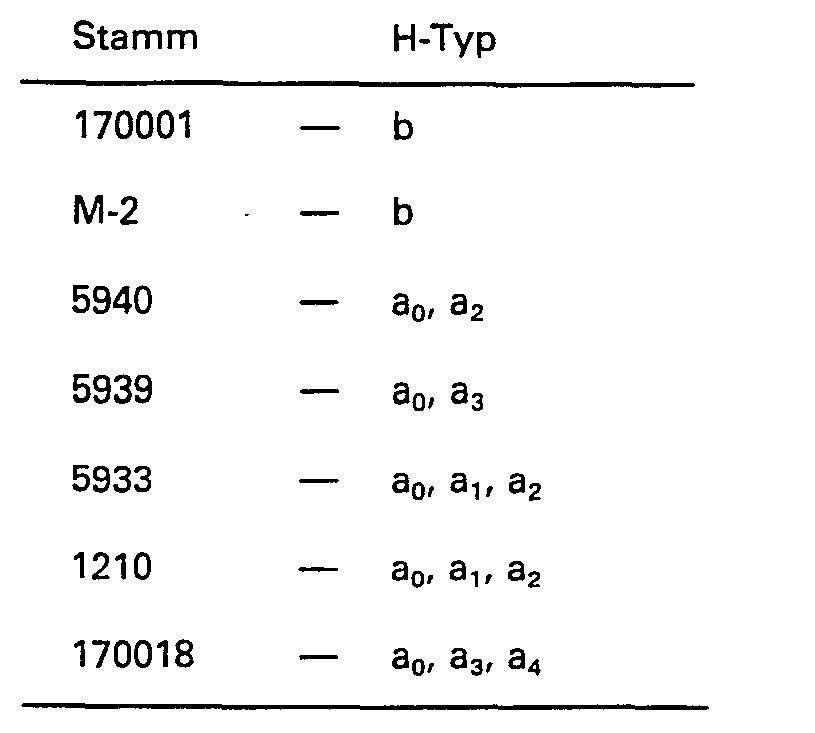
- Diese Aufgabe wird erfindungsgemäß dadurch gelöst, daß die folgenden H-Typ-Antigene produzierendem Stämme

- Die genannte Kohlenstoffquelle hat sich in besonderem Maß als wachstumsfördernd erwiesen.
- Für die Stämme 170001, 5940, 5939, 5933 und 170018 ist die Bezeichnung nach Ansorg verwendet. Die Zuordnung der untypisierten Stämme M-2 und 1210 zum entsprechenden H-Serotyp erfolgte aufgrund von Vergleichsuntersuchungen der Molekulargewichte und serologischen Kreuzreaktionen durch Montie et al.
- Vorzugsweise wird die Züchtung der Stämme im kontinuierlicher Weise durchgeführt.
- Nach einer weiteren bevorzugten Arbeitsweise kann die Züchtung auf turbidostatischem Weg erfolgen, wobei der Sauerstoffgehalt im Nährmedium 5 bis 20%, vorzugsweise etwa 10%, beträgt, die Zelldichte auf 2-3x 10⁹ Zellen/ml gehalten und eine Verdünnungsrate des Substrates durch Zuführung von frischem Nährmedium auf 0,1 My bis 0,3 My eingehalten wird.
- Die erfindungsgemäße Züchtung der Pseudomonas aeruginosa-Bakterienstämme erfolgt unter Agitation und Belüftung einer "offenen Kultur" in solcher Weise, daß sie zum maximalen Wachstum und Ausbildung der Flagellen veranlaßt werden. Die Zufuhr des Nährsubstrates wird in Abhängigkeit von der Wachstumsrate der Kultur bzw. vom Gleichgewichtszustand, den die Kultur erreicht hat, vergenommen. Die Regelung bzw. Steuerung der Zufuhr von frischem Nährmedium erfolgt in Abhängigkeit von einem dem Wachstum der Kultur proportionalen Parameter, vorzugsweise der zeitlichen Veränderung der Zelldichte. Es können jedoch auch andere Parameter, die der Entwicklung der Kultur proportional sind, wie Atmungsaktivität, CO2-Produktion, Änderung der Wasserstoffionenkonzentration, Änderung der Kohlenstoffquellenkonzentration, Respirationsquotient, Stickstoffverbrauch, Sauerstoffverbrauch und Wärmetönung, herangezoen werden. Weiters kann die Regelung der Zufuhr von frischem Nährmedium in Abhängigkeit von der Menge des gebildeten Antigens erfolgen.
- Bei der erfindungsgemäßen kontinuierlichen Züchtungsmethode wird gleichzeitig mit der Zufuhr von frischem Nährmedium Kulturflüssigkeit aus dem Züchtungsgefäß abgezogen, so daß sich zwischen dem Wachstum und der physiologischen Aktivität, insbesondere der Bildung von Zellen einerseits und dem Umgebungsmilieu der Zellen anderseits, ein genau definierbarer und jederzeit reproduzierbarer Fließgleichgewichtszustand einstellt, welcher auf praktisch zeitlich unbegrenzte Dauer erhalten werden kann.
- Als Nährmedium wird ein synthetisches proteinfreies Medium verwendet, welches ausschließlich chemisch sowie physikochemisch qualitativ und quantitativ erfaßbare Bestandteile enthält. Geeignet ist eine anorganische Nährlösung, die alle essentiellen Elemente enthält.
- Beim bevorzugten erfindungsgemäßen Verfahren sind für die fermentative Produktion der Keime sowohl das chemostatische Prinzip der kontinuierlichen Kultur, bei welchem die physiologische Aktivität der Kultur durch ein limitierendes Substrat, vorzugsweise der Kohlenstoff- und Energiquelle, reguliert wird, wie auch das turbidostatische Prinzip der kontinuierlichen Kultur, bei welchem die Verdünnungsgeschwindigkeit (My) und damit die physiologische Aktivität der Kultur extern über einen Wachstumsparameter, vorzugsweise über die augenblickliche Zelldichte der Kultur, reguliert wird, anwendbar.
- Vorzugsweise wird die turbidostatische kontinuierliche Kultivierung angewendet.
- Um ein maximales Bakterienwachstum zu fördern, sind auch die Temperaturen bzw. der pH-Wert von Bedeutung; so soll zweckmäßig während der Züchtung eine Temperatur von 20 bis 35°C, vorzugsweise 30°C, und ein pH-Wert von 6,5 bis 7,5 vorzugsweise 7,0, eingehalten werden.
- Im einzelnen wird das erfindungsgemäße Verfahren bei turbidostatischer Arbeitsweise in einem Fermentor durchgeführt, indem zunächst das Nährmedium mit einem Bakterienstamm beimpft und unter Einhaltung der angegebenen Bedingungen gearbeitet wird, bis die angegebene Zelldichte von 2-3x10⁹ Zellen/mi in der logarithmischen Endphase erreicht wird. Sobald dies der Fall ist, wird aus dem Fermentor Baktiensuspension kontinuierlich abgezogen und durch frische Nährlösung kontinuierlich ersetzt. Die Verdünnungsrate soll zweckmäßig nicht mehr als 0,3 My, vorzugsweise 0,1 bis 0,2 My, betragen.
- Unter den angegebenen Bedingungen werden nach Erreichen des Fließgleichgewichtszustandes 1,5 bis 2,0 g/I nasse Zellen erhalten, was einem Trübungswert der Suspension vor der Zentrifugierung bei 590 nm nach der Methode von Tyndall von 0,5 bis 0,7 entspricht.
- Das erfindungsgemäße Verfahren wird durch das folgende Beispiel näher erläutert:
- Beispiel:
- Es wurde ein Nährlösung folgender Zusammensetzung verwendet:der pH-Wert auf 7,0 eingestellt und die Temperatur auf 30°C gebracht. Die Nährlösung wurde mit dem Stamm Pseudomonas aeruginosa M-2 beimpft und in einen 15 I Fermentor eingebracht. Während einer Fermentationsdauer von 96 Stunden wurden 140 I des Nährmediums durchgesetzt, wobei der Luftdurchsatz 10% p02 (Sauerstoffpartialdruck) betrug. Die Verdünngsrate betrug 0,1 My. Die Zelldichte nach Erreichen des Fließgleichgewichtszustandes betrug 2-3x10⁹ Zellen/ml.

- Unter den gleichen Bedingungen wurden die Stämme 170001 und 1210 kultiviert, wobei in der folgenden Tabelle die Kulturbedingungen, Verdünnungsrate, Sauerstoffpartialdruck in % und Zellenausbeute in g/I Naßgewicht nach zweimaliger Zentrifugation bei 15000xg ersichtlich ist. Weiters sind die Trübungswerte der Suspension vor der Zentrifugierung angegeben.

Claims (2)
Applications Claiming Priority (2)
| Application Number | Priority Date | Filing Date | Title |
|---|---|---|---|
| AT73/85 | 1985-01-14 | ||
| AT0007385A AT384238B (de) | 1985-01-14 | 1985-01-14 | Verfahren zur submersen zuechtung von pseudomonas aeruginosa-bakterienstaemmen |
Publications (2)
| Publication Number | Publication Date |
|---|---|
| EP0211014A1 EP0211014A1 (de) | 1987-02-25 |
| EP0211014B1 true EP0211014B1 (de) | 1990-09-26 |
Family
ID=3480817
Family Applications (1)
| Application Number | Title | Priority Date | Filing Date |
|---|---|---|---|
| EP86900708A Expired - Lifetime EP0211014B1 (de) | 1985-01-14 | 1986-01-13 | Verfahren zur submersen züchtung von pseudomonas aeruginosa-bakterienstämmen |
Country Status (9)
| Country | Link |
|---|---|
| EP (1) | EP0211014B1 (de) |
| JP (1) | JPH07114690B2 (de) |
| AT (2) | AT384238B (de) |
| CA (1) | CA1273887C (de) |
| DE (1) | DE3674502D1 (de) |
| DK (1) | DK421386A (de) |
| ES (1) | ES8706820A1 (de) |
| FI (1) | FI84280C (de) |
| WO (1) | WO1986004086A1 (de) |
Family Cites Families (7)
| Publication number | Priority date | Publication date | Assignee | Title |
|---|---|---|---|---|
| GB1201638A (en) * | 1969-04-02 | 1970-08-12 | Chinese Petroleum Corp | Microbiological production of high protein compositions |
| US3928565A (en) * | 1971-10-19 | 1975-12-23 | Yuzuru Homma | Pharmaceutical preparation of pseudomonas aeruginosa bacterial component possessing anti-tumor and anti-infection properties |
| US3987164A (en) * | 1970-10-20 | 1976-10-19 | Yuzuru Homma | Method for prevention of pseudomonas aeruginosa infections |
| US4444888A (en) * | 1979-06-22 | 1984-04-24 | Sybron Corporation | Microorganism for decolorizing pulp and paper mill wastewater |
| US4482632A (en) * | 1981-05-07 | 1984-11-13 | Spraker Philip W | Microbiological process for removing oleaginous material from wastewater and microbiological combination capable of same |
| JPS5991879A (ja) * | 1982-11-16 | 1984-05-26 | Hideaki Yamada | シユ−ドモナス属細菌の培養法 |
| BR8400054A (pt) * | 1983-01-10 | 1984-08-14 | Nitto Chemical Industry Co Ltd | Processo para cultivar bacterias pseudomonas |
-
1985
- 1985-01-14 AT AT0007385A patent/AT384238B/de not_active IP Right Cessation
-
1986
- 1986-01-13 AT AT86900708T patent/ATE56988T1/de not_active IP Right Cessation
- 1986-01-13 JP JP61500682A patent/JPH07114690B2/ja not_active Expired - Fee Related
- 1986-01-13 EP EP86900708A patent/EP0211014B1/de not_active Expired - Lifetime
- 1986-01-13 CA CA499448A patent/CA1273887C/en not_active Expired - Lifetime
- 1986-01-13 WO PCT/AT1986/000003 patent/WO1986004086A1/de not_active Ceased
- 1986-01-13 ES ES550832A patent/ES8706820A1/es not_active Expired
- 1986-01-13 DE DE8686900708T patent/DE3674502D1/de not_active Expired - Lifetime
- 1986-09-03 DK DK421386A patent/DK421386A/da not_active Application Discontinuation
- 1986-09-11 FI FI863678A patent/FI84280C/fi not_active IP Right Cessation
Also Published As
| Publication number | Publication date |
|---|---|
| FI84280B (fi) | 1991-07-31 |
| AT384238B (de) | 1987-10-12 |
| WO1986004086A1 (en) | 1986-07-17 |
| ATE56988T1 (de) | 1990-10-15 |
| FI863678A0 (fi) | 1986-09-11 |
| DE3674502D1 (de) | 1990-10-31 |
| ATA7385A (de) | 1987-03-15 |
| CA1273887A (en) | 1990-09-11 |
| DK421386D0 (da) | 1986-09-03 |
| JPH07114690B2 (ja) | 1995-12-13 |
| FI84280C (fi) | 1991-11-11 |
| FI863678L (fi) | 1986-09-11 |
| DK421386A (da) | 1986-09-03 |
| ES8706820A1 (es) | 1987-07-01 |
| EP0211014A1 (de) | 1987-02-25 |
| ES550832A0 (es) | 1987-07-01 |
| JPS62501330A (ja) | 1987-06-04 |
| CA1273887C (en) | 1990-09-11 |
Similar Documents
| Publication | Publication Date | Title |
|---|---|---|
| AT391323B (de) | Mikroorganismus der species bacillus coagulans sowie ein verfahren zur herstellung von optisch reiner l(+)-milchsaeure | |
| DE3888789T2 (de) | Mikroorganismus mit geringer Fähigkeit zur Acetat-Bildung und Verfahren zur Herstellung nützlicher Substrate unter Verwendung dieses Mikroorganismus. | |
| DE60206740T2 (de) | Definiertes kulturmedium | |
| DE2400323C2 (de) | Neue Glucose-Isomerase und ihre Herstellung | |
| DE3524991A1 (de) | Verfahren zur herstellung von menschlichem leukozytaerem interferon alpha-2 | |
| DE69218700T2 (de) | Verfahren zur Herstellung von Riboflavin durch Fermentation | |
| DE2411209C2 (de) | Verfahren zur fermentativen Herstellung von L-Valin | |
| DE2402217A1 (de) | Verfahren zur herstellung von proteinmaterial auf mikrobiologischem wege | |
| WO1986004086A1 (en) | Method for the immersed culture of pseudomonas aeruginosa bacterial strains | |
| DE3019254C2 (de) | ||
| DE69005143T2 (de) | Verfahren zur Herstellung von Mevalonsäure. | |
| DE2638024C2 (de) | Verfahren zur Erhöhung der Cephamycin C-Ausbeute beim Züchten eines Cephamycin C erzeugenden Stammes der Gattung Streptomyces | |
| DE2755033A1 (de) | Verfahren zur herstellung von alpha-glycerophosphat-oxidase | |
| EP0504818B1 (de) | Mikrobiologisches Verfahren zur Herstellung von 6-Hydroxypicolinsäure | |
| DE60318484T2 (de) | Bakterielle stämme von exiguobakterium, deren zellkultur und verwendung | |
| DE1942833A1 (de) | L-Asparaginase und Verfahren zu ihrer Herstellung | |
| DE2319242B2 (de) | Verfahren zur herstellung von dextranase | |
| DE3719332C2 (de) | Verfahren zur Herstellung von L-Isoleucin | |
| EP0504819B1 (de) | Mikrobiologisches Verfahren zur Herstellung von 6-Hydroxynikotinsäure | |
| DE1767940B2 (de) | Verfahren zur herstellung von l- threonin durch mikroorganismen in einem naehrmedium | |
| DE2757877C3 (de) | Herstellung von Biomassen | |
| DE1642678A1 (de) | Verfahren zur Herstellung von L-Ornithin und gegebenenfalls L-Isoleucin auf biologischem Wege | |
| DE3930338A1 (de) | Verfahren zur herstellung von sorbinsaeure | |
| DE2708112C3 (de) | Verfahren zur mikrobiologischen Erzeugung von Protein | |
| DE3044969A1 (de) | Verfahren zur herstellung von coproporphyrin iii |
Legal Events
| Date | Code | Title | Description |
|---|---|---|---|
| PUAI | Public reference made under article 153(3) epc to a published international application that has entered the european phase |
Free format text: ORIGINAL CODE: 0009012 |
|
| 17P | Request for examination filed |
Effective date: 19860904 |
|
| AK | Designated contracting states |
Kind code of ref document: A1 Designated state(s): AT BE CH DE FR GB IT LI LU NL SE |
|
| 17Q | First examination report despatched |
Effective date: 19881219 |
|
| GRAA | (expected) grant |
Free format text: ORIGINAL CODE: 0009210 |
|
| AK | Designated contracting states |
Kind code of ref document: B1 Designated state(s): AT BE CH DE FR GB IT LI LU NL SE |
|
| REF | Corresponds to: |
Ref document number: 56988 Country of ref document: AT Date of ref document: 19901015 Kind code of ref document: T |
|
| GBT | Gb: translation of ep patent filed (gb section 77(6)(a)/1977) | ||
| REF | Corresponds to: |
Ref document number: 3674502 Country of ref document: DE Date of ref document: 19901031 |
|
| ET | Fr: translation filed | ||
| PGFP | Annual fee paid to national office [announced via postgrant information from national office to epo] |
Ref country code: LU Payment date: 19901205 Year of fee payment: 6 |
|
| ITF | It: translation for a ep patent filed | ||
| ITTA | It: last paid annual fee | ||
| PG25 | Lapsed in a contracting state [announced via postgrant information from national office to epo] |
Ref country code: LU Free format text: LAPSE BECAUSE OF NON-PAYMENT OF DUE FEES Effective date: 19910131 |
|
| EPTA | Lu: last paid annual fee | ||
| PLBE | No opposition filed within time limit |
Free format text: ORIGINAL CODE: 0009261 |
|
| STAA | Information on the status of an ep patent application or granted ep patent |
Free format text: STATUS: NO OPPOSITION FILED WITHIN TIME LIMIT |
|
| 26N | No opposition filed | ||
| EAL | Se: european patent in force in sweden |
Ref document number: 86900708.8 |
|
| REG | Reference to a national code |
Ref country code: GB Ref legal event code: IF02 |
|
| PGFP | Annual fee paid to national office [announced via postgrant information from national office to epo] |
Ref country code: DE Payment date: 20030131 Year of fee payment: 18 |
|
| PGFP | Annual fee paid to national office [announced via postgrant information from national office to epo] |
Ref country code: NL Payment date: 20031216 Year of fee payment: 19 |
|
| PGFP | Annual fee paid to national office [announced via postgrant information from national office to epo] |
Ref country code: AT Payment date: 20031219 Year of fee payment: 19 |
|
| PGFP | Annual fee paid to national office [announced via postgrant information from national office to epo] |
Ref country code: GB Payment date: 20040107 Year of fee payment: 19 |
|
| PGFP | Annual fee paid to national office [announced via postgrant information from national office to epo] |
Ref country code: SE Payment date: 20040122 Year of fee payment: 19 Ref country code: FR Payment date: 20040122 Year of fee payment: 19 |
|
| PGFP | Annual fee paid to national office [announced via postgrant information from national office to epo] |
Ref country code: CH Payment date: 20040126 Year of fee payment: 19 |
|
| PGFP | Annual fee paid to national office [announced via postgrant information from national office to epo] |
Ref country code: BE Payment date: 20040216 Year of fee payment: 19 |
|
| PG25 | Lapsed in a contracting state [announced via postgrant information from national office to epo] |
Ref country code: DE Free format text: LAPSE BECAUSE OF NON-PAYMENT OF DUE FEES Effective date: 20040803 |
|
| PG25 | Lapsed in a contracting state [announced via postgrant information from national office to epo] |
Ref country code: IT Free format text: LAPSE BECAUSE OF NON-PAYMENT OF DUE FEES;WARNING: LAPSES OF ITALIAN PATENTS WITH EFFECTIVE DATE BEFORE 2007 MAY HAVE OCCURRED AT ANY TIME BEFORE 2007. THE CORRECT EFFECTIVE DATE MAY BE DIFFERENT FROM THE ONE RECORDED. Effective date: 20050113 Ref country code: GB Free format text: LAPSE BECAUSE OF NON-PAYMENT OF DUE FEES Effective date: 20050113 Ref country code: AT Free format text: LAPSE BECAUSE OF NON-PAYMENT OF DUE FEES Effective date: 20050113 |
|
| PG25 | Lapsed in a contracting state [announced via postgrant information from national office to epo] |
Ref country code: SE Free format text: LAPSE BECAUSE OF NON-PAYMENT OF DUE FEES Effective date: 20050114 |
|
| PG25 | Lapsed in a contracting state [announced via postgrant information from national office to epo] |
Ref country code: LI Free format text: LAPSE BECAUSE OF NON-PAYMENT OF DUE FEES Effective date: 20050131 Ref country code: CH Free format text: LAPSE BECAUSE OF NON-PAYMENT OF DUE FEES Effective date: 20050131 Ref country code: BE Free format text: LAPSE BECAUSE OF NON-PAYMENT OF DUE FEES Effective date: 20050131 |
|
| BERE | Be: lapsed |
Owner name: *IMMUNO A.G. FUR CHEMISCH-MEDIZINISCHE PRODUKTE Effective date: 20050131 |
|
| PG25 | Lapsed in a contracting state [announced via postgrant information from national office to epo] |
Ref country code: NL Free format text: LAPSE BECAUSE OF NON-PAYMENT OF DUE FEES Effective date: 20050801 |
|
| EUG | Se: european patent has lapsed | ||
| GBPC | Gb: european patent ceased through non-payment of renewal fee |
Effective date: 20050113 |
|
| REG | Reference to a national code |
Ref country code: CH Ref legal event code: PL |
|
| PG25 | Lapsed in a contracting state [announced via postgrant information from national office to epo] |
Ref country code: FR Free format text: LAPSE BECAUSE OF NON-PAYMENT OF DUE FEES Effective date: 20050930 |
|
| NLV4 | Nl: lapsed or anulled due to non-payment of the annual fee |
Effective date: 20050801 |
|
| REG | Reference to a national code |
Ref country code: FR Ref legal event code: ST |
|
| BERE | Be: lapsed |
Owner name: *IMMUNO A.G. FUR CHEMISCH-MEDIZINISCHE PRODUKTE Effective date: 20050131 |