EP0211139A2 - Dispositif pour la séparation de déchets en verre, en particulier de bouteilles en verre transparent et en verre coloré - Google Patents
Dispositif pour la séparation de déchets en verre, en particulier de bouteilles en verre transparent et en verre coloré Download PDFInfo
- Publication number
- EP0211139A2 EP0211139A2 EP86103766A EP86103766A EP0211139A2 EP 0211139 A2 EP0211139 A2 EP 0211139A2 EP 86103766 A EP86103766 A EP 86103766A EP 86103766 A EP86103766 A EP 86103766A EP 0211139 A2 EP0211139 A2 EP 0211139A2
- Authority
- EP
- European Patent Office
- Prior art keywords
- glass
- conveyor
- waste
- white
- light transmission
- Prior art date
- Legal status (The legal status is an assumption and is not a legal conclusion. Google has not performed a legal analysis and makes no representation as to the accuracy of the status listed.)
- Granted
Links
Images



Classifications
-
- B—PERFORMING OPERATIONS; TRANSPORTING
- B07—SEPARATING SOLIDS FROM SOLIDS; SORTING
- B07C—POSTAL SORTING; SORTING INDIVIDUAL ARTICLES, OR BULK MATERIAL FIT TO BE SORTED PIECE-MEAL, e.g. BY PICKING
- B07C5/00—Sorting according to a characteristic or feature of the articles or material being sorted, e.g. by control effected by devices which detect or measure such characteristic or feature; Sorting by manually actuated devices, e.g. switches
- B07C5/34—Sorting according to other particular properties
- B07C5/342—Sorting according to other particular properties according to optical properties, e.g. colour
- B07C5/3425—Sorting according to other particular properties according to optical properties, e.g. colour of granular material, e.g. ore particles, grain
-
- B—PERFORMING OPERATIONS; TRANSPORTING
- B03—SEPARATION OF SOLID MATERIALS USING LIQUIDS OR USING PNEUMATIC TABLES OR JIGS; MAGNETIC OR ELECTROSTATIC SEPARATION OF SOLID MATERIALS FROM SOLID MATERIALS OR FLUIDS; SEPARATION BY HIGH-VOLTAGE ELECTRIC FIELDS
- B03B—SEPARATING SOLID MATERIALS USING LIQUIDS OR USING PNEUMATIC TABLES OR JIGS
- B03B9/00—General arrangement of separating plant, e.g. flow sheets
- B03B9/06—General arrangement of separating plant, e.g. flow sheets specially adapted for refuse
- B03B9/061—General arrangement of separating plant, e.g. flow sheets specially adapted for refuse the refuse being industrial
- B03B9/062—General arrangement of separating plant, e.g. flow sheets specially adapted for refuse the refuse being industrial the refuse being glass
-
- B—PERFORMING OPERATIONS; TRANSPORTING
- B07—SEPARATING SOLIDS FROM SOLIDS; SORTING
- B07C—POSTAL SORTING; SORTING INDIVIDUAL ARTICLES, OR BULK MATERIAL FIT TO BE SORTED PIECE-MEAL, e.g. BY PICKING
- B07C5/00—Sorting according to a characteristic or feature of the articles or material being sorted, e.g. by control effected by devices which detect or measure such characteristic or feature; Sorting by manually actuated devices, e.g. switches
- B07C5/34—Sorting according to other particular properties
- B07C5/342—Sorting according to other particular properties according to optical properties, e.g. colour
-
- B—PERFORMING OPERATIONS; TRANSPORTING
- B65—CONVEYING; PACKING; STORING; HANDLING THIN OR FILAMENTARY MATERIAL
- B65F—GATHERING OR REMOVAL OF DOMESTIC OR LIKE REFUSE
- B65F1/00—Refuse receptacles; Accessories therefor
- B65F1/0033—Refuse receptacles; Accessories therefor specially adapted for segregated refuse collecting, e.g. receptacles with several compartments; Combination of receptacles
-
- B—PERFORMING OPERATIONS; TRANSPORTING
- B65—CONVEYING; PACKING; STORING; HANDLING THIN OR FILAMENTARY MATERIAL
- B65F—GATHERING OR REMOVAL OF DOMESTIC OR LIKE REFUSE
- B65F1/00—Refuse receptacles; Accessories therefor
- B65F1/10—Refuse receptacles; Accessories therefor with refuse filling means, e.g. air-locks
-
- B—PERFORMING OPERATIONS; TRANSPORTING
- B65—CONVEYING; PACKING; STORING; HANDLING THIN OR FILAMENTARY MATERIAL
- B65F—GATHERING OR REMOVAL OF DOMESTIC OR LIKE REFUSE
- B65F1/00—Refuse receptacles; Accessories therefor
- B65F1/0033—Refuse receptacles; Accessories therefor specially adapted for segregated refuse collecting, e.g. receptacles with several compartments; Combination of receptacles
- B65F2001/008—Means for automatically selecting the receptacle in which refuse should be placed
-
- B—PERFORMING OPERATIONS; TRANSPORTING
- B65—CONVEYING; PACKING; STORING; HANDLING THIN OR FILAMENTARY MATERIAL
- B65F—GATHERING OR REMOVAL OF DOMESTIC OR LIKE REFUSE
- B65F2210/00—Equipment of refuse receptacles
- B65F2210/108—Authorization means
-
- B—PERFORMING OPERATIONS; TRANSPORTING
- B65—CONVEYING; PACKING; STORING; HANDLING THIN OR FILAMENTARY MATERIAL
- B65F—GATHERING OR REMOVAL OF DOMESTIC OR LIKE REFUSE
- B65F2210/00—Equipment of refuse receptacles
- B65F2210/144—Level detecting means
- B65F2210/1443—Electrical
-
- Y—GENERAL TAGGING OF NEW TECHNOLOGICAL DEVELOPMENTS; GENERAL TAGGING OF CROSS-SECTIONAL TECHNOLOGIES SPANNING OVER SEVERAL SECTIONS OF THE IPC; TECHNICAL SUBJECTS COVERED BY FORMER USPC CROSS-REFERENCE ART COLLECTIONS [XRACs] AND DIGESTS
- Y02—TECHNOLOGIES OR APPLICATIONS FOR MITIGATION OR ADAPTATION AGAINST CLIMATE CHANGE
- Y02W—CLIMATE CHANGE MITIGATION TECHNOLOGIES RELATED TO WASTEWATER TREATMENT OR WASTE MANAGEMENT
- Y02W30/00—Technologies for solid waste management
- Y02W30/10—Waste collection, transportation, transfer or storage, e.g. segregated refuse collecting, electric or hybrid propulsion
-
- Y—GENERAL TAGGING OF NEW TECHNOLOGICAL DEVELOPMENTS; GENERAL TAGGING OF CROSS-SECTIONAL TECHNOLOGIES SPANNING OVER SEVERAL SECTIONS OF THE IPC; TECHNICAL SUBJECTS COVERED BY FORMER USPC CROSS-REFERENCE ART COLLECTIONS [XRACs] AND DIGESTS
- Y02—TECHNOLOGIES OR APPLICATIONS FOR MITIGATION OR ADAPTATION AGAINST CLIMATE CHANGE
- Y02W—CLIMATE CHANGE MITIGATION TECHNOLOGIES RELATED TO WASTEWATER TREATMENT OR WASTE MANAGEMENT
- Y02W30/00—Technologies for solid waste management
- Y02W30/50—Reuse, recycling or recovery technologies
- Y02W30/60—Glass recycling
Definitions
- the invention relates to a system for separating hollow waste glasses, in particular bottles at least according to white and stained glass, according to the preamble of claim 1.
- the system according to the invention is intended in particular for processing the glass portion of domestic and industrial waste. It can be provided in central waste processing plants if it is preceded by a sorting of the total waste, which ensures that only the hollow glasses contained in the waste arrive at the plant according to the invention, but that the other components of the waste, in particular organic waste, plastics and Metals are excreted earlier. This is done according to different processing principles, which are not the subject of the invention. Or the system according to the invention is set up decentrally and is then based on the pre-sorting of the garbage by the garbage deliverers. In this case, the hollow glass is thrown into at least one container reserved for the glass.
- the invention relates to systems which separate white glass from so-called stained glass.
- White glass is used for bottles or mason jars, as well as different usage glass.
- the white glass is much more valuable than stained glass.
- Stained glass is available in different colors, whereby stained glasses have different values among themselves.
- the green glass which is used, for example, for wine bottles, is more valuable as waste glass than amber glass, which is used, among other things, as light protection for juices and fruit nectars containing vitamins.
- the difference to a central waste processing system compared to a decentralized waste collection is, among other things, that the latter takes up unprocessed glass, ie usually unbroken hollow glasses, only exceptionally broken glass in bottles or mason jars, which however have relatively large dimensions.
- central waste processing plants usually only reach broken glasses, of which the portion sorted out by hand is relatively small, so that the larger portion is usually sorted after pre-shredding, which is extremely difficult on a technical scale.
- the invention is based on a decentralized system, without being limited to this.
- the containers are separate containers, usually placed side by side, each with an insertion opening through which the deliverer should insert the glasses he has sorted out according to their colors.
- the disadvantage of these decentralized systems is that stained glass is not kept separate from white glass with the required purity. This is based at least in part on the fact that a proportion of more than 1% stained glass in white glass precludes its use as a white glass mass. Insofar as the previously known decentralized systems also separate green glass from amber glass, the same purity requirements apply to the glass masses used for the production of green glass. Contamination of the more valuable varieties with components of the less valuable glasses is essentially due to the carelessness of the garbage deliverers. If one tries to bring the glass thrown into the container to the required purity, this requires considerable effort, which is based on the fact that the majority of the glass mass consists of largely broken glass that cannot be sorted out by hand.
- the invention has for its object to a system for sorting hollow waste glasses create, in which the glass waste is sorted automatically, ie without the influence of a sorting person at the collection point for white glass and other glass.
- the sorting provided in central and decentralized systems is replaced by an optoelectronic sorting according to the visual impression.
- the containers therefore have a common feed, in the case of decentralized containers, a common insertion opening which receives the unprocessed glass waste.
- the adjoining conveyor separates the unsorted glass waste, which also works in the event of glass breakage and also enables the optoelectronic color recognition to be carried out on each glass body and on all glass bodies in succession. This results in a sorting that is independent of human influence, which corresponds to the purity requirement of the sorted goods.
- This sorted material is obtained with the deflection device controlled by the optoelectronic early detection, which on the one hand separates the varieties, but also removes them separately, so that they arrive in the containers sorted by color. This makes the sorted goods more abusive Throw-in protected and its purity guaranteed.
- the invention has the advantage that it automates the required purity of the differently colored glass waste in a particularly economical manner.
- the deflecting effect of the deflecting device can be reserved for the glass waste which is the least common in the total amount of glass waste. According to the invention, this is generally white glass.
- the deflection device then functions expediently only with a white hollow waste glass, but remains unactuated with stained glass if stained glass is not to be sorted any further.
- containers of different sizes can be provided for the types of glass, the volume of which corresponds to the proportion of the respective glass in the total amount of glass waste. These containers can be arranged one behind the other along the conveying path, white glass being arranged at the end of the conveying path. This has the advantage that broken glass cannot get into the white glass, which is accordingly reserved for the whole white glass or the coarser broken glass because these bodies develop the greater kinetic energy.
- the invention also has the advantage that it largely prevents losses due to causes that cannot be influenced. This applies, for example, to white glasses with adhesive labels that are not recognized as such by the electronics. In case of doubt, the sorting will arrange a labeled glass the stained glass and in this way keeps the white glass clean. The result is an almost complete purity of the white glass or green glass, if the waste glass is also sorted according to this type of glass.
- the features of claim 2 are preferably suitable for implementation at decentralized waste collection points, for example from the containers already mentioned.
- the promoting organ is particularly simple because it consists of an immovable sliding surface and gives the thrown-in waste glass a high kinetic energy, which is due to the low friction of glass on metal.
- the inlet opening of the tube, in which the sliding surface is formed serves as a separating device, which of course is operated by the supplier.
- the entire device which is decisive for the sorting of the thrown-in used glass, is obtained from any outside influence by installing it in the container.
- This embodiment of the invention is particularly suitable for the described tubular construction of the conveyor. It has the advantage that the high kinetic energy of unbroken white glass works as an additional criterion of separation, so that only unbroken white glass or correspondingly large pieces of white glass can reach the container provided for white glass.
- the deflection device provided according to the invention is brought into an expedient embodiment with patent claim 4, because the flap design functions both as a deflection device as a result of the baffle surfaces formed on the flaps, but can also brake the material completely in order to prevent it from getting into the wrong container .
- the deflection device can be limited to one partition wall cutout and can be equipped with a e.g. block double leaf gate.
- the closed gate then acts as a baffle for stained glass. If the light transmission device recognizes a waste glass as stained glass, the gate remains closed, the glass in question bounces against the gate and falls into the container for stained glass arranged in front of the gate.
- a waste glass recognized as white glass is passed through the opened gate in the container for white glass arranged behind the cutout of a partition.
- the plant according to the invention is not limited to the sorting of glass waste only according to two criteria, ie according to white glass and stained glass.
- the system is rather designed so that it contains three containers that make it possible to sort the stained glass again in addition to the separation of white glass and stained glass and thereby distinguish brown from green glass.
- the deflection device is provided with an additional swivel flap, which is controlled by a second light transmission device. If a waste glass passes the first light transmission device, only white and stained glass are distinguished and sorted. White glass reaches the white glass container through the open gate. If stained glass passes the first light transmission device, the gate remains closed. The second light transmission device, however, differentiates between brown and green glass.
- the swivel flap is then actuated to either lead amber glass into one or green glass into the other container after or before it has rebounded in front of the closed door.
- the signals originating from the light transmission devices are processed electronically according to the invention and passed on as control signals to the deflection device. It is particularly useful in decentralized garbage collection points to make the system according to the invention independent of the network, which is the subject of claim 7.
- This embodiment can be implemented differently.
- mechanical designs in the form of a microswitch come into consideration, the switching element of which consists of a wire extending into the guide. This wire is folded over through the thrown in old glass and thus switches on the entire device.
- the flap movement In the simpler embodiments of the invention, which preferably work with steering flaps, it is expedient to move the flap movement with as little effort as possible of the devices which have a long service life. It is advisable to pretension the steering flaps with a spring and to actuate them with a magnetic switch.
- the magnetic switch uses a lock that holds the relevant steering flap in a position, so that the steering flap is opened by spring force when the lock is released and then immediately jumps back into its closed position.
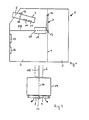
- a plant according to the invention is generally designated 1.
- it consists of two so-called depot containers 2 and 3, which form the containers in which the sorted glass is deposited.
- These containers form a unit in which they are divided by a partition 4.
- the unit represents a container that is set up, for example.
- the container wall has a recess 5, to which a conveyor is directly connected.
- it is a delivery pipe 6 which is oriented obliquely inwards and downwards.
- the tube 6 ends at a fixed distance from the partition 4.
- a deflection device 7 is arranged in the partition 4.
- the steering flaps 8 and 9 of the door can be moved apart in the horizontal direction on opposite sides. This is served by springs 10 and 11, the pretensioning of which can be released with the help of magnetic switches 12 and 13.
- a light transmission device 14 Via control electronics 15, it sends signals to the magnetic switches 12 and 13.
- a voltage source 16 in the form of a 12 volt supply is used to power the parts.
- Battery which is arranged on the inside of the system 1.
- the microswitch 17 is switched using a wire 18 which extends into the guide 6 and is deflected by the inserted glass parts.
- the light transmission device 14 is switched on. It supplies a signal via the control electronics 15 to the magnetic switches 12 and 13, which thereby instantly open the two longitudinal flaps 8 and 9.
- the bottle sliding in the tube leaves the sliding surface at the end of the tube and flies freely through the gate opened with the swiveled-out steering flaps into the interior of the container intended for white glass 3. With the aid of a delay circuit, the circuit of the steering flaps is held until the bottle has passed the gate. If a stained glass bottle follows, the microswitch 17 is also flipped and the light transmission device 14 is switched on.
- the stained glass bottle hits the closed gate in free fall, bounces off it and remains in the container 2, which because of the larger proportion of stained glass in the Waste glass larger than the container 3 is designed for white glass.
- the system sorts according to white glass, green glass and amber glass.
- a further partition 18 is provided, which divides the container for stained glass.
- the partition is in the longitudinal median plane of the tube, which serves as a conveyor.
- the upper edge of the intermediate wall 18 is formed by a steering flap 19 which is pivotable about an axis 20.
- the axis lies horizontally in the longitudinal median plane mentioned and, moreover, runs through the center of gravity of the steering flap 19. In the rest position, the steering flap 19 is oriented horizontally.
- another light transmission device 21 is arranged behind it in the direction of movement of the glass.
- This optoelectronic device is set so that it can distinguish between green and amber glass. If a white glass bottle is thrown in, the device works according to the principle described at the beginning. If a green glass bottle gets into the tube, the gate 7 remains closed. The light transmission device 21 controls the swivel flap 20 via the electronics 15 so that it swivels down to the side on which the container provided for green glass is located. The green glass bottle hits the closed gate 7 and slides over the swivel flap 19 into the correct container. The same procedure is followed with amber glass bottles. In this way, all three varieties can be made without sort the influence of the throwing in deliverers.
- the modified embodiment according to FIGS. 6 and 9 enables a kit for the sorting device which is built into the container by the manufacturer of the container.
- a tube 6 serving as a conveyor
- the opening 22 limits the maximum bottle diameter to 150 mm.
- the length of the tube 5 results from the maximum bottle length with e.g. 350 mm.
- the white glass sorting which will be explained in more detail below, functions up to a minimum diameter, which in the example is approximately 55 mm. White glass underneath automatically gets into one of the stained glass containers.
- This sorting device is designed so that it works in a certain temperature range.
- the range is, for example, between -20 ° C to + 50 ° C based on the environment of the control and optoelectronics.
- a set of commercially available dry cell batteries is used to operate them, with around 0.5 million sorting operations expected.
- the mass of the moving parts is reduced.
- the spatial separation of the thrown bottles is therefore not effected electronically or electrically, but by the kinetic energy of the bottles.
- a thrown-in bottle is accelerated evenly over a length of approximately 750 mm over a gradient of the tube 6 of approximately 25 °.
- the flanges are guided past the electro-optical device on the acceleration path.
- the light barrier 23 replaces the microswitch previously described and, like this, is located directly behind the insertion opening 23.
- This light barrier is continuously switched on, but generates 17 flashes of light in rapid succession to relieve the battery.
- This light barrier has two functions. On the one hand, it recognizes every waste glass body that exceeds the minimum diameter of the white glass detection. On the other hand, it controls the actual white glass detection.
- This white glass detection works with two light barriers.
- the upper, ie the first interrupted light barrier 36 recognizes that a bottle with its full diameter and not just with its neck is located in the area of the light barrier.
- the second light barrier 37 measures the mean values of the light transmission over a width of approximately 50 mm and over a defined small length of the bottle, which is sufficient for differentiation. It is generally so low that the Bottle remainder is sufficient, which is measured before or after a stomach label of the bottle. If the previously adjusted measured value is reached, the magnets 12, 13 are excited and open the lowering flaps so that the white glass bottle flies into the container 3.
- the battery 17 supplies the voltage U B to the clocked LED driver 38, which is temperature compensated.
- the two light barriers and the color receiver 39 are linked to one another via the AND function 40, which controls the regulated power supply 41 and the sample + hold circuit 42. This turns on the comparator and the white level threshold 43 as well as the central logic and sequence control 44.
- the LD driver 46 of the light barriers 36 and 37 is switched via a timer 45. From the color receivers 39, the signals reach the integrator 47 and the central logic and sequence control 44. This is fed back with the pull magnets 12, 13 for locking the steering flaps via the driver 48.
- the electronics described are accommodated at 16 and are shown schematically at 49 with their light barriers.
- Another, correspondingly constructed electronics follows at 50. It serves to control the magnetic switch 29 of a deflection flap 48 as soon as a green glass has been recognized. This distraction The flap closes a recess 51, the cross section of which is composed of a parabolic section 31 and an open emplacement 32 arranged at the top. If the cutout is closed with the flap, this directs the green glass bottle onto a slide rail 24. The green glass bottle then falls between fixed guide walls 26 and 27, which extend as far as the closed cutout 7, through the opening 24 behind the slide rail into the container 30 .
Landscapes
- Engineering & Computer Science (AREA)
- Mechanical Engineering (AREA)
- Sorting Of Articles (AREA)
- Processing Of Solid Wastes (AREA)
Priority Applications (1)
| Application Number | Priority Date | Filing Date | Title |
|---|---|---|---|
| AT86103766T ATE64330T1 (de) | 1985-08-05 | 1986-03-19 | Anlage zur trennung von abfallhohlglaesern, insbesondere von flaschen mindestens nach weiss- und nach buntglas. |
Applications Claiming Priority (2)
| Application Number | Priority Date | Filing Date | Title |
|---|---|---|---|
| DE3528069 | 1985-08-05 | ||
| DE19853528069 DE3528069A1 (de) | 1985-08-05 | 1985-08-05 | Vorrichtung zum sortieren von altglas |
Publications (3)
| Publication Number | Publication Date |
|---|---|
| EP0211139A2 true EP0211139A2 (fr) | 1987-02-25 |
| EP0211139A3 EP0211139A3 (en) | 1988-05-04 |
| EP0211139B1 EP0211139B1 (fr) | 1991-06-12 |
Family
ID=6277745
Family Applications (1)
| Application Number | Title | Priority Date | Filing Date |
|---|---|---|---|
| EP19860103766 Expired - Lifetime EP0211139B1 (fr) | 1985-08-05 | 1986-03-19 | Dispositif pour la séparation de déchets en verre, en particulier de bouteilles en verre transparent et en verre coloré |
Country Status (3)
| Country | Link |
|---|---|
| EP (1) | EP0211139B1 (fr) |
| AT (1) | ATE64330T1 (fr) |
| DE (2) | DE3528069A1 (fr) |
Cited By (7)
| Publication number | Priority date | Publication date | Assignee | Title |
|---|---|---|---|---|
| DE3842098A1 (de) * | 1987-12-15 | 1989-06-29 | Z Za Elektronna Nestandartna A | Vorrichtung zum automatischen sortieren von fruechten, gemuese und wurzelgemuese |
| EP0291959A3 (fr) * | 1987-05-19 | 1990-04-25 | ENICHEM S.p.A. | Méthode de séparation d'articles manufacturés en matériaux plastiques et appareil pour la mise en oeuvre de cette méthode |
| DE4317513A1 (de) * | 1993-05-26 | 1994-12-01 | Select Ingenieurgesellschaft F | Verfahren und Vorrichtung zur selektiven Trennung von Körpern und Anwendung des Verfahrens |
| WO1995026835A1 (fr) * | 1994-04-01 | 1995-10-12 | Rg & Partners | Procede et dispositif de recolte selective d'objets en verre et de stockage temporaire de leur matiere |
| EP0684191A1 (fr) * | 1994-05-25 | 1995-11-29 | Klaus Rudolph | Dispositif pour trier et/ou collecter des matériaux |
| EP0328126B1 (fr) * | 1988-02-12 | 1996-04-17 | Hubertus Exner | Méthode et dispositif pour trier des déchets de verre |
| DE19511901A1 (de) * | 1995-03-31 | 1996-10-02 | Commodas Gmbh | Vorrichtung und Verfahren zum Sortieren von Schüttgut |
Families Citing this family (2)
| Publication number | Priority date | Publication date | Assignee | Title |
|---|---|---|---|---|
| DE3905231A1 (de) * | 1989-02-21 | 1990-08-30 | Friedrich Dr Ebner | Sammelbehaelter und verfahren zum sammeln, sortieren und zerkleinern von altglasflaschen |
| US5314072A (en) * | 1992-09-02 | 1994-05-24 | Rutgers, The State University | Sorting plastic bottles for recycling |
Family Cites Families (6)
| Publication number | Priority date | Publication date | Assignee | Title |
|---|---|---|---|---|
| US3179247A (en) * | 1962-06-28 | 1965-04-20 | Sphere Invest Ltd | Random stream materials sorter |
| DE2533873C3 (de) * | 1975-07-29 | 1979-01-25 | Erwin Sick Gmbh Optik-Elektronik, 7808 Waldkirch | Vorrichtung zum Erkennen von Flaschenfarben |
| DE7540674U (de) * | 1975-12-20 | 1976-07-01 | Erkelenzer Maschinenfabrik Ferd. Clasen Kg, 5140 Erkelenz | Vorrichtung zum aussortieren von farbigem glasbruch |
| CH605338A5 (fr) * | 1975-12-22 | 1978-09-29 | Ernest Pluss | |
| DE2952411C2 (de) * | 1979-12-27 | 1982-04-08 | Erkelenzer Maschinenfabrik Ferd.Clasen KG, 5140 Erkelenz | Vorrichtung zum getrennten Sammeln von Glasbruch verschiedener Färbung |
| DE3119329C2 (de) * | 1981-05-15 | 1983-03-31 | Gerresheimer Glas AG, 4000 Düsseldorf | Vorrichtung zur Farbsortierung von Althohlglas |
-
1985
- 1985-08-05 DE DE19853528069 patent/DE3528069A1/de not_active Withdrawn
-
1986
- 1986-03-19 AT AT86103766T patent/ATE64330T1/de not_active IP Right Cessation
- 1986-03-19 DE DE8686103766T patent/DE3679733D1/de not_active Expired - Fee Related
- 1986-03-19 EP EP19860103766 patent/EP0211139B1/fr not_active Expired - Lifetime
Cited By (8)
| Publication number | Priority date | Publication date | Assignee | Title |
|---|---|---|---|---|
| EP0291959A3 (fr) * | 1987-05-19 | 1990-04-25 | ENICHEM S.p.A. | Méthode de séparation d'articles manufacturés en matériaux plastiques et appareil pour la mise en oeuvre de cette méthode |
| DE3842098A1 (de) * | 1987-12-15 | 1989-06-29 | Z Za Elektronna Nestandartna A | Vorrichtung zum automatischen sortieren von fruechten, gemuese und wurzelgemuese |
| EP0328126B1 (fr) * | 1988-02-12 | 1996-04-17 | Hubertus Exner | Méthode et dispositif pour trier des déchets de verre |
| DE4317513A1 (de) * | 1993-05-26 | 1994-12-01 | Select Ingenieurgesellschaft F | Verfahren und Vorrichtung zur selektiven Trennung von Körpern und Anwendung des Verfahrens |
| WO1995026835A1 (fr) * | 1994-04-01 | 1995-10-12 | Rg & Partners | Procede et dispositif de recolte selective d'objets en verre et de stockage temporaire de leur matiere |
| BE1008100A5 (fr) * | 1994-04-01 | 1996-01-16 | D V T | Procede et dispositif de recolte selective d'objets en verre et de stockage temporaire de leur matiere. |
| EP0684191A1 (fr) * | 1994-05-25 | 1995-11-29 | Klaus Rudolph | Dispositif pour trier et/ou collecter des matériaux |
| DE19511901A1 (de) * | 1995-03-31 | 1996-10-02 | Commodas Gmbh | Vorrichtung und Verfahren zum Sortieren von Schüttgut |
Also Published As
| Publication number | Publication date |
|---|---|
| DE3679733D1 (de) | 1991-07-18 |
| EP0211139A3 (en) | 1988-05-04 |
| ATE64330T1 (de) | 1991-06-15 |
| DE3528069A1 (de) | 1987-02-05 |
| EP0211139B1 (fr) | 1991-06-12 |
Similar Documents
| Publication | Publication Date | Title |
|---|---|---|
| DE69213066T2 (de) | Segmentweise Schiebersteuerung für ein Fördersystem | |
| DE3520486C2 (fr) | ||
| EP2444363B1 (fr) | Dispositif et procédé destinés à la fermeture de récipients avec bouchons | |
| CH629018A5 (de) | Muenzsortiervorrichtung. | |
| EP0211139B1 (fr) | Dispositif pour la séparation de déchets en verre, en particulier de bouteilles en verre transparent et en verre coloré | |
| DE102008050907A1 (de) | Ausblasvorrichtung zum selektiven Ausblasen von Fördergutteilen aus einem Fördergutsstrom und Sortiervorrichtung mit einer solchen Ausblasvorrichtung | |
| DE3709179C1 (de) | Verfahren und Vorrichtung zur Wiedergewinnung von Glas aus Altglas | |
| DE3804391A1 (de) | Verfahren und vorrichtung zum sortieren von altglasbruchstuecken | |
| DE2800494C3 (de) | Münzsortiervorrichtung mit Auswerferstößeln | |
| EP0461616B1 (fr) | Procédé et dispositif de tri de déchets de verre | |
| DE3828067C2 (fr) | ||
| EP0897762B1 (fr) | Dispositif de tri de matériaux en vrac bruts, prétraités ou recyclés | |
| DE3346129C2 (de) | Vorrichtung zum Sortieren von Altglas enthaltendem Abfall | |
| DE10149505A1 (de) | Verfahren und Vorrichtung zur Selektierung von Kunststoffen und anderen Materialien bezüglich Farbe und Zusammensetzung | |
| DE102014011401B3 (de) | "Ausblasvorrichtung zum selektiven Ausblasen von Fördergutteilen aus einem Fördergutstrom" | |
| AT391842B (de) | Vorrichtung zum zufuehren und vereinzeln von montageteilen | |
| EP0743269A2 (fr) | Voie de distribution pour objets plats | |
| DE3731402A1 (de) | Anlage zur trennung von abfallhohlglaesern, insbesondere von flaschen mindestens nach weiss- und buntglas | |
| DE8806095U1 (de) | Glassammelbehälter | |
| DE3445428C2 (fr) | ||
| EP0334987A2 (fr) | Collecteur de déchets de verre concave pourvu d'un dispositif de séparation et de tri selon la couleur | |
| DE9106292U1 (de) | Vorrichtung zum Sortieren von Altmaterial, insbesondere Altglas nach seiner Farbe | |
| DE102010042333A1 (de) | Vorrichtung zum Ausrichten von Gegenständen | |
| EP1188490B1 (fr) | Procédé de tri d'une fraction de plastiques et dispositif de tri de déchets | |
| DE69505510T2 (de) | Verfahren und vorrichtung zur selektiven sammlung von gegenständen aus glas und zum zeitweiligen lagern ihres stoffes |
Legal Events
| Date | Code | Title | Description |
|---|---|---|---|
| PUAI | Public reference made under article 153(3) epc to a published international application that has entered the european phase |
Free format text: ORIGINAL CODE: 0009012 |
|
| AK | Designated contracting states |
Kind code of ref document: A2 Designated state(s): AT BE CH DE FR GB IT LI LU NL SE |
|
| 17P | Request for examination filed |
Effective date: 19870410 |
|
| PUAL | Search report despatched |
Free format text: ORIGINAL CODE: 0009013 |
|
| RHK1 | Main classification (correction) |
Ipc: B07C 5/342 |
|
| AK | Designated contracting states |
Kind code of ref document: A3 Designated state(s): AT BE CH DE FR GB IT LI LU NL SE |
|
| 17Q | First examination report despatched |
Effective date: 19891107 |
|
| GRAA | (expected) grant |
Free format text: ORIGINAL CODE: 0009210 |
|
| AK | Designated contracting states |
Kind code of ref document: B1 Designated state(s): AT BE CH DE FR GB IT LI LU NL SE |
|
| REF | Corresponds to: |
Ref document number: 64330 Country of ref document: AT Date of ref document: 19910615 Kind code of ref document: T |
|
| ITF | It: translation for a ep patent filed | ||
| ET | Fr: translation filed | ||
| GBT | Gb: translation of ep patent filed (gb section 77(6)(a)/1977) | ||
| REF | Corresponds to: |
Ref document number: 3679733 Country of ref document: DE Date of ref document: 19910718 |
|
| PGFP | Annual fee paid to national office [announced via postgrant information from national office to epo] |
Ref country code: FR Payment date: 19911226 Year of fee payment: 7 |
|
| PGFP | Annual fee paid to national office [announced via postgrant information from national office to epo] |
Ref country code: GB Payment date: 19920226 Year of fee payment: 7 |
|
| PGFP | Annual fee paid to national office [announced via postgrant information from national office to epo] |
Ref country code: SE Payment date: 19920320 Year of fee payment: 7 |
|
| PGFP | Annual fee paid to national office [announced via postgrant information from national office to epo] |
Ref country code: LU Payment date: 19920324 Year of fee payment: 7 Ref country code: AT Payment date: 19920324 Year of fee payment: 7 |
|
| PGFP | Annual fee paid to national office [announced via postgrant information from national office to epo] |
Ref country code: NL Payment date: 19920331 Year of fee payment: 7 |
|
| PGFP | Annual fee paid to national office [announced via postgrant information from national office to epo] |
Ref country code: BE Payment date: 19920403 Year of fee payment: 7 |
|
| PLBE | No opposition filed within time limit |
Free format text: ORIGINAL CODE: 0009261 |
|
| STAA | Information on the status of an ep patent application or granted ep patent |
Free format text: STATUS: NO OPPOSITION FILED WITHIN TIME LIMIT |
|
| PGFP | Annual fee paid to national office [announced via postgrant information from national office to epo] |
Ref country code: CH Payment date: 19920421 Year of fee payment: 7 |
|
| PGFP | Annual fee paid to national office [announced via postgrant information from national office to epo] |
Ref country code: DE Payment date: 19920529 Year of fee payment: 7 |
|
| 26N | No opposition filed | ||
| EPTA | Lu: last paid annual fee | ||
| PG25 | Lapsed in a contracting state [announced via postgrant information from national office to epo] |
Ref country code: LU Free format text: LAPSE BECAUSE OF NON-PAYMENT OF DUE FEES Effective date: 19930319 Ref country code: GB Effective date: 19930319 Ref country code: AT Effective date: 19930319 |
|
| PG25 | Lapsed in a contracting state [announced via postgrant information from national office to epo] |
Ref country code: SE Effective date: 19930320 |
|
| PG25 | Lapsed in a contracting state [announced via postgrant information from national office to epo] |
Ref country code: LI Effective date: 19930331 Ref country code: CH Effective date: 19930331 Ref country code: BE Effective date: 19930331 |
|
| BERE | Be: lapsed |
Owner name: MABEG MULL- UND ABFALLBESEITIGUNGS G.M.B.H. & CO. Effective date: 19930331 |
|
| PG25 | Lapsed in a contracting state [announced via postgrant information from national office to epo] |
Ref country code: NL Effective date: 19931001 |
|
| NLV4 | Nl: lapsed or anulled due to non-payment of the annual fee | ||
| GBPC | Gb: european patent ceased through non-payment of renewal fee |
Effective date: 19930319 |
|
| PG25 | Lapsed in a contracting state [announced via postgrant information from national office to epo] |
Ref country code: FR Effective date: 19931130 |
|
| REG | Reference to a national code |
Ref country code: CH Ref legal event code: PL |
|
| PG25 | Lapsed in a contracting state [announced via postgrant information from national office to epo] |
Ref country code: DE Effective date: 19931201 |
|
| REG | Reference to a national code |
Ref country code: FR Ref legal event code: ST |
|
| EUG | Se: european patent has lapsed |
Ref document number: 86103766.1 Effective date: 19931008 |
|
| PG25 | Lapsed in a contracting state [announced via postgrant information from national office to epo] |
Ref country code: IT Free format text: LAPSE BECAUSE OF NON-PAYMENT OF DUE FEES;WARNING: LAPSES OF ITALIAN PATENTS WITH EFFECTIVE DATE BEFORE 2007 MAY HAVE OCCURRED AT ANY TIME BEFORE 2007. THE CORRECT EFFECTIVE DATE MAY BE DIFFERENT FROM THE ONE RECORDED. Effective date: 20050319 |