EP0212449A2 - Polyvinylchloridpolymermischung, welche einen kristallinen Polyester mit begrenzter Mischbarkeit enthält und daraus erhaltene verstärkte Verbundstoffe - Google Patents
Polyvinylchloridpolymermischung, welche einen kristallinen Polyester mit begrenzter Mischbarkeit enthält und daraus erhaltene verstärkte Verbundstoffe Download PDFInfo
- Publication number
- EP0212449A2 EP0212449A2 EP86110863A EP86110863A EP0212449A2 EP 0212449 A2 EP0212449 A2 EP 0212449A2 EP 86110863 A EP86110863 A EP 86110863A EP 86110863 A EP86110863 A EP 86110863A EP 0212449 A2 EP0212449 A2 EP 0212449A2
- Authority
- EP
- European Patent Office
- Prior art keywords
- pvc
- scpe
- range
- polyblend
- hdt
- Prior art date
- Legal status (The legal status is an assumption and is not a legal conclusion. Google has not performed a legal analysis and makes no representation as to the accuracy of the status listed.)
- Withdrawn
Links
- 229920000915 polyvinyl chloride Polymers 0.000 title claims abstract description 137
- 239000004800 polyvinyl chloride Substances 0.000 title claims abstract description 137
- -1 Poly(vinylchloride) Polymers 0.000 title claims abstract description 29
- 239000002131 composite material Substances 0.000 title abstract description 6
- 229920000728 polyester Polymers 0.000 title description 17
- 239000003365 glass fiber Substances 0.000 claims abstract description 21
- KKEYFWRCBNTPAC-UHFFFAOYSA-N Terephthalic acid Chemical compound OC(=O)C1=CC=C(C(O)=O)C=C1 KKEYFWRCBNTPAC-UHFFFAOYSA-N 0.000 claims abstract description 18
- WERYXYBDKMZEQL-UHFFFAOYSA-N butane-1,4-diol Chemical compound OCCCCO WERYXYBDKMZEQL-UHFFFAOYSA-N 0.000 claims abstract description 17
- 229920001634 Copolyester Polymers 0.000 claims abstract description 16
- QQVIHTHCMHWDBS-UHFFFAOYSA-N isophthalic acid Chemical compound OC(=O)C1=CC=CC(C(O)=O)=C1 QQVIHTHCMHWDBS-UHFFFAOYSA-N 0.000 claims abstract description 12
- 239000002253 acid Substances 0.000 claims abstract description 9
- YPFDHNVEDLHUCE-UHFFFAOYSA-N 1,3-propanediol Substances OCCCO YPFDHNVEDLHUCE-UHFFFAOYSA-N 0.000 claims abstract description 8
- DNIAPMSPPWPWGF-VKHMYHEASA-N (+)-propylene glycol Chemical compound C[C@H](O)CO DNIAPMSPPWPWGF-VKHMYHEASA-N 0.000 claims abstract description 6
- 229940035437 1,3-propanediol Drugs 0.000 claims abstract description 6
- 229920000166 polytrimethylene carbonate Polymers 0.000 claims abstract description 6
- 150000001335 aliphatic alkanes Chemical class 0.000 claims abstract 4
- 125000001931 aliphatic group Chemical group 0.000 claims description 14
- 238000002156 mixing Methods 0.000 claims description 12
- 238000000034 method Methods 0.000 claims description 10
- 125000004432 carbon atom Chemical group C* 0.000 claims description 9
- 239000011859 microparticle Substances 0.000 claims description 9
- 229920003232 aliphatic polyester Polymers 0.000 claims description 8
- JHIVVAPYMSGYDF-UHFFFAOYSA-N cyclohexanone Chemical compound O=C1CCCCC1 JHIVVAPYMSGYDF-UHFFFAOYSA-N 0.000 claims description 8
- 230000006872 improvement Effects 0.000 claims description 8
- 238000002844 melting Methods 0.000 claims description 8
- 230000008018 melting Effects 0.000 claims description 8
- 238000012545 processing Methods 0.000 claims description 8
- 230000006835 compression Effects 0.000 claims description 4
- 238000007906 compression Methods 0.000 claims description 4
- 229910052799 carbon Inorganic materials 0.000 claims description 2
- 230000008569 process Effects 0.000 claims description 2
- 239000012260 resinous material Substances 0.000 claims 2
- 238000004519 manufacturing process Methods 0.000 claims 1
- 239000008188 pellet Substances 0.000 claims 1
- 238000003856 thermoforming Methods 0.000 claims 1
- LYCAIKOWRPUZTN-UHFFFAOYSA-N Ethylene glycol Chemical compound OCCO LYCAIKOWRPUZTN-UHFFFAOYSA-N 0.000 abstract description 31
- 239000000306 component Substances 0.000 abstract description 18
- 150000002148 esters Chemical class 0.000 abstract description 16
- WGCNASOHLSPBMP-UHFFFAOYSA-N hydroxyacetaldehyde Natural products OCC=O WGCNASOHLSPBMP-UHFFFAOYSA-N 0.000 abstract description 14
- 230000000694 effects Effects 0.000 abstract description 8
- 239000011521 glass Substances 0.000 abstract description 5
- 125000003827 glycol group Chemical group 0.000 abstract description 2
- 239000000203 mixture Substances 0.000 description 29
- 239000011159 matrix material Substances 0.000 description 20
- 229920001707 polybutylene terephthalate Polymers 0.000 description 13
- 229920000642 polymer Polymers 0.000 description 11
- 239000000126 substance Substances 0.000 description 8
- 238000003917 TEM image Methods 0.000 description 6
- 239000000654 additive Substances 0.000 description 6
- 238000006243 chemical reaction Methods 0.000 description 6
- 238000003801 milling Methods 0.000 description 6
- 239000002245 particle Substances 0.000 description 6
- IJGRMHOSHXDMSA-UHFFFAOYSA-N Atomic nitrogen Chemical compound N#N IJGRMHOSHXDMSA-UHFFFAOYSA-N 0.000 description 4
- WNLRTRBMVRJNCN-UHFFFAOYSA-N adipic acid Chemical compound OC(=O)CCCCC(O)=O WNLRTRBMVRJNCN-UHFFFAOYSA-N 0.000 description 4
- 150000002009 diols Chemical class 0.000 description 4
- 229940090044 injection Drugs 0.000 description 4
- 238000002347 injection Methods 0.000 description 4
- 239000007924 injection Substances 0.000 description 4
- 239000000463 material Substances 0.000 description 4
- 230000000704 physical effect Effects 0.000 description 4
- 239000004014 plasticizer Substances 0.000 description 4
- 238000002360 preparation method Methods 0.000 description 4
- 239000012763 reinforcing filler Substances 0.000 description 4
- 238000012360 testing method Methods 0.000 description 4
- 238000005809 transesterification reaction Methods 0.000 description 4
- 229920006385 Geon Polymers 0.000 description 3
- OFOBLEOULBTSOW-UHFFFAOYSA-N Malonic acid Chemical compound OC(=O)CC(O)=O OFOBLEOULBTSOW-UHFFFAOYSA-N 0.000 description 3
- OKKJLVBELUTLKV-UHFFFAOYSA-N Methanol Chemical compound OC OKKJLVBELUTLKV-UHFFFAOYSA-N 0.000 description 3
- MUBZPKHOEPUJKR-UHFFFAOYSA-N Oxalic acid Chemical compound OC(=O)C(O)=O MUBZPKHOEPUJKR-UHFFFAOYSA-N 0.000 description 3
- 238000007792 addition Methods 0.000 description 3
- 229920001577 copolymer Polymers 0.000 description 3
- MTHSVFCYNBDYFN-UHFFFAOYSA-N diethylene glycol Chemical compound OCCOCCO MTHSVFCYNBDYFN-UHFFFAOYSA-N 0.000 description 3
- 238000001938 differential scanning calorimetry curve Methods 0.000 description 3
- 229920001519 homopolymer Polymers 0.000 description 3
- 238000006068 polycondensation reaction Methods 0.000 description 3
- 229920002959 polymer blend Polymers 0.000 description 3
- 239000011164 primary particle Substances 0.000 description 3
- PUPZLCDOIYMWBV-UHFFFAOYSA-N (+/-)-1,3-Butanediol Chemical compound CC(O)CCO PUPZLCDOIYMWBV-UHFFFAOYSA-N 0.000 description 2
- 239000004808 2-ethylhexylester Substances 0.000 description 2
- ZSYUYBMMNNGZIB-UHFFFAOYSA-N 6-(4-hydroxybutoxy)-6-oxohexanoic acid Chemical compound OCCCCOC(=O)CCCCC(O)=O ZSYUYBMMNNGZIB-UHFFFAOYSA-N 0.000 description 2
- 239000004801 Chlorinated PVC Substances 0.000 description 2
- KRADHMIOFJQKEZ-UHFFFAOYSA-N Tri-2-ethylhexyl trimellitate Chemical compound CCCCC(CC)COC(=O)C1=CC=C(C(=O)OCC(CC)CCCC)C(C(=O)OCC(CC)CCCC)=C1 KRADHMIOFJQKEZ-UHFFFAOYSA-N 0.000 description 2
- BZHJMEDXRYGGRV-UHFFFAOYSA-N Vinyl chloride Chemical compound ClC=C BZHJMEDXRYGGRV-UHFFFAOYSA-N 0.000 description 2
- 239000001361 adipic acid Substances 0.000 description 2
- 235000011037 adipic acid Nutrition 0.000 description 2
- 230000015572 biosynthetic process Effects 0.000 description 2
- YHWCPXVTRSHPNY-UHFFFAOYSA-N butan-1-olate;titanium(4+) Chemical compound [Ti+4].CCCC[O-].CCCC[O-].CCCC[O-].CCCC[O-] YHWCPXVTRSHPNY-UHFFFAOYSA-N 0.000 description 2
- CDQSJQSWAWPGKG-UHFFFAOYSA-N butane-1,1-diol Chemical compound CCCC(O)O CDQSJQSWAWPGKG-UHFFFAOYSA-N 0.000 description 2
- 230000015556 catabolic process Effects 0.000 description 2
- 239000003054 catalyst Substances 0.000 description 2
- PFURGBBHAOXLIO-UHFFFAOYSA-N cyclohexane-1,2-diol Chemical compound OC1CCCCC1O PFURGBBHAOXLIO-UHFFFAOYSA-N 0.000 description 2
- 238000006731 degradation reaction Methods 0.000 description 2
- 150000001991 dicarboxylic acids Chemical class 0.000 description 2
- WOZVHXUHUFLZGK-UHFFFAOYSA-N dimethyl terephthalate Chemical compound COC(=O)C1=CC=C(C(=O)OC)C=C1 WOZVHXUHUFLZGK-UHFFFAOYSA-N 0.000 description 2
- 239000000428 dust Substances 0.000 description 2
- 239000000975 dye Substances 0.000 description 2
- 239000000806 elastomer Substances 0.000 description 2
- 238000005516 engineering process Methods 0.000 description 2
- 230000009477 glass transition Effects 0.000 description 2
- 238000010438 heat treatment Methods 0.000 description 2
- 239000012535 impurity Substances 0.000 description 2
- 229910052757 nitrogen Inorganic materials 0.000 description 2
- BDJRBEYXGGNYIS-UHFFFAOYSA-N nonanedioic acid Chemical compound OC(=O)CCCCCCCC(O)=O BDJRBEYXGGNYIS-UHFFFAOYSA-N 0.000 description 2
- 239000000049 pigment Substances 0.000 description 2
- 229920000233 poly(alkylene oxides) Polymers 0.000 description 2
- 229920005989 resin Polymers 0.000 description 2
- 239000011347 resin Substances 0.000 description 2
- CXMXRPHRNRROMY-UHFFFAOYSA-N sebacic acid Chemical compound OC(=O)CCCCCCCCC(O)=O CXMXRPHRNRROMY-UHFFFAOYSA-N 0.000 description 2
- FZHAPNGMFPVSLP-UHFFFAOYSA-N silanamine Chemical compound [SiH3]N FZHAPNGMFPVSLP-UHFFFAOYSA-N 0.000 description 2
- 229920001169 thermoplastic Polymers 0.000 description 2
- 239000004416 thermosoftening plastic Substances 0.000 description 2
- 229940058015 1,3-butylene glycol Drugs 0.000 description 1
- PXGZQGDTEZPERC-UHFFFAOYSA-N 1,4-cyclohexanedicarboxylic acid Chemical compound OC(=O)C1CCC(C(O)=O)CC1 PXGZQGDTEZPERC-UHFFFAOYSA-N 0.000 description 1
- RTBFRGCFXZNCOE-UHFFFAOYSA-N 1-methylsulfonylpiperidin-4-one Chemical compound CS(=O)(=O)N1CCC(=O)CC1 RTBFRGCFXZNCOE-UHFFFAOYSA-N 0.000 description 1
- LTMRRSWNXVJMBA-UHFFFAOYSA-N 2,2-diethylpropanedioic acid Chemical compound CCC(CC)(C(O)=O)C(O)=O LTMRRSWNXVJMBA-UHFFFAOYSA-N 0.000 description 1
- OEPOKWHJYJXUGD-UHFFFAOYSA-N 2-(3-phenylmethoxyphenyl)-1,3-thiazole-4-carbaldehyde Chemical compound O=CC1=CSC(C=2C=C(OCC=3C=CC=CC=3)C=CC=2)=N1 OEPOKWHJYJXUGD-UHFFFAOYSA-N 0.000 description 1
- KRXMYBAZKJBJAB-UHFFFAOYSA-N 2-(4-methylphenyl)-1,2-benzothiazol-3-one Chemical compound C1=CC(C)=CC=C1N1C(=O)C2=CC=CC=C2S1 KRXMYBAZKJBJAB-UHFFFAOYSA-N 0.000 description 1
- ZOXJGFHDIHLPTG-UHFFFAOYSA-N Boron Chemical compound [B] ZOXJGFHDIHLPTG-UHFFFAOYSA-N 0.000 description 1
- GDOPTJXRTPNYNR-UHFFFAOYSA-N CC1CCCC1 Chemical compound CC1CCCC1 GDOPTJXRTPNYNR-UHFFFAOYSA-N 0.000 description 1
- OKTJSMMVPCPJKN-UHFFFAOYSA-N Carbon Chemical compound [C] OKTJSMMVPCPJKN-UHFFFAOYSA-N 0.000 description 1
- 229920000271 Kevlar® Polymers 0.000 description 1
- 239000006057 Non-nutritive feed additive Substances 0.000 description 1
- 239000004721 Polyphenylene oxide Substances 0.000 description 1
- 239000004743 Polypropylene Substances 0.000 description 1
- 239000006087 Silane Coupling Agent Substances 0.000 description 1
- XUIMIQQOPSSXEZ-UHFFFAOYSA-N Silicon Chemical compound [Si] XUIMIQQOPSSXEZ-UHFFFAOYSA-N 0.000 description 1
- KDYFGRWQOYBRFD-UHFFFAOYSA-N Succinic acid Natural products OC(=O)CCC(O)=O KDYFGRWQOYBRFD-UHFFFAOYSA-N 0.000 description 1
- 206010047289 Ventricular extrasystoles Diseases 0.000 description 1
- 238000002441 X-ray diffraction Methods 0.000 description 1
- AEBIBBWVNCPTNL-UHFFFAOYSA-N [1-(hydroxymethyl)cyclobutyl]methanol Chemical compound OCC1(CO)CCC1 AEBIBBWVNCPTNL-UHFFFAOYSA-N 0.000 description 1
- ORLQHILJRHBSAY-UHFFFAOYSA-N [1-(hydroxymethyl)cyclohexyl]methanol Chemical compound OCC1(CO)CCCCC1 ORLQHILJRHBSAY-UHFFFAOYSA-N 0.000 description 1
- 230000000996 additive effect Effects 0.000 description 1
- 125000002947 alkylene group Chemical group 0.000 description 1
- 229920006125 amorphous polymer Polymers 0.000 description 1
- 150000008064 anhydrides Chemical class 0.000 description 1
- JFCQEDHGNNZCLN-UHFFFAOYSA-N anhydrous glutaric acid Natural products OC(=O)CCCC(O)=O JFCQEDHGNNZCLN-UHFFFAOYSA-N 0.000 description 1
- 239000003963 antioxidant agent Substances 0.000 description 1
- 239000004760 aramid Substances 0.000 description 1
- 229920003235 aromatic polyamide Polymers 0.000 description 1
- 125000003118 aryl group Chemical group 0.000 description 1
- 229910052796 boron Inorganic materials 0.000 description 1
- 235000019437 butane-1,3-diol Nutrition 0.000 description 1
- KDYFGRWQOYBRFD-NUQCWPJISA-N butanedioic acid Chemical compound O[14C](=O)CC[14C](O)=O KDYFGRWQOYBRFD-NUQCWPJISA-N 0.000 description 1
- 239000004917 carbon fiber Substances 0.000 description 1
- 125000003178 carboxy group Chemical group [H]OC(*)=O 0.000 description 1
- 229920000457 chlorinated polyvinyl chloride Polymers 0.000 description 1
- PMMYEEVYMWASQN-IMJSIDKUSA-N cis-4-Hydroxy-L-proline Chemical compound O[C@@H]1CN[C@H](C(O)=O)C1 PMMYEEVYMWASQN-IMJSIDKUSA-N 0.000 description 1
- 230000001427 coherent effect Effects 0.000 description 1
- 238000000748 compression moulding Methods 0.000 description 1
- 230000002153 concerted effect Effects 0.000 description 1
- 238000007796 conventional method Methods 0.000 description 1
- 239000007822 coupling agent Substances 0.000 description 1
- 239000013078 crystal Substances 0.000 description 1
- CCQPAEQGAVNNIA-UHFFFAOYSA-N cyclobutane-1,1-dicarboxylic acid Chemical compound OC(=O)C1(C(O)=O)CCC1 CCQPAEQGAVNNIA-UHFFFAOYSA-N 0.000 description 1
- NBBUYPNTAABDEY-UHFFFAOYSA-N cyclobutane-1,1-diol Chemical class OC1(O)CCC1 NBBUYPNTAABDEY-UHFFFAOYSA-N 0.000 description 1
- XBZSBBLNHFMTEB-UHFFFAOYSA-N cyclohexane-1,3-dicarboxylic acid Chemical compound OC(=O)C1CCCC(C(O)=O)C1 XBZSBBLNHFMTEB-UHFFFAOYSA-N 0.000 description 1
- VCVOSERVUCJNPR-UHFFFAOYSA-N cyclopentane-1,2-diol Chemical compound OC1CCCC1O VCVOSERVUCJNPR-UHFFFAOYSA-N 0.000 description 1
- NUUPJBRGQCEZSI-UHFFFAOYSA-N cyclopentane-1,3-diol Chemical compound OC1CCC(O)C1 NUUPJBRGQCEZSI-UHFFFAOYSA-N 0.000 description 1
- 230000007423 decrease Effects 0.000 description 1
- 230000000994 depressogenic effect Effects 0.000 description 1
- SZXQTJUDPRGNJN-UHFFFAOYSA-N dipropylene glycol Chemical compound OCCCOCCCO SZXQTJUDPRGNJN-UHFFFAOYSA-N 0.000 description 1
- 238000004821 distillation Methods 0.000 description 1
- 229920001971 elastomer Polymers 0.000 description 1
- 238000001125 extrusion Methods 0.000 description 1
- 239000000945 filler Substances 0.000 description 1
- SYLAFCZSYRXBJF-UHFFFAOYSA-N furan-3,4-dicarboxylic acid Chemical compound OC(=O)C1=COC=C1C(O)=O SYLAFCZSYRXBJF-UHFFFAOYSA-N 0.000 description 1
- 150000004820 halides Chemical class 0.000 description 1
- 239000012760 heat stabilizer Substances 0.000 description 1
- ACCCMOQWYVYDOT-UHFFFAOYSA-N hexane-1,1-diol Chemical compound CCCCCC(O)O ACCCMOQWYVYDOT-UHFFFAOYSA-N 0.000 description 1
- 239000008240 homogeneous mixture Substances 0.000 description 1
- 238000007654 immersion Methods 0.000 description 1
- 239000004615 ingredient Substances 0.000 description 1
- 239000012784 inorganic fiber Substances 0.000 description 1
- 230000003993 interaction Effects 0.000 description 1
- 239000004761 kevlar Substances 0.000 description 1
- 239000004611 light stabiliser Substances 0.000 description 1
- 229920005684 linear copolymer Polymers 0.000 description 1
- 239000007788 liquid Substances 0.000 description 1
- 239000000155 melt Substances 0.000 description 1
- 238000000048 melt cooling Methods 0.000 description 1
- 238000001000 micrograph Methods 0.000 description 1
- 239000000178 monomer Substances 0.000 description 1
- SLCVBVWXLSEKPL-UHFFFAOYSA-N neopentyl glycol Chemical compound OCC(C)(C)CO SLCVBVWXLSEKPL-UHFFFAOYSA-N 0.000 description 1
- 229940117969 neopentyl glycol Drugs 0.000 description 1
- 235000006408 oxalic acid Nutrition 0.000 description 1
- 238000012856 packing Methods 0.000 description 1
- 229920001610 polycaprolactone Polymers 0.000 description 1
- 239000004632 polycaprolactone Substances 0.000 description 1
- 229920001225 polyester resin Polymers 0.000 description 1
- 239000004645 polyester resin Substances 0.000 description 1
- 229920001155 polypropylene Polymers 0.000 description 1
- 238000000926 separation method Methods 0.000 description 1
- 239000007787 solid Substances 0.000 description 1
- 125000001424 substituent group Chemical group 0.000 description 1
- KKEYFWRCBNTPAC-UHFFFAOYSA-L terephthalate(2-) Chemical compound [O-]C(=O)C1=CC=C(C([O-])=O)C=C1 KKEYFWRCBNTPAC-UHFFFAOYSA-L 0.000 description 1
- 125000000383 tetramethylene group Chemical group [H]C([H])([*:1])C([H])([H])C([H])([H])C([H])([H])[*:2] 0.000 description 1
- ZIBGPFATKBEMQZ-UHFFFAOYSA-N triethylene glycol Chemical compound OCCOCCOCCO ZIBGPFATKBEMQZ-UHFFFAOYSA-N 0.000 description 1
- JNXDCMUUZNIWPQ-UHFFFAOYSA-N trioctyl benzene-1,2,4-tricarboxylate Chemical compound CCCCCCCCOC(=O)C1=CC=C(C(=O)OCCCCCCCC)C(C(=O)OCCCCCCCC)=C1 JNXDCMUUZNIWPQ-UHFFFAOYSA-N 0.000 description 1
- 238000009736 wetting Methods 0.000 description 1
- 239000002023 wood Substances 0.000 description 1
Images



Classifications
-
- C—CHEMISTRY; METALLURGY
- C08—ORGANIC MACROMOLECULAR COMPOUNDS; THEIR PREPARATION OR CHEMICAL WORKING-UP; COMPOSITIONS BASED THEREON
- C08L—COMPOSITIONS OF MACROMOLECULAR COMPOUNDS
- C08L27/00—Compositions of homopolymers or copolymers of compounds having one or more unsaturated aliphatic radicals, each having only one carbon-to-carbon double bond, and at least one being terminated by a halogen; Compositions of derivatives of such polymers
- C08L27/02—Compositions of homopolymers or copolymers of compounds having one or more unsaturated aliphatic radicals, each having only one carbon-to-carbon double bond, and at least one being terminated by a halogen; Compositions of derivatives of such polymers not modified by chemical after-treatment
- C08L27/04—Compositions of homopolymers or copolymers of compounds having one or more unsaturated aliphatic radicals, each having only one carbon-to-carbon double bond, and at least one being terminated by a halogen; Compositions of derivatives of such polymers not modified by chemical after-treatment containing chlorine atoms
- C08L27/06—Homopolymers or copolymers of vinyl chloride
-
- C—CHEMISTRY; METALLURGY
- C08—ORGANIC MACROMOLECULAR COMPOUNDS; THEIR PREPARATION OR CHEMICAL WORKING-UP; COMPOSITIONS BASED THEREON
- C08L—COMPOSITIONS OF MACROMOLECULAR COMPOUNDS
- C08L67/00—Compositions of polyesters obtained by reactions forming a carboxylic ester link in the main chain; Compositions of derivatives of such polymers
- C08L67/02—Polyesters derived from dicarboxylic acids and dihydroxy compounds
Definitions
- This invention is related to a polymer blend ("polyblend") 100 parts by weight (by wt) of which comprises from about 70:30 to about 30:70 parts of poly(vinyl chloride) (“PVC”) and a segmented copolyester (“SCPE”) having particular chemical and physical properties.
- the polyblend has unexpected and desirable processing characteristics, especially when it is reinforced with glass fiber.
- miscible I refer to a solubility of the poly ester in the PVC, or vice versa, such that the polyblend exhibits no discernible separation of amorphous phases, and a single glass transition temperature ("T g ").
- T g single glass transition temperature
- this invention is directed to a polyblend prepared by mechanical mixing of its solid components which yields a mixture consisting of a matrix and a dispersed particle phase, any one of which contains within its physical boundary, two well-mixed polymers as distinct discernible phases. If a reinforcing filler such as glass fiber is added, the matrix includes a third phase. Each additional filler or immiscible additive constitutes an additional phase.
- polyesters or copolyesters which are miscible with chlorinated polymers such as PVC, chlorinated PVC ("CPVC"), chlorinated poly(ethylenes), and copolymers of vinylidene chloride, has centered upon the particular ester concentration of the (co)polyester which defines a "miscibility window” in which miscibility is found. Outside this window there is pondered to be “immiscibility", there purportedly being no intermediate condition or state.
- the SCPEs used in the polyblend of this invention are neither immiscible nor inside the window of miscibility but have "limited miscibility” which is critical for polyester crystal formation during the melt cooling of the polyblend into shaped articles.
- polyblend is used herein to connote a mixture of PVC and SCPE which maintains a polyphase or multiple phase polymeric structure consisting essentially of PVC-rich and SCPE-rich amorphous phases, and crystalline PVC and SCPE phases, which structure satisfies the criteria defining "limited miscibility".
- a SCPE having limited miscibility is one which has sufficient crystallinity so that, when blended with the PVC, the polyblend has distinct discernible phases characterized by a crystallinity in the range from 25% to about 55% based on SCPE.
- the essential criterion of limited miscibility which the SCPE in the PVC/SCPE polyblend of this invention meets, is specified in greater detail herein onlybelow by giving (i) the composition of the polyblend and the characteristics of its components, (ii) the sample history as to method of preparation, (iii) the method and instruments used to determine limited miscibility, and (iv) the experimental results and conclusions.
- miscible is preferred rather than, say, the term “compatible” because the latter term has been often misapplied and misconstrued despite studious and concerted efforts on the part of many to lend uniformity to its meaning (see, for instance, "The Concept of Compatibility in Polyblends” by Arthur J. Yu in the chapter titled “Multicomponent Polymer Systems”, Encyclopedia of Polymer Science and Technology , inter alia).
- U.S Patent No. 3,718,715 teaches a blend of PVC and a semicrystalline SCPE having long chain "soft" and short chain "hard” ester segments or units.
- the long chain units are derived from a dicarboxylic acid and a poly(alkylene oxide)glycol having a mol wt in the range 600-6000.
- the short chain units are derived from a dicarboxylic acid and a low mol wt diol.
- the blends so formed are elastomers marketed as the Hytrel R copolyesters.
- the essential key to forming a desirable polyblend of PVC with a polyester was to provide a SCPE which had limited misciblity in the PVC, and that this key would be provided by a tailored SCPE which had a m p in the range from above 170°C to about 220°C.
- the tailored SCPE used in my invention has long chain hard PBT or PPT segments and short chain soft tetramethylene glycol adipate (say) segments.
- Such a SCPE becomes a specific and necessary component of the polyblend because it provides a balance between the crystallinity required and the limited miscibility of the SCPE in the PVC. This balance is determined by the particular structure of the SCPE, and, for this SCPE, is peculiar to vinyl chloride homopolymer. Such limited miscibility of the SCPE does not extend to copolymers of vinyl chloride.
- this invention is related to a PVC/SCPE polyblend which is reinforced with glass or other inorganic fibers without substantially vitiating the strong affinity the two polymers show for each other despite the discernibly separate phases.
- This affinity is adduced by the small domain sizes of the polyblend, it being recognized that if "miscibility” is to mean “single homogeneous phase” such as is associated with nearly complete mixing of the molecules at the molecular level, as it does for simple liquids, only a few polyblends are found to be truly miscible, and the polyblend of this invention is not among them.
- SCPE crystalline segmented copolyester
- the matrix (b) is present as the major phase and the dispersed macroparticles (a)(ii) are desirably held to a minimum.
- the chemistry of the polyblend is so chosen as to ensure a crystallinity in the range from 25% to about 50%.
- a polyblend is prepared of a relatively high mol wt PVC and a SCPE, and the SCPE itself has (i) a crystallinity in the range from 30-90%, (ii) a melting temperature (Tm) in the range of processing temperatures of the PVC, and (iii) a well-defined chemical composition which infuses only limited miscibility of the polyester in the PVC, or vice versa, then the polyblend has unique properties.
- a copolyester consists essentially of three components, including: (a) terephthalic acid and a minor amount, relative to the terephthalic acid, of isophthalic acid; (b) 1,3-propane diol or 1,4-butane diol which, with component (a) forms a long PPT or PBT chain (referred to as the hard segment); and, (c) a short chain ester glycol (soft segment) consisting of a C2-C12 alkanedioic acid or cycloalkanedioic acid ("(cyclo)alkanedioic”) and a C2-C12 alkane diol or cycloalkane diol ("(cyclo)alkane”) coupled with component (a), so that the SCPE has a m p in the range from above 170°C to about 220°C; then, the SCPE provides a plasticizing function in PVC without substantially denigrating the desirable proper
- the polyblend of this invention exhibits the unexpected improvement in physical properties only with homopolymers of PVC and the specified SCPE when each is present in the relatively narrow range of 70:30 to 30:70 parts by wt based on 100 parts of additive-free polyblend. If the SCPE is present in less than about 30 parts or the crystallinity of the polyblend is less than 20% as determined by a heat of melting which is less than about 9 J/g, then the SCPE only provides a plasticizing function with no improvement in physical properties.
- the polyblend of this invention consists essentially of PVC and the above-identified SCPE.
- the PVC may be any commercial grade homopolymer having an inherent viscosity ("i.v.") measured in cyclohexanone at 30°C, greater than 0.4, preferably in the range from about 0.4 to about 1.5, and other particular physical properties of the PVC are not narrowly critical.
- i.v. inherent viscosity
- a particularly desirable PVC is commercially available as Geon R 110 ⁇ 377 brand PVC having an i.v. of about 0.54.
- the heat deflection temperature (HDT) of preferred PVC is in the range 64-70°C, its second order or glass transition temperature (T g ) is about 83-90°C, and it is processed at about 182°C, or higher to yield rigid PVC shapes.
- the polyblend of this invention exhibits an HDT which exceeds that which might be expected due to the proportional effects of the SCPE and unblended PVC when each is reinforced with a reinforcing filler such as Kevlar R aramid, boron, carbon or glass fiber, the last being most preferred for typical high performance applications.
- the HDT of the compositions tested are determined by ASTM D-648.
- the test specimens used are molded bars 5" long and have a 0.25" ⁇ 0.50" cross-section.
- the test composition is first dry blended and is then milled, as described in more detail hereinafter in connection with the examples, to form a coherent sheet which is subsequently removed from the mill and cooled.
- the sheet is cut into strips which are molded at a temperature of about 200°C and a pressure of about 3000 psi, then cooled within a period of 5 min to room temperature in a water-cooled press, to prepare the specimen bars in the desired size for testing.
- the stress applied on the samples is 264 psi and the immersion medium is a silicone oil heated during the test at an average rate, starting at room temperature, of about 2°C/min.
- the SCPE used in my polyblend is necessarily crystalline, preferably having a crystallinity in the range from about 30-90%.
- the m p of the copolyester is determined as a readily observable crystalline m p peak on a differential scanning calorimeter (DSC curve), or as an ostensible crystalline m p peak where a showing of crystallinity is supported by X-ray diffraction results.
- the SCPE of this invention may be represented by the formula -(MR) x -(MQ) y - wherein, M represents the residue of terephthalic acid which may include a minor amount, preferably less than about 10 mole % of isophthalic acid; R represents the residue of 1,3-propane diol or 1,4-butane diol; Q represents the residue of a polyester glycol of a (cyclo)aliphatic dibasic acid having from 3 to about 12 carbon atoms, and, a (cyclo)alkanediol having from 2 to about 12 carbon atoms; and, x and y represent the mole fractions present, y being in the range from 0.03-0.10 when x is 1.0.
- the foregoing structure of the SCPE is obtained by transesterfication resulting in the end-to-end linking of long chain hard segments and short chain soft segments.
- Preferred SCPEs of this invention are represented by the formula (II): Q-(MR) x-1 -(MQ) y-1 -MRQ
- (MR) x-1 most preferably represents PBT and may include up to 10 parts by wt of poly(butylene isophthalate) ("PBIT") per 100 parts of PBT which has a number average molecular weight Mn in the range from 15000 to about 30000.
- the (cyclo)aliphatic dicarboxylic acid may contain a substituent group which does not substantially interfere with the formation of the (cyclo)aliphatic polyester which is represented by the structure wherein, m is an integer in the range from 0 to about 12, n is an integer in the range from 2 to about 12, p is an integer in the range from 1 to 50.
- the SCPE with the required characteristics may be conveniently formed by a conventional polycondensation procedure, or by transesterification.
- a PBT or PPT having a number average mol wt Mn in the range from about 5000 to about 30000 (hard segments) is reacted with a (cyclo)aliphatic ester glycol having a Mn in the range from about 190 to about 10000 (soft segments), such as is available under the Estol R brand, so that the latter is present as short chains in the range from about 10 to 30% by wt of the SCPE.
- the hard and soft segments in end-to-end configuration form an intralinear copolymer in which their distribution is random, that is, statistically determined by the conditions of reaction.
- the segment length of the (cyclo)aliphatic ester glycol may not be maintained, as it is well known that all ester functions may undergo transesterification reactions.
- a 5 gal reactor provided with a stirrer, an inlet tube for nitrogen, and a distillation condenser leading to a receiver, 6020 g of dimethyl terephthalate, 6125 g of 1,4-butanediol and 1182.7 g of tetramethylene glycol adipate (number avg mol wt about 1000) were heated in the presence of 3.72 g of titanium(iv) n-butoxide catalyst. The reaction was initiated at 165°C and the temperature gradually raised to 215°C.
- the temperature is raised to 220°C and a slight vacuum is applied to help remove excess butanediol from the system.
- the second stage of the reaction, or the polycondensation is carried out at 230-250°C under reduced pressure in the range from about 15 mm to about 0.3 mm to distill off butanediol until the desirable mol wt of the polymer is obtained.
- Dicarboxylic acids used for the preparation of the copolyester include acid equivalents having two functional carboxyl groups which perform substantially like dicarboxylic acids in reactions with diols to form copolyesters.
- Such equivalents include esters, ester-forming derivatives, such as halides and anhydrides, and the like.
- Representative (cyclo)aliphatic acids are sebacic acid, succinic acid, glutaric acid, adipic acid, oxalic acid, azelaic acid, diethylmalonic acid, 1,4-cyclohexane dicarboxylic acid, 1,3-cyclohexane dicarboxylic acid, 3,4-furan dicarboxylic acid and 1,1-cyclobutane dicarboxylic acid.
- adipic acid is preferred.
- alkylene glycols used for the short chain soft segments are ethylene glycol, diethylene glycol, triethylene glycol, 1,3-propylene glycol, dipropylene glycol, 1,3-butylene glycol, 1,4-butylene glycol, neopentyl glycol, 1,5-hexalene glycol; and among the cycloalkylene glycols are 1,2-cyclopentanediol, 1,3-cyclopentanediol, 1,2-cyclohexanediol, 1,4-cyclohexanediol, cyclobutanediols, cyclobutanedimethanol, cyclohexanedimethanol and the like.
- the polyblend of this invention may include conventional additives such as antioxidants, heat and light stabilizers, pigments, dyes, and the like but do not require the addition of a plasticizer.
- the polyblend may be reinforced with any conventional reinforcing filler, most preferably glass fiber, in an amount from about 1 to about 40% by wt, and be thermoformed by conventional forming processes such as extrusion, compression molding and the like.
- glass fibers used are not narrowly critical but sized rather than unsized or bare glass fibers are preferred. Most preferred are glass fibers sized with an amino silane coupling agent and a film former consisting essentially of a polymer having a ring-opened lower alkylene oxide containing from about 2 to about 4 carbon atoms as an essential component in a repeating unit optionally containing another copolymerizable component. Further details of such sized glass fiber are given in U.S. patent application Ser. No. 630,421 the disclosure of which is incorporated by reference thereto as if fully set forth herein.
- the various additives of the polyblend are incorporated by heating the polyblend and additives sufficiently to melt the copolyester and mixing until a uniform polyblend is obtained.
- the order of addition of the additives is not important though it will be evident that it is undesirable to keep the PVC at a temperature near its degradation temperature for any significant amount of time if it can be avoided, and the lowest temperature at which efficient and thorough mixing can be had, is preferred.
- Suitable mixing devices include Banbury mixers, extruders and the like.
- the critical crystallinity of the SCPE is determined by the PPT or PBT long chain hard segments, and (cyclo)aliphatic short chain soft segments, and the presence of the former in about 70-90% by wt of the SCPE, the remaining 10-30% by wt being soft short chain segments.
- the manner in which the SCPE is formed is not critical, and conventional methods are used, it is essential that a soft segment be present in a molar ratio in the range from 0.03-0.1 for each mol of hard segment depending on the specific structure of the soft segment chosen. This distribution is obtained when the PBT or PPT is heated with the (cyclo)aliphatic ester in the range from about 250-300°C.
- the SCPE was dumped on a two-roll mill with the roll temperature set at 420°F and the SCPE was allowed to melt completely before adding the PVC and processing aids, optionally including such additives as pigments, dyes, etc.
- processing aids optionally including such additives as pigments, dyes, etc.
- Figs 1-5 there is presented a photomicrograph of a polyblend of this invention at 325 ⁇ magnification, which provides evidence of two phases, namely a PVC-rich dispersed phase represented by the macroparticles, identified on the photomicrograph as "A”, and a SCPE-rich matrix represented by the surrounding resin, identified as "B".
- the speckled appearance of the SCPE-rich matrix provides evidence for the presence of two co-continuous phases.
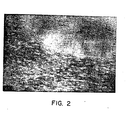
- the appearance of the co-continuous phases is unlike the characteristic uniform light gray appearance of a polyblend in which the PVC and SCPE are miscible, as seen in the macroparticle "A" in the transmission electron micrograph shown in Fig 2.
- the macroparticles of PVC in Fig 1 are surrounded by the matrix consisting of contiguous microparticles "C” of PVC or PVC-rich matter (much smaller than the macroparticles "A") surrounded by SCPE identified as "D"; therefore, the matrix is referred to as the "first co-continuous phase".
- the nearly black dots are caused by impurities or dust on the negative.
- the dark gray specks "C” against a background of lighter gray area "D" are the PVC-rich microparticles and the SCPE-rich matter, respectively.
- Fig 2 there is shown a transmission electron micrograph, taken at 8000 ⁇ magnification, of the same polyblend shown in Fig 1, showing a portion of a macroparticle "A” such as the ones identified in Fig 1, in which portion of the macroparticle, the PVC and SCPE are miscible, resulting in a single phase seen as a uniform light gray area.
- the single phase macroparticle is surrounded by the matrix "B” which is now seen to consist essentially of microparticles of dark PVC and PVC-rich spots "C” interspersed with light regions of SCPE and SCPE-rich matter, indicated as "D”; this matrix is characterized as the first co-continuous phase.
- the PVC domains are clearly visible as small dark circles which exhibit a diffuse boundary. This provides evidence of substantial molecular mixing near the interface.
- FIG 3 there is a presented a photomicrograph of a polyblend of this invention (325 ⁇ magnification) milled at 375°F, showing macroparticles of PVC, indicated by the letter "E”, as the dispersed phase in the polyblend, the macroparticles being surrounded by the first co-continuous phase (matrix "B") consisting of microparticles of PVC domains "C” surrounded by SCPE “D”.
- matrix “B" first co-continuous phase
- the wood grain-like striations are flow lines, the light flow lines “F” being SCPE or SCPE-rich matter.
- the light specks “G” appear to be substantially pure SCPE.
- the light boundary "H” of the macroparticle "E” indicates molecular mixing.
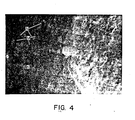
- Fig 4 there is presented a transmission electron micrograph, taken at 8000 ⁇ magnification of the same polyblend shown in Fig 3, showing (a) a portion of a macroparticle "E” (the dispersed phase) composed of microparticles "J” awash with SCPE, forming a "second co-continuous phase”; (b) the first co-continuous phase (matrix "B") referred to hereinabove; and, (c) the boundary "L" (delineated by the light area) indicative of molecular mixing in the zone between the first co-continuous phase, and the dispersed phase which consists of the second co-continuous phase.
- Fig 5 there is presented an electron photomicrograph at 15000 ⁇ magnification of pure PVC. It has a characteristic, uniform mottled gray appearance. The streaks are cut lines from the microtome which is responsible for slightly varying thicknesses across the ultrathin sample. There are no discernible microparticles. The black specks "O" are impurities such as dust.
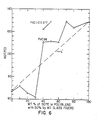
- Fig 6 there is plotted the values of HDT obtained with varying amounts of SCPE in the polyblend prepared with PVC 110 ⁇ 377 and PVC 86 having different different mol wts, using the "typical milling procedure".
- the SCPE is made as described in the illustrative procedure, and each polyblend contains 30% by wt glass.
- the HDT of either reinforced unblended PVC is 68°C; the HDT of reinforced unblended SCPE is 163°C.
- An HDT expected by linearly ratioing the contribution of HDT to the polyblend according to the amounts of PVC and SCPE, will fall on the line L' connecting the points representing the HDTs of the pure polymers.
- glass fibers will provide much improvement of HDT in many highly crystalline polymers (see, "Towards an Understanding of Heat Distortion Temperature of Thermoplastics" by M.T. Takemori, Polym. Eng. Sci. Vol 19, No. 15 p 1104) but there is no indication and no reason to believe that such improvement may be provided by the glass fibers in a polyblend of an essentially amorphous polymer and a crystalline polymer. The evidence is that most such polyblends do not provide substantial improvement of HDT.
- a polyblend of equal parts by wt of Geon PVC 110 ⁇ 377 or Geon PVC 86 with an SCPE of terephthalic acid, 1,4-butane diol, hexanediol or polycaprolactone diol (10% of the equiv wt diol) gives an HDT lower than 70°C with 30% by wt glass fiber. This HDT is the same as that of unblended PVC with 30% by wt glass fiber.
- polyblends were prepared by milling the stated parts by wt of PVC 110 ⁇ 377 with the stated parts by wt of SCPE prepared as described in the illustrative example hereinabove, along with 30% by wt of chopped glass fiber sized with an aminosilane coupling agent, on a two-roll mill at 420°F.
- the blended material was pelletized and injection molded.
- the mold temperature was about 100°C and the cycle time was 50 sec.
- the nozzle temperature was about 200°C, and the extrudate was annealed at 120°C for 30 min.
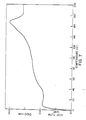
- Fig 7 shows a DSC curve (2nd heat) for a 50/50 PVC/SCPE polyblend which exhibits a "broadened T g " so referred to because it is characteristically unlike the sharper curves obtained for the PVC and SCPE components individually.
Landscapes
- Chemical & Material Sciences (AREA)
- Health & Medical Sciences (AREA)
- Chemical Kinetics & Catalysis (AREA)
- Medicinal Chemistry (AREA)
- Polymers & Plastics (AREA)
- Organic Chemistry (AREA)
- Compositions Of Macromolecular Compounds (AREA)
- Processes Of Treating Macromolecular Substances (AREA)
- Polyesters Or Polycarbonates (AREA)
- Reinforced Plastic Materials (AREA)
Applications Claiming Priority (2)
| Application Number | Priority Date | Filing Date | Title |
|---|---|---|---|
| US76349885A | 1985-08-08 | 1985-08-08 | |
| US763498 | 1985-08-08 |
Publications (2)
| Publication Number | Publication Date |
|---|---|
| EP0212449A2 true EP0212449A2 (de) | 1987-03-04 |
| EP0212449A3 EP0212449A3 (de) | 1988-12-07 |
Family
ID=25067993
Family Applications (1)
| Application Number | Title | Priority Date | Filing Date |
|---|---|---|---|
| EP86110863A Withdrawn EP0212449A3 (de) | 1985-08-08 | 1986-08-06 | Polyvinylchloridpolymermischung, welche einen kristallinen Polyester mit begrenzter Mischbarkeit enthält und daraus erhaltene verstärkte Verbundstoffe |
Country Status (10)
| Country | Link |
|---|---|
| EP (1) | EP0212449A3 (de) |
| JP (1) | JPS62104860A (de) |
| KR (1) | KR870002193A (de) |
| CN (1) | CN1006393B (de) |
| AU (1) | AU594068B2 (de) |
| BR (1) | BR8603779A (de) |
| ES (1) | ES2000600A6 (de) |
| FI (1) | FI863243A7 (de) |
| NO (1) | NO863118L (de) |
| PT (1) | PT83177B (de) |
Cited By (4)
| Publication number | Priority date | Publication date | Assignee | Title |
|---|---|---|---|---|
| US5574104A (en) * | 1990-01-05 | 1996-11-12 | The B. F. Goodrich Company | Chain extended low molecular weight polyoxiranes and electrostatic dissipating blend compositions based thereon |
| WO2005092604A1 (en) * | 2004-03-18 | 2005-10-06 | Noveon, Inc. | Flexible laminated plastic pipe having a chlorinated poly(vinyl chloride) (cpvc) hollow core |
| WO2018236582A3 (en) * | 2017-06-21 | 2019-01-31 | Eastman Chemical Company | FIBER-REINFORCED VINYL POLYCHLORIDE COMPOSITIONS AND ARTICLES MADE THEREFROM |
| US20260022260A1 (en) * | 2024-04-03 | 2026-01-22 | The Azek Group Llc | Composite board including core and capstock, and associated method |
Families Citing this family (6)
| Publication number | Priority date | Publication date | Assignee | Title |
|---|---|---|---|---|
| AU622147B2 (en) * | 1988-02-23 | 1992-04-02 | Geon Company, The | Rigid thermoplastic compositions capable of forming articles with matte surface |
| US5672650A (en) * | 1988-06-08 | 1997-09-30 | Sumitomo Bakelite Company Limited | Vinyl chloride resin composition |
| JPH083965B2 (ja) * | 1988-06-08 | 1996-01-17 | 住友ベークライト株式会社 | 高反発弾性艶消しカールコード |
| US5225487A (en) * | 1989-08-09 | 1993-07-06 | Sumitomo Bakelite Company Limited | Vinyl chloride resin composition |
| EP2258760B1 (de) | 2001-09-25 | 2014-06-25 | ExxonMobil Chemical Patents Inc. | Weich-Polyvinylchlorid |
| US11512198B2 (en) * | 2017-06-21 | 2022-11-29 | Eastman Chemical Company | Polyvinyl chloride and copolyester compositions and articles made using these compositions |
Family Cites Families (6)
| Publication number | Priority date | Publication date | Assignee | Title |
|---|---|---|---|---|
| USRE28982E (en) * | 1971-05-19 | 1976-09-28 | E. I. Du Pont De Nemours And Company | Blends of thermoplastic copolyester elastomers with vinyl chloride polymers |
| DE2336026C3 (de) * | 1973-07-14 | 1980-09-25 | Basf Ag, 6700 Ludwigshafen | Verfahren zur Herstellung von modifizierten Polyalkylenterephthalaten |
| GB1454920A (en) * | 1974-08-21 | 1976-11-10 | Ciba Geigy Ag | Polyesters |
| GB1455390A (en) * | 1974-08-22 | 1976-11-10 | Ciba Geigy Ag | Polyesters self-cooling wheel |
| US4210730A (en) * | 1977-12-27 | 1980-07-01 | Monsanto Company | Plastifiers, method of preparation and PVC compositions containing same |
| US4664115A (en) * | 1984-06-18 | 1987-05-12 | Terumo Kabushiki Kaisha | Polyvinyl chloride resin medical instrument and method of making |
-
1986
- 1986-07-28 AU AU60635/86A patent/AU594068B2/en not_active Ceased
- 1986-08-01 NO NO863118A patent/NO863118L/no unknown
- 1986-08-06 EP EP86110863A patent/EP0212449A3/de not_active Withdrawn
- 1986-08-07 BR BR8603779A patent/BR8603779A/pt unknown
- 1986-08-07 ES ES8600928A patent/ES2000600A6/es not_active Expired
- 1986-08-08 FI FI863243A patent/FI863243A7/fi not_active Application Discontinuation
- 1986-08-08 JP JP61185396A patent/JPS62104860A/ja active Pending
- 1986-08-08 CN CN86104972A patent/CN1006393B/zh not_active Expired
- 1986-08-08 KR KR1019860006574A patent/KR870002193A/ko not_active Withdrawn
- 1986-08-08 PT PT83177A patent/PT83177B/pt not_active IP Right Cessation
Cited By (7)
| Publication number | Priority date | Publication date | Assignee | Title |
|---|---|---|---|---|
| US5574104A (en) * | 1990-01-05 | 1996-11-12 | The B. F. Goodrich Company | Chain extended low molecular weight polyoxiranes and electrostatic dissipating blend compositions based thereon |
| WO2005092604A1 (en) * | 2004-03-18 | 2005-10-06 | Noveon, Inc. | Flexible laminated plastic pipe having a chlorinated poly(vinyl chloride) (cpvc) hollow core |
| US7223456B2 (en) | 2004-03-18 | 2007-05-29 | Noveon, Inc. | Flexible laminated plastic pipe having a chlorinated poly(vinyl chloride) hollow core |
| WO2018236582A3 (en) * | 2017-06-21 | 2019-01-31 | Eastman Chemical Company | FIBER-REINFORCED VINYL POLYCHLORIDE COMPOSITIONS AND ARTICLES MADE THEREFROM |
| US10308799B2 (en) | 2017-06-21 | 2019-06-04 | Eastman Chemical Company | Fiber reinforced polyvinyl chloride and copolyester compositions and articles made using these compositions |
| US10584238B2 (en) | 2017-06-21 | 2020-03-10 | Eastman Chemical Company | Fiber reinforced polyvinyl chloride and copolyester compositions and articles made using these compositions |
| US20260022260A1 (en) * | 2024-04-03 | 2026-01-22 | The Azek Group Llc | Composite board including core and capstock, and associated method |
Also Published As
| Publication number | Publication date |
|---|---|
| JPS62104860A (ja) | 1987-05-15 |
| AU6063586A (en) | 1987-02-12 |
| EP0212449A3 (de) | 1988-12-07 |
| FI863243A0 (fi) | 1986-08-08 |
| FI863243A7 (fi) | 1987-02-09 |
| NO863118D0 (no) | 1986-08-01 |
| BR8603779A (pt) | 1987-03-10 |
| CN86104972A (zh) | 1987-06-03 |
| AU594068B2 (en) | 1990-03-01 |
| KR870002193A (ko) | 1987-03-30 |
| NO863118L (no) | 1987-02-09 |
| PT83177B (pt) | 1989-03-30 |
| ES2000600A6 (es) | 1988-03-01 |
| CN1006393B (zh) | 1990-01-10 |
| PT83177A (en) | 1986-09-01 |
Similar Documents
| Publication | Publication Date | Title |
|---|---|---|
| US4820763A (en) | Poly(vinyl chloride) polyblend containing a crystalline polyester with limited miscibility and reinforced composites thereof | |
| CA1141879A (en) | Poly(alkyleneterephthalate) molding compositions containing oligomeric polyester and segmented copolyester-polyether elastomer | |
| DE69701963T2 (de) | Polyester/polyesteramid mischungen | |
| EP0051933B1 (de) | PTFE-Zusammensetzungen enthaltend eine anisotrope Schmelze bildende Polymere | |
| JP3174339B2 (ja) | 高衝撃性ポリエステル/エチレンコポリマーブレンド | |
| EP0174343A1 (de) | Verstärkte thermoplastische polyesterzusammensetzungen. | |
| US3541039A (en) | Flexible polymeric vinylidene fluoride compositions | |
| EP0143953B1 (de) | Polyester-Polyesteramid-Mischungen | |
| JPH01256565A (ja) | ポリアミド及びエチレン共重合体を基磯とする熱可塑性成形材料 | |
| JP3423062B2 (ja) | カレンダー加工用ポリエステルエラストマ組成物 | |
| JPS62104860A (ja) | ポリ(塩化ビニル)のポリブレンド | |
| EP0524790B1 (de) | Polyester-Massen | |
| EP0548282A4 (en) | Films or sheets of blends of amorphous poly(aryl ether ketones) with polyarylates and laminates thereof | |
| EP0249134B1 (de) | Polyethylenterephthalat-Harzmasse | |
| DE3889119T3 (de) | Mit Glasfasern von geringer Haftung gefülltes Polyesterharz. | |
| US4900788A (en) | Blow molding polyester compositions | |
| DE69030900T2 (de) | Elastomere Zusammensetzungen aus Mischungen von elastomeren Copolyestern und Äthylen-Äthylacrylat-Copolymeren | |
| JP4616963B2 (ja) | コポリエステル系樹脂組成物及びその組成物製シート並びにコポリエステル系樹脂組成物の製造方法 | |
| US4725651A (en) | Polymeric blend composition of a vinylidene chloride interpolymer and a thermoplastic copolyester | |
| JPH04339851A (ja) | ポリアセタール樹脂組成物構造体及びその製造法 | |
| JPH11158362A (ja) | ポリエステルエラストマ製管状体 | |
| JP2843386B2 (ja) | ポリ塩化ビニル系樹脂組成物 | |
| JP2001316570A (ja) | ポリエステル樹脂組成物および成形品 | |
| JP2000327889A (ja) | ポリエステル樹脂組成物およびその成形品 | |
| JPS6284150A (ja) | ポリカ−ボネ−ト樹脂組成物 |
Legal Events
| Date | Code | Title | Description |
|---|---|---|---|
| PUAI | Public reference made under article 153(3) epc to a published international application that has entered the european phase |
Free format text: ORIGINAL CODE: 0009012 |
|
| AK | Designated contracting states |
Kind code of ref document: A2 Designated state(s): BE CH DE FR GB IT LI NL SE |
|
| PUAL | Search report despatched |
Free format text: ORIGINAL CODE: 0009013 |
|
| AK | Designated contracting states |
Kind code of ref document: A3 Designated state(s): BE CH DE FR GB IT LI NL SE |
|
| 17P | Request for examination filed |
Effective date: 19890321 |
|
| 17Q | First examination report despatched |
Effective date: 19900424 |
|
| STAA | Information on the status of an ep patent application or granted ep patent |
Free format text: STATUS: THE APPLICATION HAS BEEN WITHDRAWN |
|
| 18W | Application withdrawn |
Withdrawal date: 19910618 |
|
| R18W | Application withdrawn (corrected) |
Effective date: 19910618 |