EP0212660A2 - Procédé d'analyse quantitative d'analyte dans un échantillon liquide utilisant un élément analytique - Google Patents
Procédé d'analyse quantitative d'analyte dans un échantillon liquide utilisant un élément analytique Download PDFInfo
- Publication number
- EP0212660A2 EP0212660A2 EP86111800A EP86111800A EP0212660A2 EP 0212660 A2 EP0212660 A2 EP 0212660A2 EP 86111800 A EP86111800 A EP 86111800A EP 86111800 A EP86111800 A EP 86111800A EP 0212660 A2 EP0212660 A2 EP 0212660A2
- Authority
- EP
- European Patent Office
- Prior art keywords
- analytical
- analyte
- elements
- optical reflection
- liquid sample
- Prior art date
- Legal status (The legal status is an assumption and is not a legal conclusion. Google has not performed a legal analysis and makes no representation as to the accuracy of the status listed.)
- Withdrawn
Links
Images




Classifications
-
- C—CHEMISTRY; METALLURGY
- C12—BIOCHEMISTRY; BEER; SPIRITS; WINE; VINEGAR; MICROBIOLOGY; ENZYMOLOGY; MUTATION OR GENETIC ENGINEERING
- C12Q—MEASURING OR TESTING PROCESSES INVOLVING ENZYMES, NUCLEIC ACIDS OR MICROORGANISMS; COMPOSITIONS OR TEST PAPERS THEREFOR; PROCESSES OF PREPARING SUCH COMPOSITIONS; CONDITION-RESPONSIVE CONTROL IN MICROBIOLOGICAL OR ENZYMOLOGICAL PROCESSES
- C12Q1/00—Measuring or testing processes involving enzymes, nucleic acids or microorganisms; Compositions therefor; Processes of preparing such compositions
- C12Q1/58—Measuring or testing processes involving enzymes, nucleic acids or microorganisms; Compositions therefor; Processes of preparing such compositions involving urea or urease
-
- C—CHEMISTRY; METALLURGY
- C12—BIOCHEMISTRY; BEER; SPIRITS; WINE; VINEGAR; MICROBIOLOGY; ENZYMOLOGY; MUTATION OR GENETIC ENGINEERING
- C12Q—MEASURING OR TESTING PROCESSES INVOLVING ENZYMES, NUCLEIC ACIDS OR MICROORGANISMS; COMPOSITIONS OR TEST PAPERS THEREFOR; PROCESSES OF PREPARING SUCH COMPOSITIONS; CONDITION-RESPONSIVE CONTROL IN MICROBIOLOGICAL OR ENZYMOLOGICAL PROCESSES
- C12Q1/00—Measuring or testing processes involving enzymes, nucleic acids or microorganisms; Compositions therefor; Processes of preparing such compositions
- C12Q1/54—Measuring or testing processes involving enzymes, nucleic acids or microorganisms; Compositions therefor; Processes of preparing such compositions involving glucose or galactose
-
- G—PHYSICS
- G01—MEASURING; TESTING
- G01N—INVESTIGATING OR ANALYSING MATERIALS BY DETERMINING THEIR CHEMICAL OR PHYSICAL PROPERTIES
- G01N21/00—Investigating or analysing materials by the use of optical means, i.e. using sub-millimetre waves, infrared, visible or ultraviolet light
- G01N21/17—Systems in which incident light is modified in accordance with the properties of the material investigated
- G01N21/25—Colour; Spectral properties, i.e. comparison of effect of material on the light at two or more different wavelengths or wavelength bands
- G01N21/27—Colour; Spectral properties, i.e. comparison of effect of material on the light at two or more different wavelengths or wavelength bands using photo-electric detection ; circuits for computing concentration
- G01N21/274—Calibration, base line adjustment, drift correction
-
- G—PHYSICS
- G01—MEASURING; TESTING
- G01N—INVESTIGATING OR ANALYSING MATERIALS BY DETERMINING THEIR CHEMICAL OR PHYSICAL PROPERTIES
- G01N33/00—Investigating or analysing materials by specific methods not covered by groups G01N1/00 - G01N31/00
- G01N33/48—Biological material, e.g. blood, urine; Haemocytometers
- G01N33/50—Chemical analysis of biological material, e.g. blood, urine; Testing involving biospecific ligand binding methods; Immunological testing
- G01N33/52—Use of compounds or compositions for colorimetric, spectrophotometric or fluorometric investigation, e.g. use of reagent paper and including single- and multilayer analytical elements
- G01N33/525—Multi-layer analytical elements
-
- G—PHYSICS
- G01—MEASURING; TESTING
- G01N—INVESTIGATING OR ANALYSING MATERIALS BY DETERMINING THEIR CHEMICAL OR PHYSICAL PROPERTIES
- G01N21/00—Investigating or analysing materials by the use of optical means, i.e. using sub-millimetre waves, infrared, visible or ultraviolet light
- G01N21/17—Systems in which incident light is modified in accordance with the properties of the material investigated
- G01N21/47—Scattering, i.e. diffuse reflection
- G01N21/4738—Diffuse reflection, e.g. also for testing fluids, fibrous materials
-
- G—PHYSICS
- G01—MEASURING; TESTING
- G01N—INVESTIGATING OR ANALYSING MATERIALS BY DETERMINING THEIR CHEMICAL OR PHYSICAL PROPERTIES
- G01N21/00—Investigating or analysing materials by the use of optical means, i.e. using sub-millimetre waves, infrared, visible or ultraviolet light
- G01N21/84—Systems specially adapted for particular applications
- G01N21/8483—Investigating reagent band
Definitions
- This invention relates to a method for quantitative analysis of an analyte in a liquid sample using an analytical element. More particularly, this invention relates to an improvement in a method for quantitatively analyzing an analyte in a liquid sample by applying the liquid sample on one of a set of analytical elements and measuring a color developed in the analytical element through reflection photometory in which said set of analytical elements are the same elements as a standard element except for deviation of sensitivity to the analyte, but said deviation of sensitivity is essentially equivalent to each other among the set of analytical elements, the calibration curve of the standard element with respect to said analyte being predetermined.
- analyte i.e., a substance to be analyzed
- a reaction-in-solution system involving a homogeneous reaction in a dilute solution and a procedure of measuring a light transmitted through the solution.
- This system gives analytical data with high accuracy, so long as the system is conducted by a skilled operator using a long period of time.
- the quantitative determination of an analyte in a liquid sample is performed by applying the liquid sample on the analytical element and measuring a color developed in the element through reflection photometry. It is known that the relationship between a content of an analyte in an applied liquid sample and the optical reflection density value observed on the color development due to the application of the liquid sample does not follow Beer's law, while the relationship between a content of an analyte in a liquid sample and the transmittance value observed on the color development in a solution due to the introduction of the liquid sample does follow such law.
- a calibration curve which shows the relationship between a content of an analyte in an applied liquid sample and the optical reflection density to be observed on the color development due to the application of the liquid sample is ought to be predetermined for each kind of analytical element.
- the same calibration curve is applicable to all analytical systems involving the same analyte and analytical elements belonging to the same nature, for example, those having the same composition.
- the compositions of the analytical elements slightly vary depending upon the conditions of their pre parations. Otherwise, even if analytical elements having the almost the same compositions are prepared, the analytical elements are apt to be denatured slightly in the course of their storage under influence of light, heat, humidity and so on.
- 58(1983)-109837 teaches a method for adjusting a predetermined calibration curve which comprises a step of measuring an absorbance for at least one sample having a known concentration and a step of adjusting the calibration curve based on the measured absorbance and the absorbance corresponding to the sample having the same concentration, the latter absorbance being obtained using the predetermined calibration curve.
- This adjusting method is very simple but is only applicable to a measuring system based on measurement of transmitted light.
- the measuring system utilizing transmission of light follows the Beer's law
- the relationship between the concentration or content of an analyte in a sample and the optical transmission density can be expressed by a linear equation.
- This means that such relationship can be expressed by a straight line in a graph. Accordingly, the deviation of the sensitivity of the transmittance-measuring sustem can be easily adjusted by such simple method.
- the present inventors have studied reflection photometry with respect to quantitative analysis using analytical elements and discovered that there is a linear relationship between an optical reflection density on a color developed upon application of a liquid sample on a standard analytical element and an optical reflection density on a color developed upon application of the same liquid sample on a deviated analytical element.
- the term "deviated analytical element” means an analytical element having essentially the same composition as the standard analytical element but having a sensitivity to an analyte to be detected which is different from the corresponding sensitivity of the standard analytical element. Such difference in the sensitivity is generally caused by variation or fluctuation of the conditions of the preparation of analytical elements or denaturation of the analytical element in the course of their storage under influence of light, heat, humidity and so on.
- an improvement in a method for quantitatively analyzing an analyte in a liquid sample by applying the liquid sample on one of a set of analytical elements and measuring a color developed in the analytical element through reflection photometory in which said set of analytical elements are the same elements as a standard element except for deviation of sensitivity to the analyte, but said deviation of sensitivity is essentially equivalent to each other among the set of analytical elements, the calibration curve of the standard element with respect to said analyte being predetermined, the improvement comprising the steps of:
- the first step (I) and the second step (II) are steps for determining the relationship between the sensitivity of the standard analytical element and the sensitivity of the analytical elements to be calibrated.
- the first step comprises applying two standard solutions containing the analyte in contents C1 and C2 different from each other on two analytical elements, respectively, these analytical elements being selected from said set of analytical elements and measuring colors developed on the elements through reflection photometry to obtain optical reflection density values OD x1 and OD x2 , respectively.
- the analytical element to be employed in the method of the present invention there is no specific limitation with respect to the analytical element to be employed in the method of the present invention, so long as the element is subjected to reflection photometry.
- the analytical element there can be mentioned multilayer analytical elements supplied by Eastman Kodak under the tradename of Ektachem and multilayer analytical elements by Fuji Photo Film Co., Ltd. under the tradename of Drychem.
- the method of the inven tion can be utilized to quantitatively determine glucose content, total protein content, urea-nitrogen (BUN) content, bilirubin content, contents of other substances, amylase activity, alkaline phosphotase activity, and activities of other enzymes in a liquid sample such as whole blood, serum, plasma, saliva, urine, or the like.
- BUN urea-nitrogen
- the first step two analytical elements are taken out of a set of analytical elements. All of the analytical elements belonging to the above-mentioned set are considered to have the equivalent composition and the equivalent sensitivity to an analyte to be analyzed to each other. Accordingly, any two elements can be selected from the set of the analytical elements. Alternatively, three analytical elements can be employed. In this case, the third analytical element is employed for obtaining an average value in combination with the first or sencond element. In the same way, more than three analytical elements can be employed in this stage.
- the standard solutions employed in this stage contain different amounts of the same analyte (contents are identified by C1 and C2, respectively) as the analyte of the analytical system under consideration.
- the composition of the standard solution other than the analyte can be the same as or different from the composition of the liquid sample to be analyzed, so long as the content of the analyte in the standard solution is known.
- the standard solution can be a serum containing a known amount of the analyte or a commercially available standard solution such as those supplied under tradenames of Monitol and Versatol.
- the standard solution preferably is the equivalent or as similar as possible in the physical characteristics such as viscosity to the liquid sample to be analyzed.
- the second step comprises preparing a linear equation for defining a relationship between an optical reflection density value OD x to be measured on an analytical element belonging to the above-mentioned set of the analytical elements and an optical reflection density value OD s being predetermined on the standard analytical element.
- the optical reflection density values OD x and OD s are those to be determined on colors developed on the respective elements upon application of a liquid sample containing the analyte in the same content C x .
- the preparation of the linear equation is made utilizing the calibration curve on the standard analytical element and the optical reflection density values OD x1 and OD x2 obtained in the step (I).
- the abovementioned linear equation is preferably stored either in the form of the functional equation or a graph in a memory of a computer for determining the desired results precise strictlyly within a short time of period.
- the third step and the fourth step are steps for actually analyzing a liquid sample containing a unknown amount of the analyte using the deviated analytical element.
- the third step comprises applying a liquid sample containing the analyte in a unknown amount on an analytical element belonging to the above-mentioned set of deviated analytical elements and measuring a color developed on said element through reflection photometry to obtain an optical reflection density value.
- the measurement of the color developed on the element through reflection photometrrt can be done in the known way.
- the fourth step comprises determining the content of the analyte in the applied liquid sample according to the above-prepared linear equation and the predetermined calibration curve.
- the determination of the content of the analyte in the applied liquid sample is done based on the linear equation prepared in the step (II) and the calibration curve predetermined on the standard analytical element.
- the optical reflection density value measured on the deviated analytical element is in the first place converted into an optical reflection density value of the standard analytical element, in which the latter value is positively or negatively deviated from the former value.
- the latter optical reflection density value obtained upon the conversion is then converted into a content of the analyte in the applied liquid sample according to the calibration curve previously determined on the standard analytical element.
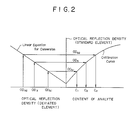
- the axis of abscissa on the left side indicates an optical reflection density measured on a deviated analytical element and the axis of abscissa on the right side indicates a content of the analyte in a liquid sample.
- the axis of ordinate indicates an optical reflection density to be measured on the standard analytical element.
- the curved line on the right side is the calibration curve prepared on the standard analytical element, and the straight line on the left side is the line representing the linear equation prepared in the second step.
- the conversion from the optical reflection density value OD x measured on the deviated analytical element to the content of the analyte C x in the applied liquid sample is easily made actually or imaginarily via the optical reflection density value OD s .
- the present invention is further decribed by the following example.
- a set of slides for glucose analysis each containing an integral multilayer analytical element for quantitative analysis of glucose were prepared according to the Example 1 described in Japanese Patent Provisional Publication No. 59(1984)-20853. A half of the set of the slides were stored for 24 hours at 30°C and 70%RH to denature the analytical elements.
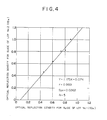
- optical reflection density values of the original slide and the denatured slide were measured with no application of sample.
- the original slide gave an optical reflection density of 0.221, while the denatured slide gave an optical reflection density of 0.250.
- the measured optical reflection density values were converted into the optical reflection density values for the original slide in accordance with the above-mentioned linear equation, and then converted into the glucose content in accordance with a calibration curve previously determined using the original slide and standard liquid samples each containing a known amount of glucose.
- the results are set forth in Table 1 in the column (1).
- the values set forth in Table 1 in the column (2) are glucose content values obtained directly by calculation from the observed reflection density values in the manner applicable to the measuring system based on the measurement of transmitted light.
- the values set forth in Table 1 in the column (3) are glucose content values determined according to a standard solution system, namely, Hexokinase method.
- the reagent layer was wetted with water, and on the wetted layer was placed under pressure a tricot-knitted cloth (thickness: 200 ⁇ m) of polyethylene terephthalate spun yarn (thickness corresponding to 100 S) to form a spreading layer.
- a tricot-knitted cloth thickness: 200 ⁇ m
- polyethylene terephthalate spun yarn thickness corresponding to 100 S
- the integral multilayer analytical element was cut to give a square tip (15 mm x 15 mm) and encased in a plastic mount disclosed in Japanese Patent Provisional Publication No. 57(1981)-63452 to prepare an analytical slide for quantitative analysis of total protein.
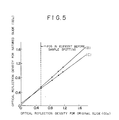
- the values on the line with the asterisk * mean the optical reflection density values (fog values) before receiving the spotting of the sample.
- Fig. 5 clearly indicates that the relationship between the optical reflection density (X) for the original slide and the optical reflection density (Y) for the denatured slide is also expressed by a straight line in the case of an integral multilayer analytical element for quantitative analysis of total protein.
- PET polyethylene terephthalate
- a membrane filter of cellulose diacetate having thickness of 140 ⁇ m (minimum pore size: 3.0 ⁇ m, void ratio: 75%) was immersed in a solution of silicone resin in hexane and dried.
- liquid-blocking layer On the liquid-blocking layer were coated successively the following coating solutions to form a urease-containing reagent layer, a light-blocking layer and an adhesive layer.
- the above coating solution was adjusted to pH 8 by addition of disodium orthophosphate and sodium hydroxide.
- the adhesive layer was swollen with water, and on the swollen layer was placed under pressure a cotton broadcloth (thickness: approx. 150 ⁇ m, cotton broadcloth #100) to form a spreading layer.
- a cotton broadcloth thinness: approx. 150 ⁇ m, cotton broadcloth #100
- the integral multilayer analytical element was cut to give a square tip and encased in a plastic mount to prepare an analytical slide for quantitative analysis of BUN.
- Fig. 6 clearly indicates that the relationship between the optical reflection density (X) for the original slide and the optical reflection density (Y) for the denatured slide is also expressed by a straight line in the case of an integral multilayer analytical element for quantitative analysis of BUN.
- Human serums containing different amounts of urea were separately spotted on the above slides.
- the spotted slides were incubated, and the optical reflection density on the element was measured.
- Fig. 7 clearly indicates that the relationship between the optical reflection density values for the slides belonging to different lots is also expressed by a straight line in the case of an integral multilayer analytical element for quantitative analysis of BUN.
Landscapes
- Chemical & Material Sciences (AREA)
- Life Sciences & Earth Sciences (AREA)
- Health & Medical Sciences (AREA)
- Engineering & Computer Science (AREA)
- Organic Chemistry (AREA)
- Immunology (AREA)
- Physics & Mathematics (AREA)
- Proteomics, Peptides & Aminoacids (AREA)
- Analytical Chemistry (AREA)
- Molecular Biology (AREA)
- Zoology (AREA)
- Wood Science & Technology (AREA)
- General Health & Medical Sciences (AREA)
- Biochemistry (AREA)
- Biotechnology (AREA)
- Hematology (AREA)
- Microbiology (AREA)
- Genetics & Genomics (AREA)
- General Physics & Mathematics (AREA)
- Pathology (AREA)
- General Engineering & Computer Science (AREA)
- Bioinformatics & Cheminformatics (AREA)
- Urology & Nephrology (AREA)
- Biophysics (AREA)
- Biomedical Technology (AREA)
- Cell Biology (AREA)
- Food Science & Technology (AREA)
- Spectroscopy & Molecular Physics (AREA)
- Theoretical Computer Science (AREA)
- Mathematical Physics (AREA)
- Medicinal Chemistry (AREA)
- Emergency Medicine (AREA)
- Investigating Or Analysing Biological Materials (AREA)
- Investigating Or Analysing Materials By The Use Of Chemical Reactions (AREA)
- Investigating Or Analysing Materials By Optical Means (AREA)
Applications Claiming Priority (2)
| Application Number | Priority Date | Filing Date | Title |
|---|---|---|---|
| JP60188226A JPH0629852B2 (ja) | 1985-08-26 | 1985-08-26 | 偏倚乾式分析要素を用いた液体試料中の被検物質の定量分析方法 |
| JP188226/85 | 1985-08-26 |
Publications (2)
| Publication Number | Publication Date |
|---|---|
| EP0212660A2 true EP0212660A2 (fr) | 1987-03-04 |
| EP0212660A3 EP0212660A3 (fr) | 1988-01-13 |
Family
ID=16219983
Family Applications (1)
| Application Number | Title | Priority Date | Filing Date |
|---|---|---|---|
| EP86111800A Withdrawn EP0212660A3 (fr) | 1985-08-26 | 1986-08-26 | Procédé d'analyse quantitative d'analyte dans un échantillon liquide utilisant un élément analytique |
Country Status (3)
| Country | Link |
|---|---|
| US (1) | US4884213A (fr) |
| EP (1) | EP0212660A3 (fr) |
| JP (1) | JPH0629852B2 (fr) |
Cited By (3)
| Publication number | Priority date | Publication date | Assignee | Title |
|---|---|---|---|---|
| EP0290013A3 (en) * | 1987-05-06 | 1990-11-22 | Fuji Photo Film Co., Ltd. | Method of density calibration and apparatus therefore |
| EP0305563A3 (en) * | 1986-09-01 | 1990-11-28 | Fuji Photo Film Co., Ltd. | Method for correction of calibration curve in dry analytical process |
| EP0653622A1 (fr) * | 1993-11-12 | 1995-05-17 | Fuji Photo Film Co., Ltd. | Procédé d'étalonnage d'un analyseur colorimétrique |
Families Citing this family (18)
| Publication number | Priority date | Publication date | Assignee | Title |
|---|---|---|---|---|
| JPH0746111B2 (ja) * | 1988-03-18 | 1995-05-17 | 株式会社日立製作所 | 試料分析方法及びこれを用いた自動分析装置 |
| DE3842580A1 (de) * | 1988-12-17 | 1990-06-21 | Behringwerke Ag | Verfahren zur verbesserung von richtigkeit und reproduzierbarkeit der messdaten immunometrischer tests |
| JP2654682B2 (ja) * | 1989-02-17 | 1997-09-17 | 富士写真フイルム株式会社 | 生化学分析装置、生化学分析補正方法及び補正値記録体 |
| US5568400A (en) * | 1989-09-01 | 1996-10-22 | Stark; Edward W. | Multiplicative signal correction method and apparatus |
| JPH06105217B2 (ja) * | 1990-01-11 | 1994-12-21 | 倉敷紡績株式会社 | 分光測定法 |
| DK0485549T3 (da) * | 1990-06-04 | 1996-03-11 | Behring Diagnostics Inc | Analytisk assay |
| US5197017A (en) * | 1990-09-27 | 1993-03-23 | Carroll Wallace E | Potentiophotometric fibrinogen determination |
| US5126952A (en) * | 1991-01-22 | 1992-06-30 | Eastman Kodak Company | Bar coding calibration |
| US5257212A (en) * | 1991-03-21 | 1993-10-26 | Eastman Kodak Company | Normalizing analyzer systems to a standard analyzer |
| EP0731951B1 (fr) * | 1993-02-26 | 2000-07-05 | E-Y Laboratories, Inc. | Procede et systeme d'analyse optique d'echantillons |
| US5786223A (en) * | 1995-05-19 | 1998-07-28 | Fuji Photo Film Co., Ltd. | Two-step calibration method for dry chemical analysis element |
| US5525521A (en) * | 1995-06-15 | 1996-06-11 | Borrego Analytical, Inc. | Cystic fibrosis tester |
| WO1999040536A1 (fr) * | 1998-02-10 | 1999-08-12 | Ey Laboratories, Inc. | Systeme de reflectometrie avec compensation pour topologie de supports d'echantillons et avec elimination synchrone du bruit de reseau |
| DE10138661A1 (de) * | 2000-09-01 | 2002-05-02 | Roche Diagnostics Gmbh | Verfahren zum Kontrollieren der Gebrauchstauglichkeit von Analyseelementen |
| JP2002116145A (ja) * | 2000-10-06 | 2002-04-19 | Matsushita Electric Ind Co Ltd | 溶液濃度計測方法および溶液濃度計測装置 |
| US6595456B2 (en) * | 2001-09-19 | 2003-07-22 | Sonoco Development, Inc. | Textile tube with start-up feature |
| EP1475679A1 (fr) * | 2003-05-05 | 2004-11-10 | Asulab S.A. | Dispositif d'affichage des phases de la lune, notamment dans une piece d'horologerie |
| CN111398184A (zh) * | 2020-04-07 | 2020-07-10 | 陈海锋 | 一种氢氧化镁生成氧化镁的转化率检测方法 |
Family Cites Families (9)
| Publication number | Priority date | Publication date | Assignee | Title |
|---|---|---|---|---|
| US2554414A (en) * | 1945-07-12 | 1951-05-22 | Phillips Petroleum Co | Apparatus for determining a chemically reactive gas |
| JPS55136957A (en) * | 1979-04-14 | 1980-10-25 | Olympus Optical Co Ltd | Automatic analyzer |
| JPS56155835A (en) * | 1980-05-02 | 1981-12-02 | Olympus Optical Co Ltd | Component analyzing method |
| JPS57104342U (fr) * | 1980-10-23 | 1982-06-26 | ||
| JPS5772047A (en) * | 1980-10-24 | 1982-05-06 | Olympus Optical Co Ltd | Component analyzing method |
| JPS58109837A (ja) * | 1981-12-24 | 1983-06-30 | Olympus Optical Co Ltd | 検量線補正方法 |
| DD224666A1 (de) * | 1984-03-18 | 1985-07-10 | Adw Ddr | Farbkomparator zur visuellen bewertung analytischer elemente |
| JPH0776771B2 (ja) * | 1984-07-30 | 1995-08-16 | 株式会社東芝 | 自動化学分析装置 |
| JPH076917B2 (ja) * | 1986-09-01 | 1995-01-30 | 富士写真フイルム株式会社 | 乾式分析方法における検量線の補正方法 |
-
1985
- 1985-08-26 JP JP60188226A patent/JPH0629852B2/ja not_active Expired - Lifetime
-
1986
- 1986-08-26 EP EP86111800A patent/EP0212660A3/fr not_active Withdrawn
-
1989
- 1989-02-15 US US07/311,444 patent/US4884213A/en not_active Expired - Lifetime
Cited By (4)
| Publication number | Priority date | Publication date | Assignee | Title |
|---|---|---|---|---|
| EP0305563A3 (en) * | 1986-09-01 | 1990-11-28 | Fuji Photo Film Co., Ltd. | Method for correction of calibration curve in dry analytical process |
| EP0290013A3 (en) * | 1987-05-06 | 1990-11-22 | Fuji Photo Film Co., Ltd. | Method of density calibration and apparatus therefore |
| EP0653622A1 (fr) * | 1993-11-12 | 1995-05-17 | Fuji Photo Film Co., Ltd. | Procédé d'étalonnage d'un analyseur colorimétrique |
| US5592290A (en) * | 1993-11-12 | 1997-01-07 | Fuji Photo Film Co., Ltd. | Method for correcting instrumental error of spectroscope of optical analyzer |
Also Published As
| Publication number | Publication date |
|---|---|
| EP0212660A3 (fr) | 1988-01-13 |
| JPS6247535A (ja) | 1987-03-02 |
| JPH0629852B2 (ja) | 1994-04-20 |
| US4884213A (en) | 1989-11-28 |
Similar Documents
| Publication | Publication Date | Title |
|---|---|---|
| EP0212660A2 (fr) | Procédé d'analyse quantitative d'analyte dans un échantillon liquide utilisant un élément analytique | |
| DK3050974T3 (en) | Procedure for Detecting Moisture Compromised Urine Test Strips | |
| CA2560638A1 (fr) | Compteur et systeme de cartouche d'analytes de liquides organiques pour la realisation de dosages par liaison specifiques | |
| GB1582153A (en) | Multilayer analytical element | |
| US4748114A (en) | Test strip for collecting of blood sugar daily profiles and process for its preparation | |
| US4832488A (en) | Method for correction of calibration curve in dry analytical process | |
| JPH0726960B2 (ja) | 乾式全血分析要素 | |
| JPH0721455B2 (ja) | 液体試料中の特定成分を分析するための用具および方法 | |
| US4812399A (en) | Analytical element and method for the determination of creatinine or creatine | |
| JPS6327761A (ja) | 安定化されたペルオキシダ−ゼを有する組成物及び分析要素 | |
| US5348889A (en) | Method for correcting a calibration curve | |
| Neeley et al. | Multilayer film analysis for glucose in 1-microL samples of plasma. | |
| EP0112166B1 (fr) | Procédé d'analyse quantitative utilisant un élément analytique en forme d'une feuille | |
| Zipp et al. | Solid-phase chemistry: its principles and applications in clinical analysis | |
| ZA200607521B (en) | Body fluid analyte meter & cartridge system for performing combined general chemical and specific binding assays | |
| JPH0526865A (ja) | 乾式分析要素を用いた測定方法及び乾式分析要素 | |
| EP0114403B1 (fr) | Elément analytique à couches multiples | |
| Ohkubo et al. | Plasma glucose concentrations of whole blood, as determined with a multilayer-film analytical element. | |
| Rodriguez-Segade et al. | Effects of various serum proteins on quantification of fructosamine. | |
| Greyson | Problems and possibilities of chemistry on dry reagent carriers | |
| EP0291321A2 (fr) | Elément et procédé pour la détermination de la créatinine ou créatine | |
| CN111308079B (zh) | 一种提高胶体金免疫层析平台定量分析准确度的方法 | |
| Thomas et al. | Evaluation of a Quantitative Solid Phase Reagent System for Determination of Blood Analytes: Experiences with the Analytes: LDH, Bilirubin, BUN, Glucose, and Uric Acid | |
| Sonntag | Dry chemistry: analysis with carrier-bound reagents | |
| Bandi et al. | Extended clinical trial and evaluation of glucose determination with the Eastman Kodak Ektachem GLU/BUN Analyzer. |
Legal Events
| Date | Code | Title | Description |
|---|---|---|---|
| PUAI | Public reference made under article 153(3) epc to a published international application that has entered the european phase |
Free format text: ORIGINAL CODE: 0009012 |
|
| AK | Designated contracting states |
Kind code of ref document: A2 Designated state(s): DE GB |
|
| PUAL | Search report despatched |
Free format text: ORIGINAL CODE: 0009013 |
|
| AK | Designated contracting states |
Kind code of ref document: A3 Designated state(s): DE GB |
|
| STAA | Information on the status of an ep patent application or granted ep patent |
Free format text: STATUS: THE APPLICATION IS DEEMED TO BE WITHDRAWN |
|
| 18D | Application deemed to be withdrawn |
Effective date: 19880714 |
|
| RIN1 | Information on inventor provided before grant (corrected) |
Inventor name: KITAJIMA, MASAOC/O FUJI PHOTO FILM CO., LTD. Inventor name: IWATA, YUZOC/O FUJI PHOTO FILM CO., LTD. Inventor name: MAKIUCHI, HAJIMAC/O FUJI PHOTO FILM CO., LTD. |