EP0213490A2 - Matériau d'enregistrement photographique couleur - Google Patents
Matériau d'enregistrement photographique couleur Download PDFInfo
- Publication number
- EP0213490A2 EP0213490A2 EP86111202A EP86111202A EP0213490A2 EP 0213490 A2 EP0213490 A2 EP 0213490A2 EP 86111202 A EP86111202 A EP 86111202A EP 86111202 A EP86111202 A EP 86111202A EP 0213490 A2 EP0213490 A2 EP 0213490A2
- Authority
- EP
- European Patent Office
- Prior art keywords
- color
- couplers
- formula
- compounds
- yellow
- Prior art date
- Legal status (The legal status is an assumption and is not a legal conclusion. Google has not performed a legal analysis and makes no representation as to the accuracy of the status listed.)
- Granted
Links
- 0 CC(C)OC1C=CC(C)**1 Chemical compound CC(C)OC1C=CC(C)**1 0.000 description 6
Images
Classifications
-
- G—PHYSICS
- G03—PHOTOGRAPHY; CINEMATOGRAPHY; ANALOGOUS TECHNIQUES USING WAVES OTHER THAN OPTICAL WAVES; ELECTROGRAPHY; HOLOGRAPHY
- G03C—PHOTOSENSITIVE MATERIALS FOR PHOTOGRAPHIC PURPOSES; PHOTOGRAPHIC PROCESSES, e.g. CINE, X-RAY, COLOUR, STEREO-PHOTOGRAPHIC PROCESSES; AUXILIARY PROCESSES IN PHOTOGRAPHY
- G03C7/00—Multicolour photographic processes or agents therefor; Regeneration of such processing agents; Photosensitive materials for multicolour processes
- G03C7/30—Colour processes using colour-coupling substances; Materials therefor; Preparing or processing such materials
- G03C7/32—Colour coupling substances
- G03C7/333—Coloured coupling substances, e.g. for the correction of the coloured image
- G03C7/3335—Coloured coupling substances, e.g. for the correction of the coloured image containing an azo chromophore
-
- C—CHEMISTRY; METALLURGY
- C09—DYES; PAINTS; POLISHES; NATURAL RESINS; ADHESIVES; COMPOSITIONS NOT OTHERWISE PROVIDED FOR; APPLICATIONS OF MATERIALS NOT OTHERWISE PROVIDED FOR
- C09B—ORGANIC DYES OR CLOSELY-RELATED COMPOUNDS FOR PRODUCING DYES, e.g. PIGMENTS; MORDANTS; LAKES
- C09B29/00—Monoazo dyes prepared by diazotising and coupling
- C09B29/34—Monoazo dyes prepared by diazotising and coupling from other coupling components
- C09B29/36—Monoazo dyes prepared by diazotising and coupling from other coupling components from heterocyclic compounds
- C09B29/3604—Monoazo dyes prepared by diazotising and coupling from other coupling components from heterocyclic compounds containing only a nitrogen as heteroatom
- C09B29/3647—Monoazo dyes prepared by diazotising and coupling from other coupling components from heterocyclic compounds containing only a nitrogen as heteroatom containing a five-membered ring with two nitrogen atoms as heteroatoms
- C09B29/3652—Monoazo dyes prepared by diazotising and coupling from other coupling components from heterocyclic compounds containing only a nitrogen as heteroatom containing a five-membered ring with two nitrogen atoms as heteroatoms containing a 1,2-diazoles or hydrogenated 1,2-diazoles
- C09B29/366—Monoazo dyes prepared by diazotising and coupling from other coupling components from heterocyclic compounds containing only a nitrogen as heteroatom containing a five-membered ring with two nitrogen atoms as heteroatoms containing a 1,2-diazoles or hydrogenated 1,2-diazoles containing hydroxy-1,2-diazoles, e.g. pyrazolone
Definitions
- the invention relates to a color photographic recording material with at least one silver halide emulsion layer, which is associated with a magenta coupler.
- the recording material according to the invention further contains at least one yellow 4-bisalkoxyphenylazopyrazolone dye.
- Color photographic recording materials which are processed by the chromogenic process often contain yellow dyes which serve a wide variety of purposes. Dyes from the class of 4-arylazopyrazolones are of particular importance. With a suitable structure, such dyes are able, for example, to react with the oxidation product of the color developer used and to contribute to the formation of the purple partial color image by forming purple dyes, at the same time the yellow dye being destroyed imagewise. Such yellow dyes are therefore suitable in a known manner as mask couplers for correcting undesirable yellow secondary densities of the image dyes, in particular those from the colorless or colored magenta couplers generated purple dyes. This color correction principle is described, for example, in US-A-2 428 054 and US-A-2 449 966.
- Suitable mask couplers not only have a high coupling activity, but also meet the requirements placed on them in spectral terms. This means that the yellow inherent color of such mask couplers is matched as well as possible to the yellow secondary density to be masked and that the dye produced during the coupling also absorbs mainly in the green spectral range and as little as possible in the other spectral ranges (blue, red).
- yellow dyes can advantageously be used as correction dyes, namely to improve the sharpness and as so-called Dmin dyes to set a desired yellow density in the processed color photographic recording materials, in order to use them in the subsequent copying process with recording materials of others To make origin and composition compatible without simultaneously causing overmasking.
- Those yellow dyes derived from 3-acylaminopyrazolone are mainly suitable for this purpose.
- a major disadvantage of the compounds is their poor solubility.
- the yellow dyes are normally added to the photographic materials in emulsified form;
- the compounds in an organic solvent for example ethyl acetate or diethyl carbonate, if necessary with the addition of a further high-boiling organic solvent, the oil former, for example tricresyl phosphate, dibutyl phthalate and the like, are necessary. to solve.
- the invention has for its object to provide a color photographic recording material which contains silver halide and color coupler and for color correction purposes at least one yellow dye with an absorption maximum at about 440 ⁇ 20 nm, the yellow dye is characterized by ease of manufacture and in particular by excellent solubility in organic solvents and emulsifiability in hydrophilic binder media.
- the alkyl radicals represented by R 1 and R 2 are accordingly s-alkyl radicals having 3 to 5 carbon atoms, ie alkyl radicals which are branched on the ⁇ -C atom.
- R 1 and R 2 can also preferably be represented by the formula represent and in particular it is isopropyl or s-butyl.
- R 1 and R 2 do not necessarily have to be identical.
- the organic residue represented by T can serve in particular as an emulsifying residue; as such it can contain straight-chain, optionally unsaturated or branched alkyl radicals and also aromatic rings.
- Compounds of formula 11 are generally suitable yellow mask couplers with high coupling reactivity.
- An acyl group represented by Y in formula 1 is in particular an aryl group derived from an aliphatic or aromatic carboxylic acid, or an acyl group derived from carbonic acid monoesters.
- the compounds in question can be represented by the following formula III in which R 1 , R 2 and Z have the meaning already given and in which A represents optionally substituted aryl, alkyl or alkoxy.
- a phenyl radical represented by Z in formulas 1, 11 or III may be unsubstituted or contain one or more identical or different substituents, e.g. Halogen (for example Cl or Br), alkyl, alkoxy, alkylsulfonyl, alkoxcarbonyl or acylamino.
- Halogen for example Cl or Br
- alkyl alkoxy, alkylsulfonyl, alkoxcarbonyl or acylamino.
- the compounds according to the invention are prepared in a manner known per se: in an aqueous-alcoholic solution, the anilino derivative is diazotized with an equimolar amount of sodium nitrite at -5 - + 5 ° C. in acidic solution (2-4 mol of hydrochloric acid).
- the diazonium salt solution thus obtained is added dropwise to an alkaline solution of the 4-Xquivalentpyrazolonkuppler at 10-30'C with stirring.
- alcohols e.g. Methanol
- the dye is obtained in solid form by stirring these solutions in aqueous acid solution.
- the yellow dyes according to the invention are equally distinguished by their favorable spectral properties and by their excellent solubility in organic solvents. Their absorption maximum in the range of 440 + 20 nm makes them equally suitable for color correction purposes, regardless of whether they have a higher or lower coupling activity due to their structure and are therefore more suitable or less suitable as mask couplers for masking the undesirable yellow secondary density.
- the yellow dyes can be incorporated into photographic layers, and their excellent solubility in organic solvents is very useful for the production of appropriate dispersions.
- they can be either a silver halide-containing layer (preferably compounds of the formula II) or a silver halide-free layer (preferably compounds of the formula III) are added.
- the reactive compounds are preferably added to a green-sensitized silver halide emulsion layer
- the less reactive compounds are mainly used in one or more intermediate layers that are closely related to a green-sensitized silver halide emulsion layer, for example in one of the intermediate layers that contain the green-sensitized silver halide emulsion layer or the green-sensitive one Limit layer package, or in an intermediate layer which is arranged between the layer support and the lowermost light-sensitive layer.
- a compound according to the invention having a comparatively high reactivity is expediently used in combination with another colorless purple coupler, the amount of the mask coupler according to the invention being up to 30%, usually between 20 and 30%, based on the amount of the colorless purple coupler.
- the color photographic recording materials according to the invention are preferably multilayer materials which have a plurality of silver halide emulsion layers or emulsion layer units with different spectral sensitivity.
- Laminates of 2 or more silver halide emuls are used as the emulsion layer units sion layers understood the same spectral sensitivity.
- Layers of the same spectral sensitivity do not necessarily have to be arranged adjacent to one another, but can also be separated from one another by other layers, in particular also by layers of different spectral sensitivity.
- Each of the light-sensitive silver halide emulsion layers or emulsion layer units mentioned is assigned at least one color coupler, which can react with color developer oxidation products to form a non-diffusing dye.
- the color couplers are expediently non-diffusing and accommodated in the light-sensitive layer itself or in close proximity to it.
- the color couplers assigned to the two or more partial layers of an emulsion layer unit do not necessarily have to be identical. They are only intended to give the same color in color development, usually a color that is complementary to the color of the light to which the photosensitive silver halide emulsion layers are sensitive.
- the blue-sensitive silver halide emulsion layers contain at least one non-diffusing color coupler for producing the yellow partial color image, usually a color coupler with an open-chain ketomethylene grouping.
- a color coupler with an open-chain ketomethylene grouping are particularly noteworthy.
- yellow couplers as described in US Pat. No. 3,408,194, DE-A-2,329,587, DE-A-2,456,976.
- Color couplers of these types are known in large numbers and are described in a large number of patents. Examples include the publications “Color Coupler” by W. Pelz, "Messages from the research laboratories of Agfa, LeverkusenlMünchen", Volume III (1961) p. 111, and by K. Venkataraman in “The Chemistry of Synthetic Dyes", Vol 4th, 341 to 387, Academic Press (1971).
- the color couplers can be either conventional 4-equivalent couplers or 2-equivalent couplers, which require a smaller amount of silver halide to produce the color.
- 2-X-equivalent couplers are derived from the 4-equivalent couplers in that they contain a substituent in the coupling point which is split off during the coupling.
- the 2-equivalency couplers include both those which are practically colorless and those which, for example the yellow dyes of the present invention, have an intense inherent color which disappears during the color coupling or is replaced by the color of the image dye produced.
- the 2-X equivalent couplers include the known DIR couplers, which are couplers that contain a detachable residue in the coupling point, which is released as a diffusible development inhibitor or precursor of a development inhibitor when reacted with color developer oxidation products.
- DIR couplers can also be used in the recording material according to the invention which release development inhibitors on reaction with color developer oxidation products without contributing significantly to the color image by the formation of a dye.
- color coupler mixtures can be used to set a desired color or reactivity.
- water-soluble couplers in combination with hydrophobic water-insoluble ones Couplers are used.
- the couplers can also be used in polymerized form, for example as so-called latex couplers.
- the same methods can be considered as are also used for the incorporation of the compounds according to the invention.
- hydrophobic color couplers one advantageously uses one of the known emulsifying methods, in which, for example, the color coupler is optionally dissolved in an organic solvent in the presence of a high-boiling coupler solvent or oil former and then dispersed in a gelatin solution.
- high boiling coupler solvents are dibutyl phthalate and tricresyl phosphate.
- Other coupler solvents are described, for example, in US-A-2,322,927, US-A-3,689,271, US-A-3,764,336 and US-A-3,765,897.
- aqueous dispersions of the hydrophobic couplers It is also possible to prepare aqueous dispersions of the hydrophobic couplers and to add them to the respective casting solutions.
- aqueous slurries of the couplers are finely ground, for example by intensive stirring with the addition of sharp-edged sand and / or by using ultrasound.
- the compounds according to the invention are used in combination with magenta couplers, they can be used together with the respective color couplers dissolved in an oil former and added to the respective casting solution in the form of such a common solution. However, they can also be added to the casting solution in the form of a separate solution in an oil former.
- the color photographic recording material can additionally contain other known stabilizing agents, for example UV absorbers and agents which prevent or delay the absence of the dyes, in particular when exposed to light, heat or moisture.
- stabilizing agents for example UV absorbers and agents which prevent or delay the absence of the dyes, in particular when exposed to light, heat or moisture.
- UV absorbers for example, phenol derivatives, hydroquinone derivatives, p-alkoxyphenol derivatives, pyrogallol derivatives, gallic acid derivatives, 5-hydroxycoumaran derivatives, 6-hydroxychromane derivatives and 5-hydroxyindane derivatives have been described as being suitable for this purpose.
- the compounds according to the invention are preferably used in combination with purple couplers.
- These are in particular hydrophobic magenta couplers with good solubility in hydrophobic or hydrophilic oil formers.
- the intermediate layers arranged between the light-sensitive silver halide emulsion layers, the binder of which preferably consists of gelatin, may contain compounds which are able to react with color developer oxidation products and which thus prevent undesired diffusion of the color developer oxidation products.
- Examples of such connections are, for example, non-diffusing reducing agents, for example hydroquinone derivatives, which, when reacted with the color developer oxidation products, do not result in any dye remaining in the layers, or color couplers, which give a soluble dye which is washed out of the layers during color photographic processing.
- the recording materials according to the invention can be developed with the usual color developer compounds, in particular those of the p-phenylenediamine series with a primary amino group, e.g. 4-amino-N, N-dimethylaniline, 4-amino-N, N-diethylaniline, 4-amino-3-methyl-N, N-diethylaniline, 4-amino-3-methyl-N-methyl-N- (ß -methylsulfonamido-ethyl) aniline, 4-amino-N-ethyl-N- ( ⁇ -hydroxyethyl) aniline, 4-amino-3-methyl-N-ethyl-N- ( ⁇ -hydroxyethyl) aniline, 4- Amino-3-methyl-N-ethyl-N- ( ⁇ -methoxyethyl) aniline, 4-Amino-3-methyl-N- ( ⁇ -methylsulfonamidoethyl) aniline, 4-Amino-N-butyl
- the compounds II-1, 11-5 and III-1 according to the invention and the structurally analogous comparison compounds V-1, V-2, V-3, V-4, V-5 and V-6 were found to be soluble in ethyl acetate at 60 ° C determined. For this purpose, it was determined how many parts by weight of solvent are required to dissolve one part by weight of yellow dye. The dyes to be compared differed only in the substitution of the phenylazo residue
- the solutions produced crystallize again at room temperature, sometimes after some time.
- the dyes can be brought back into solution in the concentration indicated above by heating again.
- Dispersion Ia was prepared from compound 11-1 according to the invention and dispersion Ib was prepared from the relevant comparison compound V-2 in each case according to the procedure described below.
- 100 g of mask couplers are dissolved in a mixture of 100 g of tricresyl phosphate and 300 g of ethyl acetate at 55 ° C.
- the solution is emulsified in 1 kg of a 7.5% aqueous gelatin, which is also heated to 55 ° C. and was provided with 10 g of alkanol XC, using a high-speed mixer.
- the low-boiling solvent was then removed in vacuo and the remaining dispersion solidified at 6 ° C.
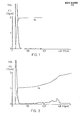
- the mean particle size of both dispersions was determined with the help of the Coulter-Nano-Sizer from Coulter Electronics, Hialeah, Florida / USA about the periodic fluctuation of laser light irradiated and scattered in the dispersion (autocorrelation spectroscopy) and, secondly, with the help of the Elzone Counter of the Particle Date Inc. Elmhurst, Illinois / USA determined the particle size distribution by measuring the change in resistance when a particle passes through a narrow capillary. 1 and 2 the histograms for the frequency distribution (step-shaped curves) FD of the volumes in the respective particle size classes D between 0.3 and 8 ⁇ m for the dispersions la (FIG. 1) and 1b (FIG. 2) can be seen.
- the second curve represents the sum curve normalized to 100% of the same volume distribution.
- the curve ends at 2.5 ⁇ m. This means that there are no further particles in the dispersion above this particle size.
- the undesired coarse particles and crystals in the examination area are particularly heavily weighted and recorded with great accuracy in addition to the large number of dispersion droplets in the target particle size range of 0.3 ⁇ m.
- the latter are represented in the undiluted dispersion with approximately 200 billion particles per milliliter, while the coarse particles are present for the two dispersions as follows:
- the dispersion 2a was prepared from the compound 11-5 according to the invention and the dispersion 2b from the comparison compound V-4 in question.
- the comparative compound V-4 had to be heated to 70 ° C. in the hydrophobic dispersion phase in order to go into solution).
- the dispersions obtained were heated again to 40 ° C. and in a closed system with a peristaltic pump of the type Masterflex R-7563-00 with pump head No. 7014 from the Cole Parmer Instrument Company, Chicago / Illinois, through a surface filter of the type HDC H050 with a pore size of 5 ⁇ m from Pall Corporation New York / USA.
- the delivery rate of the peristaltic pump was set to 60 ml water / min at 20 ° C without a filter.
- the filter area of the surface filter was 10.2 cm 2 .
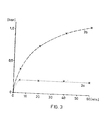
- the pressure building up in front of the filter was measured as a function of the time in the case of the two dispersions. The result for both dispersions is from diagrams 2a and 2b in FIG. 3
- the dispersion 2a of the compound 11-5 according to the invention showed a pressure increase of 0.2 bar after 5 min, which is constant after 1 hour. In contrast, the pressure for the comparison dispersion 2b rose continuously. Such pressure increases lead to considerable production problems, since a frequent filter change has to take place and the metering can only be carried out very unevenly during the pouring.
Landscapes
- Physics & Mathematics (AREA)
- General Physics & Mathematics (AREA)
- Chemical & Material Sciences (AREA)
- Organic Chemistry (AREA)
- Silver Salt Photography Or Processing Solution Therefor (AREA)
Applications Claiming Priority (2)
| Application Number | Priority Date | Filing Date | Title |
|---|---|---|---|
| DE3530357 | 1985-08-24 | ||
| DE19853530357 DE3530357A1 (de) | 1985-08-24 | 1985-08-24 | Farbfotografisches aufzeichnungsmaterial |
Publications (3)
| Publication Number | Publication Date |
|---|---|
| EP0213490A2 true EP0213490A2 (fr) | 1987-03-11 |
| EP0213490A3 EP0213490A3 (en) | 1988-11-23 |
| EP0213490B1 EP0213490B1 (fr) | 1989-10-25 |
Family
ID=6279320
Family Applications (1)
| Application Number | Title | Priority Date | Filing Date |
|---|---|---|---|
| EP86111202A Expired EP0213490B1 (fr) | 1985-08-24 | 1986-08-13 | Matériau d'enregistrement photographique couleur |
Country Status (3)
| Country | Link |
|---|---|
| EP (1) | EP0213490B1 (fr) |
| JP (1) | JPH06100801B2 (fr) |
| DE (2) | DE3530357A1 (fr) |
Cited By (14)
| Publication number | Priority date | Publication date | Assignee | Title |
|---|---|---|---|---|
| EP0603964A3 (fr) * | 1992-12-23 | 1995-04-19 | Eastman Kodak Co | Copulants de masquage de type azo-pyrazolone. |
| EP0661591A2 (fr) | 1993-12-29 | 1995-07-05 | Eastman Kodak Company | Eléments photographiques contenant un latex de polymère changé absorbant l'ultraviolet |
| EP0684511A1 (fr) | 1994-05-20 | 1995-11-29 | Eastman Kodak Company | Pellicule à contraste bas |
| EP0686873A1 (fr) | 1994-06-08 | 1995-12-13 | Eastman Kodak Company | Elément photographique couleur comprenant des agents de blocage époxy nouveaux pour copulant magenta résiduel |
| EP0695968A2 (fr) | 1994-08-01 | 1996-02-07 | Eastman Kodak Company | Réduction de la viscosité dans une composition photographique à l'état fondue |
| EP0717313A1 (fr) | 1994-11-30 | 1996-06-19 | Eastman Kodak Company | Composés absorbant l'UV à base de benzotriazole et des éléments photographiques les contenant |
| EP0762198A1 (fr) | 1995-08-02 | 1997-03-12 | Eastman Kodak Company | Colorants filtres pour éléments photographiques |
| EP0773471A2 (fr) | 1995-11-13 | 1997-05-14 | Eastman Kodak Company | Elément photographique comprenant une couche d'émulsion à l'halogénured'argent sensible dans le rouge |
| EP0778493A1 (fr) | 1995-11-30 | 1997-06-11 | Eastman Kodak Company | Colorants sous forme d'agrégat pour éléments sensibles au rayonnement |
| EP0786692A1 (fr) | 1996-01-26 | 1997-07-30 | Eastman Kodak Company | Couche d'émulsion à l'halogénure d'argent sensible à la lumière ayant sensibilité photographique renforcée |
| EP0786690A2 (fr) | 1996-01-26 | 1997-07-30 | Eastman Kodak Company | Couche d'émulsion à l'halogénure d'argent sensible à la lumière ayant une sensibilité photographique renforcée |
| EP0786691A1 (fr) | 1996-01-26 | 1997-07-30 | Eastman Kodak Company | Couche d'émulsion à l'halogénure d'argent sensible à la lumière ayant sensibilité photographique renforcée |
| EP0849626A3 (fr) * | 1996-12-19 | 1999-06-02 | Agfa-Gevaert AG | Matériau photographique couleur d'enregistrement ayant des propriétés mécaniques améliorées et une stabilité améliorée dans un climat tropical |
| WO2013032827A1 (fr) | 2011-08-31 | 2013-03-07 | Eastman Kodak Company | Films cinématographiques pour fournir des images d'archive |
Families Citing this family (1)
| Publication number | Priority date | Publication date | Assignee | Title |
|---|---|---|---|---|
| JP4862429B2 (ja) * | 2006-02-28 | 2012-01-25 | Jfeスチール株式会社 | 鋼管内面印字方法 |
Family Cites Families (2)
| Publication number | Priority date | Publication date | Assignee | Title |
|---|---|---|---|---|
| US2983608A (en) * | 1958-10-06 | 1961-05-09 | Eastman Kodak Co | Yellow-colored magenta-forming couplers |
| JPH0234372B2 (ja) * | 1982-04-02 | 1990-08-02 | Konishiroku Photo Ind | Harogenkaginkaraashashinkankozairyo |
-
1985
- 1985-08-24 DE DE19853530357 patent/DE3530357A1/de not_active Withdrawn
-
1986
- 1986-08-13 EP EP86111202A patent/EP0213490B1/fr not_active Expired
- 1986-08-13 DE DE8686111202T patent/DE3666637D1/de not_active Expired
- 1986-08-22 JP JP61195703A patent/JPH06100801B2/ja not_active Expired - Lifetime
Cited By (15)
| Publication number | Priority date | Publication date | Assignee | Title |
|---|---|---|---|---|
| EP0603964A3 (fr) * | 1992-12-23 | 1995-04-19 | Eastman Kodak Co | Copulants de masquage de type azo-pyrazolone. |
| US5492799A (en) * | 1992-12-23 | 1996-02-20 | Eastman Kodak Company | Azopyrazolone masking couplers |
| EP0661591A2 (fr) | 1993-12-29 | 1995-07-05 | Eastman Kodak Company | Eléments photographiques contenant un latex de polymère changé absorbant l'ultraviolet |
| EP0684511A1 (fr) | 1994-05-20 | 1995-11-29 | Eastman Kodak Company | Pellicule à contraste bas |
| EP0686873A1 (fr) | 1994-06-08 | 1995-12-13 | Eastman Kodak Company | Elément photographique couleur comprenant des agents de blocage époxy nouveaux pour copulant magenta résiduel |
| EP0695968A2 (fr) | 1994-08-01 | 1996-02-07 | Eastman Kodak Company | Réduction de la viscosité dans une composition photographique à l'état fondue |
| EP0717313A1 (fr) | 1994-11-30 | 1996-06-19 | Eastman Kodak Company | Composés absorbant l'UV à base de benzotriazole et des éléments photographiques les contenant |
| EP0762198A1 (fr) | 1995-08-02 | 1997-03-12 | Eastman Kodak Company | Colorants filtres pour éléments photographiques |
| EP0773471A2 (fr) | 1995-11-13 | 1997-05-14 | Eastman Kodak Company | Elément photographique comprenant une couche d'émulsion à l'halogénured'argent sensible dans le rouge |
| EP0778493A1 (fr) | 1995-11-30 | 1997-06-11 | Eastman Kodak Company | Colorants sous forme d'agrégat pour éléments sensibles au rayonnement |
| EP0786692A1 (fr) | 1996-01-26 | 1997-07-30 | Eastman Kodak Company | Couche d'émulsion à l'halogénure d'argent sensible à la lumière ayant sensibilité photographique renforcée |
| EP0786690A2 (fr) | 1996-01-26 | 1997-07-30 | Eastman Kodak Company | Couche d'émulsion à l'halogénure d'argent sensible à la lumière ayant une sensibilité photographique renforcée |
| EP0786691A1 (fr) | 1996-01-26 | 1997-07-30 | Eastman Kodak Company | Couche d'émulsion à l'halogénure d'argent sensible à la lumière ayant sensibilité photographique renforcée |
| EP0849626A3 (fr) * | 1996-12-19 | 1999-06-02 | Agfa-Gevaert AG | Matériau photographique couleur d'enregistrement ayant des propriétés mécaniques améliorées et une stabilité améliorée dans un climat tropical |
| WO2013032827A1 (fr) | 2011-08-31 | 2013-03-07 | Eastman Kodak Company | Films cinématographiques pour fournir des images d'archive |
Also Published As
| Publication number | Publication date |
|---|---|
| DE3530357A1 (de) | 1987-02-26 |
| EP0213490B1 (fr) | 1989-10-25 |
| DE3666637D1 (en) | 1989-11-30 |
| EP0213490A3 (en) | 1988-11-23 |
| JPS6250830A (ja) | 1987-03-05 |
| JPH06100801B2 (ja) | 1994-12-12 |
Similar Documents
| Publication | Publication Date | Title |
|---|---|---|
| EP0176845B1 (fr) | Matériau d'enregistrement photographique | |
| EP0213490B1 (fr) | Matériau d'enregistrement photographique couleur | |
| EP0169458B1 (fr) | Matériau d'enregistrement photographique couleur avec un coupleur DIR jaune | |
| DE2042581C3 (de) | Farbphotographisches Aufzeichnungsmaterial | |
| DE2504844A1 (de) | Verfahren zur herstellung von cyanbildern | |
| DE2421544C2 (de) | Mehrschichtiges farbphotographisches Aufzeichnungsmaterial mit einverleibten Kupplern | |
| DE2706117C2 (fr) | ||
| DE3135938C2 (de) | Photographisches Aufzeichnungsmaterial | |
| DE2734148C3 (de) | Farbphotographisches Aufzeichnungsmaterial | |
| DE2704826A1 (de) | Farbphotographisches aufzeichnungsmaterial | |
| DE2730773A1 (de) | Farbempfindliches mehrschichten- material | |
| EP0415056B1 (fr) | Matériau d'enregistrement pour photographie en couleurs à un coupleur libérant un composé photographiquement actif | |
| DE3628318A1 (de) | Farbfotografisches aufzeichnungsmaterial | |
| EP0421221B1 (fr) | Produit pour la reproduction photographique couleur contenant un coupleur DIR | |
| DE3878368T2 (de) | Photographisches eintragungsmaterial mit einer ein purpurrotes farbbild bildenden kupplerverbindung. | |
| DE3624544A1 (de) | Farbfotografisches aufzeichnungsmaterial mit einem farbkuppler vom pyrazoloazol-typ | |
| DE2149789B2 (de) | Farbfotografisches Aufzeichnungsmaterial | |
| DE2415870A1 (de) | 2-pyrazolin-5-on-purpurkuppler und deren verwendung in der farbphotographie | |
| DE2509408C3 (de) | Farbphotographisches Aufzeichnungsmaterial | |
| EP0032699A1 (fr) | Matériau d'enregistrement pour la photographie en couleurs contenant un composé formateur de colorant émulsionné et hydrophile | |
| DE2454301A1 (de) | Lichtempfindliches farbphotographisches material | |
| DE2122570C3 (de) | Farbphotographisches Aufzeichnungsmaterial | |
| DE3541858A1 (de) | Farbfotografisches farbkupplerhaltiges aufzeichnungsmaterial | |
| DE3706202C2 (de) | Farbfotografisches Aufzeichnungsmaterial | |
| DE2326590C3 (de) | Farbphotographisches Aufzeichnungsmaterial mit mindestens einer einen Farbkuppler enthaftenden Silberhalogenidemulsionsschicht |
Legal Events
| Date | Code | Title | Description |
|---|---|---|---|
| PUAI | Public reference made under article 153(3) epc to a published international application that has entered the european phase |
Free format text: ORIGINAL CODE: 0009012 |
|
| 17P | Request for examination filed |
Effective date: 19860813 |
|
| AK | Designated contracting states |
Kind code of ref document: A2 Designated state(s): BE DE FR GB |
|
| RAP1 | Party data changed (applicant data changed or rights of an application transferred) |
Owner name: AGFA-GEVAERT AG |
|
| PUAL | Search report despatched |
Free format text: ORIGINAL CODE: 0009013 |
|
| AK | Designated contracting states |
Kind code of ref document: A3 Designated state(s): BE DE FR GB |
|
| 17Q | First examination report despatched |
Effective date: 19890329 |
|
| GRAA | (expected) grant |
Free format text: ORIGINAL CODE: 0009210 |
|
| AK | Designated contracting states |
Kind code of ref document: B1 Designated state(s): BE DE FR GB |
|
| REF | Corresponds to: |
Ref document number: 3666637 Country of ref document: DE Date of ref document: 19891130 |
|
| ET | Fr: translation filed | ||
| GBT | Gb: translation of ep patent filed (gb section 77(6)(a)/1977) | ||
| PLBE | No opposition filed within time limit |
Free format text: ORIGINAL CODE: 0009261 |
|
| STAA | Information on the status of an ep patent application or granted ep patent |
Free format text: STATUS: NO OPPOSITION FILED WITHIN TIME LIMIT |
|
| 26N | No opposition filed | ||
| PGFP | Annual fee paid to national office [announced via postgrant information from national office to epo] |
Ref country code: BE Payment date: 19970827 Year of fee payment: 12 |
|
| REG | Reference to a national code |
Ref country code: GB Ref legal event code: 746 Effective date: 19980106 |
|
| PG25 | Lapsed in a contracting state [announced via postgrant information from national office to epo] |
Ref country code: BE Free format text: LAPSE BECAUSE OF NON-PAYMENT OF DUE FEES Effective date: 19980831 |
|
| BERE | Be: lapsed |
Owner name: AGFA-GEVAERT A.G. Effective date: 19980831 |
|
| PGFP | Annual fee paid to national office [announced via postgrant information from national office to epo] |
Ref country code: FR Payment date: 20010628 Year of fee payment: 16 |
|
| PGFP | Annual fee paid to national office [announced via postgrant information from national office to epo] |
Ref country code: GB Payment date: 20010629 Year of fee payment: 16 Ref country code: DE Payment date: 20010629 Year of fee payment: 16 |
|
| REG | Reference to a national code |
Ref country code: GB Ref legal event code: IF02 |
|
| PG25 | Lapsed in a contracting state [announced via postgrant information from national office to epo] |
Ref country code: GB Free format text: LAPSE BECAUSE OF NON-PAYMENT OF DUE FEES Effective date: 20020813 |
|
| PG25 | Lapsed in a contracting state [announced via postgrant information from national office to epo] |
Ref country code: DE Free format text: LAPSE BECAUSE OF NON-PAYMENT OF DUE FEES Effective date: 20030301 |
|
| GBPC | Gb: european patent ceased through non-payment of renewal fee |
Effective date: 20020813 |
|
| PG25 | Lapsed in a contracting state [announced via postgrant information from national office to epo] |
Ref country code: FR Free format text: LAPSE BECAUSE OF NON-PAYMENT OF DUE FEES Effective date: 20030430 |
|
| REG | Reference to a national code |
Ref country code: FR Ref legal event code: ST |