EP0214068B1 - Procédé de préparation de composés aromatiques fluorés - Google Patents
Procédé de préparation de composés aromatiques fluorés Download PDFInfo
- Publication number
- EP0214068B1 EP0214068B1 EP86420197A EP86420197A EP0214068B1 EP 0214068 B1 EP0214068 B1 EP 0214068B1 EP 86420197 A EP86420197 A EP 86420197A EP 86420197 A EP86420197 A EP 86420197A EP 0214068 B1 EP0214068 B1 EP 0214068B1
- Authority
- EP
- European Patent Office
- Prior art keywords
- stage
- temperature
- process according
- sodium fluoride
- naf
- Prior art date
- Legal status (The legal status is an assumption and is not a legal conclusion. Google has not performed a legal analysis and makes no representation as to the accuracy of the status listed.)
- Expired
Links
- 238000000034 method Methods 0.000 title claims description 29
- 150000001491 aromatic compounds Chemical class 0.000 title description 6
- 238000002360 preparation method Methods 0.000 title description 5
- PUZPDOWCWNUUKD-UHFFFAOYSA-M sodium fluoride Chemical compound [F-].[Na+] PUZPDOWCWNUUKD-UHFFFAOYSA-M 0.000 claims abstract description 130
- 239000011775 sodium fluoride Substances 0.000 claims abstract description 63
- 235000013024 sodium fluoride Nutrition 0.000 claims abstract description 63
- 238000006193 diazotization reaction Methods 0.000 claims abstract description 23
- LPXPTNMVRIOKMN-UHFFFAOYSA-M sodium nitrite Chemical compound [Na+].[O-]N=O LPXPTNMVRIOKMN-UHFFFAOYSA-M 0.000 claims abstract description 23
- 239000000203 mixture Substances 0.000 claims abstract description 20
- XLYOFNOQVPJJNP-UHFFFAOYSA-N water Substances O XLYOFNOQVPJJNP-UHFFFAOYSA-N 0.000 claims abstract description 20
- 235000010288 sodium nitrite Nutrition 0.000 claims abstract description 11
- 238000005979 thermal decomposition reaction Methods 0.000 claims abstract description 8
- 238000010908 decantation Methods 0.000 claims abstract description 6
- 239000012954 diazonium Substances 0.000 claims abstract description 6
- 150000001412 amines Chemical class 0.000 claims abstract description 5
- 150000001875 compounds Chemical class 0.000 claims abstract description 5
- 239000002253 acid Substances 0.000 claims abstract description 3
- 125000003118 aryl group Chemical group 0.000 claims abstract description 3
- 150000001989 diazonium salts Chemical class 0.000 claims abstract description 3
- 238000004519 manufacturing process Methods 0.000 claims abstract description 3
- 239000011734 sodium Substances 0.000 claims description 12
- DGAQECJNVWCQMB-PUAWFVPOSA-M Ilexoside XXIX Chemical compound C[C@@H]1CC[C@@]2(CC[C@@]3(C(=CC[C@H]4[C@]3(CC[C@@H]5[C@@]4(CC[C@@H](C5(C)C)OS(=O)(=O)[O-])C)C)[C@@H]2[C@]1(C)O)C)C(=O)O[C@H]6[C@@H]([C@H]([C@@H]([C@H](O6)CO)O)O)O.[Na+] DGAQECJNVWCQMB-PUAWFVPOSA-M 0.000 claims description 8
- 229910052708 sodium Inorganic materials 0.000 claims description 8
- 238000009833 condensation Methods 0.000 claims description 2
- 230000005494 condensation Effects 0.000 claims description 2
- 229910052500 inorganic mineral Inorganic materials 0.000 description 14
- 235000010755 mineral Nutrition 0.000 description 14
- 239000011707 mineral Substances 0.000 description 14
- KRHYYFGTRYWZRS-UHFFFAOYSA-N Fluorane Chemical compound F KRHYYFGTRYWZRS-UHFFFAOYSA-N 0.000 description 13
- 239000011269 tar Substances 0.000 description 13
- 239000010410 layer Substances 0.000 description 11
- HEMHJVSKTPXQMS-UHFFFAOYSA-M Sodium hydroxide Chemical compound [OH-].[Na+] HEMHJVSKTPXQMS-UHFFFAOYSA-M 0.000 description 9
- 239000012044 organic layer Substances 0.000 description 8
- YCKRFDGAMUMZLT-UHFFFAOYSA-N Fluorine atom Chemical compound [F] YCKRFDGAMUMZLT-UHFFFAOYSA-N 0.000 description 7
- IJGRMHOSHXDMSA-UHFFFAOYSA-N Atomic nitrogen Chemical compound N#N IJGRMHOSHXDMSA-UHFFFAOYSA-N 0.000 description 6
- 238000000354 decomposition reaction Methods 0.000 description 6
- 238000004821 distillation Methods 0.000 description 6
- 239000011737 fluorine Substances 0.000 description 6
- 229910052731 fluorine Inorganic materials 0.000 description 6
- 239000000047 product Substances 0.000 description 6
- 239000000243 solution Substances 0.000 description 5
- PAYRUJLWNCNPSJ-UHFFFAOYSA-N Aniline Chemical compound NC1=CC=CC=C1 PAYRUJLWNCNPSJ-UHFFFAOYSA-N 0.000 description 4
- QAOWNCQODCNURD-UHFFFAOYSA-N Sulfuric acid Chemical compound OS(O)(=O)=O QAOWNCQODCNURD-UHFFFAOYSA-N 0.000 description 4
- 150000004982 aromatic amines Chemical class 0.000 description 4
- 238000006243 chemical reaction Methods 0.000 description 4
- 238000010438 heat treatment Methods 0.000 description 4
- 239000000843 powder Substances 0.000 description 4
- 239000007787 solid Substances 0.000 description 4
- KRHYYFGTRYWZRS-UHFFFAOYSA-M Fluoride anion Chemical compound [F-] KRHYYFGTRYWZRS-UHFFFAOYSA-M 0.000 description 3
- CDBYLPFSWZWCQE-UHFFFAOYSA-L Sodium Carbonate Chemical compound [Na+].[Na+].[O-]C([O-])=O CDBYLPFSWZWCQE-UHFFFAOYSA-L 0.000 description 3
- YXFVVABEGXRONW-UHFFFAOYSA-N Toluene Chemical compound CC1=CC=CC=C1 YXFVVABEGXRONW-UHFFFAOYSA-N 0.000 description 3
- DFBOAQFUHCAEAE-UHFFFAOYSA-N [chloro(fluoro)methyl]benzene Chemical class FC(Cl)C1=CC=CC=C1 DFBOAQFUHCAEAE-UHFFFAOYSA-N 0.000 description 3
- IJGRMHOSHXDMSA-UHFFFAOYSA-O diazynium Chemical group [NH+]#N IJGRMHOSHXDMSA-UHFFFAOYSA-O 0.000 description 3
- PYLWMHQQBFSUBP-UHFFFAOYSA-N monofluorobenzene Chemical compound FC1=CC=CC=C1 PYLWMHQQBFSUBP-UHFFFAOYSA-N 0.000 description 3
- 229910052757 nitrogen Inorganic materials 0.000 description 3
- 230000004580 weight loss Effects 0.000 description 3
- MMZYCBHLNZVROM-UHFFFAOYSA-N 1-fluoro-2-methylbenzene Chemical compound CC1=CC=CC=C1F MMZYCBHLNZVROM-UHFFFAOYSA-N 0.000 description 2
- PMZURENOXWZQFD-UHFFFAOYSA-L Sodium Sulfate Chemical compound [Na+].[Na+].[O-]S([O-])(=O)=O PMZURENOXWZQFD-UHFFFAOYSA-L 0.000 description 2
- 241001080024 Telles Species 0.000 description 2
- 238000013019 agitation Methods 0.000 description 2
- 125000003545 alkoxy group Chemical group 0.000 description 2
- 125000004429 atom Chemical group 0.000 description 2
- 125000004432 carbon atom Chemical group C* 0.000 description 2
- 125000001309 chloro group Chemical group Cl* 0.000 description 2
- 238000001914 filtration Methods 0.000 description 2
- 239000012530 fluid Substances 0.000 description 2
- 238000011065 in-situ storage Methods 0.000 description 2
- 238000006386 neutralization reaction Methods 0.000 description 2
- RNVCVTLRINQCPJ-UHFFFAOYSA-N o-toluidine Chemical compound CC1=CC=CC=C1N RNVCVTLRINQCPJ-UHFFFAOYSA-N 0.000 description 2
- -1 polyéthylène Polymers 0.000 description 2
- 125000002924 primary amino group Chemical group [H]N([H])* 0.000 description 2
- JXHZRQHZVYDRGX-UHFFFAOYSA-M sodium;hydrogen sulfate;hydrate Chemical compound [OH-].[Na+].OS(O)(=O)=O JXHZRQHZVYDRGX-UHFFFAOYSA-M 0.000 description 2
- 238000003756 stirring Methods 0.000 description 2
- 239000006228 supernatant Substances 0.000 description 2
- 238000005406 washing Methods 0.000 description 2
- 239000004698 Polyethylene Substances 0.000 description 1
- CIUQDSCDWFSTQR-UHFFFAOYSA-N [C]1=CC=CC=C1 Chemical compound [C]1=CC=CC=C1 CIUQDSCDWFSTQR-UHFFFAOYSA-N 0.000 description 1
- 238000010521 absorption reaction Methods 0.000 description 1
- 238000009825 accumulation Methods 0.000 description 1
- 125000000217 alkyl group Chemical group 0.000 description 1
- 230000015572 biosynthetic process Effects 0.000 description 1
- 239000012267 brine Substances 0.000 description 1
- 229910052799 carbon Inorganic materials 0.000 description 1
- 125000003178 carboxy group Chemical group [H]OC(*)=O 0.000 description 1
- 238000001816 cooling Methods 0.000 description 1
- 238000007872 degassing Methods 0.000 description 1
- 238000010586 diagram Methods 0.000 description 1
- 238000001035 drying Methods 0.000 description 1
- 230000007613 environmental effect Effects 0.000 description 1
- 235000013305 food Nutrition 0.000 description 1
- 239000007789 gas Substances 0.000 description 1
- 239000008246 gaseous mixture Substances 0.000 description 1
- 125000005843 halogen group Chemical group 0.000 description 1
- 239000011261 inert gas Substances 0.000 description 1
- 238000004898 kneading Methods 0.000 description 1
- 238000002386 leaching Methods 0.000 description 1
- 235000020094 liqueur Nutrition 0.000 description 1
- 238000002156 mixing Methods 0.000 description 1
- SHLTXWFNRJQZTQ-UHFFFAOYSA-N n-chloro-2-methylaniline Chemical class CC1=CC=CC=C1NCl SHLTXWFNRJQZTQ-UHFFFAOYSA-N 0.000 description 1
- 125000001624 naphthyl group Chemical group 0.000 description 1
- GQPLMRYTRLFLPF-UHFFFAOYSA-N nitrous oxide Inorganic materials [O-][N+]#N GQPLMRYTRLFLPF-UHFFFAOYSA-N 0.000 description 1
- 235000011837 pasties Nutrition 0.000 description 1
- 229920000573 polyethylene Polymers 0.000 description 1
- 239000012429 reaction media Substances 0.000 description 1
- 238000011084 recovery Methods 0.000 description 1
- 238000000926 separation method Methods 0.000 description 1
- 229910000029 sodium carbonate Inorganic materials 0.000 description 1
- 229910052938 sodium sulfate Inorganic materials 0.000 description 1
- 235000011152 sodium sulphate Nutrition 0.000 description 1
- HPALAKNZSZLMCH-UHFFFAOYSA-M sodium;chloride;hydrate Chemical compound O.[Na+].[Cl-] HPALAKNZSZLMCH-UHFFFAOYSA-M 0.000 description 1
- BFXAWOHHDUIALU-UHFFFAOYSA-M sodium;hydron;difluoride Chemical compound F.[F-].[Na+] BFXAWOHHDUIALU-UHFFFAOYSA-M 0.000 description 1
- 239000012265 solid product Substances 0.000 description 1
- 238000003860 storage Methods 0.000 description 1
- 125000001424 substituent group Chemical group 0.000 description 1
- 239000000725 suspension Substances 0.000 description 1
- 238000010408 sweeping Methods 0.000 description 1
- 150000004992 toluidines Chemical class 0.000 description 1
- 125000000876 trifluoromethoxy group Chemical group FC(F)(F)O* 0.000 description 1
Images
Classifications
-
- C—CHEMISTRY; METALLURGY
- C07—ORGANIC CHEMISTRY
- C07B—GENERAL METHODS OF ORGANIC CHEMISTRY; APPARATUS THEREFOR
- C07B39/00—Halogenation
-
- C—CHEMISTRY; METALLURGY
- C07—ORGANIC CHEMISTRY
- C07C—ACYCLIC OR CARBOCYCLIC COMPOUNDS
- C07C17/00—Preparation of halogenated hydrocarbons
- C07C17/093—Preparation of halogenated hydrocarbons by replacement by halogens
Definitions
- the present invention relates to a process for the preparation of fluorinated aromatic compounds; it relates more particularly to an improved process for the preparation of fluorinated aromatic compounds by diazotization of aromatic amines in hydrofluoric acid and then in situ decomposition of the diazonium fluoride formed.
- the diazotization of aromatic amines can be carried out in anhydrous or aqueous hydrofluoric acid.
- the patent of the United States of America 2,939,766 describes a process according to which water is captured by the addition of anhydrous SO 3 and then the sulfuric acid formed is reacted on the HF, NaF mixture. By distillation, the HF can be recovered, and simultaneously H 2 50 4 reacts on HF, NaF releasing HF and forming acid sodium hydroxide sulfate.
- the HF is recovered well, but large amounts of sodium hydroxide sulfate and sulfuric acid are obtained, which are very difficult to remove and which require special treatment in terms of environmental protection.
- the sodium in the form of sodium sulphate is lost because it cannot be recovered under satisfactory industrial and economic conditions.
- the present invention overcomes the drawbacks of the prior art. It provides a process for the preparation of fluorinated aromatic compounds by diazotization of aromatic amines allowing, without the addition of additional compounds foreign to the process, on the one hand to recover in the form of anhydrous HF almost all of the residual HF and, d on the other hand, to recover all of the sodium which has been introduced at the time of the diazotization in the form of sodium nitrite.
- Another objective achieved by a particularly advantageous embodiment of the process according to the invention is to reuse in the process itself all of the hydrofluoric acid recovered and the vast majority of the sodium recovered. This is a very important advantage economically.
- the gaseous hydrofluoric acid is, after condensation, recycled to the diazotization reaction and the sodium fluoride is recycled in the first step after having withdrawn the amount corresponding to the sodium introduced during the diazotization reaction in the form of sodium nitrite.
- the quantity of sodium fluoride withdrawn can, for example, after dissolving in water and filtration to remove the tars present, be used without additional treatment to manufacture cryoliths.
- the process according to the invention is preferably carried out under atmospheric pressure. It can also be implemented under pressure higher than atmospheric pressure.
- the method according to the invention makes it possible to recover, in the form of HF and in the form of NaF, between 95 and 99% of the fluorine not used during the diazotization reaction.
- the molar ratio of sodium fluoride to free HF present in the medium is between 1 and 1.5. Even more preferably, this ratio is equal to approximately 1.2.
- the HF present in the medium is completely in the combined form NaF, HF; there will also be an excess of NaF and of water resulting from the diazotization reaction.
- the reaction is exothermic. To avoid the departure of gaseous HF it is preferable to maintain the temperature at an adequate value below 110 ° C and even more preferably between 60 and 80 ° C, when one is under atmospheric pressure.
- the temperature used in the second step is not critical since the temperature of the solid product remains at all times below 110 ° C. so as to avoid the loss of gaseous HF by decomposition of HF, NaF. Drying is continued until the water is completely eliminated.
- the HF is in the HF, NaF form. Also present is excess NaF.
- the thermal decomposition of the third step will make it possible to obtain on the one hand the HF and on the other hand the NaF.
- the processing temperature in this third step is preferably between 250 and 400 ° C. Even more preferably, it is preferred to operate at approximately 350 ° C.
- the process according to the invention can be carried out continuously or batchwise.
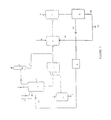
- Reactor A in which the diazotization and thermal decomposition reaction is carried out is successively supplied with HF (1), aromatic amine Ar (NH 2 ) (2) and sodium nitrite (3).
- the reaction is carried out under conditions well known in the prior art.
- the mixture from reactor A is sent to a decanter C where an organic layer and an inorganic layer separate.
- the organic layer essentially contains the desired fluorinated aromatic compound, a small part of the tars and a very small amount of HF.
- the mineral layer consists of HF, NaF, HF of water and tars which are insoluble and which in most cases are found mainly in the upper part of the mineral layer near the organic interface.
- the mineral layer optionally added with the HF solution from column B at 4 (which increases the level of fluorine recovered) is mixed in a mixer E with NaF in an amount such that the molar ratio of NaF to Free HF is greater than 1.
- a powder or paste is immediately obtained consisting of HF, NaF, water and excess NaF. This mixture is sent to a dryer F where it is subjected to a temperature such that the temperature of the mixture is less than 110 ° C., until all of the water is removed at 9.
- the dry product is sent to an oven G where it is subjected to a heat treatment at a temperature above 200 ° C.
- the HF is recovered at 10.
- NaF is introduced at 8 if using NaF outside the process (and this is necessarily during start-up) or at 14 when, according to a preferred embodiment, NaF from G. is used. Although this is practical, we can use, at the start, a compound giving with the HF NaF such as for example sodium carbonate or soda.
- the gaseous HF is condensed in the condenser H then, according to a preferred embodiment reintroduced at 11 into the reactor A.
- the NaF recovered at 12 is preferably, after drawing off at 13, an amount equivalent to the amount of sodium introduced into reactor A in the form of sodium nitrite, recycled to 14 in mixer E.
- the NaF recovered in 13 containing tars is dissolved in water then filtered so as to remove the fluorinated tars, and recovered in a directly usable form.
- aniline As examples of such amines, mention may be made of aniline, toluidines o, m, p, chlorotoluidines.
- the temperature is raised to 60 ° C., controlling it so as to decompose the diazonium fluoride.
- the reaction medium is sent to the decanter C where the mineral layer and the organic layer are separated by simple decantation.
- the organic layer contains 133 kg of fluorobenzene, about 5 kg of tar and heavy products.
- the mineral layer contains 180 kg of free HF, 36 kg of HF bound to 76 kg of NaF, 60 kg of H 2 O and some finely dispersed tars.
- the mineral layer is sent to a storage tank which is continuously fed (59 kg / h) by a horizontal mixer E cooled by double jacket, into which sodium fluoride (75 kg / h) is simultaneously introduced at a temperature of 60 ° C approx.
- the residence time is approximately 30 minutes.
- the powder obtained which circulates from the upper trays to the lower trays against a current of a hot inert gas stream (130-150 ° C.), is continuously sent to a superimposed tray dryer.
- the temperature of the product at the outlet of the dryer is at any time below 110 ° C.
- the evaporated water (10 - 11 kg / h) escapes at 9 with the heating gases.
- the solid is introduced continuously into a rotary oven with external heating and reaches a temperature of approximately 350 ° C. at the end of the stay (2 h).
- the released HF is cooled in a first tubular water exchanger then passes through a water condenser to be cooled to -20 ° C. 35 kg / h of HF are thus recovered which are recycled to food.
- the resulting NaF is cooled to about 80 ° C in a fluid bed dryer with air at room temperature, the heated air can be sent in addition to the previous tray dryer.
- This recovery rate is 80% compared to the fluorine not used in the diazotization reaction. It could have been increased if the 55 kg of HF recovered by methodical washing of the gaseous effluents from the diazotization reactor had been introduced into the mixer.
- the diazonium fluoride formed is broken down, two layers are obtained at the end of the reaction: a supernatant organic layer of 1050 g composed essentially of orthofluorotoluene, and a bottom mineral layer of 3650 g.
- the temperature is maintained at 50 ° C.
- the balance sheet is then established:
- the decomposition carried out in the same apparatus as for operation no. Is carried out by increasing the temperature in 2 h 30 min to 375 ° C then 2 hours at 375 ° C.
- the weight loss is 88 g.
- the yield is 92%.
- the HF content of decomposed NaF is 1.17%.
- the sodium fluoride obtained (240 g) is very little colored. After leaching with hot water and filtration, it gives a clear and colorless solution.
- the density is 1.42 and the total fluorine content 70.5%.
- the 228 g are put inside a tubular oven with a light air sweep. It rises to 250 ° C in 45 minutes then from 250 to 300 ° C per hour. The mixture is left at 300 ° C. for 1 hour.
- the HF output in water bubblers is measured: 71 g.
- the yield is 98.6%. 155 g of NaF are obtained.
Landscapes
- Chemical & Material Sciences (AREA)
- Organic Chemistry (AREA)
- Organic Low-Molecular-Weight Compounds And Preparation Thereof (AREA)
Description
- La présente invention à pour objet un procédé de préparation de composés aromatiques fluorés; elle concerne plus particulièrement un procédé perfectionné de préparation de composés aromatiques fluorés par diazotation d'amines aromatiques dans de l'acide fluorhydrique puis décomposition in situ du fluorure de diazonium formé. La diazotation des amines aromatiques peut être réalisée dans l'acide fluorhydrique anhydre ou aqueux.
- Un tel procédé est bien connu dans l'art antérieur. Il est bien connu également qu'il entraîne la perte d'une quantité importante d'acide fluorhydrique et la formation d'effluents difficiles à traiter compte tenu de la présence dans ces effluents de sodium.
- En effet, la séparation par distillation de l'HF libre est limitée, d'une part par la combinaison HF, NaF qui est stable à la température de distillation et, d'autre part, par l'existence de l'azéotrope H20-HF.
- Des tentatives ont été faites pour résoudre au moins partiellement ces inconvénients.
- C'est ainsi que le brevet des Etats-Unis d'Amérique 2 939 766 décrit un procédé selon lequel on capte l'eau par addition de S03 anhydre puis on fait réagir l'acide sulfurique formé sur le mélange HF, NaF. Par distillation on peut récupérer l'HF, et simultanément H2504 réagit sur HF, NaF libérant de l'HF et formant du sulfate acide de soude.
- On récupère bien l'HF mais on obtient des quantités importantes dc sulfate acide de soude et d'acide sulfurique qui sont très difficiles à éliminer et qui nécessitent un traitement particulier au plan de la protection de l'environnement.
- Le sodium sous forme de sulfate de soude est perdu car irrécupérable dans des conditions industrielles et économiques satisfaisantes.
- La présente invention pallie les inconvénients de l'art antérieur. Elle apporte un procédé de préparation de composés aromatiques fluorés par diazotation d'amines aromatiques permettant sans apport de composés additionnels étrangers au procédé, d'une part de récupérer sous forme d'HF anhydre la quasi-totalité de l'HF résiduaire et, d'autre part, de récupérer la totalité du sodium qui à été introduit au moment de la diazotation sous forme de nitrite de sodium. Un autre objectif atteint par un mode de mise en oeuvre particulièrement avantageux du procédé selon l'invention est de réutiliser dans le procédé lui-même la totalité de l'acide fluorhydrique récupéré et la grande majorité du sodium récupéré. C'est, sur le plan économique, un avantage très important.
- La présente invention a donc pour objet un procédé de préparation de composés fluorés aromatiques de formule ArF dans laquelle Ar représente un radical aromatique, du type selon lequel on soumet une amine de formule ArNH2 à une réaction de diazotation avec du nitrite de sodium dans de l'HF, le sel de diazonium formé étant ensuite décomposé thermiquement in situ, caractérisé en ce que ultérieurement,
- - dans une première étape, on traite la couche minérale provenant de la décantation du mélange obtenu après diazotation et décomposition thermique, avec une quantité de fluorure de sodium telle que le rapport molaire du fluorure de sodium à l'HF libre présent dans le mélange est supérieur à 1;
- - dans une deuxième étape, on sèche le mélange obtenu, éventuellement additionné de l'HF extrait des ef fluents gazeux de la réaction de diazotation, à une température telle que le fluorure acide de sodium HF, NaF n'est pas décomposé, et jusqu'à ce que l'eau soit totalement éliminée;
- - et dans une troisième étape, on soumet le produit obtenu à une décomposition thermique à une température supérieure à 200°C, ce qui conduit à de l'acide fluorhydrique anhydre gazeux et du fluorure de sodium solide.
- Selon un mode de réalisation particulièrement avantageux du procédé selon l'invention, l'acide fluorhydrique gazeux est, après condensation, recyclé à la réaction de diazotation et le fluorure de sodium est recyclé à la première étape après avoir soutiré la quantité correspondant au sodium introduit lors de la réaction de diazotation sous forme de nitrite de sodium.
- La quantité de fluorure de sodium soutirée peut par exemple, après dissolution dans l'eau et filtration pour éliminer les goudrons présents, être utilisée sans traitement supplémentaire pour fabriquer des cryolithes.
- Le procédé selon l'invention est, de préférence, conduit sous pression atmosphérique. Il peut également être mis en oeuvre sous pression supérieure à la pression atmosphérique.
- Le procédé selon l'invention permet de récupérer sous forme d'HF et sous forme de NaF entre 95 et 99 % du fluor non utilisé lors de la réaction de diazotation.
- On préfère, lors de la première étape, utiliser une quantité de fluorure de sodium telle que le rapport molaire du fluorure de sodium à l'HF libre présent dans le milieu est compris entre 1 et 1,5. Encore plus préférentiellement, ce rapport est égal à environ 1,2.
- A la fin de cette première étape l'HF présent dans le milieu est totalement sous la forme combinée NaF, HF; on sera également en présence d'un excès de NaF et d'eau issue de la réaction de diazotation.
- La réaction est exothermique. Pour éviter le départ d'HF gazeux il est préférable de maintenir la température à une valeur adéquate inférieure à 110°C et encore plus préférentiellement comprise entre 60 et 80° C, quand on est sous pression atmosphérique.
- La température utilisée dans la deuxième étape n'est pas critique dans la mesure où la température du produit solide reste à tout moment inférieure à 110°C de façon à éviter la perte d'HF gazeux par décomposition de HF, NaF. Le séchage est poursuivi jusqu'à ce que l'eau soit totalement éliminée.
- Dans le solide obtenu en fin de deuxième étape l'HF est sous forme HF, NaF. Est également présent le NaF en excès. La décomposition thermique de la troisième étape va permettre d'obtenir d'une part l'HF et d'autre part le NaF.
- La température de mise en oeuvre dans cette troisième étape est de préférence comprise entre 250 et 400°C. Encore plus préférentiellement, on préfère opérer à 350° C environ.
- Le procédé selon l'invention peut être mis en oeuvre en continu ou en discontinu.
- Le procédé va être maintenant plus complètement décrit à l'aide du schéma représenté en figure 1.
- Le réacteur A dans lequel est effectuée la réaction de diazotation et de décomposition thermique est alimenté sucessivement en HF (1) en amine aromatique Ar(NH2) (2) et en nitrite de sodium (3). La réaction est conduite dans les conditions bien connues de l'art antérieur.
- Lors de la réaction, un mélange gazeux d'HF et d'azote se dégage et est envoyé dans une colonne d'absorption B où l'on peut, par un lavage méthodique à l'eau, obtenir en 4 une solution d'HF de concentration égale à 20 - 40 %, l'azote s'échappant en 5.
- Le mélange issu du réacteur A est envoyé dans un décanteur C où une couche organique et une couche minérale se séparent. La couche organique contient essentiellement le composé aromatique fluoré désiré, une petite partie des goudrons et une très faible quantité d'HF. La couche minérale est constituée d'HF, de NaF, HF d'eau et de goudrons insolubles et qui dans la plupart des cas se retrouvent en majeure partie dans la partie supérieure de la couche minérale près de l'interface organique.
- La couche organique et la plus grande partie des goudrons rassemblés près de l'interface sont envoyés dans un bouilleur de colonne à distiller D où après neutralisation et distillation, le composé aromatique fluoré est obtenu en 6, les goudrons récupérés en 7 étant brûlés.
- La couche minérale, éventuellement additionnée de la solution d'HF issue de la colonne B en 4 (ce qui augmente le taux de fluor récupéré) est mélangée dans un mélangeur E avec du NaF en quantité telle que le rapport molaire du NaF à l'HF libre soit supérieur à 1. On obtient immédiatement une poudre ou une pâte constituée de HF, NaF, d'eau et de NaF en excès. Ce mélange est envoyé dans un sécheur F où il est soumis à une température telle que la température du mélange soit inférieure à 110°C, jusqu'à ce que la totalité de l'eau soit éliminée en 9. Le produit sec est envoyé dans un four G où il est soumis à un traitement thermique à une température supérieure à 200°C. L'HF est récupéré en 10.
- Le NaF est introduit en 8 si on utilise du NaF extérieur au procédé (et c'est nécessairement lors du démarrage) ou en 14 quand selon un mode de réalisation préférentiel on utilise le NaF issu de G. Bien que cela ne soit pratique, on peut utiliser, lors du démarrage, un composé donnant avec l'HF du NaF comme par exemple le carbonate de soude ou de la soude.
- L'HF gazeux est condensé dans le condenseur H puis selon un mode de réalisation préférentiel réintroduit en 11 dans le réacteur A. Le NaF récupéré en 12 est de préférence, après soutirage en 13 d'une quantité équivalente à la quantité de sodium introduite dans le réacteur A sous forme de nitrite de sodium, recyclé en 14 dans le malaxeur E.
- Si on le souhaite, le NaF récupéré en 13 contenant des goudrons est dissous dans l'eau puis filtré de façon à éliminer les goudrons fluorés, et récupéré sous une forme directement utilisable.
- Le procédé selon l'invention est particulièrement bien adapté à la mise en oeuvre d'une amine de formule ArNH2 ou Ar(NH2)2 dans laquelle Ar représente un radical naphtyle ou phényle comportant éventuellement au moins un substituant choisi parmi le groupe comprenant:
- - les radicaux alkyle et alkoxy ayant de préférence de 1 à 6 atomes de carbone;
- - les radicaux phényle et phénoxy;
- - les radicaux phényle et phénoxy substitués par au moins un radical alkyle ou alkoxy ayant de préférence de 1 à 6 atomes de carbone ou halogéno;
- - les radicaux halogéno;
- - les radicaux CN, CF3 et OCF3.
- - les radicaux -COOH et -OH
- On peut citer comme exemples de telles amines l'aniline, les toluidines o, m, p, les chlorotoluidines.
- Il est particulièrement intéressant de préparer selon le procédé de l'invention les dérivés suivants: le fluorobenzène, les fluorotoluènes o, m, p, les chlorofluorotoluènes.
- Dans un réacteur de 750 litres agité à double enveloppe, on introduit 340 Kg d'HF anhydre et 160 kg d'aniline en maintenant la température par circulation de saumure dans la double enveloppe à une valeur inférieure à 10°C. On introduit ensuite 125 kg de nitrite de sodium de façon progressive de façon à ce que la température reste inférieure à 10°C.
- Lorsque le nitrite de sodium à été complètement introduit, on fait monter la température jusqu'à 60° C en la contrôlant de façon à décomposer le fluorure de diazonium.
- Les effluents gazeux contenant 50 kg d'azote et de vapeurs nitreuses et 55.kg d'HF sont séparés dans la colonne B.
- Le milieu réactionnel est envoyé dans le décanteur C où la couche minérale et la couche organique se séparent par simple décantation.
- La couche organique contient 133 kg de fluorobenzène, 5 kg environ de goudrons et de produits lourds.
- La distillation de la couche organique et des goudrons collectés à l'interface après neutralisation permet d'obtenir 130 kg de fluorobenzène.
- La couche minérale contient 180 kg d'HF libre, 36 kg d'HF lié à 76 kg de NaF, 60 kg d'H2O et quelques goudrons finement dispersés.
- La couche minérale est envoyée dans un bac de stockage qu'alimente en continu (59 kg/h) un malaxeur horizontal E refroidi par double enveloppe, dans lequel on introduit simultanément du fluorure de sodium (75 kg/h) à une température de 60° C environ. Le temps de séjour est d'environ 30 minutes.
- On envoie en continu dans un sécheur à plateaux superposés la poudre obtenue qui circule des plateaux supérieurs aux plateaux inférieurs à contre-courant d'un courant gazeux inerte chaud (130 - 150°C) la température du produit à la sortie du sécheur étant à tout moment inférieure à 110°C. L'eau évaporée (10 - 11 kg/h) s'échappe en 9 avec les gaz de chauffage.
- Le solide est introduit en continu dans un four rotatif à chauffage externe et atteint en fin de séjour (2 h) une température de 350°C environ. L'HF dégagé est refroidi dans un premier échangeur tubulaire à eau puis passe dans un condenseur à eau pour être refroidi à -20°C. On récupère ainsi 35 kg/h d'HF qui sont recyclés à l'alimentation.
- Le NaF résultant est refroidi à 80° C environ dans un sécheur à lit fluide par de l'air à température ambiante, l'air réchauffé pouvant être envoyé en appoint du sécheur à plateaux précédent.
- Il est ensuite dirigé par transport pneumatique à air dans le malaxeur (75 kg/h) après avoir soutiré 12 kg/h.
- Il à donc été récupéré sous forme d'HF et sous forme de NaF 96 % du fluor disponible dans la partie minérale résultant de l'opération de décantation.
- Ce taux de récupération est de 80 % par rapport au fluor non utilisé dans la réaction de diazotation. Il aurait pu être augmenté si on avait introduit dans le malaxeur les 55 kg d'HF récupérés par lavage méthodique des effluents gazeux issus du réacteur de diazotation.
- Dans un réacteur agité de 6 litres, équipé des systèmes de refroidissement, de réchauffage et de dégazage nécessaires, on procède à une opération séquentielle de diazotation en introduisant sucessivement:
- - 2700 g d'HF
- - 1450 g d'orthotoluidine
- On décompose le fluorure de diazonium formé, on obtient à la fin de la réaction deux couches: une, organique surnageante de 1050 g composée essentiellement d'orthofluorotoluène, et une couche inférieure minérale de 3650 g.
- La phase inférieure décantée est récupérée, cette liqueur est très colorée et chargée en goudrons finement dispersés - densité 1,4. L'HF libre est dosé: 61,3 %.
- Dans un malaxeur on introduit 140 g de cette liqueur (HF récupérable 86 g (4,3) moles). Puis, par fraction, 216 g de NaF (5,15 moles, 20 % en excès).
- La température est maintenue à 50° C.
- Après 20 minutes de malaxage on recueille 355 g de poudre que l'on sèche à 70° C. On obtient 335 g, le dosage par la soude indique une teneur en NaF-HF de 4,3 moles. Les 335 g sont placés dans une nacelle disposée dans un four tubulaire avec léger balayage de l'air.
- On monte en 2 heures à 300° C puis 3 heures de 300 à 350° C. La perte de poids est de 78 g les 257 g de NaF contiennent encore 1,98 % d'HF, on a capté dans les barboteurs 74 g, 3,7 moles d'HF.

- 2ème opération
- 230 g de NaF de l'opération 1 sont ajoutés à 140 g de la même liqueur suivant le procédé décrit dans l'opération n° 1.
- Le bilan s'établit alors:

- On obtient 365 g de poudre qui séchée à 70° C donne 340 g, et qui contiennent 4,45 moles de NaF-HF.
- La décomposition menée dans le même appareillage que pour l'opération n° est conduite en montant la température en 2 h 30 à 375° C puis 2 heures à 375° C.
- La perte de poids est de 88 g.
- Les 252 g de NaF restant contiennent 1,75 % d'HF, on à récupéré 83 g d'HF dans les eaux soit 4,15 moles.

- 3ème opération
- Pour 140 g de liqueur décantée on ajoute 230 g de NaF de l'opération n°2. On procède de la même manière qu'à l'opération n°2 la température de décomposition est encore augmentée. On monte en 2 heures 30 à 375° C puis 3 heures de 375 à 400°C.
- Le rendement est de 92 %.
- La teneur en HF de NaF décomposé est de 1,17 %.
- 4ème opération
- Le rendement est de 93 %. Mêmes conditions qu'au n°3.
- Le rendement est de 93 - 94 %. Mêmes conditions qu'au n°3.
- Le fluorure de sodium obtenu (240 g) est très peu coloré. Il donne après lessivage à l'eau chaude et filtration, une solution claire et incolore.
- Dans le même appareillage qu'à l'exemple 2 et suivant le même mode opératoire, on introduit:
- - 1740 g de HF anhydre
- - 1180 g de Amino 2 Chloro 6 Toluène
- - 760 g de nitrite de sodium (N02Na).
- Après décantation, on obtient une couche organique surnageante de 1050 g environ composée essentiellement de chlorofluorotoluène et une couche inférieure minérale de 2200 g environ.
- Dans ce cas particulier, il y à nette accumulation de goudrons dans la phase minérale à l'interiace, le restant de la phase minérale est très peu chargé en matières en suspension.
- La phase inférieure décantée est récupérée, cette liqueur est peu colorée, il n'y à pratiquement pas de goudrons en suspension, par analyse on obtient la composition suivante:

- La densite est de 1,42 et la teneur en fluor total de 70,5 %.
- 1ère opération
- a) 200 g de cette phase minérale sont dilués avec 200 g d'eau dans un bécher en polyéthylène et, sous agitation, on introduit en 1 heure, 282 g d'une solution de soude à 41 %, la température est maintenue à 30 - 40° C, puis est ramenée sous agitation à 20 - 25° C en 30 minutes. On filtre, essore et sèche le solide à 60° C.
- Poids obtenu 228 g à 97,8 % en NaF HF (dosage par NaOH) Total: 3,6 moles.
- b) Décomposition du NaF HF obtenu.
- Les 228 g sont mis à l'intérieur d'un four tubulaire avec un léger balayage d'air. On monte à 250°C en 45 minutes puis de 250 à 300°C en l'heure. On laisse à 300°C pendant 1 heure. On dose l'HF sorti dans des barboteurs d'eau: 71 g. Perte de poids: 73 g (HF théoriquement disponible: 72 g). Le rendement est de 98,6 %. On obtient 155 g de NaF.
- 2ème opération
- A 100 g de la phase minérale décrite ci-dessus, diluée avec 100 cm3 d'eau, on ajoute en malaxant 155 g de NaF obtenu dans l'opération précédente.
- Ce qui représente 110 % de l'HF libre et combiné sous forme NaF, HF, on maintient la température à 40 - 50° C.
- On obtient 328 g de produit pâteux que l'on sèche à 60°C. 223 g de produit sec sont obtenus contenant 93,6 % de NaF, HF. On décompose comme précédemment, on obtient 66,5 g de HF soit 3,325 moles.
 = 98,9 %
- En enchaînant avec le NaF récupéré de l'opération précédente, on fait 5 opérations supplémentaires.
- Le bilan sur six opérations est:
- Fluor total introduit: 3,71 x 6 = 22,25 moles
- HF récupéré: 19,4 moles
- Rendement 19,4 : 22,25: 87,2 %
- NaF récupéré: 6 x 20 g = 2,85 moles
- Rendement 2,85 : 22,25: 12,8 %
puis 1000 g de N02Na.
Claims (10)
Priority Applications (1)
| Application Number | Priority Date | Filing Date | Title |
|---|---|---|---|
| AT86420197T ATE43572T1 (de) | 1985-08-19 | 1986-07-18 | Verfahren zur herstellung von fluorierten aromatischen verbindungen. |
Applications Claiming Priority (2)
| Application Number | Priority Date | Filing Date | Title |
|---|---|---|---|
| FR8511435 | 1985-08-19 | ||
| FR8511435A FR2586247B1 (fr) | 1985-08-19 | 1985-08-19 | Procede de preparation de composes aromatiques fluores |
Publications (2)
| Publication Number | Publication Date |
|---|---|
| EP0214068A1 EP0214068A1 (fr) | 1987-03-11 |
| EP0214068B1 true EP0214068B1 (fr) | 1989-05-31 |
Family
ID=9321664
Family Applications (1)
| Application Number | Title | Priority Date | Filing Date |
|---|---|---|---|
| EP86420197A Expired EP0214068B1 (fr) | 1985-08-19 | 1986-07-18 | Procédé de préparation de composés aromatiques fluorés |
Country Status (6)
| Country | Link |
|---|---|
| EP (1) | EP0214068B1 (fr) |
| JP (1) | JPS6245545A (fr) |
| AT (1) | ATE43572T1 (fr) |
| CA (1) | CA1263966A (fr) |
| DE (1) | DE3663657D1 (fr) |
| FR (1) | FR2586247B1 (fr) |
Cited By (1)
| Publication number | Priority date | Publication date | Assignee | Title |
|---|---|---|---|---|
| US8030529B2 (en) | 2005-02-09 | 2011-10-04 | Syngenta Crop Protection, Inc. | Process for the preparation of intermediates |
Families Citing this family (4)
| Publication number | Priority date | Publication date | Assignee | Title |
|---|---|---|---|---|
| JP2565560B2 (ja) * | 1987-04-06 | 1996-12-18 | マリンクロッド・インコーポレイテッド | 芳香族フッ化物の改良された調製方法 |
| US4886920A (en) * | 1987-04-06 | 1989-12-12 | Mallinckrodt, Inc. | Process for preparing aromatic fluorides |
| US5032371A (en) * | 1989-02-27 | 1991-07-16 | Mallinckrodt Specialty Chemicals Co. | Process for the continuous recovery of hydrogen fluoride gas |
| JPH04298743A (ja) * | 1990-11-27 | 1992-10-22 | Fuji Photo Film Co Ltd | ハロゲン化銀カラー写真感光材料 |
Family Cites Families (1)
| Publication number | Priority date | Publication date | Assignee | Title |
|---|---|---|---|---|
| US2939766A (en) * | 1957-07-01 | 1960-06-07 | Olin Mathieson | Method of producing hydrogen fluoride |
-
1985
- 1985-08-19 FR FR8511435A patent/FR2586247B1/fr not_active Expired
-
1986
- 1986-07-18 EP EP86420197A patent/EP0214068B1/fr not_active Expired
- 1986-07-18 AT AT86420197T patent/ATE43572T1/de active
- 1986-07-18 DE DE8686420197T patent/DE3663657D1/de not_active Expired
- 1986-08-14 JP JP61189713A patent/JPS6245545A/ja active Granted
- 1986-08-18 CA CA000516197A patent/CA1263966A/fr not_active Expired
Cited By (1)
| Publication number | Priority date | Publication date | Assignee | Title |
|---|---|---|---|---|
| US8030529B2 (en) | 2005-02-09 | 2011-10-04 | Syngenta Crop Protection, Inc. | Process for the preparation of intermediates |
Also Published As
| Publication number | Publication date |
|---|---|
| FR2586247A1 (fr) | 1987-02-20 |
| CA1263966A (fr) | 1989-12-19 |
| EP0214068A1 (fr) | 1987-03-11 |
| JPS6245545A (ja) | 1987-02-27 |
| JPH0115487B2 (fr) | 1989-03-17 |
| DE3663657D1 (en) | 1989-07-06 |
| ATE43572T1 (de) | 1989-06-15 |
| FR2586247B1 (fr) | 1987-11-20 |
Similar Documents
| Publication | Publication Date | Title |
|---|---|---|
| US7175819B2 (en) | Regeneration of cupric etchants and recovery of copper sulfate | |
| FR2564829A1 (fr) | Procede de preparation d'acides trifluoromethyles | |
| EP0237446B1 (fr) | Procédé de préparation d'acides perhalogénométhanesulfiniques et sulfoniques et de leurs sels | |
| WO2008030682A1 (fr) | Procédé à basse température permettant de régénérer de l'acide sulfurique usé | |
| EP0214068A1 (fr) | Procédé de préparation de composés aromatiques fluorés | |
| EP0013586B1 (fr) | Procédé de préparation combinée d'hydrocarbures chlorés et du bicarbonate de sodium | |
| JP2516637B2 (ja) | フッ化アンモニウム溶液からアンモニアとフッ化物の有価物回収方法 | |
| US7842272B2 (en) | Process for the regeneration of sulfuric acid | |
| EP0340070A1 (fr) | Procédé de synthèse du chlorure ferrique | |
| US3058808A (en) | Production of chlorine dioxide | |
| JPH0233025B2 (fr) | ||
| US20060104892A1 (en) | High yield co-production of anhydrous hydrogen bromide and sodium bisulfate | |
| US4886920A (en) | Process for preparing aromatic fluorides | |
| CN117777034A (zh) | 一种降低氟离子含量的二氟甲基三唑啉酮中间体的合成方法 | |
| EP0357671B1 (fr) | Procede ameliore de preparation de fluorures aromatiques | |
| US4599455A (en) | Process of purifying fluorinated carbonyl compound mixed with hydrogen fluoride | |
| JP3850636B2 (ja) | 蒸留残渣の処理方法 | |
| FR2777277A1 (fr) | Procede de preparation en continu de mono et/ou bis(mono-, et/ou di-, et/ou trichloromethyl) benzenes | |
| JPS61100560A (ja) | 置換ジペルオキシコハク酸の製造方法 | |
| FR2458509A1 (fr) | Procede de production de chlorure d'hydrogene et d'ammoniac | |
| EP0020281B1 (fr) | Préparation de benzoxazolone | |
| EP0885872B1 (fr) | Procédé continu de fabrication de solutions aqueuses de sels alcalins d'acides arylacétiques. | |
| JP4544805B2 (ja) | フルオロスルホニルイミドモノマーの製造方法 | |
| FR2463747A1 (fr) | Procede pour l'obtention de tetrafluorure d'uranium et d'hexafluorure d'uranium | |
| EP0465294B1 (fr) | Procédé de fabrication de bromures insaturés |
Legal Events
| Date | Code | Title | Description |
|---|---|---|---|
| PUAI | Public reference made under article 153(3) epc to a published international application that has entered the european phase |
Free format text: ORIGINAL CODE: 0009012 |
|
| AK | Designated contracting states |
Kind code of ref document: A1 Designated state(s): AT BE CH DE FR GB IT LI LU NL SE |
|
| 17P | Request for examination filed |
Effective date: 19870616 |
|
| RAP1 | Party data changed (applicant data changed or rights of an application transferred) |
Owner name: RHONE-POULENC CHIMIE |
|
| 17Q | First examination report despatched |
Effective date: 19880902 |
|
| GRAA | (expected) grant |
Free format text: ORIGINAL CODE: 0009210 |
|
| AK | Designated contracting states |
Kind code of ref document: B1 Designated state(s): AT BE CH DE FR GB IT LI LU NL SE |
|
| REF | Corresponds to: |
Ref document number: 43572 Country of ref document: AT Date of ref document: 19890615 Kind code of ref document: T |
|
| ITF | It: translation for a ep patent filed | ||
| GBT | Gb: translation of ep patent filed (gb section 77(6)(a)/1977) | ||
| REF | Corresponds to: |
Ref document number: 3663657 Country of ref document: DE Date of ref document: 19890706 |
|
| PLBE | No opposition filed within time limit |
Free format text: ORIGINAL CODE: 0009261 |
|
| STAA | Information on the status of an ep patent application or granted ep patent |
Free format text: STATUS: NO OPPOSITION FILED WITHIN TIME LIMIT |
|
| 26N | No opposition filed | ||
| PGFP | Annual fee paid to national office [announced via postgrant information from national office to epo] |
Ref country code: FR Payment date: 19910625 Year of fee payment: 6 |
|
| PGFP | Annual fee paid to national office [announced via postgrant information from national office to epo] |
Ref country code: GB Payment date: 19910705 Year of fee payment: 6 |
|
| PGFP | Annual fee paid to national office [announced via postgrant information from national office to epo] |
Ref country code: BE Payment date: 19910715 Year of fee payment: 6 |
|
| PGFP | Annual fee paid to national office [announced via postgrant information from national office to epo] |
Ref country code: SE Payment date: 19910717 Year of fee payment: 6 |
|
| PGFP | Annual fee paid to national office [announced via postgrant information from national office to epo] |
Ref country code: AT Payment date: 19910730 Year of fee payment: 6 |
|
| ITTA | It: last paid annual fee | ||
| PGFP | Annual fee paid to national office [announced via postgrant information from national office to epo] |
Ref country code: NL Payment date: 19910731 Year of fee payment: 6 Ref country code: CH Payment date: 19910731 Year of fee payment: 6 |
|
| PGFP | Annual fee paid to national office [announced via postgrant information from national office to epo] |
Ref country code: LU Payment date: 19910806 Year of fee payment: 6 |
|
| PGFP | Annual fee paid to national office [announced via postgrant information from national office to epo] |
Ref country code: DE Payment date: 19910830 Year of fee payment: 6 |
|
| EPTA | Lu: last paid annual fee | ||
| PG25 | Lapsed in a contracting state [announced via postgrant information from national office to epo] |
Ref country code: LU Free format text: LAPSE BECAUSE OF NON-PAYMENT OF DUE FEES Effective date: 19920718 Ref country code: GB Effective date: 19920718 Ref country code: AT Effective date: 19920718 |
|
| PG25 | Lapsed in a contracting state [announced via postgrant information from national office to epo] |
Ref country code: SE Effective date: 19920719 |
|
| PG25 | Lapsed in a contracting state [announced via postgrant information from national office to epo] |
Ref country code: LI Effective date: 19920731 Ref country code: CH Effective date: 19920731 Ref country code: BE Effective date: 19920731 |
|
| BERE | Be: lapsed |
Owner name: RHONE-POULENC CHIMIE Effective date: 19920731 |
|
| PG25 | Lapsed in a contracting state [announced via postgrant information from national office to epo] |
Ref country code: NL Effective date: 19930201 |
|
| NLV4 | Nl: lapsed or anulled due to non-payment of the annual fee | ||
| GBPC | Gb: european patent ceased through non-payment of renewal fee |
Effective date: 19920718 |
|
| PG25 | Lapsed in a contracting state [announced via postgrant information from national office to epo] |
Ref country code: FR Effective date: 19930331 |
|
| REG | Reference to a national code |
Ref country code: CH Ref legal event code: PL |
|
| PG25 | Lapsed in a contracting state [announced via postgrant information from national office to epo] |
Ref country code: DE Effective date: 19930401 |
|
| REG | Reference to a national code |
Ref country code: FR Ref legal event code: ST |
|
| EUG | Se: european patent has lapsed |
Ref document number: 86420197.5 Effective date: 19930204 |
|
| PG25 | Lapsed in a contracting state [announced via postgrant information from national office to epo] |
Ref country code: IT Free format text: LAPSE BECAUSE OF NON-PAYMENT OF DUE FEES Effective date: 20050718 |