EP0214640A2 - Monoklonaler Antikörper in Bezug auf heilmittelresistente Krebse und dessen Herstellung - Google Patents
Monoklonaler Antikörper in Bezug auf heilmittelresistente Krebse und dessen Herstellung Download PDFInfo
- Publication number
- EP0214640A2 EP0214640A2 EP86112391A EP86112391A EP0214640A2 EP 0214640 A2 EP0214640 A2 EP 0214640A2 EP 86112391 A EP86112391 A EP 86112391A EP 86112391 A EP86112391 A EP 86112391A EP 0214640 A2 EP0214640 A2 EP 0214640A2
- Authority
- EP
- European Patent Office
- Prior art keywords
- hybridoma
- strain
- cell
- mouse
- resistant
- Prior art date
- Legal status (The legal status is an assumption and is not a legal conclusion. Google has not performed a legal analysis and makes no representation as to the accuracy of the status listed.)
- Granted
Links
Images


Classifications
-
- C—CHEMISTRY; METALLURGY
- C07—ORGANIC CHEMISTRY
- C07K—PEPTIDES
- C07K16/00—Immunoglobulins [IG], e.g. monoclonal or polyclonal antibodies
- C07K16/18—Immunoglobulins [IG], e.g. monoclonal or polyclonal antibodies against material from animals or humans
- C07K16/28—Immunoglobulins [IG], e.g. monoclonal or polyclonal antibodies against material from animals or humans against receptors, cell surface antigens or cell surface determinants
- C07K16/30—Immunoglobulins [IG], e.g. monoclonal or polyclonal antibodies against material from animals or humans against receptors, cell surface antigens or cell surface determinants from tumour cells
-
- A—HUMAN NECESSITIES
- A61—MEDICAL OR VETERINARY SCIENCE; HYGIENE
- A61P—SPECIFIC THERAPEUTIC ACTIVITY OF CHEMICAL COMPOUNDS OR MEDICINAL PREPARATIONS
- A61P35/00—Antineoplastic agents
-
- C—CHEMISTRY; METALLURGY
- C07—ORGANIC CHEMISTRY
- C07K—PEPTIDES
- C07K2317/00—Immunoglobulins specific features
- C07K2317/70—Immunoglobulins specific features characterized by effect upon binding to a cell or to an antigen
- C07K2317/73—Inducing cell death, e.g. apoptosis, necrosis or inhibition of cell proliferation
-
- Y—GENERAL TAGGING OF NEW TECHNOLOGICAL DEVELOPMENTS; GENERAL TAGGING OF CROSS-SECTIONAL TECHNOLOGIES SPANNING OVER SEVERAL SECTIONS OF THE IPC; TECHNICAL SUBJECTS COVERED BY FORMER USPC CROSS-REFERENCE ART COLLECTIONS [XRACs] AND DIGESTS
- Y10—TECHNICAL SUBJECTS COVERED BY FORMER USPC
- Y10S—TECHNICAL SUBJECTS COVERED BY FORMER USPC CROSS-REFERENCE ART COLLECTIONS [XRACs] AND DIGESTS
- Y10S530/00—Chemistry: natural resins or derivatives; peptides or proteins; lignins or reaction products thereof
- Y10S530/861—Chemistry: natural resins or derivatives; peptides or proteins; lignins or reaction products thereof involving IgG3, IgG4, IgA, or IgY
-
- Y—GENERAL TAGGING OF NEW TECHNOLOGICAL DEVELOPMENTS; GENERAL TAGGING OF CROSS-SECTIONAL TECHNOLOGIES SPANNING OVER SEVERAL SECTIONS OF THE IPC; TECHNICAL SUBJECTS COVERED BY FORMER USPC CROSS-REFERENCE ART COLLECTIONS [XRACs] AND DIGESTS
- Y10—TECHNICAL SUBJECTS COVERED BY FORMER USPC
- Y10S—TECHNICAL SUBJECTS COVERED BY FORMER USPC CROSS-REFERENCE ART COLLECTIONS [XRACs] AND DIGESTS
- Y10S530/00—Chemistry: natural resins or derivatives; peptides or proteins; lignins or reaction products thereof
- Y10S530/863—Chemistry: natural resins or derivatives; peptides or proteins; lignins or reaction products thereof involving IgM
- Y10S530/864—Monoclonal
Definitions
- This invention relates to a monoclonal antibody in relation to drug-resistant cancers and production thereof. More particularly, the present invention relates to the monoclonal antibody, a hybridoma which produces the same and a process for producing the monoclonal antibody.
- cancer cells which are resistant to an antitumor agent selectedly appear upon treatment of the cancer by chemotherapy, which poses a serious problem in the art. It may be an approach to overcoming the problem of drug-resistance to increase the dosage of the antitumor agent. However, increase of dosage will give unnecessary pains to patients through the side effects of disorders to normal cells.
- Another approach to overcoming the problem of drug-resistance may be to use several types of antitumor agents in combination, but this approach can be accompanied by a problem of what is called pleiotropic drug-resistance, thus bringing about little effect in many cases.
- a monoclonal antibody which has selectivity to cancer cells having pleiotropic drug-resistance has been already prepared [J. Clin. Oncology, vol. 3, p. 311 - 315 .(1985)]. It is a monoclonal antibody which is reactive with glycoproteins having molecular weights of 170,000 to 180,000 daltons which appear specifically on the cell membrane of a cancer cell exhibiting pleiotropic drug-resistance.
- the resistant strain used in preparation of this monoclonal antibody is not derived from human but from Chinese hamster, and also nothing is reported about sensitivity of the drug-resistant cancer cells to the drug when use is made of this monoclonal antibody.
- the monoclonal antibody produced by the hybridoma obtained by fusion between a mouse spleen cell immunized with adriamycin-resistant tumor cell and a mouse myeloma cell inhibits selectively growth of a cancer cell which exhibits pleiotropic drug resistance or enhances its sensitivity to the drug.
- the monoclonal antibody in relation to drug-resistant cancers is characterized by the definitions (i) to (iv) shown below.
- the process for producing the monoclonal antibody in relation to drug-resistant cancers as defined below by (i) to (iv) comprises the steps (a) to (g) shown below.
- the present invention also relates to a hybridoma. That is, the hybridoma capable of producing monoclonal antibody according to the present invention is prepared between a spleen cell obtained from a mouse immunized with an adriamycin-resistant strain K562/ADM of a human myelogenous leukemia cell K562 strain and a mouse myeloma cell.
- the monoclonal antibody according to the present invention has the ability of selectively inhibiting growth of a cancer cell exhibiting pleiotropic drug-resistance or enhancing its sensitivity to drugs.
- the monoclonal antibody according to the present invention can be one means for solving the important task of establishing a drug or a method which has little side effects, high selectivity and .effectiveness against cancer cells exhibiting pleiotropic drug resistance.
- the monoclonal antibody according to the present invention can be produced according to any desired method suited for the purpose comprising production of a. hybridoma by cell fusion and production of a monoclonal antibody by this hybridoma, while bearing in mind that the cell for the antigen is.an adriamycin-resistant human tumor cell.
- the present inventors have already selected and established a strain of human myeloma cell (K562/VCR), resistant to vincristine which is a vincaalkaloid type antitumor agent.
- This resistant strain has already exhibited a light degree of cross-resistance to adriamycin which is an anthracycline type antitumor agent ["Gann", vol. 74, p. 751 - 758 (1983)].
- this strain is used as the starting strain.
- This strain is freely available from the Foundation, Gann Kenkyukai-Cancer Chemotherapeutical Center (Kamiikebukuro 1-37-1, Toshima-ku, Tokyo, Japan).
- the vincristine-resistant strain K562/VCR is cultured in a RPMI1640 (10 % fetal calf serum (FCS)) containing 3 nM of adriamycin which is IC50, and the grown cells are successively cultured in cultural media in which the concentration of adriamycin is increased stepwise by a ratio of about 3-fold to select a drug-resistant strain at high concentration.
- RPMI1640 % fetal calf serum (FCS)
- FCS % fetal calf serum
- the drug-resistant strain selected is grown for about one year under the presence of the drug at the maximum concentration at which the resistant strain can grow, and thereafter stable strains which will no longer lose the resistant properties even when cultured in a medium containing no drug are obtained.
- HBBS Hanks' balance buffer saline
- the anti-adriamycin resistant strain antibody value is examined by enzyme immunoassay according to the solid phase method as described below.
- myeloma strain for example, 8-azaguanine- resistant myeloma strain P3 ⁇ X63 ⁇ Ag8 ⁇ 653 derived from mouse [Journal of Immunology, vol. 123, p. 1548 - 1550 (1979)] is used. On the day of fusion, 2 x 10 7 or more cells should be ready for use.
- This strain is registered as CRL-1580 at American Type Culture Collection (Maryland, U.S.A.) and is freely available therefrom or from Flow Laboratory Inc., U.S.A.
- the fused cell is grown on a 96-well plastic plate in a RPMI-1640 medium containing hypoxantine; aminopterin and thymidine (hereinafter abbreviated as HAT) for 7 days, and further in a medium containing no HAT. During this cultivation, the medium is exchanged with new one every 3 to 5 days.
- HAT hypoxantine
- HAT aminopterin and thymidine
- cloning of positive cells is performed by repeating the limiting dilution method with the use of a RPMI-1640 containing 20 % fetal calf serum as the diluting solution.
- the supernatant after centrifugal separation is divided into small aliquots and stored under freezing at -70°C.
- the ascite is salted out at 4°C with 45% saturated ammonium sulfate, followed further by gel filtration by use of (R) ephacryl-400 (Pharmacia Co., Sweden). Quantitative determination of protein is carried out by the Rowry method.
- the class of the monoclonal antibody obtained as described above can be judged by use of the antibodies of the respective classes of antimouse Ig of rabbit (produced by Cappel Co., U.S.A.).
- Selectivity for K562/ADM of drug-resistant strain can be examined according to the enzyme immunoassay of the above (2) with the use of the parent strain K562 as a control, or otherwise by measuring the extent of inhibition of cell growth against the respective strains.
- the change of the sensitivity of the drug-resistant strain to a drug with the monoclonal antibody can be examined also by measuring the extent of inhibition of the cell growth by permitting the strain to be co-present with the monoclonal antibody in the presence of various concentrations of the drug.
- Typical examples of the monoclonal antibodies according to the present invention include those of which isotype is IgG 3 F IgG 2a and IgG 1 , etc. In. the present invention, these are named as MRK4, MRK16 and MRK17, respectively. Among them, those representative are MRK16 and MRK17.
- the monoclonal antibodies MRK16 and MRK17 have the activity of selective growth inhibition against drug-resistant human cancer cells or the activity of increasing sensitivity to drugs (see Example II).
- a vincristine-resistant strain K562/VCR which had been prepared from the same parent strain of a human myelogenous leukemia cell K562 strain was used as the starting strain.
- K562/VCR was cultured in a RPMI-1640 (containing 10% fetal calf serum) containing 15 nM adriamycin which is the IC50 (concentration which inhibits 50% of cell growth) for this strain for one week, and thereafter the cells grown were selected.
- the drug concentration of adriamycin was increased to about 3-fold of 50 nM and cultivation was carried out at that concentration for one week.
- the resistant cells obtained were further cultured at a drug concentration which was increased stepwise to 150 nM which was the 3- fold amount, until finally adriamycin-resistant cells capable of growing even in the presence of 450 nM of adriamycin could be obtained.
- the adriamycin-resistant cells were continuously cultured in a medium containing 500 nM of this drug for about one year, whereby they became stable resistant strains which would not lose the resistance even when cultured in a medium containing no adriamycin for about 3 months thereafter.
- the present inventors named this strain "K562/ADM”.
- an amount corresponding to 10 7 cells per mouse was suspended in 0.5 ml of EBBS and, after washing once, administered intraperitoneally into a female Balb/c mouse of 4 to 6 weeks old. Similarly, administration was continuously repeated once per week over 6 weeks and, in the last week, 1 0 ' cells as the booster were suspended in 0.1 ml of B B SS and intravenously administered. Three days later, the spleen was aseptically taken out. The spleen cells were obtained in numbers of 1.4 to 3 x 10 8 per mouse. The spleen was loosened by a pair of tweezers and made into a suspension.
- Cell fusion was practiced following the method of Kohler & Milstein. More specifically, 1.4 x 10 8 of the spleen cells were fused with 2 x 10 7 of p3 ⁇ 63 ⁇ Ag8 ⁇ 653 myeloma cells in a RPMI 1640 medium containing 43 % polyethyleneglycol 4000 and 13 % dimethylsulfoxide.
- the fused cells were grown in BAT medium on a 96-well plastic plate for 7 days and further in a medium containing no HAT for 7 days. Culturing of about 300 to 400 wells per mouse was conducted and growth of cells could be seen in about 75% of the wells.' For the culture supernatant of .these wells, the reactivities with K562 and R562/ADM were examined according to enzyme immunoassay. As a result, in about 2/3 of the wells, positive color formations of the same extent could be seen in both of K562 and K562/ADM while no reaction with both occurred in the remaining 1/3 of the wells. Further, wells were found which reacted with 0 to 3 K562 and K562/ADM per 300 to 400 wells derived from one mouse, but apparently reacted more strongly with K562/ADM.
- the reaction positive cells were cloned according to the limiting dilution method.
- a RPMI-1640 containing 20 % fetal calf serum was used and culturing was carried out with dilution so that 0.5 to 5 cells were partitioned per well.
- presence and the properties of the antibody in the culture supernatant were examined according to enzyme immunoassay.
- cloning according to the limiting dilution method was further repeated, whereby clones of 25 stable hybridomas could be obtained.
- MRK16 or MRK17 does not react with K562 cells but reacts with extremely high .selectivity with K562/ADM which is the resistant strain (see Fig. 1). More specifically, 10 6 cells were allowed to react respectively with ascites diluted solutions of M R K16 and 17 and, after washing the cells, the cells were incubated with F (ab l ) 2 fragment of sheep antimouse Ig labelled with 125 1 (produced by Amersham Co., U.K.) at 4°C for 30 minutes. After washing, the reactivities (cpm) of MRK16 and 17 which had reacted with the cells were measured to obtain the results as shown in Fig. 1.
- adriamycin-resistant strains have been found in human tumor strains.
- adriamycin-resistant strain 2780 AD of a human ovary carcinoma strain 2780 the reactivities with MRK16 and MRK17 were examined by use of radioimmunoassay.
- both of the monoclonal antibodies were found to react more strongly with the resistant strain of 2780 AD as compared with the parent strain of 2780 (see Fig. 2).
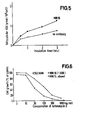
- an ascites containing the monoclonal antibody MRK17 was diluted stepwise for examination of the inhibitory effect against cell growth, respectively (see Fig. 3). More specifically, 2 x 1 0 4 K562 and K562/ADM cells, and 6 x 10 4 2780 and 27 80 AD cells were incubated together with the ascites diluted solution of MRK17, and the cell number after 72 hours was measured and the percent growth inhibitions calculated therefrom to obtain the results as shown in Fig. 3.
- MRK17 can be said to have a potent and selective growth inhibition activity for drug-resistant strains.
- MRK16 was found to have a light degree of direct growth inhibition effect against the drug-resistant strain K562/ADM.
- vincristine was added at a concentration of 0.5 pg/ml to this experiment ratio, however, growth inhibition against the resistant strain up to about 75% at the maximum was observed by the co-presence of MRK16 (see Fig. 4).
- 2 x 10 4 K562/ADM cells either in the presence or absence of 500 ng/ml of vincristine (VCR) were incubated together with ascites diluted solutions of MRK16, and the growth inhibition percents after 72 hours were measured to obtain the results as shown in Fig. 4.
- MRK16 has the possibility of recognizing the acting site which participates in expelling intracellular drugs out of the cells which are more advanced in resistant strains.
- MRK16 could potentiate the sensitivity of K562/ADM to actinomycin D by about 3- fold (see Fig. 6). More specifically, 2 x 10 4 K562/ADM cells either in the presence or absence of MRK16 (ascites diluted to 1:1000) were incubated at 37°C together with various concentrations of actinomycin D, and the growth inhibitory percents after 72 hours were measured to obtain the results as shown in Fig. 6.
- MRK16 can act selectively on a large number of anti-cancer drug-resistant strains to enhance sensitivity to the drug.
Landscapes
- Health & Medical Sciences (AREA)
- Chemical & Material Sciences (AREA)
- Life Sciences & Earth Sciences (AREA)
- Organic Chemistry (AREA)
- Immunology (AREA)
- Medicinal Chemistry (AREA)
- General Health & Medical Sciences (AREA)
- Molecular Biology (AREA)
- Cell Biology (AREA)
- Proteomics, Peptides & Aminoacids (AREA)
- Genetics & Genomics (AREA)
- Biophysics (AREA)
- Biochemistry (AREA)
- Veterinary Medicine (AREA)
- General Chemical & Material Sciences (AREA)
- Pharmacology & Pharmacy (AREA)
- Public Health (AREA)
- Nuclear Medicine, Radiotherapy & Molecular Imaging (AREA)
- Chemical Kinetics & Catalysis (AREA)
- Animal Behavior & Ethology (AREA)
- Preparation Of Compounds By Using Micro-Organisms (AREA)
- Medicines Containing Antibodies Or Antigens For Use As Internal Diagnostic Agents (AREA)
- Micro-Organisms Or Cultivation Processes Thereof (AREA)
- Medicines That Contain Protein Lipid Enzymes And Other Medicines (AREA)
- Peptides Or Proteins (AREA)
Priority Applications (1)
| Application Number | Priority Date | Filing Date | Title |
|---|---|---|---|
| AT86112391T ATE76904T1 (de) | 1985-09-11 | 1986-09-08 | Monoklonaler antikoerper in bezug auf heilmittelresistente krebse und dessen herstellung. |
Applications Claiming Priority (2)
| Application Number | Priority Date | Filing Date | Title |
|---|---|---|---|
| JP60201445A JPS6261596A (ja) | 1985-09-11 | 1985-09-11 | 薬剤耐性癌に関するモノクロ−ナル抗体およびその製造 |
| JP201445/85 | 1985-09-11 |
Publications (3)
| Publication Number | Publication Date |
|---|---|
| EP0214640A2 true EP0214640A2 (de) | 1987-03-18 |
| EP0214640A3 EP0214640A3 (en) | 1988-11-30 |
| EP0214640B1 EP0214640B1 (de) | 1992-06-03 |
Family
ID=16441205
Family Applications (1)
| Application Number | Title | Priority Date | Filing Date |
|---|---|---|---|
| EP86112391A Expired - Lifetime EP0214640B1 (de) | 1985-09-11 | 1986-09-08 | Monoklonaler Antikörper in Bezug auf heilmittelresistente Krebse und dessen Herstellung |
Country Status (5)
| Country | Link |
|---|---|
| US (1) | US5087560A (de) |
| EP (1) | EP0214640B1 (de) |
| JP (1) | JPS6261596A (de) |
| AT (1) | ATE76904T1 (de) |
| DE (1) | DE3685533T2 (de) |
Cited By (2)
| Publication number | Priority date | Publication date | Assignee | Title |
|---|---|---|---|---|
| US5959084A (en) * | 1990-10-29 | 1999-09-28 | Chiron Corporation | Bispecific antibodies, methods of production and uses thereof |
| FR2906533A1 (fr) * | 2006-09-28 | 2008-04-04 | Pierre Fabre Medicament Sa | Procede de generation d'anticorps actifs contre un antigene de resistance,anticorps obtenus par ledit procede et leurs utilisations |
Families Citing this family (2)
| Publication number | Priority date | Publication date | Assignee | Title |
|---|---|---|---|---|
| JP2564412B2 (ja) * | 1990-03-02 | 1996-12-18 | 財団法人癌研究会 | 薬剤耐性癌に対するキメラ抗体およびその製造 |
| US20080124329A1 (en) * | 2006-07-05 | 2008-05-29 | Schreiner George F | Conditioned Cell Immunization |
-
1985
- 1985-09-11 JP JP60201445A patent/JPS6261596A/ja active Granted
-
1986
- 1986-09-08 EP EP86112391A patent/EP0214640B1/de not_active Expired - Lifetime
- 1986-09-08 AT AT86112391T patent/ATE76904T1/de not_active IP Right Cessation
- 1986-09-08 DE DE8686112391T patent/DE3685533T2/de not_active Expired - Fee Related
-
1990
- 1990-10-01 US US07/593,276 patent/US5087560A/en not_active Expired - Lifetime
Non-Patent Citations (6)
| Title |
|---|
| CHEMICAL ABSTRACTS, vol. 100, no. 9, 27th February 1984, page 443, no. 66295q, Columbus, Ohio, US; N.S. YOUNG et al.: "Anti-K562 monoclonal antibodies that recognize antigens on immature hematopoietic cells" & PROG. CLIN. BIOL. RES. 1983, 134 (GLOBIN GENE EXPRESSION HEMATOPOIETIC DIFFER.), 293-304 * |
| CHEMICAL ABSTRACTS, vol. 104, no. 5, 3rd February 1986, page 443, no. 32835h, Columbus, Ohio, US; R. GAMBARI: "A monoclonal antibody to human transferrin receptor which inhibits erythroid differentiation of human leukemic K-562 cells" & BOLL. - SOC. ITAL. BIOL. SPER. 1984, 60(6), 1283-5 * |
| JOURNAL OF CLINICAL ONCOLOGY, vol. 3, no. 3, March 1985, pages 311-315, American Society of Clinical Oncology; D.R. BELL et al.: "Detection of P-glycoprotein in ovarian cancer: a molecular marker associated with multidrug resistance" * |
| PROCEEDINGS OF THE NATIONAL ACADEMY OF SCIENCES USA, vol. 83, October 1986, pages 7785-7789; H. HAMADA et al.: "Functional role for the 170- to 180-kDa glycoprotein specific to drug-resistant tumor cells as revealed by monoclonal antibodies" * |
| PROGRESS IN CLINICAL BIOLOGICAL RESEARCH, vol. 134, 1983, pages 293-304, Alan R. Liss, Inc., New York, US; N.S. YOUNG et al.: "Anti-K562 monoclonal antibodies that recognize antigens on immature hematopoietic cells" * |
| SCIENCE, vol. 221, July/September 1983, pages 1285-1288, American Association for the Advancement of Science, Washington, D.C., US; N. KARTNER et al.: "Cell surface P-glycoprotein associated with multidrug resistance in mammalian cell lines" * |
Cited By (15)
| Publication number | Priority date | Publication date | Assignee | Title |
|---|---|---|---|---|
| US5959084A (en) * | 1990-10-29 | 1999-09-28 | Chiron Corporation | Bispecific antibodies, methods of production and uses thereof |
| US6106833A (en) * | 1990-10-29 | 2000-08-22 | Chiron Corporation | Bispecific antibodies, methods of production and use thereof |
| US6143873A (en) * | 1990-10-29 | 2000-11-07 | Chiron Corporation | Monoclonal anti-multiple drug resistance antibody, methods of production and uses thereof |
| FR2906533A1 (fr) * | 2006-09-28 | 2008-04-04 | Pierre Fabre Medicament Sa | Procede de generation d'anticorps actifs contre un antigene de resistance,anticorps obtenus par ledit procede et leurs utilisations |
| WO2008046724A1 (en) * | 2006-09-28 | 2008-04-24 | Pierre Fabre Medicament | Method for generating active antibodies against a resistance antigen, antibodies obtained by said method and their uses |
| US8241646B2 (en) | 2006-09-28 | 2012-08-14 | Pierre Fabre Medicament | Method for generating active antibodies against a resistance antigen, antibodies obtained by said method and their uses |
| EP2491945A1 (de) * | 2006-09-28 | 2012-08-29 | Pierre Fabre Medicament | Verfahren zur Erzeugung von aktiven Antikörpern gegen ein resistentes Antigen, Antikörper, die mit diesem Verfahren erhalten werden und ihre Verwendungen |
| EP2494984A1 (de) * | 2006-09-28 | 2012-09-05 | Pierre Fabre Medicament | Verfahren zur Erzeugung von aktiven Antikörpern gegen ein resistentes Antigen, Antikörper, die mit diesem Verfahren erhalten werden und ihre Verwendungen |
| EP2497491A1 (de) * | 2006-09-28 | 2012-09-12 | Pierre Fabre Medicament | Verfahren zur Erzeugung von aktiven Antikörpern gegen ein resistentes Antigen, Antikörper, die mit diesem Verfahren erhalten werden und ihre Verwendungen |
| AU2007312437B2 (en) * | 2006-09-28 | 2014-01-23 | Pierre Fabre Medicament | Method for generating active antibodies against a resistance antigen, antibodies obtained by said method and their uses |
| AU2007312437C1 (en) * | 2006-09-28 | 2014-04-10 | Pierre Fabre Medicament | Method for generating active antibodies against a resistance antigen, antibodies obtained by said method and their uses |
| RU2515904C2 (ru) * | 2006-09-28 | 2014-05-20 | Пьер Фабр Медикамент | Способ генерирования активных антител к антигену устойчивости, антитела, полученные этим способом, и их применения |
| CN101516394B (zh) * | 2006-09-28 | 2014-07-30 | 皮埃尔法布雷医药公司 | 制备抗耐药性抗原的活性抗体的方法、所述方法获得的抗体及其用途 |
| US8808667B2 (en) | 2006-09-28 | 2014-08-19 | Pierre Fabre Medicament | Method for generating active antibodies against a resistance antigen, antibodies obtained by said method and their uses |
| KR101504770B1 (ko) * | 2006-09-28 | 2015-03-20 | 피에르 파브르 메디카먼트 | 내성 항원에 대항하는 활성 항체의 생산 방법, 상기 방법에 의해 생산된 항체 및 이의 용도 |
Also Published As
| Publication number | Publication date |
|---|---|
| DE3685533T2 (de) | 1993-02-18 |
| EP0214640B1 (de) | 1992-06-03 |
| EP0214640A3 (en) | 1988-11-30 |
| JPH0430278B2 (de) | 1992-05-21 |
| JPS6261596A (ja) | 1987-03-18 |
| DE3685533D1 (de) | 1992-07-09 |
| US5087560A (en) | 1992-02-11 |
| ATE76904T1 (de) | 1992-06-15 |
Similar Documents
| Publication | Publication Date | Title |
|---|---|---|
| EP0068763B2 (de) | Rekombinante Monoklonale Antikörper | |
| US4714681A (en) | Quadroma cells and trioma cells and methods for the production of same | |
| JPH06113832A (ja) | ジゴキシンに対し高い親和性を有するモノクローナル抗体を産生するハイブリッドセルライン及びその製造法 | |
| AU577293B2 (en) | Monoclonal antibodies against non small cell lung cancer | |
| US4524025A (en) | Hybridoma cell lines and monoclonal antibodies to theophylline | |
| US5084380A (en) | Monoclonal antibodies reactive with activated and oncogenic ras p21 proteins | |
| EP0048357A1 (de) | Verfahren zum Bestimmen eines Antigens in einer Lösung | |
| EP0214640B1 (de) | Monoklonaler Antikörper in Bezug auf heilmittelresistente Krebse und dessen Herstellung | |
| US4898932A (en) | Monoclonal antibodies reactive with activated and oncogenic ras p21 proteins | |
| EP0168907B1 (de) | L-Thyroxin erkennende monoklonale Antikörper | |
| FI90988B (fi) | Monoklonaaliset vasta-aineet natriumdiureesia lisääviä nisäkkäiden sydäneteisen peptidejä kohtaan | |
| EP0205177B1 (de) | Verfahren zur Bestimmung der leichten Kette von Myosin | |
| US5650324A (en) | Inhibitor and anti-inhibitor monoclonal antibodies specific for horseradish peroxidase | |
| EP0512905B1 (de) | Heterobifunktionelle Antikörper mit sowohl katalytischen Eigenschaften als auch spezifischen Antigenbindungseigenschaften und Verfahren zu deren Verwendung | |
| US20030228316A1 (en) | Mitochondrial creatine kinase antibody | |
| US5798213A (en) | Monoclonal antibodies | |
| US5262523A (en) | Antibodies reactive with normal and oncogenic forms of the ras p21 protein | |
| JP2004091453A (ja) | モノクローナル抗体及びその製造方法並びにモノクローナル抗体を用いた抗原の定量方法 | |
| US4521510A (en) | Hybridoma cell lines and monoclonal antibodies to theophylline | |
| JPH11290071A (ja) | 抗ジンセノサイドRb1モノクローナル抗体産生ハイブリドーマ | |
| JP2004091454A (ja) | 抗体及びその製造方法並びに抗体を用いた抗原の定量方法 | |
| JP2002069100A (ja) | 抗ジンセノシドRg1モノクローナル抗体 | |
| JPH05219946A (ja) | 薬剤耐性癌に関するモノクローナル抗体生産性ハイブリドーマ | |
| JPH0690784A (ja) | モノクローナル抗体及びその利用 | |
| JPS61249999A (ja) | モノクロ−ナル抗体 |
Legal Events
| Date | Code | Title | Description |
|---|---|---|---|
| PUAI | Public reference made under article 153(3) epc to a published international application that has entered the european phase |
Free format text: ORIGINAL CODE: 0009012 |
|
| AK | Designated contracting states |
Kind code of ref document: A2 Designated state(s): AT BE CH DE FR GB IT LI LU NL SE |
|
| PUAL | Search report despatched |
Free format text: ORIGINAL CODE: 0009013 |
|
| AK | Designated contracting states |
Kind code of ref document: A3 Designated state(s): AT BE CH DE FR GB IT LI LU NL SE |
|
| 17P | Request for examination filed |
Effective date: 19890425 |
|
| 17Q | First examination report despatched |
Effective date: 19900906 |
|
| GRAA | (expected) grant |
Free format text: ORIGINAL CODE: 0009210 |
|
| AK | Designated contracting states |
Kind code of ref document: B1 Designated state(s): AT BE CH DE FR GB IT LI LU NL SE |
|
| REF | Corresponds to: |
Ref document number: 76904 Country of ref document: AT Date of ref document: 19920615 Kind code of ref document: T |
|
| REF | Corresponds to: |
Ref document number: 3685533 Country of ref document: DE Date of ref document: 19920709 |
|
| ITF | It: translation for a ep patent filed | ||
| ET | Fr: translation filed | ||
| PLBE | No opposition filed within time limit |
Free format text: ORIGINAL CODE: 0009261 |
|
| STAA | Information on the status of an ep patent application or granted ep patent |
Free format text: STATUS: NO OPPOSITION FILED WITHIN TIME LIMIT |
|
| 26N | No opposition filed | ||
| EPTA | Lu: last paid annual fee | ||
| EAL | Se: european patent in force in sweden |
Ref document number: 86112391.7 |
|
| PGFP | Annual fee paid to national office [announced via postgrant information from national office to epo] |
Ref country code: FR Payment date: 19970909 Year of fee payment: 12 |
|
| PGFP | Annual fee paid to national office [announced via postgrant information from national office to epo] |
Ref country code: LU Payment date: 19970911 Year of fee payment: 12 |
|
| PGFP | Annual fee paid to national office [announced via postgrant information from national office to epo] |
Ref country code: AT Payment date: 19970912 Year of fee payment: 12 |
|
| PGFP | Annual fee paid to national office [announced via postgrant information from national office to epo] |
Ref country code: SE Payment date: 19970918 Year of fee payment: 12 |
|
| PGFP | Annual fee paid to national office [announced via postgrant information from national office to epo] |
Ref country code: CH Payment date: 19970924 Year of fee payment: 12 |
|
| PGFP | Annual fee paid to national office [announced via postgrant information from national office to epo] |
Ref country code: NL Payment date: 19970929 Year of fee payment: 12 |
|
| PGFP | Annual fee paid to national office [announced via postgrant information from national office to epo] |
Ref country code: BE Payment date: 19971104 Year of fee payment: 12 |
|
| PG25 | Lapsed in a contracting state [announced via postgrant information from national office to epo] |
Ref country code: LU Free format text: LAPSE BECAUSE OF NON-PAYMENT OF DUE FEES Effective date: 19980908 Ref country code: AT Free format text: LAPSE BECAUSE OF NON-PAYMENT OF DUE FEES Effective date: 19980908 |
|
| PG25 | Lapsed in a contracting state [announced via postgrant information from national office to epo] |
Ref country code: SE Free format text: LAPSE BECAUSE OF NON-PAYMENT OF DUE FEES Effective date: 19980909 |
|
| PG25 | Lapsed in a contracting state [announced via postgrant information from national office to epo] |
Ref country code: LI Free format text: LAPSE BECAUSE OF NON-PAYMENT OF DUE FEES Effective date: 19980930 Ref country code: CH Free format text: LAPSE BECAUSE OF NON-PAYMENT OF DUE FEES Effective date: 19980930 Ref country code: BE Free format text: LAPSE BECAUSE OF NON-PAYMENT OF DUE FEES Effective date: 19980930 |
|
| BERE | Be: lapsed |
Owner name: JAPANESE FOUNDATION FOR CANCER RESEARCH Effective date: 19980930 |
|
| PG25 | Lapsed in a contracting state [announced via postgrant information from national office to epo] |
Ref country code: NL Free format text: LAPSE BECAUSE OF NON-PAYMENT OF DUE FEES Effective date: 19990401 |
|
| REG | Reference to a national code |
Ref country code: CH Ref legal event code: PL |
|
| EUG | Se: european patent has lapsed |
Ref document number: 86112391.7 |
|
| PG25 | Lapsed in a contracting state [announced via postgrant information from national office to epo] |
Ref country code: FR Free format text: LAPSE BECAUSE OF NON-PAYMENT OF DUE FEES Effective date: 19990531 |
|
| NLV4 | Nl: lapsed or anulled due to non-payment of the annual fee |
Effective date: 19990401 |
|
| REG | Reference to a national code |
Ref country code: FR Ref legal event code: ST |
|
| REG | Reference to a national code |
Ref country code: GB Ref legal event code: IF02 |
|
| PGFP | Annual fee paid to national office [announced via postgrant information from national office to epo] |
Ref country code: DE Payment date: 20040902 Year of fee payment: 19 |
|
| PGFP | Annual fee paid to national office [announced via postgrant information from national office to epo] |
Ref country code: GB Payment date: 20040908 Year of fee payment: 19 |
|
| PG25 | Lapsed in a contracting state [announced via postgrant information from national office to epo] |
Ref country code: IT Free format text: LAPSE BECAUSE OF NON-PAYMENT OF DUE FEES;WARNING: LAPSES OF ITALIAN PATENTS WITH EFFECTIVE DATE BEFORE 2007 MAY HAVE OCCURRED AT ANY TIME BEFORE 2007. THE CORRECT EFFECTIVE DATE MAY BE DIFFERENT FROM THE ONE RECORDED. Effective date: 20050908 Ref country code: GB Free format text: LAPSE BECAUSE OF NON-PAYMENT OF DUE FEES Effective date: 20050908 |
|
| PG25 | Lapsed in a contracting state [announced via postgrant information from national office to epo] |
Ref country code: DE Free format text: LAPSE BECAUSE OF NON-PAYMENT OF DUE FEES Effective date: 20060401 |
|
| GBPC | Gb: european patent ceased through non-payment of renewal fee |
Effective date: 20050908 |