EP0214936A2 - Verfahren zur Herstellung von Mikrokapseln - Google Patents
Verfahren zur Herstellung von Mikrokapseln Download PDFInfo
- Publication number
- EP0214936A2 EP0214936A2 EP86810406A EP86810406A EP0214936A2 EP 0214936 A2 EP0214936 A2 EP 0214936A2 EP 86810406 A EP86810406 A EP 86810406A EP 86810406 A EP86810406 A EP 86810406A EP 0214936 A2 EP0214936 A2 EP 0214936A2
- Authority
- EP
- European Patent Office
- Prior art keywords
- acid
- water
- diisocyanate
- microcapsules
- salt
- Prior art date
- Legal status (The legal status is an assumption and is not a legal conclusion. Google has not performed a legal analysis and makes no representation as to the accuracy of the status listed.)
- Granted
Links
Classifications
-
- A—HUMAN NECESSITIES
- A01—AGRICULTURE; FORESTRY; ANIMAL HUSBANDRY; HUNTING; TRAPPING; FISHING
- A01N—PRESERVATION OF BODIES OF HUMANS OR ANIMALS OR PLANTS OR PARTS THEREOF; BIOCIDES, e.g. AS DISINFECTANTS, AS PESTICIDES OR AS HERBICIDES; PEST REPELLANTS OR ATTRACTANTS; PLANT GROWTH REGULATORS
- A01N25/00—Biocides, pest repellants or attractants, or plant growth regulators, characterised by their forms, or by their non-active ingredients or by their methods of application, e.g. seed treatment or sequential application; Substances for reducing the noxious effect of the active ingredients to organisms other than pests
- A01N25/26—Biocides, pest repellants or attractants, or plant growth regulators, characterised by their forms, or by their non-active ingredients or by their methods of application, e.g. seed treatment or sequential application; Substances for reducing the noxious effect of the active ingredients to organisms other than pests in coated particulate form
- A01N25/28—Microcapsules or nanocapsules
-
- B—PERFORMING OPERATIONS; TRANSPORTING
- B01—PHYSICAL OR CHEMICAL PROCESSES OR APPARATUS IN GENERAL
- B01J—CHEMICAL OR PHYSICAL PROCESSES, e.g. CATALYSIS OR COLLOID CHEMISTRY; THEIR RELEVANT APPARATUS
- B01J13/00—Colloid chemistry, e.g. the production of colloidal materials or their solutions, not otherwise provided for; Making microcapsules or microballoons
- B01J13/02—Making microcapsules or microballoons
- B01J13/06—Making microcapsules or microballoons by phase separation
- B01J13/14—Polymerisation; cross-linking
- B01J13/16—Interfacial polymerisation
Definitions
- a polymer is formed whose monomeric units naphthalene and phenol are linked partly via methylene groups and partly via sulfone groups.
- Naphthalene, phenol, sulfuric acid, formaldehyde and base in a molar ratio of 1: 0.5-1: 2-2.5: 0.4-0.8: 2-3 can be used in the preparation of dispersant A.
- the molar ratio of naphthalene: phenol: sulfuric acid: formaldehyde: base is advantageously 1: 0.7: 2: 0.5: 2, sodium hydroxide being advantageously used as the base.
- Suitable aromatic isocyanates are tolylene diisocyanate (TDI; mixture of 2,4- and 2,6-isomers), diphenylmethane-4,4'-diisocyanate (MDI; DESMODUR® VL (Bayer)), (polymethylene polyphenyl isocyanate (MONDUR® MR (Mobay Chemical Company)); PAPI®, PAPI e 135 (Upjohn Co)), 2,4,4'-diphenyl ether triisocyanate, 3,3'-dimethyl-4,4'-diphenyl diisocyanate, 3,3'-dimethoxy-4,4'-diphenyldiiaocyanate, 1,5-naphthylene diisocyanate and 4,4 ', 4 "-triphenylmethane triisocyanate.
- TDI tolylene diisocyanate
- MDI diphenylmethane-4,4'-diisocyanate
- MDI DESMOD
- di- and triisocyanates can each be used individually or as mixtures of two or more of these isocyanates.
- polyamines are generally understood to mean those compounds which contain two or more amino groups in the molecule, it being possible for these amino groups to be bound to aliphatic and aromatic base bodies.
- Suitable aliphatic polyamines are, for example, ⁇ , ⁇ -diamines of the formula in which n is an integer from 2-6.
- diamines include ethylenediamine, propylene-1,3-diamine, tetramethylene diamine, pentamethylene diamine and hexamethylene diamine.
- a preferred diamine is hexamethylene diamine.
- Suitable water-immiscible solvents in which the pesticides can be dissolved are aliphatic and aromatic hydrocarbons, such as hexane, cyclohexane, benzene, toluene, xylene, mineral oil or kerosene. Cyclohexanone and halogenated hydrocarbons such as methylene chloride, chloroform, carbon tetrachloride, chlorobenzene and o-dichlorobenzene are also suitable. Mixtures of mono- and polyalkylated aromatics, such as those sold under the name (SHELLSOL®), are also suitable.
- Etaconazole propiconazole, 1- [2- (2,4-dichlorophenyl) pent-1-yl] -1H-1,2,4-triazole; Triadi phone.
- Aldrin endosulfan.
- the process according to the invention for the production of microcapsules is advantageously carried out by first dissolving the anionic disperser and the nonionic protective colloid and / or the nonionic surfactant in water and then a solution of one or more polyisocyanates of the aforementioned type in one or more of the aforementioned adding pesticidal active substances or in a solution of one or more of these active substances in a water-immiscible solvent and stirring vigorously until a homogeneous dispersion is formed. Then, with further stirring, one or more polyamines of the above are added Kind to and the mixture continues until the polyamine is completely reacted with the isocyanate.
- the polyamines are advantageously added as an aqueous solution.
- reaction times of the polyisocyanate with the polyamine are usually 2-30 minutes.
- the respective degree of conversion and the end of the reaction can be determined by titration of the free amine present in the aqueous phase.
- the components required to form the capsule wall can generally be used in an amount of 2.5-30% by weight, preferably 5-20% by weight, based on the material to be encapsulated, the material to be encapsulated consisting of one active substance or a mixture of two and several active substances or from a solution of an active substance or a mixture of two and more active substances in a water-immiscible solvent.
- the amount of the components required to form the capsule wall used in the individual case depends primarily on the wall thickness of the capsules to be produced and also on the capsule size.
- Aqueous suspensions of microcapsules which contain 100-700 g of microcapsules per liter can be produced by the process according to the invention.
- the suspensions which can be prepared by the process according to the invention preferably contain 400-600 g of microcapsules per liter.
- the suspensions of microcapsules which can be prepared by the process according to the invention are immediately ready for use. However, they can be stabilized for transport and storage by other additives such as surface-active agents, thickeners, anti-foaming agents and anti-freeze.
- microcapsules separated from the immediately obtained suspension by filtration or centrifugation and either to dry them or to convert them into a suspension again.
- the microcapsules separated from the suspension and dried represent a free-flowing powder that can be stored practically without restriction.
- the capsule suspensions produced according to the invention are stable and show no serum and sediment formation even after prolonged storage.
- the suspensions of microcapsules which can be prepared according to the invention furthermore have thixotropic properties when the type and amount of the anionic and nonionic dispersants are selected appropriately and can therefore be brought into an easily flowable state by shaking or stirring.
- the trade names used and other non-self-evident names stand for the following products:
- Dispersant A sodium salt of a condensation product of naphthalenesulfonic acid with phenolsulfonic acid and formaldehyde prepared according to Example 1.
- TAMOL® SN sodium salt of a condensation product of naphthalenesulfonic acid and formaldehyde, manufacturer: Rohm and Haas Co.
- MOWIOL® 18-88 polyvinyl alcohol with a viscosity of 18 cp (measured in 4% aqueous solution at 20 ° C), produced by saponification of polyvinyl acetate (degree of saponification: 88%), manufacturer: Hoechst AG.
- MOWIOL® 40-88 polyvinyl alcohol with a viscosity of 40 cp (measured in 4% aqueous solution at 20 ° C), produced by saponification of polyvinyl acetate (degree of saponification: 88%), manufacturer: Hoechst AG.
- PLURONIC® P-85 ethylene oxide-propylene oxide polymer of the formula (EO) (PO) (EO) z with a molecular weight of 4500 and an ethylene oxide content of 50%, manufacturer: BASF Wyandotte Corp.
- PLURONIC® L-42 Ethylene oxide-propylene oxide block polymer of the formula (EO) (PO) (EO) z with a molecular weight of 1450 and an ethylene oxide content of 20%, manufacturer: BASF Wyandotte Corp.
- TETRONIC® 707 ethoxylated / propoxylated ethylenediamine with a molecular weight of 12000 and an ethylene oxide content of 70%, manufacturer: BASF Wyandotte Corp.
- ANTAROX® CO 710 Nonylphenol polyglycol ether with 10 ethylene oxide units, manufacturer: GAF.
- GENAPOL® C-200 ethoxylated coconut fatty alcohol with 25 ethylene oxide units, manufacturer: Hoechst AG.
- the naphthalene is melted in a stirred vessel and, after adding the sulfuric acid, heated to 120-125 ° C for 4 hours. The phenol is then added and the temperature is kept at 120-125 ° C. for a further hour.
- the reaction vessel is then evacuated to a pressure of 15 bar, the temperature slowly to 160 ° C increased and held there for 3 hours, water of reaction being separated off by distillation.
- the reaction mixture is then cooled to 105-110 ° C. and homogenized by stirring.
- the mixture is then cooled to 90 ° C. by carefully adding 200 g of ice, the homogeneity of the mixture being maintained by constant stirring.
- the formaldehyde solution is added at 90-95 ° C for one hour and stirred for 3 hours at 95 0 C.
- a sample of the reaction mixture now forms a clear 5% solution with water and no longer smells of formaldehyde.
- the reaction mixture is cooled to 80 ° C. by adding 60 g of ice and 60 g of water each. After adding a further 180 ml of water, the mixture is neutralized with approximately 230-250 ml of 48% sodium hydroxide solution at a temperature of 80 ° C. Then the pH of a 10% solution of a sample of the reaction mixture is about 6.5.
- the reaction mixture is then evaporated to dryness in vacuo and granulated. In this way, 900 g of dispersant A are obtained in the form of water-soluble granules.
- Example 2 A solution of 360 g of N-chloroacetyl-N- (1-methyl-2-methoxyethyl) -2,6-dimethylaniline and 70.8 g of diphenylmethane-4,4'-diisocyanate is placed in a 2 liter beaker 353 g SHELLSOL® AB using a high-speed stirrer in a solution of 15 g dispersant A and 15 g MOWIOL® 18-88 (in the form of a 10% aqueous solution) dispersed in 360 g water at 27-33 ° C.
- Example 3 A solution of 37.3 g of diphenylmethane-4,4'-diisocyanate in 480 g of metolachlor is mixed using a high-speed stirrer in a solution of 7.5 g of Dispersant A and 7.5 g of MOWIOL® 40-88 (in Form a 10% aqueous solution) dispersed in 232.5 g of water, the temperature rising by 3-5 ° C. 16.4 g of hexamethylenediamine (in the form of a 40% strength aqueous solution) are then added, with further stirring, the temperature rising by a further 8-12 ° C.
- Example 4 A solution of 87 g of diphenylmethane-4,4'-diisocyanate in 1080 g of diazinon is placed in a 2 liter beaker using a high-speed stirrer in a solution of 9.0 g of Dispersant A and 9.0 g of MOWIOL e 18- 88 (in the form of a 10% aqueous solution) dispersed in 392 g of water. After about a minute, 38 g of hexamethylenediamine (in the form of a 40% aqueous solution) are added, the temperature rising by 5-8 ° C.
- the mixture is stirred for an hour and the capsule suspension formed is stabilized by adding a solution of 29 g of GENAMIN® T 100 in 80 g of water.
- a stable capsule suspension with a viscosity of 700-1200 cp and an average particle size of 2-5 ⁇ m is obtained.
- the ratio of dispersant to MOWIOL® 18-88 can be varied in the range from 3: 1 to 1: 3 with practically constant quality of the suspension of microcapsules formed.
- Example 5 A solution of 8.1 g of diphenylmethane-4,4'-diisocyanate in 100 g of furathiocarb is mixed using a high-speed stirrer in a solution of 1.5 g of Dispersant A and 1.5 g of MOWIOL® 18-88 (in the form a 10% aqueous solution) dispersed in 55 g of water at 50 ° C. 3.5 g of hexamethylenediamine (in the form of a 40% strength aqueous solution) are added to the dispersion with further stirring, the temperature of the mixture increasing by about 3 ° C.
- Example 6 A solution of 6.3 g of diphenylmethane-4,4'-diisocyanate and 24 g of N- (2,3-dihydro-3-methyl-1,3-thiazol-2-ylidene) -3 is placed in a beaker , 4-xylidine in 47.2 g SHELLSOL® AB using a high-speed stirrer in a solution of 0.83 g of dispersant A and 0.83 g of MOWIOL® 40-88 (in the form of a 10% aqueous solution) in 58 g of water dispersed at room temperature.
- hexamethylenediamine in the form of a 40% strength aqueous solution
- the temperature increasing by about 2 ° C.
- the mixture is stirred for one hour, during which the capsule suspension formed cools to room temperature. This gives a free-flowing suspension of microcapsules with a viscosity of 150-300 cp, in which the average capsule size is 5-20 pm.
- Example 7 A solution of 8.5 g of diphenylmethane-4,4'-diisocyanate in 100 g of Profenofos and using a high-speed stirrer in a solution of 1 g of dispersant A and 1 g of MOWIOL® 18-88 in 70 is placed in a beaker at room temperature g of water dispersed. Then, with further stirring, 3.7 g of hexamethylenediamine (in the form of a 40% strength aqueous solution) are added and the mixture is stirred for one hour. A stable suspension of microcapsules with good suspendability and a viscosity of about 100 cp is obtained. The average capsule size is 5-15 pm.
- EXAMPLE 8 A solution of 19.7 g of diphenylmethane-4,4'-diisocyanate in 80 g of isazofos is mixed using a high-speed stirrer at room temperature in a solution of 8 g of Dispersant A and 0.8 g of MOWIOL® 18-88 in 44. Dispersed 2 g of water. Then 8.6 g of hexamethylenediamine (in the form of a 40% strength aqueous solution) are added to the dispersion obtained, the temperature rising by about 10 ° C. The mixture is still 30 minutes at room temperature stirred. A stable suspension of microcapsules containing 35% by weight of polyurea, based on the amount of active substance used, is obtained.
- Example 9 A mixture of 8.1 g of diphenylmethane-4,4'-diisocyanate, 80 g of propiconazole and 15.4 g of xylene is mixed with vigorous stirring in a solution of 1.6 g of Dispersant A, 0.8 g of MOWIOL 8 18-88 and 0.8 g of PLURONIC 8 F 108 dispersed in 58.6 g of water at room temperature. Then 3.3 g of hexamethylenediamine (in the form of a 40% strength aqueous solution) are added and the mixture is stirred for 1 hour. A thin, liquid, stable, aqueous suspension of microcapsules with an average capsule diameter of 2-3 ⁇ m is obtained. The active substance content of the suspension is 46% by weight.
- Example 10 A solution of 42.5 g of xylene and 44.5 g of diphenylmethane-4,4'-diisocyanate in 480 g of propiconazole is in vigorously stirred at room temperature in a solution of 20 g of dispersant A and 8 g of PLURONIC® F 108 in 247.6 g of water dispersed. Then 18.4 g of hexamethylenediamine (in the form of a 40% strength aqueous solution) are added, the temperature rising by about 10 ° C. The mixture is stirred until it has cooled to room temperature. A stable, low-viscosity suspension of microcapsules with an average capsule size of 3-5 ⁇ m and an active substance content of 54% by weight is obtained.
- Example 11 A solution of 75.4 g of diphenylmethane-4,4'-diisocyanate in 463.7 g of metolachlor is stirred vigorously at room temperature in a solution of 15 g of polystyrene sulfonic acid sodium salt and 10 g of PLURONIC® F 108 in 328 g of water dispersed. Then 32.8 g of hexamethylenediamine (in the form of a 40% strength aqueous solution) are added, the temperature rising by about 15 ° C. The mixture is stirred until it has cooled to room temperature. A suspension of microcapsules with an average capsule size of 1-2 ⁇ m is obtained.
- Example 12 A solution of 8.1 g of diphenylmethane-4,4'-diisocyanate in 100 g of metolachlor is stirred vigorously at room temperature in a solution of 1.5 g of polystyrene sulfonic acid sodium salt and 1.5 g of MOWIOL® 4C-88 in Dispersed 76.6 g of water. Then 3.5 g of hexamethylenediamine (in the form of a 40% strength aqueous solution) are added, the temperature rising by about 10 ° C. The mixture is stirred for 1 hour. A stable suspension of microcapsules with an average capsule size of 1-2 ⁇ m is obtained.
- Example 13 A solution of 6.5 g of diphenylmethane-4,4'-diisocyanate in 80 g of metolachlor is stirred vigorously at room temperature in a solution of 1.6 g of Dispersant A and 1.6 g of GENAPOL® C-200 in 61 g of water dispersed. Then 2.7 g of hexamethylenediamine (in the form of a 40% strength aqueous solution) are added, the temperature rising by 7 ° C. The mixture is stirred until it has cooled to room temperature. A suspension of microcapsules with a viscosity of 150 cp and an average capsule size of 5-6 pm is obtained. The capsule suspension spreads spontaneously when diluted with water.
- Example 14 The procedure is as in Example 13, but instead of GENAPOL® C-200 ANTAROX® CO 710. When the hexamethylenediamine is added, the temperature rises by 6 ° C. A suspension of microcapsules with a viscosity of 880 cp and an average capsule size of 5 .mu.m is obtained, which disperses spontaneously when diluted with water.
- Example 15 The procedure is as in Example 13, but instead of GENAPOL® C-200 an ethoxylated dinonylphenol with 150 ethylene oxide units is used. After adding the hexamethylenediamine, the temperature rises by 5 ° C. A suspension of microcapsules with a viscosity of 65 cp and an average capsule size of 4 ⁇ m is obtained, which is spontaneously distributed when diluted with water.
- Example 16 The procedure is as in Example 13, but instead of GENAPOL® C-200 PLURONIC® P-85. A suspension of microcapsules with a viscosity of 30 cp and an average capsule size of 4 pm is obtained, which disperses spontaneously when diluted with water.
- Example 17 The procedure is as in Example 13, but instead of GENAPOL® C-200 PLURONIC® L-42.
- the suspension obtained is initially thin, but thickens to a viscosity of 1600 cp within 24 hours.
- the suspension is easy to shake.
- the mean capsule size is 3.5-4 ⁇ m.
- Example 18 The procedure is as in Example 13, but instead of GENAPOL® C-200 TETRONIC® 707. When the hexamethylenediamine is added, the temperature rises by 5 ° C. A suspension of microcapsules with a viscosity of 500 cp and an average capsule size of 5 ⁇ m is obtained, which is spontaneously distributed when diluted with water.
- Example 19 A solution of 75.4 g of diphenylmethane-4,4'-diisocyanate in 463.7 g of metolachlor is dispersed at room temperature with vigorous stirring in a solution of 15 g of dispersant A and 10 g of PLURONIC® F 108 in 360 g of water . Then 32.8 g of hexamethylenediamine (in the form of a 40% strength aqueous solution) are added, the temperature rising by about 15 ° C. The mixture is stirred until it has cooled to room temperature. A suspension of microcapsules with a viscosity of 60 cp and an average capsule diameter of 2 ⁇ m is obtained.
- the suspension of microcapsules formed is stirred for a further hour and then adjusted to pH 7 with hydrochloric acid. After adding 19.5 g of a 3.6% dispersion of xantam (polysaccharide), a storage-stable suspension of microcapsules with a viscosity of 200-500 cp is obtained.
- the capsule diameter is 4-30 pm depending on the stirring speed.
- Example 21 A solution of 39 g of polymethylene polyphenyl isocyanate (PAPI O 135) in 511 g of Isazophos are placed in a 1.5 1 beaker at room temperature using a high-speed stirrer in a solution of 22 g of TAMOL® SN, 11 g of PLURONIC® F 108 and 55 g of ethylene glycol dispersed in 372.4 g of water. The dispersion is stirred for 2 minutes, the temperature rising by 10-15 ° C. Then 15.5 g of hexamethylenediamine (in the form of a 40% strength aqueous solution) are added, the temperature rising by a further 7-12 ° C.
- PAPI O 135 polymethylene polyphenyl isocyanate
- Isazophos Isazophos
- the mixture is stirred for 1 hour and then neutralized to pH 7 with hydrochloric acid. After adding 19.5 g of a 3.6% dispersion of xantham (polysaccharide) in water, a storage-stable suspension of microcapsules with a viscosity of 200-500 cp is obtained.
- the average capsule diameter is 2-8 ⁇ m depending on the stirring speed.
- Example 22 A solution of 20.4 g of dichloromethane and 7.5 g of diphenylmethane-4,4'-diisocyanate in 80 g of N-chloroacetyl-N- (1-methyl-2-methoxyethyl) -2,6-dimethylaniline is dispersed with vigorous stirring at room temperature in a solution of 1.8 g of dispersant A and 1.8 g of PLURONIC® F 108 in 66.9 g of water. Then 3.1 g of hexamethylenediamine (in the form of a 40% solution) are added, the temperature rising by about 10 ° C. A stable, low-viscosity suspension of microcapsules with an average capsule size of 2-4 .mu.m and an active substance content of 43% by weight is obtained.
- viscosity 150 cp
- Example 24 A solution of 87 g of diphenylmethane-4,4'-diisocyanate in 1080 g of diazinon is stirred vigorously at room temperature in a solution of 9.0 g of dispersant A, 3.0 g of MOWIOL e 18-88 (in the form of a 10% aqueous solution) and 6.0 g (PLURONIC F 108 dispersed in 446 g water. 37.9 g hexamethylenediamine (in the form of a 40% aqueous solution) are then added, the temperature rising by 3-5 ° C
- the liquid suspension of microcapsules obtained with an average capsule size of 1.5-2.5 ⁇ m has a viscosity of 250-600 cp. It contains 61.6% by weight of active substance and 7.1% by weight of capsule wall.
Landscapes
- Life Sciences & Earth Sciences (AREA)
- Chemical & Material Sciences (AREA)
- Organic Chemistry (AREA)
- General Health & Medical Sciences (AREA)
- Health & Medical Sciences (AREA)
- Pest Control & Pesticides (AREA)
- Dentistry (AREA)
- Chemical Kinetics & Catalysis (AREA)
- Dispersion Chemistry (AREA)
- Plant Pathology (AREA)
- Toxicology (AREA)
- Engineering & Computer Science (AREA)
- Agronomy & Crop Science (AREA)
- Wood Science & Technology (AREA)
- Zoology (AREA)
- Environmental Sciences (AREA)
- Agricultural Chemicals And Associated Chemicals (AREA)
- Manufacturing Of Micro-Capsules (AREA)
- Medicinal Preparation (AREA)
Abstract
Description
- Die vorliegende Erfindung betrifft ein Verfahren zur Herstellung von Mikrokapseln mit einer Kapselwand aus Polyharnstoff, die einen mit Wasser nicht mischbaren pestiziden Wirkstoff einschliessen, durch Grenzflächenreaktion einer wässrigen Dispersion einer Lösung eines Polyisocyanats in dem mit Wasser nicht mischbaren Pestizid und einer wässrigen Lösung eines Polyamins.
- Die Herstellung von Mikrokapseln durch Grenzflächenreaktion in einer Dispersion, wobei eine der zur Bildung der Kapselwand benötigten reaktiven Komponenten in der dispersen Phase und die andere in der kontinuierlichen Phase gelöst ist, ist an sich bekannt. Ein solches Verfahren ist beispielsweise in der US-Patentschrift 3 577 515 beschrieben. Dieses Verfahren wird in der Weise durchgeführt, dass man zunächst eine Lösung der zur Bildung der Kapselwand benötigten ersten reaktiven Komponente in einer kontinuierlichen Phase dispergiert und dann eine Lösung der zweiten reaktiven Komponente in dem die kontinuierliche Phase bildenden Medium zugibt. Dabei wird für die Dispersion einer mit Wasser nicht mischbaren organischen Phase in einer kontinuierlichen wässrigen Phase die Verwendung von nichtionischen Schutzkolloiden, wie Polyvinylalkohol, Gelatine und Methylcellulose, empfohlen.
- Ein weiteres Verfahren der vorgenannten Art ist in den US-Patentschriften 4 280 833 und 4 417 916 beschrieben. Nach diesem Verfahren wird eine Suspension von Mikrokapseln mit einer Kapselwand aus Polyharnstoff hergestellt, die einen herbiziden Wirkstoff enthalten. Das Verfahren wird in der Weise durchgeführt, dass man eine Lösung von Polymethylenpolyphenylisocyanat in dem herbiziden Wirkstoff in Wasser dispergiert und die Dispersion anschliessend mit der wässrigen Lösung eines Polyamins zur Reaktion bringt. Das wesentliche Merkmal dieses Verfahrens besteht darin, dass man als Dispergiermittel Salze von Ligninsulfonsäure verwendet.
- Ein wesentlicher Nachteil dieser bekannten Verfahren besteht darin, dass bei Verwendung der genannten Dispergiermittel nach der Zugabe der zweiten reaktiven Komponente eine starke Steigerung der Viskosität auftritt, die die Rührfähigkeit der Mischung stark herabsetzt. Dies ist insbesondere dann der Fall, wenn der Anteil der aus Aktivsubstanz, Isocyanat und gegebenenfalls Lösungsmittel bestehenden dispersen Phase hoch ist und beispielsweise 50 Gew.% oder mehr beträgt. Durch diese Herabsetzung der Rührfähigkeit wird der Reaktionsverlauf nachteilig beeinflusst, was zu verzögerter und unvollständiger Umsetzung der beiden reaktiven Komponenten führt. Dies hat zur Folge, dass die unmittelbar erhaltene Suspension von Mikrokapseln in der wässrigen Phase noch nicht umgesetztes Polyamin und in den Kapseln noch nicht umgesetztes Polyisocyanat enthält. Dies ist insbesondere bei der direkten Weiterverwendung der erhaltenen Kapselsuspension nicht wünschenswert.
- Es ist das Ziel der vorliegenden Erfindung, ein Verfahren zur Herstellung von Mikrokapseln mit einer Kapselwand aus Polyharnstoff bereitzustellen, das von den Nachteilen der vorgenannten bekannten Verfahren frei ist und das die Herstellung von Mikrokapseln in einfacher Weise und unter vollständiger Umsetzung der die Kapselwand bildenden reaktiven Komponenten ermöglicht.
- Es wurde gefunden, dass dieses Ziel für die Herstellung von Mikrokapseln, die einen pestiziden Wirkstoff einschliessen, mit einer Kapselwand aus Polyharnstoff dadurch erreicht werden kann, dass man die Umsetzung der in Wasser dispergierten Lösung eines Polyisocyanats in einem in Wasser schwerlöslichen pestiziden Wirkstoff mit der wässrigen Lösung eines Polyamins in Gegenwart eines Gemisches aus mindestens einem anionischen Dispergator und einem nichtionischen Schutzkolloid und/oder einem nichtionischen Tensid durchführt.
- Gegenstand der vorliegenden Erfindung ist daher ein Verfahren zur Herstellung einer wässrigen Suspension von Mikrokapseln mit einer Kapselwand aus Polyharnstoff, die ein mit Wasser nicht mischbares Pestizid einschliessen, durch Dispergieren einer Lösung eines Polyisocyanats in dem in Wasser schwerlöslichen Pestizid in Wasser und nachfolgende Umsetzung der Dispersion mit einem Polyamin, dadurch gekennzeichnet, dass man das Dispergieren der Lösung des Polyisocyanats in dem in Wasser schwerlöslichen Pestizid in Wasser und die nachfolgende Umsetzung der Dispersion mit dem Polyamin in Gegenwart eines anionischen Dispergators und mindestens eines nichtionischen Schutzkolloids und/oder eines nichtionischen Tensids durchführt.
- Als anionische Dispergatoren kommen allgemein Oligomere und Polymere, sowie Polykondensate in Betracht, die eine ausreichende Anzahl von anionischen Gruppen enthalten, um ihre Wasserlöslichkeit zu gewährleisten. Geeignete anionische Gruppen sind beispielsweise Sulfogruppen oder Carboxylgruppen, wobei Polymere mit Carboxylgruppen nur bei höherem pH-Wert, vorzugsweise bei einem pH-Wert grösser als 5, verwendet werden können. Die Zahl der anionischen Gruppen pro Polymermolekül beträgt in der Regel mindestens 60 % der Anzahl der am Aufbau des Moleküls beteiligten Monomereinheiten. Oligomere und Polymere, die Sulfogruppen enthalten, können entweder durch Polymerisation Sulfogruppen enthaltenden Monomeren oder durch Sulfonierung der betreffenden Oligomeren oder Polymeren hergestellt werden. Polymere, die Carboxylgruppen enthalten, können durch Verseifung von Polyacrylaten oder Polymethacrylaten erhalten werden, wobei der Verseifungsgrad mindestens 60 % betragen muss. Insbesondere sind als anionische Dispergatoren sulfonierte Polymere und Kondensationsprodukte von aromatischen Sulfonsäuren mit Formaldehyd geeignet. Typische Beispiele für solche anionischen Dispergatoren sind:
- A. Salze der Polystyrolsulfonsäure, insbesondere die Alkalimetall-, Erdalkalimetall- und Ammoniumsalze, sowie die Salze von organischen Aminen, die durch Polymerisation von Styrolsulfonsäure beziehungsweise deren Salzen oder durch Sulfonierung von Polystyrol und anschliessende Neutralisation mit einer entsprechenden Base erhalten werden können, wobei im Falle der Sulfonierung von Polystyrol der Sulfonierungsgrad wenigstens 60 % betragen sollte;
- B. Salze der Polyvinylsulfonsäure, insbesondere die Alkalimetall-, Erdalkalimetall- und Ammoniumsalze, sowie die Salze mit organischen Aminen, die durch Polymerisation von Vinylsulfonsäure oder deren Salzen herstellbar sind;
- C. Salze von Kondensationsprodukten von Naphthalinsulfonsäuren, insbesondere Naphthalin-2-sulfonsäure, mit Formaldehyd, insbesondere die Alkalimetall-, Erdalkalimetall- und Ammoniumsalze, sowie ihre Salze mit organischen Aminen, die durch Sulfonieren von Naphthalin, Kondensation der gebildeten Naphthalinsulfonsäuren mit Formaldehyd und Neutralisation mit einer entsprechenden Base erhalten werden können. Die Kondensationsprodukte können durch die Formel

- D. Salze von Kondensationsprodukten von Naphthalinsulfonsäure mit Phenolsulfonsäure und Formaldehyd, insbesondere die Alkalimetall-, Erdalkalimetall- und Ammoniumsalze, sowie Salze mit organischen Aminen. Diese Produkte stellen Sulfogruppen enthaltende Polymere mit einem mittleren Molekulargewicht von 6'000-8'000 dar, in denen die monomeren Bausteine Naphthalin und Phenol teils über Methylengruppen und teils über Sulfongruppen miteinander verbunden sind. Ihre Struktur ist ungefähr wie folgt:

- E. Salze der Ligninsulfonsäure, insbesondere das Natrium-, Kalium-, Magnesium-, Calcium- oder Ammoniumsalz.
- Bevorzugte anionische Dispergatoren sind Salze von Polystyrolsulfonsäure (Typ A), Salze von Kondensationsprodukten von Naphthalinsulfonsäure mit Formaldehyd (Typ C) und insbesondere Kondensationsprodukte von Naphthalinsulfonsäure mit Phenolsulfonsäure und Formaldehyd (Typ D).
- Die als anionische Dispergatoren besonders bevorzugten Kondensationsprodukte von Naphthalinsulfonsäure mit Phenolsulfonsäure und Formaldehyd des oben genannten Typs D sind bisher nicht in der Literatur beschrieben. Sie können hergestellt werden, indem man Naphthalin bei 120-130°C zunächst mit konzentrierter Schwefelsäure und/oder Oleum in Naphthalinsulfonsäure überführt, dem Reaktionsgemisch anschliessend Phenol zufügt und zuerst bei 120-130° weiter umsetzt und dann im Vakuum bei 150-170°C das Reaktionswasser abtrennt und das Reaktionsprodukt nach Abkühlung auf 90-1000 mit Formaldehyd kondensiert, danach auf pH 6-7 neutralisiert, zur Trockene eindampft und den Rückstand granuliert. Man erhält so einen wasserlöslichen anionischen Dispergator (nachfolgend "Dispergator A" genannt) in Form eines Granulats mit einem mittleren Molekulargewicht von 6'000-8'000.
- Bei der Sulfonierung von Naphthalin unter den vorgenannten Bedingungen wird vorwiegend Naphthalin-2-Sulfonsäure neben geringen Mengen Naphthalindisulphonsäure gebildet. Nach Zugabe des Phenols wird dieses ebenfalls sulfoniert. Dabei werden jedoch, insbesondere beim nachfolgenden Aufheizen auf 150-170° neben Phenolsulfonsäure auch in erheblichem Masse Sulfone, wie 4,4'-Dihydroxydiphenylsulfon und 4-Hydroxyphenylnaphthylsulfon, gebildet. Daher entsteht bei der nachfolgenden Kondensation mit Formaldehyd ein Polymeres, dessen monomere Bausteine Naphthalin und Phenol teils über Methylengruppen und teils über Sulfongruppen verknüpft sind. Bei der Herstellung von Dispergator A können Naphthalin, Phenol, Schwefelsäure, Formaldehyd und Base im Molverhältnis 1:0,5-1:2-2,5:0,4-0,8:2-3 eingesetzt werden. Vorteilhaft beträgt das Molverhältnis von Naphthalin:Phenol:Schwefelsäure:Formaldehyd:Base 1:0,7:2:0,5:2, wobei als Base vorteilhaft Natriumhydroxid verwendet wird. Die Schwefelsäure besteht vorteilhaft aus Gemischen von konzentrierter Schwefelsäure und Oleum, wobei die Menge von freiem SOa im Oleum mindestens der Menge Wasser in der konzentrierten Schwefelsäure equivalent ist, sodass beim Vermischen von konzentrierter Schwefelsäure und Oleum mindestens 100 %ige Schwefelsäure entsteht. Formaldehyd wird vorteilhaft als wässrige Lösung, beispielsweise 37Xige wässrige Lösung, eingesetzt. Die destillative Abtrennung des Reaktionswassers erfolgt vorteilhaft bei einem Druck von 10-50 bar.
- Als nichtionische Schutzkolloide kommen allgemeinwasserlösliche Polymere in Betracht, deren Molekulargewicht in der Regel 10 000 - 200 000 beträgt. Dabei kann über das Molekulargewicht des jeweils verwendeten wasserlöslichen Polymeren der mittlere Durchmesser der gebildeten Kapseln beeinflusst werden. Die Verwendung von wasserlöslichen Polymeren mit niedrigerem Molekulargewicht hat eine geringere Viskosität des Reaktionsgemisches und damit die Bildung von grösseren Kapseln zur Folge, während die Verwendung von wasserlöslichen Polymeren mit höherem Molekulargewicht eine höhere Viskosität des Reaktionsgemisches und damit die Bildung von Kapseln mit kleinerem Durchmesser bewirkt. Geeignete wasserlösliche Polymere sind beispielsweise:
- Polyvinylalkohol, Polyvinylmethyläther, Polyvinylpyrrolidon, Hydroxyäthylcellulose, Hydroxypropylcellulose, Methylcellulose (Substitutionsgrad: 1,5-2), Hydroxyäthymethylcellulose, Hydroxypropylmethylcellulose, Poly-(2-hydroxyäthyl)-methacrylat, Poly-[2-(2-hydroxyäthoxy)-äthyl]-methacrylat, Polyäthylenoxid (Polyoxy- äthylen) und Polyallylalkohol (Polyglycidol).
- Ein bevorzugtes nichtionisches Schutzkolloid ist Polyvinylalkohol. Besonders geeignet sind Polyvinylalkohole mit einer Viskosität von 4-60 cp (gemessen an 4 %igen wässrigen Lösungen bei 20°C), die durch Verseifung von Polyvinylacetat hergestellt wurden, wobei der Verseifungsgrad mindestens 60 %, vorzugsweise jedoch 80-95 % beträgt. Geeignete Produkte dieser Art sind beispielsweise unter der Bezeichnung MOWIOLe im Handel.
- Als nichtionische Tenside kommen allgemein nichtionische wasserlösliche Polymere mit einem Molekulargewicht unter 20 000, vorzugsweise unter 5 000 in Betracht. Besonders geeignete nichtionische Tenside dieser Art sind die durch Umsetzung von Aethylenoxid oder durch kombinierte Umsetzung von Aethylenoxid und Propylenoxid mit Fettalkoholen, Alkylphenolen, Fettsäuren, Fettsäureestern von Polyhydroxyverbindungen, Fettsäureamiden und Fettaminen herstellbaren Produkte, wobei die Zahl der Aethylenoxid und Propylenoxid-Einheiten in weiten Grenzen variiert werden kann. Im allgemeinen liegt die Zahl der Aethylenoxid bzw. Aethylenoxid/Propylenoxid-Einheiten bei 1-200, vorzugsweise bei 5-100 und insbesondere bei 8-40. Geeignete nichtionische Tenside sind beispielsweise:
- Alkylpolyäthylenglykoläther der Formel
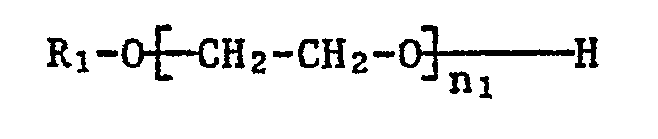
- Alkylphenolpolyäthylenglykoläther der Formel


- Fettsäure(polyäthoxyäthyl)ester der Formel

- Sorbitan-polyäthylenglykoläther-fettsäureester der Formel

- Triglycerid-polyäthylenglykoläther der Formel


- N-Polyäthoxyäthylamine der Formel

- N,N,N',N'-Tetra(polyäthoxypolyproxyäthyl)-äthylendiamine der Formel

- Alkyl-polyäthylenglykol/polypropylenglykoläther der Formel

- Bevorzugte nichtionische Tenside sind Aethylenoxid-Propylenoxid-Blockpolymerisate (PLURONICS®), N,N,N',N'-Tetra(polyäthoxypoly- propoxyäthyl)-äthylendiamine (TETRONICS®), Nonylphenolpolylglykol- äther mit 10-20-Aethylenoxideinheiten, Alkylpolyäthylenglykoläther, die sich von Fettalkoholen ableiten (GENAPOL®) und N-Polyäthoxyäthylamine, die sich von Fettaminen ableiten (GENAMIN®). Besonders bevorzugte nichtionische Tenside sind Aethylenoxid-Propylenoxid-Blockpolymersate (PLURONICS®).
- Unter Polyisocyanaten sind im Rahmen vorliegender Anmeldung allgemein solche Verbindungen zu verstehen, die zwei und mehr Isocyanatgruppen im Molekül enthalten. Bevorzugt sind Di- und Triisocyanate, wobei die Isocyanatgruppen an einen aliphatischen oder einen aromatischen Grundkörper gebunden sein können. Beispiele für geeignete aliphatische Diisocyanate sind Tetramethylendiisocyanat, Pentamethylendiisocyanat und Hexamethylendiisocyanat. Geeignete aromatische Isocyanate sind Toluylendiisocyanat (TDI; Mischung aus 2,4- und 2,6-Isomeren), Diphenylmethan-4,4'-diisocyanat (MDI; DESMODUR® VL (Bayer)), (Polymethylenpolyphenylisocyanat (MONDUR® MR (Mobay Chemical Company)); PAPI®, PAPIe 135 (Upjohn Co)), 2,4,4'-Diphenyläthertriisocyanat, 3,3'-Dimethyl-4,4'-diphenyldiisocyanat, 3,3'-Dimethoxy-4,4'-diphenyldiiaocyanat, 1,5-Naphthylendiisocyanat und 4,4',4"-Triphenylmethantriisocyanat. Ein weiteres geeignetes Diisocyanat ist Isophorondiisocyanat. Ferner sind auch Additionsprodukte von Diisocyanaten an mehrwertige Alkohole, wie Aethylenglykol, Glycerin und Trimethylolpropan geeignet, wobei pro Mol mehrwertiger Alkohol jeweils eine der Zahl der Hydroxygruppen des jeweiligen Alkohols entsprechende Zahl von Molen Diisocyanat addiert werden. Auf diese Weise werden mehrere Moleküle Diisocyanat über Urethangruppen an den mehrwertigen Alkohol unter Bildung von höhermolekularen Polyisocyanaten gebunden. Ein besonders geeignetes Produkt dieser Art ist durch Umsetzung von 3 Mol Toluylendiisocyanat mit einem Mol 2-Aethylglycerin (1,1-bis-Methylolpropanol) herstellbar (DESMODURe L). Weitere geeignete Produkte werden durch Addition von Hexamethylendiisocyanat oder Isophorondiisocyanat an Aethylenglykol oder Glycerin erhalten. Bevorzugte Polyisocyanate sind Diphenylmethan-4,4'-diisocyanat und Polymethylenpolyphenylisocyanat.
- Die vorgenannten Di- und Triisocyanate können jeweils einzeln oder als Mischungen von zwei und mehreren dieser Isocyanate verwendet werden.
- Als Polyamine sind im Rahmen vorliegender Erfindung allgemein solche Verbindungen zu verstehen, die zwei und mehr Aminogruppen im Molekül enthalten, wobei diese Aminogruppen an aliphatische und aromatische Grundkörper gebunden sein können. Geeignete aliphatische Polyamine sind beispielsweise α,ω-Diamine der Formel

- Weitere geeignete aliphatische Polyamine sind Polyäthylenimine der Formel

- Weitere geeignete aliphatische Polyamine sind Dioxaalkan-α,m-diamine, wie das 4,9-Dioxadodecan-1,12-diamin der Formel

- Geeignete aromatische Polyamine sind beispielsweise 1,3-Phenylendiamin, 2,4-Toluylendiamin, 4,4'-Diaminodiphenylmethan, 1,5-Diaminonaphthalin, 1,3,5-Triaminobenzol, 2,4,6-Triaminotoluol, 1,3,6-Triaminonaphthalin, 2,4,4'-Triaminodiphenyläther, 3,4,5-Triamino-1,2,4-triazol und 1,4,5,8-Tetraaminoanthrachinon. Diejenigen der vorgenannten Polyamine, die nicht oder nicht genügend wasserlöslich sind, können als Hydrochloride eingesetzt werden.
- Weiterhin sind Polyamine geeignet, die neben den Aminogruppen Sulfogruppen oder Carboxylgruppen enthalten. Beispiele für solche Polyamine sind 1,4,-Phenylendiaminsulfonsäure, 4,4'-Diaminodiphenyl-2-sulfonsäure, oder Diaminomonocarbonsäuren, wie Ornithin und Lysin.
- Die vorgenannten Polyamine können einzeln oder als Mischungen von zwei oder mehr Polyaminen eingesetzt werden.
- Als Pestizide, die nach dem erfindungsgemässen Verfahren formuliert werden können, kommen allgemein solche in Betracht, die
- - in Wasser unlöslich, aber gegen Wasser stabil sind,
- - bei Raumtemperatur flüssig oder einen Schmelzpunkt von S 60°C haben oder solche, die in einem mit Wasser nicht mischbaren organischen Lösungsmittel löslich sind,
- - gegen Isocyanate inert sind und
- - ein Lösungsvermögen für Polyisocyanate der vorgenannten Art besitzen.
- Als mit Wasser nicht mischbare Lösungsmittel, in denen die Pestizide gelöst sein können, kommen aliphatische und aromatische Kohlenwasserstoffe, wie Hexan, Cyclohexan, Benzol, Toluol, Xylol, Mineralöl oder Kerosin in Betracht. Weiterhin geeignet sind Cyclohexanon, sowie halogenierte Kohlenwasserstoffe, wie Methylenchlorid, Chloroform, Kohlenstofftetrachlorid, Chlorbenzol und o-Dichlorbenzol. Weiterhin sind Gemische von ein- und mehrfach alkylierten Aromaten geeignet, wie sie beispielsweise unter der Bezeichnung (SHELLSOL®) im Handel sind.
- Nach dem erfindungsgemässen Verfahren können pestizide Wirkstoffe verschiedenster Art, wie z.B.Herbizide, Pflanzenwuchsregulatoren, Insektizide, Akarizide, Nematizide, Safener und Ectoparasitizide verarbeitet werden, die von ihrer chemischen Konstitution her den verschiedensten Stoffklassen angehören können. Stoffklassen, denen die nach dem erfindungsgemässen Verfahren formulierbaren pestiziden Wirksubstanzen angehören können, sind beispielsweise:
- s-Triazine, Harnstoffe, Halogenacetanilide, Diphenylätherderivate, Phenoxypropionsäurederivate, Dinitroaniline, Acylalanine, Triazolderivate, Carbamate, Phosphorsäureester, Pyrethroide, Benzylsäureester, polycyclische Halogenkohlenwasserstoffe, Formamidine und Dihydro-1,3-thiazol-2-yliden-aniline. Nachstehend werden für die vorgenannten Stoffklassen Beispiele für verwendbare Einzelverbindungen genannt, wobei zur Bezeichnung der einzelnen Verbindungen der Common-Name verwendet wird, sofern dieser bekannt ist (vgl. The Pesticide Manual, 7th Edition, 1983, British Crop Protection Council).
- Atrazin, Propazin, Terbutylazin; Ametryn, Aziprotryn, Deametryn, Dipropetryn, Prometryn, Terbutryn; Secbumeton, Terbumeton.
- Chlorbromuron, Chloroxuron, Chlortoluron, Fluometuron, Metobromuron, Thiazafluron.
- Dimethachlor, Metolachlor, Pretilachlor, 2-Chlor-N-(1-methyl-2-methoxyäthyl)-acet-2,6-xylidid, Alachlor, Butachlor, Diethatyl- äthyl, Propachlor.
- Bifenox, Diclofopmethyl, 4-(4-Pentyn-1-yloxy)-diphenyläther.
- Fluazifop.
- Butralin, Ethalfluralin, Fluchloralin, Isopropalin, Pendimethalin, Profluralin, Trifluralin.
- Fluralaxyl, Metalaxyl; Benzoylprop-äthyl, Flamprop-methyl.
- Etaconazol, Propiconazol, 1-[2-(2,4-Dichlorphenyl)-pent-1-yl]-1H-1,2,4-triazol; Triadimefon.
- Dioxacarb, Furathiocarb; Aldicarb, Benomyl, 2-sec.Butylphenyl-methylcarbamat, Etiofencarb, Isoprocarb, Propoxur; Carbetamid, Butylat, Di-allat, EPTC, Molinat, Thiobencarb, Tri-allat, Vernolat.
- Piperophos, Anilofos, Butamifos; Azamethiphos, Chlorfenvinphos, Dichlorvos, Diazinon, Methidathion; Azinphos-äthyl, Azinphos-methyl, Chlorpyrifos, Chlorthiofos, Crotoxyphos, Cyanophos, Demeton, Dialifos, Dimethoate, Disulfoton, Etrimfos, Famphur, Flusulfothion, Fluthion, Fonofos, Formothion, Heptenophos, Isofenphos, Isoxathion, Malathion, Mephospholan, Mevinphos, Naled. Oxydemeton-methyl, Oxydeprofos, Parathion, Phoxim, Pyrimiphos-methyl, Profenofos, Propaphos, Propetamphos, Prothiophos, Quinalphos, Sulprofos, Phemephos, Terbufos, Triazophos, Trichloronate; Fenamipos, Isazophos; s-Benzyl-o,o-diisopropylphosphorothioat, Edinphos Pyrazophos;
- Allethrin, Bioallethrin, Bioresmethrin, Cyhalotrin, Cypermethrin, Deltamethrin, Fenpropathrin, Fenvalerate, Flucythrinate, Fluvalinate, Permethrin, Pyrethrine, Resmethrin, Tetramethrin, Tralomethrin.
- Brompropylat, Chlorbenzylat, Chlorpropylat.
- Aldrin, Endosulfan.
- Chlordimeform.
- N-(2,3-Dihydro-3-methyl-1,3-thiazol-2-yliden)-2,4-xylidin.
-
- Methopren, Kinopren;
- Flupropimorph, Tridemorph;
- Bromoxynil;
- Crimidine, Bupyrimate;
- Sethoxydim;
- Chlorphenprop-methyl;
- Carboxin;
- Buthiobate, Amithraz;
- Dicofol;
- Oxadiazon;
- Prochloraz;
- Propargite;
- Dicamba;
- Camphechlor;
- Chlorfenson.
- Die nach dem erfindungsgemässen Verfahren herstellbaren Mikrokapseln können die vorgenannten pestiziden Wirkstoffe einzeln oder als Kombinationen von zwei und mehr pestiziden Wirkstoffen enthalten.
- Das erfindungsgemässe Verfahren zur Herstellung von Mikrokapseln wird vorteilhaft in der Weise durchgeführt, dass man zunächst den anionischen Disperator und das nichtionische Schutzkolloid und/oder das nichtionische Tensid in Wasser löst und anschliessend eine Lösung eines oder mehrerer Polyisocyanate der vorgenannten Art in einer oder mehreren der vorgenannten pestiziden Wirksubstanzen oder in einer Lösung einer oder mehrerer dieser Wirksubstanzen in einem mit Wasser nicht mischbaren Lösungsmittel zugibt und bis zur Entstehung einer homogenen Dispersion intensiv rührt. Dann fügt man unter weiterem Rühren ein oder mehrere Polyamine der oben genannten Art zu und rührt die Mischung bis zur vollständigen Umsetzung des Polyamins mit dem Isocyanat weiter. Die Polyamine werden vorteilhaft als wässrige Lösung zugesetzt.
- Das erfindungsgemässe Verfahren kann bei Raumtemperatur oder mässig erhöhter Temperatur durchgeführt werden. Geeignete Temperaturen liegen im Bereich von 10-75°C. Vorzugsweise wird das erfindungsgemässe Verfahren im Temperaturbereich von 2θ-45°C durchgeführt.
- Die Reaktionszeiten des Polyisocyanats mit dem Polyamin beträgt in der Regel 2 - 30 Minuten. Der jeweilige Grad der Umsetzung und das Ende der Reaktion können durch Titration des in der wässrigen Phase vorliegenden freien Amins festgestellt werden.
- Die zur Bildung der Kapselwand benötigten Komponenten können im allgemeinen in einer Menge von 2,5-30 Gew.-% vorzugsweise 5 - 20 Gew.% bezogen auf das einzukapselnde Material eingesetzt werden, wobei das einzukapselnde Material aus einer Wirksubstanz oder einem Gemisch von zwei und mehreren Wirksubstanzen oder aus einer Lösung einer Wirksubstanz oder einer Mischung von zwei und mehreren Wirksubstanzen in einem mit Wasser nicht-mischbaren Lösungsmittel bestehen kann. Die im Einzelfall verwendete Menge der zur Bildung der Kapselwand benötigten Komponenten hängt in erster Linie von der Wanddicke der herzustellenden Kapseln und ferner auch von der Kapselgrösse ab.
- Nach dem erfindungsgemässen Verfahren können wässerige Suspensionen von Mikrokapseln hergestellt werden, die pro Liter 100-700 g Mikrokapseln enthalten. Vorzugsweise enthalten die nach dem erfindungsgemässen Verfahren herstellbaren Suspensionen 400-600 g Mikrokapseln pro Liter.
- Die nach dem erfindungsgemässen Verfahren herstellbaren Suspensionen von Mikrokapseln sind unmittelbar gebrauchsfertig. Sie können jedoch für Transport und Lagerung durch weitere Zusätze, wie oberflächenaktive Mittel, Verdicker, Antischaummittel und Frostschutzmittel, stabilisiert werden.
- Es ist jedoch auch möglich, die Mikrokapseln durch Filtrieren oder Zentrifugieren aus der unmittelbar erhaltenen Suspension abzutrennen und entweder zu trocknen oder erneut in eine Suspension überzuführen. Die aus der Suspension abgetrennten und getrockneten Mikrokapseln stellen ein rieselfähiges Pulver dar, das praktisch unbeschränkt lagerfähig ist.
- Durch die erfindungsgemässe gleichzeitige Verwendung eines anionischen Dispergators und eines nichtionischen Schutzkolloids und/oder nichtionischen Tenside wird bereits beim Dispergieren der Lösung des Polyisocyanats im pestiziden Wirkstoff die insbesondere bei der alleinigen Verwendung eines anionischen Dispergators, wie Ligninsulfonat, auftretende starke Viskositätserhöhung vermieden. Dadurch wird nicht nur die Durchführung des Verfahrens erleichtert, sondern es wird gleichzeitig eine schnellere und vollständigere Umsetzung von Polyisocyanat und Polyamin erreicht, wodurch die Bildung unerwünschter Nebenprodukte weitgehend unterbunden wird. Durch die Verringerung der Viskosität des Reaktionsgemisches resultiert ferner bei gleicher Scherkraft eine feinere Dispersion und damit eine Verkleinerung des Durchmessers der hergestellten Kapseln. Die erfindungsgemäss hergestellten Kapselsuspensionen sind stabil und zeigen auch bei längerer Lagerung keine Serum- und Sedimentbildung. Die erfindungsgemäss herstellbaren Suspensionen von Mikrokapseln zeigen ferner bei geeigneter Wahl von Art und Menge der anionischen und nichtionischen Dispergatoren thixotrope Eigenschaften und lassen sich daher durch Aufschütteln oder durch Rühren auf einfache Weise in einen leicht fliessfähigen Zustand bringen. In den nachfolgenden Beispielen, die das erfindungsgemässe Verfahren näher erläutern, stehen die verwendeten Handelsnamen und andere nicht selbstverständliche Bezeichnungen für folgende Produkte:
- Dispergator A: Natriumsalz eines Kondensationsprodukts von Naphthalinsulfonsäure mit Phenolsulfonsäure und Formaldehyd hergestellt nach Beispiel 1.
- TAMOL® SN: Natriumsalz eines Kondensationsprodukts von Naphthalinsulfonsäure und Formaldehyd, Hersteller: Rohm and Haas Co.
- MOWIOL® 18-88: Polyvinylalkohol mit einer Viskosität von 18 cp (gemessen in 4%iger wässriger Lösung bei 20°C), hergestellt durch Verseifung von Polyvinylacetat (Verseifungsgrad: 88 %), Hersteller: Hoechst AG.
- MOWIOL® 40-88: Polyvinylalkohol mit einer Viskosität'von 40 cp (gemessen in 4%iger wässriger Lösung bei 20°C), hergestellt durch Verseifung von Polyvinylacetat (Verseifungsgrad: 88 %), Hersteller: Hoechst AG.
- PLURONIC® F-108: Aethylenoxid-Propylenoxid-Blockpolymerisat der Formel (EO)(PO)
 (EO)z mit einem Molekular- gewicht von etwa 16000 und einem Aethylenoxidanteil von 80 %, Hersteller: BASF Wyandotte Corp.
- PLURONIC® P-85: Aethylenoxid-Propylenoxid-Polymerisat der Formel (EO)(PO)
 (EO)z mit einem Molekulargewicht von 4500 und einem Aethylenoxidanteil von 50 %, Hersteller: BASF Wyandotte Corp.
- PLURONIC® L-42: Aethyxlenoxid-Propylenoxid-Blockpolymerisat der Formel (EO)(PO)
 (EO)z mit einem Molekular- gewicht von 1450 und einem Aethylenoxidanteil von 20 %, Hersteller: BASF Wyandotte Corp.
- TETRONIC® 707: äthoxyliertes/propoxyliertes Aethylendiamin mit einem Molekulargewicht von 12000 und einem Aethylenoxidanteil von 70 %, Hersteller: BASF Wyandotte Corp.
- ANTAROX® CO 710: Nonylphenolpolyglykoläther mit 10 Aethylenoxid-Einheiten, Hersteller: GAF.
- GENAPOL® C-200: äthoxylierter Kokosfettalkohol mit 25 Aethylenoxid-Einheiten, Hersteller: Hoechst AG.
- GENAMIN® T100: äthoxyliertes Talgfettamin mit 10 Aethylenoxid-Einheiten, Hersteller: Hoechst AG.
- SHELLSOL® AB: Gemisch ein- und mehrfach alkylierter aromatischer Kohlenwasserstoffe, Hersteller: Shell.
-

- Das Naphthalin wird in einem Rührgefäss geschmolzen und nach Zugabe der Schwefelsäure 4 Stunden auf 120-125°C erhitzt. Dann wird das Phenol zugegeben und die Temperatur eine weitere Stunde auf 120-125°C gehalten. Anschliessend wird das Reaktionsgefäss auf einen Druck von 15 bar evakuiert, die Temperatur langsam auf 160°C gesteigert und 3 Stunden dort gehalten, wobei Reaktionswasser durch Destillation abgetrennt wird. Danach wird das Reaktionsgemisch auf 105-110°C abgekühlt und durch Rühren homogenisiert. Dann wird durch vorsichtige Zugabe von 200 g Eis auf 90°C abgekühlt, wobei die Homogenität des Gemisches durch ständiges Rühren aufrecht erhalten wird. Danach wird während einer Stunde die Formaldehydlösung bei 90-95°C zugegeben und 3 Stunden bei 950C nachgerührt. Eine Probe des Reaktionsgemisches bildet nun mit Wasser eine klare 5%ige Lösung und riecht nicht mehr nach Formaldehyd. Nun wird das Reaktionsgemisch durch Zugabe von je 60 g Eis und 60 g Wasser auf 80°C abgekühlt. Nach Zugabe von weiteren 180 ml Wasser wird mit etwa 230-250 ml 48%iger Natronlauge bei einer Temperatur von 80°C neutralisiert. Dann ist der der pH-Wert einer 10%igen Lösung einer Probe des Reaktionsgemisches etwa 6,5. Das Reaktionsgemisch wird nun im Vakuum zur Trockene eingedampft und granuliert. Auf diese Weise werden 900 g Dispergator A in Form eines wasserlöslichen Granulats erhalten.
- Beispiel 2: In einem 2-Liter Becherglas wird eine Lösung von 360 g N-Chloracetyl-N-(1-methyl-2-methoxyäthyl)-2,6-dimethylanilin und 70,8 g Diphenylmethan-4,4'-diisocyanat in 353 g SHELLSOL® AB unter Verwendung eines Schnellrührers in einer Lösung von 15 g Dispergator A und 15 g MOWIOL® 18-88 (in Form einer 10%igen wässrigen Lösung) in 360 g Wasser bei 27-33°C dispergiert. Nach etwa einer Minute werden unter weiterem Rühren 30,8 g Hexamethylendiamin (in Form einer 40%igen wässrigen Lösung zugesetzt, wobei die Temperatur auf etwa 40°C steigt. Nach Zugabe des Hexamethylendiamins wird eine Stunde langsam weitergerührt, wobei sich das Reaktionsgemisch auf Raumtemperatur abkühlt. Die gebildete Suspension wird durch Zugabe von 15 g PLURONIC® F-108 stabilisiert. Man erhält eine niedrigviskose Suspension von Mikrokapseln mit Kapseldurchmessern von 2-20 um.
- Beispiel 3: Eine Lösung von 37,3 g Diphenylmethan-4,4'-diisocyanat in 480 g Metolachlor wird unter Verwendung eines Schnellrührers in einer Lösung von 7,5 g Dispergator A und 7,5 g MOWIOL® 40-88 (in Form einer 10%igen wässrigen Lösung) in 232,5 g Wasser dispergiert, wobei die Temperatur um 3-5°C ansteigt. Anschliessend werden unter weiterem Rühren 16,4 g Hexamethylendiamin (in Form einer 40%igen wässrigen Lösung) zugesetzt, wobei die Temperatur um weitere 8-12°C ansteigt. Nach Zugabe des Hexamethylendiamins wird eine Stunde nachgerührt und die auf Raumtemperatur abgekühlte Suspension mit 8,7 g PLURONIC® F-108 stabilisiert. Man erhält eine dünnflüssige lagerstabile Kapselsuspension mit einer Kapselgrössen von 2-30 µm.
- Beispiel 4: In einem 2-Liter Becherglas wird eine Lösung von 87 g Diphenylmethan-4,4'-diisocyanat in 1080 g Diazinon unter Verwendung eines Schnellrührers in einer Lösung von 9,0 g Dispergator A und 9,0 g MOWIOLe 18-88 (in Form einer 10%igen wässrigen Lösung) in 392 g Wasser dispergiert. Nach etwa einer Minute werden 38 g Hexamethylendiamin (in Form einer 40%igen wässrigen Lösung) zugegeben, wobei die Temperatur um 5-8°C ansteigt. Es wird eine Stunde nachgerührt und die entstandene Kapselsuspension durch Zugabe einer Lösung von 29 g GENAMIN® T 100 in 80 g Wasser stabilisiert. Man erhält eine stabile Kapselsuspension mit einer Viskosität von 700-1200 cp und einer mittleren Teilchengrösse von 2-5 µm.
- Das Verhältnis von Dispergator zu MOWIOL® 18-88 kann bei praktisch gleichbleibender Qualität der gebildeten Suspension von Mikrokapseln im Bereich von 3:1 bis 1:3 variiert werden.
- Beispiel 5: Eine Lösung von 8,1 g Diphenylmethan-4,4'-diisocyanat in 100 g Furathiocarb wird unter Verwendung eines SchnellrUhrers in einer Lösung von 1,5 g Dispergator A und 1,5 g MOWIOL® 18-88 (in Form einer 10%igen wässrigen Lösung) in 55 g Wasser bei 50°C dispergiert. Der Dispersion werden unter weiterem Rühren 3,5 g Hexamethylendiamin (in Form einer 40%igen wässrigen Lösung) zugesetzt, wobei sich die Temperatur der Mischung um etwa 3°C erhöht. Nach Zugabe des Hexamethylendiamins wird eine Stunde weitergerührt, wobei sich die entstandene Suspension von Mikrokapseln auf Raumtemperatur abkühlt. Nach Zugabe von 10 g GENAMINO T 100 erhält man eine dünnflüssige, lagerfähige Suspension von Mikrokapseln. Die mittlere Kapselgrösse beträgt 2-50 pm.
- Beispiel 6: In einem Becherglas wird eine Lösung von 6,3 g Diphenylmethan-4,4'-diisocyanat und 24 g N-(2,3-Dihydro-3-methyl-1,3-thiazol-2-yliden)-3,4-xylidin in 47,2 g SHELLSOL® AB unter Verwendung eines Schnellrührers in einer Lösung von 0,83 g Dispergator A und 0,83 g MOWIOL® 40-88 (in Form einer 10%igen wässrigen Lösung) in 58 g Wasser bei Raumtemperatur dispergiert. Anschliessend werden 6,8 g Hexamethylendiamin (in Form einer 40%igen wässrigen Lösung) zugesetzt, wobei sich die Temperatur um etwa 2°C erhöht. Nach Zugabe des Hexamethylendiamins wird eine Stunde nachgerührt, wobei sich die gebildete Kapselsuspension auf Raumtemperatur abkühlt. Man erhält eine gut fliessfähige Suspension von Mikrokapseln mit einer Viskosität von 150-300 cp, in der die mittlere Kapselgrösse von 5-20 pm beträgt.
- Beispiel 7: In einem Becherglas wird bei Raumtemperatur eine Lösung von 8,5 g Diphenylmethan-4,4'-diisocyanat in 100 g Profenofos und Verwendung eines Schnellrührers in einer Lösung von 1 g Dispergator A und 1 g MOWIOL® 18-88 in 70 g Wasser dispergiert. Anschliessend werden unter weiterem Rühren 3,7 g Hexamethylendiamin (in Form einer 40%igen wässrigen Lösung) zugesetzt und eine Stunde nachgerührt. Man erhält eine stabile Suspension von Mikrokapseln mit guter Suspendierbarkeit und einer Viskosität von etwa 100 cp. Die mittlere Kapselgrösse beträgt 5-15 pm.
- Beispiel 8: Eine Lösung von 19,7 g Diphenylmethan-4,4'-diisocyanat in 80 g Isazofos wird unter Verwendung eines Schnellrührers bei Raumtemperatur in einer Lösung von 8 g Dispergator A und 0,8 g MOWIOL® 18-88 in 44,2 g Wasser dispergiert. Dann werden der erhaltenen Dispersion 8,6 g Hexamethylendiamin (in Form einer 40%igen wässrigen Lösung) zugesetzt, wobei die Temperatur um etwa 10°C ansteigt. Die Mischung wird noch 30 Minuten bei Raumtemperatur nachgerührt. Man erhält eine stabile Suspension von Mikrokapseln mit einem Gehalt von 35 Gew.-% Polyharnstoff bezogen auf die eingesetzte Menge Wirksubstanz.
- Beispiel 9: Eine Mischung von 8,1 g Diphenylmethan-4,4'-diisocyanat, 80 g Propiconazol und 15,4 g Xylol wird unter intensiven Rühren in einer Lösung von 1,6 g Dispergator A, 0.8 g MOWIOL8 18-88 und 0,8 g PLURONIC8 F 108 in 58,6 g Wasser bei Raumtemperatur dispergiert. Danach werden 3,3 g Hexamethylendiamin (in Form einer 40%igen wässrigen Lösung) zugegeben und 1 Stunde nachgerührt. Man erhält eine dünnflüssige stabile wässrige Suspension von Mikrokapseln mit einem mittleren Kapseldurchmesser von 2-3 um. Der Wirkstoffgehalt der Suspension liegt bei 46 Gew.-%.
- Beispiel 10: Eine Lösung von 42,5 g Xylol und 44,5 g Diphenylmethan-4,4'-diisocyanat in 480 g Propiconazol wird unter intensivem Rühren bei Raumtemperatur in einer Lösung von 20 g Dispergator A und 8 g PLURONIC® F 108 in 247,6 g Wasser dispergiert. Danach werden 18,4 g Hexamethylendiamin (in Form einer 40%igen wässrigen Lösung) zugesetzt, wobei die Temperatur um etwa 10°C steigt. Die Mischung wird bis zur Abkühlung auf Raumtemperatur nachgerührt. Man erhält eine stabile dünnflüssige Suspension von Mikrokapseln mit einer mitteleren Kapselgrösse von 3-5 um und einem Wirkstoffgehalt von 54 Gew.-%.
- Beispiel 11: Eine Lösung von 75,4 g Diphenylmethan-4,4'-diisocyanat in 463,7 g Metolachlor wird unter intensivem Rühren bei Raumtemperatur in einer Lösung von 15 g Polystyrolsulfonsäure-natriumsalz und 10 g PLURONIC® F 108 in 328 g Wasser dispergiert. Dann werden 32,8 g Hexamethylendiamin (in Form einer 40%igen wässrigen Lösung) zugegeben, wobei die Temperatur um etwa 15°C ansteigt. Die Mischung wird bis zur Abkühlung auf Raumtemperatur weitergerührt. Man erhält eine Suspension von Mikrokapseln mit einer mittleren Kapselgrösse von 1-2 µm.
- Beispiel 12: Eine Lösung von 8,1 g Diphenylmethan-4,4'-diisocyanat in 100 g Metolachlor wird unter intensivem Rühren bei Raumtemperatur in einer Lösung von 1,5 g Polystyrolsulfonsäure-natriumsalz und 1,5 g MOWIOL® 4C-88 in 76,6 g Wasser dispergiert. Anschliessend werden 3,5 g Hexamethylendiamin (in Form einer 40%igen wässrigen Lösung) zugefügt, wobei die Temperatur um etwa 10°C ansteigt. Die Mischung wird 1 Stunde nachgerührt. Man erhält eine stabile Suspension von Mikrokapseln mit einer mittleren Kapselgrösse von 1-2 um.
- Beispiel 13: Eine Lösung von 6,5 g Diphenylmethan-4,4'-diisocyanat in 80 g Metolachlor wird unter intensivem Rühren bei Raumtemperatur in einer Lösung von 1,6 g Dispergator A und 1,6 g GENAPOL® C-200 in 61 g Wasser dispergiert. Danach werden 2,7 g Hexamethylendiamin (in Form einer 40%igen wässrigen Lösung) zugesetzt, wobei die Temperatur um 7°C ansteigt. Die Mischung wird bis zur Abkühlung auf Raumtemperatur nachgerührt. Man erhält eine Suspension von Mikrokapseln mit einer Viskosität von 150 cp und einer mittleren Kapselgrösse von 5-6 pm. Die Kapselsuspension verteilt sich beim verdünnen mit Wasser spontan.
- Beispiel 14: Man verfährt wie im Beispiel 13, verwendet jedoch anstelle von GENAPOL® C-200 ANTAROX® CO 710. Bei der Zugabe des Hexamethylendiamins steigt die Temperatur um 6°C an. Man erhält eine Suspension von Mikrokapseln mit einer Viskosität von 880 cp und einer mittleren Kapselgrösse von 5 um, die sich beim verdünnen mit Wasser spontan verteilt.
- Beispiel 15: Man verfährt wie im Beispiel 13, verwendet jedoch anstelle von GENAPOL® C-200 ein äthoxyliertes Dinonylphenol mit 150 Ethylenoxid-Einheiten. Nach Zugabe des Hexamethylendiamins steigt die Temperatur um 5°C an. Man erhält eine Suspension von Mikrokapseln mit einer Viskosität 65 cp und einer mittleren Kapselgrösse von 4 µm, die sich beim verdünnen mit Wasser spontan verteilt.
- Beispiel 16: Man verfährt wie in Beispiel 13, verwendet jedoch anstelle von GENAPOL® C-200 PLURONIC® P-85. Man erhält eine Suspension von Mikrokapseln mit einer Viskosität von 30 cp und einer mittleren Kapselgrosse von 4 pm, die sich beim verdünnen mit Wasser spontan verteilt.
- Beispiel 17: Man verfährt wie in Beispiel 13, verwendet jedoch anstelle von GENAPOL® C-200 PLURONIC® L-42. Die erhaltene Suspension ist zunächst dünnflüssig, verdickt jedoch innerhalb von 24 Stunden auf eine Viskosität von 1600 cp. Die Suspension ist leicht aufschüttelbar. Die mittlere Kapselgrösse beträgt 3,5-4 um.
- Beispiel 18: Man verfährt wie in Beispiel 13, verwendet jedoch anstelle von GENAPOL® C-200 TETRONIC® 707. Bei der Zugabe des Hexamethylendiamins steigt die Temperatur um 5°C an. Man erhält eine Suspension von Mikrokapseln mit einer Viskosität von 500 cp und einer mittleren Kapselgrösse von 5 µm, die sich beim verdünnen mit Wasser spontan verteilt.
- Beispiel 19: Eine Lösung von 75,4 g Diphenylmethan-4,4'-diisocyanat in 463,7 g Metolachlor wird bei Zimmertemperatur unter intensivem Rühren in einer Lösung von 15 g Dispergator A und 10 g PLURONIC® F 108 in 360 g Wasser dispergiert. Dann werden 32,8 g Hexamethylendiamin (in Form einer 40%igen wässrigen Losung) zugegeben, wobei die Temperatur um etwa 15°C ansteigt. Die Mischung wird bis zur Abkühlung auf Raumtemperatur weitergerührt. Man erhält eine Suspension von Mikrokapseln mit einer Viskosität von 60 cp und einen mittleren Kapseldurchmesser von 2 µm.
- Beispiel 20: Eine Lösung von 35,5 g Polymethylenpolyphenylisocyanat (MONDUR® MR (Mobay Chemical Company)) in 465 g Metolachlor wird in einem 1,5 1 Becherglas bei Raumtemperatur mit einem Schnellrührer in einer Lösung von 20 g TAMOL® SN, 10 g PLURONIC® F 108 und 50 g Aethylenglykol in 348,5 g Wasser dispergiert. Die Mischung wird 2 Minuten gerührt wobei die Temperatur um 3-15°C ansteigt. Danach wird in der Dispersion 15,5 g Hexamethylendiamin (in Form einer 40%igen wässrigen Lösung) zugesetzt, wobei die Temperatur um weitere 7-12°C. Die gebildete Suspension von Mikrokapseln wird eine weitere Stunde gerührt und dann mit Salzsäure auf pH 7 eingestellt. Nach Zugabe von 19,5 g einer 3,6 %igen Dispersion von Xantam (Polysaccharid) wird eine lagerstabile Suspension von Mikrokapseln mit einer Viskosität von 200-500 cp erhalten. Der Kapseldurchmesser beträgt je nach Rührgeschwindigkeit 4-30 pm.
- Beispiel 21: Eine Lösung von 39 g Polymethylenpolyphenylisocyanat (PAPIO 135) in 511 g Isazophos werden in einem 1,5 1 Becherglas bei Raumtemperatur unter Verwendung eines Schnellrührers in einer Lösung von 22 g TAMOL® SN, 11 g PLURONIC® F 108 und 55 g Aethylenglykol in 372,4 g Wasser dispergiert. Die Dispersion wird 2 Minuten gerührt, wobei die Temperatur um 10-15°C steigt. Dann werden 15,5 g Hexamethylendiamin (in Form einer 40%igen wässrigen Lösung) zugesetzt, wobei die Temperatur um weitere 7-12°C steigt. Es wird 1 Stunde nachgerührt und dann mit Salzsäure auf pH 7 neutralisiert. Nach Zugabe von 19,5 g einer 3,6%igen Dispersion von Xantham (Polysaccharid) in Wasser erhält man eine lagerstabile Suspension von Mikrokapseln mit einer Viskosität von 200-500 cp. Der durchschnittliche Kapseldurchmesser beträgt je nach Rührgeschwindigkeit 2-8 µm.
- Beispiel 22: Eine Lösung von 20,4 g Dichlormethan und 7,5 g Diphenylmethan-4,4'-diisocyanat in 80 g N-Chloracetyl-N-(1-methyl-2-methoxy- aethyl)-2,6-dimethylanilin wird unter intensivem Rühren bei Raumtemperatur in eidner Lösung von 1,8 g Dispergator A und 1,8 g PLURONIC® F 108 in 66,9 g Wasser dispergiert. Danach werden 3,1 g Hexamethylendiamin (in Form einer 40%igen Lösung) zugesetzt, wobei die Temperatur um etwa 10°C ansteigt. Man erhält eine stabile dünnflüssige Suspension von Mikrokapseln mit einer mittleren Kapselgrösse von 2-4 um und einem Wirksoffgehalt von 43 Gew.-%.
- Beispiel 23: Eine Lösung von 18 g Diphenylmethan-4'4-diisocyanat in 96 g Chlorofenvinphos wird unter intensivem Rühren bei Raumtemperatur in einer Lösung von 1,6 g Dispergator A und 1,6 g PLURONIC® F 108 in 50,5 g Wasser dispergiert. Danach werden 7,4 g Hexamethylendiamin (in Form einer 40%igen wässrigen Lösung) zugesetzt, wobei die Temperatur um 20-30°C steigt. Die Mischung wird bis zur Abkühlung auf Raumtemperatur nachgerührt. Man erhält eine stabilfde dünnflüssige Suspension vond Mikrokapseln (Viskosität = 150 cp) mit einer mittleren Teilchengrösse von 2-3 µm, eindem Wirkstoffgehalt von 51,5 Gew.-% und einem Kapselwandanteidl von 13,6 Gew.-%.
- Beispiel 24: Eine Lösung von 87 g Diphenylmethan-4,4'-diisocyanat in 1080 g Diazinon wird unter intensivem Rühren bei Raumtemperatur in einer Lösung von 9,0 g Dispergator A, 3,0 g MOWIOLe 18-88 (in Form einer 10%igen wässrigen Lösung) und 6,0 g (PLURONIC F 108 in 446 g Wasser dispergiert. Danach werden 37,9 g Hexamethylendiamin (in Form einer 40%igen wässrigen Lösung) zugesetzt, wobei die Temperatur um 3-5°C ansteigt. Die erhaltene flüssige Suspension von Mikrokapseln mit einer mittleren Kapselgörsse von 1,5-2,5 um hat eine Viskosität von 250-600 cp. Sie enthält 61,6 Gew.-% Wirksubstanz und 7,1 Gew.-% Kapselwandanteil.
Claims (22)
Priority Applications (1)
| Application Number | Priority Date | Filing Date | Title |
|---|---|---|---|
| AT86810406T ATE77916T1 (de) | 1985-09-13 | 1986-09-08 | Verfahren zur herstellung von mikrokapseln. |
Applications Claiming Priority (2)
| Application Number | Priority Date | Filing Date | Title |
|---|---|---|---|
| US77608085A | 1985-09-13 | 1985-09-13 | |
| US776080 | 2004-02-11 |
Publications (3)
| Publication Number | Publication Date |
|---|---|
| EP0214936A2 true EP0214936A2 (de) | 1987-03-18 |
| EP0214936A3 EP0214936A3 (en) | 1989-08-02 |
| EP0214936B1 EP0214936B1 (de) | 1992-07-08 |
Family
ID=25106400
Family Applications (1)
| Application Number | Title | Priority Date | Filing Date |
|---|---|---|---|
| EP86810406A Expired - Lifetime EP0214936B1 (de) | 1985-09-13 | 1986-09-08 | Verfahren zur Herstellung von Mikrokapseln |
Country Status (11)
| Country | Link |
|---|---|
| US (1) | US4938797A (de) |
| EP (1) | EP0214936B1 (de) |
| JP (1) | JPH0764682B2 (de) |
| AT (1) | ATE77916T1 (de) |
| AU (1) | AU588913B2 (de) |
| CA (1) | CA1292678C (de) |
| DE (1) | DE3685920D1 (de) |
| IL (1) | IL80009A (de) |
| SU (1) | SU1741602A3 (de) |
| UA (1) | UA13387A (de) |
| ZA (1) | ZA866953B (de) |
Cited By (12)
| Publication number | Priority date | Publication date | Assignee | Title |
|---|---|---|---|---|
| EP0264794A1 (de) * | 1986-10-22 | 1988-04-27 | Bayer Ag | Mikrokapseln mit Wänden aus Polyurethan |
| US4853223A (en) * | 1986-10-23 | 1989-08-01 | Ciba-Geigy Corporation | Control of ectoparasites |
| EP0327748A1 (de) * | 1988-02-08 | 1989-08-16 | Moore Business Forms, Inc. | Polyharnstoff und Polyharnstoff-Epoxy-Mikrokapseln |
| EP0336666A3 (de) * | 1988-04-04 | 1989-11-23 | Ici Americas Inc. | Polymerisierte substituierte Benzoalkylsulfonsäuren und Salze als Schutzkolloide bei der Mikroverkapselung |
| EP0369614A1 (de) * | 1988-11-18 | 1990-05-23 | Imperial Chemical Industries Plc | Insektizide Zusammensetzungen |
| US5006161A (en) * | 1987-03-06 | 1991-04-09 | Ciba-Geigy Corporation | Herbicidal composition |
| EP0611253A1 (de) * | 1993-02-09 | 1994-08-17 | Ciba-Geigy Ag | Verfahren zur Herstellung von Mikrokapseln |
| EP0671206A3 (de) * | 1994-03-09 | 1995-11-08 | Nippon Paint Co Ltd | Verfahren zur Herstellung von Mikrokapseln. |
| WO1996022159A1 (en) * | 1995-01-19 | 1996-07-25 | Dowelanco | Microencapsulation process and product |
| WO1998003065A1 (en) * | 1996-07-19 | 1998-01-29 | Dow Agrosciences Llc | Process for preparing storage-stable pesticide dispersion |
| EP3459622A1 (de) * | 2009-09-18 | 2019-03-27 | International Flavors & Fragrances Inc. | Aktives material in kapseln |
| EP3868207A1 (de) | 2020-02-24 | 2021-08-25 | Bayer Aktiengesellschaft | Verkapselte pyrethroide mit verbesserter wirksamkeit bei boden- und blattanwendungen |
Families Citing this family (50)
| Publication number | Priority date | Publication date | Assignee | Title |
|---|---|---|---|---|
| DE3635823A1 (de) * | 1986-10-22 | 1988-04-28 | Bayer Ag | Mikrokapseln mit verbesserten waenden |
| AU641944B2 (en) * | 1989-11-10 | 1993-10-07 | Sumitomo Chemical Company, Limited | Improved pesticidal composition |
| CA2107803C (en) * | 1991-02-06 | 2001-03-27 | Herbert Benson Scher | Microencapsulated herbicidal composition |
| DK0551796T3 (da) * | 1992-01-03 | 1998-03-23 | Ciba Geigy Ag | Suspension af mikrokapsler og fremgangsmåde til dens fremstiling |
| JP3114321B2 (ja) * | 1992-01-29 | 2000-12-04 | 住友化学工業株式会社 | 飛翔性双翅目衛生害虫防除剤 |
| US5674514A (en) * | 1992-09-21 | 1997-10-07 | Ciba-Geigy Corporation | Storage stable pesticidal aqueous emulsions |
| US5866153A (en) * | 1993-02-09 | 1999-02-02 | Novartis Corporation | Process for the preparation of microcapsules |
| US6090925A (en) | 1993-03-09 | 2000-07-18 | Epic Therapeutics, Inc. | Macromolecular microparticles and methods of production and use |
| US5981719A (en) | 1993-03-09 | 1999-11-09 | Epic Therapeutics, Inc. | Macromolecular microparticles and methods of production and use |
| GB9306808D0 (en) * | 1993-04-01 | 1993-05-26 | Ciba Geigy Ag | Coated microparticle agglomerates |
| GB9306852D0 (en) * | 1993-04-01 | 1993-05-26 | Ciba Geigy Ag | Multiply-coated particles |
| DK0638235T3 (da) * | 1993-08-05 | 1999-10-11 | Shell Int Research | Fast præparat |
| US5552149A (en) * | 1993-10-12 | 1996-09-03 | Lignotech Usa, Inc. | Method for microencapsulation of agriculturally active substances |
| ES2119354T3 (es) * | 1993-11-15 | 1998-10-01 | Zeneca Ltd | Microcapsulas que contienen suspensiones de compuestos biologicamente activos. |
| US5846554A (en) * | 1993-11-15 | 1998-12-08 | Zeneca Limited | Microcapsules containing suspensions of biologically active compounds and ultraviolet protectant |
| US5529772A (en) * | 1994-06-09 | 1996-06-25 | Lignotech, Usa, Inc. | Method for producing improved biological pesticides |
| MX245101B (es) | 1994-11-16 | 2007-04-19 | Fmc Corp | Formulaciones de clomazone de baja volatilidad. |
| US5993842A (en) * | 1994-12-12 | 1999-11-30 | Zeneca Limited | Microcapsules containing suspensions of biologically active compounds |
| DE19646880A1 (de) * | 1996-11-13 | 1998-05-14 | Hoechst Schering Agrevo Gmbh | Endosulfan-Mikrokapseldispersion |
| EP0882498B1 (de) * | 1997-06-02 | 2004-02-11 | Hodogaya Chemical Co Ltd | Verfahren zur Herstellung von lösungsmittellose Emulsionen des Typs O/W |
| WO2000005952A1 (en) * | 1998-07-30 | 2000-02-10 | Syngenta Limited | Acid-triggered release microcapsules |
| DE69914916D1 (de) | 1998-07-30 | 2004-03-25 | Fmc Corp | Mikrokapsel-formulierungen von cadusafos |
| JP2004503513A (ja) * | 2000-06-12 | 2004-02-05 | 呉羽化学工業株式会社 | マイクロカプセル懸濁液およびその方法 |
| US6992047B2 (en) * | 2001-04-11 | 2006-01-31 | Monsanto Technology Llc | Method of microencapsulating an agricultural active having a high melting point and uses for such materials |
| GB0121580D0 (en) | 2001-09-06 | 2001-10-24 | Syngenta Ltd | Novel compounds |
| DE10223916A1 (de) * | 2002-05-29 | 2003-12-11 | Bayer Cropscience Ag | Mikrokapsel-Formulierungen |
| PT1524902E (pt) * | 2002-07-22 | 2007-03-30 | Basf Corp | Métodos de utilizar compostos de dinitroanilina na forma de formulações de microcapsula |
| GB0219611D0 (en) * | 2002-08-22 | 2002-10-02 | Syngenta Ltd | Composition |
| AU2003297683A1 (en) * | 2002-12-13 | 2004-07-09 | Monsanto Technology Llc | Microcapsules with amine adjusted release rates |
| BRPI0512102A (pt) * | 2004-06-14 | 2008-02-06 | Monsanto Technology Llc | microcápsulas tendo liberação ativada de material de núcleo dentro delas |
| US9072294B2 (en) * | 2006-02-15 | 2015-07-07 | Cognis Ip Management Gmbh | Emulsifier system and pesticidal formulations containing the emulsifier system |
| EP2001910B1 (de) * | 2006-03-30 | 2017-05-17 | Solvay USA Inc. | Reaktive monomere tenside |
| ES2398125T3 (es) * | 2006-03-30 | 2013-03-13 | Rhodia, Inc. | Tensioactivos reactivos y su uso en emulsiones y dispersiones |
| MX2009005419A (es) * | 2006-11-23 | 2009-07-06 | Gat Microencapsulation Ag | Novedosas formulaciones agroquimicas que contienen microcapsulas. |
| EP2395843B1 (de) | 2009-02-13 | 2017-08-09 | Monsanto Technology LLC | Einkapseln von herbiziden zur verhinderung von ernteschäden |
| ES2628087T3 (es) * | 2010-06-25 | 2017-08-01 | Cognis Ip Management Gmbh | Procedimiento para producir microcápsulas |
| US9913469B2 (en) | 2010-08-18 | 2018-03-13 | Monsanto Technology Llc | Early applications of encapsulated acetamides for reduced injury in crops |
| US8895126B2 (en) | 2010-12-31 | 2014-11-25 | Kimberly-Clark Worldwide, Inc. | Segmented films with high strength seams |
| BR102012027933A2 (pt) | 2011-11-01 | 2015-11-17 | Dow Agrosciences Llc | composições pesticidas estáveis |
| US9801377B2 (en) | 2012-07-27 | 2017-10-31 | Fmc Corporation | Formulations of clomazone |
| RU2540431C2 (ru) * | 2012-08-31 | 2015-02-10 | Федеральное государственное бюджетное образовательное учреждение высшего профессионального образования Курская государстенная сельскохозяйственная академия имени профессора И.И. Иванова Министерства сельского хозяйства Российской Федерации | Способ получения микрокапсул гетероциклических соединений триазинового ряда |
| US9969042B2 (en) | 2013-05-16 | 2018-05-15 | Kreg Enterprises, Inc. | Ratcheting quick-adjust drilling jig |
| CA3181871A1 (en) | 2014-01-27 | 2015-07-30 | Monsanto Technology Llc | Aqueous herbicidal concentrates comprising an acetanilide herbicide, a protoporphyrinogen oxidase inhibitor, and a pseudoplastic thickener |
| CN109414013B (zh) * | 2016-07-27 | 2021-11-12 | 巴斯夫欧洲公司 | 具有阴离子c6-c10共分散剂的微胶囊的农用配制剂 |
| MX2019015014A (es) | 2017-06-13 | 2020-02-26 | Monsanto Technology Llc | Herbicidas microencapsulados. |
| CN107691434A (zh) * | 2017-09-07 | 2018-02-16 | 中化化肥有限公司成都研发中心 | 农药微胶囊悬浮液的加工方法 |
| SG10201806031VA (en) * | 2018-07-13 | 2020-02-27 | Mitsui Chemicals Inc | Re-dispersible polyurea microcapsules and method of preparing re-dispersible polyurea microcapsules |
| UA129154C2 (uk) | 2019-01-30 | 2025-01-29 | Монсанто Текнолоджі Ллс | Мікрокапсульовані ацетамідні гербіциди |
| JP2020180104A (ja) * | 2019-04-26 | 2020-11-05 | トッパン・フォームズ株式会社 | 分散体 |
| JP7692268B2 (ja) * | 2020-02-03 | 2025-06-13 | 日本化薬株式会社 | マイクロカプセル農薬組成物 |
Family Cites Families (8)
| Publication number | Priority date | Publication date | Assignee | Title |
|---|---|---|---|---|
| US4285720A (en) * | 1972-03-15 | 1981-08-25 | Stauffer Chemical Company | Encapsulation process and capsules produced thereby |
| DE2757017C3 (de) * | 1977-12-21 | 1986-07-31 | Hoechst Ag, 6230 Frankfurt | Verfahren zum Herstellen von druckbeständigen Polyurethan-Polyharnstoff-Kapseln mit strukturierter Innenmasse |
| JPS558856A (en) * | 1978-07-05 | 1980-01-22 | Mitsubishi Paper Mills Ltd | Covering of finely dispersed liquid droplet with thin film |
| DK253779A (da) * | 1978-08-03 | 1980-02-04 | Du Pont | Insecticidt middel og fremgangsmaade til fremstilling deraf |
| US4280833A (en) * | 1979-03-26 | 1981-07-28 | Monsanto Company | Encapsulation by interfacial polycondensation, and aqueous herbicidal composition containing microcapsules produced thereby |
| CA1165636A (en) * | 1981-07-20 | 1984-04-17 | George B. Beestman | Encapsulation by interfacial polycondensation of polymethylene polyphenylisocyanate with a poly- functional amine in presence of a lignin sulfonate emulsifier |
| US4563212A (en) * | 1983-12-27 | 1986-01-07 | Monsanto Company | High concentration encapsulation by interfacial polycondensation |
| AR240875A1 (es) * | 1984-01-09 | 1991-03-27 | Stauffer Chemical Co | Procedimiento para producir capsulas de poliurea de dimensiones multiples que contienen un material inmiscible en agua en su interior y las capsulas resultantes |
-
1986
- 1986-09-08 AT AT86810406T patent/ATE77916T1/de not_active IP Right Cessation
- 1986-09-08 EP EP86810406A patent/EP0214936B1/de not_active Expired - Lifetime
- 1986-09-08 DE DE8686810406T patent/DE3685920D1/de not_active Expired - Lifetime
- 1986-09-11 IL IL80009A patent/IL80009A/xx not_active IP Right Cessation
- 1986-09-11 CA CA000517943A patent/CA1292678C/en not_active Expired - Lifetime
- 1986-09-12 ZA ZA866953A patent/ZA866953B/xx unknown
- 1986-09-12 UA UA4028125A patent/UA13387A/uk unknown
- 1986-09-12 SU SU864028125A patent/SU1741602A3/ru active
- 1986-09-12 AU AU62643/86A patent/AU588913B2/en not_active Expired
- 1986-09-13 JP JP61216953A patent/JPH0764682B2/ja not_active Expired - Lifetime
-
1988
- 1988-06-07 US US07/203,791 patent/US4938797A/en not_active Expired - Lifetime
Cited By (16)
| Publication number | Priority date | Publication date | Assignee | Title |
|---|---|---|---|---|
| EP0264794A1 (de) * | 1986-10-22 | 1988-04-27 | Bayer Ag | Mikrokapseln mit Wänden aus Polyurethan |
| US4853223A (en) * | 1986-10-23 | 1989-08-01 | Ciba-Geigy Corporation | Control of ectoparasites |
| US5006161A (en) * | 1987-03-06 | 1991-04-09 | Ciba-Geigy Corporation | Herbicidal composition |
| EP0327748A1 (de) * | 1988-02-08 | 1989-08-16 | Moore Business Forms, Inc. | Polyharnstoff und Polyharnstoff-Epoxy-Mikrokapseln |
| AU600140B2 (en) * | 1988-02-08 | 1990-08-02 | Moore North America, Inc. | Polyurea and polyurea-epoxy microcapsules |
| EP0336666A3 (de) * | 1988-04-04 | 1989-11-23 | Ici Americas Inc. | Polymerisierte substituierte Benzoalkylsulfonsäuren und Salze als Schutzkolloide bei der Mikroverkapselung |
| EP0369614A1 (de) * | 1988-11-18 | 1990-05-23 | Imperial Chemical Industries Plc | Insektizide Zusammensetzungen |
| CN1066069C (zh) * | 1993-02-09 | 2001-05-23 | 诺瓦提斯公司 | 微胶囊剂的制备方法 |
| EP0611253A1 (de) * | 1993-02-09 | 1994-08-17 | Ciba-Geigy Ag | Verfahren zur Herstellung von Mikrokapseln |
| EP0671206A3 (de) * | 1994-03-09 | 1995-11-08 | Nippon Paint Co Ltd | Verfahren zur Herstellung von Mikrokapseln. |
| US5603986A (en) * | 1994-03-09 | 1997-02-18 | Nippon Paint Co., Ltd. | Method of preparing microcapsules |
| WO1996022159A1 (en) * | 1995-01-19 | 1996-07-25 | Dowelanco | Microencapsulation process and product |
| WO1998003065A1 (en) * | 1996-07-19 | 1998-01-29 | Dow Agrosciences Llc | Process for preparing storage-stable pesticide dispersion |
| EP3459622A1 (de) * | 2009-09-18 | 2019-03-27 | International Flavors & Fragrances Inc. | Aktives material in kapseln |
| EP3868207A1 (de) | 2020-02-24 | 2021-08-25 | Bayer Aktiengesellschaft | Verkapselte pyrethroide mit verbesserter wirksamkeit bei boden- und blattanwendungen |
| WO2021170527A1 (de) | 2020-02-24 | 2021-09-02 | Bayer Aktiengesellschaft | Verkapselte pyrethroide mit verbesserter wirksamkeit bei boden- und blattanwendungen |
Also Published As
| Publication number | Publication date |
|---|---|
| UA13387A (uk) | 1997-02-28 |
| JPS6267003A (ja) | 1987-03-26 |
| DE3685920D1 (de) | 1992-08-13 |
| IL80009A0 (en) | 1986-12-31 |
| ATE77916T1 (de) | 1992-07-15 |
| SU1741602A3 (ru) | 1992-06-15 |
| AU588913B2 (en) | 1989-09-28 |
| EP0214936B1 (de) | 1992-07-08 |
| CA1292678C (en) | 1991-12-03 |
| ZA866953B (en) | 1988-04-27 |
| IL80009A (en) | 1989-12-15 |
| US4938797A (en) | 1990-07-03 |
| JPH0764682B2 (ja) | 1995-07-12 |
| EP0214936A3 (en) | 1989-08-02 |
| AU6264386A (en) | 1987-03-19 |
Similar Documents
| Publication | Publication Date | Title |
|---|---|---|
| EP0214936B1 (de) | Verfahren zur Herstellung von Mikrokapseln | |
| DE69221601T2 (de) | Suspension von Mikrokapseln und Verfahren zu ihrer Herstellung | |
| DE69414735T2 (de) | Verfahren zur Herstellung von Mikrokapseln | |
| EP0281521B1 (de) | Herbizide Zusammensetzungen | |
| CA2647672C (en) | Reverse-phase microcapsules for active ingredients, simplified process of manufacture thereof and combined formulations wdg-cs, zc, ec-sc and cx | |
| EP0747116A2 (de) | Verfahren zur Herstellung von mikrokapselhaltigen Zusammensetzungen | |
| DE69611184T2 (de) | Trockene wasserdispergierbare zusammensetzungen von mikroverkapselten pestiziden | |
| EP0267150B1 (de) | Bekämpfung von Ektoparasiten | |
| US9622473B2 (en) | Herbicidal compositions | |
| DE2617747C2 (de) | Reaktionsdurchschreibepapiere | |
| EP0706822B1 (de) | Verfahren zur Mikroverkapselung unter Verwendung öllöslicher Emulgatoren | |
| EP0938259B1 (de) | Endosulfan-mikrokapseldispersion | |
| US20220217976A1 (en) | New microcapsules for agricultural applications | |
| CA1165636A (en) | Encapsulation by interfacial polycondensation of polymethylene polyphenylisocyanate with a poly- functional amine in presence of a lignin sulfonate emulsifier | |
| DD142274A5 (de) | Herbizides mittel |
Legal Events
| Date | Code | Title | Description |
|---|---|---|---|
| PUAI | Public reference made under article 153(3) epc to a published international application that has entered the european phase |
Free format text: ORIGINAL CODE: 0009012 |
|
| 17P | Request for examination filed |
Effective date: 19860910 |
|
| AK | Designated contracting states |
Kind code of ref document: A2 Designated state(s): AT BE CH DE FR GB IT LI LU NL SE |
|
| PUAL | Search report despatched |
Free format text: ORIGINAL CODE: 0009013 |
|
| AK | Designated contracting states |
Kind code of ref document: A3 Designated state(s): AT BE CH DE FR GB IT LI LU NL SE |
|
| 17Q | First examination report despatched |
Effective date: 19910423 |
|
| GRAA | (expected) grant |
Free format text: ORIGINAL CODE: 0009210 |
|
| AK | Designated contracting states |
Kind code of ref document: B1 Designated state(s): AT BE CH DE FR GB IT LI LU NL SE |
|
| REF | Corresponds to: |
Ref document number: 77916 Country of ref document: AT Date of ref document: 19920715 Kind code of ref document: T |
|
| REF | Corresponds to: |
Ref document number: 3685920 Country of ref document: DE Date of ref document: 19920813 |
|
| ITF | It: translation for a ep patent filed | ||
| ET | Fr: translation filed | ||
| GBT | Gb: translation of ep patent filed (gb section 77(6)(a)/1977) | ||
| PLBE | No opposition filed within time limit |
Free format text: ORIGINAL CODE: 0009261 |
|
| STAA | Information on the status of an ep patent application or granted ep patent |
Free format text: STATUS: NO OPPOSITION FILED WITHIN TIME LIMIT |
|
| 26N | No opposition filed | ||
| EPTA | Lu: last paid annual fee | ||
| EAL | Se: european patent in force in sweden |
Ref document number: 86810406.8 |
|
| REG | Reference to a national code |
Ref country code: CH Ref legal event code: PFA Free format text: CIBA-GEIGY AG TRANSFER- NOVARTIS AG |
|
| REG | Reference to a national code |
Ref country code: GB Ref legal event code: 732E |
|
| NLS | Nl: assignments of ep-patents |
Owner name: NOVARTIS AG |
|
| REG | Reference to a national code |
Ref country code: SE Ref legal event code: SPCF Free format text: 9790033, 930910 |
|
| REG | Reference to a national code |
Ref country code: FR Ref legal event code: TP |
|
| REG | Reference to a national code |
Ref country code: FR Ref legal event code: CP |
|
| REG | Reference to a national code |
Ref country code: GB Ref legal event code: IF02 |
|
| REG | Reference to a national code |
Ref country code: CH Ref legal event code: PUE Owner name: SYNGENTA PARTICIPATIONS AG Free format text: NOVARTIS AG#SCHWARZWALDALLEE 215#4058 BASEL (CH) -TRANSFER TO- SYNGENTA PARTICIPATIONS AG#SCHWARZWALDALLEE 215#4058 BASEL (CH) |
|
| NLS | Nl: assignments of ep-patents |
Owner name: SYNGENTA PARTICIPATIONS AG |
|
| PGFP | Annual fee paid to national office [announced via postgrant information from national office to epo] |
Ref country code: FR Payment date: 20050823 Year of fee payment: 20 |
|
| PGFP | Annual fee paid to national office [announced via postgrant information from national office to epo] |
Ref country code: DE Payment date: 20050902 Year of fee payment: 20 |
|
| PGFP | Annual fee paid to national office [announced via postgrant information from national office to epo] |
Ref country code: NL Payment date: 20050904 Year of fee payment: 20 |
|
| PGFP | Annual fee paid to national office [announced via postgrant information from national office to epo] |
Ref country code: SE Payment date: 20050906 Year of fee payment: 20 |
|
| PGFP | Annual fee paid to national office [announced via postgrant information from national office to epo] |
Ref country code: GB Payment date: 20050907 Year of fee payment: 20 |
|
| PGFP | Annual fee paid to national office [announced via postgrant information from national office to epo] |
Ref country code: AT Payment date: 20050913 Year of fee payment: 20 |
|
| PGFP | Annual fee paid to national office [announced via postgrant information from national office to epo] |
Ref country code: CH Payment date: 20050914 Year of fee payment: 20 |
|
| PGFP | Annual fee paid to national office [announced via postgrant information from national office to epo] |
Ref country code: IT Payment date: 20050927 Year of fee payment: 20 |
|
| REG | Reference to a national code |
Ref country code: GB Ref legal event code: PE20 |
|
| PGFP | Annual fee paid to national office [announced via postgrant information from national office to epo] |
Ref country code: LU Payment date: 20050928 Year of fee payment: 20 |
|
| PGFP | Annual fee paid to national office [announced via postgrant information from national office to epo] |
Ref country code: BE Payment date: 20051121 Year of fee payment: 20 |
|
| REG | Reference to a national code |
Ref country code: FR Ref legal event code: TP |
|
| PG25 | Lapsed in a contracting state [announced via postgrant information from national office to epo] |
Ref country code: GB Free format text: LAPSE BECAUSE OF EXPIRATION OF PROTECTION Effective date: 20060907 |
|
| PG25 | Lapsed in a contracting state [announced via postgrant information from national office to epo] |
Ref country code: NL Free format text: LAPSE BECAUSE OF EXPIRATION OF PROTECTION Effective date: 20060908 |
|
| REG | Reference to a national code |
Ref country code: CH Ref legal event code: PL |
|
| NLV7 | Nl: ceased due to reaching the maximum lifetime of a patent |
Effective date: 20060908 |
|
| EUG | Se: european patent has lapsed | ||
| BE20 | Be: patent expired |
Owner name: *SYNGENTA PARTICIPATIONS A.G. Effective date: 20060908 |