EP0215614A2 - Bezugselektrode - Google Patents
Bezugselektrode Download PDFInfo
- Publication number
- EP0215614A2 EP0215614A2 EP86306847A EP86306847A EP0215614A2 EP 0215614 A2 EP0215614 A2 EP 0215614A2 EP 86306847 A EP86306847 A EP 86306847A EP 86306847 A EP86306847 A EP 86306847A EP 0215614 A2 EP0215614 A2 EP 0215614A2
- Authority
- EP
- European Patent Office
- Prior art keywords
- electrode
- polymer
- anionic
- cationic
- ion
- Prior art date
- Legal status (The legal status is an assumption and is not a legal conclusion. Google has not performed a legal analysis and makes no representation as to the accuracy of the status listed.)
- Withdrawn
Links
- 229920000642 polymer Polymers 0.000 claims abstract description 84
- XLYOFNOQVPJJNP-UHFFFAOYSA-N water Substances O XLYOFNOQVPJJNP-UHFFFAOYSA-N 0.000 claims abstract description 75
- 239000000203 mixture Substances 0.000 claims abstract description 69
- 125000000129 anionic group Chemical group 0.000 claims abstract description 64
- 229920003303 ion-exchange polymer Polymers 0.000 claims abstract description 54
- 125000002091 cationic group Chemical group 0.000 claims abstract description 47
- 239000008367 deionised water Substances 0.000 claims abstract description 36
- 229910021641 deionized water Inorganic materials 0.000 claims abstract description 36
- 150000002500 ions Chemical class 0.000 claims abstract description 24
- 239000002562 thickening agent Substances 0.000 claims abstract description 23
- 239000007788 liquid Substances 0.000 claims abstract description 19
- 238000000034 method Methods 0.000 claims abstract description 13
- 229920005989 resin Polymers 0.000 claims description 72
- 239000011347 resin Substances 0.000 claims description 72
- 238000012360 testing method Methods 0.000 claims description 57
- 239000000463 material Substances 0.000 claims description 53
- WCUXLLCKKVVCTQ-UHFFFAOYSA-M Potassium chloride Chemical compound [Cl-].[K+] WCUXLLCKKVVCTQ-UHFFFAOYSA-M 0.000 claims description 42
- 239000000243 solution Substances 0.000 claims description 32
- 239000001768 carboxy methyl cellulose Substances 0.000 claims description 28
- 229920002134 Carboxymethyl cellulose Polymers 0.000 claims description 23
- 235000010948 carboxy methyl cellulose Nutrition 0.000 claims description 23
- 239000008112 carboxymethyl-cellulose Substances 0.000 claims description 23
- 229920006317 cationic polymer Polymers 0.000 claims description 22
- 239000001103 potassium chloride Substances 0.000 claims description 21
- 235000011164 potassium chloride Nutrition 0.000 claims description 21
- 229920006318 anionic polymer Polymers 0.000 claims description 20
- ZLMJMSJWJFRBEC-UHFFFAOYSA-N Potassium Chemical compound [K] ZLMJMSJWJFRBEC-UHFFFAOYSA-N 0.000 claims description 16
- 239000003456 ion exchange resin Substances 0.000 claims description 16
- 238000005259 measurement Methods 0.000 claims description 16
- NWUYHJFMYQTDRP-UHFFFAOYSA-N 1,2-bis(ethenyl)benzene;1-ethenyl-2-ethylbenzene;styrene Chemical compound C=CC1=CC=CC=C1.CCC1=CC=CC=C1C=C.C=CC1=CC=CC=C1C=C NWUYHJFMYQTDRP-UHFFFAOYSA-N 0.000 claims description 14
- 229910021607 Silver chloride Inorganic materials 0.000 claims description 13
- 150000001768 cations Chemical class 0.000 claims description 13
- 229920002678 cellulose Polymers 0.000 claims description 13
- 239000001913 cellulose Substances 0.000 claims description 13
- HKZLPVFGJNLROG-UHFFFAOYSA-M silver monochloride Chemical compound [Cl-].[Ag+] HKZLPVFGJNLROG-UHFFFAOYSA-M 0.000 claims description 13
- 150000001450 anions Chemical class 0.000 claims description 12
- 229910052700 potassium Inorganic materials 0.000 claims description 11
- 239000011591 potassium Substances 0.000 claims description 11
- 239000003792 electrolyte Substances 0.000 claims description 10
- 239000012528 membrane Substances 0.000 claims description 10
- 239000012266 salt solution Substances 0.000 claims description 10
- JVIPLYCGEZUBIO-UHFFFAOYSA-N 2-(4-fluorophenyl)-1,3-dioxoisoindole-5-carboxylic acid Chemical compound O=C1C2=CC(C(=O)O)=CC=C2C(=O)N1C1=CC=C(F)C=C1 JVIPLYCGEZUBIO-UHFFFAOYSA-N 0.000 claims description 9
- BQCADISMDOOEFD-UHFFFAOYSA-N Silver Chemical compound [Ag] BQCADISMDOOEFD-UHFFFAOYSA-N 0.000 claims description 9
- 230000002378 acidificating effect Effects 0.000 claims description 9
- 229920001577 copolymer Polymers 0.000 claims description 8
- -1 halogen ions Chemical class 0.000 claims description 8
- 238000005342 ion exchange Methods 0.000 claims description 7
- VEXZGXHMUGYJMC-UHFFFAOYSA-M Chloride anion Chemical compound [Cl-] VEXZGXHMUGYJMC-UHFFFAOYSA-M 0.000 claims description 6
- 239000012498 ultrapure water Substances 0.000 claims description 6
- 230000007774 longterm Effects 0.000 claims description 5
- 239000000230 xanthan gum Substances 0.000 claims description 5
- 229920001285 xanthan gum Polymers 0.000 claims description 5
- 235000010493 xanthan gum Nutrition 0.000 claims description 5
- 229940082509 xanthan gum Drugs 0.000 claims description 5
- 229910052736 halogen Inorganic materials 0.000 claims description 4
- 229920000058 polyacrylate Polymers 0.000 claims description 4
- 108010010803 Gelatin Proteins 0.000 claims description 3
- QGZKDVFQNNGYKY-UHFFFAOYSA-O ammonium group Chemical group [NH4+] QGZKDVFQNNGYKY-UHFFFAOYSA-O 0.000 claims description 3
- 239000008273 gelatin Substances 0.000 claims description 3
- 229920000159 gelatin Polymers 0.000 claims description 3
- 235000019322 gelatine Nutrition 0.000 claims description 3
- 235000011852 gelatine desserts Nutrition 0.000 claims description 3
- 238000001139 pH measurement Methods 0.000 claims description 3
- OYPRJOBELJOOCE-UHFFFAOYSA-N Calcium Chemical compound [Ca] OYPRJOBELJOOCE-UHFFFAOYSA-N 0.000 claims description 2
- DGAQECJNVWCQMB-PUAWFVPOSA-M Ilexoside XXIX Chemical compound C[C@@H]1CC[C@@]2(CC[C@@]3(C(=CC[C@H]4[C@]3(CC[C@@H]5[C@@]4(CC[C@@H](C5(C)C)OS(=O)(=O)[O-])C)C)[C@@H]2[C@]1(C)O)C)C(=O)O[C@H]6[C@@H]([C@H]([C@@H]([C@H](O6)CO)O)O)O.[Na+] DGAQECJNVWCQMB-PUAWFVPOSA-M 0.000 claims description 2
- 229910002651 NO3 Inorganic materials 0.000 claims description 2
- NHNBFGGVMKEFGY-UHFFFAOYSA-N Nitrate Chemical compound [O-][N+]([O-])=O NHNBFGGVMKEFGY-UHFFFAOYSA-N 0.000 claims description 2
- 229910001413 alkali metal ion Inorganic materials 0.000 claims description 2
- 239000011575 calcium Substances 0.000 claims description 2
- 229910052791 calcium Inorganic materials 0.000 claims description 2
- 238000009792 diffusion process Methods 0.000 claims description 2
- 239000000451 gelidium spp. gum Substances 0.000 claims description 2
- 229910052708 sodium Inorganic materials 0.000 claims description 2
- 239000011734 sodium Substances 0.000 claims description 2
- 229920006321 anionic cellulose Polymers 0.000 claims 2
- 230000001737 promoting effect Effects 0.000 claims 2
- QAOWNCQODCNURD-UHFFFAOYSA-L Sulfate Chemical compound [O-]S([O-])(=O)=O QAOWNCQODCNURD-UHFFFAOYSA-L 0.000 claims 1
- 239000003513 alkali Substances 0.000 claims 1
- 238000002848 electrochemical method Methods 0.000 claims 1
- 150000002367 halogens Chemical class 0.000 claims 1
- 125000000542 sulfonic acid group Chemical group 0.000 claims 1
- 239000000523 sample Substances 0.000 description 19
- VEXZGXHMUGYJMC-UHFFFAOYSA-N Hydrochloric acid Chemical compound Cl VEXZGXHMUGYJMC-UHFFFAOYSA-N 0.000 description 14
- 239000012085 test solution Substances 0.000 description 13
- 125000000391 vinyl group Chemical group [H]C([*])=C([H])[H] 0.000 description 11
- 229920002554 vinyl polymer Polymers 0.000 description 11
- 239000002253 acid Substances 0.000 description 9
- 229920001425 Diethylaminoethyl cellulose Polymers 0.000 description 7
- 239000006260 foam Substances 0.000 description 7
- 239000000047 product Substances 0.000 description 7
- 230000004044 response Effects 0.000 description 7
- 230000003068 static effect Effects 0.000 description 7
- 229920005654 Sephadex Polymers 0.000 description 6
- 239000012507 Sephadex™ Substances 0.000 description 6
- 229920001429 chelating resin Polymers 0.000 description 6
- 239000000499 gel Substances 0.000 description 6
- 238000012423 maintenance Methods 0.000 description 6
- DPXJVFZANSGRMM-UHFFFAOYSA-N acetic acid;2,3,4,5,6-pentahydroxyhexanal;sodium Chemical compound [Na].CC(O)=O.OCC(O)C(O)C(O)C(O)C=O DPXJVFZANSGRMM-UHFFFAOYSA-N 0.000 description 5
- 239000000919 ceramic Substances 0.000 description 5
- 230000000694 effects Effects 0.000 description 5
- 239000011521 glass Substances 0.000 description 5
- 239000003014 ion exchange membrane Substances 0.000 description 5
- 229910052709 silver Inorganic materials 0.000 description 5
- 239000004332 silver Substances 0.000 description 5
- 235000019812 sodium carboxymethyl cellulose Nutrition 0.000 description 5
- 229920001027 sodium carboxymethylcellulose Polymers 0.000 description 5
- QGZKDVFQNNGYKY-UHFFFAOYSA-N Ammonia Chemical compound N QGZKDVFQNNGYKY-UHFFFAOYSA-N 0.000 description 4
- 239000004354 Hydroxyethyl cellulose Substances 0.000 description 4
- 229920000663 Hydroxyethyl cellulose Polymers 0.000 description 4
- 239000000853 adhesive Substances 0.000 description 4
- 230000001070 adhesive effect Effects 0.000 description 4
- 239000002585 base Substances 0.000 description 4
- 238000010276 construction Methods 0.000 description 4
- 229920001971 elastomer Polymers 0.000 description 4
- 239000003822 epoxy resin Substances 0.000 description 4
- 235000019447 hydroxyethyl cellulose Nutrition 0.000 description 4
- 239000002245 particle Substances 0.000 description 4
- 229920001467 poly(styrenesulfonates) Polymers 0.000 description 4
- 229920000647 polyepoxide Polymers 0.000 description 4
- 239000000126 substance Substances 0.000 description 4
- 229920002684 Sepharose Polymers 0.000 description 3
- 238000000502 dialysis Methods 0.000 description 3
- 150000004676 glycans Chemical class 0.000 description 3
- 230000002209 hydrophobic effect Effects 0.000 description 3
- 229920001282 polysaccharide Polymers 0.000 description 3
- 239000005017 polysaccharide Substances 0.000 description 3
- NLKNQRATVPKPDG-UHFFFAOYSA-M potassium iodide Chemical compound [K+].[I-] NLKNQRATVPKPDG-UHFFFAOYSA-M 0.000 description 3
- 229920001059 synthetic polymer Polymers 0.000 description 3
- IXPNQXFRVYWDDI-UHFFFAOYSA-N 1-methyl-2,4-dioxo-1,3-diazinane-5-carboximidamide Chemical compound CN1CC(C(N)=N)C(=O)NC1=O IXPNQXFRVYWDDI-UHFFFAOYSA-N 0.000 description 2
- NLXLAEXVIDQMFP-UHFFFAOYSA-N Ammonia chloride Chemical compound [NH4+].[Cl-] NLXLAEXVIDQMFP-UHFFFAOYSA-N 0.000 description 2
- CURLTUGMZLYLDI-UHFFFAOYSA-N Carbon dioxide Chemical compound O=C=O CURLTUGMZLYLDI-UHFFFAOYSA-N 0.000 description 2
- 229920000298 Cellophane Polymers 0.000 description 2
- 239000004593 Epoxy Substances 0.000 description 2
- 229920002153 Hydroxypropyl cellulose Polymers 0.000 description 2
- MZVQCMJNVPIDEA-UHFFFAOYSA-N [CH2]CN(CC)CC Chemical group [CH2]CN(CC)CC MZVQCMJNVPIDEA-UHFFFAOYSA-N 0.000 description 2
- 229910021529 ammonia Inorganic materials 0.000 description 2
- 239000003957 anion exchange resin Substances 0.000 description 2
- QVGXLLKOCUKJST-UHFFFAOYSA-N atomic oxygen Chemical compound [O] QVGXLLKOCUKJST-UHFFFAOYSA-N 0.000 description 2
- 239000011230 binding agent Substances 0.000 description 2
- 125000002057 carboxymethyl group Chemical group [H]OC(=O)C([H])([H])[*] 0.000 description 2
- 239000003729 cation exchange resin Substances 0.000 description 2
- 229910010293 ceramic material Inorganic materials 0.000 description 2
- 238000006243 chemical reaction Methods 0.000 description 2
- 229920001477 hydrophilic polymer Polymers 0.000 description 2
- 239000001863 hydroxypropyl cellulose Substances 0.000 description 2
- 235000010977 hydroxypropyl cellulose Nutrition 0.000 description 2
- 230000006872 improvement Effects 0.000 description 2
- 238000011065 in-situ storage Methods 0.000 description 2
- 238000011545 laboratory measurement Methods 0.000 description 2
- QSHDDOUJBYECFT-UHFFFAOYSA-N mercury Chemical compound [Hg] QSHDDOUJBYECFT-UHFFFAOYSA-N 0.000 description 2
- 238000002156 mixing Methods 0.000 description 2
- 238000012544 monitoring process Methods 0.000 description 2
- 230000010355 oscillation Effects 0.000 description 2
- 229910052760 oxygen Inorganic materials 0.000 description 2
- 239000001301 oxygen Substances 0.000 description 2
- BASFCYQUMIYNBI-UHFFFAOYSA-N platinum Chemical compound [Pt] BASFCYQUMIYNBI-UHFFFAOYSA-N 0.000 description 2
- 229920002959 polymer blend Polymers 0.000 description 2
- 239000002861 polymer material Substances 0.000 description 2
- NXLOLUFNDSBYTP-UHFFFAOYSA-N retene Chemical compound C1=CC=C2C3=CC=C(C(C)C)C=C3C=CC2=C1C NXLOLUFNDSBYTP-UHFFFAOYSA-N 0.000 description 2
- 229920006395 saturated elastomer Polymers 0.000 description 2
- 238000007789 sealing Methods 0.000 description 2
- 238000000926 separation method Methods 0.000 description 2
- 235000010413 sodium alginate Nutrition 0.000 description 2
- 239000000661 sodium alginate Substances 0.000 description 2
- 229940005550 sodium alginate Drugs 0.000 description 2
- 125000006850 spacer group Chemical group 0.000 description 2
- XSNSOQNHJHPRQG-UHFFFAOYSA-N 2-[bis(2-hydroxyethyl)amino]ethanol;2-(chloromethyl)oxirane Chemical compound ClCC1CO1.OCCN(CCO)CCO XSNSOQNHJHPRQG-UHFFFAOYSA-N 0.000 description 1
- RZVAJINKPMORJF-UHFFFAOYSA-N Acetaminophen Chemical compound CC(=O)NC1=CC=C(O)C=C1 RZVAJINKPMORJF-UHFFFAOYSA-N 0.000 description 1
- 229920001817 Agar Polymers 0.000 description 1
- 229920002307 Dextran Polymers 0.000 description 1
- 238000012369 In process control Methods 0.000 description 1
- OKIZCWYLBDKLSU-UHFFFAOYSA-M N,N,N-Trimethylmethanaminium chloride Chemical compound [Cl-].C[N+](C)(C)C OKIZCWYLBDKLSU-UHFFFAOYSA-M 0.000 description 1
- 229910019142 PO4 Inorganic materials 0.000 description 1
- 229920002873 Polyethylenimine Polymers 0.000 description 1
- PMZURENOXWZQFD-UHFFFAOYSA-L Sodium Sulfate Chemical compound [Na+].[Na+].[O-]S([O-])(=O)=O PMZURENOXWZQFD-UHFFFAOYSA-L 0.000 description 1
- 239000004809 Teflon Substances 0.000 description 1
- 229920006362 Teflon® Polymers 0.000 description 1
- 239000008272 agar Substances 0.000 description 1
- 235000019270 ammonium chloride Nutrition 0.000 description 1
- 238000005349 anion exchange Methods 0.000 description 1
- 239000007864 aqueous solution Substances 0.000 description 1
- 230000004888 barrier function Effects 0.000 description 1
- 230000008901 benefit Effects 0.000 description 1
- AXCZMVOFGPJBDE-UHFFFAOYSA-L calcium dihydroxide Chemical class [OH-].[OH-].[Ca+2] AXCZMVOFGPJBDE-UHFFFAOYSA-L 0.000 description 1
- 239000001569 carbon dioxide Substances 0.000 description 1
- 229910002092 carbon dioxide Inorganic materials 0.000 description 1
- 238000005341 cation exchange Methods 0.000 description 1
- 239000011248 coating agent Substances 0.000 description 1
- 238000000576 coating method Methods 0.000 description 1
- 239000012612 commercial material Substances 0.000 description 1
- 239000013065 commercial product Substances 0.000 description 1
- 230000000052 comparative effect Effects 0.000 description 1
- 238000011109 contamination Methods 0.000 description 1
- 238000012937 correction Methods 0.000 description 1
- 239000013078 crystal Substances 0.000 description 1
- 238000013461 design Methods 0.000 description 1
- 230000001066 destructive effect Effects 0.000 description 1
- 238000010790 dilution Methods 0.000 description 1
- 239000012895 dilution Substances 0.000 description 1
- ZOMNIUBKTOKEHS-UHFFFAOYSA-L dimercury dichloride Chemical compound Cl[Hg][Hg]Cl ZOMNIUBKTOKEHS-UHFFFAOYSA-L 0.000 description 1
- 239000000835 fiber Substances 0.000 description 1
- 238000011049 filling Methods 0.000 description 1
- 238000001914 filtration Methods 0.000 description 1
- 239000012847 fine chemical Substances 0.000 description 1
- 238000009472 formulation Methods 0.000 description 1
- 230000005484 gravity Effects 0.000 description 1
- 238000000227 grinding Methods 0.000 description 1
- 229920001600 hydrophobic polymer Polymers 0.000 description 1
- 238000007654 immersion Methods 0.000 description 1
- 238000010965 in-process control Methods 0.000 description 1
- 238000002347 injection Methods 0.000 description 1
- 239000007924 injection Substances 0.000 description 1
- 238000003780 insertion Methods 0.000 description 1
- 230000037431 insertion Effects 0.000 description 1
- 238000002955 isolation Methods 0.000 description 1
- 238000004519 manufacturing process Methods 0.000 description 1
- MINVSWONZWKMDC-UHFFFAOYSA-L mercuriooxysulfonyloxymercury Chemical compound [Hg+].[Hg+].[O-]S([O-])(=O)=O MINVSWONZWKMDC-UHFFFAOYSA-L 0.000 description 1
- 229910052753 mercury Inorganic materials 0.000 description 1
- 229910000370 mercury sulfate Inorganic materials 0.000 description 1
- 229910000371 mercury(I) sulfate Inorganic materials 0.000 description 1
- 230000003204 osmotic effect Effects 0.000 description 1
- 230000033116 oxidation-reduction process Effects 0.000 description 1
- 150000002924 oxiranes Chemical class 0.000 description 1
- 238000010979 pH adjustment Methods 0.000 description 1
- 238000012856 packing Methods 0.000 description 1
- NBIIXXVUZAFLBC-UHFFFAOYSA-K phosphate Chemical compound [O-]P([O-])([O-])=O NBIIXXVUZAFLBC-UHFFFAOYSA-K 0.000 description 1
- 239000010452 phosphate Substances 0.000 description 1
- 238000000053 physical method Methods 0.000 description 1
- 229920003023 plastic Polymers 0.000 description 1
- 239000004033 plastic Substances 0.000 description 1
- 229910052697 platinum Inorganic materials 0.000 description 1
- 229920001343 polytetrafluoroethylene Polymers 0.000 description 1
- 239000004810 polytetrafluoroethylene Substances 0.000 description 1
- 230000002028 premature Effects 0.000 description 1
- 238000002360 preparation method Methods 0.000 description 1
- 238000004886 process control Methods 0.000 description 1
- 230000002035 prolonged effect Effects 0.000 description 1
- 239000005297 pyrex Substances 0.000 description 1
- 239000010453 quartz Substances 0.000 description 1
- 230000008929 regeneration Effects 0.000 description 1
- 238000011069 regeneration method Methods 0.000 description 1
- 238000011160 research Methods 0.000 description 1
- 239000011369 resultant mixture Substances 0.000 description 1
- 230000000717 retained effect Effects 0.000 description 1
- 230000002441 reversible effect Effects 0.000 description 1
- 238000012552 review Methods 0.000 description 1
- 239000012488 sample solution Substances 0.000 description 1
- 210000002966 serum Anatomy 0.000 description 1
- VYPSYNLAJGMNEJ-UHFFFAOYSA-N silicon dioxide Inorganic materials O=[Si]=O VYPSYNLAJGMNEJ-UHFFFAOYSA-N 0.000 description 1
- 238000002791 soaking Methods 0.000 description 1
- 159000000000 sodium salts Chemical class 0.000 description 1
- 229910052938 sodium sulfate Inorganic materials 0.000 description 1
- 235000011152 sodium sulphate Nutrition 0.000 description 1
- 230000001954 sterilising effect Effects 0.000 description 1
- 238000004659 sterilization and disinfection Methods 0.000 description 1
- 238000003756 stirring Methods 0.000 description 1
- 238000006467 substitution reaction Methods 0.000 description 1
- 230000008961 swelling Effects 0.000 description 1
- 238000005406 washing Methods 0.000 description 1
- 239000003643 water by type Substances 0.000 description 1
- 229920003176 water-insoluble polymer Polymers 0.000 description 1
- 229920003169 water-soluble polymer Polymers 0.000 description 1
- 238000009736 wetting Methods 0.000 description 1
- 239000002023 wood Substances 0.000 description 1
Images




Classifications
-
- G—PHYSICS
- G01—MEASURING; TESTING
- G01N—INVESTIGATING OR ANALYSING MATERIALS BY DETERMINING THEIR CHEMICAL OR PHYSICAL PROPERTIES
- G01N27/00—Investigating or analysing materials by the use of electric, electrochemical, or magnetic means
- G01N27/26—Investigating or analysing materials by the use of electric, electrochemical, or magnetic means by investigating electrochemical variables; by using electrolysis or electrophoresis
- G01N27/28—Electrolytic cell components
- G01N27/30—Electrodes, e.g. test electrodes; Half-cells
- G01N27/301—Reference electrodes
Definitions
- This invention is concerned with reference electrodes and in particular with a novel salt bridge and liquid junction structure for such electrodes which comprises anionic and cationic polymer.
- the reference electrode is a necessary part of instrumentation systems used in the measurement of electrochemical potentials in analytical laboratories and industrial process control systems.
- the stability of the reference electrode potential is often the major factor which determines the precision of the measurement.
- the internal reference cell In order to maintain this stability the internal reference cell must be isolated from direct contact with the various test solutions and kept in a constant ionic environment. This is accomplished by use of a salt bridge which is usually a strong solution of potassium chloride and in which the reference cell is immersed.
- the salt bridge solution must have a constant concentration and must also function to make electrochemical contact with the test sample and thus complete the electrical circuit between the reference and sensing electrodes.
- the salt bridge makes contact with the test solution through some form of porous substance or capillary structure through which the salt bridge solution flows or diffuses slowly.
- a porous plug of material such as ceramic, wood, porous Teflon, quartz fiber, or a micropore structure is used as the liquid junction.
- the sample electrolytes make contact either by slow flow of salt bridge solution through the porous structure into the sample, a flowing junction electrode, or by mutual diffusion into the porous structure from each side, a sealed static junction electrode.
- the flowing junction electrode is the more stable and reproduceable of these two junction types. When properly designed it performs reliably in most test samples and is preferred for high precision laboratory measurements. It must be maintained, however, by refilling the salt bridge body with electrolyte to restore the solution lost by outflow. This is not a serious inconvenience in laboratory applications. However, in continuous monitoring for industrial pH control it can become a substantial cost factor, both because of the elaborate hardware needed and the necessity for well-trained personnel.
- the sealed, static junction system is designed to be maintenance free for the useful life of the salt bridge:
- These electrodes have the advantage of requiring simple hardware and minimal maintenance.
- the salt bridge in such electrodes cannot be maintained by the replenishment of the salt bridge electrolyte and will eventually fail due - to contamination and/or dilution of the salt bridge.
- electrodes of this design are not as precise and reproduceable as those with flowing junctions, they have an acceptably long life in many routine laboratory measurements where critical precision is not needed. However, situations where temperature and pressure fluctuations occur will greatly shorten electrode life.
- a few industrial pH control applications exist where these electrodes perform well enough for an acceptable period of time. These are applications where sample composition is not chemically destructive and where temperature and pressure remain relatively constant.
- An electrochemical reference electrode must ideally have a constant potential in a variety of test solutions in order for the electrode to qualify as a reference.
- most reference electrodes do not behave in this manner and often deviate from one given test solution to another. This deviation can often be compensated for by adjustment of the metering controls so as to bring the value back to the apparent constant potential.
- this is clearly no substitution for a better reference electrode and sometimes the deviation is so great that it cannot be corrected for by the range available on the control unit.
- the response time to obtain a stable reading in a test sample should be rapid, for convenience. Long response times tend to lead to premature, and therefore inaccurate, readings.
- Conventional sealed electrodes tend to be relatively slow. In continuous monitoring situations the reading should be as consistent as possible to obtain an accurate measurement. Often conventional reference electrodes drift with time and therefore give uncertain and inaccurate measurements.
- calibrating the electrode error is easily introduced by using the first calibration measurement to establish calibration in other samples. In fact, because of the hysterysis effect, prominent in sealed electrodes, the first calibration value could be varying and therefore this will render the other values inaccurate.
- Niedrach also discloses in French patent no. 2,158,905 an ion specific membrane electrode in which the electrolyte comprises an immobilized anionic ion-exchange resin.
- Freiser in U.S. patent no, 4,115,209 discloses an electrode in which a coating of anionic ion-exchange resin is prepared on a conductive surface.
- Chang in U.S. patent no. 4,282,079 discloses a planar, multilayer electrode with a hydrophobic ion-exchange resin in the electrolyte layer.
- an electrochemical electrode comprising anionic and cationic ion exchange polymer.
- the electrode of this invention is a reference electrode, which in one embodiment may be combined with a measuring electrode to form a combination electrode.
- the electrode of this invention is preferably a sealed-type electrode.
- the electrode of this invention is a reference electrode comprising:
- the polymer preferably comprises the salt bridge in the electrode. More preferably, the polymer in combination with a salt solution around the half cell provides the electrochemical connection between that cell and the liquid to be measured through a liquid junction structure.
- This structure can be a conventional porous structure such as a ceramic material.
- the polymer can form the liquid junction structure itself by being incorporated in a diaphragm which forms the outer junction of the electrode between the test material and the internal salt bridge. In this embodiment the diaphragm can either cover one end of the electrode or form substantially all of the outer body of the electrode which is to be immersed in the test sample.
- the polymer can be a mixture of anionic ion exchange polymer and cationic ion-exchange polymer or can be a polymer which has both ionic functions, i.e., an amphoteric or Zwitterion polymer. From the standpoint of readily available materials and cost, the mixture of polymers is preferred.
- the polymer may comprise water insoluble polymer carrying the necessary ionic functionality or it may comprise hydrophilic polymer or, when a mixture of polymers is used, a mixture of these types of hydrophobic and hydrophilic polymers.
- the polymer is converted into an equitransferent state by exchange with suitable equitransferent ions. This may be accomplished before or after assembly of the electrode.
- the relative proportions in the mixture of polymers is such that they are present in substantially equivalent amounts with respect to their relative capacities so as to provide substantially equivalent amounts of equitransferent ions.
- the polymer further comprises a hydrophilic water soluble or swellable polymer which acts as a thickener or binder in the system. This polymer can be anionic, cationic or nonionic.
- an electrode generally referred to by the numeral 1 and comprising a housing 2 having a generally tubular configuration.
- Housing 2 is preferably made of a rigid inert plastic material, such as an epoxide, for strength and resistance to damage.
- Housing 2 forms an internal chamber 3 which contains a half cell 4 formed by a wire 5 which extends through the upper end 6 of housing 2.
- Wire 5 is sealed into the end 6 by an adhesive material 7 which closes off the end 6 of housing 2.
- end 6 is embedded in cap 8 which has an extension 9 projecting therefrom around the wire 5 outside the housing 2 to provide the strain relief to the wire.
- the lower end 10 of housing 2 is closed by means of porous thimble 11 which forms the liquid junction structure of the electrode 1.
- Thimble 11 is preferably made of a ceramic material cemented into the end 10 of housing 2.
- Thimble 11 contains the anionic and cationic polymer material 12.
- the thimble construction is preferred because it conveniently contains polymer 12. It will be appreciated by those skilled in the art that other types of liquid junction structure could be used.
- Polymer 12 is preferably retained in the lower portion of the housing 2 by retaining means 13, which preferably comprises an annular rubber gasket 14 across the top of thimble 11 snugly fitting within the interior walls of housing 2.
- Retaining means 13 preferably further comprises a porous synthetic polymer foam plug 15.
- Plug 15 promotes contact between polymer 12 and a salt solution 16 in chamber 3 above plug 15 and around wire 5 while preventing polymer 12 from dispersing. This is particularly useful when polymer 12 is water insoluble.
- the upper end of chamber 3 is closed by a rubber plug 17 between solution 16 and the adhesive material 7.
- Solution 16 may be any conventional electrolyte which can form a reversible equilibrium with the internal half cell.
- Examples of solution 16 include potassium chloride or ammonium chloride. Other, less common solutions could be used, but it is preferred that solution 16 is a potassium chloride solution, for example 3.8 molar and saturated with silver chloride. This solution may be thickened-to form a gel, as is conventional to resist loss of salt bridge from an electrode, for example with about 5X by weight of carboxymethyl cellulose.
- Wire 5 is preferably a silver wire whose free end in solution 16 has been coated with silver chloride 18.
- the electrode shown in Figure 1 is approximately 10 cm long, from the top 6 of the housing 2 to the bottom end of the electrode, and about 12 mm across the outside diameter of housing 2.
- a combination electrode which includes a measuring half cell 19 which comprises a tube 20 extending down the center of housing 2.
- the upper end of tube 20 extends through the center of plug 17 and is embedded in adhesive 7 at the upper end 6 of housing 2 so that the upper end of tube 20 is sealed by adhesive 7.
- Tube 20 extends down through salt solution 16, and is impervious to that solution, through the center of porous plug 15 and polymer 12 to project beyond the lower end of housing 2 and terminate in an exposed measuring bulb 21.
- Tube 20 is made from a conventional insulating glass and bulb 21 is made from a pH measuring glass.
- annular gasket 22 which is preferably made of an inert synthetic polymer, such as polytetrafluoroethylene.
- Gasket 22 has extending therethrough porous plugs 23, preferably made of ceramic, to allow electrochemical contact between polymer 12 and the sample solution.
- Bulb 21 contains the tip of a wire 24 which extends through the top of the electrode for electrical connection.
- Wire 24 is preferably made of silver which has been dipped in silver chloride 25 at its tip to form the other half cell with respect to wire 5 in solution 16.
- Tube 20 and bulf 21 contain a commercial buffered glass-electrode filling solution 26.
- a diaphragm reference electrode which comprises a structure similar to that shown in Figure 1 except that the polymer 12 forms a membrane across the bottom of housing 2 of the electrode in contact with the internal salt solution 16.
- the polymer 12 forms a membrane across the bottom of housing 2 of the electrode in contact with the internal salt solution 16.
- Such a construction allows the electrode to be made on a small scale, which is useful in medical and biological applications.
- Means for mounting diaphragms in such a manner are known in the art.
- Polymer 12 can be formed into the diaphragm by known techniques. For example, a review of methods of making ion exchange membrane electrodes is given in Physical Techniques in Biological Research, 2nd Edition, Volume 2, Part A, pages 353 to 363, published 1968 by Academic Press, Inc., New York by K.S. Spiegler and M.R.J. Wyllie which is incorporated herein by reference.
- the polymer can be dispersed in a suitable inert material such as a synthetic polymer, to form the
- the anionic and cationic exchange polymer is preferably a mixture of an anionic ion exchange polymer and a cationic ion exchange polymer. Substantially any known ion exchange polymers are appropriate.
- the polymers may be insoluble polymers, having a hydrophobic backbone, or hydrophilic, substantially water-soluble polymers, or a mixture thereof.
- the ion exchange functionality may be strong or weak acid for the cationic material or strong or weak base for the anionic material.
- the insoluble ion exchange resin polymers are preferably the crosslinked styrene divinylbenzene copolymer type sold under the trademarks Amberlite by Rohm & Haas Company, Philadelphia, Dowex by the Dow Chemical Company of Midland, Michigan and other similar brands by other manufacturers.
- Suitable polymers in this category include, but are not limited to, Amberlite IR-116; IR-118; IR-120; IR-122; IR-124; IR-130; IR-140; IR-169; IRN-218; IRN-163; and IRP-69 strongly acidic cation exchangers; Amberlite DP-1, IRC-50, IRC-84, CG-50, IRP-64, and IRP-88, weakly acidic cation exchangers; Amberlite IRA-900, IRA-904, ' IRA-400, IRA-401, IRA-402, IRA-410, IRA-420, IRA-458, and CG-400 strongly basic anion exchangers and Amberlite IRA-93, IRA-94, IRA-45, IRA-47, and IRA-68, weakly basic anion exchangers; Dowex 1X2, 1X4, 1X8 and 2X8 anion exchangers and Dowex 50-WX2, 50-WX4, 50-WX8,
- Similar materials from Bio-Rad Corporation of Richmond, California include their AG-1 and AG-2 series, strongly basic anion exchangers, their AG-50 and 50-W strongly acidic cation exchangers, their Biorex 70 weakly acidic carboxylic cationic exchangers, their AG3-X4A weakly basic ion exchangers, and their AG11-A8 strongly basic ion plus weakly acidic cation Zwitterion exchanger.
- Such individual anionic ion exchange polymers and cationic ion exchange polymers can be mixed together in this invention to form the anionic and cationic polymer. It is usually more convenient, however, to use a material that is already available as a commercial mixture as a monobed or mixed bed resin, for example Amberlite MB1-A or MB3-A from Rohm & Haas Company, Biorex RG501-X8 from Dow or the equivalent AG-501-X8 material from Bio-Rad.
- Suitable hydrophilic ion exchange polymers are well known and include, for example, cellulose and other polysaccharide derivatives.
- Commercial materials include the Sephadex and Sepharose materials from Pharmacia Fine Chemicals, Inc..
- Sephadex is a derivative of the polysaccharide dextran. Materials of this type include carboxymethyl Sephadex; diethylaminoethyl Sephadex; a fully quaternized strongly basic ion exchanger sold under the brand name QAE Sephadex; sulphopropyl Sephadex; carboxymethyl Sepharose cation exchanger; and diethylaminoethyl Sepharose anion exchanger.
- Cellulosic materials are also suitable including, as cation exchangers: carboxymethylcellulose; cellulose phosphate and oxycellulose; as anion exchangers: aminoethyl- cellulose, diethylaminoethyl cellulose, benzyldiethyl- aminoethyl cellulose, epichlorohydrintriethanolamine cellulose, polyethyleneimine cellulose, diethyl-[2-hydroxypropyl]-aminoethyl cellulose, and triethyl- aminoethyl cellulose. Because of their price and availability, carboxymethyl cellulose and diethyl- aminoethyl cellulose are preferred.
- the composition also comprises a binder or thickener polymer, which may be anionic, cationic or nonionic.
- this polymer is substantially inert electrochemically so that it does not appreciably affect the potential of the reference half-cell.
- This component may be any of the hydrophilic ion-exchange polymers listed above.
- Preferred thickeners include synthetic acrylic polymers, gelatin and cellulose and polysaccharide derivatives.
- the thickener polymer is a cellulose derivative, such as carboxymethyl cellulose, usually in the form of the sodium salt, diethylaminoethyl cellulose or hydroxyethyl cellulose.
- Carboxymethyl cellulose is most preferred for its relatively high temperature stability which allows the electrode to be used in applications using such temperatures, for example, where sterilization is required.
- Other preferred thickeners include xanthan gum, agar gum and sodium alginate.
- the amount of this component is that sufficient to thicken the anionic and cationic polymer in the electrode, for example from about 1% to about 10% by weight of the anionic and cationic polymer material, preferably from about 2 to about 5%.
- the commercial insoluble anionic and cationic -polymers contain a substantial proportion of water and can therefore be thickened readily.
- This thickened ion exchange polymer can be formed in situ in the electrode, or more conveniently, prior to incorporating the polymer in the electrode. Because the polymer may swell appreciably it is preferred to prepare the material before insertion into the electrode. Materials prepared in the electrode can break the electrode housing if the swelling is excessive.
- anionic and cationic polymers When one or both of the anionic and cationic polymers is hydrophilic and substantially. water soluble, as described above, it is not usually necessary to include in the polymer formulation this relatively small amount of thickener polymer since the larger amount of soluble ion-exchange polymer tends to serve that function. It will still, however, be usual to include a thickener polymer in the salt bridge solution to gel that material.
- the ion exchange polymer is converted into a form having ions which are bound to the polymer relatively strongly.
- the polymer is converted into a equitransferent form.
- Those skilled in the art will be familiar with suitable equitransferent ions.
- This conversion may be made in situ when the polymer forms part of the salt bridge in the electrode, or more conveniently, it is done by treating the polymer with the appropriate ions before assembly of the electrode.
- Preferred as cations are the alkali metal ions, such as potassium and sodium; ammonium and calcium; and as anions halogen, such as chloride; and nitrate. Particularly preferred is potassium and chloride.
- the conversion may be made by treating a mixed bed resin with the appropriate ions or by taking separate anion and cation exchange polymers and treating them with the respective suitable anion and cation.
- the electrode of the invention should provide a stable reading of plus or minus 20 millivolts from a given calibration value, more preferably, plus or minus 10 millivolts, particularly preferably plus or minus 5 millivolts in such solutions.
- the equivalent ratio of anionic polymer to cationic polymer, based on their relative binding capacities is from 3:1 to 1:3, more preferably from 2:1 to 1:2, most preferably about 1:1, respectively.
- the particle size of the insoluble ion-exchange polymers has been found to have some, although not a major, effect on the performance of the electrodes of this invention. Any normal commercial particle sizes are appropriate in this invention, but the smaller sizes are preferred. Less than about 100 mesh is preferred, more preferably about 200-400 mesh. Thus the packing of these insoluble particles in the electrodes of this invention can have an effect on performance, particularly on the response time of the electrode. It is therefore preferred that such materials are packed tightly in the electrode.
- anionic and cationic polymer in the electrodes of this invention include:
- the electrodes of this invention can be used separately or in combined construction with pH or other ion-selective electrodes or oxidation-reduction electrodes.
- the polymer in the electrodes of this invention is suitable for any half cell chemistry.
- the half cell may be, for example, silver/silver chloride (which is preferred), mercury/mercurous chloride, mercury/mercurous sulfate or platinum/potassium iodide.
- a method of measuring the pH of a liquid which comprises immersing in that liquid an electrode according to this invention.
- this liquid is high purity water.
- a further embodiment of this invention provides a method of excluding test solution ions from a reference electrode which comprises immersing an electrode of this invention in the test solution.
- the test solution is high purity water.
- an electrode of this invention provides stable, ie non-erratic and non- wavering, reproducible readings when immersed in high purity water for extended periods of time, for example at least one month, such as about six months.
- Such performance from an electrode is very unusual, since conventional electrodes usually provide poor, erratic readings in deionized water from the outset.
- the state of the art refillable reference electrodes typically provide a pH reading under constant conditions which fluctuates over about a 0.07 to 0.15 pH unit oscillation or band width, or even more, depending on the skill and frequency with which the electrode is maintained.
- the electrode of this invention provides a non-erratic, substantially straight and non fluctuating line under the same conditions.
- the electrode of this invention provides such a pH reading which typically fluctuates over a width of less than 0.035 pH units under substantially constant pH conditions, preferably less than 0.017 pH units, most preferably less than 0.008 pH units. This degree of stability provides an accuracy which is valuable in industry, particularly in the power industry where such precision can extend the life of expensive equipment, such as the ion exchange beds and the boilers.
- the recording equipment can generate a noise signal which can also generate an erratic readout.
- the state of the art equipment is such that such noise signals can be minimized, for example by isolation of the pH analyzer input and output and by external preamplification.
- noise can be minimized to an extent that it is not apparent in the readout.
- the improvements in stability described above are directly attributable to the electrode of this invention because the performance of the electrode can be compared with that of a prior art electrode using the proper equipment.
- electrodes of this invention can provide acceptable measurements on a continuous long-term basis, for example at least one month and even as long as six months, particularly in flowing deionized water, and even when sealed and no pressure is applied to the electrode to counter that of the deionized water.
- One aspect of this invention therefore provides a reference electrode which provides a stable, non-erratic reading in deionized water, - as compared with the erratic signal which is customary from conventional reference electrodes.
- Such electrodes provide a fluctuating reading which is a source of error.
- conventional electrodes produce an erratic, zigzag readout whereas the electrodes of this invention produce a stable readout line which is free of erratic fluctuations to the extent that the band width of the line is substantially the same as that of the pen of the recorder.
- the electrode of this invention is characterized by having the ability to maintain an acceptably stable, low liquid junction potential in deionized water on a long term basis.
- the anionic and cationic polymer in the electrode of this invention can be regarded as a substantially ion- impermeable membrane.
- the electrode of this invention responds extremely quickly to the test material even in its preferred sealed form.
- known sealed electrodes take a substantially longer time to come to equilibrium in a new test sample compared with state of the art flowing junction electrodes in a similar sample.
- the sealed electrodes of this invention generally respond like a flowing junction electrode, rather than at the slower rate, as would be expected by a sealed electrode. Error often arises in the use of conventional sealed electrodes because the operator does not wait long enough for the electrode to stabilize.
- the sealed electrodes of this invention therefore provide a method of improving accuracy by improving the response time to stabilize in a test solution.
- a reference electrode comprising anionic and cationic ion exchange polymer, as defined above, which will achieve within 1mV of its stable potential in a test material in less than five minutes.
- test material is deionized water and the time is preferably less than two minutes, more preferably less than one minute.
- the invention therefore also provides a method of rapidly measuring pH with such an electrode, preferably in deionized water.
- Electrodes of this invention typically reach within 1mV of their stable values about 10 times as fast as conventional sealed reference electrodes in deionized water, preferably about 100 times as fast.
- Examples 1, 2, 8 and 9 are comparative examples. Unless otherwise specified, in these examples a reference electrode was constructed using Pyrex tubing approximately 13 centimeters long and having an outside diameter of about 10 millimeters. One end of the tubing is sealed by a vinyl cap through which was passed a silver wire which had previously been dipped in silver chloride. The other end of the tubing was closed by a membrane of dialysis cellophane obtained from the VWR Scientific, Inc. of San Francisco, California, No.
- test electrodes were immersed in various test solutions and their potentials measured against a 9023 refillable reference electrode with a flowing junction salt bridge, available from Broadley - James Corporation, Santa Ana, California recording the output until equilibrium was reached. All measurements were made on static samples without stirring.
- the test solutions were 1.9 molar potassium chloride; pH 7.0 buffer; pH 4.01 buffer; pH 10.00 buffer; deionized water, having a pH of about 5.8; 10% sodium sulfate, having a pH of about 7.0;. 0.1N hydrochloric acid, having a pH of about 1.1; and saturated calcium hydroxide solution having a pH of about 12.4.
- Each test electrode was stored in 1.9M potassium chloride between test runs and returned to 1.9M potassium chloride between each test so as to normalize and check the electrode. Before immersion in a test sample, the electrode was taken from the potassium chloride and rinsed with deionized water.
- Bio-Rad AG50W-X8 has a capacity of 5.1 meq/dry gm, 1.7 meq/ml of resin bed and a water content of 50 to 56%.
- AG-1-X8 has a capacity of 3.2 meq/dry gm, 1.4 meq/ml of resin bed and a water content of 39 to 45%. Mean water content values were used from the published ranges.
- Example 3 25 grams of the polymer mixture of Example 3 was mixed with 2X by weight of that polymer of carboxymethyl cellulose obtained from Hercules, Inc.
- Example 3 25 grams of the polymer mixture of Example 3 were mixed with 2X by weight of that polymer of hydroxyethyl cellulose to produce the results indicated by line 5 in Figures 4 and 5.
- the variation in voltage found for the solutions tested was from zero to +4 millivolts, indicating a very useful reference electrode.
- This resin has a coarser particle size than previous examples. Its wet mesh size is from 16 to 50. It can be seen that the performance of this material, as illustrated by line 6 in Figures 4 and 5 is not quite as good as the finer mixture in Example 3, but nevertheless provided a very useful reference electrode.
- Bio-Rad AG-501-X8 is a mixed bed resin having a dry mesh from 20 to 50 and is therefore relatively coarse.
- test electrode including this material produced line 10 in Figures 4 and 5, in which the value ranged from 0 to -9 millivolts. Thus a useful electrode was produced.
- Example 14 In a similar manner to Example 14, 4 grams of carboxymethyl cellulose were mixed with 6 grams of Bio-Rad AG-1-X8 anionic ion-exchange polymer, in its chloride form washed free of acid, to produce a 40/60 mixture.
- a flow cell was constructed with three electrodes; the first was a combination electrode having both glass and reference function, no. 9093 sealed electrode available from Broadley James Corporation; the second was a single measuring glass electrode, no. 9001 from the same company; and the third a ceramic thimble reference electrode, similar to that shown in Figure 1 and containing the polymer of Example 4. It is known from other measurements that the glass electrodes of the 9001 and 9093 electrodes have the same performance.
- the pH of the water was checked independently with a freshly calibrated electrode pair and was found to be within+ 0.05 pH units of the Example 4 value.
- a new electrode of this invention When a new electrode of this invention is first manufactured it can often require several days of soaking in either deionized water or potassium chloride before its potential stabilizes.
- the tube of a test electrode was packed with resin from Example 18 between open cell vinyl foam plugs in the tube and topped with 3.8 M KC1 solution. The assembly was placed in 3.8 M KC1 solution in a test tube. The test tube was then placed in a water bath and heated to 80 to 90 degrees Centigrade for about one hour. The electrode tube was then removed from the test tube and the contents pushed carefully towards the bottom of the tube until the lower vinyl plug came out and the resin projected slightly from the end of the tube. The tube was then capped with a dialysis membrane to form a test electrode, of the type described above.
- anionic ionic exchange resin 15.8 grams were mixed with 4.2 grams of the cationic exchange resin, treated with potassium chloride, filtered and washed as described above to produce a mixture having an equivalent ratio of 3 to 1 anionic to cationic resins. This corresponds to a weight percent ratio of 78.9 to 21.1 anionic to cationic resin, respectively. Also, 5.9 grams of anionic resin were mixed with 14.1 grams of cationic resin and mixed with potassium chloride and then filtered and washed to produce a mixture having an equivalent ratio of 1 to 3 anionic to cationic resin, which corresponds to a weight percent ratio of 29.4 to 70.6 anionic to cationic resin, respectively.
- the equivalent ratio of anionic to cationic polymer in the electrode of this invention is preferably from about 3 to 1 to 1 to 3, more preferably from about 2 to 1 to 1 to 2, most preferably about 1 to 1.
- Example 3 Ten grams of the 1:1 equivalent resin mixture of Example 3 were mixed with 0.2 grams of xanthan gum sold under the trade name Kelzan by Kelco Chemical Company. The mixture was placed in a test electrode tube and held in place by a vinyl foam plug. The tube was then placed in deionized water to allow the mixture to become moist before completing assembly of the test electrode. On standing the mixture appeared to have become completely wetted and therefore the test electrode was completed and tested to obtain the results shown in Figure 8 by line 21. It can be seen that a very useful reference electrode was produced.
- test electrode was prepared containing the mixture of anionic and cationic exchange material from Example 3 and two percent by weight of sodium alginate sold under the trade name Seacor by Stauffer Chemical Company. The results obtained are shown in Figure 8 by line 22 and are similar to the results in the previous example.
- test electrode was prepared containing two percent by weight of gelatin thickener on the weight of resin instead of the xanthan gum.
- the results from the test electrode are shown by line 23 in Figure 8 and are similar to the previous two examples.
- Example 21 The procedure of Example 21 was followed except that the xanthan gum was substituted by two percent by weight of the resin of hydroxypropylcellulose sold under the trade name Klucel-MF by Hercules Inc.. To make sure that both the resin and the vinyl foam plug in the test electrode were thoroughly wetted, deionized water was also placed above the vinyl plug and the tube placed in deionized water in a beaker. The beaker was then placed in a desiccator to which was applied a vacuum in order to wet the vinyl plug and remove air bubbles from the sample. The deionized water was replaced with 3.8 M KC1 in the test sample to soak the plug. Then the KC1 was replaced by silver chloride gel into which was placed a silver/silver chloride wire to form the test electrode.
- deionized water was also placed above the vinyl plug and the tube placed in deionized water in a beaker. The beaker was then placed in a desiccator to which was applied a vacuum in order to we
- Reten 210 a synthetic cationic acrylic polymer sold by Hercules Inc, was used as thickener instead of the hydroxypropylcellulose.
- the results obtained in the test electrode are shown by line 25 in Figure 8 and are similar to the previous example.
- Examples 21 to 27 are offset from the graph obtained in Example 3 for the non-thickened ion exchange polymer mixture and also from the results obtained in Example 4 for the sodium carboxymethylcellulose thickened mixture.
- the Example 3 material used in Examples 21 to 27 had been standing for some months since the results were obtained for Example 3 and it is believed that the offset is probably caused by some separation of the two resins during this period.
- An open ended epoxy tube was taken and a rubber plug cut from a serum cap was placed in one end of the tube. Above that plug was placed a vinyl foam spacer. A vacuum was applied to one end of the tube and through a small hole in the rubber plug. Ground mixed resin was placed on top of the vinyl foam spacer. Then catalyzed epoxy resin was applied to the ion exchange resin mixture and the vacuum maintained until the epoxy resin thoroughly wetted the ion exchange material and all air bubbles were removed from it. The vacuum was then removed and the epoxy resin allowed to cure. A disc approximately 3.5 millimeters thick was then cut from the resin and glued with epoxy resin into the open end of an appropriately sized epoxy tube so as to form an ion exchange membrane across, and sealing, the bottom of the tube. The tube was then filled with silver chloride solution gelled with sodium carboxymethylcellulose and a silver/silver chloride wire placed in the gel. This produced an electrode according to the invention using the anionic and cationic exchange mixture as a membrane.
- Electrodes were constructed using the material of Example 4.
- the electrodes were sealed electrodes having a ceramic thimble at their tip containing the ion exchange material, as shown in Figure 1.
- a similar, but conventional sealed reference electrode was also constructed containing gelled 3.8M potassium chloride saturated with silver chloride and a silver/silver chloride wire.
- the long-term performance of the electrodes was assessed in static, 1.9M potassium chloride and static, deionized water for the electrodes of this invention and in static, deionized water for the conventional electrode.
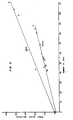
- the conventional electrode rather rapidly deteriorates to provide large millivolt values whereas, in comparison, the electrodes of this invention drift substantially more slowly to lower offset potential values.
- the electrodes of this invention typically respond as fast, and usually significantly faster than the conventional electrodes. Indeed, in many cases, the response times of the electrodes of this invention are dramatically shorter than those of the conventional electrodes.
- the electrodes of this invention are consistently much faster to respond and reach a stable potential.
- the data indicate that the electrodes of this invention are typically about 10 times as fast to respond and in many cases as much as 100 times as fast as the conventional sealed reference electrodes.
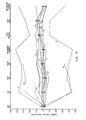
- Figure 10A illustrates the results normally obtained with a state of the art refillable reservoir, ceramic reference electrode.
- the large excursion represents the injection of ammonia into the water to correct the pH of the water in response to the pH value determined by the pH meter. It can be seen that the graph is erratic and typically fluctuates over about 4 divisions, or about 0.14 pH units. This fluctuation makes it uncertain what the true pH of the water is and therefore renders inaccurate the pH adjustment.
- Figure 10B illustrates the results obtained with the same equipment as in Figure 10A, but after careful maintenance and selection of the electrode. It can be seen that the graph is still erratic but less so than in Figure 10A.
- the width of the average fluctuations in Figure 10B is about 2 divisions, or about 0.07 pH units. This still represents a source of very significant error.
- FIG 10C illustrates the results obtained using an electrode of this invention.
- the electrode is a sealed reference electrode of the type shown in Figure 1 and containing ion exchange polymer of Example 4. It can be seen that the graph is dramatically different from those of Figures 10A and 10B.
- the read-out line is free of visible erratic oscillations and allows a substantially improved degree of accuracy and control over the pH. The excursion caused by the addition of ammonia is visibly better defined. This performance allows the pH correction to be achieved more accurately and without significant over adjustment.
Landscapes
- Chemical & Material Sciences (AREA)
- Life Sciences & Earth Sciences (AREA)
- Health & Medical Sciences (AREA)
- Physics & Mathematics (AREA)
- Chemical Kinetics & Catalysis (AREA)
- Electrochemistry (AREA)
- Molecular Biology (AREA)
- Analytical Chemistry (AREA)
- Biochemistry (AREA)
- General Health & Medical Sciences (AREA)
- General Physics & Mathematics (AREA)
- Immunology (AREA)
- Pathology (AREA)
- Water Treatment By Electricity Or Magnetism (AREA)
Applications Claiming Priority (4)
| Application Number | Priority Date | Filing Date | Title |
|---|---|---|---|
| US77454685A | 1985-09-10 | 1985-09-10 | |
| US06/816,378 US4913793A (en) | 1985-09-10 | 1986-01-06 | Reference electrode and method of making same |
| US816378 | 1986-01-06 | ||
| US774546 | 1996-12-30 |
Publications (1)
| Publication Number | Publication Date |
|---|---|
| EP0215614A2 true EP0215614A2 (de) | 1987-03-25 |
Family
ID=27118913
Family Applications (1)
| Application Number | Title | Priority Date | Filing Date |
|---|---|---|---|
| EP86306847A Withdrawn EP0215614A2 (de) | 1985-09-10 | 1986-09-04 | Bezugselektrode |
Country Status (3)
| Country | Link |
|---|---|
| US (1) | US4913793A (de) |
| EP (1) | EP0215614A2 (de) |
| AU (1) | AU6255086A (de) |
Cited By (4)
| Publication number | Priority date | Publication date | Assignee | Title |
|---|---|---|---|---|
| WO1989003032A1 (fr) * | 1987-09-25 | 1989-04-06 | Mussard Automation Sa | Electrode de reference |
| EP0449166A3 (en) * | 1990-03-30 | 1991-11-27 | Centro Sviluppo Materiali S.P.A. | Device for measuring the ph of liquid films |
| EP0550555A4 (en) * | 1990-09-28 | 1993-12-15 | Rosemount Inc. | Integral hydrolysis layer junction |
| TWI427654B (zh) * | 2006-12-19 | 2014-02-21 | Gen Electric | 超電容去鹽作用裝置及其製造方法 |
Families Citing this family (19)
| Publication number | Priority date | Publication date | Assignee | Title |
|---|---|---|---|---|
| DE3789898T2 (de) * | 1986-07-10 | 1994-09-08 | Terumo Corp | Referenzelektrode. |
| GB9013411D0 (en) * | 1990-06-15 | 1990-08-08 | Nat Power Plc | Improvements in or relating to glass ph electrodes |
| GB9015307D0 (en) * | 1990-07-12 | 1990-08-29 | Nat Power Plc | Improvements in or relating to glass ph electrodes |
| US5384031A (en) * | 1992-04-29 | 1995-01-24 | Diametrics Medical, Inc. | Reference electrode |
| US5346604A (en) * | 1992-10-21 | 1994-09-13 | Diametrics Medical, Inc. | Self-activating chemical sensor system |
| US5346606A (en) * | 1993-08-16 | 1994-09-13 | Elsag International N.V. | Electrochemical sensor |
| US5584978A (en) * | 1994-11-15 | 1996-12-17 | Cominco Ltd. | Collection electrode (collectrode) for geo-electrochemical sampling |
| DE69633441T2 (de) * | 1995-04-28 | 2005-10-13 | Rosemount Analytical Inc., Eden Prairie | Elektrochemischer sensor |
| US6495012B1 (en) | 2000-03-31 | 2002-12-17 | The Foxboro Company | Sensor for electrometric measurement |
| US20030178305A1 (en) * | 2000-03-31 | 2003-09-25 | Catalano Lauren M. | PH glass membrane and sensor |
| US6780307B2 (en) * | 2001-10-12 | 2004-08-24 | The United States Of America As Represented By The Secretary Of The Navy | Ion selective electrodes for direct organic drug analysis in saliva, sweat, and surface wipes |
| JP3625448B2 (ja) * | 2002-01-11 | 2005-03-02 | 株式会社日立ハイテクノロジーズ | イオンセンサ及びそれを用いた生化学自動分析装置 |
| US7166201B2 (en) * | 2003-12-01 | 2007-01-23 | Sierra Medical Technology | Self-condensing pH sensor |
| US20060249386A1 (en) * | 2005-05-05 | 2006-11-09 | Bower Michael M | Use of an osmotic pump to create a flowing reference junction for ionic-activity sensors |
| US7628901B2 (en) * | 2005-08-03 | 2009-12-08 | Horiba, Ltd. | Reference electrode, salt bridge and ionic concentration measuring device by the use of reference electrode and salt bridge |
| DE102006055221A1 (de) * | 2006-11-21 | 2008-05-29 | Endress + Hauser Conducta Gesellschaft für Mess- und Regeltechnik mbH + Co. KG | Elektrode und Einstabmesskette zur Bestimmung elektrochemischer Potentiale |
| DE102018128895A1 (de) * | 2017-12-19 | 2019-06-19 | Endress+Hauser Conducta Gmbh+Co. Kg | Bezugselektrode und Verfahren zur Herstellung einer Bezugselektrode |
| EP3795988B1 (de) * | 2019-09-19 | 2024-03-06 | ABB Schweiz AG | System mit ph-elektroden mit verbesserten anti-vergiftungseigenschaften |
| US11959870B2 (en) * | 2022-01-05 | 2024-04-16 | Hach Company | Differential probe with low-slope component |
Family Cites Families (27)
| Publication number | Priority date | Publication date | Assignee | Title |
|---|---|---|---|---|
| US24222A (en) * | 1859-05-31 | Suction-hose | ||
| USRE24222E (en) | 1956-09-18 | Electrode for determining | ||
| US2614976A (en) * | 1951-10-19 | 1952-10-21 | Gulf Research Development Co | Electrode for determining cationic activity |
| US2927887A (en) * | 1957-08-29 | 1960-03-08 | Leeds & Northrup Co | Plastic salt-bridge junctions |
| US3498899A (en) * | 1965-06-18 | 1970-03-03 | Beckman Instruments Inc | Electrochemical electrode assembly |
| FR1566161A (de) * | 1967-05-08 | 1969-05-09 | ||
| US3681025A (en) * | 1970-08-19 | 1972-08-01 | Svend B Dalgaard | Method and system to monitor ph values in water |
| US4002547A (en) * | 1970-08-21 | 1977-01-11 | Beckman Instruments, Inc. | Electrochemical reference electrode |
| US3686091A (en) * | 1970-10-02 | 1972-08-22 | Beckman Instruments Inc | Electrochemical cell |
| US3703457A (en) * | 1970-10-15 | 1972-11-21 | Gen Electric | Sensor with anion exchange resin electrolyte |
| US3800410A (en) * | 1970-10-15 | 1974-04-02 | Gen Electric | Sensor and method of manufacture |
| US3730868A (en) * | 1970-12-21 | 1973-05-01 | Gen Electric | Carbon dioxide sensor |
| IT969685B (it) * | 1971-10-21 | 1974-04-10 | Gen Electric | Elettrodo ionico specifico per uso elettrochimico |
| US3856649A (en) * | 1973-03-16 | 1974-12-24 | Miles Lab | Solid state electrode |
| US3911901A (en) * | 1974-07-24 | 1975-10-14 | Gen Electric | In vivo hydrogen ion sensor |
| US4115209A (en) * | 1974-10-30 | 1978-09-19 | Research Corporation | Method of determining ion activity using coated ion selective electrodes |
| JPS5198089A (en) * | 1975-02-25 | 1976-08-28 | Hikakudenkyokuno ekirakubu | |
| US4105509A (en) * | 1975-02-28 | 1978-08-08 | Leeds & Northrup Company | Combination measuring and reference potential electrode and method of measuring ph in samples subject to large voltage gradients |
| JPS5439155A (en) * | 1977-09-01 | 1979-03-26 | Toshiaki Hiratani | Folding large bell |
| US4214968A (en) * | 1978-04-05 | 1980-07-29 | Eastman Kodak Company | Ion-selective electrode |
| US4357143A (en) * | 1979-09-14 | 1982-11-02 | Phillips Petroleum Company | Determining ion concentration |
| DE3100302A1 (de) * | 1980-01-11 | 1981-12-10 | List, Hans, Prof. Dipl.-Ing. Dr.Dr.h.c., Graz | Elektrochemische referenzelektrode |
| US4282079A (en) * | 1980-02-13 | 1981-08-04 | Eastman Kodak Company | Planar glass ion-selective electrode |
| EP0042157B1 (de) * | 1980-06-16 | 1985-10-23 | Shimadzu Corporation | Elektrode zum Messen der ionischen Aktivität |
| DE3228647A1 (de) * | 1982-07-31 | 1984-02-02 | Dr. W. Ingold KG, 6000 Frankfurt | Bezugselektrode oder einstabmesskette |
| JPS5924242A (ja) * | 1982-08-02 | 1984-02-07 | Terumo Corp | 基準電極 |
| NL8300057A (nl) * | 1983-01-07 | 1984-08-01 | Cordis Europ | Elektrochemische halfcel. |
-
1986
- 1986-01-06 US US06/816,378 patent/US4913793A/en not_active Expired - Lifetime
- 1986-09-04 EP EP86306847A patent/EP0215614A2/de not_active Withdrawn
- 1986-09-10 AU AU62550/86A patent/AU6255086A/en not_active Abandoned
Cited By (4)
| Publication number | Priority date | Publication date | Assignee | Title |
|---|---|---|---|---|
| WO1989003032A1 (fr) * | 1987-09-25 | 1989-04-06 | Mussard Automation Sa | Electrode de reference |
| EP0449166A3 (en) * | 1990-03-30 | 1991-11-27 | Centro Sviluppo Materiali S.P.A. | Device for measuring the ph of liquid films |
| EP0550555A4 (en) * | 1990-09-28 | 1993-12-15 | Rosemount Inc. | Integral hydrolysis layer junction |
| TWI427654B (zh) * | 2006-12-19 | 2014-02-21 | Gen Electric | 超電容去鹽作用裝置及其製造方法 |
Also Published As
| Publication number | Publication date |
|---|---|
| AU6255086A (en) | 1987-03-12 |
| US4913793A (en) | 1990-04-03 |
Similar Documents
| Publication | Publication Date | Title |
|---|---|---|
| US4913793A (en) | Reference electrode and method of making same | |
| Hepler et al. | Dilatometric measurements of apparent molar volumes of dilute aqueous electrolytes | |
| EP0313657B1 (de) | Referenzelektrode | |
| US3498899A (en) | Electrochemical electrode assembly | |
| US5360529A (en) | Reference half-cell electrode | |
| EP0044869A4 (de) | Ionenselektive elektrode. | |
| US4495050A (en) | Temperature insensitive potentiometric electrode system | |
| Durst | Fluoride microanalysis by linear null-point potentiometry | |
| Durst et al. | Ion-selective electrode study of trace silver ion adsorption on selected surfaces | |
| CA1121001A (en) | Halide electrode | |
| JPS6351503B2 (de) | ||
| US4349426A (en) | Anion sensing electrode | |
| US4328082A (en) | Solid state ion-sensitive electrode and method of making said electrode | |
| US3671413A (en) | Nitrate ion sensitive electrode | |
| US4619739A (en) | Method and apparatus for measuring halogen ion concentration | |
| WO1991001495A1 (en) | Electrochemical cell, reference electrode and electrochemical method | |
| Nanjo et al. | An investigation of polyphenyl-onium bases and other materials for phosphate ion-selective electrodes | |
| WO2012057606A1 (en) | Silver and silver chloride reference electrode | |
| US4981567A (en) | Lithium-salt reference half-cell for potentiometric determinations | |
| JPH0518930A (ja) | 基準電極 | |
| WO1993015393A1 (en) | Reference electrodes | |
| US3824169A (en) | Ion selective electrode comprising gold | |
| JP2816125B2 (ja) | 塩素イオン濃度の測定方法 | |
| CN104849334A (zh) | 一种亚硝酸盐离子选择性电极及其制备方法 | |
| Srivastava et al. | Studies with an inorganic ion-exchange membrane exhibiting selectivity for Pb (II) ions |
Legal Events
| Date | Code | Title | Description |
|---|---|---|---|
| PUAI | Public reference made under article 153(3) epc to a published international application that has entered the european phase |
Free format text: ORIGINAL CODE: 0009012 |
|
| AK | Designated contracting states |
Kind code of ref document: A2 Designated state(s): AT BE CH DE FR GB IT LI LU NL SE |
|
| STAA | Information on the status of an ep patent application or granted ep patent |
Free format text: STATUS: THE APPLICATION IS DEEMED TO BE WITHDRAWN |
|
| 18D | Application deemed to be withdrawn |
Effective date: 19890331 |
|
| RIN1 | Information on inventor provided before grant (corrected) |
Inventor name: LEONARD, JOHN E. |