EP0216472A1 - Verfahren zur Umsetzung von Synthesegas in Gegenwart von abriebfesten Sulfiden - Google Patents
Verfahren zur Umsetzung von Synthesegas in Gegenwart von abriebfesten Sulfiden Download PDFInfo
- Publication number
- EP0216472A1 EP0216472A1 EP86306001A EP86306001A EP0216472A1 EP 0216472 A1 EP0216472 A1 EP 0216472A1 EP 86306001 A EP86306001 A EP 86306001A EP 86306001 A EP86306001 A EP 86306001A EP 0216472 A1 EP0216472 A1 EP 0216472A1
- Authority
- EP
- European Patent Office
- Prior art keywords
- catalytic
- centric
- sulfide
- precursor
- percent
- Prior art date
- Legal status (The legal status is an assumption and is not a legal conclusion. Google has not performed a legal analysis and makes no representation as to the accuracy of the status listed.)
- Withdrawn
Links
- 238000006243 chemical reaction Methods 0.000 title description 18
- 150000003568 thioethers Chemical class 0.000 title 1
- 239000002243 precursor Substances 0.000 claims abstract description 69
- 230000003197 catalytic effect Effects 0.000 claims abstract description 62
- 150000001298 alcohols Chemical class 0.000 claims abstract description 60
- UCKMPCXJQFINFW-UHFFFAOYSA-N Sulphide Chemical compound [S-2] UCKMPCXJQFINFW-UHFFFAOYSA-N 0.000 claims abstract description 56
- 229910052751 metal Inorganic materials 0.000 claims abstract description 28
- 239000002184 metal Substances 0.000 claims abstract description 28
- 150000001338 aliphatic hydrocarbons Chemical class 0.000 claims abstract description 27
- 229910052750 molybdenum Inorganic materials 0.000 claims abstract description 12
- 229910052721 tungsten Inorganic materials 0.000 claims abstract description 10
- 229910052758 niobium Inorganic materials 0.000 claims abstract description 6
- 229910052715 tantalum Inorganic materials 0.000 claims abstract description 6
- 229910052713 technetium Inorganic materials 0.000 claims abstract description 6
- 230000001376 precipitating effect Effects 0.000 claims abstract description 3
- 239000003054 catalyst Substances 0.000 claims description 57
- 238000000034 method Methods 0.000 claims description 38
- 230000008569 process Effects 0.000 claims description 31
- 239000000203 mixture Substances 0.000 claims description 25
- 238000005979 thermal decomposition reaction Methods 0.000 claims description 22
- VNWKTOKETHGBQD-UHFFFAOYSA-N methane Chemical compound C VNWKTOKETHGBQD-UHFFFAOYSA-N 0.000 claims description 21
- 238000004519 manufacturing process Methods 0.000 claims description 17
- 230000000694 effects Effects 0.000 claims description 16
- OKTJSMMVPCPJKN-UHFFFAOYSA-N Carbon Chemical compound [C] OKTJSMMVPCPJKN-UHFFFAOYSA-N 0.000 claims description 15
- 229910052799 carbon Inorganic materials 0.000 claims description 15
- 150000002430 hydrocarbons Chemical class 0.000 claims description 15
- IJGRMHOSHXDMSA-UHFFFAOYSA-N Atomic nitrogen Chemical compound N#N IJGRMHOSHXDMSA-UHFFFAOYSA-N 0.000 claims description 14
- 229930195733 hydrocarbon Natural products 0.000 claims description 14
- UFHFLCQGNIYNRP-UHFFFAOYSA-N Hydrogen Chemical compound [H][H] UFHFLCQGNIYNRP-UHFFFAOYSA-N 0.000 claims description 13
- 239000001257 hydrogen Substances 0.000 claims description 13
- UGFAIRIUMAVXCW-UHFFFAOYSA-N Carbon monoxide Chemical compound [O+]#[C-] UGFAIRIUMAVXCW-UHFFFAOYSA-N 0.000 claims description 12
- 229910002091 carbon monoxide Inorganic materials 0.000 claims description 12
- 229910052739 hydrogen Inorganic materials 0.000 claims description 12
- CWQXQMHSOZUFJS-UHFFFAOYSA-N molybdenum disulfide Chemical compound S=[Mo]=S CWQXQMHSOZUFJS-UHFFFAOYSA-N 0.000 claims description 10
- 229910052982 molybdenum disulfide Inorganic materials 0.000 claims description 9
- 229910052961 molybdenite Inorganic materials 0.000 claims description 7
- 229910052757 nitrogen Inorganic materials 0.000 claims description 7
- 229910052742 iron Inorganic materials 0.000 claims description 6
- 229910052759 nickel Inorganic materials 0.000 claims description 6
- 229910052776 Thorium Inorganic materials 0.000 claims description 5
- 239000012530 fluid Substances 0.000 claims description 5
- 229910052746 lanthanum Inorganic materials 0.000 claims description 5
- 229910052725 zinc Inorganic materials 0.000 claims description 5
- 229910052783 alkali metal Inorganic materials 0.000 claims description 3
- 150000001340 alkali metals Chemical class 0.000 claims description 3
- 229910052791 calcium Inorganic materials 0.000 claims description 3
- 229910052749 magnesium Inorganic materials 0.000 claims description 3
- 229910052700 potassium Inorganic materials 0.000 claims description 3
- 229910052702 rhenium Inorganic materials 0.000 claims description 3
- 239000004215 Carbon black (E152) Substances 0.000 claims description 2
- 229910052684 Cerium Inorganic materials 0.000 claims description 2
- 229910052772 Samarium Inorganic materials 0.000 claims description 2
- 150000001335 aliphatic alkanes Chemical class 0.000 claims description 2
- 239000007864 aqueous solution Substances 0.000 claims description 2
- 239000008246 gaseous mixture Substances 0.000 claims description 2
- 229910052708 sodium Inorganic materials 0.000 claims description 2
- 229910019964 (NH4)2MoS4 Inorganic materials 0.000 claims 1
- 230000015572 biosynthetic process Effects 0.000 abstract description 22
- 238000003786 synthesis reaction Methods 0.000 abstract description 18
- 235000019441 ethanol Nutrition 0.000 description 65
- OKKJLVBELUTLKV-UHFFFAOYSA-N Methanol Chemical compound OC OKKJLVBELUTLKV-UHFFFAOYSA-N 0.000 description 49
- 239000007789 gas Substances 0.000 description 32
- 239000000047 product Substances 0.000 description 30
- 239000002245 particle Substances 0.000 description 28
- LFQSCWFLJHTTHZ-UHFFFAOYSA-N Ethanol Chemical compound CCO LFQSCWFLJHTTHZ-UHFFFAOYSA-N 0.000 description 23
- QGZKDVFQNNGYKY-UHFFFAOYSA-N Ammonia Chemical compound N QGZKDVFQNNGYKY-UHFFFAOYSA-N 0.000 description 19
- 150000001875 compounds Chemical class 0.000 description 12
- 239000013078 crystal Substances 0.000 description 12
- 229910000037 hydrogen sulfide Inorganic materials 0.000 description 12
- XLYOFNOQVPJJNP-UHFFFAOYSA-N water Substances O XLYOFNOQVPJJNP-UHFFFAOYSA-N 0.000 description 12
- RWSOTUBLDIXVET-UHFFFAOYSA-N Dihydrogen sulfide Chemical compound S RWSOTUBLDIXVET-UHFFFAOYSA-N 0.000 description 11
- 239000012298 atmosphere Substances 0.000 description 11
- 239000007788 liquid Substances 0.000 description 11
- 229910052784 alkaline earth metal Inorganic materials 0.000 description 10
- 239000000463 material Substances 0.000 description 9
- CURLTUGMZLYLDI-UHFFFAOYSA-N Carbon dioxide Chemical compound O=C=O CURLTUGMZLYLDI-UHFFFAOYSA-N 0.000 description 8
- 229910052768 actinide Inorganic materials 0.000 description 8
- 150000001255 actinides Chemical class 0.000 description 8
- 229910052747 lanthanoid Inorganic materials 0.000 description 8
- 150000002602 lanthanoids Chemical class 0.000 description 8
- 238000010899 nucleation Methods 0.000 description 8
- 230000006911 nucleation Effects 0.000 description 8
- 230000009467 reduction Effects 0.000 description 8
- PXHVJJICTQNCMI-UHFFFAOYSA-N Nickel Chemical compound [Ni] PXHVJJICTQNCMI-UHFFFAOYSA-N 0.000 description 7
- 238000001556 precipitation Methods 0.000 description 7
- 239000000243 solution Substances 0.000 description 7
- XEEYBQQBJWHFJM-UHFFFAOYSA-N Iron Chemical compound [Fe] XEEYBQQBJWHFJM-UHFFFAOYSA-N 0.000 description 6
- 239000003513 alkali Substances 0.000 description 6
- 239000006227 byproduct Substances 0.000 description 6
- KFZMGEQAYNKOFK-UHFFFAOYSA-N Isopropanol Chemical compound CC(C)O KFZMGEQAYNKOFK-UHFFFAOYSA-N 0.000 description 5
- LRHPLDYGYMQRHN-UHFFFAOYSA-N N-Butanol Chemical compound CCCCO LRHPLDYGYMQRHN-UHFFFAOYSA-N 0.000 description 5
- NINIDFKCEFEMDL-UHFFFAOYSA-N Sulfur Chemical compound [S] NINIDFKCEFEMDL-UHFFFAOYSA-N 0.000 description 5
- 150000001342 alkaline earth metals Chemical class 0.000 description 5
- BTANRVKWQNVYAZ-UHFFFAOYSA-N butan-2-ol Chemical compound CCC(C)O BTANRVKWQNVYAZ-UHFFFAOYSA-N 0.000 description 5
- 150000002739 metals Chemical class 0.000 description 5
- BDERNNFJNOPAEC-UHFFFAOYSA-N propan-1-ol Chemical compound CCCO BDERNNFJNOPAEC-UHFFFAOYSA-N 0.000 description 5
- 239000007787 solid Substances 0.000 description 5
- 229910052717 sulfur Inorganic materials 0.000 description 5
- 239000011593 sulfur Substances 0.000 description 5
- 239000011701 zinc Substances 0.000 description 5
- 229910002092 carbon dioxide Inorganic materials 0.000 description 4
- 229910017052 cobalt Inorganic materials 0.000 description 4
- 239000010941 cobalt Substances 0.000 description 4
- GUTLYIVDDKVIGB-UHFFFAOYSA-N cobalt atom Chemical compound [Co] GUTLYIVDDKVIGB-UHFFFAOYSA-N 0.000 description 4
- 230000007423 decrease Effects 0.000 description 4
- 238000005755 formation reaction Methods 0.000 description 4
- 239000011521 glass Substances 0.000 description 4
- ZXEKIIBDNHEJCQ-UHFFFAOYSA-N isobutanol Chemical compound CC(C)CO ZXEKIIBDNHEJCQ-UHFFFAOYSA-N 0.000 description 4
- 239000000843 powder Substances 0.000 description 4
- 239000002904 solvent Substances 0.000 description 4
- 150000004763 sulfides Chemical class 0.000 description 4
- 229910052723 transition metal Inorganic materials 0.000 description 4
- 238000011282 treatment Methods 0.000 description 4
- QGZKDVFQNNGYKY-UHFFFAOYSA-O Ammonium Chemical compound [NH4+] QGZKDVFQNNGYKY-UHFFFAOYSA-O 0.000 description 3
- LYCAIKOWRPUZTN-UHFFFAOYSA-N Ethylene glycol Chemical compound OCCO LYCAIKOWRPUZTN-UHFFFAOYSA-N 0.000 description 3
- PEDCQBHIVMGVHV-UHFFFAOYSA-N Glycerine Chemical compound OCC(O)CO PEDCQBHIVMGVHV-UHFFFAOYSA-N 0.000 description 3
- ZOKXTWBITQBERF-UHFFFAOYSA-N Molybdenum Chemical compound [Mo] ZOKXTWBITQBERF-UHFFFAOYSA-N 0.000 description 3
- DKGAVHZHDRPRBM-UHFFFAOYSA-N Tert-Butanol Chemical compound CC(C)(C)O DKGAVHZHDRPRBM-UHFFFAOYSA-N 0.000 description 3
- HCHKCACWOHOZIP-UHFFFAOYSA-N Zinc Chemical compound [Zn] HCHKCACWOHOZIP-UHFFFAOYSA-N 0.000 description 3
- PNEYBMLMFCGWSK-UHFFFAOYSA-N aluminium oxide Inorganic materials [O-2].[O-2].[O-2].[Al+3].[Al+3] PNEYBMLMFCGWSK-UHFFFAOYSA-N 0.000 description 3
- 239000002585 base Substances 0.000 description 3
- 239000001569 carbon dioxide Substances 0.000 description 3
- 239000003153 chemical reaction reagent Substances 0.000 description 3
- 238000000354 decomposition reaction Methods 0.000 description 3
- 238000009826 distribution Methods 0.000 description 3
- 238000001035 drying Methods 0.000 description 3
- 239000000446 fuel Substances 0.000 description 3
- 238000010438 heat treatment Methods 0.000 description 3
- 125000004356 hydroxy functional group Chemical group O* 0.000 description 3
- 239000011733 molybdenum Substances 0.000 description 3
- 235000016768 molybdenum Nutrition 0.000 description 3
- JKQOBWVOAYFWKG-UHFFFAOYSA-N molybdenum trioxide Chemical compound O=[Mo](=O)=O JKQOBWVOAYFWKG-UHFFFAOYSA-N 0.000 description 3
- 238000002360 preparation method Methods 0.000 description 3
- 239000000725 suspension Substances 0.000 description 3
- 238000012360 testing method Methods 0.000 description 3
- 150000003624 transition metals Chemical class 0.000 description 3
- 229910052720 vanadium Inorganic materials 0.000 description 3
- LEONUFNNVUYDNQ-UHFFFAOYSA-N vanadium atom Chemical compound [V] LEONUFNNVUYDNQ-UHFFFAOYSA-N 0.000 description 3
- ZSLUVFAKFWKJRC-IGMARMGPSA-N 232Th Chemical compound [232Th] ZSLUVFAKFWKJRC-IGMARMGPSA-N 0.000 description 2
- XKRFYHLGVUSROY-UHFFFAOYSA-N Argon Chemical compound [Ar] XKRFYHLGVUSROY-UHFFFAOYSA-N 0.000 description 2
- OAKJQQAXSVQMHS-UHFFFAOYSA-N Hydrazine Chemical compound NN OAKJQQAXSVQMHS-UHFFFAOYSA-N 0.000 description 2
- GWEVSGVZZGPLCZ-UHFFFAOYSA-N Titan oxide Chemical compound O=[Ti]=O GWEVSGVZZGPLCZ-UHFFFAOYSA-N 0.000 description 2
- QVGXLLKOCUKJST-UHFFFAOYSA-N atomic oxygen Chemical compound [O] QVGXLLKOCUKJST-UHFFFAOYSA-N 0.000 description 2
- 239000011230 binding agent Substances 0.000 description 2
- 239000011575 calcium Substances 0.000 description 2
- 230000008859 change Effects 0.000 description 2
- 229910052804 chromium Inorganic materials 0.000 description 2
- 239000011651 chromium Substances 0.000 description 2
- 229910052802 copper Inorganic materials 0.000 description 2
- 239000010949 copper Substances 0.000 description 2
- 229910052593 corundum Inorganic materials 0.000 description 2
- 238000005243 fluidization Methods 0.000 description 2
- 230000005484 gravity Effects 0.000 description 2
- FZLIPJUXYLNCLC-UHFFFAOYSA-N lanthanum atom Chemical compound [La] FZLIPJUXYLNCLC-UHFFFAOYSA-N 0.000 description 2
- 239000011777 magnesium Substances 0.000 description 2
- 238000005259 measurement Methods 0.000 description 2
- 229910052976 metal sulfide Inorganic materials 0.000 description 2
- 238000002156 mixing Methods 0.000 description 2
- 229910052760 oxygen Inorganic materials 0.000 description 2
- 239000001301 oxygen Substances 0.000 description 2
- 238000012545 processing Methods 0.000 description 2
- 230000005855 radiation Effects 0.000 description 2
- 230000000717 retained effect Effects 0.000 description 2
- SMQUZDBALVYZAC-UHFFFAOYSA-N salicylaldehyde Chemical compound OC1=CC=CC=C1C=O SMQUZDBALVYZAC-UHFFFAOYSA-N 0.000 description 2
- 238000000926 separation method Methods 0.000 description 2
- 239000000126 substance Substances 0.000 description 2
- 230000003319 supportive effect Effects 0.000 description 2
- 239000010936 titanium Substances 0.000 description 2
- 229910052719 titanium Inorganic materials 0.000 description 2
- ITRNXVSDJBHYNJ-UHFFFAOYSA-N tungsten disulfide Chemical compound S=[W]=S ITRNXVSDJBHYNJ-UHFFFAOYSA-N 0.000 description 2
- 229910001845 yogo sapphire Inorganic materials 0.000 description 2
- VHUUQVKOLVNVRT-UHFFFAOYSA-N Ammonium hydroxide Chemical compound [NH4+].[OH-] VHUUQVKOLVNVRT-UHFFFAOYSA-N 0.000 description 1
- OYPRJOBELJOOCE-UHFFFAOYSA-N Calcium Chemical compound [Ca] OYPRJOBELJOOCE-UHFFFAOYSA-N 0.000 description 1
- VYZAMTAEIAYCRO-UHFFFAOYSA-N Chromium Chemical compound [Cr] VYZAMTAEIAYCRO-UHFFFAOYSA-N 0.000 description 1
- 235000013162 Cocos nucifera Nutrition 0.000 description 1
- 244000060011 Cocos nucifera Species 0.000 description 1
- RYGMFSIKBFXOCR-UHFFFAOYSA-N Copper Chemical compound [Cu] RYGMFSIKBFXOCR-UHFFFAOYSA-N 0.000 description 1
- OTMSDBZUPAUEDD-UHFFFAOYSA-N Ethane Chemical compound CC OTMSDBZUPAUEDD-UHFFFAOYSA-N 0.000 description 1
- CWYNVVGOOAEACU-UHFFFAOYSA-N Fe2+ Chemical compound [Fe+2] CWYNVVGOOAEACU-UHFFFAOYSA-N 0.000 description 1
- AVXURJPOCDRRFD-UHFFFAOYSA-N Hydroxylamine Chemical compound ON AVXURJPOCDRRFD-UHFFFAOYSA-N 0.000 description 1
- FYYHWMGAXLPEAU-UHFFFAOYSA-N Magnesium Chemical compound [Mg] FYYHWMGAXLPEAU-UHFFFAOYSA-N 0.000 description 1
- 235000009421 Myristica fragrans Nutrition 0.000 description 1
- ZLMJMSJWJFRBEC-UHFFFAOYSA-N Potassium Chemical compound [K] ZLMJMSJWJFRBEC-UHFFFAOYSA-N 0.000 description 1
- XBDQKXXYIPTUBI-UHFFFAOYSA-M Propionate Chemical compound CCC([O-])=O XBDQKXXYIPTUBI-UHFFFAOYSA-M 0.000 description 1
- RTAQQCXQSZGOHL-UHFFFAOYSA-N Titanium Chemical compound [Ti] RTAQQCXQSZGOHL-UHFFFAOYSA-N 0.000 description 1
- 229910052770 Uranium Inorganic materials 0.000 description 1
- QCWXUUIWCKQGHC-UHFFFAOYSA-N Zirconium Chemical compound [Zr] QCWXUUIWCKQGHC-UHFFFAOYSA-N 0.000 description 1
- 238000010521 absorption reaction Methods 0.000 description 1
- KXKVLQRXCPHEJC-UHFFFAOYSA-N acetic acid trimethyl ester Natural products COC(C)=O KXKVLQRXCPHEJC-UHFFFAOYSA-N 0.000 description 1
- 229910052767 actinium Inorganic materials 0.000 description 1
- QQINRWTZWGJFDB-UHFFFAOYSA-N actinium atom Chemical compound [Ac] QQINRWTZWGJFDB-UHFFFAOYSA-N 0.000 description 1
- 230000004913 activation Effects 0.000 description 1
- 230000002730 additional effect Effects 0.000 description 1
- 239000000654 additive Substances 0.000 description 1
- 230000000996 additive effect Effects 0.000 description 1
- 150000001299 aldehydes Chemical class 0.000 description 1
- 229910001854 alkali hydroxide Inorganic materials 0.000 description 1
- 229910000272 alkali metal oxide Inorganic materials 0.000 description 1
- 239000000956 alloy Substances 0.000 description 1
- 229910045601 alloy Inorganic materials 0.000 description 1
- 235000011114 ammonium hydroxide Nutrition 0.000 description 1
- 230000002421 anti-septic effect Effects 0.000 description 1
- 229940064004 antiseptic throat preparations Drugs 0.000 description 1
- 229910052786 argon Inorganic materials 0.000 description 1
- 229910052788 barium Inorganic materials 0.000 description 1
- DSAJWYNOEDNPEQ-UHFFFAOYSA-N barium atom Chemical compound [Ba] DSAJWYNOEDNPEQ-UHFFFAOYSA-N 0.000 description 1
- 238000009835 boiling Methods 0.000 description 1
- 229910052793 cadmium Inorganic materials 0.000 description 1
- 239000003575 carbonaceous material Substances 0.000 description 1
- 125000002915 carbonyl group Chemical group [*:2]C([*:1])=O 0.000 description 1
- 238000006555 catalytic reaction Methods 0.000 description 1
- 239000003638 chemical reducing agent Substances 0.000 description 1
- 239000003245 coal Substances 0.000 description 1
- 150000001869 cobalt compounds Chemical class 0.000 description 1
- -1 cobaltous sulfides Chemical class 0.000 description 1
- 238000002485 combustion reaction Methods 0.000 description 1
- 238000010960 commercial process Methods 0.000 description 1
- 239000013065 commercial product Substances 0.000 description 1
- 239000000470 constituent Substances 0.000 description 1
- 238000005260 corrosion Methods 0.000 description 1
- 230000007797 corrosion Effects 0.000 description 1
- 238000005336 cracking Methods 0.000 description 1
- 238000002425 crystallisation Methods 0.000 description 1
- 230000008025 crystallization Effects 0.000 description 1
- 230000003247 decreasing effect Effects 0.000 description 1
- 230000002939 deleterious effect Effects 0.000 description 1
- 238000000432 density-gradient centrifugation Methods 0.000 description 1
- 239000002019 doping agent Substances 0.000 description 1
- 239000000428 dust Substances 0.000 description 1
- 239000000945 filler Substances 0.000 description 1
- 238000001914 filtration Methods 0.000 description 1
- 239000000727 fraction Substances 0.000 description 1
- 239000002816 fuel additive Substances 0.000 description 1
- 238000002309 gasification Methods 0.000 description 1
- 229910052735 hafnium Inorganic materials 0.000 description 1
- VBJZVLUMGGDVMO-UHFFFAOYSA-N hafnium atom Chemical compound [Hf] VBJZVLUMGGDVMO-UHFFFAOYSA-N 0.000 description 1
- 150000002431 hydrogen Chemical class 0.000 description 1
- 238000005984 hydrogenation reaction Methods 0.000 description 1
- 150000004679 hydroxides Chemical class 0.000 description 1
- 238000005470 impregnation Methods 0.000 description 1
- 239000011261 inert gas Substances 0.000 description 1
- 239000004615 ingredient Substances 0.000 description 1
- 239000000543 intermediate Substances 0.000 description 1
- UQSXHKLRYXJYBZ-UHFFFAOYSA-N iron oxide Inorganic materials [Fe]=O UQSXHKLRYXJYBZ-UHFFFAOYSA-N 0.000 description 1
- 235000013980 iron oxide Nutrition 0.000 description 1
- VBMVTYDPPZVILR-UHFFFAOYSA-N iron(2+);oxygen(2-) Chemical class [O-2].[Fe+2] VBMVTYDPPZVILR-UHFFFAOYSA-N 0.000 description 1
- 239000007791 liquid phase Substances 0.000 description 1
- 239000006194 liquid suspension Substances 0.000 description 1
- 239000001115 mace Substances 0.000 description 1
- 229910052748 manganese Inorganic materials 0.000 description 1
- 239000011572 manganese Substances 0.000 description 1
- WPBNNNQJVZRUHP-UHFFFAOYSA-L manganese(2+);methyl n-[[2-(methoxycarbonylcarbamothioylamino)phenyl]carbamothioyl]carbamate;n-[2-(sulfidocarbothioylamino)ethyl]carbamodithioate Chemical compound [Mn+2].[S-]C(=S)NCCNC([S-])=S.COC(=O)NC(=S)NC1=CC=CC=C1NC(=S)NC(=O)OC WPBNNNQJVZRUHP-UHFFFAOYSA-L 0.000 description 1
- 229910052753 mercury Inorganic materials 0.000 description 1
- 229910052987 metal hydride Inorganic materials 0.000 description 1
- 150000004681 metal hydrides Chemical class 0.000 description 1
- 229940057952 methanol Drugs 0.000 description 1
- 125000000956 methoxy group Chemical group [H]C([H])([H])O* 0.000 description 1
- 239000002808 molecular sieve Substances 0.000 description 1
- 239000003345 natural gas Substances 0.000 description 1
- LVIYYTJTOKJJOC-UHFFFAOYSA-N nickel phthalocyanine Chemical compound [Ni+2].C12=CC=CC=C2C(N=C2[N-]C(C3=CC=CC=C32)=N2)=NC1=NC([C]1C=CC=CC1=1)=NC=1N=C1[C]3C=CC=CC3=C2[N-]1 LVIYYTJTOKJJOC-UHFFFAOYSA-N 0.000 description 1
- 239000003921 oil Substances 0.000 description 1
- 230000001590 oxidative effect Effects 0.000 description 1
- 239000011236 particulate material Substances 0.000 description 1
- 238000005191 phase separation Methods 0.000 description 1
- 229910052697 platinum Inorganic materials 0.000 description 1
- 239000011591 potassium Substances 0.000 description 1
- 238000000746 purification Methods 0.000 description 1
- 230000036647 reaction Effects 0.000 description 1
- 230000008929 regeneration Effects 0.000 description 1
- 238000011069 regeneration method Methods 0.000 description 1
- 230000001105 regulatory effect Effects 0.000 description 1
- 238000012552 review Methods 0.000 description 1
- 229910052703 rhodium Inorganic materials 0.000 description 1
- 239000012047 saturated solution Substances 0.000 description 1
- 229910052706 scandium Inorganic materials 0.000 description 1
- SIXSYDAISGFNSX-UHFFFAOYSA-N scandium atom Chemical compound [Sc] SIXSYDAISGFNSX-UHFFFAOYSA-N 0.000 description 1
- 238000012216 screening Methods 0.000 description 1
- 238000005245 sintering Methods 0.000 description 1
- 239000002002 slurry Substances 0.000 description 1
- URGAHOPLAPQHLN-UHFFFAOYSA-N sodium aluminosilicate Chemical compound [Na+].[Al+3].[O-][Si]([O-])=O.[O-][Si]([O-])=O URGAHOPLAPQHLN-UHFFFAOYSA-N 0.000 description 1
- 239000011877 solvent mixture Substances 0.000 description 1
- 230000002269 spontaneous effect Effects 0.000 description 1
- 239000010935 stainless steel Substances 0.000 description 1
- 229910001220 stainless steel Inorganic materials 0.000 description 1
- 238000000629 steam reforming Methods 0.000 description 1
- 238000003756 stirring Methods 0.000 description 1
- 229910052712 strontium Inorganic materials 0.000 description 1
- CIOAGBVUUVVLOB-UHFFFAOYSA-N strontium atom Chemical compound [Sr] CIOAGBVUUVVLOB-UHFFFAOYSA-N 0.000 description 1
- XTQHKBHJIVJGKJ-UHFFFAOYSA-N sulfur monoxide Chemical class S=O XTQHKBHJIVJGKJ-UHFFFAOYSA-N 0.000 description 1
- 235000010215 titanium dioxide Nutrition 0.000 description 1
- 150000003623 transition metal compounds Chemical class 0.000 description 1
- WFKWXMTUELFFGS-UHFFFAOYSA-N tungsten Chemical compound [W] WFKWXMTUELFFGS-UHFFFAOYSA-N 0.000 description 1
- 239000010937 tungsten Substances 0.000 description 1
- DNYWZCXLKNTFFI-UHFFFAOYSA-N uranium Chemical compound [U][U][U][U][U][U][U][U][U][U][U][U][U][U][U][U][U][U][U][U][U][U][U][U][U][U][U][U][U][U][U][U][U][U][U][U][U][U][U][U][U][U][U][U][U][U][U][U][U][U][U][U][U][U][U][U][U][U][U][U][U][U][U][U][U][U][U][U][U][U][U][U][U][U][U][U][U][U][U][U][U][U][U][U][U][U][U][U][U][U][U][U][U][U][U][U][U][U][U][U][U][U][U][U][U][U][U][U][U][U][U][U][U][U] DNYWZCXLKNTFFI-UHFFFAOYSA-N 0.000 description 1
- 229910052727 yttrium Inorganic materials 0.000 description 1
- VWQVUPCCIRVNHF-UHFFFAOYSA-N yttrium atom Chemical compound [Y] VWQVUPCCIRVNHF-UHFFFAOYSA-N 0.000 description 1
- 235000014692 zinc oxide Nutrition 0.000 description 1
- 229910052726 zirconium Inorganic materials 0.000 description 1
Images
Classifications
-
- C—CHEMISTRY; METALLURGY
- C01—INORGANIC CHEMISTRY
- C01G—COMPOUNDS CONTAINING METALS NOT COVERED BY SUBCLASSES C01D OR C01F
- C01G39/00—Compounds of molybdenum
- C01G39/06—Sulfides
-
- C—CHEMISTRY; METALLURGY
- C07—ORGANIC CHEMISTRY
- C07C—ACYCLIC OR CARBOCYCLIC COMPOUNDS
- C07C31/00—Saturated compounds having hydroxy or O-metal groups bound to acyclic carbon atoms
- C07C31/02—Monohydroxylic acyclic alcohols
-
- B—PERFORMING OPERATIONS; TRANSPORTING
- B01—PHYSICAL OR CHEMICAL PROCESSES OR APPARATUS IN GENERAL
- B01J—CHEMICAL OR PHYSICAL PROCESSES, e.g. CATALYSIS OR COLLOID CHEMISTRY; THEIR RELEVANT APPARATUS
- B01J27/00—Catalysts comprising the elements or compounds of halogens, sulfur, selenium, tellurium, phosphorus or nitrogen; Catalysts comprising carbon compounds
- B01J27/02—Sulfur, selenium or tellurium; Compounds thereof
- B01J27/04—Sulfides
- B01J27/047—Sulfides with chromium, molybdenum, tungsten or polonium
-
- C—CHEMISTRY; METALLURGY
- C07—ORGANIC CHEMISTRY
- C07C—ACYCLIC OR CARBOCYCLIC COMPOUNDS
- C07C1/00—Preparation of hydrocarbons from one or more compounds, none of them being a hydrocarbon
- C07C1/02—Preparation of hydrocarbons from one or more compounds, none of them being a hydrocarbon from oxides of a carbon
- C07C1/04—Preparation of hydrocarbons from one or more compounds, none of them being a hydrocarbon from oxides of a carbon from carbon monoxide with hydrogen
- C07C1/0425—Catalysts; their physical properties
- C07C1/0445—Preparation; Activation
-
- C—CHEMISTRY; METALLURGY
- C07—ORGANIC CHEMISTRY
- C07C—ACYCLIC OR CARBOCYCLIC COMPOUNDS
- C07C29/00—Preparation of compounds having hydroxy or O-metal groups bound to a carbon atom not belonging to a six-membered aromatic ring
- C07C29/15—Preparation of compounds having hydroxy or O-metal groups bound to a carbon atom not belonging to a six-membered aromatic ring by reduction of oxides of carbon exclusively
- C07C29/151—Preparation of compounds having hydroxy or O-metal groups bound to a carbon atom not belonging to a six-membered aromatic ring by reduction of oxides of carbon exclusively with hydrogen or hydrogen-containing gases
- C07C29/153—Preparation of compounds having hydroxy or O-metal groups bound to a carbon atom not belonging to a six-membered aromatic ring by reduction of oxides of carbon exclusively with hydrogen or hydrogen-containing gases characterised by the catalyst used
-
- C—CHEMISTRY; METALLURGY
- C07—ORGANIC CHEMISTRY
- C07C—ACYCLIC OR CARBOCYCLIC COMPOUNDS
- C07C2521/00—Catalysts comprising the elements, oxides or hydroxides of magnesium, boron, aluminium, carbon, silicon, titanium, zirconium or hafnium
- C07C2521/10—Magnesium; Oxides or hydroxides thereof
-
- C—CHEMISTRY; METALLURGY
- C07—ORGANIC CHEMISTRY
- C07C—ACYCLIC OR CARBOCYCLIC COMPOUNDS
- C07C2523/00—Catalysts comprising metals or metal oxides or hydroxides, not provided for in group C07C2521/00
- C07C2523/02—Catalysts comprising metals or metal oxides or hydroxides, not provided for in group C07C2521/00 of the alkali- or alkaline earth metals or beryllium
- C07C2523/04—Alkali metals
-
- C—CHEMISTRY; METALLURGY
- C07—ORGANIC CHEMISTRY
- C07C—ACYCLIC OR CARBOCYCLIC COMPOUNDS
- C07C2523/00—Catalysts comprising metals or metal oxides or hydroxides, not provided for in group C07C2521/00
- C07C2523/06—Catalysts comprising metals or metal oxides or hydroxides, not provided for in group C07C2521/00 of zinc, cadmium or mercury
-
- C—CHEMISTRY; METALLURGY
- C07—ORGANIC CHEMISTRY
- C07C—ACYCLIC OR CARBOCYCLIC COMPOUNDS
- C07C2523/00—Catalysts comprising metals or metal oxides or hydroxides, not provided for in group C07C2521/00
- C07C2523/10—Catalysts comprising metals or metal oxides or hydroxides, not provided for in group C07C2521/00 of rare earths
-
- C—CHEMISTRY; METALLURGY
- C07—ORGANIC CHEMISTRY
- C07C—ACYCLIC OR CARBOCYCLIC COMPOUNDS
- C07C2523/00—Catalysts comprising metals or metal oxides or hydroxides, not provided for in group C07C2521/00
- C07C2523/12—Catalysts comprising metals or metal oxides or hydroxides, not provided for in group C07C2521/00 of actinides
-
- C—CHEMISTRY; METALLURGY
- C07—ORGANIC CHEMISTRY
- C07C—ACYCLIC OR CARBOCYCLIC COMPOUNDS
- C07C2523/00—Catalysts comprising metals or metal oxides or hydroxides, not provided for in group C07C2521/00
- C07C2523/70—Catalysts comprising metals or metal oxides or hydroxides, not provided for in group C07C2521/00 of the iron group metals or copper
- C07C2523/74—Iron group metals
- C07C2523/745—Iron
-
- C—CHEMISTRY; METALLURGY
- C07—ORGANIC CHEMISTRY
- C07C—ACYCLIC OR CARBOCYCLIC COMPOUNDS
- C07C2523/00—Catalysts comprising metals or metal oxides or hydroxides, not provided for in group C07C2521/00
- C07C2523/70—Catalysts comprising metals or metal oxides or hydroxides, not provided for in group C07C2521/00 of the iron group metals or copper
- C07C2523/74—Iron group metals
- C07C2523/75—Cobalt
-
- C—CHEMISTRY; METALLURGY
- C07—ORGANIC CHEMISTRY
- C07C—ACYCLIC OR CARBOCYCLIC COMPOUNDS
- C07C2523/00—Catalysts comprising metals or metal oxides or hydroxides, not provided for in group C07C2521/00
- C07C2523/70—Catalysts comprising metals or metal oxides or hydroxides, not provided for in group C07C2521/00 of the iron group metals or copper
- C07C2523/74—Iron group metals
- C07C2523/755—Nickel
-
- C—CHEMISTRY; METALLURGY
- C07—ORGANIC CHEMISTRY
- C07C—ACYCLIC OR CARBOCYCLIC COMPOUNDS
- C07C2527/00—Catalysts comprising the elements or compounds of halogens, sulfur, selenium, tellurium, phosphorus or nitrogen; Catalysts comprising carbon compounds
- C07C2527/02—Sulfur, selenium or tellurium; Compounds thereof
- C07C2527/04—Sulfides
- C07C2527/047—Sulfides with chromium, molybdenum, tungsten or polonium
-
- Y—GENERAL TAGGING OF NEW TECHNOLOGICAL DEVELOPMENTS; GENERAL TAGGING OF CROSS-SECTIONAL TECHNOLOGIES SPANNING OVER SEVERAL SECTIONS OF THE IPC; TECHNICAL SUBJECTS COVERED BY FORMER USPC CROSS-REFERENCE ART COLLECTIONS [XRACs] AND DIGESTS
- Y02—TECHNOLOGIES OR APPLICATIONS FOR MITIGATION OR ADAPTATION AGAINST CLIMATE CHANGE
- Y02P—CLIMATE CHANGE MITIGATION TECHNOLOGIES IN THE PRODUCTION OR PROCESSING OF GOODS
- Y02P20/00—Technologies relating to chemical industry
- Y02P20/50—Improvements relating to the production of bulk chemicals
- Y02P20/52—Improvements relating to the production of bulk chemicals using catalysts, e.g. selective catalysts
Definitions
- This invention concerns an attrition-resistant, unsupported catalytic sulfide containing Nb, Ta, Mo, W, Tc or Re used to make C 1-10 aliphatic hydrocarbons or mixed alcohols from synthesis gas.
- the catalytic sulfide which has a new crystal structure, is made by thermal decomposition of a centric particulate precursor.
- U.S. Patent 4,177,202 teachs a process for making methane-rich hydrocarbons from H2/CO over a molybdena and optionally promoted cobalt or vanadium catalyst. Selectivity to ethane is enhanced by the presence of hydrogen sulfide in the syngas feed.
- U.S. Patent 2,490,488 discloses that molybdenum sulfide methanation catalysts acquire Fischer-Tropsch activity when promoted with an alkaline compound of an alkali metal.
- the example of the invention shows a 30 percent selectivity to C3+ hydrocarbons and oxygenates. Of this 30 percent, no more than 44 percent boils near or above 65°C, the boiling point of methanol. Accordingly, the maximum possible alcohol selectivity is no more than 13.2 percent (44 percent of 30 percent).
- U.S. Patents 4,243,553 and 4,243,554 teach the thermal decomposition of certain aliphatic- and heterocyclic- ammoniumthiomolybdate and -oxythiomolybdate powders into a high surface area molybdenum disulfide catalyst.
- the catalyst must be processed with binders, supports and/or metal doping agents such as tungsten and vanadium in order to retard sintering loss and thus to be useful in a fluid bed reactor.
- U.S. Patent 4,459,369 teachs a catalyst for preparing oxygenates from syngas.
- the catalyst contains Cu and Ti, plus at least one other metal of Cr, Mn, Co, Mo, Rh, Pt or Fe, and an alkali or alkaline earth metal in stated ratios.
- the process must employ a catalyst and conditions which are highly efficient.
- the catalyst must yield a high weight ratio of desired product per unit weight of catalyst in a given period of time.
- the catalyst must be stable and active for long periods of time between regenerations. This may be particularly difficult to accomplish, especially for alcohols, when the H2/CO ratio of the feed gas is low, such as less than 2 to 1.
- the catalyst will be sulfur tolerant and will have a high selectivity to a commercial product to avoid purification or removal and disposal of by-products and to avoid separation into two or more product streams.
- the ratio of C1 to C2+ alcohols be no greater than a certain amount.
- the ratio of C1 to C2+ alcohols means the molar ratio of methanol to C2 to C5 alcohols taken as a whole.
- methanol is generally considered an unattractive additive to gasolines. Methanol may decrease drivability increase corrosion in the fuel system, and cause phase separation when used in excessive quantities. These problems can be alleviated by blending methanol with higher alcohols.
- the present invention provides such an improved process for preparing C1-10 aliphatic hydrocarbons or C1-10 mixed alcohols which comprises reacting a gaseous mixture of synthesis gas (which contains hydrogen and carbon monoxide) with a catalytic amount of an attrition-resistant, unsupported catalytic sulfide which contains Nb, Ta, Mo, W, Tc, or Re and which is prepared by precipitating a centric particulate precursor, then thermally decomposing the precursor.
- synthesis gas which contains hydrogen and carbon monoxide
- Another embodiment of the invention is a centric particulate precursor comprising (NH4)2Mos2O2, (NH4)2WS4, or (NH4)2Mos4 and its thermal decomposition products.
- the process of the present invention prepares well-known products useful as combustibles, solvents and, when appropriately treated, antiseptics.
- the process can be extremely efficient and adaptable, showing high conversion and variable selectivity, and can be especially efficient as a fluidized bed process.
- the unsupported catalytic sulfide is especially adaptable to a fluidized bed process wherein the catalyst preferably shows surprising attrition-resistance and high activity.
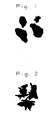
- Figure 1 generally illustrates the centric precursor (NH4)2-Mos2O2; and Figure 2 generally illustrates the prior art needlelike precursor (NH4)2Mos2O2.
- the catalytic sulfide contains a catalyst metal of Nb, Ta, Mo, W, Tc, or Re. Mo and W are preferred, and Mo is most preferred.
- the catalytic sulfide may be present in the catalyst in any amount that demonstrates catalytic activity in the process in which it is used.
- the catalytic sulfide is present in percentages based on the weight of the total catalyst, of from 2 to 98 percent, more preferably from 5 to 95 percent, most preferably from 10 to 90 percent, and most particularly preferred from 20 to 80 percent.
- sulfide in catalytic sulfide means the catalyst metal may be generally present as the sulfide. It is not necessary that any particular stoichiometric amount of sulfide be present, but only that the catalyst metal is present in combination with sulfur. Some of the catalyst metal may be present in combination with other elements, for example oxygen as oxysulfides. The free metal may possibly be present if reduction of the composition has ensued during or after thermal decomposition of the precursor. Such reduction could be by flowing, hot hydrogen.
- the range of the stoichiometric ratio of sulfur to the catalyst metal in the catalytic sulfide is from 0.1 to 3, more preferably from 1.8 to 2.3.
- the catalytic sulfide is molybdenum or tungsten disulfide.
- Catalytic herein means the sulfide has catalytic activity of the described character.
- the catalytic activity may be conversion of synthesis gas in the presence of a catalyst metal sulfide into C 1-5 aliphatic hydrocarbons at a conversion percent of 12 or more.
- the catalyst metal sulfide would be a catalytic sulfide therein.
- the catalytic sulfide is made from thermal decomposit6ion of a centric particulate precursor.
- the centric particulate precursor itself contains sulfur as a component. Examples of this precursor are centric (NH4)2Mos4, (NH4)2WS4 and (NH4)2Mos2O2, with (NH4)2MosO2 being preferred.
- centric means having mass concentrated about a center.
- Examples of centric shapes of precursors include the following: spheres, tetrahedrons, slightly to moderately distorted tetrahedrons, cubes, square antiprisms, dodecahedrons, octahedrons, slightly to moderately tetragonally, rohombically and trigonally distorted octahedrons, ellipsoids having foci within a distance of 10 percent of the length of the major axis, square prisms having a height about two times the length of the base, and square based pyramids of a height about 11 ⁇ 2 times the length of a side of the base.
- shapes not considered centric include square prisms having a height four or more times the length of the base.
- leaflets, needles, needle-like chemical solids, and needle agglomerates such as would be represented by a spiked mace shape, are not considered centric.
- Preferable centric shapes have about 20 percent or more volume included within the boundary established by a sphere of a center which is also a geometrical center of a generally representative sample shape of the particulate precursor.
- the radius of the sphere is established by the nearest boundary of the representative particular precursor. More preferively, the included volume is about 35 percent or more and most preferably about 45 percent or more. It is especially preferred that any appendages on the basic centric shape include about 10 percent or less of the total volume of the basic shape and more especially about 5 percent or less.
- a basic centric shape is a generally representative sample shape of the particulate precursor which is centric.
- Particulate herein means composed of discrete particles of sufficient independent size which are considered solids at the temperature and pressure of thermal decomposition and in the reaction as a catalyst.
- discrete particles of molybdenum disulfide are generally considered solid and particulate.
- Powders are not composed of discrete particles of sufficient independent size to be considered particulate.
- the resultant thermally decomposed catalytic sulfide from the centric particulate precursor has a higher attrition-resistance in a fluidized suspension than has a comparable thermally decomposed catalytic sulfide from a particulate precursor which is not considered centric, such as needles.
- the higher attrition-resistance is measured under regular test conditions.
- Regular test conditions herein include the measurement of 10.0 g of sample consisting of the catalytic sulfide in an inert gas consisting of dry nitrogen at about 25°C and about one atmosphere pressure.
- the vessel holding the suspended particles is a smooth-walled glass cylinder of 12-inch (30.5 cm) height or greater and one-inch (2.5 cm) internal diameter, with the C ⁇ axis of symmetry of the cylinder mounted in vertical alignment with the force of earth's gravity.
- the lower end cap of the glass cylinder is of fritted glass, the upper end is generally open and allows unrestricted nitrogen flow.
- the fluid bed suspension is maintained for a period of thirty days by continuously maintaining a Gas Hourly Space Velocity (i.e., GHSV) of the nitrogen through the lower end cap at a rate sufficient to maintain the fluidized suspension, excluding attrited carryover dust and the like, at a volume about two or three times the volume of the 10.0 g sample in the cylinder before the fluidization.
- GHSV Gas Hourly Space Velocity
- the other conditions are otherwise normal (e.g., no microwave bombardment or sound bombardment).
- the higher attrition-resistance of the catalytic sulfide is preferably measured by a percent loss of catalytic sulfide of about 33 percent by weight or less. More preferably, the loss is about 15 percent by weight or less and most preferably about 5 percent by weight or less.
- the particle size of the precursor is such that its thermal decomposition results in a catalytically useful catalytic sulfide.
- the particle size of the centric particulate precursor is from 5 to 1000 ⁇ m. More preferably, lower limits of the range of the particle size of the centric precursor, found by measurement of the longest line segment traversing the internal space of a reasonably representative sample shape of the centric precursor, are about 10 ⁇ m , preferably about 20 microns, more preferably about 37 ⁇ m and most preferably about 50 ⁇ m. Equivalent more preferable upper limits of the range are about 1000 ⁇ m, most preferably about 300 ⁇ m.
- the particle size of the centric precursor affects the catalytic sulfide.
- thermal decomposition of the centric particulate precursor results in a non-agglomerated particulate catalytic sulfide.
- Non-agglomerated herein means the particles substantially do not stick together as a fused mass.
- Preferable particle sizes of the catalytic sulfide are those which can advantageously be used in fluidized bed reactors.
- the particle size of the catalytic sulfide is from 5 to 300 ⁇ m.
- the particle size limits of the particle size range measured in the same manner as the centric precursor, are from 10 to 300 ⁇ m, preferably from 20 to 200 ⁇ m, more preferably from 37 to 150 ⁇ m, and most preferably from 50 to 150 ⁇ m.
- the particles may be advantageously screened anytime during or after processing to obtain particle size distribution advantageous for particular applications. Screening is, however, often not necessary. For example, it may be desired to have particles of from 70 to 100 ⁇ m in a fluidized bed to convert syngas.
- the centric particulate precursor may be made to conform to these requirements, or the precursor or the catalytic sulfide may be screened to conform to them.
- the centric particulate precursor is made by controlled precipitation, forming particles of the desired size and shape.
- the precipitation is from a liquid mixture.
- Control of the precipitation is achieved by control of the nucleation and/or crystal growth of the centric particulate precursor.
- the number of particles and, therefore, the particle size of the precursor are determined by the number of nuclei formed in the nucleation. The number of nuclei formed, and hence control of nucleation, is approximately related to the relative supersaturation of the liquid mixture.
- Relative supersaturation is the ratio of (Q-S)/S.
- Q is the actual concentration of a dissolved precursor at the instant precipitation begins
- S is the equilibrium concentration of solute in a saturated solution. Stirring of the liquid mixture lowers the relative supersaturation. Larger crystals are also often induced by more dilute solutions at the time of the beginning of precipitation.
- suitable solid particles may be present or introduced that provide sites upon which crystal growth of the precursor can be initiated.
- suitable particles include added finely divided powders of the centric precursor to the catalytic sulfide, smaller particles of the centric precursor, particles of catalytic sulfide too small to be effectively employed in a fluidized bed reactor application, particulate promoters, inert supportive particles smaller than the desired size of the centric precursor, and other supports smaller than the desired size of the centric precursor such as alumina, titania, zinc and iron oxides, carbon and the like.
- nucleation sites are 0.005 to 0.01 percent insoluble matter.
- nucleation is not induced by the addition of the inert supportive particles and the other supports smaller than the desired site of the centric precursor. Spontaneous nucleation may also occur.
- liquid solvent has a large effect on the size and shape of the centric particulate precursor.
- Water and C 1-4 hydroxy-containing hydrocarbons such as methanol, ethanol, ethylene glycol, isopropanol, n-propanol, glycerol, isobutanol, n-butanol, sec-butanol, t-butanol and the like are preferred solvents. Water is most preferred.
- solvents may be used in conjunction with others to aid in precipitation of the centric particulate precursor.
- an alcohol like ethanol may be added to water or solvent mixtures may be used to aid in such precipitation.
- the pH of the solution often has a marked effect on the formation of the centric particulate precursor.
- the aqueous pH is about seven or greater.
- the growth of the centric particulate precursor is most easily controlled by regulating the temperature of the liquid mixture forming the centric particulate precursor. Temperatures from 0 to 40°C are preferred, more preferably from 10 to 25°C and most preferably from 10 to 20°C. Temperatures between 12 to 18°C are especially preferred, for example, in producing centric (NH4)2MoS2O2(from aqueous mixtures.
- Centric (NH4)2MoS2O2 is especially preferred as the catalytic sulfide. Centric particulate precursors based on centric (NH4)2MoS2O2 are also especially preferred.
- the centric particulate precursor can be removed from the liquid mixture at the desired size by methods known in the art such as straining through a mesh, filtration, scooping, density gradient centrifugation, liquid suspension techniques and the like. After removal from the liquid mixture, the centric particulate precursor may be dried. Drying in an inert atmosphere, such as dry nitrogen or dry argon, at temperatures about 80°C or below, preferably about 50°C or below, and most preferably about 30°C or below.
- an inert atmosphere such as dry nitrogen or dry argon
- the centric particulate precursor At any time during processing, it may be advantageous to add another catalyst metal (or added metal promoter) to the centric particulate precursor at hand.
- the centric particulate precursor must at some time be thermally decomposed at least once.
- Thermal decomposition follows the formation of the centric particulate precursor.
- Thermal decomposition is such that the centric particulate precursor changes its composition.
- the composition change preferably enhances catalytic activity (and may even be the basis for the catalytic activity).
- the composition change may be effected by any added promoters and by the method of thermal decomposition employed. Typically, the physical shape and size of the precursor is generally retained after thermal decomposition.
- Thermal decomposition is accomplished by methods such as bombardment with infrared radiation, microwave radiation, or through heating in an inert liquid or in an inert atmosphere. Heating in an inert atmosphere is preferred. Suitable temperatures for heating are from 200 to 1200°C, preferably from 400 to 700°C.
- Times of thermal decomposition are such that the required, and desired level of, decomposition occur.
- thermal decomposition is maintained for from 1 ⁇ 2 to 2 hours and more preferably from 1 to 2 hours.
- Pressures during the thermal decomposition are such that the centric particulate precursor is decomposed.
- Lower and higher pressures during thermal decomposition may affect the rate, level of decomposition and/or composition of the decomposed precursor.
- the pressure during decomposition is about ambient atmospheric pressure or below, more preferably about ambient atmospheric.
- Unsupported catalytic sulfides from centric (NH4)2MoS2O2 are especially preferred.
- Unsupported catalytic sulfides based on centric (NH4)2MoS2O2 are also especially preferred.
- the centric, thermally decomposed product catalyst is preferably MoS2.
- Other centric, thermally decomposed catalysts are the sulfides of Nb, Ta, W, Tc or Re.
- the thermally decomposed precursor may be optionally treated with a reactive atmosphere, for example air, oxygen, carbon monoxide, methane, hydrogen and hydrogen sulfide, preferably hydrogen and hydrogen sulfide and more preferably in combination as a sulfiding atmosphere.
- a reactive atmosphere for example air, oxygen, carbon monoxide, methane, hydrogen and hydrogen sulfide, preferably hydrogen and hydrogen sulfide and more preferably in combination as a sulfiding atmosphere.
- Temperatures of treatment are generally equivalent to those of thermal decomposition. Times may be longer, such as for 4 hours or more. Higher pressures may be more advantageous, such as about ambient atmospheric pressure or greater.
- the catalytic sulfide may optionally contain a metal promoter, including the following types: another transition metal; a lanthanide or actinide series metal; an alkali or alkaline earth metal; or combination thereof, in free or combined form. In free or combined form means the metal component is present as a metal, alloy, compound or adduct thereof.
- the transition metals herein do not include Cd and Hg, but do include Zn.
- Preferred transition metal promoters are Fe, Ni and Co compounds, more preferably as their sulfides. It is most preferred that the Fe, Ni and Co contain ferrous, nickelous or cobaltous sulfides. Cobalt compounds are especially preferred.
- the sulfide in the finished catalyst may be obtained by combination with the existing sulfide or may often be produced by conversion from another Fe, Ni or Co compound by sulfiding.
- the sulfided transition metal compound-containing catalysts, especially cobalt, are preferably protected from air or other oxidizing atmosphere before use.
- sulfiding is accomplished by reactive treatment with hydrogen sulfide gas at elevated temperatures, more preferably the hydrogen sulfide is mixed with hydrogen gas, most preferably at a level of from 1 to 10 percent by weight.
- elevated temperature limits are those herein articulated for the thermal decomposition and the reactive atmospheric treatments.
- the more preferred transition metal promotors may especially be employed in the catalytic sulfide in a process for making mixed alcohols to shift the selectivity from the production of preponderantly methanol to C2+ alcohols from synthesis gas. Such a shift may be significantly enhanced by the addition or recycle of methanol to the synthesis gas feed.
- the lanthanide and actinide series metals are herein considered one type.
- the lanthanide series metals include lanthanum and the elements of atomic number 58 through 71, inclusive.
- the actinide series metals include actinium and the elements of atomic number 90 through 103, inclusive.
- Preferred lanthanide and actinide series promoters are La, Ce, Sm and Th, with La and Th more preferred and Th most preferred.
- the lanthanide and actinide series metals may enhance the activity of the catalytic sulfide in the conversion of synthesis gas into C 1-10 , and especially into C 1-5 , aliphatic hydrocarbons.
- the more preferred lanthanide and actinide series metals may also be employed as Fischer-Tropsch promoters or in special conjunction therewith.
- Reduction of the catalytic sulfide containing the lanthanides or actinides may enhance activity. Reduction may be accomplished by methods known in the art. For example, reduction by contact with a liquid phase reducing agent such as hydrazine or hydroxylamine or reduction using a metal hydride may be advantageous.
- Reduction at elevated temperatures with a reactive reducing atmosphere such as methane, hydrogen, hydrogen sulfide, and mixtures of these may be advantageous and is preferred. Hydrogen and hydrogen sulfide are more preferred reactive reducing atmospheres.
- the conditions for reactive atmosphere reduction are as herein generally described for the optional treatment with a reactive atmosphere.
- alkali and alkaline earth metals are herein also considered one type.
- the alkali and alkaline earth metals are also preferred promoters and are among the Fischer-Tropsch promoters, for example Zn, Ca, Mg, K or Na.
- the alkali metals are more preferred, and potassium is most preferred.
- Fischer-Tropsch promoters enhance the formation of mixed alcohols from synthesis gas. Excess amounts of a Fischer-Tropsch promoter of an alkali or alkaline earth metal may decrease activity.
- the total amount of metal promoter of any type may be present at any level which enhances the production of the desired product.
- Preferred total levels of promoter are from 0.05 to 30 weight percent as if a free element in the finished catalyst, more preferably from 0.1 to 20 weight percent and most preferably from 1 to 20 weight percent.
- preferred levels of each type of promotor are 0.05 to 20 weight percent as if a free element in the finished catalyst, more preferivelyably from 0.1 to 10 weight percent and most preferively from 1 to 7 weight percent.
- the promoter may be added at any time during or after the preparation of the catalytic sulfide and preferably after formation of the catalytic sulfide. It may be added as an ingredient in another promoter, the catalytic sulfide component or other material.
- the promoter may be added by physical mixing, solution impregnation or in forming the centric particulate precursor.
- carbon material prepared from coconut shells often contains small amounts of alkali metal oxides or hydroxides; the centric precursor may have its crystallization induced by the addition of such a particulate material.
- any additional material generally considered a support when present generally comprises an amount about 5 percent or less of the finished catalyst.
- Additional refers to materials other than that of a catalyst metal which is made into a centric particulate precursor.
- the catalytic sulfide is herein considered to be unsupported.
- any additional material generally considered a support is present in an amount about 2 percent or less of the finished catalyst. More preferably, no such additional material is added.
- Examples of materials generally considered supports include: the aluminas, basic oxides, the silicas, carbons, or suitable solid compounds of magnesium, calcium, strontium, barium, scandium, yttrium, lanthanum and the rare earths, titanium, zirconium, hafnium, vanadium, thorium, uranium, and zinc, of which oxides are exemplary compounds.
- the catalysts of the invention may be employed individually or in combination with other catalysts. In combination with other catalysts, these catalysts may tend to progressively modify the usual effects in accordance with their individual characteristics so that quantitatively intermediate results may be achieved.
- the catalysts of the present invention may be combined with typical hydrogenation catalysts such as cobalt and nickel.
- the catalyst is stable for long periods of time.
- Activity and selectivity are preferably substantially retained after 700 hours of operation, more preferably after 2000 hours and most preferably after 4000 hours operation. Under ideal conditions it may be stable and active for as many as 6000 hours or more.
- the finished catalyst may be used in a fixed bed, moving bed, fluid bed, ebulliated bed or a graded bed wherein concentration and/or activity of the catalyst varies from inlet to outlet in similar manner to known catalysts. Because of the high attrition-resistance of the catalytic sulfide, it may find preferred use in fluidized bed reactors.
- the catalytic sulfide preferably shows high activity in the conversion of synthesis gas into the desired product under reactive conditions.
- Reactive conditions are those known in the art or herein, such as generally illustrated in the example and especially wherein the synthesis gas consists of about 95 mole percent hydrogen and carbon monoxide gases at an H2/CO ratio of about 1.0 and about 5 mole percent dry nitrogen, GHSV corrected to standard temperature and pressure (i.e., STP) about 1000 hours ⁇ 1 or slightly less, temperature about 300°C and pressure about 500 psig (3.5 MPa), with no recycle.
- This surprising activity is preferably about 5 ⁇ 107 units or above, more preferably about 8 ⁇ 107 units or above, most preferably about 1 ⁇ 108 units or above, and especially about 3 ⁇ 108 units or above, wherein activity as defined herein is as generally defined by Anderson et al ., Ind . Eng. Chem.
- GHSV is the gas hourly space velocity in units of hour ⁇ 1 as if at STP; 1n is the natural logarithm of the quantity (1-C); C is the fraction of synthesis gas converted into products excluding carbon dioxide; E is the activation energy (e.g., 18,100 cal/mole (75.8 kJ/mole) for the process of converting the synthesis gas into C 2-5 hydrocarbons); R is the gas constant (i.e., e.g., 1.987 cal/mole °K; 8.314 J/mole °K); T is the temperature in degrees Kelvin (i.e., °K); and P is the pressure of the feed synthesis gas in units of atmospheres.
- percent CO2-free carbon selectivity it is meant the percent of carbon in a specific product with respect to the total carbon converted from carbon monoxide to some product other than carbon dioxide.
- one mole of ethyl alcohol is 2 moles of carbon and would represent 50 carbon mole percent selectivity to ethanol if 4 moles of CO were converted to products other than CO2.
- the hydrogen and carbon monoxide required for this process can be obtained by methods known in the art. Examples are gasification of hydrocarbonaceous materials such as coal, high specific gravity oils, or natural gas; as a by-product of partial combustion cracking of hydrocarbons; by steam reforming of liquid or gaseous hydrocarbons; through the water-gas shift reaction; or some combination of these.
- the two components may also be generated separately and combined for the subject reaction.
- the molar ratio of hydrogen to carbon monoxide in the feed gas which contacts the catalyst is such that the C 1-10 aliphatic hydrocarbons or mixed alcohols are produced.
- limits of the ratio are from 0.25 to 100, more preferably from 0.5 to 5, and most preferably from 0.7 to 3.
- some hydrogen sulfide is also in the feed gas, preferably, from 10 to 200 ppm, most preferably from 20 to 100 ppm.
- a desired product may comprise a mixture of C 1-10 aliphatic hydrocarbons and mixed alcohols.
- the desired product either comprises a mixture of C 1-10 aliphatic hydrocarbons or comprises a mixture of C 1-10 mixed alcohols.
- the desired product may more preferably either comprise a mixture of methane (i.e., methanation process) or comprise a mixture of C 2-10 aliphatic hydrocarbons (i.e., Fischer-Tropsch process for production of aliphatic hydrocarbons of up to ten carbons per molecule).
- a most preferably desired hydrocarbon product is C 2-5 aliphatic hydrocarbons and especially C 2-5 alkanes.
- C l-5 mixed alcohols are more preferred, and C 2-5 mixed alcohols are most preferred.
- the mixed alcohols are preferred over the aliphatic hydrocarbons.
- Pressures are such that the C 1-10 aliphatic hydrocarbons or mixed alcohols are produced.
- the selectivity to the desired product can be enhanced by varying the pressure.
- the minimum preferred pressure for mixed alcohols production is about 500 psig (3.5 MPa).
- the more preferred minimum for mixed alcohols production is about 750 psig (5 MPa) with about 1,000 psig (7 MPa) being a most preferred minimum.
- 1,500 psig (10 MPa) to 4,000 psig (28 MPa) is the most desirable range, higher pressures may be used and are limited primarily by cost of the high pressure vessels, compressors and energy costs needed to carry out the higher pressure reactions.
- About 10,000 psig (69 MPa) is a typical preferred maximum with about 5,000 psig ( 35 MPa ) a more preferred maximum.
- About 3,000 psig (21 MPa) is a most preferred maximum pressure.
- Methane production is generally favored by generally lower pressures.
- pressures such as from 100 psig to 2000 psig (about 800 kPa to about 14 MPa) are employed.
- Fischer-Tropsch processes for the production of C 2-10 aliphatic hydrocarbons, especially for the production of C 2-5 aliphatic hydrocarbons, are favored by generally lower pressures such as from atmospheric to about 1500 psig (gauge pressure of about 10 MPa ). Pressures therein are preferivelyably from 150 to 700 psig (gauge pressure from 1,000 to 4,800 kPa) and more preferably are from 200 to 500 psig (gauge pressure from 1,400 to 3,500 kPa).
- Temperatures are such that the C 1-10 aliphatic hydrocarbons or mixed alcohols are produced.
- the selectivity to the desired product is also a function of temperature and is interrelated with the pressure function.
- the minimum temperature used is governed by productivity considerations and the fact that at temperatures below about 200°C, volatile catalytic metal carbonyls may form.
- the preferred temperature is generally from 200 to 400°C. A more preferred maximum is about 350°C. However, the most preferred range of operation is from 240 to 325°C.
- Methane production is favored by generally higher temperatures. Preferably, temperatures from 300 to 600°C are employed therein.
- Fischer-Tropsch processes for the production of C 2-10 aliphatic hydrocarbons, especially for the production of C 2-5 aliphatic hydrocarbons are favored generally by temperatures from 200 to 500°C. Preferably, temperatures from 300 to 420°C are employed therein.
- Alcohols herein are compounds otherwise hydrocarbons which contain at least one hydroxy functionality bound to carbon therein. Alcohols do not include other hydroxy-containing or oxygenated hydrocarbon compounds. For example, the methoxy portion of methyl acetate is not counted as methanol. Salicylaldehyde is not an alcohol herein only because of its aldehyde functionality.
- the mixed alcohol fraction usually formed in the mixed alcohols synthesis may contain methanol, ethanol, 1-propanol, 2-propanol, 1-butanol, 2-butanol, 2-methyl-1-propanol, 2-methyl-2-propanol, other C 2-4 alcohols and C 5-10 alcohols.
- the selectivity to C 2-5 alcohols is high while the selectivity to methanol is low.
- the product mixture, as formed under preferred conditions, contains only small portions of other oxygenated compounds besides alcohols. These other compounds may not be deleterious to using the product, as is, in motor fuels.
- the mixed alcohols fraction is formed in at least about 50 percent CO2-free carbon selectivity and especially greater than about 70 percent. Under the most preferred conditions, total alcohols may be obtained in up to about an 87 percent CO2-free carbon selectivity.
- CO2-free carbon selectivity to methanol is less than about one-half the CO2-free carbon selectivity to the C 1-10 mixed alcohol fraction, more preferably about one-third or less and most preferably about one-fifth or less and especially about one-tenth or less. It is especially preferred that the methanol CO2-free carbon selectivity is similarly compared with C 1-5 mixed alcohols CO2-free carbon selectivity. As conversion increases, the product distribution of mixed alcohols produced usually shifts toward higher molecular weight alcohols.
- the co-products formed with the alcohol fraction in the mixed alcohols process are primarily gaseous products. That is, they are preferably primarily C 1-4 hydrocarbons.
- C5+ hydrocarbons are coproduced therein at less than about 20 percent CO2-free carbon selectivity, more preferably at less than 10 percent and most preferably at less than 5 percent. Lower amounts of normally liquid hydrocarbons make the normally liquid alcohols easier to separate from by-products.
- the amount of water formed is sucstantially less than the amount of desired product formed.
- this is less than about 10 weight percent and most preferably about 5 weight percent or less.
- This water may be removed by known techniques. For example, in a mixed alchols process, if the water content is about 2 weight percent or less based on mixed alcohols, the water may advantageously be removed by absorption on molecular sieves.
- a water gas shift drying step as disclosed in British Patents 2,076,015 and 2,076,423.
- Use of a sulfur tolerant catalyst such as Haldor Topsoe SSK is preferred in the water gas shift drying step.
- the H2/CO gas hourly space velocity GHSV is a measure of the volume of hydrogen plus carbon monoxide gas at standard temperature and pressure passing a given volume of catalyst in an hour's time.
- GHSV is such that the C 1-10 aliphatic hydrocarbons or mixed alcohols are produced.
- lower limits of GHSV are about 100 hour ⁇ 1 and more preferably about 300 hour ⁇ 1.
- equivalent upper limits are about 20,000 hour ⁇ 1 and more preferably about 1,000 hour ⁇ 1 for methane, about 3,000 hour ⁇ 1 for C 2-10 and especially 2-5 aliphatic hydrocarbons and about 5,000 hour ⁇ 1 for the mixed alcohols.
- Selectivity to the C 1-10 aliphatic hydrocarbons or mixed alcohols usually increases as the space velocity decreases. Conversion of carbon monoxide typically decreases as space velocity increases.
- At least a portion of the unconverted hydrogen and carbon monoxide in the effluent gas from the reaction may be recycled to the reaction.
- other by-products formed may include hydrocarbons.
- the amount of recycle is expressed as the recycle ratio which is the ratio of moles of gases in the recycle stream to the moles of gases in the fresh feed stream.
- a recycle ratio of zero is within the scope of the invention with at least some recycle preferred.
- a recycle ratio of at least about one is more preferred and at least about three is most preferred.
- the synthesis should be carried out at as little feed conversion per pass as is compatible with economic constraints related to the separation of the desired product from unreacted feed and other by-product gases.
- the space velocity and recycle ratios are adjusted to obtain about 15-25 percent conversion per pass.
- the reagents are of reagent-grade, ot higher, quality.
- Catalytic-grade reagents are reagents of such higher quality than reagent-grade and may be advantageously employed in the invention.
- An unsupported catalytic sulfide with suitable particle size and shape for use in a fluid bed reactor is prepared as follows:
- the alkalized MoS2 (6.5 g, 5.5 cm3) is mixed with 5.5 cm3 of tabular Al2O3, loaded between layers of tabular Al2O3 filler in a heated 1 ⁇ 2 in. ⁇ 3 ft. (1.3 cm ⁇ 0.9 m) (internal dimensions) stainless steel reactor, and exposed to syngas consisting of 95 mole percent hydrogen and carbon monoxide and 5 mole percent dry nitrogen under the following conditions:
Landscapes
- Chemical & Material Sciences (AREA)
- Organic Chemistry (AREA)
- Chemical Kinetics & Catalysis (AREA)
- Engineering & Computer Science (AREA)
- Materials Engineering (AREA)
- General Chemical & Material Sciences (AREA)
- Oil, Petroleum & Natural Gas (AREA)
- Inorganic Chemistry (AREA)
- Organic Low-Molecular-Weight Compounds And Preparation Thereof (AREA)
- Low-Molecular Organic Synthesis Reactions Using Catalysts (AREA)
- Production Of Liquid Hydrocarbon Mixture For Refining Petroleum (AREA)
- Catalysts (AREA)
Applications Claiming Priority (2)
| Application Number | Priority Date | Filing Date | Title |
|---|---|---|---|
| US76223985A | 1985-08-05 | 1985-08-05 | |
| US762239 | 1985-08-05 |
Publications (1)
| Publication Number | Publication Date |
|---|---|
| EP0216472A1 true EP0216472A1 (de) | 1987-04-01 |
Family
ID=25064490
Family Applications (1)
| Application Number | Title | Priority Date | Filing Date |
|---|---|---|---|
| EP86306001A Withdrawn EP0216472A1 (de) | 1985-08-05 | 1986-08-04 | Verfahren zur Umsetzung von Synthesegas in Gegenwart von abriebfesten Sulfiden |
Country Status (8)
| Country | Link |
|---|---|
| EP (1) | EP0216472A1 (de) |
| JP (1) | JPS6234986A (de) |
| KR (1) | KR870002041A (de) |
| CN (1) | CN1015357B (de) |
| AU (1) | AU6074986A (de) |
| NO (1) | NO863134L (de) |
| PL (1) | PL260931A1 (de) |
| ZA (1) | ZA865875B (de) |
Cited By (12)
| Publication number | Priority date | Publication date | Assignee | Title |
|---|---|---|---|---|
| EP0444399A1 (de) * | 1990-03-02 | 1991-09-04 | Union Carbide Chemicals And Plastics Company, Inc. | Tantal enthaltender Katalysator zur Herstellung von Alkoholen aus Synthesegas |
| EP0850688A1 (de) * | 1996-12-27 | 1998-07-01 | Institut Français du Pétrole | Wasserstoffbehandlung und Hydrocrackkatalysator enthaltend ein Mischsulfid mit Schwefel, zumindest ein Element der Gruppe 5B und zumindest ein Element der Gruppe 6B |
| US6432867B1 (en) | 1998-06-25 | 2002-08-13 | Insitut Francais Du Petrole | Process for sulfurizing catalysts in a reducing medium |
| US6562752B2 (en) | 1998-06-25 | 2003-05-13 | Institut Francais Du Petrole | Metallic sulphide catalysts, processes for synthesising said catalysts and use thereof |
| US20090042998A1 (en) * | 2007-08-03 | 2009-02-12 | Daiki Ataka Engineering Co., Ltd. | Catalyst for methanation of carbon oxides, preparation method of the catalyst and process for the methanation |
| US7955588B2 (en) | 2009-05-26 | 2011-06-07 | Conocophillips Company | Metal sulfide catalysts and methods of making same |
| US8129436B2 (en) | 2006-04-13 | 2012-03-06 | Dow Global Technologies Llc | Mixed alcohol synthesis with enhanced carbon value use |
| WO2012134490A1 (en) * | 2011-04-01 | 2012-10-04 | Dow Global Technologies Llc | Improved process for synthesis of molybdenum sulfide-based catalysts |
| JP2012532011A (ja) * | 2009-06-30 | 2012-12-13 | アルベマール・コーポレーシヨン | 高級アルコール合成用の改良コバルトモリブデン−硫化物触媒の作成方法。 |
| US8420564B2 (en) | 2010-09-23 | 2013-04-16 | Phillips 66 Company | Sulfur-tolerant catalyst prepared through high pressure decomposition |
| CN104324715A (zh) * | 2014-10-14 | 2015-02-04 | 华东师范大学 | 三维MoS2/SnO2异质半导体纳米材料及其制备方法 |
| US10112883B2 (en) | 2013-04-24 | 2018-10-30 | Saudi Basic Industries Corporation | Production of products from natural resources |
Families Citing this family (7)
| Publication number | Priority date | Publication date | Assignee | Title |
|---|---|---|---|---|
| JP2007307436A (ja) * | 2006-05-16 | 2007-11-29 | Ihi Corp | フィッシャー・トロプシュ合成触媒とその製造方法 |
| CN101144021B (zh) * | 2007-02-16 | 2011-11-09 | 淮北中润生物能源技术开发有限公司 | 纤维素生物质煤化工燃料生产工艺 |
| JP5691119B2 (ja) * | 2007-08-03 | 2015-04-01 | アタカ大機株式会社 | 水素化触媒の製造方法およびそれを使用したメタンガスの製造方法 |
| CN102987462B (zh) * | 2012-12-28 | 2018-10-23 | 长春大学 | 一种速溶大豆低聚糖肽花生产品的制备方法 |
| WO2014174374A2 (en) * | 2013-04-24 | 2014-10-30 | Saudi Basic Industries Corporation | Catalyst for selective synthesis of lower hydrocarbons from syngas |
| CN113072099B (zh) * | 2020-01-03 | 2022-07-08 | 中国科学院上海微系统与信息技术研究所 | TMDs二维材料薄膜、器件及制备方法 |
| KR102811693B1 (ko) * | 2022-04-11 | 2025-05-23 | 대한민국 | 땅콩 신품종 우도올레-1 및 이를 포함하는 식품 조성물 |
Citations (3)
| Publication number | Priority date | Publication date | Assignee | Title |
|---|---|---|---|---|
| US4243554A (en) * | 1979-06-11 | 1981-01-06 | Union Carbide Corporation | Molybdenum disulfide catalyst and the preparation thereof |
| US4528089A (en) * | 1982-07-20 | 1985-07-09 | Exxon Research And Engineering Co. | Hydrogenation processes using carbon-containing molybdenum and tungsten sulfide catalysts |
| WO1985003073A1 (en) * | 1983-12-30 | 1985-07-18 | Union Carbide Corporation | Process for producing alcohols from carbon monoxide and hydrogen using an alkali-molybdenum sulfide catalyst |
-
1986
- 1986-07-31 AU AU60749/86A patent/AU6074986A/en not_active Abandoned
- 1986-08-04 NO NO863134A patent/NO863134L/no unknown
- 1986-08-04 EP EP86306001A patent/EP0216472A1/de not_active Withdrawn
- 1986-08-04 CN CN86105974A patent/CN1015357B/zh not_active Expired
- 1986-08-05 JP JP61182839A patent/JPS6234986A/ja active Pending
- 1986-08-05 ZA ZA865875A patent/ZA865875B/xx unknown
- 1986-08-05 KR KR1019860006455A patent/KR870002041A/ko not_active Withdrawn
- 1986-08-05 PL PL1986260931A patent/PL260931A1/xx unknown
Patent Citations (3)
| Publication number | Priority date | Publication date | Assignee | Title |
|---|---|---|---|---|
| US4243554A (en) * | 1979-06-11 | 1981-01-06 | Union Carbide Corporation | Molybdenum disulfide catalyst and the preparation thereof |
| US4528089A (en) * | 1982-07-20 | 1985-07-09 | Exxon Research And Engineering Co. | Hydrogenation processes using carbon-containing molybdenum and tungsten sulfide catalysts |
| WO1985003073A1 (en) * | 1983-12-30 | 1985-07-18 | Union Carbide Corporation | Process for producing alcohols from carbon monoxide and hydrogen using an alkali-molybdenum sulfide catalyst |
Non-Patent Citations (4)
| Title |
|---|
| JOURNAL OF CATALYSIS, vol. 95, 1985, pages 249-259, Academic Press, Inc., New York, US; K. RAMANATHAN et al.: "Characterization of tungsten sulfide catalysts" * |
| JOURNAL OF CATALYSIS, vol. 95, 1985, pages 455-464, Academic Press, Inc., New York, US; D.G. KALTHOD et al.: "Studies of molybdenum sulfide catalysts: Effects of pretreatment on sintering, stoichiometry, and oxygen chemisorption" * |
| JOURNAL OF INORGANIC AND NUCLEAR CHEMISTRY, vol. 35, 1973, pages 1895-1904, Pergamon Press., Oxford, GB; T.P. PRASAD et al.: "Thermal decomposition of (NH4)2MoO2S2, (NH4)2MoS4, (NH4)2WO2S2 and (NH4)2WS4" * |
| THERMOCHIMICA ACTA, vol. 81, 1984, pages 281-296, Elsevier Science Publishers B.V., Amsterdam, NL; Q. WU et al.: "Characterization of unsupported CoMo sulfide catalysts and their precursors by temperature-programmed reactions" * |
Cited By (18)
| Publication number | Priority date | Publication date | Assignee | Title |
|---|---|---|---|---|
| EP0444399A1 (de) * | 1990-03-02 | 1991-09-04 | Union Carbide Chemicals And Plastics Company, Inc. | Tantal enthaltender Katalysator zur Herstellung von Alkoholen aus Synthesegas |
| EP0850688A1 (de) * | 1996-12-27 | 1998-07-01 | Institut Français du Pétrole | Wasserstoffbehandlung und Hydrocrackkatalysator enthaltend ein Mischsulfid mit Schwefel, zumindest ein Element der Gruppe 5B und zumindest ein Element der Gruppe 6B |
| US6071402A (en) * | 1996-12-27 | 2000-06-06 | Institut Francais Du Petrole | Hydrodefining and hydrocracking catalyst comprising a mixed sulphide comprising sulphur, at least one group VB element and at least one group VIB element |
| US6432867B1 (en) | 1998-06-25 | 2002-08-13 | Insitut Francais Du Petrole | Process for sulfurizing catalysts in a reducing medium |
| US6562752B2 (en) | 1998-06-25 | 2003-05-13 | Institut Francais Du Petrole | Metallic sulphide catalysts, processes for synthesising said catalysts and use thereof |
| US8129436B2 (en) | 2006-04-13 | 2012-03-06 | Dow Global Technologies Llc | Mixed alcohol synthesis with enhanced carbon value use |
| US9731278B2 (en) | 2007-08-03 | 2017-08-15 | Hitachi Zosen Corporation | Catalyst for methanation of carbon oxides, preparation method of the catalyst and process for the methanation |
| US20090042998A1 (en) * | 2007-08-03 | 2009-02-12 | Daiki Ataka Engineering Co., Ltd. | Catalyst for methanation of carbon oxides, preparation method of the catalyst and process for the methanation |
| US9617196B2 (en) * | 2007-08-03 | 2017-04-11 | Hitachi Zosen Corporation | Catalyst for methanation of carbon oxides, preparation method of the catalyst and process for the methanation |
| US9732010B2 (en) | 2007-08-03 | 2017-08-15 | Hitachi Zosen Corporation | Catalyst for methanation of carbon oxides, preparation method of the catalyst and process for the methanation |
| US7955588B2 (en) | 2009-05-26 | 2011-06-07 | Conocophillips Company | Metal sulfide catalysts and methods of making same |
| JP2012532011A (ja) * | 2009-06-30 | 2012-12-13 | アルベマール・コーポレーシヨン | 高級アルコール合成用の改良コバルトモリブデン−硫化物触媒の作成方法。 |
| US8420564B2 (en) | 2010-09-23 | 2013-04-16 | Phillips 66 Company | Sulfur-tolerant catalyst prepared through high pressure decomposition |
| WO2012134490A1 (en) * | 2011-04-01 | 2012-10-04 | Dow Global Technologies Llc | Improved process for synthesis of molybdenum sulfide-based catalysts |
| US9233367B2 (en) | 2011-04-01 | 2016-01-12 | Dow Global Technologies Llc | Process for synthesis of molybdenum sulfide-based catalysts |
| US10112883B2 (en) | 2013-04-24 | 2018-10-30 | Saudi Basic Industries Corporation | Production of products from natural resources |
| US10676419B2 (en) | 2013-04-24 | 2020-06-09 | Saudi Basic Industries Corporation | Production of products from natural resources |
| CN104324715A (zh) * | 2014-10-14 | 2015-02-04 | 华东师范大学 | 三维MoS2/SnO2异质半导体纳米材料及其制备方法 |
Also Published As
| Publication number | Publication date |
|---|---|
| NO863134L (no) | 1987-02-06 |
| KR870002041A (ko) | 1987-03-28 |
| JPS6234986A (ja) | 1987-02-14 |
| CN1015357B (zh) | 1992-02-05 |
| NO863134D0 (no) | 1986-08-04 |
| PL260931A1 (en) | 1988-07-07 |
| CN86105974A (zh) | 1987-07-08 |
| AU6074986A (en) | 1987-02-12 |
| ZA865875B (en) | 1988-04-27 |
Similar Documents
| Publication | Publication Date | Title |
|---|---|---|
| US5254520A (en) | Catalyst for the synthesis of methanol | |
| US4752623A (en) | Mixed alcohols production from syngas | |
| US4831060A (en) | Mixed alcohols production from syngas | |
| US6927190B2 (en) | Catalysts with high cobalt surface area | |
| US5140049A (en) | Method for producing olefins from H2 and CO2 using an iron carbide based catalyst | |
| AU653844B2 (en) | Substituted cobalt catalysts for fischer-tropsch synthesis | |
| JP2557959B2 (ja) | 炭化鉄ベース触媒を用いるh▲下2▼及びco▲下2▼からのアルコール及びオレフィンの製造法 | |
| US5506273A (en) | Catalyst for hydrogenation and method for hydrogenation therewith | |
| AU2001248633A1 (en) | Catalysts with high cobalt surface area | |
| US5703133A (en) | Isoalcohol synthesis | |
| US3962140A (en) | Nickel-copper-molybdenum methanation catalyst | |
| JPS6234986A (ja) | 合成ガスの転化における耐摩損性スルフイド | |
| US5248701A (en) | Substituted cobalt catalysts for Fischer-Tropsch synthesis | |
| IE53599B1 (en) | Catalyst and its use for producing methanol/higher alcohol mixtures | |
| US4618597A (en) | High surface area dual promoted iron/managanese spinel compositions | |
| EP0548679A1 (de) | Verfahren zur Herstellung von Synthesegas | |
| US4559316A (en) | Copper-zirconium-manganese-containing catalysts | |
| US5691268A (en) | Isoalcohol synthesis catalyst | |
| KR900008125B1 (ko) | 알코올의 제조방법 | |
| US4077995A (en) | Process for synthesizing low boiling aliphatic hydrocarbons from carbon monoxide and hydrogen | |
| US3997582A (en) | Process and catalyst for synthesizing a gaseous hydrocarbon mixture having a high methane content from carbon monoxide and hydrogen | |
| CA2033732A1 (en) | Tantalum-containing catalyst useful for producing alcohols from synthesis gas | |
| CA2915532C (en) | Production of mixed alcohols from synthesis gas | |
| US4621102A (en) | Fischer-Tropsch hydrocarbon synthesis with high surface area Cu and K promoted reduced-carbided iron/manganese spinels | |
| US4666944A (en) | Copper-zirconium-manganese-containing catalysts and processes for making alcohol mixtures using same |
Legal Events
| Date | Code | Title | Description |
|---|---|---|---|
| PUAI | Public reference made under article 153(3) epc to a published international application that has entered the european phase |
Free format text: ORIGINAL CODE: 0009012 |
|
| AK | Designated contracting states |
Kind code of ref document: A1 Designated state(s): BE DE FR GB IT NL |
|
| 17P | Request for examination filed |
Effective date: 19870521 |
|
| 17Q | First examination report despatched |
Effective date: 19880607 |
|
| STAA | Information on the status of an ep patent application or granted ep patent |
Free format text: STATUS: THE APPLICATION IS DEEMED TO BE WITHDRAWN |
|
| 18D | Application deemed to be withdrawn |
Effective date: 19890218 |
|
| RIN1 | Information on inventor provided before grant (corrected) |
Inventor name: STEVENS, REX R. |