EP0217451A1 - Soutien - Google Patents
Soutien Download PDFInfo
- Publication number
- EP0217451A1 EP0217451A1 EP86201590A EP86201590A EP0217451A1 EP 0217451 A1 EP0217451 A1 EP 0217451A1 EP 86201590 A EP86201590 A EP 86201590A EP 86201590 A EP86201590 A EP 86201590A EP 0217451 A1 EP0217451 A1 EP 0217451A1
- Authority
- EP
- European Patent Office
- Prior art keywords
- support
- foot
- palmar
- skin
- rectangle
- Prior art date
- Legal status (The legal status is an assumption and is not a legal conclusion. Google has not performed a legal analysis and makes no representation as to the accuracy of the status listed.)
- Granted
Links
- 230000003387 muscular Effects 0.000 claims abstract description 14
- 210000002683 foot Anatomy 0.000 claims description 56
- 210000000245 forearm Anatomy 0.000 claims description 17
- 210000003813 thumb Anatomy 0.000 claims description 16
- 239000000463 material Substances 0.000 claims description 15
- 241001481789 Rupicapra Species 0.000 claims description 14
- 239000010985 leather Substances 0.000 claims description 13
- 239000013013 elastic material Substances 0.000 claims description 12
- 210000003857 wrist joint Anatomy 0.000 claims description 9
- 210000005224 forefinger Anatomy 0.000 claims description 6
- 210000000544 articulatio talocruralis Anatomy 0.000 claims description 3
- 210000002435 tendon Anatomy 0.000 description 43
- 210000002414 leg Anatomy 0.000 description 25
- 210000003205 muscle Anatomy 0.000 description 15
- 210000000707 wrist Anatomy 0.000 description 14
- 210000001519 tissue Anatomy 0.000 description 12
- 210000003811 finger Anatomy 0.000 description 11
- 210000003041 ligament Anatomy 0.000 description 11
- 230000033001 locomotion Effects 0.000 description 10
- 210000003423 ankle Anatomy 0.000 description 9
- 230000000272 proprioceptive effect Effects 0.000 description 9
- 210000002082 fibula Anatomy 0.000 description 8
- 210000003010 carpal bone Anatomy 0.000 description 6
- 210000003127 knee Anatomy 0.000 description 6
- 241000411545 Punargentus Species 0.000 description 4
- 208000027418 Wounds and injury Diseases 0.000 description 4
- 238000005452 bending Methods 0.000 description 4
- 230000006378 damage Effects 0.000 description 4
- 208000014674 injury Diseases 0.000 description 4
- 210000000236 metacarpal bone Anatomy 0.000 description 4
- 210000000453 second toe Anatomy 0.000 description 4
- 210000004233 talus Anatomy 0.000 description 4
- 208000022542 ankle injury Diseases 0.000 description 3
- 210000000988 bone and bone Anatomy 0.000 description 3
- 210000003169 central nervous system Anatomy 0.000 description 3
- 210000000693 hamate bone Anatomy 0.000 description 3
- 210000000615 pisiform bone Anatomy 0.000 description 3
- 210000000431 third toe Anatomy 0.000 description 3
- 210000000623 ulna Anatomy 0.000 description 3
- 206010060820 Joint injury Diseases 0.000 description 2
- 210000000454 fifth toe Anatomy 0.000 description 2
- 230000030214 innervation Effects 0.000 description 2
- 210000004932 little finger Anatomy 0.000 description 2
- 210000000457 tarsus Anatomy 0.000 description 2
- 210000001215 vagina Anatomy 0.000 description 2
- 208000032843 Hemorrhage Diseases 0.000 description 1
- 241000428086 Mahanarva tibialis Species 0.000 description 1
- 208000027669 Wrist injury Diseases 0.000 description 1
- 210000003797 carpal joint Anatomy 0.000 description 1
- 229940116592 central nervous system diagnostic radiopharmaceuticals Drugs 0.000 description 1
- 230000008602 contraction Effects 0.000 description 1
- 230000000694 effects Effects 0.000 description 1
- 230000002349 favourable effect Effects 0.000 description 1
- 210000005117 flexor retinaculum Anatomy 0.000 description 1
- 210000000455 fourth toe Anatomy 0.000 description 1
- 210000001255 hallux Anatomy 0.000 description 1
- 230000000977 initiatory effect Effects 0.000 description 1
- 230000009916 joint effect Effects 0.000 description 1
- 238000004519 manufacturing process Methods 0.000 description 1
- 210000001872 metatarsal bone Anatomy 0.000 description 1
- 210000000056 organ Anatomy 0.000 description 1
- 210000004341 tarsal joint Anatomy 0.000 description 1
- 239000004753 textile Substances 0.000 description 1
- 210000002303 tibia Anatomy 0.000 description 1
Images



Classifications
-
- A—HUMAN NECESSITIES
- A61—MEDICAL OR VETERINARY SCIENCE; HYGIENE
- A61F—FILTERS IMPLANTABLE INTO BLOOD VESSELS; PROSTHESES; DEVICES PROVIDING PATENCY TO, OR PREVENTING COLLAPSING OF, TUBULAR STRUCTURES OF THE BODY, e.g. STENTS; ORTHOPAEDIC, NURSING OR CONTRACEPTIVE DEVICES; FOMENTATION; TREATMENT OR PROTECTION OF EYES OR EARS; BANDAGES, DRESSINGS OR ABSORBENT PADS; FIRST-AID KITS
- A61F13/00—Bandages or dressings; Absorbent pads
- A61F13/10—Bandages or dressings; Absorbent pads specially adapted for fingers, hands or arms; Finger-stalls; Nail-protectors
- A61F13/107—Bandages or dressings; Absorbent pads specially adapted for fingers, hands or arms; Finger-stalls; Nail-protectors for wrist support ; Compression devices for tennis elbow (epicondylitis)
- A61F13/108—Openable readjustable
-
- A—HUMAN NECESSITIES
- A61—MEDICAL OR VETERINARY SCIENCE; HYGIENE
- A61F—FILTERS IMPLANTABLE INTO BLOOD VESSELS; PROSTHESES; DEVICES PROVIDING PATENCY TO, OR PREVENTING COLLAPSING OF, TUBULAR STRUCTURES OF THE BODY, e.g. STENTS; ORTHOPAEDIC, NURSING OR CONTRACEPTIVE DEVICES; FOMENTATION; TREATMENT OR PROTECTION OF EYES OR EARS; BANDAGES, DRESSINGS OR ABSORBENT PADS; FIRST-AID KITS
- A61F13/00—Bandages or dressings; Absorbent pads
- A61F13/06—Bandages or dressings; Absorbent pads specially adapted for feet or legs; Corn-pads; Corn-rings
- A61F13/064—Bandages or dressings; Absorbent pads specially adapted for feet or legs; Corn-pads; Corn-rings for feet
- A61F13/066—Bandages or dressings; Absorbent pads specially adapted for feet or legs; Corn-pads; Corn-rings for feet for the ankle
Definitions
- the invention relates to a support for a part of the body, particularly for a joint, comprising a sleeve or wrapper made substantially from elastic material and extending, after its application, between a proximal line and a distal line in respect of the joint, to which sleeve or wrapper optionally a bandage is fastened to provide greater pressure on and/or more support to the part of the body.
- Such supports are known as ankle supports from US-A-1,027,897 and US-A-3,084,023 and as wrist supports from US-A-3,710,790 and US-A-3,238,939. These supports have the property of providing, after their application round the part of the body for which they are intended, within certain limits, through the sleeve or wrapper or additionally with their bandages, an exclusively mechanical immobilization of the parts of the skeleton on either side of a joint.
- the invention provides a support which has the additional advantage of the body itself being stimulated to contribute to the supporting effort.
- the surface is provided with a part having an increased coefficient of friction in respect of the skin compared with the rest of the inner surface, and in that that part of the surface is situated at that place that is in contact, after the application of the support, with parts of the surface of the skin having muscular and/or tendinous tissue underneath which tissue can be innervated proprioceptively to initiate one particular change in position between skeleton parts situated on either side of the joint.
- Proprioceptive innervation of the musculature is understood to mean in this connection the increase in the muscular tension by proprioceptively sensible receptors present in the muscular or tendinous tissue passing stimuli on to the central nervous system, which in its turn influences the muscular action.
- the proprioceptive sensibility must be distinguished from the exteroceptive sensibility with the stimuli from the environment being transferred to the central nervous system via the organs of sense. With the proprioceptive sensibility stimuli from the body itself are further conveyed to the central nervous system.
- the invention utilizes the presence of proprioceptive sensibility. Care is taken that particular parts of the skin having, underneath, receptors to be stimulated should be covered with material having a very low slipping effect on the skin, sticking to the skin as it were. When the parts round the joint are moved, the skin is moved to and fro and massages the deeper tissue in which the receptors are contained. As a result, the muscle in which the receptors are contained is contracted and a higher tension is brought about in the muscle and tendon so that a change in position can be initiated between two skeleton parts situated on either side of a joint. The non-slipping parts of the surface are so placed as to initiate exactly that change in position that will relieve a damaged or weak ligament.
- plantar on the side of the sole of the foot
- dorsal on the side of the back of the hand or wrist or on the upper side of the foot
- sagittal plane a plane parallel to a vertical plane dividing a standing human body accurately into a left-hand side and a right-hand side.
- the parts of the surface having an increased coefficient of friction in respect of the skin are preferably formed from pieces of natural chamois leather stuck or sown to the inside of the sleeve or wrapper.
- the fact is that the property of natural chamois is that already in dry condition it has a coefficient of friction in respect of the skin which is higher than that of the customary textile materials used for supports. When it becomes damp and wet, chamois leather shows even a much higher coefficient of friction, which is an advantage for the object of the invention, because the moisture content of the inside of a support applied to the skin will increase rapidly as a result of perspiration.
- the part of the surface having an increased coefficient of friction may be discontinuous. This is an advantage when the part of the surface having an increased coefficient of friction consists of material less elastic than the material of the rest of the support.
- the part of the surface with an increased coefficient of friction in respect of the skin belonging to an ankle support serving an area between proximal and distal in respect of the tarsus may be situated in a strip of the support between the proximal and distal limits, which strip will be in contact, after the application of the support, with a strip of the skin situated in a lateral position in respect of a sagittal plane between the second and the third toe.
- the advantage of such a support is that it is suited for the vast majority of ankle injuries.
- the most frequent ankle injury is the spraining or rupture of the ligamentum talofibulare anterius, a ligamentum (a ligament) connecting the talus (ankle bone) with the fibula (calf bone) and respectively fastened to the collum tali and the malleolus lateralis (external malleolus).
- the said injury is usually caused by spraining in consequence of which an excessive inward bending of the foot occurs, whether or not in combination with a plantar flexion.
- the muscular and tendinous system capable of opposing the said bending is formed by a. the m. tibialis anterior (anterior shinbone muscle), b. the m.
- extensor hallucis longus long extensor for the big toe
- d. possibly the m. peronaeus tertius e. the m. peronaeus longus (long calfbone mucle)
- f. the m. peronaeus brevis short calfbone muscle.
- the abreviation m. stands for musculum (muscle). Said muscles proceed as tendons in the said order a.
- the part of the surface with an increased coefficient of friction in the ankle support according to the invention takes the skin along, which passes this movement on via the retinaculum and possibly even other thin layers of tissue to the underlying tendons c. up to and including f. in which the proprioceptively sensible receptors are situated.
- An ankle support particularly suited for applying the invention is characterized in that the support consisting of a first elastic material substantially consists of a sleeve which is bent in the shape of a foot and open at both ends, comprising a straight leg portion terminating in an edge of the leg portion, a bent heel portion linking up with the leg portion and a straight foot portion linking up with the heel portion and terminating in an edge of the foot portion, in that on the concave side of the sleeve a strip of the support extending between the edge of the leg portion and the edge of the foot portion consists of a second elastic material having a greater elasticity than the first elastic material and in that on the concave side, between the first and the second elastic material, a split has been provided from the edge of the leg portion to near the edge of the foot portion, which split can be closed with fasteners.
- This support with split has a wide instep and precludes any extra difficulties in the application of the support, usually already a close fit round the part of the body as it is, arising on account of the greater friction of the inner surface on the skin.
- the support can be positioned more easily before closing the split. This is particularly an advantage in the positioning of any existing parts of the surface with an increased coefficient of friction.
- the strip with the second elastic material may overlap a few sizes, which depresses the manufacturing costs.
- the action of the ankle support described above which is based on the proprioceptive sensibility, can even be further improved by providing the support with two cross bandages fastened before the heel portion, to the sole of the foot portion of the support, both of them having a length sufficient for the one, the medial cross bandage, to be fastened medially along the foot portion, crosswise over the instep and laterally on the proximal side of the support and for the other, the lateral cross bandage, to be fastened laterally along the foot portion, crosswise over the instep and medially on the proximal side of the support.
- the cross bandages then exercise an additional pressure on these parts and the medial cross bandage will pull the foot into the desired direction, while the lateral cross bandage precludes too great an abduction of the foot resulting from the joint effect of the pull of the medial cross bandage and the pull of the proprioceptively innervated muscles.
- cross bandages described above are also an advantage on ankle supports that make no use of the proprioceptive sensibility, so on sleeves or wrappers the surfaces of which have no parts with an increased coefficient of friction in respect of the skin.
- the fact is that these short cross bandages fix the foot within certain limits of deviation thereby protecting ligaments against overloading.
- the proprioceptive action of the ankle support described can even be further improved by fastening to the support a busk passing before the heel under the foot, coming up along the medial and lateral sides of the foot and bending backwards to beyond the areas where the malleolus medialis and the malleolus lateralis are to be found after the application of the support, the busk extending from here vertically behind the malleoli as far as the edge of the leg portion of the support.
- a support provided with such a busk will try to pull the part of the inner surface before the busk, which part has an increased coefficient of friction in respect of the skin, from its place already in a light plantar flexion of the foot, so that the skin, too, will be taken along, and consequently the underlying muscular and/or tendinous tissue will be better massaged to stimulate the proprioceptively sensible receptors.
- this busk offers the advantage that it is not an impediment while walking and standing, that it opposes the rotation of the foot round the longitudinal axis of the foot and that it maintains the bent shape of the support.
- the busk can be incorporated in stitchings applied on the outside of the support.
- the part of surface having an increased coefficient of friction in respect of the skin may be situated in an area extending from the proximal side of the upsport, which area is in contact, after the application of the support, with the palmar and ulnar parts of the skin of the forearm and the hand.
- the advantage of such an elastic bandage is that it is suited for the vast majority of the injuries of the articulationes carpi (carpal joints).
- the m flexor carpi radialis In the said order a-d, from the ulnar sides of the forearm and hand to the radial sides of the forearm and hand, these muscles extend side by side as tendons from the forearm onwards into the hand.
- the m. flexor carpi ulnaris is fastened to the os pisiforme (pisiform bone), extending further to the os hamatum (hamate bone), to the metacarpal bone of the little finger.
- flexor digitorum superficialis is fastened with four tendons, each of them splitting up into two sub-tendons, to the edges on both sides of the middle phalanges of the 2nd up to and including the 5th finger.
- the m. palmaris longus spreads out into the palmar flat of the hand up to the proximal phalanges of the 2nd up to and including the 5th finger.
- the m. flexor carpi radialis is fastened to the metacarpal bone of the 2nd, sometimes also of the 3rd finger.
- the strip extending from the closed end of the U may have an excess of material for the bridging function.
- a good fit round the base of the thumb can be achieved with sufficient support for the thumb.
- Fig. 1 a left foot with a part of the leg below the knee 2, which are joined via the tarsus (tarsal joint) 3.
- tendon 4 of the m. extensor digitorum longus (long toe extensor)
- tendon 5 of the m. peronaeus brevis (short calfbone muscle)
- tendon 6 of the m. peronaeus longus (long calfbone muscle)
- Tendon 4 branches into four sub-tendons 7, 8, 9 and 10 extending into respectively the second toe 11, the third toe 12, the fourth toe 13 and the fifth toe 14.
- Tendon 4a may be present as the fifth sub-tendon of tendon 4 and be fastened to the metatarsal bone of the fifth toe, but may, however, also run as a tendon of an existing m. peronaeus tertius from the leg to the foot.
- Tendon 4 passes under retinaculum mm. extensorum superius 15 and retinaculum mm. extensorum inferius 16.
- Tendons 5 and 6 pass under retinaculum mm. peronaeus superius 17 and the retinaculum mm. peronaeus inferius 18.
- Tendons 4, 5 and 6 are fixed sideways by the retinacula covering them.
- Tendons 4, 5 and 6 with their covering retinacula are all of them situated laterally of the sagittal plane between the second toe 11 and the third toe 12 indicated by I.
- these tendons are all situated on the left half of the left foot and of the left leg below the knee. It is these tendons which by the contraction of their corresponding muscles impart to the foot a movement which is substantially the result of a dorsiflexion, and an abduction, so respectively of an upward movement and a movement sideways of the foot as indicated by the arrows A and B respectively in Fig. 1. It is the resulting movement opposed to the excessive movement of the foot occuring in most ankle injuries, which is referred to as spraining.
- a strip 26 consisting of a material more elastic than the rest of sleeve 19, which consists of elastic material.
- This strip 26 extending between the edge of the leg portion 25 and the edge of the foot portion 24, serves to make the support suitable for a few foot sizes.
- This strip of chamois leather is indicated by dotted lines 29 and 30.
- edges 33 and 34 of the split can be closed with a zip 35.
- the support drawn in Fig. 2 has a busk 36 applied crosswise under the foot before heel 37.
- the position of the busk is the same as visible on the lateral side in Fig. 2, where the busk is bent along a line vertically upwards 38, virtually horizontally 39 to beyond malleolus lateralis 40 and vertically upwards 41 to the edge of leg portion 23.
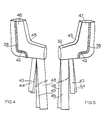
- stitchings 42 drawn in Figs. 4 nd 5 this busk is confined against the outside of the support.
- the support has short bandages 43 and 44, the lateral cross bandage and the medial cross bandage respectively, fastened under the foot portion.
- Bandage 43 is intended to be fastened as a lateral bandage along the lateral side of the support, crosswise over instep 45, medially at 46 on the proximal side of the support.
- Bandage 44 is intended to be fastened as a medial bandage along the medial side of the support, crosswise over instep 45, laterally at 47 on the proximal side of the support. They oppose a plantar flexion of the foot and set limits to the abduction and the adduction, that is the lateral and medial rotation of the foot. Morever, the two bandages increase the pressure at places where chamois leather is applied to the inner surface of the support.
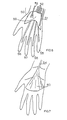
- Fig. 6 shows the position of the muscular tendons extending, right under the palmar skin of forearm and hand, from the forearm over the carpus 50 (wrist joint) into the hand, which tendons can cooperate in effecting a palmar flexion of the hand.
- 51 indicates the tendon of the m. flexor carpi ulnaris
- 52 the four sub-tendons of the m. flexor digitorum superficialis
- 53 the tendon of the m. flexor carpi radialis.
- tendon 54 of the m. palmaris longus has been drawn, which is even closer to the surface.
- Tendon 51 extends via the pisiform bone and the hamate bone to the metacarpal bone of the fifth finger (little finger).
- the four sub-tendons 52 reach up to the middle phalanges of the second finger 56, the third finger 57, the fourth finger 58 and the fifth finger 55.
- Tendon 53 reaches as far as the metacarpal bone of the second finger 56, sometimes also as far as that of the third finger 57.
- Tendons 52 and 53 pass through the canalis carpi (not drawn), these are ducts formed by the m. retinaculum flexorum 59 and carpal bones.
- Tendon 51 is situated closer towards the ulnar side of the wrist and the hand.
- the palmar aponeurosis 60 a tissue consisting of many longitudinal and cross fibres and fastened in many ways to metacarpal parts, inter alia with the longitudinal fibres to the flexor tendons of the 2nd-5th fingers.
- the palmar and dorsal sides of the rectangle are on the ulnar side of the wrist and the hand.
- a U-shaped recess 68 having its mouth on the distal side 62 of the rectangle.
- the recess is bridged by two elastic strips of material 71 and 72, which have a greater elasticity than the material of wrapper 61, and of which strip 72 has been applied in excess for bridging the distance.
- the first strip 71 extends from the ends 73 and 74 of the legs of the U and the second strip 72 extends from the closed end 75 of the U.
- the thumb can be inserted between strips 71 and 72 and is thus comfortably supported at its base.
- the muscles of these tendons are proprioceptively innervated to initiate a palmar flexion when the chamois leather surface portions move the skin to and fro during the movements of the hand.
- the support is provided with an elastic bandage 77 fastened to the dorsal side 65 of the rectangle, which bandage is long enough to cover the way from the ulnar side of the wrist: palmar, radial, dorsal sides of the forearm, ulnar and palmar sides of the hand, between the thumb and forefinger obliquely over the dorsal side of the hand, over ulnar, palmar and radial sides of the forearm and then obliquely to the dorsal side of the hand.
- the bandage On its proximal side the bandage has a recess 78 so that a narrowing 79 exists, which finds its position between thumb and forefinger after the application of the support.
- the bandage described enhances the action of the support, because it excercises pressure on the chamois leather surface portions.
- Stitchings 80 may serve to incorporate busks.
- the described wrist support offers advantages. It can be applied easily, it provides a comfortable support for the base of the thumb and, with the narrowing of the bandage, the bandage firmly presses the muscular tissue of the caput transversum fastened to the tendon of the m. adductor pollicis so that an adduction and opposition of the thumb is brought about, which means that the thumb is pushed away from those positions in which most injuries occur.
- the fastening of the bandages of the supports described can be realized as known in the art. Preference is given to fastening with hook and pile tape.
Landscapes
- Health & Medical Sciences (AREA)
- Life Sciences & Earth Sciences (AREA)
- General Health & Medical Sciences (AREA)
- Biomedical Technology (AREA)
- Heart & Thoracic Surgery (AREA)
- Vascular Medicine (AREA)
- Veterinary Medicine (AREA)
- Animal Behavior & Ethology (AREA)
- Engineering & Computer Science (AREA)
- Public Health (AREA)
- Rheumatology (AREA)
- Orthopedics, Nursing, And Contraception (AREA)
- Non-Silver Salt Photosensitive Materials And Non-Silver Salt Photography (AREA)
- Polymers With Sulfur, Phosphorus Or Metals In The Main Chain (AREA)
- Pharmaceuticals Containing Other Organic And Inorganic Compounds (AREA)
Priority Applications (1)
| Application Number | Priority Date | Filing Date | Title |
|---|---|---|---|
| AT86201590T ATE74741T1 (de) | 1985-09-17 | 1986-09-16 | Stuetze. |
Applications Claiming Priority (2)
| Application Number | Priority Date | Filing Date | Title |
|---|---|---|---|
| NL8502536 | 1985-09-17 | ||
| NL8502536A NL8502536A (nl) | 1985-09-17 | 1985-09-17 | Steunverband. |
Publications (2)
| Publication Number | Publication Date |
|---|---|
| EP0217451A1 true EP0217451A1 (fr) | 1987-04-08 |
| EP0217451B1 EP0217451B1 (fr) | 1992-04-15 |
Family
ID=19846568
Family Applications (1)
| Application Number | Title | Priority Date | Filing Date |
|---|---|---|---|
| EP86201590A Expired - Lifetime EP0217451B1 (fr) | 1985-09-17 | 1986-09-16 | Soutien |
Country Status (6)
| Country | Link |
|---|---|
| US (1) | US4702234A (fr) |
| EP (1) | EP0217451B1 (fr) |
| JP (2) | JPS6268457A (fr) |
| AT (1) | ATE74741T1 (fr) |
| DE (1) | DE3684854D1 (fr) |
| NL (1) | NL8502536A (fr) |
Cited By (3)
| Publication number | Priority date | Publication date | Assignee | Title |
|---|---|---|---|---|
| US5095897A (en) * | 1990-09-21 | 1992-03-17 | Clark E Nelson | Orthopedic splint and method of constructing same |
| DE4104930A1 (de) * | 1991-02-18 | 1992-08-20 | Beiersdorf Ag | Sprunggelenk-bandage |
| US10245171B2 (en) | 2015-04-09 | 2019-04-02 | Ossur Iceland Ehf | Hand support and method for using the same |
Families Citing this family (34)
| Publication number | Priority date | Publication date | Assignee | Title |
|---|---|---|---|---|
| JPH02178Y2 (fr) * | 1986-09-30 | 1990-01-05 | ||
| US4813079A (en) * | 1987-05-18 | 1989-03-21 | Reitzel Jimmie R | Quilted weight pad for sports gloves and method |
| USD329108S (en) | 1989-05-09 | 1992-09-01 | Boyd Timothy J I | Horse bandage |
| US5425702A (en) * | 1989-11-20 | 1995-06-20 | Sunmed, Inc. | Soft tissue support for hip and shoulder |
| JP2603769B2 (ja) * | 1991-05-22 | 1997-04-23 | 株式会社 ワコール | 人体の体表面に圧接して着用されるテーピング機能を有する下腿部用サポーター |
| US5217431A (en) * | 1992-02-20 | 1993-06-08 | Smith & Nephew Donjoy, Inc. | Orthopedic ankle brace |
| US5667484A (en) * | 1995-04-21 | 1997-09-16 | Brossard; Andre | Method for controlling the reflex response of the muscles of a living body joint |
| USD373639S (en) | 1995-08-22 | 1996-09-10 | Mckie Ann W | Thumb splint |
| US5957878A (en) * | 1996-11-22 | 1999-09-28 | Gilliam; Phillip L. | Body support garments |
| US5769808A (en) * | 1996-12-02 | 1998-06-23 | Matthijs; Omer C. | Wrist support band |
| FR2819396B1 (fr) * | 2001-01-17 | 2004-04-23 | Francaise Coop Pharma | Chevillere orthopedique perfectionnee |
| US20040054308A1 (en) * | 2001-08-23 | 2004-03-18 | Thorsten Herzberg | Joint brace |
| JP2004298355A (ja) * | 2003-03-31 | 2004-10-28 | Taketora:Kk | 関節固定具 |
| FR2879899B1 (fr) * | 2004-12-28 | 2007-03-09 | Millet Innovation Sa | Chaussette de maintien d'un module de protection d'une zone du pied |
| WO2006075375A1 (fr) * | 2005-01-13 | 2006-07-20 | Sea Shell Co., Ltd. | Bande pour poignet |
| US20070282233A1 (en) * | 2005-12-12 | 2007-12-06 | Tyco Healthcare Group Lp | Compression apparatus |
| US7931606B2 (en) | 2005-12-12 | 2011-04-26 | Tyco Healthcare Group Lp | Compression apparatus |
| US20080306420A1 (en) * | 2007-06-08 | 2008-12-11 | Tyco Healthcare Group Lp | Compression device with independently moveable inflatable member |
| USD569985S1 (en) * | 2007-06-08 | 2008-05-27 | Tyco Healthcare Group Lp | Foot cuff for therapeutic compression of a foot |
| USD579116S1 (en) * | 2007-07-27 | 2008-10-21 | Tyco Healthcare Group Lp | Foot cuff with tapered, blunt end |
| WO2009135222A1 (fr) | 2008-05-02 | 2009-11-05 | Protasiewicz Richard E Jr | Système de vêtement à activation cutanée proprio-réceptive |
| US9554934B2 (en) | 2008-06-03 | 2017-01-31 | The Lonnie and Shannon Paulos Trust | Elastic brace assembly and methods of use |
| US8808211B2 (en) | 2008-06-03 | 2014-08-19 | The Lonnie and Shannon Paulos Trust | Elastic brace assembly and methods of use |
| US10675166B2 (en) | 2008-06-03 | 2020-06-09 | The Lonnie and Shannon Paulos Trust | Adjustable brace assembly and methods of use |
| US8852133B2 (en) * | 2008-06-03 | 2014-10-07 | The Lonnie and Shannon Pavlos Trust | Hyperextension brace assembly and methods of use |
| US9320634B2 (en) | 2008-06-03 | 2016-04-26 | The Lonnie and Shannon Paulos Trust (as Amended and Restated) F/K/A The James Dizikis Trust Dated February 26, 2008 | Training brace assembly and methods of use |
| US8636678B2 (en) | 2008-07-01 | 2014-01-28 | Covidien Lp | Inflatable member for compression foot cuff |
| CA2817715A1 (fr) | 2010-11-12 | 2012-05-18 | Topical Gear, Llc | Equipement topique, proprioceptif pour cheville et procedes d'utilisation |
| US9125787B2 (en) | 2011-09-30 | 2015-09-08 | Covidien Lp | Compression garment having a foam layer |
| US8887315B2 (en) * | 2011-11-02 | 2014-11-18 | Erin Lynn Boynton | Orthopedic support garment |
| USD712557S1 (en) * | 2012-10-30 | 2014-09-02 | Lyn Tallarida Gatti | Shin shackle |
| US9402779B2 (en) | 2013-03-11 | 2016-08-02 | Covidien Lp | Compression garment with perspiration relief |
| RU2713454C2 (ru) * | 2017-04-25 | 2020-02-05 | Общество с ограниченной ответственностью "НейроБиоЛаб" | Способ объективной оценки проприоцептивной чувствительности в отдельных суставах конечностей у человека |
| DE102021207095A1 (de) * | 2021-07-06 | 2023-01-12 | Bauerfeind Ag | Bandage für das Handgelenk oder das Sprunggelenk |
Citations (5)
| Publication number | Priority date | Publication date | Assignee | Title |
|---|---|---|---|---|
| US1462534A (en) * | 1921-06-14 | 1923-07-24 | Michael J Condylis | Arch supporter |
| DE529151C (de) * | 1931-07-09 | Wilhelm Schoenberger | Mit Gummizug versehene endlose Mittelfussbandage | |
| US3595244A (en) * | 1968-10-30 | 1971-07-27 | Scholl Mfg Co Inc | Foot-massaging sandal |
| US3934583A (en) * | 1974-09-27 | 1976-01-27 | Danny W. Hollingshead | Therapeutic musculoskeletal support sleeve and method of manufacturing same |
| US4479495A (en) * | 1982-09-27 | 1984-10-30 | Isaacson Gary S | Acupressure point stimulator device |
Family Cites Families (12)
| Publication number | Priority date | Publication date | Assignee | Title |
|---|---|---|---|---|
| US999010A (en) * | 1910-10-22 | 1911-07-25 | Henry James Collis | Ankle support and protector. |
| US2994322A (en) * | 1959-01-12 | 1961-08-01 | Charles C Cullen | Protective supporter |
| JPS4428909Y1 (fr) * | 1967-05-24 | 1969-12-01 | ||
| US3533407A (en) * | 1969-09-22 | 1970-10-13 | Faberge Inc | Strap type wrist support |
| US4084586A (en) * | 1976-10-13 | 1978-04-18 | Hettick Lon R | Tubular support for enclosing a body member |
| US4166460A (en) * | 1977-09-19 | 1979-09-04 | Surgical Appliance Industries, Inc. | Ankle protector |
| US4309991A (en) * | 1980-06-18 | 1982-01-12 | Demarco Alexander H | Wrist brace |
| US4323058A (en) * | 1980-10-14 | 1982-04-06 | Detty Garnett E | Ankle brace |
| JPS6034310Y2 (ja) * | 1982-09-08 | 1985-10-12 | 康夫 加藤 | 関節用パツト |
| US4550721A (en) * | 1983-07-01 | 1985-11-05 | Michel Lorraine M | Foot support |
| US4556054A (en) * | 1983-11-21 | 1985-12-03 | Paulseth Stephen G | Ankle orthosis |
| US4625336A (en) * | 1985-05-30 | 1986-12-02 | Nike, Inc. | Athletic garment |
-
1985
- 1985-09-17 NL NL8502536A patent/NL8502536A/nl not_active Application Discontinuation
-
1986
- 1986-09-04 US US06/903,491 patent/US4702234A/en not_active Expired - Lifetime
- 1986-09-16 EP EP86201590A patent/EP0217451B1/fr not_active Expired - Lifetime
- 1986-09-16 AT AT86201590T patent/ATE74741T1/de not_active IP Right Cessation
- 1986-09-16 DE DE8686201590T patent/DE3684854D1/de not_active Expired - Lifetime
- 1986-09-17 JP JP61217364A patent/JPS6268457A/ja active Granted
-
1990
- 1990-09-06 JP JP2234658A patent/JPH03218750A/ja active Pending
Patent Citations (5)
| Publication number | Priority date | Publication date | Assignee | Title |
|---|---|---|---|---|
| DE529151C (de) * | 1931-07-09 | Wilhelm Schoenberger | Mit Gummizug versehene endlose Mittelfussbandage | |
| US1462534A (en) * | 1921-06-14 | 1923-07-24 | Michael J Condylis | Arch supporter |
| US3595244A (en) * | 1968-10-30 | 1971-07-27 | Scholl Mfg Co Inc | Foot-massaging sandal |
| US3934583A (en) * | 1974-09-27 | 1976-01-27 | Danny W. Hollingshead | Therapeutic musculoskeletal support sleeve and method of manufacturing same |
| US4479495A (en) * | 1982-09-27 | 1984-10-30 | Isaacson Gary S | Acupressure point stimulator device |
Cited By (6)
| Publication number | Priority date | Publication date | Assignee | Title |
|---|---|---|---|---|
| US5095897A (en) * | 1990-09-21 | 1992-03-17 | Clark E Nelson | Orthopedic splint and method of constructing same |
| DE4104930A1 (de) * | 1991-02-18 | 1992-08-20 | Beiersdorf Ag | Sprunggelenk-bandage |
| DE4104930C2 (de) * | 1991-02-18 | 2000-05-04 | Beiersdorf Ag | Sprunggelenk-Bandage |
| US10245171B2 (en) | 2015-04-09 | 2019-04-02 | Ossur Iceland Ehf | Hand support and method for using the same |
| US11376147B2 (en) | 2015-04-09 | 2022-07-05 | Ossur Iceland Ehf | Hand support and method for using the same |
| US12023268B2 (en) | 2015-04-09 | 2024-07-02 | Ossur Iceland Ehf | Hand support and method for using the same |
Also Published As
| Publication number | Publication date |
|---|---|
| DE3684854D1 (de) | 1992-05-21 |
| EP0217451B1 (fr) | 1992-04-15 |
| NL8502536A (nl) | 1987-04-16 |
| JPS6268457A (ja) | 1987-03-28 |
| JPH03218750A (ja) | 1991-09-26 |
| ATE74741T1 (de) | 1992-05-15 |
| JPH0370970B2 (fr) | 1991-11-11 |
| US4702234A (en) | 1987-10-27 |
Similar Documents
| Publication | Publication Date | Title |
|---|---|---|
| EP0217451B1 (fr) | Soutien | |
| US4724831A (en) | Knee support for aiding proprioceptive Innervation | |
| Sammarco et al. | Partial rupture of the flexor hallucis longus tendon in classical ballet dancers: two case reports. | |
| US6776769B2 (en) | Anatomically configured tubular body of woven or knitted fabric for pressure support of articulating joint | |
| AU782356B2 (en) | Bandage for the ankle joint | |
| Sabir et al. | Pathogenesis of pes cavus in Charcot-Marie-Tooth disease | |
| US20180028342A1 (en) | Dynamic hallux tension device for treatment of plantar fasciitis | |
| US5099860A (en) | Orthotic device for the dynamic treatment of tearing or straining of the ligaments of the lateral ankle | |
| US12150491B2 (en) | Therapeutic sock with one or more elastomeric bands | |
| CA2161841A1 (fr) | Methode et dispositif pour controler le reflexe des muscles d'une articulation chez un organisme vivant | |
| US6458091B1 (en) | Muscle tone reduction splint | |
| AU673228B2 (en) | Self-adhesive prefabricated bandage | |
| Parkes | Paralytic claw fingers—a graft tenodesis operation | |
| Said | A modified tendon transference for radial nerve paralysis | |
| US20190133804A1 (en) | Ankle support | |
| Cromer | Splinting and Casting | |
| CN101015479A (zh) | 拇趾外翻矫正器 | |
| Agarwal | Peripheral Nerve Examination in a Child | |
| KR200196097Y1 (ko) | 일회용 테이프 | |
| Prabhakar et al. | The foot and ankle | |
| CN86203214U (zh) | 弹力绑腿 | |
| Patil et al. | CONCEPTUAL REVIEW ON ADHO SHAKHAGATA MARMA | |
| Soule | Treatment of Congenital Talipes Equinovarus in Infancy and Early Childhood | |
| Au et al. | Taping and bracing in sports | |
| ROCHE | WJ THEUVENET,* SP RUCHAL, DJ SOARES & |
Legal Events
| Date | Code | Title | Description |
|---|---|---|---|
| PUAI | Public reference made under article 153(3) epc to a published international application that has entered the european phase |
Free format text: ORIGINAL CODE: 0009012 |
|
| AK | Designated contracting states |
Kind code of ref document: A1 Designated state(s): AT BE CH DE FR GB IT LI LU NL SE |
|
| 17P | Request for examination filed |
Effective date: 19870907 |
|
| 17Q | First examination report despatched |
Effective date: 19890306 |
|
| GRAA | (expected) grant |
Free format text: ORIGINAL CODE: 0009210 |
|
| AK | Designated contracting states |
Kind code of ref document: B1 Designated state(s): AT BE CH DE FR GB IT LI LU NL SE |
|
| PG25 | Lapsed in a contracting state [announced via postgrant information from national office to epo] |
Ref country code: IT Free format text: LAPSE BECAUSE OF FAILURE TO SUBMIT A TRANSLATION OF THE DESCRIPTION OR TO PAY THE FEE WITHIN THE PRESCRIBED TIME-LIMIT;WARNING: LAPSES OF ITALIAN PATENTS WITH EFFECTIVE DATE BEFORE 2007 MAY HAVE OCCURRED AT ANY TIME BEFORE 2007. THE CORRECT EFFECTIVE DATE MAY BE DIFFERENT FROM THE ONE RECORDED. Effective date: 19920415 Ref country code: AT Effective date: 19920415 Ref country code: SE Effective date: 19920415 |
|
| REF | Corresponds to: |
Ref document number: 74741 Country of ref document: AT Date of ref document: 19920515 Kind code of ref document: T |
|
| REF | Corresponds to: |
Ref document number: 3684854 Country of ref document: DE Date of ref document: 19920521 |
|
| ET | Fr: translation filed | ||
| PGFP | Annual fee paid to national office [announced via postgrant information from national office to epo] |
Ref country code: LU Payment date: 19920902 Year of fee payment: 7 |
|
| EPTA | Lu: last paid annual fee | ||
| PLBE | No opposition filed within time limit |
Free format text: ORIGINAL CODE: 0009261 |
|
| STAA | Information on the status of an ep patent application or granted ep patent |
Free format text: STATUS: NO OPPOSITION FILED WITHIN TIME LIMIT |
|
| 26N | No opposition filed | ||
| PG25 | Lapsed in a contracting state [announced via postgrant information from national office to epo] |
Ref country code: LU Free format text: LAPSE BECAUSE OF NON-PAYMENT OF DUE FEES Effective date: 19930916 |
|
| ITTA | It: last paid annual fee | ||
| BECA | Be: change of holder's address |
Free format text: 940704 *NEA INTRNATIONAL B.V.:SINT GERARDUSWEG 50, 6224 LV MAASTRICHT |
|
| ITPR | It: changes in ownership of a european patent |
Owner name: CESSIONE;NEA INTERNATIONAL B.V. |
|
| REG | Reference to a national code |
Ref country code: FR Ref legal event code: TP |
|
| NLS | Nl: assignments of ep-patents |
Owner name: NEA INTERNATIONAL B.V. |
|
| REG | Reference to a national code |
Ref country code: CH Ref legal event code: PUE Owner name: MACINTOSH N.V. TRANSFER- NEA INTERNATIONAL B.V. |
|
| PGFP | Annual fee paid to national office [announced via postgrant information from national office to epo] |
Ref country code: FR Payment date: 20010831 Year of fee payment: 16 |
|
| PGFP | Annual fee paid to national office [announced via postgrant information from national office to epo] |
Ref country code: GB Payment date: 20010904 Year of fee payment: 16 |
|
| REG | Reference to a national code |
Ref country code: GB Ref legal event code: IF02 |
|
| PG25 | Lapsed in a contracting state [announced via postgrant information from national office to epo] |
Ref country code: GB Free format text: LAPSE BECAUSE OF NON-PAYMENT OF DUE FEES Effective date: 20020916 |
|
| GBPC | Gb: european patent ceased through non-payment of renewal fee |
Effective date: 20020916 |
|
| PG25 | Lapsed in a contracting state [announced via postgrant information from national office to epo] |
Ref country code: FR Free format text: LAPSE BECAUSE OF NON-PAYMENT OF DUE FEES Effective date: 20030603 |
|
| REG | Reference to a national code |
Ref country code: FR Ref legal event code: ST |
|
| PGFP | Annual fee paid to national office [announced via postgrant information from national office to epo] |
Ref country code: NL Payment date: 20040829 Year of fee payment: 19 |
|
| PGFP | Annual fee paid to national office [announced via postgrant information from national office to epo] |
Ref country code: CH Payment date: 20040924 Year of fee payment: 19 |
|
| PGFP | Annual fee paid to national office [announced via postgrant information from national office to epo] |
Ref country code: BE Payment date: 20041021 Year of fee payment: 19 |
|
| PGFP | Annual fee paid to national office [announced via postgrant information from national office to epo] |
Ref country code: DE Payment date: 20041102 Year of fee payment: 19 |
|
| PG25 | Lapsed in a contracting state [announced via postgrant information from national office to epo] |
Ref country code: CH Free format text: LAPSE BECAUSE OF NON-PAYMENT OF DUE FEES Effective date: 20050930 Ref country code: BE Free format text: LAPSE BECAUSE OF NON-PAYMENT OF DUE FEES Effective date: 20050930 Ref country code: LI Free format text: LAPSE BECAUSE OF NON-PAYMENT OF DUE FEES Effective date: 20050930 |
|
| PG25 | Lapsed in a contracting state [announced via postgrant information from national office to epo] |
Ref country code: NL Free format text: LAPSE BECAUSE OF NON-PAYMENT OF DUE FEES Effective date: 20060401 Ref country code: DE Free format text: LAPSE BECAUSE OF NON-PAYMENT OF DUE FEES Effective date: 20060401 |
|
| REG | Reference to a national code |
Ref country code: CH Ref legal event code: PL |
|
| NLV4 | Nl: lapsed or anulled due to non-payment of the annual fee |
Effective date: 20060401 |
|
| BERE | Be: lapsed |
Owner name: *NEA INTRNATIONAL B.V. Effective date: 20050930 |