EP0218638B1 - Pivot pin bearing for biomedical systems - Google Patents
Pivot pin bearing for biomedical systems Download PDFInfo
- Publication number
- EP0218638B1 EP0218638B1 EP86902224A EP86902224A EP0218638B1 EP 0218638 B1 EP0218638 B1 EP 0218638B1 EP 86902224 A EP86902224 A EP 86902224A EP 86902224 A EP86902224 A EP 86902224A EP 0218638 B1 EP0218638 B1 EP 0218638B1
- Authority
- EP
- European Patent Office
- Prior art keywords
- pivot pin
- rotor
- seal
- housing
- pin
- Prior art date
- Legal status (The legal status is an assumption and is not a legal conclusion. Google has not performed a legal analysis and makes no representation as to the accuracy of the status listed.)
- Expired
Links
- 229920003023 plastic Polymers 0.000 claims abstract description 37
- 239000004033 plastic Substances 0.000 claims abstract description 37
- 239000000463 material Substances 0.000 claims abstract description 18
- 239000012530 fluid Substances 0.000 claims abstract description 14
- 238000002347 injection Methods 0.000 claims abstract description 12
- 239000007924 injection Substances 0.000 claims abstract description 12
- 238000002616 plasmapheresis Methods 0.000 claims abstract description 12
- 229920002647 polyamide Polymers 0.000 claims abstract description 11
- 239000011347 resin Substances 0.000 claims abstract description 11
- 229920005989 resin Polymers 0.000 claims abstract description 11
- 229920001296 polysiloxane Polymers 0.000 claims abstract description 6
- 238000012545 processing Methods 0.000 claims abstract description 4
- 210000004369 blood Anatomy 0.000 claims description 16
- 239000008280 blood Substances 0.000 claims description 16
- 239000012528 membrane Substances 0.000 claims description 12
- 238000001914 filtration Methods 0.000 claims description 9
- 238000007789 sealing Methods 0.000 claims description 6
- 229920004738 ULTEM® Polymers 0.000 claims description 3
- 229920002292 Nylon 6 Polymers 0.000 claims description 2
- 230000003993 interaction Effects 0.000 claims description 2
- 239000007788 liquid Substances 0.000 claims description 2
- 238000004519 manufacturing process Methods 0.000 claims description 2
- 239000000706 filtrate Substances 0.000 claims 4
- 239000000203 mixture Substances 0.000 claims 1
- 230000005855 radiation Effects 0.000 abstract description 6
- 238000004659 sterilization and disinfection Methods 0.000 abstract description 5
- 230000015556 catabolic process Effects 0.000 abstract description 2
- 238000006731 degradation reaction Methods 0.000 abstract description 2
- 238000012986 modification Methods 0.000 abstract description 2
- 230000004048 modification Effects 0.000 abstract description 2
- 230000001954 sterilising effect Effects 0.000 abstract description 2
- 229920000642 polymer Polymers 0.000 description 15
- 238000000926 separation method Methods 0.000 description 11
- 239000002991 molded plastic Substances 0.000 description 8
- 239000010935 stainless steel Substances 0.000 description 8
- 229910001220 stainless steel Inorganic materials 0.000 description 8
- 210000004027 cell Anatomy 0.000 description 6
- 238000000034 method Methods 0.000 description 6
- 230000008878 coupling Effects 0.000 description 5
- 238000010168 coupling process Methods 0.000 description 5
- 238000005859 coupling reaction Methods 0.000 description 5
- 238000012360 testing method Methods 0.000 description 5
- 238000005461 lubrication Methods 0.000 description 4
- 238000005498 polishing Methods 0.000 description 4
- 239000004642 Polyimide Substances 0.000 description 3
- 239000004963 Torlon Substances 0.000 description 3
- 229920003997 Torlon® Polymers 0.000 description 3
- 230000000694 effects Effects 0.000 description 3
- 229920001721 polyimide Polymers 0.000 description 3
- -1 polypropylene Polymers 0.000 description 3
- 229920001343 polytetrafluoroethylene Polymers 0.000 description 3
- 239000004810 polytetrafluoroethylene Substances 0.000 description 3
- 239000004800 polyvinyl chloride Substances 0.000 description 3
- 229920000915 polyvinyl chloride Polymers 0.000 description 3
- 238000009987 spinning Methods 0.000 description 3
- XECAHXYUAAWDEL-UHFFFAOYSA-N acrylonitrile butadiene styrene Chemical compound C=CC=C.C=CC#N.C=CC1=CC=CC=C1 XECAHXYUAAWDEL-UHFFFAOYSA-N 0.000 description 2
- 239000004676 acrylonitrile butadiene styrene Substances 0.000 description 2
- 229920000122 acrylonitrile butadiene styrene Polymers 0.000 description 2
- 229910045601 alloy Inorganic materials 0.000 description 2
- 239000000956 alloy Substances 0.000 description 2
- 210000000601 blood cell Anatomy 0.000 description 2
- 238000004140 cleaning Methods 0.000 description 2
- 238000004891 communication Methods 0.000 description 2
- 238000004132 cross linking Methods 0.000 description 2
- 238000013461 design Methods 0.000 description 2
- 238000011161 development Methods 0.000 description 2
- 238000001746 injection moulding Methods 0.000 description 2
- 239000000314 lubricant Substances 0.000 description 2
- 238000005374 membrane filtration Methods 0.000 description 2
- 238000000465 moulding Methods 0.000 description 2
- 239000004417 polycarbonate Substances 0.000 description 2
- 229920000515 polycarbonate Polymers 0.000 description 2
- 229920002545 silicone oil Polymers 0.000 description 2
- 239000000243 solution Substances 0.000 description 2
- BQCIDUSAKPWEOX-UHFFFAOYSA-N 1,1-Difluoroethene Chemical compound FC(F)=C BQCIDUSAKPWEOX-UHFFFAOYSA-N 0.000 description 1
- 239000004925 Acrylic resin Substances 0.000 description 1
- 229920000178 Acrylic resin Polymers 0.000 description 1
- 244000118350 Andrographis paniculata Species 0.000 description 1
- 229920000049 Carbon (fiber) Polymers 0.000 description 1
- GUTLYIVDDKVIGB-OUBTZVSYSA-N Cobalt-60 Chemical compound [60Co] GUTLYIVDDKVIGB-OUBTZVSYSA-N 0.000 description 1
- 229920004943 Delrin® Polymers 0.000 description 1
- 229920002449 FKM Polymers 0.000 description 1
- 102000001554 Hemoglobins Human genes 0.000 description 1
- 108010054147 Hemoglobins Proteins 0.000 description 1
- 239000002033 PVDF binder Substances 0.000 description 1
- 229920002614 Polyether block amide Polymers 0.000 description 1
- 239000004743 Polypropylene Substances 0.000 description 1
- XUIMIQQOPSSXEZ-UHFFFAOYSA-N Silicon Chemical compound [Si] XUIMIQQOPSSXEZ-UHFFFAOYSA-N 0.000 description 1
- 229910000831 Steel Inorganic materials 0.000 description 1
- 239000011354 acetal resin Substances 0.000 description 1
- NIXOWILDQLNWCW-UHFFFAOYSA-N acrylic acid group Chemical group C(C=C)(=O)O NIXOWILDQLNWCW-UHFFFAOYSA-N 0.000 description 1
- 230000009471 action Effects 0.000 description 1
- 239000000654 additive Substances 0.000 description 1
- 230000002411 adverse Effects 0.000 description 1
- 229920005601 base polymer Polymers 0.000 description 1
- 238000010261 blood fractionation Methods 0.000 description 1
- 238000010504 bond cleavage reaction Methods 0.000 description 1
- 239000004917 carbon fiber Substances 0.000 description 1
- 238000012668 chain scission Methods 0.000 description 1
- 150000001875 compounds Chemical class 0.000 description 1
- 239000000470 constituent Substances 0.000 description 1
- 229920001577 copolymer Polymers 0.000 description 1
- 238000010790 dilution Methods 0.000 description 1
- 239000012895 dilution Substances 0.000 description 1
- 201000010099 disease Diseases 0.000 description 1
- 208000037265 diseases, disorders, signs and symptoms Diseases 0.000 description 1
- 239000000428 dust Substances 0.000 description 1
- 229920001971 elastomer Polymers 0.000 description 1
- 238000002474 experimental method Methods 0.000 description 1
- 229920001973 fluoroelastomer Polymers 0.000 description 1
- 230000004907 flux Effects 0.000 description 1
- 239000003365 glass fiber Substances 0.000 description 1
- HCDGVLDPFQMKDK-UHFFFAOYSA-N hexafluoropropylene Chemical group FC(F)=C(F)C(F)(F)F HCDGVLDPFQMKDK-UHFFFAOYSA-N 0.000 description 1
- JEIPFZHSYJVQDO-UHFFFAOYSA-N iron(III) oxide Inorganic materials O=[Fe]O[Fe]=O JEIPFZHSYJVQDO-UHFFFAOYSA-N 0.000 description 1
- 238000003754 machining Methods 0.000 description 1
- 239000000696 magnetic material Substances 0.000 description 1
- VNWKTOKETHGBQD-UHFFFAOYSA-N methane Chemical compound C VNWKTOKETHGBQD-UHFFFAOYSA-N 0.000 description 1
- 231100000989 no adverse effect Toxicity 0.000 description 1
- 238000007383 open-end spinning Methods 0.000 description 1
- 230000003287 optical effect Effects 0.000 description 1
- 229920000620 organic polymer Polymers 0.000 description 1
- 239000013618 particulate matter Substances 0.000 description 1
- 239000002861 polymer material Substances 0.000 description 1
- 229920006324 polyoxymethylene Polymers 0.000 description 1
- 229920001155 polypropylene Polymers 0.000 description 1
- 229920002981 polyvinylidene fluoride Polymers 0.000 description 1
- 230000002028 premature Effects 0.000 description 1
- 238000002360 preparation method Methods 0.000 description 1
- 230000008569 process Effects 0.000 description 1
- 239000002994 raw material Substances 0.000 description 1
- 230000004044 response Effects 0.000 description 1
- 239000005060 rubber Substances 0.000 description 1
- 230000007017 scission Effects 0.000 description 1
- 229910052710 silicon Inorganic materials 0.000 description 1
- 239000010703 silicon Substances 0.000 description 1
- 239000010959 steel Substances 0.000 description 1
- 239000000057 synthetic resin Substances 0.000 description 1
- 229920003002 synthetic resin Polymers 0.000 description 1
- 230000001988 toxicity Effects 0.000 description 1
- 231100000419 toxicity Toxicity 0.000 description 1
Images

Classifications
-
- F—MECHANICAL ENGINEERING; LIGHTING; HEATING; WEAPONS; BLASTING
- F16—ENGINEERING ELEMENTS AND UNITS; GENERAL MEASURES FOR PRODUCING AND MAINTAINING EFFECTIVE FUNCTIONING OF MACHINES OR INSTALLATIONS; THERMAL INSULATION IN GENERAL
- F16C—SHAFTS; FLEXIBLE SHAFTS; ELEMENTS OR CRANKSHAFT MECHANISMS; ROTARY BODIES OTHER THAN GEARING ELEMENTS; BEARINGS
- F16C33/00—Parts of bearings; Special methods for making bearings or parts thereof
- F16C33/02—Parts of sliding-contact bearings
- F16C33/04—Brasses; Bushes; Linings
- F16C33/20—Sliding surface consisting mainly of plastics
-
- A—HUMAN NECESSITIES
- A61—MEDICAL OR VETERINARY SCIENCE; HYGIENE
- A61M—DEVICES FOR INTRODUCING MEDIA INTO, OR ONTO, THE BODY; DEVICES FOR TRANSDUCING BODY MEDIA OR FOR TAKING MEDIA FROM THE BODY; DEVICES FOR PRODUCING OR ENDING SLEEP OR STUPOR
- A61M1/00—Suction or pumping devices for medical purposes; Devices for carrying-off, for treatment of, or for carrying-over, body-liquids; Drainage systems
- A61M1/14—Dialysis systems; Artificial kidneys; Blood oxygenators ; Reciprocating systems for treatment of body fluids, e.g. single needle systems for hemofiltration or pheresis
- A61M1/16—Dialysis systems; Artificial kidneys; Blood oxygenators ; Reciprocating systems for treatment of body fluids, e.g. single needle systems for hemofiltration or pheresis with membranes
- A61M1/26—Dialysis systems; Artificial kidneys; Blood oxygenators ; Reciprocating systems for treatment of body fluids, e.g. single needle systems for hemofiltration or pheresis with membranes and internal elements which are moving
- A61M1/262—Dialysis systems; Artificial kidneys; Blood oxygenators ; Reciprocating systems for treatment of body fluids, e.g. single needle systems for hemofiltration or pheresis with membranes and internal elements which are moving rotating
- A61M1/265—Dialysis systems; Artificial kidneys; Blood oxygenators ; Reciprocating systems for treatment of body fluids, e.g. single needle systems for hemofiltration or pheresis with membranes and internal elements which are moving rotating inducing Taylor vortices
-
- B—PERFORMING OPERATIONS; TRANSPORTING
- B01—PHYSICAL OR CHEMICAL PROCESSES OR APPARATUS IN GENERAL
- B01D—SEPARATION
- B01D63/00—Apparatus in general for separation processes using semi-permeable membranes
- B01D63/06—Tubular membrane modules
- B01D63/062—Tubular membrane modules with membranes on a surface of a support tube
-
- B—PERFORMING OPERATIONS; TRANSPORTING
- B01—PHYSICAL OR CHEMICAL PROCESSES OR APPARATUS IN GENERAL
- B01D—SEPARATION
- B01D63/00—Apparatus in general for separation processes using semi-permeable membranes
- B01D63/16—Rotary, reciprocated or vibrated modules
-
- F—MECHANICAL ENGINEERING; LIGHTING; HEATING; WEAPONS; BLASTING
- F16—ENGINEERING ELEMENTS AND UNITS; GENERAL MEASURES FOR PRODUCING AND MAINTAINING EFFECTIVE FUNCTIONING OF MACHINES OR INSTALLATIONS; THERMAL INSULATION IN GENERAL
- F16C—SHAFTS; FLEXIBLE SHAFTS; ELEMENTS OR CRANKSHAFT MECHANISMS; ROTARY BODIES OTHER THAN GEARING ELEMENTS; BEARINGS
- F16C17/00—Sliding-contact bearings for exclusively rotary movement
- F16C17/04—Sliding-contact bearings for exclusively rotary movement for axial load only
- F16C17/08—Sliding-contact bearings for exclusively rotary movement for axial load only for supporting the end face of a shaft or other member, e.g. footstep bearings
-
- A—HUMAN NECESSITIES
- A61—MEDICAL OR VETERINARY SCIENCE; HYGIENE
- A61M—DEVICES FOR INTRODUCING MEDIA INTO, OR ONTO, THE BODY; DEVICES FOR TRANSDUCING BODY MEDIA OR FOR TAKING MEDIA FROM THE BODY; DEVICES FOR PRODUCING OR ENDING SLEEP OR STUPOR
- A61M1/00—Suction or pumping devices for medical purposes; Devices for carrying-off, for treatment of, or for carrying-over, body-liquids; Drainage systems
- A61M1/34—Filtering material out of the blood by passing it through a membrane, i.e. hemofiltration or diafiltration
- A61M1/3496—Plasmapheresis; Leucopheresis; Lymphopheresis
-
- B—PERFORMING OPERATIONS; TRANSPORTING
- B01—PHYSICAL OR CHEMICAL PROCESSES OR APPARATUS IN GENERAL
- B01D—SEPARATION
- B01D2315/00—Details relating to the membrane module operation
- B01D2315/02—Rotation or turning
Definitions
- This invention relates to biomedical systems for fluids separation embodying a rotor mounted on a pivot pin bearing, and is particularly concerned with medical disposable units involving rotation of a molded plastic part suspended on pivot pin bearings, especially for applications involving the rotation of a filtration support housing or for the rotation of a centrifugal separation housing.
- a particular area of usefulness of the present invention is in hemapheresis, relating to the separation of one or more constituents of blood, using disposable filtration or centrifugal separation devices.
- a specific area of application is in a plasmapheresis disposable separation device for the filtration of plasma from whole blood.
- Plasmapheresis devices presently employed include membrane filtration devices as exemplified by the device disclosed and claimed in EP-A-112152 "Blood Fractionation System And Method" by H. Fischel.
- Such membrane filtration device has an interior spinner which is covered with a filter membrane and includes a conduit system for collecting the plasma passing through the membrane.
- the device receives an input fluid such as whole blood which passes into the space between the spinner and the outer wall of the housing.
- the plasma in the blood is filtered through the membrane into corrugations on the surface of the spinner, from which the plasma passes through holes into a central conduit and passes out at the bottom through an outlet conduit concentric with the central axis of the device.
- the spinner is mounted in a closed cell or housing, and is driven remotely. This is accomplished by providing a magnetic coupling device at the top of the spinner.
- An external magnetic drive has one or more magnets which attract and lock onto the internal magnetic coupling device of the spinner.
- the magnetic coupling device may be either a piece of magnetic permeable material or another magnet oriented to attract the drive magnet.
- a pivot pin bearing is mounted at the top of the device to hold the upper end of the spinner during rotation
- a second pivot pin bearing is mounted at the bottom of the device on which the spinner rests during rotation.
- the spinner is rotatably supported by upper and lower pivot pin bearings and pivot pins which are conventionally made of stainless steel.
- An O-ring seal is loosely positioned between the spinner and the lower pivot pin bearing.
- the first step involves machining a taper on the outside radius of the pin. This taper is required to prevent a steel edge from contacting and gouging an adjacent plastic wall when the pin rotates.
- the second involves the polishing of the end of the pin. This is accomplished by spinning the pin at a high rate of speed and applying a rubber abrasive for a certain length of time. Then the pin surface is brought to a mirror finish with a rouge polishing compound.
- the final part of this second step involves extensive cleaning of the pin to remove all polishing media and debris.
- the third step is the lubrication process. Both the pin and the O-ring are immersed in a diluted silicone oil solution. This silicone oil solution is specially tailored in both dilution and viscosity to provide sufficient lubrication without migrating to other undesirable areas of the blood separation filter. After all of the particulate matter has been cleaned from the pins, so that they are perfectly clean, the pins must be installed in devices and then sterilized by exposure to gamma radiation.
- the separation device In order to avoid communication of disease the separation device is used only once and then discarded. Since the separation device is disposable it is essential that it be manufactured as inexpensively as possible. However, since the upper and lower pivot pins for the rotor or spinner of these devices are fabricted from stainless steel, their initial raw material costs are relatively high. Further, the procedures for polishing, lapping the seal surface to minimize wear, and the cleaning of the pins greatly increases the cost of these pins. Moreover, the rejection rate for the processed stainless steel pins is surprisingly high, mainly due to the close tolerances which must be kept on the pivot pins in order for them to function properly together with the necessary tolerances required in molded plastic rotors.
- disposable apparatus for processing biomedical fluids in a closed environment including a plastic rotor mounted for rotation on a pivot pin and a seal located between the rotor and pivot pin which pivot pin has a low coefficient of friction, a tapered end and is a structural member supporting the rotor, characterised by: the pivot pin being moulded of a hard polyamide-based resin plastics material having gamma-irradiation-enhanced lubriciousness.
- a low cost, disposable plasmapheresis unit in accordance with the invention includes an outer shell or housing and a rotor including a rotating membrane supported within the shell by a hard plastic injection molded pivot pin.
- the polyamide-based resin plastic material of the pivot pin has qualities of lubriciousness and hardness which enable the pin to withstand the stresses of supporting the rotor in high speed operation, and which is capable of being injection molded.
- Such molding of the pivot pin is highly desirable since it avoids the many labor intensive preparation procedures noted above for stainless steel pivot pins.
- the inexpensive injection molding operation produces pins with sufficient smoothness and hardness on bearing surfaces while maintaining tight tolerances on critical dimensions.
- molded plastic pivot pins produced according to the invention can be gamma irradiated not only for sterilisation, but for modifying the polymer of the pivot pin to provide a surface having a low coefficient of friction so as to permit rotating of the spinning filter unit on the pivot pin for a length of time sufficient to provide required liquid separations.
- the molded pivot pin is formed from a hard polyamide-based resin plastic having a low coefficient of friction.
- the pin has a lubricious wear resistant nature and will not create hot spots and will not shed debris.
- Such molded pivot pin is particularly useful in conjunction with a certain type of O-ring seal under the conditions of force which are required to be exerted to effect adequate sealing, and which will permit the device to operate for a sufficient length of time to permit the collection of the required amount of separated material, e.g. a typical volume of donated plasma, before discarding the unit.
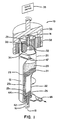
- numeral 10 illustrates a disposable plasmapheresis device with which the pivot pin design of the invention can be employed.
- the device comprises a cylindrical housing 12 completed by an upper end cap 14, the walls of which are non-magnetic, and a bottom end housing 16 terminating in a plasma outlet port 18 concentric with a central axis of the device 10.
- a generally cylindrical spinner or rotor 20 is mounted in a vertical position between the upper end cap 14 and the bottom end housing 16 for rotation about a rotor central axis which coincides with the central axis of housing 12.
- the spinner 20 comprises a shaped central mandrel 22, preferably of a light weight strong impermeable synthetic resin material such as high density polypropylene, acrylic, or ABS (acrylonitrile-butadiene-styrene resin). To simplify molding the spinner may be made in two separate pieces (not shown) that are joined together.
- the outer surface of the central mandrel 22 is shaped to define a series of spaced apart circumferential grooves or plasma channels 24 in the outer periphery of the mandrel.
- radially extending channels 25a provide communication between the periphery of mandrel 22 and a central orifice or manifold 26 concentric with the central axis.
- Axially extending grooves 25b in the periphery of the mandrel 22 interconnect the circumferential grooves 24 with the radial channels 25a to complete a network of interconnected paths between grooves 24 and manifold 26.
- the surface of the rotary spinner 20 is covered by a cylindrical membrane 28 such as a commercially available filtration membrane of the type sold under the designation polyvinylidene fluoride by Millipore.
- the rotary spinner 20 is rotationally supported relative to the upper end cap 14 by a stationary upper pivot pin 29 which is press fitted at its upper end into the end cap 14.
- the lower end of the pin 29 is seated within a cylindrical bearing surface 30 in an end cylinder 32 attached to or forming an integral part of the rotary spinner 20.
- the lower end of the pin 29 protrudes into a small chamber adjacent the bearing surface 30 so that the pin does not bind in the end cylinder 32.
- the end cylinder 32 is partially encompassed by a ring 34 of magnetic material such as stainless steel, utilized in indirect driving of the spinner 20.
- a drive motor 35 exterior to the housing 12 is coupled to turn an annular magnetic drive member 36 which partially surrounds the non-magnetic end cap 14.
- the drive member 36 includes diametrically opposed internal permanent magnets 38 so that as the annular drive member 36 is rotated, magnet attraction between the ring 34 interior to the housing and the magnets 38 exterior to the housing locks the spinner 20 to the exterior drive, causing the spinner to rotate without slippage.
- a rotational speed of the order of about 3600 rpm is used in this example, although higher rotational rates can be used.
- the central outlet orifice 26 communicates with a central bore 40 in a cylindrical lower end pivot pin 42 concentric with the central axis.
- the lower pivot pin 42 is seated in the bottom end housing 16.
- An O-ring seal 44 is mounted on an upper end surface of the pivot pin 42 and an internal shoulder 46 at the lower end of the rotor 20 rests on top of the O-ring seal 44.
- the O-ring seal is fabricated preferably of a Viton material, a series of fluoroelastomers based on the copolymer of vinylidene fluoride and hexafluoropropylene, marketed by DuPont, and is specifically formulated for medical applications.
- the O-ring is covered with a silicone lubricant to provide sufficient lubrication.
- a silicone lubricant to provide sufficient lubrication.
- the pivot pin 42 is in the form of a plastic pivot pin molded from suitable organic polymers which confer certain important characteristics on the pivot pin as described in greater detail hereinafter.
- the upper pivot pin 29 is preferably of the same configuration and molded of the same polymers as the lower pivot pin 42. Although it is not essential that the upper pin be hollow, use of the same part at both ends reduces cost of the disposable.
- the weight of the rotor 20 is supported on the O-ring seal 44 which rides on an upper end of the lower pivot pin 42.
- the first is the weight of the rotor and the second is a downward force generated by the interaction of the magnetic coupling device 34 in the rotor with the magnetic drive 38. It has been found in the specific plasmapheresis device of the present invention that these two forces should add up to a force equivalent to that due to a weight in the range of 1000-1800 grams per square cm of seal contact area.
- this corresponds to between 370 and 450 grams of total weight. It has been found empirically that this seal force is necessary to prevent leakage of red cells exterior of the filter membrane 28 into the separated plasma in the central plasma channel 26 of the hollow rotor 20 and to prevent leakage of the plasma through the seal and back into the red cell rich blood. However, too much seal force causes premature wear-out of the O-ring seal.
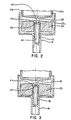
- ridge wear Another phenomenon which occurs in some instances when employing the combination of plastic rotor, Viton O-ring and non-tapered stainless steel pivot pin of Fig. 2 is the phenomenon termed herein "ridge wear" illustrated in Fig. 4.
- a ridge of plastic indicated at 54, forms the action of the rotor 20 spinning around the pivot pin 42.
- the pin 42 is not always installed perfectly perpendicular to the axis of rotation and this misalignment of the pin 42 causes the rotor plastic to "see" an up-down motion at the edge of the pin 42. That is, the circumferential edge of the upper end of pin 42 has an apparent oscillating axial motion relative to a point on the rotor 20 as rotor 20 rotates about pin 42.
- Fig. 5 it has been found that providing a slight upper taper or cone shape at 58 at the top of the molded plastic pivot pin 42 of Fig. 2 removes the sharp contact edge noted at 60 in Fig. 2, from the plastic pivot pin bearing 42 of the invention, thus permitting the pin to be slightly off the vertical axis of the rotor, and yet not cause the ridge wear phenomenon noted in Fig. 4.
- the polyamide-based resin plastic molded hollow pivot pin according to the present invention is indicated at 57 in Fig. 5.
- the plastic pivot pin indicated at 42 in Fig. 2 and at 57 in Fig. 5, is a molded pivot pin of a hard plastic material having a low coefficient of friction and having lubriciousness and wear resistance, so that the rotor spinning against the plastic pin does not creat hot spots on the pin or shed debris.
- the entire fluid separation device is irradiated by gamma radiation, as by a cobalt 60 source, not only for sterilization purposes, but for additional polymer modification of the plastic pivot pin, without degradation and with enhancement of the lubricious properties of the pivot pin.
- plastic pivot pins having the above noted required properties for use in biomedical applications could be economically produced by injection molding of suitable polymer materials.
- certain plastics for example the modified plastics marketed by LNP Corporation, of Malvern, Pennsylvania, such as RL 4730, also possess certain desirable characteristics when molded, as opposed to being machined. Properties such as the "skinning effect" to the outside of the injection molded plastic material make it a very low friction surface.
- ULTEM EL 4040 which is an alloy of polyether amide (marketed separately by the General Electric Company under the trade mark ULTEM) and 20% PTFE, the alloy EL 4040 being marketed by LNP Corporation.
- the invention provides a novel combination of plastic spinner and molded plastic pivot pin bearing, in conjunction with an O-ring seal, which is highly advantageous and applicable particularly for use in biomedical applications where it is necessary to separate fluids, as by filtration, e.g. in hemapheresis, in a closed environment employing a seal, and where the device is disposable.
- the invention resides particularly in the provision of an economical plastic molded pivot pin which is sufficiently hard and lubricious, in conjunction with an O-ring seal, preferably covered with a silicone lubricant, such as to permit operation of the separation unit for a sufficient period under the conditions of force which has to be exerted, to collect the required amount of product, e.g. units of plasma, after which the device is discarded.
Landscapes
- Engineering & Computer Science (AREA)
- Health & Medical Sciences (AREA)
- General Engineering & Computer Science (AREA)
- Mechanical Engineering (AREA)
- Urology & Nephrology (AREA)
- Chemical Kinetics & Catalysis (AREA)
- Heart & Thoracic Surgery (AREA)
- Chemical & Material Sciences (AREA)
- Animal Behavior & Ethology (AREA)
- Emergency Medicine (AREA)
- Hematology (AREA)
- Life Sciences & Earth Sciences (AREA)
- Anesthesiology (AREA)
- General Health & Medical Sciences (AREA)
- Public Health (AREA)
- Veterinary Medicine (AREA)
- Vascular Medicine (AREA)
- Biomedical Technology (AREA)
- Centrifugal Separators (AREA)
- External Artificial Organs (AREA)
- Investigating Or Analysing Biological Materials (AREA)
- Separation Using Semi-Permeable Membranes (AREA)
- Prostheses (AREA)
- Pivots And Pivotal Connections (AREA)
- Sliding-Contact Bearings (AREA)
Priority Applications (1)
| Application Number | Priority Date | Filing Date | Title |
|---|---|---|---|
| AT86902224T ATE66382T1 (de) | 1985-04-12 | 1986-03-21 | Zapfenlager fuer biomedizinische systeme. |
Applications Claiming Priority (2)
| Application Number | Priority Date | Filing Date | Title |
|---|---|---|---|
| US06/722,707 US4675106A (en) | 1985-04-12 | 1985-04-12 | Pivot pin bearing for biomedical systems |
| US722707 | 1985-04-12 |
Publications (3)
| Publication Number | Publication Date |
|---|---|
| EP0218638A1 EP0218638A1 (en) | 1987-04-22 |
| EP0218638A4 EP0218638A4 (en) | 1987-09-30 |
| EP0218638B1 true EP0218638B1 (en) | 1991-08-21 |
Family
ID=24903034
Family Applications (1)
| Application Number | Title | Priority Date | Filing Date |
|---|---|---|---|
| EP86902224A Expired EP0218638B1 (en) | 1985-04-12 | 1986-03-21 | Pivot pin bearing for biomedical systems |
Country Status (6)
| Country | Link |
|---|---|
| US (1) | US4675106A (2) |
| EP (1) | EP0218638B1 (2) |
| JP (2) | JPS62500402A (2) |
| AT (1) | ATE66382T1 (2) |
| DE (1) | DE3680983D1 (2) |
| WO (1) | WO1986005998A1 (2) |
Families Citing this family (17)
| Publication number | Priority date | Publication date | Assignee | Title |
|---|---|---|---|---|
| US4790942A (en) * | 1983-12-20 | 1988-12-13 | Membrex Incorporated | Filtration method and apparatus |
| US4675106A (en) * | 1985-04-12 | 1987-06-23 | Hemascience Laboratories, Inc. | Pivot pin bearing for biomedical systems |
| AU611648B2 (en) * | 1986-08-11 | 1991-06-20 | Baxter International Inc. | Pivot pin bearing/seal with loose eyelet especially suited for disposable continuous flow blood filtration system cartridges |
| US4965846A (en) * | 1986-08-11 | 1990-10-23 | Baxter International Inc. | Pivot pin bearing/seal with loose eyelet especially suited for disposable continuous flow blood filtration system cartridges |
| SE459715B (sv) * | 1986-09-08 | 1989-07-31 | Karl J Allsing | Foerfarande vid s.k.roterande filter samt filter |
| US4867878A (en) * | 1988-06-09 | 1989-09-19 | Membrex, Inc. | Liquid bearing for rotary apparatus |
| US4935002A (en) * | 1988-06-29 | 1990-06-19 | Biodynamics, Inc. | Apparatus and method for the autotransfusion of blood |
| US5004540A (en) * | 1989-12-01 | 1991-04-02 | Ketema Process Equipment Division | Invertible filter-type centrifuge with improved bearing and seal assembly |
| US5298016A (en) * | 1992-03-02 | 1994-03-29 | Advanced Haemotechnologies | Apparatus for separating plasma and other wastes from blood |
| US5487719A (en) * | 1994-01-14 | 1996-01-30 | Denver Instrument Company | Centrifuge rotor assembly |
| US6251295B1 (en) | 1998-01-08 | 2001-06-26 | Nexell Therapeutics Inc. | Method for recirculation washing of blood cells |
| US6773389B2 (en) | 2000-11-02 | 2004-08-10 | Gambro Inc | Fluid separation devices, systems and/or methods using a fluid pressure driven and/or balanced configuration |
| EP1509306B1 (en) * | 2002-05-30 | 2008-07-23 | Kkj, Inc. | Vortex enhanced filtration device and methods |
| AU2004220569B2 (en) * | 2003-03-10 | 2009-12-03 | Kkj, Inc. | Vortex-enhanced filtration devices |
| AU2004322685B2 (en) | 2004-08-20 | 2009-04-23 | Kkj, Inc. | Two stage hemofiltration that generates replacement fluid |
| US7374677B2 (en) * | 2004-08-20 | 2008-05-20 | Kkj, Inc. | Two stage hemofiltration that generates replacement fluid |
| AU2011207357A1 (en) * | 2010-01-21 | 2012-08-09 | Kkj, Inc. | Vortex-enhanced filtration devices |
Family Cites Families (7)
| Publication number | Priority date | Publication date | Assignee | Title |
|---|---|---|---|---|
| BE557363A (2) * | 1956-06-16 | |||
| US3448858A (en) * | 1968-07-25 | 1969-06-10 | Ingersoll Rand Canada | Centrifugal filtering apparatus |
| FR2251230A5 (en) * | 1973-11-09 | 1975-06-06 | Cons Foods Corp | Roller assembly - with in situ moulded inner bearing stator member |
| DD126140A1 (2) * | 1975-12-06 | 1977-06-22 | ||
| CA1258053A (en) * | 1982-12-13 | 1989-08-01 | Halbert Fischel | Blood fractionation system and method |
| US4776964A (en) * | 1984-08-24 | 1988-10-11 | William F. McLaughlin | Closed hemapheresis system and method |
| US4675106A (en) * | 1985-04-12 | 1987-06-23 | Hemascience Laboratories, Inc. | Pivot pin bearing for biomedical systems |
-
1985
- 1985-04-12 US US06/722,707 patent/US4675106A/en not_active Expired - Lifetime
-
1986
- 1986-03-21 AT AT86902224T patent/ATE66382T1/de active
- 1986-03-21 DE DE8686902224T patent/DE3680983D1/de not_active Expired - Lifetime
- 1986-03-21 EP EP86902224A patent/EP0218638B1/en not_active Expired
- 1986-03-21 WO PCT/US1986/000586 patent/WO1986005998A1/en not_active Ceased
- 1986-03-21 JP JP61501982A patent/JPS62500402A/ja active Granted
-
1992
- 1992-08-18 JP JP4242707A patent/JP2530978B2/ja not_active Expired - Lifetime
Also Published As
| Publication number | Publication date |
|---|---|
| WO1986005998A1 (en) | 1986-10-23 |
| JPS62500402A (ja) | 1987-02-19 |
| JPH058986B2 (2) | 1993-02-03 |
| JP2530978B2 (ja) | 1996-09-04 |
| EP0218638A4 (en) | 1987-09-30 |
| ATE66382T1 (de) | 1991-09-15 |
| DE3680983D1 (de) | 1991-09-26 |
| US4675106A (en) | 1987-06-23 |
| EP0218638A1 (en) | 1987-04-22 |
| JPH0691201A (ja) | 1994-04-05 |
Similar Documents
| Publication | Publication Date | Title |
|---|---|---|
| US4675106A (en) | Pivot pin bearing for biomedical systems | |
| US4753729A (en) | Rotor drive for medical disposables | |
| US4643641A (en) | Method and apparatus for sterilization of a centrifugal pump | |
| CA1261765A (en) | Method and apparatus for separation of matter from suspension | |
| US5387174A (en) | Centrifugal separator with disposable bowl assembly | |
| US4816151A (en) | Rotor drive for medical disposables | |
| CA1258053A (en) | Blood fractionation system and method | |
| US4120448A (en) | Centrifugal liquid processing apparatus with automatically positioned collection port | |
| US5783085A (en) | Blood fractionation method | |
| CA2237019C (en) | System for filtering medical and biological fluids | |
| EP0194271B1 (en) | Closed hemapheresis system | |
| US4965846A (en) | Pivot pin bearing/seal with loose eyelet especially suited for disposable continuous flow blood filtration system cartridges | |
| CA1300212C (en) | Pivot pin bearing/seal with loose eyelet especially suited for disposable continuous flow blood filtration system cartridges | |
| JPS6050497B2 (ja) | 使い捨て可能な遠心血液処理システム | |
| EP0303765B1 (en) | Blood fractionation system | |
| US20010032811A1 (en) | Filtering device and a filtering method | |
| Tonelli | 4965187 Method and apparatus for assaying whole blood | |
| Williamson | 4965846 Pivot pin bearing/seal with loose eyelet especially suited for disposable continuous flow blood filtration system cartridges | |
| KR20000069522A (ko) | 무균성 와류 농축 장치 |
Legal Events
| Date | Code | Title | Description |
|---|---|---|---|
| PUAI | Public reference made under article 153(3) epc to a published international application that has entered the european phase |
Free format text: ORIGINAL CODE: 0009012 |
|
| AK | Designated contracting states |
Kind code of ref document: A1 Designated state(s): AT BE CH DE FR GB LI NL SE |
|
| 17P | Request for examination filed |
Effective date: 19870422 |
|
| A4 | Supplementary search report drawn up and despatched |
Effective date: 19870930 |
|
| 17Q | First examination report despatched |
Effective date: 19890316 |
|
| RAP1 | Party data changed (applicant data changed or rights of an application transferred) |
Owner name: BAXTER INTERNATIONAL INC. (A DELAWARE CORPORATION) |
|
| GRAA | (expected) grant |
Free format text: ORIGINAL CODE: 0009210 |
|
| AK | Designated contracting states |
Kind code of ref document: B1 Designated state(s): AT BE CH DE FR GB LI NL SE |
|
| REF | Corresponds to: |
Ref document number: 66382 Country of ref document: AT Date of ref document: 19910915 Kind code of ref document: T |
|
| REF | Corresponds to: |
Ref document number: 3680983 Country of ref document: DE Date of ref document: 19910926 |
|
| ET | Fr: translation filed | ||
| PLBE | No opposition filed within time limit |
Free format text: ORIGINAL CODE: 0009261 |
|
| STAA | Information on the status of an ep patent application or granted ep patent |
Free format text: STATUS: NO OPPOSITION FILED WITHIN TIME LIMIT |
|
| 26N | No opposition filed | ||
| EAL | Se: european patent in force in sweden |
Ref document number: 86902224.4 |
|
| PGFP | Annual fee paid to national office [announced via postgrant information from national office to epo] |
Ref country code: GB Payment date: 20000302 Year of fee payment: 15 Ref country code: FR Payment date: 20000302 Year of fee payment: 15 Ref country code: DE Payment date: 20000302 Year of fee payment: 15 |
|
| PGFP | Annual fee paid to national office [announced via postgrant information from national office to epo] |
Ref country code: AT Payment date: 20000303 Year of fee payment: 15 |
|
| PGFP | Annual fee paid to national office [announced via postgrant information from national office to epo] |
Ref country code: NL Payment date: 20000307 Year of fee payment: 15 Ref country code: CH Payment date: 20000307 Year of fee payment: 15 |
|
| PGFP | Annual fee paid to national office [announced via postgrant information from national office to epo] |
Ref country code: SE Payment date: 20000308 Year of fee payment: 15 |
|
| PGFP | Annual fee paid to national office [announced via postgrant information from national office to epo] |
Ref country code: BE Payment date: 20000328 Year of fee payment: 15 |
|
| PG25 | Lapsed in a contracting state [announced via postgrant information from national office to epo] |
Ref country code: GB Free format text: LAPSE BECAUSE OF NON-PAYMENT OF DUE FEES Effective date: 20010321 Ref country code: AT Free format text: LAPSE BECAUSE OF NON-PAYMENT OF DUE FEES Effective date: 20010321 |
|
| PG25 | Lapsed in a contracting state [announced via postgrant information from national office to epo] |
Ref country code: SE Free format text: LAPSE BECAUSE OF NON-PAYMENT OF DUE FEES Effective date: 20010322 |
|
| PG25 | Lapsed in a contracting state [announced via postgrant information from national office to epo] |
Ref country code: LI Free format text: LAPSE BECAUSE OF NON-PAYMENT OF DUE FEES Effective date: 20010331 Ref country code: CH Free format text: LAPSE BECAUSE OF NON-PAYMENT OF DUE FEES Effective date: 20010331 Ref country code: BE Free format text: LAPSE BECAUSE OF NON-PAYMENT OF DUE FEES Effective date: 20010331 |
|
| BERE | Be: lapsed |
Owner name: BAXTER INTERNATIONAL INC. (A DELAWARE CORP.) Effective date: 20010331 |
|
| PG25 | Lapsed in a contracting state [announced via postgrant information from national office to epo] |
Ref country code: NL Free format text: LAPSE BECAUSE OF NON-PAYMENT OF DUE FEES Effective date: 20011001 |
|
| EUG | Se: european patent has lapsed |
Ref document number: 86902224.4 |
|
| GBPC | Gb: european patent ceased through non-payment of renewal fee |
Effective date: 20010321 |
|
| REG | Reference to a national code |
Ref country code: CH Ref legal event code: PL |
|
| PG25 | Lapsed in a contracting state [announced via postgrant information from national office to epo] |
Ref country code: FR Free format text: LAPSE BECAUSE OF NON-PAYMENT OF DUE FEES Effective date: 20011130 |
|
| NLV4 | Nl: lapsed or anulled due to non-payment of the annual fee |
Effective date: 20011001 |
|
| REG | Reference to a national code |
Ref country code: FR Ref legal event code: ST |
|
| PG25 | Lapsed in a contracting state [announced via postgrant information from national office to epo] |
Ref country code: DE Free format text: LAPSE BECAUSE OF NON-PAYMENT OF DUE FEES Effective date: 20020101 |