EP0218759B1 - Appareil et procédé pour la moxibustion - Google Patents
Appareil et procédé pour la moxibustion Download PDFInfo
- Publication number
- EP0218759B1 EP0218759B1 EP19850306418 EP85306418A EP0218759B1 EP 0218759 B1 EP0218759 B1 EP 0218759B1 EP 19850306418 EP19850306418 EP 19850306418 EP 85306418 A EP85306418 A EP 85306418A EP 0218759 B1 EP0218759 B1 EP 0218759B1
- Authority
- EP
- European Patent Office
- Prior art keywords
- pyrogen
- moxa
- heat
- package body
- herb
- Prior art date
- Legal status (The legal status is an assumption and is not a legal conclusion. Google has not performed a legal analysis and makes no representation as to the accuracy of the status listed.)
- Expired
Links
Images

Classifications
-
- A—HUMAN NECESSITIES
- A61—MEDICAL OR VETERINARY SCIENCE; HYGIENE
- A61K—PREPARATIONS FOR MEDICAL, DENTAL OR TOILETRY PURPOSES
- A61K9/00—Medicinal preparations characterised by special physical form
- A61K9/70—Web, sheet or filament bases ; Films; Fibres of the matrix type containing drug
- A61K9/7023—Transdermal patches and similar drug-containing composite devices, e.g. cataplasms
- A61K9/703—Transdermal patches and similar drug-containing composite devices, e.g. cataplasms characterised by shape or structure; Details concerning release liner or backing; Refillable patches; User-activated patches
- A61K9/7084—Transdermal patches having a drug layer or reservoir, and one or more separate drug-free skin-adhesive layers, e.g. between drug reservoir and skin, or surrounding the drug reservoir; Liquid-filled reservoir patches
-
- A—HUMAN NECESSITIES
- A61—MEDICAL OR VETERINARY SCIENCE; HYGIENE
- A61B—DIAGNOSIS; SURGERY; IDENTIFICATION
- A61B18/00—Surgical instruments, devices or methods for transferring non-mechanical forms of energy to or from the body
- A61B18/04—Surgical instruments, devices or methods for transferring non-mechanical forms of energy to or from the body by heating
- A61B18/06—Surgical instruments, devices or methods for transferring non-mechanical forms of energy to or from the body by heating caused by chemical reaction, e.g. moxaburners
Definitions
- the present invention relates to a method and apparatus for carrying out moxibustion treatment, namely the burning of the moxa herb in close proximity to or contact with the skin.
- Moxibustion treatment involving such application of moxa has long been used in oriental medicine. It manifests significant curative effects on pain of the nerve system of the body including the motor nerve, the autonomic nerve, sensory nerves or on pain due to psychoneurosis Moxibustion has special advantages in that moxa contains many ingredients including adenine, choline and highly volatile thymol. Thus, when the moxa is burnt the above ingredients are vapourized and are readily absorbed through the skin into the tissue of the body or blood, and effectively act on the cells of the human body. A further specific feature is that of improving functions by the stimulation of heat.
- moxa is placed on a certain key point, and the moxa ignited or burnt.
- This method is considered to have the merit that skin tissue is burnt, and a part of the dead tissue is absorbed from the skin into the blood vessels and is though to make various immunizing materials in the blood vessels.
- it has the disadvantage that it causes severe pain at and near the point of application, leaves a scar from the burn on the skin and generates a burning smell.
- the treatment it is necessary for the treatment to be performed by a specialist in moxibustion treatment.
- no-scar moxibustion In order to avoid leaving a scar a modified process known as "no-scar moxibustion" became to be used. This method involves placing a vegetable or herb material, e.g. ginger, garlic, onion, leek, or miso, on the skin, placing the moxa on such material and igniting the moxa. The procedure does not make one feel so hot, and leaves no scar. However, since this method only utilizes warm or lower heat temperature it is not thought to utilize the ingredients of moxa fully.
- a vegetable or herb material e.g. ginger, garlic, onion, leek, or miso
- the present invention aims to achieve an effective moxibustion treatment whereby the ingredients of moxa are applied to the body to achieve curative effects without the use of fire.
- the procedure of the present invention is such as to full vapourize the ingredients of the moxa without using fire, whilst fully exhibiting the effect of heating though not leaving scarring.
- the device of the present invention feeds air to a pyrogen provided by a heat generating composition which generates heat by oxidation.
- Herb material composed of moxa or a mixture of moxa and other medicinal herbs is located in contact with the pyrogen, the heat from which vapourizes the ingredients of the moxa and medicinal herbs, and the vapour or fumes and heat so produced act on the surface of the skin on which the device is positioned.
- the pyrogen to be used in the present invention involves a heat generating composition such as iron powder, carbon, cellulose, chlorides, and water.
- the powdered iron is mainly used in an amount of 42 wt%-51 wt% preferably in the form of iron-oxide.
- the carbon is mainly in an amount of 18 wt%-22 wt% e.g. as active carbon.
- the cellulose is mainly used in an amount of 15.5 wt%-19 wt% e.g. as wood wool (excelsior).
- the chloride is mainly used in an amount of 3.7 wt%-4.5 wt% e.g. as sodium chloride.
- the water content is desirably 11 wt%-13.5 wt%.
- the pyrogen used in the present invention Since the pyrogen used in the present invention generates heat by reduction with oxygen in the air, it must be stored out of contact with air.
- a material impermeable to oxygen should be used to pack and store the pyrogen out of contact with air and desirably means should be provided to enable air to get access to the pyrogen when the device is to be used.
- the pyrogen is desirably housed in a gas permeable package.
- the pyrogen may be accommodated in an internal package which may be formed of woven fabric e.g. of synthetic resin or cotton, gas permeability being provided by the gaps between fibres, or a non-woven fabric e.g. of synthetic resin, cotton, or a film provided with an appropriate number of ventilation holes.
- the exterior of the internal package is covered by the external package formed of non-permeable material e.g. of synthetic resin film or thin sheet, which keeps the pyrogen out of contact with air.
- the external package may be arranged to be torn off at the time of application of the device to the skin to enable oxygen in the air to contact the pyrogen and start the heat generating process.
- the structure can also be one where the non-permeable envelope (e.g. formed of synthetic resin film, thin sheet or unwoven fabric) will be perforated at the time of use.
- the external non-permeable envelope is prepared with ventilation holes which are sealed during storage of the device prior to use by a sealing plate or strip, which is peeled off at the time of application to open the ventilation hole or holes.
- the pyrogen as described above can be adjusted to give the desired heat generation time and temperature as desired by adjusting the composition of the material or the ventilating structure. However, in normal cases 10g-20g of the pyrogen is sufficient, 10g of pyrogen typically affording continuous heat generation for a time of 3-4 hrs and 50g of pyrogen affording continuous heat generation for 5 hrs-6 hrs.
- the temperature at the heat generation source is of the order of 65 ° C whilst the temperature at the point of contacting with the skin is about 40 ° C-45 ° C.
- the moxa can be used on its own as the sole herb material or can be mixed with other vegetable or herb materials e.g. ginger, garlic, Swertia japoneca, or Angelica utilis, to increase the effect further and in such case the amount of such other vegetable or herb material is preferably 1 g-3g.
- other vegetable or herb materials e.g. ginger, garlic, Swertia japoneca, or Angelica utilis
- the herb material can be filled into the package as is, however, it is more convenient to use a herb supporting board preferably made of flexible material e.g. synthetic unwoven fabric, paper or cloth, desirable coated on one side with adhesive, the herb material being adhered to the adhesive by being pressed onto it.
- the herb material must be arranged so as to be in contact with the pyrogen to ensure that the ingredients of the herb composition are vapourised when the pyrogen generates heat and can then act on the skin.
- the herb material is packed in the package in such a way that it contacts the bag containing the pyrogen, or the above herb supporting board with the adhered herb material is placed in contact with the pyrogen containing bag.
- the skin side of the package body is preferably constructed so as to be open, and this opening may be completely open packed so that gas permeability will be maintained, or covered e.g. pasted with a separate piece, e.g. a sheet, having gas permeability.
- the heat generated by the pyrogen and the vapours generated from the herb material come into contact with the skin surface through this opening and the effects of moxibustion can be expected.
- the face of the package body which is to be applied to the skin may be formed to allow it to be moved at will from place to place during use, or may be provided with adhesive so that it will be adhered to the skin surface at the predetermined key point.
- the device of the present invention heats the herb material by the heat of the oxidation of the pyrogen, the ingredients of the herb material are vapourized by this heat, and this generates the required vapours. Infrared rays and heat are radiated by these vapours and heat thus acts on the skin surface, and activates the functions of the cells.
- This arrangement eliminates the dangers of using fire or burning of the moxa as in the conventional method.
- the method is thus simple and easy, and is safe, it does not leave a scar on the skin, no burning smell is generated, and also the functions of the cells are activated by injection of infrared rays.
- composition of pyrogen for use in the present invention e.g. for a 20 gram amount of pyrogen is as follows.
- a preferred form of device in accordance with the present invention has the above pyrogen filled into an internal package body made of unwoven fabric of synthetic resin, many small ventilation holes being formed in the internal package body.
- a paper support with 2g of moxa on its own adhered to it is located on or in the internal package so that the paper contacts the internal package, the moxa side of the paper being held by adhering gas-permeable woven cloth around the internal package, and the whole is wrapped in non-permeable external package body.
- the external package is torn off prior to application of the device to the skin.
- the pyrogen will typically generate heat for 5 hrs-6 hrs, and the vapours generated from the moxa permeate to the surface of the skin to which the device is applied.
- FIG. 1 a first embodiment of a moxibustion apparatus or device 1 is shown which has a central circular protruberance.
- This circular saucer type package body 3 is made of non-permeable material such as paper, synthetic paper, synthetic resin, and has a flange shaped rim 2.
- a supporting body 7 of good gas-permeability is adhered to the bottom side of the rim 2 and carries the herb material 6.
- a adhesive agent 8 is applied to the under surface of the supporting body 7, and the adhesive agent 8 is pasted with a non-gas-permeable peelable sealing paper or strip 9.
- a pyrogen 5 is located inside the package so formed inside the protruberance. The pyrogen is enclosed within a non-permeable bag body 4 made of synthetic resin film.
- This herb material 6 may alternatively be packed in paper or cloth of good gas-permeability and accommodated in the package body 3.
- the device is adhered to the skin surface corresponding to the key point of the human body by the adhesive agent 8.
- Air then intrudes through the said ventilation hole or holes, and the pyrogen 5 starts to be oxidized by the oxygen in the air and generates heat.
- This heat generation will cause the ingredients of the herb material 6 to vapourize, and these vapours, heat produced by the heat generation and infrared rays caused by the heat will act on the surface of the skin through the supporting body 7, and the moxibustion effect can be expected to occur.
- a central part affords a circular protruberance 3' within which the pyrogen 5 is accommodated.
- the package body 3' is formed of non-permeable material such as synthetic resin.
- the package body again has a flange shaped rim 2, and a dished paper partition plate 10 is adhered to the under side of the rim 2 to support the pyrogen 5.
- the herb material 6 is placed in the dished centre of the under side of the partition plate 10 so that the herb material forms a layer.
- a supporting body 7 is adhered to the periphery of the under side of the partition plate 10 so as to support the herb material 6 to hold it close against the partition plate 10.
- This supporting body 7 is made of a thin film of synthetic resin with many ventilation holes 11.
- the under side of the supporting body 7 is provided with a layer of adhesive agent 8, and a peelable sealing paper or strip 9 is pasted to the adhesive agent 8.
- the air ventilation holes 11 extend through the supporting body 7, the layer of adhesive agent 8 and the peelable sealing paper or strip. Vapourised herb material may reach the skin through the ventilation holes 11.
- a number of air feeding holes 13 are formed in the top wall 12 of the package body 3, and a peelable sealing plate or strip 14 is pasted to the upper surface of the top wall 12, closing the air feeding holes 13, and preventing intrusion of air into the package body 3.
- the sealing plate 14 In use, the sealing plate 14 will be peeled off, the air feeding holes 13 thus being opened.
- the peeling paper 9 is peeled off and the device is secured to the skin corresponding to the key point of the human body by the adhesive 8. Oxidation of the pyrogen 5 generates heat and vapours from the herb material 6 as in the first embodiment.
- This second embodiment is very convenient in that air is fed to the pyrogen 5 by removing the sealing plate 14 rather than having to form holes in the wall 3'.
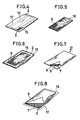
- the package body 3 has a non-gas-permeable rectangular top wall 12 and bottom wall 15 which are formed of synthetic resin unwoven fabric.
- the pyrogen 5 located between the top and bottom walls, and the circumference of the walls 12 and 15 is heat sealed to seal in the pyrogen 5.
- Air feeding holes 13 consisting of many small holes are formed in the top wall 12.
- a herb supporting plate 16 (see Figure 5) consists of e.g. paper, unwoven fabric or gauze, and of rectangular shape, carries herb material 6 consisting of moxa on its own or moxa mixed with other herbs adhered to the plate 16 by adhesive agent or electrostatic adhesion.
- the herb supporting plate 16 formed in this way is adhered to or loaded to the centre of the bottom wall 15, so that the herb material 6 is located against the under side of the wall 15.
- An adhesion plate 17 is formed by a supporting plate 7 formed of gas-permeable cloth e.g. of unwoven fabric, having elasticity and wettability and coated with adhesive agent 8, and covered with a peelable sealing paper or strip 9 as shown in Figure 7.
- the supporting body 7 is adhered, e.g. by heat sealing, to the circumferential rim and penetrating adhesive agent 8 to the circumferential rim of the bottom wall 15 so that the body 7 will cover the herb supporting plate 16.
- the package body 3 constituted as above and with the adhesion plate 17 adhered to it is packed within a non-gas-permeable external package bag 18 as shown by chain lines in Figure 8 to form a moxibustion device or apparatus in accordance with the present invention.
- the external package bag 18 will first be torn off. This results in air entering through the air feeding holes 13 of the package body 3, and the pyrogen 5 will generate heat on oxidation by the oxygen in the air.
- the peeling paper 9 located on the one side of the package body 3 is then peeled off, and the device is applied to the skin area corresponding to the key point or affected part of the human body with the adhesive agent 8 attached to the supporting body 7.
- Warm heat produced by the heat generation of the pyrogen 5 is transmitted to the herb material 6 through the package body 3, and vapours of the ingredients are generated by the warm heat, and these vapours permeate from the supporting body 7 through the skin, and perform the moxibustion treatment.
- the supporting body 7 affords an air layer, which absorbs sweat and transfers heat to the body from the skin, performing the function of a thermal cushion, and successively releases accumulated heat in the human body to outside of the body, and is able to maintain the body temperature at the proper temperature in the range 40 ° C-45°C.
- Air feeding holes 13 are located in the top wall of the package body 3, however, the supporting body 7 need not be adhered for over the whole of its area with the skin surface, and thus additional air feeding holes 13 may be made in the bottom wall 15, so that the air can intrude through the supporting body 7 to also supply oxygen to the pyrogen 5.
- both top and bottom walls 12 and 15 may be prepared with air feeding holes or one or other of them.
- Culpak processed Kraft paper may be used as the herb supporting plate 16 for adhering the herb material 6, and its black colour provides good heat conduction and results in the whole surface of the herb supporting plate 16 being heated evenly even if the generation of heat by the pyrogen 5 only occurs partially, so that good vapour generation can still be achieved.
Landscapes
- Health & Medical Sciences (AREA)
- Engineering & Computer Science (AREA)
- Bioinformatics & Cheminformatics (AREA)
- Life Sciences & Earth Sciences (AREA)
- Public Health (AREA)
- Dermatology (AREA)
- Chemical & Material Sciences (AREA)
- Surgery (AREA)
- Veterinary Medicine (AREA)
- Animal Behavior & Ethology (AREA)
- General Health & Medical Sciences (AREA)
- Pharmacology & Pharmacy (AREA)
- Otolaryngology (AREA)
- Chemical Kinetics & Catalysis (AREA)
- General Chemical & Material Sciences (AREA)
- Physics & Mathematics (AREA)
- Plasma & Fusion (AREA)
- Nuclear Medicine, Radiotherapy & Molecular Imaging (AREA)
- Epidemiology (AREA)
- Medicinal Chemistry (AREA)
- Biomedical Technology (AREA)
- Heart & Thoracic Surgery (AREA)
- Medical Informatics (AREA)
- Molecular Biology (AREA)
- Finger-Pressure Massage (AREA)
- Thermotherapy And Cooling Therapy Devices (AREA)
Claims (16)
Priority Applications (2)
| Application Number | Priority Date | Filing Date | Title |
|---|---|---|---|
| EP19850306418 EP0218759B1 (fr) | 1985-09-10 | 1985-09-10 | Appareil et procédé pour la moxibustion |
| DE8585306418T DE3570356D1 (en) | 1985-09-10 | 1985-09-10 | Moxibustion method and device |
Applications Claiming Priority (1)
| Application Number | Priority Date | Filing Date | Title |
|---|---|---|---|
| EP19850306418 EP0218759B1 (fr) | 1985-09-10 | 1985-09-10 | Appareil et procédé pour la moxibustion |
Publications (2)
| Publication Number | Publication Date |
|---|---|
| EP0218759A1 EP0218759A1 (fr) | 1987-04-22 |
| EP0218759B1 true EP0218759B1 (fr) | 1989-05-24 |
Family
ID=8194359
Family Applications (1)
| Application Number | Title | Priority Date | Filing Date |
|---|---|---|---|
| EP19850306418 Expired EP0218759B1 (fr) | 1985-09-10 | 1985-09-10 | Appareil et procédé pour la moxibustion |
Country Status (2)
| Country | Link |
|---|---|
| EP (1) | EP0218759B1 (fr) |
| DE (1) | DE3570356D1 (fr) |
Families Citing this family (3)
| Publication number | Priority date | Publication date | Assignee | Title |
|---|---|---|---|---|
| FR2675125B1 (fr) * | 1991-04-15 | 1994-11-04 | Dupret Anne Marie | Dispositif pour la presentation et le conditionnement de produits visqueux a application cutanee. |
| GB0412793D0 (en) * | 2004-06-09 | 2004-07-14 | Boots Healthcare Int Ltd | Therapeutic product |
| CN115317438B (zh) * | 2022-06-08 | 2025-03-25 | 广州汇灵健康产业有限公司 | 一种脐灸组合物及其制备方法和应用 |
Family Cites Families (5)
| Publication number | Priority date | Publication date | Assignee | Title |
|---|---|---|---|---|
| DE1071897B (fr) * | 1957-12-19 | 1959-12-24 | ||
| US3946733A (en) * | 1975-01-13 | 1976-03-30 | Jin Suk Han | Moxibustion apparatus |
| JPS536088U (fr) * | 1976-07-01 | 1978-01-19 | ||
| US4325371A (en) * | 1977-04-08 | 1982-04-20 | Koukichi Atsumi | Loquat-leaf moxibustion therapy and a moxa stick for use in the therapy |
| DE3118232A1 (de) * | 1981-05-08 | 1982-11-18 | Hestia Pharma GmbH, 6800 Mannheim | Hautverband |
-
1985
- 1985-09-10 DE DE8585306418T patent/DE3570356D1/de not_active Expired
- 1985-09-10 EP EP19850306418 patent/EP0218759B1/fr not_active Expired
Also Published As
| Publication number | Publication date |
|---|---|
| EP0218759A1 (fr) | 1987-04-22 |
| DE3570356D1 (en) | 1989-06-29 |
Similar Documents
| Publication | Publication Date | Title |
|---|---|---|
| US4747841A (en) | Methods and instruments of moxibustion | |
| US4106477A (en) | Therapeutic self-generating moist heat pad | |
| EP1656087B1 (fr) | Piece thermoreflechissante | |
| EP0218759B1 (fr) | Appareil et procédé pour la moxibustion | |
| US20020068891A1 (en) | Ready made charcoal compress kit | |
| WO1994019043A1 (fr) | Conditionnement de medicament | |
| KR960006875Y1 (ko) | 쑥뜸구 | |
| WO2006006663A1 (fr) | Appareil de moxibustion | |
| US20050049662A1 (en) | Adjustable temperature heat patch | |
| CA2335569C (fr) | Vehicule d'administration de substances volatiles dans une voie d'acheminement d'inhalation et methodes connexes | |
| CN1010656B (zh) | 艾灸的方法和设备 | |
| US3167075A (en) | Self-lighting cigarettes | |
| JP4333021B2 (ja) | α波増強具 | |
| KR101469958B1 (ko) | 황토찜질팩 | |
| JPH0233767Y2 (fr) | ||
| JPH0229248A (ja) | 化学カイロ | |
| JPH065753Y2 (ja) | 燻製器用蓋 | |
| JP2600693Y2 (ja) | 加温はり薬 | |
| JPS5964040A (ja) | 「がい」温熱燻蒸気発生方法および其の装置 | |
| JPH10174706A (ja) | 温灸用具 | |
| KR950009186B1 (ko) | 약쑥의 약성분 발취방법 및 장치 | |
| CA1073772A (fr) | Coussin chauffant therapeutique | |
| JPS6025258Y2 (ja) | 低周波置針治療器用発熱体 | |
| JPS5810047A (ja) | 温灸構造体 | |
| JPS6030223B2 (ja) | 香料封入体 |
Legal Events
| Date | Code | Title | Description |
|---|---|---|---|
| PUAI | Public reference made under article 153(3) epc to a published international application that has entered the european phase |
Free format text: ORIGINAL CODE: 0009012 |
|
| AK | Designated contracting states |
Kind code of ref document: A1 Designated state(s): DE FR GB |
|
| 17P | Request for examination filed |
Effective date: 19870612 |
|
| 17Q | First examination report despatched |
Effective date: 19880715 |
|
| GRAA | (expected) grant |
Free format text: ORIGINAL CODE: 0009210 |
|
| AK | Designated contracting states |
Kind code of ref document: B1 Designated state(s): DE FR GB |
|
| REF | Corresponds to: |
Ref document number: 3570356 Country of ref document: DE Date of ref document: 19890629 |
|
| ET | Fr: translation filed | ||
| PLBE | No opposition filed within time limit |
Free format text: ORIGINAL CODE: 0009261 |
|
| STAA | Information on the status of an ep patent application or granted ep patent |
Free format text: STATUS: NO OPPOSITION FILED WITHIN TIME LIMIT |
|
| 26N | No opposition filed | ||
| REG | Reference to a national code |
Ref country code: GB Ref legal event code: IF02 |
|
| PGFP | Annual fee paid to national office [announced via postgrant information from national office to epo] |
Ref country code: DE Payment date: 20040902 Year of fee payment: 20 |
|
| PGFP | Annual fee paid to national office [announced via postgrant information from national office to epo] |
Ref country code: GB Payment date: 20040908 Year of fee payment: 20 Ref country code: FR Payment date: 20040908 Year of fee payment: 20 |
|
| PG25 | Lapsed in a contracting state [announced via postgrant information from national office to epo] |
Ref country code: GB Free format text: LAPSE BECAUSE OF EXPIRATION OF PROTECTION Effective date: 20050909 |
|
| REG | Reference to a national code |
Ref country code: GB Ref legal event code: PE20 |