EP0219091A2 - Pyranderivate und ein Verfahren zu ihrer Herstellung - Google Patents
Pyranderivate und ein Verfahren zu ihrer Herstellung Download PDFInfo
- Publication number
- EP0219091A2 EP0219091A2 EP86114179A EP86114179A EP0219091A2 EP 0219091 A2 EP0219091 A2 EP 0219091A2 EP 86114179 A EP86114179 A EP 86114179A EP 86114179 A EP86114179 A EP 86114179A EP 0219091 A2 EP0219091 A2 EP 0219091A2
- Authority
- EP
- European Patent Office
- Prior art keywords
- alkyl
- optionally substituted
- formula
- methyl
- optionally
- Prior art date
- Legal status (The legal status is an assumption and is not a legal conclusion. Google has not performed a legal analysis and makes no representation as to the accuracy of the status listed.)
- Granted
Links
- 238000000034 method Methods 0.000 title claims abstract description 12
- 238000002360 preparation method Methods 0.000 title claims abstract description 9
- 125000004309 pyranyl group Chemical class O1C(C=CC=C1)* 0.000 title abstract 2
- -1 methylol group Chemical group 0.000 claims abstract description 65
- 125000001997 phenyl group Chemical group [H]C1=C([H])C([H])=C(*)C([H])=C1[H] 0.000 claims abstract description 20
- 239000001257 hydrogen Substances 0.000 claims abstract description 15
- 229910052739 hydrogen Inorganic materials 0.000 claims abstract description 15
- 125000004169 (C1-C6) alkyl group Chemical group 0.000 claims abstract description 5
- 125000006702 (C1-C18) alkyl group Chemical group 0.000 claims abstract description 4
- 125000004435 hydrogen atom Chemical group [H]* 0.000 claims abstract description 4
- 125000004178 (C1-C4) alkyl group Chemical group 0.000 claims description 23
- 125000000229 (C1-C4)alkoxy group Chemical group 0.000 claims description 12
- 239000003054 catalyst Substances 0.000 claims description 12
- 229910052736 halogen Chemical group 0.000 claims description 12
- 150000002367 halogens Chemical group 0.000 claims description 12
- 150000004880 oxines Chemical class 0.000 claims description 12
- 125000002496 methyl group Chemical group [H]C([H])([H])* 0.000 claims description 11
- 150000002084 enol ethers Chemical class 0.000 claims description 10
- 238000005984 hydrogenation reaction Methods 0.000 claims description 10
- UFHFLCQGNIYNRP-UHFFFAOYSA-N Hydrogen Chemical compound [H][H] UFHFLCQGNIYNRP-UHFFFAOYSA-N 0.000 claims description 9
- 150000003527 tetrahydropyrans Chemical class 0.000 claims description 8
- BUDQDWGNQVEFAC-UHFFFAOYSA-N Dihydropyran Chemical class C1COC=CC1 BUDQDWGNQVEFAC-UHFFFAOYSA-N 0.000 claims description 7
- 239000012442 inert solvent Substances 0.000 claims description 7
- 150000001728 carbonyl compounds Chemical class 0.000 claims description 6
- 125000001495 ethyl group Chemical group [H]C([H])([H])C([H])([H])* 0.000 claims description 5
- 239000007789 gas Substances 0.000 claims description 5
- 230000001681 protective effect Effects 0.000 claims description 5
- 125000004187 tetrahydropyran-2-yl group Chemical group [H]C1([H])OC([H])(*)C([H])([H])C([H])([H])C1([H])[H] 0.000 claims description 5
- 150000002431 hydrogen Chemical group 0.000 claims description 4
- 125000000959 isobutyl group Chemical group [H]C([H])([H])C([H])(C([H])([H])[H])C([H])([H])* 0.000 claims description 4
- 125000003236 benzoyl group Chemical group [H]C1=C([H])C([H])=C(C([H])=C1[H])C(*)=O 0.000 claims description 3
- 125000001797 benzyl group Chemical group [H]C1=C([H])C([H])=C(C([H])=C1[H])C([H])([H])* 0.000 claims description 3
- 125000002485 formyl group Chemical group [H]C(*)=O 0.000 claims description 3
- 125000004184 methoxymethyl group Chemical group [H]C([H])([H])OC([H])([H])* 0.000 claims description 3
- ZAMOUSCENKQFHK-UHFFFAOYSA-N Chlorine atom Chemical group [Cl] ZAMOUSCENKQFHK-UHFFFAOYSA-N 0.000 claims 3
- 229910052801 chlorine Chemical group 0.000 claims 3
- 239000000460 chlorine Chemical group 0.000 claims 3
- 125000002777 acetyl group Chemical group [H]C([H])([H])C(*)=O 0.000 claims 2
- 125000001301 ethoxy group Chemical group [H]C([H])([H])C([H])([H])O* 0.000 claims 1
- 125000000956 methoxy group Chemical group [H]C([H])([H])O* 0.000 claims 1
- 125000004674 methylcarbonyl group Chemical group CC(=O)* 0.000 claims 1
- 125000001501 propionyl group Chemical group O=C([*])C([H])([H])C([H])([H])[H] 0.000 claims 1
- 125000000026 trimethylsilyl group Chemical group [H]C([H])([H])[Si]([*])(C([H])([H])[H])C([H])([H])[H] 0.000 claims 1
- 125000003178 carboxy group Chemical group [H]OC(*)=O 0.000 abstract description 5
- 125000003172 aldehyde group Chemical group 0.000 abstract description 2
- 150000001875 compounds Chemical class 0.000 description 18
- 239000000203 mixture Substances 0.000 description 13
- YXFVVABEGXRONW-UHFFFAOYSA-N Toluene Chemical compound CC1=CC=CC=C1 YXFVVABEGXRONW-UHFFFAOYSA-N 0.000 description 12
- 238000006243 chemical reaction Methods 0.000 description 12
- 239000000047 product Substances 0.000 description 11
- OKKJLVBELUTLKV-UHFFFAOYSA-N Methanol Chemical group OC OKKJLVBELUTLKV-UHFFFAOYSA-N 0.000 description 7
- 238000009835 boiling Methods 0.000 description 7
- CSCPPACGZOOCGX-UHFFFAOYSA-N Acetone Chemical compound CC(C)=O CSCPPACGZOOCGX-UHFFFAOYSA-N 0.000 description 6
- IJGRMHOSHXDMSA-UHFFFAOYSA-N Atomic nitrogen Chemical compound N#N IJGRMHOSHXDMSA-UHFFFAOYSA-N 0.000 description 6
- UHOVQNZJYSORNB-UHFFFAOYSA-N Benzene Chemical compound C1=CC=CC=C1 UHOVQNZJYSORNB-UHFFFAOYSA-N 0.000 description 6
- RTZKZFJDLAIYFH-UHFFFAOYSA-N Diethyl ether Chemical compound CCOCC RTZKZFJDLAIYFH-UHFFFAOYSA-N 0.000 description 6
- LFQSCWFLJHTTHZ-UHFFFAOYSA-N Ethanol Chemical compound CCO LFQSCWFLJHTTHZ-UHFFFAOYSA-N 0.000 description 6
- XEKOWRVHYACXOJ-UHFFFAOYSA-N Ethyl acetate Chemical compound CCOC(C)=O XEKOWRVHYACXOJ-UHFFFAOYSA-N 0.000 description 6
- HEMHJVSKTPXQMS-UHFFFAOYSA-M Sodium hydroxide Chemical compound [OH-].[Na+] HEMHJVSKTPXQMS-UHFFFAOYSA-M 0.000 description 6
- WYURNTSHIVDZCO-UHFFFAOYSA-N Tetrahydrofuran Chemical compound C1CCOC1 WYURNTSHIVDZCO-UHFFFAOYSA-N 0.000 description 6
- VLKZOEOYAKHREP-UHFFFAOYSA-N n-Hexane Chemical compound CCCCCC VLKZOEOYAKHREP-UHFFFAOYSA-N 0.000 description 6
- VYPSYNLAJGMNEJ-UHFFFAOYSA-N Silicium dioxide Chemical compound O=[Si]=O VYPSYNLAJGMNEJ-UHFFFAOYSA-N 0.000 description 5
- 150000002576 ketones Chemical class 0.000 description 5
- 239000002904 solvent Substances 0.000 description 5
- SYBYTAAJFKOIEJ-UHFFFAOYSA-N 3-Methylbutan-2-one Chemical compound CC(C)C(C)=O SYBYTAAJFKOIEJ-UHFFFAOYSA-N 0.000 description 4
- 238000005698 Diels-Alder reaction Methods 0.000 description 4
- QIGBRXMKCJKVMJ-UHFFFAOYSA-N Hydroquinone Chemical compound OC1=CC=C(O)C=C1 QIGBRXMKCJKVMJ-UHFFFAOYSA-N 0.000 description 4
- IMNFDUFMRHMDMM-UHFFFAOYSA-N N-Heptane Chemical compound CCCCCCC IMNFDUFMRHMDMM-UHFFFAOYSA-N 0.000 description 4
- PXHVJJICTQNCMI-UHFFFAOYSA-N Nickel Chemical compound [Ni] PXHVJJICTQNCMI-UHFFFAOYSA-N 0.000 description 4
- KDLHZDBZIXYQEI-UHFFFAOYSA-N Palladium Chemical compound [Pd] KDLHZDBZIXYQEI-UHFFFAOYSA-N 0.000 description 4
- CDBYLPFSWZWCQE-UHFFFAOYSA-L Sodium Carbonate Chemical compound [Na+].[Na+].[O-]C([O-])=O CDBYLPFSWZWCQE-UHFFFAOYSA-L 0.000 description 4
- HEDRZPFGACZZDS-MICDWDOJSA-N Trichloro(2H)methane Chemical compound [2H]C(Cl)(Cl)Cl HEDRZPFGACZZDS-MICDWDOJSA-N 0.000 description 4
- 150000001299 aldehydes Chemical class 0.000 description 4
- 229910052751 metal Inorganic materials 0.000 description 4
- 239000002184 metal Substances 0.000 description 4
- YGSGOJPTGPTAQH-UHFFFAOYSA-N 2-(3,4-dihydro-2h-pyran-4-yl)-5,5-dimethyl-1,3-dioxane Chemical compound O1CC(C)(C)COC1C1C=COCC1 YGSGOJPTGPTAQH-UHFFFAOYSA-N 0.000 description 3
- OKTJSMMVPCPJKN-UHFFFAOYSA-N Carbon Chemical compound [C] OKTJSMMVPCPJKN-UHFFFAOYSA-N 0.000 description 3
- XDTMQSROBMDMFD-UHFFFAOYSA-N Cyclohexane Chemical compound C1CCCCC1 XDTMQSROBMDMFD-UHFFFAOYSA-N 0.000 description 3
- YMWUJEATGCHHMB-UHFFFAOYSA-N Dichloromethane Chemical compound ClCCl YMWUJEATGCHHMB-UHFFFAOYSA-N 0.000 description 3
- KWYUFKZDYYNOTN-UHFFFAOYSA-M Potassium hydroxide Chemical compound [OH-].[K+] KWYUFKZDYYNOTN-UHFFFAOYSA-M 0.000 description 3
- ZMANZCXQSJIPKH-UHFFFAOYSA-N Triethylamine Chemical compound CCN(CC)CC ZMANZCXQSJIPKH-UHFFFAOYSA-N 0.000 description 3
- 238000004821 distillation Methods 0.000 description 3
- 239000000706 filtrate Substances 0.000 description 3
- 229910052757 nitrogen Inorganic materials 0.000 description 3
- 239000011541 reaction mixture Substances 0.000 description 3
- 238000005160 1H NMR spectroscopy Methods 0.000 description 2
- 125000004201 2,4-dichlorophenyl group Chemical group [H]C1=C([H])C(*)=C(Cl)C([H])=C1Cl 0.000 description 2
- ZWEHNKRNPOVVGH-UHFFFAOYSA-N 2-Butanone Chemical compound CCC(C)=O ZWEHNKRNPOVVGH-UHFFFAOYSA-N 0.000 description 2
- JWAZRIHNYRIHIV-UHFFFAOYSA-N 2-naphthol Chemical compound C1=CC=CC2=CC(O)=CC=C21 JWAZRIHNYRIHIV-UHFFFAOYSA-N 0.000 description 2
- 125000004860 4-ethylphenyl group Chemical group [H]C1=C([H])C(=C([H])C([H])=C1*)C([H])([H])C([H])([H])[H] 0.000 description 2
- 125000004861 4-isopropyl phenyl group Chemical group [H]C1=C([H])C(=C([H])C([H])=C1*)C([H])(C([H])([H])[H])C([H])([H])[H] 0.000 description 2
- 125000004172 4-methoxyphenyl group Chemical group [H]C1=C([H])C(OC([H])([H])[H])=C([H])C([H])=C1* 0.000 description 2
- 125000000590 4-methylphenyl group Chemical group [H]C1=C([H])C(=C([H])C([H])=C1*)C([H])([H])[H] 0.000 description 2
- UAQAQQFCGXBWJT-UHFFFAOYSA-N 5,5-dimethyl-2-(oxan-4-yl)-1,3-dioxane Chemical compound O1CC(C)(C)COC1C1CCOCC1 UAQAQQFCGXBWJT-UHFFFAOYSA-N 0.000 description 2
- XKRFYHLGVUSROY-UHFFFAOYSA-N Argon Chemical compound [Ar] XKRFYHLGVUSROY-UHFFFAOYSA-N 0.000 description 2
- VTYYLEPIZMXCLO-UHFFFAOYSA-L Calcium carbonate Chemical compound [Ca+2].[O-]C([O-])=O VTYYLEPIZMXCLO-UHFFFAOYSA-L 0.000 description 2
- 239000005909 Kieselgur Substances 0.000 description 2
- NTIZESTWPVYFNL-UHFFFAOYSA-N Methyl isobutyl ketone Chemical compound CC(C)CC(C)=O NTIZESTWPVYFNL-UHFFFAOYSA-N 0.000 description 2
- UIHCLUNTQKBZGK-UHFFFAOYSA-N Methyl isobutyl ketone Natural products CCC(C)C(C)=O UIHCLUNTQKBZGK-UHFFFAOYSA-N 0.000 description 2
- BZLVMXJERCGZMT-UHFFFAOYSA-N Methyl tert-butyl ether Chemical compound COC(C)(C)C BZLVMXJERCGZMT-UHFFFAOYSA-N 0.000 description 2
- JLTDJTHDQAWBAV-UHFFFAOYSA-N N,N-dimethylaniline Chemical compound CN(C)C1=CC=CC=C1 JLTDJTHDQAWBAV-UHFFFAOYSA-N 0.000 description 2
- CTQNGGLPUBDAKN-UHFFFAOYSA-N O-Xylene Chemical compound CC1=CC=CC=C1C CTQNGGLPUBDAKN-UHFFFAOYSA-N 0.000 description 2
- 239000007868 Raney catalyst Substances 0.000 description 2
- 229910000564 Raney nickel Inorganic materials 0.000 description 2
- PMZURENOXWZQFD-UHFFFAOYSA-L Sodium Sulfate Chemical compound [Na+].[Na+].[O-]S([O-])(=O)=O PMZURENOXWZQFD-UHFFFAOYSA-L 0.000 description 2
- UIIMBOGNXHQVGW-UHFFFAOYSA-M Sodium bicarbonate Chemical compound [Na+].OC([O-])=O UIIMBOGNXHQVGW-UHFFFAOYSA-M 0.000 description 2
- QAOWNCQODCNURD-UHFFFAOYSA-N Sulfuric acid Chemical compound OS(O)(=O)=O QAOWNCQODCNURD-UHFFFAOYSA-N 0.000 description 2
- DHXVGJBLRPWPCS-UHFFFAOYSA-N Tetrahydropyran Chemical compound C1CCOCC1 DHXVGJBLRPWPCS-UHFFFAOYSA-N 0.000 description 2
- 150000001298 alcohols Chemical class 0.000 description 2
- TZCXTZWJZNENPQ-UHFFFAOYSA-L barium sulfate Chemical compound [Ba+2].[O-]S([O-])(=O)=O TZCXTZWJZNENPQ-UHFFFAOYSA-L 0.000 description 2
- 230000015572 biosynthetic process Effects 0.000 description 2
- 125000000484 butyl group Chemical group [H]C([*])([H])C([H])([H])C([H])([H])C([H])([H])[H] 0.000 description 2
- 238000001816 cooling Methods 0.000 description 2
- 150000002148 esters Chemical class 0.000 description 2
- 125000004051 hexyl group Chemical group [H]C([H])([H])C([H])([H])C([H])([H])C([H])([H])C([H])([H])C([H])([H])* 0.000 description 2
- 229930195733 hydrocarbon Natural products 0.000 description 2
- 150000002430 hydrocarbons Chemical class 0.000 description 2
- ZXEKIIBDNHEJCQ-UHFFFAOYSA-N isobutanol Chemical compound CC(C)CO ZXEKIIBDNHEJCQ-UHFFFAOYSA-N 0.000 description 2
- 125000001449 isopropyl group Chemical group [H]C([H])([H])C([H])(*)C([H])([H])[H] 0.000 description 2
- 239000000463 material Substances 0.000 description 2
- 150000002739 metals Chemical class 0.000 description 2
- 125000001160 methoxycarbonyl group Chemical group [H]C([H])([H])OC(*)=O 0.000 description 2
- GXCOZTURFDNRGN-UHFFFAOYSA-N methyl 2-methoxy-3,4-dihydro-2h-pyran-4-carboxylate Chemical compound COC1CC(C(=O)OC)C=CO1 GXCOZTURFDNRGN-UHFFFAOYSA-N 0.000 description 2
- CNCMVGXVKBJYNU-UHFFFAOYSA-N methyl oxane-4-carboxylate Chemical compound COC(=O)C1CCOCC1 CNCMVGXVKBJYNU-UHFFFAOYSA-N 0.000 description 2
- 125000003854 p-chlorophenyl group Chemical group [H]C1=C([H])C(*)=C([H])C([H])=C1Cl 0.000 description 2
- 229910052763 palladium Inorganic materials 0.000 description 2
- 125000001147 pentyl group Chemical group C(CCCC)* 0.000 description 2
- 239000003208 petroleum Substances 0.000 description 2
- BASFCYQUMIYNBI-UHFFFAOYSA-N platinum Chemical compound [Pt] BASFCYQUMIYNBI-UHFFFAOYSA-N 0.000 description 2
- BWHMMNNQKKPAPP-UHFFFAOYSA-L potassium carbonate Chemical compound [K+].[K+].[O-]C([O-])=O BWHMMNNQKKPAPP-UHFFFAOYSA-L 0.000 description 2
- 125000001436 propyl group Chemical group [H]C([*])([H])C([H])([H])C([H])([H])[H] 0.000 description 2
- WQGWDDDVZFFDIG-UHFFFAOYSA-N pyrogallol Chemical compound OC1=CC=CC(O)=C1O WQGWDDDVZFFDIG-UHFFFAOYSA-N 0.000 description 2
- 239000012266 salt solution Substances 0.000 description 2
- 229910000029 sodium carbonate Inorganic materials 0.000 description 2
- 229910052938 sodium sulfate Inorganic materials 0.000 description 2
- 235000011152 sodium sulphate Nutrition 0.000 description 2
- 125000001424 substituent group Chemical group 0.000 description 2
- 238000003786 synthesis reaction Methods 0.000 description 2
- 125000000999 tert-butyl group Chemical group [H]C([H])([H])C(*)(C([H])([H])[H])C([H])([H])[H] 0.000 description 2
- YLQBMQCUIZJEEH-UHFFFAOYSA-N tetrahydrofuran Natural products C=1C=COC=1 YLQBMQCUIZJEEH-UHFFFAOYSA-N 0.000 description 2
- JOXIMZWYDAKGHI-UHFFFAOYSA-N toluene-4-sulfonic acid Chemical compound CC1=CC=C(S(O)(=O)=O)C=C1 JOXIMZWYDAKGHI-UHFFFAOYSA-N 0.000 description 2
- XLYOFNOQVPJJNP-UHFFFAOYSA-N water Substances O XLYOFNOQVPJJNP-UHFFFAOYSA-N 0.000 description 2
- 239000008096 xylene Substances 0.000 description 2
- RYHBNJHYFVUHQT-UHFFFAOYSA-N 1,4-Dioxane Chemical compound C1COCCO1 RYHBNJHYFVUHQT-UHFFFAOYSA-N 0.000 description 1
- QNAWUGLNXFOTIO-UHFFFAOYSA-N 2-(2-methoxyoxan-4-yl)-5,5-dimethyl-1,3-dioxane Chemical compound C1COC(OC)CC1C1OCC(C)(C)CO1 QNAWUGLNXFOTIO-UHFFFAOYSA-N 0.000 description 1
- JLFJINQFSQCLPD-UHFFFAOYSA-N 2-ethoxy-4-(oxan-2-yloxymethyl)oxane Chemical compound C1COC(OCC)CC1COC1OCCCC1 JLFJINQFSQCLPD-UHFFFAOYSA-N 0.000 description 1
- 125000004493 2-methylbut-1-yl group Chemical group CC(C*)CC 0.000 description 1
- 125000005916 2-methylpentyl group Chemical group 0.000 description 1
- MVOWKKPIOJAMHW-UHFFFAOYSA-N 4-(dimethoxymethyl)-2-ethoxy-3,4-dihydro-2H-pyran Chemical compound CCOC1CC(C(OC)OC)C=CO1 MVOWKKPIOJAMHW-UHFFFAOYSA-N 0.000 description 1
- ZMZSKSBVQLBFPW-UHFFFAOYSA-N 4-(dimethoxymethyl)-2-ethoxyoxane Chemical compound CCOC1CC(C(OC)OC)CCO1 ZMZSKSBVQLBFPW-UHFFFAOYSA-N 0.000 description 1
- 125000004800 4-bromophenyl group Chemical group [H]C1=C([H])C(*)=C([H])C([H])=C1Br 0.000 description 1
- 125000000782 4-ethoxyphenylcarbonyl group Chemical group [H]C1=C([H])C(=C([H])C([H])=C1OC([H])([H])C([H])([H])[H])C(*)=O 0.000 description 1
- ZNSMNVMLTJELDZ-UHFFFAOYSA-N Bis(2-chloroethyl)ether Chemical compound ClCCOCCCl ZNSMNVMLTJELDZ-UHFFFAOYSA-N 0.000 description 1
- 101000623895 Bos taurus Mucin-15 Proteins 0.000 description 1
- RYGMFSIKBFXOCR-UHFFFAOYSA-N Copper Chemical compound [Cu] RYGMFSIKBFXOCR-UHFFFAOYSA-N 0.000 description 1
- 239000007832 Na2SO4 Substances 0.000 description 1
- BPQQTUXANYXVAA-UHFFFAOYSA-N Orthosilicate Chemical compound [O-][Si]([O-])([O-])[O-] BPQQTUXANYXVAA-UHFFFAOYSA-N 0.000 description 1
- KJTLSVCANCCWHF-UHFFFAOYSA-N Ruthenium Chemical compound [Ru] KJTLSVCANCCWHF-UHFFFAOYSA-N 0.000 description 1
- 238000009825 accumulation Methods 0.000 description 1
- 239000000654 additive Substances 0.000 description 1
- 229910000287 alkaline earth metal oxide Inorganic materials 0.000 description 1
- 125000000217 alkyl group Chemical group 0.000 description 1
- 150000001412 amines Chemical class 0.000 description 1
- 229910052786 argon Inorganic materials 0.000 description 1
- 229910000019 calcium carbonate Inorganic materials 0.000 description 1
- 229910052799 carbon Inorganic materials 0.000 description 1
- 239000007795 chemical reaction product Substances 0.000 description 1
- 229910017052 cobalt Inorganic materials 0.000 description 1
- 239000010941 cobalt Substances 0.000 description 1
- GUTLYIVDDKVIGB-UHFFFAOYSA-N cobalt atom Chemical compound [Co] GUTLYIVDDKVIGB-UHFFFAOYSA-N 0.000 description 1
- 229910052802 copper Inorganic materials 0.000 description 1
- 239000010949 copper Substances 0.000 description 1
- 150000004292 cyclic ethers Chemical class 0.000 description 1
- OILAIQUEIWYQPH-UHFFFAOYSA-N cyclohexane-1,2-dione Chemical compound O=C1CCCCC1=O OILAIQUEIWYQPH-UHFFFAOYSA-N 0.000 description 1
- 125000002704 decyl group Chemical group [H]C([H])([H])C([H])([H])C([H])([H])C([H])([H])C([H])([H])C([H])([H])C([H])([H])C([H])([H])C([H])([H])C([H])([H])* 0.000 description 1
- 239000003814 drug Substances 0.000 description 1
- 239000000975 dye Substances 0.000 description 1
- 230000008030 elimination Effects 0.000 description 1
- 238000003379 elimination reaction Methods 0.000 description 1
- 150000002170 ethers Chemical class 0.000 description 1
- 125000003754 ethoxycarbonyl group Chemical group C(=O)(OCC)* 0.000 description 1
- 125000005745 ethoxymethyl group Chemical group [H]C([H])([H])C([H])([H])OC([H])([H])* 0.000 description 1
- 238000010438 heat treatment Methods 0.000 description 1
- 229910052734 helium Inorganic materials 0.000 description 1
- 239000001307 helium Substances 0.000 description 1
- SWQJXJOGLNCZEY-UHFFFAOYSA-N helium atom Chemical compound [He] SWQJXJOGLNCZEY-UHFFFAOYSA-N 0.000 description 1
- 125000003187 heptyl group Chemical group [H]C([*])([H])C([H])([H])C([H])([H])C([H])([H])C([H])([H])C([H])([H])C([H])([H])[H] 0.000 description 1
- 239000004009 herbicide Substances 0.000 description 1
- 238000007327 hydrogenolysis reaction Methods 0.000 description 1
- 125000004029 hydroxymethyl group Chemical group [H]OC([H])([H])* 0.000 description 1
- 238000005470 impregnation Methods 0.000 description 1
- 239000003112 inhibitor Substances 0.000 description 1
- 239000000543 intermediate Substances 0.000 description 1
- 229910052741 iridium Inorganic materials 0.000 description 1
- GKOZUEZYRPOHIO-UHFFFAOYSA-N iridium atom Chemical compound [Ir] GKOZUEZYRPOHIO-UHFFFAOYSA-N 0.000 description 1
- 125000005929 isobutyloxycarbonyl group Chemical group [H]C([H])([H])C([H])(C([H])([H])[H])C([H])([H])OC(*)=O 0.000 description 1
- 125000001972 isopentyl group Chemical group [H]C([H])([H])C([H])(C([H])([H])[H])C([H])([H])C([H])([H])* 0.000 description 1
- 238000002844 melting Methods 0.000 description 1
- 230000008018 melting Effects 0.000 description 1
- XJRBAMWJDBPFIM-UHFFFAOYSA-N methyl vinyl ether Chemical compound COC=C XJRBAMWJDBPFIM-UHFFFAOYSA-N 0.000 description 1
- 229910052759 nickel Inorganic materials 0.000 description 1
- 125000001400 nonyl group Chemical group [H]C([*])([H])C([H])([H])C([H])([H])C([H])([H])C([H])([H])C([H])([H])C([H])([H])C([H])([H])C([H])([H])[H] 0.000 description 1
- 125000002347 octyl group Chemical group [H]C([*])([H])C([H])([H])C([H])([H])C([H])([H])C([H])([H])C([H])([H])C([H])([H])C([H])([H])[H] 0.000 description 1
- YSNVSVCWTBLLRW-UHFFFAOYSA-N oxan-4-ylmethanol Chemical compound OCC1CCOCC1 YSNVSVCWTBLLRW-UHFFFAOYSA-N 0.000 description 1
- CXLGNJCMPWUZKM-UHFFFAOYSA-N oxane-4-carbaldehyde Chemical compound O=CC1CCOCC1 CXLGNJCMPWUZKM-UHFFFAOYSA-N 0.000 description 1
- TWNQGVIAIRXVLR-UHFFFAOYSA-N oxo(oxoalumanyloxy)alumane Chemical compound O=[Al]O[Al]=O TWNQGVIAIRXVLR-UHFFFAOYSA-N 0.000 description 1
- 125000000913 palmityl group Chemical group [H]C([*])([H])C([H])([H])C([H])([H])C([H])([H])C([H])([H])C([H])([H])C([H])([H])C([H])([H])C([H])([H])C([H])([H])C([H])([H])C([H])([H])C([H])([H])C([H])([H])C([H])([H])C([H])([H])[H] 0.000 description 1
- 125000002958 pentadecyl group Chemical group [H]C([*])([H])C([H])([H])C([H])([H])C([H])([H])C([H])([H])C([H])([H])C([H])([H])C([H])([H])C([H])([H])C([H])([H])C([H])([H])C([H])([H])C([H])([H])C([H])([H])C([H])([H])[H] 0.000 description 1
- 230000000737 periodic effect Effects 0.000 description 1
- 229910052697 platinum Inorganic materials 0.000 description 1
- 231100000614 poison Toxicity 0.000 description 1
- 229910000027 potassium carbonate Inorganic materials 0.000 description 1
- 125000005767 propoxymethyl group Chemical group [H]C([H])([H])C([H])([H])C([H])([H])[#8]C([H])([H])* 0.000 description 1
- 125000004742 propyloxycarbonyl group Chemical group 0.000 description 1
- 239000011814 protection agent Substances 0.000 description 1
- 238000000746 purification Methods 0.000 description 1
- 229940079877 pyrogallol Drugs 0.000 description 1
- 230000035484 reaction time Effects 0.000 description 1
- 238000007363 ring formation reaction Methods 0.000 description 1
- 229910052707 ruthenium Inorganic materials 0.000 description 1
- 150000003839 salts Chemical class 0.000 description 1
- 238000007086 side reaction Methods 0.000 description 1
- 239000000377 silicon dioxide Substances 0.000 description 1
- 229910000030 sodium bicarbonate Inorganic materials 0.000 description 1
- 235000017557 sodium bicarbonate Nutrition 0.000 description 1
- 239000007787 solid Substances 0.000 description 1
- 125000004079 stearyl group Chemical group [H]C([*])([H])C([H])([H])C([H])([H])C([H])([H])C([H])([H])C([H])([H])C([H])([H])C([H])([H])C([H])([H])C([H])([H])C([H])([H])C([H])([H])C([H])([H])C([H])([H])C([H])([H])C([H])([H])C([H])([H])C([H])([H])[H] 0.000 description 1
- 238000006467 substitution reaction Methods 0.000 description 1
- 239000003440 toxic substance Substances 0.000 description 1
Classifications
-
- C—CHEMISTRY; METALLURGY
- C07—ORGANIC CHEMISTRY
- C07D—HETEROCYCLIC COMPOUNDS
- C07D407/00—Heterocyclic compounds containing two or more hetero rings, at least one ring having oxygen atoms as the only ring hetero atoms, not provided for by group C07D405/00
- C07D407/02—Heterocyclic compounds containing two or more hetero rings, at least one ring having oxygen atoms as the only ring hetero atoms, not provided for by group C07D405/00 containing two hetero rings
- C07D407/04—Heterocyclic compounds containing two or more hetero rings, at least one ring having oxygen atoms as the only ring hetero atoms, not provided for by group C07D405/00 containing two hetero rings directly linked by a ring-member-to-ring-member bond
-
- C—CHEMISTRY; METALLURGY
- C07—ORGANIC CHEMISTRY
- C07D—HETEROCYCLIC COMPOUNDS
- C07D309/00—Heterocyclic compounds containing six-membered rings having one oxygen atom as the only ring hetero atom, not condensed with other rings
- C07D309/02—Heterocyclic compounds containing six-membered rings having one oxygen atom as the only ring hetero atom, not condensed with other rings having no double bonds between ring members or between ring members and non-ring members
- C07D309/08—Heterocyclic compounds containing six-membered rings having one oxygen atom as the only ring hetero atom, not condensed with other rings having no double bonds between ring members or between ring members and non-ring members with hetero atoms or with carbon atoms having three bonds to hetero atoms with at the most one bond to halogen, e.g. ester or nitrile radicals, directly attached to ring carbon atoms
- C07D309/10—Oxygen atoms
-
- C—CHEMISTRY; METALLURGY
- C07—ORGANIC CHEMISTRY
- C07D—HETEROCYCLIC COMPOUNDS
- C07D309/00—Heterocyclic compounds containing six-membered rings having one oxygen atom as the only ring hetero atom, not condensed with other rings
- C07D309/16—Heterocyclic compounds containing six-membered rings having one oxygen atom as the only ring hetero atom, not condensed with other rings having one double bond between ring members or between a ring member and a non-ring member
- C07D309/28—Heterocyclic compounds containing six-membered rings having one oxygen atom as the only ring hetero atom, not condensed with other rings having one double bond between ring members or between a ring member and a non-ring member with hetero atoms or with carbon atoms having three bonds to hetero atoms with at the most one bond to halogen, e.g. ester or nitrile radicals, directly attached to ring carbon atoms
- C07D309/30—Oxygen atoms, e.g. delta-lactones
Definitions
- the present invention relates to new pyran derivatives and a process for their preparation, starting from unsaturated carbonyl compounds and enol ethers.
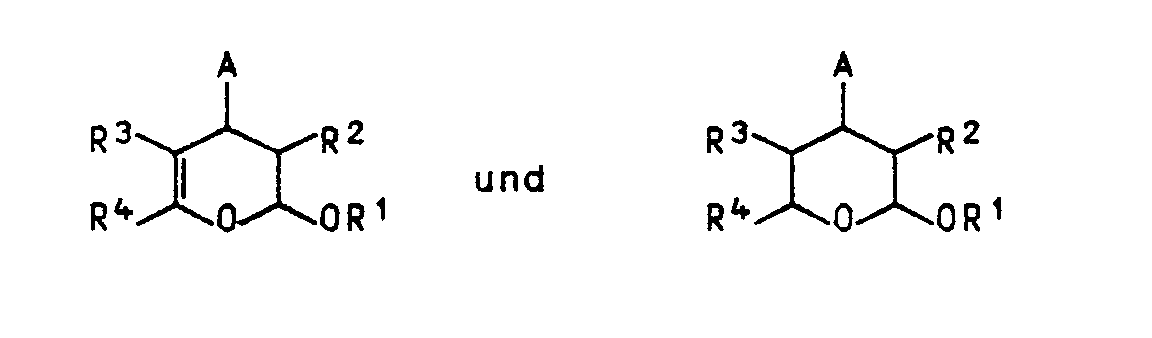
- New pyran derivatives of the formulas Ia and Ib have been found in which R1 C1-C18-alkyl or phenyl, which is optionally substituted by C1-C4-alkyl, C1-C4-alkoxy or halogen, R2-R4 is hydrogen, C1-C6-alkyl or phenyl, which is optionally substituted by C1-C4-alkyl, C1-C4-alkoxy or halogen, and A is CH2-OR5, in which R5 is C1-C4-alkyl or C2-C8-alkoxyalkyl, benzyl, which is optionally substituted by C1-C4-alkyl, C1-C4-alkoxy or halogen in the phenyl ring, tetrahydropyran-2- yl, C1-C4-trialkylsilyl, formyl, C2-C4-alkylcarbonyl or benzoyl, which is optionally substituted
- alkyl groups listed in the radicals R1, R2, R3, R4, R5, R6 and R7 can each be straight-chain or branched.
- R1 in formulas Ia and Ib means e.g. Methyl, ethyl, propyl, isopropyl, butyl, isobutyl, tert-butyl, pentyl, 2-methylbutyl, hexyl, 2-methylpentyl, heptyl, octyl, 2-ethylhexyl, isooctyl, nonyl, isononyl, decyl, isodecyl, 3.5, 5,7-tetramethylnonyl, isotridecyl, pentadecyl, hexadecyl or octadecyl.
- isooctyl, isononyl, isodecyl and isotridecyl are trivial designations and come from the alcohols obtained after oxosynthesis (cf. Ullmann, Encyclopedia of Technical Chemistry, 4th edition, volume 7, pages 216 and 217 and volume 11, pages 435 and 436).
- R1 furthermore denotes optionally substituted phenyl, such as 4-methylphenyl, 2,4-dimethylphenyl, 4-ethylphenyl, 4-isopropylphenyl, 4-tert-butylphenyl, 4-methoxyphenyl, 2-ethoxyphenyl, 4-chlorophenyl, 4-bromophenyl or 2, 4-dichlorophenyl.
- optionally substituted phenyl such as 4-methylphenyl, 2,4-dimethylphenyl, 4-ethylphenyl, 4-isopropylphenyl, 4-tert-butylphenyl, 4-methoxyphenyl, 2-ethoxyphenyl, 4-chlorophenyl, 4-bromophenyl or 2, 4-dichlorophenyl.
- R2, R3 and R4, which are the same or different, in the formulas Ia and Ib independently of one another are, for example, hydrogen, methyl, ethyl, propyl, isopropyl, butyl, isobutyl, tert-butyl, pentyl, 3-methylbutyl, hexyl, phenyl, 4-methylphenyl, 2,6-dimethylphenyl, 4-ethylphenyl, 4-isopropylphenyl, 4-methoxyphenyl, 2-butoxyphenyl, 4-chlorophenyl or 2,4-dichlorophenyl.
- a in the formulas Ia and Ib denotes the radical CH2-OR5, for example methoxymethyl, ethoxymethyl, propoxymethyl, isopropoxymethyl, butoxymethyl, isobutoxymethyl, tert-butoxymethyl, (methoxymethoxy) methyl, (1-isobutoxyethoxy) - methyl, benzyloxymethyl, 4-methylbenzyloxymethyl, (4-methoxybenzyloxy) methyl, 2-chlorobenzyloxymethyl, tetrahydropyran-2-yloxymethyl, trimethylsilyloxymethyl, formyloxymethyl, acetoxymethyl, propionyloxymethyl, benzoyloxymethyl, 4-methylbenzoyloxymethyl, 4-methylbenzoyloxymethyl, 4-methylbenzoyloxymethyl, 4-methylbenzoyloxymethyl the rest CH (OR6) 2, for example dimethoxymethyl, diethoxyethyl, bis (acetoxy) methyl, 1,3-dioxan-2-yl-,
- Preferred pyran derivatives of the formula Ia and Ib are those in which R1 is methyl, ethyl or isobutyl, R2, R3 and R4 are the same or different and are each independently hydrogen or methyl and A methoxymethyl, tert-butoxymethyl, benzyloxymethyl, tetrahydropyran-2-yl , Bis (acetoxy) methyl, dimethoxymethyl, 1,3-dioxolan-2-yl, 5,5-dimethyl-1,3-dioxan-2-yl or methoxycarbonyl.
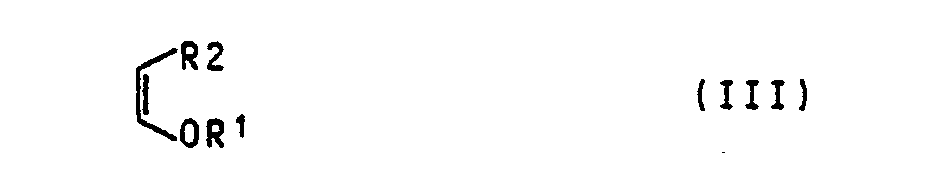
- the pyran derivatives of the formula Ia according to the invention are advantageously obtained if an unsaturated carbonyl compound of the formula II with an enol ether of formula III implements.
- the reaction is expediently carried out at a temperature of 100 to 300 ° C., preferably 150 to 250 ° C. and a pressure of 1 to 1000, preferably from 70 to 100 bar, if appropriate in the presence of an inert solvent and an inert protective gas.
- the Diels-Alder reaction is carried out in the presence of an inert solvent, for example hydrocarbons such as hexane, cyclohexane, heptane, petroleum ether, ligroin, benzene, toluene or xylene; Ethers such as tetrahydrofuran, tetrahydropyran or dioxane; Ketones such as acetone, butanone, methyl isopropyl ketone or methyl isobutyl ketone; or esters such as ethyl acetate and mixtures thereof.
- hydrocarbons such as hexane, cyclohexane, heptane, petroleum ether, ligroin, benzene, toluene or xylene
- Ethers such as tetrahydrofuran, tetrahydropyran or dioxane
- Ketones such as acetone, butanone,
- the enol ethers of the formula III used as the starting product and the dihydropyran derivatives of the formula Ia formed as the reaction product, which also have an enol ether structure are polymerizable compounds, it is expedient to carry out the reaction in the presence of an inert protective gas (e.g. nitrogen, helium or argon). For this reason it is also advisable to add inhibitors to the reaction mixture, e.g. Hydroquinone, pyrogallol or ⁇ -naphthol and bases such as sodium hydroxide, potassium hydroxide, sodium carbonate, sodium hydrogen carbonate, potassium carbonate, calcium carbonate or amines, for example triethylamine or N, N-dimethylaniline, are added.
- an inert protective gas e.g. nitrogen, helium or argon
- the preparation of the dihydropyrans of the formula Ia by the process according to the invention is advantageously carried out by heating a mixture of unsaturated carbonyl compound of the formula II and enol ether of the formula III to the reaction temperature in a reactor in the pressure range mentioned.
- the starting products can be used in stoichiometric amounts.
- the use of one of the two components in excess can also be advantageous, e.g. to increase the reaction rate or instead of a solvent.
- the reaction time is generally 1 to 4 hours, but can also be reduced by suitable measures.
- the reaction can be carried out in a continuous or discontinuous manner.
- the target product can be separated off from the solvent or from excess starting component II or III by distillation and isolated in pure form, the excess starting products II or III also being able to be recovered again.
- the resulting dihydropyran derivative of the formula Ia can optionally be converted into a tetrahydropyran derivative of the formula Ib by means of hydrogen in the presence of a hydrogenation catalyst.
- the hydrogenation reaction is advantageously carried out at a temperature of from -20 to + 300 ° C., preferably +10 to 100 ° C. and a pressure of 1 to 300 bar, preferably 1 to 50 bar, if appropriate in the presence of an inert solvent.
- the customary supported catalysts known per se or also unsupported catalysts can be used as hydrogenation catalysts.
- Catalysts which contain metals from groups 8 and 1B of the periodic table as the active component are preferably used.
- the metals cobalt, nickel, ruthenium, iridium, palladium, platinum or copper may be mentioned as examples.
- catalysts in which the respective metal has been applied to an inert support (for example by impregnation with a metal salt solution) or have been precipitated from a combined salt solution together with the inert material is.
- Suitable inert material is e.g. porous silica, alkaline earth silicate, barium sulfate, aluminum oxide or carbon.
- basic additives for example alkaline earth metal oxides, can also be present in the catalyst.
- inert solvents examples include alcohols, such as methanol, ethanol or isobutanol; cyclic ethers such as tetrahydrofuran or tetrahydropyran; Hydrocarbons such as hexane, cyclohexane, heptane, petroleum ether, ligroin, benzene, toluene or xylene; Esters, such as ethyl acetate or ketones, such as acetone, methyl isopropyl ketone or methyl isobutyl ketone, and mixtures thereof.
- alcohols such as methanol, ethanol or isobutanol
- cyclic ethers such as tetrahydrofuran or tetrahydropyran
- Hydrocarbons such as hexane, cyclohexane, heptane, petroleum ether, ligroin, benzene, toluene or xylene
- the hydrogenation can be carried out either continuously or batchwise.
- the target products are obtained in high yield and purity and can, if necessary, be freed from the solvent by distillation after the catalyst has been separated off.
- the pyran derivatives of the formulas Ia and Ib according to the invention are valuable intermediates for the synthesis of crop protection agents, pharmaceuticals or dyes.
- herbicides based on cyclohexanedione such as those e.g. are described in DE-A-3 121 355.
- the dihydropyran derivatives of the formula Ia can be converted directly into those tetrahydropyran derivatives which have a hydrogen atom in place of the OR 1 radicals by methods known per se in one step by hydrogenation and hydrogenolysis.
- These products can then, if appropriate after converting group A into the functionality desired in each case (for example a hydroxymethyl, aldehyde or carboxyl group), be incorporated directly into the cyclohexane system (cf. for example DE-A-3 121 355).
- the new method offers a number of Advantages.
- the novel pyran derivatives of the formulas Ia and Ib can be obtained in surprisingly high yields by the process according to the invention.
- the use of toxic substances eg bis (2-chloroethyl) ether
- the cyclization step is carried out without the salt accumulation that has previously occurred. After all, the feedstocks required in the process are easily accessible products.
- the dihydropyrans listed in Table 1 can be obtained in an analogous manner.
Landscapes
- Chemical & Material Sciences (AREA)
- Organic Chemistry (AREA)
- Plural Heterocyclic Compounds (AREA)
- Preparation Of Compounds By Using Micro-Organisms (AREA)
- Saccharide Compounds (AREA)
- Heterocyclic Carbon Compounds Containing A Hetero Ring Having Oxygen Or Sulfur (AREA)
- Pyrane Compounds (AREA)
Abstract
R¹ C₁-C₁₈-Alkyl oder gegebenenfalls substituiertes Phenyl,
R²-R⁴ Wasserstoff, C₁-C₆-Alkyl oder gegebenenfalls substituiertes Phenyl und
A eine derivatisierte Methylolgruppe, eine derivatisierte Aldehydgruppe oder eine derivatisierte Carboxylgruppe
bedeuten, mit der Maßgabe, daß R⁴ nicht für C₁-C₆-Alkyl oder gegebenenfalls substituiertes Phenyl steht, wenn A eine derivatisierte Carboxylgruppe bedeutet, und ein Verfahren zu ihrer Herstellung.
Description
- Die vorliegende Erfindung betrifft neue Pyranderivate sowie ein Verfahren zu ihrer Herstellung, ausgehend von ungesättigten Carbonylverbindungen und Enolethern.
- Es ist bekannt, α,β-ungesättigte Aldehyde oder Ketone und Enolether mittels einer Diels-Alder-Reaktion in substituierte Dihydropyrane überzuführen (Chem. Rev. 75, 651 (1975) und Houben-Weyl, Methoden der organischen Chemie 6/4, 355 (1966)). Die bisher dazu als Ausgangsprodukt verwendeten, gegebenenfalls substituieren α,β-ungesättigten Aldehyde oder Ketone weisen aber weder substituierte Methylolgruppen noch derivatisierte Aldehydgruppen als Substituenten an der C-C-Doppelbindung auf. Von diesen Gruppen konnte nämlich erwartet werden, daß sie den drastischen Reaktionsbedingungen der Diels-Alder-Reaktion (Reaktionstemperatur: 180 bis 220°C) nicht standhalten würden, und daß somit Dihydropyranverbindungen, die die genannten Substituenten in 4-Stellung tragen, entweder überhaupt nicht oder allenfalls nur in geringer Ausbeute entstehen würden.
- In der US-A-2 774 771 ist weiterhin die Diels-Alder-Reaktion von α,β-ungesättigten Ketonen, die eine derivatisierte Carboxylgruppe an der C-C-Doppelbindung besitzen, mit Enolethern beschrieben, die zu den jeweiligen 6-Alkyldihydropyranen führt. Auch hier war zu erwarten, daß die entsprechenden, in 6-Stellung unsubstituierten Dihydropyrane entweder überhaupt nicht oder nur in schlechter Ausbeute entstehen würden, da die zu ihrer Synthese erforderlichen, durch eine derivatisierte Carboxylgruppe substituierten α,β-ungesättigten Aldehyde unter den genannten Reaktionsbedingungen zu Nebenreaktionen neigen.
- Aufgabe der vorliegenden Erfindung war es nun, Pyranderivate mit diesem bisher nicht bekannten Substitutionsmuster bereitzustellen und dabei gleichzeitig einen vorteilhaften Syntheseweg zu beschreiten.
- Es wurden neue Pyranderivate der Formeln Ia und Ib gefunden

R¹ C₁-C₁₈-Alkyl oder Phenyl, das gegebenenfalls durch C₁-C₄-Alkyl, C₁-C₄-Alkoxy oder Halogen substituiert ist,
R²-R⁴ Wasserstoff, C₁-C₆-Alkyl oder Phenyl, das gegebenenfalls durch C₁-C₄- Alkyl, C₁-C₄-Alkoxy oder Halogen substituiert ist, und
A den Rest CH₂-OR⁵, in dem R⁵ für C₁-C₄-Alkyl oder C₂-C₈-Alkoxyalkyl, Benzyl, das gegebenenfalls durch C₁-C₄-Alkyl, C₁-C₄-Alkoxy oder Halogen im Phenylring substituiert ist, Tetrahydropyran-2-yl, C₁-C₄-Trialkylsilyl, Formyl, C₂-C₄-Alkylcarbonyl oder Benzoyl, das gegebenenfalls durch C₁-C₄-Alkyl, C₁-C₄-Alkoxy oder Halogen substituiert ist, steht,
den Rest CH(OR⁶)₂, in dem R⁶ für C₁-C₄-Alkyl oder C₁-C₄-Alkylcarbonyl steht, oder wobei der Rest CH(OR⁶)₂ für gegebenenfalls C₁-C₄-alkylsubstituiertes 1,3-Dioxan-2-yl oder gegebenenfalls C₁-C₄-alkylsubstituiertes 1,3-Dioxolan-2-yl steht, oder
den Rest CO-OR⁷, in dem R⁷ für C₁-C₄-Alkyl oder Phenyl steht, das gegebenenfalls durch C₁-C₄-Alkyl, C₁-C₄-Alkoxy oder Halogen substituiert ist, bedeuten,
mit der Maßgabe, daß R⁴ nicht für C₁-C₄-Alkyl oder gegebenenfalls substituiertes Phenyl steht, wenn A den Rest CO-OR⁷ bedeutet. - Die in den Resten R¹, R², R³, R⁴, R⁵, R⁶ und R⁷ aufgeführten Alkylgruppen können jeweils geradkettig oder verzweigt sein.
- R¹ in den Formeln Ia und Ib bedeutet z.B. Methyl, Ethyl, Propyl, Isopropyl, Butyl, Isobutyl, tert-Butyl, Pentyl, 2-Methylbutyl, Hexyl, 2-Methylpentyl, Heptyl, Octyl, 2-Ethylhexyl, Isooctyl, Nonyl, Isononyl, Decyl, Isodecyl, 3,5,5,7-Tetramethylnonyl, Isotridecyl, Pentadecyl, Hexadecyl oder Octadecyl. (Die Bezeichnungen Isooctyl, Isononyl, Isodecyl und Isotridecyl sind Trivialbezeichnungen und stammen von den nach der Oxosynthese erhaltenen Alkoholen (vgl. dazu Ullmann, Enzyklopädie der Technischen Chemie, 4. Auflage, Band 7, Seiten 216 und 217 sowie Band 11, Seiten 435 und 436).
- R¹ bedeutet weiterhin gegebenenfalls substituiertes Phenyl, wie 4-Methylphenyl, 2,4-Dimethylphenyl, 4-Ethylphenyl, 4-Isopropylphenyl, 4-tert-Butylphenyl, 4-Methoxyphenyl, 2-Ethoxyphenyl, 4-Chlorphenyl, 4-Bromphenyl oder 2,4-Dichlorphenyl.
- R², R³ und R⁴, die gleich oder verschieden sind, bedeuten in den Formeln Ia und Ib unabhängig voneinander beispielsweise Wasserstoff, Methyl, Ethyl, Propyl, Isopropyl, Butyl, Isobutyl, tert-Butyl, Pentyl, 3-Methylbutyl, Hexyl, Phenyl, 4-Methylphenyl, 2,6-Dimethylphenyl, 4-Ethylphenyl, 4-Isopropylphenyl, 4-Methoxyphenyl, 2-Butoxyphenyl, 4-Chlorphenyl oder 2,4-Dichlorphenyl.
- A in den Formeln Ia und Ib bedeutet den Rest CH₂-OR⁵, z.B. Methoxymethyl, Ethoxymethyl, Propoxymethyl, Isopropoxymethyl, Butoxymethyl, Isobutoxymethyl, tert-Butoxymethyl, (Methoxymethoxy)methyl, (1-Isobutoxyethoxy)- methyl, Benzyloxymethyl, 4-Methylbenzyloxymethyl, (4-Methoxybenzyloxy)methyl, 2-Chlorbenzyloxymethyl, Tetrahydropyran-2-yloxymethyl, Trimethylsilyloxymethyl, Formyloxymethyl, Acetoxymethyl, Propionyloxymethyl, Benzoyloxymethyl, 4-Methylbenzoyloxymethyl oder 4-Chlorbenzoyloxymethyl; den Rest CH(OR⁶)₂, z.B. Dimethoxymethyl, Diethoxyethyl, Bis(acetoxy)methyl, 1,3-Dioxan-2-yl-, 4-Methyl-1,3-dioxan-2-yl- oder 1,3-Dioxolan-2-yl-; oder den Rest CO-OR⁷, z.B. Methoxycarbonyl, Ethoxycarbonyl, Propoxycarbonyl, Isobutoxycarbonyl, Phenyloxycarbonyl, 4-Methylphenyloxycarbonyl, 4-Ethoxyphenylcarbonyl oder 4-Chlorphenylcarbonyl.
- Bevorzugte Pyranderivate der Formel Ia und Ib sind solche, in denen R¹ Methyl, Ethyl oder Isobutyl, R², R³ und R⁴ gleich oder verschieden sind und unabhängig voneinander jeweils Wasserstoff oder Methyl und A Methoxymethyl, tert-Butoxymethyl, Benzyloxymethyl, Tetrahydropyran-2-yl, Bis(acetoxy)methyl, Dimethoxymethyl, 1,3-Dioxolan-2-yl, 5,5-Dimethyl-1,3-dioxan-2-yl oder Methoxycarbonyl bedeuten.
- Die erfindungsgemäßen Pyranderivate der Formel Ia werden vorteilhaft erhalten, wenn man eine ungesättigte Carbonylverbindung der Formel II


- Die oben genannten Formeln II und III sollen dabei diejenigen Verbindungen umfassen, in denen der Rest A sowohl cis- als auch trans-ständig zum Rest R³, bzw. der Rest R² sowohl cis- als auch trans-ständig zum Rest OR¹ ist.
- Die Umsetzung wird zweckmäßig bei einer Temperatur von 100 bis 300°C, vorzugsweise 150 bis 250°C und einem Druck von 1 bis 1000, vorzugsweise von 70 bis 100 bar, gegebenenfalls in Anwesenheit eines inerten Lösungsmittels und eines inerten Schutzgases vorgenommen.
- Für den Fall, daß man die Diels-Alder-Reaktion in Gegenwart eines inerten Lösungsmittels durchführt, kommen beispielsweise Kohlenwasserstoffe, wie Hexan, Cyclohexan, Heptan, Petrolether, Ligroin, Benzol, Toluol oder Xylol; Ether wie Tetrahydrofuran, Tetrahydropyran oder Dioxan; Ketone wie Aceton, Butanon, Methylisopropylketon oder Methylisobutylketon; oder Ester wie Essigsäureethylester sowie deren Gemische in Betracht.
- Da es sich bei den als Ausgangsprodukt verwendeten Enolethern der Formel III sowie bei den als Reaktionsprodukt entstehenden Dihydropyranderivaten der Formel Ia, die ebenfalls eine Enoletherstruktur aufweisen, um polymerisierbare Verbindungen handelt, ist es zweckmäßig, die Umsetzung in Gegenwart eines inerten Schutzgases (z.B. Stickstoff, Helium oder Argon) durchzuführen. Weiterhin empfiehlt es sich aus diesem Grunde auch, dem Reaktionsgemisch Inhibitoren, z.B. Hydrochinon, Pyrogallol oder β-Naphthol und Basen, wie Natriumhydroxid, Kaliumhydroxid, Natriumcarbonat, Natriumhydrogencarbonat, Kaliumcarbonat, Calciumcarbonat oder Amine, beispielsweise Triethylamin oder N,N-Dimethylanilin zuzusetzen.
- Die Herstellung der Dihydropyrane der Formel Ia nach dem erfindungsgemäßen Verfahren führt man zweckmäßig so durch, daß man ein Gemisch aus ungesättigter Carbonylverbindung der Formel II und Enolether der Formel III in einem Reaktor im genannten Druckbereich auf die Reaktionstemperatur erwärmt. Die Ausgangsprodukte können dabei in stöchiometrischen Mengen eingesetzt werden. Aber auch die Verwendung einer der beiden Komponenten im Überschuß kann vorteilhaft sein, z.B. zur Erhöhung der Reaktionsgeschwindigkeit oder anstelle eines Lösungsmittels.
- Die Reaktionsdauer beträgt im allgemeinen 1 bis 4 Stunden, kann aber durch geeignete Maßnahmen auch noch gesenkt werden.
- Die Umsetzung kann in kontinuierlicher oder diskontinuierlicher Arbeitsweise durchgeführt werden.
- Nach Beendigung der Reaktion kann das Zielprodukt durch Destillation vom Lösungsmittel oder von überschüssiger Ausgangskomponente II oder III abgetrennt und in reiner Form isoliert werden, wobei auch die überschüssigen Ausgangsprodukte II oder III wieder zurückgewonnen werden können. Es ist aber auch möglich, die Dihydropyrane ohne Reinigungsschritt weiter umzusetzen.
- Gegebenenfalls kann in einer Folgestufe das entstandene Dihydropyranderivat der Formel Ia mittels Wasserstoff in Gegenwart eines Hydrierkatalysators in ein Tetrahydropyranderivat der Formel Ib übergeführt werden.
- Die Hydrierreaktion wird zweckmäßig bei einer Temperatur von -20 bis +300°C, vorzugsweise +10 bis 100°C und einem Druck von 1 bis 300 bar, vorzugsweise 1 bis 50 bar, gegebenenfalls in Anwesenheit eines inerten Lösungsmittels durchgeführt.
- Als Hydrierkatalysatoren können die üblichen, an sich bekannten Trägerkatalysatoren oder auch trägerfreie Katalysatoren eingesetzt werden. Vorzugsweise verwendet man solche Katalysatoren, die als aktive Komponente Metalle der Gruppe 8 und 1B des Periodensystems enthalten. Beispielhaft seien die Metalle Kobalt, Nickel, Ruthenium, Iridium, Palladium, Platin oder Kupfer genannt.
- Für den Fall, daß man die Hydrierung mit Trägerkatalysatoren durchführt, kann man solche Katalysatoren verwenden, bei denen das jeweilige Metall auf einen inerten Träger aufgebracht worden ist (z.B. durch Tränken mit einer Metallsalzlösung) oder auch gemeinsam mit dem Inertmaterial aus einer vereinigten Salzlösung gefällt worden ist. Als Inertmaterial eignet sich dabei z.B. poröse Kieselsäure, Erdalkalisilikat, Bariumsulfat, Aluminiumoxid oder Kohle. Weiterhin können auch basische Zusätze, beispielsweise Erdalkalioxide im Katalysator erhalten sein.
- Als inerte Lösungsmittel kommen beispielsweise Alkohole, wie Methanol, Ethanol oder Isobutanol; cyclische Ether, wie Tetrahydrofuran oder Tetrahydropyran; Kohlenwasserstoffe, wie Hexan, Cyclohexan, Heptan, Petrolether, Ligroin, Benzol, Toluol oder Xylol; Ester, wie Essigsäureethylester oder Ketone, wie Aceton, Methylisopropylketon oder Methylisobutylketon, sowie deren Gemische, in Betracht.
- Die Hydrierung kann sowohl in kontinuierlicher als auch in diskontinuierlicher Arbeitsweise durchgeführt werden.
- Die Zielprodukte fallen dabei in hoher Ausbeute und Reinheit an und können nach Abtrennen des Katalysators gegebenenfalls durch Destillation vom Lösungsmittel befreit werden.
- Die erfindungsgemäßen Pyranderivate der Formeln Ia und Ib sind wertvolle Zwischenprodukte für die Synthese von Pflanzenschutzmitteln, Pharmazeutika oder Farbstoffen. Insbesondere sind dabei Herbizide auf Cyclohexandionbasis zu nennen, wie sie z.B. in der DE-A-3 121 355 beschrieben sind.
- Die Dihydropyranderivate der Formel Ia können dazu nach an sich bekannten Methoden in einer Stufe durch Hydrierung und Hydrogenolyse direkt in solche Tetrahydropyranderivate übergeführt werden, die an Stelle des Reste OR¹ ein Wasserstoffatom besitzen. Es ist aber auch möglich, die Pyranderivate der Formel Ib durch hydrogenolytische Abspaltung von R¹OH oder durch Eliminierng von R¹OH und sich anschließender Hydrierung in die genannten Tetrahydropyanderivate umzuwandeln. Diese Produkte können dann, gegebenenfalls nach Überführung der Gruppe A in die jeweils gewünschte Funktionalität (z.B. eine Hydroxymethyl-, Aldehyd- oder Carboxylgruppe), direkt in das Cyclohexansystem eingebaut werden (vgl. dazu z.B. DE-A-3 121 355).
- Im Vergleich zu bekannten Syntheseschritten (z.B. J. Chem. Soc. 1930, 2525; Angew. Chem. 86, 742 (1974); J. Am. Chem. Soc. 97, 210 (1975)) bietet das neue Verfahren eine Reihe von Vorteilen. So können mittels des erfindungsgemäßen Vefahrens die neuen Pyranderivate der Formeln Ia und Ib in überraschend hohen Ausbeuten erhalten werden. Weiterhin kann auf die Verwendung von toxischen Substanzen (z.B. Bis(2-chlorethyl)ether) verzichtet werden. Außerdem wird der Cyclisierungsschritt ohne den bisher auftretenden Salzanfall durchgeführt. Schließlich handelt es sich bei den im Verfahren benötigten Einsatzstoffen um leicht zugängliche Produkte.
- Die nachfolgenden Beispiele sollen die Erfindung näher erläutern.
- Ein Gemisch aus 319 g β-Formylacrylsäuremethylester, 325 g Methylvinylether, 5 g Hydrochinon, 5 g Natriumcarbonat und 600 ml Toluol wurde in einem 2 l-Autoklaven unter einem Stickstoffdruck von 10 bar auf 180°C erwärmt und 3 Stunden bei dieser Temperatur gerührt. Nach dem Abkühlen wurde der Feststoff abgesaugt und das Filtrat destilliert. Man erhielt 439 g (90 % d. Th.) 2-Methoxy-3,4-dihydro-2H-pyran-4-carbonsäure-methylester (Verbindung Nr. 1) Siedepunkt: 72°C/2 mbar.
- In analoger Weise können die in Tabelle 1 aufgeführten Dihydropyrane erhalten werden.


- In ein Gemisch aus 303 g 2-Ethoxy-3.4-dihydro-2H-pyran-4-aldehyddimethylacetal (Verbindung Nr. 11), 30 g Raney-Nickel und 2 Liter Ethanol wurde bei 25 bis 30°C während 8 Stunden Wasserstoff eingeleitet. Das Reaktionsgemisch wurde dann über Kieselgur abgesaugt und das Filtrat destilliert. Man erhielt 273 g (90 % d.Th.) 2-Ethoxytetrahydropyran-4-aldehyd-dimethylacetal (Verbindung Nr. 58) Siedepunkt: 63°C/0,5 mbar.
- In analoger Weise können die in Tabelle 2 aufgeführten Tetrahydropyrane erhalten werden.


- Die folgenden Beispiele Nr. 89 bis 94 sollen die Überführung der erfindungsgemäßen Pyranderivate der Formeln Ia und Ib in solche Tetrahydropyranderivate zeigen, die anstelle der OR¹-Gruppe ein Wasserstoffatom besitzen.
- Auf ein Gemisch aus 248 g 2-Methoxy-3,4-dihydro-2H-pyran-4-carbonsäuremethylester (Verbindung Nr. 1), 5 g Palladium auf Aktivkohle und 1000 ml THF wurden in einem Autoklaven 200 bar Wasserstoff aufgepreßt, dann wurde auf 150°C erwärmt und 20 Stunden bei 150°C und 200 bar Wasserstoff gerührt. Der Reaktionsaustrag wurde über Kieselgur abgesaugt. Destillation des Filtrats ergab 202 g (97 % d.Th.) Tetrahydropyran-4-carbonsäuremethylester (Verbindung Nr. 89). Siedepunkt: 77 bis 79°C/15 mbar.
- 10 g 2-Ethoxy-4-(tetrahydropyran-2-yloxymethyl)tetrahydropyran (Verbindung Nr. 83) ergaben unter den in Beispiel 89 beschriebenen Reaktionsbedingungen 3,6 g (75 % d.Th.) 4-Hydroxymethyltetrahydropyran (Verbindung Nr. 90). Siedepunkt 92-94°C/12 mbar.
- Zu einem Gemisch aus 229 g NaOH, 1000 ml Wasser und 700 ml Methanol wurden bei 60°C während 40 Minuten 485 g Tetrahydropyran-4-carbonsäuremethylester (Verbindung Nr. 89) zugetropft, dann wurde 8 Stunden unter Rückfluß gehalten. Nach Destillation des Lösungsmittels gab man 500 ml Wasser zu und extrahierte mit Methyl-tert-butylether. Die Etherphase wurde über Na₂SO₄ getrocknet und das Lösungsmittel abdestilliert. Man erhielt als Rückstand 418 g (96 % d.Th.) Tetrahydropyranyl-4-carbonsäure (Verbindung Nr. 91). Schmelzpunkt: 84-86°C.
- Ein Gemisch aus 12,7 g 4-(5,5-Dimethyl-1,3-dioxan-2-yl)-2-methoxy-tetrahydropyran (Verbindung Nr. 69), 0,06 g p-Toluolsulfonsäure und 0,25 g Toluol wurde bei einem Druck von 15 mbar innerhalb von 2 Stunden in einen Kolben getropft, der sich in einem auf 150°C erwärmten Ölbad befand. Gleichzeitig wurden die leichtsiedenden Produkte abdestilliert. Rektifikation des Destillats ergab 6,86 g (62 % d.Th.) 4-(5,5-Dimethyl-1,3- dioxan-2-yl)-3,4-dihydro-2H-pyran (Verbindung Nr. 92) pft, der sich in einem auf 150°C erwärmten Ölbad befand. Gleichzeitig wurden die leichtsiedenden Produkte abdestilliert. Rektifikation des Destillats ergab 6,86 g (62 % d.Th.) 4-(5,5-Dimethyl-1,3-dioxan-2-yl)-3,4-dihydro-2H-pyran (Verbindung Nr. 92)
- ¹H-NMR (CDCl₃): 0,7 (S, 3H), 1,2 (S, 3H), 1,6-2,1 (M, 3H)
3,2-4,3 (M, 7H), 4,7 (M, 1H), 6,4 (M, 1H) ppm
und 3,3 g (26 %) unumgesetztes Ausgangsprodukt. - In ein Gemisch aus 4,8 g 4-(5,5-Dimethyl-1,3-dioxan-2-yl)-3,4-dihydro-2H-pyran (Verbindung Nr. 92), 2 g Raney-Nickel und 50 ml Ethanol wurde bei 25°C während 2 Stunden Wasserstoff eingeleitet. Das Reaktionsgemisch wurde über Kieselgur abgesaugt und destilliert. Man erhielt 4,1 g (82 % d.Th.) 4-(5,5-Dimethyl-1,3-dioxan-2-yl)-tetrahydropyran (Verbindung Nr. 93).
- ¹H-NMR (CDCl₃): 0,7 (S, 3H), 1,2 (S, 3H), 1,4-1,8 (m, 5H),
3,2-4,3 (m, 9H) ppm. - Ein Gemisch aus 3,8 g 4-(5,5-Dimethyl-1,3-dioxan-2-yl)-tetrahydropyran (Verbindung Nr. 93) und 40 ml 5 %ige Schwefelsäure wurde unter Stickstoff 8 Stunden bei 60°C gerührt. Nach dem Abkühlen wurde mit Methylenchlorid extrahiert, über Natriumsulfat getrocknet und destilliert. Man erhielt 1,3 g (61 % d.Th.) 4-Formyltetrahydropyran (Verbindung Nr. 94). Siedepunkt: 74-76°C/25 mbar.
Claims (4)

R¹ C₁-C₁₈-Alkyl oder Phenyl, das gegebenenfalls durch C₁-C₄-Alkyl, C₁-C₄-Alkoxy oder Halogen substituiert ist,
R²-R⁴ Wasserstoff, C₁-C₆-Alkyl oder Phenyl, das gegebenenfalls durch C₁-C₄- Alkyl, C₁-C₄-Alkoxy oder Halogen substituiert ist, und
A den Rest CH₂-OR⁵, in dem R⁵ für C₁-C₄-Alkyl oder C₂-C₈-Alkoxyalkyl, Benzyl, das gegebenenfalls durch C₁-C₄-Alkyl, C₁-C₄-Alkoxy oder Halogen im Phenylring substituiert ist, Tetrahydropyran-2-yl, C₁-C₄-Trialkylsilyl, Formyl, C₂-C₄-Alkylcarbonyl oder Benzoyl, das gegebenenfalls durch C₁-C₄-Alkyl, C₁-C₄-Alkoxy oder Halogen substituiert ist, steht,
den Rest CH(OR⁶)₂, in dem R⁶ für C₁-C₄-Alkyl oder C₁-C₄-Alkylcarbonyl steht, oder wobei der Rest CH(OR⁶)₂ für gegebenenfalls C₁-C₄-alkylsubstituiertes 1,3-Dioxan-2-yl oder gegebenenfalls C₁-C₄-alkylsubstituiertes 1,3-Dioxolan-2-yl steht, oder
den Rest CO-OR⁷, in dem R⁷ für C₁-C₄-Alkyl oder Phenyl steht, das gegebenenfalls durch C₁-C₄-Alkyl, C₁-C₄-Alkoxy oder Halogen substituiert ist, bedeuten,
mit der Maßgabe, daß R⁴ nicht für C₁-C₄-Alkyl oder gegebenenfalls substituiertes Phenyl steht, wenn A den Rest CO-OR⁷ bedeutet, dadurch gekennzeichnet, daß man eine ungesättigte Carbonylverbindung der Formel II

R¹ C₁-C₁₈-Alkyl oder Phenyl, das gegebenenfalls durch C₁-C₄-Alkyl, C₁-C₄-Alkoxy oder Halogen substituiert ist,
R²-R⁴ Wasserstoff, C₁-C₆-Alkyl oder Phenyl, das gegebenenfalls durch C₁-C₄-Alkyl, C₁-C₄-Alkoxy oder Halogen substituiert ist, und
A den Rest CH₂-OR⁵, in dem R⁵ für C₁-C₄-Alkyl oder C₂-C₆-Alkoxyalkyl, Benzyl, das gegebenenfalls durch Methyl, Methoxy oder Chlor im Phenylring substituiert ist, Tetrahydropyran-2-yl, Trimethylsilyl, Formyl, Acetyl, Propionyl oder Benzoyl, das gegebenenfalls durch Methyl oder Chlor substituiert ist, steht, den Rest CH(OR⁶)₂, in dem R⁶ für Methyl, Ethyl oder Acetyl steht, oder wobei der Rest CH(OR⁶)₂ für gegebenenfalls Methyl substituiertes 1,3-Dioxan-2-yl oder 1,3-Dioxolan-2-yl steht, oder
den Rest CO-OR⁷, in dem R⁷ für C₁-C₄-Alkyl oder Phenyl steht, das gegebenenfalls durch Methyl, Ethoxy oder Chlor substituiert ist, bedeuten,
mit der Maßgabe, daß R⁴ nicht für C₁-C₄-Alkyl oder gegebenenfalls substituiertes Phenyl steht, wenn A den Rest CO-OR⁷ bedeutet, dadurch gekennzeichnet, daß man eine ungesättigte Carbonylverbindung der Formel II


R¹ Methyl, Ethyl oder Isobutyl,
R²-R⁴ Wasserstoff oder Methyl, A Methoxymethyl, tert.-Butoxymethyl, Benzyloxymethyl, Tetrahydropyran-2-yl, Bis-(acetoxy)methyl, Dimethoxymethyl, 1,3-Dioxolan-2-yl, 5,5-Dimethyl-1,3-dioxan-2-yl oder Methylcarbonyl bedeuten,
dadurch gekennzeichnet, daß man eine ungesättigte Carbonylverbindung der Formel II


Priority Applications (1)
| Application Number | Priority Date | Filing Date | Title |
|---|---|---|---|
| AT86114179T ATE42551T1 (de) | 1985-10-17 | 1986-10-14 | Pyranderivate und ein verfahren zu ihrer herstellung. |
Applications Claiming Priority (2)
| Application Number | Priority Date | Filing Date | Title |
|---|---|---|---|
| DE3536956 | 1985-10-17 | ||
| DE19853536956 DE3536956A1 (de) | 1985-10-17 | 1985-10-17 | Pyranderivate und ein verfahren zu ihrer herstellung |
Publications (3)
| Publication Number | Publication Date |
|---|---|
| EP0219091A2 true EP0219091A2 (de) | 1987-04-22 |
| EP0219091A3 EP0219091A3 (en) | 1988-02-10 |
| EP0219091B1 EP0219091B1 (de) | 1989-04-26 |
Family
ID=6283768
Family Applications (1)
| Application Number | Title | Priority Date | Filing Date |
|---|---|---|---|
| EP86114179A Expired EP0219091B1 (de) | 1985-10-17 | 1986-10-14 | Pyranderivate und ein Verfahren zu ihrer Herstellung |
Country Status (5)
| Country | Link |
|---|---|
| EP (1) | EP0219091B1 (de) |
| JP (1) | JPS6293285A (de) |
| AT (1) | ATE42551T1 (de) |
| DE (2) | DE3536956A1 (de) |
| IL (1) | IL80258A0 (de) |
Cited By (3)
| Publication number | Priority date | Publication date | Assignee | Title |
|---|---|---|---|---|
| WO1992010488A1 (de) * | 1990-12-14 | 1992-06-25 | Basf Aktiengesellschaft | Verfahren zur herstellung von formyltetrahydropyranen |
| WO2006062211A1 (en) * | 2004-12-06 | 2006-06-15 | Showa Denko K.K. | Production process of tetrahydropyran compound and tetrahydropyran compound produced by the production process |
| CN104781245A (zh) * | 2012-10-12 | 2015-07-15 | 学校法人冲绳科学技术大学院大学学园 | 用于生产二氢-2h-吡喃衍生物的方法 |
Families Citing this family (1)
| Publication number | Priority date | Publication date | Assignee | Title |
|---|---|---|---|---|
| DE3630614A1 (de) * | 1986-09-09 | 1988-03-17 | Basf Ag | Verfahren zur herstellung von 4-formyltetrahydropyranen und neue 4-formyltetrahydropyrane |
Family Cites Families (1)
| Publication number | Priority date | Publication date | Assignee | Title |
|---|---|---|---|---|
| US2774771A (en) * | 1955-08-11 | 1956-12-18 | Monsanto Chemicals | Dihydropyran derivatives |
-
1985
- 1985-10-17 DE DE19853536956 patent/DE3536956A1/de not_active Withdrawn
-
1986
- 1986-10-08 IL IL80258A patent/IL80258A0/xx unknown
- 1986-10-14 EP EP86114179A patent/EP0219091B1/de not_active Expired
- 1986-10-14 DE DE8686114179T patent/DE3663026D1/de not_active Expired
- 1986-10-14 AT AT86114179T patent/ATE42551T1/de not_active IP Right Cessation
- 1986-10-15 JP JP61243302A patent/JPS6293285A/ja active Pending
Cited By (6)
| Publication number | Priority date | Publication date | Assignee | Title |
|---|---|---|---|---|
| WO1992010488A1 (de) * | 1990-12-14 | 1992-06-25 | Basf Aktiengesellschaft | Verfahren zur herstellung von formyltetrahydropyranen |
| WO2006062211A1 (en) * | 2004-12-06 | 2006-06-15 | Showa Denko K.K. | Production process of tetrahydropyran compound and tetrahydropyran compound produced by the production process |
| US7518003B2 (en) | 2004-12-06 | 2009-04-14 | Showa Denko K.K. | Production process of tetrahydropyran compound and tetrahydropyran compound produced by the production process |
| CN104781245A (zh) * | 2012-10-12 | 2015-07-15 | 学校法人冲绳科学技术大学院大学学园 | 用于生产二氢-2h-吡喃衍生物的方法 |
| US9346780B2 (en) | 2012-10-12 | 2016-05-24 | Okinawa Institute Of Science And Technology School Corporation | Process for producing dihydro-2H-pyran derivatives |
| US9630940B2 (en) | 2012-10-12 | 2017-04-25 | Okinawa Institute Of Science And Technology School Corporation | Process for producing dihydro-2H-pyran derivatives |
Also Published As
| Publication number | Publication date |
|---|---|
| DE3536956A1 (de) | 1987-04-23 |
| EP0219091B1 (de) | 1989-04-26 |
| JPS6293285A (ja) | 1987-04-28 |
| EP0219091A3 (en) | 1988-02-10 |
| ATE42551T1 (de) | 1989-05-15 |
| DE3663026D1 (en) | 1989-06-01 |
| IL80258A0 (en) | 1987-01-30 |
Similar Documents
| Publication | Publication Date | Title |
|---|---|---|
| DE3718527A1 (de) | Verfahren zur herstellung von 2(5h)-furanonen | |
| DE2065551C3 (de) | Verfahren zur Herstellung von Lactonen mit 14 bis 17 Ringkohlenstoffatomen | |
| EP0031932A2 (de) | Substituierte Lactone, Pentacarbonsäurederivate und Verfahren zu ihrer Herstellung | |
| EP0219091B1 (de) | Pyranderivate und ein Verfahren zu ihrer Herstellung | |
| EP0107806B1 (de) | Verfahren zur Herstellung von optisch aktiven Hydrochinonderivaten sowie von d-alpha-Tocopherol | |
| DE3034040C2 (de) | Verfahren zur Herstellung von Muscon, 16-Oxa-14-methyl-bicyclo[10.3.1]-hexadec-1-en als Zwischenprodukt für dieses Verfahren und ein Verfahren zu dessen Herstellung | |
| EP0001089B1 (de) | Verfahren zur Herstellung von halogenvinylsubstituierten Tetrahydrofuran-2-onen, bestimmte halogenvinylsubstituierte Tetrahydrofuran-2-one | |
| EP0842917A1 (de) | Verfahren zur Herstellung Gamma,Delta-ungesättigten Ketonen durch Carroll-Reaktion in cyclischen Carbonaten oder Gamma-Lactonen als Lösungsmittel | |
| CH626096A5 (de) | ||
| EP0161580A2 (de) | Verfahren zur Herstellung eines Lactons | |
| EP0187345B1 (de) | Substituierte Furane und deren Vorprodukte | |
| DE1493793B2 (de) | Substituierte Tetrahydropyrane und Verfahren zu deren Herstellung | |
| DE2253089C2 (de) | 9-Oxo-9,10,seco-östran-Derivate und Verfahren zur Herstellung dieser Verbindungen und von 9-Oxo-D-homo-9,10-seco-östran-Derivaten | |
| DE2212589C3 (de) | Verfahren zur Herstellung von 13 beta-R-4,9,11-gonatrienen und 13 beta-R-4,5-seco-9,l 1-gonadiene als Z wise henproduk te | |
| EP0805803B1 (de) | Verfahren zur herstellung von 1,4,5,6-tetrahydropyrazin-2-carbonsäureamiden | |
| EP0257521A2 (de) | 3,4-Dihydro-2H-pyrane und ein Verfahren zu ihrer Herstellung | |
| CH628639A5 (en) | Process for the preparation of furanose derivatives | |
| DE602005002750T2 (de) | Chirale heptinderivate zur herstellung von epothilonen und verfahren zu deren herstellung | |
| EP0224256A1 (de) | 4-Alkoxy-2-oxo-pyrrolidin-1-yl-essigsäurealkylester | |
| EP0097874B1 (de) | Verfahren zur Herstellung von 6-exo-Alkanoyl-1,3,3-trimethyl-bicyclo(2.2.2)octan-2-onen | |
| AT347610B (de) | Verfahren zur herstellung neuer ausgangsstoffe fuer die synthese von prostaglandinen der ''eins''-reihe | |
| DE900216C (de) | Verfahren zur selektiven Hydrierung der 3-Ketogruppe des Pregnan-3, 11, 20-trions | |
| DE2253088C2 (de) | 9-Hydroxy-9,10-seco-östran-Derivate und Verfahren zur Herstellung dieser Verbindungen und von 9-Hydroxy-9,10-seco-D-homo-östran-Derivaten | |
| AT272541B (de) | Verfahren zur Herstellung von Benzindenen | |
| CH567028A5 (en) | Dioxatricyclodecenes - elimination of esterified hydroxyl groups from dioxatricyclodecanol intermediates for prostaglandins in |
Legal Events
| Date | Code | Title | Description |
|---|---|---|---|
| PUAI | Public reference made under article 153(3) epc to a published international application that has entered the european phase |
Free format text: ORIGINAL CODE: 0009012 |
|
| AK | Designated contracting states |
Kind code of ref document: A2 Designated state(s): AT BE CH DE FR GB IT LI |
|
| PUAL | Search report despatched |
Free format text: ORIGINAL CODE: 0009013 |
|
| AK | Designated contracting states |
Kind code of ref document: A3 Designated state(s): AT BE CH DE FR GB IT LI |
|
| 17P | Request for examination filed |
Effective date: 19871223 |
|
| 17Q | First examination report despatched |
Effective date: 19880915 |
|
| GRAA | (expected) grant |
Free format text: ORIGINAL CODE: 0009210 |
|
| AK | Designated contracting states |
Kind code of ref document: B1 Designated state(s): AT BE CH DE FR GB IT LI |
|
| REF | Corresponds to: |
Ref document number: 42551 Country of ref document: AT Date of ref document: 19890515 Kind code of ref document: T |
|
| ITF | It: translation for a ep patent filed | ||
| REF | Corresponds to: |
Ref document number: 3663026 Country of ref document: DE Date of ref document: 19890601 |
|
| GBT | Gb: translation of ep patent filed (gb section 77(6)(a)/1977) | ||
| ET | Fr: translation filed | ||
| PLBE | No opposition filed within time limit |
Free format text: ORIGINAL CODE: 0009261 |
|
| STAA | Information on the status of an ep patent application or granted ep patent |
Free format text: STATUS: NO OPPOSITION FILED WITHIN TIME LIMIT |
|
| 26N | No opposition filed | ||
| ITTA | It: last paid annual fee | ||
| REG | Reference to a national code |
Ref country code: GB Ref legal event code: IF02 |
|
| PGFP | Annual fee paid to national office [announced via postgrant information from national office to epo] |
Ref country code: DE Payment date: 20051006 Year of fee payment: 20 |
|
| PGFP | Annual fee paid to national office [announced via postgrant information from national office to epo] |
Ref country code: FR Payment date: 20051010 Year of fee payment: 20 |
|
| PGFP | Annual fee paid to national office [announced via postgrant information from national office to epo] |
Ref country code: AT Payment date: 20051012 Year of fee payment: 20 Ref country code: GB Payment date: 20051012 Year of fee payment: 20 |
|
| PGFP | Annual fee paid to national office [announced via postgrant information from national office to epo] |
Ref country code: CH Payment date: 20051014 Year of fee payment: 20 |
|
| PGFP | Annual fee paid to national office [announced via postgrant information from national office to epo] |
Ref country code: IT Payment date: 20051027 Year of fee payment: 20 |
|
| REG | Reference to a national code |
Ref country code: GB Ref legal event code: PE20 |
|
| PGFP | Annual fee paid to national office [announced via postgrant information from national office to epo] |
Ref country code: BE Payment date: 20051215 Year of fee payment: 20 |
|
| PG25 | Lapsed in a contracting state [announced via postgrant information from national office to epo] |
Ref country code: GB Free format text: LAPSE BECAUSE OF EXPIRATION OF PROTECTION Effective date: 20061013 |
|
| REG | Reference to a national code |
Ref country code: CH Ref legal event code: PL |
|
| BE20 | Be: patent expired |
Owner name: *BASF A.G. Effective date: 20061014 |