EP0219791A2 - Procédé de culture de cellules recombinantes - Google Patents
Procédé de culture de cellules recombinantes Download PDFInfo
- Publication number
- EP0219791A2 EP0219791A2 EP86114159A EP86114159A EP0219791A2 EP 0219791 A2 EP0219791 A2 EP 0219791A2 EP 86114159 A EP86114159 A EP 86114159A EP 86114159 A EP86114159 A EP 86114159A EP 0219791 A2 EP0219791 A2 EP 0219791A2
- Authority
- EP
- European Patent Office
- Prior art keywords
- desired product
- culture
- cell growth
- cells
- substance
- Prior art date
- Legal status (The legal status is an assumption and is not a legal conclusion. Google has not performed a legal analysis and makes no representation as to the accuracy of the status listed.)
- Granted
Links
Images





Classifications
-
- C—CHEMISTRY; METALLURGY
- C12—BIOCHEMISTRY; BEER; SPIRITS; WINE; VINEGAR; MICROBIOLOGY; ENZYMOLOGY; MUTATION OR GENETIC ENGINEERING
- C12N—MICROORGANISMS OR ENZYMES; COMPOSITIONS THEREOF; PROPAGATING, PRESERVING, OR MAINTAINING MICROORGANISMS; MUTATION OR GENETIC ENGINEERING; CULTURE MEDIA
- C12N1/00—Microorganisms; Compositions thereof; Processes of propagating, maintaining or preserving microorganisms or compositions thereof; Processes of preparing or isolating a composition containing a microorganism; Culture media therefor
- C12N1/10—Protozoa; Culture media therefor
-
- C—CHEMISTRY; METALLURGY
- C12—BIOCHEMISTRY; BEER; SPIRITS; WINE; VINEGAR; MICROBIOLOGY; ENZYMOLOGY; MUTATION OR GENETIC ENGINEERING
- C12N—MICROORGANISMS OR ENZYMES; COMPOSITIONS THEREOF; PROPAGATING, PRESERVING, OR MAINTAINING MICROORGANISMS; MUTATION OR GENETIC ENGINEERING; CULTURE MEDIA
- C12N1/00—Microorganisms; Compositions thereof; Processes of propagating, maintaining or preserving microorganisms or compositions thereof; Processes of preparing or isolating a composition containing a microorganism; Culture media therefor
- C12N1/38—Chemical stimulation of growth or activity by addition of chemical compounds which are not essential growth factors; Stimulation of growth by removal of a chemical compound
-
- C—CHEMISTRY; METALLURGY
- C12—BIOCHEMISTRY; BEER; SPIRITS; WINE; VINEGAR; MICROBIOLOGY; ENZYMOLOGY; MUTATION OR GENETIC ENGINEERING
- C12N—MICROORGANISMS OR ENZYMES; COMPOSITIONS THEREOF; PROPAGATING, PRESERVING, OR MAINTAINING MICROORGANISMS; MUTATION OR GENETIC ENGINEERING; CULTURE MEDIA
- C12N15/00—Mutation or genetic engineering; DNA or RNA concerning genetic engineering, vectors, e.g. plasmids, or their isolation, preparation or purification; Use of hosts therefor
- C12N15/09—Recombinant DNA-technology
- C12N15/63—Introduction of foreign genetic material using vectors; Vectors; Use of hosts therefor; Regulation of expression
- C12N15/70—Vectors or expression systems specially adapted for E. coli
-
- C—CHEMISTRY; METALLURGY
- C12—BIOCHEMISTRY; BEER; SPIRITS; WINE; VINEGAR; MICROBIOLOGY; ENZYMOLOGY; MUTATION OR GENETIC ENGINEERING
- C12N—MICROORGANISMS OR ENZYMES; COMPOSITIONS THEREOF; PROPAGATING, PRESERVING, OR MAINTAINING MICROORGANISMS; MUTATION OR GENETIC ENGINEERING; CULTURE MEDIA
- C12N9/00—Enzymes; Proenzymes; Compositions thereof; Processes for preparing, activating, inhibiting, separating or purifying enzymes
- C12N9/14—Hydrolases (3)
- C12N9/24—Hydrolases (3) acting on glycosyl compounds (3.2)
- C12N9/2402—Hydrolases (3) acting on glycosyl compounds (3.2) hydrolysing O- and S- glycosyl compounds (3.2.1)
- C12N9/2468—Hydrolases (3) acting on glycosyl compounds (3.2) hydrolysing O- and S- glycosyl compounds (3.2.1) acting on beta-galactose-glycoside bonds, e.g. carrageenases (3.2.1.83; 3.2.1.157); beta-agarase (3.2.1.81)
- C12N9/2471—Beta-galactosidase (3.2.1.23), i.e. exo-(1-->4)-beta-D-galactanase
-
- C—CHEMISTRY; METALLURGY
- C12—BIOCHEMISTRY; BEER; SPIRITS; WINE; VINEGAR; MICROBIOLOGY; ENZYMOLOGY; MUTATION OR GENETIC ENGINEERING
- C12P—FERMENTATION OR ENZYME-USING PROCESSES TO SYNTHESISE A DESIRED CHEMICAL COMPOUND OR COMPOSITION OR TO SEPARATE OPTICAL ISOMERS FROM A RACEMIC MIXTURE
- C12P1/00—Preparation of compounds or compositions, not provided for in groups C12P3/00 - C12P39/00, by using microorganisms or enzymes
-
- C—CHEMISTRY; METALLURGY
- C12—BIOCHEMISTRY; BEER; SPIRITS; WINE; VINEGAR; MICROBIOLOGY; ENZYMOLOGY; MUTATION OR GENETIC ENGINEERING
- C12Y—ENZYMES
- C12Y302/00—Hydrolases acting on glycosyl compounds, i.e. glycosylases (3.2)
- C12Y302/01—Glycosidases, i.e. enzymes hydrolysing O- and S-glycosyl compounds (3.2.1)
- C12Y302/01023—Beta-galactosidase (3.2.1.23), i.e. exo-(1-->4)-beta-D-galactanase
Definitions
- This invention relates to an efficient process for culturing recombinant cells which can be employed when cells having an objective gene from an animal, plant, microorganism or the like introduced thereinto are cultured, and the objective gene is expressed, followed by collecting the resulting product.
- a genetic recombination technique comprising using host cells containing complex DNA (deoxyribonucleic acid) composed of their vector plasmid or the like and a gene inserted thereinto having information sequence for a useful product, and allowing said cells to produce a large amount of the useful product.
- Human interferon and insulin, etc. are already being produced by using this technique, and Escherichia coli, yeasts, Bacillus subtilis, Actynomyces, animal cells, plant cells, etc. have heretofore been utilized as the host.
- This process is intended for culturing yeasts to produce a large amount of cells them strictlyself and is not a process for culturing cells having complex DNA for allowing the cells to produce a desired product.
- a process comprising detecting the production of ethanol by measuring the respiratory quotient, feeding a substrate, and thereby raising the yeast concentration (Japanese Patent Application Kokai (Laid-Open) Nos. 36983/82 and 78584/83).
- Japanese Patent Application Kokai (Laid-Open) Nos. 36983/82 and 78584/83 Japanese Patent Application Kokai (Laid-Open) Nos. 36983/82 and 78584/83.
- this culture process is not a process for culturing cells having complex DNA.
- An object of this invention is to provide an efficient process for culturing cells having complex DNA which permits production of a large amount of a desired product.
- Another object of this invention is to provide an efficient process for fed-batch culture or continuous culture of E. coli having complex DNA.
- Another object of this invention is to provide an efficient process for fed-batch culture or continuous culture of yeast, Bacillus subtilis, Actynomyces, animal cells or plant cells having complex DNA.
- this invention is related to a process for culturing recombinant cells by culturing cells having complex DNA and possessing an ability to produce a desired product, causing expression of an objective gene, and collecting the resulting desired product, characterized by the improvement which comprises, at least one step selected from the group consisting of
- This invention is applicable to any cell having complex DNA and possessing an ability to produce desired product, namely, any cell having complex DNA comprising an objective gene and a promoter.
- a cell includes, for example, E. coli having an ability to produce ⁇ -galactosidase ( ⁇ -gal); recombinant E. coli capable of producing interferon or hormones such as insulin; recombinant animal cells capable of producing glcocorticoid hormones; and recombinant yeasts, Bacillus subtilis, Actynomyces, plant cells and the like which have an ability to produce a useful product.
- the culture process of this invention involves at least one step selected from the group consisting of (a) a step of removing a cell growth inhibiting substance, and (b) a step of removing a substance which inhibits induction of a desired product. These steps are explained below by taking the case of E. coli.
- Glucose and casamino acid medium as substrate were fed with the guidance of a rise in dissolved oxygen concentration.
- the cell concentration reached l3.l g/liter at l8 hours of culture, but at this time, the cell growth stopped.
- 3- ⁇ -Indoleacrylic acid (IA) as inducing agent and casamino acid as nutrient were added at 32 hours of culture for induction of ⁇ -gal. production, but no ⁇ -gal. production was induced.
- IA 3- ⁇ -Indoleacrylic acid
- the present inventors further conducted closer investigation on the cell growth inhibiting substance and the substance which inhibits induction of a desired product.
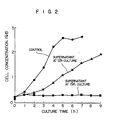
- ionic substances were separated from said fraction by using an anion-exchange resin IRA-400 and a cation-exchange resin IR-l20B and examined for their effect on cell growth to find that an anionic substance inhibited cell growth.
- the cell growth inhibiting substance was found to be a low-molecular-weight, anionic substance and was assumed to be an organic acid which was well known to be secreted from cells. Accordingly, the liquid containing the low-molecular-weight, anionic substance was analyzed for organic acids by using a isotachothoretic analyzer. The analysis result is shown in Fig. 3.
- Electrophoresis was carried out at an electrophoresis current of l00 ⁇ A by using a 0.0l M ⁇ -alanine hydrochloride solution as a terminal solution.
- acetic acid 2 was accumulated at a high concentration of 33 g/liter.
- the corresponding amount of acetate was added to fresh medium and culture was carried out, cell growth was inhibited.
- a substance which played the most important role in the inhibition of cell growth was acetic acid.
- analysis of the culture supernatant by using a gas chromatograph also confirmed that said substance was acetic acid.
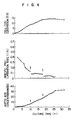
- Fig. 4 is shown the changes dependent on time of cell concentration, specific growth rate per hour and acetic acid concentration in culture broth which took place when glucose and casamino acid medium were continuously fed from 4 hours and l5 minutes after the initiation of cultivation of recombinant E. coli.
- rapid changes in the specific growth rate were observed between at l0 hours of culture and at ll hours of culture and between at l8 hours of culture and at l9 hours of culture.
- the cell growth rate after l9 hours of culture became very low, suggesting that cell growth stopped substantially.
- the acetic acid concentration was 6 g/liter at l0 hours of culture and l7 g/liter at l8 hours of culture. From this fact, it can be seen that the acetic acid concentration in culture broth should be controlled so as to be at most l7 g/liter or less, preferably 6 g/liter or less. In other words, the cell growth inhibiting substance can be removed by keeping the acetic acid concentration in culture broth at l7 g/liter or less, more preferably 6 g/liter or less.
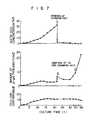
- IA addition causes no ⁇ -gal. production at an acetic acid concentration of 8 g/liter but induces ⁇ -gal. production at acetic acid concentration of 3 g/liter or less (see Example 3 and Comparative Example l). That is to say, the substance which inhibits induction of a desired product can be removed by keeping the acetic acid concentration in culture broth at preferably 3 g/liter or less.
- Cultivation of cell such as E. coli, yeasts, Bacillus subtilis, Actynomyces, animal cells, plant cells and the like having complex DNA and possessing an ability to produce an desired product required (a) a step of removing the cell growth inhibiting substance, preferably organic acids, more preferably acetic acid, and/or (b) a step of removing the substance which inhibits induction of a desired product, preferably organic acids, more preferivelyably acetic acid (namely, a step of adjusting the concentration of preferably organic acids, more preferably acetic acid so as to be lower than that attained in the step (a)).
- a culture process involving both the steps (a) and (b) is preferred. It is preferable to adjust the concentration of organic acids in culture broth to about l7 g/liter or less by the process (a) and to about 3 g/liter or less by the process (b).
- the cell growth inhibiting substance and the substance which inhibits induction of a desired product include, for example, organic acids such as lactic acid, formic acid and the like besides acetic acid.
- Other examples of the cell growth inhibiting substance are sugars, salts, etc.
- Other examples of the substance which inhibits induction of a desired product are inhibitors to the respective promoters such as tryptophan promotor, lactose promotor, P L of ⁇ pharge, etc.
- methods for removing the cell growth inhibiting substance or the substance which inhibits induction of a desired product there are employed, for example, method comprising taking out a part of culture broth, recovering cells by centrifugation, and returning the obtained cell to a culture tank; a method using a permeable membrane, a ultrafilter membrane or the like which is employed when the inhibiting substance has a low molecular weight; and a method using an ion exchange resin. These methods may be practised continuously.
- the culture process of this invention requires essentially (c) a step of inducing production of a desired product, in addition to the above process (a) and/or process (b).
- a method for inducing the production of a desired product there is employed a method which comprises adding an inducing agent for promoter contained in the complex DNA in cells. That is to say, for example, in the case of trp. promoter, addition of 3- ⁇ -indoleacrylic acid (IA) is effective, and in the case of lac. promoter and tac. promoter, addition of isopropyl- ⁇ -D-thiogalactoside (IPTG) is effective.
- IA 3- ⁇ -indoleacrylic acid
- IPTG isopropyl- ⁇ -D-thiogalactoside
- elevation of the temperature of culture broth is effective for P L promoter.
- the process (c) is preferably practised subsequently to at least one of the above processes (a) and (b).
- the step (c) may be carried out continuously.
- the culture process of this invention preferably involves (d) a step of promoting cell growth, together with the above step (c).
- a method for carrying out the step (d) there is used a method which comprises adding a nutrient suitable for cells used.
- the nutrient for example, casamino acid composed of a mixture of amino acids, amino acids, glucose, yeast extract, bouillon and the like are effective.
- the step (d) can also be carried out continuously.
- the culture process of this invention described above permits very efficient cultivation of cells having complex DNA, and hence production of a large amount of a desired product.
- the culture process of this invention is effective particularly in cluturing E. coli.
- FIG. 9 A culture medium and cells are placed in a culture tank l, and recombinant cells are cultured while blowing air into the culture tank l through a conduit l3 and stirring the culture broth by means of a stirrer 2.
- the dissolved oxygen concentration of the culture broth at each stage is measured by means of a dissolved oxygen sensor 6 and a dissolved oxygen meter 5 both placed in the culture tank l.
- the measurement data are sent to a controller 3, which monitors the change of the dissolved oxygen concentration and transmits signals to a metering pump 9 at the time of a rapid rise of the dissolved oxygen concentration to feed substrate from a substrate tank 7.
- a part of the culture broth is taken out through a conduit l6, and inhibiting substances are removed therefrom by means of an inhibiting substance removing device 4, after which the cell suspension thus obtained is returned to the culture tank through a conduit l5.
- inhibiting substances are similarly removed by means of the inhibiting substance removing device 4, after which an inducing agent and substrate are added from an inducing tank 8 by means of a metering pump l0 to induce production of a desired product, whereby mass production of the desired product is carried out.
- the desired product produced inside or outside the cells is made into a final product by separation and purification.
- the cell growth inhibiting substance and/or the substance which inhibits induction of a desired product and inducing the production of a desired product during culture merely by removing the cell growth inhibiting substance and/or the substance which inhibits induction of a desired product and inducing the production of a desired product during culture, a high cell concentration can be attained and production of a large amount of the desired product can be induced.
- Initial medium M9-casamino acid medium, which was composed of l g of NH4Cl, 6 g of Na2HPO4, 3 g of KH2PO4, 5 g of NaCl, 0.l g of MgSO4 ⁇ 7H2O, l5 mg of CaCl2 ⁇ 2H2O, 0.l g of thiamine hydrochloride, 0.l g of proline, 0.0l g of tryptophan, 5 g of glucose, 2.5 g of casamino acid, l.5 g of yeast extract and l l of distilled water, and had a pH of 7.0. To the medium was added 50 mg/liter of ampicillin (Ap) in order to grow only. E. coli having a complex plasmid.
- this medium was composed of 200 g of glucose, 4 g of proline, l00 g of casamino acid, 60 g of yeast extract, 0.4 g of tryptophan and l liter of distilled water, and had a pH of 7.0.
- E. coli having complex plasmid was inoculated into four 500-ml shaker flasks each containing 50 ml of M9-casamino acid medium and cultured overnight by means of a shaker under the conditions of a stroke of 7 cm, a oscillation of ll5 times/min. and a temperature of 37°C.
- Into a 5-liter jar fermenter containing M9-casamino acid medium was inoculated 200 ml of the seed culture thus obtained, and culture was initiated at an initial volume of culture broth of 2 liters, at 37°C, at pH 7.0 and at an aeration rate of 2 liters/min. The change of the dissolved oxygen concentration during culture was detected, and at the time of a rapid rise of the dissolved oxygen concentration, 50 ml of feeding medium was fed.
- Cells E. coli strain HB l0l having complex plasmid pTREZl.
- Initial medium M9-casamino acid medium, which was composed of l g of NH9Cl, 6 g of Na2HPO4, 3 g of KH2PO4, 5 g of NaCl, 0.l g of MgSO4 ⁇ 7H2O, l5 mg of CaCl2 ⁇ 2H2O, 0.l g of thiamine hydrochloride, 0.l g of proline, 0.0l g of tryptophan, 5 g of glucose, 2.5 g of casamino acid, l.5 g of yeast extract and l liter of distilled water, and had a pH of 7.0. To the medium was added 50 kg/liter of ampicillin (Ap) in order to grow only E. coli having complex plasmid.
- Amp ampicillin
- this medium was composed of 200 g of glucose, 4 g of proline, l00 g of casamino acids, 60 g of yeast extract, 0.4 g of tryptophan, l g of ampicillin and l liter of distilled water, and had a pH of 7.0.
- E. coli having complex plasmid was inoculated into four 500-ml shaker flasks each containing 50 ml of M9-casamino acid medium and cultured overnight by means of a shake culture machine under the conditions of a stroke of 7 cm, a oscillation of ll5 times/min and a temperature of 37°C.
- Into a 5-liter jar fermenter containing M9-casamino acid medium was inoculated 200 ml of the seed culture thus obtained, and culture was initiated at an initial volume of culture broth of 2 liters, at 37°C, at pH 7.0 and at an aeration rate of 3 liters/min.
- the change of the dissolved oxygen concentration during culture was detected and at the time of a rapid rise of the dissolved oxygen concentration, 50 to l50 ml of medium for batch feeding was added.
- Acetic acid in the culture broth was determined by introducing culture supernatant into a gas chromatograph filled with Unicarbon A-300 60/80, and culture supernatant was removed with the guidance of the time at which about l0 g/liter of acetic acid was accumulated.
- the removal of culture supernatant was conducted by centrifuging the culture broth at 6,000 r.p.m. for l0 minutes, and cells were recovered and suspended in fresh initial medium to make a total volume of 2 liters, after which culture was initiated again.
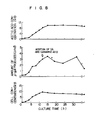
- cells can be cultured so as to attain a high cell concentration by removing acetic acid, i.e., a cell growth inhibiting substance by centrifugation, and a large amount of a useful product can be obtained by causing expression of an objective gene by using an inducing agent.
- acetic acid i.e., a cell growth inhibiting substance by centrifugation
- the acetic acid concentration in culture broth in this case was 2.8 g/liter at the time when culture was initiated again after the removal of culture supernatant but then decreased gradually and became substantially zero at 68 hours of culture.
- acetic acid i.e., a cell growth inhibiting substance and a substance which inhibits induction of the desired product
- expression of an objective gene can be caused by using an inducing agent, so that it becomes possible to obtain a large amount of a useful product.
- Culture was carried out without removing acetic acid, i.e., a cell growth inhibiting substance accumulated in culture broth, and an inducing agent (IA) was added.
- acetic acid i.e., a cell growth inhibiting substance accumulated in culture broth
- IA inducing agent
Landscapes
- Chemical & Material Sciences (AREA)
- Life Sciences & Earth Sciences (AREA)
- Health & Medical Sciences (AREA)
- Engineering & Computer Science (AREA)
- Organic Chemistry (AREA)
- Genetics & Genomics (AREA)
- Wood Science & Technology (AREA)
- Zoology (AREA)
- Bioinformatics & Cheminformatics (AREA)
- Biotechnology (AREA)
- General Engineering & Computer Science (AREA)
- General Health & Medical Sciences (AREA)
- Biochemistry (AREA)
- Microbiology (AREA)
- Biomedical Technology (AREA)
- Medicinal Chemistry (AREA)
- General Chemical & Material Sciences (AREA)
- Molecular Biology (AREA)
- Tropical Medicine & Parasitology (AREA)
- Virology (AREA)
- Mycology (AREA)
- Chemical Kinetics & Catalysis (AREA)
- Physics & Mathematics (AREA)
- Biophysics (AREA)
- Plant Pathology (AREA)
- Micro-Organisms Or Cultivation Processes Thereof (AREA)
- Preparation Of Compounds By Using Micro-Organisms (AREA)
- Apparatus Associated With Microorganisms And Enzymes (AREA)
Applications Claiming Priority (2)
| Application Number | Priority Date | Filing Date | Title |
|---|---|---|---|
| JP226785/85 | 1985-10-14 | ||
| JP60226785A JPH07110232B2 (ja) | 1985-10-14 | 1985-10-14 | 遺伝子組換え大腸菌の遺伝子生産物を採取する方法および装置 |
Publications (3)
| Publication Number | Publication Date |
|---|---|
| EP0219791A2 true EP0219791A2 (fr) | 1987-04-29 |
| EP0219791A3 EP0219791A3 (en) | 1988-09-07 |
| EP0219791B1 EP0219791B1 (fr) | 1993-04-21 |
Family
ID=16850574
Family Applications (1)
| Application Number | Title | Priority Date | Filing Date |
|---|---|---|---|
| EP86114159A Expired - Lifetime EP0219791B1 (fr) | 1985-10-14 | 1986-10-13 | Procédé de culture de cellules recombinantes |
Country Status (5)
| Country | Link |
|---|---|
| US (1) | US5445948A (fr) |
| EP (1) | EP0219791B1 (fr) |
| JP (1) | JPH07110232B2 (fr) |
| KR (1) | KR890004020B1 (fr) |
| DE (1) | DE3688311T2 (fr) |
Cited By (7)
| Publication number | Priority date | Publication date | Assignee | Title |
|---|---|---|---|---|
| EP0248675A1 (fr) * | 1986-06-06 | 1987-12-09 | Genentech, Inc. | Procédé de production d'activateur de plasminogène biologiquement actif |
| EP0233937A4 (fr) * | 1985-08-15 | 1988-05-26 | Amgen | Procedes de fermentation pour la production de vaccins contre l'hepatite. |
| EP0283726A1 (fr) * | 1987-03-23 | 1988-09-28 | Hitachi, Ltd. | Méthode et appareil de culture avec contrôle de la concentration d'acétate |
| EP0316229A1 (fr) * | 1987-11-07 | 1989-05-17 | Shiseido Company Limited | Micro-organisme ayant une capacité de formation d'acétate réduite et procédé pour la production de substance par ce micro-organisme |
| FR2634220A1 (fr) * | 1988-07-15 | 1990-01-19 | Nippon Shinyaku Co Ltd | Procede de production de l'hegf |
| EP1498475A1 (fr) * | 2003-07-18 | 2005-01-19 | Meristem Therapeutics S.A. | Bioréacteur et procédé de culture en continu de cellules végétales |
| WO2008107663A3 (fr) * | 2007-03-02 | 2008-10-30 | Ekb Technology Ltd | Suppression de produit inhibitoire |
Families Citing this family (5)
| Publication number | Priority date | Publication date | Assignee | Title |
|---|---|---|---|---|
| US5955323A (en) * | 1996-08-01 | 1999-09-21 | American Home Products Corporation | Automated high-yield fermentation of plasmid DNA in Escherichia coli |
| US20030017554A1 (en) * | 2000-11-15 | 2003-01-23 | Mechthild Rieping | Process for the fermentative preparation of L-amino acids using strains of the enterobacteriaceae family |
| US20030054503A1 (en) * | 2001-04-03 | 2003-03-20 | Degussa Ag | Process for the production of L-amino acids using strains of the family enterobacteriaceae that contain an attenuated dgsA gene |
| WO2003008606A2 (fr) * | 2001-07-18 | 2003-01-30 | Degussa Ag | Procede de preparation de l-amino-acides au moyen de souches de la famille enterobacteriaceae contenant un gene amplifie phob ou phor |
| JPWO2003016907A1 (ja) * | 2001-08-17 | 2004-12-02 | エーザイ株式会社 | 生体試料中のラミニン5抗原の測定試薬及び測定方法 |
Family Cites Families (8)
| Publication number | Priority date | Publication date | Assignee | Title |
|---|---|---|---|---|
| JPS49126882A (fr) * | 1973-04-19 | 1974-12-04 | ||
| US4282255A (en) * | 1979-06-28 | 1981-08-04 | State Of Oregon, By And Through The Oregon State Board Of Higher Education On Behalf Of Oregon State University | Method and starter compositions for the growth of acid producing bacteria and bacterial compositions produced thereby |
| US4420398A (en) * | 1981-08-13 | 1983-12-13 | American National Red Cross | Filteration method for cell produced antiviral substances |
| JPS58141796A (ja) * | 1982-02-18 | 1983-08-23 | Kyowa Hakko Kogyo Co Ltd | ペプチドの製造法 |
| ZA839242B (en) * | 1982-12-15 | 1984-09-26 | Bio Response Inc | A method and system for culturing and treating substances disposed in a flowing culture fluid |
| BG49718A3 (bg) * | 1983-07-15 | 1992-01-15 | Bio- Technology General Corp | Метод за получаване на полипептид със супероксиддисмутазна активност |
| EP0165613B1 (fr) * | 1984-06-22 | 1992-01-15 | Hitachi, Ltd. | Procédé pour contrôler la culture de recombinants |
| JPH078231B2 (ja) * | 1985-03-25 | 1995-02-01 | 株式会社日立製作所 | 培養制御方法及び培養制御装置 |
-
1985
- 1985-10-14 JP JP60226785A patent/JPH07110232B2/ja not_active Expired - Lifetime
-
1986
- 1986-10-13 KR KR1019860008553A patent/KR890004020B1/ko not_active Expired
- 1986-10-13 EP EP86114159A patent/EP0219791B1/fr not_active Expired - Lifetime
- 1986-10-13 DE DE86114159T patent/DE3688311T2/de not_active Expired - Fee Related
-
1993
- 1993-09-21 US US08/124,075 patent/US5445948A/en not_active Expired - Lifetime
Cited By (16)
| Publication number | Priority date | Publication date | Assignee | Title |
|---|---|---|---|---|
| EP0233937A4 (fr) * | 1985-08-15 | 1988-05-26 | Amgen | Procedes de fermentation pour la production de vaccins contre l'hepatite. |
| US5053334A (en) * | 1986-06-06 | 1991-10-01 | Genentech, Inc. | Process for producing biologically active plasminogen activator in recombinant CHO cells using suspension culture and removing detrimental components from medium |
| FR2599625A1 (fr) * | 1986-06-06 | 1987-12-11 | Genentech Inc | Procede de production d'activateur du plasminogene biologiquement actif |
| DE3718939A1 (de) * | 1986-06-06 | 1987-12-17 | Genentech Inc | Verfahren zur herstellung von biologisch aktivem plasminogenaktivator |
| EP0248675A1 (fr) * | 1986-06-06 | 1987-12-09 | Genentech, Inc. | Procédé de production d'activateur de plasminogène biologiquement actif |
| DE3718939C2 (de) * | 1986-06-06 | 1998-09-17 | Genentech Inc | Verfahren zur Herstellung von biologisch aktivem Plasminogenaktivator |
| EP0283726A1 (fr) * | 1987-03-23 | 1988-09-28 | Hitachi, Ltd. | Méthode et appareil de culture avec contrôle de la concentration d'acétate |
| US5139938A (en) * | 1987-03-23 | 1992-08-18 | Hitachi, Ltd. | Production of substances with an acetic acid-producing and assimilating bacterium inhibited by acetic acid |
| WO1989004365A1 (fr) * | 1987-11-07 | 1989-05-18 | Shiseido Co. Ltd. | Microorganisme produisant une faible quantite d'acetate et son application |
| EP0316229A1 (fr) * | 1987-11-07 | 1989-05-17 | Shiseido Company Limited | Micro-organisme ayant une capacité de formation d'acétate réduite et procédé pour la production de substance par ce micro-organisme |
| US5919662A (en) * | 1987-11-07 | 1999-07-06 | Shiseido Company, Ltd. | Microorganism having low acetate forming capability, and process for production of useful substrate using same |
| FR2634220A1 (fr) * | 1988-07-15 | 1990-01-19 | Nippon Shinyaku Co Ltd | Procede de production de l'hegf |
| EP0352839A3 (fr) * | 1988-07-15 | 1990-05-02 | Nippon Shinyaku Company, Limited | Méthode de préparation d'hEGF |
| BE1004361A4 (fr) * | 1988-07-15 | 1992-11-10 | Nippon Shinyaku Co Ltd | PROCEDE DE PRODUCTION DE L'hEGF. |
| EP1498475A1 (fr) * | 2003-07-18 | 2005-01-19 | Meristem Therapeutics S.A. | Bioréacteur et procédé de culture en continu de cellules végétales |
| WO2008107663A3 (fr) * | 2007-03-02 | 2008-10-30 | Ekb Technology Ltd | Suppression de produit inhibitoire |
Also Published As
| Publication number | Publication date |
|---|---|
| EP0219791B1 (fr) | 1993-04-21 |
| US5445948A (en) | 1995-08-29 |
| JPH07110232B2 (ja) | 1995-11-29 |
| KR890004020B1 (ko) | 1989-10-16 |
| DE3688311T2 (de) | 1993-10-28 |
| EP0219791A3 (en) | 1988-09-07 |
| DE3688311D1 (de) | 1993-05-27 |
| JPS6287086A (ja) | 1987-04-21 |
| KR870004130A (ko) | 1987-05-07 |
Similar Documents
| Publication | Publication Date | Title |
|---|---|---|
| Shimizu et al. | Fed-batch cultures of recombinant Escherichia coli with inhibitory substance concentration monitoring | |
| Korz et al. | Simple fed-batch technique for high cell density cultivation of Escherichia coli | |
| EP0219791A2 (fr) | Procédé de culture de cellules recombinantes | |
| US4891310A (en) | Method of controlling culture | |
| EP0283726B1 (fr) | Méthode et appareil de culture avec contrôle de la concentration d'acétate | |
| KR100405944B1 (ko) | 단백질 제조방법 | |
| KR100429935B1 (ko) | 이종단백질을생물공학적으로고수율로생산하기위한효모알콜데하이드로게나제이소엔자임ii(adhii)프로모터시스템의사용방법 | |
| CN120555478A (zh) | 一种高效生产萜类化合物的酿酒酵母重组菌及其构建方法和应用 | |
| CN119685181A (zh) | 一种利用乙醇诱导毕赤酵母表达人源α-乳白蛋白的方法 | |
| CN115838713B (zh) | 一种蛋白酶及其在l-肌肽合成中的应用 | |
| Wong et al. | Extracellular expression of human epidermal growth factor encoded by an Escherichia coli K-12 plasmid stabilized by the ytl2-incR system of Salmonella typhimurium | |
| JP2977241B2 (ja) | 大腸菌中での外来性タンパク製造のための最適化発酵法 | |
| KR20020060258A (ko) | 미생물의 유가 배양에 의한 펩티드의 제조 | |
| JP2003530823A (ja) | 微生物発酵工程において組換え蛋白質の収率を高めるための方法 | |
| JP2932791B2 (ja) | 微生物好気培養における炭素源濃度の制御方法及び装置 | |
| JPS63141579A (ja) | 高効率培養制御方法 | |
| US20060286631A1 (en) | Method for preparating t-20 peptide by high cell density cultivation of recombinant e. coli containing t-20 peptide coding gene | |
| Park et al. | Analysis of kinetic paramers for the 3 β-indoleacrylic acid effect on trp promoter in Escherichia coli | |
| EP0248227A1 (fr) | Production de streptokinase à partir de cellules de levure | |
| CN115806925B (zh) | 一种高产l-半胱氨酸的基因工程菌、构建方法及应用 | |
| Vaks et al. | A semi-continuous process for the production of human interferon-αc from E. coli using tangential-flow microfiltration and immuno-affinity chromatography | |
| Chalmers et al. | A simple membrane reactor to obtain high cell density and plasmid encoded protein production from Escherichia coli | |
| Tabandeh et al. | GROWTH KINETICS AND HUMAN GROWTH HORMONE PRODUCTION OF A HEAT-INDUCIBLE RECOMBI-NANTE CHERICHIA COLI DURING BATCH FERMENTATION | |
| KR930001387B1 (ko) | 유전자 재조합에 의한 인간 알파인터페론의 제조방법 | |
| An et al. | Effect of specific growth rate on the extracellular expression of Baccillus stearothermophillus Ll lipase in recombinant Saccharomyces cerevisiae |
Legal Events
| Date | Code | Title | Description |
|---|---|---|---|
| PUAI | Public reference made under article 153(3) epc to a published international application that has entered the european phase |
Free format text: ORIGINAL CODE: 0009012 |
|
| AK | Designated contracting states |
Kind code of ref document: A2 Designated state(s): DE GB |
|
| PUAL | Search report despatched |
Free format text: ORIGINAL CODE: 0009013 |
|
| AK | Designated contracting states |
Kind code of ref document: A3 Designated state(s): DE GB |
|
| 17P | Request for examination filed |
Effective date: 19890227 |
|
| 17Q | First examination report despatched |
Effective date: 19900905 |
|
| GRAA | (expected) grant |
Free format text: ORIGINAL CODE: 0009210 |
|
| AK | Designated contracting states |
Kind code of ref document: B1 Designated state(s): DE GB |
|
| REF | Corresponds to: |
Ref document number: 3688311 Country of ref document: DE Date of ref document: 19930527 |
|
| PLBE | No opposition filed within time limit |
Free format text: ORIGINAL CODE: 0009261 |
|
| STAA | Information on the status of an ep patent application or granted ep patent |
Free format text: STATUS: NO OPPOSITION FILED WITHIN TIME LIMIT |
|
| 26N | No opposition filed | ||
| PGFP | Annual fee paid to national office [announced via postgrant information from national office to epo] |
Ref country code: DE Payment date: 19971223 Year of fee payment: 12 |
|
| PG25 | Lapsed in a contracting state [announced via postgrant information from national office to epo] |
Ref country code: DE Free format text: LAPSE BECAUSE OF NON-PAYMENT OF DUE FEES Effective date: 19990803 |
|
| PGFP | Annual fee paid to national office [announced via postgrant information from national office to epo] |
Ref country code: GB Payment date: 20011008 Year of fee payment: 16 |
|
| REG | Reference to a national code |
Ref country code: GB Ref legal event code: IF02 |
|
| PG25 | Lapsed in a contracting state [announced via postgrant information from national office to epo] |
Ref country code: GB Free format text: LAPSE BECAUSE OF NON-PAYMENT OF DUE FEES Effective date: 20021013 |
|
| GBPC | Gb: european patent ceased through non-payment of renewal fee |
Effective date: 20021013 |