EP0220730A2 - Vorrichtung zur Leckaufnahme und Lecküberwachung für unterirdische Behälter - Google Patents
Vorrichtung zur Leckaufnahme und Lecküberwachung für unterirdische Behälter Download PDFInfo
- Publication number
- EP0220730A2 EP0220730A2 EP86115040A EP86115040A EP0220730A2 EP 0220730 A2 EP0220730 A2 EP 0220730A2 EP 86115040 A EP86115040 A EP 86115040A EP 86115040 A EP86115040 A EP 86115040A EP 0220730 A2 EP0220730 A2 EP 0220730A2
- Authority
- EP
- European Patent Office
- Prior art keywords
- tank
- enclosure
- leak
- body sheet
- leakage
- Prior art date
- Legal status (The legal status is an assumption and is not a legal conclusion. Google has not performed a legal analysis and makes no representation as to the accuracy of the status listed.)
- Granted
Links
- 238000001514 detection method Methods 0.000 title claims abstract description 36
- 229920001903 high density polyethylene Polymers 0.000 claims abstract description 23
- 239000004700 high-density polyethylene Substances 0.000 claims abstract description 23
- 239000003209 petroleum derivative Substances 0.000 claims abstract description 19
- 238000000034 method Methods 0.000 claims description 14
- 238000005260 corrosion Methods 0.000 claims description 13
- 230000007797 corrosion Effects 0.000 claims description 13
- 229910000831 Steel Inorganic materials 0.000 claims description 11
- 239000004020 conductor Substances 0.000 claims description 11
- 239000010959 steel Substances 0.000 claims description 11
- 230000015556 catabolic process Effects 0.000 claims description 9
- 238000006731 degradation reaction Methods 0.000 claims description 9
- 238000009413 insulation Methods 0.000 claims description 8
- 239000000126 substance Substances 0.000 claims description 8
- 239000004746 geotextile Substances 0.000 claims description 7
- 239000003502 gasoline Substances 0.000 claims description 6
- 238000007789 sealing Methods 0.000 claims description 6
- 238000010438 heat treatment Methods 0.000 claims description 4
- 239000007788 liquid Substances 0.000 claims description 4
- 238000012544 monitoring process Methods 0.000 claims description 3
- 239000003208 petroleum Substances 0.000 claims 5
- 239000003112 inhibitor Substances 0.000 claims 3
- 239000000463 material Substances 0.000 abstract description 8
- 229920004889 linear high-density polyethylene Polymers 0.000 abstract description 3
- 230000002745 absorbent Effects 0.000 abstract description 2
- 239000002250 absorbent Substances 0.000 abstract description 2
- 238000009434 installation Methods 0.000 description 8
- 230000008901 benefit Effects 0.000 description 6
- 238000004210 cathodic protection Methods 0.000 description 6
- 239000000945 filler Substances 0.000 description 6
- 239000000446 fuel Substances 0.000 description 6
- 238000009412 basement excavation Methods 0.000 description 5
- 238000011109 contamination Methods 0.000 description 5
- XLYOFNOQVPJJNP-UHFFFAOYSA-N water Substances O XLYOFNOQVPJJNP-UHFFFAOYSA-N 0.000 description 5
- 239000003673 groundwater Substances 0.000 description 4
- 239000002689 soil Substances 0.000 description 4
- 238000003466 welding Methods 0.000 description 4
- 239000006096 absorbing agent Substances 0.000 description 3
- 239000003921 oil Substances 0.000 description 3
- 239000004927 clay Substances 0.000 description 2
- 231100001010 corrosive Toxicity 0.000 description 2
- 239000003599 detergent Substances 0.000 description 2
- 230000008439 repair process Effects 0.000 description 2
- 230000000717 retained effect Effects 0.000 description 2
- XUIMIQQOPSSXEZ-UHFFFAOYSA-N Silicon Chemical compound [Si] XUIMIQQOPSSXEZ-UHFFFAOYSA-N 0.000 description 1
- 239000002253 acid Substances 0.000 description 1
- 150000007513 acids Chemical class 0.000 description 1
- 230000015572 biosynthetic process Effects 0.000 description 1
- 238000009933 burial Methods 0.000 description 1
- 239000003518 caustics Substances 0.000 description 1
- 230000006378 damage Effects 0.000 description 1
- 230000000694 effects Effects 0.000 description 1
- 238000004880 explosion Methods 0.000 description 1
- 239000004744 fabric Substances 0.000 description 1
- 239000011152 fibreglass Substances 0.000 description 1
- 239000012530 fluid Substances 0.000 description 1
- 238000011010 flushing procedure Methods 0.000 description 1
- 238000005755 formation reaction Methods 0.000 description 1
- 239000002828 fuel tank Substances 0.000 description 1
- 239000004519 grease Substances 0.000 description 1
- 239000012774 insulation material Substances 0.000 description 1
- 239000012212 insulator Substances 0.000 description 1
- 230000007246 mechanism Effects 0.000 description 1
- 239000003348 petrochemical agent Substances 0.000 description 1
- 238000004023 plastic welding Methods 0.000 description 1
- 230000002028 premature Effects 0.000 description 1
- 238000003825 pressing Methods 0.000 description 1
- 230000008569 process Effects 0.000 description 1
- 230000001681 protective effect Effects 0.000 description 1
- 238000009420 retrofitting Methods 0.000 description 1
- 230000000630 rising effect Effects 0.000 description 1
- 239000004576 sand Substances 0.000 description 1
- 229910052710 silicon Inorganic materials 0.000 description 1
- 239000010703 silicon Substances 0.000 description 1
- 239000002904 solvent Substances 0.000 description 1
Images



Classifications
-
- B—PERFORMING OPERATIONS; TRANSPORTING
- B65—CONVEYING; PACKING; STORING; HANDLING THIN OR FILAMENTARY MATERIAL
- B65D—CONTAINERS FOR STORAGE OR TRANSPORT OF ARTICLES OR MATERIALS, e.g. BAGS, BARRELS, BOTTLES, BOXES, CANS, CARTONS, CRATES, DRUMS, JARS, TANKS, HOPPERS, FORWARDING CONTAINERS; ACCESSORIES, CLOSURES, OR FITTINGS THEREFOR; PACKAGING ELEMENTS; PACKAGES
- B65D90/00—Component parts, details or accessories for large containers
- B65D90/48—Arrangements of indicating or measuring devices
- B65D90/50—Arrangements of indicating or measuring devices of leakage-indicating devices
- B65D90/501—Arrangements of indicating or measuring devices of leakage-indicating devices comprising hollow spaces within walls
-
- B—PERFORMING OPERATIONS; TRANSPORTING
- B65—CONVEYING; PACKING; STORING; HANDLING THIN OR FILAMENTARY MATERIAL
- B65D—CONTAINERS FOR STORAGE OR TRANSPORT OF ARTICLES OR MATERIALS, e.g. BAGS, BARRELS, BOTTLES, BOXES, CANS, CARTONS, CRATES, DRUMS, JARS, TANKS, HOPPERS, FORWARDING CONTAINERS; ACCESSORIES, CLOSURES, OR FITTINGS THEREFOR; PACKAGING ELEMENTS; PACKAGES
- B65D90/00—Component parts, details or accessories for large containers
-
- B—PERFORMING OPERATIONS; TRANSPORTING
- B65—CONVEYING; PACKING; STORING; HANDLING THIN OR FILAMENTARY MATERIAL
- B65D—CONTAINERS FOR STORAGE OR TRANSPORT OF ARTICLES OR MATERIALS, e.g. BAGS, BARRELS, BOTTLES, BOXES, CANS, CARTONS, CRATES, DRUMS, JARS, TANKS, HOPPERS, FORWARDING CONTAINERS; ACCESSORIES, CLOSURES, OR FITTINGS THEREFOR; PACKAGING ELEMENTS; PACKAGES
- B65D90/00—Component parts, details or accessories for large containers
- B65D90/48—Arrangements of indicating or measuring devices
- B65D90/50—Arrangements of indicating or measuring devices of leakage-indicating devices
- B65D90/51—Arrangements of indicating or measuring devices of leakage-indicating devices characterised by sensors
Definitions
- the present invention relates to the field of leak containment and detection, and is concerned with improvements in containment and detection of leaks from underground storage tanks, for example, tanks used for storage of gasoline or other petrochemicals.
- the present invention provides a method of containing and detecting leakage from a subterranean tank containing a petroleum product such as gasoline or heating oil, by providing adjacent the tank an electrical leak detecting cable of the type that has an insulator that is subject to degradation by the petroleum product, enclosing the cable and tank together in an enclosure impervious to the product, sealing the enclosure to prevent the ingress of the product due to accidental spillage or from other sources of the product, and connecting the cable to an electrical sensor whereby leakage from the tank into the sealed enclosure is detected by the cable and electrical sensor.
- a petroleum product such as gasoline or heating oil
- Leakage may occur from underground storage tanks from a number of causes. Since most tanks are steel, internal and external corrosion resulting in perforation of the tank is probably the primary causes of leakage. Internal corrosion results from the presence of water or acids in the stored products. External corrosion is due to groundwater and other soil-borne corrosives. Leaks may also be caused by cracks or by punctures due to sharp stones, pressing on the tank wall. In extremely dry, porous soils punctures might occur in such a way as to prevent leakage from the tank reaching the leak detector. In order to prevent this, and to ensure that any leak from the tank reaches the leak sensor in a minimum time, the present invention provides two additional important features.
- a drainage mesh is wrapped around the tank, inside the enclosures, and secondly, an absorbent geotextile is placed along the botom of the tank. This latter material collects and holds leaking products so that it cannot escape to the environment without being detected.
- An acceptable form of drainage mesh is sold by Tensar Corporation, Marrow Georgia, as TENSAR drainage net.
- a suitable geotextile absorber is sold by American Engineering Fabrics Inc. l Coffin Avenue, New Bedford, Massachusetts, 02746 U.S.A.
- the leak sensor is positioned in a perforated duct inside the enclosure adjacent the tank so that leakage from the tank will penetrate the duct, and be detected by the leak sensor.
- the perforated duct thus can be used to gain access to the leak detection cable.
- both ends of the cable may extend outside the enclosure (in suitable protective sleeves), one end being connected to a suitable monitor, for example, the Total Containment Inc. model Ml05B, the other end being terminated by a fixed resistance.
- a suitable monitor for example, the Total Containment Inc. model Ml05B
- the cable may be replaced after destruction by leakage by using the destroyed cable to pull a new cable through the duct, after the source of leakage has been pinpointed and the leaking container repaired and resealed.
- the enclosure may be cleansed using a flushing technique with detergents, to rehabilitate the interior of the enclosure, thus avoiding the necessity of excavation.
- FIG. l there is shown a tank l0 sealed within a secondary containment enclosure. Extending through the enclosure is a fill pipe l2 and a leak detection duct l3. Located within the duct l3 is a leak sensor cable l4 terminated with a resistor l5. The entire installation is below ground level l6.
- Figure 3 illustrates one way in which the enclosure ll may be sealed to the filler pipe l2. As illustrated the enclosure ll is drawn up around the filler pipe l2 to a point l9, and screw clamps 20 may be used together with a suitable sealer to complete the sealing of the enclosure ll about the filler pipe l2. Clay might be added to completely isolate this whole section from contaminated ground.
- a principal advantage is that it is now possible to use a bare steel tank in an underground location without premature failure of the tank due to corrosion.
- Such bare steel tank is the least expensive container for storing fuels, but is not presently used because of leakage caused by corrosion.
- the tank l0 being entirely sealed in the enclosure ll is completely isolated from any of the corrosive effects due to its environment.
- One form of the enclosure material particularly suitable for use with the invention is linear high density polyethylene (HPDE).
- Linear HDPE may, of course, be welded with commercially available plastic welding tools, available for example from Munsch Chemiepumpen GmbH.
- the leak detection duct l3 used in Figure l and Figure 3 can be formed for example from one inch diameter perforated HDPE pipe.
- the use of the duct containing the sensor cable also provides a significant further feature for the invention since, should petroleum products for any unforesen reason other than by a leak get into the space between the tank and the enclosure, it is quite simple to circulate water with or without detergent added through the duct and flush out the product and replace the sensor cable.
- the system of the present invention provides a significant further advantage in the event of a leak in that the enclosure is capable of retaining the leak and avoiding unnecessary contamination of the surrounding environment.
- underground storage tanks can be maintained in a controlled environment free from moisture and harmful chemicals in the surrounding ground.
- corrosion of tanks can be kept to a minimum.
- a further advantage of the invention is that in the event of a leak or sudden failure of the tank any product in the tank will not be lost to the environment where it is able to pollute the-surrounding ground water.
- the enclosure retains all of the lost product within its walls so that it may be removed safely and without contamination of the product or of the surrounding area.
- the material used for the enclosure of the present invention is strong, water and oil resistant.
- the enclosure is formed from three prefabricated sections; two end caps which are of the desired diameter with a six inch lip and one body sheet the same length as the tank, as wide as the circumference of the tank plus two feet.
- the enclosure is welded together on site using a commercially available HDPE welding process. In a typical installation, the site excavation is dug in the normal manner with a six inch layer of compacted sand placed on the bottom.
- the leak detection duct l3 may be laid in the form of a letter L or preferably the letter U with the vertical end(s) rising to the ground level l6, while a horizontal run is along the bottom, right on the material of the enclosure.
- the enclosure can be welded together. Prior to sealing it is also possible to add chemicals in the bottom of the enclosure to inhibit corrosion of the steel storage tank. When the top flaps are sealed, holes are cut for fill pipes, vent pipes and pump pipes. Special sleeves or “chimneys” may be made for these pipes and welded to the enclosure so that all connections are protected to the ground surface as illustrated in Figure 3. These sleeves may be clamped with a screw clamp 20 approximately six inches below the ground level l6, filled with silicon grease and then sealed with a second clamp as illustrated in Figure 3. Impervious clay can then be used to further isolate this area to prevent liquids from entering the bag.
- the enclosure After sealing the upper end of the top flap l7, the enclosure should be completely sealed so that no moisture is able to get into the liner where it is able to affect the tank l0.
- a man-hole (not shown) may be placed so that it will be slightly below final grade and not affected by any surface equipment such as snowplows or the like.
- a sensor cable l4 is installed within the leak detection duct l3.
- a suitable form of cable is disclosed in Canadian Patent No. 775,758 of January 9, l968 to E.O. Butts (corresponding to USA 3,564,526) and Canadian Patent No. 978,6l4 of November 25, l975 to Wolkowski, contents of all of which are incorporated hereinto by reference.
- a twisted pair of conductors are separated by insulation materials which are subject to degradation upon contact with petroleum products such as gasoline or heating oil. Sufficient degradation alters the resistance between conductors and ultimately allows the conductors to come into contact with each other and thereby energize an alarm.
- preassemble the enclosure, duct, sensor, and tank to factory seal the preassembled unit, which may then be installed in a suitable excavation, and connected to filler pipes and leak detection monitors.
- FIG. 4 illustrates an alternative form of enclosure for use with a bare steel tank, particularly useful for example in the service station environment.
- the tank 30 is enclosed in a linear HDPE enclosure consisting of a pair of molded end caps 3l and a body sheet 32.
- the end of the cylindrical tank 33 is spaced from the inner end of the end cap 3l, to provide a space for the applicant's preferred one inch perforated duct containing the leak detection cable 34.
- the leak detection cable and duct 34 extend to the bottom edge of the tank to provide the earliest possible sensing of any leakage which may occur from within the tank.
- the duct 34 is connected to a test point at the surface 35 by an impervious HDPE chimney fitting 36 welded to the end cap 3l.
- the fill pipe 37 and vent pipe 38 are both encased in HDPE chimney fittings similarly welded to the body sheet 32.
- the piping to pumps 39 may be similarly protected with an appropriate chimney fitting of HDPE, and in addition in accordance with a further feature of the invention may be provided with leak detection cable for sensing leaks in the piping to the pumps which leak detection cable may be connected via a further impervious HDPE pipe 40 to the test point 35.
- the detail of the interconnection of the piping to pumps 39 and the pipe 40 is illustrated in Figure 7.
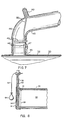
- Figure 5 illustrates a detail of the junction between the end cap 3l and the body sheet 32 at the point A-A of Figure 4. As illustrated, the end cap 3l overlaps the body sheet 32 and is welded thereto with an HDPE weld at 4l.
- the perforated duct 34 containing the sensor cable 42 passes along the bottom edge of the end cap 3l such that any leakage from the tank 30 will contact the sensor cable 42 at the earliest opportunity, to give indication of such a leak.
- FIG. 6 illustrates the assembly of the applicant's enclosure to a typcial gasoline storage tank.
- a typcial gasoline storage tank Such tank 30 is equipped with lifting lugs 43 for lifting and positioning the tank.
- the body sheet 32 is positioned in the excavation in which the tank 30 is to be installed, the tank is placed on the body sheet 32, and the ends of the sheet are then wrapped around the tank, appropriate slits 44 being provided to accommodate the lifting lugs 43.
- the body sheet 32 is then welded to itself with the tank inside the sheet.
- the end caps 3l containing the perforated duct 34 and leak detection cable 42 are mounted on the ends of the tank, and the end caps 3l are welded to the body sheet using known high density polyethylene welding techniques. Patches are welded over the lifting lugs. With the tank entirely sealed in the high density polyethylene container all leakage from the tank is completely prevented.
- a preferable material for use as the body sheet and end caps is linear high density polyethylene the thickness of the sheet material is at least 0.l00 inch.
- the enclosure components may be prefabricated to the tank dimensions and shipped to the tank manufacturer where the components are permanently attached to the tank to protect the tank during transportation. On site the tank may be pressure tested according to local requirements. If the enclosure is to be applied on site, the body sheet and end caps can be shipped as a kit and welded to the tank. The leak detection cable is fitted into the end fittings, and the entire enclosure is welded together on the tank prior to burial. The piping to the pumps, filler pipes and vent pipes can also be fitted with separate leak detection systems. Special chimney fittings are designed to fit over the tank piping and are clamped to the pipes with the bases welded to the enclosure so as to prevent liquids from entering the enclosure at these locations. All wiring connections are done after backfilling so as to allow the tanks and piping systems to be monitored by a single monitor.
- FIG 7 illustrates a detail of Figure 4 in which a tank 30 sealed within a body sheet 32 is provided with a chimney fitting 45 also welded to the body sheet 32 through which piping to the fuel dispensing pumps is passed.
- the chimney fitting 45 is clamped to the pipe 46 by a clamp 47, and a further HDPE sleeve 48 is fitted over the piping 46 and the chimney 45, and is clamped by a screw clamp 49 about the piping 46.
- a further leak detection cable 50 contained within a non-perforated duct 40 is looped around the piping 46 just above the clamp 49, to provide a mechanism for detecting leaks in the piping 46 which might otherwise go undetected, or which, if clamps 47 and 49 were not provided on the piping 46, leak back into the enclosure to give an erroneous detection of a leak in the tank per se .
- FIG 8 illustrates the application of cathodic protection to a tank positioned in an enclosure in accordance with the invention.
- the tank 30 is provided with a standard cathodic protection cable 62 welded at 6l to the tank 30.
- the other end of cable 62 is attached to a bag of chemicals 64.
- the cable 62 is fed through the HDPE pipe 36 together with the leak detection cable 34.
- the chemical bag 64 is buried in the ground and acts as a sacrificial anode in the usual way.
- the system of the present invention specifically lends itself to replacement of the sensor cable without any excavation, and the system can be filled with water, causing the petroleum product to float out through the test point.
- the water may be pumped out from the system, and a new cable installed and the system reactivated. This technique is particularly attractive in the case of large tanks, which are frequently repaired from the inside for example by re-welding previously cracked welds, or welding plates over leak locations.
- FIGS 9 and l0 illustrate a preferred form of secondary containment system of the present invention.
- a cylindrical tank 30, preferably without lifting lugs, is wrapped in a body sheet 32 of HDPE the sheet 32 is rectangular when flat and is of sufficient width and length to completely cover the tank except for the ends. As before the sheet 32 is wrapped around the tank and welded in place.
- Between the tank 30 and the body sheet 32 are a geotextile absorber l20 and a drainage mesh l2l.
- the mesh l2l provides channels for the flow of leakage from the tank 30 to the absorber l20 which ensures that any leakage is retained in the vicinity of the leak sensor located in one of the end caps l22.
- the end caps l22 and l23 are welded to the body sheet to complete the secondary containment system.
- the interior surface of the body sheet could be suitably ribbed to provide the required flow channels.
- the tank should be installed with the end containing the leak sensor lower than the other end, to assist in early detection of leakage.
- One of the end caps l22 is provided with a perforated tube or well in which the leak sensor may be located.
Landscapes
- Engineering & Computer Science (AREA)
- Mechanical Engineering (AREA)
- Examining Or Testing Airtightness (AREA)
- Loading And Unloading Of Fuel Tanks Or Ships (AREA)
- Underground Structures, Protecting, Testing And Restoring Foundations (AREA)
- Filling Or Discharging Of Gas Storage Vessels (AREA)
Applications Claiming Priority (2)
| Application Number | Priority Date | Filing Date | Title |
|---|---|---|---|
| US06/792,737 US4672366A (en) | 1981-01-09 | 1985-10-29 | Subterranean tank leak containment and detection system |
| US792737 | 1985-10-29 |
Publications (3)
| Publication Number | Publication Date |
|---|---|
| EP0220730A2 true EP0220730A2 (de) | 1987-05-06 |
| EP0220730A3 EP0220730A3 (en) | 1989-04-05 |
| EP0220730B1 EP0220730B1 (de) | 1992-08-12 |
Family
ID=25157905
Family Applications (1)
| Application Number | Title | Priority Date | Filing Date |
|---|---|---|---|
| EP86115040A Expired - Lifetime EP0220730B1 (de) | 1985-10-29 | 1986-10-29 | Vorrichtung zur Leckaufnahme und Lecküberwachung für unterirdische Behälter |
Country Status (6)
| Country | Link |
|---|---|
| EP (1) | EP0220730B1 (de) |
| JP (1) | JPS62182091A (de) |
| CA (1) | CA1316579C (de) |
| DE (1) | DE3686389T2 (de) |
| NO (1) | NO172819C (de) |
| PL (1) | PL161650B1 (de) |
Cited By (4)
| Publication number | Priority date | Publication date | Assignee | Title |
|---|---|---|---|---|
| WO1988008822A1 (fr) * | 1987-05-15 | 1988-11-17 | Lohr Karl W R | Cylindre a gaz comprimes comportant un dispositif d'essai, de stockage et de surveillance de gaz comprimes comme l'ammoniac, le propane et similaire |
| US4800128A (en) * | 1986-06-23 | 1989-01-24 | Keramchemie Gmbh | Chemical attack-resistant, liquid-tight lining |
| EP0545784A3 (en) * | 1991-11-29 | 1993-06-30 | Troxler Electronic Laboratories, Inc. | Apparatus and method for detecting subterranean leakage from a large storage vessel |
| CN113775940A (zh) * | 2021-08-04 | 2021-12-10 | 江苏鑫赛德智慧建设有限公司 | 一种城市地下消防管道渗漏定位系统及其施工方法 |
Families Citing this family (2)
| Publication number | Priority date | Publication date | Assignee | Title |
|---|---|---|---|---|
| JPH0615918Y2 (ja) * | 1988-02-19 | 1994-04-27 | トキコ株式会社 | 配管漏洩検知機能付給油システム |
| CN101367466B (zh) * | 2008-08-15 | 2011-11-23 | 李束为 | 储存运输油品装置 |
Family Cites Families (3)
| Publication number | Priority date | Publication date | Assignee | Title |
|---|---|---|---|---|
| CH575326A5 (en) * | 1973-03-08 | 1976-05-14 | Mannesmann Ag | Double skinned heating oil tank with leak indicator - has detector in base of perforated annular profiled section between skins |
| US3995472A (en) * | 1975-06-26 | 1976-12-07 | Murgor Electric Company, Inc. | Detector system |
| CA1120131A (en) * | 1981-01-09 | 1982-03-16 | Nicholas E. Butts | Subterranean tank leak detection system and method |
-
1986
- 1986-10-22 CA CA000521160A patent/CA1316579C/en not_active Expired - Fee Related
- 1986-10-27 JP JP61253881A patent/JPS62182091A/ja active Pending
- 1986-10-29 EP EP86115040A patent/EP0220730B1/de not_active Expired - Lifetime
- 1986-10-29 DE DE8686115040T patent/DE3686389T2/de not_active Expired - Fee Related
- 1986-10-29 NO NO864327A patent/NO172819C/no unknown
- 1986-10-29 PL PL86262106A patent/PL161650B1/pl unknown
Cited By (4)
| Publication number | Priority date | Publication date | Assignee | Title |
|---|---|---|---|---|
| US4800128A (en) * | 1986-06-23 | 1989-01-24 | Keramchemie Gmbh | Chemical attack-resistant, liquid-tight lining |
| WO1988008822A1 (fr) * | 1987-05-15 | 1988-11-17 | Lohr Karl W R | Cylindre a gaz comprimes comportant un dispositif d'essai, de stockage et de surveillance de gaz comprimes comme l'ammoniac, le propane et similaire |
| EP0545784A3 (en) * | 1991-11-29 | 1993-06-30 | Troxler Electronic Laboratories, Inc. | Apparatus and method for detecting subterranean leakage from a large storage vessel |
| CN113775940A (zh) * | 2021-08-04 | 2021-12-10 | 江苏鑫赛德智慧建设有限公司 | 一种城市地下消防管道渗漏定位系统及其施工方法 |
Also Published As
| Publication number | Publication date |
|---|---|
| DE3686389T2 (de) | 1993-01-14 |
| NO864327D0 (no) | 1986-10-29 |
| NO864327L (no) | 1987-04-30 |
| EP0220730B1 (de) | 1992-08-12 |
| PL262106A1 (en) | 1987-08-24 |
| PL161650B1 (pl) | 1993-07-30 |
| CA1316579C (en) | 1993-04-20 |
| NO172819C (no) | 1993-09-08 |
| JPS62182091A (ja) | 1987-08-10 |
| EP0220730A3 (en) | 1989-04-05 |
| NO172819B (no) | 1993-06-01 |
| DE3686389D1 (de) | 1992-09-17 |
Similar Documents
| Publication | Publication Date | Title |
|---|---|---|
| US4672366A (en) | Subterranean tank leak containment and detection system | |
| US4110947A (en) | Storage tank installation | |
| US5176025A (en) | Pipeline secondary containment system and method | |
| US4685327A (en) | Total containment storage tank system | |
| US5288168A (en) | Method and apparatus for lining outdoor fluid containment areas to facilitate electrical leak detection | |
| US5911155A (en) | Connecting device for pipe assemblies | |
| AU647643B1 (en) | Two-wall leakage detection system for a pipe | |
| US4708015A (en) | Storage tanks with secondary containment means and non-visual leak detection means | |
| US4449853A (en) | Flexible sleeve elbow for gas service lines | |
| US4978249A (en) | Safe, fluid-storage system | |
| US4653958A (en) | Modular secondary containment kit for housing pipelines | |
| CA1316579C (en) | Subterranean tank leak containment and detection system and method | |
| AU2014200967A1 (en) | A Pipeline Leak Detection System | |
| US4973946A (en) | Underground liquid storage tank leak containment, detection and alarm system | |
| US20210222835A1 (en) | System and method for secondary containment of products conveyed by pipeline transport | |
| US12129974B2 (en) | System and method for leak containment, leak detection, and corrosion mitigation in a pipeline environment | |
| US5664696A (en) | Installation of tanks for storing fuel or chemical products in service stations and the like | |
| WO2004094894A2 (en) | Pipeline trench system and method of construction | |
| US5052216A (en) | Containment means for storage tank systems | |
| US4985682A (en) | Leak monitor for secondary containment of liquid stored in underground storage tanks | |
| JP3093462B2 (ja) | 遮水シート漏水監視装置 | |
| US5136877A (en) | Storage tank systems with auxiliary enclosure assembly | |
| EP4410709A1 (de) | Verfahren zum abdecken von flüssigkeitsbehältern | |
| CA3225063A1 (en) | System and method for leak containment, leak detection, and corrosion mitigation in a pipeline environment | |
| JP3478384B2 (ja) | 遮水シートを使用した施設並びにその施設の監視方法及び管理方法 |
Legal Events
| Date | Code | Title | Description |
|---|---|---|---|
| PUAI | Public reference made under article 153(3) epc to a published international application that has entered the european phase |
Free format text: ORIGINAL CODE: 0009012 |
|
| AK | Designated contracting states |
Kind code of ref document: A2 Designated state(s): BE DE FR GB IT LU NL |
|
| PUAL | Search report despatched |
Free format text: ORIGINAL CODE: 0009013 |
|
| AK | Designated contracting states |
Kind code of ref document: A3 Designated state(s): BE DE FR GB IT LU NL |
|
| 17P | Request for examination filed |
Effective date: 19890810 |
|
| 17Q | First examination report despatched |
Effective date: 19900418 |
|
| RAP1 | Party data changed (applicant data changed or rights of an application transferred) |
Owner name: PLACEMENTS CMI INC. |
|
| RAP1 | Party data changed (applicant data changed or rights of an application transferred) |
Owner name: GROUPE TRECO LTEE |
|
| GRAA | (expected) grant |
Free format text: ORIGINAL CODE: 0009210 |
|
| AK | Designated contracting states |
Kind code of ref document: B1 Designated state(s): BE DE FR GB IT LU NL |
|
| ITF | It: translation for a ep patent filed | ||
| REF | Corresponds to: |
Ref document number: 3686389 Country of ref document: DE Date of ref document: 19920917 |
|
| ET | Fr: translation filed | ||
| PLBE | No opposition filed within time limit |
Free format text: ORIGINAL CODE: 0009261 |
|
| STAA | Information on the status of an ep patent application or granted ep patent |
Free format text: STATUS: NO OPPOSITION FILED WITHIN TIME LIMIT |
|
| 26N | No opposition filed | ||
| ITTA | It: last paid annual fee | ||
| EPTA | Lu: last paid annual fee | ||
| REG | Reference to a national code |
Ref country code: GB Ref legal event code: 732E |
|
| REG | Reference to a national code |
Ref country code: FR Ref legal event code: TP |
|
| NLS | Nl: assignments of ep-patents |
Owner name: TOTAL CONTAINMENT, INC. TE OAKS, PENNSYLVANIE, VER |
|
| ITPR | It: changes in ownership of a european patent |
Owner name: CESSIONE;TOTAL CONTAINMENT INC. |
|
| PGFP | Annual fee paid to national office [announced via postgrant information from national office to epo] |
Ref country code: DE Payment date: 19961031 Year of fee payment: 11 |
|
| PGFP | Annual fee paid to national office [announced via postgrant information from national office to epo] |
Ref country code: FR Payment date: 19970911 Year of fee payment: 12 |
|
| PGFP | Annual fee paid to national office [announced via postgrant information from national office to epo] |
Ref country code: LU Payment date: 19971003 Year of fee payment: 12 |
|
| PGFP | Annual fee paid to national office [announced via postgrant information from national office to epo] |
Ref country code: GB Payment date: 19971007 Year of fee payment: 12 |
|
| PGFP | Annual fee paid to national office [announced via postgrant information from national office to epo] |
Ref country code: BE Payment date: 19971015 Year of fee payment: 12 |
|
| PGFP | Annual fee paid to national office [announced via postgrant information from national office to epo] |
Ref country code: NL Payment date: 19971031 Year of fee payment: 12 |
|
| PG25 | Lapsed in a contracting state [announced via postgrant information from national office to epo] |
Ref country code: DE Free format text: LAPSE BECAUSE OF NON-PAYMENT OF DUE FEES Effective date: 19980701 |
|
| PG25 | Lapsed in a contracting state [announced via postgrant information from national office to epo] |
Ref country code: LU Free format text: LAPSE BECAUSE OF NON-PAYMENT OF DUE FEES Effective date: 19981029 Ref country code: GB Free format text: LAPSE BECAUSE OF NON-PAYMENT OF DUE FEES Effective date: 19981029 |
|
| PG25 | Lapsed in a contracting state [announced via postgrant information from national office to epo] |
Ref country code: BE Free format text: LAPSE BECAUSE OF NON-PAYMENT OF DUE FEES Effective date: 19981031 |
|
| BERE | Be: lapsed |
Owner name: TOTAL CONTAINMENT INC. Effective date: 19981031 |
|
| PG25 | Lapsed in a contracting state [announced via postgrant information from national office to epo] |
Ref country code: NL Free format text: LAPSE BECAUSE OF NON-PAYMENT OF DUE FEES Effective date: 19990501 |
|
| GBPC | Gb: european patent ceased through non-payment of renewal fee |
Effective date: 19981029 |
|
| PG25 | Lapsed in a contracting state [announced via postgrant information from national office to epo] |
Ref country code: FR Free format text: LAPSE BECAUSE OF NON-PAYMENT OF DUE FEES Effective date: 19990630 |
|
| NLV4 | Nl: lapsed or anulled due to non-payment of the annual fee |
Effective date: 19990501 |
|
| REG | Reference to a national code |
Ref country code: FR Ref legal event code: ST |
|
| PG25 | Lapsed in a contracting state [announced via postgrant information from national office to epo] |
Ref country code: IT Free format text: LAPSE BECAUSE OF NON-PAYMENT OF DUE FEES;WARNING: LAPSES OF ITALIAN PATENTS WITH EFFECTIVE DATE BEFORE 2007 MAY HAVE OCCURRED AT ANY TIME BEFORE 2007. THE CORRECT EFFECTIVE DATE MAY BE DIFFERENT FROM THE ONE RECORDED. Effective date: 20051029 |