EP0220928A1 - Sinterglas - Google Patents
Sinterglas Download PDFInfo
- Publication number
- EP0220928A1 EP0220928A1 EP86308200A EP86308200A EP0220928A1 EP 0220928 A1 EP0220928 A1 EP 0220928A1 EP 86308200 A EP86308200 A EP 86308200A EP 86308200 A EP86308200 A EP 86308200A EP 0220928 A1 EP0220928 A1 EP 0220928A1
- Authority
- EP
- European Patent Office
- Prior art keywords
- glass
- temperature
- sintered
- sintering
- binder
- Prior art date
- Legal status (The legal status is an assumption and is not a legal conclusion. Google has not performed a legal analysis and makes no representation as to the accuracy of the status listed.)
- Withdrawn
Links
- 239000011521 glass Substances 0.000 title claims abstract description 54
- 238000005245 sintering Methods 0.000 claims abstract description 21
- XLYOFNOQVPJJNP-UHFFFAOYSA-N water Substances O XLYOFNOQVPJJNP-UHFFFAOYSA-N 0.000 claims abstract description 14
- 229910001868 water Inorganic materials 0.000 claims abstract description 12
- NTHWMYGWWRZVTN-UHFFFAOYSA-N sodium silicate Chemical compound [Na+].[Na+].[O-][Si]([O-])=O NTHWMYGWWRZVTN-UHFFFAOYSA-N 0.000 claims abstract description 9
- 238000000034 method Methods 0.000 claims description 24
- 239000011230 binding agent Substances 0.000 claims description 10
- 239000002245 particle Substances 0.000 claims description 10
- DSSYKIVIOFKYAU-XCBNKYQSSA-N (R)-camphor Chemical group C1C[C@@]2(C)C(=O)C[C@@H]1C2(C)C DSSYKIVIOFKYAU-XCBNKYQSSA-N 0.000 claims description 7
- 241000723346 Cinnamomum camphora Species 0.000 claims description 7
- 229960000846 camphor Drugs 0.000 claims description 7
- 229930008380 camphor Natural products 0.000 claims description 7
- 239000000463 material Substances 0.000 claims description 7
- UFWIBTONFRDIAS-UHFFFAOYSA-N Naphthalene Chemical compound C1=CC=CC2=CC=CC=C21 UFWIBTONFRDIAS-UHFFFAOYSA-N 0.000 claims description 4
- 239000000470 constituent Substances 0.000 claims description 4
- 238000013270 controlled release Methods 0.000 claims description 3
- 238000004031 devitrification Methods 0.000 claims description 3
- 238000010438 heat treatment Methods 0.000 claims description 3
- 239000011148 porous material Substances 0.000 claims description 3
- 239000000020 Nitrocellulose Substances 0.000 claims description 2
- 229920001220 nitrocellulos Polymers 0.000 claims description 2
- 239000005365 phosphate glass Substances 0.000 claims description 2
- 210000004767 rumen Anatomy 0.000 claims description 2
- 239000011368 organic material Substances 0.000 abstract description 4
- 239000000203 mixture Substances 0.000 description 16
- 239000000843 powder Substances 0.000 description 14
- RTZKZFJDLAIYFH-UHFFFAOYSA-N Diethyl ether Chemical compound CCOCC RTZKZFJDLAIYFH-UHFFFAOYSA-N 0.000 description 5
- 230000008569 process Effects 0.000 description 5
- VYPSYNLAJGMNEJ-UHFFFAOYSA-N silicon dioxide Inorganic materials O=[Si]=O VYPSYNLAJGMNEJ-UHFFFAOYSA-N 0.000 description 5
- 238000005056 compaction Methods 0.000 description 4
- 238000001816 cooling Methods 0.000 description 4
- 238000004090 dissolution Methods 0.000 description 4
- 239000002904 solvent Substances 0.000 description 4
- 239000011149 active material Substances 0.000 description 3
- IJGRMHOSHXDMSA-UHFFFAOYSA-N Atomic nitrogen Chemical compound N#N IJGRMHOSHXDMSA-UHFFFAOYSA-N 0.000 description 2
- CURLTUGMZLYLDI-UHFFFAOYSA-N Carbon dioxide Chemical compound O=C=O CURLTUGMZLYLDI-UHFFFAOYSA-N 0.000 description 2
- XLOMVQKBTHCTTD-UHFFFAOYSA-N Zinc monoxide Chemical compound [Zn]=O XLOMVQKBTHCTTD-UHFFFAOYSA-N 0.000 description 2
- 229910052799 carbon Inorganic materials 0.000 description 2
- 239000012153 distilled water Substances 0.000 description 2
- 238000009826 distribution Methods 0.000 description 2
- 238000007496 glass forming Methods 0.000 description 2
- 239000000395 magnesium oxide Substances 0.000 description 2
- CPLXHLVBOLITMK-UHFFFAOYSA-N magnesium oxide Inorganic materials [Mg]=O CPLXHLVBOLITMK-UHFFFAOYSA-N 0.000 description 2
- 238000005259 measurement Methods 0.000 description 2
- 238000012545 processing Methods 0.000 description 2
- 239000000377 silicon dioxide Substances 0.000 description 2
- KKCBUQHMOMHUOY-UHFFFAOYSA-N sodium oxide Chemical compound [O-2].[Na+].[Na+] KKCBUQHMOMHUOY-UHFFFAOYSA-N 0.000 description 2
- MQWCQFCZUNBTCM-UHFFFAOYSA-N 2-tert-butyl-6-(3-tert-butyl-2-hydroxy-5-methylphenyl)sulfanyl-4-methylphenol Chemical compound CC(C)(C)C1=CC(C)=CC(SC=2C(=C(C=C(C)C=2)C(C)(C)C)O)=C1O MQWCQFCZUNBTCM-UHFFFAOYSA-N 0.000 description 1
- OYPRJOBELJOOCE-UHFFFAOYSA-N Calcium Chemical compound [Ca] OYPRJOBELJOOCE-UHFFFAOYSA-N 0.000 description 1
- DGAQECJNVWCQMB-PUAWFVPOSA-M Ilexoside XXIX Chemical compound C[C@@H]1CC[C@@]2(CC[C@@]3(C(=CC[C@H]4[C@]3(CC[C@@H]5[C@@]4(CC[C@@H](C5(C)C)OS(=O)(=O)[O-])C)C)[C@@H]2[C@]1(C)O)C)C(=O)O[C@H]6[C@@H]([C@H]([C@@H]([C@H](O6)CO)O)O)O.[Na+] DGAQECJNVWCQMB-PUAWFVPOSA-M 0.000 description 1
- KFZMGEQAYNKOFK-UHFFFAOYSA-N Isopropanol Chemical compound CC(C)O KFZMGEQAYNKOFK-UHFFFAOYSA-N 0.000 description 1
- 230000009471 action Effects 0.000 description 1
- 230000004075 alteration Effects 0.000 description 1
- 238000010420 art technique Methods 0.000 description 1
- 229910052791 calcium Inorganic materials 0.000 description 1
- 239000011575 calcium Substances 0.000 description 1
- BRPQOXSCLDDYGP-UHFFFAOYSA-N calcium oxide Chemical compound [O-2].[Ca+2] BRPQOXSCLDDYGP-UHFFFAOYSA-N 0.000 description 1
- 239000000292 calcium oxide Substances 0.000 description 1
- ODINCKMPIJJUCX-UHFFFAOYSA-N calcium oxide Inorganic materials [Ca]=O ODINCKMPIJJUCX-UHFFFAOYSA-N 0.000 description 1
- 239000001569 carbon dioxide Substances 0.000 description 1
- 229910002092 carbon dioxide Inorganic materials 0.000 description 1
- 230000008859 change Effects 0.000 description 1
- 238000010276 construction Methods 0.000 description 1
- 238000009770 conventional sintering Methods 0.000 description 1
- 230000007423 decrease Effects 0.000 description 1
- 230000000694 effects Effects 0.000 description 1
- 238000002474 experimental method Methods 0.000 description 1
- 238000010304 firing Methods 0.000 description 1
- 230000004927 fusion Effects 0.000 description 1
- 230000009477 glass transition Effects 0.000 description 1
- 238000010348 incorporation Methods 0.000 description 1
- 239000007788 liquid Substances 0.000 description 1
- AXZKOIWUVFPNLO-UHFFFAOYSA-N magnesium;oxygen(2-) Chemical compound [O-2].[Mg+2] AXZKOIWUVFPNLO-UHFFFAOYSA-N 0.000 description 1
- 238000004519 manufacturing process Methods 0.000 description 1
- 238000007567 mass-production technique Methods 0.000 description 1
- 238000002844 melting Methods 0.000 description 1
- 230000008018 melting Effects 0.000 description 1
- 229910052751 metal Inorganic materials 0.000 description 1
- 239000002184 metal Substances 0.000 description 1
- VUZPPFZMUPKLLV-UHFFFAOYSA-N methane;hydrate Chemical compound C.O VUZPPFZMUPKLLV-UHFFFAOYSA-N 0.000 description 1
- 229910052757 nitrogen Inorganic materials 0.000 description 1
- 238000010943 off-gassing Methods 0.000 description 1
- 230000003287 optical effect Effects 0.000 description 1
- 230000000149 penetrating effect Effects 0.000 description 1
- 238000010587 phase diagram Methods 0.000 description 1
- 238000004663 powder metallurgy Methods 0.000 description 1
- 238000002360 preparation method Methods 0.000 description 1
- 238000003825 pressing Methods 0.000 description 1
- 239000010453 quartz Substances 0.000 description 1
- 230000009467 reduction Effects 0.000 description 1
- 239000011734 sodium Substances 0.000 description 1
- 229910052708 sodium Inorganic materials 0.000 description 1
- 229910001948 sodium oxide Inorganic materials 0.000 description 1
- 230000009466 transformation Effects 0.000 description 1
- 238000005303 weighing Methods 0.000 description 1
- -1 which is volatile Chemical compound 0.000 description 1
- 239000011787 zinc oxide Substances 0.000 description 1
Images

Classifications
-
- A—HUMAN NECESSITIES
- A61—MEDICAL OR VETERINARY SCIENCE; HYGIENE
- A61K—PREPARATIONS FOR MEDICAL, DENTAL OR TOILETRY PURPOSES
- A61K9/00—Medicinal preparations characterised by special physical form
- A61K9/20—Pills, tablets, discs, rods
- A61K9/2004—Excipients; Inactive ingredients
- A61K9/2009—Inorganic compounds
-
- C—CHEMISTRY; METALLURGY
- C03—GLASS; MINERAL OR SLAG WOOL
- C03B—MANUFACTURE, SHAPING, OR SUPPLEMENTARY PROCESSES
- C03B19/00—Other methods of shaping glass
- C03B19/06—Other methods of shaping glass by sintering, e.g. by cold isostatic pressing of powders and subsequent sintering, by hot pressing of powders, by sintering slurries or dispersions not undergoing a liquid phase reaction
-
- C—CHEMISTRY; METALLURGY
- C03—GLASS; MINERAL OR SLAG WOOL
- C03C—CHEMICAL COMPOSITION OF GLASSES, GLAZES OR VITREOUS ENAMELS; SURFACE TREATMENT OF GLASS; SURFACE TREATMENT OF FIBRES OR FILAMENTS MADE FROM GLASS, MINERALS OR SLAGS; JOINING GLASS TO GLASS OR OTHER MATERIALS
- C03C11/00—Multi-cellular glass ; Porous or hollow glass or glass particles
Definitions
- This invention relates to methods of forming sintered glass bodies and to glass bodies formed by such methods.
- Water soluble glass compositions have been used to provide controlled dissolution of active materials incorporated in the compositions.
- active material When the active material is inorganic it can generally be incorporated, e.g. in oxide form, in the glass composition.
- Organic materials however degrade at glass melting termperatures and cannot therefore be incorporated in the glass itself. In an attempt to overcome this problem it has been porposed to provide a sintered glass body the pores of which are filled with an organic material.
- the object of the present invention is to minimise or to overcome these disadvantages.
- a method of forming a sintered water soluble glass body including providing a water soluble glass in particulate form, compacting the glass particles together with a binder to form a self-supporting porous body, and heating the body to a temperature above Ts-10°C where Ts is the dilatometric softening temperature of the glass, the temperature not exceeding the denitrification temperature of the glass.
- a device for the controlled release of an active constituent comprising a sintered glass body as defined in the above preceding paragraph and having pores containing the active constituent.
- the porosity of the body prior to sintering is determined by the compaction pressure and by the particle size distribution of the glass.
- a very wide size distribution results in a low porosity.
- the glass particles are sieved to provide a fraction within a predetermined particle size range. For example, we have found that, by providing a glass powder of substantially uniform particle size a free volume as high as 45% can be obtained prior to sintering. It will be appreciated that, by providing predetermined proportions of various sieve fractions the free volume prior to sintering can be controlled to a desired value. For example, by increasing the proportion of finer sieve fractions, the free volume or porosity may be reduced and vice versa.
- a powdered water soluble glass is sieved to provide a material of substantially uniform particle size.
- the powder is then treated with a binder.
- a binder For this purpose we prefer to employ a material that is either volatile or decomposes to volatile material at a temperature no greater than the subsequent firing temperature of the sinter.
- camphor which is volatile
- nitrocellulose which decomposes to carbon dioxide, water and nitrogen, for this purpose but other materials, for example naphthalene, can of course be used.
- the binder may be applied to the powder in a solvent, the solvent being allowed to evaporate prior to further processing.
- the treated powder is next placed in a mould and compacted under pressure to form a porous body.
- High pressure is not required as it is necessary only to compact the powder sufficiently to form a self-supporting body.
- pressures between 10 and 100 1b/inch2.
- the compaction pressure determines the porosity or free volume of the 'green' compact prior to sintering.
- the maximum free volume that can be achieved is 45% as this is the limit beyond which the compact becomes too fragile to permit further processing.
- the green compact is sintered at a temperature between Ts-10°C and Ts+100°C, and preferably between Tg-10 and Ts+25°C where Ts is the dilatometric softening temperature of the glass.
- Ts is the dilatometric softening temperature of the glass.
- the sinter temperature is equal to or above Ts.
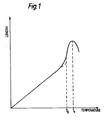
- Fig. 1 of the accompanying drawings shows a graph of the thermal expansion of a glass.
- a glass specimen is heated slowly, typically at 3°C-min ⁇ 1, in a quartz dilatometer.
- One face of the specimen is supported on a silica platform and the movement of the end of a silica push-rod held in contact with the opposite face by a light pressure is detected by a sensitive optical or electromagnetic sensor.
- the length of the specimen is continuously monitored. As the temperature is raised from room temperature the specimen at first expands at a constant rate. At an elevated temperature the expansion coefficient of the glass increases. Eventually the glass 'softens' and the load on the push rod is sufficient for it to start penetrating the glass.
- the temperature corresponding to the intersection of the extrapolated lines of region I and II is known as the glass transition or glass transformation temperature and is shown on the figure as T g .
- the softening point T s is defined as the temperature at which the push rod starts to penetrate the glass.
- the compact During sintering the compact generally shrinks in volume and the porosity or free volume thus decreases. The magnitude of this shrinkage is determined by the sintering temperature and time. Thus, higher sintering temperatures and longer sintering times cause a reduction in porosity.
- the binder is driven off during this sintering process. In some cases we have observed a small increase in free volume. This is thought to be due to outgassing from the binder residues in the compact.
- the compact may be subjected to a prebake, e.g. by heating to a temperature of 100 to 150°C for 1 to 2 hours, to remove both solvent residue and surplus binder. We have found that the compact is still self supporting after this treatment.
- the sintered body is annealed by cooling at a controlled rate to ambient temperature. Typically cooling is effected at a rate of 10 to 100°C per hour, and preferably 20 to 30°C per hour. In general, larger sintered bodies require slower cooling rates.
- any tendency to denitrification may be overcome by the incorporation of one or more further glass modifying oxides in the glass.
- a water soluble sodium/calcium/phosphate glass may be protected against devitrification by the replacement of up to 5 mole % of the calcium oxide with magnesium oxide, zinc oxide or mixtures thereof.
- the proportion of P2O5 may be increased to move the composition further away from the glass-forming boundary on the phase diagram. The resultant change in dissolution rate may be compensated by an appropriate alteration of the sodium oxide content of the glass.
- the porous sintered glass body may be filled with an organic material in liquid form or in solution by capillary action. Under ambient pressure conditions over 90% of the free volume of the porous body can be filled in this way whilst under vacuum a substantially complete fill may be achieved.
- a water soluble glass was prepared having the following molar composition Na2O 44% CaO 6% MgO 5% P2O5 45%
- the dissolution rate in distilled water at 38°C was 7.0 mg/cm2/h.
- Dilatometric measurement of the thermal characteristics of the glass showed Tg to be 304°C and Ts to be 318°C.
- the glass was sieved to provide a powder classified as +45 microns -170 microns and 100g of this powder was treated with a solution of 5g camphor (C10H16O) in 100ml propan-2-ol.
- Sample quantities weighing 4.75g of the treated powder were pressed into discs of 2.5 cm diameter and 0.55 cm in thickness corresponding to a compaction of about 68% of the density of the glass.
- the compacts were heated in air at 150°C for 30 minutes to drive off the solvent and were then sintered at temperatures between 320°C and 337°C for a further 30 minutes.
- the sintered discs were then annealed by cooling at a rate of 25°C/hr.
- the porosity (free volume) of each disc was measured by determining its soak-up of white spirit. The results are summarised in Table 1 below.
- a glass was prepared by fusion of a mixture comparing the following batch weights:-
- T s Dilatometric measurement of the thermal characteristics of the glass showed T s to be 310°C.
- the dissolution rate in distilled water at 38°C was 120 mg/cm2/h.
- a quantity of the glass was crushed and sieved to remove all particles larger than 180 microns.
- the sieved powder was then mixed with 2 weight percent camphor and pressed into discs as before with a pressure of 100 pounds per square inch.
- the discs were baked at a temperature of 150°C for 2 hours and were sintered at a temperature of 348°C for 1 hour. They were then cooled to ambient temperature at a rate of 25°C per hour.
- the average porosity of the discs measured by determining soak-up of white spirit was 6 volume percent.
- the glass was ground and graded to obtain selected particle size ranges, and the sieve fractions mixed in given proportions to provide a material suitable for the preparation of discs.
- the proportions of the sieve fractions are listed in Table II below.
- the glass powders were then pressed into discs by the following process.
- Pressed discs were heated at 150°C for 1 hour followed by a sintering cycle of 330°C for 1 hour and cooled to room temperature at a ramp rate of 25°C/hour. All operations were carried out in air.
- the average porosity of the sintered discs measured by the white spirit method was found to be 32% for each glass.
- porous bodies formed by the process described herein are of particular application in the construction of rumen boluses, but they may of course be used in other applications for the controlled release of active materials.
Landscapes
- Chemical & Material Sciences (AREA)
- Health & Medical Sciences (AREA)
- Engineering & Computer Science (AREA)
- Life Sciences & Earth Sciences (AREA)
- Organic Chemistry (AREA)
- Materials Engineering (AREA)
- Epidemiology (AREA)
- Manufacturing & Machinery (AREA)
- General Health & Medical Sciences (AREA)
- Public Health (AREA)
- Veterinary Medicine (AREA)
- Dispersion Chemistry (AREA)
- Pharmacology & Pharmacy (AREA)
- Animal Behavior & Ethology (AREA)
- Medicinal Chemistry (AREA)
- Inorganic Chemistry (AREA)
- Chemical Kinetics & Catalysis (AREA)
- General Chemical & Material Sciences (AREA)
- Geochemistry & Mineralogy (AREA)
- Glass Compositions (AREA)
Applications Claiming Priority (2)
| Application Number | Priority Date | Filing Date | Title |
|---|---|---|---|
| GB8526124 | 1985-10-23 | ||
| GB08526124A GB2182034A (en) | 1985-10-23 | 1985-10-23 | Sintered glass |
Publications (1)
| Publication Number | Publication Date |
|---|---|
| EP0220928A1 true EP0220928A1 (de) | 1987-05-06 |
Family
ID=10587109
Family Applications (1)
| Application Number | Title | Priority Date | Filing Date |
|---|---|---|---|
| EP86308200A Withdrawn EP0220928A1 (de) | 1985-10-23 | 1986-10-22 | Sinterglas |
Country Status (5)
| Country | Link |
|---|---|
| US (1) | US4849001A (de) |
| EP (1) | EP0220928A1 (de) |
| AU (1) | AU6479186A (de) |
| GB (1) | GB2182034A (de) |
| WO (1) | WO1987002657A1 (de) |
Cited By (2)
| Publication number | Priority date | Publication date | Assignee | Title |
|---|---|---|---|---|
| WO1995019763A1 (en) * | 1994-01-20 | 1995-07-27 | New Zealand Pastorial Agriculture Research Institute Limited | Device for administration of beneficial materials to ruminants |
| WO2012159632A1 (en) * | 2011-05-26 | 2012-11-29 | Vestergaard Frandsen Sa | Sintered glass for release of nutrients or other agents |
Families Citing this family (9)
| Publication number | Priority date | Publication date | Assignee | Title |
|---|---|---|---|---|
| GB2237015A (en) * | 1989-09-06 | 1991-04-24 | Russell * Mcneill Keith | Method of manufacturing glass-ceramic articles |
| JP3310291B2 (ja) * | 1992-08-13 | 2002-08-05 | ザ・トラスティーズ・オブ・ザ・ユニバーシティ・オブ・ペンシルバニア | 骨組織のin vitro合成のための生物活性物質テンプレート |
| US8701441B2 (en) * | 2006-08-21 | 2014-04-22 | 3M Innovative Properties Company | Method of making inorganic, metal oxide spheres using microstructured molds |
| US20110100061A1 (en) * | 2009-10-30 | 2011-05-05 | James Fleming | Formation of microstructured fiber preforms using porous glass deposition |
| US8991211B1 (en) | 2009-11-01 | 2015-03-31 | The Exone Company | Three-dimensional printing glass articles |
| WO2011153369A2 (en) * | 2010-06-02 | 2011-12-08 | University Of Washington Through Its Center For Commercialization | Porous glass articles formed using cold work process |
| DE102016012003A1 (de) | 2016-10-06 | 2018-04-12 | Karlsruher Institut für Technologie | Zusammensetzung und Verfahren zur Herstellung eines Formkörpers aus hochreinem, transparentem Quarzglas mittels additiver Fertigung |
| HUE067496T2 (hu) | 2020-12-08 | 2024-10-28 | Ruminant Biotech Corp Ltd | Az állatoknak szánt anyagok bejuttatására szolgáló eszközök és módszerek fejlesztése |
| GB202106923D0 (en) * | 2021-05-14 | 2021-06-30 | Bimeda Animal Health Ltd | A water soluble or water dispersible bolus article containing bromoform |
Citations (4)
| Publication number | Priority date | Publication date | Assignee | Title |
|---|---|---|---|---|
| DE2020327A1 (de) * | 1970-04-25 | 1971-11-11 | Sklarny Kavalier N P | Verfahren zur Erzeugung poroeser Gegenstaende durch Sintern |
| WO1985001210A1 (en) * | 1983-09-10 | 1985-03-28 | The University Of Strathclyde | Biodegradable implant |
| EP0140538A2 (de) * | 1983-09-15 | 1985-05-08 | Stc Plc | System zur gesteuerten Freisetzung |
| EP0147932A1 (de) * | 1983-11-26 | 1985-07-10 | Stc Plc | Wasserlösliche Glaszusammensetzungen |
Family Cites Families (6)
| Publication number | Priority date | Publication date | Assignee | Title |
|---|---|---|---|---|
| US1654404A (en) * | 1924-12-23 | 1927-12-27 | Stockholders Syndicate | Acid metal phosphate and process of making same |
| US2390354A (en) * | 1942-11-06 | 1945-12-04 | Corning Glass Works | Method of molding glass |
| US2466849A (en) * | 1944-01-03 | 1949-04-12 | Corning Glass Works | Molded glass article |
| US4165226A (en) * | 1977-03-29 | 1979-08-21 | Narumi China Corporation | Process for preparing an element of a dual-in-line ceramic package provided with a layer of sealing glass |
| GB8325061D0 (en) * | 1983-09-20 | 1983-10-19 | Dow Chemical Co | Microcapsules |
| GB2161800B (en) * | 1984-07-18 | 1988-08-10 | Stc Plc | Water soluble compositions for preparing analytical solutions |
-
1985
- 1985-10-23 GB GB08526124A patent/GB2182034A/en not_active Withdrawn
-
1986
- 1986-10-22 AU AU64791/86A patent/AU6479186A/en not_active Abandoned
- 1986-10-22 EP EP86308200A patent/EP0220928A1/de not_active Withdrawn
- 1986-10-22 WO PCT/GB1986/000648 patent/WO1987002657A1/en not_active Ceased
- 1986-10-22 US US07/094,879 patent/US4849001A/en not_active Expired - Fee Related
Patent Citations (4)
| Publication number | Priority date | Publication date | Assignee | Title |
|---|---|---|---|---|
| DE2020327A1 (de) * | 1970-04-25 | 1971-11-11 | Sklarny Kavalier N P | Verfahren zur Erzeugung poroeser Gegenstaende durch Sintern |
| WO1985001210A1 (en) * | 1983-09-10 | 1985-03-28 | The University Of Strathclyde | Biodegradable implant |
| EP0140538A2 (de) * | 1983-09-15 | 1985-05-08 | Stc Plc | System zur gesteuerten Freisetzung |
| EP0147932A1 (de) * | 1983-11-26 | 1985-07-10 | Stc Plc | Wasserlösliche Glaszusammensetzungen |
Cited By (3)
| Publication number | Priority date | Publication date | Assignee | Title |
|---|---|---|---|---|
| WO1995019763A1 (en) * | 1994-01-20 | 1995-07-27 | New Zealand Pastorial Agriculture Research Institute Limited | Device for administration of beneficial materials to ruminants |
| US5720972A (en) * | 1994-01-20 | 1998-02-24 | New Zealand Pastoral Agriculture Research Institute Limited | Device for administration of beneficial materials to ruminants |
| WO2012159632A1 (en) * | 2011-05-26 | 2012-11-29 | Vestergaard Frandsen Sa | Sintered glass for release of nutrients or other agents |
Also Published As
| Publication number | Publication date |
|---|---|
| GB8526124D0 (en) | 1985-11-27 |
| GB2182034A (en) | 1987-05-07 |
| WO1987002657A1 (en) | 1987-05-07 |
| US4849001A (en) | 1989-07-18 |
| AU6479186A (en) | 1987-05-19 |
Similar Documents
| Publication | Publication Date | Title |
|---|---|---|
| US4849001A (en) | Method for making sintered glass | |
| US4652534A (en) | High-strength glass ceramic containing apatite crystals and a large quantity of wollastonite crystals and process for producing same | |
| Terwilliger et al. | Hot‐Pressing Behavior of Si3N4 | |
| US5549123A (en) | Process for producing biocompatible implant material by firing a mixture of a granulated powder and a combustible substance | |
| US4336338A (en) | Hollow microspheres of silica glass and method of manufacture | |
| Wasson | Constraints on chondrule origins | |
| Eastman et al. | Preparation and tests of refractory sulfide crucibles | |
| EP0245812A2 (de) | Verfahren zur Herstellung eines Formkörpers aus Pulvermaterial durch isostatisches Pressen | |
| Arstila et al. | The sintering range of porous bioactive glasses | |
| Meszaros et al. | Three-dimensional printing of a bioactive glass | |
| Jean et al. | Densification kinetics of binary borosilicate glass composite | |
| JP3320645B2 (ja) | セラミックス焼結体の製造方法 | |
| JP2012046358A (ja) | 封着用ガラスタブレット | |
| US3429720A (en) | Materials having high corrosive resistance to attack by fluorine at cryogenic temperatures and method of preparing them | |
| JP2903575B2 (ja) | Pb―Zr―Ti酸化物系ターゲット材の製造方法 | |
| KR101960721B1 (ko) | 방사성 폐기물 소결 고형체의 드럼 포장 방법 | |
| JP2968882B2 (ja) | SiC質焼結体およびその焼成方法 | |
| KR940004775B1 (ko) | 산화물성 핵연료 소결체의 제조방법 | |
| Berger et al. | Syntheses of rapidly resorbable calcium phosphate ceramics with high macro or high microporosity | |
| SU1178547A1 (ru) | Способ изготовлени спеченных пористых изделий из бронзы | |
| RU2003193C1 (ru) | Способ изготовлени катодного узла электровакуумного прибора | |
| JPS6346167A (ja) | 多孔質体の製造方法 | |
| JPH0611663B2 (ja) | 生体用リン酸カルシウム系焼結体 | |
| KR950009990B1 (ko) | 저융점 봉착용 유리조성물 | |
| JPH05156241A (ja) | 蓄冷材の製造方法 |
Legal Events
| Date | Code | Title | Description |
|---|---|---|---|
| PUAI | Public reference made under article 153(3) epc to a published international application that has entered the european phase |
Free format text: ORIGINAL CODE: 0009012 |
|
| AK | Designated contracting states |
Kind code of ref document: A1 Designated state(s): BE CH DE ES FR GB IT LI LU NL SE |
|
| 17P | Request for examination filed |
Effective date: 19870812 |
|
| 17Q | First examination report despatched |
Effective date: 19890413 |
|
| STAA | Information on the status of an ep patent application or granted ep patent |
Free format text: STATUS: THE APPLICATION IS DEEMED TO BE WITHDRAWN |
|
| 18D | Application deemed to be withdrawn |
Effective date: 19890824 |
|
| RIN1 | Information on inventor provided before grant (corrected) |
Inventor name: ARCH, ALFRED JOHN Inventor name: DRAKE, CYRIL FRANCIS Inventor name: TRIPP, MARY |